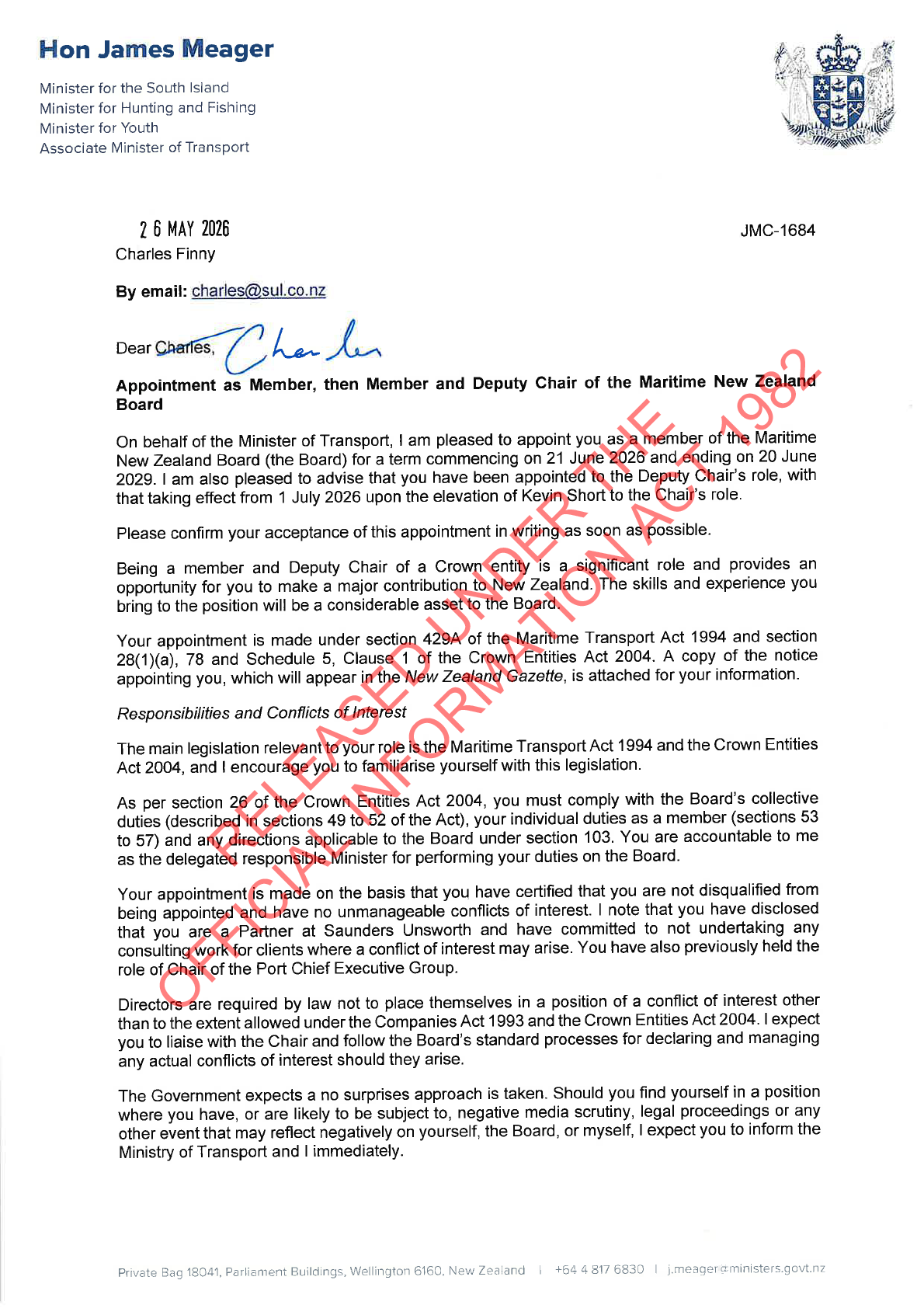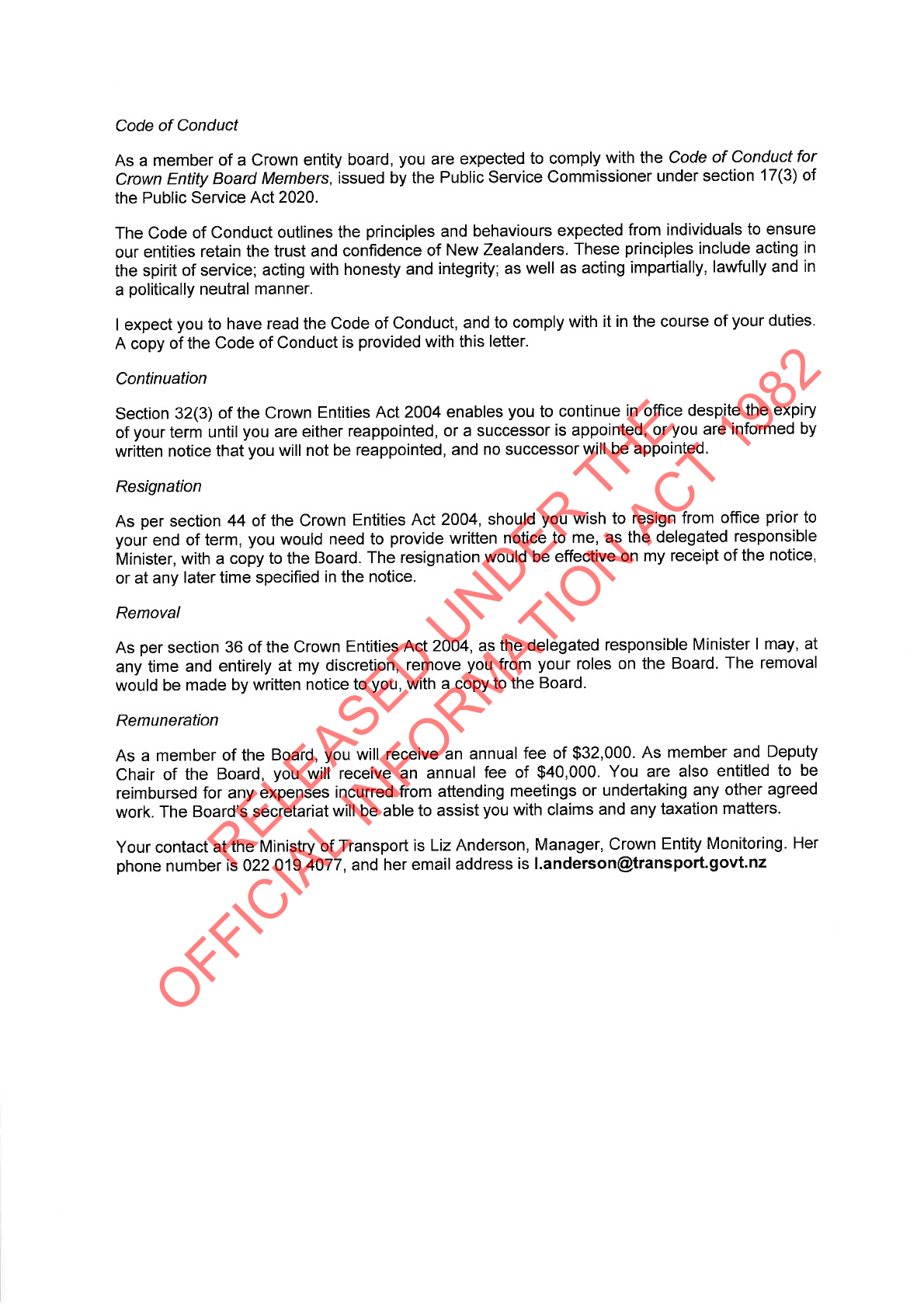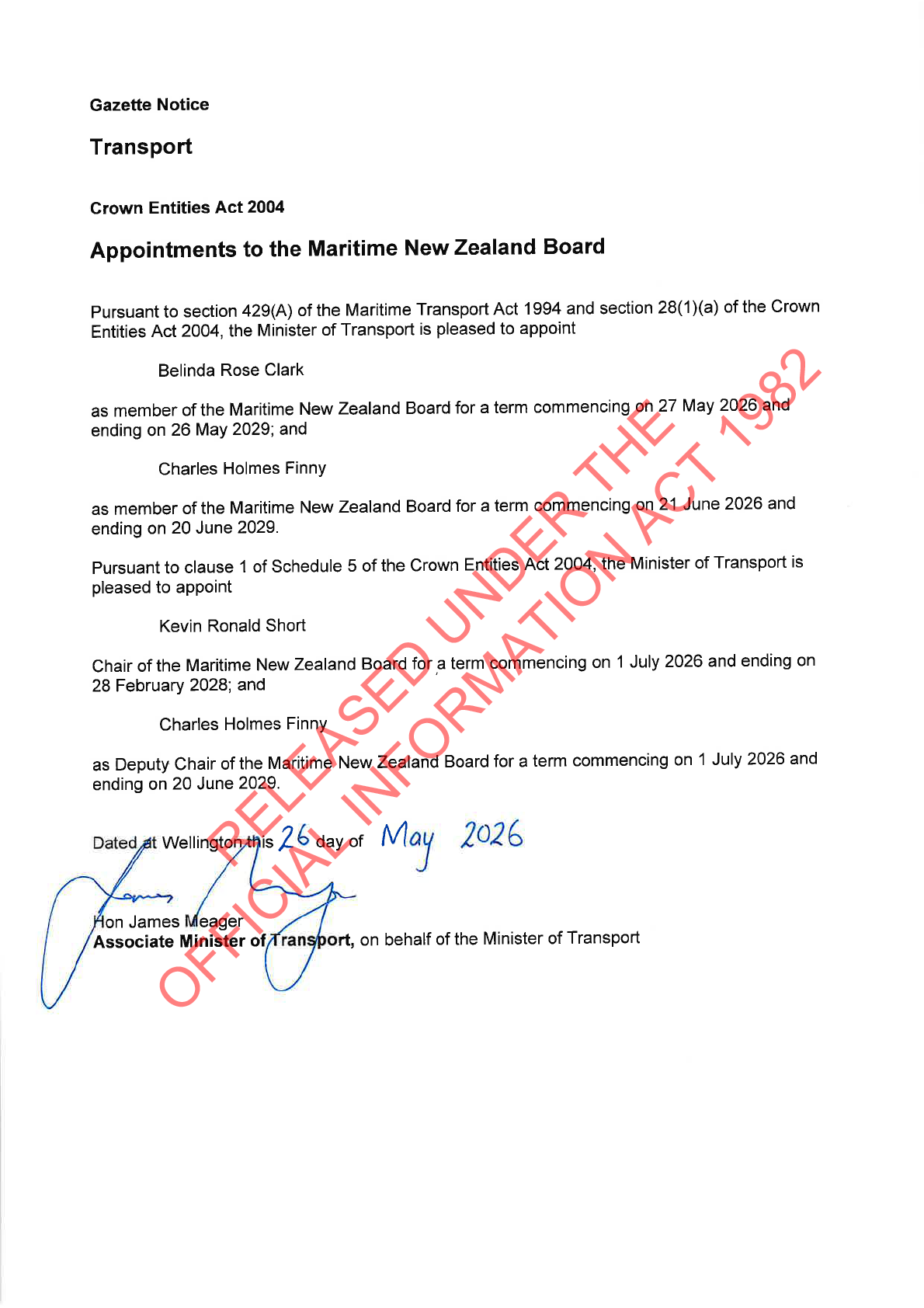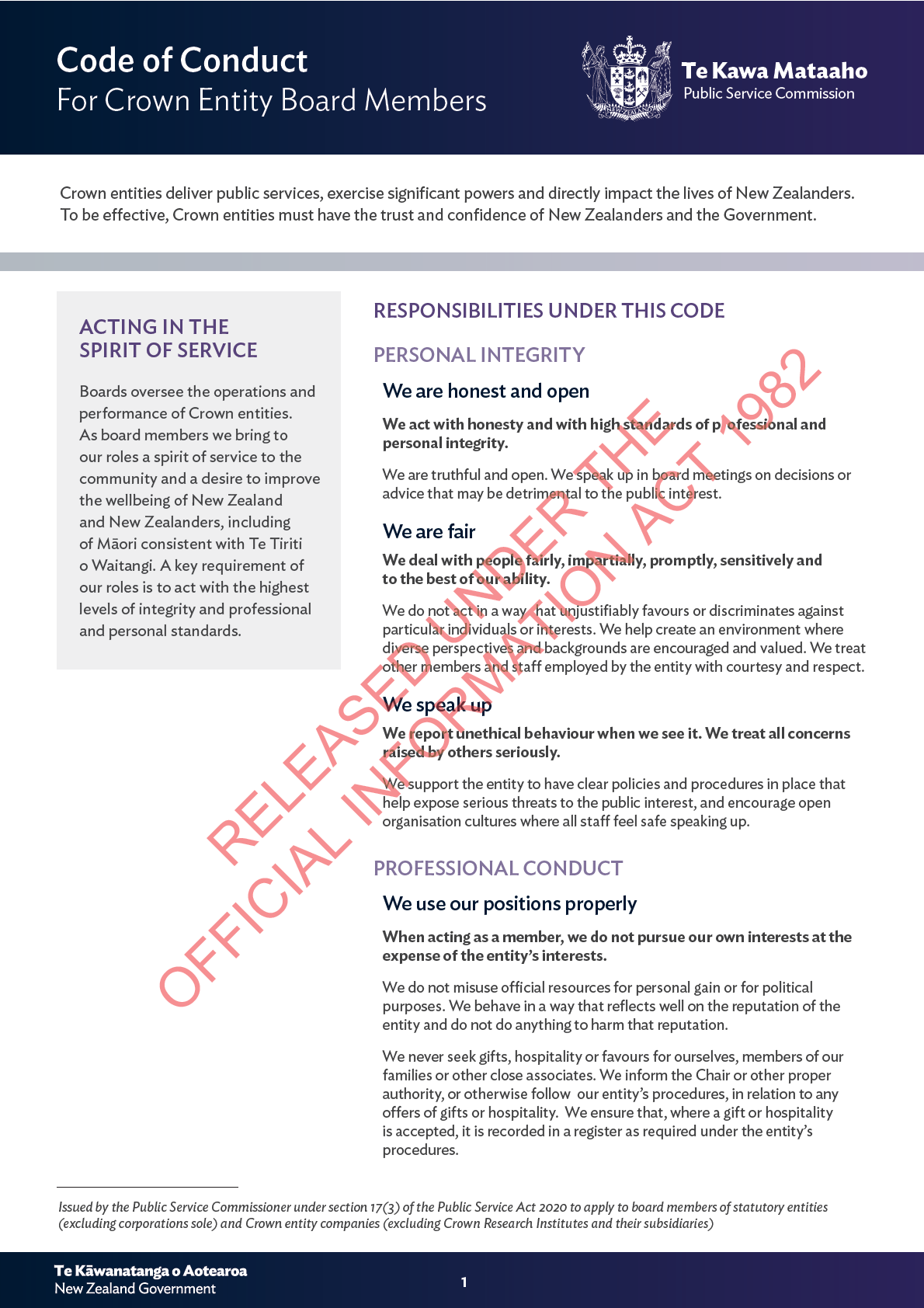
 POSITION DESCRIPTION – MEMBERS, MARITIME NEW ZEALAND
On behalf of the Associate Minister of Transport, the Ministry of Transport is searching for a
candidate to serve as a member on the Maritime New Zealand Board (the Board).
Maritime NZ is a Crown entity, governed by a five-to-seven-member Board appointed by the
Associate Minister of Transport under the Maritime Transport Act 1994 (the Act). Maritime NZ is
the national regulatory, compliance and response agency for the safety, security, and
environmental protection of coastal and inland waterways.
As a type of Crown entity called a Crown agent, Maritime NZ must give effect to Government
policy which relates to its functions and objectives, if directed by the Minister of Transport
However, the Director of Maritime NZ (who is also the Chief Executive) has certain independent
statutory powers under the Act.
Competencies
The Board requires a full range of competencies across its members to be effective. To be
considered, candidates must possess competencies which complement those of existing board
ACT 1982
members. They should also have either no or manageable conflicts of interest.
Under section 429(A) of the Act, the Minister may only appoint “persons who [he/she] considers
will represent the public interest in maritime matters ” In addition, section 30(2) of the Crown
Entities Act 2004 sets out the criteria for disqualification from membership of a Crown entity Board.
Board members are also unable to serve on the Board of the Transport Accident Investigation
Commission while holding office.
Priority Competencies
For this appointment round, the Minister is seeking the following competencies and experience:
• deep experience in governance and leadership, ideally across public and private sectors
INFORMATION
• deep understanding of financial planning, funding mechanisms, cost recovery, value for money
RELEASED UNDER THE
and operating in a fiscally responsible manner within a given funding envelope
• strong experience as a regulator, with an understanding of the fundamentals of regulation,
regulatory frameworks, functions, and powers within a complex regulatory environment.
In addition, all board members should be well-versed in asking the right questions, contributing
independent thought, providing constructive chal enge, and operating within a diverse team who
can distinguish between governance and management. Members should also collectively possess
OFFICIAL
the following competencies:
• financial management and commercial knowledge
• business transformation
• public sector operating requirements across central and/or local government
• stakeholder engagement
• understanding of te Tiriti and te ao Māori
• oversight of audit, risk and assurance functions within large organisations/committees
• maritime sector knowledge
Maritime NZ as a Crown Entity
The work of Maritime NZ is vital to ensure that New Zealand’s commercial and recreational
vessels operate safely and securely, and the impact on the marine environment is managed
effectively. Its responsibilities extend over a vast geographical area and across a large and diverse
range of maritime, environmental, and search and rescue activities. Maritime NZ also represents
New Zealand at the International Maritime Organization.
Maritime NZ helps to develop and maintain the national safety, security, and environmental
protection maritime regulations. It supports and requires operator compliance with those
regulations by licensing and certifying seafarers and commercial operations; educating the
maritime community; auditing operators and service providers; investigating incidents to try to stop
them happening again, ensuring the health and safety on ports, and enforcing the regulations to
hold people to account for their actions.
Background to the Board’s functions
The Board has the following responsibilities:
ACT 1982
• Setting the strategic direction of Maritime NZ and overseeing the delivery of the entity’s
regulatory functions and objectives.
• Ensuring appropriate vision and values for the entity.
• Ensuring that the culture of the organisation is such as to positively support the achievement of
required outcomes.
• Ensuring the organisational structure, capability and capacity can deliver on the direction,
objectives, and functions of the entity.
• Determining organisational policies and business strategies.
• Reviewing and evaluating strategic opportunities, threats, risks, and mitigations, and taking
appropriate action.
INFORMATION
• Employing and supporting the Chief Executive to enable the success of the organisation and
holding the entity’s executive to account for its performance.
RELEASED UNDER THE
• Assessing the entity risk appetite and ensuring there is a robust risk management and
assurance programme.
The Board also supports the Minister by influencing and contributing to the transport sector.
The Crown Entities Act 2004 provides a framework for Crown entity governance and
accountability, including responsibilities of Board members, disclosure of interests, and the roles of
OFFICIAL
Ministers. It is available at http://www.legislation.govt.nz.
Board members are subject to the collective and individual duties of members set out in sections
58 and 59 of the Crown Entities Act. The collective duties of Board members are to ensure the
Board’s functions are performed efficiently, effectively, and consistently in the spirit of the public
service, and in a financially responsible manner.
Further information on how the relationships between Crown entities, Ministers, and departments
work in practice can be found on the Public Service Commission’s website
Page 2 of 3
Time Commitment and Remuneration
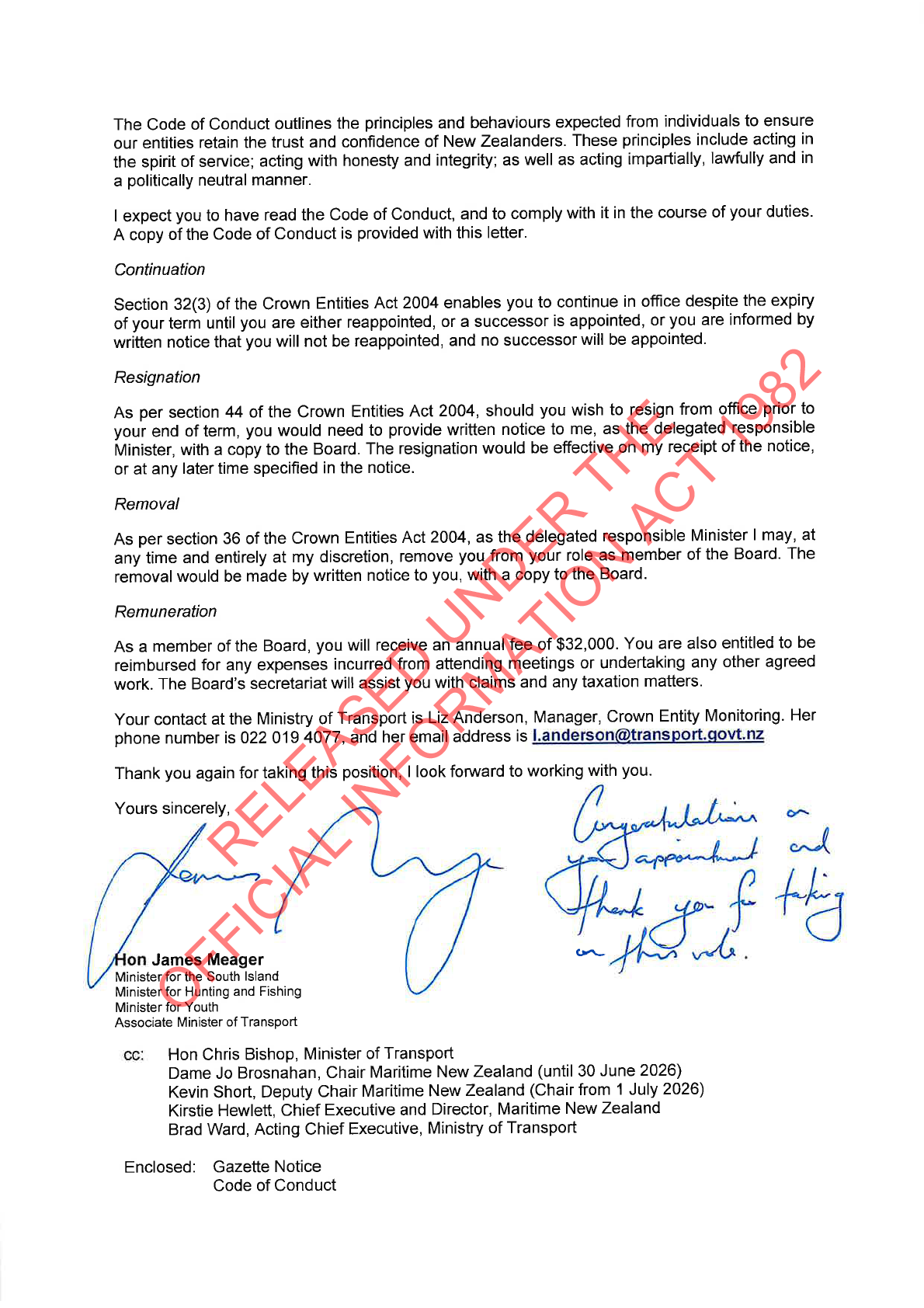
Board members are appointed for a term of up to three years. Meetings are between February and
December and have an alternating schedule of in-person and online meetings. The in-person
meetings usually last for one and a half days. Board members are expected to commit
approximately 30 days a year.
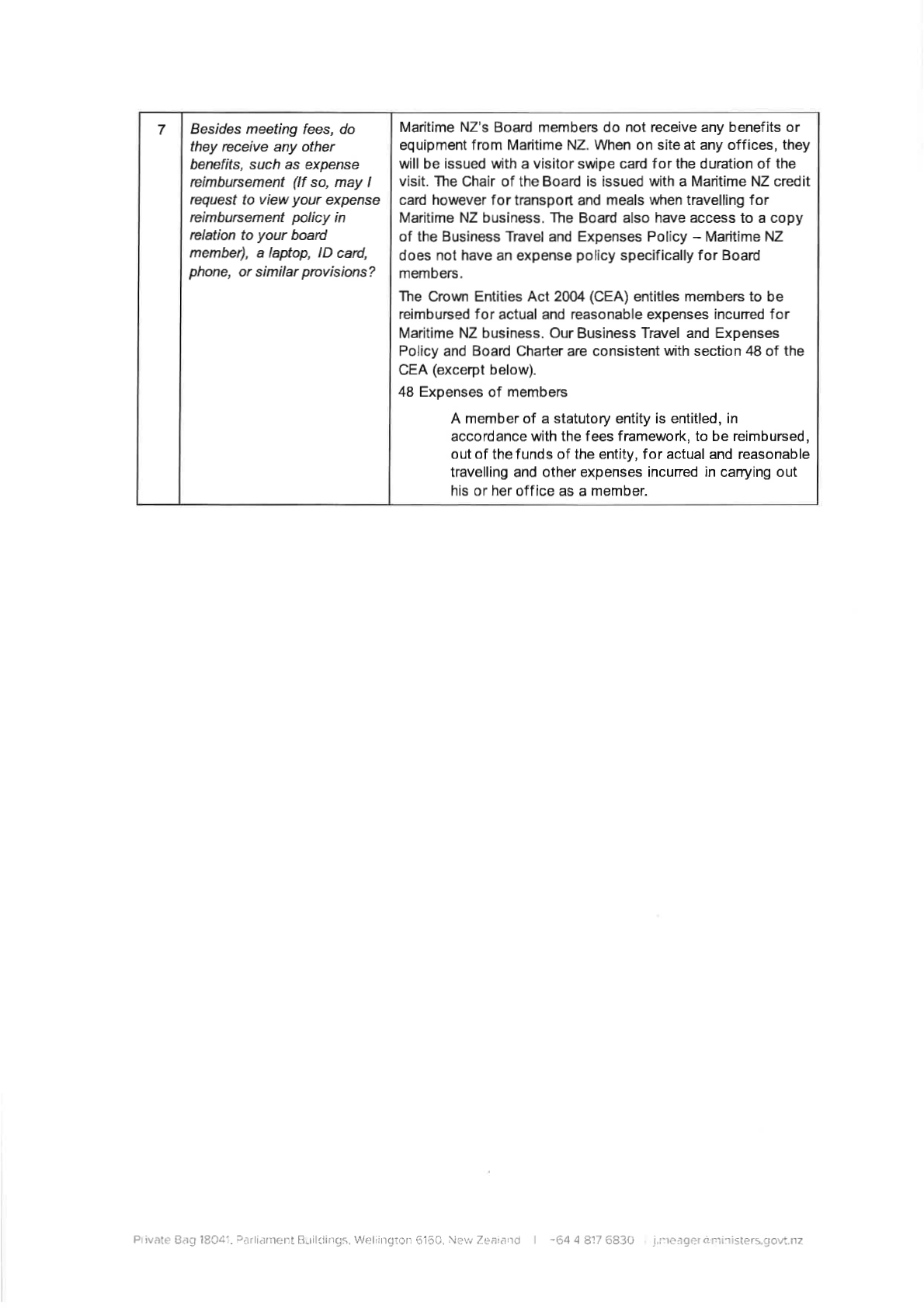
Board fees are set according to criteria in the Cabinet Fees Framework. Maritime NZ is classified
as a Group 3a Level 3 General Governance Board, and accordingly members wil be entitled to an
annual fee of $32,000 effective from 1 January 2026.
Appointment Process
The process for appointing to a Crown entity Board can take up to three months after the closu e of
applications. For this appointment round to the Board, it consists of the following stages:
• Shortlisting of applications/nominations:
• Interviews
• Due diligence and reference checks. Please note that the Ministry may request that the New
Zealand Security Intelligence Service conducts national security screening of the candidate as
part of the appointment process.
ACT 1982
• Recommendation to the Minister:
• Consultation with Ministerial colleagues
• Consideration by the Cabinet Appointments and Honours (APH) Committee and Cabinet.
• Appointment by the Minister.
Expressions of Interest
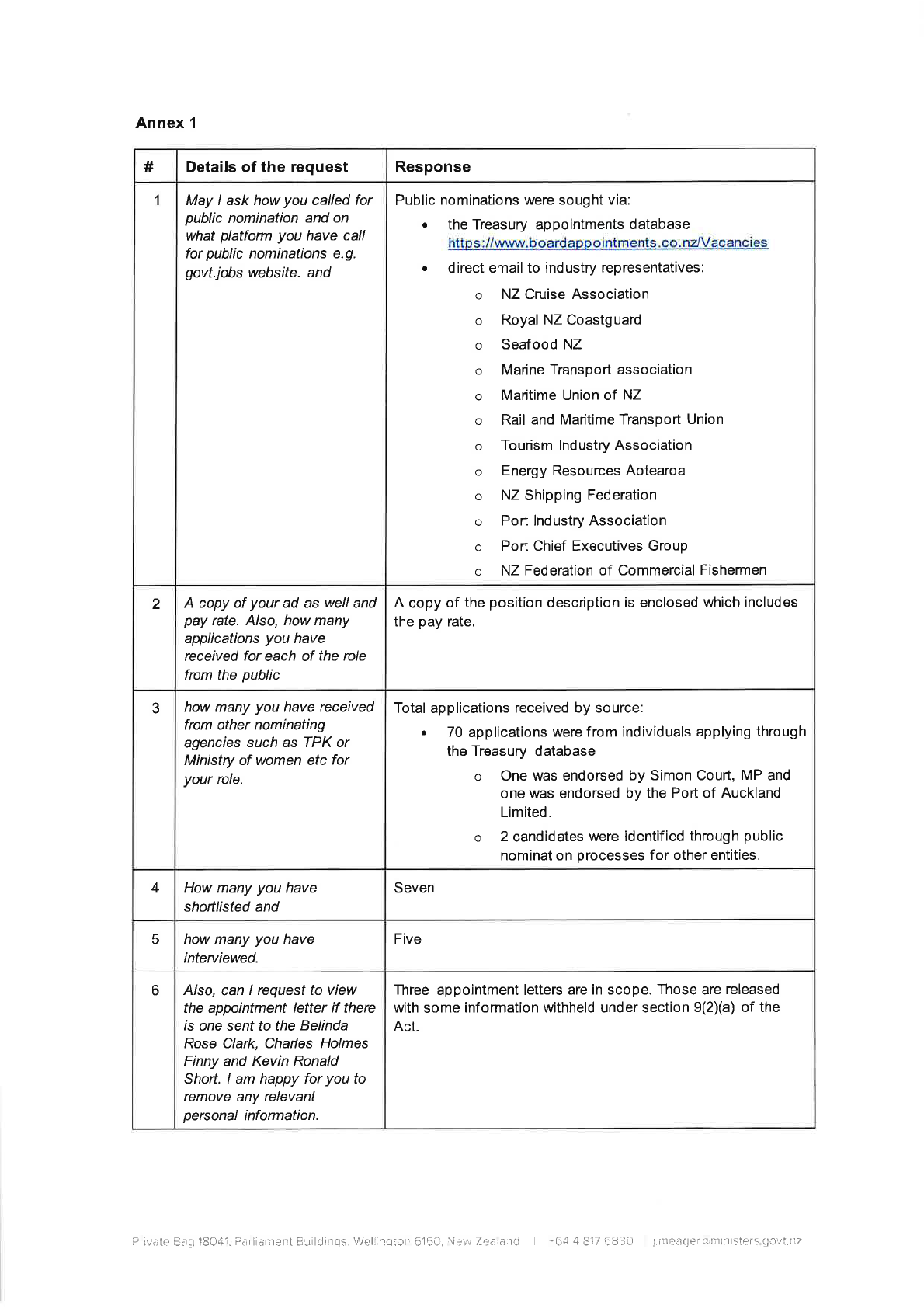
To apply for the role, please apply through the Treasury database:
https://www.boardappointments co.nz/Vacancies. Include a copy of your full Curriculum Vitae by
9.00am on 20 October 2025
If you require further information, please email Jaimee Ramage at [email address].
INFORMATION
Privacy Disclaimer
RELEASED UNDER THE
The Ministry of Transport wil collect and hold information about you as part of the appointments
process. Applicants applying through the Treasury database have agreed to the Terms and
Conditions and Privacy policy of that database as part of their registration.
Should you be appointed, the terms of your appointment wil be recorded on both the Treasury
appointments database as wel as on AppointNet, which is a centralised reporting database
OFFICIAL
administered by the Public Service Commission.
You can find more information at the following links:
• Board Appointments Database Terms and Conditions
• Board Appointments Database Privacy Policy
• The protocol and privacy disclaimer for AppointNet
• The Ministry of Transport’s Privacy and Transparency statement
Page 3 of 3