

30 April 2026
Feebee Newlands
By E-mail Only:
[FYI request #34255 email]
Dear Feebee,
OFFICIAL INFORMATION REQUEST: GOODMAN LEDGER PARK WASTEWATER PUMP STATION
We refer to your official information request pertaining to the air quality, odour and emissions
associated with the wastewater pump station servicing the Goodman Ledger Park area in
Motueka which was formal y transferred to us by the Environmental Protection Authority on
31 March 2026. Our response is set out
below:
1. Legal standards and limits
a. What are the legal standards, limits, or guidelines for odour emissions applicable to
this facility and surrounding area?
b. Are there specific limits for gases such as hydrogen sulfide (H₂S)?
c. How are these limits applied in sensitive environments such as playgrounds and
community spaces?
under LGOIMA
In response to part 1 a-c. New Zealand does not have a National Environmental Standard
for H₂S. Instead, councils rely on the
Ministry for the Environment (MfE) Ambient air
quality guidelines, which are odour based, not health based.
MfE Ambient Air Quality Guideline for H₂S
1-hour average: 5 ppb
(≈ 7 µg/m³)
This guideline is explicitly based on preventing nuisance odour, not toxicity. There is no
single enforceable public ambient limit.
Released
Health effects of H2S are effectivity control ed by WorkSafe and the 8-hour average is
5ppm or about 7mg/m3. This is 1,000 times higher than the ambient guideline.
Sensitive receivers, we aim to manage concentrations to avoid an odour effect.
Where there has been justifiable complaints, odour control is installed. It should be
noted that the Ledger-Goodman pump station has had odour control for some time. An
odour filter was instal ed at the Ledger-Goodman pump station in 2019.
2. Definition & Assessment Of Odour
a. How is “offensive or objectionable odour” defined under the Resource
Management Act 1991 and relevant regional air quality rules?
b. What criteria or assessment methods are used to determine when odour becomes
unacceptable or in breach?
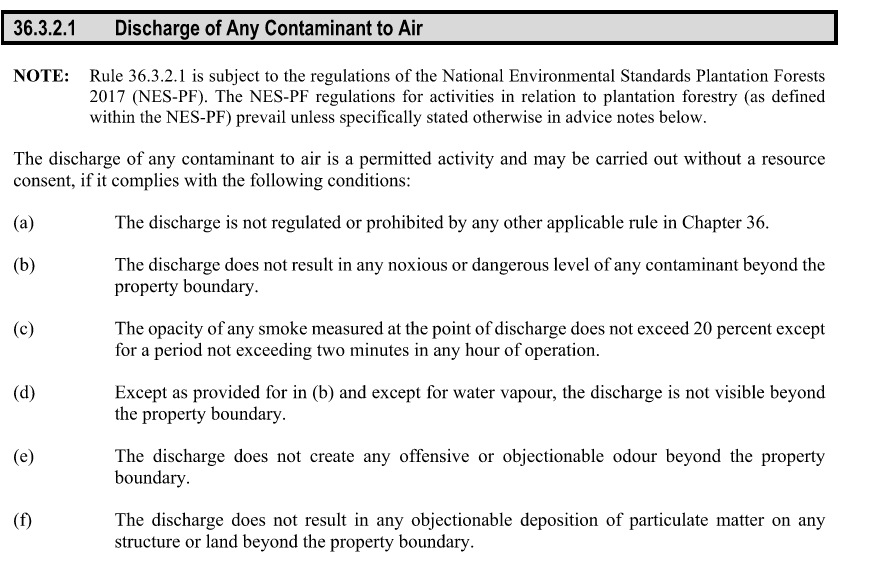
In response to part 2 a-b. The key rule in th
e Tasman Resource Management Plan (TRMP)
is 36.3.2.1:
LGOIMA
under
There is a useful odour guidance document published by MfE titled
‘Good Practice Guide
for Odour’. This is the second version of the guide, which was updated in 2016
. This
document provides a good analysis of how odour is managed and examines "offensive or
objectionable odour"
Released
3. Resource Consent
a. Please provide a full copy of the current resource consent(s) for the wastewater
pump station/plant servicing the Goodman Ledger Park area.
b. What consent conditions relate specifical y to:
i. Odour
ii. Air emissions
iii. Community impact and amenity
In response to part 3 a-b. The wastewater pump station/plant servicing the Goodman
Ledger Park area does not hold a resource consent as it operates under the permitted
activity rule 36.3.2.1, therefore a resource consent is not required.
4. Monitoring & Measurement
a. What monitoring systems are currently in place at or near this site (e.g. fixed
sensors, portable monitoring, field officers, or complaint-based logging)
b. Where are these monitoring devices located?
c. How frequently is monitoring conducted?
d. Are gases such as hydrogen sulphide measured directly? If so, how and how often?
5. Data & Compliance
LGOIMA
a. Please provide al available air quality and odour monitoring data for the past 2–5
years.
b. How many times have:
i. Any legal limits (if defined) been exceeded?
ii. Conditions been assessed as “offensive or objectionable”?
6. Compliance Status
a. Based on the above data, is the facility currently considered to be in compliance
with:
under
iii. Resource consent conditions
iv. Regional air quality rules
v. The Resource Management Act 1991
b. If not, please provide details of any identified breaches and actions taken.
In response to part 4–6, the Council does not operate any fixed or portable odour or air
quality monitoring equipment at or near this site, and no direct monitoring of gases is
undertaken. As a result, no routine monitoring is conducted, and no air quality or odour
monitoring data is held for the past 2–5 years. Odour effects are assessed reactively
through service requests and officer investigation.
There is a hydrogen sulphide sensor located on the filter unit, which allows us to
Released
intermittently check to determine if the filter media is due for replacement. This data is
not recorded.
The fol owing work has been undertaken at the Ledger-Goodman Pumpstation this year:
• A stilling tube was installed and the level sensor was relocated into it
• level setpoints were adjusted to allow capture of the odours from the upstream pipe.
• Replaced the activated carbon media in the odour scrubber.
• Replaced perished rubber seals around wetwel lids.
• Replaced plastic sealing rings in manholes in the road.
If you are unsatisfied with the Council’s response, you have the right to seek an investigation
and review by the Ombudsman. Information about how to make a complaint is available at
www.ombudsman.parliament.nz or freephone 0800 802 602.
Yours sincerely
Legal Services Officer
LGOIMA
under
Released
