

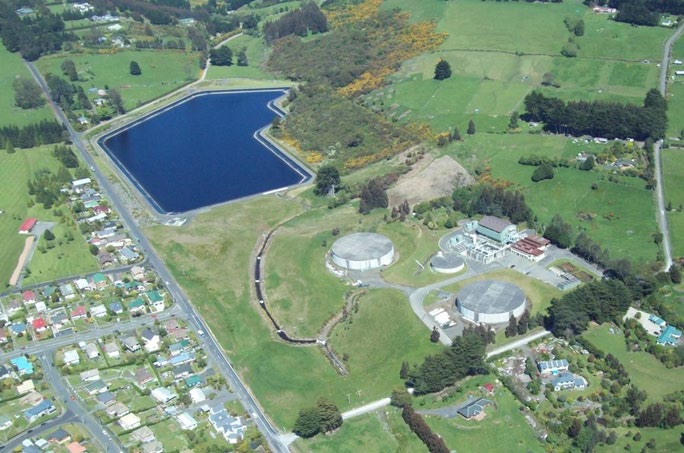
 Mount Grand
WATER TREATMENT
Emergency
Response Plan
DUNEDIN CITY COUNCIL
3 WATERS
Version: 9.02
DUNEDIN CITY COUNCIL 3 WATERS

Dunedin City Council 3 Waters
General
Water Treatment
Version 9
Mount Gra nd Emergency Response Plan
AMENDMENTS
Section
Page
DIF
Current Version & Date Authorised b y
2
10 & 11 24/01
9.01
Michael Walker
3
12 & 13 24/11
9.02
Jonathan
Barnsley
RE-ISSUES
Section Page
Current Version No.
Date
Revised By
All
All
Eight
November 2018
D.Crawford
Eight
February 2021
All
All
9.0
September 2023
K.Herrick
Page | 1
Version Nine: December 2024
link to page 5 link to page 5 link to page 5 link to page 5 link to page 5 link to page 6 link to page 6 link to page 6 link to page 7 link to page 7 link to page 7 link to page 8 link to page 8 link to page 8 link to page 9 link to page 9 link to page 10 link to page 10 link to page 11 link to page 12 link to page 12 link to page 12 link to page 12

Dunedin City Council 3 Waters
General
Water Treatment
Version 9
Mount Gra nd Emergency Response Plan
TABLE OF CONTENTS
1 General ......................................................................................................... 4
1.1
Introduction ............................................................................................. 4
1.2
Site Evacuation ......................................................................................... 4
1.2.1
Evacuation Procedure .......................................................................... 4
1.2.2
Priorities ............................................................................................ 4
1.3
Communication ......................................................................................... 5
1.3.1
Communication Strategy/Procedure ...................................................... 5
1.3.2
Contact Information ............................................................................ 5
1.4
Documentation ......................................................................................... 6
1.4.1
Safety Data Sheets ............................................................................. 6
1.4.2
Chemical Inventory ............................................................................. 6
1.4.3
Chlorine Tracking ................................................................................ 7
1.4.4
Site Plan ............................................................................................ 7
1.5
Incident Classifications .............................................................................. 7
1.6
Audit/Testing ............................................................................................ 8
1.7
Definitions ............................................................................................... 8
2 Chlorine ........................................................................................................ 9
2.1
Response Procedure .................................................................................. 9
2.2
First Aid Procedures ................................................................................ 10
2.3
Training Requirements ............................................................................. 11
2.3.1
Operators ........................................................................................ 11
2.4
Extra Information.................................................................................... 11
2.4.1
Parking ............................................................................................ 11
Page | 2
Version Nine: December 2024
link to page 12 link to page 13 link to page 13 link to page 13 link to page 13 link to page 14 link to page 14 link to page 14 link to page 15 link to page 15 link to page 15 link to page 15 link to page 16 link to page 17 link to page 17 link to page 17 link to page 18 link to page 18 link to page 19 link to page 19 link to page 19 link to page 20

Dunedin City Council 3 Waters
General
Water Treatment
Version 9
Mount Gra nd Emergency Response Plan
2.4.2
Safety Equipment Locations ...............................................................
11
3 Fire ............................................................................................................. 12
3.1
Procedure .............................................................................................. 12
3.1.1
Minor Incident .................................................................................. 12
3.1.2
Major Incident .................................................................................. 12
3.2
First Aid ................................................................................................. 13
3.3
Training ................................................................................................. 13
3.4
Extra Information.................................................................................... 13
4 Earthquake ................................................................................................. 14
4.1
Procedure .............................................................................................. 14
4.2
First Aid ................................................................................................. 14
4.3
Training ................................................................................................. 14
4.4
Extra Information.................................................................................... 15
5 Hazardous Substances ................................................................................ 16
5.1
Procedure .............................................................................................. 16
5.1.1
Minor Incident .................................................................................. 16
5.1.2
Major Incident in a bund .................................................................... 17
5.1.3
Major leak in an un-bunded area ........................................................ 17
5.2
First Aid ................................................................................................. 18
5.3
Training ................................................................................................. 18
5.4
Extra Notes ............................................................................................ 18
6 Appendix .................................................................................................... 19
Page | 3
Version Nine: December 2024

Dunedin City Council 3 Waters
General
Water Trea
tment
Version 9
Mount Gra nd Emergency Response Plan
1 GENERAL
1.1 INTRODUCTION
The purpose of this document is to provide effective emergency response plans for all
practicably foreseeable emergency events that could occur at Mount Grand Water
Treatment Plant.
1.2 SITE EVACUATION
1.2.1 EVACUATION PROCEDURE
#
Step
Action
1
Exit the building
Calmly exit the building. Ensure the Staff Indicator Board
and tablet has been removed from the wall and taken
outside. It is the responsibility of anyone who is passing
the board or tablet to take it with them.
2
Proceed to
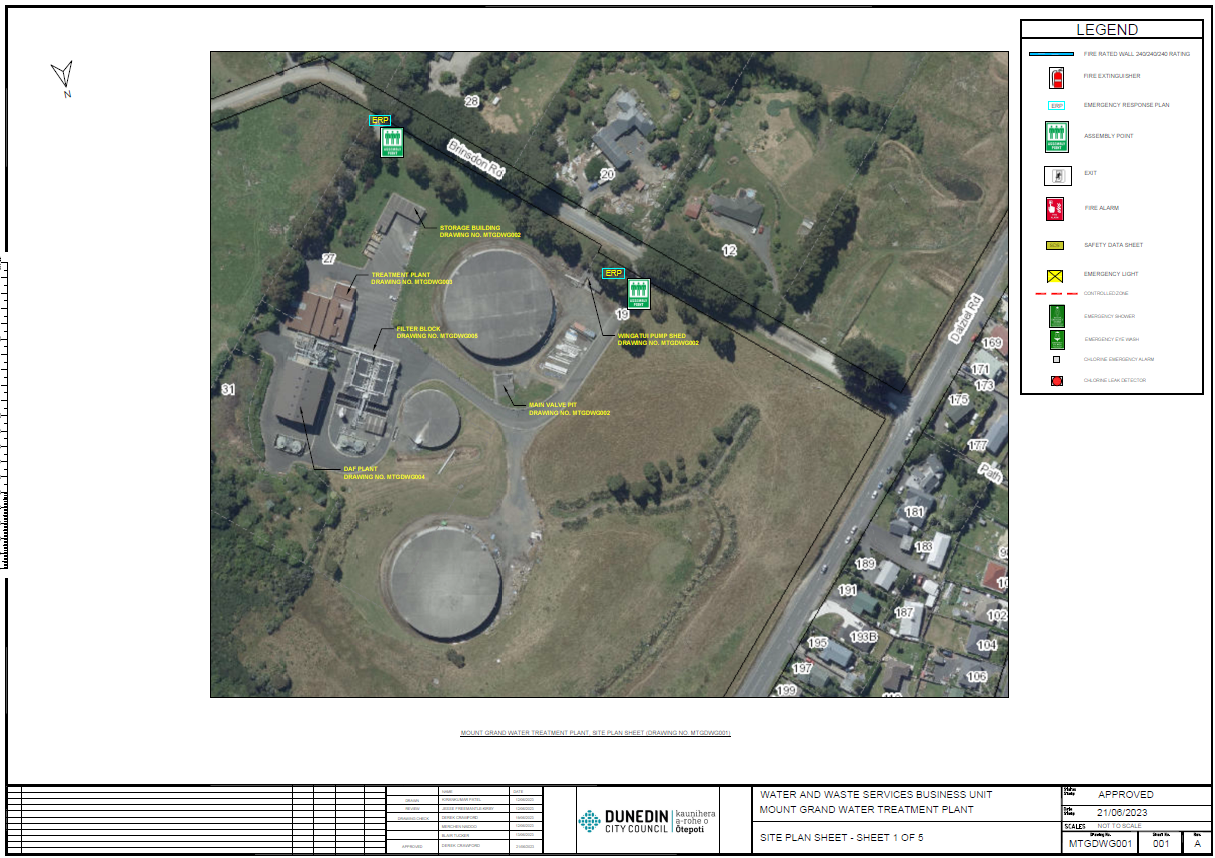
Check the wind sock if applicable. Proceed to assembly
assembly point
point 1 if able. If assembly point 1 is unavailable or the
windsock dictates assembly point 1 is unsafe, proceed to
assembly point 2. Staff indicator board can be used to
open the gates.
3
When everyone is When everyone has gathered at the assembly point, take
gathered
a roll call using the staff indicator board. Call emergency
services (111).
1.2.2 PRIORITIES
1.
Safety of the staff. The protection of staff is always the first priority as they
have the skill and experience to control the situation.
2.
Safety of the general public. Having protected staff, the second priority is to
ensure that the public or the environment is not placed at risk.
3.
Rectify the situation.
Page | 4
Version Nine: December 2024

Dunedin City Council 3 Waters
General
Water Trea
tment
Version 9
Mount Gra nd Emergency Response Plan
1.3 COMMUNICATION
1.3.1 COMMUNICATION STRATEGY/PROCEDURE
All DCC staff have work cell phones on their person at all times. In the event of a chlorine
leak, all water treatment technicians and the team leader will be notified via automatic
text message.
If a technician is off site and gets a text relating to an emergency,
they are to ring the site or someone at the site to offer assistance/ensure people
are safe.
Contact information is provided below for all necessary people/organisations that may
need to be contacting in the event of an emergency.
1.3.2 CONTACT INFORMATION
Contact Name
Contact Number
Blair Tucker
027 582 2455
Danielle Tennant
027 5822 458
Jonathan Barnsley
021 658 839
Thomas Rottler
021 085 11796
Graeme Turnbull
027 582 2453
Michael Walker
021 346 393
Yolande Steenkampf
021 191 9812
Chrisanna Hancock
021 893 658
Olivia Glover
021 524 397
Lily Dorking
027 582 2457
Gavin Cooper
021 344 509
Page | 5
Version Nine: December 2024

Dunedin City Council 3 Waters
General
Water Trea
tment
Version 9
Mount Gra nd Emergency Response Plan
In the event of a Major Site Incident or a Public Hazard notify the:
Team Leader (Derek Crawford)
021 708 614
Plant Operations Manager (John McAndrew)
021 568 481
DCC 3 Waters Group Manager (David Ward)
03 474 3873
Chemtrex Limited (Mike Gilbert)
021 920 846
ChemCall
0800 243 662
Fire and Emergency New Zealand
111
FENZ National Headquarters (False Alarms)
04 496 3600
1.4 DOCUMENTATION
1.4.1 SAFETY DATA SHEETS
Safety data sheets provide important information about your hazardous substances. It is
mandatory to have a current safety data sheet for each of the hazardous substances in
your workplace regardless of the quantity you hold (WorkSafe, 2017). All Safety Data
Sheets are available in three locations at all times: the location of the substance, the front
gate/assembly point and in the Water Treatment Quality Folder.
1.4.2 CHEMICAL INVENTORY
The chemical inventory is a register of all hazardous substances at the plant. Details will
include:
• Location
• Container Size
• Maximum amount stored on site at one time
Page | 6
Version Nine: December 2024

Dunedin City Council 3 Waters
General
Water Trea
tment
Version 9
Mount Gra nd Emergency Response Plan
• Hazardous substance codes
The inventory can be found at the front entrance in case of an emergency and emergency
responders need to know what is on site. There is also a copy located in the Water
Treatment Quality System.
1.4.3 CHLORINE TRACKING
Chlorine is a tracked substance used by Water Treatment. The chlorine tracking sheets
are found in the Water Treatment Quality System.
1.4.4 SITE PLAN
A detailed Site Plan with all locations and emergency information relevant to this site can
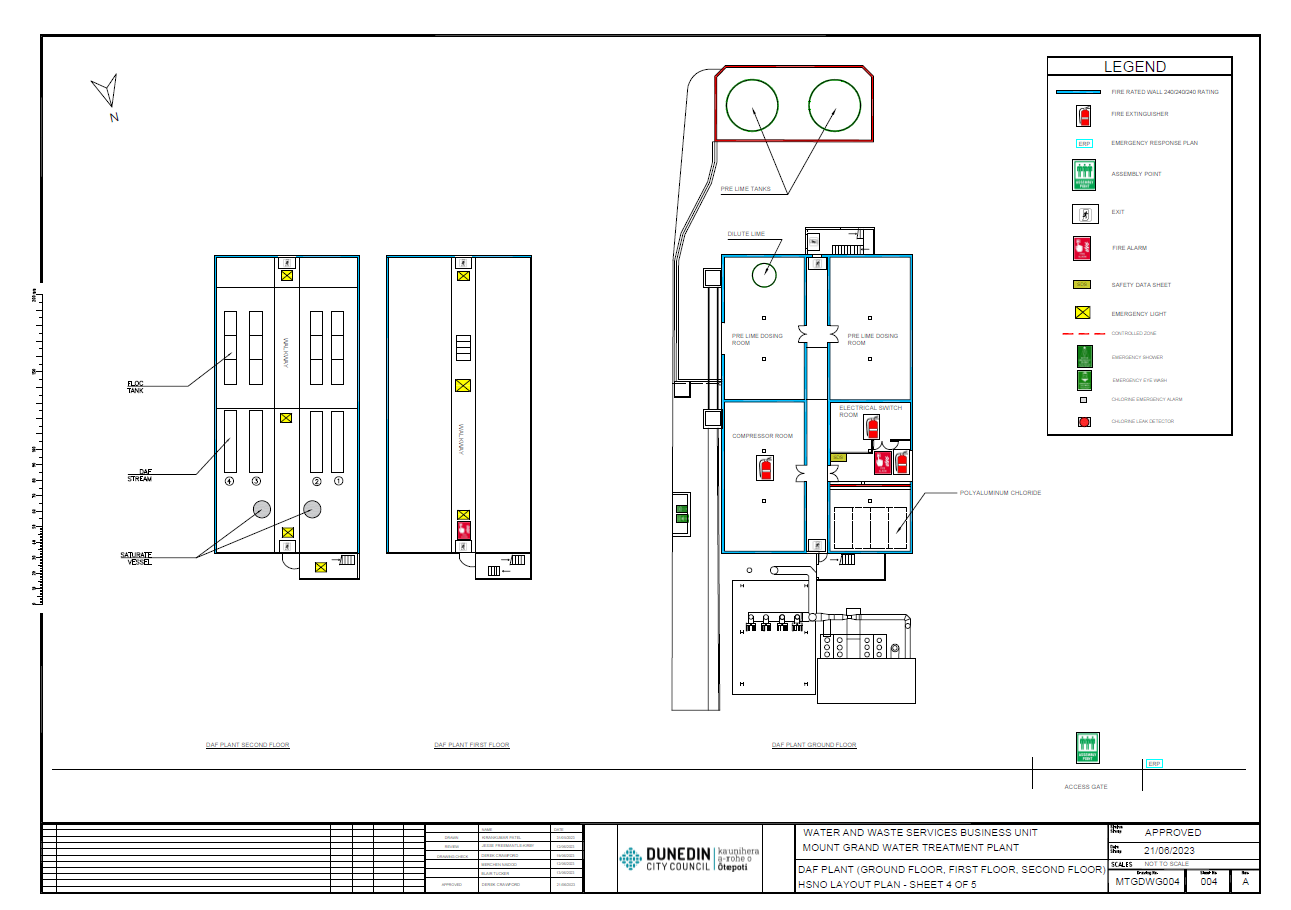
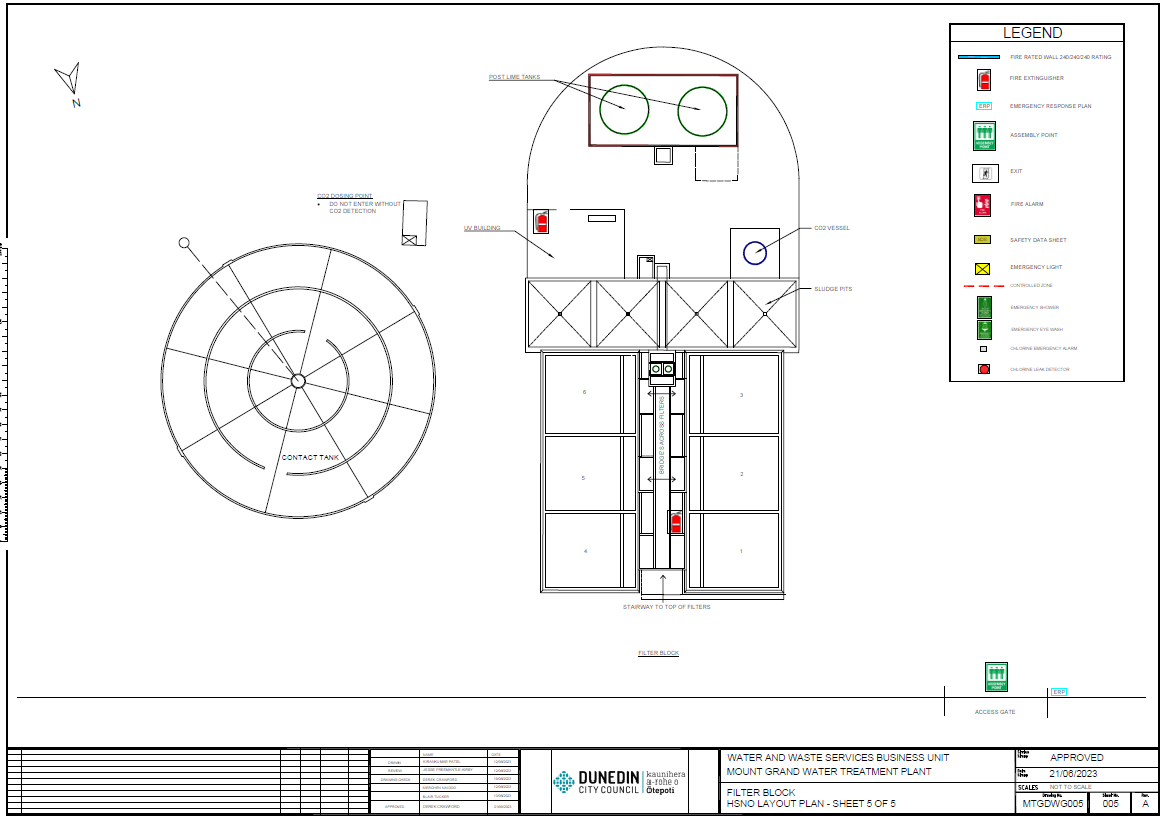
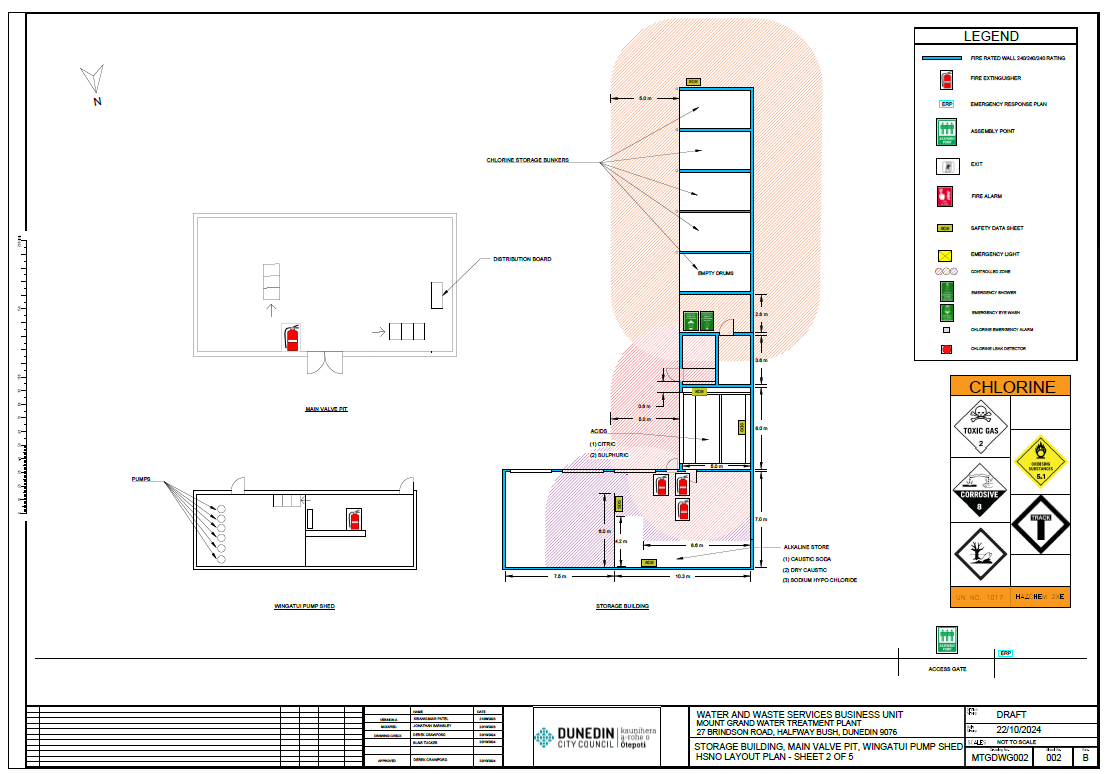
be found in the appendix of this document (Appendix 1-5).
1.5 INCIDENT CLASSIFICATIONS
Classification
Definition
False Alarm
Alarm has sounded. No leak found.
Minor Incident
This must be an incident in which WT Technicians are able to
gain immediate control.
Major Incident
A leak for a limited period in which control can be established.
E.g. a jammed valve. Consider calling FENZ for assistance.
Public Hazard
Above criteria can apply to a public hazard, however, will likely
be an uncontrollable leak involving the rupture or serious
damage to a chlorine drum/cylinder. The nature of this
emergency will call for a response from DCC 3 Waters,
Emergency Services and the Hazardous Substances team.
Page | 7
Version Nine: December 2024

Dunedin City Council 3 Waters
General
Water Trea
tment
Version 9
Mount Gra nd Emergency Response Plan
1.6 AUDIT/TESTING
All procedures within this document are tested, audited and updated on an annual basis
or within 3 months of a new staff joining or when a procedure has been changed.
Records of testing is kept in the Water Treatment Quality System for at least 5 years.
1.7 DEFINITIONS
FENZ – Fire and emergency New Zealand’
Enforcement Officer - Any constable, or an employee, volunteer, or contractor of Fire
and Emergency New Zealand exercising functions under the Fire and Emergency New
Zealand Act 2017
Assembly Point – A designated safe location (I.e. safe from potential chlorine gas
exposure). The evacuation point for Mount Grand Water Treatment Plant are the main
entrance and to the plant and the truck entrance (Indicated by signage).
Competent Technician – Competent technicians in this scenario is referring to those
technicians who have received training in chlorine emergency response planning and hold
their chemical handling certificate.
WT Technician – Water Treatment Technician
SCBA – Self-Contained Breathing Apparatus
SDS – Safety Data Sheet
Page | 8
Version Nine: December 2024

Dunedin City Council 3 Waters
Chlorine
Water Trea
tment
Version 9
Mount Gra nd Emergency Response Plan
2 CHLORINE
2.1 RESPONSE PROCEDURE
#
Step
Action
1
Evacuate the
In the event of a chlorine leak all personnel should move
premises
to the appropriate designated evacuation area taking into
account of the wind direction (check windsock). As you are
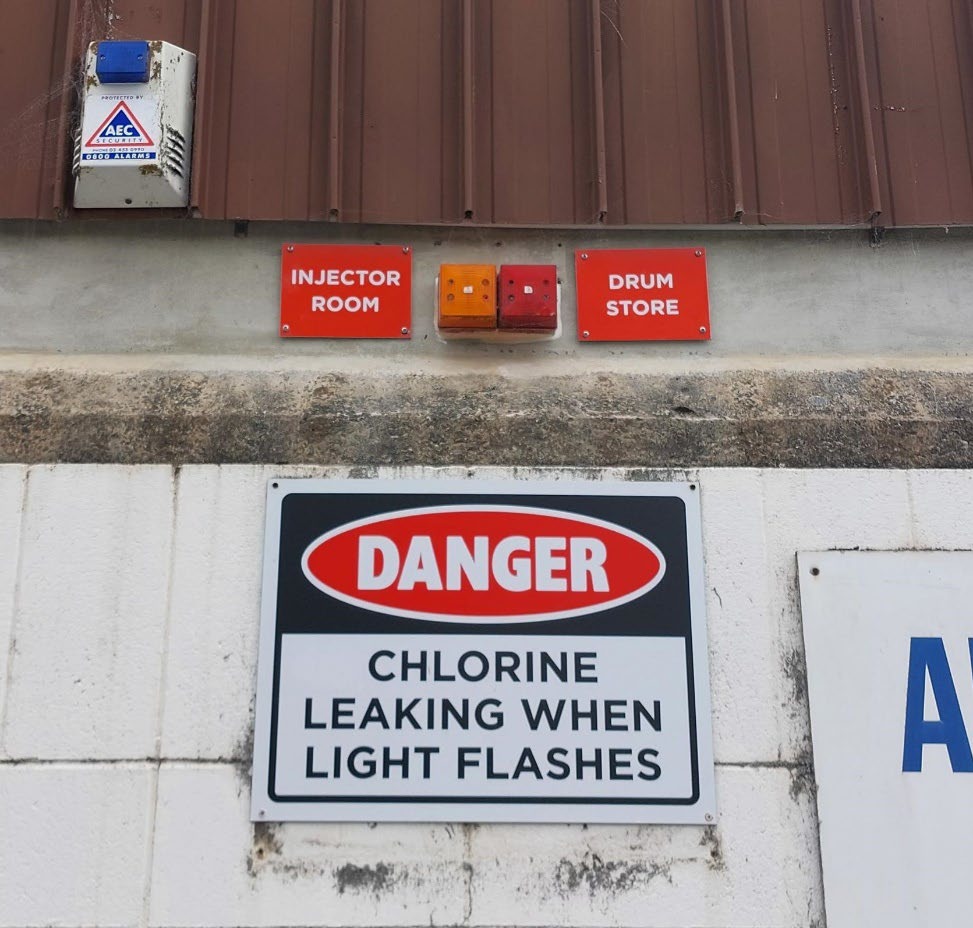
walking past the visitors car park, take note of where the
leak is happening by looking at the flashing light indicator
on the wall outside (See appendix 6).
2
Assess the leak
The first thing to do is for both technicians/supervisors to
don the SCBA/protective clothing (to be done at the
assembly point) and determine the source of the leak and
develop plan to address it. Use the buddy system whereby
one technician/supervisor assesses the leak while the other
technician/supervisor stays at a safe distance. If the
primary technician/supervisor gets into difficulty while
assessing the leak the second technician/supervisor can
assist them to fresh air upwind from the leak. Use portable
gas detector or ammonia puffer bottle to assess leak.
2.1 If incident is out of If WT technicians on standby are called to an out of hours
hours
leak, the first technician to arrive will park at a safe
distance and prepare their SCBA whilst waiting for the
second technician. On arrival of the second technician,
both will immediately put on their SCBA and assess the
leak together.
3.1
If false alarm
Rectify situation, fill out Chlorine Leak Form
3.2
If minor incident
Rectify situation using capping kit (If this cannot be done,
refer to the major incident/public hazard response), notify
plant supervisor
Page | 9
Version Nine: December 2024

Dunedin City Council 3 Waters
Chlorine
Water Trea
tment
Version 9
Mount Gra nd Emergency Response Plan
3.3 If major incident or Call FENZ (111), notify WT team leader, Water treatment
public Hazard
supervisor and plant operations manager. If needed call
+
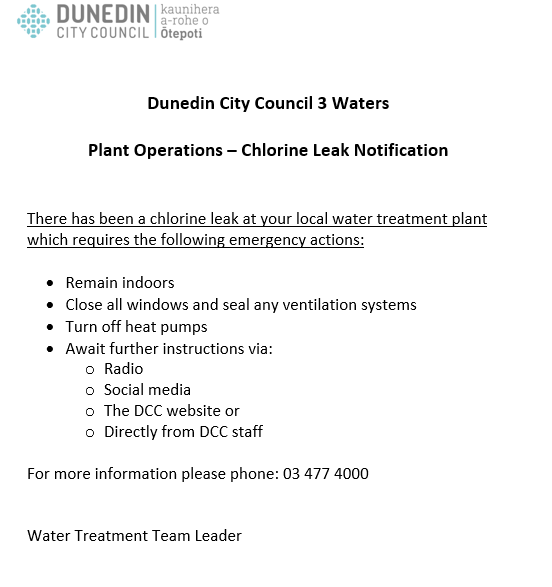
R/T DCC 3 Waters for extra support. The chlorine lea k
notice (Appendix 8) should be used to notify residents
within immediate vicinity of the chlorine leak. When any
emergency responder arrives on site, they are able to take
charge of the operation as an Enforcement Officer. If more
assistance is needed, call Chemcall (0800 243 622) or Mike
Gilbert (021 920 846) for further assistance.
4
After incident
After the incident has been rectified, ensure that all alarms
have been reset and verified to be working properly again.
The same is to be done for the chlorine gas detector.
Ensure that the chlorine leak form has been filled out.
2.2 FIRST AID PROCEDURES
If chlorine comes into contact with skin
Immediately remove contaminated
clothing and rinse victim under a safety
shower for 15 minutes.
If chlorine gets into eyes
Hold eyelids apart and flush eyes for at
least 15 minutes.
If chlorine is inhaled
Remove victim from area if you can do so
safely. Remove contaminated clothing and
allow the victim to assume a comfortable
position.
Note: Always contact a medical professional immediately if first aid is required.
Note: If more information is required, refer to Chlorine SDS.
Page | 10
Version Nine: December 2024

Dunedin City Council 3 Waters
Chlorine
Water Trea
tment
Version 9
Mount Gra nd Emergency Response Plan
2.3 TRAINING REQUIREMENTS
2.3.1 OPERATORS
To perform all procedures in this plan effectively, all operators are required to have
completed the following training:
• Confined Spaces + Gas detection
• Breathing Apparatus Training
• Management and handling of Hazardous Substances
• First Aid
• Certified Handler Training
• Chlorine Training
2.4 EXTRA INFORMATION
2.4.1 CHLORINE LEAK NOTICE
In the event of a chlorine leak, especially a leak which is considered major or potentially
a public hazard, the chlorine leak notice (Appendix 8) should be used to notify residents
of the presence of a chlorine leak.
2.4.2 PARKING
Ensure vehicles are parked on opposite sides of the treatment plant and outside of a 50m
radius of at least one chlorine storage area. This ensures that wherever a leak occurs,
there will always be a vehicle available.
2.4.3 SAFETY EQUIPMENT LOCATIONS
Equipment
Location
Self-Contained Breathing
DCC 3 Waters vehicle
Apparatus (SCBA)
Portable Gas Detectors
Stand by Technicians will have in vehicle. There
will be backup units in the control room
Overalls
Control room/Lockers/Vehicles
Page | 11
Version Nine: December 2024

Dunedin City Council 3 Waters
Fire
Water Trea
tment
Version 9
Mount Gra nd Emergency Response Plan
Capping Kits (one for 1000kg
Small Plant Store – Mount Grand
drums and one for 100kg
cylinders)
3 FIRE
3.1 PROCEDURE
3.1.1 MINOR INCIDENT
If the person who discovers the fire considers it to be a minor incident they may put out
the fire with a fire extinguisher after yelling “Fire, Fire, Fire” and alerting everyone around
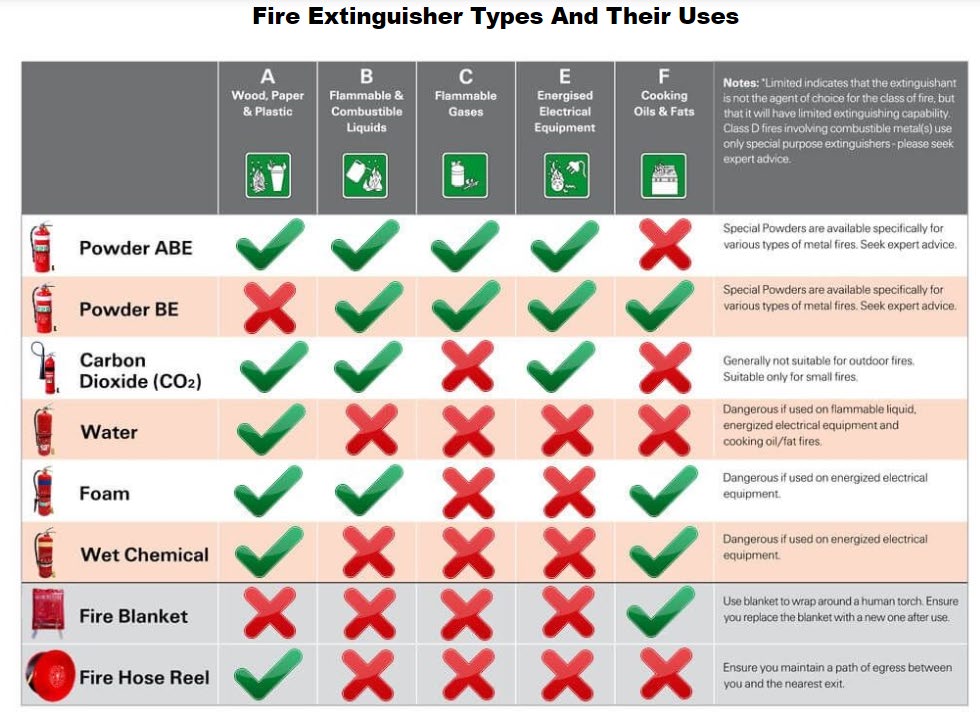
them. Ensure you are using the correct type of fire extinguisher (see appendix 7).
3.1.2 MAJOR INCIDENT
#
Step
Action
1
Alert Everyone
When a fire is identified, the first thing to do is yell “fire,
fire, fire” to alert everyone in the immediate vicinity. Find
the nearest fire alarm and activate.
2
Evacuate
Evacuate from the premises to the evacuation location. If
it is safe to do so, close doors behind you as evacuating.
If there is smoke, get on your hands and knees and crawl
out to avoid smoke inhalation.
The first Fire Warden trained staff to reach the Fire Warden
band assumes the following tasks, if they are safe to carry
out:
1. Collect the Fire Warden Band, DCC staff sign-in
board, contractor sign-in sheet and the information
checklist which is attached to the contractor sign-in
sheet
2. Sweep the building for staff and contractors and
request they evacuate immediately,
3. Proceed to and guide individuals to the evacuation
location,
Page | 12
Version Nine: December 2024

Dunedin City Council 3 Waters
Fire
Water Trea
tment
Version 9
Mount Gra nd Emergency Response Plan
4. Use the checklist to report important information
to
FENZ on their arrival (e.g. any missing staff or
contractors based on the sign-in information),
3
Call FENZ
As soon as it is safe to do so, FENZ will need to be called
(111) by whoever is available to do so. Inform the 111
call operator of the nature of the emergency and all
hazardous chemicals on site that may be involved with the
fire. Ensure someone (preferably a fire warden) is
available to greet the emergency services, guide them to
the scene and report any important information, including
missing staff or contractors based on sign-in information.
For false alarms, call the FENZ National Headquarters on
04 496 3600.
3.2 FIRST AID
First priority should always be to ensure your own safety
If someone has been burned or needs medical attention, a first aider can administer first
aid if possible while waiting for emergency services to arrive and take control of the
situation.
3.3 TRAINING
Required training to carry out these procedures effectively are:
• First Aid
• Fire Extinguisher/Fire Warden Training
3.4 EXTRA INFORMATION
• Only return to site if FENZ confirm that it is safe to do so.
• All staff are responsible for helping any disabled persons on site when evacuating
where reasonably practicable.
• Following a major incident, there may be need to consider other response plans in
relation to the supply of water.
• Fire Wardens can be identified by the florescent band on their arm.
Page | 13
Version Nine: December 2024

Dunedin City Council 3 Waters
Earthquake
Water Trea
tment
Version 9
Mount Gra nd Emergency Response Plan
4 EARTHQUAKE
4.1 PROCEDURE
#
Step
Action
1
Drop, Cover, Hold
Drop to the ground, take cover under a desk or table and
hold on until the shaking stops. If there is no table or desk
in the immediate vicinity, take cover in a doorframe. If
outside, drop down in a spot clear of buildings, trees and
powerlines. If you are driving, pull over in a clear location
if able, ensure seatbelt is fastened and apply the hand
brake.
2
Stay where you are If inside, do not leave until the shaking has stopped and
you are sure it is safe to exit the building. If outside, avoid
moving close to buildings, trees, and powerlines until you
are sure it is safe to move.
3 When Shaking Stops When the shaking has stopped and you have determined
it is safe to move, proceed to the assembly point. If
someone is trapped or injured whilst evacuating, provide
assistance.
Do not try and help move someone if they are
seriously injured unless they are in immediate danger of
sustaining further injury.
4
If stuck
If stuck after an earthquake, use your cell phone to text
for help, use a shirt to protect yourself from inhaling dust
by covering your mouth and nose. Try to avoid yelling for
help, whistling is best if possible.
4.2 FIRST AID
First aiders can provide first aid to those who need it when practical. Do not put yourself
in harms way.
4.3 TRAINING
• First Aid Training
Page | 14
Version Nine: December 2024

Dunedin City Council 3 Waters
Earthquake
Water Trea
tment
Version 9
Mount Gra nd Emergency Response Plan
4.4 EXTRA INFORMATION
There is very little to no actions that should be taken by on site staff to respond to the
earthquake. FENZ will tell staff if they need assistance.
When returning to site after an earthquake:
• Do not approach any damaged areas unless otherwise stated to by FENZ.
• If Staff need to return home and check in with dependents, they may do so.
• Staff still on site should assess the site in groups to locate potentially damaged
areas. When doing this, staff must be wearing hard hats, Hi-Vis, be in groups of at
least two people and have at least one cell phone per group.
When an earthquake occurs, the following points are important to take into consideration:
• Expect aftershocks after the first main earthquake.
• During and after an earthquake, phone lines can become overwhelmed. Texts will
likely be the most reliable means of communication. R/T Units are also available in
vehicles if needed.
Page | 15
Version Nine: December 2024

Dunedin City Council 3 Waters
Hazardous Substances
Water Trea
tment
Version 9
Mount Gra nd Emergency Response Plan
5 HAZARDOUS SUBSTANCES
The hazardous substances covered by this plan include:
• PACl
• Lime
• Fluoride
• Caustic Soda
• Sulphuric Acid
• Sodium Hypochlorite
• Soda Ash
• Granular Aluminium Sulphate
5.1 PROCEDURE
5.1.1 MINOR INCIDENT
#
Step
Action
1
Alert Supervisor
When a leak of a hazardous substance is found,
immediately alert the site supervisor and don PPE.
2
Take Control of Leak place signage/cones around the area to stop. Place drain
cover over any nearby drains.
3
Clean Leak
Use Spill kit to contain the leak stopping/preventing any
chemical from entering drains or covering a wider area.
Use spill kit to clean the leak.
4 Dispose of Chemicals Call a waste disposal company such as Waste Management
(0800-10-10-10) to dispose of or give advice on the
disposal of the spilled chemical.
Page | 16
Version Nine: December 2024

Dunedin City Council 3 Waters
Hazardous Substances
Water Trea
tment
Version 9
Mount Gra nd Emergency Response Plan
5.1.2 MAJOR INCIDENT IN A BUN
D
#
Step
Action
1
Alert Supervisor
When a leak of a hazardous substance is found,
immediately alert the site supervisor and don PPE
2
Refer to SDS
Read SDS to familiarise yourself with the hazards related
to the chemical and the first aid measures to take if you
come in contact.
3
Isolate area
Place signage/cones around the area to stop. Place drain
cover over any nearby drains if there is some chemical
outside of the bund.
4
Clean spill
In most cases, the chemical should have leaked into a
bund. Procedure from here is to call Responsible Care NZ
(0800 243 622) and Waste Management (0800 10 10 10)
ask for advice regarding the disposal of the spilled
chemical. This will likely be to dilute the chemical and
slowly run the spill into the sludge pit over time.
5.1.3 MAJOR LEAK IN AN UN-BUNDED AREA
#
Step
Action
1
Minimise Leak
If the leak has been caused due to a puncturing of a vessel,
do not remove the item from the hole (e.g. do not reverse
forklift out if the forks puncture an IBC). Cover the nearest
drain to the leak with a drain cover. retrieve spill it and
don PPE inside. Use spill kit to contain the spill as much
as possible and divert the spill away from drains.
2
Alert Supervisor
Alert the supervisor as soon as possible.
3
Dispose Chemicals
Once the leak has stopped and the liquid has been
absorbed by the matts or sand contained in the spill kit,
transfer to the empty spill kit container. Call waste
management to dispose of the chemical.
Page | 17
Version Nine: December 2024

Dunedin City Council 3 Waters
Hazardous Substances
Water Trea
tment
Version 9
Mount Gra nd Emergency Response Plan
5.2 FIRST AID
•
When dealing with hazardous substances, always refer to the SDS for any safety
precautions or first aid measures. SDS’s for all substances are located where
the chemical is stored and assembly point 1.
•
If any persons comes into contact with a hazardous substance, first point of call
should always be to remove contaminated clothing and use safety shower/eye
wash for 15 minutes. See appendix for safety shower locations.
5.3 TRAINING
•
Confined Spaces + Gas detection
•
Breathing Apparatus Training
•
Management and Handling of Hazardous Substances Training
•
First Aid Training
•
Certified Handler Training
5.4 EXTRA NOTES
• It is the responsibility of the person who identifies an incident to decide whether it
is a minor incident or a major incident.
• If the leak occurs due to a forklift fork piercing an IBC or drum,
Do Not Remove
the fork from container. Leave fork in container to prevent a large leak and proceed
with spill kit procedure.
• Always refer to SDS for more specific responses, first aid and any other pieces of
information that may be required
Page | 18
Version Nine: December 2024

Dunedin City Council 3 Waters
Section
6
Water Treatment
Appendix
Emergency Response Plan
6 APPENDIX
Appendix 1 – Site Plans: DAF
19

Dunedin City Council 3 Waters
Section
6
Water Treatment
Appendix
Emergency Response Plan
Appendix 2 – Site Plans: Filter Block
20

Dunedin City Council 3 Waters
Section
6
Water Treatment
Appendix
Emergency Response Plan
Appendix 3 – Site Plans: Chlorine Storage + Acid/Alkali Store
21

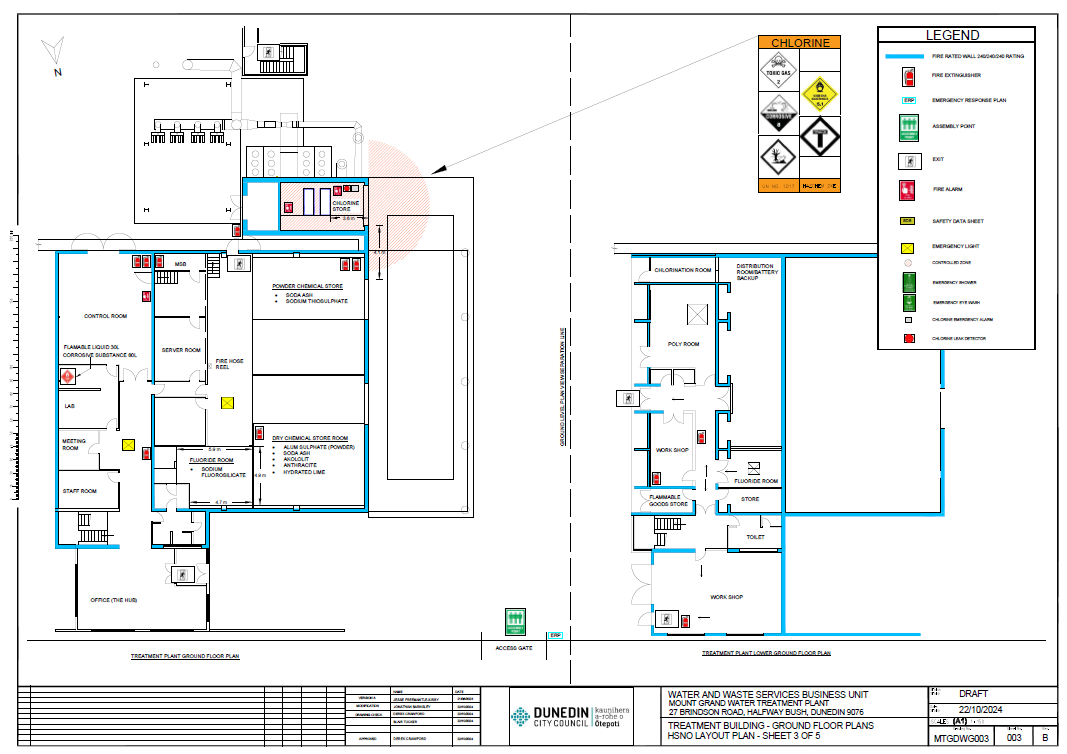
Dunedin City Council 3 Waters
Section
6
Water Treatment
Appendix
Emergency Response Plan
Appendix 4 – Site Plans: Main Building
22

Dunedin City Council 3 Waters
Section
6
Water Treatment
Appendix
Emergency Response Plan
Appendix 5 - Site plans: Mount Grand
23

Dunedin City Council 3 Waters
Section
6
Water Treatment
Appendix
Emergency Response Plan
Appendix 6 – Chlorine leak indicator
Appendix 7 – Fire Extinguisher Compatibility
24

Dunedin City Council 3 Waters
Section
6
Water Treatment
Appendix
Emergency Response Plan
Appendix 8 – Chlorine Leak Notice
25

Dunedin City Council 3 Waters
Section
7
Water Treatment
Notes
Emergency Response Plan
7 NOTES
26
Document Outline
