





 Safety Data Sheet
1. IDENTIFICATION OF THE MATERIAL AND SUPPLIER
Product Name:
HYDROFLUOROSILICIC ACID
Other name(s):
Safety Data Sheet
1. IDENTIFICATION OF THE MATERIAL AND SUPPLIER
Product Name:
HYDROFLUOROSILICIC ACID
Other name(s):
Hydrofluosilicic acid; Hydrosilicofluoric acid; HFA.
Recommended use of the chemical Water fluoridation; sterilising equipment.
and restrictions on use:
Supplier:
Ixom Operations Pty Ltd (Incorporated in Australia)
NZBN:
9429041465226
Street Address:
166 Totara Street
Mt Maunganui South
New Zealand
Telephone Number:
+64 9 368 2700
Facsimile:
+64 9 368 2710
Emergency Telephone:
0 800 734 607 (ALL HOURS)
Please ensure you refer to the limitations of this Safety Data Sheet as set out in the "Other Information" section at the end of this Data Sheet.
2. HAZARDS IDENTIFICATION
Classified as a Dangerous Good according to NZS 5433:2012 Transport of Dangerous Goods on Land.
Classified as hazardous according to criteria in the HS (Minimum Degrees of Hazard) Regulations 2001.
SIGNAL WORD: DANGER
Subclasses:
Subclass 6.1 Category D - Substances which are acutely toxic.
Subclass 8.1 Category A - Substances that are corrosive to metals.
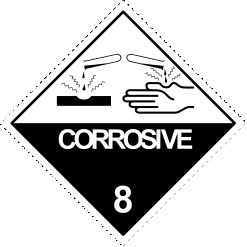
Subclass 8.2 Category C - Substances that are corrosive to dermal tissue.
Subclass 8.3 Category A - Substances that are corrosive to ocular tissue.
Approval Number: HSR004496
Hazard Statement(s):
H290 May be corrosive to metals.
H302 Harmful if swallowed.
H314 Causes severe skin burns and eye damage.
Precautionary Statement(s):
Prevention:
P102 Keep out of reach of children.
P103 Read label before use.
P234 Keep only in original container.
P260 Do not breathe mist/vapours/spray.
P264 Wash hands thoroughly after handling.
P270 Do not eat, drink or smoke when using this product.
P280 Wear protective gloves/protective clothing/eye protection/face protection.
Product Name: HYDROFLUOROSILICIC ACID
Issued: 07/05/2015
Substance No: 000000015539
Version: 4
Page 1 of 7
 Safety Data Sheet
Response:
Safety Data Sheet
Response:
P301+P330+P331 IF SWALLOWED: Rinse mouth. Do NOT induce vomiting.
P303+P361+P353 IF ON SKIN (or hair): Remove/Take off immediately all contaminated clothing. Rinse skin with water/shower.
P304+P340 IF INHALED: Remove to fresh air and keep at rest in a position comfortable for breathing.
P305+P351+P338 IF IN EYES: Rinse cautiously with water for several minutes. Remove contact lenses, if present and easy to do.
Continue rinsing.
P310 Immediately call a POISON CENTER or doctor/physician.
P321 Specific treatment (see First Aid Measures on the Safety Data Sheet).
P363 Wash contaminated clothing before re-use.
P390 Absorb spillage to prevent material damage.
Storage:
P405 Store locked up.
P406 Store in corrosive resistant container with a resistant inner liner.
Disposal:
P501 In case of a substance that is in compliance with a HSNO approval other than a Part 6A (Group Standards) approval, a label
must provide a description of one or more appropriate and achievable methods for the disposal of a substance in accordance with
the Hazardous Substances (Disposal) Regulations 2001. This may also include any method of disposal that must be avoided.
3. COMPOSITION/INFORMATION ON INGREDIENTS
Components
CAS Number
Proportion
Hazard Codes
Fluorosilicic acid
16961-83-4
17-23%
H314
Water
7732-18-5
to 100%
-
4. FIRST AID MEASURES
For advice, contact a Poisons Information Centre (e.g. phone Australia 131 126; New Zealand 0800 764 766) or a
doctor at once.
Inhalation:
Remove victim from area of exposure - avoid becoming a casualty. Remove contaminated clothing and loosen
remaining clothing. Allow patient to assume most comfortable position and keep warm. Keep at rest until fully
recovered. If patient finds breathing difficult and develops a bluish discolouration of the skin (which suggests a lack of
oxygen in the blood - cyanosis), ensure airways are clear of any obstruction and have a qualified person give oxygen
through a face mask. Apply artificial respiration if patient is not breathing. Seek immediate medical advice.
Skin Contact:
If skin contact occurs, immediately remove contaminated clothing. Flush skin under running water for 15 minutes.
Then apply calcium gluconate gel. Contact the Poisons Information Centre. For skin burns, cover with a clean, dry
dressing until medical help is available.
Eye Contact:
Immediately wash in and around the eye area with large amounts of water for at least 15 minutes. Eyelids to be held
apart. Remove clothing if contaminated and wash skin. Urgently seek medical assistance. Transport promptly to
hospital or medical centre. Continue to wash with large amounts of water until medical help is available.
Ingestion:
Immediately rinse mouth with water. If swallowed, do NOT induce vomiting. Give a glass of water. Seek immediate
medical assistance.
Indication of immediate medical attention and special treatment needed:
Treat symptomatically. Material is corrosive. Can cause corneal burns. Can cause pulmonary oedema. Effects may be
delayed.
Product Name: HYDROFLUOROSILICIC ACID
Issued: 07/05/2015
Substance No: 000000015539
Version: 4
Page 2 of 7
 Safety Data Sheet
5. FIRE FIGHTING MEASURES
Suitable Extinguishing Media:
Safety Data Sheet
5. FIRE FIGHTING MEASURES
Suitable Extinguishing Media:
Not combustible, however, if material is involved in a fire use: Fine water spray, normal foam, dry agent (carbon
dioxide, dry chemical powder).
Hazchem or Emergency Action Code: 2X
Specific hazards arising from the substance or mixture:
Non-combustible material.
Special protective equipment and precautions for fire-fighters:
Decomposes on heating emitting toxic fumes, including those of hydrogen fluoride . Fire fighters to wear
self-contained breathing apparatus and suitable protective clothing if risk of exposure to products of decomposition.
6. ACCIDENTAL RELEASE MEASURES
Emergency procedures/Environmental precautions:
Clear area of all unprotected personnel. If contamination of sewers or waterways has occurred advise local
emergency services.
Personal precautions/Protective equipment/Methods and materials for containment and cleaning up:
Slippery when spilt. Avoid accidents, clean up immediately. Wear protective equipment to prevent skin and eye
contact and breathing in vapours. Work up wind or increase ventilation. Contain - prevent run off into drains and
waterways. Use absorbent (soil, sand or other inert material). Neutralise with lime or soda ash. Collect and seal in
properly labelled containers or drums for disposal.
7. HANDLING AND STORAGE
Precautions for safe handling: Avoid skin and eye contact and breathing in vapour, mists and aerosols. Always add
the acid to water, never the reverse. Not to be available except to authorised or licensed persons.
Conditions for safe storage, including any incompatibilities: Keep locked up. Keep away from children and
animals. Store in a cool, dry, well ventilated place and out of direct sunlight. Store away from foodstuffs. Store away
from incompatible materials described in Section 10. Keep dry - reacts with water, may lead to drum rupture. Keep
containers closed when not in use - check regularly for leaks.
8. EXPOSURE CONTROLS/PERSONAL PROTECTION
Workplace Exposure Standards: No value assigned for this specific material by the New Zealand Workplace
Health & Safety Authority. However, Workplace Exposure Standard(s) for related component(s):
Fluorides, as F: WES-TWA 2.5 mg/m3, bio
Hydrogen fluoride, as F: Ceiling 3 ppm, 2.6 mg/m3
Product Name: HYDROFLUOROSILICIC ACID
Issued: 07/05/2015
Substance No: 000000015539
Version: 4
Page 3 of 7

 Safety Data Sheet
As published by the New Zealand Workplace Health & Safety Authority.
WES - TWA (Workplace Exposure Standard - Time Weighted Average) - The eight-hour, time-weighted average
exposure standard is designed to protect the worker from the effects of long-term exposure.
'bio' - Biological Exposure Index.
WES - Ceiling (Workplace Exposure Standard - Ceiling). A concentration that should not be exceeded during any part
of the working day.
These Workplace Exposure Standards are guides to be used in the control of occupational health hazards. All
atmospheric contamination should be kept to as low a level as is workable. These workplace exposure standards
should not be used as fine dividing lines between safe and dangerous concentrations of chemicals. They are not a
measure of relative toxicity.
Appropriate engineering controls:
Ensure ventilation is adequate and that air concentrations of components are controlled below quoted Workplace
Exposure Standards. Keep containers closed when not in use.
If in the handling and application of this material, safe exposure levels could be exceeded, the use of engineering
controls such as local exhaust ventilation must be considered and the results documented. If achieving safe exposure
levels does not require engineering controls, then a detailed and documented risk assessment using the relevant
Personal Protective Equipment (PPE) (refer to PPE section below) as a basis must be carried out to determine the
minimum PPE requirements.
Individual protection measures, such as Personal Protective Equipment (PPE):
The selection of PPE is dependent on a detailed risk assessment. The risk assessment should consider the work
situation, the physical form of the chemical, the handling methods, and environmental factors.
OVERALLS, CHEMICAL GOGGLES, FACE SHIELD, GLOVES (Long), APRON, RUBBER BOOTS.
Wear overalls, chemical goggles, face shield, elbow-length impervious gloves, splash apron or equivalent chemical
impervious outer garment, and rubber boots. Always wash hands before smoking, eating, drinking or using the toilet.
Wash contaminated clothing and other protective equipment before storage or re-use.
If determined by a risk assessment an inhalation risk exists, wear a suitable mist respirator meeting the requirements
of AS/NZS 1715 and AS/NZS 1716.
9. PHYSICAL AND CHEMICAL PROPERTIES
Physical state:
Liquid
Colour:
Pale Yellow
Odour:
Characteristic , Pungent , Acidic
Solubility:
Miscible with water.
Specific Gravity:
1.16-1.22 @ 20°C
Relative Vapour Density (air=1): Not available
Vapour Pressure (20 °C):
18 mmHg
Product Name: HYDROFLUOROSILICIC ACID
Issued: 07/05/2015
Substance No: 000000015539
Version: 4
Page 4 of 7
 Safety Data Sheet
Flash Point (°C):
Safety Data Sheet
Flash Point (°C):
Not applicable
Flammability Limits (%):
Not applicable
Autoignition Temperature (°C):
Not applicable
Boiling Point/Range (°C):
>100
Decomposition Point (°C):
105
pH:
Not available
Freezing Point/Range (°C):
ca. 0
10. STABILITY AND REACTIVITY
Reactivity:
Reacts exothermically on dilution with water. Reacts violently with alkalis and
organic chemicals. Corrodes metals.
Chemical stability:
Stable under normal ambient and anticipated storage and handling conditions of
temperature and pressure.
Possibility of hazardous
Contact with metals may evolve flammable hydrogen gas. May corrode glass.
reactions:
Conditions to avoid:
Avoid contact with foodstuffs. Avoid contact with combustible substances. Always
add acid to water, never the reverse, due to significant exothermic reaction.
Incompatible materials:
Incompatible with alkalis , organic chemicals , and metals .
Hazardous decomposition
Hydrogen fluoride. Hydrogen. Silicon tetrafluoride. Fluorides.
products:
11. TOXICOLOGICAL INFORMATION
No adverse health effects expected if the product is handled in accordance with this Safety Data Sheet and the
product label. Symptoms or effects that may arise if the product is mishandled and overexposure occurs are:
Ingestion:
Swallowing can result in nausea, vomiting, diarrhoea, abdominal pain and
chemical burns to the gastrointestinal tract. Swallowing can result in chemical
burns to the mouth, throat and abdomen; perforation of the gastrointestinal tract
and vomiting of blood and eroded tissue. Collapse and coma may result.
Eye contact:
A severe eye irritant. Corrosive to eyes; contact can cause corneal burns.
Contamination of eyes can result in permanent injury. Contact with eyes even for
short periods can cause blindness.
Skin contact:
Contact with skin will result in severe irritation. Corrosive to skin - may cause skin
burns.
Inhalation:
Breathing in vapour will produce respiratory irritation. Delayed (up to 48 hours)
fluid build up in the lungs may occur.
Acute toxicity: No LD50 data available for the product. For the constituent FLUOSILICIC ACID:
Oral LD50 (rat): 430 mg/kg.
Chronic effects: Repeated or prolonged exposure may result in bone changes (fluorosis). Repeated exposure may
cause respiratory problems.
12. ECOLOGICAL INFORMATION
Product Name: HYDROFLUOROSILICIC ACID
Issued: 07/05/2015
Substance No: 000000015539
Version: 4
Page 5 of 7


 Safety Data Sheet
Ecotoxicity
Safety Data Sheet
Ecotoxicity
Avoid contaminating waterways.
13. DISPOSAL CONSIDERATIONS
Disposal methods:
Refer to local government authority for disposal recommendations. Dispose of contents/container in accordance with
local/regional/national/international regulations.
14. TRANSPORT INFORMATION
Road and Rail Transport
Classified as a Dangerous Good according to NZS 5433:2012 Transport of Dangerous Goods on Land.
UN No:
1778
Transport Hazard Class:
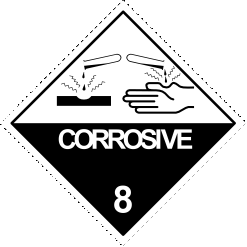
8 Corrosive
Packing Group:
II
Proper Shipping Name or
FLUOROSILICIC ACID
Technical Name:
Hazchem or Emergency Action
2X
Code:
Marine Transport
Classified as Dangerous Goods by the criteria of the International Maritime Dangerous Goods Code (IMDG Code) for
transport by sea; DANGEROUS GOODS.
UN No:
1778
Transport Hazard Class:
8 Corrosive
Packing Group:
II
Proper Shipping Name or
FLUOROSILICIC ACID
Technical Name:
IMDG EMS Fire:
F-A
IMDG EMS Spill:
S-B
Air Transport
Classified as Dangerous Goods by the criteria of the International Air Transport Association (IATA) Dangerous Goods
Regulations for transport by air; DANGEROUS GOODS.
UN No:
1778
Transport Hazard Class:
8 Corrosive
Packing Group:
II
Proper Shipping Name or
FLUOROSILICIC ACID
Technical Name:
15. REGULATORY INFORMATION
Classification:
Classified as hazardous according to criteria in the HS (Minimum Degrees of Hazard) Regulations 2001.
Product Name: HYDROFLUOROSILICIC ACID
Issued: 07/05/2015
Substance No: 000000015539
Version: 4
Page 6 of 7
 Safety Data Sheet
Subclasses:
Safety Data Sheet
Subclasses:
Subclass 6.1 Category D - Substances which are acutely toxic.
Subclass 8.1 Category A - Substances that are corrosive to metals.
Subclass 8.2 Category C - Substances that are corrosive to dermal tissue.
Subclass 8.3 Category A - Substances that are corrosive to ocular tissue.
Approval Number: HSR004496
Hazard Statement(s):
H290 May be corrosive to metals.
H302 Harmful if swallowed.
H314 Causes severe skin burns and eye damage.
16. OTHER INFORMATION
`Registry of Toxic Effects of Chemical Substances'. Ed. D. Sweet, US Dept. of Health & Human Services: Cincinatti,
2014.
This safety data sheet has been prepared by Ixom Operations Pty Ltd Toxicology & SDS Services.
Reason(s) for Issue:
Revised Primary SDS
Change in Formulation
Alignment to GHS requirements
This SDS summarises to our best knowledge at the date of issue, the chemical health and safety hazards of the
material and general guidance on how to safely handle the material in the workplace. Since Ixom Operations Pty Ltd
cannot anticipate or control the conditions under which the product may be used, each user must, prior to usage,
assess and control the risks arising from its use of the material.
If clarification or further information is needed, the user should contact their Ixom representative or Ixom Operations
Pty Ltd at the contact details on page 1.
Ixom Operations Pty Ltd's responsibility for the material as sold is subject to the terms and conditions of sale, a copy
of which is available upon request.
Product Name: HYDROFLUOROSILICIC ACID
Issued: 07/05/2015
Substance No: 000000015539
Version: 4
Page 7 of 7
