
19 January 2026
Sovereign Sharna
Em
ail: [FYI request #32674 email]
Dear Sharna
REQUEST FOR INFORMATION UNDER THE LOCAL GOVERNMENT OFFICIAL INFORMATION AND MEETINGS
ACT 1987 (LGOIMA) – COMMUNITY WATER FLUORIDATION
Your request
On 5 December 2025, we received a partial transfer of your
attached request for information (attachment
1) via the Ministry of Health (MoH).
Fluoridation in Auckland
First, I would like to begin with some background information regarding fluoridation in Auckland’s drinking
water.
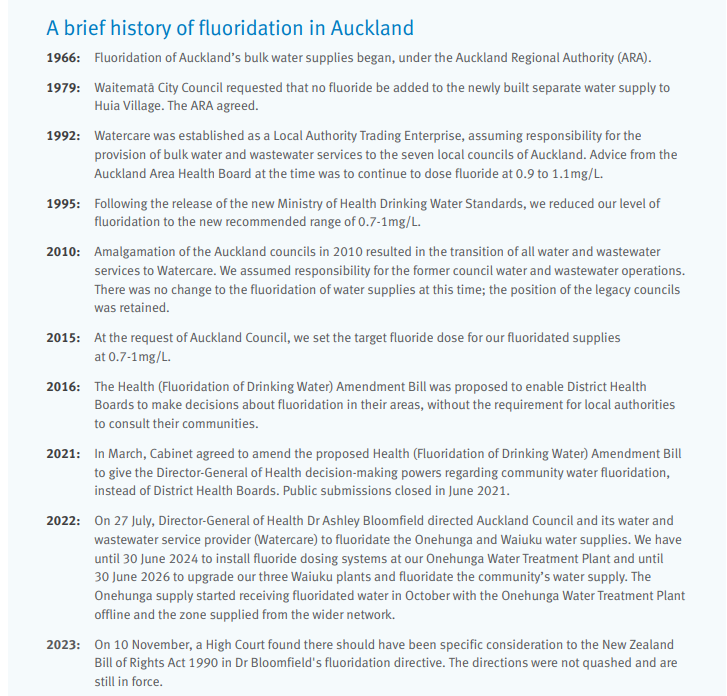
History of fluoridation in Auckland
The document linked below includes a brief history of fluoridation in Auckland
: Fluoride fact sheet.
For ease of reference, I set out the relevant page below from the document linked above.
 Watercare’s legislative requirements
Watercare is a limited liability company registered under the Companies Act 1993, and a local government
organisation under the Local Government Act 2002. We are subject to regulation governing planning,
health and environmental matters. The principal regulators include Auckland Council, Waikato Regional
Council, Taumata Arowai and the Ministry of Health.
In addition to the various Local Government Acts, further legislative requirements enabling and governing
our operations as the provider of water and wastewater services in Auckland are set out below:
Water Services Act 2021
• Water Services (Drinking Water Standards for New Zealand) Regulations 2022
• Drinking Water Quality Assurance Rules 2022
• Aesthetic Values for Drinking Water Notice 2022
• Health Act 1956.
To ensure we meet our various legislative requirements, we collect Auckland’s drinking water from dams,
rivers and underground aquifers across the region.
At our treatment plants, we use multiple water treatment barriers to ensure the treated water meets the
requirements set by New Zealand Water Services Regulator, Taumata Arowai and the Ministry of Health.
The requirements are provided for in th
e Drinking Water Quality Assurance Rules 2022 (DWQAR),
Drinking
Water Standards for New Zealand 2022 (DWSNZ),
Water Services Act 2021 and
Health (Fluoridation of
Drinking Water) Amendment Act 2021. Treatment chemicals as required by the regulations are added at
various stages of the water treatment processes to ensure compliance. The chemicals used depend on the
types of water treatment at each site.
Under th
e Health Act 1956 as amended by the
Health (Fluoridation of Drinking Water) Amendment Act
2021, the Director-General of Health (DGH) has decision-making powers regarding community water
fluoridation.
Watercare’s current role regarding fluoridation of drinking water supply is to undertake and maintain
compliant fluoridation system operations. Fluoride is added at the request of the DGH.
Our responsibility in regard to fluoridation has always been to ensure that where we are required by the
DGH to add fluoride to our treated water, it’s done safely and carefully monitored to ensure our water
complies with the New Zealand Drinking Water Standards.
Fluoride is currently added at main treatment plants supplying metropolitan Auckland. Fluoride is not
currently added at our non-metropolitan water treatment plants, serving communities in Waiuku, Bombay,
Huia Village, Wellsford, Warkworth, Snells-Algies, Helensville and Muriwai. In the past, the decision on
whether to fluoridate water supplies rested with Auckland’s legacy councils. We retained the position of
legacy councils when we became responsible for the region’s water and wastewater services in 2010.
All information regarding fluoridation in the Auckland region can be found on our FAQ sheet on
Fluoridation
: Fluoride fact sheet.
More information is available on the Ministry of Health website:
policy on community water fluoridation
Our response
Our initial review of your request indicated that the majority of your questions relate to overarching
matters such as supply, production, transport, and policies for fluoride. Watercare does not have access to
this information.
However, we acknowledge the complex nature of your request and the chal enges the MoH faced in
transferring or identifying the appropriate local authorities for the specific questions you raised. Therefore,
we accepted the partial transfer of your request for information, even though we do not hold all the
information required to address every aspect of your questions (i.e., questions 3, 5, 17, and 18).
On that basis, and as stated by the MoH in their
attached letter dated 5 December 2025 (attachment 2), we
provide our response below to questions 3, 5, 17, and 18. We acknowledge that our responses may lack
context without the remaining information, as they do not address al aspects of your request.
After reviewing our roles and responsibilities in relation to fluoridation in Auckland as outlined above, if you
have any further questions for Watercare, please let us know.
 3. Provide the ful chemical composition, including chemical names, chemical formulae, and
concentrations of all fluoride compounds added to the public water supply.
3. Provide the ful chemical composition, including chemical names, chemical formulae, and
concentrations of all fluoride compounds added to the public water supply.
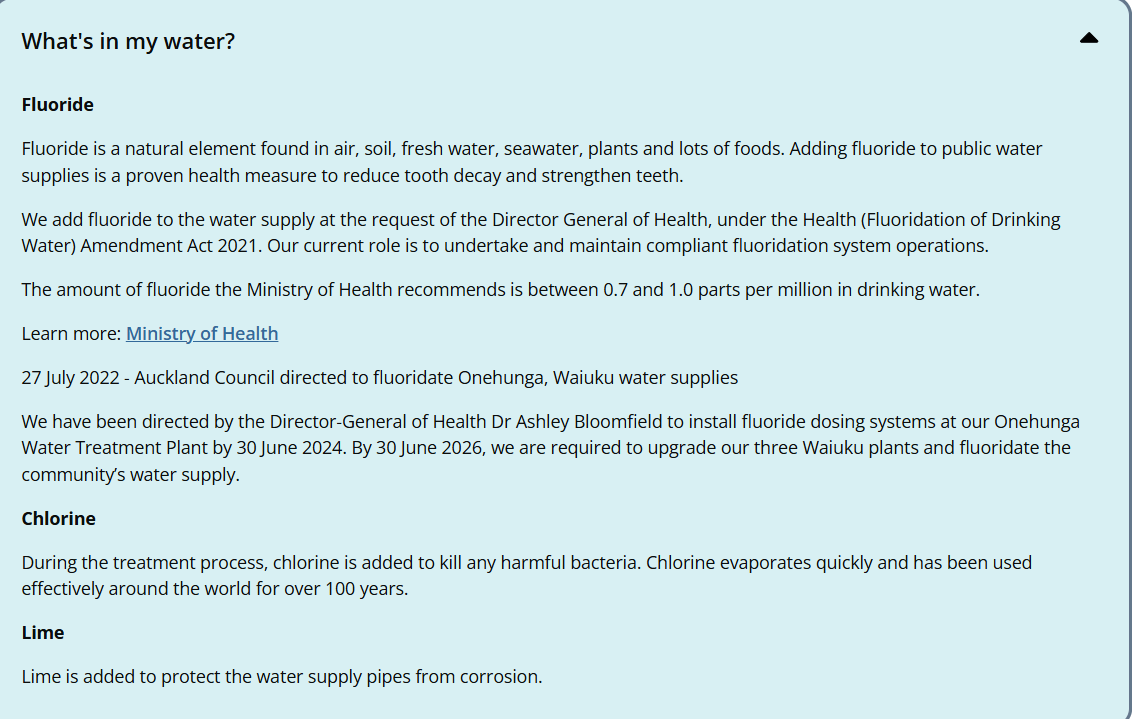
The screenshot below is from our
website.
Watercare uses hydrofluorosilicic acid (HFA) as the fluoridating agent which is one of the three approved
fluoridating agents as per the
Code of Practice for the Fluoridation of Drinking-Water Supplies in New
Zealand.
5. Provide details of any chemical by-products, waste, or residues generated during production, storage,
transport, or dosing, including their environmental and human health impacts.
Wastewater containing low levels of fluoride from our water treatment plants is discharged into either the
wastewater network or consented stormwater discharge points. We do not discharge concentrated
fluoride from our consented sites to land. The HFA is stored in bunded areas. Bunding is essentially a
containment system of the fluoride chemical itself, and it does not go to landfills. Instead it is added to the
water, as one of the final steps of the process.
17. Provide documentation of regulatory compliance, inspections, or audits by government or third-party
authorities.
18. Disclose any incidents, complaints, or breaches relating to fluoride chemical safety, handling, or
dosing.
We provide our combined response for your questions 17 and 18 set out above.
Auckland’s drinking water undergoes rigorous testing to make sure it is safe to drink. Our treatment plants
use continuous online instruments to monitor fluoride levels in the treated water. Alarms are triggered and
dosing stops if the fluoride concentration deviates from the control limits.
At water treatment plants where we add fluoride to the water, it is added as one of the final steps before
the water leaves the plant. It is added at a specified concentration to maintain fluoride levels between 0.7
and 1.0 mg/L as recommended by the Ministry of Health so there is no risk of adding a more concentrated
solution.
The maximum acceptable value of fluoride is 1.5 mg/L, as set by the Drinking Water Standards for New
Zealand 2022 (DWSNZ). Watercare has strict control measures in place to ensure that this is not exceeded.
We can confirm that the level of fluoride has not exceeded 1.5mg/L in our compliance sampling
programme at any time.
We test our treated water every week at the Watercare Laboratory to ensure fluoride levels are in the
recommended range. These results are published on our website each month and are also reported in our
annual water quality reports (under
Water quality reports section).
We have had no recordable safety incidents associated with fluoride safety, handling or dosing.
Future options
You have the right to seek an investigation and review by the Ombudsman of this decision. Information
about how to make a complaint is available at
www.ombudsman.parliament.nz or freephone 0800 802
602.
Yours sincerely,
Tuan Hawke
Head of Operations Performance
