From:
To:
Subject:
Response to request for information re fluoride
Date:
Monday, 8 July 2024 4:00:00 pm
Attachments:
image001.png
image002.png
image003.png
image004.png
image005.png
image006.png
102 other 102.13 dannevirke water supply fluoridation - moh direction letter tararua(d23 35908).pdf
hfa-safety-data-sheet.pdf
Kia ora
I refer to your official information request dated 7 July 2024 for information relating to the
fluoridation of drinking water by the Tararua District Council.
The information you have requested follows.
Is your council adding fluoride to the water supply YES/NO – not currently. However our Council
has been directed by the Director General of Health to fluoridate the drinking water supply for
the township of Dannevirke. The plant is currently under construction, with finalisation due 30
September 2024.
What is the LEGAL name of the company that makes it? The product will be supplied by Ixom
Operations Pty Ltd. We do not have the name of the manufacturer of the product.
What is the specific CHEMICAL name of the product that is added ? HFA (Hydrofluorosilicic Acid)
Please provide an email copy of the MSDS of the product being used. Please see attached Safety
Data Sheet.
How many PPM are added to the water and how often are they added? Fluoridation of the
Dannevirke drinking water supply has not yet started, however when it does, we have to follow
the Water New Zealand Code of Practice for Fluoridation of Drinking Water Supplies in NZ (2014)
and the Good Practice Guide for Fluoridation of Drinking Water (2023). This requires HFA to be
added to constantly maintain a content of 0.7 to 1.0 mg/L
What is the name of the person in charge of/who signs off the Water treatment in your area?
Under section 7(2)(a) of the Local Government Official Information and Meetings Act 1987, we
are withholding names of employees (protection of privacy). However, fluoridation of the water
supply is undertaken in accordance with the directive received under Sections 116C to 116J of
the Health Act 1956, a copy of which is attached.
A picture of the bag would be great too please if possible. We are not able to provide you with a
picture of a bag, as we do not hold such information. Therefore we decline this part of your
request under section 17(e) of the Local Government Official Information and Meetings Act
1987. Note that when fluoridation of the water supply does start, the product will not be
supplied in a bag. The product will be added via an automated containerised dosing unit.
Therefore it will not be possible to provide a picture of a bag at a future stage.
You have the right to seek an investigation and review by the Ombudsman of this decision.
Information about how to make a complaint is available at www.ombudsman.parliament.nz or
freephone 0800 802 602.
Ngā mihi
Allie Dunn | Manager - Democracy Services
Strategy & Community Wellbeing - Democracy Services | Tararua
District Council

Phone: +64 6 3744080 | Mobile: +64 27 3331626
[email address]
26 Gordon Street, Dannevirke 4930, PO Box 115
www.tararuadc.govt.nz
www.facebook.com/tararuadc
From: Allie Dunn
Sent: Monday, July 8, 2024 8:17 AM
To:
Subject: Acknowledgement - request for information re fluoride
Kia ora
This email is to acknowledge receipt of your request for information, regarding fluoride added to
water supply.
We will endeavour to respond to your request as soon as possible and in any event no later than
2 August 2024, being 20 working days after the day your request was received. If we are unable
to respond to your request by then, we will notify you of an extension of that timeframe.
As part of our commitment to openness and accountability, we are now proactively publishing
copies of requests for information and the responses provided to these requests, on our
website. In doing so, we will ensure we comply with the provisions of the Privacy Act 2020 and
redact any personal / identifying information from any response published.
If you have any questions about this, please don’t hesitate to get in contact with me.
Ngā mihi
Allie Dunn | Manager - Democracy Services
Strategy & Community Wellbeing - Democracy Services | Tararua
District Council
Phone: +64 6 3744080 | Mobile: +64 27 3331626
[email address]
26 Gordon Street, Dannevirke 4930, PO Box 115
www.tararuadc.govt.nz
www.facebook.com/tararuadc
From:
Sent: Sunday, July 7, 2024 9:40 PM
To:
Subject: OIA request - WATER DEPARTMENT
EXTERNAL EMAIL ALERT: Caution advised. This message is from an external sender. Verify the
sender's identity and use caution with attachments and links.
To whom it may concern,
Please find below - a copy of an email from me to the Dunedin City Council requesting
information on the type of fluoride added to our water supply.
I am requesting under the Local Government Official Information and Meetings Act
1987 (LGOIMA) a copy of the same information from your council please.
Is your council adding fluoride to the water supply YES/NO
What is the LEGAL name of the company that makes it?
What is the specific CHEMICAL name of the product that is added ?
Please provide an email copy of the MSDS of the product being used.
How many PPM are added to the water and how often are they added?
What is the name of the person in charge of/who signs off the Water treatment in your
area?
AND
A picture of the bag would be great too please if possible.
Thank-You
Kind Regards
Dunedin
From:
Sent: Friday, 2 July 2021 8:15 a.m.
To:
Subject: LGOIMA requesting the exact fluoride product added to the water supply
Kia ora
I am writing in response to your Local Government Official Information and Meetings Act
1987 (LGOIMA) request of 11 June 2021, for ease of reference a copy your request is
below.
The exact fluoride product added to the water supply is Sodium Silico Fluoride (scientific
name) and the manufacturer is Shimonoseki Mitsui Chemical Inc.
As requested please find attached photos of the front and back of a bag, fluoride is added
continuously to the metro water supply via the Mt Grand and Southern Water Treatment
Plants at the rate of 0.75 grams per 1000L.
I trust this answers your request.
Kā mihi
GOVERNANCE SUPPORT OFFICER
CIVIC
Dunedin City Council, 50 The Octagon, Dunedin
PO Box 5045, Dunedin 9054
New Zealand
www.dunedin.govt.nz

133 Molesworth Street
PO Box 5013
Wellington 6140
New Zealand
T+64 4 496 2000
27 July 2022
Bryan Nicholson
Chief Executive
Tararua District Council
[email address]
Tēnā koe Mr Nicholson
Decision in relation to fluoridation direction
Thank you for responding to my letter of 3 May 2022. I have considered the information
you have provided, alongside further information I am required to consider under
section 116E of the Health Act 1956 (the Act). I have also received and considered
advice from the Director of Public Health.
Informed by the matters I am required to consider, I have decided to exercise my
statutory powers under section 116E of the Act to direct you to fluoridate the Dannevirke
drinking water supply in your region.
In accordance with section 116I of the Act, you are required to ensure that by 30 June
2024 you are fluoridating at the optimal levels (between 0.7ppm to 1ppm, parts per
million) at the Dannevirke supply. Contravening these requirements, or permitting these
requirements to be contravened, constitutes an offence under section 116J of the Act.
Fluoridation of the Dannevirke drinking water supply is an important step in improving
the oral health of your community, and it is my intention that Manatū Hauora (the
Ministry of Health) will work constructively with you to implement these important
changes.
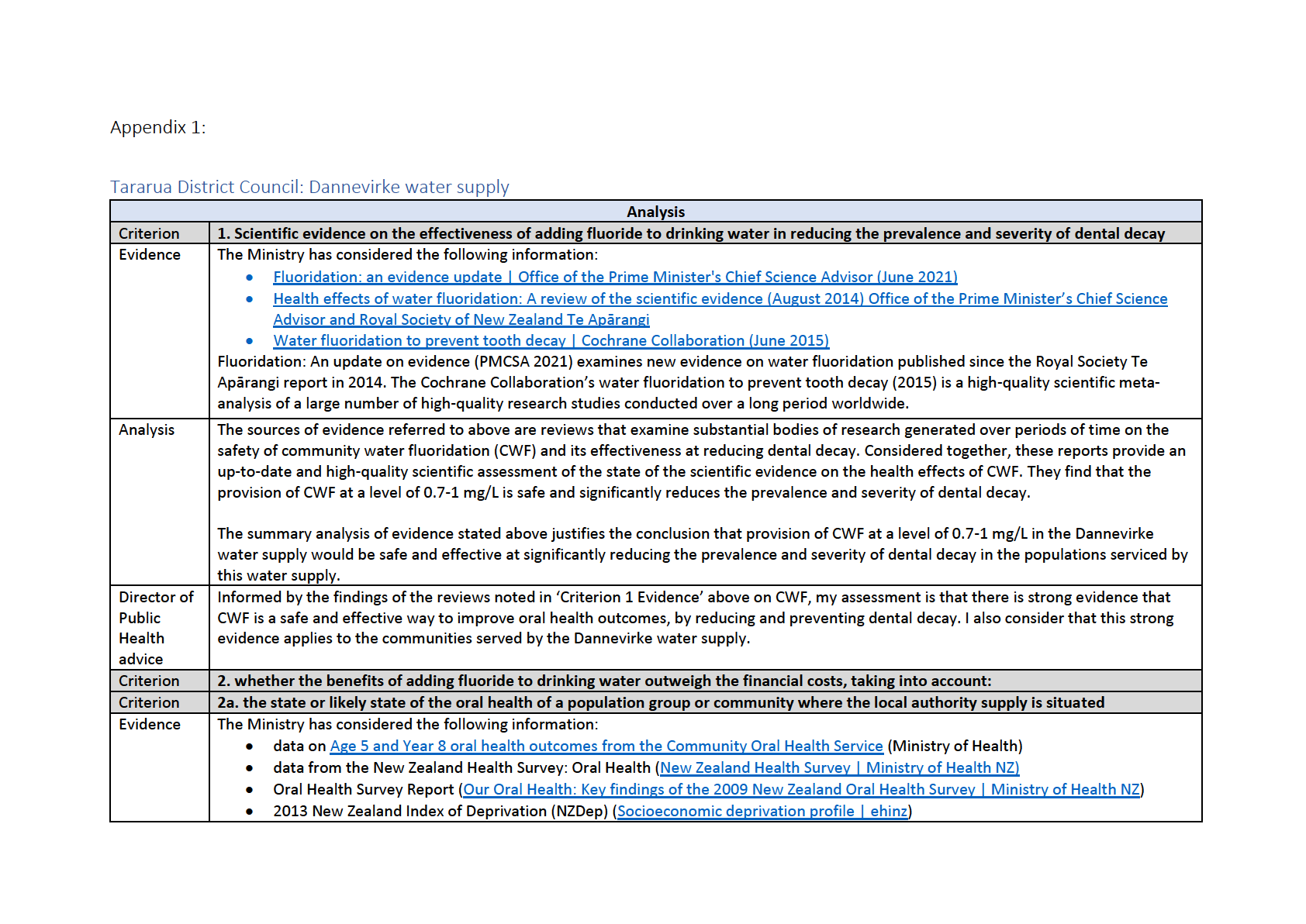
In reaching my decision to issue this direction to you, I considered the scientific
evidence on the effectiveness of adding fluoride to drinking water in reducing the
prevalence and severity of dental decay. I am satisfied that community water
fluoridation is a safe and effective public health measure that significantly reduces the
prevalence and severity of dental decay. In reaching this conclusion, I considered:
Water fluoridation to prevent tooth decay (Cochrane Collaboration 2015),
Health effects
of water fluoridation: A review of the scientific evidence (PMCSA and Royal Society Te
Apārangi 2014) and
Fluoridation: An update on evidence (PMCSA 2021).
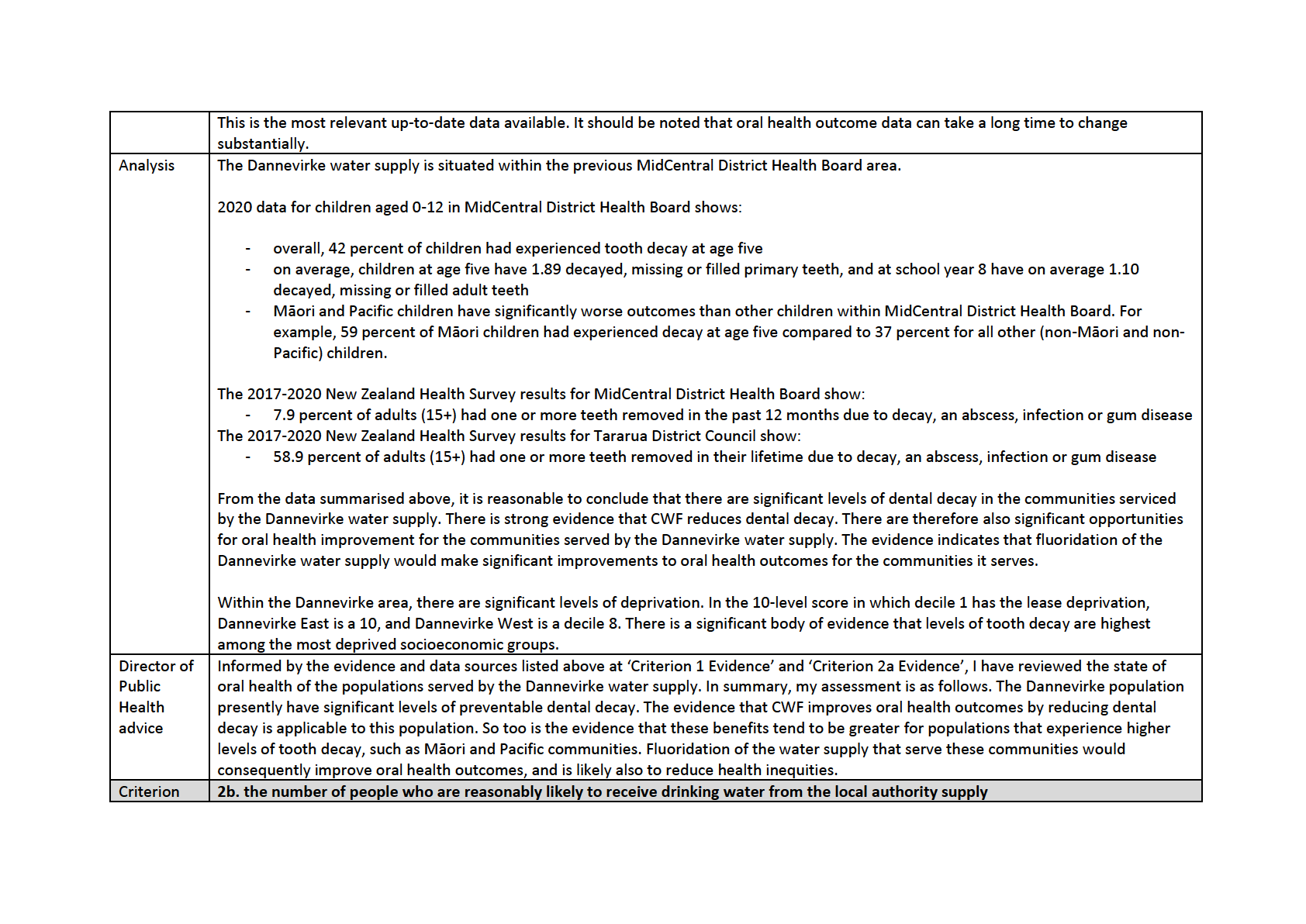
In reaching my decision, I also considered whether the benefits of adding fluoride to the
drinking water outweigh the financial costs, taking into account: the state or likely state
of the oral health of your community served by the Dannevirke supply; the number of
people who are reasonably likely to receive drinking water from this supply; and the
likely financial cost and savings of adding fluoride to the drinking water of this supply,
including any additional financial costs of ongoing management and monitoring.
I am satisfied that the benefits of introducing community water fluoridation across the
Dannevirke drinking water supply outweigh the financial costs of doing so. In reaching
this conclusion, I gave weight to the following:
• the Tararua community would receive significant benefit, through improvement
to the state of its oral health, because fluoridation of the drinking water supply
would significantly reduce the prevalence and severity of dental decay in its
community
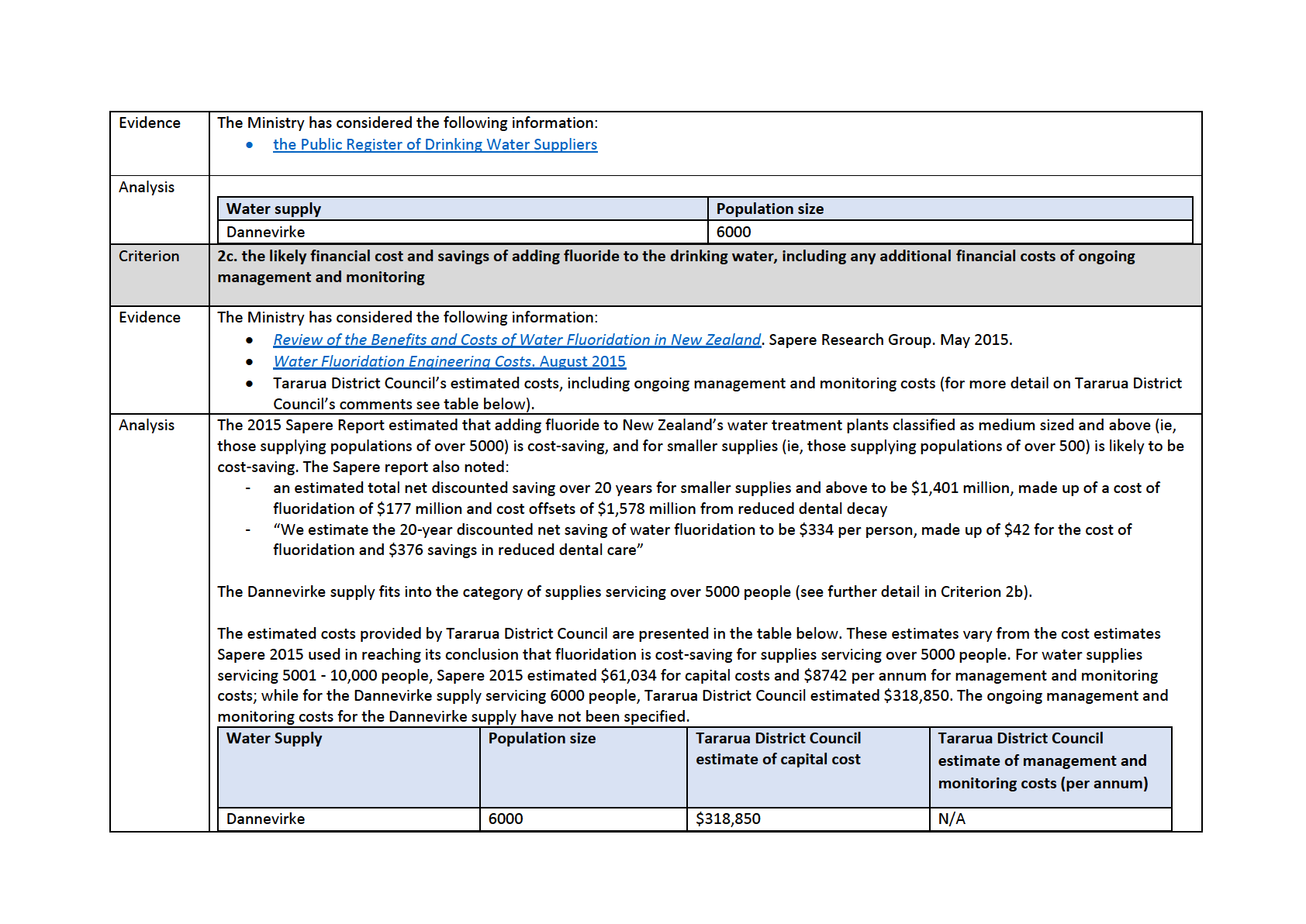
• approximately 6,000 people are reasonably likely to receive drinking water from
the Dannevirke supply
• the likely financial cost and savings of adding fluoride to drinking water for the
Dannevirke supply, including any additional financial costs of ongoing
management and monitoring.
My decision-making process included inviting written comment from Tararua District
Council and having regard to the comments I received. Below I summarise and respond
to the comments I received:
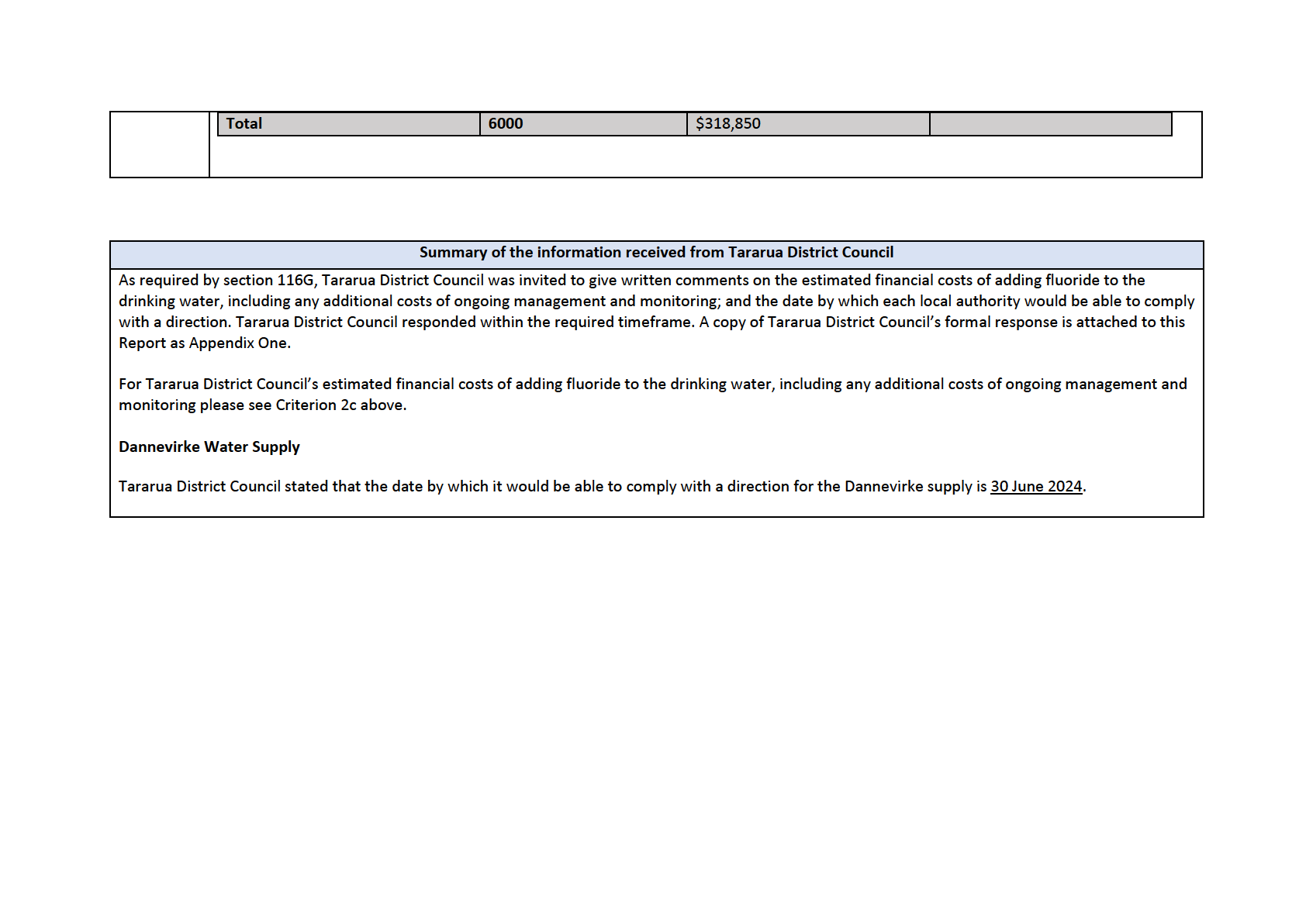
• the estimated capital cost of introducing fluoridation for the Dannevirke supply is
$318,850. Ongoing management and monitoring costs were not specified at this
time.
• the date by which Tararua District Council would be able to comply with a
direction for the Dannevirke drinking water supply is 30 June 2024.
As part of considering whether to issue a direction to fluoridate, I considered the cost
estimates you provided. I also accept the date you specified by which you could comply
with a direction for the Dannevirke drinking water supply. This date is reflected in the
compliance date stated earlier in this letter.
Appendix 1 presents a more extensive summary of the information that informed my
decision-making, including the advice I received and considered from the Director of
Public Health.
Funding
Manatū Hauora is making capital works funding available for local authorities that have
been issued a direction to fluoridate, and that begin work to fluoridate drinking water
supplies by the end of 2022. It will shortly provide detailed information about the
application process for this funding to cover fluoridation-related capital costs.
Communicating this ‘direction to fluoridate’ decision
Manatū Hauora is responsible for communicating this decision at a national level.
Please note too, that as required under section 116E(5) of the Act, all direction letters
will be published on the Manatū Hauora website in due course.
Page 2 of 3
 Next steps
An official from Manatū Hauora will contact your team in the coming weeks to discuss
any needs you might have for further clarity or additional information. Manatū Hauora
recognises that this is a busy time for local authorities and wishes to work with you to
make the process as straightforward as possible for your team.
Nākū noa, nā
Dr Ashley Bloomfield
Te Tumu Whakarae mō te Hauora Director-General of Health
Page 3 of 3
 SAFETY DATA SHEET
Revision date:
SAFETY DATA SHEET
Revision date: 06-Jun-2023
Revision Number 7
1. IDENTIFICATION OF THE MATERIAL AND SUPPLIER
Product identifier
Product Name
HYDROFLUOROSILICIC ACID
Product Code(s)
000000015539
Other means of identification
UN number
1778
Synonyms
Hydrofluorosilicic acid; Hydrofluosilicic acid; Hydrosilicofluoric acid; Silicate(2-),
hexafluoro-, dihydrogen; Fluorosilicic acid; HFA.
Recommended use of the chemical and restrictions on use
Recommended use
Fluoridation of water.
Uses advised against
No information available
Details of the supplier of the safety data sheet
Supplier
Ixom Operations Pty Ltd (Incorporated in Australia)
NZBN: 9429041465226 Address: 166 Totara Street
Mt Maunganui South
New Zealand
Telephone Number: +64 9 368 2700
Facsimile: +64 9 368 2710
For further information, please contact
Contact Point
Product Safety Department
Emergency telephone number
Emergency Telephone
0 800 734 607 (ALL HOURS)
Please ensure you refer to the limitations of this Safety Data Sheet as set out in the "Other Information" section at the end of this Data Sheet.
2. HAZARDS IDENTIFICATION
Classified as a Dangerous Good according to NZS 5433 Transport of Dangerous Goods on Land; DANGEROUS GOODS.
Classified as hazardous according to criteria in the Hazardous Substances (Hazard Classification) Notice 2020.
GHS Classification
SIGNAL WORD
Danger
Water Treatment Chemicals (Corrosive) Group Standard 2020
Approval Number: HSR002681
_____________________________________________________________________________________________
Page 1 / 11

 000000015539
 -
HYDROFLUOROSILICIC ACID
Revision date: 06-Jun-2023
Revision Number 7
_____________________________________________________________________________________________
Corrosive to metals
Category 1
Acute toxicity - Oral
Category 4
Acute toxicity - Dermal
Category 4
Acute toxicity - Inhalation (Dusts/Mists)
Category 4
Skin corrosion/irritation
Category 1 Sub-category C
Serious eye damage/eye irritation
Category 1
Specific target organ toxicity (single exposure)
Category 1
Label elements
Hazard statements
H290 - May be corrosive to metals
H302 - Harmful if swallowed
H312 - Harmful in contact with skin
H314 - Causes severe skin burns and eye damage
H318 - Causes serious eye damage
H332 - Harmful if inhaled
H370 - Causes damage to organs
Precautionary Statements - Prevention
Keep out of reach of children.
Do not breathe dusts or mists
Wash face, hands and any exposed skin thoroughly after handling
Do not eat, drink or smoke when using this product
Use only outdoors or in a well-ventilated area
Wear protective gloves / protective clothing / eye protection / face protection
Precautionary Statements - Response
IF exposed: Call a POISON CENTER or doctor/physician
Specific treatment (see First aid on this SDS)
IF IN EYES: Rinse cautiously with water for several minutes. Remove contact lenses, if present and easy to do. Continue rinsing
Immediately call a POISON CENTER or doctor/physician
IF ON SKIN: Wash with plenty of soap and water
IF ON SKIN (or hair): Remove/Take off immediately all contaminated clothing. Rinse skin with water/shower
Wash contaminated clothing before reuse
IF INHALED: Remove victim to fresh air and keep at rest in a position comfortable for breathing
Immediately call a POISON CENTER or doctor/physician
IF SWALLOWED: Rinse mouth. DO NOT induce vomiting
IF SWALLOWED: Immediately call a POISON CENTER or doctor/physician
Precautionary Statements - Storage
Store locked up
Precautionary Statements - Disposal
Dispose of contents/container in accordance with local, regional, national, and international regulations as applicable
Other hazards which do not result in classification
3. COMPOSITION/INFORMATION ON INGREDIENTS
Mixture
Chemical name
CAS No.
Weight-%
Fluorosilicic acid
16961-83-4
21.0-23.0%
_____________________________________________________________________________________________
Page 2 / 11
000000015539 -
HYDROFLUOROSILICIC ACID
Revision date: 06-Jun-2023
Revision Number 7
_____________________________________________________________________________________________
Hydrofluoric acid
7664-39-3
0.1-<1.0%
Water
7732-18-5
to 100%
4. FIRST AID MEASURES
Description of first aid measures
General advice
For advice, contact a Poisons Information Centre (e.g. phone Australia 13 11 26; New
Zealand 0800 764 766) or a doctor. Immediate medical attention is required. Show this
safety data sheet to the doctor in attendance.
Emergency telephone number
Poisons Information Center, New Zealand: 0800 764 766
Poisons Information Center, Australia: 13 11 26
Inhalation
Remove to fresh air and keep at rest in a position comfortable for breathing. If breathing is
difficult, (trained personnel should) give oxygen. If breathing is irregular or stopped,
administer artificial respiration. Seek immediate medical attention/advice.
Eye contact
Rinse immediately with plenty of water, also under the eyelids, for at least 15 minutes.
Remove contact lenses, if present and easy to do. Continue rinsing. Do not rub affected
area. Immediate medical attention is required.
Skin contact
Wash off immediately with plenty of water for at least 15 minutes. Then apply calcium
gluconate gel. Take off contaminated clothing and wash before reuse. Get immediate
medical advice/attention.
Ingestion
Rinse mouth immediately and drink plenty of water. Do NOT induce vomiting. Never give
anything by mouth to an unconscious person. Get immediate medical advice/attention.
Most important symptoms and effects, both acute and delayed
Symptoms
Irritation/Corrosion. May cause redness and tearing of the eyes. Erythema (skin redness).
Burning.
Indication of any immediate medical attention and special treatment needed
Note to physicians
Treat symptomatically. Can cause corneal burns. Delayed pulmonary edema may occur.
Delayed health effects.
5. FIRE FIGHTING MEASURES
Suitable Extinguishing Media
Suitable Extinguishing Media
Dry chemical, CO2, water spray or regular foam.
Unsuitable extinguishing media
No information available.
Specific hazards arising from the chemical
Specific hazards arising from the
Corrosive hazard. Wear protective gloves/clothing and eye/face protection.
chemical
Non-combustible, substance itself does not burn but may decompose upon heating to
produce corrosive and/or toxic fumes.
Special protective actions for fire-fighters
Special protective equipment for
Firefighters should wear self-contained breathing apparatus and full firefighting turnout
_____________________________________________________________________________________________
Page 3 / 11
000000015539 -
HYDROFLUOROSILICIC ACID
Revision date: 06-Jun-2023
Revision Number 7
_____________________________________________________________________________________________
fire-fighters
gear. Use personal protection equipment.
Hazchem code
2X
6. ACCIDENTAL RELEASE MEASURES
Personal precautions, protective equipment and emergency procedures
Personal precautions
Attention! Corrosive material. Avoid contact with skin and eyes. Do not breathe vapor or
mist. Ensure adequate ventilation. Evacuate personnel to safe areas. Do not touch or walk
through spilled material. Do not eat, drink or smoke when using this product. Wear
protective gloves/protective clothing and eye/face protection. Wash thoroughly after
handling.
For emergency responders
Clear area of all unprotected personnel. Use personal protection recommended in Section
8.
Environmental precautions
Environmental precautions
Prevent further leakage or spillage if safe to do so. Prevent product from entering drains.
Refer to protective measures listed in Sections 7 and 8.
Methods and material for containment and cleaning up
Methods for containment
Stop leak if you can do it without risk. Do not touch or walk through spilled material. Dike far
ahead of spill to collect runoff water. Absorb with earth, sand or other non-combustible
material and transfer to containers for later disposal. Keep out of drains, sewers, ditches
and waterways.
Methods for cleaning up
Soak up with inert absorbent material. Use personal protective equipment as required. Pick
up and transfer to properly labelled containers.
Precautions to prevent secondary hazards
Prevention of secondary hazards
Clean contaminated objects and areas thoroughly observing environmental regulations.
7. HANDLING AND STORAGE
Precautions for safe handling
Advice on safe handling
Do not breathe vapor or mist. Avoid contact with skin, eyes, and clothing. Ensure adequate
ventilation. Use personal protection equipment. Use according to package label
instructions. Handle in accordance with good industrial hygiene and safety practice. Always
add the acid to water, never the reverse. Keep out of reach of children. Not to be available
except to authorised or licensed persons.
General hygiene considerations
Take off contaminated clothing and wash it before reuse. Do not eat, drink or smoke when
using this product. Wash hands before breaks and immediately after handling the product.
Conditions for safe storage, including any incompatibilities
Storage Conditions
Keep containers tightly closed in a cool, well-ventilated place. Store locked up. Store away
from foodstuffs. Store away from incompatible materials described in Section 10. Keep
container closed when not in use.
Incompatible materials
Alkalis. Organic compounds. Metals.
_____________________________________________________________________________________________
Page 4 / 11




 000000015539
 -
HYDROFLUOROSILICIC ACID
Revision date: 06-Jun-2023
Revision Number 7
_____________________________________________________________________________________________
8. EXPOSURE CONTROLS/PERSONAL PROTECTION
Control parameters
Exposure Limits
No value assigned for this specific material by the New Zealand Workplace Health & Safety
Authority. However, Workplace Exposure Standard(s) for constituent(s):
Chemical name
New Zealand
ACGIH
Hydrofluoric acid
2 mg/L urine prior to shift Fluoride
7664-39-3
3 mg/L urine end of shift Fluoride
Fluorides, as F: WES-TWA 2.5 mg/m3, bio
Hydrogen fluoride, as F: Ceiling 3 ppm, 2.6 mg/m3
As published by the New Zealand Workplace Health & Safety Authority.
WES - TWA (Workplace Exposure Standard - Time Weighted Average) - The eight-hour, time-weighted average exposure
standard is designed to protect the worker from the effects of long-term exposure.
The Biological Exposure Indices (bio) are not applicable to non-metal fluorides and organic fluoride-containing compounds.
WES - Ceiling (Workplace Exposure Standard - Ceiling). A concentration that should not be exceeded during any part of the
working day.
These Workplace Exposure Standards are guides to be used in the control of occupational health hazards. All atmospheric
contamination should be kept to as low a level as is workable. These workplace exposure standards should not be used as fine
dividing lines between safe and dangerous concentrations of chemicals. They are not a measure of relative toxicity.
Appropriate engineering controls
Engineering controls
Apply technical measures to comply with the occupational exposure limits.
If in the handling and application of this material, safe exposure levels could be exceeded,
the use of engineering controls such as local exhaust ventilation must be considered and
the results documented. If achieving safe exposure levels does not require engineering
controls, then a detailed and documented risk assessment using the relevant Personal
Protective Equipment (PPE) (refer to PPE section below) as a basis must be carried out to
determine the minimum PPE requirements.
Individual protection measures, such as personal protective equipment
The selection of PPE is dependent on a detailed risk assessment. The risk assessment should consider the work situation, the
physical form of the chemical, the handling methods, and environmental factors.
OVERALLS, CHEMICAL GOGGLES, FACE SHIELD, GLOVES (Long), APRON, RUBBER BOOTS.
Eye/face protection
Tight sealing safety goggles. If splashes are likely to occur:. Face protection shield.
Hand protection
Elbow-length impervious gloves.
_____________________________________________________________________________________________
Page 5 / 11
000000015539 -
HYDROFLUOROSILICIC ACID
Revision date: 06-Jun-2023
Revision Number 7
_____________________________________________________________________________________________
Skin and body protection
Overalls. Boots. Splash apron or equivalent chemical impervious outer garment.
Respiratory protection
If determined by a risk assessment an inhalation risk exists, wear a suitable mist respirator
meeting the requirements of AS/NZS 1715 and AS/NZS 1716.
Environmental exposure controls
No information available.
9. PHYSICAL AND CHEMICAL PROPERTIES
Information on basic physical and chemical properties
Physical state
Liquid
Appearance
No information available
Color
Pale Yellow
Odor
Characteristic , Pungent , Acidic
Odor threshold
No information available
Property
Values
Remarks • Method
pH
No data available
None known
Melting point / freezing point
-15°C to -21°C
None known
Boiling point / boiling range
>100°C
None known
Flash point
Not applicable
None known
Evaporation rate
No data available
None known
Flammability (solid, gas)
No data available
None known
Flammability Limit in Air
None known
Upper flammability or explosive
Not applicable
limits
Lower flammability or explosive Not applicable
limits
Vapor pressure
18 mm Hg @20°C
None known
Vapor density
No data available
None known
Relative density
1.16-1.22 @20°C
None known
Water solubility
Miscible in water
None known
Solubility(ies)
No data available
None known
Partition coefficient
No data available
None known
Autoignition temperature
Not applicable
None known
Decomposition temperature
105°C
None known
Kinematic viscosity
No data available
None known
Dynamic viscosity
No data available
None known
Other information
10. STABILITY AND REACTIVITY
Reactivity
Reactivity
Corrosive to metals. Reacts with alkalis.
Chemical stability
Stability
Stable under normal ambient and anticipated storage and handling conditions of
temperature and pressure.
Explosion data
Sensitivity to mechanical impact
None.
Sensitivity to static discharge
None.
_____________________________________________________________________________________________
Page 6 / 11
000000015539 -
HYDROFLUOROSILICIC ACID
Revision date: 06-Jun-2023
Revision Number 7
_____________________________________________________________________________________________
Possibility of hazardous reactions
Possibility of hazardous reactions Contact with metals may evolve flammable hydrogen gas. Hydrogen fluoride will react with
all silicon containing materials such as glass, concrete, and chemical spill sorbents such as
vermiculite. This reaction will cause the generation of the highly toxic gas, silicon
tetrafluoride.
Conditions to avoid
Conditions to avoid
Contact with foodstuffs.
Incompatible materials
Incompatible materials
Alkalis. Organic compounds. Metals.
Hazardous decomposition products
Hazardous decomposition products Hydrogen fluoride. Oxides of silicon. Fluorides.
11. TOXICOLOGICAL INFORMATION
Acute toxicity
Information on likely routes of exposure
Product Information
No adverse health effects expected if the chemical is handled in accordance with this
Safety Data Sheet and the chemical label. Symptoms or effects that may arise if the
chemical is mishandled and overexposure occurs are:
Inhalation
May cause irritation. Delayed (up to 48hours) fluid build up in the lungs may occur.
Eye contact
Corrosive to the eyes and may cause severe damage including blindness.
Skin contact
Contact causes severe skin irritation and possible burns.
Ingestion
Ingestion may cause gastrointestinal irritation, nausea, vomiting and diarrhoea. Can burn
mouth, throat, and stomach.
Symptoms
Irritation/Corrosion. May cause redness and tearing of the eyes. Erythema (skin redness).
Burning.
Acute toxicity
Numerical measures of toxicity
Refer to component information below.
Component Information
Chemical name
Oral LD50
Dermal LD50
Inhalation LC50
Fluorosilicic acid
= 430 mg/kg ( Rat )
-
= 1.11 mg/L ( Rat ) 1 h
Hydrofluoric acid
-
-
= 0.79 mg/L ( Rat ) 1 h
See section 16 for terms and abbreviations
Delayed and immediate effects as well as chronic effects from short and long-term exposure
Skin corrosion/irritation
Causes burns. Classification is based on mixture calculation methods based on component
data.
_____________________________________________________________________________________________
Page 7 / 11
000000015539 -
HYDROFLUOROSILICIC ACID
Revision date: 06-Jun-2023
Revision Number 7
_____________________________________________________________________________________________
Serious eye damage/eye irritation
Causes serious eye damage. Classification is based on mixture calculation methods based
on component data.
Respiratory or skin sensitization
No information available.
Germ cell mutagenicity
No information available.
Carcinogenicity
Fluoride ion has been classified by the International Agency for Research on Cancer
(IARC) as a Group 3 agent. Group 3 - The agent is not classifiable as to its carcinogenicity
to humans. Data available is insufficient for an assessment to be made.
Reproductive toxicity
No information available.
STOT - single exposure
No information available.
STOT - repeated exposure
Causes damage to organs. Classification is based on mixture calculation methods based
on component data.
Aspiration hazard
No information available.
Chronic effects:
Repeated or prolonged exposure may result in bone changes (fluorosis). Fluorosis in
humans can result with the repeated ingestion of >6mg of fluorine per day. The fluoride
accumulates in bone and can lead to the development of osteosclerosis and other bone
changes. Teeth may also be affected.
Symptoms of fluorosis may include weight loss, brittle bones, anaemia, weakness and
stiffness of joints.
12. ECOLOGICAL INFORMATION
Ecotoxicity
Ecotoxicity
Keep out of waterways. Avoid contaminating waterways.
Terrestrial ecotoxicity
There is no data for this product.
Chemical name
Algae/aquatic plants
Fish
Crustacea
Fluorosilicic acid
-
LC50: =65mg/L (96h, Poecilia
-
reticulata) LC50: =28.7mg/L (96h,
Pimephales promelas)
Hydrofluoric acid
-
LC50: =660mg/L (48h, Leuciscus
EC50: =270mg/L (48h, Daphnia
idus)
species)
Persistence and degradability
Persistence and degradability
No information available.
Bioaccumulative potential
Bioaccumulation
No information available.
Mobility
Mobility in soil
No information available.
Chemical name
Partition coefficient
Hydrofluoric acid
-1.4
_____________________________________________________________________________________________
Page 8 / 11
000000015539 -
HYDROFLUOROSILICIC ACID
Revision date: 06-Jun-2023
Revision Number 7
_____________________________________________________________________________________________
Other adverse effects
Other adverse effects
No information available.
13. DISPOSAL CONSIDERATIONS
Waste treatment methods
Waste from residues/unused
Dispose of product in packaging/container in a way that is consistent with the Hazardous
products
Substances (Disposal) Notice 2017 and the Act, and Hazardous Substances (Amendments
and Revocations) Notice 2020. Treat the chemical using a method that changes the
characteristics or composition of the chemical so that the chemical is no longer a hazardous
chemical; or export the chemical from New Zealand as waste. Class 6 and 8 chemicals –
may be discharged into the environment if a tolerable exposure limit has been set for the
substance (or a component of that chemical); and the discharge does not, after reasonable
mixing, result in the concentration of the substance in an environmental medium exceeding
the tolerable exposure limit. If there is not tolerable exposure limit for the substance, then it
may only be discharged into the environment if the substance is very rapidly converted to
substances that are not hazardous substances.
Contaminated packaging
For packages that have been in direct contact with hazardous chemicals, the person must
ensure that the package is rendered incapable of containing any chemical. It must be
disposed of in a manner that is consistent with the requirements for disposal of the
chemical that it contained, taking into account the material the package is manufactured
from. Packages may only be reused or recycled if the package has been treated to remove
any residual contents of the hazardous chemical (class 1, 2, 3, 4, or 5); or the contents of
the residue in the package are below the threshold for the chemical to be classified as
hazardous (class 6, 8, or 9 chemical).
14. TRANSPORT INFORMATION
ROAD AND RAIL TRANSPORT
Classified as a Dangerous Good according to NZS 5433 Transport of Dangerous Goods on
Land; DANGEROUS GOODS.
UN number
1778
Proper shipping name
FLUOROSILICIC ACID
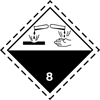
Hazard class
8
Packing group
II
Hazchem code
2X
IATA
Classified as Dangerous Goods by the criteria of the International Air Transport Association
(IATA) Dangerous Goods Regulations for transport by air; DANGEROUS GOODS.
UN number
1778
UN proper shipping name
FLUOROSILICIC ACID
Transport hazard class(es)
8
Packing group
II
IMDG
Classified as Dangerous Goods by the criteria of the International Maritime Dangerous
Goods Code (IMDG Code) for transport by sea; DANGEROUS GOODS.
UN number
1778
UN proper shipping name
FLUOROSILICIC ACID
Transport hazard class(es)
8
Packing group
II
IMDG EMS Fire
F-A
IMDG EMS Spill
S-B
Marine pollutant
No
_____________________________________________________________________________________________
Page 9 / 11
000000015539 -
HYDROFLUOROSILICIC ACID
Revision date: 06-Jun-2023
Revision Number 7
_____________________________________________________________________________________________
15. REGULATORY INFORMATION
Safety, health and environmental regulations/legislation specific for the substance or mixture
New Zealand
National regulations
See section 8 for national exposure control parameters
.
International Inventories
NZIoC
All the constituents of this material are listed on the New Zealand Inventory of Chemicals.
TSCA
Contact supplier for inventory compliance status.
DSL/NDSL
Contact supplier for inventory compliance status.
EINECS/ELINCS
Contact supplier for inventory compliance status.
ENCS
Contact supplier for inventory compliance status.
IECSC
Contact supplier for inventory compliance status.
KECL
Contact supplier for inventory compliance status.
PICCS
Contact supplier for inventory compliance status.
AIIC
All the constituents of this material are listed on the Australian Inventory of Industrial
Chemicals.
Legend: NZIoC - New Zealand Inventory of Chemicals
TSCA - United States Toxic Substances Control Act Section 8(b) Inventory
DSL/NDSL - Canadian Domestic Substances List/Non-Domestic Substances List
EINECS/ELINCS - European Inventory of Existing Chemical Substances/European List of Notified Chemical Substances
ENCS - Japan Existing and New Chemical Substances
IECSC - China Inventory of Existing Chemical Substances
KECL - Korean Existing and Evaluated Chemical Substances
PICCS - Philippines Inventory of Chemicals and Chemical Substances
AIIC- Australian Inventory of Industrial Chemicals
International Regulations
The Montreal Protocol on Substances that Deplete the Ozone Layer Not applicable
The Stockholm Convention on Persistent Organic Pollutants Not applicable
The Rotterdam Convention Not applicable
16. OTHER INFORMATION
Prepared By
This Safety Data Sheet has been prepared by Ixom Operations Pty Ltd (Toxicology and
SDS Services).
Issuing Date:
06-Jun-2023
Reason(s) For Issue:
Change in Physical Properties
Revision Note:
The symbol (*) in the margin of this SDS indicates that this line has been revised.
Key or legend to abbreviations and acronyms used in the safety data sheet
Legend Section 8: EXPOSURE CONTROLS/PERSONAL PROTECTION
_____________________________________________________________________________________________
Page 10 / 11
000000015539 -
HYDROFLUOROSILICIC ACID
Revision date: 06-Jun-2023
Revision Number 7
_____________________________________________________________________________________________
TWA
TWA (time-weighted average)
STEL
STEL (Short Term Exposure Limit)
Ceiling
Maximum limit value
*
Skin designation
C
Carcinogen
Key literature references and sources for data used to compile the SDS
Agency for Toxic Substances and Disease Registry (ATSDR)
U.S. Environmental Protection Agency ChemView Database
European Food Safety Authority (EFSA)
EPA (Environmental Protection Agency)
Acute Exposure Guideline Level(s) (AEGL(s))
U.S. Environmental Protection Agency Federal Insecticide, Fungicide, and Rodenticide Act
U.S. Environmental Protection Agency High Production Volume Chemicals
Food Research Journal
Hazardous Substance Database
International Uniform Chemical Information Database (IUCLID)
Japan GHS Classification
Australian Industrial Chemicals Introduction Scheme (AICIS)
NIOSH (National Institute for Occupational Safety and Health)
National Library of Medicine's ChemID Plus (NLM CIP)
National Library of Medicine's PubMed database (NLM PUBMED)
National Toxicology Program (NTP)
New Zealand's Chemical Classification and Information Database (CCID)
Organization for Economic Co-operation and Development Environment, Health, and Safety Publications
Organization for Economic Co-operation and Development High Production Volume Chemicals Program
Organization for Economic Co-operation and Development Screening Information Data Set
RTECS (Registry of Toxic Effects of Chemical Substances)
World Health Organization
Disclaimer
This SDS summarises to our best knowledge at the date of issue, the chemical health and safety hazards of the material
and general guidance on how to safely handle the material in the workplace. Since Ixom Operations Pty Ltd cannot
anticipate or control the conditions under which the product may be used, each user must, prior to usage, assess and
control the risks arising from its use of the material.
If clarification or further information is needed, the user should contact their Ixom representative or Ixom Operations Pty
Ltd at the contact details on page 1.
Ixom Operations Pty Ltd's responsibility for the material as sold is subject to the terms and conditions of sale, a copy of
which is available upon request.
End of Safety Data Sheet
_____________________________________________________________________________________________
Page 11 / 11
