
Document 1
1982
ACT
Request for Proposal (RFP)
by: Ministry of Education
INFORMATION
for: A Standardised Assessment and Aromatawai Tool
ref: MOE29225
OFFICIAL
RFP released:
07/03/2025
Deadline for Questions:
12pm 27/03/2025
Deadline for Proposals:
5pm 08/04/2025
THE
*Note all times and dates are NZ daylight time (NZDT) or NZ standard time (NZST)
Ministry of EducationUNDER
www.education.govt.nz
1 The Terrace WELLINGTON
RELEASED
Introductory Glossary of Terms
Note: A full glossary is available in
Appendix 1 – Glossary.
Term
Explanation
Ākonga
Student
1982
Aromatawai
Aromatawai focusses on the ākonga, what they can do, their learning journey and
experiences, the relationship between kaiako and ākonga, and how that information can
support learning, instantly, and over time. Assessment informs a portion of aromatawai.
ACT
Functional Requirement
The specific features or functionality that a solution must have to meet the needs of the
Ministry and achieve its objectives
Kaiako
Teacher
Kura
School
Non-functional requirement The qualities or attributes that a solution must have such as performance, reliability,
usability and security
Pāngarau
A Wāhanga Ako within Te Marautanga o Aotearoa that focuses on the delivery of maths.
INFORMATION
Pānui
A Wāhanga Ako within Te Marautanga o Aotearoa that focuses on the delivery of reading.
Respondent
A company, organisation or individual that submits a proposal to provide the standardised
assessment and aromatawai tool to the Ministry.
Responses
The information, documents or other artefacts that the Respondent submit in response to
the Ministry’s RFP
OFFICIAL
Te Marautanga o Aotearoa Curriculum used to design teaching and learning programmes in and through te reo Māori
and reflects a te ao Māori view.
THE
Te Reo Māori
A Wāhanga Ako within Te Marautanga o Aotearoa that focuses on the delivery of the te reo
Māori language and its domains (including pānui and tuhituhi, reading and writing
domains).
The New Zealand Curriculum Curriculum that is taught in all English medium settings.
UNDER
Tuhituhi
Writing domain within Te Marautanga o Aotearoa.
Wāhanga Ako
The areas of knowledge and understanding covered, the skills and learner dispositions to be
developed, and the levels of knowledge, skills and understandings to be achieved by ākonga
throughout their years of schooling.
Whānau
Extended family or family group. In the modern context the term is sometimes used to
include friends who may not have any kinship ties to other members.
RELEASED
Request for Proposal Standardised Assessment and Aromatawai Tool – March 2025
Page
2
link to page 3 link to page 3
The opportunity
This RFP is issued by Ministry of Education referred to below as “the Buyer” or “we” or “us”.
We require a new ‘Standardised Tool for Assessment and Aromatawai’ that will deliver a long-term solution
to support all schools and kura to effectively enact twice-yearly assessment of learners and is aligned to Years
3 to 10 of the new National Curriculum (The New Zealand Curriculum and Te Marautanga o Aotearoa). 1982
Through the ‘Teaching the Basics Brilliantly
’1 policy, the Government has committed to lifting student
outcomes in reading, writing, maths, pānui, tuhituhi and pāngarau, and have set an ambitious target of 80
ACT
percent of Year 8 students at, or above, the expected curriculum level for their age in reading, writing and
maths by December 2030 (Government Target
72).
To achieve this, we are introducing a whole-of-pathway approach to assessment, aromatawai, reporting and
monitoring across our schooling system so that good quality data about students’ learning progress is
available to inform teaching and learning, provide timely information to parents, whānau and caregivers, and
underpin decisions at every level of the education system (including where any extra support or interventions
are required at a system level).
An important foundational aspect of this is the need to purchase a standardised tool to support schools and
INFORMATION
kura with assessment of students because, unlike many comparable jurisdictions, New Zealand currently has
no standardised assessment tool that provides a clear view of how individual students are progressing until
NCEA Level 1 (Year 11). To close this gap, we are seeking a tool which:
• Measures student progress and achievement.
• Closely aligns with the National Curriculum for schooling (The New Zealand Curriculum and Te
OFFICIAL
Marautanga o Aotearoa).
• Helps to inform decisions on targeted support for individual students who require it.
•
THE
Is based on up-to-date technology.
• Provides highly useful analysis and reporting of results, including:
o Support for teachers and kaiako with reporting to parents, whānau and caregivers on student
progress and achievement, as well as
UNDER
o Monitoring and insights at the education system level.
The tool will directly support the Government’s core education priorities, especially:
• Smarter assessment and reporting: Implementing consistent modes of monitoring student progress
and achievement.
• Greater use of data: Using data and evidence to drive consistent improvement in achievement.
RELEASED
1 https://www.national.org.nz/policies/teaching-the-basics-brilliantly
2 https://www.dpmc.govt.nz/sites/default/files/2024-12/gt-factsheet-target-7-sep24.pdf
Request for Proposal Standardised Assessment and Aromatawai Tool – March 2025
Page
3
What we need
The Ministry is seeking a proven ‘Software as a Service’ (SaaS) solution from a provider with demonstrable
experience delivering mature, effective, bilingual assessment tools to similarly sized and complex
organisations. The solution must:
• Provide the ability to cater for both English and te reo Māori language (acknowledging that a te reo
Māori language solution may not exist currently therefore the requirement is that the solution offers
1982
dual language capability).
• Offer initial capacity for approximately 1.6 million tests undertaken twice yearly by 540,000 students
in the domains of reading, writing, maths, pānui, tuhituhi and pāngarau.
ACT
• Be implemented expediently, preferably only requiring configuration, not customisation.
• Support the diversity of New Zealand students and ākonga, as well as schools and kura.
• Have a proven track record.
• Be intuitive for teachers and kaiako to use with no or minimal training.
• Ability to interact with other Education systems.
The Ministry also wishes to understand if Respondents have:
INFORMATION
1. An existing bank of reading, writing and/or mathematics items in English that the Ministry could align
to the New Zealand Curriculum, and potentially be used for te reo Māori assessment items; and / or
2. Any item / content development services in English that Respondents can make available to the
Ministry.
What we don’t want
OFFICIAL
We do not want proposals that:
•
THE
Require heavy customisation or that are bespoke solutions,
• Solutions that are not tried and tested and/or not currently in use with an existing customer(s), and
• Unduly increase the burden to teachers and kaiako, or the Ministry.
UNDER
What’s important to us?
Currently, not enough schools are assessing students using robust tools that consistently measure progress
against the National Curriculum.
A standardised Assessment and Aromatawai tool will provide teachers and kaiako with the insights and data
they need to understand and respond to individual student progress and achievement over time (and get
targeted, equitable access to intervention or extension support as needed). It will also facilitate better
RELEASED
information sharing with parents, whānau and caregivers – as well as students themselves. Because we have
a diverse education workforce, with variable assessment and aromatawai capability, the tool must be user
friendly and simple to incorporate into the busy schedules of classroom teachers and kaiako.
A standardised assessment tool will also provide valuable data to inform policy decisions that will help shape
effective system-wide (or targeted) investments and strategies. Therefore, the Ministry is looking for a
Request for Proposal Standardised Assessment and Aromatawai Tool – March 2025
Page
4
link to page 5
mature, fit-for-purpose, cost effective solution from a credible provider who can offer an existing SaaS tool
that will meet our requirements and implementation timeframe.
We need the solution to be available at the start of 2026 with change management / engagement
opportunities for teachers and kaiako from Term 4, 202
53.
Providers need to have knowledge and experience of, or in, the education sector and must have an excellent
track record in terms of implementation of their proposed solution.
1982
Why should you bid?
ACT
This is an opportunity to contribute to an important educational initiative to support New Zealand educators
and their students and to improve overall educational outcomes.
This solution will be a key contributor to achieving the Government’s target of 80 percent of Year 8 students
at, or above, the expected curriculum level for their age in reading, writing and maths by December 2030.
The successful provider will be working with passionate and capable sector representatives and Ministry staff
who are highly invested in the implementation and on-going success of our chosen solution.
The Ministry intends to develop a long-term relationship with the successful provider with the potential of up
to a 9-year contract (5 years + 2 years + 2 years).
INFORMATION
A bit about us
The Ministry plays a critical role in shaping the education system to deliver equitable and excellent outcomes
for all children and young people. The education system touches every person, family, whānau and
community in New Zealand.
OFFICIAL
The Ministry (both regionally and centrally) performs a crucial role in supporting schools and kura to design
and implement teaching and learning programmes that deliver the national curricula and provide access to a
THE
nationally and internationally recognised qualification, so that every student can attain their highest possible
standard in educational achievement. This includes supporting schools and kura to monitor and report on
student performance using good quality assessment and aromatawai information.
New Zealand is a bilingual and multi-cultural society and as such, students and ākonga can learn in English, te
reo Māori or both. Therefore, we need a tool that can be used to assess students in their chosen language of
UNDER
learning or has this potential in the implementation timeline.
The Ministry assists over 2,500 schools and kura, as well as 64,000 teachers and kaiako, to deliver education
services to approximately 830,000 students and ākonga. Schools and kura can teach one of two curricula:
•
The New Zealand Curriculum (NZC) for use in English-medium settings.
•
Te Marautanga o Aotearoa (TMoA) (Māori Curriculum), for use in kura delivering teaching and
RELEASED
learning programmes through Te Reo Māori.
3 https://www.education.govt.nz/term-dates-and-holidays
Request for Proposal Standardised Assessment and Aromatawai Tool – March 2025
Page
5
SECTION 1: Key Information
1.1 Context
This Request for Proposals (RFP) is an invitation to submit a Proposal for the provision of Software as a
Service (SaaS) Standardised Assessment and Aromatawai tool contract opportunity.
1982
This RFP is a single-step, multistage, procurement process. The Ministry intends to evaluate submissions and
down select to a smaller number of participants to have more detailed workshops and conversations with
prior to deciding on a preferred supplier.
ACT
1.2 Our timeline
Our timeline for this RFP as follows (
all are New Zealand times and dates):
Action
Indicative date
(dd/mm/yyyy)
Request For Proposal
Request for Proposal advertised on GETS
07/03/2025
INFORMATION
Last date for supplier questions
12pm 27/03/2025
Respondents' complete intention to respond form and
5pm 27/03/2025
request “one time” access to the repository for submission of
videos
Last date for the Ministry to answer questions
31/03/2025
OFFICIAL
Ministry to provide “one time” link for Respondent to submit
31/03/2025
their video as part of their submission
THE
Request for Proposal closing date – ensure that videos are
5pm 08/04/2025
submitted by closing date and time.
Evaluation process
09/04/2025 –
05/06/2025
UNDER
Shortlisted respondents notified and invited to participate
02/05/2025
(online) in workshop/interactive solution refinement dialogue
(dialogue sessions). The notification/invitation will state their
session times and specific content to enable you to prepare
for these sessions
Interactive solution refinement dialogue with shortlisted
08/05/2025 –
respondents.
20/05/2025
RELEASED
Request refined submission from shortlisted respondents
21/05/2025
Respondents submit refined Proposal via GETS
27/05/2025
Post Evaluation
Notification of outcome of the preferred respondent
06/06/2025
Request for Proposal Standardised Assessment and Aromatawai Tool – March 2025
Page
6
link to page 10 link to page 17
Contract negotiation commences
13/06/2025
Contract negotiation completed
27/06/2025
Contract award
11/07/2025
Contract award notice published and debrief offered to all
July 2025
respondents (successful and unsuccessful)
1982
1.3 How to contact us
ACT
Contact us through our Point of Contact the Government Electronic Tenders System (GETS).
a.
Point of Contact:
All enquiries must be directed through the GETS.
Question Function v
ia http://www.gets.govt.nz/. We will manage all external communications through GETS.
b. Respondents can contact GETS Helpdesk if they require assistance on GETS.
GETS Helpdesk
INFORMATION
New Zealand based callers - Phone: 0508 GETS HELP (0508438743)
International: +64 4 9013188
Email
: [email address]
OFFICIAL
c. If there is an issue and the Respondent cannot get the response required from the GETS team, then
please contact the Ministry’s point of contact for this Procurement.
Robbie Mckechnie – Senior Procurement Specialist
THE
Email:
[email address]
1.4 Developing and submitt
UNDER
ing your Proposal
a. This is an open competitive tender process.
b. Take time to read and understand the RFP.
c. Take time to understand our Requirements. These are referenced
in SECTION 2: of this document.
d. Take time to understand how your Proposal will be evaluated. See
SECTION 3: of this document.
RELEASED
e. For resources on tendering visit
https://www.procurement.govt.nz/suppliers-2/
f. If you have questions, ask our Point of Contact before the Deadline for Questions (see Section 1.3 above).
Request for Proposal Standardised Assessment and Aromatawai Tool – March 2025
Page
7
g. Complete and submit your
Response 1 - Notice to Respond and Video Submission Form. This form must be
submitted via GETS by
5pm 27/03/2025. This form will also request the Ministry to provide access to our
online secure storage solution for you to submit your videos.
h. Use the
Response 2 - RFP Response Form as provided in the tender pack on GETS to submit your Proposal.
i. Complete and sign the declaration at the end of the
Response 2 - RFP Response Form.
1982
j. Complete the requirements conformance statements using
Response 3 - Functional Requirements
Conformance Workbook and
Response 4 - Non-Functional Requirements Conformance Workbook.
ACT
k. Upload your Demonstrable Conformance videos to the Ministry online secure storage solution (not to
GETS).
l. Use
Response 5 - Pricing Schedule as provided in the tender pack on GETS for your pricing information.
m. As this is a two-envelope system, all financial information must be submitted in the separate pricing
response form provided as an attachment to this RFP.
n. Ensure that you adhere to any, limit on number of pages or format for supporting artefacts. Pages in
excess of the page limits stated, will be removed from evaluation.
INFORMATION
o. Check you have provided all the requested information.
p. Submit your Proposal before the Deadline for Proposals.
Respondents are required to:
OFFICIAL
Complete and return the
Response 1 - Notice to Respond and Video Submission Form by
5pm 27/03/2025.
THE
Submit the
Response 2 - RFP Response Form, pricing form and any other information requested by the
Ministry in the RFP by the date and time stated in this RFP by
5pm 08/04/2025.
Submit videos that demonstrate the solution capability as requested, to the Ministry’s secure online
document storage solution by
5pm 08/04/2025. The address for submitting your videos will be provided to
you in response to the
Response 1 - Notice to Respond and Video Submission Form being received.
UNDER
Submit your Proposal via GETS to the following address:
www.gets.govt.nz
How to register as a supplier on GETS? Please visit here
: https://www.gets.govt.nz/RegisterUser.htm
Any questions regarding GETS, contact GETS directly for suppor
t: https://www.gets.govt.nz/ContactUs.htm
If you are unable to up
RELEASED load your response to GETS due to technical issues which the GETS team cannot solve,
please contact our Point of Contract before the deadline to arrange an email submission.
We will NOT accept any late submissions or submissions sent by post or delivered to our office.
Request for Proposal Standardised Assessment and Aromatawai Tool – March 2025
Page
8
link to page 29
1.5 Our RFP Terms
a.
Offer Validity Period
By submitting a Proposal, the Respondent agrees that their offer will remain open for
three calendar
months from the Deadline for Proposals.
b.
RFP Terms
By submitting a Proposal, the Respondent agrees to the RFP-Terms described in
SECTION 6: .
1982
Remember, if a Respondent commits a non-trivial breach of the RFP-Terms, we may exclude them from
further participation in the RFP process, whether or not that requirement is contractually binding.
ACT
1.6 Later changes to the RFP or RFP process
After publishing the RFP, if we need to change anything or provide additional information, we will let all
Respondents know by placing a notice on GETS. All respondents that have registered on GETS for this
procurement opportunity will be notified if/when any notices pertaining to this procurement are published.
1.7 Defined terms
These are shown using capitals. You can find all definitions at the back of the RFP-Terms.
INFORMATION
1.8 Probity
An independent external probity auditor has been appointed for this RFP process and verify that the
procedures set out in this RFP are complied with. The external probity auditor does not contribute to any
decisions made during the evaluation process and is not a scoring member of the evaluation panel.
OFFICIAL
A respondent concerned about any procedural issue has the right to contact the appointed external probity
auditor and request their review. The name and contact details of the external probity auditor are as follows:
THE
Minnie Prakash (Assurance Director)
McHale Group Ltd, PO Box 25103, Wellington 6146, New Zealand
Mobile: +64 27 446 2274 | Email:
[email address]
UNDER
The role of the external probity auditor includes the following:
• Giving confidence to both you and us that the RFP process is robust and transparent, befitting a major
public procurement project.
• Providing independent assurance that the process carried out is consistent with the RFP
documentation.
• Acting as a contact point for us to address any probity-related issues raised by respondents, and
investigating the issues further, following agreement from us and the relevant respondents.
RELEASED
Request for Proposal Standardised Assessment and Aromatawai Tool – March 2025
Page
9
SECTION 2: Our Requirements
2.1 Background
This procurement relates to Government Target 7, that is ‘More students at expected curriculum levels’.
Specifically, the Ministry is seeking to implement twice yearly national standardised assessments for all
student and ākonga years 3 to 10.
1982
Such standardised assessments have not been undertaken in the past.
ACT
Going forward we wish to provide New Zealand schools and kura with a fit-for-purpose ‘Software as a
Service’ (SaaS) solution for consistent and reliable understanding of student progress and achievement in
reading, writing, maths, pānui, tuhituhi and pāngarau aligned to Years 3 to 10 of the updated national
curricula (Te Marautanga o Aotearoa and The New Zealand Curriculum).
2.2 Key outcomes
Key outcomes are about what we are buying and why. This RFP relates to the purchase of a new
‘Standardised Tool for Assessment and Aromatawai’ that is aligned to Years 3 to 10 of the new national
curricula (
The New Zealand Curriculum and
Te Marautanga o Aotearoa) and will support schools and kura to
INFORMATION
effectively enact twice-yearly student assessments.
We want to lift student achievement outcomes in reading, writing, maths, pānui, tuhituhi and pāngarau. To
support this, the outcomes we require are:
• Allowing all students’ progress in every school and kura to be monitored over time (through
OFFICIAL
standardised assessments), providing information earlier in their educational journey.
• Capturing good quality data about students’ learning and progress against the curriculum, using the
THE
new tool from the start of 2026.
• Enabling targeted, equitable access to intervention or extension support, as needed.
• Providing Government, Ministry of Education and other central agencies better understanding of
student progress, the impacts of teaching, and investments that support this at a system level.
UNDER
2.3 What we require from a Respondent:
a. Functional Conformance
We are seeking a solution that demonstrably meets all our functional needs classified as MUST.
RELEASED
If a respondent's solution does not conform to a specific requirement but through other means the outcome
is the same, then the Ministry will mark the requirements as conforming.
The functional requirements are set out in
Appendix 2 – Detailed Requirements.
Please use the
Response 3 - Functional Requirements Conformance Workbook to provide your response.
Request for Proposal Standardised Assessment and Aromatawai Tool – March 2025
Page
10
b. Non-Functional Conformance
We are seeking a solution that meets or exceeds our non-functional requirements.
If a respondent's solution does not conform to a specific non-functional requirement but through other
means the outcome is the same, then the Ministry will mark the requirements as conforming.
The non-functional requirements are set out in
Appendix 2 – Detailed Requirements.
1982
Please use the
Response 4 - Non-Functional Requirements Conformance Workbook to provide your response.
c. Demonstrable Conformance
ACT
Through the Functional and Non-Function Conformance Workbooks (Response 3 and Response 4), you will
provide a conformance statement against each of the Requirements set out in
Appendix 2 – Detailed
Requirements. Your statements will indicate one of the following levels of conformance:
•
Full – Out of the Box: meets the requirement with no configuration or customisation required.
•
Full – With Configuration: The ability to change the behaviour of an application via menus, screens or
configuration files by a trained user of the application. INFORMATION
•
Full – With Customisation: The ability to extend the solution functionality beyond its default
capability using an extensible framework supported by the solution. Requires a developer or
administrator trained in the specific framework/language
•
Partially conforming: the solution can meet some parts of the requirement, but not all.
•
No/non-conforming (noting there is provision in the supplementary information section for
Respondent to include any suitable alternative/workaround that will deliver the requirement and
OFFICIAL
achieve conforming status).
As well as your statements, we will assess your conformance level based a series of short videos of your
THE
solution in use, demonstrating the core elements of your solution applied to a typical assessment lifecycle,
expressed in the use cases set out in
Appendix 2 – Detailed Requirements.
d. Delivery Conformance
We are seeking Respondents that can successfully deliver their solution by the start of 2026.
UNDER
It is imperative that the successful solution will provide change management / engagement opportunities to
teachers and kaiako from Term 4, 2025.
Respondents must provide a sufficiently detailed implementation plan. This plan must include details of all
activities, as well as a register of any identified risks, assumptions and / or constraints or dependencies that
supports meeting the Ministry’s timeframes.
RELEASED
If the Respondent is intending to utilise any subcontractors or third parties to deliver any element of the
Ministry’s requirements then ensure that you provide details of who they are, what they will be doing and
how you will manage that relationship.
Please provide these details in
Response 2 - RFP Response Form.
Request for Proposal Standardised Assessment and Aromatawai Tool – March 2025
Page
11
e. Value Premium
We are looking for solutions that deliver long-term measurable value in the areas of:
• Assisting teachers and kaiako
• Supporting learners with disabilities
•
1982
Ongoing operational management
We are also looking for immediate measurable value across:
ACT
• Solution and implementation approach – e.g. use of automated tools, blueprints, playbooks, lessons
learned reports
• Security and assurance – certification and accreditation, risk reviews that are relevant to the service
the Ministry needs.
Respondents must provide a written response in
Response 2 - RFP Response Form that details how their
solution will realise tangible, measurable value across each of the topics above. These responses should
include details of any dependencies that will affect the measurable value. If the respondent believes that
there is additional value across other areas, then please ensure that you document the value, how it is
INFORMATION
impacted by your solution and how it can be measured. This information will be utilised to understand the
impact of your Proposal for the Ministry and the wider sector.
f. Assessment Items
The Ministry requires sufficient assessment items to support twice yearly national standardised assessments
OFFICIAL
for student and ākonga years 3 to 10.
We are looking to understand if Respondents have an existing bank of reading, writing and/or mathematics
THE
items in English that the Ministry could align to the New Zealand Curriculum and potentially be used for te
reo Māori assessment items.
Additionally, the Ministry needs to understand what, if any item / content development services in English
that Respondents can make available to the Ministry. A separate RFP process will be undertaken to identify
suppliers who can support the creatio
UNDER n of te reo Māori assessment items.
Information on Assessment Items may be considered in the final stage of evaluation.
Please use
Response 2 - RFP Response Form to provide details of your assessment item and content services
offering(s).
RELEASED
Request for Proposal Standardised Assessment and Aromatawai Tool – March 2025
Page
12
2.4 Other information
Organisation Due Diligence
It is expected that the Ministry ultimately contracts with a supplier that fulfils the expectations of New
Zealand Government Supplier Code of Condu
ct Supplier Code of Conduct | New Zealand Government
1982
Procurement and can provide confidence in their ability to successfully deliver against our requirements.
To help facilitate the Ministry with the decision, this RFP requires all respondents to provide some high-level
ACT
written responses to a limited number of Organisational due diligence questions.
For Respondents that are shortlisted and invited to participate in the interactive solution refinement dialogue
workshops more detailed or additional information may be requested.
The initial questions (to be answered in
Response 2 - RFP Response Form) for all Respondents are:
Company Background and History
a. What is the legal name of your company, and when was it established?
INFORMATION
b. What is your company's ownership structure? If the company is part of a group, please provide details of
the parent company and any subsidiaries
c. Can you provide a brief history of your company’s operations? (no more than two pages)
Financial Information and Stability
OFFICIAL
d. What is the company’s current financial position (e.g., assets, liabilities, equity)?
THE
e. Are there any financial issues, such as bankruptcy, insolvency, or ongoing litigation in the last 5 years?
Legal and Compliance
f. Are there any current or past legal proceedings involving the company? If so, what is the status?
UNDER
g. Has the company been involved in any violations of intellectual property rights or contractual obligations?
h. Has the company been subject to any privacy or security breaches in the last 5 years?
Corporate Governance
i. It is important to identify any perceived or real conflicts of interest between the Ministry and your
company. Are there any perceived or real conflicts of interest within the company’s leadership team or
RELEASED
board members? (Note: this includes, but is not limited to, any offer of gifts, sponsorship, and hospitality
from the company to any of the Ministry’s personnel in the last 3 years.)
j. What internal controls and risk management systems are in place to ensure compliance and operational
integrity?
Request for Proposal Standardised Assessment and Aromatawai Tool – March 2025
Page
13
Risk Management and Insurance
k. What types of insurance coverage does the company hold (e.g. liability, property, professional indemnity)?
Please provide the levels of insurance for each of the insurance held.
l. Have there been any significant insurance claims made in the past 5 years?
Intellectual Property
m. Confirm that the company has the legal rights, licenses, and permission to sell the Ministry the proposed
1982
solution in your submission. You must ensure that the intellectual property, and where appropriate the
software and materials associated with the solution are either owned by or licensed to you the
respondent and that there is no legal constraint in your ability to sell or implement the solution.
ACT
n. Are there any ongoing or potential IP-related disputes or challenges?
Future Plans and Strategy
o. What are the company’s strategic goals and plans for the next 3-5 years? (no more than two pages)
RFP Issued Contract
The Ministry has provided in this RFP pack a templated ICT Service Agreement
INFORMATION
Respondents
do not have to mark this contract up with suggested changes and submit in their response. It
has been provided to give the Respondents an understanding of the potential contract that will be negotiated
with a preferred supplier.
If a Respondents is shortlisted and invited to participate in the dialogue sessions, then they will be required to
provide a marked-up version to the Ministry and be prepared to spend some time in one of the specific
OFFICIAL
sessions talking through changes or alternative constructs that may be beneficial.
THE
Payment and Commercial Construct
The Ministry acknowledges that there could be a number of different commercial constructs utilised across
the duration of the contract term. For example, for implementation, payment may be on successful delivery
of milestones.
UNDER
Once we enter business as usual then the ministry would like to investigate appropriate commercial
constructs for example cost per test, cost per student or any other “pay as you go” structures. The Ministry
acknowledges that there may be opportunities when a time and materials construct may suit all parties best.
This procurement process will allow the Ministry and the successful bidder to discuss and agree the most
practical and mutually beneficial form of engagement.
Pre-market Engagement
RELEASED
In late 2024 the Ministry carried out a Request for Information (RFI) seeking information to help understand
the nature and capability of current SaaS solutions and matters pertaining to the potential cost,
implementation timeframe and other aspects to usefully inform an RFP process.
Request for Proposal Standardised Assessment and Aromatawai Tool – March 2025
Page
14
This was a paper-based exercise that asked a number of questions that were able to fill the gap of the
Ministry’s knowledge. The RFI respondents were not provided with any additional information that is not
included in the RFP documentation.
The suppliers that participated in the RFI process are listed in
Appendix 5 – RFI Supplier List.
2.5 Contract term
1982
We expect that the Contract will commence in July 2025. The anticipated Contract term and options to
extend are:
ACT
Description
Years
Initial term of the Contract
5 years
Options for us to extend the Contract
Up to two extensions of two years each i.e. 5+2+2
Maximum term of the Contract
9 years
2.6 Key deliverables
INFORMATION
Description
Indicative date for delivery
RFP Responses received in GETS
08 April, 2025
Expected contract award
11 July, 2025
OFFICIAL
Change management / engagement opportunities made
Term 4, 2025
available to teachers and kaiako
First standardised assessment for Years 3 to 10 in
THE
Term 1, 2026
reading, writing, maths, pānui, tuhituhi and pāngarau
2.7 Other RFP documents
UNDER
These documents have been uploaded on GETS and are available to Respondents – they form part of this
RFP. These include:
Appendices
• Appendix 1 – Glossary.
RELEASED
• Appendix 2 – Detailed Requirements.
o
Includes use cases, functional, non-functional and integration).
• Appendix 3 – Sample Assessment Items.
Request for Proposal Standardised Assessment and Aromatawai Tool – March 2025
Page
15
o
Provided for respondents to optionally uses when creating response videos and presentations.
• Appendix 4 – Services (ICT) Agreement Cloud RFP.
• Appendix 5 – RFI Supplier List.
Response Documents
•
1982
Response 1 - Notice to Respond and Video Submission Form.
o
For access to Secure Online document storage solution for submission of response videos.
ACT
• Response 2 - RFP Response Form.
• Response 3 - Functional Requirements Conformance Workbook.
• Response 4 - Non-Functional Requirements Conformance Workbook.
• Response 5 - Pricing Schedule.
INFORMATION
OFFICIAL
THE
UNDER
RELEASED
Request for Proposal Standardised Assessment and Aromatawai Tool – March 2025
Page
16
SECTION 3: Our Evaluation Approach
3.1 Overview
This section sets out the Evaluation Approach that will be used to assess Proposals.
This procurement process will be a single step procurement process. Respondents do not have to pre-register
1982
and be evaluated to receive the Proposal information (i.e. no registration of Interest is required).
This RFP process will however have multiple evaluation stages which will allow the Ministry to efficiently
ACT
down select down to a smaller number of respondents and focus our attention on only realistically achievable
solutions.
Respondents will be required to state whether they fully conform, partially conform or non-conform for all
our requirements. The Respondents' will be required to provide a conformation statement as well as a
written responses to some of the Ministry’s requirements (e.g. security and privacy requirements).
A cross-functional evaluation panel will be responsible for the evaluation of responses and recommending
the preferred supplier.
The evaluation stages of this procurement will be:
INFORMATION
Stage 1
Check against Compliance.
Check against Pre-Conditions.
Failure of either of these checks will mean removal of that Proposal from further
consideration.
OFFICIAL
Stage 2
Conformance against documented requirements.
THE
Review of pricing element and assignment of scores for Value Premium and Price will be
applied.
Respondents ranked, taking into consideration the Compliance, conformance and scores
agreed by the Evaluation Panel. Shortlisting by Evaluation Panel following the activities
above.
UNDER
Stage 3
Participation in Stage 3 workshop / interactive solution refinement dialogue (dialogue
sessions)
These workshops will cover:
• Item bank / item maintenance / test generation / test blueprinting.
• Digital / architecture / integration / environments.
RELEASED • Assurance / security.
• Configuration / customisation.
• Reporting.
Request for Proposal Standardised Assessment and Aromatawai Tool – March 2025
Page
17
• Commercial and contractual understanding, as well as planning and ways of
working.
Participants of the Stage 3 activities will be invited to prepare and submit a refined Proposal
post the Stage 3 dialogue sessions.
Stage 4
Evaluation panel will follow the same process as Stage 2 against the refined proposals and
agree, as a group utilising the evaluation criteria that has been applied earlier in the process,
the outcome of the activities, with the intention of deciding upon a preferred supplier. 1982
Stage 5
Negotiation with preferred supplier.
ACT
3.2 Procurement process details
The stages of this procurement process are detailed below.
Stage 1
Only compliant responses i.e. responses received on time, completed as requested will go forward for
precondition checks.
INFORMATION
Only responses that state that they meet all the preconditions will be provided to the Evaluation Panel (EP)
for evaluation. Failure to meet any one or more of the pre-conditions will mean removal of the respondent
from the process.
Stage 2
OFFICIAL
The EP will review the compliant submitted responses individually and use their Evaluation workbook to note
the conform/non conform statements, and where required apply a score to the question that have
weightings assigned to them. They will also make any notes or questions that arise from their review. The EP
THE
will review the implementation plan which must contain dependencies, variables and risks identified that will
provide comfort to the Ministry in the respondent's ability to deliver to our time frames.
Following the individual evaluation of responses and based on assessment of each conforming requirement
and the weighted criteria, the EP will meet as a group and agree by consensus a conformance rating and
UNDER
scores for each requirement and Proposal. The EP will use the published conformance rating and the
standard scoring matrix.
If a requirement is stated as conforming by the respondent but assessed by the EP as non-conforming,
justification will be provided by the EP with supporting rationale for this result. If the EP agrees that a
requirement is in fact non-conforming the Procurement lead will seek clarification from the Respondent with
regards to that specific requirement.
RELEASED
If a respondent provides a partial conforming statement, then the EP will review the response and decide if
the requirement has been met in another way. If it is agreed by the EP that the partial conforming statement
can meet our requirements outcome, then the response will be deemed as conforming and notes to support
that decision will be kept.
Request for Proposal Standardised Assessment and Aromatawai Tool – March 2025
Page
18
Following evaluation of the conforming requirements, the conforming respondents’ Proposals will go forward
for pricing analysis.
This pricing analysis will consist of consideration of the price provided in the response, affordability,
standardised price. The EP will then be presented with the Respondent score which will utilise the standard
formula to assign proportional scoring on price. The formula is:
(Lowest Price) / (Response Price) x 100
1982
Note: The Pricing is weighted at 30% with the remaining 70% to be applied to the Value Premium weighted
questions.
ACT
The EP will as a group discuss the Pricing analysis and scores and any comments or concerns will be
documented.
All Proposals will then be ranked based on the total score at this point.
At the end of Stage 2 the EP will agree which Respondents will be invited to participate in Stage 3
workshop/interactive solution refinement dialogue (dialogue sessions). The EP will use the agreed shortlisting
criteria of compliance, conformance, and score.
Stage 3
INFORMATION
A maximum of three Respondents will be shortlisted for the next step, the workshop/interactive solution
refinement dialogue (dialogue sessions). The Shortlisted Respondents will be notified that they have been
selected for the dialogue sessions and will be provided with the topics, timing, format and date.
The dialogue sessions will be online (8 – 20 May 2025) and will follow a documented process which will allow
for managed dialogue around set topics (informed by the evaluation processes already undertaken). All
OFFICIAL
dialogue sessions will be recorded using MS Teams (one of the rules for participation). Respondents will be
asked not to record the sessions as the Ministry will make the recordings available on request.
Comprehensive notes will also be taken.
THE
Dialogue sessions will be attended by the EP and where required, subject matter experts i.e. privacy, security,
IT assurance, data, legal EP representatives. The external probity auditor will attend these sessions. The
dialogue sessions will be chaired by the EP panel chair.
UNDER
At the end of Stage 3 the shortlisted respondents will be invited to refine their Proposal response, utilising
the information gathered in the Interactive workshops and make any changes necessary.
At this point the respondents will be informed of the benefit/value adjusted price that the Ministry has
assigned their Proposal and have the opportunity to provide information if required.
If at the end of Stage 3 workshops a respondent has been found to not be able to meet our requirements the
Ministry reserves the right to not take that respondent any further in the evaluation process.
RELEASED
Stage 4
The EP will review the refined responses individually and then will come together to consider the new pricing
analysis to reach a consensus agreement as to the preferred respondent/supplier and the next steps
required.
Request for Proposal Standardised Assessment and Aromatawai Tool – March 2025
Page
19
The Procurement Lead EP chair at this point will provide a recommendation report for governance approval,
as well as preparing a negotiation plan to facilitate successful contracting phase.
Respondents will be informed of the Ministry’s decision with the preferred supplier being invited to
participate in negotiations with the Ministry.
Stage 5
1982
Negotiation with preferred supplier with the intention of agreeing an ICT Service Agreement and the initial
statement of work (potentially a brief engagement for planning and onboarding). Stage 5 is when we will
publish the award notice on GETS and offer the opportunity for debrief session to all respondents (successful
and unsuccessful).
ACT
This process will be overseen by our independent probity advisor.
INFORMATION
OFFICIAL
THE
UNDER
RELEASED
Request for Proposal Standardised Assessment and Aromatawai Tool – March 2025
Page
20
Clarifications
At any stage during evaluation the Ministry may, if required, seek clarifications from Respondents in
relation to any aspect of their proposed solution and RFP response, or any other information
submitted by the Respondent with its Proposal. The Ministry is not required to request the same
clarification or information from each Respondent.
3.3 Pre-conditions
1982
Each Proposal must meet the following pre-conditions. We will
not consider Proposals which fail to meet
these conditions. Please use
Response 2 - RFP Response Form to capture your pre-condition responses.
ACT
#
Pre-conditions
1. Your proposed solution is a Software as a Service solution
The solution must be offered as a SaaS (Software as a Service) exhibiting the following attributes:
• Accessible from the Internet.
• Pay as you go.
• Fully Managed:
o
INFORMATION
Security.
o Monitoring
o Capacity.
o Performance.
o Product development.
•
OFFICIAL
Scalable.
• Product releases, major and minor.
• Provides Integration via standards-based interfaces.
THE
[Refer Requirements: SCO-05]
2. You must be able to provide details of existing client(s) from the education sector of a similar, or
larger, size and scale as the Ministry that is/are using the proposed solution.
UNDER
3,240,000 tests delivered annually, over two 10-day predefined testing windows (in Term 1 and
Term 4), to 540,000 students.
[Refer Requirements: SH045, SH026, NFR SPE-02]
3. The solution is already supporting multiple languages and is able to support both English and te
reo Māori.
[Refer Requirements: SH030, SH023, SH027, SH046, SH057]
RELEASED
4. The solution is already supporting the domains of mathematics, reading, and writing.
[Refer Requirements: SH006, SH008]
Request for Proposal Standardised Assessment and Aromatawai Tool – March 2025
Page
21
#
Pre-conditions
5. Ministry Item Developers/Content SMEs can create, update, review, publish and retire
mathematics, reading, pāngarau, and pānui test 'blueprints', which specify parameters for a test
such as time allowed, curriculum phase, curriculum strands, and whether the test is for item
trialling purposes.
[Refer Requirements: SH088]
1982
6. Students and ākonga can be assessed using either on-screen or paper-based tests.
[Refer Requirements: SH009, SH011, SH015, SH028]
ACT
7. Ministry Content SMEs can upload and manage Ministry approved content, including items (and
testlets), prompts, rubrics, and exemplars.
[Refer Requirements: SH065]
8. Automated scoring for close-ended (selected response) items in on-screen tests.
[Refer Requirements: SH013]
9. Provides assistance for scoring open-ended (constructed response) items in on-screen tests.
[Refer Requirements: SH102]
INFORMATION
3.4 Evaluation model
Respondents must meet the pre-conditions provided in this document.
OFFICIAL
For all the Ministry's requirements, the Respondents must indicate if their solution meets the requirements
by specifying the level of conformance which can be any one of the following:
a. Non-Conformant: The solution cannot meet the requirement.
THE
b.
Partially Conformant: The solution can meet some parts of the requirement, but not all.
c.
Full – Out of the Box: The requirement is met with the default behaviour of the application.
d.
Full – With Configuration: The ability to change the behaviour of an application via menus, screens or
configuration files by a trained user of the application.
UNDER
e.
Full – With Customisation: The ability to extend the solution functionality beyond its default capability
using an extensible framework supported by the solution. Requires a developer or administrator trained
in the specific framework/language.
Respondents are required to provide support for their responses for a number of the functional and non-
functional requirements listed in this RFP.
If a Proposal partially conforms or is non-conformant with one or more mandatory requirement(s) as
RELEASED
specified in the RFP
Appendix 2 – Detailed Requirements – the Ministry reserves the right to eliminate that
Proposal from further consideration.
We will use the “two-envelope” system to conduct evaluations. Respondents must submit all financial
information relating to price, expenses and costs in
Response 5 - Pricing Schedule.
Request for Proposal Standardised Assessment and Aromatawai Tool – March 2025
Page
22
As well as the “two-envelope” systems the Ministry requires Respondents to curate and provide a number of
videos which will provide the Ministry overviews of specific areas of interest with regards to your solution.
The videos that we require are to be no more than 5 minutes long and need to show the following:
1. Managing users / roles / permissions
2. Managing school / class / student information
3. Populating the item bank with questions, using a Data Loader
1982
4. Populating the item bank with questions, using a UI
5. Setting a standardised test as a Ministry representative
6. Preparing the test for a class of students as a School Administrator / Teacher
ACT
7. Sitting a standardised test in one language as a student and include (where possible) the student using
available assistive tools as well as any help / guidance
8. Sitting a standardised test in a second language as a different student and include (where possible) the
student using available assistive tools as well as any help / guidance
9. Including a paper-based test
10. Scoring tests
11. Reporting on the results
12. Exporting data to an external repository
INFORMATION
These videos will need to be sent directly to the Ministry’s secure online storage solution.
Not through GETS.
To receive the link to the secure online document storage solution the Respondent must submit
Response 1 -
Notice to Respond and Video Submission Form. The form
must be sent through GETS. Once received the
Respondents will be sent a one-time access code.
OFFICIAL
All Proposals that are assessed by the evaluation panel as capable of full delivery on time will be initially
shortlisted.
THE
The Ministry has carried out a thorough investigation with regards to markets ability to deliver against our
requirements. As only submissions that meet our pre-conditions and our must have requirements will
progress through the procurement, the most significant differential that the Ministry will focus on is the
value, both beneficial and or detrimental to the wider sector. This is represented as the weighted Value
Premium attributes specified Evaluation Criteria section.
UNDER
Value Premium will form, with Pricing, the weighted criteria elements of this Procurement.
The evaluation panel will individually review and score the Proposals and then come together to moderate
and agree as a consensus, a small (no more than three) shortlist of Respondents that will be invited to
participate in a series of workshop/interactive solution refinement dialogue (dialogue sessions).
These dialogue sessions will allow the Respondent to get a better understanding of the project, the timelines
RELEASED
and complexities prior to the next stage of the procurement process. These sessions will also allow the
Ministry to test some of the elements of the submission and to gain a confidence in the Respondents ability
to deliver and operate in a manner that is in line with the Ministry.
Following the dialogue sessions, the shortlisted Respondents will be invited to refine their initial Proposal
taking into consideration all that has been discussed and learnt. The Ministry will inform the Respondents of
Request for Proposal Standardised Assessment and Aromatawai Tool – March 2025
Page
23
any concerns or clarifications that need to be addressed. We reserve the right to not progress any participant
that is found to be non-conformant to any of the Ministry’s requirements during the evaluation workshop
process.
Upon receipt of the refined submission, the Ministry’s evaluation panel will undertake a review. If any
clarifications arise then the Ministry will document the question and provide that and details of the time
frame for response to the relevant Respondent.
1982
If the refined submission is different to the original response, then the
weighted scores will be recalculated
and the revised Proposal with the highest total will likely be selected as the Successful Respondent and will
be invited to participate in negotiations with the Ministry with the intention to put in place contractual
ACT
documentation that will govern and facilitate the relationship between the two parties.
The evaluation panel will assess each Proposal according to the criteria in Section 3.5 below, and then
examine the financial information of each Proposal. The panel will assess which Proposals to shortlist based
on their assessment and the total costs over the whole-of-life Contract.
3.5 Evaluation criteria
Proposals which meet all pre-conditions will be evaluated according to the following criteria.
INFORMATION
Evaluation /
Criteria
Weighting
Functional Conformance (via requirements conformance statements)
Conforming
Non-Functional Conformance (via requirements conformance statements)
Conforming
OFFICIAL
Demonstrable Conformance (via use case video recordings)
Conforming
Delivery Conformance
Conforming
THE
Value Premium
Assistance to teachers and kaiako
40%
Implementation approach and assurance
20%
UNDER
Learner support and inclusivity
5%
Ongoing Ministry maintenance requirements
5%
Price
30%
Assessment Items
For information
RELEASED
Request for Proposal Standardised Assessment and Aromatawai Tool – March 2025
Page
24
3.6 Scoring
Rating
Definition
Score
EXCELLENT
Respondent demonstrates exceptional ability, understanding, experience
9-10
and skills. The Proposal identifies factors that will offer potential added
value, or negligible detrimental impact, with supporting evidence.
1982
GOOD
Respondent demonstrates above average ability, understanding,
7-8
experience and skills. The Proposal identifies minor additional benefits,
ACT
or minor detrimental impact, with supporting evidence.
ACCEPTABLE
Respondent demonstrates the ability to meet the criteria, with
5-6
supporting evidence.
RESERVATIONS
Satisfies only a minimum of the criteria but not all. Reservations about
3-4
the Respondent to adequately meet the criteria. The Proposal identifies
substantial detrimental impacts. Little supporting evidence.
INFORMATION
SERIOUS
Extremely limited or no supporting evidence to meet the criteria. The
1-2
RESERVATIONS
Proposal identifies major detrimental impacts. Minimum effort made to
meet the criteria.
UNACCEPTABLE
Does not comply or meet the criteria at all. Insufficient information to
0
demonstrate the criteria. OFFICIAL
THE
3.7 Price
If a Respondent offers a substantially lower price than other Proposals, we may make enquiries or require
additional evidence to verify that the Respondent can meet all the Requirements and conditions of the
Proposed Contract for the price quoted.
UNDER
The Ministry will focus on the value, both beneficial and or detrimental to the wider sector as well as
considering the submitted cost estimate, as outlined in the Evaluation Criteria section.
The score for price will be calculated using the formula:
(Lowest Price) / (Response Price) x 100
RELEASED
Note: The Pricing is weighted at 30% with the remaining 70% to be applied to the Value Premium weighted
questions.
Note: Any claims made about price must be clear, accurate and unambiguous. Prices must include or be clear
about Goods and Services Tax (GST).
Request for Proposal Standardised Assessment and Aromatawai Tool – March 2025
Page
25
3.8 Due diligence
The Ministry requires all Respondents to provide responses to some high-level due diligence questions.
Shortlisted Respondents invited to participate in the Interactive Workshops will be required to provide more
detailed information.
All Respondents will have to initially provide details on:
1982
Company Background and History
a. What is the legal name of your company, and when and where was it established?
ACT
b. What is your company's ownership structure? If the company is part of a group, please provide details of
the parent company and any subsidiaries.
c. Provide a brief history of your company’s operations and any key milestones (no more than two pages).
Financial Information and Stability
d. What is the company’s current financial position (e.g., assets, liabilities, equity)?
e. Are there any financial issues, such as bankruptcy, insolvency, or ongoing litigation?
INFORMATION
Legal and Compliance
f. Are there any current or past legal proceedings involving the company? If so, what is the status?
Corporate Governance
g. It is important to identify any conflicts of interest between the Ministry and your company. Are there any
OFFICIAL
conflicts of interest within the company’s leadership team or board members?
h. What internal controls and risk management systems are in place to ensure compliance and operational
integrity?
THE
Risk Management and Insurance
i. What types of insurance coverage does the company hold (e.g., liability, property, professional
indemnity)?
UNDER
j. Have there been any significant insurance claims made in the past 5 years?
Intellectual Property
k. Confirm that the company has the rights to sell the Ministry the solution provided in their Proposal
submission.
l. Has the company been involved in any violations of intellectual property rights or contractual obligations?
RELEASED
m. Are there any ongoing or potential IP-related disputes or challenges?
Future Plans and Strategy
n. What are the company’s strategic goals and plans for the next 3-5 years? (no more than two pages)
Request for Proposal Standardised Assessment and Aromatawai Tool – March 2025
Page
26
SECTION 4: Pricing information
4.1 Pricing information provided by Respondents
a. Respondents must use the
Response 5 - Pricing Schedule provided.
b. The Pricing Schedule must show a breakdown of all costs, fees, expenses and charges (including any 1982
subcontractors that are being used). It must also clearly state the total Contract price exclusive of GST.
The total Contract price, must include, implementation, ongoing recuring or pay as you go costs.
ACT
c. Where the price is based on fee rates, specify all rates, either hourly or daily or both as required.
d. Respondents must show how they will manage risks and contingencies related to the delivery of the
Requirements.
e. Respondents must document all assumptions and dependencies that affect its pricing and/or the total
cost to us. In other words, if the Respondent would expect us to pay more than the quoted price or
estimate if assumptions or dependencies are not satisfied, the Respondent must call out those
assumptions and dependencies.
INFORMATION
f. Respondents must provide prices in NZ$. Unless otherwise agreed, we will arrange contractual
payments in NZ$.
g. Respondents may submit a pricing approach that is different to the Pricing Schedule, however, the
Respondent must also submit a Pricing Schedule that conforms.
OFFICIAL
THE
UNDER
RELEASED
Request for Proposal Standardised Assessment and Aromatawai Tool – March 2025
Page
27
SECTION 5: Our Proposed Contract
5.1 Proposed Contract
The Proposed Contract that we intend to use for this procurement is attached to this RFP (via GETS). Please
refer to
Appendix 4 - Services (ICT) Agreement Cloud RFP. The Ministry does not require any Respondents to
provide a mark of the contract in their initial Response submission.
1982
The Respondents invited to participate in the dialogue sessions will be required to provide a mark-up of the
attached Contract and provide any other contractual documentation that they want to negotiate.
ACT
For the Respondents required to provide a marked-up contract, in submitting your Proposal, you must let us
know if you wish to question or negotiate any of the terms or conditions in the Proposed Contract or wish to
negotiate new terms or conditions.
The
Response 2 - RFP Response Form contains a section for you to state your position. If you do not state your
position, you will be deemed to have accepted the terms and conditions in the Proposed Contract in full.
INFORMATION
OFFICIAL
THE
UNDER
RELEASED
Request for Proposal Standardised Assessment and Aromatawai Tool – March 2025
Page
28
SECTION 6: RFP Terms
View the current
RFP Terms
1982
ACT
INFORMATION
OFFICIAL
THE
UNDER
RELEASED
Request for Proposal Standardised Assessment and Aromatawai Tool – March 2025
Page
29

Document 1a
Assessment & Aromatawai Tool Project Glossary
This document provides the acronyms and key business definitions relevant to the Assessment &
Aromatawai Tool project.
1982
Acronyms
ACT
System
Description
ADKAR
Awareness, Desire, Knowledge, Ability, and Reinforcement.
AfL
Assessment for Learning
AI
Artificial Intelligence
INFORMATION
AIG
Automated Item Generation
API
Application Programming Interface
BAU
Business As Usual
CACP
Curriculum and Assessment Change Programme
OFFICIAL
CAPEX
Capital Expenditure
CASE
(IMS) Competencies and Academic Standards Exchange
THE
CAST
Computer Adaptive Sequential Testing
CAT
Computer Adaptive Testing
COTS
Commercial Off The Shelf
UNDER
CSF
Critical Success Factor
CSO
Consulting Services Order
DI4OL
Digital Identity for Online Learning
DPSB
Digital Public Service Branch
RELEASED
e-asTTle
electronic assessment Tool for Teaching and learning
EDW
Education Data Warehouse
ENROL
Electronic Enrolment Management system
ESDDS
Education System Digital Data Strategy
ESL
Education Sector Logon
FIRST
Funding Information Regulatory System Technology
GCDO
Government Chief Digital Officer
1982
GST
Goods and Services Tax
IAM
Identity and Access Management
ACT
IBC
Indicative Business Case
ICT
Information and Communications Technology
ILM
Investment Logic Mapping
IMS CASE
Instructional Management System Competencies and Academic Standards Exchange
IQA
Independent Quality Assurance
INFORMATION
IRT
Item Response Theory
IT
Information Technology
MDF
Ministry Delivery Framework
MOE
Ministry of Education
OFFICIAL
NAPLAN
National Assessment Program – Literacy and Numeracy (Australian)
THE
NCEA
National Certificate of Educational Achievement
NPC
Net Present Cost
NSN
National Student Number
UNDER
NZC
New Zealand Curriculum taught in English medium schools
NZQA
New Zealand Qualifications Authority
ODH
Operational Data Hub
OPEX
Operating Expenditure
OTJ
Overall Teacher Judgement
RELEASED
PaCT
Progress and Consistency tool
PAT
Progressive Achievement Test
PGB
Programme Governance Board
Glossary
In Confidence
Page 2 of 13
PIA
Privacy Impact Assessment
PLD
Professional Learning and Development
PMO
Programme Management Office
Respondent
A company, organisation or individual that submits a proposal to provide the
standardised assessment and aromatawai tool to the Ministry.
1982
Responses
The information, documents or other artefacts that the Respondent submit in
response to the Ministry’s RFP
ACT
RFI
Request for Information
RFP
Request for Proposal
RFx
Request for Quote, Request of Information and/or Request for Proposal
ROI
Registration of Interest
RPA
Risk Profile Assessment
INFORMATION
SaaS
Software as a Service
SAC
Special Assessment Conditions
SIF
System Interoperability Framework
SMS
Student Management System
OFFICIAL
SOW
Statement of Work
SRO
Senior Responsible Owner
THE
SSBC
Single Stage Business Case
STAR
Supplementary Test of Achievement in Reading
UNDER
TMoA
Te Marautanga o Aotearoa
TQA
Technical Quality Assurance
TWA
Te Waharoa Ararau
WoLC
Whole of Life Costing
Table 1. Acronym Glossary
RELEASED
Glossary
In Confidence
Page 3 of 13
Business Definitions
System
Description
Adaptive testing
Series of ‘mini tests’ designed to adjust level of difficulty
based on the responses provided to match the
knowledge and ability of a test taker.
1982
Aligned with the national curricula
In the context of reporting, alignment to the national
curricula means that reporting, clear feedback, and next
steps on learner | mokopuna progress uses the same
ACT
language and key concepts (e.g., phases | tūārere,
Years, progressions, and wāhanga ako) as the national
curricula.
Application Programming Interface (API)
Documented way of how one system can talk to
another system in a well-defined manner.
Aromatawai
Aromatawai focusses on the ākonga, what they can do,
their learning journey and experiences, the relationship
between kaiako and ākonga, and how that information
INFORMATION
can support learning, instantly, and over time. This
investment proposal is an opportunity to support
aromatawai as defined in Te Puāwaitanga Harakeke,
tīrewa ako and the redesigned Te Marautanga o
Aotearoa. Assessment informs portion of aromatawai.
Artificial Intelligence
A wide-ranging
OFFICIAL branch of computer science concerned
with building smart machines capable of performing
tasks that typically require human intelligence.
THE
Assessment for Learning
The process of collecting and interpreting evidence for
use by teachers and students to decide where they are
in their learning, where they need to go, and how best
to get there.
UNDER
Assessment item & prompt bank
A repository of test questions (Items) and prompts, and
any information pertaining to those items and prompts.
Assessment item
Individual test questions – Items and any information
(metadata) pertaining to those items – stored in an
assessment item bank.
Assessment of Learning
Typically administered at the end of a unit or grading
RELEASED
period and evaluate a student’s understanding by
comparing his/her achievement against a class, region,
or nationwide benchmark or standard.
Assessment prompt
A statement, question or visual stimuli that serve to
inspire students writing, whilst also providing a context,
theme, or subject matter for which they need to base
Glossary
In Confidence
Page 4 of 13
their responses on. An example of a Writing prompt
would be: Think of a time when you did something
special with your friends. Followed by the item stem,
write to recount that time.
Automated Item Generation (AIG)
AIG is a process based on cognitive theory whereby
complex templates (including cognitive and item) are
leveraged by specialised computer algorithms to quickly
1982
create large volumes of candidate assessment items,
which must then be reviewed before being added to an
assessment item bank. The variety of assessment items
ACT
produced is based on the stimuli and templates
provided.
Automated marking
The use of automated marking systems, which can score
students work based on predefined criteria and
algorithms. A common use of this technology at its
simplest form is for closed-form (selected response)
questions such as multiple-choice, true/false, or fill-in-
the-blanks. These question types have definitive
answers, making them suitable for automated marking.
INFORMATION
Bicultural
When Māori language, knowledge, and culture is
(in relation to Te Mātaiaho)
protected and enhanced as a part of our mutual
obligations to and through Te Tiriti o Waitangi. The
enactment of this obligation ensures that Māori will
achieve success as Māori and that the identities,
languages, and cultures of all those that call Aotearoa
OFFICIAL
New Zealand their home, are embraced through a
collective sense of nationhood.
THE
Bi-cultural framework
Frameworks for bicultural education.
Blueprint
A detailed plan that outlines the structure, content,
distribution of questions, and the time allocated for an
assessment to ensure it aligns with learning objectives
UNDER
and covers the necessary content areas and cognitive
levels.
Charter school
Another type of state-funded school, providing
educators and parents with more choice.
Close-ended item
Open-ended items, otherwise known as selected-
response items, are assessment items which force
RELEASED
students to select a response from those the item
makes available. For example, multi-choice, true/false,
matching, etc.
Commercial-off-the-shelf (COTS)
A COTS product (software and/or hardware) is
commercially made, and readily available for sale, lease,
or license to the public.
Glossary
In Confidence
Page 5 of 13
(Computer) Adaptive Testing (CAT)
A type of assessment where the items adapt to the
knowledge and ability of the individual test-taker during
the test.
Computer Adaptive Sequential Testing
Computer adaptive sequential testing (CAST) is a type of
(CAST)
computer adaptive testing that uses pre-defined groups
of items of different difficulties called mini-tests (rather
1982
than operating at the level of individual items as in CAT
(tests); the test-taker is presented with a series of ‘mini-
tests’ which adjust in difficulty based on their responses
ACT
to the previous mini-test, in order to match the
knowledge and ability of a test taker.
Note: this is what is currently implemented by e-asTTle.
Configured software
To use pre-existing, built-in, tools and configuration
options in the application to meet specific requirements
without modifying the codebase of an existing software
application to meet the needs of the business or user.
Generally, this is simpler and less costly as it relies on
using the software’s pre-existing features and settings.
INFORMATION
Content
Collectively used to refer to the items in the assessment
item banks as well as the prompts, rubrics, and
exemplars associated with writing and tuhituhi
assessment.
Continuous assessment
Continuous assessment will often include some form of
OFFICIAL
formative assessment covering the range of informal
diagnostic tests a teacher can use to assist the process
of learning by their students. Could be on a weekly
THE basis.
Core student
Refers to a set of attributes about a student | ākonga
that is managed by the Ministry source of truth and
cannot be altered within the solution.
UNDER
Attributes for a learner include, ID (NSN), name, email,
gender, ethnicity, Year level, language, accessibility
needs, enrolment info (status and school), and time in
te reo Māori immersion.
Any change to core student information must occur at
the source and be refreshed by School Administrators.
RELEASED
Curricula Framework Repository
A Curricula Framework Repository is a technology
solution which stores and provides a readily
consumable digitally codified version national curricula
structure, which complies with the IMS CASE
specification.
Glossary
In Confidence
Page 6 of 13
Customised software
To modify the codebase (programs, class files, scripts) of
an existing software application so that it meets specific
requirements (i.e., new features, change to its current
behaviour, integrate with other applications, etc.) of the
business. Customisation typically requires specialised
development and understanding of the software’s
architecture, is typically complex, and not only is costly
1982
to implement, often increases the ongoing cost and
complexity of maintenance during the life of the
software.
ACT
Digital Identity 4 Online Learning (DI4OL)
DI4OL is an identity broker managed by the Ministry,
providing students with safe and secure access to online
education-related services.
Domain
That portion of the total universe of subject matter that
is being tested, and for which inferences can therefore
be made. In this SSBC we include reading, writing,
maths, pānui, pāngarau and tuhituhi as domains.
e-asTTle
Free online tool provided by the Ministry for teachers |
INFORMATION
kaiako to measure progress and achievement in
reading, writing and mathematics; pānui, tuhituhi and
pāngarau.
Education Data Warehouse (EDW)
EDW is a modern, fit for purpose, data warehouse
specifically built for analytics and reporting, populated
OFFICIAL
with data from source systems within the Ministry and
from across the Sector, creating a unified data model
for all education sector data that facilitates cross-source
THE analytics.
Education Sector Logon (ESL)
ESL is the identity management, authentication, and
authorisation solution for the staff in the sector to
access education sector applications.
UNDER
ENROL
ENROL is an online system that is used to monitor the
enrolment history of each student in New Zealand. All
schools are required to use this system, and users have
an obligation to maintain this system on behalf of their
school. ENROL is the source of truth for student
identification and enrolment information. Student
identifying information maintained in ENROL includes
RELEASED
student National School Number (NSN), which is
retrieved from the National Student Index; ENROL also
sources school information from FIRST.
Exemplar
An example of student work annotated to illustrate
learning, achievement, and quality in relation to the
levels described in the relevant national curriculum
statement. Each exemplar highlights significant features
Glossary
In Confidence
Page 7 of 13
of that work and important aspects of students’
learning.
Funding Information Regulatory System
FIRST is the source of truth for information on schools,
Technology (FIRST)
kura, and communities of learning. It is managed by the
Ministry.
Formative assessment
A range of formal and informal assessment procedures 1982
conducted by teachers | kaiako during the learning
process to inform and allow modification of teaching
and learning activities to improve student attainment.
ACT
Group
When group is used regarding learner information it
refers to the membership of the Learner | Mokopuna
within a class or similar concept.
High stakes testing
A high-stakes test is a test with important consequences
for the test taker. It usually involves credentialling
/certification.
Identity and Access Management (IAM)
A security and business discipline that enables the right
INFORMATION
individuals to access the right resources at the right
times and for the right reasons.
Inclusive
Having each student | ākonga in mind and their right to
(in relation to Te Mātaiaho)
belong and thrive through high quality learning
experiences.
OFFICIAL
Intellectual Property – Content
Intellectual Property – Content refers to the assessment
items, prompts, rubrics, exemplars provided by the
Ministry and entered into the solution.
THE
Intellectual Property - Information
Intellectual Property – Information refers to all the
information stored in the system such as but not limited
to
• School | kura
UNDER
• Student | ākonga
• Teacher | kaiako
• Configuration information
• Assessment results
Item Response Theory (IRT)
IRT is a psychometric theory used to analyse responses
RELEASED
to tests with the goal of improving measurement
accuracy and reliability of test scores. IRT models the
response of each test-taker of a given ability to each
item in the test, considering the number of questions
answered correctly and the difficulty of the question.
Glossary
In Confidence
Page 8 of 13
Iterative delivery
Iterative development techniques plan, develop, and
implement project functionality in small chunks (or
iterations).
Linear Testing
A type of assessment where the items in a test are
‘fixed’ – the items will not change or update once the
candidate starts taking the test. This is the opposite of 1982
adaptive testing, where the items adapt to the
knowledge and ability of the individual test-taker during
the test.
ACT
Logit
A "logit" is a unit in Item Response Theory (IRT) used to
measure test item difficulty and test-taker ability on a
common scale. Derived from the logistic function, it
represents the natural logarithm of the odds of a
correct response. This transformation to a linear scale
simplifies data analysis and interpretation, enabling
precise measurement and comparison of test items and
abilities.
Low stakes testing
A crucial form of assessment that supports the student’s
INFORMATION
learning journey and informs tailored teaching
interventions, can also be called ‘formative’ assessment.
It is to inform the teacher, parent, student, and other
key stakeholders on how to best support the student to
unlock their full potential and tackle any learning gaps.
This is not to be considered an exam which is
OFFICIAL
summative / high stakes testing e.g., Australia’s NAPLAN
and NCEA exams.
THE
Mātauranga Māori
Māori knowledge. The body of knowledge originating
from Māori ancestors, including the Māori worldview
and perspectives, Māori creativity and tikanga.
National Curriculum
Term to describe both New Zealand Curriculum and Te
Marautanga o Aotearoa.
UNDER
NCEA Co-requisite
All learners need to achieve a one-off 20-credit co-
requisite specific to te reo matatini or literacy and
pāngarau or numeracy skills to be awarded any level of
NCEA
Open-ended item
Open-ended items, otherwise known as constructed-
RELEASED
response items, are assessment items which force
students to construct their own response. For short
answer, inline, etc. This also includes essays.
Pāngarau
A Wāhanga Ako within Te Marautanga o Aotearoa that
focuses on the delivery of maths.
Glossary
In Confidence
Page 9 of 13
Pānui
A Wāhanga Ako within Te Marautanga o Aotearoa that
focuses on the delivery of reading.
PRINCE2
A structured project management method and
practitioner certification programme.
Procurement
The process to follow in identifying the most
1982
appropriate supplier for the assessment and
aromatawai tool. It includes identifying technology
needs, conducting market research, selecting suppliers,
negotiating contracts, and managing the lifecycle of th
ACT e
assets.
Progressions
Learning area progress outcomes which show progress
steps for the phases of learning.
Progressive Achievement Tests (PAT)
A suite of standardised tools that were developed by
NZCER, specifically for students in Years 3 to 10. These
assessments have been developed for use in Aotearoa
New Zealand English-medium contexts and are available
in online, paper-based and computer adaptive formats.
INFORMATION
Prompt
A statement, question or visual stimuli that serves to
inspire student | ākonga writing while also providing a
context, theme or subject matter on which they need to
base their responses.
OFFICIAL
Psychometric measurement
A field of study that involves the objective
measurement of latent constructs that cannot be
directly observed such as educational achievement.
THE Psychometric measurement is concerned with how
accurately knowledge, abilities, attitudes, and beliefs
can be measured.
Realm schools
Schools in Cook Islands, Niue, Tokelau.
UNDER
Reliable
Reliability refers to the consistency of the results we
obtain from assessment and in aromatawai. This may
mean:
• Consistency across time—would the results have
been the same if the test or assessment had taken
place on another day, or at another time?
•
RELEASED
Consistency across tasks—would the result have
been the same if other tasks had been chosen to
assess the learning?
• Consistency across markers—would the results have
been similar if another marker had scored the
assessment?
Glossary
In Confidence
Page 10 of 13
Teacher | kaiako or student | ākonga
Reports that are specific to the school or student |
mokopuna Reports
ākonga at the school that is not individually comparable
with other schools
Rubric
An explicit set of criteria used for assessing a particular
type of work or performance.
1982
School Management System (SMS)
A School Management Systems, also known as a
Student Information System (
SIS), is an integrated set of
components used by an education or training provider
that together: are the education provider's system of
ACT
record for core student management processes and
data (e.g. student membership of classes, teachers
allocated to classes and therefore students, etc.);
enable required Government reporting and data
collection; are able to exchange core student data with
other systems; and provide necessary functional
components for operating the education or training
provider.
There are currently seven School Management Systems
INFORMATION
in use within the New Zealand education sector.
Selection effects
Bias introduced by the selection of individuals, groups,
or data for analysis in such a way that proper
randomization is not achieved, thereby ensuring that
the sample obtained is not representative of the
population intended to be analysed.
OFFICIAL
Special Assessment Conditions
Special assessment conditions give students with
particular learning needs access to the conditions they
THE need to help them complete formal assessments.
Standardised assessment
An assessment that has been designed so that the
questions, conditions for administering, scoring
procedures, and interpretations are consistent and are
UNDER
administered and scored in a predetermined, standard
manner i.e., the assessment can be used by anyone,
anywhere, at any time, and the results will be
comparable.
Summative assessment
A range of formal ‘standardised’ assessment procedures
conducted to gain information of student at a room,
school, region, and national level. This not only
RELEASED
measures student progress, with the results informing
and allowing for modification of teaching and learning
activities to improve student|ākonga attainment, it also
measures national level achievement levels.
System-level Reporting
Ministry reporting at an aggregate level (that does not
expose individual student | ākonga information) that
Glossary
In Confidence
Page 11 of 13
informs the future direction of the system via data and
insights within the Ministry EDW.
Tāhūrangi
Digital home for curriculum content, teaching
resources, and news.
Te Puāwaitanga Harakeke
The Ministry’s refreshed position paper and strategy on
Aromatawai, dated 2023.
1982
Te Marautanga o Aotearoa
Curriculum used to design teaching and learning
programmes in and through te reo Māori and reflects a
ACT
te ao Māori view.
Te Reo Matatini
Māori medium education setting te reo Māori.
Te Reo Māori
A Wāhanga Ako within Te Marautanga o Aotearoa that
focuses on the delivery of the te reo Māori language
and its domains (including pānui and tuhituhi, reading
and writing domains).
Te Rito
Te Rito is the Ministry’s learner data repository. The
INFORMATION
objective of Te Rito is to ensure that data about
students is accurate, timely and available to support the
student as they transition through early childhood,
schooling, and into tertiary education
Te Waharoa Ararau (TWA)
An online tool to capture student progress and
achievement through the recording of Overall Teacher
OFFICIAL
Judgements (OTJ) with aromatawai gathered from a
range of sources.
THE
Test Blueprint
Test 'blueprints' are a set of parameters (i.e., time
allowed, curriculum phase, curriculum strands, whether
the test is for item trialling purposes, etc.), which an
assessment tool solution can use to automatically
generate a test by algorithmically selecting items (and
UNDER
testlets) from the solution's item banks which satisfy
the 'blueprint'.
Testlet
A group of test items administered together, which
share a common topic or stimulus.
The New Zealand Curriculum
Curriculum that is taught in all English medium settings.
RELEASED
Tikanga
Māori customary values, practices or behaviours. To act
in accordance with tikanga is to behave in a way that is
culturally proper and appropriate.
Tūārere
Describes the knowledge and teaching and learning foci
that sit across all the wāhanga ako for each phase.
Glossary
In Confidence
Page 12 of 13
Tuhituhi
Writing domain within Te Marautanga o Aotearoa.
Validity
Put simply, validity is how well the inferences we make
or actions we take on the basis of an assessment result
can be justified (Darr, 2005).
In the context of Aromatawai, validity speaks to
authenticity and credibility – whether the aromatawai 1982
task or approach authentically capture what is intended.
Because of the link between ako and aromatawai,
authenticity begins with the learning experience.
ACT
Wāhanga Ako
The areas of knowledge and understanding covered, the
skills and learner dispositions to be developed, and the
levels of knowledge, skills and understandings to be
achieved by ākonga throughout their years of schooling.
Table 1 Business Definitions
INFORMATION
OFFICIAL
THE
UNDER
RELEASED
Glossary
In Confidence
Page 13 of 13

Document 1b
1982
ACT
AAT Detailed Functional and Non-Functional
Requirements
INFORMATION
OFFICIAL
THE
UNDER
RELEASED
1
link to page 45
 A&A Tool Detail-Level Requirements
Purpose
A&A Tool Detail-Level Requirements
Purpose
The purpose of this document is to describe the functional and non-functional requirements that the new
1982
AAT (Assessment & Aromatawai Tool) needs to provide. The functional and non-functional requirements
are supplied to prospective providers who will evaluate their solution against the requirements described in
this document.
ACT
Requirements
Prioritisation (MoSCoW)
The MoSCoW prioritisation method is used to understand the importance of a requirement to a
stakeholder and its importance to the project’s objectives and outcomes.
Name
Meaning
INFORMATION
Must
All the requirements that are necessary for the successful
completion of the project
Should
Requirements that are important for project completion but not
necessary
Could
Requirements that are good to have a much smaller impact when
left out of the project
OFFICIAL
Wont
All the requirements that have been recognised as not a priority for
the project timeframe.
THE
Use Cases
Use cases
is a system analysis method the project team is using to identify, clarify and organise the
requirements for the AAT. Use cases explain
how users interact with a system and are developed during
the detailed requirements phase of a project.
UNDER
The diagram
Figure 1 - AAT Use Case Model presents the Use Case Model for the AAT and describes the:
•
Actors (or users) – people that will interact with the Tool
•
System – the system boundary and functionality within the project scope for the Tool
•
Goal – the purpose or objective the users will reach, using the Tool
RELEASED
Page | 2

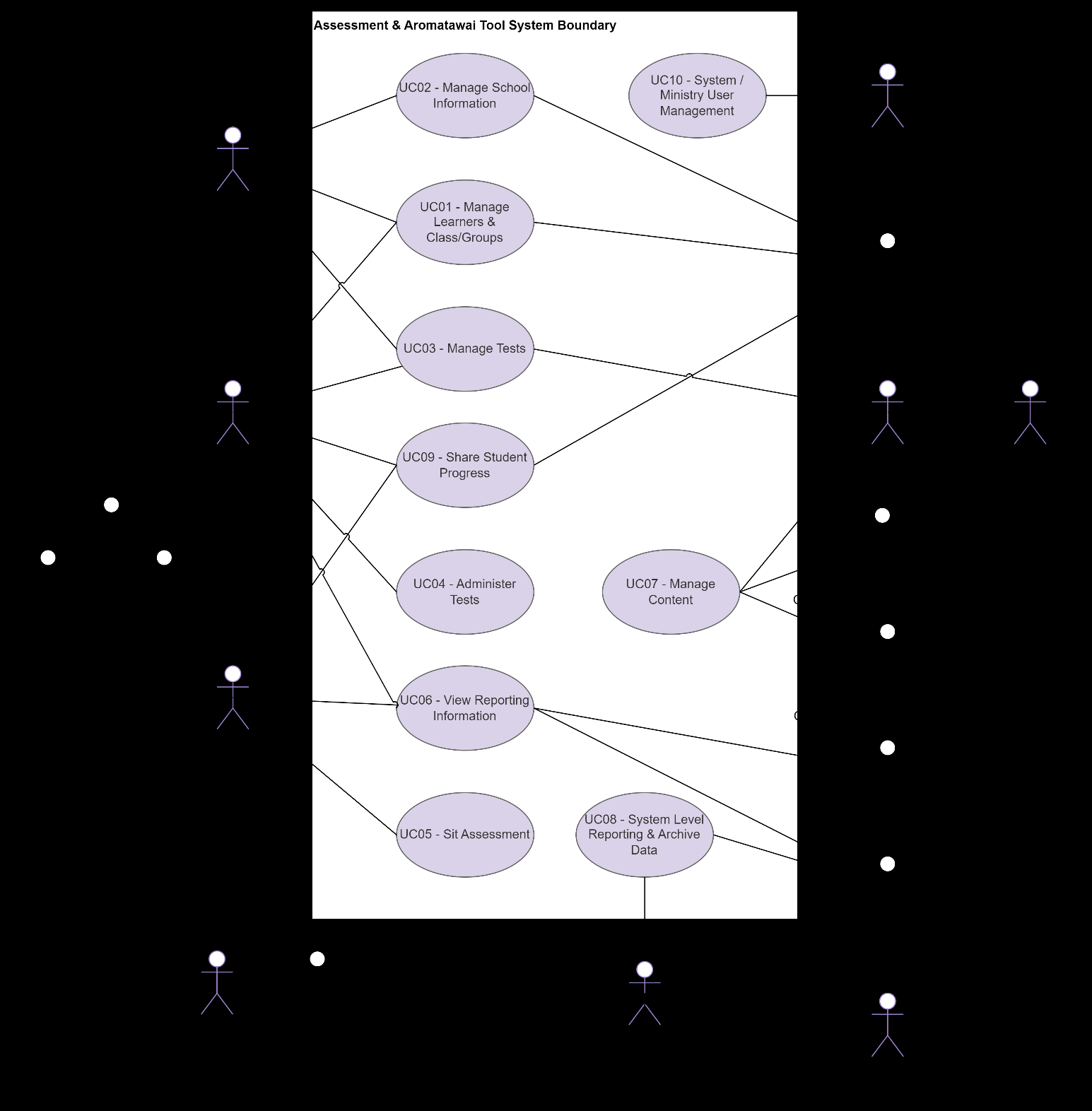
The following diagram depicts the AAT Use Cases and stakeholders involved in using the solution.
1982
ACT
INFORMATION
OFFICIAL
THE
UNDER
Figure 1 - AAT Use Case Model
RELEASED
Page | 3

ID
Use Case
Description
UC01 Manage
For the system to assign and report on test results for student | ākonga, it is
Student &
necessary for teachers | kaiako and school administrators to be able to enter,
Class/Group
view, update student | ākonga and class/group information. School
Information
administrators are also able to delete student | ākonga and classes/groups from
the system.
1982
Note: The Assessment & Aromatawai Tool shall only contain the student, class,
and group information necessary to carry out assessment and aromatawai.
ACT
UC02 Manage
For the system to correctly partition users and grant them the necessary
School
permissions, it is necessary for school administrators to be able to view and
Information
update schools, organisation, and communities of learning/kāhui ako
information.
Note: The Assessment & Aromatawai Tool shall only contain the school
information necessary to carry out assessment and aromatawai.
UC03 Manage
Teachers | kaiako, school administrators may create, and delete tests, to
Tests
maintain a set of appropriate tests to administer to students | ākonga and keep a
INFORMATION
(Create,
record of tests which have been administered.
maintain)
UC04 Administer
Administration of tests includes the assignment of tests to students | ākonga, in
Tests (Assign, either on-screen or paper-based format, and the scoring of tests that have been
OFFICIAL
score)
completed; this is performed by teachers | kaiako.
THE
UC05 Sit Test
Once a test has been assigned to a student | ākonga in either on-screen or
paper-based format, the student | ākonga may select and proceed to sit the test
and answer the presented questions.
UC06 View
A primary purpose of assessment and aromatawai is to produce clear and concise
Reporting
information on the progress and achievement of students | ākonga and student |
UNDER
Information
ākonga groups. Teachers | Kaiako may view various reports at an individual,
class/group, and school level; they may also download student | ākonga test
result information to then import, or manually enter, into their school
management system.
As a student | ākonga, it is possible to view various reports regarding their
individual progress and achievement.
RELEASED System-level reporting will not be provided by the AAT, instead aggregated
progress and achievement information will be transferred to the Education Data
Warehouse (
EDW), allowing the Ministry to analyse and report on system-level
information from the EDW.
UC07 Manage
Ministry Content SMEs can create, update, and delete curriculum progression
Content
information (e.g., curriculum levels, learning strands, and achievement
objectives).
Page | 4

ID
Use Case
Description
Ministry Content SMEs can create, update, and delete content, including item
(and testlets), prompts, rubrics, and exemplars. This includes the content itself,
as well as its associated metadata (e.g., assigned difficulty, or alignment to
curriculum progressions, etc.).
UC08 System Level Student progress and achievement information, including assessment results, is 1982
Reporting &
transmitted to the Ministry EDW in an automated fashion for system level
Archive
reporting and to support legal and records management requirements.
Information will be aggregated not exposing individual student | ākonga
ACT
information then analysed to produce system-level reporting for Te Poutāhū
Managers and Ministry SMEs (from the Education Data Warehouse).
UC09 Share
Teachers | kaiako can facilitate the transmission of student progress and
Student
achievement information, including assessment results, to School Management
Progress
Systems in an agreed fashion, so that schools can use this information to inform
their reporting to parents and fulfill their obligatory reporting requirements.
UC10 System Level Ministry administrators can configure system level features and manage Ministry
and Ministry
users, roles and permissions.
User
Note:
Ministry Administrator cannot change school configurations unless
INFORMATION
Management
authorised to do so by the respective school as part of a support call.
Table 1 - Use Case Descriptions
OFFICIAL
THE
UNDER
RELEASED
Page | 5
link to page 44 link to page 44
 Functional Requirements
The following table details the functional requirement for the AAT solution.
ID:
The reference number of the requirement.
Stakeholder Group:
The group the requirement was derived or addresses.
Short Name:
A short description of the requirement.
Priority:
MoSCoW rating (refer pag
e 2 for a description of the MoSCoW).
1982
Use Case ID:
The Use Case ID that this requirement belongs to (refer pag
e 2 for a description of the use cases).
Related REQ ID:
The reference of the high-Level requirements this requirement is related to.
ACT
ID
Stakeholder Group Short Name
Requirement Description
Priority
Use Case
ID
SH001 Teachers | kaiako
Teachers | kaiako Maintain
Teachers | kaiako or school administrators can create, view, and update group (e.g. class membership)
Must
UC1
Class and Group information information and update student | ākonga assessment information but cannot update core student |
ākonga information received from the Ministry.
SH002 Teachers | kaiako
Student | ākonga
Core student | ākonga information includes: ID (NSN), name, email, gender, ethnicity, Year level,
Must
UC1
information
language, accessibility needs, enrolment info (status and school), and time in te reo Māori immersion.
Note: The solution will only receive information it has valid reason to use and will align with the
INFORMATION
Principles within the Privacy Act 2020.
SH003 Teachers | kaiako
Teachers | kaiako or school
Teachers | kaiako or school administrators can update core student | ākonga information for a school
Must
UC1
administrators can update
by triggering a refresh of data from the Ministry source of truth for student information.
core student | ākonga
information for a school by
triggering a refresh of data
OFFICIAL
from the Ministry source of
truth for learner information.
SH004 Teachers | kaiako
Automated refresh of
The solution regularly retrieves updated core student | ākonga information for all schools in an
Must
UC1
THE
student | ākonga information automated fashion by triggering a refresh of data from the Ministry source of truth for student
information at agreed intervals.
SH005 Teachers | kaiako
Teachers | kaiako receives
The solution is able to receive student | ākonga information and group (e.g. class membership)
Must
UC1
student | ākonga, class and
information from School Management Systems in an agreed fashion (either .ast file import by a teacher
group information from SMS
| kaiako, school administrator, Ministry administrator or via API), so that the administrative burden for
UNDER
teacher | Kaiako and administrators is reduced.
SH006 Teachers | kaiako
Teachers | kaiako create
Teachers | kaiako and school administrators can create mathematics, reading, pāngarau, and pānui
Must
UC3
tests from blueprint
tests by selecting an appropriate existing test 'blueprint' of parameters (i.e., time allowed, curriculum
year, curriculum strands, etc.), which the solution then uses to automatically generate a test by
selecting items (and testlets) from the solution's item banks which satisfy the 'blueprint'.
SH007 Teachers | kaiako
Teachers | kaiako create
Teachers | kaiako and school administrators can create adaptive mathematics, reading, pāngarau, and
Must
UC3
adaptive tests
pānui tests selecting an appropriate existing test 'blueprint' of parameters (i.e., time allowed,
curriculum year, curriculum strands) which the solution then uses to automatically generate an adaptive
RELEASED
test by selecting items (and testlets) from the solution's item banks which satisfy the 'blueprint'.
SH008 Teachers | kaiako
Teachers | kaiako create
Teachers | kaiako and school administrators can create writing and tuhituhi tests by selecting a single
Must
UC3
writing and tuhituhi tests
prompt from the solution's item banks and specifying administrative settings (e.g., time allowed).
SH086 Teachers | kaiako
Teachers | kaiako cannot
Teachers | kaiako and school administrators cannot modify the content of tests.
Must
UC3
modify content.
SH084 Teachers | kaiako
Teachers | kaiako can delete
Teachers | kaiako and school administrators can delete a test, if the test is not currently assigned and
Must
UC3
a test
has not been previously sat by any individual or class/group of students | ākonga.
6
 ID
Stakeholder Group Short Name
Requirement Description
Priority
Use Case
ID
ID
Stakeholder Group Short Name
Requirement Description
Priority
Use Case
ID
SH009 Teachers | kaiako
Teachers | kaiako assign test
Teachers | kaiako can assign a test to an individual or class/group of students | ākonga, in either on-
Must
UC4
within defined window
screen or paper-based format, within a predefined testing window defined by the Ministry.
SH010 Teachers | kaiako
Teachers | kaiako assigns an
Teachers | kaiako can assign an adaptive test to an individual or a group of students | ākonga, in on-
Must
UC4
adaptive test within defined
screen format only, within a predefined testing window defined by the Ministry.
window.
SH011 Teachers | kaiako
Teachers | kaiako assigns
Teachers | kaiako can assign a test to an individual or group (e.g. class membership) of students |
Should
UC4
1982
test outside of defined
ākonga, in either on-screen or paper-based format, outside of any predefined testing windows defined
window.
by the Ministry.
Note: The Ministry is asking for two assessments a year but requires the flexibility for additional ACT
assessments.
SH012 Teachers | kaiako
Teachers | kaiako scores on-
Teachers | kaiako can score on-screen tests and record the scores in the solution.
Must
UC4
screen tests.
SH013 Teachers | kaiako
Teachers | kaiako scores on-
Teachers | kaiako can score on-screen mathematics, reading, pāngarau, and pānui tests with the
Must
UC4
screen close-ended tests with assistance of automated marking for close-ended (selected-response) items.
assistance of automation.
SH102 Teachers | kaiako
Teacher scores on-screen
Teachers | kaiako can score on-screen mathematics, reading, pāngarau, and pānui tests with the
Must
UC4
open-ended tests with
assistance of automated marking for open-ended (constructed-response) items.
assistance of automation
INFORMATION
SH014 Teachers | kaiako
Teachers | kaiako score on-
Teachers | kaiako can score on-screen writing and tuhituhi tests with the assistance of automated
Must
UC4
screen screen writing and
marking.
tuhituhi tests with assistance
of automation.
SH015 Teachers | kaiako
Teachers | kaiako score
Teachers | kaiako can score paper-based tests and record the scores in the solution.
Must
UC4
paper-based tests.
SH016 Teachers | kaiako
Teachers | kaiako upload
Teachers | kaiako can upload a digital scan of paper-based tests into the tool.
Should
UC4
OFFICIAL
scan of paper test.
SH017 Teachers | kaiako
Teachers | kaiako view
Teachers | kaiako can view and download reports that provide information about how individuals and
Must
UC6
reports on a per-item basis.
groups of students | ākonga scored on a test, including on a per-item basis, aligned to the national
THE
curricula.
SH018 Teachers | kaiako
Teachers | kaiako view
Teachers | kaiako can view and download reports on the progress over time of individuals and group
Must
UC6
reports over time.
(e.g. class membership) of students | ākonga at their school, aligned to the national curricula.
SH019 Teachers | kaiako
Teacher view reports that
Teachers | kaiako can view and download reports on individuals and group (e.g. class membership) of
Must
UC6
include feedback and next
students | ākonga at their school that include feedback and next steps regarding specific areas for
UNDER
steps.
further learning in the curricula, including links to relevant teaching and learning resources on
Tāhūrangi.
SH100 Teachers | kaiako
Tāhūrangi links can be used
Teachers | kaiako and students | ākonga can use the links to relevant teaching and learning resources
Must
UC6
from reports
on Tāhūrangi contained in reports to view these resources on Tāhūrangi.
SH020 Teachers | kaiako
Teachers | kaiako view
Teachers | kaiako can view and download reports that provide information about how well each
Must
UC6
reports against curriculum
student | ākonga or group (e.g. class membership) at their school is doing in relation to expected
curriculum progress.
SH021 Teachers | kaiako
Teachers | kaiako view
Teachers | kaiako can view reports that provide information about how well a student | ākonga or
Should
UC6
RELEASED
report on cohorts.
class/group at their school is progressing compared to the progress of equivalent population cohorts
such as year, gender, ethnicity, English as a second language, and equity index.
SH022 Teachers | kaiako
Teachers | kaiako can add a
Teachers | kaiako can add a comment to pāngarau, pānui, and tuhituhi reports on individuals and group
Must
UC6
commentary to report.
(e.g. class membership) of students | ākonga, prior to sharing the reports (externally to the system)
with students | ākonga.
Page | 7
 ID
Stakeholder Group Short Name
Requirement Description
Priority
Use Case
ID
ID
Stakeholder Group Short Name
Requirement Description
Priority
Use Case
ID
SH023 Teachers | kaiako
Teachers | kaiako can select
Teachers | kaiako teaching through te reo Māori can select which language they wish to receive
Must
UC6
language.
reporting in, either te reo Māori or English.
SH024 Teachers | kaiako
Reports align with language
All teacher | kaiako reporting uses language that is consistent with the curriculum and aligns to the
Must
UC6
and progression of the
progressions in the curriculum.
curriculum.
SH025 Teachers | kaiako
Transfer student information
The solution can transmit student | ākonga progress and achievement information, including
Must
UC9
1982
to SMS.
assessment results, to School Management Systems in an agreed fashion (either csv file export by a
teacher | kaiako, or via API), so that student | ākonga, class/group, and school level reporting can be
produced for school stakeholders.
SH026 Teachers | kaiako
Support 28,000 teachers |
The solution allows 28,000 teachers | kaiako to administer the twice-yearly testing within predefined
ACT Must
N/A
kaiako.
testing windows (e.g., a minimum 10 day window at the beginning of Terms 1 and 4).
SH027 Teachers | kaiako
Provide tailored guidance to
The solution provides tailored guidance for teachers | kaiako to assist in the effective and efficient use
UC1
Must
for teachers | kaiako.
of the system, in both English and te reo Māori.
UC3
UC9
UC4
UC8
SH028 Students | ākonga
Tests are available on-screen
Students | ākonga can sit tests in either on-screen or paper-based format.
Must
UC5
and on-paper.
SH029 Students | ākonga
Adaptive tests on-screen.
Students | ākonga can sit adaptive tests in on-screen format only.
Must
UC5
INFORMATION
SH030 Students | ākonga
All content is displayed in the Testing in its entirety - including items, prompts, instructions, guidance, and user interfaces - is in te reo
Must
UC5
selected language.
Māori for those learning through te reo Māori, and in English for those learning in English medium
settings.
SH031 Students | ākonga
Students | ākonga can view
Students | ākonga can view and download reports that provide information about how they scored on a
Must
UC6
and download how they
mathematics, reading, writing, pāngarau, pānui, and tuhituhi test, including on a per-item basis, aligned
scored.
to the New Zealand Curriculum and Te Marautanga o Aotearoa.
SH032 Students | ākonga
Students | ākonga can view
Students | ākonga can view and download reports on their progress over time in mathematics, reading,
Must
UC6
OFFICIAL
and download their
writing, pāngarau, pānui and tuhituhi aligned to the New Zealand Curriculum and Te Marautanga o
progression.
Aotearoa.
SH033 Students | ākonga
Students | ākonga can view
Students | ākonga can view and download reports that include feedback and next steps regarding
Must
UC6
THE
and download reports with
specific areas for further learning in mathematics, reading, writing, pāngarau, pānui and tuhituhi in the
feedback and next steps.
New Zealand Curriculum and Te Marautanga o Aotearoa, including links to relevant learning resources
on Tāhūrangi.
SH034 Students | ākonga
Students | ākonga can view
Students | ākonga can view and download reports on mathematics, reading, writing, pāngarau, pānui
Must
UC6
and download reports on
and tuhituhi that provide information about how well they are doing in relation to expected curriculum
UNDER
how well they are doing.
progress in the New Zealand Curriculum and Te Marautanga o Aotearoa.
SH035 Students | ākonga
Students | ākonga can view
Students | ākonga can view reports that provide information about how well they are doing relevant to
Must
UC6
and download reports on
other population cohorts such as year, gender, ethnicity and English as a second language.
how they are doing relative
to other cohorts.
SH037 Students | ākonga
student | ākonga reporting is All student | ākonga reporting should use language that is consistent with the curriculum and aligns to
Must
UC6
consistent with progression
the progressions in the curriculum.
on the curriculum.
RELEASED
SH038 Students | ākonga
Support for additional
Students | ākonga can select to view reports in other languages.
Could
UC6
languages
Page | 8
 ID
Stakeholder Group Short Name
Requirement Description
Priority
Use Case
ID
ID
Stakeholder Group Short Name
Requirement Description
Priority
Use Case
ID
SH039 Students | ākonga
Students | ākonga Inclusion
The solution supports accessibility and inclusion accommodations, including Special Assessment
Must
UC5
and access.
Conditions (SAC). For example, but not limited to supporting the following.
• Change font size / zoom
• Change contrast level
• Text to speech
• Allow extra time for tests
1982
• Allow breaks during tests
SH040 Students | ākonga
Students | ākonga
Students | ākonga can save their accessibility settings preferences in the solution, so that the solution
Should
UC5
ACT
accessibility settings.
implements these accessibility settings whenever the student | ākonga uses the solution.
SH041 Students | ākonga
Provide braille tests.
The solution supports braille paper-based tests for sight impaired students | ākonga.
Should
UC5
SH042 Students | ākonga
Intermitted connectivity.
Students | ākonga can complete the sitting of an on-screen administered test despite intermittent
Must
UC5
connectivity or system issues.
SH043 Students | ākonga
Available on a range of
In order for the solution to be used effectively and efficiently by end-users on a range of modern
Must
UC5
classroom devices.
classroom devices. It must provide a consistent user experience across multiple modern browsers
running on a range of popular operating systems.
SH044 Students | ākonga
Practice tests.
Students | ākonga can take a practice test to familiarise themselves with the solution.
Must
UC5
SH045 Students | ākonga
Support 540,000 students |
Allow approximately 540,000 students | ākonga to complete twice-yearly (e.g. Term 1 and 4) testing
Must
UC5
ākonga.
within a minimum of a 10 day testing window.
INFORMATION
SH046 Students | ākonga
Tailored guidance for
The solution provides tailored guidance for students | ākonga to assist in the effective and efficient use
Must
UC5
leaners.
of the system, in both English and te reo Māori.
SH052 School
Refresh school information.
School administrators can update school information for a school by triggering a refresh of data from
Must
UC2
administrators
the Ministry source of truth for school information.
SH053 School
Automated refresh of school
The solution regularly retrieves updated school information for all schools in an automated fashion by
Must
UC2
administrators
information.
triggering a refresh of data from the Ministry source of truth for school information at agreed intervals.
OFFICIAL
SH054 School
Assign school administrator.
School administrators can assign other school administrators to their school.
Must
UC2
administrators
SH055 School
Assign Ministry administrator School administrators can grant permission to a Ministry administrator for a period in response to a
Must
UC1
administrators
for school.
support request.
THE
SH057 School
Tailored guidance to School
The solution provides tailored guidance for school administrators to assist in the effective and efficient
Must
UC1
administrators
administrators.
use of the system, in both English and te reo Māori.
UC2
UC3
SH061 Ministry
Ministry administrator can
Ministry administrators can assign school administrators to a school.
Must
UC2
administrators
assign school administrators.
UNDER
SH063 Ministry
Tailored guidance for
The solution provides tailored guidance for Ministry administrators to assist in the effective and
Must
UC1
administrators
Ministry administrators.
efficient use of the system, in English only.
UC2
UC3
SH064 Ministry content
Ministry content SMEs
Ministry content SMEs can update curriculum progression information (i.e., curriculum years, progress
Must
UC7
SMEs
update curriculum.
outcomes, strands, and teaching sequence) by triggering a refresh of data from the Curriculum
Framework Repository.
SH065 Ministry content
Ministry content SMEs
Ministry content SMEs can upload, export, create, update, review, publish, retire, and delete content
Must
UC7
RELEASED
SMEs
update test content.
such as items (and testlets), prompts, rubrics, and exemplars. This includes the content itself and its
associated metadata (e.g., assigned difficulty (logit), alignment to curriculum progressions).
SH101 Ministry content
Ministry content SMEs
Ministry content SMEs can facilitate the automated transfer of content from a Content authoring / AIG
Could
UC7
SMEs
transfer content from
system (used by the Ministry) to the solution if content authoring occurs outside of the system.
content authoring system.
SH066 Ministry content
Supports different item
The solution supports close-ended items (e.g., multi-choice), open-ended items (e.g., short answer), and
Must
UC7
SMEs
types.
prompts (for Writing and Tuhituhi).
Page | 9
 ID
Stakeholder Group Short Name
Requirement Description
Priority
Use Case
ID
ID
Stakeholder Group Short Name
Requirement Description
Priority
Use Case
ID
SH067 Ministry content
Items support additional
Items have associated metadata including difficulty (logit), associated curriculum progression
Must
UC7
SMEs
metadata.
information such as phase, progress outcome, strand, and teaching sequence, and IP rights information.
SH068 Ministry content
Curriculum and items in
Curriculum progression information and content including items, testlets, prompts, rubrics, and
Must
UC7
SMEs
either English or te reo
exemplars can be in either English or te reo Māori.
Māori.
SH103 Ministry content
Supports content in: New
The solution supports curriculum progression information and content for both national curricula: New
Must
UC7
1982
SMEs
Zealand Curriculum and Te
Zealand Curriculum and Te Marautanga o Aotearoa.
Marautanga o Aotearoa.
SH069 Ministry content
Content authoring workflow.
The solution provides a workflow capability for Ministry content SMEs to create and manage content
Must
UC7
SMEs / 3rd Party
throughout the content lifecycle (including development, review/approval, publishing, and retiring).
ACT
content providers
SH070 Ministry content
Items use the IRT (Item
The solution uses Item Response Theory (IRT) or equivalent as the psychometric model, utilised as part
Must
UC7
SMEs
Response Theory) or
of item calibration, item selection, scoring, and reporting.
equivalent.
SH071 Ministry content
Performance statistics of
Ministry content SMEs can view item and prompt statistics, including usage and performance data, and
Must
UC7
SMEs
items and prompts.
reports on these statistics. Item statistics are not student specific.
SH090 Ministry content
Item performance statistics
Item and prompt statistics from tests conducted for item/prompt trialing purposes are available for
Must
UC7
SMEs
only available to Ministry.
Ministry content SMEs to view, however scores from these tests are excluded from student | ākonga
INFORMATION
and teacher | kaiako reporting data sets. Item statistics are not student specific.
SH072 Ministry content
Allow Recalibration.
Ministry content SMEs can recalibrate the solution on a regular basis, including updating item logits,
Must
UC7
SMEs
scale scores, population cohort norms, etc.
Ministry content
Recalibration – workflow.
The solution provides a workflow capability allowing a recalibrate (
refer SH072) to be designed,
Must
UC7
SH104 SMEs, Curriculum
reviewed, approved and published in a controlled fashion.
SME and
OFFICIAL
Psychometricians
SH073 Ministry content
Provide tailored guidance to
The solution provides tailored guidance for Ministry content SMEs in English to assist in the effective
Must
UC7
SMEs
Content SME.
and efficient use of the system.
THE
SH088 Ministry content
Content SME can delete
Ministry Content SMEs can create, update, review, publish, retire, and delete mathematics, reading,
Must
UC7
SMEs
blueprints.
pāngarau, and pānui test 'blueprints', which specify parameters for a test such as time allowed,
curriculum year, curriculum strands, and whether the test is for item trialing purposes.
SH089 Ministry content
Provide Non scored trial
Ministry content SMEs can specify whether a test will include a small number of trial items, as one of
Could
UC7
SMEs
items.
the parameters within the test 'blueprint'. A student's response on these items would not count
UNDER
towards their score, but the item statistics would be used by Ministry content SMEs to refine and
calibrate the items.
SH074 Ministry content
Select from item bank.
Ministry Content SMEs can create mathematics, reading, pāngarau, and pānui tests by manually
Must
UC3
SMEs
selecting specific items and testlets from the solution's item banks. They may also delete tests.
SH075 Te Poutāhū general Transfer student progress to
The solution can transmit student progress and achievement information, including assessment results,
Must
UC8
and senior
the Ministry.
to the Ministry EDW in an automated fashion, so that system-level reporting that does not expose
managers
individual student | ākonga information can be produced.
SH078 Te Pou Rangatōpū - Intellectual property –
All intellectual property rights of information provided to the system remain intact - the supplier lays no
Must
N/A
RELEASED
Records Services
Information.
claim.
Team
SH079 Te Pou Rangatōpū - Intellectual property –
The Ministry owns the intellectual property rights of all content produced by the Ministry's use of the
Must
N/A
Records Services
Content.
system - the supplier lays no claim.
Team
Page | 10
 ID
Stakeholder Group Short Name
Requirement Description
Priority
Use Case
ID
ID
Stakeholder Group Short Name
Requirement Description
Priority
Use Case
ID
SH080 Te Pou Rangatōpū - Automate transfer of student The solution can transmit student progress and achievement information, including assessment results,
Must
UC8
Records Services
progress to the Ministry.
to the Ministry EDW in an automated fashion, so that this information can be retained for as long as
Team
required to meet legal and records management obligations.
SH081 Te Pou Hanganga,
Education sector standards
The solution complies with relevant interoperability standards within the education sector for example
Must
N/A
Matihiko - TPHM
and Interfaces.
IMS CASE, IMS QTI, IMS CAT, LTI Resource Search, and LTI Launch.
Ministry
1982
Architecture
Practice
SH105 Students | ākonga
Students | ākonga cannot
The solution should provide the capability to prevent students | ākonga from copying, pasting or
Should
UC5
access other information
accessing other resources during a test.
ACT
during a test.
SH106 Solution
Minimise disruption
The solution must minimise disruption to users during releases and upgrades of the product.
Must
N/A
SH107 Ministry
Ministry user access
Ministry administrators must be able to manage access to system level features to Ministry staff.
Must
UC10
administrators
management.
Access to school information is only provided via approval of the school administrators (r
efer SH055)
SH108 Solution
Support growth of domains,
The solution must be capable of supporting
Must
N/A
frequency and year groups.
• Additional domains beyond the current reading, writing, mathematics, pānui, tuhituhi and pāngarau.
• Increased number of assessments per year from the current requirement of two.
• Additional learner year groups.
SH109 Teachers | Kaiako
Reporting between schools
Teachers | kaiako or school administrators of the solution must not be able to compare progression
Must
UC6
INFORMATION
(e.g. League Table).
with other schools.
Table 2- Functional Requirements
OFFICIAL
THE
UNDER
RELEASED
Page | 11
 Non-Functional
Non-functional requirements (NFRs) define the quality attributes, performance, and constraints of a system
rather than its specific functionalities. They describe
how the system should behave rather than
what it
should do.
ID
Short Name
Description
Category 1982
EAV-01
Recovery
The solution shall be able to automatically recover from
Compliance
Process.
a failure event.
ACT
ECM-01
Security & Event The solution shall capture and store all events including
Compliance
Logging.
but not limited to security events, audit, read, update
and deletes to enable support and auditing activities.
SCO-03
Security & Event The solution shall provide the ability to ingest audit and
Compliance
Logging
security logs into the Ministry SEIM (Security Event and
Ingestion.
Incident Management) capability.
ECM-02
Electronic
Any electronic data shall be transmitted in a manner
Compliance
Transmission.
consistent with its classification IN-CONFIDENCE as per
the NZISM and NZ Government Information Security
INFORMATION
Classification System.
ECM-03
Electronic
Any electronic data shall be stored in a manner
Compliance
Storage.
consistent with its classification IN-CONFIDENCE as per
the NZISM and NZ Government Information Security
Classification System.
OFFICIAL
ECM-04
Sensitive
The solution shall protect any sensitive parameters in a
Compliance
Parameters.
manner consistent with the classification of IN-
CONFIDENCE for the data the solution collects,
THE
processes and/or stores as per the NZISM.
ECM-05
Service Account
Service accounts are managed to minimise the risk of
Compliance
Credential
unauthorised and/or malicious access.
Management.
ECM-06
Least Privilege.
The principle of least privilege applies, whereby users,
Compliance
UNDER
external systems or modules are assigned the least level
of privilege required to fulfil its legitimate purpose.
For users, least privilege means that all user accounts
run with as few privileges as possible and launch
applications with as few privileges possible, with
advantages including:
RELEASED
• Users are partially protected from mistakes made
using privileged access.
• Reduction of the impact of user exploits (e.g.,
compromised passwords).
12
 ID
Short Name
Description
Category
ID
Short Name
Description
Category
ECM-07
Denial of
The solution shall provide protection against DDoS
Compliance
Service
(denial-of-service) attacks.
(DoS/DDoS)
Protection.
ECM-08
Privacy
The solution shall comply with all relevant privacy
Compliance 1982
Regulations.
regulations, including the
Privacy Act 2020, including but not limited to:
•
ACT
The Information Privacy Principles (IPPs) set out in
Section 22 of the Act.
• Breach management provisions
• Information sharing and matching provisions
Health Information Privacy Code (2020) which modifies
the IPPs for the collection of health information. Used
to assist the tool in identifying students who may
require additional assistance due to a learning difficulty.
ECM-09
Single Sign On
The solution must provide integration with standards
Compliance
INFORMATION
(SSO).
based Single Sign On supporting
• SAML 2 (including Logout end points)
• OIDC (Open ID Connect)
SCO-11
Single Sign On
The solution must support multiple identity providers
Compliance
(SSO) - Multiple
for example but not limited to:
OFFICIAL
IdP.
• Students | ākonga (*DI4OL)
• Teachers | kaiako (ESL)
THE
• Ministry Staff (ESL, Ministry Azure Entra ID)
*DI4OL does not support primary schools or provide the
NSN identifier.
SCO-12
Younger
The solution must provide mechanisms for younger
Compliance
UNDER
students |
students | ākonga to use the solution who have a range
ākonga.
of digital skills.
ECM-10
Authorisation.
The solution shall provide authorisation capabilities that
Compliance
are secure and provide effective and efficient
mechanisms for managing access.
RELEASED
Page | 13
 ID
Short Name
Description
Category
ID
Short Name
Description
Category
ECM-11
User Lifecycle
The solution shall provide efficient mechanisms for
Compliance
Management.
integrating with the organisation’s digital identity (ESL,
DI4OL) services in order to support user lifecycle
management.
• Bulk provisioning
1982
• Individual user provisioning
• User deprovisioning
ACT
• Resynchronisation
*DI4OL does not currently support primary schools or
provide the NSN identifier.
ECM-12
Content
The flow of data within gateways is examined and
Compliance
Filtering.
controls to prevent unauthorized or malicious content
crossing security domain boundaries.
ECM-13
Data Transfer.
Data transfers between systems (security domains) are
Compliance
controlled and accountable. Reference (New Zealand
INFORMATION
Information Security Manual - Section 20.1.1)
Data is transferred through gateways in a controlled
and accountable manner. Reference (New Zealand
Information Security Manual - Section 20.2.1)
ECM-15
Log
The solution shall perform log management for each of
Compliance
Management.
its components to enable effective IT Service
OFFICIAL
Management and Cyber Security incident management.
ECM-16
Secure Session
All solutions establishing web sessions shall consider
Compliance
Management.
the session management cheat sheet published by
THE
OWASP (Open Worldwide Application Security Project)
and guidance contained in ECM-02
https://cheatsheetseries.owasp.org/cheatsheets/Sessio
n_Management_Cheat_Sheet.html
UNDER
Other protocols requiring stateful behaviour must
implement equivalent protections in accordance with
best practice of secure session management for the
protocol being used.
ECM-17
Education &
The solution shall comply with the Education & Training
Compatibility
Training Act
Act (2020) and associated directions, including but not
(2020).
limited to the use and sharing of data.
RELEASED
ECO-01
Data Collection,
The solution shall align with the New Zealand data
Compatibility
Sharing &
standards published in:
Publishing
https://data.govt.nz/toolkit/data-standards/mandated-
Formats.
standards-register
Page | 14
 ID
Short Name
Description
Category
ID
Short Name
Description
Category
ECO-03
Character
The solution shall fully support UTF-8 Unicode
Localisation
Encoding.
characters and ensure macrons are processed and
stored correctly for all languages.
ELO-01
Language
The solution is to have the capability to support
Localisation
Support.
multiple languages via the use of configuration
1982
parameters.
ELO-02
Localisation
The functionality of the solution must not be
Maintainability
Preserves
diminished by any localisations required to adapt it for
ACT
Functionality.
use by different user groups/languages.
EMA-01 Deployment
The component(s) of the solution shall be able to be
Maintainability
Reversal.
reversed back to the state of a previous deployment in
the event of an issue that affects the effective use of
the solution.
EMA-02
Change Control. The solution provider shall work with the Ministry
Maintainability
change process and co-ordinate product changes to
ensure continuity of service, training and
communication is maintained.
INFORMATION
EMA-05
Automated
The solution shall support automated testing of
Reliability
Testing.
relevant solution components which generates output
sufficient for analysis and evaluation of compliance to
requirements.
ERE-01
Exception
The solution shall handle exceptions in a manner that
Scalability
Handling.
allows diagnosis and resolution wh
OFFICIAL ilst not causing
damage, loss of data or availability of the service.
ESC-01
Elasticity.
The solution shall be able to adapt to changes in
Usability
THE
workloads by automatically provisioning and de-
provisioning resources such that at each point in time,
the resources available match the demand as closely as
possible whilst maintaining conformance with all
functional and non-functional requirements.
UNDER
EUS-01
User Assistance. The solution shall provide the user assistance to utilise
Usability
it effectively and properly, including:
• Syntactic & semantic validation of user input.
• Warning, error, and exception event handling.
• End user help (e.g., user manuals/documentation,
context sensitive help, artificial intelligence, chat
RELEASED
bots).
• Pre-population of fields.
Page | 15
 ID
Short Name
Description
Category
ID
Short Name
Description
Category
EUS-02
Web UI Design
The solution shall comply with the New Zealand
Availability
Standards.
Government Web and Accessibility standards.
https://www.digital.govt.nz/standards-and-
guidance/nz-government-web-standards
1982
ACT
INFORMATION
OFFICIAL
THE
UNDER
RELEASED
Page | 16

SAV-01
Service
The solution incorporates two levels of service for
Availability
Continuity
production
Response Time.
1. During assessment and reporting periods
2. Outside of assessment and reporting periods
as criticality and load has higher demands during the
assessment period.
1982
Therefore, the requirement positions two tiers as
defined within the Ministry.
ACT
During assessment and reporting: Tier 0.
Outside of assessment and reporting: Tier 2.
Priority Levels:
• P1 - Response (15 Minutes) - Resolution (2 Hours)
• P2 - Response (30 Minutes) - Resolution (4 Hours)
• P3 - Response (4 Hours) - Resolution (1 Business
Day)
INFORMATION
• P4 - Response (1 Business Day) - Resolution (5
Business Days)
Impact Guide:
• Complete
• Partial OFFICIAL
• Typical
• Request / Inquiry
THE
Tier 0
• Complete - P1
• Partial - P1
• Typical - P3
UNDER • Request / Inquiry - P4
Tier 2
• Complete - P1
• Partial - P2
• Typical - P3
RELEASED
• Request / Inquiry P4
The difference between Tier 0 and 1 is that a war room
is called immediately. In the case of a P1/P2 where
students | ākonga are unable to take an assessment
during the assessment period an immediate war room
is required.
Page | 17
 ID
Short Name
Description
Category
ID
Short Name
Description
Category
SAV-03
Recovery Point
Production RPO (Recover Point Objective) is:
Availability
Objective.
• In the event of a catastrophic failure 24 hours.
• In the event of a non-catastrophic failure 15
minutes.
1982
SAV-02
Service
The solution must be available:
Availability
Availability.
• During assessment periods 99.9% three nines
(outside agreed windows).
ACT
• Outside assessment time 99% two nines (outside
agreed windows).
The intent in the two scales is to provide flexibility to
providers to position an elastic model depending on the
stage of the assessment process. If your solution
requires a fixed availability, then the three nines is the
default requirement.
SAV-04
Backup &
The data managed by the solution shall be backed up in
Compliance
INFORMATION
restore.
a manner resistant to ransomware and be able to be
restored to meet the Recovery Point Objectives detailed
in SAV-03.
SCM-01
Public Records
The solution shall be capable of managing data
Maintainability
Act (2005).
according to the organisation’s lifecycle requirements,
which includes:
OFFICIAL
Retention and disposal of data according to the
specified retention schedules.
• Production School Records Class 1.8 (DA699 Class
THE
1.8) - Student Information.
• Production School Records Class 3.2 (GDA6 Class
3.1.3) - Individual Staff Information.
• Production GDA6 Class 3.1.3 - Individual Staff
UNDER Information including contractors.
https://assets.education.govt.nz/public/Records/School
-Records-Retention-and-Disposal-Schedule-All.pdf
SMA-01
Environments.
The solution shall provide four environments necessary
Performance
to support the initial delivery and ongoing operational
requirements.
RELEASED
• Training.
• UAT / Pre-Production.
• Test.
• Production.
Page | 18
 ID
Short Name
Description
Category
ID
Short Name
Description
Category
SPE-01
Transaction
The solution shall remain performant, with all other
Performance
Volumes.
non-functional requirements being met, during periods
of maximum transaction processing which is the
minimum 10 day period twice a year with the user base
detailed in SPE-02 accessing the solution.
1982
SPE-02
User Volumes.
The solution shall be capable of supporting:
Performance
• Students | ākonga: 540,000
•
ACT
Teachers | kaiako: 28,000
• Ministry users: 200
At least two Assessments a year covering, for example:
• Term 1
• Term 4
Refe
r https://www.govt.nz/browse/education/school-
and-college/school-terms-and-holidays/ for Term
information
INFORMATION
Assessments occur over a minimum of a 10 day period.
SPE-03
Response
Response time refers to the amount of time it takes for
Scalability
Times.
a system to react to a given input, request, or event.
For clarity the measure pertaining to this requirement is
from the user initiating an action to displaying the
OFFICIAL
business relevant information.
• Assessment functions 2 seconds or less.
THE
• Integration API calls 500ms or less.
• Operational reporting 5 seconds or less.
Long running functions taking longer than 5 seconds
should present a progress indicator.
UNDER
SSC-01
Utilisation
The solution must support
Compliance
Growth.
• New domains in addition to reading, writing,
mathematics, pānui, tuhituhi and pāngarau.
• Increased frequency of assessments per year.
• Additional year groups.
RELEASED
Page | 19
 ID
Short Name
Description
Category
ID
Short Name
Description
Category
SCO-02
Interoperability
In order for the solution to interoperate with the
Compatibility
Standards.
broader learning and assessment ecosystem, it shall
support a number of relevant established
interoperability standards and offer API-first integration
based on these standards.
•
1982
1EdTech Competencies and Academic Standards
Exchange (CASE).
• 1EdTech Question & Test Interoperability (QTI).
ACT
• 1EdTech Computer Adaptive Testing (CAT).
• LTI Resource Search.
• LTI Launch.
SCO-01
Supported User
In order for the solution to be used effectively and
Maintainability
Browsers & OS.
efficiently by end-users on a range of modern classroom
devices, it must provide a consistent user experience
INFORMATION
across multiple modern browsers running on a range of
popular operating systems.
SMA-04
Support Hours.
The provider must provide second level support to
Compliance
schools, teachers | kaiako and the Ministry during New
Zealand Standard and Daylight times.
The Ministry will be responsible for first level support
OFFICIAL
from schools.
SCO-04
Exit Strategy.
The Ministry must have access to all assessment
Maintainability
information and associated reference data held within
THE
the solution for an agreed period to enable migration to
another service if required.
SMA-03
Environment
The solution should support moving configurations
Compliance
Propagation.
between environments as part of a change lifecycle
UNDER
though non-production and production environments.
RELEASED
Page | 20
 ID
Short Name
Description
Category
ID
Short Name
Description
Category
SCO-05
SaaS Offering.
The solution must be offered as a SaaS (Software as a
Availability
Service) exhibiting the following attributes:
• Accessible from the Internet.
• Pay as you go.
•
1982
Fully Managed
o Security.
o Monitoring.
ACT
o Capacity.
o Performance.
o Product development.
• Scalable.
• Product releases, major and minor.
• Provides Integration via standards-based
interfaces.
INFORMATION
SCO-06
Support
The solution offers API-first integration based on
Compatibility
Interoperability. relevant interoperability standards.
Refer digit.govt.nz API Guidelines
OFFICIAL
https://www.digital.govt.nz/standards-and-
guidance/technology-and-architecture/application-
programming-interfaces-apis/api-guidelines.
THE
SCO-07
Artificial
Ministry information is not used to train AI models,
Compliance
Intelligence
unless the information is provided by the Ministry
training.
explicitly for this purpose or the information is already
in the public domain.
UNDER
SCO-08
Brand
The solution has a new Ministry sub-brand, aligning
Compliance
Alignment.
with the Ministry’s sub-identity framework.
SCO-09
Brand
The solution uses specified Ministry corporate
Compliance
typefaces.
typefaces.
SCO-10
Diverse
The solution can operate in diverse environments that
Compatibility
Environments.
are distributed and not centrally managed.
RELEASED
SCO-13
Training
Solution providers must be able to deliver training
Maintainability
collateral in support of the product, its concepts,
features, and configuration for Teachers | kaiako,
Ministry staff (or their agents) and Students | ākonga
including future product releases.
Table 3 - Non-Functional Requirements
Page | 21

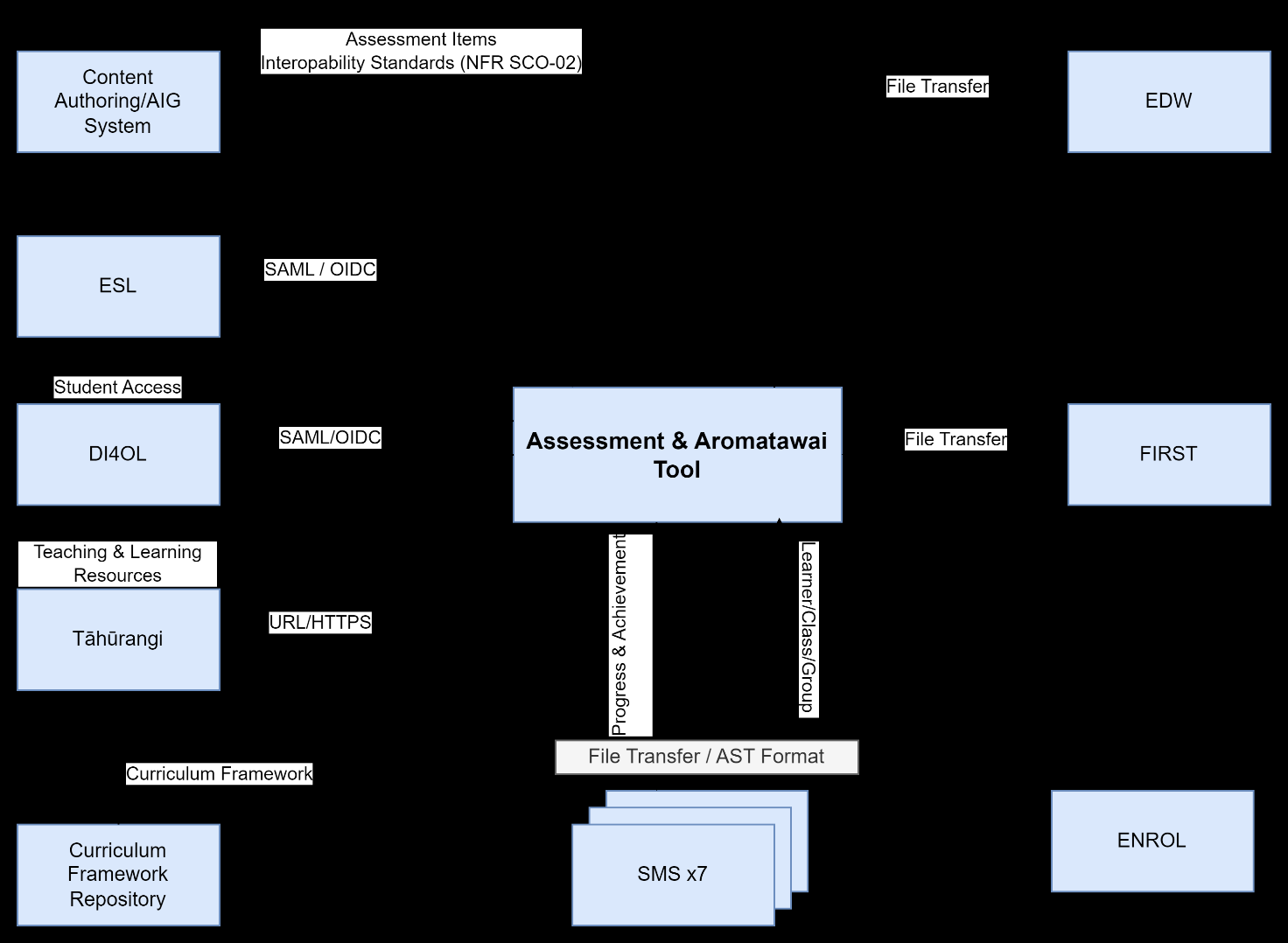 Appendix – Integrations
The following diagram represents the current integrations referenced within the detailed requirements.
The Ministry is moving towards an API approach to provide a single interface across its systems in the
future, the diagram below reflects the current state and likely capability for the first release of AAT.
1982
ACT
INFORMATION
OFFICIAL
THE
UNDER
Figure 2 - Current AAT Integration
RELEASED
Page | 22

Document 1c
1982
ACT
Sample Test Items
INFORMATION
OFFICIAL
THE
UNDER
RELEASED
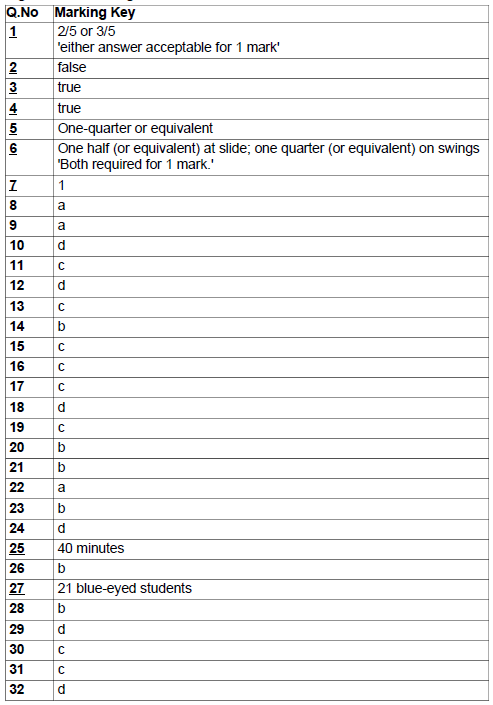 Maths
Marking Guide
Maths
Marking Guide
1982
ACT
INFORMATION
OFFICIAL
THE
UNDER
RELEASED
Sample Test Items
In Confidence
Page 2 of 16
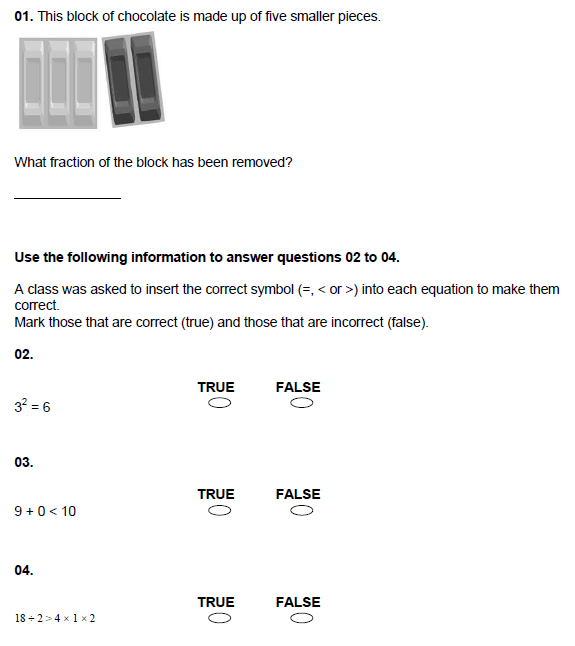 Sample Items
1982
ACT
INFORMATION
OFFICIAL
THE
UNDER
RELEASED
Sample Test Items
In Confidence
Page 3 of 16
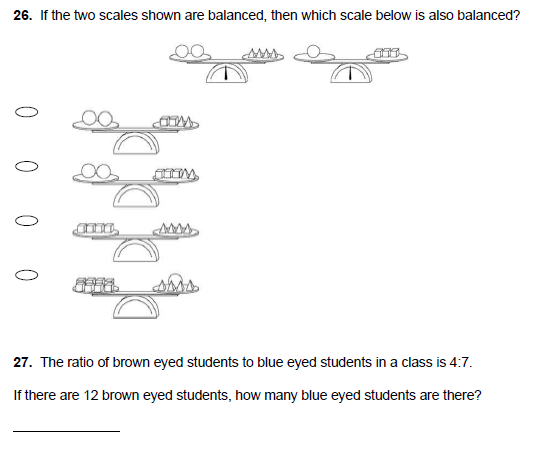
1982
ACT
INFORMATION
OFFICIAL
THE
UNDER
RELEASED
Sample Test Items
In Confidence
Page 4 of 16
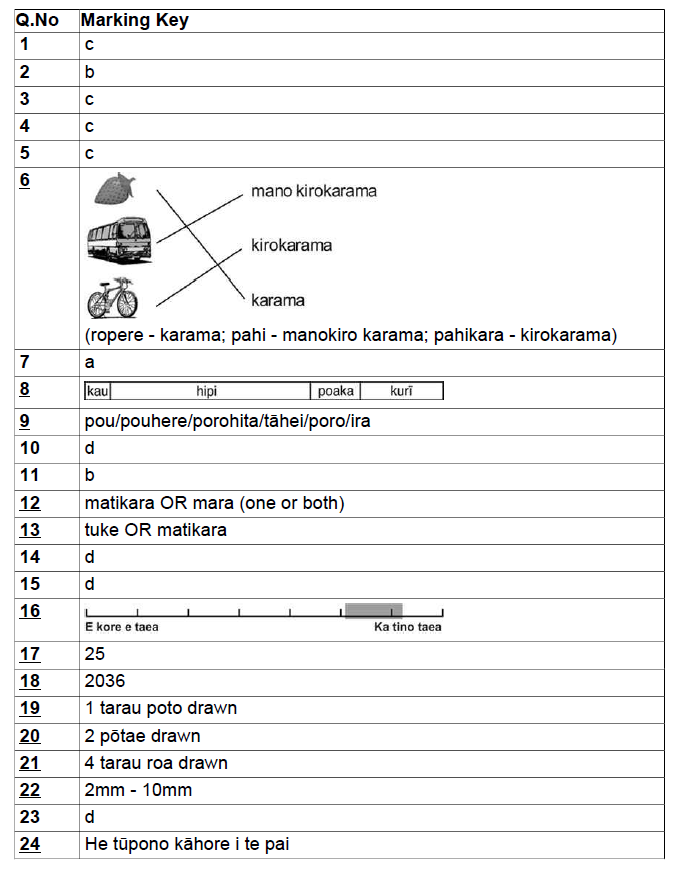 Pāngarau
Marking Guide
Pāngarau
Marking Guide
1982
ACT
INFORMATION
OFFICIAL
THE
UNDER
RELEASED
Sample Test Items
In Confidence
Page 5 of 16
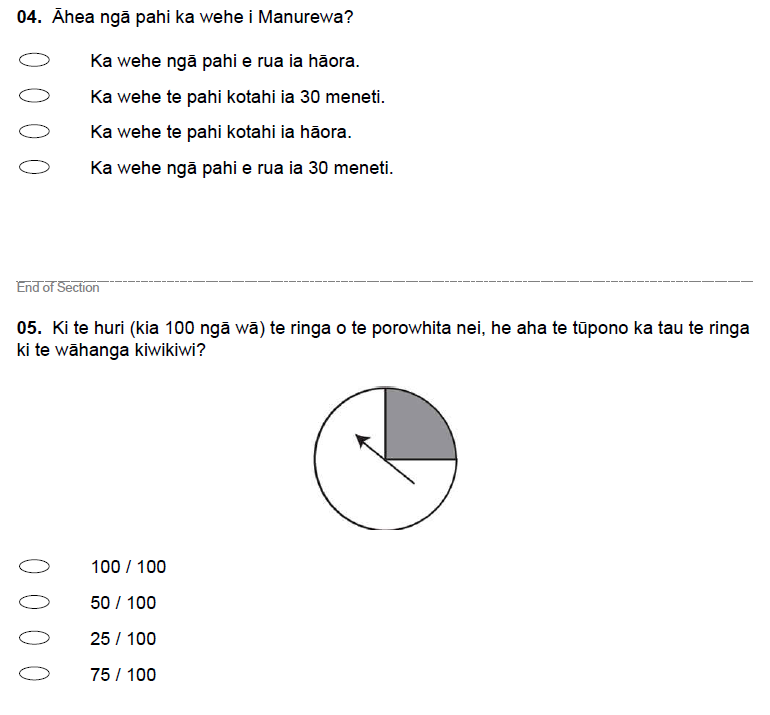 Sample Items
1982
ACT
INFORMATION
OFFICIAL
THE
UNDER
RELEASED
Sample Test Items
In Confidence
Page 6 of 16
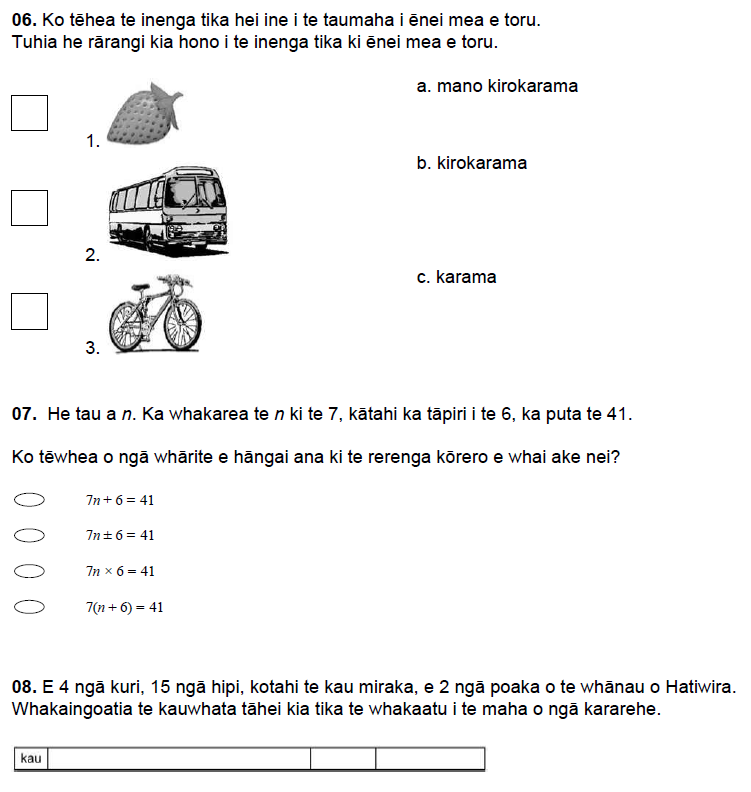
1982
ACT
INFORMATION
OFFICIAL
THE
UNDER
RELEASED
Sample Test Items
In Confidence
Page 7 of 16
 Reading
Marking Guide
Reading
Marking Guide
1982
ACT
INFORMATION
OFFICIAL
THE
UNDER
RELEASED
Sample Test Items
In Confidence
Page 8 of 16
 Sample Items
1982
ACT
INFORMATION
OFFICIAL
THE
UNDER
RELEASED
Sample Test Items
In Confidence
Page 9 of 16
1982
ACT
INFORMATION
OFFICIAL
THE
UNDER
RELEASED
Sample Test Items
In Confidence
Page 10 of 16
 Pānui
Marking Guide
Pānui
Marking Guide
1982
ACT
INFORMATION
OFFICIAL
THE
UNDER
RELEASED
Sample Test Items
In Confidence
Page 11 of 16
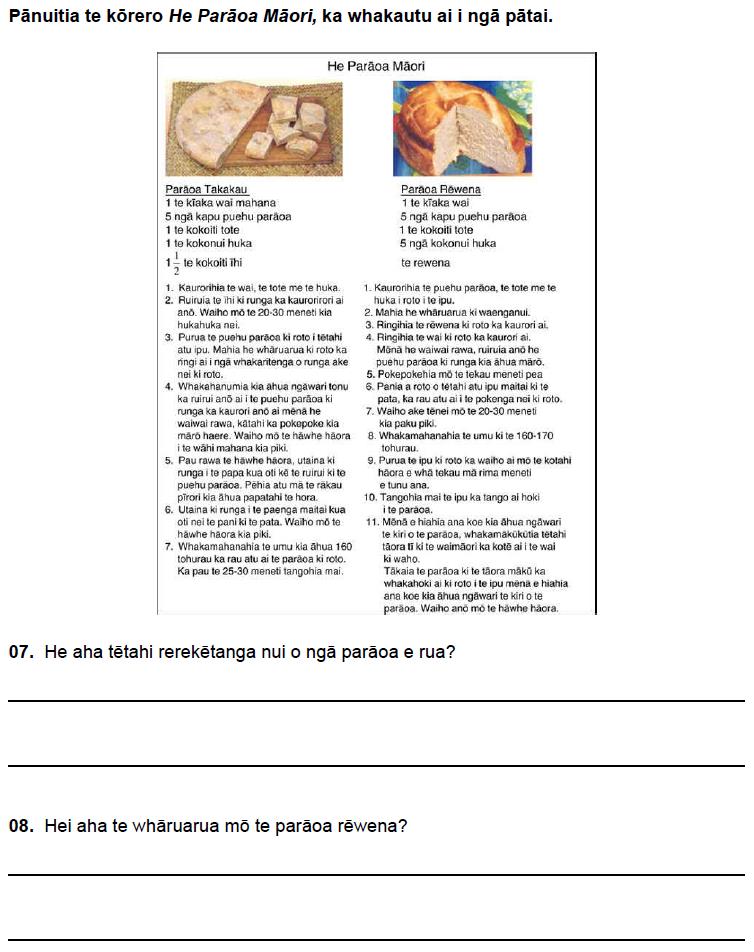 Sample Items
1982
ACT
INFORMATION
OFFICIAL
THE
UNDER
RELEASED
Sample Test Items
In Confidence
Page 12 of 16
1982
ACT
INFORMATION
OFFICIAL
THE
UNDER
RELEASED
Sample Test Items
In Confidence
Page 13 of 16
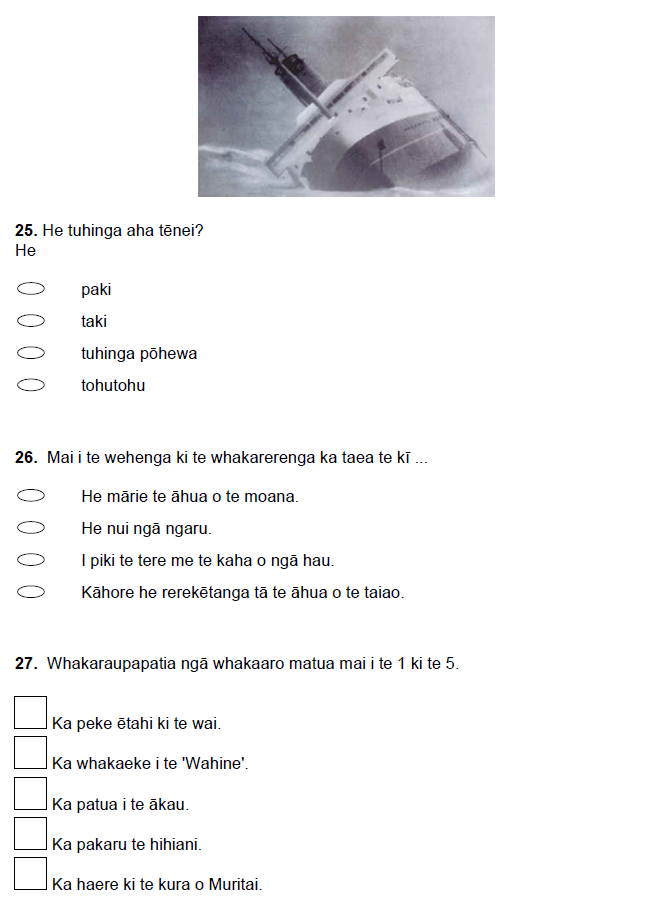
1982
ACT
INFORMATION
OFFICIAL
THE
UNDER
RELEASED
Sample Test Items
In Confidence
Page 14 of 16
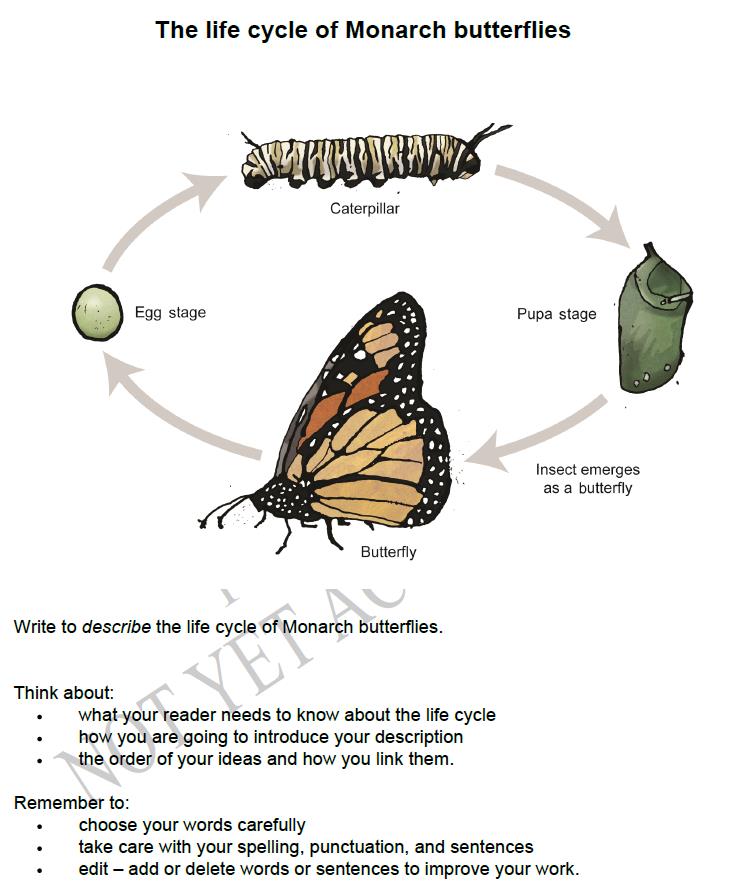 Writing
Sample Item
Writing
Sample Item
1982
ACT
INFORMATION
OFFICIAL
THE
UNDER
RELEASED
Sample Test Items
In Confidence
Page 15 of 16
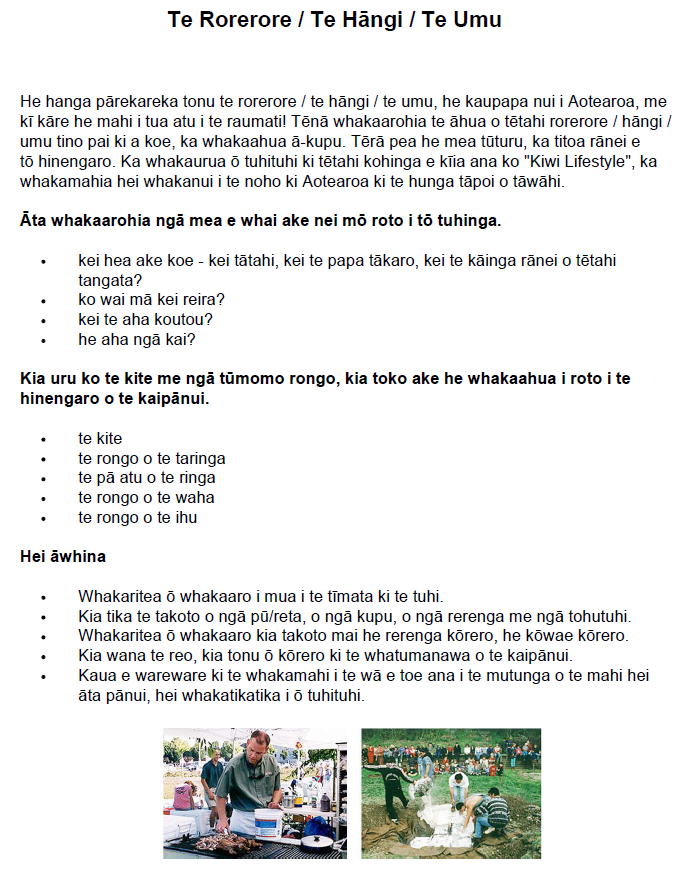 Tuhituhi
Sample Item
Tuhituhi
Sample Item
1982
ACT
INFORMATION
OFFICIAL
THE
UNDER
RELEASED
Sample Test Items
In Confidence
Page 16 of 16


Document 1d
1982
ICT SERVICES AGREEMENT
ACT
INFORMATION
Ministry of Education
[Supplier]
OFFICIAL
THE
Drafting notes:
•
This Agreement is for a cloud solution
UNDER
•
Remove all drafting notes before publishing and fill in all square brackets
•
Publish on GETS in pdf format
•
consider whether a benchmarking clause is appropriate to include
•
Changes to the terms and conditions must be approved by Legal Services
RELEASED
link to page 83 link to page 87 link to page 88 link to page 89 link to page 89 link to page 90 link to page 91 link to page 92 link to page 94 link to page 95 link to page 96 link to page 98 link to page 99 link to page 100 link to page 101 link to page 102 link to page 104 link to page 105 link to page 106 link to page 107 link to page 107 link to page 108 link to page 111 link to page 112 link to page 116 link to page 121 link to page 123
CONTENTS
1.
DEFINITIONS AND INTERPRETATION ............................................................... 3
2.
OVERVIEW ................................................................................................... 7
3.
SUPPLIER OBLIGATIONS ................................................................................ 8
4.
MINISTRY OBLIGATIONS ............................................................................... 9 1982
5.
MINISTRY PROPERTY AND SITES .................................................................... 9
6.
PERSONNEL AND SUBCONTRACTORS .............................................................10
ACT
7.
PROJECT MANAGEMENT, REVIEWS AND REPORTING ........................................11
8.
IMPLEMENTATION ........................................................................................12
9.
ACCEPTANCE TESTING .................................................................................14
10. BUSINESS CONTINUITY AND DISASTER RECOVERY..........................................15
11. CHARGES AND PAYMENTS .............................................................................16
12. DOCUMENTATION, RECORDS AND AUDIT .......................................................18
INFORMATION
13. WARRANTIES ..............................................................................................19
14. INDEMNITY, LIABILITY AND INSURANCE .........................................................20
15. INTELLECTUAL PROPERTY .............................................................................21
OFFICIAL
16. DATA PROTECTION AND SECURITY ................................................................22
17. CONFIDENTIAL INFORMATION .......................................................................24
THE
18. REMEDIES FOR FAULTS and breach ................................................................25
19. TERMINATION .............................................................................................26
20. DISPUTE RESOLUTION ..................................................................................27
UNDER
21. FORCE MAJEURE ..........................................................................................27
22. GENERAL ....................................................................................................28
SCHEDULE 1: PARTICULARS OF AGREEMENT ...........................................................31
SCHEDULE 2: Services and delverables ...................................................................32
RELEASED
SCHEDULE 3: CHANGE REQUESTS PROCESS ...........................................................36
SCHEDULE 4: CHARGES ........................................................................................41
SCHEDULE 5: DISPUTE RESOLUTION ......................................................................43
Commercial in Confidence 20200421_Ministry of Education ICT Services Agreement (Cloud)_TM
2
link to page 99 link to page 94 link to page 94
AGREEMENT dated
20[xx]
PARTIES
The Sovereign in right of the Government of New Zealand acting by and through the
Secretary for Education or his or her authorised delegate (the
Ministry)
[
Supplier]
at
[Location] company registration no. [insert] (the
Supplier)
BACKGROUND
A.
The Ministry [insert background information (2-3 paragraphs) as to need for the
cloud solution].
1982
B.
On [date] the Ministry issued a request for proposal (
RFP) entitled [
insert] seeking
an experienced and suitably qualified supplier to [insert].
C.
ACT
Based on the Supplier’s response to the RFP, and other supporting documentation,
the Ministry wishes to engage the Supplier to provide the solution proposed by the
Supplier, and associated services and deliverables, to the on the terms and
conditions set out in this Agreement.
AGREEMENT
1.
DEFINITIONS AND INTERPRETATION
1.1
Definitions
In this Agreement, unless the context requires otherwise:
INFORMATION
Acceptance and
Accepted, in relation to:
(a)
any Deliverable, means that the Ministry has accepted (or has been deemed to
have accepted) the Deliverable by issuing an Acceptance Certificate; and
(b)
any Documentation, means that the Ministry has notified Supplier in writing
that it has accepted the Documentation.
OFFICIAL
Acceptance Certificate means, in respect of any Deliverable, a written notice from the
Ministry to the Supplier substantially in form appended to Schedule 2 recording that
the Ministry is satisfied that the Acceptance Criteria for the Deliverable or Service
have been met.
THE
Acceptance Criteria means the following criteria:
(a) the relevant Deliverable complies with the Specifications;
(b)
all warranties set out in clause
13 are true and correct in relation to the
relevant Deliverable; and
UNDER
(c)
the relevant Deliverable complies with all acceptance criteria set out in this
Agreement.
Acceptance Test Plan means the acceptance test plan recorded or specified in
Schedule 2, where no such acceptance test plan is recorded or specified in Schedule
2, the acceptance test plan to be prepared by the Supplier and approved by the
Ministry in accordance with clause
9.2.
Acceptance Tests means the acceptance tests recorded or specified in Schedule 2, or
where no such acceptance tests are recorded or specified in Schedule 2, the
RELEASED
acceptance tests to be prepared by the Supplier and approved by the Ministry in
accordance with clause
9.6.
Agreement means this agreement, the schedules to this agreement and all
appendices.
Business Day means any day other than a Saturday, a Sunday or a public holiday (as
defined in the Holidays Act 2003) in Wellington, New Zealand.
Commercial in Confidence 20200421_Ministry of Education ICT Services Agreement (Cloud)_TM
3
Change Request has the meaning given to that term in paragraph 1 of Schedule 3.
Change Request Process means the process set out in Schedule 3.
Charges means the amounts payable by the Ministry as specified in Schedule 4.
Commencement Date means the date specified as the commencement date in
Schedule 1.
Confidential Information means all information in any form relating to or proprietary
to a party (
Discloser) that:
(d) is provided by (or on behalf of) the Discloser to the other party (
Recipient) in
connection with the Agreement; or
(e) otherwise becomes known to the Recipient in connection with the Agreement; 1982
and
(f)
is by its nature confidential, is designated (in writing or otherwise) by the
Discloser as confidential or which the Recipient ought reasonably to know is
ACT
confidential,
but excludes any information to the extent the Recipient can show the relevant
information:
(g) at the time of receipt by the Recipient is in the public domain or subsequently
comes in to the public domain otherwise than as a result of a breach of this
Agreement or any other obligation of confidentiality;
(h) is already or lawfully comes in to the unrestricted possession of the Recipient
without there having been any breach of any obligations of confidentiality owed
INFORMATION
by a third party;
(i)
has been independently developed by the Recipient (as evidenced by records in
its possession);
(j)
is not intended to be confidential as evidenced by the written agreement of
Discloser;
OFFICIAL
(k) is disclosed by the Recipient with the prior written approval of the Discloser in
accordance with the terms of such written approval; or
THE
(l)
is required is required to be disclosed, by law or by a governmental or other
competent authority or pursuant to the listing rules of any applicable stock
exchange, provided that before making the disclosure the Recipient has given
the Discloser notice of the request for disclosure and where practical obtained a
confidentiality order or similar protection limiting the persons to whom
disclosure of the Confidential Information is made if Discloser has no effective
UNDER
status on the matter.
Control means, in relation to a party:
(a) the legal, beneficial or equitable ownership of at least 50% of the shares in
that party;
(b)
the power to appoint more than 50% of the board of directors of that party; or
(c)
the power to control, by any other means, the affairs and policies of that party.
RELEASED
Core Customer Data means all data inputted into the Solution and all data generated
by the Solution regarding the Ministry, its operations, customers and personnel.
Crown means Her Majesty the Queen in right of New Zealand, including all:
(a) ministers of the Crown;
(b)
government departments;
(c)
offices of Parliament;
Commercial in Confidence 20200421_Ministry of Education ICT Services Agreement (Cloud)_TM
4
(d)
Crown entities as defined in the Crown Entities Act 2004; and
(e)
state enterprises as defined in the State-Owned Enterprises Act 1986.
Deliverable means any output of a Service, and without limitation may include
equipment, Documentation, software and other materials provided, or to be
provided, by the Supplier under or in connection with this Agreement.
Documentation means any document which the Supplier must prepare or provide to
the Ministry in accordance with this Agreement and any other documentation
reasonably required by the Ministry to enable the Ministry to use and obtain the full
intended benefit of the Deliverables and the Services.
End Date means the date specified as the expiry date in Schedule 1.
Force Majeure Event means any:
1982
(a) act of God, fire, earthquake, storm, flood, or landslide;
(b)
strike, lockout, work stoppage or other labour hindrance;
ACT
(c)
explosion, public mains electrical supply failure for 10 or more continuous
Business Days, or nuclear accident;
(d)
sabotage, riot, civil disturbance, insurrection, epidemic, pandemic, national
emergency (whether in fact or law) or act of war (whether declared or not);
(e)
requirement or restriction of, or failure to act by, any government, semi-
governmental or judicial entity; and/or
(f)
without limitation by reference to the foregoing, any other cause beyond the
reasonable control of the party claiming the benefit of clause,
but does not include:
INFORMATION
(g)
any event which the party affected could have prevented or overcome by
exercising a reasonable standard of foresight and care;
(h)
in the case of the Supplier, any event which the Supplier or its Personnel or
Subcontractors could have prevented or overcome but for a prior failure to
comply with the Supplier’s obligations under this Agreement, including those
relating to disaster recovery, business continuity, security and/or the resiliency
of the Services; or
OFFICIAL
(i)
a lack of funds for any reason.
GST means goods and services tax payable under the Goods and Services Tax Act
1985 at the rate prevailing from time to time, including any tax levied in substitution
THE
for that tax.
Hourly Rates means the “Hourly Rates” specified in Schedule 4.
Intellectual Property means all intellectual property rights and interests (including
common law rights and interests) in any jurisdiction including:
UNDER
(a) patents, trademarks, service marks, copyright, registered designs, trade
names, domain names, symbols and logos;
(a) patent applications and applications to register trademarks, service marks and
designs; and
(b) tools, techniques, computer program code, data inventions, discoveries,
developments, trade secrets, information and logical sequences (whether or
not reduced to writing or other machine or human readable form).
RELEASED
Key Personnel means the “Key Personnel” specified in Schedule 2.
Milestone means all or any of the performance milestones specified in Schedule 2.
Milestone Date means the date specified in Schedule 2 by which a Milestone must be
achieved.
Ministry Data means all data, documents and other information (in any form) owned,
held, used or created by or on behalf of the Ministry, including:
Commercial in Confidence 20200421_Ministry of Education ICT Services Agreement (Cloud)_TM
5
link to page 92
(a) the Core Customer Data;
(b) Ministry and third party data, documents and other information stored or made
available on or through any Deliverable from time to time, including the
Solution;
(c)
data relating to Ministry's operations, customers and personnel, including all
client and staff data, documents and other information on any other system
created by the Supplier; and
(d) all information, data or business knowledge about Ministry or its personnel, and
third party suppliers, which is provided or made available by Ministry to the
Supplier or is created by or on behalf of Ministry as part of the Supplier’s
performance of this Agreement, including information about the Ministry
Operating Environment;
1982
Ministry Operating Environment means all aspects of Ministry's information
technology and telecommunications environment, including hardware, operating
systems, middleware, network systems, applications, processing facilities, support
ACT
systems and desktops, whether in a production or other environment from time to
time.
Ministry Property means equipment, tools or other property owned or leased by the
Ministry.
Ministry Sites means the sites specified by the Ministry from time to time at which
the Supplier will provide the Services or Deliverables.
Personnel means any employee, agent or representative of the Supplier, or of any
subcontractor of the Supplier, who provides any Service or Deliverable.
Pre-existing IP means any Intellectual Property right, title or interest in a Deliverable
or Documentation which, in relation to a party to this Agreement, is either:
INFORMATION
(a) owned by, licensed to or in the possession of that party on or before the
Commencement Date; or
(b) developed by, licensed to or in the possession of that party after the start of
the Commencement Date, but not in relation to this Agreement.
Project Manager has the meaning given to that term in clause
7.2.
OFFICIAL
Project Plan means a project plan set out or described in Schedule 2.
Proposal means the Supplier’s proposal (if any) referred to in this Agreement.
Records means information, whether in its original form or otherwise, including a
THE
document, a signature, a seal, text, images, sound, speech, or data compiled,
recorded, or stored, as the case may be:
(a) in written form on any material;
(b) on film, negative, tape, or other medium so as to be capable of being
UNDER
reproduced; or
(c)
by means of any recording device or process, computer or other electronic
device or process.
Relationship Manager has the meaning given to that term in clause 7.1.
Requirements means the requirements for the Deliverables and Services and/or the
Solution as a whole, as set out in Schedule 2, including any quality standards and
functional and non-functional requirements.
RELEASED
Service Levels means the standards of service specified in this Agreement, including
the service levels specified in Schedule 2 or any service level agreement between the
parties.
Services means:
(a) the services described in this Agreement;
(a) all services incidental to, or required for the proper performance of, the
services described in (a); and
Commercial in Confidence 20200421_Ministry of Education ICT Services Agreement (Cloud)_TM
6
(b) all other services agreed in writing by the parties from time to time.
Solution means the Supplier's solution for meeting the Ministry’s requirements and
any other specified detail in Schedule 2.
Specifications means, for each Deliverable or Service and the Solution as a whole, all
the specifications and requirements relevant to that Deliverable or Service and the
Solution as a whole including all the specifications and requirements for that
Deliverable set out in Schedule 2 or issued or published by or on behalf of the
Supplier.
Term means the term of this Agreement described in clause 2.1.
1.2
Interpretation:
In this Agreement, unless the context requires otherwise:
1982
(a)
headings are for convenience only and have no legal effect unless otherwise
specified;
(b)
ACT
references to the singular include the plural and vice versa;
(c)
references to a party include that party’s successors, executors, administrators
and permitted assignees (as the case may be);
(d)
references to clauses and Schedules are to the clauses and Schedules in this
Agreement;
(e)
where a word or phrase is defined, its other grammatical forms have a
corresponding meaning;
(f)
references to a person include:
(i)
an individual, firm, company, corporation or unincorporated body of
persons;
INFORMATION
(ii)
any public, territorial or regional authority;
(iii) any government; and
(iv) any agency of any government or authority;
(g)
an obligation not to do anything includes an obligation not to suffer, permit or
cause that thing to be done;
OFFICIAL
(h)
references to any statute include any amendment to, or replacement of, that
statute and any subordinate legislation made under it;
(i)
THE
wherever the words “includes” or “including” (or similar words) are used, they
are deemed to be followed by the words “without limitation”;
(j)
except as otherwise expressly stated, monetary references are references to
New Zealand currency; and
(k)
if there is any conflict between the terms of this Agreement, the following
order of precedence will apply:
UNDER
(i)
the terms of the body of this Agreement;
(ii)
the Schedules to this Agreement.
2.
OVERVIEW
2.1
Term
This Ag
RELEASED reement will commence on the Commencement Date and unless terminated
earlier in accordance with its terms, will end on the Expiry Date.
2.2
[Further term
[Drafting note: if no further term is required, delete this clause 2.2]
The Ministry may extend the term of this Agreement, for [insert] further term of
[insert] years on the same terms and conditions, by giving the Supplier notice in
writing at least [insert] [months] before the Expiry Date.
]
Commercial in Confidence 20200421_Ministry of Education ICT Services Agreement (Cloud)_TM
7
2.3
Appointment
With effect from the Commencement Date, the Ministry appoints the Supplier, and
the Supplier agrees, to provide the Services and Deliverables in accordance with this
Agreement.
2.4
Non-exclusivity
The Supplier acknowledges that it does not have exclusive rights of supply in respect
of any goods or services and the Ministry may at any time provide such goods or
services for itself or procure them from a third party
.
2.5
No minimum volume
The Ministry does not guarantee that it will acquire a certain volume of goods or
services from the Supplier during the term of this Agreement and the Supplier 1982
confirms that it has not received or relied on any representation in this regard.
2.6
Supplier premises
Except as otherwise specified in this Agreement or agreed between the parties, the
ACT
Supplier will work from its own premises.
2.7
Reliance
The Supplier acknowledges that the Ministry is relying on the Supplier’s expertise in
entering into this Agreement, including all statements made by the Supplier in the
Proposal or in any written material provided to the Ministry regarding the Supplier’s
or it’s Personnel’s skills, experience and expertise and the quality and performance of
the Services and Deliverables.
3.
SUPPLIER OBLIGATIONS
3.1
Performance
INFORMATION
In providing the Services and Deliverables and complying with its other obligations
under this Agreement, the Supplier must:
(a)
provide, at its own cost, all equipment, tools, materials and other resources
necessary for the provision of the Services and Deliverables;
(b)
take full responsibility for the performance of all tasks and activities necessary
to provide the Services and Deliverables in accordance with this Agreement,
OFFICIAL
other than tasks or activities specifically identified as being the Ministry’s
responsibility;
(c)
comply with all reasonable directions given by the Ministry from time to time;
THE
(d)
comply with all the Ministry policies and procedures notified to the Supplier
from time to time;
(e)
comply with all of its legal obligations (including under statute, regulation, and
contract);
(f)
co-operate with the Ministry and all other contractors and suppliers to the
UNDER
Ministry, to ensure the Services, Deliverables and all products and services
related to them are delivered efficiently and seamlessly to the Ministry;
(g)
not damage, disrupt, introduce any computer virus into or otherwise adversely
affect any part of the Ministry’s:
(i)
business or operations; or
(ii)
information technology or telecommunications systems; and
(h)
RELEASED
promptly notify the Ministry in writing of:
(i)
any breach of the Supplier’s obligations under this Agreement; and
(ii)
any matter that may impact on the Supplier’s ability to perform its
obligations in accordance with this Agreement.
3.2
The Supplier must provide the Services and Deliverables so as to meet or exceed the
applicable Service Levels.
Commercial in Confidence 20200421_Ministry of Education ICT Services Agreement (Cloud)_TM
8
3.3
Without limiting the Ministry’s other rights and remedies, if the parties agree that the
Ministry is entitled to rebates from the Charges paid or payable under this Agreement
if the Supplier fails to meet any Service Level, details of those rebates and the
methods of calculating and paying them will be described this Agreement. Further,
the Supplier will implement relevant service improvement plans to ensure that the
Services that have failed Service Levels are continuously improved.
3.4
Maintain reputation
The Supplier must not engage in any activity or conduct that might, in the Ministry’s
opinion, damage the reputation or image of the Ministry or the Crown.
3.5
Conflict of interest
The Supplier must not enter into any agreement or arrangement that will, or is likely 1982
to:
(a)
prejudice the Supplier’s ability to meet its obligations under this Agreement; or
(b)
create a conflict of interest for the Supplier.
ACT
3.6
Resolve conflict
Notwithstanding clause 3.5, the Supplier must:
(a)
immediately notify the Ministry in writing if the Supplier is, or is likely to be,
conflicted in the performance of its obligations under this Agreement; and
(b)
take all actions reasonably required by the Ministry to resolve any such
conflict.
3.7
Add value
The Supplier must proactively use its experience and expertise to improve the
Services and Deliverables, and the manner of providing them, to more eff
INFORMATION ectively
and efficiently meet the Ministry’s requirements both in terms of quality and cost.
4.
MINISTRY OBLIGATIONS
4.1
Ministry obligations
The Ministry will
(a)
provide the Supplier with any information and access to Ministry personnel
OFFICIAL
and the Ministry Operating Environment, which the Supplier has reasonably
requested to enable delivery of the Deliverables and Services;
(b)
not use the Deliverables and Services in a manner that breaches any term of
THE
this Agreement (including but not limited to ensuring it, and its personnel,
comply with any acceptable use policy in relation to the Services or
Deliverables agreed by Ministry in writing in advance (acting reasonably);
(c)
notify the Supplier of any information or issues that could materially impact on
the delivery of the Deliverables and Services;
UNDER
(d)
make, within reasonable timeframes, all decisions and give all approvals
reasonably required by the Supplier to enable the delivery of the Deliverables
and Services.
5.
MINISTRY PROPERTY AND SITES
5.1
Ministry Property
If the Supplier has access to any of the Ministry’s Property under or in connection
with this Agreement, the Supplier must:
RELEASED
(a)
use the Ministry Property:
(i)
for the sole purpose of complying with its obligations under this
Agreement and for no other purpose; and
(ii)
only to the extent necessary to comply with its obligations under this
Agreement;
Commercial in Confidence 20200421_Ministry of Education ICT Services Agreement (Cloud)_TM
9
(b)
comply with all directions regarding the use of Ministry Property given by the
Ministry from time to time; and
(c)
return all Ministry Property to the Ministry on the earlier of:
(i)
completion of the Services and/or Deliverables relating to Ministry
Property;
(ii)
receipt of the Ministry’s request for it to be returned; or
(iii) termination or expiry of this Agreement.
5.2
Ministry Sites
The Ministry will provide the Supplier with access to the Ministry Sites solely for the
purpose of enabling, and to the extent necessary to enable, the Supplier to comply 1982
with its obligations under this Agreement. The Supplier must not use or access the
Ministry Sites or any other premises of the Ministry for any other purpose without the
Ministry’s prior written consent.
ACT
6.
PERSONNEL AND SUBCONTRACTORS
6.1
Personnel
The Supplier:
(a)
must ensure the Services and Deliverables are provided using appropriately
experienced, skilled and qualified Personnel who are capable of providing the
Services and Deliverables to the standards required under this Agreement;
(b)
is responsible for all acts and omissions of the Personnel as if they were the
acts or omissions of the Supplier; and
(c)
must ensure that all Personnel comply with the terms of this Agreement and
INFORMATION
with all of Ministry’s policies, procedures and directions notified to it from time
to time.
6.2
Key Personnel
The Supplier must ensure the Key Personnel provide the Services and Deliverables
they are required to provide under this Agreement. The Supplier may only replace
any Key Personnel if:
OFFICIAL
(a)
that person is unavailable due to resignation, illness or death;
(b)
the replacement person is, in the reasonable opinion of the Ministry,
appropriately experienced, skilled and qualified to perform the applicable role;
THE
and
(c)
the Supplier first obtains the Ministry’s written consent to the replacement
person.
6.3
Subcontractors
(a)
UNDER
The Supplier must not subcontract any of its obligations under this Agreement
to any other person without first obtaining the Ministry’s written consent and
complying with clause 6.3(b).
(b)
The Supplier must:
(i)
ensure each subcontractor complies with the terms of this Agreement;
(ii)
manage the agreement between the Supplier and the subcontractor in
the best interests of the Ministry;
(iii)
RELEASED if necessary, authorise the Ministry to deal with the subcontractor
directly;
(iv) ensure that an appropriate written agreement is in place between the
Supplier and the subcontractor that is consistent with the terms of this
Agreement; and
(v) if requested by the Ministry, ensure that the agreement referred to in
clause 6.3(b)(iv) acknowledges the benefit to the Ministry for the
Commercial in Confidence 20200421_Ministry of Education ICT Services Agreement (Cloud)_TM
10
purposes of the Contracts and Commercial Law Act and is therefore
enforceable by the Ministry.
(c)
The Supplier will remain liable to the Ministry for all acts or omissions of each
subcontractor as if they were the acts or omissions of the Supplier. The entry
by the Supplier into an agreement with a subcontractor will not:
(i)
create a contractual relationship between the Ministry and the
subcontractor except as described in clause 6.3(b)(v); or
(ii)
relieve the Supplier from liability for the performance of any obligations
under this Agreement.
(d)
The Supplier must obtain the Ministry’s prior written consent to the
replacement of any subcontractor, and clauses 6.3(b) and (c) will apply to all 1982
replacement subcontractors.
6.4
Health, safety and security
The Supplier will comply, and will ensure that all of its Personnel comply, with all of
ACT
the Ministry’s health, safety, operational and security requirements while on the
Ministry Sites and any other the Ministry premises.
6.5
Health and Safety at Work Act 2015
The Supplier shall:
(a) consult, cooperate and coordinate with the Ministry, to the extent required by
the Ministry, and to ensure that the Ministry and the Supplier will each comply
with their respective obligations under the Health and Safety at Work Act 2015
as they relate to this Agreement;
INFORMATION
(b) perform its, and ensure that its Personnel perform their, obligations under this
Agreement in compliance with its and their obligations under the Health and
Safety at Work Act 2015;
(c)
comply with all reasonable directions of the Ministry relating to health, safety,
and security;
(d)
OFFICIAL
report any health and safety incident, injury or near miss, or any notice issued
under the Health and Safety at Work Act 2015, to the Ministry to the extent
that it relates to, or affects, this Agreement;
THE
(e) comply with any additional health and safety requirements described in
Schedule 2.
6.6
Replacement of Personnel
If the Ministry considers (acting reasonably) that any of the Personnel are
unsatisfactory or unsuitable then, without limiting any other rights of the Ministry,
UNDER
the Ministry may, by written notice, require the Supplier to replace the relevant
Personnel and the Supplier will do so as soon as possible at its own cost, but in any
event no later than five Business Days after receipt by the Supplier of the notice. In
the case of any replacement of Key Personnel, clauses 6.2(b) and (c) will apply.
6.7
Non-solicitation
The Supplier agrees not to actively solicit for employment during the Term of this
Agreement any employee of the Ministry who has been engaged by the Ministry in
connection with the Services. This clause does not prevent the Supplier from
RELEASED
employing any person who responds to a genuine advertisement placed by the
Supplier.
7.
PROJECT MANAGEMENT, REVIEWS AND REPORTING
7.1
Relationship Managers
Each party will, at all times during the Term, maintain the appointment of one
suitably qualified person as its relationship manager (
Relationship Manager). Each
Commercial in Confidence 20200421_Ministry of Education ICT Services Agreement (Cloud)_TM
11
party will ensure that its Relationship Manager meets no less than quarterly and is
tasked with:
(a)
primary responsibility for establishing and maintaining an effective, proactive
business relationship with the other party;
(b)
assessing and recommending service delivery and process improvements
which will realise benefits for both parties;
(c)
ensuring that Change Requests are promptly considered and managed in
accordance with the Change Request Process;
(d)
exchanging information about the parties' respective objectives, visions, needs
and risks; and
(e)
undertaking such other responsibilities or actions consistent with the strategic 1982
benefits of the relationship intended by the parties and as reasonably
requested by either party.
7.2
Project Managers
ACT
Each party will appoint a project manager in relation (
Project Manager) who will:
(a)
serve as the primary point of contact with the other party for the Services and
Deliverables; and
(b)
have overall responsibility for the performance of that party's obligations under
Schedule 2.
The Supplier's proposed Project Manager will be subject to the prior written approval
of the Ministry.
7.3
Replacement
Each party may replace its Project Manager from time to time provided, in
INFORMATION the case
of the Ministry, it gives prior written notice of such replacement and, in the case of
the Supplier, it complies with clause 7.2.
7.4
Meetings
The Project Managers will meet together in the manner and at the frequency
specified in Schedule 2 and as otherwise reasonably required by the Ministry, to:
(a)
OFFICIAL
monitor progress of the Supplier in providing the Deliverables and the
Services;
(b)
review resource needs and detail timing for upcoming tasks;
THE
(c)
as far as they are able, settle and agree any issues arising in the course of
providing the Deliverables or the Services, and review risks and agree risk
management actions;
(d)
monitor compliance by each party of any other of their respective obligations
under this Agreement;
UNDER
(e)
review and discuss system performance, efficiency systems planning, systems
management and metrics; and
(f)
monitor the Change Request Process and, where appropriate, software release
management planning.
7.5
Reporting
The Supplier must provide reports at the frequency and containing the detail set out
in Schedule 2.
RELEASED
7.6
Governance
The parties will comply with the specific governance and relationship management
procedures as set out in Schedule 2.
8.
IMPLEMENTATION
8.1
Delivery
Commercial in Confidence 20200421_Ministry of Education ICT Services Agreement (Cloud)_TM
12
The Supplier will deliver each Deliverable to the relevant Ministry Site in accordance
with Schedule 2.
8.2
Installation and implementation
Unless otherwise agreed in Schedule 2, the Supplier will provide installation and
implementation services in respect of all Deliverables in accordance with the
Requirements or, if no such requirements are specified, in accordance with the
reasonable timeframes and other requirements specified by the Ministry.
8.3
Project Plan
The Supplier will provide the Deliverables and the Services in accordance with the
Milestones and other timeframes recorded in each Project Plan. Where no Project
Plan is recorded in Schedule 2, unless otherwise agreed in writing by Ministry, the 1982
Supplier will, in accordance with the reasonable timeframes and other requirements
specified by the Ministry, prepare, and obtain approval from the Ministry of, a project
plan which records all of the details which this Agreement anticipates will be included
in such project plan, including relevant milestones and the date by which each
ACT
milestone must be achieved, and that approved plan will be taken to be the Project
Plan for the relevant Deliverables and Services.
8.4
Milestones
The Supplier will provide the Deliverables and the Services in accordance with the
Milestones on or before the date specified for its performance. If a Milestone is not
met on or before that date (other than as a result of a permitted extension under
clause 8.6 or 8.7), that Milestone will be deemed to have been delayed.
8.5
Remedies for Supplier’s delays
Without limiting any other rights or remedies of the Ministry but subject to clause
8.6, if the Supplier fails, or is likely to fail, to complete a Milestone by the relevant
INFORMATION
Milestone Date:
(a)
the Supplier will, immediately following it becoming aware of the Milestone
delay, provide full details of the Milestone delay to the Ministry in writing;
(b)
the Supplier will (at its own cost) immediately take all steps available to it to
avoid and minimise the effects of the Milestone delay;
(c)
OFFICIAL
the parties will, if requested by the Ministry, meet to review in good faith the
reasons for the Milestone delay;
(d)
the Supplier will, if requested by the Ministry, promptly prepare a
comprehensive rectification plan setting out how it intends to complete the
THE
relevant Milestone, the relevant timeframes for such completion and any other
details reasonably required by the Ministry, and will submit such plan to the
Ministry for approval; and
(e)
the Supplier will, if requested by the Ministry, comply with any rectification
plan submitted by the Supplier under clause 8.5(d), together with any
UNDER
modifications to the rectification plan or other requirements notified by the
Ministry.
8.6
Remedies for the Ministry’s delays
If a Milestone delay is caused by the Ministry:
(a)
the Supplier will, immediately following it becoming aware of the Milestone
Delay, provide full details of the Milestone delay to the Ministry in writing;
(b)
the parties will, if requested by the Ministry, meet to review in good faith the
RELEASED reasons for the Milestone delay;
(c)
the Supplier will, if requested by the Ministry, cooperate with the Ministry in
relation to the Milestone delay and will use reasonable efforts to rectify the
Milestone delay and ensure future Milestone Dates are met; and
(d)
if, notwithstanding the Supplier’s compliance with clauses 8.5(a), (b) and (c),
the Supplier fails to complete the relevant Milestone by the relevant Milestone
Commercial in Confidence 20200421_Ministry of Education ICT Services Agreement (Cloud)_TM
13
Date, the Supplier will not be liable for that failure to the extent the failure was
caused by the Ministry.
8.7
Permitted extensions
The date for performance of each Milestone of a party will only be extended in
accordance with clause 8.4 or clause 8.5 or to the extent that party is unable to
meet the Milestone by the Milestone Date as a result of a:
(a)
a Force Majeure Event; or
(b)
a material breach of this Agreement by the other party or its subcontractors.
8.8
Change Request Process
If:
1982
(a)
the Ministry requires any new deliverables or services under this Agreement
that are not within the scope of Schedule 2; or
(b)
either party proposes any change to the Services and/or the Deliverables
ACT
(including any changes to the nature or scope of the Deliverables or the
Services or to the timing of the delivery of the Deliverables or the Services),
the parties will deal with each such Change Request in accordance with the Change
Request Process.
9.
ACCEPTANCE TESTING
9.1
Applicability of Acceptance Tests
The parties acknowledge that the process set out in this clause 9 will apply to all
Deliverables except those that the parties have agreed in Schedule 2 will not be
subject to any acceptance testing process.
INFORMATION
9.2
Acceptance Test Plan
Each party will comply with its obligations set out in each Acceptance Test Plan, at its
own cost (unless otherwise specified in Schedule 2). Where no Acceptance Test Plan
is recorded or specified in Schedule 2, the Supplier will, if requested by the Ministry
and in accordance with the reasonable timeframes and other requirements specified
by the Ministry, prepare, and obtain approval from the Ministry of, an acceptance
test plan which records all of the detail which this Agreement anticipates will be
OFFICIAL
included in such acceptance test plan.
9.3
Initial testing
The Supplier will, prior to the delivery of any Deliverable to the Ministry, test the
THE
Deliverable in the manner described in the Acceptance Test Plan to determine
whether or not the Acceptance Criteria for that Deliverable have been met.
9.4
Delivery Notice
The Supplier will, upon completion of the testing described in clause 9.3 and the
Supplier being satisfied (acting reasonably, given its specialist expertise and
UNDER
experience) that the Acceptance Criteria have been met for the Deliverable, issue to
the Ministry a delivery notice (
Delivery Notice) confirming that the Acceptance
Criteria are met.
9.5
Acceptance Tests
The Ministry will, following receipt of the Delivery Notice or the Deliverable as the
case may be, conduct the Acceptance Tests for the relevant Deliverable in
accordance with the Acceptance Test Plan. This testing may involve testing the
Deliverable individually or in conjunction with other Deliverables or in conjunction
RELEASED
with the Ministry’s other systems. The Supplier will provide such assistance as is
reasonably required by the Ministry in relation to the Acceptance Tests.
9.6
Truncated Acceptance
Where no acceptance tests for the relevant Deliverable are recorded or
specified in
Schedule 2 or where the Ministry otherwise requires a truncated acceptance process,
the Supplier will, in accordance with the reasonable timeframes and other
requirements specified by the Ministry, prepare, and obtain the Ministry’s approval
Commercial in Confidence 20200421_Ministry of Education ICT Services Agreement (Cloud)_TM
14
of, acceptance tests for such Deliverable and the Ministry will conduct those tests.
Such acceptance tests must, at a minimum, be sufficient to demonstrate whether or
not the relevant Deliverable meets the Acceptance Criteria for that Deliverable and
may involve testing the Deliverable individually or in conjunction with other
Deliverables or in conjunction with the Ministry information technology or
telecommunications’ systems.
9.7
Successful completion
If the Acceptance Tests demonstrate to the satisfaction of the Ministry (acting
reasonably) that the Acceptance Criteria for the relevant Deliverable have been met,
the Ministry will complete and sign and provide to the Supplier an Acceptance
Certificate for that Deliverable substantially in the form attached as Appendix 1 to
Schedule 2.
1982
9.8
Unsuccessful completion
If the Acceptance Tests carried out under clauses 9.5 or 9.6 do not demonstrate to
the satisfaction of the Ministry (acting reasonably) that the Acceptance Criteria for
ACT
the relevant Deliverable have been met, the Ministry will notify the Supplier of such
failure within ten Business Days of completion of the relevant Acceptance Tests and
the Supplier will, at its own cost and within ten Business Days of receiving such
notification from the Ministry (unless otherwise agreed by the parties in writing),
remedy any relevant failures or deficiencies so that the Acceptance Criteria are met.
9.9
Repeat Acceptance Tests
The Supplier will immediately notify the Ministry in writing when it has completed the
remedial work under clause 9.8 and the Ministry will, promptly after receipt of such
notification, repeat the Acceptance Tests set out in clauses 9.5 or 9.6, as the case
may be.
INFORMATION
9.10
Continued Acceptance Tests
The process set out in clauses 9.8 and 9.9 may, at the request of the Ministry, be
repeated, until the Acceptance Tests demonstrate to the satisfaction of the Ministry
(acting reasonably) that the Acceptance Criteria for the relevant Deliverable have
been met.
9.11
Acceptance Testing failure OFFICIAL
Without limiting the Ministry’s other rights and remedies, if any repeat Acceptance
Tests under clause 9.9 do not demonstrate to the satisfaction of the Ministry (acting
reasonably) that the Acceptance Criteria for any Deliverable have been met, the
Ministry may, by written notice to the Supplier:
THE
(a)
require the Supplier to undertake remedial work in accordance with clause 9.8;
or
(b)
reject the Deliverable and terminate this Agreement in accordance with clause
19.2(c).
UNDER
9.12
General
Use of any Deliverable by the Ministry does not constitute deemed, conditional or any
other form of acceptance of that Deliverable unless it has used the Deliverable within
a live operating production environment for a continuous period of 14 days or more
(other than for testing, piloting, training or the conversion or loading of data or as
permitted in this Agreement as an interim measure).. The issue by the Ministry of
any Acceptance Certificate (or any other form of sign-off) will not release the
Supplier from its obligations under this Agreement, including the warranties set out
in clause 14.
RELEASED
10.
BUSINESS CONTINUITY AND DISASTER RECOVERY
10.1
Business continuity
The Supplier must:
(a)
implement and maintain at all times, an up to date business continuity and
disaster recovery plan (
BCP Plan) in respect of the Services and Deliverables.
The BCP Plan will:
Commercial in Confidence 20200421_Ministry of Education ICT Services Agreement (Cloud)_TM
15
(i)
include resolution of key systems capability in the event of loss of
any key site, system, personnel or technology infrastructure;
(ii)
enable the Supplier and Ministry’s use of the Deliverables and Services to
comply with all applicable Laws; and
(iii) have regard to any changes, updates or amendments to the Supplier's
business processes, applicable Laws, and the scope of the Deliverables
and Services, under this Agreement;
(b)
provide the Ministry with a copy of the BCP Plan at the Commencement Date,
on each annual anniversary of this Agreement, when the BCP Plan is updated,
or when otherwise requested by the Ministry from time to time;
1982
(c)
review, test and, if necessary to comply with subclause (a), update the BCP
Plan at regular intervals not exceeding six months;
(d)
include in the BCP Plan such changes as the Ministry considers reasonably
ACT
necessary to ensure continuity of the provision of Services and Deliverables in
the event of a disaster in accordance with the highest international standards
and practice for business continuity;
(e)
upon the occurrence of an event triggering the BCP Plan, promptly implement
the relevant portion or portions of the plan, promptly notify the Ministry of
such implementation and, at appropriate intervals following such event, report
to the Ministry on the implementation of the BCP Plan until the relevant trigger
event (or the effects of such event) is resolved; and
(f)
provide the Ministry on request with all additional information regarding the
BCP Plan as may be reasonably necessary to allow the Ministry to develop and
INFORMATION
maintain its own business continuity plans to work in concert with the BCP
Plan.
10.2
Clarification.
To avoid doubt, nothing in this clause 10, including the provision of the BCP Plan to
the Ministry or the inclusion of any changes requested by the Ministry, will relieve the
Supplier from any breach of its obligations, including any warranty, under this
Agreement.
OFFICIAL
11.
CHARGES AND PAYMENTS
11.1
Total charge
THE
The Ministry will pay the Charges to the Supplier in accordance with this clause.
11.2
No other amounts payable
Except as expressly provided by in this Agreement or otherwise agreed by the
parties, the Supplier will not be entitled to any additional payment for the provision of
the Services, the granting of any rights under this Agreement, and/or the
UNDER
performance of any other activities in connection with this Agreement.
11.3
Invoicing and payment
The Supplier will invoice the Charges incurred in respect of each calendar month or
as otherwise specified in Schedule 4, and will ensure that each such invoice is a valid
tax invoice under the Goods and Services Tax Act 1985. Subject to clause 11.8 the
Ministry shall pay each such invoice on or before the 20th of the month following the
month in which the valid invoice is received.
11.4
RELEASED
Effect of payment
Payment of an invoice will be taken only as payment on account and is not evidence
or an admission that any Service has been supplied in accordance with this
Agreement or otherwise accepted by the Ministry, nor an admission of liability or
concession to any claim in respect of the invoice, its subject matter or any aspect of
this Agreement or the parties’ relationship under it.
11.5
Supporting documentation
Commercial in Confidence 20200421_Ministry of Education ICT Services Agreement (Cloud)_TM
16
The Supplier will include sufficient details in each invoice to enable the Ministry to
identify:
(a) the particular Deliverables and Services which are the subject of the invoice,
and the Charges for each such Deliverable and/or Service;
(b)
whether any amounts should be (or should have been) deducted from the
Charges by way of service credits;
(c)
in respect of any Charges on a time and rate basis, the relevant times and
rates upon which the Charge is based, and each of the Supplier’s Personnel
who performed the work, his/her hours worked and charge-out rate;
(d)
in respect of any Charges which may be charged upon completion of any
Milestone, details of the Milestone and its achievement;
1982
(e)
full details of any approved expenses incurred, together with copies of GST
invoices; and
(f)
ACT
separately for each charged item, sums due in respect of GST.
11.6
Time based charges
Where any Charges are payable on the basis of time spent by the Supplier’s
Personnel (
Time Based Charges), the Supplier will (unless this Agreement expressly
specifies otherwise) charge for that time at rates not exceeding the Hourly Rates.
The Supplier will complete each assigned task in as reasonably economical and
expeditious a manner as possible and use appropriately qualified Personnel for the
task so as to minimise the Time Based Charges, consistent with the Supplier’s other
obligations under the Agreement. The Supplier will provide the Ministry with all
information the Ministry may reasonably require to check the time spent, the rate
charged and the overall computation of the Time Based Charges. The Ministry shall
INFORMATION
not be required to make payment of Time Based Charges for which the Supplier is
unable to provide appropriate timesheets, third party invoices and any other
reasonable supporting documentation.
11.7
Taxes
The Ministry shall pay GST in respect of all taxable supplies made by the Supplier to
the Ministry under this Agreement. All other government taxes, duties, imposts and
OFFICIAL
levies assessed or levied on the Supplier in relation to this Agreement (including
penalties thereon) are hereby deemed to be included in the Charges.
11.8
THE
Disputed invoices
If the Ministry has a genuine dispute in relation to all or any portion of an invoice
submitted by the Supplier, the Ministry may withhold payment of the amount subject
to the dispute, provided that:
(a) the Ministry shall pay the undisputed amount when it becomes due and
UNDER
payable in accordance with the terms of this Agreement;
(b)
the Ministry must provide reasonable details about the disputed amount and
the reasons for withholding payment, and must advise the Supplier of the
dispute on or before the payment date for that invoice (provided that no failure
by the Ministry to do any of the foregoing will prejudice the Ministry’s right to
dispute an invoice after it has been paid); and
(c)
the Supplier shall continue to perform its obligations under this Agreement
notwithstanding the dispute.
RELEASED
11.9
Ministry may withhold payment
Without prejudice to the Ministry’s other rights and remedies, and notwithstanding
anything else in this Agreement, if the Supplier is in breach of this Agreement, the
Ministry may withhold payment of a part or all of the Charges due to the Supplier, so
long as the withheld part is reasonably proportional to the seriousness of the breach
and is paid to the Supplier promptly on the breach being remedied.
11.10
Ministry may deduct remedy costs
Commercial in Confidence 20200421_Ministry of Education ICT Services Agreement (Cloud)_TM
17
If the Supplier is in breach of this Agreement, the Ministry may give notice to the
Supplier identifying that breach with reasonable particularity, and requiring the
Supplier to remedy that breach. If the breach remains uncorrected more than 15
Business Days after receipt of that notice, and without prejudice to the Ministry’s
other rights and remedies, the Ministry may procure its own remedy for that breach,
and the Supplier will reimburse the Ministry for all costs reasonably incurred by the
Ministry for that purpose. The Ministry may set off those costs against any amounts
payable to the Supplier.
12.
DOCUMENTATION, RECORDS AND AUDIT
12.1
Documentation
The Supplier will supply the Ministry with the Documentation in accordance with the 1982
requirements set out in Schedule 2.
12.2
Records
Without limiting its other obligations under this Agreement or at law, the Supplier
ACT
must create and maintain, and must ensure that each subcontractor creates and
maintains, full, accurate and accessible Records relating to the provision of the
Services and Deliverables and the Charges charged under this Agreement, to the
standards required under the Public Records Act 2005, as notified by the Ministry
from time to time.
12.3
Content of Records
Without limiting clause 12.2:
(a)
the Records created and maintained under clause 12.2 must, at a minimum,
describe or specify:
INFORMATION
(i)
the nature and scope of the Services and Deliverables provided under
this Agreement;
(ii)
the transactions that took place in the provision of all Services and
Deliverables;
(iii) the basis on which each invoice has been prepared and submitted to the
Ministry under this Agreement; and
OFFICIAL
(iv) any other information reasonably required by the Ministry from time to
time; and
(b)
the Supplier must ensure the Records created and maintained under clause
THE
12.2 are:
(i)
maintained in an accessible form;
(ii)
retained for the Term; and
(iii) provided to the Ministry in an accessible form on termination or expiry of
this Agreement and at any other time on the Ministry’s request.
UNDER
12.4
Audit
The Ministry may at any time notify the Supplier that the Ministry wishes to audit any
or all of the Supplier’s:
(a)
provision of the Services and Deliverables;
(b)
invoicing; and
(c)
compliance with the terms of this Agreement,
RELEASED
provided that the Ministry may only conduct an audit once in any 12 month period
and at any other time where the Ministry has reasonable grounds to suspect the
Supplier has not complied with this Agreement.
12.5
Notice of audit
The Ministry will notify the Supplier of the date on which the audit will commence,
which must be at least 2 Business Days after receipt of a notice under clause 12.4.
The Supplier will allow the Ministry or its nominee to inspect the Supplier’s premises,
Commercial in Confidence 20200421_Ministry of Education ICT Services Agreement (Cloud)_TM
18
systems and records on and from the date notified by the Ministry during the
Supplier’s normal business hours for the purpose of conducting the audit. The
Ministry will comply with the Supplier’s reasonable security and confidentiality
requirements in conducting any audit under this clause 12.5.
12.6
Assistance
The Supplier will assist the Ministry with any audit conducted under clause 12.5 and
will ensure its Personnel and subcontractors also assist the Ministry, including by
making their premises, systems and records available to the Ministry or its nominee
if requested.
12.7
Costs
The Ministry will meet its costs of any audit unless the audit discloses that the 1982
Supplier has overcharged the Ministry on any invoice by 5% or more. In that case,
the Supplier will meet the Ministry’s audit costs.
12.8
Non-compliance
ACT
Without limiting any of the Ministry’s other rights or remedies, if any audit conducted
under clause 12.5 discloses any failure to comply with this Agreement by the
Supplier, the Supplier will promptly remedy the non-compliance. The Supplier will
refund any amounts overcharged by the Supplier within five Business Days of
completion of an audit and delivery of an audit report.
12.9
Official Information Act 1982
The Supplier acknowledges that the Ministry is subject to the Official Information Act
1982 (the
OIA). The Supplier agrees to cooperate fully in providing the Ministry with
any documents or other information that the Ministry is required to provide pursuant
to a request made under the OIA, or pursuant to questions raised in Parliament or in
any Select Committee concerning this Agreement.
INFORMATION
13.
WARRANTIES
13.1
The Supplier warrants at all times that:
(a)
all information supplied by it to the Ministry under this Agreement is true,
complete and accurate;
(b)
it has full corporate power and has obtained the required authority and
OFFICIAL
authorisations to enter into and perform its obligations under this Agreement;
(c)
the Services and Deliverables will be provided in a timely manner and to a
standard of skill, care and diligence which would reasonably and ordinarily be
THE
expected from a skilled, reasonable and experienced operator in the same or
similar circumstances;
(d)
it will comply with all timeframes and milestones set out in this Agreement or
otherwise agreed in writing by the parties;
(e)
the Services and Deliverables comply with their relevant Specifications in all
UNDER
respects;
(f)
the Deliverables and the Services meet, and represent an appropriate solution
to, the Requirements;
(g)
all Deliverables are fully compatible with, and integrate and operate
satisfactorily in conjunction with, the other Deliverables and with the Ministry’s
Operating Environment;
(h)
all Services and Deliverables, and all software recommended by the Supplier in
connection with this Agreement, meets, and represents an appropriate solution
RELEASED to, the Requirements;
(i)
no Deliverable contains any computer viruses, interruptions, logic bombs,
Trojan horses or other forms of malicious code or performance impediments;
(j)
all advice, including advice regarding hardware sizing, technical architecture
and service levels, provided by the Supplier in connection with this Agreement
is provided to a high standard of skill, care and diligence, and to a level
Commercial in Confidence 20200421_Ministry of Education ICT Services Agreement (Cloud)_TM
19
reflective of, and in accordance with, a high level of industry knowledge and
competence; and
(k)
all Documentation provided by the Supplier under or in connection with this
Agreement will:
(i)
contain sufficient information for the full and efficient operation of the
relevant Deliverables and Services to which the Documentation relates in
the manner contemplated by the Ministry;
(ii)
correctly represent the attributes of the subject matter to which it
relates;
(iii) provide proper and adequate instructions for its intended purpose; and
(iv) be written or delivered in language and at a level appropriate for the 1982
intended audience.
13.2
Third party warranties
The Supplier will assign to the Ministry, or if it is unable to do so, will hold for the
ACT
sole benefit of the Ministry, all warranties and guarantees provided by third parties to
the Supplier in respect of the provision of any Services and Deliverables under this
Agreement.
13.3
Warranties additional
The express warranties provided by the Supplier under this Agreement are additional
to any other warranties or guarantees given by the Supplier or implied by custom or
law.
14.
INDEMNITY, LIABILITY AND INSURANCE
14.1
Indemnity
INFORMATION
Subject to
clause 14.2, the Supplier will at all times indemnify the Ministry and it’s
officers, employees and agents from and against any and all liability, losses,
damages, costs and expenses of any nature whatsoever awarded against, incurred or
suffered by them, arising out of or resulting from:
(a)
the non-performance or breach by the Supplier of any of its obligations under
this Agreement; or
OFFICIAL
(b)
the negligence of the Supplier or its Personnel or subcontractors.
14.2
Limitation of liability
Subject to clause 14.3, each party’s liability to the other party for damages (under
THE
the law of contract, tort including negligence, equity or otherwise) arising out of or in
connection with this Agreement will be limited in aggregate to:
(a)
in the case of the Supplier, the amount specified in Schedule 1; and
(b)
in the case of the Ministry, an amount equal to the Charges paid and the
Charges payable in the three month period preceding the month in which the
UNDER
relevant cause of action arose,
provided that liability is not limited:
(c)
in the case of wilful default, property damage or fraud;
(d)
in relation to any unauthorised use of the other party’s Intellectual Property or
Confidential Information; or
(e)
in the relation to Supplier, liability under clause 15.7 (Intellectual Property
indemnity).
RELEASED
14.3
Exclusion of liability
Despite any other provision of this Agreement, neither party will be liable to the
other (under the law of contract, tort, equity or otherwise) for any damages of any
kind arising out of or in connection with this Agreement that are indirect or
consequential (meaning not arising in the ordinary course as a direct, natural or
probable consequence of the act or omission complained of), regardless of the cause
of such damages or whether the other party had been advised of the possibility of
Commercial in Confidence 20200421_Ministry of Education ICT Services Agreement (Cloud)_TM
20
such damage.
However, the parties agree that (without limitation) the following
losses are deemed to be direct losses of the Ministry (and therefore are not excluded
by this clause 14.3):
(a) any penalties, additional taxes, fines, surcharges, interest, charges or
monetary awards incurred by the Ministry resulting from a failure of the
Solution or the Services or Deliverables to meet the Ministry Requirements;
(b) the cost of running a procurement process to procure an alternative
solution if the agreement is terminated by the Ministry pursuant to clause
19.2;
(c)
the cost of manual workarounds (including engaging additional staff) resulting
from a breach of the Supplier's obligations under this Agreement; and
1982
(d)
any costs associated with reconstituting any lost or corrupted data and
restoring it to the latest available back-up.
ACT
14.4
Insurance
During the Term and for three years after termination or expiry of this Agreement,
the Supplier will maintain insurance coverage in amounts and against risks that are
normal for businesses similar to that of the Supplier, and in particular will maintain
coverage in respect of public liability and professional indemnity for the amounts
specified in Schedule 1. The Supplier will, upon request at any time, provide the
Ministry with a certificate from the insurer or insurers confirming the terms of such
insurance.
14.5
Notice of insurance claims
The Supplier will promptly notify the Ministry in writing if any material claims have
INFORMATION
been made on the Supplier’s insurance policy required under clause 14.4.
15.
INTELLECTUAL PROPERTY
15.1
No change
Ownership of Pre-existing IP is not affected by this Agreement.
15.2
New Intellectual Property OFFICIAL
Any new Intellectual Property rights which are created as a result of, or in connection
with, the provision of the Deliverables or Services, or otherwise in connection with
this Agreement, including all modifications, enhancements or derivative work, but
excluding any Ministry Data and any reports required by the Ministry under this
THE
Agreement, will be owned by the Supplier.
15.3
Licence to the Ministry
Notwithstanding clause 15.1, the Supplier grants the Ministry
(a)
a non-exclusive licence to access, receive and utilise the Solution implemented
UNDER
under this Agreement during the Term for any of the Ministry’s business and
operational purposes.
[DRAFTING NOTE: Insert if appropriate: including to
enable the Ministry’s provision of services and deliverables to any other New
Zealand education sector agencies
]; and
(b)
a perpetual, non-exclusive, sub-licensable, transferable, fully paid and
irrevocable licence to exercise for any purpose all Intellectual Property rights in
all other Deliverables that are not owned by the Ministry or otherwise licensed
to the Ministry under this Agreement. This licence includes the right to use,
store, copy, maintain, repair and modify, as applicable, such Deliverable and to
RELEASED permit the Ministry's employees, agents, representatives or contractors,
[DRAFTING NOTE: Insert if appropriate: and other New Zealand education
sector agencies, to use the Deliverables.
]
15.4
Licence to Supplier
The Ministry grants the Supplier a non-exclusive licence to exercise, only for the
Term and to the extent necessary to provide the Services and Deliverables, all
Intellectual Property provided by or on behalf of the Ministry under this Agreement.
Commercial in Confidence 20200421_Ministry of Education ICT Services Agreement (Cloud)_TM
21
15.5
Title and risk
The parties agree that title to, and risk in, any media on which any Deliverable is
recorded, will pass to the Ministry on delivery to the Ministry, unless otherwise
agreed in writing by the parties.
15.6
Supplier warranty
The Supplier represents and warrants that:
(a)
it is authorised to licence Intellectual Property rights to the Ministry in
accordance with clause 15.3;
(b)
the exercise in accordance with this Agreement of any Intellectual Property
right vested in or licensed to the Ministry under this Agreement will not infringe
the rights of any third party; and
1982
(c)
it has obtained and/or will make available to the Ministry all licenses,
clearances, consents and authorisations necessary for the use of the Services
and Deliverables in accordance with this Agreement.
ACT
15.7
Intellectual Property indemnity
The Supplier indemnifies and holds the Ministry harmless against all actions,
proceedings, losses, liabilities, damages, claims, demands, costs and expenses
(including reasonable legal expenses) suffered or incurred by the Ministry as a result
of any claim or threatened claim alleging that any of the Deliverables or Services, or
the Ministry’s use or possession of any of them, infringes the Intellectual Property of
any person (
IP Claim).
15.8
Procedure
In the event of an IP Claim, the Ministry will:
INFORMATION
(a)
promptly notify the Supplier in writing of the IP Claim and must not make any
admission of liability or purport to settle any IP Claim without the Supplier’s
prior written consent (which will not be unreasonably withheld or delayed);
(b)
at the Supplier’s request and expense, allow the Supplier to conduct and/or
settle all negotiations and litigation resulting from the IP Claim (excluding any
admission of wrongdoing by the indemnified party), provided that the Ministry
will be entitled to be represented at, and be consulted on, all such negotiations
OFFICIAL
and litigation; and
(c)
at the request of the Supplier, provide reasonable assistance with such
negotiations or litigation, and the Supplier must reimburse the Ministry for its
THE
reasonable staff costs and out of pocket expenses of so doing.
15.9
Remedies
If any IP Claim prevents or threatens to prevent the supply or exploitation of a
Service or Deliverable then the Supplier must, at the request of and at no cost to the
Ministry or its Related Parties:
UNDER
(a)
obtain for the Ministry the right to continue the supply or exploitation;
(b)
modify the Service or Deliverable so it becomes non-infringing; or
(c)
replace the Deliverable with another non-infringing item,
provided that the Supplier must ensure that the remedy does not materially affect
the Service or Deliverable or the Ministry’s or its Related Parties’ exploitation of it.
Without prejudice to any right or remedy, the Ministry may terminate this Agreement
if the Supplier is unable to remedy the IP Claim in accordance with this clause 15.9
RELEASED
within two months of the Ministry’s request.
16.
DATA PROTECTION AND SECURITY
16.1
Security
The Supplier shall ensure that all Services and Deliverables, at all times meet the
security and access management requirements set out in the Ministry’s
Requirements. Without limiting the generality of this obligation the Supplier will
ensure that particular care is taken during the migration of Ministry Data from an
Commercial in Confidence 20200421_Ministry of Education ICT Services Agreement (Cloud)_TM
22
existing system or elsewhere in the Ministry Operating Environment to the Solution,
or when an upgrade of the Solution is taking place.
16.2
Security breach or near-miss
The Supplier must escalate any security breach or near miss relating to this
Agreement (including any breach that may involve unauthorised access to or
disclosure of personal information) (Security Incident) to Ministry as soon as it
becomes aware of the Security Incident, and will work together with the Ministry to
manage the consequences and implications of the Security Incident, and implement
reasonable procedures to prevent such a Security Incident in the future. The
Supplier must make all necessary Personnel available to the Ministry to assist with
the consequences and implications arising from the Security Incident.
16.3
Supplier obligations in relation to Ministry Data
1982
Without limiting clause 16.1, the Supplier must:
(a)
use Ministry Data only to the extent necessary to provide the Services and
Deliverables;
ACT
(b)
not copy, reproduce, publish, sell, let, modify, extract or otherwise part with
possession of the whole or any part of the Ministry Data or relay or
disseminate the same to any third party, except as reasonably required to
back-up Ministry Data or during a process of data migration;
(c)
where using or processing Ministry Data, do so in accordance with any
applicable data protection laws (including the Privacy Act 1993);
(d)
not permit any Ministry Data to be transferred, stored, or made available to
any person, outside New Zealand or Australia, unless expressly authorised by
the Ministry in writing in advance, which may be subject to conditions;
INFORMATION
(e)
where Ministry Data is held by the Supplier:
(i)
maintain technical and all other reasonable safeguards to protect Ministry
Data against any destruction, unauthorised access, loss, loss of integrity,
alteration, misuse or disclosure, including by implementing and
maintaining adequate Disabling Code protection;
(ii)
ensure that such Ministry Data (including, to avoid doubt, any metadata)
is encrypted and backed up at least daily, that the Solution enables the
OFFICIAL
Ministry to back-up such data itself to a location nominated and
controlled by the Ministry, and that copies of back-ups taken by the
Supplier are available at all times to the Ministry on request and in a
THE
format reasonably specified or required by the Ministry;
(iii) not store, or allow to be stored, Ministry Data, on the servers or any
other data storage equipment on which any other person's data is
stored, without the Ministry's consent;
(iv) not allow Ministry Data to be combined with the Supplier's, or any other
UNDER
person's, data in any way, except to the extent agreed in this
Agreement;
(v) not provide Ministry Data to, or allow the provision of Ministry Data or
access to the Ministry Data by, any agents or subcontractors of the
Supplier without the prior written consent of the Ministry;
(vi) ensure that at all times it has in place appropriate technical and
organisational measures to guard against unauthorised or unlawful
transmission, transfer, processing and storage of the Ministry Data and
RELEASED accidental loss, destruction or damage to Ministry Data; and
(vii) in the event of any loss or damage to Ministry Data, use best endeavours
to restore the lost or damaged Ministry Data from the latest back-up of
such Ministry Data maintained by the Supplier; and
(f)
assist the Ministry to ensure it complies with the New Zealand Information
Security Manual (NZISM) published by the Government Communications
Security Bureau from time to time, and any other All-of-Government cloud
Commercial in Confidence 20200421_Ministry of Education ICT Services Agreement (Cloud)_TM
23
link to page 104
security requirements issued by the New Zealand Government and notified by
the Ministry from time to time.
17.
CONFIDENTIAL INFORMATION
17.1
Confidentiality obligations
Subject to clause
17.2, each party will keep the other party’s Confidential
Information in the utmost confidence, and will not use or disclose that Confidential
Information except as permitted by this Agreement
.
17.2
Permitted use and disclosure
Clause 17.1 will not prohibit:
(a)
either party from using or disclosing any information with the express prior 1982
consent of the other party;
(b)
use or disclosure of information that has become generally known to the public
other than through a breach of this Agreement;
ACT
(c)
either party disclosing information to its Personnel with a need to know, to be
used to enable that party to perform its obligations or take the intended
benefit of its rights under this Agreement, so long as the disclosing party
informs such Personnel of the confidential nature of that information and
makes a written record of doing so;
(d)
disclosure compelled by any statute or regulations, or any court order;
(e)
disclosure by the Supplier to the extent necessary to comply with the rules of
any stock exchange on which the shares of the Supplier or any of its related
companies are listed or quoted;
(f)
disclosure by the Ministry at the request of an officer of parliament, a
INFORMATION
parliamentary select committee, a royal commission, or a minister of the
Crown (including for the purposes of a parliamentary question); and/or
(g)
disclosure by the Ministry of technical and/or operational information describing
the Services and Deliverables, for the purpose of enabling a third party to offer
or supply goods or services to the Ministry, so long as that third party gives
the Ministry an undertaking that it will not use that information or those
materials for any other purpose, and will destroy or return that information to
OFFICIAL
the Ministry once it is no longer required for that purpose.
17.3
Privacy
To the extent applicable to its activities in connection with this Agreement, the
THE
Supplier will comply with all aspects of privacy and data protection legislation
governing the use and/or storage of personal information in each relevant
jurisdiction.
17.4
Misuse or breach
The Supplier will notify the Ministry in writing immediately upon becoming aware of
UNDER
any:
(a)
potential, threatened or actual misuse or unauthorised disclosure of
Confidential Information by any person to whom the Supplier makes any
disclosure in accordance with clause 17.2(b); or
(b)
breach of the Supplier’s obligations under this clause 17,
and will co-operate with the Ministry in preventing or limiting such misuse,
unauthorised disclosure or breach, at the cost of the Supplier.
RELEASED
17.5
Equitable relief
Each party acknowledges that any breach of this clause 17 by the Recipient may
cause the Owner irreparable harm for which damages would not be an adequate
remedy. In addition to any other remedy available to it, the Owner may seek
equitable relief (including injunctive relief or specific performance) against any
breach or threatened breach of this clause 17 by the Recipient.
17.6
No limitation
Commercial in Confidence 20200421_Ministry of Education ICT Services Agreement (Cloud)_TM
24
link to page 105 link to page 105
Nothing in this clause limits or restricts any rights granted to the Ministry under
clause 16.
17.7
Announcements
The Supplier must not make any announcement regarding this Agreement to any
person, without the Ministry’s prior written consent.
18.
REMEDIES FOR FAULTS AND BREACH
18.1
Remedies for fault
If any of the Services and Deliverables are not, in the Ministry's reasonable opinion,
provided in accordance with this Agreement (a
Fault), the Ministry's Relationship
Manager may, without limiting the Ministry's other rights or remedies, take one or
more of the following actions:
1982
(a) give the Supplier a notice requiring the Supplier to immediately remedy the
Fault at the Supplier's cost within a specified timeframe, including by
requesting a Remedial Plan in accordance with clause
18.2; or
ACT
(b) withhold any payment due to the Supplier until the Fault is remedied to the
Ministry’s reasonable satisfaction; and
(c)
if the Supplier does not remedy the Fault to the Ministry's reasonable
satisfaction within a reasonable timeframe specified by the Ministry's
Contract Manager:
(i)
deduct a reasonable amount from the payment due to the Supplier
related to the Fault;
(ii)
INFORMATION
treat the matter as a breach under clause 19.2 and terminate all or any
part of this Agreement.
18.2
Request for Remedial Plan
Without limiting any right or remedy available to the Ministry, if at any time:
(a) the Ministry reasonably considers that the Supplier has breached any of its
obligations under this Agreement; or
OFFICIAL
(b) the Supplier has given the Ministry notice of a breach or likely breach of any
of its obligations under this Agreement,
THE
(in each case, a
Performance Issue) which may include any breach of the warranties
set out in clause 14.1, the Ministry's Relationship Manager may, by notice to the
Supplier, require the Supplier to prepare a plan to remedy the Performance Issue (a
Remedial Plan).
18.3
Preparation of Remedial Plan
UNDER
Promptly and no later than five days after receipt of a notice from the Ministry's
Relationship Manager under clause
18.2, the Supplier will, in consultation with the
Ministry, prepare and provide to the Ministry a proposed Remedial Plan setting out:
(a)
full details of the Performance Issue including its cause(s), expected duration
and impact on the relevant Services and/or Deliverables;
(b)
a plan (including Milestones and proposed Milestone Dates) setting out the
steps it will take to eliminate, and mitigate the effect of, the Performance Issue
RELEASED and prevent the Performance Issue from reoccurring (as applicable); and
(c)
success criteria to determine whether the Performance Issue has been
rectified.
18.4
Implementation
Once the parties have (acting reasonably) agreed to the Remedial Plan, and without
prejudice to any rights or remedies the Ministry may have in relation to the breach
Commercial in Confidence 20200421_Ministry of Education ICT Services Agreement (Cloud)_TM
25
which gave rise to the creation of the Remedial Plan, the Supplier will implement its
part in the Remedial Plan in accordance with that Remedial Plan.
19.
TERMINATION
19.1
Termination for convenience
The Ministry may terminate this Agreement at any time by giving the Supplier at
least
[30
] days’ written notice.
19.2
Termination for Supplier’s breach
Without prejudice to any other right or remedy it may have, the Ministry may
immediately terminate this Agreement at any time by notice in writing to the
Supplier if:
1982
(a)
the Supplier is in material breach of this Agreement and, in the case of a
material breach capable of remedy, the material breach is not remedied within
15 Business Days of the Supplier receiving written notice specifying the
material breach and requiring its remedy;
ACT
(b)
the Supplier is in material breach of this Agreement and the material breach is
not capable of remedy;
(c)
any repeat Acceptance Tests undertaken under clause 9.9 do not demonstrate
(to the satisfaction of the Ministry) the Acceptance Criteria for any Deliverable
have been met;
(d)
the Supplier ceases or threatens to cease to carry on all or substantially all of
its business or operations;
(e)
the Supplier is declared or becomes bankrupt or insolvent, is unable to pay its
debts as they fall due, enters into a general assignment of its indebtedness or
INFORMATION
a scheme of arrangement or composition with its creditors, or takes or suffers
any similar or analogous action in consequence of debt; or
(f)
the Supplier has a trustee, manager, administrator, administrative receiver,
receiver, inspector under legislation or similar officer appointed in respect of
the whole or any part of the Supplier’s assets or business, or an order is made
or a resolution is passed for the liquidation of the Supplier.
19.3
OFFICIAL
Termination for Ministry’s breach
Without prejudice to any other right or remedy it may have, the Supplier may
immediately terminate this Agreement at any time by giving to the Ministry notice in
writing if:
THE
(a)
the Ministry fails to pay any Charges that are not the subject of a dispute
between the parties under clause 11.8 by the due date and if:
(i)
the failure to pay is not remedied within 20 Business Days of the Ministry
receiving written notice from the Supplier specifying the failure to pay
and requiring payment; and
UNDER
(ii)
the failure to pay is not remedied within 20 Business Days of the Ministry
receiving a further written notice from the Supplier noting the Ministry’s
failure to pay within the time period set out in clause 19.5(a)(i), and
specifying that failure to pay within 20 Business Days of receipt of the
notice under this clause 19.5(a)(ii), may result in the Supplier
terminating this Agreement; or
(b)
the Ministry is in material breach of this Agreement, other than a failure to pay
any Charges, and the material breach is not remedied within 20 Business Days
RELEASED of the Ministry receiving notice specifying the material breach, requiring its
remedy and specifying failure to remedy may result in termination.
19.4
Consequences of termination
On termination or expiry of this Agreement for any reason:
(a)
the Supplier will, subject to clause 19.4(e), cease to provide the relevant
Services and Deliverables;
Commercial in Confidence 20200421_Ministry of Education ICT Services Agreement (Cloud)_TM
26
(b)
the Supplier will return to the Ministry all the Ministry Property and other
property that the Ministry has provided to the Supplier under or in connection
with this Agreement;
(c)
the Supplier will, upon receipt of a written request from the Ministry this
Agreement is terminated or expires in its entirety, return or destroy (at the
Ministry’s option), all Confidential Information in the possession or control of
the Supplier or any Personnel or subcontractor;
(d)
upon the return or destruction (as the case may be) of such Confidential
Information, the Supplier will provide to the Ministry a certificate stating that
the Confidential Information returned or destroyed comprises all of the
applicable Confidential Information in the possession or control of the Supplier
or any Personnel or subcontractor;
1982
(e)
the Supplier will provide such information and assistance as the Ministry
requires to allow the Ministry to make an orderly transition of all or any of the
Services and Deliverables to the Ministry and/or any nominated alternative
service provider, including by using its best endeavours to transfer to the
ACT
Ministry the benefit of all subcontracts that it has entered in to which relate to
the applicable Services and Deliverables where requested to do so by the
Ministry; and
(f)
the Supplier will, for up to six months (or for such further period as may be
agreed) after termination or expiry, continue to offer the applicable Services
and Deliverables to the Ministry, under the terms of this Agreement as the
Ministry may reasonably require while the Ministry makes the transition to an
alternative service provider, and during that six month period the Supplier will
charge the Ministry at the rates set out in Schedule 4 unless otherwise agreed
in writing.
INFORMATION
19.5
Survival of provisions
Upon termination or expiry of this Agreement for any reason, the provisions of
clauses 5.1(c), 12.2, 13.2, 13.3, 13.6–13.9, 14, 15, 16, 18, 20.4–20.6, 21 and 23,
Schedule 4 and any other clauses intended to survive termination or expiry, together
with those other provisions of this Agreement that are required in order to give effect
to those clauses, will remain in full force and effect.
19.6
OFFICIAL
Accrued rights
Termination or expiry of this Agreement will be without prejudice to the rights and
remedies of the parties accrued prior to termination or expiry, including in respect of
any prior breach of this Agreement.
THE
20.
DISPUTE RESOLUTION
In the event of any dispute, controversy or claim arising out of or in connection
with this Agreement (
Dispute), either party may give notice (
Dispute Notice)
requiring that the Dispute be submitted to the dispute resolution process set out in
Schedule 5.
UNDER
21.
FORCE MAJEURE
21.1
Neither party will be liable to the other for any failure to perform any of its
obligations under this Agreement to the extent the failure is caused by a Force
Majeure Event, provided that the party seeking to rely on this clause 21.1 has:
(a)
notified the other party as soon as practicable after the Force Majeure Event
occurs and provided full information concerning the Force Majeure Event,
including an estimate of the time likely to be required to overcome it;
RELEASED
(b)
used its best endeavours to overcome the Force Majeure Event and minimise
the loss to the other party; and
(c)
continued to perform its obligations under this Agreement as far as practicable.
21.2
If a Force Majeure Event prevents, or is likely to prevent, either party from
complying with its obligations under this Agreement to a material extent for a
continuous period of 20 Business Days or more, the other party may terminate this
Commercial in Confidence 20200421_Ministry of Education ICT Services Agreement (Cloud)_TM
27
Agreement by giving the non-complying party at least 20 Business Days’ notice in
writing.
22.
GENERAL
22.1
Variations
No amendment to this Agreement will be effective unless it is in writing and signed
by the parties.
22.2
Assignment
(a)
The Supplier may not assign, transfer, novate, subcontract, charge, pledge or
otherwise encumber this Agreement, or any of its rights or obligations under
this Agreement, without first obtaining the Ministry’s written consent.
1982
(b)
Any change in the Control of the Supplier will be treated as an assignment by
the Supplier under clause 22.2(a).
(c)
the Ministry may, assign, transfer or novate any or all of its rights and
obligations under this Agreement to any person, agency or regulatory body
ACT
tasked by the Crown with fulfilling any of the functions of the Ministry by giving
notice in writing to the Supplier.
22.3
No waiver
(a)
A delay, neglect or forbearance by a party in enforcing any provision of this
Agreement against the other will not waive or limit any right of that party.
(b)
No provision of this Agreement will be considered waived by a party unless that
party waives the provision in writing.
(c)
The parties will not treat a waiver by a party of any breach as a waiver of any
continuing or re-occurring breach, unless the parties have expressly agreed to
INFORMATION
do so in writing.
22.4
Invalid clauses
If any part of this Agreement is held to be invalid, unenforceable or illegal for any
reason, this Agreement will be deemed to be amended by the addition or deletion of
wording necessary to remove the invalid, unenforceable or illegal part, but otherwise
to retain the provisions of this Agreement to the maximum extent permissible under
applicable law.
OFFICIAL
22.5
Costs
Each party will bear its own legal costs and expenses incurred in connection with the
THE
preparation, negotiation and execution of this Agreement.
22.6
Relationship
(a)
The parties will perform their obligations under this Agreement as independent
contractors to each other.
(b)
This Agreement will not create, constitute or evidence any partnership, joint
UNDER
venture, agency, trust or employer/employee relationship between the parties,
unless it expressly states otherwise. Neither party may make or allow anyone
to represent that any such relationship exists between the parties.
(c)
Neither party will have the authority to act for, or incur any obligation on
behalf of, the other party, except as expressly provided for in this Agreement.
22.7
Entire agreement
This Agreement contains the whole of the contract and understanding between the
RELEASED
parties in respect of the matters covered by it and supersedes all prior
representations, agreements, statements and understandings between the parties in
respect of those matters, whether verbal or in writing.
22.8
Remedies cumulative
The rights of the parties under this Agreement are cumulative. The parties do not
exclude any rights provided by law, unless otherwise expressly stated in this
Agreement.
Commercial in Confidence 20200421_Ministry of Education ICT Services Agreement (Cloud)_TM
28
22.9
Notices
Any notice, consent, approval, agreement, undertaking, report or other
communication given by a party for the purposes this Agreement will be of no effect
unless given in writing and addressed to the recipient at the address last notified by
the recipient to the other party. Until a change is so notified, the address of each
party is as stated in Schedule 1.
Delivery may be effected by hand, by post with postage prepaid or by email. A notice
or other communication will be deemed to have been received:
(a) in the case of hand delivery or pre-paid post sent from outside New Zealand, at
the time of actual delivery to the recipient’s address;
1982
(b) in the case of delivery by pre-paid post sent from within New Zealand, no later
than the second Business Day after posting;
(c)
ACT
in the case of delivery by email, no later than when the recipient’s email server
acknowledges receipt.
However, if a notice or other communication is received or deemed to have been
received after 5 pm on a Business Day in the place to which it is sent, or on a day
which is not a Business Day in that place, it will be deemed not to have been
received until the next Business Day in that place.
22.10
Governing Law
This Agreement is governed by New Zealand law. Subject to clause 20, the parties
submit to the non-exclusive jurisdiction of the New Zealand courts in respect of all
INFORMATION
matters relating to this Agreement.
22.11
Counterparts
This Agreement may be signed in any number of counterparts (including email
copies) all of which, when taken together, will constitute one and the same
agreement. A party may enter into this Agreement by signing any counterpart.
22.12
Further assurances
OFFICIAL
Each party undertakes, at its own expense, to execute and deliver any document and
to do all things as may reasonably be required in order to assist, in respect of
matters within that party's control, the other party to obtain the full benefit of this
Agreement according to its true intent, including assisting the Ministry to register as
THE
proprietor of, and to perfect the Ministry's title to, any Intellectual Property Right
owned by the Ministry under this Agreement
22.13
Non merger
The warranties, undertakings and indemnities given under this Agreement will not
merge on any completion or settlement under this Agreement or any other
UNDER
agreement between the parties, but will remain enforceable to the fullest extent
permissible, despite any rule of law to the contrary.
SIGNED
RELEASED
For
The Sovereign in right of the
For [
Supplier]:
Government of New Zealand acting by and
through the
Secretary for Education or his
or her authorised delegate:
Signature:
Commercial in Confidence 20200421_Ministry of Education ICT Services Agreement (Cloud)_TM
29
Signature:
Name:
Name:
Position:
Position:
Date:
Date:
Witnessed by:
Witnessed by:
Name:
Name:
1982
Date:
Date:
ACT
INFORMATION
OFFICIAL
THE
UNDER
RELEASED
Commercial in Confidence 20200421_Ministry of Education ICT Services Agreement (Cloud)_TM
30
SCHEDULE 1: PARTICULARS OF AGREEMENT
Commencement Date
Expiry Date
Public Liability
$xx
Professional indemnity
$xx
Supplier’s liability amount $xx
Details for notices to
To the Supplier:
Supplier
Address:
Email:
1982
Details for notices to the
To the Ministry:
Ministry
Address: PO Box 1666, 33 Bowen Street, Wellington 6011
Email:
CC:
ACT
INFORMATION
OFFICIAL
THE
UNDER
RELEASED
Commercial in Confidence 20200421_Ministry of Education ICT Services Agreement (Cloud)_TM
31
SCHEDULE 2: SERVICES AND DELVERABLES
1.
DEFINITIONS
1.1
In addition to the definitions in clause 1.1 of this Agreement, unless the context
requires otherwise, in following words have the following meaning in this Schedule:
[Insert]
1982
2.
MINISTRY REQUIREMENTS
2.1
The Ministry’s requirements for the Services and/or Deliverable are as follows:
ACT
No. Requirement Description
1
2
3
etc
3.
DELIVERABLES
Deliverables
3.1
The Supplier will provide the following Deliverables:
INFORMATION
No. Deliverable Description Due date
1
2
3
4
5
etc
OFFICIAL
Documentation
3.2
The Supplier will provide the following Documentation:
THE
No. Document Description Owner/licence
1
2
3
4
etc
UNDER
Out of scope Deliverables
3.3
The following are out of scope and will not be provided by Supplier as part of the
Deliverables:
[Insert]
4.
SERVICES
RELEASED
4.1
The Services that the Supplier will provide to the Ministry include:
Design
4.2
[TBC]
Build
4.3
[TBC]
Commercial in Confidence 20200421_Ministry of Education ICT Services Agreement (Cloud)_TM
32
Test
4.4
[TBC]
Train
4.5
[TBC]
Handover
4.6
[TBC]
Support
4.7
[TBC]
1982
5.
SERVICE LEVELS
5.1
The Supplier will meet or exceed the following Service Levels:
ACT
[Insert]
6.
ACCEPTANCE CRITERIA AND ACCEPTANCE TESTING
Acceptance Criteria
6.1
The Acceptance Criteria for the Deliverables are as follows:
No. Deliverable Acceptance Criteria
1
The Software must:
(a) meet the [Requirements]; and
INFORMATION
be fit for purpose.
2
The Documentation must:
(a) meet its description;
(b) meet be accurate and include all relevant information;
(c) be clear, concise and in plain English;
(d) be provided in a format editable in a user friendly way;
(e) be fit for purpose; and
OFFICIAL
meet good practice.
3
4
5
etc
THE
7.
[PROJECT/SERVICE] MANAGEMENT
Engagement Model
7.1
[Add diagram showing the project team roles and their interfaces with each
other, and governance and relationship management strucutre. Describe
UNDER
responsibilities of key roles (if helpful).
]
Key Personnel
7.2
The Supplier’s Key Personnel and their respective functions are:
Key Personnel Role description
etc
RELEASED
Reports
7.3
The Supplier will provide to the Ministry the following reports at the following times:
No. Report Report Details Frequency/Date
1
2
Commercial in Confidence 20200421_Ministry of Education ICT Services Agreement (Cloud)_TM
33
No. Report Report Details Frequency/Date
3
etc
Meetings
7.4
The Supplier's designated representatives will attend the following meetings at the
following times:
Meeting Representative Frequency/Date
[Name/party]
[Name/party]
1982
Project Management Plans
7.5
[The parties will maintain their own project management plans specifying the
activities required to meet their obligations under this Agreement. The project
ACT
management plans are not binding on either party.]
[Optional: ADDITIONAL TERMS]
[Optional: Health and safety]
7.6
For the purpose of clause 6.5(e) of this Agreement, the following additional health
and safety requirements are as follows:
[Insert]
[Optional: Permitted subcontracting]
INFORMATION
7.7
For the purpose of clause 6.3(a), the Ministry consents to the Supplier subcontracting
under this Agreement to:
[Insert]
[Optional: Permitted off-shoring]
7.8
OFFICIAL
For the purpose of clause 16.3(d) of this Agreement, the Ministry confirms that under
this Agreement the Supplier may:
[Insert]
THE
7.9
[Optional…Existing IP]
[TBC]
7.10
[Optional…Revised licence terms]
UNDER
[TBC]
7.11
[Optional…Security requirements]
[TBC]
RELEASED
Commercial in Confidence 20200421_Ministry of Education ICT Services Agreement (Cloud)_TM
34
APPENDIX TO SCHEDULE 2: ACCEPTANCE CERTIFICATE
ACCEPTANCE CERTIFICATE
[Insert] and the
Minsitry of Education (the
Ministry) are parties to a Master ICT
Agreement dated [
insert] (
Agreement) under which the Supplier, among other things, is
required to deliver:
1982
Deliverables
[Insert]
ACT
Acceptance Criteria
[Insert]
Without limiting the Ministry’s other rights and remedies, and the Supplier’s obligations, under
the Master Agreement or otherwise, the Ministry confirms that, on the basis of the Acceptance
Testing undertaken, the Ministry is satisfied that the Deliverable/s meets the Acceptance
Criteria for that Deliverable in accordance with and for the purpose of clause 9.7 of the
Agreement.
SIGNED
INFORMATION
SIGNED by the
Ministry of Education:
OFFICIAL
[INSERT NAME]
THE
In the presence of:
Witness Signature:
Witness Name:
UNDER
Witness Occupation:
RELEASED
Commercial in Confidence 20200421_Ministry of Education ICT Services Agreement (Cloud)_TM
35
SCHEDULE 3: CHANGE REQUESTS PROCESS
1.
Change Requests
From time to time either party may request changes to this Agreement (including the
Service Levels) by submitting a request to the other marked with a unique reference
number and signed by the representative nominated by the submitting party (by notice
to the other) for that purpose (
Change Request).
2.
Supplier to prepare change impact report
Within 20 Business Days of receiving each Change Request from the Ministry, and at
the same time as it submits any Change Request to the Ministry, the Supplier will 1982
provide the Ministry with a report containing a detailed specification of the proposed
modifications to this Agreement, which specifies how and when the Change Request is
to be implemented and, to the extent relevant, specifies:
ACT
(a) the feasibility of the Change Request;
(b) the effect of any such modification on the ability of the Supplier to meet the then
existing Service Levels and/or other requirements of this Agreement;
(c) the cost implications (if any) for the Supplier and the Ministry, including any
changes to the Charges which the Supplier considers necessary;
(d) a description of any consequential material impacts that the modifications may
have on the Ministry or the Supplier;
INFORMATION
(e) where appropriate, provide suggested acceptance testing procedures and
acceptance criteria for the implementation of the proposed modifications; and
(f) any other information which is likely to be material to the Ministry and/or the
Supplier in deciding whether to proceed with the Change Request,
(each a
Change Impact Report). OFFICIAL
3.
Ministry to respond THE
The Ministry will review each Change Impact Report within 15 Business Days of
receiving it, and respond advising the Supplier whether the Ministry:
(a) accepts the Change Request;
(b) wishes to negotiate, or requires further information in respect of, the Change
UNDER
Request; or
(c) rejects the Change Request,
or if no such response is made by the Ministry, it will be deemed to have rejected the
Change Request.
4.
Consideration of Change Requests
(a)
RELEASED
The Supplier shall not unreasonably refuse to accept and/or sign any Change
Request.
(b) Unreasonable refusal of a Change Request will include imposing unreasonable
conditions, and/or demanding unreasonable charges, to undertake the Change
Request.
Commercial in Confidence 20200421_Ministry of Education ICT Services Agreement (Cloud)_TM
36
(c) Without limiting the generality of the foregoing, the Supplier will calculate any
charges for work required by a Change Request using rates not exceeding any
applicable Hourly Rates.
(d) To avoid doubt, it will be unreasonable for the Supplier to demand any charges
whatsoever for any work that forms part of the Supplier’s existing obligations
under this Agreement, or for any goods or services required to remedy or mitigate
the effects of the Supplier’s negligence, misconduct or breach of contract.
(e) The Supplier will ensure that the contents of each Change Impact Report are
consistent with the requirements of this Agreement, including any requirements as
to the basis on which, or the manner in which, any costs or fees associated with a 1982
Change Request are calculated.
(f) The Supplier may only refuse a Change Request from the Ministry if the Supplier
ACT
demonstrates to the Ministry’s reasonable satisfaction that the requested change is
not technically feasible.
5.
Pricing
The following pricing principles will apply in respect of any change:
(a) the Supplier will only charge the Ministry for a Change Request to the extent the
Change Request cannot reasonably be considered already within the scope of this
Agreement;
(b) if there is a cost impact of the Change Request then the parties will use genuine
INFORMATION
efforts to agree a reasonable price, competitive and transparent for the Change
Request (taking into account the nature and extent of the Change Request) in
accordance with the rest of this paragraph 5;
6.
Formal requirements
No Change Request shall be binding on either party unless recorded in writing and
OFFICIAL
signed by both parties. Without limiting either party’s rights or remedies in respect of a
breach of this Agreement, each party will continue to perform it obligations under this
Agreement while a Change Request is pending. Once the parties have exchanged
signed copies of a Change Request, this Agreement will be deemed to have been varied
THE
to the extent expressly set out in that Change Request.
7.
Truncated Process
Where the Ministry and the Supplier have agreed that a Change Request is relatively
minor (in terms of cost and impact) or urgent, and does not require a material
UNDER
amendment to the Agreement, the Ministry and the Supplier may agree in writing to a
truncated Change Request process to manage that Change Request, provided that the
Relationship Managers sign a written variation to the Agreement in relation to the
Change Request which will be deemed to be an amendment to, and form part of, the
Agreement.
RELEASED
Commercial in Confidence 20200421_Ministry of Education ICT Services Agreement (Cloud)_TM
37
APPENDIX TO SCHEDULE 3: CHANGE REQUEST
Reference: [number]
Date: 20[x]
1.
Title: Change Request to [insert]
2.
Request prepared by [Ministry/Supplier] representative:
1982
Name Title Contact Details
ACT
3.
Request presented to [Ministry /Supplier] representative:
Name Title Contact Details
4.
Date Change Request Presented:
[Insert]
INFORMATION
5.
Key personnel for Ministry:
Name Title Contact Details
6.
Key personnel for [Supplier]
OFFICIAL
Name Title Contact Details
THE
7.
Description of Change:
(a)
(b)
UNDER
(c)
(d) etc
8.
Reason for Change:
(a)
RELEASED
(b)
(c)
(d) etc
Commercial in Confidence 20200421_Ministry of Education ICT Services Agreement (Cloud)_TM
38
9.
Modifications to the Deliverables or Services:
(a)
(b)
(c)
(d) etc
10.
Effect of change on the functional and/or non-functional performance of the
Deliverables:
(a)
1982
(b)
ACT
(c)
(d) etc
11.
Impact of change on Ministry systems or processes other than the Deliverables:
(a)
(b)
(c) etc
INFORMATION
12.
Changes to Contract Milestones and Contract Milestone Dates:
Old Milestones and Milestone Dates:
[Insert]
New Milestones and Milestone Dates:
OFFICIAL
[Insert]
13.
Cost Changes:
THE
14.
Change to project plan:
UNDER
15.
Change to support and maintenance requirements:
(a)
(b)
(c)
(d) etc
RELEASED
16.
Effective date on which SOW amended by this change:
[Insert]
Commercial in Confidence 20200421_Ministry of Education ICT Services Agreement (Cloud)_TM
39
Execution SIGNED for and on behalf of
[Supplier]:
SIGNED for and on behalf of
Ministry of
Education:
PRINT NAME:
PRINT NAME:
POSITION:
POSITION:
DATE:
DATE:
This Change Request is a “Change Request” as referenced in the ICT Services Agreement,
1982
entered into between
Ministry of Education and
[Supplier] on [date]. Upon signature by
both parties this Change Request will vary the Agreement to which it applies according to its
terms. Terms defined in the ICT Services Agreement will have the same meaning when used
in this Change Request. To the extent that there are any conflicts or inconsistencies between
ACT
the ICT Services Agreement and this Change Request, this Change Request will prevail.
INFORMATION
OFFICIAL
THE
UNDER
RELEASED
Commercial in Confidence 20200421_Ministry of Education ICT Services Agreement (Cloud)_TM
40
SCHEDULE 4: CHARGES
8.
CHARGES
8.1
The Supplier is to invoice the Charges as follows:
Fixed fee
[OPTION 1: on completion of the Services and Deliverables to the Ministry’s
satisfaction for the fixed price of $xx (excluding GST)
]
And/OR
1982
Hourly Rates
[OPTION 2: hourly rates:
ACT
In accordance with the following Hourly Rates, up to a maximum of $[
insert]
(excluding GST), invoiced monthly in arrears:
Personnel Hourly Rate (excluding GST)
OR
INFORMATION
[OPTION 3: In instalments on the dates set out below, subject to completion of the
relevant milestones to the Ministry’s satisfaction:
No. Milestone
Date Milestone payment
(excluding GST)
1
[Reference Services and
Deliverable(s) above]
2
OFFICIAL
3
etc
THE
Expenses:
8.2
No reimbursement of expenses.
OR
Reimbursement for reasonable third party expenses incurred in the provision of the
UNDER
Services and Deliverables provided that:
(a)
the Ministry has given its prior written consent to the Supplier incurring the
expenses; and
(b)
the expenses are charged at cost.
OR
Reimbursement of the following expenses to the limits set out in respect of each
RELEASED
matter:
(a)
Accommodation - $X
(b)
Airfares - $X
(c)
[Itemise other expenses] - $X.
the Ministry is under no obligation to pay for any expense item once the specified
expense limit for that item is exceeded.
Commercial in Confidence 20200421_Ministry of Education ICT Services Agreement (Cloud)_TM
41
OR
Reimbursement for reasonable third party expenses incurred in the provision of the
Services and Deliverables up to a total of $X provided that the Ministry is under no
obligation to pay for any expense item once the total limit for expenses is exceeded.
1982
ACT
INFORMATION
OFFICIAL
THE
UNDER
RELEASED
Commercial in Confidence 20200421_Ministry of Education ICT Services Agreement (Cloud)_TM
42
SCHEDULE 5: DISPUTE RESOLUTION
1
Negotiation
The parties will enter into negotiations to resolve the Dispute within 10 Business Days
of the Dispute Notice being issued. Negotiations will be held between representatives of
the parties (who must have authority to settle the Dispute). The Dispute will be
escalated to senior management as necessary.
2
Mediation
1982
If:
(a)
ACT
the parties agree; and
(b)
the Dispute is not resolved by negotiation within 10 Business Days of receipt of
the Dispute Notice,
then the Dispute may be referred to mediation (
Mediation) by one party giving written
notice to the other (
Mediation Notice). The mediation will be heard as soon as possible
in Wellington, New Zealand and conducted in accordance with the protocols of the
Arbitrators' and Mediators' Institute of New Zealand Inc (
AMINZ). The Mediation will be
conducted by a mediator, and at a fee, agreed by the parties. If the parties fail to
agree such matters within 10 Business Days following the date of the delivery of the
INFORMATION
Mediation Notice, the President for the time being AMINZ will select the mediator and
determine the mediator’s fee. The parties will share equally the cost of the mediator’s
fee.
3
Arbitration
If the Dispute is not resolved: OFFICIAL
(a)
within a period of 10 Business Days (or such longer period as the parties may
agree) in accordance with clause 1 of this Schedule; or
THE
(b)
in accordance paragraph 2 of this Schedule,
then either party may issue a notice (
Arbitration Notice) referring the Dispute to
arbitration.
Each Arbitration Notice will be regarded as a reference of the Dispute to arbitration in
UNDER
accordance with the Arbitration Act 1996 (the
Act). Each such arbitration will be
conducted on the following terms:
(c)
The place of arbitration will be Wellington, New Zealand;
(d)
The tribunal will consist of a sole arbitrator, to be appointed by agreement of the
parties, but if the parties fail to reach such agreement within 10 Business Days
of the date of the Arbitration Notice, then the arbitrator will be appointed by the
President for the time being, or his or her nominee, of the Arbitrators' and
RELEASED Mediators' Institute of New Zealand Inc;
(e)
The arbitration will be conducted as quickly as possible and, as far as is
practicable, the arbitrator will issue his or her award within four months of his or
her appointment. When determining the procedure and scheduling of the
arbitration, the arbitrator will take this time period into consideration;
Commercial in Confidence 20200421_Ministry of Education ICT Services Agreement (Cloud)_TM
43
(f)
Each party will pay its own costs in relation to the arbitration.
4
Interlocutory relief
Nothing in this Schedule will prevent either party, at any time, from seeking any urgent
interlocutory relief from a court of competent jurisdiction in relation to any matter that
arises under this Agreement.
5
Continuity
In the event of a dispute between the parties concerning this Agreement, the Supplier
will continue to provide the Services and Deliverables unless the Ministry requires
otherwise in writing.
1982
6
Without prejudice
Unless and until a Dispute is resolved by an express written agreement of the parties,
ACT
any and all statements and undertakings made by the parties in connection with the
associated Dispute resolution process (excluding any arbitration proceedings) will be
deemed to have been made on a “without prejudice” basis.
INFORMATION
OFFICIAL
THE
UNDER
RELEASED
Commercial in Confidence 20200421_Ministry of Education ICT Services Agreement (Cloud)_TM
44

Document 1e
Request for Information (RFI)
In late 2024 the Ministry carried out a Request for Information (RFI) seeking information that would allow
the Ministry to understand the nature and capability of current Software as a Service (SaaS) solutions and
matters pertaining to the potential cost, implementation timeframe and other aspects to inform this RFP
process. This was a paper-based exercise, with the Respondents to the RFI receiving no additional
1982
information to what is contained in this RFP.
To ensure transparency for all Respondents to this RFP we have published below the list of all RFI
respondents.
ACT
Respondents to the RFI for A Standardised Assessment and Aromatawai Tool
Australian Council of Education Research Limited (ACER)
Amplify
Assessment Systems Corporation
Brightpath / 3P Learning
INFORMATION
Cambium Assessment
Cognero
Dugga AB
Edsby
OFFICIAL
Educational Testing Service
Janison
THE
New Data Solutions
Northwest Evaluation Associations (NWEA)
Renaissance
RHEIS / CODEC
UNDER
RM Associates
Smarter Balanced
TAO Testing
TCS ion
Trifork
RELEASED
Vretta

[IN-CONFIDENCE - RELEASE EXTERNAL]
Document 2
Assessment & Aromatawai Tool
Notification of Intent to Respond – Request access 1982
to Ministry’s secure document storage solution for
video submissions
ACT
[insert name of the Lead Respondent] [and if applicable the named Respondent coalition members intends
to submit a Proposal for the procurement of a Standardised Assessment and Aromatawai Tool
INFORMATION
Item
Detail
Full legal name (Lead Respondent)
Trading name (if different)
Physical address
Registered office
OFFICIAL
Business website
Type of entity (legal status)
THE
NZBN number – OR relevant
Company registration number
Country of residence
GST registration number – or
UNDER
equivalent
Point of Contact
Note: correspondence will be sent via GETS so ensure that details are correct in that system
Item
Detail
RELEASED
Contact person
Position
Phone/Mobile number
Email address
[IN-CONFIDENCE - RELEASE EXTERNAL]
[IN-CONFIDENCE - RELEASE EXTERNAL]
Our Respondent coalition – if applicable
Item
Detail
Legal Names
1982
Registration for Video storage link
ACT
The Ministry requires Respondents to provide 12 short videos as part of the response submission.
To facilitate this, the Ministry will provide a one-time link to access our secure online document storage
solution.
To receive this link please complete the information below, the Ministry wil then send the link to the email
address below:
Item
Detail
Contact person
Position
INFORMATION
Phone/Mobile number
Email address
Important Note:
OFFICIAL
Respondents must complete this form and return it to the Ministry via GETS by 5pm 27 March 2025
THE
UNDER
RELEASED
Notice to Respone and Video Submission Form
In Confidence
Page 2 of 2
[IN-CONFIDENCE - RELEASE EXTERNAL]
[IN-CONFIDENCE - RELEASE
EXTERNAL]
Document 3
Request for Proposal (RFP) Response Form
Instructions for Respondents
1. Check that you have all the relevant documents, including:
• The Request for Proposals (RFP) which details the procurement process and objectives.
• The Response Form (this one) to submit your response.
• The RFP-Terms (read these carefully).
2. Before submitting this response document, read the RFP carefully, particularly Section 2 (Our Requirements) and Section 3 (Our Evaluation Approach). This will
enable you to determine if you have a solution that can meet our requirements.
3. Please follow the layout of this Response Form:
• Don’t change the section headings and sequence as this must be consistent across all Respondents.
1982
• If inserting any extra images or graphs either as part of your answer or in a separate attachment, make it clear in the Response Form that you have done so.
• Don’t upload your videos to GETS. Your videos must by uploaded to the Ministry secure online document storage solution.
ACT
• Do not insert links to documents that are not part of your response to a specific requirement e.g. marketing material, as any such material will not be viewed.
4. Everything highlighted in
PURPLE in this document is information for the Respondent (you). Delete these
PURPLE parts before sending the Response Form.
Everything shaded in BLUE is customisable by you. When you have completed these areas please un-shade them.
The purple boxes are Supplier Tips. Delete these after reading.
Write your response in the blue sections. Un-shade the blue once you have fil ed these out.
5. Remember to make a note of the Deadline for Questions. The Q & A section is really helpful for all Respondents so feel free to ask anything if it is unclear.
INFORMATION
OFFICIAL
THE
UNDER
Request for Proposal Response Form
RELEASED
ss
1
[IN-CONFIDENCE - RELEASE EXTERNAL]
[IN-CONFIDENCE - RELEASE
EXTERNAL]
Checklist for Respondents
Have you:
1. Filled out all sections of the Response Form.
2. Removed all the purple ‘Supplier Tip’ boxes from this Form.
3. Deleted the PURPLE instructions from this Form.
4. Un-shaded the
BLUE highlighting where you fill out your answer.
5. File size: Your email attachment should be no greater than 50MB (unless otherwise specified
in Section 1.4 of the RFP).
6. Arranged for the declaration to be signed. If this is a joint or consortium Proposal make sure all
the consortium members sign separate declarations.
7. Prepared your Proposal
a. This RFP requires a 'two-envelope' approach, all financial information relating to price,
expenses and costs must be in a separate soft copy file.
b. We require that you submit your response through
GETS (with the exception of your
supporting videos). If you are unable to do that, please notify the RFP Point of Contact.
1982
8. Arranged for the Proposal to be submitted electronically before the Deadline for Proposals.
ACT
INFORMATION
OFFICIAL
THE
UNDER
Request for Proposal Response Form
RELEASED
ss
2
[IN-CONFIDENCE - RELEASE EXTERNAL]
[IN-CONFIDENCE - RELEASE
EXTERNAL]
[insert your (Respondent’s) name and logo]
Request for Proposal (RFP) Response Form
In response to the Request for Proposals
By: Ministry of Education
For: A Standardised Assessment and Aromatawai Tool
Reference: MOE29225
1982
Date of this Proposal: [insert date of this document]
ACT
INFORMATION
OFFICIAL
THE
UNDER
Request for Proposal Response Form
RELEASED
ss
3
[IN-CONFIDENCE - RELEASE EXTERNAL]
[IN-CONFIDENCE - RELEASE
EXTERNAL]
SECTION 1: About the Respondent
RESPONDENT TIP
i
• This section gives the Buyer basic information about your organisation and identifies your Point
of Contact for the RFP process.
• If an item is not applicable, e.g. you do not have a registered office, complete the box by stating
'not applicable'.
• If you are submitting a joint or consortium Proposal complete an 'Our profile' table for each
member of the consortium. Cut and paste the table as appropriate. Provide only one Point of
Contact for your joint/consortium Proposal.
1.1 Our profile
Choose one of these statements to complete, and delete the others [
This is a Proposal by [insert the name of your organisation] (the Respondent) to supply the Requirements.
]
OR [This is a [joint/consortium] Proposal, by [insert the name of your organisation] and [insert the name of the other organisation/s] (together the Respondents) to
supply the Requirements.
]
1982
Item
Detail
ACT
Full legal name:
[insert the name that you do business under]
Trading name (if different):
[if applicable]
Physical address:
[put the address of your head office]
Postal address:
[e.g. P.O Box address]
Registered office:
[if you have a registered office insert the address here]
Business website:
[url address]
INFORMATION
Type of entity (legal status):
[sole trader / partnership / limited liability company / registered
charity / other please specify]
NZBN number:
[if your organisation has a NZBN registration number insert it here]
Country of residence:
[insert country where you (if you are a sole trader) or your
OFFICIAL
organisation is resident for tax purposes]
GST registration number:
[NZ GST number / if overseas please state]
THE
1.2 Our Point of Contact
UNDER
Item
Detail
Contact person:
[name of the person representing the Respondent and responsible
for communicating with the Buyer]
Request for Proposal Response Form
Position:
[job title or position]
Phone number:
[landline]
RELEASED
Mobile number:
[mobile]
Email address:
[work email]
ss
4
[IN-CONFIDENCE - RELEASE EXTERNAL]
[IN-CONFIDENCE - RELEASE
EXTERNAL]
SECTION 2: Response to the Requirements
RESPONDENT TIP
i
• Carefully read RFP Section 2 (Our Requirements) and Section 3 (Our Evaluation Approach). Then
provide your response by demonstrating your organisation's ability to meet the criteria.
• Please mark any information that is 'commercially sensitive' or 'Confidential Information' to your
business so that the Buyer knows. You cannot make the whole document confidential unless this 1982
is truly the case. Refer to the RFP-Terms for more information.
• Keep it simple. If an answer is in another document e.g. a marketing brochure, just cut and paste
the relevant part into this form. Do not show the whole document unless necessary - the Buyer
ACT
may not read it all.
• Any video or separate document should be uploaded and the link inserted into this form.
• You may include extra information in your Proposal but only if it adds value and is relevant.
2.1 Pre-conditions
RESPONDENT TIP
i
INFORMATION
• You must be able to answer 'yes' to each of these pre-conditions. Make sure you can verify this.
• 'Yes' means you currently meet the pre-condition. If you cannot answer 'yes' to all, your
Proposal will not be evaluated further.
OFFICIAL
#
Pre-condition
Meets
1. Your proposed solution is a Software as a Service solution
[Yes/No]
THE
The solution must be offered as a SaaS (Software as a Service) exhibiting the
following attributes:
• Accessible from the Internet.
• Pay as you go.
• Fully Managed:
UNDER
o Security.
o Monitoring
o Capacity.
o Performance.
o Product development.
RELEASED
• Scalable.
• Product releases, major and minor.
• Provides Integration via standards-based interfaces.
[Refer Requirements: SCO-05]
[IN-CONFIDENCE - RELEASE EXTERNAL]
[IN-CONFIDENCE - RELEASE
EXTERNAL]
#
Pre-condition
Meets
2. You must be able to provide details of existing client(s) from the education sector of
[Yes/No]
a similar, or larger, size and scale as the Ministry that is/are using the proposed
solution.
3,240,000 tests delivered annual y, over two 10-day predefined testing windows (in
Term 1 and Term 4), to 540,000 students.
[Refer Requirements: SH045, SH026, NFR SPE-02]
3. The solution is already supporting multiple languages and is able to support both
[Yes/No]
1982
English and te reo Māori.
[Refer Requirements: SH030, SH023, SH027, H046, SH057]
ACT
4. The solution is already supporting the domains of mathematics, reading, and
[Yes/No]
writing.
[Refer Requirements: SH006, SH008]
5. Ministry Content SMEs can create, update, review, publish and retire Mathematics,
[Yes/No]
Reading, Pāngarau, and Pānui test 'blueprints', which specify parameters for a test
such as time allowed, curriculum phase, curriculum strands, and whether the test is
for item trialling purposes.
[Refer Requirements: SH088]
INFORMATION
6. Learners can be assessed using either on-screen or paper-based tests.
[Yes/No]
[Refer Requirements: SH009, SH011, SH015, SH028]
7. Ministry Content SMEs can upload and manage Ministry approved content,
[Yes/No]
including items (and testlets), stimuli, prompts, rubrics, and exemplars.
OFFICIAL
[Refer Requirements: SH065]
8. Automated scoring for close-ended (selected response) items in on-screen tests.
[Yes/No]
THE
[Refer Requirements: SH013]
9. Provides assistance for scoring open-ended (constructed response) items in on-
[Yes/No]
screen tests.
[Refer Requirements: SH102]
UNDER
RELEASED
[IN-CONFIDENCE - RELEASE EXTERNAL]
[IN-CONFIDENCE - RELEASE
EXTERNAL]
2.2 Overview of your solution
Please provide an overview of your solution.
As well as detailing the functionality, capabilities and roadmap of your solution, ensure that you describe the
technical aspects of the product and/or elements of the service offering. Please use diagrams where
necessary.
1982
RESPONDENT TIP
i
ACT
• This should summarise your entire response (business and technical) in
no more than 10 pages.
Keep it simple, but ensure you address the full cross-functional evaluation panel.
• Your competitors may all have similar skills, tools and methods. Know what sets you apart and
clearly communicate it in your response.
Write your overview here keeping this element of the response to less than 10 pages.
INFORMATION
OFFICIAL
THE
UNDER
RELEASED
[IN-CONFIDENCE - RELEASE EXTERNAL]
[IN-CONFIDENCE - RELEASE
EXTERNAL]
SECTION 3: Evaluation Criteria and Price
Part A – Non-Price Evaluation Criteria
3.1 Detailed response to Requirements
1982
RESPONDENT TIP
i
ACT
• These are questions relating to the evaluation criteria (see Section 3 of the RFP). Your Proposal
will be assessed against your answers to these criteria. Aim to give answers that are relevant,
concise and comprehensive.
• If you have made any assumption about the Requirements or delivery, clearly state the
assumption.
1. Functional Conformance
INFORMATION
Please review the Functional Requirements (FR) in RFP
Appendix 2 – Detailed Requirements.
Record the level of conformance of your solution against each of the Stakeholder Requirements in
the
Response 3 - Functional Requirements Conformance Workbook.
The level of conformance can be any one of the fol owing:
a. Non-Conformant: The solution cannot meet the requirement.
OFFICIAL
b.
Partial y Conformant: The solution can meet some parts of the requirement, but not al .
c.
Full – Out of the Box: The requirement is met with the default behaviour of the application.
d.
Full – With Configuration: The ability to
THE change the behaviour of an application via menus,
screens or configuration files by a trained user of the application.
e.
Full – With Customisation: The ability to extend the solution functionality beyond its default
capability using an extensible framework supported by the solution. Requires a developer or
administrator trained in the specific framework/language.
UNDER
In each case where the level of conformance is rated a “None”, “Partial” or “Full – With
Customisation”, please provide supplementary information in the Notes column, that could
include, alternative approaches, constraints, complexity.
If your answer is “Full – Out of the Box” or “Ful – With configuration”, then no additional details
are required.
RELEASED
[attach completed Response 3 - Functional Requirements Conformance Workbook to the
response submission]
[IN-CONFIDENCE - RELEASE EXTERNAL]
[IN-CONFIDENCE - RELEASE
EXTERNAL]
2. Non-Functional Conformance
Please review the Non-Functional Requirements (NFR) in RFP
Appendix 2 – Detailed
Requirements.
Record the level of conformance of your solution against each of the Stakeholder Requirements in
the
Response 4 - Non-Functional Requirements Conformance Workbook.
1982
The level of conformance can be any one of the fol owing:
a. Non-Conformant: The solution cannot meet the requirement.
b.
Partial y Conformant: The solution can meet some parts of the requirement, but not al . ACT
c.
Full – Out of the Box: The requirement is met with the default behaviour of the application.
d.
Full – With Configuration: The ability to change the behaviour of an application via menus,
screens or configuration files by a trained user of the application.
e.
Full – With Customisation: The ability to extend the solution functionality beyond its default
capability using an extensible framework supported by the solution. Requires a developer or
administrator trained in the specific framework/language.
In each case where the level of compliance is rated a “None”, “Partial” or “Full – With
INFORMATION
Customisation”, please provide supplementary information in the Notes column, that could
include, alternative approaches, constraints, complexity.
If your answer is “Full – Out of the Box” or “Ful – With configuration”, then no additional details
are required.
OFFICIAL
[attach completed Response 4 - Non-Functional Requirements Conformance Workbook to the
response submission]
THE
UNDER
RELEASED
[IN-CONFIDENCE - RELEASE EXTERNAL]
[IN-CONFIDENCE - RELEASE
EXTERNAL]
3. Demonstrable Conformance
The following section specifies a set of scenarios (mapped to the Use Cases
in Appendix 2 –
Detailed Requirements) that require you to submit a video demonstrating your solution’s
capability. They are intended to reflect the ful lifecycle associated with the solution.
Each of the 12 scenarios specified requires a separate video.
1982
Each video must be:
• Of sufficient quality for the Evaluation Panel to clearly view the actions of the user and to
observe on screen functions for the purpose of assessing/validating solution conformance of
ACT
the related requirements; and
• No longer than five (5) minutes in duration
The scenarios for the videos that need to be supplied are as follows:
1. Managing users / roles / permissions (UC10)
2. Managing school / class / student information (UC01 and UC02)
3. Populating the item bank with questions, using a Data Loader (UC07)
4. Populating the item bank with questions, using a UI (UC07)
5. Setting a standardised test as a Ministry representative (UC03)
6. Preparing the test for a class of students as a School Administrator / Teacher (UC03)
INFORMATION
7. Sitting a standardised test in one language as a student and include (where possible) the
student using available assistive tools as well as any help / guidance (UC04 and UC05)
8. Sitting a standardised test in a second language as a different student and include (where
possible) the student using available assistive tools as well as any help / guidance (UC04 and
UC05)
9. Sitting a paper-based test (UC04 and UC05)
OFFICIAL
10. Scoring tests (UC04)
11. Reporting on the results (UC06)
12. Exporting data to an external repository (UC08 and UC09)
THE
Sample questions have been provided in
Appendix 3 – Sample Assessment Items. There is no
requirement for you to utilise them, but we have intentionally made them available to support
this section of the response.
[VIDEO#1: <link to the video location on the Ministry secure online document storage solution>
UNDER
VIDEO#2: <link to the video location on the Ministry secure online document storage solution>
VIDEO#3: <link to the video location on the Ministry secure online document storage solution>
VIDEO#4: <link to the video location on the Ministry secure online document storage solution>
VIDEO#5: <link to the video location on the Ministry secure online document storage solution>
VIDEO#6: <link to the video location on the Ministry secure online document storage solution>
VIDEO#7: <link to the video location on the Ministry secure online document storage solution>
VIDEO#8: <link to the video location on the Ministry secure online document storage solution>
RELEASED
VIDEO#9: <link to the video location on the Ministry secure online document storage solution>
VIDEO#10: <link to the video location on the Ministry secure online document storage solution>
VIDEO#11: <link to the video location on the Ministry secure online document storage solution>
VIDEO#12: <link to the video location on the Ministry secure online document storage solution>]
[IN-CONFIDENCE - RELEASE EXTERNAL]
[IN-CONFIDENCE - RELEASE
EXTERNAL]
4. Delivery Conformance
We are seeking Respondents that can successful y deliver their solution by the
start of 2026.
It is imperative that the successful solution wil provide change management / engagement
opportunities to teachers and kaiako from
Term 4, 2025.
Please outline your implementation methodology / approach.
1982
[insert answer here]
ACT
Please describe your preferred governance model.
[insert answer here]
Please provide a detailed implementation plan/schedule. This plan must include details of all
activities required to meet the requirements, and timeframes:
a. change management / engagement opportunities to teachers and kaiako from
Term 4, 2025 b. solution available for standardised assessments by the
start of 2026
[attach the implementation plan / schedule here]
INFORMATION
Aligned to your implementation plan, please provide a register of all identified:
• Risks
• Assumptions
• Dependencies
OFFICIAL
[attach RAID register here]
If you are intending to utilise any subcontractors or third parties to deliver any element of the
Ministry’s requirements then ensure that yo
THE u provide details of who they are, what they will be
doing and how you wil manage that relationship.
[insert answer here]
UNDER
RELEASED
[IN-CONFIDENCE - RELEASE EXTERNAL]
[IN-CONFIDENCE - RELEASE
EXTERNAL]
5. Value Premium
Weighting
Describe the benefits of these e.g. greater efficiency, better quality solution etc.
Describe how the benefits are measured, and where possible give examples of the
benefits achieved by your other customers.
1982
a. Describe in detail how your solution can assist teachers and kaiako, specifically in
40%
relation to:
i. Familiarisation, training and upskilling – initially and ongoing.
ACT
ii. Offline assessment – setup, printing, recording and marking.
iii. Online assessment – setup, management while sitting and marking.
iv. Post assessment – actionable class plans based on assessment results.
[insert answer here]
b. Describe in detail how your solution and implementation approach, enable effective
20%
delivery of / support for:
i. Customisations (if required)
ii. Reporting
INFORMATION
iii. Integration
iv. Ministry certification and accreditation activities
v. Mitigating the impacts of identified risks, assumptions, constraints and / or
dependencies
c. Attach any of the following security and assurance artefacts that may be relevant for
your organisation or the solution:
OFFICIAL
i. Industry / Compliance / Security Certifications (eg ISO, SOC II, CSA STAR,
ST4S)
ii. Copies of your latest audit report(s)
THE
iii. Results from last security assessment including any management response
and / or remediation plan
iv. Terms of Service / Licensing Agreements
v. Data Processing Agreements, Privacy and / or Information Management
Policies
UNDER
[insert answer here]
d. Describe in detail how your solution promotes inclusivity and can support learners
5%
with physical, emotional, sensory, medical, and learning needs. Give specific
examples of your solution increasing rates of participation or reducing the cost of
supporting learners to complete their assessment.
RELEASED
[insert answer here]
e. Describe in detail the level of Ministry resourcing you believe will be required to
5%
maintain your solution in an ongoing basis.
[insert answer here]
[IN-CONFIDENCE - RELEASE EXTERNAL]
[IN-CONFIDENCE - RELEASE
EXTERNAL]
6. Assessment Items (For Information)
The Ministry requires sufficient assessment items to support twice yearly national standardised
assessments for student and ākonga years 3 to 10.
Information on Assessment Items may be considered in the final stage of evaluation.
Note: A separate procurement is planned for the development / creation of te reo Māori items
1982
aligned to Te Marautanga o Aotearoa, hence question 6a intentional y focusses on the English
medium.
ACT
a) Do you have an existing bank of reading, writing and/or mathematics items in English that the
Ministry could use?
If you do, please provide details of what you can provide clearly articulating:
• Domains
• Year / age groups
• Item quantities
• The interaction types utilised
• Curriculum they are currently aligned to
INFORMATION
• Effort to align to the New Zealand Curriculum
• How they were developed
• How quality of the items has been assessed
• How regularly are items reviewed
• The standards, if any, the items align to
OFFICIAL
• Any data and / or analysis from previous use
• Usage rights and / or ownership
THE
[insert answer here]
b) Do you provide item / content development services, and if so, what languages do you
currently do this for?
Please provide a clear definition of what is include, and not included, in the service offering.
UNDER
Please provide details of the standards, process and results of the service.
Please provide details of any specialist expertise provided with the service e.g.
psychometricians.
[insert answer here]
RELEASED
[IN-CONFIDENCE - RELEASE EXTERNAL]
[IN-CONFIDENCE - RELEASE
EXTERNAL]
7. Due Diligence
Company Background and History
a) What is the legal name of your company, and when was it established?
b) What is your company's ownership structure? If the company is part of a group, please provide
1982
details of the parent company and any subsidiaries
c) Can you provide a brief history of your company’s operations? (no more than two pages) ACT
[insert answer here]
Financial Information and Stability
d) What is the company’s current financial position (e.g., assets, liabilities, equity)?
e) Are there any financial issues, such as bankruptcy, insolvency, or ongoing litigation in the last 5
years?
[insert answer here]
Legal and Compliance
INFORMATION
f) Are there any current or past legal proceedings involving the company? If so, what is the
status?
g) Has the company been involved in any violations of intellectual property rights or contractual
obligations?
h) Has the company been subject to any privacy or security breaches in the last 5 years?
OFFICIAL
[insert answer here]
Corporate Governance
THE
i) It is important to identify any perceived or real conflicts of interest between the Ministry and
your company. Are there any perceived or real conflicts of interest within the company’s
leadership team or board members? (Note: this includes, but is not limited to, any offer of
gifts, sponsorship, and hospitality from the company to any of the Ministry’s personnel in the
last 3 years.) UNDER
j) What internal controls and risk management systems are in place to ensure compliance and
operational integrity?
[insert answer here]
Risk Management and Insurance
k) What types of insurance coverage does the company hold (e.g. liability, property, professional
indemnity)? Please provide the levels of insurance for each of the insurance held.
RELEASED
l) Have there been any significant insurance claims made in the past 5 years?
[insert answer here]
[IN-CONFIDENCE - RELEASE EXTERNAL]
[IN-CONFIDENCE - RELEASE
EXTERNAL]
Intel ectual Property
m) Confirm that the company has the legal rights, licenses, and permission to sell the Ministry the
proposed solution in your tender submission. You must ensure that the intel ectual property,
and where appropriate the software and materials associated with the solution are either
owned by or licensed to you the respondent and that there is no legal constraint in your ability
to sell or implement the solution.
n) Are there any ongoing or potential IP-related disputes or chal enges?
1982
[insert answer here]
Future Plans and Strategy
ACT
o) What are the company’s strategic goals and plans for the next 3-5 years? (no more than two
pages)
[insert answer here]
INFORMATION
OFFICIAL
THE
UNDER
RELEASED
[IN-CONFIDENCE - RELEASE EXTERNAL]
[IN-CONFIDENCE - RELEASE
EXTERNAL]
Part B – Price
RESPONDENT TIP
i
• Refer to the RFP Section 4 for information on how to present your proposed price. Where a
separate pricing template has been provided as part of the RFP, you must use it for your pricing
information.
1982
• In your pricing information consider all risks, contingencies and other circumstances relating to
the delivery of our Requirements and include adequate provision for them.
ACT
• Document any assumptions that you have made in costing the Requirements.
• If asked, a ‘whole-of-life’ cost is the total cost to the Buyer over the whole life of the Contract.
S
ee Guide to Total Cost of Ownership and TCO calculator on our website.
• If we have asked for a two-envelope response you must put all financial and pricing information
in a separate sealed envelope or separate email attachment document.
3.2 Pricing Schedule
INFORMATION
Please submit your financial information and pricing using
Response 5 - Pricing Schedule.
Please provide as detailed a breakdown of the pricing as possible and describe any assumptions where
relevant (i.e. the number of people being applied to a job and why, or if, that changes over time). Where
relevant, please provide information regarding subcontractor input as well as your input.
OFFICIAL
Note: While financial information and pricing must be submitted in the form as attached in the Excel
template provided, the Ministry will consider alternative pricing or alternative pricing model(s). Any such
alternatives to be submitted as well as, not instead of, the conforming pricing schedule requested.
THE
3.3 Cost and Pricing Assumptions
All cost and pricing assumptions must be captured in the
Response 5 - Pricing Schedule (see 3.2 above).
UNDER
RESPONDENT TIP
i
• An assumption is something that is accepted as true or as certain to happen without proof e.g.
that the Buyer (or a third party) will provide certain information or assistance so that the
Respondent can accurately cost and price its Proposal.
RELEASED
[IN-CONFIDENCE - RELEASE EXTERNAL]
[IN-CONFIDENCE - RELEASE
EXTERNAL]
SECTION 4: Proposed Contract
RESPONDENT TIP
i
• The Ministry has provided in this RFP pack a templated ICT Service Agreement
• Respondents do not have to mark this contract up with suggested changes and submit in their 1982
response. It has been provided to give the Respondents an understanding of the potential
contract that will be negotiated with a preferred supplier.
ACT
• If a Respondents is shortlisted and invited to participate in the dialogue sessions, then they wil
be required to provide a marked-up version to the Ministry and be prepared to spend some time
in one of the specific sessions talking through changes or alternative constructs that may be
beneficial.
• The terms and conditions of the Proposed Contract are in Section 5 of the RFP. The Buyer needs
to know whether or not you are prepared to do business based on the Proposed Contract.
• If you have any suggestions or changes that you wish to alter in the Proposed Contract, please
note below (and you may be asked why it is important). INFORMATION
• In deciding which Respondents to shortlist the Buyer wil take into account each Respondent's
willingness to meet the Contract terms and conditions.
Choose one and delete the other:
Having read and understood the Proposed Contract, in the RFP Section 5, I confirm that these terms and
OFFICIAL
conditions are acceptable. If successful, I agree to sign a Contract based on the Proposed Contract, or such
amended terms and conditions of Contract as are agreed with the Buyer following negotiations.
THE
OR
Having read and understood the Proposed Contract, in the RFP Section 5, I have the fol owing suggestions to
make. If successful, I agree to sign a Contract based on the Proposed Contract subject to negotiating the
following clauses: UNDER
Clause
Concern
Proposed solution
[insert number]
[briefly describe your concern about
[describe your suggested alternative
this clause]
wording for the clause or your solution]
[insert number]
[briefly describe your concern about
[describe your suggested alternative
this clause]
wording for the clause or your solution]
RELEASED
[IN-CONFIDENCE - RELEASE EXTERNAL]
[IN-CONFIDENCE - RELEASE
EXTERNAL]
SECTION 5: Referees
RESPONDENT TIP
i
• Here you are asked to provide the names and contact details of referees. These must be work
related referees, preferably not a friend or family member (Referees can be a family member if
they can provide a truly independent reference based on the work).
• If you have provided case studies as evidence of Track Record please include details of referees 1982
from those examples here.
• The best referees are those who you have recently delivered similar goods or services for.
ACT
• Before including their details check with them to make sure that they consent to acting as
referee on behalf of your organisation.
•
Please note: In providing these referees you authorise us to collect from the referees any
information about your organisation that we consider relevant to the RFP, except commercially
sensitive information about pricing or contract terms, and use such information in the evaluation
of your Proposal. All information provided by the referee will be treated as confidential to both
you and us, i.e. we are not required to disclose that information to you, but our use and
disclosure of that information is subject to our confidentiality obligations under the RFP-Terms.
Please supply the details of three referees for your organisation. Include a brief description of the goods or
INFORMATION
services that your organisation provided, and when - from the beginning date to the end date.
First referee
Name of referee:
[insert name of the referee]
Name of organisation:
[insert name of their org
OFFICIAL anisation]
Goods/services provided:
[brief description of the goods/services you provided to this
referee]
THE
Date of provision:
[insert the date when you provided the goods/services]
Address:
[insert street address]
Phone:
UNDER [insert mobile or landline]
Email:
[insert email address]
Relationship
[describe your relationship with this referee – e.g. Contract
Manager/ Contract Owner, Key Contact]
Second referee
RELEASED
Name of referee:
[insert name of the referee]
Name of organisation:
[insert name of their organisation]
Goods/services provided:
[brief description of the goods/services you provided to this
referee]
Date of provision:
[insert the date when you provided the goods/services]
[IN-CONFIDENCE - RELEASE EXTERNAL]
[IN-CONFIDENCE - RELEASE
EXTERNAL]
Address:
[insert street address]
Phone:
[insert mobile or landline]
Email:
[insert email address]
Relationship
[describe your relationship with this referee – e.g. Contract
Manager/ Contract Owner, Key Contact]
Third referee
1982
Name of referee:
[insert name of the referee]
Name of organisation:
[insert name of their organisation]
ACT
Goods/services provided:
[brief description of the goods/services you provided to this
referee]
Date of provision:
[insert the date when you provided the goods/services]
Address:
[insert street address]
Phone:
[insert mobile or landline]
INFORMATION
Email:
[insert email address]
Relationship
[describe your relationship with this referee – e.g. Contract
Manager/ Contract Owner, Key Contact]
Please contact me before you approach a referee for a reference
[Yes/Not required]
OFFICIAL
THE
UNDER
RELEASED
[IN-CONFIDENCE - RELEASE EXTERNAL]
[IN-CONFIDENCE - RELEASE
EXTERNAL]
SECTION 6: Our declaration
RESPONDENT TIP
i
• Here you are asked to make a formal declaration. Select 'agree' or 'disagree' at the end of each
row. If you don't, you will be deemed to have agreed.
1982
• Have the declaration signed by someone who is authorised to sign and able to verify the
declaration, e.g. chief executive or a senior manager.
ACT
• If you are submitting a joint or consortium Proposal each party involved in the joint or
consortium Proposal must complete a separate declaration.
Respondent’s declaration
Topic
Declaration
Respondent’s
declaration
RFP-Terms:
I/we have read and ful y understand this RFP, including the
[agree / disagree]
RFP-Terms, as amended by Section 1.6 of the RFP (if
INFORMATION
applicable). I/we confirm that the Respondent agrees to be
bound by them.
Collection of
The Respondent authorises the Buyer to:
[agree / disagree]
further
information:
• col ect any information about the Respondent, except
commercially sensitive pricing information, from any
relevant third party, including a referee,
OFFICIAL or previous or
existing client
• use such information in the evaluation of this Proposal.
The Respondent agre
THE es that all such information will be
confidential to the Buyer.
Requirements:
I/we have read and ful y understand the nature and extent of [agree / disagree]
the Buyer’s Requirements as described in Section 2. I/we
confirm that the Respondent has the necessary capacity and
capability to fu
UNDER lly meet or exceed the Requirements and will
be available to deliver throughout the relevant Contract
period.
RELEASED
[IN-CONFIDENCE - RELEASE EXTERNAL]
[IN-CONFIDENCE - RELEASE
EXTERNAL]
Ethics:
By submitting this Proposal the Respondent warrants that it:
[agree / disagree]
• has not entered into any improper, illegal, collusive or
anti-competitive arrangements with any Competitor
• has not directly or indirectly approached any
representative of the Buyer (other than the Point of
Contact) to lobby or solicit information in relation to the
RFP
1982
• has not attempted to influence, or provide any form of
personal inducement, reward or benefit to any
representative of the Buyer.
ACT
Offer Validity
I/we confirm that this Proposal, including the price, remains
[agree / disagree]
Period:
open for acceptance for the Offer Validity Period stated in
Section 1, paragraph 1.6 of the RFP.
Conflict of
The Respondent warrants that it has no actual, potential or
[agree / disagree]
Interest
perceived Conflict of Interest in submitting this Proposal, or
declaration:
entering into a Contract to deliver the Requirements.
Where a Conflict of Interest arises during the RFP process the
Respondent wil report it immediately to the Buyer’s Point of
Contact.
INFORMATION
Details of conflict [if you think you may have a conflict of interest briefly describe the conflict and how
of interest:
you propose to manage it or write ‘not applicable’].
DECLARATION BY THE RESPONDENT
OFFICIAL
I/we declare that in submitting the Proposal and this declaration:
•
the information provided is true, accurate and complete and not misleading in any material respect
THE
•
the Proposal does not contain any material that wil infringe a third party’s intel ectual property rights
•
I/we have secured al appropriate authorisations to submit this Proposal, to make the statements and
to provide the information in the Proposal and I/we am/are not aware of any impediments to enter
into a Contract to deliver the Re
UNDER
quirements.
I/we understand that the falsification of information, supplying misleading information or the suppression
of material information in this declaration and the Proposal may result in the Proposal being eliminated
from further participation in the RFP process and may be grounds for termination of any Contract awarded
as a result of the RFP.
RELEASED
[IN-CONFIDENCE - RELEASE EXTERNAL]
[IN-CONFIDENCE - RELEASE
EXTERNAL]
By signing this declaration the signatory below represents, warrants and agrees that they have been
authorised by the Respondent to make this declaration on its/their behalf.
Signature: _______________________________________________________________________________
Full name: _______________________________________________________________________________
1982
Title/position: ____________________________________________________________________________
Name of organisation: _____________________________________________________________________
ACT
Date: ___________________________________________________________________________________
INFORMATION
OFFICIAL
THE
UNDER
RELEASED
[IN-CONFIDENCE - RELEASE EXTERNAL]
[IN-CONFIDENCE - INTERNAL ONLY]#
Document 4
SH0 REQ Id
Stakeholder Group
Short Name
Stakeholder Requirement
Priority
Use
Level of
Respondent Notes
Case
Conformance
(Mandatory if Conformance Level is None, Partial or Full-Customisation)
SH001
Teachers | kaiako
Teachers | kaiako Maintain Class and Group information
Teachers | kaiako or school administrators can create, view, and update group (e.g. class
Must
UC1
membership) information and update student | ākonga assessment information but cannot update
1982
core student | ākonga information received from the Ministry.
SH002
Teachers | kaiako
Student | ākonga information
Core student | ākonga information includes: ID (NSN), name, email, gender, ethnicity, Year level,
Must
UC1
language, accessibility needs, enrolment info (status and school), and time in te reo Māori
immersion.
ACT
Note: The solution will only receive information it has valid reason to use and will align with the
Principles within the Privacy Act 2020.
SH003
Teachers | kaiako
Teachers | kaiako or school administrators can update core
Teachers | kaiako or school administrators can update core student | ākonga information for a
Must
UC1
student | ākonga information for a school by triggering a
school by triggering a refresh of data from the Ministry source of truth for student information.
refresh of data from the Ministry source of truth for learner
information.
SH004
Teachers | kaiako
Automated refresh of student | ākonga information
The solution regularly retrieves updated core student | ākonga information for al schools in an
Must
UC1
automated fashion by triggering a refresh of data from the Ministry source of truth for student
information at agreed intervals.
SH005
Teachers | kaiako
Teachers | kaiako receives student | ākonga, class and group
The solution is able to receive student | ākonga information and group (e.g. class membership)
Must
UC1
information from SMS
information from School Management Systems in an agreed fashion (either .ast file import by a
teacher | kaiako, school administrator, Ministry administrator or via API), so that the administrative
burden for teacher | Kaiako and administrators is reduced.
SH006
Teachers | kaiako
Teachers | kaiako create tests from blueprint
Teachers | kaiako and school administrators can create mathematics, reading, pāngarau, and pānui
Must
UC3
tests by selecting an appropriate existing test 'blueprint' of parameters (i.e., time al owed,
curriculum year, curriculum strands, etc.), which the solution then uses to automatical y generate a
test by selecting items (and testlets) from the solution's item banks which satisfy the 'blueprint'.
INFORMATION
SH007
Teachers | kaiako
Teachers | kaiako create adaptive tests
Teachers | kaiako and school administrators can create adaptive mathematics, reading, pāngarau,
Must
UC3
and pānui tests selecting an appropriate existing test 'blueprint' of parameters (i.e., time al owed,
curriculum year, curriculum strands) which the solution then uses to automatical y generate an
adaptive test by selecting items (and testlets) from the solution's item banks which satisfy the
'blueprint'.
SH008
Teachers | kaiako
Teachers | kaiako create writing and tuhituhi tests
Teachers | kaiako and school administrators can create writing and tuhituhi tests by selecting a
Must
UC3
single prompt from the solution's item banks and specifying administrative settings (e.g., time
allowed).
SH086
Teachers | kaiako
Teachers | kaiako cannot modify content.
Teachers | kaiako and school administrators cannot modify the content of tests.
Must
UC3
SH084
Teachers | kaiako
Teachers | kaiako can delete a test
Teachers | kaiako and school administrators can delete a test, if the test is not currently assigned
Must
UC3
and has not been previously sat by any individual or class/group of students | ākonga.
SH009
Teachers | kaiako
Teachers | kaiako assign test within defined window
Teachers | kaiako can assign a test to an individual or class/group of students | ākonga, in either on-
Must
UC4
OFFICIAL
screen or paper-based format, within a predefined testing window defined by the Ministry.
SH010
Teachers | kaiako
Teachers | kaiako assigns an adaptive test within defined
Teachers | kaiako can assign an adaptive test to an individual or a group of students | ākonga, in on-
Must
UC4
window.
screen format only, within a predefined testing window defined by the Ministry.
SH011
Teachers | kaiako
Teachers | kaiako assigns test outside of defined window.
Teachers | kaiako can assign a test to an individual or group (e.g. class membership) of students |
Should
UC4
ākonga, in either on-screen or paper-based format, outside of any predefined testing windows
defined by the Ministry.THE
Note: The Ministry is asking for two assessments a year but requires the flexibility for additional
assessments.
SH012
Teachers | kaiako
Teachers | kaiako scores on-screen tests.
Teachers | kaiako can score on-screen tests and record the scores in the solution.
Must
UC4
SH013
Teachers | kaiako
Teachers | kaiako scores on-screen close-ended tests with
Teachers | kaiako can score on-screen mathematics, reading, pāngarau, and pānui tests with the
Must
UC4
assistance of automation.
assistance of automated marking for close-ended (selected-response) items.
SH102
Teachers | kaiako
Teacher scores on-screen open-ended tests with assistance of
Teachers | kaiako can score on-screen mathematics, reading, pāngarau, and pānui tests with the
Must
UC4
automation
assistance of automated marking for open-ended (constructed-response) items.
SH014
Teachers | kaiako
Teachers | kaiako score on-screen screen writing and tuhituhi
Teachers | kaiako can score on-screen writing and tuhituhi tests with the assistance of automated
Must
UC4
tests with assistance of automation.
marking.
UNDER
SH015
Teachers | kaiako
Teachers | kaiako score paper-based tests.
Teachers | kaiako can score paper-based tests and record the scores in the solution.
Must
UC4
SH016
Teachers | kaiako
Teachers | kaiako upload scan of paper test.
Teachers | kaiako can upload a digital scan of paper-based tests into the tool.
Should
UC4
SH017
Teachers | kaiako
Teachers | kaiako view reports on a per-item basis.
Teachers | kaiako can view and download reports that provide information about how individuals
Must
UC6
and groups of students | ākonga scored on a test, including on a per-item basis, aligned to the
national curricula.
SH018
Teachers | kaiako
Teachers | kaiako view reports over time.
Teachers | kaiako can view and download reports on the progress over time of individuals and
Must
UC6
group (e.g. class membership) of students | ākonga at their school, aligned to the national curricula.
SH019
Teachers | kaiako
Teacher view reports that include feedback and next steps.
Teachers | kaiako can view and download reports on individuals and group (e.g. class membership)
Must
UC6
of students | ākonga at their school that include feedback and next steps regarding specific areas
for further learning in the curricula, including links to relevant teaching and learning resources on
Tāhūrangi.
RELEASED
[IN-CONFIDENCE - INTERNAL ONLY]
#
[IN-CONFIDENCE - INTERNAL ONLY]#
SH100
Teachers | kaiako
Tāhūrangi links can be used from reports
Teachers | kaiako and students | ākonga can use the links to relevant teaching and learning
Must
UC6
resources on Tāhūrangi contained in reports to view these resources on Tāhūrangi.
SH020
Teachers | kaiako
Teachers | kaiako view reports against curriculum
Teachers | kaiako can view and download reports that provide information about how wel each
Must
UC6
student | ākonga or group (e.g. class membership) at their school is doing in relation to expected
1982
curriculum progress.
SH021
Teachers | kaiako
Teachers | kaiako view report on cohorts.
Teachers | kaiako can view reports that provide information about how wel a student | ākonga or
Should
UC6
class/group at their school is progressing compared to the progress of equivalent population
cohorts such as year, gender, ethnicity, English as a second language, and equity index.
SH022
Teachers | kaiako
Teachers | kaiako can add a commentary to report.
Teachers | kaiako can add a comment to pāngarau, pānui, and tuhituhi reports on individuals and
Must
UC6
ACT
group (e.g. class membership) of students | ākonga, prior to sharing the reports (external y to the
system) with students | ākonga.
SH023
Teachers | kaiako
Teachers | kaiako can select language.
Teachers | kaiako teaching through te reo Māori can select which language they wish to receive
Must
UC6
reporting in, either te reo Māori or English.
SH024
Teachers | kaiako
Reports align with language and progression of the curriculum.
Al teacher | kaiako reporting uses language that is consistent with the curriculum and aligns to the
Must
UC6
progressions in the curriculum.
SH025
Teachers | kaiako
Transfer student information to SMS.
The solution can transmit student | ākonga progress and achievement information, including
Must
UC9
assessment results, to School Management Systems in an agreed fashion (either csv file export by a
teacher | kaiako, or via API), so that student | ākonga, class/group, and school level reporting can
be produced for school stakeholders.
SH026
Teachers | kaiako
Support 28,000 teachers | kaiako.
The solution al ows 28,000 teachers | kaiako to administer the twice-yearly testing within
Must
N/A
predefined testing windows (e.g., a minimum 10 day window at the beginning of Terms 1 and 4).
SH027
Teachers | kaiako
Provide tailored guidance to for teachers | kaiako.
The solution provides tailored guidance for teachers | kaiako to assist in the effective and efficient
Must
UC1
use of the system, in both English and te reo Māori.
UC3
UC9
UC4
UC8
SH028
Students | ākonga
Tests are available on-screen and on-paper.
Students | ākonga can sit tests in either on-screen or paper-based format.
Must
UC5
SH029
Students | ākonga
Adaptive tests on-screen.
Students | ākonga can sit adaptive tests in on-screen format only.
Must
UC5
INFORMATION
SH030
Students | ākonga
Al content is displayed in the selected language.
Testing in its entirety - including items, prompts, instructions, guidance, and user interfaces - is in te
Must
UC5
reo Māori for those learning through te reo Māori, and in English for those learning in English
medium settings.
SH031
Students | ākonga
Students | ākonga can view and download how they scored.
Students | ākonga can view and download reports that provide information about how they scored
Must
UC6
on a mathematics, reading, writing, pāngarau, pānui, and tuhituhi test, including on a per-item
basis, aligned to the New Zealand Curriculum and Te Marautanga o Aotearoa.
SH032
Students | ākonga
Students | ākonga can view and download their progression.
Students | ākonga can view and download reports on their progress over time in mathematics,
Must
UC6
reading, writing, pāngarau, pānui and tuhituhi aligned to the New Zealand Curriculum and Te
Marautanga o Aotearoa.
SH033
Students | ākonga
Students | ākonga can view and download reports with
Students | ākonga can view and download reports that include feedback and next steps regarding
Must
UC6
feedback and next steps.
specific areas for further learning in mathematics, reading, writing, pāngarau, pānui and tuhituhi in
the New Zealand Curriculum and Te Marautanga o Aotearoa, including links to relevant learning
OFFICIAL
resources on Tāhūrangi.
SH034
Students | ākonga
Students | ākonga can view and download reports on how wel
Students | ākonga can view and download reports on mathematics, reading, writing, pāngarau,
Must
UC6
they are doing.
pānui and tuhituhi that provide information about how wel they are doing in relation to expected
curriculum progress in the New Zealand Curriculum and Te Marautanga o Aotearoa.
SH035
Students | ākonga
Students | ākonga can view and download reports on how they
Students | ākonga can view reports that provide information about how wel they are doing
Must
UC6
are doing relative to other cohorts.
relevant to other population cohorts such as year, gender, ethnicity and English as a second
THE
language.
SH037
Students | ākonga
student | ākonga reporting is consistent with progression on
Al student | ākonga reporting should use language that is consistent with the curriculum and aligns
Must
UC6
the curriculum.
to the progressions in the curriculum.
SH038
Students | ākonga
Support for additional languages
Students | ākonga can select to view reports in other languages.
Could
UC6
SH039
Students | ākonga
Students | ākonga Inclusion and access.
The solution supports accessibility and inclusion accommodations, including Special Assessment
Must
UC5
Conditions (SAC). For example, but not limited to supporting the fol owing.
· Change font size / zoom
· Change contrast level
· Text to speech
· Al ow extra time for tests
UNDER
· Allow breaks during tests
SH040
Students | ākonga
Students | ākonga accessibility settings.
Students | ākonga can save their accessibility settings preferences in the solution, so that the
Should
UC5
solution implements these accessibility settings whenever the student | ākonga uses the solution.
SH041
Students | ākonga
Provide brail e tests.
The solution supports brail e paper-based tests for sight impaired students | ākonga.
Should
UC5
SH042
Students | ākonga
Intermitted connectivity.
Students | ākonga can complete the sitting of an on-screen administered test despite intermittent
Must
UC5
connectivity or system issues.
SH043
Students | ākonga
Available on a range of classroom devices.
In order for the solution to be used effectively and efficiently by end-users on a range of modern
Must
UC5
classroom devices. It must provide a consistent user experience across multiple modern browsers
running on a range of popular operating systems.
SH044
Students | ākonga
Practice tests.
Students | ākonga can take a practice test to familiarise themselves with the solution.
Must
UC5
RELEASED
[IN-CONFIDENCE - INTERNAL ONLY]
#
[IN-CONFIDENCE - INTERNAL ONLY]#
SH045
Students | ākonga
Support 540,000 students | ākonga.
Al ow approximately 540,000 students | ākonga to complete twice-yearly (e.g. Term 1 and 4) testing
Must
UC5
within a minimum of a 10 day testing window.
SH046
Students | ākonga
Tailored guidance for leaners.
The solution provides tailored guidance for students | ākonga to assist in the effective and efficient
Must
UC5
use of the system, in both English and te reo Māori.
1982
SH052
School
Refresh school information.
School administrators can update school information for a school by triggering a refresh of data
Must
UC2
administrators
from the Ministry source of truth for school information.
SH053
School
Automated refresh of school information.
The solution regularly retrieves updated school information for al schools in an automated fashion
Must
UC2
administrators
by triggering a refresh of data from the Ministry source of truth for school information at agreed
intervals.
SH054
School
Assign school administrator.
School administrators can assign other school administrators to their school.
Must
UC2
ACT
administrators
SH055
School
Assign Ministry administrator for school.
School administrators can grant permission to a Ministry administrator for a period in response to a
Must
UC1
administrators
support request.
SH057
School
Tailored guidance to School administrators.
The solution provides tailored guidance for school administrators to assist in the effective and
Must
UC1
administrators
efficient use of the system, in both English and te reo Māori.
UC2
UC3
SH061
Ministry
Ministry administrator can assign school administrators.
Ministry administrators can assign school administrators to a school.
Must
UC2
administrators
SH063
Ministry
Tailored guidance for Ministry administrators.
The solution provides tailored guidance for Ministry administrators to assist in the effective and
Must
UC1
administrators
efficient use of the system, in English only.
UC2
UC3
SH064
Ministry content
Ministry content SMEs update curriculum.
Ministry content SMEs can update curriculum progression information (i.e., curriculum years,
Must
UC7
SMEs
progress outcomes, strands, and teaching sequence) by triggering a refresh of data from the
Curriculum Framework Repository.
SH065
Ministry content
Ministry content SMEs update test content.
Ministry content SMEs can upload, export, create, update, review, publish, retire, and delete
Must
UC7
SMEs
content such as items (and testlets), prompts, rubrics, and exemplars. This includes the content
itself and its associated metadata (e.g., assigned difficulty (logit), alignment to curriculum
progressions).
SH101
Ministry content
Ministry content SMEs transfer content from content authoring
Ministry content SMEs can facilitate the automated transfer of content from a Content authoring /
Could
UC7
SMEs
system.
AIG system (used by the Ministry) to the solution if content authoring occurs outside of the system.
INFORMATION
SH066
Ministry content
Supports different item types.
The solution supports close-ended items (e.g., multi-choice), open-ended items (e.g., short answer),
Must
UC7
SMEs
and prompts (for Writing and Tuhituhi).
SH067
Ministry content
Items support additional metadata.
Items have associated metadata including difficulty (logit), associated curriculum progression
Must
UC7
SMEs
information such as phase, progress outcome, strand, and teaching sequence, and IP rights
information.
SH068
Ministry content
Curriculum and items in either English or te reo Māori.
Curriculum progression information and content including items, testlets, prompts, rubrics, and
Must
UC7
SMEs
exemplars can be in either English or te reo Māori.
SH103
Ministry content
Supports content in: New Zealand Curriculum and Te
The solution supports curriculum progression information and content for both national curricula:
Must
UC7
SMEs
Marautanga o Aotearoa.
New Zealand Curriculum and Te Marautanga o Aotearoa.
SH069
Ministry content
Content authoring workflow.
The solution provides a workflow capability for Ministry content SMEs to create and manage
Must
UC7
SMEs / 3rd Party
content throughout the content lifecycle (including development, review/approval, publishing, and
OFFICIAL
content providers
retiring).
SH070
Ministry content
Items use the IRT (Item Response Theory) or equivalent.
The solution uses Item Response Theory (IRT) or equivalent as the psychometric model, utilised as
Must
UC7
SMEs
part of item calibration, item selection, scoring, and reporting.
SH071
Ministry content
Performance statistics of items and prompts.
Ministry content SMEs can view item and prompt statistics, including usage and performance data,
Must
UC7
SMEs
and reports on these statistics. Item statistics are not student specific.
SH090
Ministry content
Item performance statistics only available to Ministry.
Item and prompt statistics from tests conducted for item/prompt trialing purposes are available for
Must
UC7
SMEs
Ministry content SMEs to view, however scores from these tests are excluded from student |
THE
ākonga and teacher | kaiako reporting data sets. Item statistics are not student specific.
SH072
Ministry content
Allow Recalibration.
Ministry content SMEs can recalibrate the solution on a regular basis, including updating item logits,
Must
UC7
SMEs
scale scores, population cohort norms, etc.
SH104
Ministry content
Recalibration – workflow.
The solution provides a workflow capability al owing a recalibrate (refer SH072) to be designed,
Must
UC7
SMEs, Curriculum
reviewed, approved and published in a control ed fashion.
SME and
Psychometricians
SH073
Ministry content
Provide tailored guidance to Content SME.
The solution provides tailored guidance for Ministry content SMEs in English to assist in the
Must
UC7
SMEs
effective and efficient use of the system.
UNDER
SH088
Ministry content
Content SME can delete blueprints.
Ministry Content SMEs can create, update, review, publish, retire, and delete mathematics, reading,
Must
UC7
SMEs
pāngarau, and pānui test 'blueprints', which specify parameters for a test such as time al owed,
curriculum year, curriculum strands, and whether the test is for item trialing purposes.
SH089
Ministry content
Provide Non scored trial items.
Ministry content SMEs can specify whether a test wil include a smal number of trial items, as one
Could
UC7
SMEs
of the parameters within the test 'blueprint'. A student's response on these items would not count
towards their score, but the item statistics would be used by Ministry content SMEs to refine and
calibrate the items.
SH074
Ministry content
Select from item bank.
Ministry Content SMEs can create mathematics, reading, pāngarau, and pānui tests by manual y
Must
UC3
SMEs
selecting specific items and testlets from the solution's item banks. They may also delete tests.
RELEASED
[IN-CONFIDENCE - INTERNAL ONLY]
#
[IN-CONFIDENCE - INTERNAL ONLY]#
SH075
Te Poutāhū general
Transfer student progress to the Ministry.
The solution can transmit student progress and achievement information, including assessment
Must
UC8
and senior managers
results, to the Ministry EDW in an automated fashion, so that system-level reporting that does not
expose individual student | ākonga information can be produced.
SH078
Te Pou Rangatōpū -
Intel ectual property – Information.
Al intel ectual property rights of information provided to the system remain intact - the supplier
Must
N/A
1982
Records Services
lays no claim.
Team
SH079
Te Pou Rangatōpū -
Intel ectual property – Content.
The Ministry owns the intel ectual property rights of al content produced by the Ministry's use of
Must
N/A
Records Services
the system - the supplier lays no claim.
Team
SH080
Te Pou Rangatōpū -
Automate transfer of student progress to the Ministry.
The solution can transmit student progress and achievement information, including assessment
Must
UC8
ACT
Records Services
results, to the Ministry EDW in an automated fashion, so that this information can be retained for
Team
as long as required to meet legal and records management obligations .
SH081
Te Pou Hanganga,
Education sector standards and Interfaces.
The solution complies with relevant interoperability standards within the education sector for
Must
N/A
Matihiko - TPHM
example IMS CASE, IMS QTI, IMS CAT, LTI Resource Search, and LTI Launch.
Ministry Architecture
Practice
SH105
Students | ākonga
Students | ākonga cannot access other information during a
The solution should provide the capability to prevent students | ākonga from copying, pasting or
Should
UC5
test.
accessing other resources during a test.
SH106
Solution
Minimise disruption
The solution must minimise disruption to users during releases and upgrades of the product.
Must
N/A
SH107
Ministry
Ministry user access management.
Ministry administrators must be able to manage access to system level features to Ministry staff.
Must
UC10
administrators
Access to school information is only provided via approval of the school administrators (refer
SH055)
SH108
Solution
Support growth of domains, frequency and year groups.
The solution must be capable of supporting
Must
N/A
· Additional domains beyond the current reading, writing, mathematics, pānui, tuhituhi and
pāngarau.
· Increased number of assessments per year from the current requirement of two.
· Additional learner year groups.
SH109
Teachers | Kaiako
Reporting between schools (e.g. League Table).
Teachers | kaiako or school administrators of the solution must not be able to compare progression
Must
UC6
with other schools.
INFORMATION
OFFICIAL
THE
UNDER
RELEASED
[IN-CONFIDENCE - INTERNAL ONLY]
#
[IN-CONFIDENCE - INTERNAL ONLY]#
Document 5
NFR ID
Name
Description
Category
Level of
Respondent Notes
Conformance
(Mandatory if Conformance Level is None or Partial or Ful - Customisation)
EAV-01
Recovery Process.
The solution shall be able to automatically recover from a failure event.
Compliance
1982
ECM-01
Security & Event Logging.
The solution shal capture and store al events including but not limited to security events, audit, read,
Compliance
update and deletes to enable support and auditing activities.
SCO-03
Security & Event Logging Ingestion.
The solution shall provide the ability to ingest audit and security logs into the Ministry SEIM (Security Event
Compliance
and Incident Management) capability.
ECM-02
Electronic Transmission.
Any electronic data shal be transmitted in a manner consistent with its classification IN-CONFIDENCE as
Compliance
per the NZISM and NZ Government Information Security Classification System.
ACT
ECM-03
Electronic Storage.
Any electronic data shal be stored in a manner consistent with its classification IN-CONFIDENCE as per the
Compliance
NZISM and NZ Government Information Security Classification System.
ECM-04
Sensitive Parameters.
The solution shal protect any sensitive parameters in a manner consistent with the classification of IN-
Compliance
CONFIDENCE for the data the solution col ects, processes and/or stores as per the NZISM.
ECM-05
Service Account Credential Management.
Service accounts are managed to minimise the risk of unauthorised and/or malicious access.
Compliance
ECM-06
Least Privilege.
The principle of least privilege applies, whereby users, external systems or modules are assigned the least
Compliance
level of privilege required to fulfil its legitimate purpose.
For users, least privilege means that al user accounts run with as few privileges as possible and launch
applications with as few privileges possible, with advantages including:
· Users are partial y protected from mistakes made using privileged access.
· Reduction of the impact of user exploits (e.g., compromised passwords).
ECM-07
Denial of Service (DoS/DDoS) Protection.
The solution shal provide protection against DDoS (denial-of-service) attacks.
Compliance
ECM-08
Privacy Regulations.
The solution shall comply with all relevant privacy regulations, including the
Compliance
Privacy Act 2020, including but not limited to:
· The Information Privacy Principles (IPPs) set out in Section 22 of the Act.
· Breach management provisions
· Information sharing and matching provisions
Health Information Privacy Code (2020) which modifies the IPPs for the collection of health information.
INFORMATION
Used to assist the tool in identifying students who may require additional assistance due to a learning
difficulty.
ECM-09
Single Sign On (SSO).
The solution must provide integration with standards based Single Sign On supporting
Compliance
· SAML 2 (including Logout end points)
· OIDC (Open ID Connect)
SCO-11
Single Sign On (SSO) - Multiple IdP.
The solution must support multiple identity providers for example but not limited to:
Compliance
· Students | ākonga (*DI4OL)
· Teachers | kaiako (ESL)
· Ministry Staff (ESL, Ministry Azure Entra ID)
*DI4OL does not support primary schools or provide the NSN identifier.
SCO-12
Younger students | ākonga.
The solution must provide mechanisms for younger students | ākonga to use the solution who have a
Compliance
range of digital skills.
OFFICIAL
ECM-10
Authorisation.
The solution shal provide authorisation capabilities that are secure and provide effective and efficient
Compliance
mechanisms for managing access.
ECM-11
User Lifecycle Management.
The solution shall provide efficient mechanisms for integrating with the organisation’s digital identity (ESL,
Compliance
DI4OL) services in order to support user lifecycle management.
· Bulk provisioning
· Individual user provisioning
THE
· User deprovisioning
· Resynchronisation
*DI4OL does not currently support primary schools or provide the NSN identifier.
ECM-12
Content Filtering.
The flow of data within gateways is examined and controls to prevent unauthorized or malicious content
Compliance
crossing security domain boundaries.
ECM-13
Data Transfer.
Data transfers between systems (security domains) are control ed and accountable. Reference (New
Compliance
Zealand Information Security Manual - Section 20.1.1)
Data is transferred through gateways in a control ed and accountable manner. Reference (New Zealand
Information Security Manual - Section 20.2.1)
ECM-15
Log Management.
The solution shal perform log management for each of its components to enable effective IT Service
Compliance
UNDER
Management and Cyber Security incident management.
ECM-16
Secure Session Management.
Al solutions establishing web sessions shal consider the session management cheat sheet published by
Compliance
OWASP (Open Worldwide Application Security Project) and guidance contained in ECM-02
https://cheatsheetseries.owasp.org/cheatsheets/Session_Management_Cheat_Sheet.html
Other protocols requiring stateful behaviour must implement equivalent protections in accordance with
best practice of secure session management for the protocol being used.
ECM-17
Education & Training Act (2020).
The solution shal comply with the Education & Training Act (2020) and associated directions, including but
Compatibility
not limited to the use and sharing of data.
ECO-01
Data Collection, Sharing & Publishing Formats.
The solution shal align with the New Zealand data standards published in:
Compatibility
https://data.govt.nz/toolkit/data-standards/mandated-standards-register
RELEASED
[IN-CONFIDENCE - INTERNAL ONLY]
#
[IN-CONFIDENCE - INTERNAL ONLY]#
ECO-03
Character Encoding.
The solution shal ful y support UTF-8 Unicode characters and ensure macrons are processed and stored
Localisation
correctly for al languages.
ELO-01
Language Support.
The solution is to have the capability to support multiple languages via the use of configuration
Localisation
1982
parameters.
ELO-02
Localisation Preserves Functionality.
The functionality of the solution must not be diminished by any localisations required to adapt it for use by Maintainability
different user groups/languages.
EMA-01
Deployment Reversal.
The component(s) of the solution shal be able to be reversed back to the state of a previous deployment in Maintainability
the event of an issue that affects the effective use of the solution.
EMA-02
Change Control.
The solution provider shal work with the Ministry change process and co-ordinate product changes to
Maintainability
ACT
ensure continuity of service, training and communication is maintained.
EMA-05
Automated Testing.
The solution shal support automated testing of relevant solution components which generates output
Reliability
sufficient for analysis and evaluation of compliance to requirements.
ERE-01
Exception Handling.
The solution shall handle exceptions in a manner that allows diagnosis and resolution whilst not causing dam
Sca
lab ility
ESC-01
Elasticity.
The solution shall be able to adapt to changes in workloads by automatically provisioning and de-
Usability
provisioning resources such that at each point in time, the resources available match the demand as closely
as possible whilst maintaining conformance with al functional and non-functional requirements.
EUS-01
User Assistance.
The solution shal provide the user assistance to utilise it effectively and properly, including:
Usability
· Syntactic & semantic validation of user input.
· Warning, error, and exception event handling.
· End user help (e.g., user manuals/documentation, context sensitive help, artificial intel igence, chat bots).
· Pre-population of fields.
EUS-02
Web UI Design Standards.
The solution shal comply with the New Zealand Government Web and Accessibility standards.
Availability
https://www.digital.govt.nz/standards-and-guidance/nz-government-web-standards
SAV-01
Service Continuity Response Time.
The solution incorporates two levels of service for production
Availability
INFORMATION
1. During assessment and reporting periods
2. Outside of assessment and reporting periods
as criticality and load has higher demands during the assessment period.
Therefore, the requirement positions two tiers as defined within the Ministry.
During assessment and reporting: Tier 0.
Outside of assessment and reporting: Tier 2.
Priority Levels:
· P1 - Response (15 Minutes) - Resolution (2 Hours)
· P2 - Response (30 Minutes) - Resolution (4 Hours)
· P3 - Response (4 Hours) - Resolution (1 Business Day)
· P4 - Response (1 Business Day) - Resolution (5 Business Days)
Impact Guide:
OFFICIAL
· Complete
· Partial
· Typical
· Request / Inquiry
Tier 0
· Complete - P1
THE
· Partial - P1
· Typical - P3
· Request / Inquiry - P4
Tier 2
· Complete - P1
· Partial - P2
· Typical - P3
· Request / Inquiry P4
The difference between Tier 0 and 1 is that a war room is cal ed immediately. In the case of a P1/P2 where
students | ākonga are unable to take an assessment during the assessment period an immediate war room
UNDER
is required.
SAV-03
Recovery Point Objective.
Production RPO (Recover Point Objective) is:
Availability
· In the event of a catastrophic failure 24 hours.
· In the event of a non-catastrophic failure 15 minutes.
SAV-02
Service Availability.
The solution must be available:
Availability
· During assessment periods 99.9% three nines (outside agreed windows).
· Outside assessment time 99% two nines (outside agreed windows).
The intent in the two scales is to provide flexibility to providers to position an elastic model depending on
the stage of the assessment process. If your solution requires a fixed availability, then the three nines is the
default requirement.
RELEASED
[IN-CONFIDENCE - INTERNAL ONLY]
#
[IN-CONFIDENCE - INTERNAL ONLY]#
SAV-04
Backup & restore.
The data managed by the solution shal be backed up in a manner resistant to ransomware and be able to
Compliance
be restored to meet the Recovery Point Objectives detailed in SAV-03
SCM-01
Public Records Act (2005).
The solution shall be capable of managing data according to the organisation’s lifecycle requirements,
Maintainability
1982
which includes:
Retention and disposal of data according to the specified retention schedules.
· Production School Records Class 1.8 (DA699 Class 1.8) - Student Information.
· Production School Records Class 3.2 (GDA6 Class 3.1.3) - Individual Staff Information.
· Production GDA6 Class 3.1.3 - Individual Staff Information including contractors.
https://assets.education.govt.nz/public/Records/School-Records-Retention-and-Disposal-Schedule-Al .pdf
ACT
SMA-01
Environments.
The solution shall provide four environments necessary to support the initial delivery and ongoing
Performance
operational requirements.
· Training
· UAT / Pre-Production
· Test
· Production
SPE-01
Transaction Volumes.
The solution shal remain performant, with al other non-functional requirements being met, during periods
Performance
of maximum transaction processing which is the minimum 10 day period twice a year with the user base
detailed in SPE-02 accessing the solution.
SPE-02
User Volumes.
The solution shal be capable of supporting:
Performance
· Students | ākonga: 540,000
· Teachers | kaiako: 28,000
· Ministry users: 200
At least two Assessments a year covering, for example:
· Term 1
· Term 4
Refer https://www.govt.nz/browse/education/school-and-col ege/school-terms-and-holidays/ for Term
INFORMATION
information
Assessments occur over a minimum of a 10 day period.
SPE-03
Response Times.
Response time refers to the amount of time it takes for a system to react to a given input, request, or
Scalability
event. For clarity the measure pertaining to this requirement is from the user initiating an action to
displaying the business relevant information.
· Assessment functions 2 seconds or less.
· Integration API cal s 500ms or less
· Operational reporting 5 seconds or less.
Long running functions taking longer than 5 seconds should present a progress indicator.
SSC-01
Utilisation Growth.
The solution must support
Compliance
· New domains in addition to reading, writing, mathematics, pānui, tuhituhi and pāngarau.
· Increased frequency of assessments per year.
OFFICIAL
· Additional year groups
SCO-02
Interoperability Standards.
In order for the solution to interoperate with the broader learning and assessment ecosystem, it shal
Compatibility
support a number of relevant established interoperability standards and offer API-first integration based on
these standards.
· 1EdTech Competencies and Academic Standards Exchange (CASE)
THE
· 1EdTech Question & Test Interoperability (QTI)
· 1EdTech Computer Adaptive Testing (CAT)
· LTI Resource Search
· LTI Launch
SCO-01
Supported User Browsers & OS.
In order for the solution to be used effectively and efficiently by end-users on a range of modern classroom Maintainability
devices, it must provide a consistent user experience across multiple modern browsers running on a range
of popular operating systems.
SMA-04
Support Hours.
The provider must provide second level support to schools, teachers | kaiako and the Ministry during New
Compliance
Zealand Standard and Daylight times.
The Ministry wil be responsible for first level support from schools.
UNDER
SCO-04
Exit Strategy.
The Ministry must have access to al assessment information and associated reference data held within the Maintainability
solution for an agreed period to enable migration to another service if required.
SMA-03
Environment Propagation.
The solution should support moving configurations between environments as part of a change lifecycle
Compliance
though non production and production environments.
RELEASED
[IN-CONFIDENCE - INTERNAL ONLY]
#
[IN-CONFIDENCE - INTERNAL ONLY]#
SCO-05
SaaS Offering.
The solution must be offered as a SaaS (Software as a Service) exhibiting the fol owing attributes:
Availability
· Accessible from the Internet.
· Pay as you go.
1982
· Fully Managed
o Security.
o Monitoring.
o Capacity.
o Performance.
o Product development.
ACT
· Scalable.
· Product releases, major and minor.
· Provides Integration via standards-based interfaces.
SCO-06
Support Interoperability.
The solution offers API-first integration based on relevant interoperability standards.
Compatibility
Refer digit.govt.nz API Guidelines https://www.digital.govt.nz/standards-and-guidance/technology-and-
architecture/application-programming-interfaces-apis/api-guidelines
SCO-07
Artificial Intelligence training.
Ministry information is not used to train AI models, unless the information is provided by the Ministry
Compliance
explicitly for this purpose or the information is already in the public domain.
SCO-08
Brand Alignment.
The solution has a new Ministry sub-brand, aligning with the Ministry’s sub-identity framework.
Compliance
SCO-09
Brand typefaces.
The solution uses specified Ministry corporate typefaces.
Compliance
SCO-10
Diverse Environments.
The solution can operate in diverse environments that are distributed and not central y managed.
Compatibility
SCO-13
Training
Solution providers must be able to deliver training collateral in support of the product, its concepts,
Maintainability
features, and configuration for Teachers | kaiako, Ministry staff (or their agents) and Students | ākonga
including future product releases.
INFORMATION
OFFICIAL
THE
UNDER
RELEASED
[IN-CONFIDENCE - INTERNAL ONLY]
#
[IN-CONFIDENCE - RELEASE EXTERNAL]#
Document 6
Summary
Respondent Name
<Please enter respondent name here>
Pricing Currency
NZD
1982
Pricing Requirements
3,240,000 assessments annually, comprising:
- 1,080,000: Maths and Pāngarau assessments
- 1,080,000: Reading and Pānui assessments
- 1,080,000: Writing and Tuhituhi assessments
ACT
540,000 students and ākonga annually
28,000 teachers and kaiako annually
Proposed contract period:
5 year initial term plus two rights of renewal of 24 months each (9 years total)
All pricing is in New Zealand Dollars (NZD)
All pricing is exclusive of New Zealand Goods and Services Tax (GST)
Please state any assumptions you have made in relation to the cost and pricing information.
One-Off Implementation Costs
Other costs element
Cost (NZD excl. GST)
Assumptions
Project Management
[$ X]
<List all relevant pricing assumptions here>
Environment Establishment
[$ X]
<List all relevant pricing assumptions here>
Configuration
[$ X]
<List all relevant pricing assumptions here>
Customisation
[$ X]
<List all relevant pricing assumptions here>
Data Import (Items / Curricula /
Other based on solution capability )
[$ X]
<List all relevant pricing assumptions here>
Reporting
[$ X]
<List all relevant pricing assumptions here>
Integration
[$ X]
<List all relevant pricing assumptions here>
INFORMATION
Testing
[$ X]
<List all relevant pricing assumptions here>
Training - students and ākonga
[$ X]
<List all relevant pricing assumptions here>
Training - teachers and kaiako
[$ X]
<List all relevant pricing assumptions here>
Training - school administrators
[$ X]
<List all relevant pricing assumptions here>
Training - Ministry administrators
[$ X]
<List all relevant pricing assumptions here>
Training - Ministry content SMEs
[$ X]
<List all relevant pricing assumptions here>
Change Management and Engagement Support
[$ X]
<List all relevant pricing assumptions here>
Security and assurance
[$ X]
<List all relevant pricing assumptions here>
Artificial Intelligence training
[$ X]
<List all relevant pricing assumptions here>
Hypercare and post-go live support
[$ X]
<List all relevant pricing assumptions here>
Other - please specify
[$ X]
<List all relevant pricing assumptions here>
OFFICIAL
Total $
-
Implementation Expenses Expense Item
Maximum limit
Expected quantity
Sub-total
Assumptions
(NZD excl. GST)
(NZD excl. GST)
THE
[e.g. Flights]
[$ X] per unit
[number of units]
[$ X]
<List all relevant pricing assumptions here>
[e.g. Accommodation]
[$ X] per unit
[number of units]
[$ X]
<List all relevant pricing assumptions here>
[e.g. Other]
[$ X] per unit
[number of units]
[$ X]
<List all relevant pricing assumptions here>
Total $
-
Assessment-Based Pricing (if relevant)
Assessment-based element
Unit Cost
Expected quantity
Sub-total
Assumptions
(NZD excl. GST)
(NZD excl. GST)
Cost per assessment - maths and pāngarau
[$ X] per assessment
1,080,000
[$ X]
<List all relevant pricing assumptions here>
UNDER
Cost per assessment - reading and pānui
[$ X] per assessment
1,080,000
[$ X]
<List all relevant pricing assumptions here>
Cost per assessment - writing and tuhituhi
[$ X] per assessment
1,080,000
[$ X]
<List all relevant pricing assumptions here>
(optional) Artificial Intelligence Marking per maths assessment
[$ X] per assessment
1,047,600
[$ X]
<List all relevant pricing assumptions here>
(optional) Artificial Intelligence Marking per pangarau assessment
[$ X] per assessment
32,400
[$ X]
<List all relevant pricing assumptions here>
(optional) Artificial Intelligence Marking per reading assessment
[$ X] per assessment
1,047,600
[$ X]
<List all relevant pricing assumptions here>
(optional) Artificial Intelligence Marking per pānui assessment
[$ X] per assessment
32,400
[$ X]
<List all relevant pricing assumptions here>
(optional) Artificial Intelligence Marking per writing assessment
[$ X] per assessment
1,047,600
[$ X]
<List all relevant pricing assumptions here>
(optional) Artificial Intelligence Marking per tuhituhi assessment
[$ X] per assessment
32,400
[$ X]
<List all relevant pricing assumptions here>
Total $
-
RELEASED
[IN-CONFIDENCE - RELEASE EXTERNAL]
#
[IN-CONFIDENCE - RELEASE EXTERNAL]#
Student-Based Pricing (if relevant)
Student-based element
Unit Cost
Expected quantity
Sub-total
Assumptions
(NZD excl. GST)
(NZD excl. GST)
1982
Cost per student annual y - maths and pāngarau
[$ X] per student
540,000
[$ X]
<List all relevant pricing assumptions here>
Cost per student annual y - reading and pānui
[$ X] per student
540,000
[$ X]
<List all relevant pricing assumptions here>
Cost per student annual y - writing and tuhituhi
[$ X] per student
540,000
[$ X]
<List all relevant pricing assumptions here>
Total $ -
ACT
Annual / Licensing Based Pricing (if relevant)
Annual / License based element
Unit Cost
Expected quantity
Sub-total
Assumptions
(NZD excl. GST)
(NZD excl. GST)
Annual / License item, feature or event
[$ X] per year
9
[$ X]
<List all relevant pricing assumptions here>
Annual / License item, feature or event
[$ X] per year
9
[$ X]
<List all relevant pricing assumptions here>
Annual / License item, feature or event
[$ X] per year
9
[$ X]
<List all relevant pricing assumptions here>
Total $ -
Other costs (if relevant) Other costs element
Cost
Assumptions
(NZD excl. GST)
Please specify
[$ X]
<List all relevant pricing assumptions here>
Please specify
[$ X]
<List all relevant pricing assumptions here>
Please specify
[$ X]
<List all relevant pricing assumptions here>
Total $ -
SOLUTION AND IMPLEMENTATION SUBTOTAL
INFORMATION
Section
Total Cost
Assumptions
(NZD excl. GST)
One-Off Implementation Costs (from C33)
$ -
<List all relevant pricing assumptions here>
Implementation Expenses (from E40)
$ -
<List all relevant pricing assumptions here>
Assessment-Based Pricing (from E53)
$ -
<List all relevant pricing assumptions here>
Student-Based Pricing (from E60)
$ -
<List all relevant pricing assumptions here>
Annual Licensing Based Pricing (from E67)
$ -
<List all relevant pricing assumptions here>
Other costs (from C74)
$ -
<List all relevant pricing assumptions here>
Total $ -
OFFICIAL
Assessment Item Pricing Assessment Item elements
Unit Cost
Available quantity
Sub-total
Assumptions
(NZD excl. GST)
(NZD excl. GST)
THE
Cost per item for existing Maths items
[$ X] per item
[number of units]
[$ X]
<List all relevant pricing assumptions here>
Cost per item for existing Reading items
[$ X] per item
[number of units]
[$ X]
<List all relevant pricing assumptions here>
Cost per item for existing Writing prompts / stimuli / exemplars / rubrics
[$ X] per item
[number of units]
[$ X]
<List all relevant pricing assumptions here>
Cost per item to align existing items for New Zealand use
[$ X] per item
[number of units]
[$ X]
<List all relevant pricing assumptions here>
Cost per item to develop new Maths items
[$ X] per item
[number of units]
[$ X]
<List all relevant pricing assumptions here>
Cost per item to develop new Reading items
[$ X] per item
[number of units]
[$ X]
<List all relevant pricing assumptions here>
Cost per item to develop new Writing prompts / stimuli / exemplars / rubrics
[$ X] per item
[number of units]
[$ X]
<List all relevant pricing assumptions here>
UNDER
Total
[$ X]
RELEASED
[IN-CONFIDENCE - RELEASE EXTERNAL]
#
[IN-CONFIDENCE - RELEASE EXTERNAL]#
Resource
Rate NZD/Hour
Project Manager
[$ X] per hour per resource
Solution Architect
[$ X] per hour per resource
Business / Technical Analyst
[$ X] per hour per resource
Developer
[$ X] per hour per resource
Integration Developer
[$ X] per hour per resource
DevOps Engineer
[$ X] per hour per resource
Performance / Reliability Engineer
[$ X] per hour per resource
Test Engineer
[$ X] per hour per resource
Test Automation Specialist
[$ X] per hour per resource
1982
Data Engineer
[$ X] per hour per resource
Report Writer
[$ X] per hour per resource
Data Scientist / Machine Learning Engineer
[$ X] per hour per resource
ACT
Security Speciliat
[$ X] per hour per resource
Assessment Specilist
[$ X] per hour per resource
Psychometrician
[$ X] per hour per resource
Trainer
[$ X] per hour per resource
Technical Writer
[$ X] per hour per resource
INFORMATION
OFFICIAL
THE
UNDER
RELEASED
[IN-CONFIDENCE - RELEASE EXTERNAL]
#
Document Outline
