

Document 1
1982
Act
Lessons learnt
Information
Transfer of the National Emergency Management Agency
November 2025
Official
the
under
Released
Hukatai reference
: YYY27J26TNJA-1667321898-1888
IN CONFIDENCE
Page 1 of 10
Document 1
Purpose of this document
1. This document was created at the conclusion of the substantive work to transfer the
National Emergency Management Agency (NEMA) into the Department of Internal
Affairs (DIA) as a departmental agency. It provides an overview of the project, a
summary of successes, the challenges, and actionable recommendations for future
transfers.
2. The NEMA transfer project was significant, complex, and large in scope and scale, that
was delivered on time, within budget, in a very short timeframe. Equally, it was a project
1982
marked by high pressure, with avoidable challenges.
3. The intention of this report is to help improve efficiency with future transfers, prevent
repetition of mistakes, and ensure positive lessons are integrated into standard
Act
practices.
Process for capturing the lessons learnt
4. The lessons learnt consolidates feedback from several sources. The feedback reflects the
views of:
a. Project governors and leadership
Information
b. Project participants
c. DIA internal workstream leads and business groups
d. Information technology and information management external vendors, and
e. NEMA staff.
Official
5. The insights were captured from workshops with project governors and participants
facilitated by David Miller of Fore Consulting, through workshops with resources who
the
played a critical role in the transfer, individual conversations with project participants,
and a survey distributed to NEMA staff following the transfer.
6. The information gathered showed common themes, and forms the observations,
themes, and recommendations in the lessons learnt.
under
Project Overview
This section provides the background to the decisions that brought the transfer into effect,
the project objectives, timeline, budget, and governance structure.
Released
Formal decisions to bring the transfer into effect
7. NEMA resided within DPMC as a business unit from 2014 until 2019 when it formally
became operationally independent as a departmental agency, with DPMC responsible for
providing its corporate functions. In turn, DPMC’s corporate support is provided by
Central Agencies’ Shared Services (CASS), a unit within The Treasury. This means four
agencies (DIA, NEMA. DPMC, and CASS) needed to be involved in any discussions relating
to the transfer of NEMA to DIA.
Hukatai reference
: YYY27J26TNJA-1667321898-1888
IN CONFIDENCE
Page 2 of 10
link to page 3
Document 1
8. In April 2025, Cabinet agreed in principle to the transfer, citing alignment of DPMC’s
work to support the Prime Minister, and relevance to DIA’s work that intersect
strategically and operationally with the emergency management sector, namely local
government, community development, and Fire and Emergency legislation. Additionally,
it was noted DIA has experience hosting agencies and inquiries. [CAB-25-MIN-0108]
9. On 28 June 2025, a cohort of Minister
s1 agreed to the transfer of resources and
appropriation from DPMC to DIA to bring the transfer into effect. The Order in Council
was published in the
Gazette on 31 July 2025, marking the point at which the transfer
was officially publicly known [DPMC-2024/25-988]. The transfer took effect as intended
on 25 September 2025.
1982
Objectives of the project
10. The direction from Cabinet provided clarity on the objective: to transfer NEMA as a
Act
departmental agency from DPMC to DIA. Additionally, the project was clear that the
operational transfer requires the cooperation of four agencies:
• DIA, as the host agency, requires its internal systems and processes to be set up to
accept NEMA, and requires the information and data to be readily available and
shared from the current host agency DPMC, and CASS.
• NEMA, as the departmental agency, requires all host agency critical services to be
operational on or before 25 September, so that it can receive DIA’s services from
Information
25 September, and the transfer to DIA is not disruptive to staff or operations.
• DPMC and CASS are required to share all information with DIA that is relevant to
the transfer to ensure they can fully remove NEMA as a departmental agency on 25
September 2025, or arrangements are in place between DIA and DPMC or CASS if
full removal on that date is not possible.
Official
Leadership of the transfer project was in two stages
the
Stage 1: led by DPMC
11. As the outgoing host agency, DPMC led the first stage of the transfer project covering the
period requiring ministerial and Cabinet decisions to confirm the transfer. The initial
under
intention was the leadership of this stage of the project would shift to DIA upon
Ministers agreeing to the transfer of resourcing and appropriation on 28 June 2025.
12. The governance of the project reflected the focus at the time. Stage 1 under DPMC’s
leadership ensured the necessary decisions and information were provided to Ministers
to make timely key decisions. Likely transfer workstreams and broad deliverables were
identified.
Released
Stage 2: led by DIA
13. DPMC continued to lead the project after 28 June, to mitigate concerns that the transfer
might be publicly discussed with staff and vendors ahead of the Order in Council being
1 The Ministerial portfolios tasked with reaching agreement were: the Prime Minister, Minister of Finance, Minister for Public Service,
Minister of Emergency Management and Recovery, Minister of Internal Affairs
Hukatai reference
: YYY27J26TNJA-1667321898-1888
IN CONFIDENCE
Page 3 of 10
Document 1
published. Therefore, DIA effectively only took over leadership of the transfer on 31 July
2025.
14. In anticipation of assuming project leadership, DIA established cross-agency governance,
confirmed project workstreams to implement the necessary transfer elements, and
engaged with key vendors in information technology and information management to
confirm availability to assist with the transfer.
15. Project Managers were assigned to the larger workstreams (such as Finance, Information
Technology and Information Management). Workstream leads and decision makers were
confirmed, and a project reporting structure put in place.
16. Governance arrangements recognised the short timeframe to implementation, and the
1982
multiple, cross-agency workstreams feeding into the process. Terms of reference defined
the governance arrangements, described the roles and accountabilities of governance
members, and ensured the Project Board members and attendees understood and
Act
accepted their assigned roles and accountabilities.
17. A visualisation of the project governance and arrangements is provided below.
Heads of DIA, NEMA,
Chief
DPMC, The Treasury
Escalation – met by exception
Executives
T2 from DIA, NEMA,
Transition
Information
Escalation – met by exception and
DPMC, CASS/Treasury
Oversight
invited to Project Board meetings
Group
General Manager-level
PROJECT
decision makers from
Decision making body. Met weekly
BOARD
DIA, CASS, and NEMA
Official
Consolidated dashboard
Project
All agencies input
the
sent to Project Board
report
Internal governance
Internal
Internal
arrangements within
Internal
governanc
governanc
governance
DIA, NEMA, CASS
e DIA
e NEMA
CASS/DPMC
under
Workstreams for each
5 major: IT,
6 minor: Property,
identified corporate
IM,
Security, H&S,
Host Agency
service led by DIA
HR/Payroll,
Comms, Legal,
Agreement
Finance
Commercial
Budget
Released
18. Agencies determined their own internal transfer budgets through the best-known
information at the time. For DIA, this was guided by previous experience of actual costs
required to establish independent functions such as departmental agencies or inquiries,
and a clear corporate cost structure. It was not informed by detailed discovery of the
specific costs and resources to transfer NEMA out of DPMC/CASS into DIA.
19. The Cabinet and Ministerial decisions noted the expectation the transfer would be
fiscally neutral. Agencies funded the transfer through underspend and carry over.
Hukatai reference
: YYY27J26TNJA-1667321898-1888
IN CONFIDENCE
Page 4 of 10
Document 1
What went well
The transfer took place on the prescribed date
20. Agencies successfully completed a significant level of work to transfer people, data, and
information from DPMC/CASS to DIA in a short space of time (discovery to
implementation was around 10 weeks). Participants prioritised their time and resources
to achieve the deadline and developed pragmatic approaches where different delivery
timeframes were needed (such as aligning to accounting cycles or implementing more
complex aspects of the transfer).
1982
21. In this short space of time, contracts were novated or put in place, people were paid on
time and correctly, recruitment for additional roles was completed or well underway,
and relationship contacts were confirmed. Devices were set up and tested, the schedule
Act
of induction and training activities was put in place and well socialised, and NEMA staff
were able to operate within a new and very different environment relatively easily and
quickly. In the space of around two weeks, it was possible to transition most queries and
issues away from dedicated support to BAU activities.
Objectives were clear
22. All participants were clear that the objective was to transfer NEMA to DIA as a
Information
departmental agency, and what that entailed for each agency. The transfer objectives,
rationale, and key dates were communicated well and often. People were aware of the
transfer and understood that the transfer date was fixed.
Project governance, reporting and resourcing were responsive and
Official
informative
DPMC and DIA established a clear governance framework and project reporting
the
template that could be readily shared within organisations and easily communicated to
Chief Executives. Governance members were accessible and available at short notice.
In stage 2, the governance structure empowered decision makers to progress issues at a
Project Board level, rather than depending on the time and energy of deputy secretaries
under
to approve the decisions being taken. Participation at project meetings was prioritised
by agencies.
23. Agencies assigned very senior staff to positions of project leadership and engagement,
with high levels of experience guiding the decisions. The senior primary points of
contacts were well known, visible, and readily contactable.
Released
The transfer was a positive experience for NEMA staff
24. Feedback on the transfer experience for NEMA was gathered through a formal survey to
all NEMA staff and anecdotal comments captured by project managers and business
partners.
25. The overwhelming feedback from NEMA staff is the transfer was well communicated, the
products and services are of a high standard, and the project was delivered by DIA in a
very tight timeframe with minimal disruption to NEMA’s core business (including the
Hukatai reference
: YYY27J26TNJA-1667321898-1888
IN CONFIDENCE
Page 5 of 10
Document 1
agility to pause tasks to enable NEMA to respond to the severe weather events in late
October).
26. DIA was able to clearly articulate how it approaches its role as the host agency, its
corporate service offering, and develop pragmatic approaches to assist NEMA with the
change. The feedback noted commitment and goodwill between DIA and NEMA, with
high levels of collaboration in person and through shared online tools. The experience
was enhanced by DIA resources co-locating with NEMA at key points of the transition, to
resolve technical issues and establish ongoing relationships. Change management
messages were developed together, ensuring the communications were accurate, well-
paced, and framed in a way that would resonate for NEMA staff.
1982
What were the challenges
Act
Project leadership shifted too late to the incoming host agency
27. The focus for DPMC in leading stage 1 of the transfer project, and for DIA leading stage 2,
was markedly different, reflecting the different perspectives of the work the agencies
were required to do to complete the transfer. Consequently, when DIA took over the
project leadership, very little of the detailed discovery had been undertaken,
requirements were not gathered and a clear scope had not been documented or agreed.
Information
28. This left insufficient time to determine the best transfer approach. It also took
substantial time to be granted access to the DPMC/CASS technical environment so
scoping was not as detailed as would be desirable. This created assumptions and
misunderstandings, with grey areas determined by the transferring agency or outgoing
host agency as being ‘in scope’ but deemed ‘out of scope’ by DIA and vendors. It meant
Official
there was insufficient time to validate assumptions made about the scope, such as
actions that should have been included but were not identified or were missed until after
go-live. Until the detailed discovery was undertaken, DIA only had a high-level and
the
inadequate understanding of what the transfer might entail.
29. Exacerbating the late shift of project leadership were strained relationships at times
between agencies. The agency with the project leadership was able to direct and lead
how the project progressed, with any delays directed at the incoming host agency for
under
moving away from “lift and shift”.
30. DIA had the ultimate responsibility for the project outcomes and receiving the
transferring agency. It is not reasonable to expect the incoming host agency (and in this
case, noting the size and scale of DIA) to change its corporate service structure and
offering to match the outgoing host agency. DIA needed to be in a stronger position from
the outset to direct, dictate, and lead the project culture, project messaging, discovery of
Released
the systems and processes in DPMC/CASS, and set expectations of agencies and vendors.
31. The known key Cabinet milestones are all milestones within a single project that could be
managed within one project leadership from the outset, recognising ownership of the
Cabinet and Ministerial papers sits with the outgoing agency. If it is not possible to have
one agency with single project leadership, the latest the incoming agency should take
over the project leadership is as soon as Cabinet has provided its agreement (in this case,
the 7 April Cabinet decision).
Hukatai reference
: YYY27J26TNJA-1667321898-1888
IN CONFIDENCE
Page 6 of 10
Document 1
Governance membership was inadequate in parts
32. The membership of governance groups reflected the input from agencies at the time,
notably in the absence of detailed discovery. A breakdown of the membership positions
is provided below.
Transition Oversight Group: tier 2 from DIA, NEMA, DPMC, CASS/Treasury
• DIA (Chair): Deputy Secretary Enterprise Services
• NEMA: Deputy Chief Executive Strategic Enablement
• CASS/Treasury: Chief Financial Officer
•
DPMC: Deputy Chief Executive Corporate and Chief People Officer
1982
Project Board: tier 3 general manager level decision makers from DIA, NEMA, DPMC, CASS/Treasury
• DIA
o (Chair) Machinery of Government Lead
Act
o Chief Financial Officer
o Chief Information Officer (delegated)
33. The membersh
o
ip re
Dire flect
ctor ed
Bran th
ch e
P
e ea
rfo rly a
rman ss
ce u
Emp
n
tion
terprise that
Serv fin
ices an
cial pressures would be the
biggest
• cNoEncer
MA: n
M fo
an r the t
ager Bu ran
sine sf
ss er
Pe ,
rfan
o d
rm th
an a
ce t
a “lift and shift” would be simple to effect.
• CASS/Treasury: Chief Financial Officer
The phrase “lift and shift” created assumptions and barriers
34. From the beginning, the transfer was framed as a “lift and shift of NEMA”. This gave rise
to assumptions that the transferring departmental agency would see no difference in its
Information
devices, systems and processes. DPMC and CASS assumed their role in transfer activities
would be light touch and require little effort to move information to the DIA
environment.
35. The term “lift and shift” created an assumption that all agencies have the same systems
Official
and processes regardless of size and breadth, or that the incoming host agency would
adapt to replicate the outgoing host agency’s offering. It meant that any conversation
suggesting different systems and processes were deemed out of scope.
the
36. The reality was substantially different to “lift and shift”. DIA’s corporate offerings and
technical environment are not the same as DPMC/CASS’s. Significant work was required
by all agencies to accurately and securely transfer material between different technology
platforms, and agencies had different tools and technical environments, ways of using
under
these, and different corporate expectations.
37. DIA subsequently needed to invest considerable time finding ways to move or replicate
information that did not mirror DIA’s approach but did not negatively impact on DIA’s
internal operations. Outgoing host agencies were unprepared for the level of work
required to transfer NEMA’s data out of their agencies and were slow to provide data
necessary for a transfer, had not checked data for accuracy, prevented access to trusted
Released
vendors to assist with the work, and were critical of DIA for creating more work on
limited resources.
38. Terminology such as “lift and shift” downplays the complexity of a transfer and the work
required to bring a transfer into effect. It is also incorrect from the experience of the
transferring departmental agency as it creates an assumption that the departmental
agency will experience no change in their systems and processes with the new host
agency.
Hukatai reference
: YYY27J26TNJA-1667321898-1888
IN CONFIDENCE
Page 7 of 10
Document 1
39. As the project progressed, major issues arose relating to information technology and
information management transfer matters. The membership of the governance groups
meant decisions on escalated issues were being made by non-technical members who
did not fully understand the outgoing agency’s technical environment. Thus, the lens
applied was risk avoidance and to push back matters as being outside a “lift and shift”.
40. With the benefit of hindsight, the governance structure needed to include information
technology decision makers from CASS for the outgoing host agency. Potentially, the
membership of the outgoing and incoming host agencies needed to be mirrored.
Although agencies noted the strategic priority of the transfer, internal
1982
prioritisation was inconsistent
41. At a strategic level, all participating agencies recognised the priority of the transfer and
Act
had captured it as such in internal and external business plans.
42. However, the scale of the transfer was not consistently communicated within agencies,
tended to sit with a single business group, and was expected to be achieved as part of
substantive role activities. Consequently, agencies’ internal business groups either were
exceedingly busy and actively involved or conversely did not recognise the transfer as a
high priority and were not involved or came in quite late.
43. This put pressure on agencies as people needed to be released from other work, or the
necessary transfer work could not be achieved faster. As an example, for the incoming
Information
host agency, internal business groups with expertise in professional project management
were aware of the transfer, but were not able to see how the transfer was of greater
priority than other priorities. Professional project resources were therefore not allocated
early enough in preparation of the lead agency shift.
Official
The transfer date was not informed by an implementation plan
44. The transfer date of 25 September 2025 was determined early in the process as optimal
the
for alignment with payroll cycles, with an underlying assumption that the transfer would
be relatively straight forward as a “lift and shift”.
45. However, the date was determined in the absence of the necessary discovery into the
work required to transfer information and data between quite different systems and
under
processes and develop the necessary degree of change management support.
46. Without the discovery phase, the work required for all agencies to do the substantive
transfer was unknown and proved to be much more involved than anticipated. For CASS
as the outgoing host agency, it has necessitated short term and costly contract extensions
and ongoing allocation of resources to support NEMA beyond the anticipated end-date.
For DIA, resources to support the ongoing work has resulted in additional internal costs,
Released
created substantial unanticipated work, and put existing resources under additional
pressure.
47. As a result, while it was possible to transfer most of the corporate functions on
25 September 2025, the project needed to create additional stages to align with different
business cycles (such as financial month-end) and to transfer more complex components
(such as information management and the National Crisis Management Centre).
Hukatai reference
: YYY27J26TNJA-1667321898-1888
IN CONFIDENCE
Page 8 of 10
Document 1
The post-transfer technology support and project structure was
underestimated
48. The formal project structure formally closed shortly after the substantial project
elements had successfully transferred after 25 September 2025. In the lead up to the
transfer, and a few weeks following, dedicated information technology support was
available for NEMA staff. However, from DIA’s perspective, once the initial issues
diminished to routine matters (such as password resets) retaining a dedicated team was
no longer an optimal allocation of resources. A decision was made to move to BAU,
where NEMA raise issues through standard internal processes, and could escalate
matters through their Business Partners and the Relationship Manager.
1982
49. It became apparent in the lead up to an emergency activation that some aspects of the
transfer had not been adequately completed by the vendor, meaning NEMA staff were
Act
unable to access the emergency environment in the bunker through their DIA devices.
50. Additionally, recognising some aspects of the transfer occurred after 25 September, it
may have offered assurance to NEMA to continue a project reporting cycle and
governance structure (even if by exception only) until all stages of the transfer were
agreed as completed.
51. It has already been described that the discovery phase made it known that the scale of
the information technology and information management changes for NEMA were
beyond a “lift and shift”, and that the restricted timeframe made a fulsome discovery
Information
impossible. The constrained timeframe also meant it was not possible to run scenario
testing, particularly in an emergency environment. With these known factors, dedicated
information technology support and residual transfer reporting needed to remain in
place for longer.
Official
The transfer budget was not informed by true costs
52. Agencies set their own transfer budgets based on best known information when the
the
original estimations were undertaken in February 2024. Agencies funded the transfer
budget through baseline savings and carry over. Therefore, while sound consideration
was given to likely costs, it was not informed by detailed discovery and the impact of a
constrained timeframe on resourcing.
under
53. While most agencies were able to fund and absorb additional costs through baseline, the
budgets did not fully capture the scale of the work that was clearer after discovery work
was undertaken. This is partly reflected in the need at one stage for agencies to provide a
joint contribution towards an outgoing agency’s unanticipated transfer costs.
54. The constrained timeframe also meant the true costs did not reflect the additional
internal resources that contributed additional hours for many weeks to the project.
Released
55. A transfer budget informed by detailed discovery, including the resources that reflect
delivery timeframes, would provide a more accurate picture of true costs, and
potentially avert the need for agencies to seek support to cover unanticipated shortfalls.
While the respective agencies’ transfer budgets appear to have operated within budget,
it is likely the actual costs are under-represented.
Hukatai reference
: YYY27J26TNJA-1667321898-1888
IN CONFIDENCE
Page 9 of 10
Document 1
Lessons to apply for future transfers
56. These insights should be considered at the outset for future transfers of this nature,
within the context and risks of a future transfer. The lessons learnt provided below are
not in order of importance or priority.
Lessons learnt for Machinery of Government transfers
Lesson learnt 1: single project leadership Project leadership must sit with the incoming host agency from the outset.
1982
Lesson learnt 2: agile governance membership
Regularly review governance structures and membership to reflect and mirror the key
Act
organisational decision makers relevant to the project at that time from outgoing and
incoming host agencies, with members of sufficient seniority to facilitate early resolution
as issues arise.
Lesson learnt 3: language reflects the change in systems and processes
The language that describes the transfer should be clear that the transferring
departmental agency will experience a change in systems and processes (and desist from
using the term “lift and shift”).
Information
Lesson learnt 4: agencies signal the priority internally and resource accordingly
Agencies must ensure consistent internal understanding of the priority and allocate
suitable resources well in advance to prepare for the transfer.
Official
Lessons learnt 5: detailed discovery informs transfer date
Complete detailed discovery of the transfer requirements, ideally before determining the
transfer date.
the
Lesson learnt 6: agencies operate with clear objectives
Ensure the objectives of the transfer are clear and well communicated, including the
detailed scope of what is required to be transferred and details of the end-services to be
under
provided by the incoming host agency.
Lessons learnt 7: budget is informed by detailed discovery
Develop or revise transfer budgets for the incoming and outgoing host agencies after
detailed discovery has completed and build in the timeframe for delivery.
Released
Hukatai reference
: YYY27J26TNJA-1667321898-1888
IN CONFIDENCE
Page 10 of 10

Document 2
Priority Routinet
Internal Affairs briefing
Hon Brooke van Velden
Minister of Internal Affairs
Title:
Digital identity system and privacy protections
Date:
16 December 2025
Key issues
Your portfolio responsibilities include legislation that governs the primary identity records of New
1982
Zealanders and enables the provision of key digital identity services including the RealMe Identity
Verification Service and the Confirmation Service.
Your work sits alongside the Minister for Digitising Government’s responsibilities for the broader
Act
digital identity system. These responsibilities include work on an all of government app and wallet,
which could be used to securely store digital credentials issued by government agencies (including
DIA) or the private sector.
The Digital Identity Services Trust Framework Act 2023 (DISTF Act) sits within the Digitising
Government portfolio. The DISTF Act is the foundational legislative framework to digital identity and
regulates the opt-in accreditation and provision of secure and trusted digital identity services for
transactions between individuals and organisations in the public and private sector.
Modern digital identity credentials, that could be used under the DISTF system, are designed to be
Information
privacy protecting. 9(2)(h)
9(2)(f)(iv)
Official
Action sought
Timeframe
the
Consider the contents of this briefing, and if you wish to
discuss with
At your convenience
officials in early 2026
Forward this briefing to the Minister for Digitising Government
Contact for telephone discussions (if required)
under
Name
Position
Contact Number
Suggested
1st contact
9(2)(a)
General Manager, Policy
9(2)(a)
Kelsea Whyte
Policy Manager
9(2)(a)
Return electronic document to:
Josh War
d, [email address]
Released
Hukatai reference
6KWWFJMNQWZ4-1227312906-6015
Ministerial database reference
IA202510608
IN-CONFIDENCE
Page 1 of 12
Document 2
Department of Internal Affairs
Te Tari Taiwhenua
Purpose
1. This briefing provides you with information on your role in the digital identity system
and how modern digital identity credentials issued by the Department of Internal
Affairs could fit within the broader digital identity system that the Minister for
Digitising Government administers.
Executive summary
2. You have portfolio responsibilities for legislation that governs the primary identity
records of New Zealanders and enables the provision of key identity services including
RealMe Identity Verification Service and the Confirmation Service. The Minister for
Digitising Government is responsible for the broader digital identity system which is
1982
regulated by the Digital Identity Services Trust Framework Act 2023 (DISTF Act).
3. At the agency level, the Government Chief Digital Officer (GCDO) also sits within the
Act
Department and is responsible for al -of-government provision of digital identity
infrastructure. This role is part of the Digitising Government portfolio.
4. The Digital Identity Services Trust Framework (Trust Framework) provides a regulatory
system where public and private organisations can apply to be accredited as a trusted
digital identity service provider. An accredited provider must have strong privacy
practices in place.
5. The Department holds core identity information which could be valuable as modern
digital identity credentials, created and used within the Trust Framework system.
Information
These types of credentials are designed to be privacy-protecting. 9(2)(h)
6. 9(2)(f)(iv)
Official
the
You are responsible for the legislation governing primary identity records
7. As Minister of Internal Affairs, you are responsible for a suite of legislation that
governs New Zealanders’ primary identity records. The key pieces of legislation are:
Title
under
Primary function of legislation
Births, Deaths, Marriages,
and Relationships
Provides for the notification, registration, and verification of life
Registration
events. There is a separate Marriage Act 1955 under the Justice
Act 2021 (BDMRR Act)
portfolio that covers process and restrictions on marriage.
Citizenship Act 1977
(Citizenship Act)
Sets out eligibility and types of New Zealand citizenship.
Citizenship (Western
Sets out eligibility and New Zealand citizenship status for citizens
Released
Samoa) Act 1982
of Samoa.
Passports Act 1992
Sets out provisions around issuing passports and other travel
(Passports Act)
documents.
Enables an electronic, verified identity (RealMe verified identity)
Electronic Identity
to be used with specified participating organisations. This is
Verification Act 2012 (EIV a secure way for people to prove who they are online when
Act)
dealing with government and approved private sector services,
reducing the need to turn up in person and the time it takes to
process a person’s application.
IN-CONFIDENCE
Page 2 of 12
link to page 13
Document 2
Department of Internal Affairs
Te Tari Taiwhenua
Identity Information
Allows approved organisations to electronically check certain
Confirmation Act 2012 (I C identity information against the Department’s records. This helps
Act)
to reduce fraud and the time it takes to process a person’s
application.
8. The registers maintained by the Department contain valuable identity information and
are the authoritative source of many New Zealanders’ name, date of birth and
citizenship status. The legislation in your portfolio sets out how and what information
is collected and recorded, and how identity information is shared and/or accessed.
9. Information on the Department’s registers can already be accessed by other
government agencies and non-government organisations in specific circumstances
under an Approved Information Sharing Agreement (AISA).
1 Information can also be
1982
shared using physical certificates, like birth certificates, although these often contain
more information than is necessary to access most services. The registers are
administered by the Registrar-General of Births, Deaths and Marriages, who is
Act
appointed under the BDMRR Act.
10. Based on the legislation in your portfolio, and the information that the Department
holds, the Department provides the fol owing key identity services:
10.1
RealMe Identity Verification Service – a secure way for people to prove who
they are online when dealing with government and approved private sector
services, reducing the need to turn up in person and the time it takes to
process a person’s application;
Information
10.2
RealMe login service – a single username and password that lets people log
into multiple government services, reducing the need to remember multiple
credentials;
10.3
Confirmation service – a secure way for organisations to check whether a
person’s details are accurate, reducing frau
Official d and the time it takes to process a
person’s application; and
10.4
Identity Check – a secure way for people to use traditional identity
the
documents (passports and driver licences) to prove who they are online
without having to get a digital identity through RealMe.
The Minister for Digitising Government is responsible for the broader digital
under
identity system
11. The Minister for Digitising Government is responsible for the broader digital identity
system which is regulated by the Digital Identity Services Trust Framework Act 2023
(DISTF Act). The DISTF Act regulates the opt-in accreditation and provision of secure
and trusted digital identity services for transactions between individuals and
organisations in the public or private sector. The use of the Trust Framework wil not
be compulsory for individuals or organisations. Government agencies issuing
Released
credentials will be required to seek accreditation if they are using the Trust Framework
infrastructure.
1 For example, there is an AISA which al ows death information to be shared to a range of Government
agencies, organisations and other groups such as registered charities to make it easier for organisations to get
access to correct, reliable death information so they can improve the services they provide.
IN-CONFIDENCE
Page 3 of 12
Document 2
Department of Internal Affairs
Te Tari Taiwhenua
12. These digital credentials have the potential to be used in online, in-person and offline
contexts. This legislation sits within the Digitising Government portfolio and is
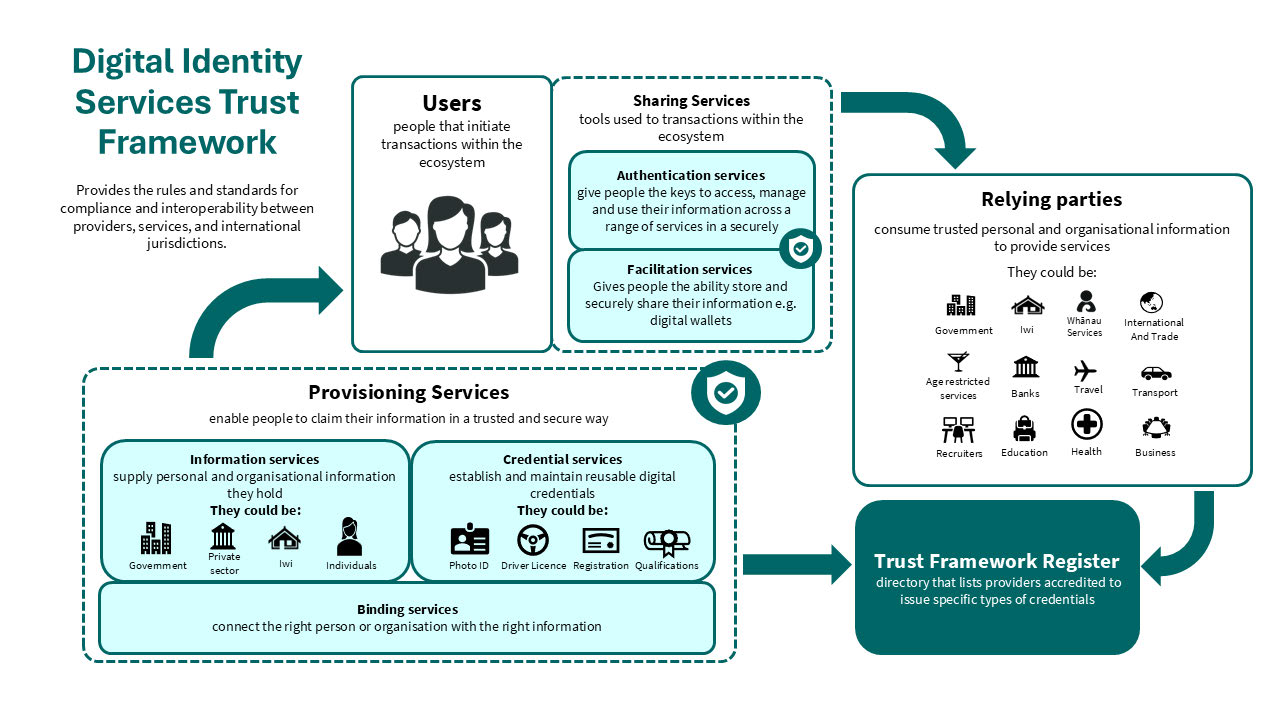
administered by the Department. Diagram A shows the DISTF system.
Diagram A – the DISTF system
1982
Act
Information
13. To become accredited as a provider (services depicted in light blue in Diagram A), an
organisation must meet a set of rules to demonstrate that they should be trusted. The
rules set the requirements for providers and services becoming accredited. They cover
requirements for:
13.1 Identification management - determining t
Official he accuracy of information, binding
that information to the correct individual or organisation, and enabling the
secure reuse of the information;
the
13.2 Privacy and confidentiality - ensuring the privacy and confidentiality of the
information of individuals or organisations is maintained;
13.3 Security and risk - ensuring information is secure and protected from
unauthorised modif
under ication, use, or loss;
13.4 Information and data management - for record keeping and format of personal
and organisational information, to ensure a common understanding of what is
shared; and
13.5 Sharing and facilitation - facilitating the sharing of information with relying
parties including authorisation processes.
Released
14. The DISTF Act makes these rules legally binding for organisations that are accredited.
This means that users and relying parties can trust that an accredited organisation
issuing a digital credential has confirmed the correct information is contained on the
credential and that the credential is being issued to the person to whom the
information belongs. They can also trust that an accredited provider of a wal et has
sufficient security and data management policies in place to keep the credential
secure.
IN-CONFIDENCE
Page 4 of 12
Document 2
Department of Internal Affairs
Te Tari Taiwhenua
The Government Chief Digital Officer is responsible for digital leadership across
agencies
15. At the agency level, the Government Chief Digital Officer (GCDO) also sits within the
Department and is responsible for al -of-government provision of digital identity
infrastructure. One of the functions of the GCDO is to ensure government agencies can
make and issue digital credentials in a safe and secure manner that also avoids
agencies duplicating ICT systems. This work sits within the Digitising Government
portfolio.
16. Work of the GCDO includes the procurement of infrastructure to support the public
and private sector digital identity ecosystem and includes:
16.1
Govt.nz app and built-in digital wallet: On 9 December 2025, the Government
1982
released its Govt.nz app. Functionality planned for early next year wil include a
built-in digital wallet that will allow New Zealanders to hold and use accredited
Act
digital credentials on their own smartphone.
An encrypted digital wal et is a secure way of storing digital credentials: The
Govt.nz wal et is similar to digital wallets already in the market, for example,
those produced by Apple and Android, but ensures that credentials produced
by the New Zealand Government wil always be able to be accommodated. The
wal et uses encryption technology to securely store and display digital
credentials. 9(2)(f)(iv)
Information
16.2
NZ Verify app: the NZ Verify app allows anyone to verify a digital credential.
Official
For instance, a bartender needing to verify a patron’s digital Kiwi Access Card
or a police officer needing to verify a driver’s digital driver licence.
the
16.3
Digital Credential Issuance Platform: the digital credential issuance platform
al ows any government agency to issue credentials while reducing costs across
the public sector and ensuring all agencies meet the same high standards for
privacy and security.
under
17. Government agencies are at varying stages of digital transformation for the services
they provide to customers but general y want to get more services provided online.
The GCDO is working with several public and private sector organisations to deliver
services using the all-of-government infrastructure in early 2026.
Modern digital identity credentials are designed with privacy at the forefront
Digital credentials p
Released
rovide greater security than physical identity products
18. Digital credentials are a way for people to prove their identity and share information
about themselves. They are an electronic version of one or more pieces of information
about a person. Digital identity credentials can be more privacy enhancing than
physical identity products for the fol owing reasons:
18.1 they are securely stored and encrypted on a user’s device compared to a
plastic or paper physical credential that can be held and viewed by anyone in
its possession;
IN-CONFIDENCE
Page 5 of 12
link to page 16 link to page 16 link to page 16
Document 2
Department of Internal Affairs
Te Tari Taiwhenua
18.2 they are only accessible using a strong authenticator like Face or Touch ID, it is
not enough to just be in possession of the credential;
18.3 unlike a physical credential, if the digital credential is lost, it is inaccessible and
unusable because of the two protections above. In addition, an issuer can
revoke a credential, or a user can remotely disable or wipe their device, in near
real time;
18.4 users only need to share the relevant information on a credential rather than
all the information. For instance, rather than sharing your entire physical driver
licence (with name, address, date of birth, driver licence number) a user can
simply share their photo and that they are over 18 to purchase an age
restricted product;
1982
18.5 physical credentials can be more easily tampered with, altered or forged. A
digital credential (with a well secured private key) is practically impossible to
Act
forge; and
18.6 a photocopy or scan of a physical document can be reused without the holder
ever knowing. Digital credentials prevent this because the credential itself is
never transferred. Instead, the wal et generates a one-time presentation that
cannot be reused in another context.
Digital identity credentials are created with built-in privacy features
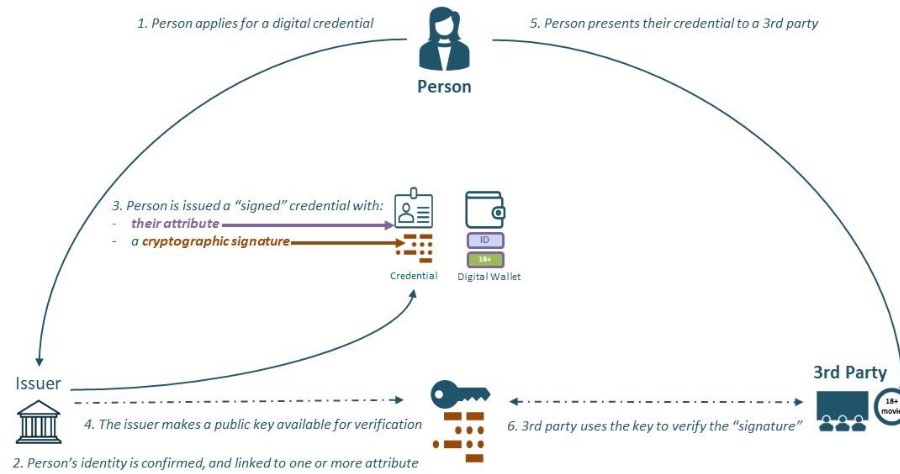
19. When a credential is issued, it is signed with the issuer’s
private key.
2 This creates a
Information
cryptographic signature3 that cannot be forged. Anyone can then use the matching
public key4 to check that the credential is genuine and has not been changed.
20. These public and private keys come as a pair generated by an algorithm and work
together to protect data. This is the same way the chip in a New Zealand passport
works. A high-level depiction of how a verifiable d
Official igital credential works is
shown in
Diagram B.
the
under
Released
2
Private key – A code uniquely associated with the owner and not made public. The private key is used to
compute a digital signature that may be verified using the corresponding public key.
3
Cryptographic signature - A de-identified piece of code, generated through the use of mathematical
techniques, that is used by a third party to test the integrity and authenticity of a verifiable credential and the
data contained within it.
4
Public key - A cryptographic key that is used to confirm a verifiable digital credential real y came from the
issuer, and that it has not been changed since it was issued.
IN-CONFIDENCE
Page 6 of 12
Document 2
Department of Internal Affairs
Te Tari Taiwhenua
Diagram B – how a verifiable digital credential works
1982
Act
Digital credentials are stored securely on a user’s device
21. Digital credentials are held in the secure chip on a user's device and therefore is in
their sole control. Digital credentials stored securely on a person's own device will
require authentication like face or touch ID by the credential holder to use.
Authentication happens via the device, not an app account.
22. Only the rightful user can view and present credentials within a digital wal et. If the
Information
device is lost or stolen, no one else can access the digital wallet without the credential
holder’s biometrics.
Using digital credentials ensures greater privacy controls
23. Credentials can be used in person or online and can be used device-to-device without
Official
internet connectivity. The user must authorise every transaction or presentation of a
credential, including what information is presented (for instance, only showing that
the
someone is over 18 rather than all the information on their driver licence). There is no
ability for a third party to access a user’s data without their explicit consent at the time
of presentation.
24. The presentation of a credential, once approved by the user, is only between the
under
user’s digital wal et and the third party. This presentation is end-to-end encrypted
meaning only the intended recipient can see the presented information.
25. The issuer and wal et provider have no ability to view a user's credentials. Only the
user can view or present the credential. This means no new central database is
created, nothing is stored in the cloud, and therefore security is greatly improved. For
example, if a rental car company was verifying a digital driver licence, or a police
officer needed to see a person's licence, they would use their device to verify the
Released
credential on the user's phone.
26. This ensures individuals remain in control of what information they choose to share,
and when. If a device is lost, the credentials would need to be reissued by the issuing
agency, just as with a lost physical document.
27. The issuer of the credential (for instance, a government agency) is not aware of when a
user presents their credential, again enabling the privacy-preserving elements.
IN-CONFIDENCE
Page 7 of 12
Document 2
Department of Internal Affairs
Te Tari Taiwhenua
However, that issuer can suspend or revoke credentials at any time. An example of
how a digital credential could be used is provided at
Appendix A.
9(2)(h)
1982
Act
9(2)(f)(iv)
Information
Official
the
under
Released
5See IA20256958 - New digital identity legislation objectives and policy approach
IN-CONFIDENCE
Page 8 of 12
Document 2
Department of Internal Affairs
Te Tari Taiwhenua
9(2)(f)(iv)
1982
Act
Information
Next steps
34. Officials are available to discuss this briefing with you and answer any further
questions you might have. We are also able to demonstrate the digital identity
Official
technology, including the wal et and use of demonstration credentials should you find
this useful.
the
under
Released
IN-CONFIDENCE
Page 9 of 12
Document 2
Department of Internal Affairs
Te Tari Taiwhenua
Recommendations
35. We recommend that you:
a)
consider the contents of this briefing; and
agree to discuss this
Agree /
briefing with officials at your convenience
Disagree
b)
forward this briefing to the Minister for Digitising Government
Agree /
Disagree
9(2)(a)
1982
Act
Hon Brooke van Velden
Minister of Internal Affairs
Information
/
/
Official
the
under
Released
IN-CONFIDENCE
Page 10 of 12
Document 2
Department of Internal Affairs
Te Tari Taiwhenua
Appendix A: Opening a bank account with a digital credential
1982
Act
Information
Official
the
under
Released
IN-CONFIDENCE
Page 11 of 12
Document 2
Department of Internal Affairs
Te Tari Taiwhenua
9(2)(f)(iv)
1982
Act
Information
Official
the
under
Released
IN-CONFIDENCE
Page 12 of 12
link to page 23











Document 2a
Proving your identity to open a bank account
Scenario: Helen owns a smal architecture studio in Lake Hāwea, near Wanaka. She likes technology and appreciates being able to work online. Helen wants to open a
new Kiwiana Bank account, to get a better interest rate for a fixed term deposit.
Helen must prove her identity to Kiwiana Bank to open her new account1.
Potential future state - Using a digital credential
Current state - Using physical documents
Helen downloads an accredited digital wal et on her smartphone. This
Helen visits the website of Kiwiana Bank. She prints out an
is because she knows it wil meet standards for privacy, security and
application form to open a bank account. Her printer is out of
operability.
cyan coloured ink, even though she’s only printing in black and
Helen protects her digital wallet using the existing Touch or Face ID
white! She has to change the cartridge. She then prints and
authenticator she already uses on her phone. Her digital wallet
completes the form. She fil s in her
name, date of birth, street
provider cannot access her wallet nor see the wal et’s contents.
address and
phone number. Helen provides them an
email
This step takes her approximately
5 minutes.
address.
She
signs the form
.
This step takes her approximately
15 minutes.
Through the digital wal et app, Helen applies to DIA for a digital
The bank account application form lists the documents Helen
identity credential. This is because she knows it is trusted and seen as
needs to prove her identity. It will not accept her passport as it
authoritative. She can use it can prove her identity to Kiwiana Bank
has expired. She chooses her
full New Zealand birth certificate
and to government and other organisations in the future. She only
and
driver licence instead. Helen has to hunt out her birth
needs to do this once.
certificate, she cannot remember where it is. It takes some
Helen shares her
name,
date of birth,
place of birth and a selfie
time.
photograph with DIA, along with an
email address and
phone
This step takes her approximately
30 minutes.
number for contact purposes. She also provides her
passport
number. This is so DIA can match Helen and her information against
her passport records. With a match confirmed, DIA creates her
digital
identity credential and issues it into her wal et.
This step takes her approximately
15 minutes.
Helen visits the website of Kiwiana Bank. On its application page, she
Helen spends an hour on hold, to book an appointment at
completes her bank account application form online. The application
Kiwiana Bank to prove her identity and open her account. The
form asks for her
name, date of birth, street address and
phone
bank does not provide an option for her to book her
1982
number, along with an
email address, and presents a QR code asking
appointment online.
for these via a digital wallet.
This step takes her approximately
60 minutes.
This step takes her approximately
5 minutes.
Act
Helen uses her wallet to scan the QR code, and it informs her that
Helen drives to the bank for her appointment. The closest
Kiwiana Bank is requesting some specific attributes from her DIA
Kiwiana Bank branch is in Wanaka. It is about 15 km away. It
credential. The request includes a link to the bank’s privacy policy.
takes her about 20 minute to drive each way, and it is only open
She quickly reads about how they wil manage her information.
three days a week. She has to find parking when she arrives.
This step takes her approximately
5 minutes.
This step takes approximately
60 minutes.
In her digital wal et, Helen’s consents to sharing the requested
Helen gives her
application form to the Customer Service
details, and her wal et asks her to authenticate with her Touch or
Officer (CSO) opening her new bank account. She also provides
Face ID before sending her credentials to Kiwiana Bank. Only a
her
birth certificate and
driver licence which are scanned and
Information
representation of the requested attributes from her
digital identity
uploaded on to the bank’s database. The appointment takes
credential is sent to the bank.
about 45 minutes as the CSO has to type al Helen’s details into
Kiwiana Bank receives a representation of the information from
the database.
Helen’s
digital identity credential and uses it to create her new
Helen’s
birth certificate has the following information:
account. It keeps
a record that a digital identity check was
•
Her name
undertaken but does not need to scan and store any hard copy
•
Her name at birth
Official
documents from Helen.
•
Her sex
This step takes her just
a few seconds.
•
Her date of birth
•
Her place of birth
the
•
An indication of if she was a citizen at birth
•
Any name changes she has had
•
Her mum’s name
•
Her mum’s name at birth
under
•
Her mum’s occupation
•
Her mum’s age
•
Her mum’s place of birth
•
Her dad’s name
•
Her dad’s name at birth
•
Her dad’s occupation
•
Her dad’s age
Released
•
Her dad’s place of birth
Helen’s
driver licence has the following information:
•
Her name
•
Her date of birth
•
Her driver licence number
•
Her drive licence restrictions
•
Her organ donor status
•
Her address
•
Her signature
This step takes her approximately
45 minutes.
To download a new wallet, create a new digital identity, and open a
To open a bank account and
prove her identity in person has
bank account and
prove her identity online has taken Helen less than
taken Helen approximately
210 minutes spread across several
30 minutes in a single session.
days.
Now that she has the wal et and credential on her phone, it wil be
The bank has col ected, used and stored a wide range of identity
even faster next time she needs to prove her identity.
information about Helen, along with identity information about
The bank has only col ected, used and stored the identity information
her
parents.
about Helen that it needs to, to open and operate her account.
The online process has saved Helen about 3 hours.
1 Please note, this example is il ustrative only. It is designed to compare the process and identity information involved in an online process verses and process using hard copy identity
documents. Kiwiana Bank is not a real bank.
Page 1 of 1

Document 3
Priority Routinet
Internal Affairs briefing
Hon Brooke van Velden
Minister of Internal Affairs
Title:
Supplementary advice to the Governance and Administration
Committee on the Regulatory Systems Amendment Bil
Date:
16 January 2026
Key issues
1982
We seek your approval to provide the attached supplementary advice to the Governance and
Administration Committee (the Committee) on the Regulatory Systems (Internal Affairs)
Amendment Bil (the Bill).
Act
The supplementary advice responds to the Committee’s request for further information about
timeframe issues for passing the amendments to the Fire and Emergency New Zealand Act 2017,
including issues associated with passing the Bill after 1 April 2026. This request followed
submissions from the Insurance Council of New Zealand and IAG New Zealand to the Committee
that advised it was critical that the Bill be passed before 1 April 2026.
We advise that passing the Bill by 1 July 2026 is important to avoid requiring late implementation
changes for the insurance sector. We also advise that passing the Bill by 1 April 2026 would provide
legal certainty for issuing insurance renewals and might reduce administrative costs.
Information
The Government has not prioritised the Bill for Q1, so it will not be passed by 1 April. We recognise
this advice surfaces the issues that may occur. For context, the advice notes that if the Bill is passed
shortly after 1 April, the scale of risk would be relatively small.
We seek your approval to provide this advice by 23 January 2026, so that it can be considered at the
Committee’s next meeting on 28 January 2026.
Official
Action sought
Decision
We recommend that you
approve the attached supplementary advice to
Yes /
No
the
be sent to the Governance and Administration Committee.
Name
Position
Contact Number
Suggested 1st contact
Louise Cooney
Policy Manager
9(2)(a)
under
9(2)(a)
General Manager
9(2)(a)
Return electronic document to:
9(2)(a)
Hukatai reference
PKR5P44QH4K4-787772508-1682
Ministerial database reference
IA202610762
9(2)(a)
Released
Hon Brooke van Velden
Minister of Internal Affairs
/
/
IN-CONFIDENCE
Page 1 of 1


Document 3a
Regulatory Systems (Internal Affairs) Amendment Bil
Supplementary information to the Governance and Administration
Committee
23 January 2026
1982
Act
Information
Official
the
under
Released
Page 1 of 4
Document 3a
Te Tari Taiwhenua
Department of Internal Affairs
Request for further information
1. On 10 December 2025, the Governance and Administration Committee (the
Committee) requested further advice on the issues related to timeframes for the new
Fire and Emergency insurance levy raised by the Insurance Council of New Zealand
(ICNZ) and IAG New Zealand (IAG) in their submissions to the Committee.
2. The Department of Internal Affairs’ (the Department) response, set out below, can be
read in conjunction with previous advice provided to the Committee on the
amendments being made to the Fire and Emergency New Zealand Act 2017 (the
FENZ Act). See paragraphs 328 – 337 of the departmental report for that advice. 1982
Passing the Bill by 1 July 2026 is important for supporting the implementation
of the Fire and Emergency levy
Act
3. The redesigned Fire and Emergency insurance levy will come into effect on 1 July
2026. The insurance sector has been working since December 2024 to make changes
to their systems necessary to implement the redesigned levy. This includes
incorporating the levy regulations made in December 2024, along with the
amendments to the FENZ Act proposed in the Regulatory Systems (Internal Affairs)
Amendment Bill (the Bill).
4. Passing the FENZ Act amendments before July 2026 will support the effective and
efficient implementation of the levy. If the FENZ Act amendments are not passed
Information
before 1 July, then it would require insurers and insurance intermediaries to reverse
or change some of the work undertaken on implementation since late 2024. This
would create unnecessary costs, and late system changes may not be completed
before the new levy comes into effect.
5. Paragraphs 334-337 of the departmental report
Official describe the intended issues that the
Bil is intending to resolve (broadening the definition of residential property, ensuring
commercial personal property is leviable, and addressing transitional arrangements
the
for insurance contracts that undergo a variation). The benefits of these amendments
– to reduce administrative costs, to better align the legislation with insurance sector
systems and to ensure Fire and Emergency’s funding needs are met – would also not
be achieved until the legislation is passed.
under
Passing the Bill by 1 April 2026, or close to this date, will support more
consistent practice and reduce the risk of administrative costs
6. In their submissions to the Committee, ICNZ and IAG advised that the Bill needed to
pass by 1 April 2026, to provide a legal basis for levy payments that are stated on
insurance renewals issued approximately three months before the contract period
begins.
Released
7. The Department acknowledges that some challenges arise if the Bil is not passed by
1 April 2026, particularly for some insurance intermediaries. They wil need to decide
whether to:
a. issue renewals based on the current provisions of the FENZ Act and risk these
provisions being changed before the contract begins, leading to a need to
correct payments later and potential penalties; or
Page 2 of 4
Document 3a
Te Tari Taiwhenua
Department of Internal Affairs
b. issue renewals based on the anticipated changes to the FENZ Act, taking on
the risk of those changes not coming into place before July 2026 and
operating under an unclear legal basis.
8. On balance, the Department considers it likely that most insurance intermediaries
will opt to incorporate the anticipated changes to the FENZ Act in their insurance
renewals. Their systems will have been updated with those changes incorporated.
ICNZ notes in paragraph 28 of its submission:
“…there would also be no ability for insurers to change their approach
at this time (i.e. April 2026) as system changes will have long been
locked in by that point.”
1982
9. However, there are over 100 insurance intermediaries in the New Zealand market,
and we are not certain that all of them will be subject to the same system
Act
constraints. Some intermediaries might opt to issue renewals on the basis of the
current provisions of the FENZ Act. In particular, some intermediaries may choose to
not apply the levy to commercial personal property in their renewals to reduce
premiums for customers. There would be transaction costs from correcting these
payments later and a risk of penalties being applied under the FENZ Act to the
insurance intermediaries for underpayments of levy.
10. The closer the Bill is passed to 1 April, the smaller the risk of inconsistent insurance
renewal practices. If passage occurs later, a growing number of renewals
Information will be
issued without the new provisions, and intermediaries may become increasingly
uncertain about the legislation’s timing as 1 July 2026 approaches.
The risks associated with passing the Bill after 1 April 2026 are mainly
Official
associated with insurance contracts that include commercial personal
property
the
11. Levy payments for residential and mixed-use properties should general y be the same
under the current legislation as under the proposed amendments in this Bil . The risk
of penalties being applied to insurance intermediaries is therefore low in relation to
levy payments for residential or mixed-use property. The Department also notes that
the earliest insurance rene
under wals, issued three months before the contract period, are
typically issued for commercial insurance contracts, rather than for residential
insurance.
12. The Department considers that the greatest risk of inconsistent practice would be in
issuing renewals that include commercial personal property. This risk may be partially
mitigated as some insurance intermediaries may still interpret the existing provisions
as requiring the collection of levy on commercial personal property, despite the
Released
ambiguity in the drafting of the FENZ Act.
Page 3 of 4
Document 3a
Te Tari Taiwhenua
Department of Internal Affairs
Summary
13. Passing the FENZ Act amendments before the new levy comes into effect would
support the smooth implementation of the levy, as the work undertaken by the
insurance sector to change its systems has incorporated the changes proposed in the
Bill. Passing the FENZ Act amendments before 1 July 2026 would also secure the
revenue from levying commercial personal property.
14. Passing the FENZ Act amendments before 1 April 2026, or as close to that date as
possible, would provide certainty for the insurance sector that they have a robust
legal basis for issuing early insurance renewals and would reduce the risk of
inconsistent practice in issuing insurance renewals. This would reduce potential 1982
administrative costs that could arise from having to correct levy payments at a later
date. The further out from 1 April that the FENZ Act amendments pass, the greater
the risk that inconsistent practice wil occur.
Act
Information
Official
the
under
Released
Page 4 of 4

Document 4
Priority Routine
Internal Affairs briefing
Hon Brooke van Velden
Minister of Internal Affairs
Title:
Deployment of AI at DIA
Date:
22 January 2026
1982
Key issues
The Department has established a framework for the safe and responsible adoption and use of AI.
The Department’s AI policy is consistent with all-of-government guidance. The policy includes the
Act
requirement for human oversight of AI use and how staff should manage information when using
enterprise AI tools.
Any AI initiatives developed by the Department will undergo the same risk, privacy and security
processes as any other technology implementation.
The Department has established an AI programme team, with the purpose of building AI capability
across DIA and accelerating the safe, effective adoption of AI.
The Department sees potential benefits in AI. Most initiatives so far are producing productivity
gains rather than direct savings. This appears to be consistent with the feedback we are receiving
Information
from other organisations and countries.
Action sought
Timeframe
Agree to discuss this briefing with officials
29 January 2026
Official
Contact for telephone discussions (if required)
Name
Position
Contact Number
Suggested
1st contact
the
Murray Davey
Chief Digital Officer
9(2)(a)
✓
Myles Ward
Deputy Secretary Digital Services
9(2)(a)
Return electronic document to:
Murray Davey, [email address]
under
Hukatai reference
2DX73NE7NTN2-2141378227-2431
Ministerial database reference
IA202610832
Released
IN-CONFIDENCE
Page 1 of 4
link to page 30
Document 4
Department of Internal Affairs
Te Tari Taiwhenua
Purpose
1.
This briefing outlines the approach that the Department of Internal Affairs (the Department)
has taken to safely adopting and using Artificial Intelligence (AI), and the early AI opportunities
the Department is exploring.
Background
2.
On 1 December 2025, we briefly discussed with you the Department’s deployment of AI. You
requested a further discussion on this topic. This briefing provides background information for
that discussion on 29 January 2026.
3.
Cabinet is encouraging the uptake of AI in the Public Service, recognising that it provides
significant opportunities for Government service delivery as well as improving productivity,
1982
driving efficiency, and delivering better value for money
.1
4.
The Government Chief Digital Officer’s (GCDO) AI Work Programme aims to accelerate the
uptake of AI through the Public Service by modelling best practice in safe and
Act
responsible AI use. This includes releasing the Public Service AI Framework and Responsible AI
Guidance for the Public Service.
5.
The GCDO AI Work programme has recently been refreshed to 2027, with the forward work
programme focused on leading work on Common Use Tools, Safe and Responsible AI,
Customer and Partnerships, and AI Workforce. The Minister for Digitising Government sent
you and other Ministers a letter about the refreshed work programme on 18 December 2025.
6.
Most government departments are adopting AI. The Department is leveraging AI resources
and forums established by the GCDO and sharing information with other Departments to
Information
enable learning and reuse across the Public Sector.
The Department has established a framework to safely adopt and use AI
7.
The Department’s approach to the adoption of AI started with establishing a framework for
the safe and responsible use of AI and a programme to coordinate this work across the
Official
Department.
This framework aligns with all-of-government guidance…
the
8.
The Department has published an AI policy which is aligned to the GCDO AI Guidance and
the Public Service AI Framework. The policy is principle based and sets out how AI should be
adopted and used within the Department. This includes the requirement for human oversight
of AI use and how staff should manage information when using enterprise AI tools.
under
…establishes clear roles and responsibilities…
9.
Clear roles and responsibilities for AI have been established. The Department’s Chief Digital
Officer has been designated as the senior responsible official for AI and will oversee the
Department’s overall adoption of AI. Responsibility for implementation and use of specific AI
solutions sits with Deputy Secretaries and business owners using existing business and
governance processes.
Released
10.
An AI Enablement Group has been established. It brings together business leaders with
privacy, security and digital expertise to provide advice, guidance and recommendations on AI
initiatives to business groups. It will help build the Department’s maturity in the use of AI and
enable the Department to adapt our advice to business groups quickly as the AI landscape
evolves.
1 As noted in ECO-24-MIN-0119 and CAB-25-MIN-0216.
IN-CONFIDENCE
Page 2 of 4
Document 4
Department of Internal Affairs
Te Tari Taiwhenua
11.
An AI Community of Practice (CoP) has been formed. This group is open to all staff, fostering
knowledge sharing and continuous learning. The CoP follows a Share – Connect – Learn model
and has good participation across the department, with over 100 attendees at its monthly
meetings and a range of internal and external speakers presenting.
…and embeds existing risk and security processes.
12.
The Department’s existing policies, risk, privacy, security and governance processes all still
apply to the use of AI. This means that any AI initiatives will undergo the same risk, privacy
and security processes as any other technology implementation.
13.
In addition to this, the Department is currently developing an AI Risk Management Framework.
This integrates specific AI considerations into the existing processes, to provide a structured
and repeatable approach to identifying and managing AI related risks across the organisation.
1982
The Department is taking a deliberate approach to our adoption of AI Act
14.
The Department has established an AI programme team, with the purpose of building AI
capability across the organisation and accelerating the safe, effective adoption of AI. The AI
programme team’s deliverables include:
14.1
Identifying and prioritising potential AI initiatives across the department.
14.2
Delivering selected initiatives with a focus on value and reuse.
14.3
Delivering an education programme for staff on how to learn, use and get business
value from AI tools.
Information
14.4
Developing guidance to support the Department and business groups in the adoption
and use of AI.
15.
The AI Programme has a maturing pipeline of over 50 initiatives. These range in size and stage
of development from exploratory ideas to early pilots already operating in small groups.
16.
The Department is taking an iterative, learning approach. Most AI initiatives that are already
Official
operating are only being used by small groups of people and are internal to the Department.
This reflects that we are still early in the adoption cycle and enables us to learn from these.
We expect that as we develop some of the initiatives in the pipeline that these will be made
the
available to larger groups across Te Tari.
17.
Currently the only enterprise-wide AI tool is Microsoft Copilot Chat, which exists within our
existing secure Microsoft Cloud environment. Staff have been instructed not to use this with
sensitive documents or personal information while we learn and get familiar with using AI
under
tools.
18.
To date the Programme has focused on providing education on the use of Microsoft Copilot
Chat to staff as they all have access to this tool and it enables them to get familiar with using
AI. The next area of focus will be to deliver education sessions for leaders to enable them to
start thinking about where they could use AI to deliver their services.
Potential benefits include productivity gains and improved services
Released
19.
There is general enthusiasm for the adoption of AI across the organisation. As awareness and
comfort with the tools are growing, staff are identifying new opportunities to explore.
20.
Most initiatives so far are producing productivity gains rather than direct savings. This appears
to be consistent with the feedback we are receiving from other organisations and countries.
This suggests direct savings from AI may not be achieved in the short term and may only
materialise when our use of AI and the capabilities in the market mature over the next few
years. This would be consistent with the adoption of previous technologies (such as the
Internet and Smart Phones).
IN-CONFIDENCE
Page 3 of 4
Document 4
Department of Internal Affairs
Te Tari Taiwhenua
21.
Our trials and business group engagement to date highlight several areas where AI can
improve services and internal operations:
21.1
Productivity and workflow support: summarisation, drafting assistance, knowledge
search, and guided processes that reduce manual workload
21.2
Service improvement: better navigation of complex information, smoother customer
interactions, more consistent responses, and reduced processing times
21.3
Regulatory and compliance functions: pattern analysis, risk identification, thematic
review of high-volume information
21.4
Training and workforce capability: onboarding support, reducing training pressure on
experienced staff.
22.
Early pilots, such as call summarisation in the Contact Centre, are showing productivity gains
1982
and helping staff build familiarity and trust in new tools. The Department is also leveraging
experience from other agencies, in this case we were able to learn from ACC, MBIE and Inland
Act
Revenue who were already adopting AI for the same purpose.
23.
The Department sees potential benefits in AI and is taking a deliberate approach to the safe
and responsible use of AI.
Recommendation
24.
We recommend that you
agree to discuss this briefing with officials.
Yes/No
Information
Official
Murray Davey
Chief Digital Officer & GM Enterprise Digital Services
the
under
Hon Brooke van Velden
Minister of Internal Affairs
/
/
Released
IN-CONFIDENCE
Page 4 of 4

Document 5
Priority Routine
Internal Affairs briefing
Hon Brooke van Velden
Minister of Internal Affairs
Title:
Advice on the use of Artificial Intelligence generated endorsements
in online casino gambling advertising
Date:
4 February 2026
Key issues
1982
This briefing provides you with further advice on Artificial Intelligence (AI) generated endorsements
as part of the suite of advertising regulations to establish the Online Casino Gambling regime.
Act
In November 2025, Cabinet agreed to prohibit the use of paid endorsements and agreed in-principle
to prohibit the use of AI to endorse operators or online casino gambling products, subject to you
receiving further policy advice.
AI generated endorsements are used by operators internationally, and there is evidence that they
are also being used to target New Zealanders. AI generated endorsements are similar to human
ones. Both are a highly impactful form of advertising that can exacerbate gambling harm and
mislead consumers.
This briefing provides options for your consideration and identifies a recommended approach to the
use of AI generated endorsements, which aligns with Cabinet’s in-principle decision and would
Information
prohibit advertising content where operators use a person’s likeness or AI generated content to
suggest or mimic a human endorsement. We expect that the most common example of such
content would be the use of AI generated or computer-generated avatars that mimic human
influencers to promote online gambling.
Subject to your agreement, draft regulations will be included in the final package of regulations on
advertising, harm prevention and minimisation, consumer
Official protection and cost recovery matters
intended to go to Cabinet for approval in late May 2026.
Action sought
the
Timeframe
Discuss advice with officials at the regulations deep dive on 10 February.
By 10 February 2026
Indicate your preferred approach to the regulation of
AI generated
By 13 February 2026
endorsements. under
Contact for telephone discussions (if required)
Name
Position
Contact Number
Suggested
1st contact
Kelly Miller
Policy Manager
9(2)(a)
9(2)(a)
General Manager, Policy
9(2)(a)
Released
Return electronic document to:
Manasi Nair, [email address]
Hukatai reference
NNZF57N5FNJM-1924615558-264
Ministerial database reference
IA202610890
IN-CONFIDENCE
Page 1 of 10
Document 5
Department of Internal Affairs
Te Tari Taiwhenua
Purpose
1.
This briefing seeks your consideration of options for the regulation of AI generated
endorsements, and agreement to prohibit online casino gambling operators from using a
person’s likeness or AI generated content to suggest or mimic a human endorsement.
2.
This paper outlines the potential benefits and risks of such content in online casino gambling
advertising. On balance, we recommend prohibiting operators from using this content in their
advertising.
Executive summary
3.
The briefing advises you on whether to prohibit online casino gambling operators from using a
person’s likeness or AI generated content to suggest or mimic human endorsements.
Cabinet
1982
has already agreed to ban paid endorsements and agreed
in principle to restrict use of a
person’s likeness or AI to endorse operators or online casino gambling products, pending
further advice. These AI endorsements—including synthetic influencers, deepfakes, and other
Act
likeness-based representations—are increasingly used internationally and have already been
observed in New Zealand, creating risks of consumer deception and contributing to gambling
harm.
4.
While existing frameworks such as the Fair Trading Act 1986, the Defamation Act 1992, and
the New Zealand Advertising Standards Authority guidelines provide some protection, they are
not designed to proactively minimise gambling harm. These endorsements can normalise
gambling in ways similar to human endorsements and deepfakes carry additional harms,
including misuse of individuals’ identities. Other jurisdictions (e.g., the United States of
Information
America, the United Kingdom, and the European Union) have taken steps to restrict false or
AI-generated endorsements, signalling a global trend toward tighter regulation.
5.
This paper proposes three regulatory options: maintaining the status quo, requiring disclosures
on AI generated content, or prohibition.
We recommend the third option (prohibition). This
option would be most effective at closing a potential loophole in the regulations, ensure clear
Official
expectations for operators, and strengthen harm-prevention measures as the regulated online
casino market is established.
6.
If you agree to prohibit this form of advertising, we will work with the Parliamentary Counsel
the
Office to draft regulations for inclusion in the draft regulations package to be considered by
Cabinet in May/June 2026.
Cabinet has already agreed to prohibit paid endorsements
under
7.
Cabinet has previously agreed to prohibit the use of paid endorsements. A paid endorsement
is an arrangement where an advertiser provides consideration to a person to act as a brand
ambassador or provide a testimonial. Endorsements may be delivered by a wel ‑known
individual or by a layperson presented as a trustworthy or relatable voice. Operators will not
be al owed to pay a person (such as an influencer, sports player, celebrity, or a tipster) to
promote online casino gambling.
8.
Paid endorsements are highly impactful, especially for children. They can normalise gambling
Released
behaviour, increase exposure, and contribute to problem gambling behaviours (IA20256569
refers).
Cabinet has also agreed in-principle to prohibit the use of AI for endorsements
9.
In November 2025, Cabinet agreed in-principle to prohibit the use of a person’s likeness or AI
generated endorsements subject to you receiving further advice [ECO-25-MIN-0197 refers].
You advised Cabinet that you would confirm your position and seek Cabinet Legislation
Committee agreement when you bring the regulations back for final approval. Due to time
IN-CONFIDENCE
Page 2 of 10
link to page 35 link to page 35
Document 5
Department of Internal Affairs
Te Tari Taiwhenua
constraints, we were unable to provide detailed advice on this issue ahead of your Cabinet
paper being considered.
10. An AI generated endorsement is an advertisement that uses AI to create videos or images that
appear to reflect a human endorsement. Because these do not involve a human receiving a
payment or benefit for the endorsement, they are not clearly captured by the current
prohibition on paid endorsements, yet they are associated with gambling harm and give rise to
similar concerns as paid endorsements. AI generated endorsements also can cause specific
harms associated with deepfakes, which we outline in detail below. This creates a loophole in
the advertising regulations, which we consider should be addressed.
We have identified two forms of AI endorsements, and we are also proposing to
limit ‘use of a person’s likeness’ to ensure similar technologies are captured 1982
11. The first form of AI generated endorsement we have identified is the use of synthetic
influencers. These are AI generated personas created to look and behave like humans.
1 These
Act
“influencers” are used as brand ambassadors due to their ability to attract people’s attention,
highlighting a shift toward technology driven marketing. They are highly customisable as they
range from hyper realistic personas to stylised cartoons or fantasy characters making them
particularly appealing to Gen Z and people with high digital literacy. These features are
desirable because they combine speed, cost, and full creative control, and brands are able to
produce or hire these “influencers” to boost their engagement. Some synthetic influencers
have their own fanbase, similar to real life influencers.
12. Deepfakes are the second form of AI generated endorsement we have identified. These are
created by impersonating the identity or voice of a celebrity, influencer, or other individual
Information
without consent. Deepfakes can produce highly realistic content that appears to show an
individual endorsing a product they have no association with, creating substantial risk of
deception. They create harms for both the person whose identity is used, and those who view
the content. We discuss this harm further at paragraph 17.
13. We also include the “use of a person’s likeness” in this advice, alongside the two previously
Official
mentioned forms of AI endorsements. This ensures that our analysis also covers
advertisements that use content created by a person (without the assistance of AI) that
suggests or mimics endorsements, similar to a paid human endorsement. Examples of this
the
would include digitally recreating a person’s voice, and computer generated images (CGI). This
would capture work that is done using computers to create digital characters that are not AI
synthetic influencers and supports future proofing, as it would capture non-AI emerging
technologies that depict or imitate humans.
under
International y, AI generated endorsements are an emerging trend
14. We have identified multiple instances of gambling operators using AI generated content to
mimic endorsements made by real people.
2 These endorsements have either used a deepfake
or synthetic influencers to make advertisements that appear more authentic or engaging.
15. AI generated endorsements are accessible and cost‑effective. They can be created and
deployed quickly and adapted for multilingual campaigns to reach a wider market. This
Released
reduces reliance on human influencers and streamlines production timelines by minimising
talent coordination. They also allow real time tailoring, for example, automatically generating
and rotating messages or testimonials by audiences and adjusting the content at pace to boost
1 Kim, E., Kim, D., E, Z., & Shoenberger, H. (2023). The next hype in social media advertising: Examining virtual
influencers’ brand endorsement effectiveness.
Frontiers in Psychology, 14, 1089051.
https://doi.org/10.3389/fpsyg.2023.1089051
2 See, for example a recent UK Advertising Standards Authority ruling. (2025, September 17). Dribble Media
Ltd. ASA | CAP.
https://www.asa.org.uk/rulings/dribble-media-ltd-g25-1300959-dribble-media-ltd.html
IN-CONFIDENCE
Page 3 of 10
link to page 36 link to page 36 link to page 36 link to page 36 link to page 36 link to page 36
Document 5
Department of Internal Affairs
Te Tari Taiwhenua
engagement on platforms. As a result, operators gain greater control over brand consistency
and campaign efficiency. Together, these features make AI generated endorsements an
efficient and scalable option for reaching diverse audiences at pace.
AI generated endorsements have very similar potential for harm as paid human
endorsements, as well as some additional risks
16. Like human endorsements, AI generated endorsements can normalise and encourage
gambling. Due to their human-like appearance, endorsements by synthetic influencers can be
perceived as authentic and credible to consumers.
3 These personas can accumulate followers,
foster trust, and exert significant marketing influence over time, creating effects comparable
to human influencer endorsements even where audiences are aware that the persona is not a
real person.
1982
17. Deepfakes create a range of additional harms due to the negative impact on the person whose
identity is used. We have already seen this form of advertising being used by a gambling
Act
operator to appeal to New Zealand audiences. In April 2025, a video used the likeness and
synthetic voice of
Breakfast host Jenny-May Clarkson to endorse a gambling app (Māori
Game), which also featured a deepfake of Taika Waititi.
4
18. The United Kingdom’s Advertising Standards Authority (UK ASA) has reported that in 2024
celebrity deepfake advertisements were amongst the most reported scams.
5 Deepfakes can
also target people with no public profile. Meta’s Oversight Board
6 reviewed an AI generated
gambling endorsement that used images of a schoolteacher, bus driver and grocery store
worker to claim players could earn more from “Plinko” than these jobs. The post was viewed
over 600,000 times before removal, highlighting the speed and reach of deceptiv
Information e AI content
and the limits of reactive moderation.
7
International jurisdictions increasingly recognise the risks associated with AI
generated endorsements
Official
19. While there is limited information on how other jurisdictions regulate AI generated
endorsements in gambling advertising, several jurisdictions have implemented broader
restrictions on deepfake or fabricated endorsements. The U.S. Federal Trade Commission
the
(FTC), for example, has ruled that “fake or false consumer reviews, consumer testimonials, and
celebrity testimonials will be prohibited”
8, including AI generated fake endorsements. The
FTC’s 2023 Endorsement Guide also clarifies that synthetic influencers are “endorsers”, and
they must not mislead the public. The Guide also states that synthetic influencer
endorsements must include disclosures that are clear and conspicuous.
under
20. Similarly, the UK ASA and Committee of Advertising Practice (CAP) codes include rules on
misleading consumers, testimonials and endorsements, and guidance has emphasised the
need for AI generated advertising to comply with existing requirements about false or
misleading advertisements. They have also ruled against false celebrity endorsements that
3 Heejae Lee, Mincheol Shin, Jeongwon Yang & T. Makana Chock (2025) Virtual Influencers vs. Human
Influencers in the Context of Influencer Marketing: The Moderating Role of Machine Heuristic on Perceived
Authenticity of Influencers, International Journal of Human–Computer Interaction, 41:10, 6029-6046,
Released
DOI: 10.1080/10447318.2024.2374100
4
Breakfast host's warning as AI gambling ad captures likeness
5 Advertising Standards Authority. (2025, February 13).
A year in scams: 2024 update on Scam Ad Alert system.
https://www.asa.org.uk/news/a-year-in-scams-2024-update-on-scam-ad-alert-system.html
6 An independent board that reviews and can overturn Meta’s content decisions.
7 (2025, June 5).
AI-manipulated video promoting gambling [Case decision].
https://www.oversightboard.com/decision/fb-o7ai7uax/
8
Federal Trade Commission Announces Final Rule Banning Fake Reviews and Testimonials | Federal Trade
Commission
IN-CONFIDENCE
Page 4 of 10
Document 5
Department of Internal Affairs
Te Tari Taiwhenua
suggest the endorsement or testimonial is genuine. The European Union’s AI Act has
introduced anti-manipulation prohibitions and transparency/labelling duties for deepfakes.
The risks from AI generated endorsements are not unique to gambling and there
are already some legal protections in place in New Zealand 21. We recognise that the issues associated with synthetic influencers and deepfake
endorsements extend wel beyond online casino gambling. There are already legal protections
in place to address some of the concerns. For example, section 9 of the Fair Trading Act 1986
(FTA) prohibits misleading or deceptive conduct in trade. Any concerns or breaches would be
addressed through complaints to the New Zealand Commerce Commission. The FTA may apply
to both the use of deepfakes and the use of synthetic influencers, if criteria for breach of
section 9 are met. In addition to the FTA restrictions, the NZ ASA’s Guidance on Generative AI
1982
warns against misrepresenting AI content, and the Commerce Commission requires
truthfulness in endorsements.
Act
22. The existing requirements in the online casino gambling regulations will also go some way to
protecting consumers. For example, where a synthetic influencer is created and control ed by a
third party, we expect that the existing prohibition on paid endorsements would apply, as the
operator would still be entering a paid arrangement with a third party to endorse their
products. Operators will also be required to ensure that advertisements are easily identifiable
as advertisements.
23. The key limitation with these existing and pending controls is that not all AI generated
endorsements are inherently misleading or deceptive, and the use of synthetic influencers and
deepfakes does not necessarily require engaging with a third party.
Information
24. There are other legal frameworks that individuals who have been personally harmed by
deepfakes can access to seek a remedy (the Defamation Act 1992, the Harassment Act 1997
and the Harmful Digital Communications Act 2015 are potential examples).
25. While there are some existing legal protections, we consider a gambling-specific prohibition
Official
may have merit, as a direct response to this issue in the gambling context and the particular
harms associated with highly influential gambling advertising. This could strengthen the
regime’s focus on minimising gambling harm.
the
We have identified three options for you to consider
26. Scenarios demonstrating how each option would work in practice have been attached at
Appendix A. We have included examples of paid human endorsements and affiliate
under
arrangements to show the wider regulatory approach.
Option 1: Do not introduce specific restrictions on AI generated endorsements
27. This option would continue to prohibit paid endorsements, as previously agreed. Use of AI
endorsements would continue to be regulated within the existing legal framework provided
for in the OCG regulations and relevant legislation like the FTA.
28. The key benefit of the status quo is that it enables a ‘watch and wait’ approach where we can
Released
see how other jurisdictions manage this risk and learn from their experience, rather than being
a first mover. It also enables us to assess the extent of this issue in the newly regulated online
casino gambling market, and to wait for potential development of wider legal controls on AI
endorsements in New Zealand, given this is an increasingly common aspect of advertising
across various sectors.
29. However, a ‘watch and wait’ approach also means that harm may occur in the interim, and use
of unpaid AI generated endorsements is likely to continue. We know advertisements are run
quickly with new advertisements being released every few days. This risk is heightened during
IN-CONFIDENCE
Page 5 of 10
link to page 38 link to page 38
Document 5
Department of Internal Affairs
Te Tari Taiwhenua
the market establishment phase, when operators are likely to significantly increase marketing
spend to build market share. A reactive model in this context may allow harm to occur before
any regulatory intervention takes place.
Option 2: Require disclosures on AI generated content
30. If this option was adopted, an operator would be required to disclose where advertising
content is AI generated. We propose that disclosures should be prominent, unavoidable and
accessible – for example, stating that the endorsement is generated by AI and is not a real
opinion or person in both visual and audio formats at the beginning of the advertisement. This
aligns with best practice guidance issued by the FTC for disclosures in advertisements.
31. When brands fail to disclose that the content is AI generated and instead suggest or mimic that
it reflects a human endorsement, it could mislead consumers. Because these endorsements
1982
often mimic influencer content, it blurs the line between advertising and authentic opinion,
undermining informed decision-making for consumers.
Act
32. The key benefit of this option is that it would enable operators to access the commercial
benefits of this form of advertising, while mitigating some of the risks. This approach would
also be consistent with the FTC guidelines. It would also reduce the risk of consumers being
misled by AI generated content, so it may be more effective at minimising harm and protecting
consumers than Option 1.
33. The key risk is that this option may be less effective than a prohibition, for the following
reasons:
33.1 The disclosure could be missed by consumers, if included in an extensive list of
Information
other required disclosures. We note that Cabinet has also agreed that
advertising must be easily identifiable and labels must be obvious, clear,
prominent and upfront and must be separate from other disclosures. Multiple
disclosures could also increase the compliance burden for operators, especially
for short-form ads like those found on Instagram stories or TikTok videos
where the length and content of the advertisement is already limited.
Official
33.2 Children are less likely to understand what disclosures mean, compared to
adults.
9
the
33.3 Synthetic influencer endorsements can still be compelling and attractive to
their audience, even when the audience knows the influencer is not a real
person.
10 A disclosure would not be effective at reducing risk of harm for
customers that already know the content of the advertisement is AI generated.
under
33.4 This option would not capture other tools for suggesting or mimicking a human
endorsement that do not use AI, such as CGI content.
34. If you agree to this option, we propose it be made clear that disclosures would not discharge
or override an operator’s obligations under other legislation, like the FTA.
Option 3: Prohibit operators from using a person’s likeness or AI generated content to
suggest or mimic a human endorsement (preferred option)
Released
35. This option would prohibit operators from using a person’s likeness or AI generated content to
suggest or mimic a human endorsement. This would include endorsements that represent,
9 Boerman SC and van Reijmersdal EA (2020) Disclosing Influencer Marketing on YouTube to Children: The
Moderating Role of Para-Social Relationship. Front. Psychol. 10:3042. doi:10.3389/fpsyg.2019.03042
10 Kim EA, Kim D, E Z and Shoenberger H (2023) The next hype in social media advertising: Examining virtual
influencers’ brand endorsement effectiveness. Front. Psychol. 14:1089051. doi: 10.3389/fpsyg.2023.1089051
IN-CONFIDENCE
Page 6 of 10
link to page 39
Document 5
Department of Internal Affairs
Te Tari Taiwhenua
simulate, or perform the function of an endorsement for online casino gambling, regardless of
whether the content is presented as a real person or a synthetic persona.
36. We propose that ‘suggest’ would apply where the operator is implying or insinuating that the
use of a person’s likeness or AI generated content is a real human. ‘Mimic’ would apply where
there is no implication or insinuation that the likeness or AI content is a real person, but the
likeness or AI content closely resembles a real human. An example of content that ‘mimics’
human endorsement but does not ‘suggest’ it is a synthetic influencer that is open and clear to
the audience that it is AI generated and not real.
37. Introducing this prohibition would close the loophole identified by officials and would prevent
operators from using AI or CGI generated endorsements to advertise. This would protect
consumers from potentially harmful or misleading marketing practices. It would also help
ensure that consumers can make informed choices about their gambling behaviours.
1982
38. This option will only apply to endorsements and would not apply to other forms of advertising
or communications between an operator and customers for administrative purposes
Act
(administrative communications are not considered advertising). We are not seeking to restrict
operators from using AI tools for legitimate service functions. This includes responding to
comments on online platforms or generating content in multiple languages. We acknowledge
that the use of AI for consumer interaction can enable operators to respond faster and
improve their service quality.
39. Introducing a prohibition on AI generated endorsements would allow us to take a proactive
regulatory approach. It would also provide operators with clear expectations on acceptable
advertising practices in the online casino gambling market at the outset, before they develop
Information
and submit their advertising and marketing strategy to the Secretary.
11
Next steps
40. Subject to discussion and your agreement, we will develop drafting instructions and work with
the Parliamentary Counsel Office (PCO) to draft the regulations. If agreed, the draft regulations
Official
will be provided for your review ahead of seeking Cabinet Legislation Committee approval.
the
under
Released
11 Clause 18(1)(a) of the Bil requires prospective operators to include an advertising and marketing strategy as
part of the pack of information that accompanies their licence application.
IN-CONFIDENCE
Page 7 of 10
Document 5
Department of Internal Affairs
Te Tari Taiwhenua
Recommendations
We recommend that you:
1.
Discuss this briefing with officials at your meeting with officials on
Agree/Disagree/Discuss
10 February 2025
2.
EITHER
(i)
Agree to option 1: Do not introduce specific restrictions
Agree/Disagree/Discuss
on AI generated endorsements
OR
1982
(ii)
Agree to option 2: Require disclosures on AI generated
Agree/Disagree/Discuss
content
Act
OR
(iii)
Agree to option 3: Prohibit operators from using a
Agree/Disagree/Discuss
person’s likeness or AI generated content to suggest or
mimic a human endorsement
9(2)(a)
Information
Official
the
Hon Brooke van Velden
under
Minister of Internal Affairs
/
/
Released
IN-CONFIDENCE
Page 8 of 10
Document 5
=
Appendix A: Scenarios demonstrating how requirements would apply under each option
Scenarios refer to an imaginary licensed online casino gambling (OCG) operator (CasinoX).
Prohibited
Not in breach of the OCG advertising regulations, but
Allowed under the OCG regulations and related
may be in breach of related legislation (e.g. the FTA)
legislation (e.g. the FTA)
Scenario description
Option 1 (No additional restriction)
Option 2 (mandatory disclosures)
Option 3 (no suggested/mimicked endorsements)
1982
CasinoX hires Lena Smith, a famous TV actor, to star in a
Prohibited – As CasinoX has entered an arrangement to
Prohibited – paid endorsement
Prohibited – paid endorsement
series of commercials promoting their online slot games.
pay Lena in exchange for her acting as a brand
Act
CasinoX pays Lena $100,000 in exchange for her services. ambassador, this would be a paid endorsement. Cabinet
has agreed to prohibit this form of advertising.
CasinoX enters a partnership with Marty, an influencer
Prohibited – This is an example of a performance based
Prohibited – paid endorsement
Prohibited – paid endorsement
who posts product reviews of OCG products to his
affiliate arrangement as CasinoX pays a third party
followers. Marty includes an affiliate link to CasinoX’s
(Marty) for each successful sign-up. Cabinet has agreed to
website in his videos, and CasinoX pays Marty a small fee prohibit this form of advertising.
for each person that creates an account through his link.
Information
CasinoX provides a personalised link to its customers and Prohibited – This is another example of a performance
Prohibited – paid endorsement
Prohibited – paid endorsement
promises customers they will get $10 in account credit for based affiliate arrangement as the customer is a third
each person that signs up through their link.
party and CasinoX are providing a benefit to the customer
to encourage them to seek new sign-ups.
Official
CasinoX pays for a small group of influencers (Ava, Benny Prohibited – While CasinoX are not paying money directly Prohibited – paid endorsement
Prohibited – paid endorsement
and Charlotte) to travel to Queenstown for three days,
to Ava, Benny and Charlotte, they have entered an
the
accommodation and activities included. In exchange for
arrangement with A, B and C that they will pay for the trip
the trip, Ava, Benny and Charlotte agree to post 2x
(which has monetary value) in exchange for them
Instagram stories and 1x Facebook post promoting
promoting CasinoX. This would be a paid endorsement.
CasinoX’s new online slot game.
under
‘Alicia Inez’ is a famous synthetic influencer with 1.2
Prohibited – While Alicia Inez is a synthetic influencer, the Prohibited – paid endorsement
Prohibited – paid endorsement
million followers across social media platforms. The
account is run by a third party (Trent). CasinoX has
account is created, owned and run by Trent. CasinoX
entered an arrangement with Trent to promote their new
enters an arrangement with Trent where they pay Trent
game, so this is a ‘paid endorsement.’ This is similar to
$100,000 for Alicia Inez to promote their new online slot
how affiliate partnerships with betting websites are
game across Alicia Inez’ platforms.
prohibited – even though the website isn’t a ‘person’
there is a third party who controls the website that an
Released
operator contracts with.
John is a customer of CasinoX and really enjoys playing
Allowed – CasinoX has not entered an arrangement with
Allowed – CasinoX has no control or involvement over
Allowed – CasinoX has no control or involvement over
their online slot games. He tells his friends (Xavier,
John to promote them, and they are not providing John
John’s personal opinion, and they are not publishing
John’s personal opinion, and they are not publishing
Yvonne and Zach) that he has won $1000 on CasinoX’s
with any ‘benefits’ to encourage him to endorse the
John’s opinion as promotional material, so it isn’t
John’s opinion as promotional material, so it isn’t
platform and encourages them to sign-up as well.
product to X, Y and Z.
‘advertising content.’
‘advertising content.’
IN-CONFIDENCE
Page 9 of 10
Document 5
Department of Internal Affairs
Te Tari Taiwhenua
CasinoX uses a CGI likeness of Lena (created by a human
Not in breach of OCG endorsement requirements because Not in breach of OCG requirements and a disclosure is not Prohibited – CasinoX’s advertisement is using Lena’s
animator) in a series of advertisements promoting their
it is not a paid endorsement or an affiliate arrangement.
required because the content is not AI generated.
likeness, so it is suggesting or mimicking a human (Lena’s)
slot games talking about how much she loves
However, the Fair Trading Act may apply, if it can be
However, the advertisement may breach the FTA.
endorsement.
CasinoX.com. Lena has not consented to her likeness
established that the ad is a false or misleading
being used and has not been paid by CasinoX in exchange representation.
for them using her likeness.
CasinoX launches ‘Nova’ a ful y AI generated virtual brand Not in breach of OCG requirements, as this is not a paid
Not in breach of OCG requirements, provided that the
Prohibited – CasinoX is suggesting that Nova is a human
ambassador (who looks like a real person) that appears in endorsement as Nova is owned/launched by CasinoX. This social media posts include a disclosure that Nova is an AI
(that is a customer of CasinoX) so the ad is suggesting or
social media posts saying ‘I have won $1000 on
advertisement may breach the Fair Trading Act, if it is not generated virtual brand ambassador, and not a real
mimicking a human endorsement.
CasinoX.com! My favourite game is [new online slot
actually possible for a person to win $1000 on
person, but the advertisement may breach the FTA.
1982
game]’
CasinoX.com when playing that specific game.
Act
CasinoX asks Lena if she is willing to star in an ad
Not in breach of OCG requirements, as CasinoX didn’t
Not in breach of OCG requirements, provided that the
Prohibited – CasinoX is suggesting that Lena is a brand
campaign for their new online slot game, but Lena says
enter a paid arrangement with Lena to use her likeness.
advertisements include a disclosure that the deepfake is
ambassador and that the game she is endorsing is her
no. CasinoX creates a deepfake of Lena that appears in
However, this advertisement may breach the Fair Trading not Lena and that Lena is not endorsing CasinoX
favourite game, so it is suggesting a human endorsement.
their ads, saying “CasinoX is my favourite online casino,
Act because it is falsely implying that Lena is a customer.
personally. However, the advertisement may breach the
I’ve personal y won $1000 on their new slot game!”
FTA.
CasinoX launches ‘Awhi’ a fully AI generated avatar who
Allowed – administrative communications with customers Allowed – administrative communications, not
Allowed – administrative communications, not
answers customer questions via live chat.
are not ‘advertising’ for the purposes of the Online Casino endorsement.
endorsement.
Gambling Bill.
Information
CasinoX creates a series of demonstration videos where
Allowed – if the content isn’t readily identifiable from
Allowed – provided that the advertisement includes a
Allowed – the tutorial isn’t suggesting or mimicking a
Awhi provides a tutorial on how to play CasinoX’s new
context that it’s an ad, it may require a disclosure that the disclosure that Awhi is AI generated.
human endorsement because Awhi is factually explaining
game. The videos are intended to be advertisements –
content is an ad.
how to play the game.
they are used in direct marketing to players and shown on
Official
CasinoX’s social media pages. The video is factual, and
Awhi doesn’t provide any opinions.
the
CasinoX features a CGI cartoon kiwi ‘Beaky’ in TV
Allowed under the Online Casino Gambling regulations,
Allowed – no disclosure is required, as Beaky is not
Allowed –Beaky is not human-like and or a person, so the
commercials and on their website as a character mascot
provided that the character’s use does not reasonably
human-like or a person and is not AI generated content
advertisement is not suggesting or mimicking a human
for the brand.
appeal to people under 18 (Cabinet has agreed that
endorsement.
advertisements must not reasonably appeal to audiences
under
under the age of 18).
CasinoX runs an ad campaign that features AI generated
Allowed – no misleading conduct.
Allowed – however the operator would need to include a Allowed – no endorsement is being made.
content (ads featuring El Dorado ‘the city of gold’ and
disclosure that the ad has AI generated content.
towering piles of golden coins)
CasinoX pays Lena $100,000 for a radio ad campaign.
Prohibited – As CasinoX has entered an arrangement to
Prohibited – paid endorsement
Prohibited – paid endorsement
Released
However, instead of recording her real voice, Lena agrees pay Lena in order to use her digital likeness/voice in their
that CasinoX can digitally recreate her voice for the ad
ad campaign, this is a paid endorsement even though
instead.
Lena is not physically appearing in the ad.
IN-CONFIDENCE
Page 10 of 10

Document 6
Priority Routine
Internal Affairs briefing
Hon Brooke van Velden
Minister of Internal Affairs
Title:
Discussion document on digital identity privacy and security issues – proposed
structure and engagement approach
Date:
5 March 2026
Key issues
1982
You recently agreed to progress a discussion document on the privacy and security of digital
identity for targeted consultation with sector experts [IA202611072 refers]. We now seek
Act
your feedback on the proposed framing and outline for the discussion document, and the
engagement approach for consultation. This includes an updated stakeholder list refined to
focus on privacy and security experts and those with an interest in this work.
The discussion document will focus on how digital identity can ensure the privacy and
security of identity information. We propose to approach the discussion on the privacy and
security of information through each stage of the digital identity ‘life cycle’. Following your
feedback, we intend to provide you with a draft discussion document on 2 April 2026 and
seek your approval to begin targeted consultation. This will allow targeted consultation to run
Information
from 20 April 2026 – 18 May 2026 and for a report back from consultation in June 2026.
Recommendations
Timeframe
Agree to the proposed framing of privacy as relating to the
By 10 March 2026
governance of information;
Official
Agree to the proposed framing of security as relating to the structures
and processes to do with the management of information;
Agree to frame the questions of the dis
the cussion document around
each stage of the digital identity ‘life cycle’;
EITHER agree for the discussion document to focus on a comparison
between the current centralised model of digital identity with a future
decentralised model
OR agree for the discussion document to focus
under
on the current centralised model of digital identity; and
Provide feedback on
to the proposed stakeholder list.
Contact for telephone discussions (if required)
Name
Position
Contact Number
Suggested
1st contact
Released
9(2)(a)
General Manager Policy 9(2)(a)
✓
Kelsea Whyte
Policy Manager
9(2)(a)
Return electronic document to:
9(2)(a)
Hukutai document reference
6KWWFJMNQWZ4-1227312906-6030
Ministerial database reference
IA202611309
link to page 44
Document 6
Department of Internal Affairs
Te Tari Taiwhenua
Purpose
1.
You recently agreed to progress a discussion document on the privacy and security of
digital identity information for targeted consultation with sector experts
1. We now seek
your feedback on the proposed framing and outline for the discussion document, and
the engagement approach for consultation.
2.
This briefing contains:
2.1 a proposed outline for the discussion document –
Appendix A; and
2.2 a proposed stakeholder list for targeted engagement –
Appendix B.
1982
Executive summary
3.
The Department of Internal Affairs is progressing work on a discussion document
focused on the privacy and security of digital identity information, following your
Act
agreement to undertake targeted consultation with sector experts. The document aims
to support a broader conversation on how identity information held by the Department
can be better protected, particularly in light of increasing public scrutiny following
incidents such as the recent Manage My Health data breach.
4.
The discussion document proposes to frame privacy and security as related but distinct
concepts: privacy as the governance and control of identity information, and security
as the integrity and protection of the systems and processes that manage that
Information
information. It will examine these issues across each stage of the digital identity life
cycle—collection, storage, use, sharing, and disposal—and seek stakeholder views on
the risks and opportunities associated with each.
5.
A key decision for you is the preferred framing of the discussion document. While both
the current centralised model and a potential future decentralised (verifiable
Official
credentials) model wil be addressed, direction is sought on whether the document
should primarily:
the
5.1 focus on improving the privacy and security of the current centralised system; or
5.2 focus on comparing the current model with a decentralised approach
increasingly adopted internationally.
6.
We propose a targeted four-week engagement with privacy and security experts,
under
beginning 20 April 2026. Stakeholders include specialist consultants, businesses that
handle identity information, major users of identity data, and relevant government
agencies. Engagement would be undertaken through written submissions and optional
workshops to support discussion of technical content.
7.
Fol owing your feedback on the proposed structure and engagement approach, a full
draft discussion document will be provided to you on 2 April 2026 for feedback prior to
Released
consultation.
1 IA202611072 –
Approach to a discussion document on the privacy and security of digital identity information,
17 February 2026
– refers.
IN-CONFIDENCE
Page 2 of 10
link to page 45
Document 6
Department of Internal Affairs
Te Tari Taiwhenua
We have developed an outline for the digital identity discussion document and
proposed engagement approach fol owing your feedback on the direction
8. We recently sought your direction on a discussion document relating to the privacy and
security of New Zealanders’ information held and used by the Department of Internal
Affairs (the Department) [IA202611072 refers
].2
9. The recent Manage My Health data breach has resulted in greater interest and scrutiny
in the privacy and security of digital identity products and services. It has also
underscored the importance of strong stewardship of identity information held by
government agencies.
10. You have indicated that your preference is to progress a discussion document to inform
1982
a broad conversation around the future of digital identity, with a specific focus on the
privacy and security of identity information. This means considering whether there are
Act
ways to improve the privacy and security of the information held by the Department,
such as through enabling (or requiring) data minimisation so that only necessary
information is being shared, incorporating new technology, and requiring robust
security measures. It also means understanding any concerns around privacy and
security, and what aspects of our efforts to protect these things are considered
effective.
11. You have also indicated your expectation that engagement with private sector privacy
and security sector experts will be prioritised. This will allow us to gather expert
Information
opinion on how to best protect privacy and security of the information we hold on
behalf of the public and identify where improvements may be made.
12. We have developed the framing and a structure with proposed content for the
discussion document in line with your preference (with a breakdown at
Appendix A).
We have also developed a proposed engagement approach for your consideration,
Official
including an updated stakeholder list (
Appendix B).
13. We seek your feedback on the direction of the discussion document and engagement
the
approach ahead of providing you with a draft discussion document on 2 April 2026.
The discussion document should frame the privacy and security of digital identity
information as connected, but distinct, issues relating to the governance of
under
information and the structures that handle them, respectively
14. As part of the discussion document, we suggest framing what we mean by privacy and
security in the context of digital identity.
15.
Privacy in the context of digital identity could mean ensuring the privacy of personal
and organisational information in digital identity systems, and focus on the governance
of information. This includes:
Released
15.1 prioritising the control that people and organisations have over their identity
information;
15.2 ensuring that any new digital identity systems will promote and protect privacy
or be privacy-enhancing by default; and
2 IA202611072 –
Approach to a discussion document on the privacy and security of digital identity information,
17 February 2026.
IN-CONFIDENCE
Page 3 of 10
Document 6
Department of Internal Affairs
Te Tari Taiwhenua
15.3 that digital identity systems should be transparent and provide users with the
ability to know who has their data and what they do with it.
16.
Security in the context of digital identity could mean ensuring the security of the
structures and processes that al ow for the handling and disposal of personal
information. While it is clearly linked with privacy, it is distinct. This includes:
16.1 ensuring that information is protected from unauthorised access and is not
corrupted, stolen, or misused;
16.2 ensuring that systems are secure using the most up-to-date and appropriate
technology; and
1982
16.3 considering the continuity of information – for example, in case of emergencies
such as floods or earthquakes.
17. We also considered framing privacy and security by reference to relevant legislatio
Act n
and codes in New Zealand, such as the Privacy Act 2020 that governs privacy, the Bill of
Rights Act 1990 that governs rights and freedoms, or the Protective Security
Requirements, which outline the government’s expectations on information security.
However, framing the discussion document in this way would be less effective in
seeking understanding of privacy and security as they relate to the way that digital
identity information is used and managed in practice. The framing that we have
proposed in paragraphs 14 to 16 also allows for consideration of relevant legislation
and codes.
Information
We propose the discussion on the privacy and security of information could
separate each stage of the digital identity ‘life cycle’ – col ection, storage, use,
sharing, and disposal
Official
18. For digital identity information to be used, it must be collected, stored, used, shared,
and disposed of. The Privacy Act 2020 and the information privacy principles that it
contains set out a legal framework to protect an individual’s right to privacy of personal
the
information during the different ‘data life cycle’ stages. In practice, the digital identity
life cycle looks like:
18.1 before it can be used, information must be
collected. This can be done in many
ways – for example, when the birth of a child in New Zealand is entered into the
under
birth register, or when someone registers a change in their name. Often,
information is collected at the same time as it is being created.
18.2 information that is col ected is immediately
stored. This can be on an Excel
spreadsheet, or as encrypted data on a server, or through a content
management system. Information can be retained for different amounts of time,
depending on what that information is used for.
Released
18.3 information is then
used for different purposes, such as where information is
checked against an authoritative source for a RealMe verified identity, checking
registry details when someone is applying to be a celebrant, or when someone
is request a birth certificate for their child.
18.4 information can then be
shared if appropriate, such as verifying age if someone
is looking to access age-restricted products, or through information sharing
agreements with other organisations and through RealMe.
IN-CONFIDENCE
Page 4 of 10
Document 6
Department of Internal Affairs
Te Tari Taiwhenua
18.5 at the end of the transaction, information that is no longer needed should be
disposed of – such as selfies that are used to check against information in
Identity Check.
19. We intend to ask stakeholders about their understanding of the privacy and security
implications at each of the data life cycle stages. Examples of questions we could ask
are provided under the proposed skeleton, attached as
Appendix A.
The discussion document could focus on improving the privacy and security of our
current centralised digital identity model, or it could focus on comparing the
privacy and security of our current model with a future system based around
verifiable credentials
1982
How the discussion document is framed will affect how we discuss the data ‘life cycle’
Act
20. We wil need to discuss both the current centralised model (discussed further below in
paragraph 22) and a future decentralised model (discussed further below in paragraph
24) in the discussion document. We seek your direction as to which of those models
you would prefer us to focus on, to help us frame how digital identity is discussed.
21. We could frame the discussion document in two possible ways: focusing how we
discuss digital identity more on the privacy and security implications of our current,
centralised, model of digital identity, or placing a greater focus on comparing the
Information
current model with a future, decentralised, model.
22. This is because the way that information is handled during the ‘life cycle’ – and as such
the subsequent privacy and security concerns and questions we would ask – will be
different between the centralised and decentralised systems. For example, a
centralised system where information is shared by the government will have different
Official
risks to a decentralised system where information is shared by individuals.
the
We could focus the discussion document on the privacy and security of the current
centralised model of digital identity…
23. The Department handles identity information currently in a centralised manner,
through services like RealMe and Identity Check. This means that identity information
under
is collected into, stored in, and used from databases that are managed by the
government, and is shared in bulk, provided as a package of information, between
RealMe participating agencies.
24. Other examples of centralised models are of MyID in Australia and Gov.UK in the
United Kingdom, which relies on government servers to provide digital identity
services.
Released
IN-CONFIDENCE
Page 5 of 10
link to page 48 link to page 48
Document 6
Department of Internal Affairs
Te Tari Taiwhenua
… or we could focus the discussion document on a comparative review with a decentralised
future model, which is the focus for some overseas jurisdictions and the Digital Identity
Services Trust Framework
25. Many overseas jurisdictions, including Australia and the United Kingdom, are currently
moving towards decentralised, credential-based models,
3 which would allow people to
provide their identity and share information about themselves. New Zealand’s Digital
Identity Services Trust Framework is also now operational and sets out a legal
framework to regulate the provision of decentralised digital identity products.
26. While the Department would still need to hold information in a centralised manner,
there is an opportunity for us to focus the discussion document to seek expert views
1982
on whether a decentralised approach would work for the digital identity products and
services that the Department may provide in the future. The discussion document
could further consider future technologies stakeholders see as being particularly salient
Act
in the international landscape.
We have also developed a proposed engagement approach focusing on targeted
consultation with privacy and security experts in the digital identity space
Targeted engagement will run for 4 weeks starting on 20 April 2026
27. We are proposing that engagement on the discussion document wil begin on 20 April
Information
2026 and run for 4 weeks, finishing on 18 May 2026. This is proposed to begin a week
later than in the timeline of the previous briefing [IA202611072 refers
]4 as we
understand from your Office that this will give you sufficient time to provide feedback
on the draft discussion document prior to starting targeted engagement. We intend to
contact stakeholders with the discussion document and invite them to provide a
written submission guided by questions throughout
Official the document.
28. Similar to the information webinars run during targeted consultation undertaken on
the video content consumer inform
the ation (VCCI) system in June 2025, we could consider
running workshops with groups of stakeholders to talk through the discussion
document and invite questions and feedback. The information webinars were found to
be useful in gathering focused feedback on the VCCI proposals. We believe workshops
are likely to help stakeholders digest the technical information in the discussion
under
document and encourage engagement. We would stil make it known to stakeholders
that we are available for one-to-one meetings should they wish to engage in that way.
The stakeholder list has been refined and additional stakeholders added fol owing your
previous feedback on the objectives of the discussion document
29. We have updated the list of stakeholders we are proposing to engage with based on
Released
the focus of the discussion document. This includes refining the previous list provided
3 Australia have established a Trusted Digital Identity Framework and have begun to implement digital driver
licences throughout states, and the United Kingdom have implemented a trust framework.
4 IA202611072 –
Approach to a discussion document on the privacy and security of digital identity information,
17 February 2026.
IN-CONFIDENCE
Page 6 of 10
link to page 49
Document 6
Department of Internal Affairs
Te Tari Taiwhenua
to you [IA202611072 refers],
5 and adding data privacy and security consultants as
requested.
30. Stakeholders that could be involved in this targeted consultation have been organised
into the fol owing groups, in accordance with their interest and expertise regarding the
content of the discussion document:
30.1
Group A: Experts with views on the privacy and security of identity
information. This includes data privacy and security consultants, privacy
oversight bodies, cybercrime experts, digital and technology sector experts, and
legal experts. We note that there is a chance the privacy consultants may wish
to charge the Department for their time and expertise and we will keep you 1982
informed if this changes the nature of the consultation.
30.2
Group B: Businesses with experience handling identity information. This
Act
includes banks, financial services, and telecommunications.
30.3
Group C: Users of identity information. This includes e-commerce, retail and
hospitality, transport providers, and mail and courier services. It also includes
population groups.
30.4
Group D: Government agencies. This includes agencies with an interest in the
digital identity work, including the Public Service Commission, New Zealand
Transport Agency, Treasury, Ministry of Business, Innovation and Employment,
Ministry of Justice, Ministry of Social Development, the Department of the
Information
Prime Minister and Cabinet, Ministry of Education, and the Inland Revenue
Department. These agencies have similar interests and experiences in holding
personal information on behalf of the public.
31. A full list of all of the proposed stakeholders under these groupings can be found at
Appendix B
Official
.
This goes into further detail regarding why these stakeholders have been
considered appropriate for targeted consultation. We seek your feedback on the
proposed list of stakeholders, and whether you would like us to engage with all of
the
these groups on this work, or some of them.
Next steps
32. Following implementation of your feedback on the proposed structure of the
under
discussion document and engagement approach, we wil provide you with a draft
discussion document on 2 April 2026 and seek your approval to begin targeted
consultation. The table below outlines the key milestones of this work:
Table One: Key milestones for the digital identity discussion document
Milestone
Timeframe
Feedback on the structure of the discussion document and
10 March 2026
Released
engagement approach
Drafting of the discussion document
Mid – Late March 2026
Briefing
with the draft discussion document seeking feedback
2 April 2026
and approval to begin targeted consultation
5 IA202611072 –
Approach to a discussion document on the privacy and security of digital identity information,
17 February 2026.
IN-CONFIDENCE
Page 7 of 10
Document 6
Department of Internal Affairs
Te Tari Taiwhenua
Feedback on the draft discussion document
15 April 2026
Targeted consultation
20 April 2026 – 18 May 2026
Submissions analysis
19 May – 8 June 2026
Briefing with report-back on findings from targeted consultation Mid-June 2026
Recommendations
33. We recommend that you:
33.1
agree to the proposed framing of privacy as
Agree/Disagree/Discuss
1982
relating to the governance of information;
33.2
agree to the proposed framing of security as
Agree/Disagree/Discuss
relating to the structures and processes to do with
Act
the management of information;
33.3
agree to frame the questions of the discussion
Agree/Disagree/Discuss
document around each stage of the digital identity
‘life cycle’;
33.4
EITHER
33.4.1
agree for the discussion document to
Agree/Disagree/Discuss
Information
focus on a comparison between the
current centralised model of digital
identity with a future decentralised model
OR
33.4.2
agree for the discussion docume
Official nt to
Agree/Disagree/Discuss
focus on the current centralised model of
digital identity; and
the
33.5
provide feedback on
to the proposed stakeholder
Agree/Disagree/Discuss
list.
9(2)(a)
under
Released
Hon Brooke van Velden
Minister of Internal Affairs
/
/
IN-CONFIDENCE
Page 8 of 10
Document 6
Department of Internal Affairs
Te Tari Taiwhenua
Appendix A: Proposed outline for the discussion document on the security and
privacy of the Department’s digital identity systems
1982
Act
Information
Official
the
under
Released
IN-CONFIDENCE
Page 9 of 10
Document 6
Department of Internal Affairs
Te Tari Taiwhenua
Appendix B: Proposed stakeholder list for targeted engagement
1982
Act
Information
Official
the
under
Released
IN-CONFIDENCE
Page 10 of 10
Document 6a
Appendix A: Proposed outline for the discussion document on the security
and privacy of digital identity information handled by the Department in a
decentralised model of digital identity
This document provides an updated proposed outline for a discussion document on digital
identity. You have told us that you wish for the discussion document to focus on how the
Department will be able to trust and have confidence in third parties that work with New
Zealanders’ digital identity information that is held by the Department – for instance, a
potential future passport credential.
One of the key pieces of legislation regulating digital identity in New Zealand is the Digital
1982
Identity Services Trust Framework Act 2023 (the DISTF Act), administered by the
Government Chief Digital Officer and the Digitising Government Portfolio. The DISTF Act
establishes an accreditation scheme for digital identity service providers, the Digital Identity
Act
Services Trust Framework (the Trust Framework). The Trust Framework wil enable the use
of digital verifiable credentials in New Zealand which are held and controlled by individuals.
We propose focusing the discussion document on how best the Department can ensure the
privacy and security of digital identity in a Trust Framework landscape.
We have set out a
potential structure for this below, for your consideration. Background
This section would give an overview of how the Department currently handles d
Information igital
identity information. It would then provide relevant context for this work, including recent
data breaches, and current work being led by the Public Service Commission. It would then
cover the ‘life cycle’ of digital identity information and how this looks in practice.
The Privacy Act 2020 and the information privacy principles that it contains set out a legal
Official
framework to protect an individual’s right to privacy of personal information during the
different ‘data life cycle’ stages.
The Department handles core identity in
the formation for New Zealand, including name and
birth information. The Department maintains that information in registers that serve as an
authoritative source for that information.
Through initiatives like the Digital Identity Services Trust Framework, there is an opportunity
for increased efficiency through
under digitising processes. The recent Manage My Health data
breach has resulted in greater interest and scrutiny in the privacy and security of digital
identity products and services across the private and public sectors.
Digital identity information has a life cycle
• Discusses the scope of the document – i.e., we are talking about core digital identity
information that we col ect in our BDM register, passports information, and
citizenship r
Released ecords. This could also include information that is
derived from
information that we hold at the moment (e.g., that someone may be “over the age of
18”, rather than just their date of birth).
• For digital identity information to be “used” it must be col ected, stored, used,
shared, and disposed of.
Draft In-Confidence
Page 1 of 6
Document 6a
• This is done by both the Department and, in a decentralised digital identity
landscape, will also be done by third parties. It is likely that, if the Department
creates a credential following a user’s request, that third parties will take personal
identity information entrusted to the Department through the life cycle.
Information about the move towards a new framework
• RealMe and Identity Check are the main ways that we provide digital identity
services.
• There are an increasing number of threats to our current systems, and technology –
as well as people’s expectations on our infrastructure – has progressed since RealMe
was established.
1982
• Digital credentials are a way for people to prove their identity and share information
about themselves. This new way of information sharing would be complementary to
Act
existing Approved Information Sharing Agreements (AISAs) which allow for
information sharing between signatories and Application Programming Interfaces
(APIs), which al ow for different software applications to communicate and share
data.
• Digital credentials will rely on different pieces of technology to share that
information.
Explanation of a future model
Information
• We could issue a consent based, standards-based digital credential that people can
store securely and share privately from a digital wallet on their mobile device. These
credentials wil not be direct digital copies of today’s documents, but newly designed
credentials that better meet people’s needs to prove who they are in a modern,
digital world.
Official
• The Digital Identity Services Trust Framework provides a legal framework for the
provision of verifiable credentials through an accreditation scheme for digital identity
the
service providers.
• Even if the credential is not retained, some information may be retained by third
party relying parties if they are not part of the Trust Framework.
under
• There is a movement globally for digital credentials to be a legitimate form of identity
product, and there is an opportunity for us to move in this direction for the
Department’s products.
Overview of objectives
Privacy in the context of digital identity deals with the governance of how information is
handled:
Released
• Prioritising user control and consent;
• Ensuring that our systems in a decentralised system are complying with privacy best
practice and are privacy-enhancing; and
• Digital Identity systems are transparent and accessible.
Security in the context of digital identity focuses on structures and processes:
• Ensuring that information is not stolen or misused;
Draft In-Confidence
Page 2 of 6
Document 6a
• Ensuring that systems are up to date; and
• Ensuring systems as a whole are secure, especial y when information is being shared
with third parties.
A
third party includes a wide range of potential people and groups, such as:
• Suppliers of information – such as an organisation that provides digital identity
services, like a digital wallet or an external credential provider, to individuals. They
could be both Trust Framework accredited or not;
• Relying parties (e.g., a supermarket, a financial lending institution, or a bar) who may
not hold onto information but wil process that information – and could potential y
1982
retain some of it. In the discussion document, where we refer to relying parties
specifically we will name them as such.
Act
Questions on each part of the life cycle
The questions wil fol ow the life cycle and ask stakeholders how they think the Department
should safeguard the privacy and security of the digital identity information it handles.
Collection
Under a digital identity system that is focused on credentials, the Department wil need to
be able to continue to col ect information that can be credentialised :
Information
• Under a decentralised model such as the Trust Framework, should there be
additional safeguards as to when information is able to be col ected (especially given
that it could be later used by third parties)?
o What is the Department’s responsibility in protecting identity information
Official
once it sits within a decentralised ecosystem?
• Should the Department prevent the col ection of its information by third parties
the
through the use of digital identity products and services?
• Should the Department be able to col ect derived information?
• Are there other future models you can identify that could better preserve privacy and
security for the identity info
under rmation the Department handles?
Storage
Under a decentralised model of digital identity, the personal information that we col ect
(and are custodians of) wil be used by third parties, with the user’s consent. As part of this,
some third parties may wish to store this information.
• Is this something you see as appropriate for third parties to be able to do?
Released
o If so, what are the minimum ‘must have’ controls/evidence that should be
required before the Department allows a third party to handle/consume a
Department created credential? Given that the Trust Framework does not
deal with relying parties, are there additional safeguards and requirements
needed?
Draft In-Confidence
Page 3 of 6
Document 6a
• If so, are there additional protections that need to be put in place to ensure that
storage is safe (e.g., should Department created credentials work exclusively with
Trust Framework accredited providers?)
• What visibility should the Department require (e.g., storage locations, incident
reporting) to maintain confidence in a decentralised ecosystem? Do these need to go
above and beyond the controls in place under the Trust Framework?
o Should the Department require that any subcontractors/downstream parties
handling Department credential data meet the same conditions as the
primary provider? What visibility should the Department require across the
supply chain?
1982
• If not, is there a way for the Department to be able to completely prevent third
parties from being able to store any information that is important to the Act
Department?
o Would this be possible to achieve under the DISTF?
o If not, what are other, effective ways to prevent our information from being
stored by third parties, through technological or other means?
• Are there additional considerations around how we can (or should) restrict third
parties from storing our information?
o Should the default be ‘access-based verification’ rather than third party
Information
storage or bulk transfer?
o How should AISAs or API’s be treated under the new system?
• How can we consider data sovereignty in an appropriate manner in a decentralised
system? Are there requirements or conditions we should impose on third parties if
Official
they are storing information the Department handles?
o Would third parties need to, for example, store Department held information
the
specifically in New Zealand based servers?
• Should there be additional safeguards as to when the Department can and cannot
store information?
• Are there other future mo
under dels you can identify that could better preserve privacy and
security for the identity information the Department handles?
Use
Under a decentralised model of digital identity, people wil present their identity information
to third parties. Before this information is presented to third parties, the information would
have been processed by the Department into a credential.
Released
• What are the minimum ‘must have’ controls/evidence that should be required before
the Department al ows a third party – including a relying party – to handle/consume
a Department issued credential presented by a user?
• What visibility should the Department require (e.g., usage logs, incident reporting) to
maintain confidence in a decentralised ecosystem?
Draft In-Confidence
Page 4 of 6
Document 6a
• Wil the burden on our infrastructure be greater if more individuals or third parties
wish to use our information? Does this expose us to further risk of threats from bad
actors?
• Are there additional protections that need to be put in place to ensure that that use
is legitimate (e.g., should the Department created credentials work exclusively with
Trust Framework accredited providers?)
o If we al ow third parties to use our information, are there additional
requirements or conditions that we should impose on them on top of what is
set out under the DISTF Act so that we are satisfied they will handle
information appropriately? If so, what could those be?
1982
o Should access to sensitive credential attributes require demonstrated
capability (training/certification) for both agency and third-party personnel? If
Act
yes, what should be mandatory?
• If a third party fails to meet expectations (assurance, incident response, retention),
what consequences should apply (e.g., suspension, revocation, limitation to low
sensitivity attributes) and who triggers them?
• Are there risks that arise where the Department uses information from other
government agencies or third parties? If so, what safeguards should there be as to
when the Department can use that information? What considerations do you see
being in play?
Information
• Are there other future models you can identify that could better preserve privacy and
security for the identity information held by the Department?
Sharing
Official
Under a decentralised model, the information that we hold would be shared by individuals
to third parties through verifiable digital credentials. The Trust Framework regulates this
through an accreditation scheme for service providers.
the
• What are the minimum ‘must have’ controls/evidence that should be required before
the Department al ows a third party to handle/consume a Department credential?
o Should access to sensitive credential attributes require demonstrated
capability (trainin
under g/certification) for third-party personnel? If yes, what should
be mandatory?
• What visibility should the Department require (e.g., onward sharing, incident
reporting) to maintain confidence in a decentralised ecosystem?
o Should the Department require that any subcontractors/downstream parties
handling Department credential data meet the same conditions as the
primary
Released provider? What visibility should the Department require across the
supply chain?
• Would you support a proposal for the Department to produce an identity credential?
Why/why not?
• If the Department were to produce a credential, what safeguards should there be
when that information is shared? Is there any information that we currently hold that
should not be credentialised?
Draft In-Confidence
Page 5 of 6
Document 6a
o Should the default be ‘access-based verification’ rather than third party
storage or bulk transfer? If bulk transfer occurs, what explicit
justification/controls should apply?
• If a third party fails to meet expectations (assurance, incident response, retention),
what consequences should apply (e.g., suspension, revocation, limitation to low
sensitivity attributes) and who triggers them?
• Should the Department restrict information sharing with third parties?
o Should the Department block identity information we hold (or a credential we
have produced) from being shared with a person or organisation that is not
accredited under the Trust Framework?
1982
o What is the best way to be able to achieve this? Or are there ways to share
less sensitive information with non-Trust Framework providers? Act
• Are there other future models you can identify that could better preserve privacy and
security for the identity information that the Department handles?
Disposal Under a decentralised model we will likely have less control over when information is
disposed or destroyed.
• What are the minimum ‘must have’ controls/evidence that should be required before
Information
the Department al ows a third party to handle/consume a Department credential?
Do these need to go above and beyond the controls in place under the Trust
Framework?
• Should third parties be required to dispose of Department held information as soon
as possible after it has been used? Do you think this should be an additional
Official
requirement under the Trust Framework?
• If third parties hold or use our information, should they be subject to the same
the
requirements as the Department when handling digital identity information?
• Are there additional disposal considerations that the Department will need to
consider under a decentralised model (e.g., do we have a responsibility for when we
are disposing of information that that information is similarly disposed of
under
elsewhere?)? Is that possible using credentials? Is that wanted?
• Are there other future models you can identify that could better preserve privacy and
security for the identity information the Department handles?
Released
Draft In-Confidence
Page 6 of 6
link to page 59
Document 6b
Appendix B: Proposed stakeholder list for targeted engagement
Group A – Experts with views on the privacy and security of identity information
Data privacy and security consultants
Simply Privacy
New Zealand’s leading privacy and responsible AI consultancy. Have deep
expertise with the Privacy Act, and skil ed at identifying risks and solutions.
•
Experience advising Government agencies.
•
Approved supplier on the New Zealand Government marketplace.
•
Approved independent evaluator for the Digital Identity Trust Framework. 1982
Wrybil Privacy
Privacy professionals that advise private businesses, government agencies and
NGO’s on how to use personal information safely and to its full potential. Subject
Act
matter experts on New Zealand privacy law and biometrics.
•
Experience advising Government agencies.
•
Approved independent evaluator for the Digital Identity Trust Framework.
ThreeBlackCats
Specialist privacy consultancy for organisations in New Zealand, Australia and
internationally. Helps businesses create privacy programmes that ensure ongoing
compliance, governance, and risk management, including privacy breach
management.
•
Approved supplier on the New Zealand Government marketplace.
Information
Gen Privacy
Amelia Harris has a background in law and privacy. She has specialist expertise in
(Amelia Harris)
privacy, data protection and AI governance, and helps businesses protect their
client’s data and build trust.
•
Member of the Privacy Foundation New Zealand.
•
Member of the Wel ington Privacy Officer Roundtable.
Official
•
Member of the International Association of Privacy Professionals.
CyberTrust
Boutique consultancy firm based in Wel ington, servicing clients worldwide.
the
Consulting
Specialises in digital identity and cryptography,1 including creating
comprehensive policies and standards that provide a governance framework for
access control, authentication and identity lifecycle. Helps organisations navigate
risks, align to global standards, and future proof their systems against emerging
threats.
under
PrivSec
Helps start-ups, established companies, service providers and Government
Consulting
agencies to keep stakeholder’s data secure. Provides a pragmatic approach and
range of services to assess risk and keep data secure and private.
•
Experience advising Government agencies.
•
Approved suppliers within the AoG Consultancy and Professionals Services
Marketplace panel.
Released
1 Cryptography means securing information by transforming it into an unreadable format (ciphertext) using mathematical algorithms
and keys, ensuring confidentiality, integrity, authentication, and non-repudiation. Only authorised parties with the
correct cryptographic key can revert ciphertext back to plaintext.
Page 1 of 4
Document 6b
Privacy Solutions Over 20 years of global experience assisting and training businesses and
Ltd
Government agencies to comply with all laws and regulations that impact on the
management and protection of personal information. Consultants have a
background in law and implementation of privacy and information management.
Knowledgeable about compliance with the Privacy Act.
•
Experience advising Government agencies.
Privacy oversight bodies
Office of the
The OPC wil be key to engage with as the primary regulator for privacy law in 1982
Privacy
New Zealand. The OPC was notified by Manage My Health of the data leak and is
Commissioner
working on the resulting Inquiry.
(OPC)
Act
Office of the
Plays a critical role in how agencies manage, release and protect identity
Ombudsman
information under the Official Information Act. Offers an independent
mechanism for addressing issues on how information is handled.
Cybercrime experts
National Cyber
New Zealand’s lead operational cyber-security agency. Protects Government
Information
Security Centre
systems, high-sensitivity data, and the national digital infrastructure. Helps
prevent cyber-attacks.
Computer
Receives and responds to cyber-incident reports. Remains across and provides
Emergency
advice on emerging cyber threats.
Response Team
Official
New Zealand
the
Digital and technology sector experts
PwC
PwC has a cybersecurity service that focuses on helping businesses understand
their digital risk, and provides advice, solutions and data-based assurance to
manage these ris
under
ks. Digital identity is one of their four “pilars” of the service.
EY
EY has data protection and privacy services that help organisations stay current
with leading services in data security and data privacy. Their consulting also
advises on complying with regulation and addressing emerging cybersecurity
threats.
New Zealand
Described as “New Zealand’s united voice for technology” with a mission to
Technology
ensure technology is trusted and safe. Brings together companies, sector groups
Released
Association
and associations across digital identity, cybersecurity, AI, and data-driven
industries – useful to provide cross-sector perspectives on data privacy concerns.
Trust Al iance
TANZ aims to enable verifiable, trusted data sharing through a secure,
New Zealand
decentralised digital framework, allowing participants to share data while
retaining control over who can access it, for how long, and for what purpose.
Able to consult on the privacy aspect of data governance.
Page 2 of 4
Document 6b
Microsoft
Microsoft is integrated into the Government’s digital infrastructure. The
company actively col aborates with agencies on compliance, security, and data
sovereignty obligations to ensure it is aligned (including with the Privacy
Commissioner).
Digital Identity
Not-for-profit organisation focused on uniting New Zealand’s digital identity,
New Zealand
trust, and assurance community. Members are committed to security, privacy,
accessibility and equity in the development of digital identity and trusted
credentials.
Global Benefits
International insurance services company that is one of the world’s major digital
Group
identity verification providers, and fraud and risk prevention specialists.
1982
NEC New Zealand Provides identity verification services, accredited under the Digital Identity
Ltd
Services Trust Framework. Emphasises privacy first in their design, using
biometrics with strong protections against identity fraud.
Act
MyMahi
Digital identity platform used widely in New Zealand schools, providing the
Digital Learner ID. Key insights on ensuring the privacy and protection of identity
data for young people.
Amazon Web
Provides infrastructure for managing identity data that is compliant with privacy
Services
regulations and meets Government requirements.
Information
Legal experts
Law Society of
Provides legal insights on how the handling of identity information is consistent
New Zealand
with privacy regulations and legislation, and where there may be risks (including
cybersecurity) and opportunities to strengthen the system.
Official
Group B – Businesses with experience handling identity information
the
Business
Interest
Banks
Banks, financial services, and telecommunication
ASB, ANZ, Westpac, Cooperative Bank Ltd, TSB companies have an interest and expertise in
Bank Ltd, Heartland Bank Ltd, Kiwibank
handling public identity information and may be
under
New Zealand Banking Association
able to provide insight into risks they have
experienced, and possible solutions.
Financial services
Financial Markets Authority
Financial Services Federation
New Zealand Financial Innovation and
Technology Association
Released
Telecommunications
Spark, One New Zealand, 2degrees
Page 3 of 4
Document 6b
Group C – Users of identity information
User Group
Interest
E-Commerce
Companies that process identity data constantly as
Payments NZ, Eftpos New Zealand, Eftpos
part of their business wil have valuable insight into
Now, Smartpay, TradeMe, Fishpond, Mighty
risks that they see at the user-end, such as
Ape
consistent or emerging fraud patterns, and if there
are other inconsistencies occurring between the
Retail and hospitality
Department’s data policies versus the actual
Retail New Zealand
application.
Food and Grocery Council
1982
Hospitality New Zealand
In terms of the discussion document, this feedback
Restaurant Association
will be most relevant for the information ‘used’ and
‘shared’ parts of the digital identity information life
Act
Transport providers
cycle.
Board of Airlines Representatives
New Zealand Cruise Association
Hire Industry Association
Mail and courier
New Zealand Post, New Zealand Couriers,
DHL, Pack and Send
Information
Interest groups
These groups may have feedback and views on
Digital Equity Coalition Aotearoa, Mana
whether the Department’s handling of digital
Mokopuna, Data Iwi Leaders Group, Disabled
identity information is trusted and safe. There may
People’s Organisations Coalition
be specific risks that they have knowledge of – for
example, identity fraud trends targeting a specific
population group.
Official
Group D – Government agencies the
Agency
Interest
Treasury, Public Service
These agencies wil have similar interests and experiences to
Commission, MBIE, NZTA, MSD,
share in holding and protecting personal information on behalf of
Justice, DPMC, IRD, Education,
the public, and an interest in a conversation on the future of
under
Ministry for Pacific Peoples, Te
digital identity information. We have included population
Puni Kōkiri (TPK), Ministry for
agencies which may have insights into specific identity fraud
Ethnic Communities, Ministry for trends or risks.
Women, Office for Seniors
Released
Page 4 of 4

Document 7
Priority Routine
Internal Affairs briefing
Hon Brooke van Velden
Minister of Internal Affairs
Title:
Proposed discussion document: Privacy and security of digital identity
information
Date:
9 April 2026
Key issues
We have finalised a draft of the discussion document:
Privacy and security of digital identity
information, attached as
Appendix A, and seek your views on it ahead of targeted
engagement with security and privacy experts which we intend to hold between 28 April
2026 and 25 May 2026.
We have identified some small risks and potential mitigations for your consideration ahead of
targeted engagement. These include the risk of material provided for targeted consultation
being shared more widely and a risk of excluding relevant perspectives on these issues.
Overall, with the proposed mitigations suggested we assess the likelihood of these risks as
low.
Recommendations
Timeframe
Agree to targeted engagement using the attached discussion
By 22 April 2026
document OR
Advise officials of further changes requested to the attached
discussion document
Contact for telephone discussions (if required)
Name
Position
Contact Number
Suggested
1st contact
Fergus Broom
General Manager Policy 9(2)(a)
✓
Kelsea Whyte
Policy Manager
9(2)(a)
under the Official Information Act 1982
Return electronic document to:
9(2)(a)
Hukutai document reference
6KWWFJMNQWZ4-1227312906-6041
Ministerial database reference
IA202611659
Released
Document 7
Department of Internal Affairs
Te Tari Taiwhenua
Purpose
1. This briefing attaches a draft of a discussion document
Privacy and security of digital
identity information, attached as
Appendix A, ahead of targeted engagement with
security and privacy experts between 28 April and 25 May 2026.
2. We seek your views on the attached document, and whether you would like any
additional changes made before engagement.
In mid-March 2026, we provided your office a proposed skeleton for a discussion
document
1982
3. The document we supplied your office was consistent with our previous discussions
held on 9 March 2026 with you around the focus and target audience for engagement
on key privacy and security issues around digital identity information.
Act
4. Further to your feedback, in the skeleton document, we focused more specifically on
the privacy and security of providing information that the Department holds on behalf
of New Zealanders to third parties under a decentralised system. We have followed this
same approach in the draft of the discussion document attached to this briefing.
5. The discussion document has been prepared to support targeted consultation, focusing
on the lifecycle of digital identity information – e.g. the collection, storage, use, sharing
and disposal of information. We have addressed your most recent feedback on the
Information
skeleton document, and added a separate section on the proposal for the Department
to produce an identity credential on page 18 of the discussion document. Throughout
consultation, we will seek views from technical privacy and security experts, as well as
informed users, on how digital identity information that is held by the Department can
be kept private and secure when sharing information with third parties. The goal is to
Official
understand how best to maintain the privacy and security protections over the
information that the Department holds on behalf of New Zealanders.
the
Further to any additional changes you would like made to the document, we can
begin targeted engagement with stakeholders
6. You agreed to our proposed list of stakeholders, supplied in advice dated 5 March 2026
[IA202611309 refers]. We h
under ave also included this list as
Appendix B to this briefing.
7. We plan for targeted consultation to run from
28 April 2026 – 25 May 2026. Relevant
stakeholders have been split into the following expertise/interest groups:
7.1
Group A: Experts with views on the privacy and security of identity information
7.2
Group B: Businesses with experience
7.3
Group C: Users of identity information
Released
7.4
Group D: Government agencies
8. We intend to publish the discussion document on the Department’s website so that it
is visible to all interested parties but will only ask for feedback on it from targeted
stakeholders. During the consultation period, we intend to use the fol owing methods
of consultation:
IN-CONFIDENCE
Page 2 of 6
Document 7
Department of Internal Affairs
Te Tari Taiwhenua
8.1
Contact via email with the discussion document and invite written feedback:
we will contact all stakeholders on the approved list with the discussion
document and request written responses;
8.2
Offer or request to meet with stakeholders 1:1 during the consultation period:
officials will be available during the four-week period for meetings with
stakeholders should they wish to connect with us directly, and discuss and/or
offer verbal feedback; and
8.3
We may also hold workshops with groups of stakeholders: officials will hold a
number of workshops and invite different groups of stakeholders to engage on
the content in the discussion document. This is intended to encourage
1982
engagement and help with digesting technical information.
We have identified some small risks relating to targeted engagement and propo
Act
sed
mitigations for your consideration
9. We have identified some small risks relating to targeted engagement on this issue.
These risks range from somewhat likely to occur, to very likely to occur. However, with
the identified mitigations, we consider that the residual or actual risk of each of the
below situations is low.
Risk of confusion about the purpose of the discussion document
Information
10. Some stakeholders have recently been involved in Digital Identity Services Trust
Framework (DISTF) consultations and may think this work revisits settled issues. The
scope of this work is distinct to the Trust Framework as it focuses on core identity
information that the Department hold on behalf of New Zealanders, rather than
personal information more generally. Clear messaging will be used to distinguish this
work from the Trust Framework. Official
Risk of stakeholder responses being influenced by DISTF accreditation interests
the
11. Some agencies may tailor responses based on their current or future accreditation
experiences. This is difficult to fully mitigate but will be managed by clear messaging
about scope and noting this contextual factor in analysis where relevant.
under
Next steps
12. Once we have incorporated any further changes you may have on the discussion
document, we intend to publish it on the Department’s website on 28 April 2026 and
begin contacting the identified targeted stakeholders.
13. We wil work with your office to support any announcements you may wish to make
about this work.
Released
14. Following the conclusion of engagement, we will analyse and collate the responses
received, and will provide you with a report summarising the results of the
engagement in mid-June 2026. Officials will be available to discuss any follow up
actions you may wish to take as a result of the information gained through
engagement.
IN-CONFIDENCE
Page 3 of 6

Document 7
Department of Internal Affairs
Te Tari Taiwhenua
Recommendations
a)
EITHER
i.
agree to proceeding with engagement using
Agree/Disagree/Discuss
the supplied discussion document
OR
ii.
advise officials of further requested changes
Agree/Disagree/Discuss
to the discussion document before
1982
engagement takes place
Act
Fergus Broom
General Manager Policy
Information
Official
Hon Brooke van Velden
Minister of Internal Affairs
/
/
the
under
Released
IN-CONFIDENCE
Page 4 of 6
Document 7
Department of Internal Affairs
Te Tari Taiwhenua
Appendix A: Draft discussion document
1982
Act
Information
Official
the
under
Released
IN-CONFIDENCE
Page 5 of 6
Document 7
Department of Internal Affairs
Te Tari Taiwhenua
Appendix B: Stakeholder list
1982
Act
Information
Official
the
under
Released
IN-CONFIDENCE
Page 6 of 6
Document Outline
