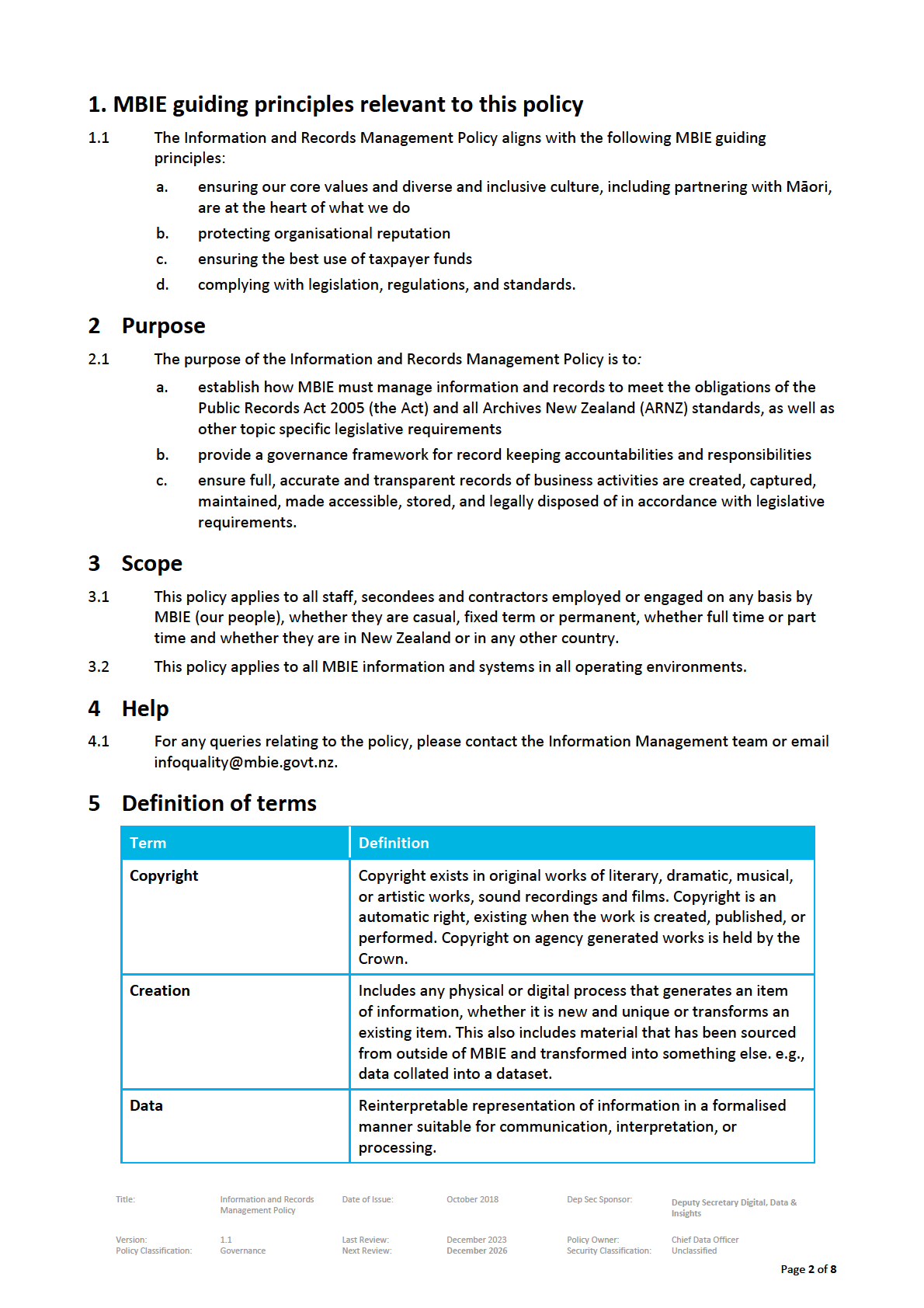
Disposal
In the context of information and records, disposal means
the decision-making processes for retaining, transferring or
destroying information and records
Executive Sponsor
Person appointed by The Secretary, to oversee information and
records management at MBIE who ensures compliance with the
Public Records Act 2005, liaise with Archives New Zealand about
monitoring and reporting on compliance, and cooperates and
align best practice process with his/her peers in other
organisations.
Information
For the purposes of this policy, information includes
information, data, records, and meta-data.
In this context, information is knowledge, facts or details that
have been created and/or obtained and managed by MBIE.
Personal information
Information about an identifiable, living person.
Records
Any information, regardless of form and format, from
documents through to data. A record includes its metadata,
which is also managed as a record and the records of any task
contracted to an independent contractor.
Records management
Is an integrated framework of governance arrangements,
architectures, policies, processes, systems, tools, and
techniques that enable organisations to create and maintain
trustworthy evidence of business activity in the form of records.
Retention and disposal
A records retention and disposal schedule outline show long
schedule
items must be kept and provides disposal guidelines for how
items should be discarded.
6 Policy statements
6.1
MBIE must have a records management framework (the Framework) as required under the Public
Records Act 2005 and the Archives New Zealand Information and records management standard
(the Standard) to manage and maintain full, authentic, accurate and accessible records over time.
The Framework must include procedures, guidelines, training, and metadata creation.
6.2
Archives New Zealand must be advised of MBIE’s Executive Sponsor appointment.
6.3
Executive Sponsor responsibility must be included in his/her performance plan.
6.4
Our people must comply with the Framework. To support compliance, MBIE will ensure our
people are aware of their information and records management responsibilities by providing
training and guidance as required.
6.5
MBIE’s information and records storing systems must be configured to ensure appropriate
classification and management of records, including records of any matters contracted out to
independent parties.
6.6
Records must be stored for as long as they are required by legislation, and protected to prevent
unauthorised and unlawful access, alteration, damage, loss, deletion, destruction, theft,
vandalism, misuse, or inadvertent release, using appropriate content management systems.
6.7
MBIE must create, maintain, and execute a Retention and Disposal Schedule to enable records to
be legally retained and disposed of. A register of all authorised disposals will be maintained.
Title:
Information and Records
Date of Issue:
October 2018
Dep Sec Sponsor:
Deputy Secretary Digital, Data &
Management Policy
Insights
Version:
1.1
Last Review:
December 2023
Policy Owner:
Chief Data Officer
Policy Classification:
Governance
Next Review:
December 2026
Security Classification:
Unclassified
Page
3 of
8
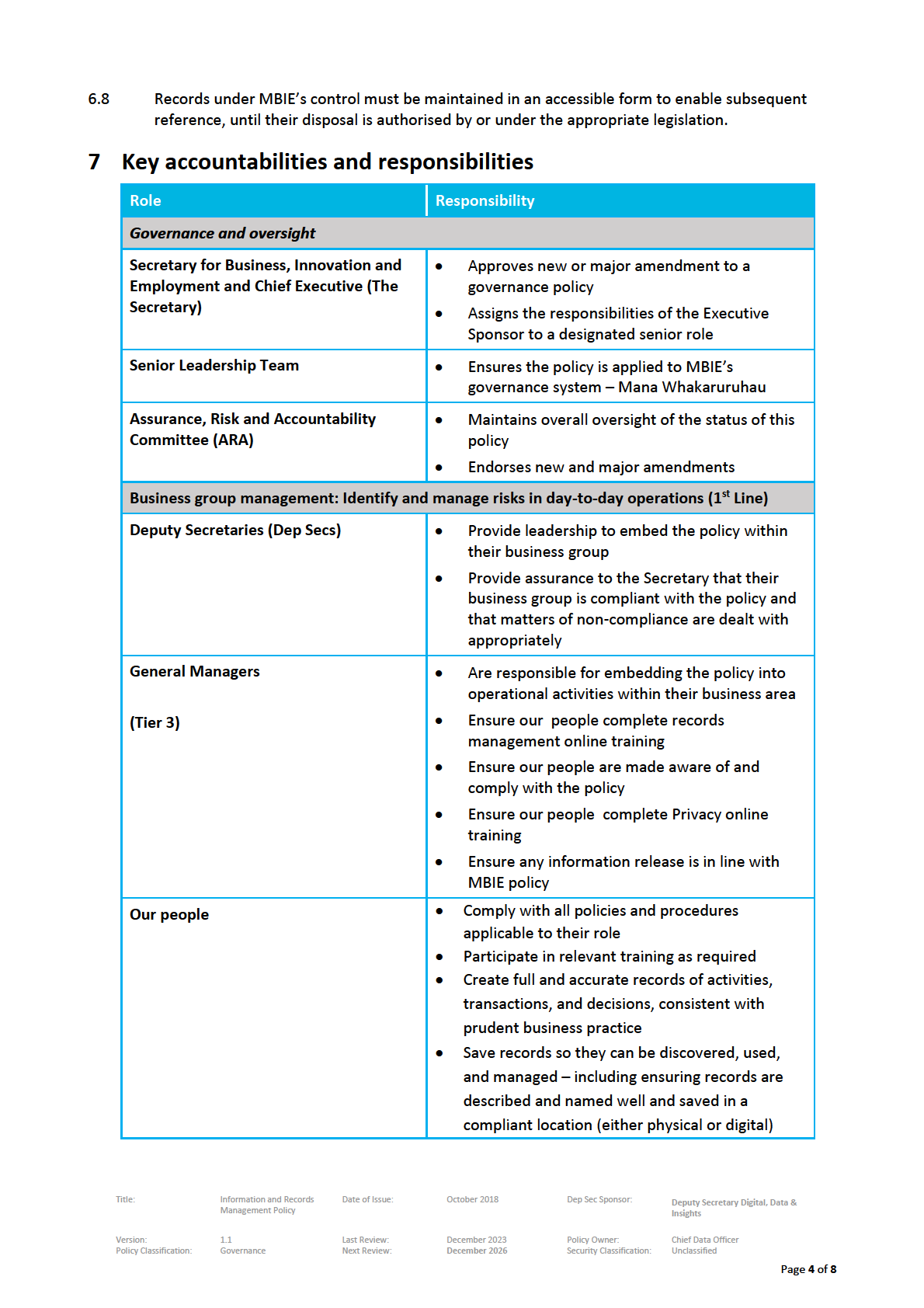
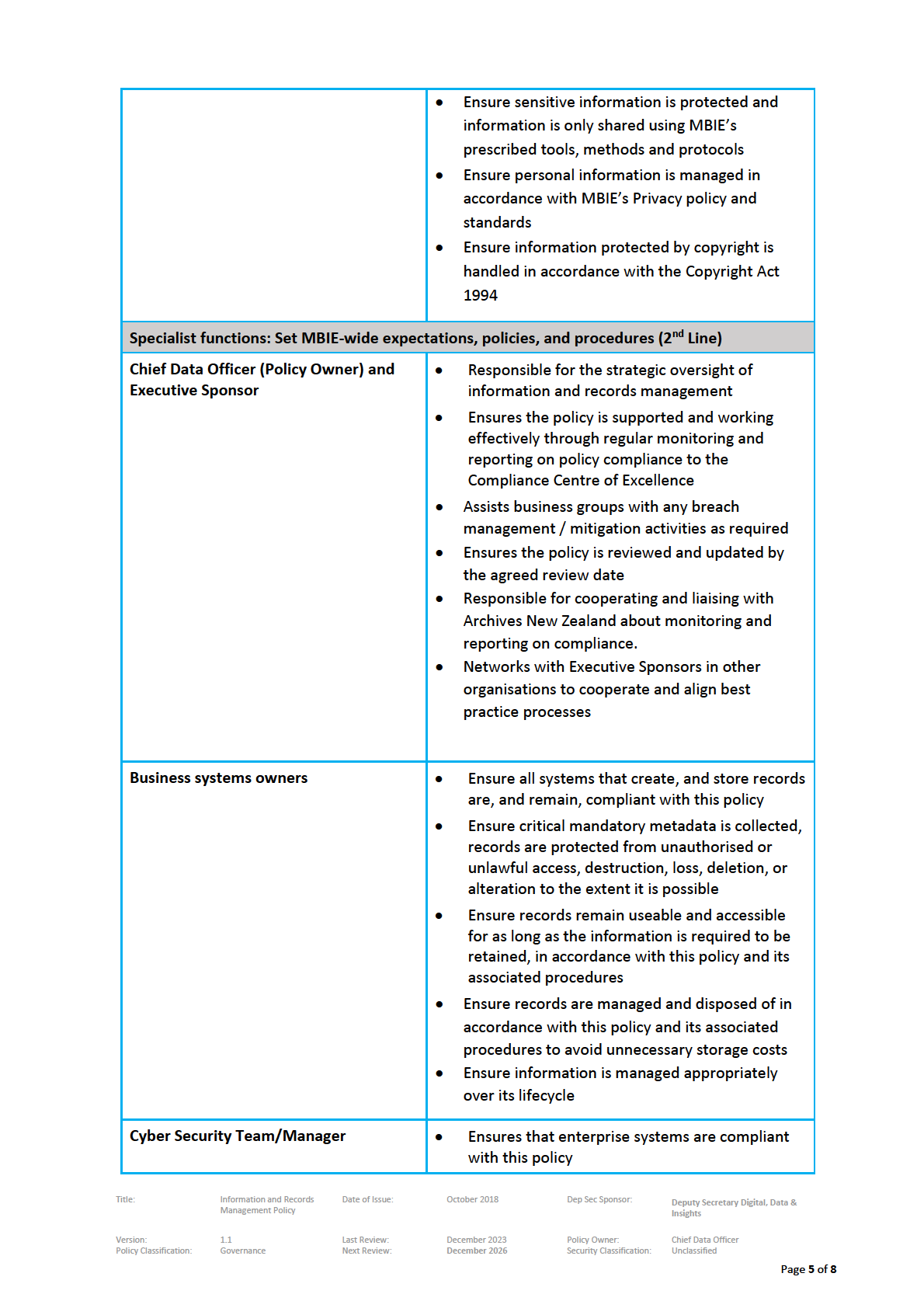
Information Management
•
Supports the CDO and the MBIE Executive
Team/Manager
Sponsor with monitoring and compliance of this
policy
•
Manage the disposal of all MBIE information
and records, including the transfer of records to
Archives NZ, completion of any Public Records
Act Section 23 transfers
•
Maintain and manage the disposal register
•
Maintain and manage the register of all
breaches of this policy
Protective Security Team/Manager
•
Ensures that enterprise policy protects
information and records in accordance with the
all-of-government Protective Security
Requirements.
Raraunga Matihiko Māori
•
Ensures that the policy gives effect to the
Team/Manager
principles of te Tiriti o Waitangi / the Treaty of
Waitangi
Technology and Architecture
•
Ensures that enterprise systems are compliant
Team/Manager
with this policy
8 Procedures
a. DA558 General Disposal Authority 6: Common Corporate Services Public Records
b. DA576 General Disposal Authority 7: Facilitative, Transitory, and/or Short-Term Value Records
c. DA644 MBIE Records Retention and Disposal Schedule
d. Guidance and advice on the management of information and data
9 Related MBIE policies and documents
a. Enterprise Data Governance Policy
b. ICT Acceptable Use Policy
c. Information Gathering Policy
d. Official Information Act Requests Policy
e. Privacy Policy
f. Protective Security Policy
g. Social Media Channel Policy
10 Relevant legislation, regulations, and standards
a. Official Information Act 1982
b. Privacy Act 2020
c. Public Records Act 2005
d. Information and Records Management Standard
Title:
Information and Records
Date of Issue:
October 2018
Dep Sec Sponsor:
Deputy Secretary Digital, Data &
Management Policy
Insights
Version:
1.1
Last Review:
December 2023
Policy Owner:
Chief Data Officer
Policy Classification:
Governance
Next Review:
December 2026
Security Classification:
Unclassified
Page
6 of
8
e. Further relevant legislation, regulations and standards listed in Appendix 1 of this policy
11 Measures of success and compliance management
11.1
The Chief Data Officer will assess the effectiveness of this policy based on the following measures
of success:
a.
At least 90 % of our people complete the relevant learning modules e.g., Records
management 101, MAKO Workshop within 3 months of commencing work with MBIE.
b.
All business groups have information and records management procedures and processes
documented.
c.
Information and records management requirements are documented or reflected in
specifications for systems and metadata schemas.
d.
The decommissioning of systems follows the requirements for disposing of information and
records
e.
Storage solutions are compliant with the requirements of this policy
11.2
The Chief Data Officer will monitor compliance with this policy as follows:
a.
Maintain a central register to record breaches of the policy.
b.
Maintain a register of all approved disposals.
11.3
Compliance information regarding the performance of this policy will be provided to the relevant
business group and Compliance Centre of Excellence on a quarterly basis.
12 Non-compliance
12.1
Failure to comply with this policy may be considered a breach of the Code of Conduct, and may
result in the loss of access to data and/or specific IT systems by individuals or teams.
12.2
Any action taken because of a breach of any of the obligations set out in this policy will be
conducted in good faith, a fair process will be followed, and the person involved will have a full
opportunity to respond to the concerns or allegations and have access to appropriate support,
advice, or representation.
Title:
Information and Records
Date of Issue:
October 2018
Dep Sec Sponsor:
Deputy Secretary Digital, Data &
Management Policy
Insights
Version:
1.1
Last Review:
December 2023
Policy Owner:
Chief Data Officer
Policy Classification:
Governance
Next Review:
December 2026
Security Classification:
Unclassified
Page
7 of
8
Appendix 1: Information and Records Management Policy – Further
related Legislation, regulations and standards
a.
Contract and Commercial Law Act 2017 (CCLA) section 229(2) mandates the “Authority to retain
public records in electronic (digital) form only.”
b.
Companies Act 1993, states company records must be kept years for 7 years.
c.
Copyright Act 1994 which protects original works, published or unpublished, in print or stored
electronically, from copying without approval from the copyright owner, unless there is a statutory
exception to such infringement.
d.
Crimes Act 1961 and Summary Offences Act 1981 make it an offence to use or disclose information
without authorisation and set out penalties for the unauthorised use or disclosure of that
information.
e.
Employment Relations Act 2000 requires employers to maintain wage, time, holiday and leave
records for their employees.
f.
Evidence Act 2006 governs the legal admissibility of documents and affects the form of the record
retained.
g.
Financial Reporting Act 2013 defines the standards to be used in preparing financial reports and
obligations in respect of the preparation and audit of financial statements.
h.
Health and Safety at Work Act 2015 requires employers to maintain a register of accidents and
incidents where staff are seriously harmed.
i.
Holidays Act 2003 states holiday and leave records must be kept for not less than 6 years.
j.
Patents Act 2013 and the Patents Regulations 2014 sets out the requirements for filing and issuing
patents.
k.
Public Finance Act 1989 sets requirements for Crown Agencies in terms of financial reporting and
accountability.
l.
State Sector Act 1988 aims to promote efficiency in the State Services and other agencies; ensure
responsible management; maintain appropriate standards of integrity and conduct among
employees in the State Services and other agencies; ensure that every employer in the State
Services is a good employer; promote equal employment opportunities (EEO); and provide for the
negotiation of conditions of employment in the State Services and other agencies.
m.
Tax Administration Act 1994 requires taxpayers and employers to keep records for 7 years for tax
purposes.
n. Public Service Code of Conduct, 2007
o. International Standards Organisation. Information and Documentation: Records Management (ISO
15489), 2001
p. Standards New Zealand, Information Security Risk Management Guidelines. New Zealand Standard
HB 231:2004
q. Protective Security Requirements (maintained by Government Communications and Security
Bureau, NZ Security Intelligence Service and Department of the Prime Minister and Cabinet)
Title:
Information and Records
Date of Issue:
October 2018
Dep Sec Sponsor:
Deputy Secretary Digital, Data &
Management Policy
Insights
Version:
1.1
Last Review:
December 2023
Policy Owner:
Chief Data Officer
Policy Classification:
Governance
Next Review:
December 2026
Security Classification:
Unclassified
Page
8 of
8
