

 AEWV Capability Building:
Independently Verifiable Evidence
AEWV Capability Building:
Independently Verifiable Evidence
29 July 2025
Overview
Background
Fairness and Natural Justice
The Importance of Defendable Decisions
Relevant Instructions
Examples of Inappropriate Rationale
Independently verifiable work experience and Holistic Assessments
Team Activities
Q&A
Purpose
• External Stakeholder Complaints
• Volume of IO queries
• QC trends
Previous Learning
August 2024 – Risk
September 2024 – Work Experience Verification
November 2024 – Writing for AEWV
May 2025 – Holistic Assessments
June 2025 – Holistic Assessments II


 Fairness and Natural Justice
A1: Fairness and Natural Justice
A1.1 Introduction
a.
Good decision-making requires attention to process, to how the decision is made, as well as looking at the merits of the case...
A1.5 Fairness
a.
Whether a decision is fair or not depends on such factors as:
o
Whether an application is given proper consideration;
o
Whether an application is decided in a way that is consistent with other decisions
A1.15 Practical steps towards achieving fairness and natural justice in decision-making
b. Consider all facts, keeping an open mind towards all relevant forms of evidence; and
c. Distinguish fact from opinion, rumour, allegation, assumption or report; and
d. Apply relevant immigration and operational instructions
Source: Immigration Operations Manual


9
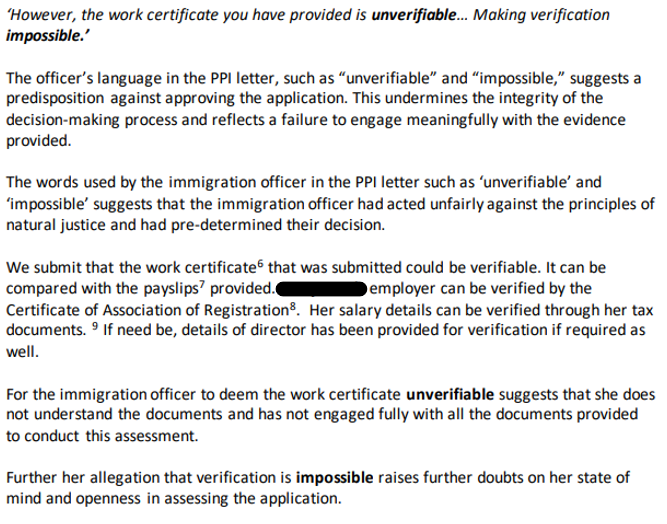
"There is
no explanation or justification for why the work experience needs to be independently
verified by a third party"
"We need to
provide the actual reasons to the employer why the immigration officer has not
been satisfied..."
"INZ shall
consider all relevant evidence on a holistic basis, i.e. consider all relevant evidence
as a whole rather than solely consider each of the documentation provided on its own merit..."
"It would be
procedurally unfair to claim our client's work experience as unverifiable when no
verification attempt has been made"
The Importance of Defendable Decisions
You need to ensure that the rationale you are using to support your decision is fair, balanced, and
based on facts
When TA completes a Quality Check we check (as per QC Tool) and in addition to the instruction-
specific questions:
•
Was all potentially prejudicial information
correctly identified and
communicated to the
applicant as per instructions
•
Where a response was received, was a
balanced assessment undertaken and
documented? …
•
Is the rationale
well-written,
accurate,
logical and
complete?
•
Can the overall outcome for New Zealand be
credibly defended?
11
The Consequences of Non-Defendable Decisions
In many of the cases that we review, the decision appears to be correct in line with the
instructions, however we cannot defend the
process that was followed to reach that conclusion.
Impacts of non-defendable decisions include:
•
Time of reviewing applications
•
Cost, including fee waivers and refunds
•
Resource – additional staff processing reconsideration or reassessment

Slide from Capability Building Session “Writing for AEWV,” November 2024


 Relevant Instructions
14
Relevant Instructions
WA4.10.5 - Determining whether an applicant is suitably qualified to do the job they have been
offered
WA4.10.6 - Determining whether an applicant meets the minimum skills threshold
WA4.10.6(a)(i): An applicant meets the minimum skills threshold if an
immigration officer is
satisfied that they can demonstrate two years or more of
relevant work experience with
sufficient evidence from a
third party
WA4.10.6(e): Evidence of relevant work experience from a third party
may include but is not
limited to letters of reference from an employer, certificates of employment, payslips or tax
certificates
15
VisaPak 611
…The fact that a document provided is listed in instructions does not automatically mean that an
immigration officer will be satisfied that the applicant meets work experience requirements. All
information submitted (whether or not it is listed in the instructions) is considered as part of an
overall assessment of whether the immigration officer is satisfied that the applicant has
three years of relevant work experience, or more if specified by the employer, supported by
sufficient evidence from a third party or parties.
Under Immigration Instructions E7.5, immigration officers must be satisfied that any document
or information provided with an application is genuine and they may take necessary steps to
verify that a document or information is genuine. An application
may be declined if an
immigration officer is not satisfied that sufficient evidence has been provided to
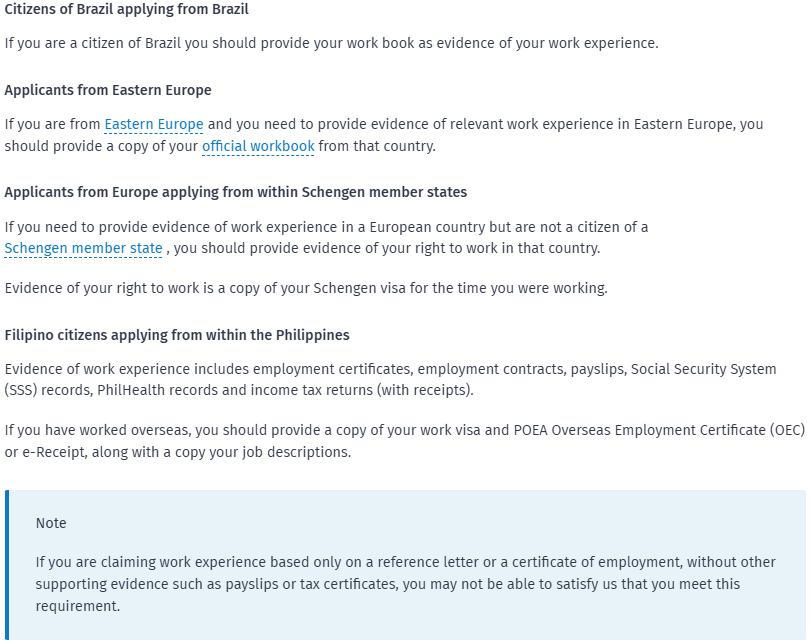
demonstrate that instructions are met. Applicants claiming work experience based on a letter
of reference or certificate of employment from an employer who are unable to provide other
supporting evidence such as payslips or tax certificates may not be able to satisfy an Immigration
Officer that they meet WA4.10.6 (d)
Source: VisaPak 611 20 December 2024
16
Relevant Instructions (Cont.)
E7.5(a) It is the
responsibility of an applicant for a visa to ensure that the information, evidence, and
submissions provided demonstrates the applicant meets applicable immigration instructions to the
satisfaction of an immigration officer
E7.5(b) Immigration officers have a
general obligation to take such steps as are
necessary or appropriate
to verify any documentation or information relevant to any decision under immigration instructions,
whether or not a particular provision enables or obliges them to do so
E7.30(a) Applications for temporary entry class visas … may be approved if the
immigration officer is
satisfied that the applicant has provided the evidence required by immigration instructions, and any
additional evidence requested by the immigration officer
Note: E7.5 are operational instructions rather than immigration instructions. They are not used as a basis for decline,but provide guidance that assists
immigration officers to determine whether immigration instructions are met.
17
Relevant Instructions (Cont.)
Key Points:
Onus remains with the applicant to demonstrate that they meet INZ
requirements
Immigration Officers have discretion within the instructions at WA4.10.5 and
WA4.10.6 as to whether the information is satisfactory and sufficient
Evidence of work experience should be viewed holistically, i.e. based on the full
circumstances of the application, a reference letter may be appropriate for lower
risk applications
To be relevant to WA4.10.6, work experience needs to be in the same field or
industry as a whole, i.e. not on what experience may be relevant to different tasks
the role has


 Examples
19
Examples of Inappropriate Explanations in PPI Letters
“While the documents may be genuine in isolation, we are unable to
confirm their authenticity or credibility in support of your
employment claims”
“…we are currently not yet satisfied that you have provided sufficient
independently verifiable evidence to credibly demonstrate your
claimed work experience a the provided documents could have been
generated by anyone at any time and is not evident of a five or more-
timeline corroborated by a third party such as a bank or a government
agency showing your claimed work experience evidence…”
20
Examples of Inappropriate Explanations
“[The reference letter] cannot be independently verified through a
third party to credibly confirm the duration or continuity of your
claimed work experience, as such letters can be
generated by anyone
at any time. While we acknowledge that the employer’s details are
stated in the letter, contacting them may not provide credible or
independently verifiable confirmation of your work experience…”

21
Examples of Inappropriate Explanations (3)
“While these documents indicate
employment with the XYZ Restaurant, we
have been unable to independently verify
their authenticity to confirm the legitimacy of
s9(2)(a)
the claimed work experience. Due to the
absence of verifiable supporting evidence, it
appears that you may not meet…”
s9(2)(a)
“After reviewing these materials, we remain
unconvinced. The evidence provided does not
contain verifiable details, and we are still unable
to confirm that the claimed work experience is
genuine…”
22
Examples of Inappropriate Explanations (4)
23
“We acknowledge receipt of the refence letter from your previous employer. However, reference letters
without supporting documentation lacks credibility, as they can be easily fabricated or altered”.
24
Expected Assessment Process
Review all of the documents provided in support of the applicant’s
skills/experience, declarations made and any risks that have triggered
against the application. Potential outcomes:
• Accept at face value with rationale as to why you are satisfied
• Conduct your own verification (such as online searches)
• s6(c)
• PPI/RFI
25
Examples of Good Rationale
The applicant has provided a reference letter from XXXX s9(2)(a)
.
attesting to the applicant’s work experience there from s9(2)(a) along with a business card for the
Chief Engineer at XXXX with the same contact details. That letter contains a range of contact details for
the company.
…I undertook [an online search] and identified the employer has an active web presence which
indicates that they s9(2)(a)
The website itself appears to be quite comprehensive, listing contact details for the company itself
which we could consider using for verification (i.e. that is independent of the individual person listed
on the reference letter). The Google Street View/Maps confirms the existence of the company at the
addresses listed on the website and reference letter…
26
Examples of Good Rationale
PPI
We acknowledge you have declared that you have been employed as a Timber Machinist with XXXX FURNITURE INDUSTRIES since January 2019
and have submitted a business registration. certificate, reference letter and photographs as evidence. We have considered this and note the
business registration certificate corroborates the existence of the business, however this does not corroborate that you were employed by the
business or your claimed period of employment. Furthermore, the photographs submitted are not sufficient to satisfy that you were employed by
the business or your claimed period of employment. Whilst you have submitted a reference letter, we note that no third-party evidence has been
submitted to corroborate your claimed work experience. Therefore, based on the evidence submitted with your application we are concerned that
your claimed work experience may not be credible.
Decline
We acknowledge the letter and salary certificate issued from a Chartered Accountant however, note these documents state they were issued at
the request of yourself for immigration purposes. Furthermore, these documents are based on information provided by yourself or the employer
and there is no third-party to corroborate the contents of these documents. We also note that ITR is self-declared.
As mentioned in our previous letter, whilst the business registration certificate corroborates the existence of the business this does not
corroborate that you were employed by the business or your claimed period of employment. Whilst you have submitted letters and pay slips from
the employer, there is no credible third-party to corroborate the contents of these documents or your claimed work experience. Therefore, based
on the evidence submitted we are not satisfied that your claimed work experience is credible and our concern is not mitigated.
27
Examples of Good Rationale
PPI
You have provided a single page reference letter from XXXX Traders to meet the above instruction however this is not sufficient to meet our
requirements. There is no third-party confirmation of the contents with it. A single page reference letter can be formatted by anyone, anywhere
and anytime. The work experience evidence that you have provided is not sufficient, substantive, credible and independently verifiable.
Decline
We have considered your response however we are stil not satisfied that you have demonstrated that you have the required work experience.
While we acknowledge the calibration and weekly checks documents submitted by you, this does not mitigate our concerns. Furthermore, the
calibration documents provided by you only demonstrates few weeks of your work and are not independently verifiable. There is no substantive
information about your employer, remuneration and length of your employment on them along with other information that could help us to verify
and establish your WE. You did not provide any corroborative information for Immigration New Zealand to verify and establish your claimed work
experience. You did not provide any third-party confirmation of the contents. Furthermore, your overseas employer had no online presence,
which could have assisted us in validating the contents of the work experience.
28
Examples of Good Rationale
PPI
You have provided a single page work experience reference letter from office of the XXX Farm however this is not sufficient to meet our
requirements. The work experience evidence that you have provided is not substantive, credible and independently verifiable. There are no third-
party confirmation of the contents for Immigration New Zeeland to verify and establish your claimed work experience.
Decline
We received your response on 19 June 2025 with the fol owing documents:
- a cover letter requesting to do an ETI for this case.
- - Support letter from employer's farm consultant
- - Support letter from NZ employer
We have considered the response however we are stil not satisfied that you have demonstrated that you have the required work experience and
qualifications. You did not provide any new work experience evidence in response to our letter that is substantive, credible and independently
verifiable. The single page reference letter from XXX Farm that you provided initial y was not substantive and independently verifiable as there
was no third-party conformation of the contents with it for Immigration New Zealand to verify and establish your claimed work experience.
29
Examples of Good Rationale
PPI
To demonstrate the work experience required, you submitted a letter from XXXX Corp. However, it does not state how long you have worked for
the company. Moreover, the document is not credible for us to acknowledge the claimed work experience because it is not independently
verifiable: there is no credible third party or additional evidence to confirm or support the details of document. Due to the insufficient evidence,
we could not acknowledge your claimed work experience.
30
Examples of Good Rationale
Decline Rationale
As per the job check approved for the job offered to you, 3 years of relevant work experience is required and you submitted a copy of Afghanistan
driver license, a graduation certificate issued by Ministry of Education in Afghanistan, a certificate of technical & computerised auto work shop
issued on s9(2)(a)
and a certificate of work experience issued on s9(2)(a)
. The driver license or graduation certificate may be
relevant to the job offered to you but does not demonstrate whether you had 3 years of relevant work experience or not. Both certificates issued
on 25 and 30 December 2021 may indicate that you have 3 years of relevant work experience, but the documents are not credible for us to
acknowledge the claimed work experience because it is not independently verifiable: there is no credible third party or additional evidence to
confirm or support the details of documents


 Independently Verifiable
Evidence
Independently Verifiable
Evidence
32
Relevant TA Update (15 April 2025)
33
Independently Verifiable Evidence
Note: there is no requirement in immigration instructions that work experience
evidence is independently verifiable
Independently Verifiable means that something can be
checked and confirmed
by someone else, without relying solely on the original source or person who
made the claim.
34
Independently Verifiable Examples
Example:
• The request for documents not issued by the employer (such as
tax records/social insurance) to verify claims made by an
employer in a reference letter
• A reference letter from an employer can still be considered as
independently verifiable evidence of a claim made by an applicant
themselves
• Using information available online to contact a company to verify
information provided in a reference letter
35
Work Experience: Holistic Assessments
Your assessment of work experience evidence must be based on a
holistic view of the information provided
• Identifying information and factors to consider, then weighing
these factors before reaching a conclusion on the credibility of a
situation
• Holistic assessments are dependent on the information and
circumstances provided, as such your decisions will be case-by-
case
How to structure your rationale
•
What has been identified ?
Concern
•
Why has it been identified as a concern?
•
Identify the factors related to the concern, evidence and applicant
Factors
themselves.
•
Weigh and Balance these factors
Conclusion
•
Summarise whether you are satisfied the instruction has been met or not
Slide from Capability Building Session “Holistic Assessments,” May 2025
37
Reference Letters and Holistic Assessments
In what cases can I accept just a reference letter as constituting evidence of work experience?
Consider factors such as:
•
Online presence – do details online match reference letter and appear credible
•
s6(c)
•
Contacting the NZ employer where it appears appropriate to do, check whether they have met their
accreditation obligation to check
•
Ask: Based on the evidence provided and the circumstances, does it appear on balance that it is
plausible that the applicant would have this experience
38
s6(c)
•
A decision is likely to be defendable provided we are able to give clear reasons in the PPI/Decline letter
to explain why the evidence is not sufficient
39
Source: Accredited Employer Work Visa
PPI
Example
Instruction:
Immigration instruction WA4.10.1(a)(ii ) states…
capture the applied instruction
Immigration Instruction WA4.10.5 states…
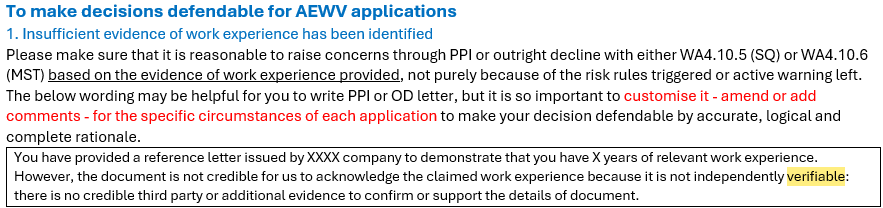
You have provided a reference letter issued by XXXX company to
Fact:
demonstrate that you have X years of relevant work experience.
“what” has been identified
However, the document is not credible for us to acknowledge the
Rationale:
claimed work experience because it is not independently verifiable;
“why” the finding has triggered concerns
there is no credible third party or additional evidence to confirm or
support the details of the document
Conclusion:
we are concerned /
Therefore, we could not acknowledge your claimed work experience
you may not meet…
and you may not be suitably qualified.
Slide modified from Capability Building Session “Writing for AEWV,” November 2024
41
The ‘Why’…
Doesn’t have to be a novel, or even a paragraph…you just need to explain
to the client
why the information they have provided does not satisfy you
Saying the information “is not credible” or “is not independently verifiable”
does not explain sufficiently – the client needs to know why you think it’s
not credible or why the fact that it is not independently verifiable does not
satisfy you
A1.15(c): distinguish fact from opinion, rumour, allegation, assumption or
report
42
Verification Requirements
•
Just because we cannot verify something, that doesn’t mean it must be rejected or that the application
will be declined…but that we may put less weight on that evidence in a holistic assessment of work
experience
•
With overseas tax records (for example) we do not decline on the fact they have not provided that
document, but that the evidence they
have provided is not sufficient…if they had been able to provide
the tax documents we would have been able to add more weight to the work experience claim.
•
Where we do have concerns we still have to demonstrate that we have appropriately considered the
information provided and outline why we are not satisfied
43
You should now be able to…
Explain what we mean by fairness and natural justice in the assessment of a visa
application
Understand the importance of making defendable immigration decisions
Understand how to effectively raise concerns about work experience in AEWV
applications
Explain what makes a strong rationale with regards to work experience evidence
Complete holistic assessments of work experience evidence


 Team Activities
Capability Building Session July 2025
45
Overview
For each of the scenarios consider:
• What are the risks involved with the evidence identified; and
• What are your proposed next steps (and why)
46
Scenario 1:
s9(2)(g)(i)
s6(c)
47
Scenario 2:
s9(2)(a)
s9(2)(a)
s9(2)(g)(i)
s9(2)(a)
s6(c)
48
Scenario 3
s9(2)(a)
s9(2)(a)
s9(2)(g)(i)
s9(2)(a)
s6(c)
49
Scenario 4:
s9(2)(a)
s9(2)(g)(i)
s9(2)(a)
s9(2)(a)
s6(c)
50
Scenario 5:
s9(2)(a)
s9(2)(g)(i)
s9(2)(a)
s9(2)(a)
s9(2)(a)
s6(c)
51
Scenario 6:
s9(2)(a)
s9(2)(a)
s9(2)(g)(i)
s9(2)(a)
s6(c)


 Questions?
Some of the content in this presentation has been
generated using Copilot Chat. This has been reviewed
and confirmed by the author. If there is any content
that is incorrect, contact the author.

 Ngā mihi
Thank you
