RECOMMENDATIONS FOR AERIAL APPLICATION OF FORAY 48B TO CONTROL
THE PAINTED APPLE MOTH
s9(2)(a)
and s9(2)(a)
Forest Research
18.10.01
SUMMARY
This report summarises options for targeted aerial spraying of Btk for control of painted apple
moth in Auckland. The SpraySafe Manager 2 (SSM2) aerial spray application modelling system
was used to:
Determine the feasibility of using aerial spraying to target narrow riparian areas and gullies
for control of the painted apple moth (PAM).
Calculate swath displacement (the horizontal offset distance between the flight line and the
target area) for a range of operational scenarios and weather conditions.
Characterise on-target deposition and likely drift levels for a worst-case scenario based on
operational and weather conditions.
It was concluded that:
1. Aerial application of Btk to control the painted apple moth is relatively straightforward
where there are large continuous target areas, but an appropriate swath displacement should
be calculated to ensure maximum deposition within the target area.
2. In all but the most favourable conditions large swath displacements are required to target
narrow riparian strips. While it is possible to calculate these displacements using SSM2, the
irregular geometry of the target areas, as they follow the variable coastline, would make it
extremely difficult to apply these recommendations in practice.
3. To minimise the problem of large swath displacements, operational applications should be
made with low wind speeds (less that 7 km/hr) and with a droplet spectrum with a volume
median diameter (VMD) of around 150 m. Release height should be 5 m above the target
vegetation or as low as is safe. A table of swath displacement distances for combinations of
crosswind speed and release height should be provided based on SSM2 simulations.
Applications should be made using up to three passes to maximise the likelihood of
achieving the correct application rate within the target area. The extent of spray drift will be
high, though dosages will be low.
4. Because of the uncertainties around the practicality of this operation (I am unaware of any
other operation of this nature being undertaken) a pre-operation field test will be essential to
under the Official Information Act 1982
see if the required targeting can be achieved.
5. Dose-response work should be undertaken as soon as possible to evaluate whether using
large droplets and dilute Btk would compromise efficacy compared with small droplets and
undiluted Btk.
Released
RECOMMENDATIONS FOR AERIAL APPLICATION OF FORAY 48B TO CONTROL THE PAINTED APPLE MOTH
Page 1
RECOMMENDATIONS FOR AERIAL APPLICATION OF FORAY 48B TO CONTROL
THE PAINTED APPLE MOTH
INTRODUCTION
The goal of the work described in this report was to evaluate the feasibility of aerial application
of Foray 48B for control of painted apple moth (PAM) in an urban environment. The population
biology of PAM and dose-response relationships between PAM and Btk are not considered in
this report. The key issue is determining the practicality of achieving specified levels of
deposition in target zones with minimum drift levels outside these areas.
Inspection of the spraying sites identified many practical difficulties with the proposed operation.
A previous insect pest eradication operation in Auckland (Operation Evergreen) used a blanket
spray approach. This technique is relatively straight forward as the successive swaths laid down
over a large area ensures good coverage of target vegetation. The likelihood of significant skips
(areas receiving low doses of BtK or that are missed completely) is very low.
MAF have specified a different approach for the PAM operation. Narrow riparian strips of
vegetation, steep gullies, and a few larger areas are the main target zones. Applications to the
larger areas should be relatively straight forward as a blanket spray approach can be used.
However, targeting the narrow strips of vegetation and the gullies is much more problematic.
The main difficulties are summarised below:
a) The vegetation in the narrow strips is often very tall (up to 30 m?), but the main target
species are generally the understorey component (10-15 m tall).
b) There are many obstacles in the spray zones, such as overhead power lines or individual tall
trees. To safely avoid these obstacles, spray release heights will often be very high,
increasing the drift potential. In some cases, steep terrain coupled with these obstacles makes
under the Official Information Act 1982
for even higher spray release heights.
c) Target vegetation along the riparian margins is very variable in terms of its height (1-30 m?)
width (10-20 m?) and its linear orientation. This presents a number of practical difficulties,
especially determining how to define the relationship between the location of the spray
aircraft relative to the target area, in relation to release height, wind speed and wind
direction. With small droplets (necessary for coverage) and high release heights, there will be
Released
considerable downwind movement of the spray cloud. Therefore, to deposit the spray on a
specific strip of vegetation the aircraft must release the spray at a significant upwind distance
from the target area - this is termed the swath displacement (i.e. the horizontal offset distance
between the flight line and the target area). While this distance can be defined for a given
RECOMMENDATIONS FOR AERIAL APPLICATION OF FORAY 48B TO CONTROL THE PAINTED APPLE MOTH
Page 2
condition, in reality the wind direction relative to the target area and flight line will be
constantly changing in relation to the convoluted nature of riparian strips. Therefore
accurately targeting these strips or gullies will be a major challenge even under ideal
conditions.
As mentioned above, the success of the operation depends on achieving good coverage of Btk on
the target foliage. While it is possible to obtain reasonable coverage with medium sized droplets
(around 200 m volume median diameter or VMD) and high spray volumes (20-50 l/ha),
evidence suggests that the most efficacious approach is using small droplets produced from
undiluted Btk (J. Ray, pers. comm.). The trade-off with this strategy is that using small droplets
increases the drift potential.
Objectives of this study were to:
1. Determine the feasibility of targeting narrow riparian areas and gullies for control of the
painted apple moth (PAM) by aerial spraying.
2. Calculate swath displacement (the horizontal offset distance between the flight line and the
target area) for a range of operational scenarios and weather conditions.
3. Characterise on-target deposition and likely drift levels for a worst-case scenario based on
operational and weather conditions.
METHODS
Swath displacement
SpraySafe Manager 2 (SSM2) is a spatially based aerial application simulation model that is run
from within the ArcView geographical information system (GIS). SSM2 was used to determine
the effect of different operational and weather conditions on the swath displacement required to
under the Official Information Act 1982
target a narrow vegetation strip when spraying with a BK117C-1 helicopter. As mentioned
above, the swath displacement is the horizontal offset distance, between the flight line and the
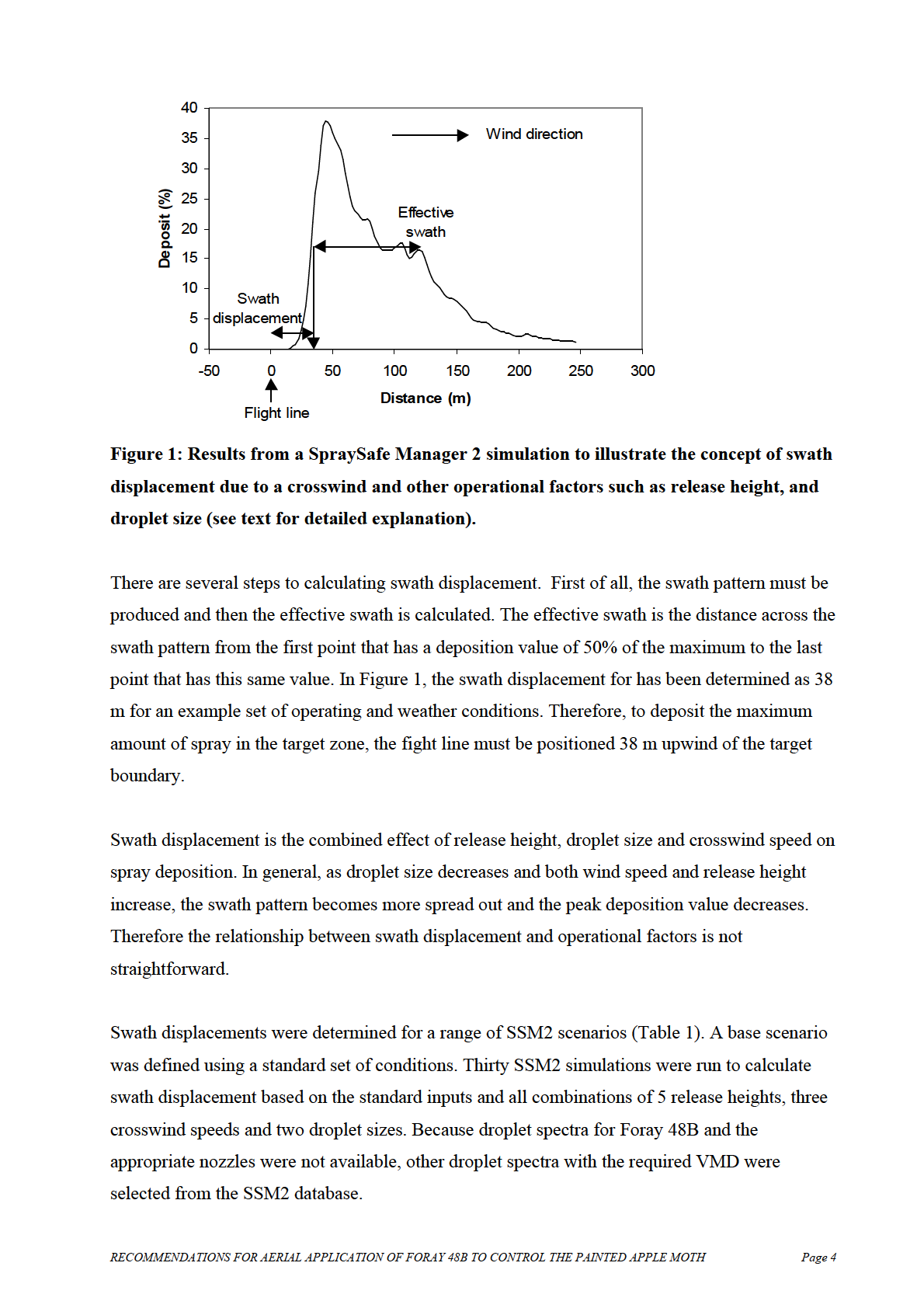
edge of the target area, with the flight line upwind of the target area (Figure 1). A swath
displacement distance is required to ensure that when the swath of spray produced by the aircraft
reaches the ground, it hits the target area. Factors having the greatest influence on swath
Released
displacement are: droplet size, release height, and crosswind speed.
RECOMMENDATIONS FOR AERIAL APPLICATION OF FORAY 48B TO CONTROL THE PAINTED APPLE MOTH
Page 3
under the Official Information Act 1982
Released
Table 1: Thirty SSM2 simulations were run to calculate swath offset distances based on the
standard inputs and all combinations of 5 release heights, three crosswind speeds and two
droplet sizes.
Variable
Standard inputs
Test values
Aircraft type
Bk117-C1
Release height (m)
10, 20, 30, 40, 50
Spray speed (knots)
60
Boom width (% of rotor length)
60
Temperature (°C)
12
Relative humidity (%)
80
Crosswind speed (km/hr)
3.6, 7.2, 10.8
Spray material
Foray 48B
Spray density (g/cm3)
1.2
Volatile fraction
0.39
Active fraction
0.61
Application rate (Litres/ha)
5
Atomisers
4xAU5000
Droplet spectrum VMD1
120, 170
1Volume median diameter
Spray interception by riparian strips
SSM2 was designed for use in situations where spray applications are made to uniform surfaces
e.g. complete forest canopies. The proposed operation for control of PAM is more complicated,
especially the targeted spraying of narrow riparian strips. There are two main concerns:
In a standard SSM2 simulation the spray release height is the vertical distance from the
nozzle to the ground surface or the top of the plant canopy where one is present. In the
complex PAM situation the assumption of a closed canopy is not valid. An isolated strip of
vegetation means that both the height of the aircraft above the ground and the canopy height
itself are significant factors. After the spray cloud is released from the aircraft it will drift
downwind. Spray particles could be: (a) deposited on the ground before reaching the riparian
under the Official Information Act 1982
strip; (b) intercepted by the vegetation strip; pass through the vegetation strip; or (c) be
deposited within or beyond the shadowing effect of the strip. Since SSM2 does not simulate
these conditions, modifications to the model were made to try to incorporate relevant
factors in a simplified simulation.
Released
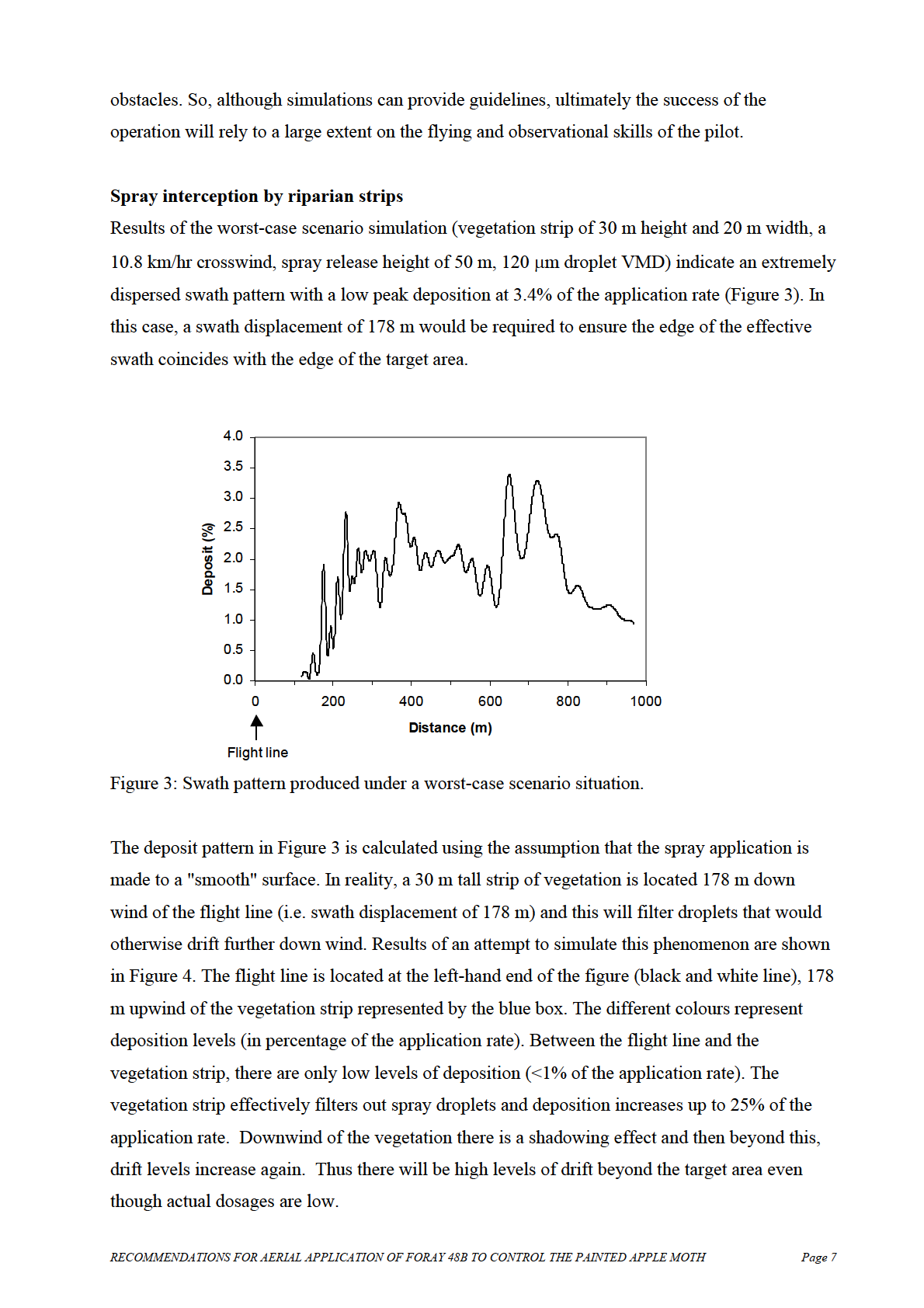
A worst-case scenario was constructed with a vegetation strip of 30 m height and 20 m
width, a 10.8 km/hr crosswind, and a spray release height of 50 m. It was assumed that 70%
of spray entering the strip would be deposited on the vegetation.
RECOMMENDATIONS FOR AERIAL APPLICATION OF FORAY 48B TO CONTROL THE PAINTED APPLE MOTH
Page 5

under the Official Information Act 1982
Released
under the Official Information Act 1982
Released
under the Official Information Act 1982
Released
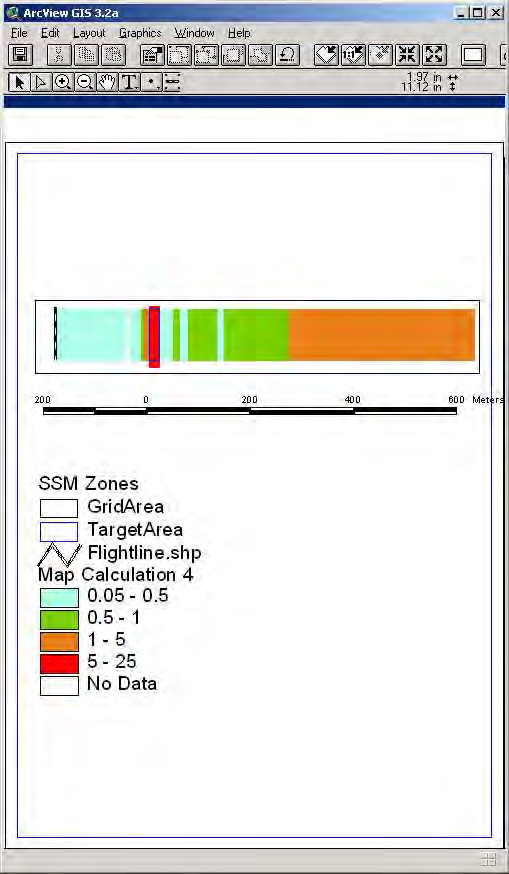
Figure 4: Modified SSM2 simulation to include the effect of a vegetation strip (deposition
values are represented by colours and are percentage of the application rate).
RECOMMENDATIONS FOR AERIAL APPLICATION OF FORAY 48B TO CONTROL THE PAINTED APPLE MOTH
Page 8
Under this worst-case scenario, the swath pattern is so spread out that flying accuracy is not too
critical as long as the aircraft is well upwind of the target area. However, the concern is that the
application rates are below what is necessary to be confident about achieving control. Therefore
the aircraft should make a minimum of three passes, following the same basic flight line, to
ensure the target are receives a reasonable dose.
CONCLUSIONS AND RECOMMENDATIONS
1. Aerial application of Btk to control the painted apple moth is relatively straightforward
where there are large continuous target areas. However, even in these areas an appropriate
swath displacement should be calculated to ensure maximum deposition within the target
area.
2. Results of SSM2 simulations indicate that in all but the most favourable conditions large
swath displacements are required to target narrow riparian strips. While it is possible to
calculate these displacements using SSM2, the irregular geometry of the target areas, as they
follow the variable coastline, would make it extremely difficult to apply these
recommendations in practice. The wind direction would be constantly changing relative to
the aircraft and the target area and so the necessary swath displacement would also be
changing. Levels of deposition on narrow strips are likely to be reasonably high because of
the filtering effect of vegetation strips, but there will be extensive drift with low dosages.
3. The only ways to simplify the application process, to increase the probability of success are:
(i) Increase the size of the target area so the application is made to a large continuous block
as with the tussock moth operation. Advice from MAF indicates that this is not an acceptable
option to the Auckland public / residents in the spray area.
(ii) Place a severe restriction on acceptable weather conditions. In all situations where flying
height is above 15-20 m, wind speeds above about 3.6 km/hr (1 m/s) require large swath
under the Official Information Act 1982
displacements. While restricting the acceptable "weather window" will make it easier for
pilots to apply appropriate swath, there is a risk that the acceptable conditions occur so
infrequently that the spraying cannot be completed on time. An assessment of the frequency
and duration of typical weather classes is required to help make a decision on what is
reasonable.
Released
(iii) The only other option is to use larger droplet sizes. The droplet spectrum tested with a
VMD of 170 m was not large enough to produce a large advantage over the 120 m
spectrum. While a spectrum with a VMD of 200-250 microns would make a significant
difference, it would severely compromise coverage. To counter this, a higher spray volume
RECOMMENDATIONS FOR AERIAL APPLICATION OF FORAY 48B TO CONTROL THE PAINTED APPLE MOTH
Page 9
would be required using a more dilute spray mixture. This option cannot be recommended
without new dose-response studies that demonstrate efficacy would not be compromised.
Considering the above constraints, the following recommendations are made:
1. Applications should be made with low wind speeds (less that 7 km/hr) and with a droplet
spectrum with a VMD of around 150 m. Release height should be 5 m above the target
vegetation or as low as is safe. A table of swath displacement distances for combinations of
crosswind speed and release height will be provided based on SSM2 simulations.
Applications should be made using up to three passes to maximise the likelihood of
achieving the correct application rate within the target area.
2. Because of the uncertainties around the practicality of this operation (I am unaware of any
other operation of this nature being undertaken) a pre-operation field test will be essential to
see if the required targeting can be achieved.
3. Dose-response work should be undertaken as soon as possible to evaluate whether using
large droplets and dilute Btk would compromise efficacy.
under the Official Information Act 1982
Released
RECOMMENDATIONS FOR AERIAL APPLICATION OF FORAY 48B TO CONTROL THE PAINTED APPLE MOTH
Page 10
