

IR-01-26-17181
3 June 2026
Nigel Gray
[FYI request #34696 email]
Dear Nigel
Request for information
I refer to your Official Information Act 1982 (OIA) request of 13 May 2026 in which you
asked for information regarding crash reporting and associated processes. I have
addressed each part of your request below.
1. Traffic Crash Report (TCR) guidance and instructions
Please provide all internal Police documents, manuals, instructions, training
material, or guidance used by officers when completing a TCR, including:
Police holds a range of operational documents, manuals, instructions, and training
material relating to the completion of Traffic Crash Reports (TCRs). It is set out across a
combination of Police Manual chapters, specialist crash investigation guidance, and
system‑based instructions used by officers when completing TCRs.
The documents identified as being within scope of your request are set out below and
have been provided with this response where not publicly available.
a. how officers identify and record a suspected medical event
There is no prescriptive or exhaustive list of factors that an officer may rely on to
determine whether a crash involves a suspected medical event.
Officers assess each crash on its individual circumstances, taking into account the totality
of information available during the course of the investigation. This includes consideration
of the crash environment, vehicle dynamics, and participant behaviour. Officers apply
professional judgement in forming their assessment, consistent with Police Manual
guidance and Serious Crash Unit (SCU) investigative practice.
In doing so, officers may consider a range of indicative factors, including:
•
the driver’s level of responsiveness and ability to communicate
•
witness accounts, including observations of driving behaviour before the crash
•
the presence of any known medical indicators or disclosed medical conditions
•
the nature of the crash, including speed and outcome
•
the number of vehicles involved in the crash
•
the pattern and extent of damage to vehicles or property
•
whether there is evidence of avoidance actions, such as braking
Police National Headquarters 180 Molesworth Street. PO Box 3017, Wellington 6140, New Zealand.
Telephone: 04 474 9499. Fax: 04 498 7400. www.police.govt.nz


• whether vehicle safety systems were activated
These factors are not exhaustive and are considered collectively. No single factor is
determinative.
Relevant observations are recorded in officers’ notebooks and within the TCR, including
within narrative and contributing factor fields, in accordance with Police Manual guidance
and standard investigative practice. Relevant information can be found in the
Vehicle
Crash Attendance and Investigation chapter of the Police Manual, which is publicly
available on the Police website:
https://www.police.govt.nz/about-us/publication/vehicle-
crash-attendance-and-investigation-police-manual-chapter
A copy of the
Serious Crash Investigation Review chapter is also included with this
response.
b. how officers identify and record drug involvement
For deceased drivers, toxicology is undertaken as part of the post‑mortem process, and
findings are reported to the Coroner by a pathologist. For surviving drivers, Police may
require evidential samples, including blood analysis. Where appropriate, an oral fluid drug
test or compulsory impairment test may be undertaken. Information relating to suspected
or confirmed drug involvement is recorded in the TCR and associated investigation
records.
c. how officers identify and record alcohol involvement
For deceased drivers, alcohol testing is conducted as part of the post‑mortem process,
and results are reported to the Coroner.
For surviving drivers, Police may require:
• an alcohol screening test
• an evidential breath test
• or a blood sample for analysis
Relevant information relating to alcohol involvement is recorded in the TCR and
associated systems.
d. how officers determine whether a crash should be referred to the coroner
Al crashes involving a fatality are referred to the Coroner in accordance with statutory
requirements.
e. how officers record pending toxicology
Where blood samples have been taken and results are pending, the officer records that
samples have been sent for analysis within the TCR. The TCR may be updated when
results are received.
f. how officers record medical history, symptoms, or collapse at the wheel
Officers record any information considered relevant to the circumstances of the crash in
their notebook and in the TCR. This may include observations of symptoms, reported
medical history, or indications of a possible collapse at the wheel.

 g. and any factor-coding or narrative conventions used by Police.
Police records information relating to the crash using structured fields and narrative
sections within the TCR. This includes recording:
• what happened (narrative)
• contributing factors
• relevant observations
There is no separate standalone document that prescribes all factor-coding or narrative
conventions. These are supported through system design, training, and operational
guidance, and require officer judgement based on the circumstances of each crash.
h. This includes any Serious Crash Unit (SCU) guidance
Police holds guidance used by the Serious Crash Unit (SCU) for the investigation of
serious and fatal crashes.
This guidance forms part of the wider crash investigation framework within which Traffic
Crash Reports are completed and supports investigative and evidential practice in more
complex cases.
Relevant policies and guidance are outlined above and include the
Vehicle Crash
Attendance and Investigation chapter of the Police Manual and associated SCU
guidance, as mentioned in my response to Question 1a.
2. Toxicology processes and status information
Please provide:
a. the process Police follow when requesting toxicology after a crash,
Police does not request toxicology analysis. Where a driver is deceased, the matter is
referred to a pathologist. The pathologist determines what toxicology testing, if any, is
required to assist in determining cause of death and reports this to the Coroner.
b. how Police record the status of toxicology (e.g., “pending”, “requested”,
“received”)
Within the TCR, a status such as “pending toxicology” may be recorded where results are
outstanding. Once results are received, the TCR will be updated to reflect this
information. Once the crash investigation is complete, the TCR is forwarded via Police
Coronial Services to the Coroner. This concludes the primary Police role in relation to
toxicology.
c. how Police record toxicology results in TCRs or associated systems
Where additional information becomes available to Police after submission of the TCR,
including toxicology results, the report will be updated to reflect that information.
d. any internal guidance on interpreting toxicology results for crash
classification
Police does not interpret toxicology results for the purpose of determining cause of death
and does not consider toxicology findings in isolation. Toxicology results are analysed


and reported by a pathologist or forensic scientist as part of the full post-mortem
examination and provided to the Coroner.
This part of the request is therefore refused under section 18(e) of the OIA, as no such
internal guidance is held.
e. and any documents describing how Police communicate toxicology
outcomes to NZTA.
Where relevant information, including toxicology results, becomes available after the
initial submission, the TCR may be updated and resubmitted to NZ Transport Agency
Waka Kotahi (NZTA).
Police does not hold separate documents describing a distinct process for communicating
toxicology outcomes beyond this. This part of the request is therefore refused under
section 18(e) of the OIA.
3. Coronial referral and pending-status information
Please provide:
a. the criteria Police use to determine whether a crash fatality is referred to
the Coroner
Fatal crashes are treated as reportable deaths and are referred to the Coroner in
accordance with the Coroners Act 2006. Deaths must be reported to Police, and in turn to
a Coroner, in the circumstances set out in section 14 of the Coroners Act 2006. Fatal
traffic crashes fall within these categories and are therefore reported.
Police are required to report al deaths immediately to the duty coroner via the National
Initial Investigation Office (NIIO). Where a doctor is able to certify the cause of death and
the Coroner does not take jurisdiction, the matter is not referred.
This information is publicly available, found within the Sudden Death Chapter on the
Police website. You can view the full chapter here:
https://www.police.govt.nz/about-
us/publication/sudden-death-police-manual-chapter
b. how Police record coronial referral status in their systems
Information that a matter has been referred to the Coroner is recorded within Police
systems, including:
• completion of a POL 47 Report for Coroner
• creation of a sudden death (1S) file
• recording within NIA and associated case management systems
Documentation is sent to the Coroner through the NIIO and recorded in Police systems
as part of the investigation file. There is no single standardised field used across all
systems to record coronial referral status.
c. how Police record cases where coronial findings are pending
There is no standardised method for recording “pending coronial findings” as a discrete
field. Once a matter has been referred, the investigation file may remain open, be filed, or
be progressed depending on the investigation status.


This part of the request is therefore refused under section 18(e) of the OIA, as no defined
or standardised method for recording “pending coronial findings” exists.
d. and any documents describing how Police track coronial outcomes for
crash cases.
There is no standardised method for recording “pending coronial findings” as a discrete
field. Police files do not need to remain open until coronial findings are received. Findings
are attached to the file when they are later provided. No consistent “pending” status is
applied across Police systems.
This part of the request is therefore refused under section 18(e) of the OIA, as no defined
or standardised process for recording “pending coronial findings” exists.
4. Classification logic used by Police
Please provide any internal Police documents, guidance, or criteria used to
determine when a crash is considered:
a. a medical event
Police does not determine whether a crash is the result of a medical event. For deceased
drivers, cause of death is determined by the Coroner, informed by pathological and
medical evidence. For surviving drivers, Police may take investigative steps such as
obtaining evidential samples or referring the individual to NZTA for consideration of
medical fitness to drive. Information relevant to possible medical involvement is recorded
in the TCR based on observations and available evidence.
b. drug-related
Police does not independently determine whether a crash is drug‑related. For deceased
drivers, this is determined through coronial processes based on toxicological evidence.
For surviving drivers, Police rely on the results of authorised testing processes, including
oral fluid testing and laboratory analysis of blood samples conducted by qualified forensic
scientists. Relevant information is recorded in the TCR.
c. alcohol-related
Police does not independently determine whether a crash is alcohol-related. For
deceased drivers, alcohol involvement is determined through coronial processes. For
surviving drivers, Police rely on evidential breath testing or laboratory analysis of blood
samples. Relevant information is recorded in the TCR.
d. or otherwise flagged for NZTA as involving impairment or sudden il ness.
This includes any definitions, thresholds, or decision rules used by Police
when forming the narrative that NZTA later codes into CAS.
Police records factual observations, circumstances, and contributing factors in the TCR.
Where appropriate, matters may be referred to NZTA for further consideration, including
matters relating to medical fitness to drive. Police does not apply formalised definitions,
thresholds, or decision rules to classify impairment or sudden il ness. Instead, officers
record the available evidence to support downstream assessment and coding by NZTA.



Police does not hold specific definitions, thresholds, or decision rules used to classify
crashes as medical events, drug‑related, or alcohol‑related. Police undertake a
fact‑finding role and record observations and evidence. Classification and analysis of
crash data for national reporting purposes is undertaken by NZTA.
This part of the request is therefore refused under section 18(e) of the OIA, as the
requested information does not exist.
5. Information about the transfer of my previous request Please provide:
a. any internal Police correspondence, emails, or notes relating to the
decision to transfer my previous request to NZTA,
b. including any assessment of what information Police believed they did or
did not hold.
Please find attached three emails which discussed the assessment of and subsequent
transfer of your previous request to Police. Please note, some personal details have been
withheld under section 9(2)(a) of the OIA to protect the privacy of natural persons.
I trust this information is satisfactory in answering your request. If you are not satisfied
with the way your request has been responded to, you have the right under section 28(3)
of the OIA to ask the Ombudsman to review our decisions. Information on how to do this
is available online at
www.ombudsman.parliament.nz.
Yours sincerely
Inspector Peter Mckennie
Acting Director: Road Policing
New Zealand Police
Serious crash investigation review
link to page 2 link to page 2 link to page 3 link to page 4 link to page 4 link to page 4 link to page 4 link to page 5 link to page 6 link to page 6 link to page 6 link to page 6 link to page 7 link to page 7 link to page 7 link to page 8 link to page 8 link to page 8 link to page 8 link to page 10 link to page 10 link to page 10 link to page 11
Table of Contents
Table of Contents
2
Executive summary
3
Overview
4
Introduction
4
What is a serious traffic crash?
4
Purposes of a review
4
Outcomes
5
Review
6
Reviewer training
6
Out-of-district review
6
External review
6
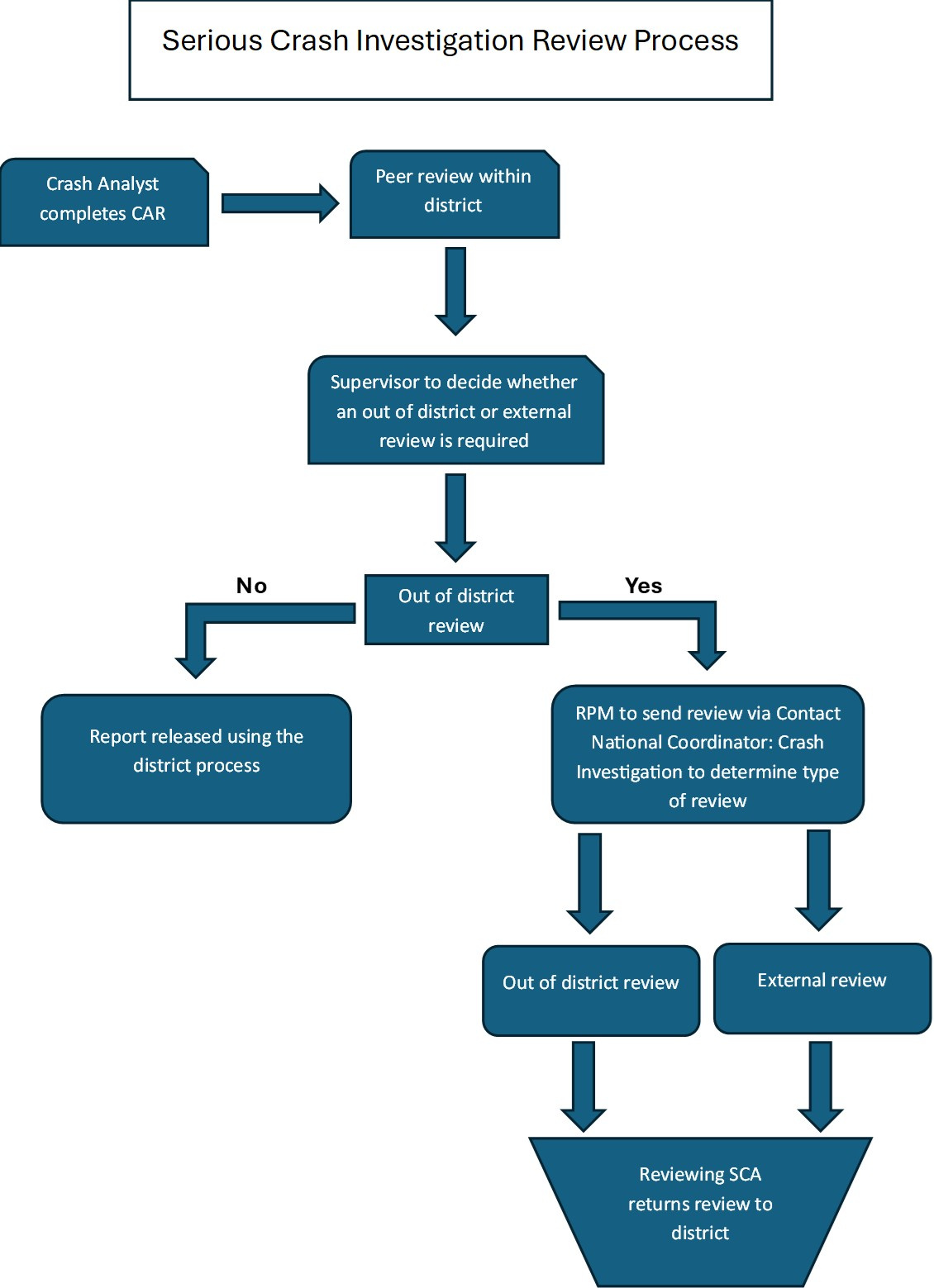
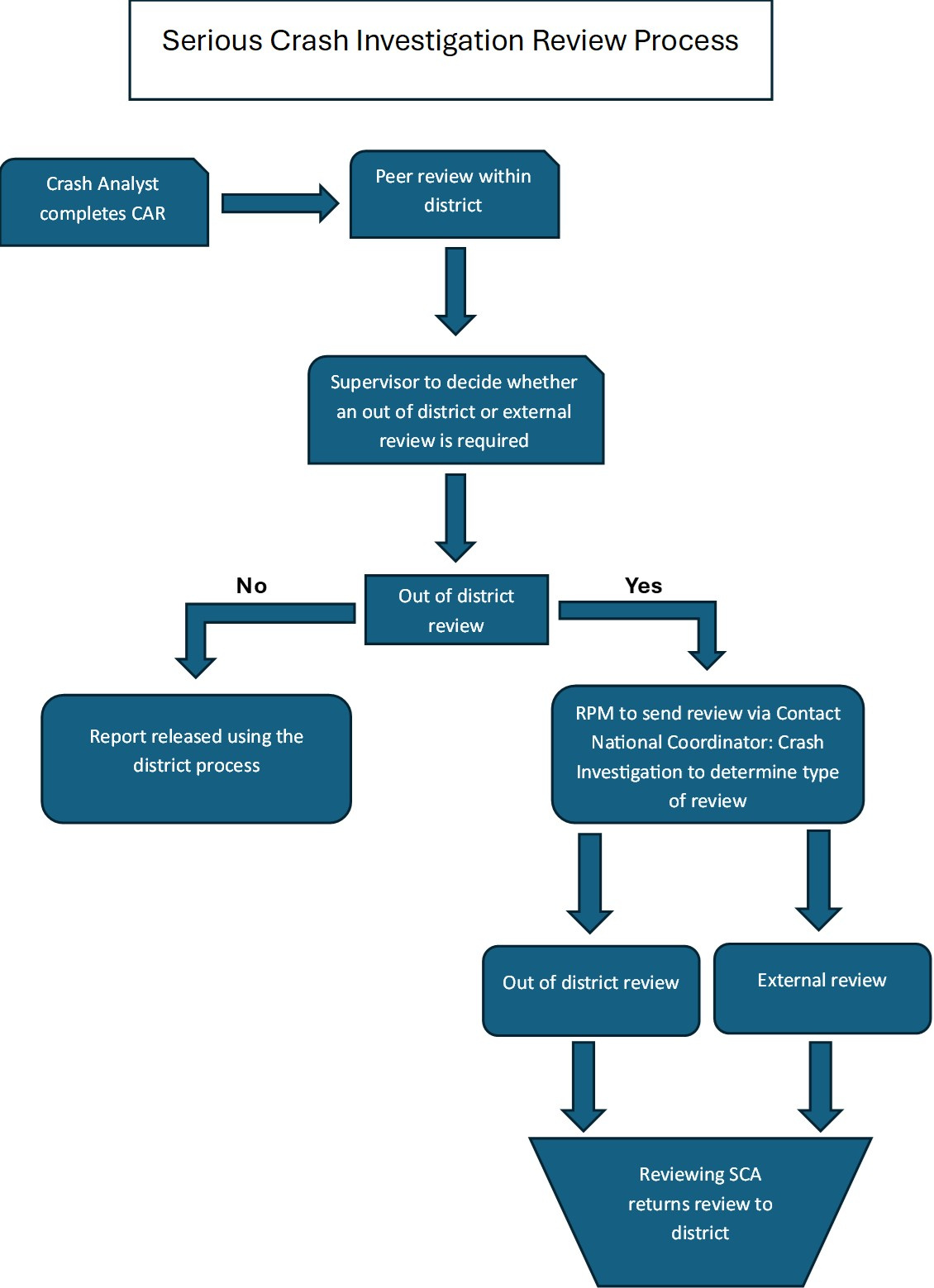
Review process flowchart
7
Review format
7
Dispute resolution
7
Roles and responsibilities
8
Crash analyst's supervisor
8
District RPM
8
National Coordinator: Crash Investigations
8
Peer review certificate
10
Police forms
10
Word:
10
Process review flowchart
11
link to page 2
Serious crash investigation review
Executive summary
The purpose of a serious crash investigation file review is to al ow independent peer review of crash
investigations.
Police reviewing serious crash investigation files must be aware of these key points:
- Al files must be reviewed in district first.
- Serious crash supervisors must determine if an out of district or external file review is required.
- Serious crash files that include an animation or relate to a fleeing driver incident, or on/off duty
Police employee must undergo an out of district review.
- Out of district reviewers must communicate with the author within 10 working days.
- Al reviewers must be suitably trained for the type of crash being reviewed.
3/12
link to page 2 link to page 2 link to page 2 link to page 2
Serious crash investigation review
Overview
Introduction
Crash Analysis Reports (CAR) are coming under increasing scrutiny particularly from investigators
working in the private sector and the Judiciary. In order to maintain the validity and reputation of Police
crash analysts, a quality assurance system must be included in the report compilation process.
Given the average number of serious crash investigations conducted annual y, it is appropriate that a
tiered approach to reviews is adopted. This chapter outlines the peer review process for CARs.
This chapter should be read in conjunction with the 'crash reporting' section of the 'Vehicle Crash
Attendance and Investigation' and 'Vehicle crash data recording devices' chapters of the Police Manual.
What is a serious traffic crash?
A serious traffic crash is one that:
- results in a significant life-threatening injury that could result in a fatality
- is likely to attract high public interest and, for this reason, requires a detailed investigation.
Purposes of a review
Al CARs must be peer reviewed within district, prior to the report being forwarded for inclusion on the
crash file.
- The author of the CAR forwards the report to their supervisor.
- The supervisor assigns to a suitably trained analyst within the district for review.
- The peer reviewer sends their review to the supervisor within 10 working days of receiving it.
The supervisor completes their section of the peer review certificate and decides whether or not to seek
an out of district or external review. The final decision as to whether a further review is required is at the
discretion of the report author's supervisor or district management.
- CARs selected for out of district or external review must be sent via the District Road Policing
Manager (RPM) to the National Coordinator: Crash Investigations, PNHQ, who wil determine the
type of review required.
Any CAR:
- including an animation
- fleeing driver incident, or
- involving an on/off duty member of Police,
must undergo an out-of-district review.
Reviews are initiated to ensure:
4/12
link to page 2
Serious crash investigation review
- appropriate and accurate mathematical analysis is correctly applied
- the CAR is aligned with Police procedures
- the findings of the investigation are appropriate and justifiable.
- the CAR has been authored by the appropriately trained analyst and complies with Schedule 4 of
the High Court Rules 2016 Act for expert witnesses.
Outcomes
A review may have these long-term outcomes:
- new initiatives developed during the investigation are documented and, where appropriate,
incorporated into crash procedures and Police Instructions
- district serious crash analysts gain insight into techniques and procedures being developed in
other districts, and
- inter-district communication is enhanced.
5/12
link to page 2 link to page 2 link to page 2 link to page 2
Serious crash investigation review
Review
Reviewer training
A Police employee nominated to review any CAR must:
- have completed Crash Investigation Training to at least Crash Analyst Level 2 (SCA2)
- be appropriately trained for the type of crash being reviewed (e.g., HMV, Ped/Bicycle &
Motorcycle)
- have completed at least one Contemporary Personal Development (SC Review Course) conducted
by the Royal New Zealand Police Col ege (RNZPC), within two years prior to any review being
undertaken (*or been exempted from attending the course), and
- be qualified to carry out speed estimates based on vehicle deformation if the file being reviewed
contains such.
*Note: Exemption requests must be submitted via the District Road Policing Manager to the National
Coordinator Crash Investigations. Exemptions wil be considered for employees that meet the above
reviewer qualifications and who are a current RNZPC Serious Crash Course trainer or facilitator.
Exemptions are granted at the discretion of the National Coordinator Crash Investigations in recognition
of the employee's contemporary skil s/knowledge/experience. An exemption wil be valid for up to two
years, after which the employee must have completed a relevant CPD (SC Review Course) or reapplied
for, and been granted, continued exemption via their District Road Policing Manager.
Out-of-district review
An out-of-district review involves the serious crash analysis report and supporting material being sent to
a suitably trained member of another district for peer review.
External review
Al crashes involving Police, which result in death or serious injury, must be external y reviewed.
Additional y, an external review may be required when:
- there is significant interest in the incident
- the out-of-district reviewer and the CAR writer cannot agree on some aspect of the report, or
- there are overly complex issues to address.
An external review involves the Director: Road Policing contracting an independent private sector analyst
or academic.
An external review must not be confused with the normal investigative process, where districts are free to
6/12
link to page 2 link to page 2 link to page 2 link to page 11
Serious crash investigation review
engage whatever investigative methods they require (at their own expense).
Review process flowchart
Download
the review process flowchart details.
Review format
Communication between the reviewer and the report author is essential. Reports must be discussed
verbal y to ensure precise understanding of the facts of the crash. This may involve both the reviewer and
CAR author working together to achieve an agreed report.
Once the reviewer is satisfied that the CAR is correct, they must forward a completed peer review
certificate with the CAR to the author's supervisor and the National Co-ordinator
Dispute resolution
If agreement cannot be reached between the reviewer and the author of the CAR, the National
Coordinator: Crash Investigations wil determine the appropriate course of action.
7/12
link to page 2 link to page 2 link to page 2 link to page 2 link to page 10
Serious crash investigation review
Roles and responsibilities
Crash analyst's supervisor
Internal
- Ensures:
review
- the CAR is satisfactory
- al serious CARs are peer reviewed within the districts
- employees completing serious crash investigations fol ow the principals of good
practicedecides on whether an out of district or external review is required.
- Completes an assessment of the report and signs the
peer review certificate as
appropriate.
District RPM
Support the Peer Encourages CARs be presented for 'out of district' review
Review process Considers requests from the National Coordinator: Crash Investigations for staff to
Peer Review CARs from other Districts (taking into account staffing levels and
workloads).
Internal reviews Ensures al CARs are peer reviewed within district.
Out of district
Considers whether either of these are appropriate. If so, the RPM refers the file to the
and external
National Coordinator: Crash Investigations for consideration and approval.
reviews
Issues raised by Raises any concerns with the National Coordinator: Crash Investigations, regarding
reviews
training deficiencies or issues of national concern.
National Coordinator: Crash Investigations
8/12
Serious crash investigation review
Contact RPM's
Requests release of SCA 2 officer to complete review of files submitted for out of
district review.
Managing workloads Ensures that CAR review workloads are spread evenly around al districts that have
qualified staff to undertake out of district reviews.
Consultation and
Consults and liaises with the originating district if any file is one that may be
liaison
considered for al ocation to an external reviewer.
Al ocating and
Al ocates CAR reviews to external reviewers, and is the Police point of contact
coordinating
for receiving the external reviewer's report and forwarding the file and report to the
external reviews
district RPM.
Responds to
Escalates issues identified.
implications from
reviews
Coordinates changes required to training and methodology when issues of
national importance are raised.
Responds to review Wil determine the course of action for resolution should there be a district dispute
disputes
between internal supervisor, and out-of-district peer reviewers.
Provides advice
Is available to assist employees with advice on serious crash investigation as
required or sought.
9/12
link to page 2 link to page 2 link to page 2
Serious crash investigation review
Peer review certificate
The Peer review certificates are available in:
Police forms
- Serious Crash Investigation Review
- Out of District Peer Review Certificate
Word:
- Microsoft Word> Police Forms> Road policing> Serious crash investigation review
- Microsoft Word> Police Forms> Road policing> Out of District Peer Review Certificate
10/12
link to page 2
Serious crash investigation review
Process review flowchart
11/12
Serious crash investigation review
Printed on : 21/05/2026
Printed from : https://tenone.police.govt.nz/pi/police-manual/s-u/serious-crash-investigation-review
12/12
 From:
From:
Ministerial Services
To:
Official Correspondence
Subject:
RE: [EXTERNAL] RE: Possible Transfer - Medical Event and Drug Related Crashes (2023–2025)
Date:
Tuesday, 14 April 2026 10:17:00 AM
Attachments:
Notification of transfer - Medical Event and Drug Related Crashes (20232025).msg
image001.png
image002.png
Morena Chanell,
Thank you for your confirmation. As discussed, and for the reason set out in the attached letter to
Nigel Gray, this request is being transferred to your agency for response.
Please treat this letter as a formal transfer of the request under section 14 of the Official
Information Act.
You should be aware that a response must be provided to the requester as soon as reasonably
practicable, and no later than 20 working days after the day this transfer is received by your
agency, unless an extension of time is required and duly notified to the requester.
Ngā mihi
Jonelle Smith|Advisor: Ministerial Services
|(she/her)
Policy & Partnerships |Police National Headquarters |
Īmēra / E [email address]
[ ]
From: Official Correspondence <[email address]>
Sent: Tuesday, 14 April 2026 9:46 am
To: Ministerial Services <[email address]>
Subject: [EXTERNAL] RE: Possible Transfer - Medical Event and Drug Related Crashes (2023–
2025)
CAUTION: This email originated from outside the New Zealand Police Network. DO
NOT click links or open attachments unless you recognise the sender and are
assured that the content is safe.
Kia ora Jonelle
Confirming we can accept transfer.
Ngā mihi
Chanell
 Ministerial Services
Te Waka Kōtuia
Ministerial Services
Te Waka Kōtuia | Engagement & Partnerships
NZ Transport Agency Waka Kotahi
Connect with us on Social Media
From: Ministerial Services <[email address]>
Sent: Tuesday, 14 April 2026 9:39 am
To: Official Correspondence <[email address]>
Subject: Possible Transfer - Medical Event and Drug Related Crashes (2023–2025)
Kia ora Team,
We have received the below request:
‘I am requesting the following information under the Official Information Act 1982.
To avoid ambiguity, each item refers specifically to data recorded or held by NZ Police, including
but not limited to the Crash Analysis System (CAS), Police crash reports, and any internal
classification or coding guidance.
A. Medical‑
Event Crashes (2023, 2024, 2025) For each of the last three calendar years, please
provide:
The number of fatal crashes where the primary contributing factor was recorded as a medical
event.
The number of serious‑
injury crashes where the primary contributing factor was a medical event.
The number of minor‑
injury crashes where the primary contributing factor was a medical event.
The number of fatal crashes removed from the official road‑
toll dataset because they were
determined to be caused by a medical event.
The exact Police or CAS factor codes, definitions, or descriptors used to classify a crash as a
medical event.
The number of cases currently coded as “suspected medical event” or equivalent where coronial
findings are pending.
B. Drug‑
Related Crashes (2023, 2024, 2025) For each of the last three calendar years, please
provide:
The number of fatal crashes where drugs were recorded as a contributing factor.
The number of serious‑
injury crashes where drugs were recorded as a contributing factor.
The number of minor‑
injury crashes where drugs were recorded as a contributing factor.
The number of fatal crashes where both alcohol and drugs were contributing factors.
The factor codes, definitions, or descriptors used to classify drug involvement.
The number of cases initially coded as “pending toxicology” that were later updated to
“drug‑
related.”
C. Classification and Data‑
Handling Procedures Please provide:
The internal Police guidance, instructions, or criteria used to determine when a crash is classified
as: although this is asked specifically of Police
this is not a function of Police and therefore we
hold no information or internal guidance on this, as this role sits with NZTA.
a medical event
drug‑
related
alcohol‑
related
excluded from the official road toll
Any procedures or thresholds used when updating crash records following coronial findings or
toxicology results.
D. Format
Please provide the information in tabular form (CSV, XLSX, or similar), or as a structured table in
your response.
E. Administrative Notes
To avoid unnecessary delay:
If any part of this request is considered too broad, please identify the specific part and provide all
remaining items.’
The request cannot be answered by NZ Police and the information is believed to be held by
NZTA.
In accordance with section 14 of the Official Information Act 1982 (OIA), we are therefore
seeking to transfer this request in full to your agency for response.
Please confirm by return email that the transfer is accepted, or, in the event you are unable to
accept transfer, reasons for the refusal.
On receipt of transfer confirmation, we will notify the requestor and process formal transfer of
the request to NZTA.
Ngā mihi
Jonelle Smith|Advisor: Ministerial Services
|(she/her)
Policy & Partnerships |Police National Headquarters |

Īmēra / E [email address]
[ ]
===============================================================
WARNING
The information contained in this email message is intended for the addressee only and
may contain privileged information. It may also be subject to the provisions of section 50
of the Policing Act 2008, which creates an offence to have unlawful possession of Police
property. If you are not the intended recipient of this message or have received this
message in error, you must not peruse, use, distribute or copy this message or any of its
contents. Also note, the views expressed in this message may not necessarily reflect those
of the New Zealand Police. If you have received this message in error, please email or
telephone the sender immediately
This message, together with any attachments, may contain information that is classified
and/or subject to legal privilege. Any classification markings must be adhered to. If you are
not the intended recipient, you must not peruse, disclose, disseminate, copy or use the
message in any way. If you have received this message in error, please notify us
immediately by return email and then destroy the original message. This communication
may be accessed or retained by NZ Transport Agency Waka Kotahi for information
assurance purposes.
From:
Ministerial Services
To:
Nigel Gray
Subject:
Notification of transfer - Medical Event and Drug Related Crashes (2023–2025)
Date:
Tuesday, 14 April 2026 10:14:00 AM
Tena koe Nigel,
I refer to your Official Information Act request dated 11 April 2026 below.
We have transferred your request in full to NZTA. The information to which your request relates is not held by
us, but is believed to be held by NZTA. In these circumstances, we are required by section 14 of the Official
Information Act 1982 to transfer your request, you will hear further from them concerning your request.
Ngā mihi
Jonelle|Advisor: Ministerial Services |(she/her)
Policy & Partnerships |Police National Headquarters |
-----Original Message-----
From: Nigel Gray <[email address]>
Sent: Saturday, 11 April 2026 8:58 pm
To: Ministerial Services <[email address]>
Subject: [EXTERNAL] Official Information request - Official Information Act Request – Medical Event and
Drug Related Crashes (2023–2025)
CAUTION: This email originated from outside the New Zealand Police Network. DO NOT click links or open
attachments unless you recognise the sender and are assured that the content is safe.
NZ Police – National Road Policing Centre / Ministerial Services
Subject: Official Information Act Request – Medical‑Event and Drug‑Related Crashes (2023–2025)
I am requesting the following information under the Official Information Act 1982.
To avoid ambiguity, each item refers specifically to data recorded or held by NZ Police, including but not
limited to the Crash Analysis System (CAS), Police crash reports, and any internal classification or coding
guidance.
A. Medical‑Event Crashes (2023, 2024, 2025) For each of the last three calendar years, please provide:
The number of fatal crashes where the primary contributing factor was recorded as a medical event.
The number of serious‑injury crashes where the primary contributing factor was a medical event.
The number of minor‑injury crashes where the primary contributing factor was a medical event.
The number of fatal crashes removed from the official road‑toll dataset because they were determined to be
caused by a medical event.
The exact Police or CAS factor codes, definitions, or descriptors used to classify a crash as a medical event.
The number of cases currently coded as “suspected medical event” or equivalent where coronial findings are
pending.
B. Drug‑Related Crashes (2023, 2024, 2025) For each of the last three calendar years, please provide:
The number of fatal crashes where drugs were recorded as a contributing factor.
The number of serious‑injury crashes where drugs were recorded as a contributing factor.
The number of minor‑injury crashes where drugs were recorded as a contributing factor.
The number of fatal crashes where both alcohol and drugs were contributing factors.
The factor codes, definitions, or descriptors used to classify drug involvement.
The number of cases initially coded as “pending toxicology” that were later updated to “drug‑related.”
C. Classification and Data‑Handling Procedures Please provide:
The internal Police guidance, instructions, or criteria used to determine when a crash is classified as:
a medical event
drug‑related
alcohol‑related
excluded from the official road toll
Any procedures or thresholds used when updating crash records following coronial findings or toxicology
results.
D. Format
Please provide the information in tabular form (CSV, XLSX, or similar), or as a structured table in your
response.
E. Administrative Notes
To avoid unnecessary delay:
If any part of this request is considered too broad, please identify the specific part and provide all remaining
items.
If any information is not held by Police but is held by another agency, please transfer that portion under section
14 of the OIA.
If coronial delays affect final classification, please provide the current Police coding and note which cases are
pending.
Yours faithfully,
Nigel Gray
-------------------------------------------------------------------
This is an Official Information request made via the FYI website.
Please use this email address for all replies to this request:
[email address]
Is [New Zealand Police request email] the wrong address for Official Information requests to New Zealand
Police? If so, please contact us using this form:
https://fyi.org.nz/change_request/new?body=new_zealand_police
Disclaimer: This message and any reply that you make will be published on the internet. Our privacy and
copyright policies:
https://fyi.org.nz/help/officers
If you find this service useful as an Official Information officer, please ask your web manager to link to us from
your organisation's OIA or LGOIMA page.
-------------------------------------------------------------------
 From:
From:
Ministerial Services
To:
Data; NRPC.Strategy
Subject:
RE: [EXTERNAL] Official Information request - Official Information Act Request – Medical‑Event and
Drug‑Related Crashes (2023–2025)
Date:
Tuesday, 14 April 2026 9:27:00 AM
Attachments:
image001.png
image002.png
Thanks team, I’ll organise the transfer now.
Jonelle Smith|Advisor: Ministerial Services
|(she/her)
Policy & Partnerships |Police National Headquarters |
Īmēra / E [email address]
[ ]
From: Data <[email address]>
Sent: Tuesday, 14 April 2026 9:14 am
To: NRPC.Strategy <[email address]>
Cc: Ministerial Services <[email address]>
Subject: RE: [EXTERNAL] Official Information request - Official Information Act Request –
Medical‑Event and Drug‑Related Crashes (2023–2025)
Thanks Laura, much appreciated, I’ll leave with Min Services to action.
Thank you, Keith.
From: NRPC.Strategy <[email address]>
Sent: Tuesday, 14 April 2026 9:12 am
To: Data <[email address]>
Cc: Ministerial Services <[email address]>; NRPC.Strategy
<[email address]>
Subject: RE: [EXTERNAL] Official Information request - Official Information Act Request –
Medical‑Event and Drug‑Related Crashes (2023–2025)
Hi Keith
This request should be transferred in its entirety to NZTA – they hold information regarding
crashes and crash factors in their Crash Analysis System. I note that the requestor has asked
specifically for Part C for ‘Police guidance’, so in the transfer, we should explicitly advise that this
is not a function of Police and therefore we hold no information or internal guidance on this, as

this role sits with NZTA.
Thanks
Ngā mihi
Laura Staples (she/her)
Senior Advisor – Business Strategy
National Road Policing Centre - PNHQ
s 9(2)(a) OIA
E [email address]
QID LSND45
-----Original Message-----
From: Data <[email address]>
Sent: Tuesday, 14 April 2026 9:01 AM
To: NRPC.Strategy <[email address]>
Subject: FW: [EXTERNAL] Official Information request - Official Information Act Request –
Medical‑Event and Drug‑Related Crashes (2023–2025)
Hi,
Min Services have asked about where to best assign this OIA request - are you able to provide any
of the information requested below?
Thanks very much, Keith.
Keith Baldwin
Information Management Coordinator
Data and Performance Insights
-----Original Message-----
From: Ministerial Services <[email address]>
Sent: Monday, 13 April 2026 11:42 am
To: Data <[email address]>
Subject: FW: [EXTERNAL] Official Information request - Official Information Act Request –
Medical‑Event and Drug‑Related Crashes (2023–2025)
Mōrena Team,
Can you please confirm if the below would sit with you with input from Road Policing?
Ngā mihi
Jonelle Smith|Advisor: Ministerial Services |(she/her) Policy & Partnerships |Police National
Headquarters |
Īmēra / E [email address]
-----Original Message-----
From: Nigel Gray <[email address]>
Sent: Saturday, 11 April 2026 8:58 pm
To: Ministerial Services <[email address]>
Subject: [EXTERNAL] Official Information request - Official Information Act Request –
Medical‑Event and Drug‑Related Crashes (2023–2025)
CAUTION: This email originated from outside the New Zealand Police Network. DO NOT click
links or open attachments unless you recognise the sender and are assured that the content is
safe.
NZ Police – National Road Policing Centre / Ministerial Services
Subject: Official Information Act Request – Medical‑Event and Drug‑Related Crashes (2023–
2025)
I am requesting the following information under the Official Information Act 1982.
To avoid ambiguity, each item refers specifically to data recorded or held by NZ Police, including
but not limited to the Crash Analysis System (CAS), Police crash reports, and any internal
classification or coding guidance.
A. Medical‑Event Crashes (2023, 2024, 2025) For each of the last three calendar years, please
provide:
The number of fatal crashes where the primary contributing factor was recorded as a medical
event.
The number of serious‑injury crashes where the primary contributing factor was a medical event.
The number of minor‑injury crashes where the primary contributing factor was a medical event.
The number of fatal crashes removed from the official road‑toll dataset because they were
determined to be caused by a medical event.
The exact Police or CAS factor codes, definitions, or descriptors used to classify a crash as a
medical event.
The number of cases currently coded as “suspected medical event” or equivalent where coronial
findings are pending.
B. Drug‑Related Crashes (2023, 2024, 2025) For each of the last three calendar years, please
provide:
The number of fatal crashes where drugs were recorded as a contributing factor.
The number of serious‑injury crashes where drugs were recorded as a contributing factor.
The number of minor‑injury crashes where drugs were recorded as a contributing factor.
The number of fatal crashes where both alcohol and drugs were contributing factors.
The factor codes, definitions, or descriptors used to classify drug involvement.
The number of cases initially coded as “pending toxicology” that were later updated to
“drug‑related.”
C. Classification and Data‑Handling Procedures Please provide:
The internal Police guidance, instructions, or criteria used to determine when a crash is classified
as:
a medical event
drug‑related
alcohol‑related
excluded from the official road toll
Any procedures or thresholds used when updating crash records following coronial findings or
toxicology results.
D. Format
Please provide the information in tabular form (CSV, XLSX, or similar), or as a structured table in
your response.
E. Administrative Notes
To avoid unnecessary delay:
If any part of this request is considered too broad, please identify the specific part and provide all
remaining items.
If any information is not held by Police but is held by another agency, please transfer that portion
under section 14 of the OIA.
If coronial delays affect final classification, please provide the current Police coding and note
which cases are pending.
Yours faithfully,
Nigel Gray
-------------------------------------------------------------------
This is an Official Information request made via the FYI website.
Please use this email address for all replies to this request:
[email address]
Is [New Zealand Police request email] the wrong address for Official Information requests to New
Zealand Police? If so, please contact us using this form:
https://fyi.org.nz/change request/new?body=new zealand police
Disclaimer: This message and any reply that you make will be published on the internet. Our
privacy and copyright policies:
https://fyi.org.nz/help/officers
If you find this service useful as an Official Information officer, please ask your web manager to
link to us from your organisation's OIA or LGOIMA page.
-------------------------------------------------------------------
