

NOT FOR EXTERNAL DISTRIBUTION
Contents
1. Executive summary ....................................................................................................... 5 2. Market analysis ............................................................................................................ 7 3. Requirements and costs .............................................................................................. 12 4. Key stakeholders ........................................................................................................ 15 5. Tendering process....................................................................................................... 17 6. Evaluation methodology ............................................................................................. 20 7. Risk management ....................................................................................................... 25 Appendix One: RFP non-price questions ............................................................................ 28 Appendix Two: Proposed Contract ..................................................................................... 36 Appendix Three: Waka Kotahi extended term approval ..................................................... 38
GWRC Procurement Plan PT1078 Page
2 of
40



NOT FOR EXTERNAL DISTRIBUTION
1. Executive summary
On 30 June 2024, our bus and rail signage contract with Dzine Signs & Display Limited (
Dzine Signs), co-
funded by Waka Kotahi, will end. Wider GW signage requirements are met by individuals raising low-
value purchase orders with Dzine Signs and other smal , local providers on an ad-hoc basis such as MESH
Wellington Limited and The Sign Factory.
This procurement aims to maintain seamless service delivery post 30 June and uphold our commitment to
the public transport network. In addition, this procurement presents an opportunity to broaden out the
scope to include wider GW signage requirements for GW parks, environment, flood protection, vehicle
fleet and corporate teams. This approach will help streamline and consolidate GW’s signage
requirements, costs, eliminate inefficiencies and provide GW teams with signage services that are easy to
use.
Our goal is to deliver consistently branded information that is straightforward for users and offers a
consistent customer experience. The intended outcome is that people see, act, understand or get to their
intended destination quickly and safely.
With this in mind, the purpose of this procurement is to identify a suitably qualified supplier to deliver
signage requirements across GW. A supplier who can:
•
manufacture, instal and maintain signage across our sites including parks and reserves
•
proactively manage a comprehensive scheduled maintenance, annual inspections, renewal
and warranty management programmes
•
engage with GW teams to design, develop, and provide consistently branded graphic services
•
help streamline signage processes across GW, so we work smarter together and unlock cost
savings through economies of scale
•
accommodate ad-hoc signage requests from time to time
•
bring innovative ideas, including waste management practices that respect our environment,
without compromising quality and cost
•
help us achieve our carbon neutral goal by 2030
•
hold the relevant site access qualifications and can obtain the necessary permits such as rail
corridor access, or partner with someone who can
•
hold the relevant brand qualifications for the signage solution put forward in their proposal.
To achieve this goal, this procurement covers the end-to-end signage lifecycle. This includes designing,
manufacturing, installing, maintaining and replacing GW signs across our busy Metlink public transport
network plus corporate offices, parks, reserves, vehicle fleet and environment teams1.
Who are we?
Greater Wellington Regional Council is a public statutory body constituted under the Local Government
Act 2002 (
GW, we). Our core role is to protect the environment while enabling sustainable economic
development and to do that, we are responsible for a wide range of activities that contribute to the
overall wellbeing of the region. We regulate the use of the region’s natural resources, protect high value
biodiversity areas, manage flood risk across the region and manage public land on behalf of the
1 For the purposes of this procurement, in-scope maintenance activities include regular scheduled inspections, deep
cleans or polish and warranty checks. Please note that day to day cleaning is performed as part of our FM contract.
GWRC Procurement Plan PT1078 Page
5 of
40

NOT FOR EXTERNAL DISTRIBUTION
community including eight regional parks. We also look after the region’s harbours and manage
environmental threats such as pest plants and animals2.
We also operate a complex, well-established public transport network across the Wel ington region under
the brand ‘Metlink’. The Metlink brand brings together all the region's bus, train, and harbour ferry
services under one name into an integrated public transport information system for the Greater
Wel ington Public Transport Network. Metlink has a consistently branded wayfinding signage system that
is easy to use and offers a consistent Metlink Customer experience. We pride ourselves on having a clear
and well-maintained signage network, this is key to people recognising Metlink and is a key driver in this
procurement process.
What are we buying and why?
We are looking for a supplier to manage our signage portfolio in a way that upholds a consistent look and
feel, consistent messaging and recognises our commitment to waste management and sustainable
business practices. For the purposes of this procurement, the scope includes signage across all GW teams
and sites, with a primary focus on the following.
•
For rail: we operate a wide range of rail assets across our stations, commuter Park and Rides,
stabling yards, and the EMU (Electrical Multiple Unit) Depot for the rail network.
•
For bus: we own or lease numerous bus hubs, shelters, bus driver toilets, layovers and
parking yards for the purpose of operating the bus network.
•
For ferry: we have wharf waiting areas at Day’s Bay and Wellington wharf.
•
For parks: we have eight regional parks and four river, forest and wetland areas that cater
for public access to recreational activities.
•
For the harbour team: the marine environment requires a product that can withstand
maritime conditions as wel as the strong Wel ington wind conditions.
•
For vehicle fleet: GW owns a range of vehicles across the region that require sign marking in
a range of ways from vehicle wraps to the GW logo on the doors.
•
For other GW business groups: a range of ad hoc signage is required such as signage in
buildings or for events.
To enable suppliers to get a deeper understanding of our sites and signage needs, we wil append current
state appendices, diagrams and images to the RFP. Suppliers may wish to clarify their understanding using
the question and answer process once the RFP is in the market.
Why should suppliers bid?
We believe this is an opportunity to work alongside lots of inspiring and passionate GW teams, resulting
in the chosen supplier’s signage being placed across Wel ington communities, parks, reserves and
harbour, and be seen by thousands of people on a daily basis. We anticipate that this contract
opportunity will provide a sense of pride for the chosen supplier, knowing they are contributing to the
ongoing effectiveness of the public transport network, the health and safety of the public and all those
who frequent greater Wellington parks, reserves, harbour and all of GW corporate offices. Moreover, we
believe this is a great opportunity for a business to be involved in our Metlink programme, to directly
improve the operational safety of the Metlink public transport system for staff and customers throughout
the Wellington region.
2 Check out our Long Term Plan to find out more about who we are, our strategy and activities to 2031 here.
GWRC Procurement Plan PT1078 Page
6 of
40



NOT FOR EXTERNAL DISTRIBUTION
2. Market analysis
Based on our supplier positioning analysis
3, we place this procurement in the
high value strategic
quadrant because:
a) Metlink’s busy bus and rail networks consider signage as a critical asset and
b) We consider the contract value to be reasonably high: around $1m p/a. The contract value is
not as large as other recent GW tenders, but this would be considered a large contract for a
local Wellington supplier.
Our value as a customer
We believe GWRC is seen as an attractive customer with
development potential. This is because we
have a good reputation in the marketplace, are a steward of the natural environment and strive towards
sustainable transport options across greater Wellington. We believe suppliers would see us as a client
they would want to do business with, and the broad tender scope is a great opportunity to showcase
their work to a large audience right across the Wellington region.
We hope this procurement will attract industry-leading suppliers (including Māori, Pasifika and regional
businesses and social enterprises) who want to showcase their expertise and ultimately grow their brand.
We endeavor to make it easy for all suppliers (small and large) to do business with GW.
3 Positioning yourself in the market | New Zealand Government Procurement
GWRC Procurement Plan PT1078 Page
7 of
40



NOT FOR EXTERNAL DISTRIBUTION
Market competition
Based on our knowledge of the supply market, market competition is general y based on signage unit
price, experience, resources capacity and response times. We can expect variations in proposal prices
regarding the product brand and resource rates, and differences in the supplier and subcontractor
methodologies.
GW is taking an outcomes-based approach to requirements. As such, we believe there could be multiple
suppliers who put forward Proposals with different product sets.
We are open to different brands, so
long as the suppliers can demonstrate that they meet our requirements.
There are no All of Government, Collaborative or Syndicated contracts that can fulfil the requirements of
this procurement either.
Power and dependency matrix
An assessment of the levels of power and dependency between GWRC and suppliers has been
undertaken. Currently, we believe the
Supplier is dominant (lower, right-hand quadrant). This is
because suppliers generally have limited visibility of us as a potential customer. They are probably
unaware of the market potential for growth. Moreover, demand across the industry is currently
outstripping supply as we are aware of response time delays in some situations. This gives suppliers the
ability to select which tenders they respond to, to extract maximum profits. This puts them in the driving
seat. Demand is greater than supply.
The supplier is also dominant because we have a current contract with an end date governed by Waka
Kotahi rules. We cannot extend beyond this date therefore we are in a time-critical position to select a
supplier and establish a new contract.
We applied for an exemption from Waka Kotahi, to extend the new contract term from five years to a
maximum term of ten years. This was approved. A longer contract term may move GWRC’s position on
the matrix from bottom, right-hand side (navy blue) to top right-hand quadrant where
Buyer and
supplier are interdependent. Our credibility as a customer of choice becomes more visible across
the industry, as the potential contract duration and revenue streams are greater (subject to service levels
and contract renewals being exercised).
GWRC Procurement Plan PT1078 Page
9 of
40


NOT FOR EXTERNAL DISTRIBUTION
Financial benefits of going to market
Market Rate Adjustment: Prices will be realigned with current market rates, which could result in
increased cost-effectiveness.
Potential Savings: A competitive process may drive down costs by attracting more cost-effective
bids, as well as introducing volume discounts.
Transition Costs: There may be costs associated with transitioning to a new supplier, including
potential downtime and upskilling staff. We believe this cost to be smal in relation to the broader
benefits, given the simplicity of signage.
Desired supplier relationship
Given the contract term and value, the level of desired trust and communication with the supplier and
the approach to managing risk, we seek a strategic collaborative relationship with the chosen supplier.
In practice, this means establishing and committing to a collaborative, mutually beneficial relationship for
all parties. The collaborative relationship means the chosen supplier can help GW optimise signage
manufacturing, installation and maintenance and other in-scope signage elements while coordinating
with GW’s contract managers to complete the work within the specified time, quality, and budget.
As time goes on and the importance of this contract and quality and standards of the signage develops
across the industry, we are likely to move right, along the spectrum to an even more robust and
dedicated relationship.
Characteristics of unsuitable suppliers
The following characteristics are unsuitable.
• A supplier that does not have experience working in the rail corridor or at the very least can
evidence an acceptable health and safety record that will allow them to apply for and secure a
rail corridor permit from KiwiRail. KiwiRail also require HSE induction and the online electrical
awareness Intermediate-level certification.4
4 A permit to enter is required for Rail, more information on this process can be found here
GWRC Procurement Plan PT1078 Page
10 of
40

NOT FOR EXTERNAL DISTRIBUTION
• A supplier that does not have experience working on local authority road networks (with
traffic management plans), unless they are partnering with a supplier who has this capability.
• A supplier with no access or subcontractor access to a manufacturing facility and/or no
storage capacity to store our inventory off-site, prior to installation, if required.
• A supplier without capable resources available to provide maintenance and reactive service.
This may include being available to provide emergency maintenance and repairs on short
notice for critical signage.
• A supplier who is unable to articulate and demonstrate their ability, as a principal PCBU, to
effectively manage the relationships and activities of other PCBU’s associated with the services
required of this contact.
• A supplier who is unable to respond to signage requests within pre-agreed SLA timeframes.
To help ensure these characteristics are not carried through to the shortlisted respondent group, the
procurement methodology includes setting realistic preconditions and asking questions on these topics.
GWRC Procurement Plan PT1078 Page
11 of
40

NOT FOR EXTERNAL DISTRIBUTION
3. Requirements and costs
The RFP requirements are summarised below. These wil be built out as RFP questions, to ensure critical
areas are clearly emphasized, communicated, and understood by suppliers.
Production
• Participate in the sign design process, providing expertise as required to ensure that
signs are functional, informative, consistent and value for money.
• Fabricate and instal signs using a range of techniques, as appropriate for the site and
taking all necessary health and safety measures into careful consideration.
• Manufacture and print signage across a range of products, backed by product set
qualifications and accreditations.
Services
• On site inspections and maintenance across diverse environments, including within
the strict health and safety parameters associated with each site. Sites range from
simple to high complexity, high risk sites that can only be entered after the pre-
requisite approvals have been obtained.
• Establish and actively maintain a programme of inspections and maintenance of
existing sign inventory. Ensure good record keeping and signage continues to be
maintained to the correct standards.
• Provide regular, up-to-date reporting including uploading content into GW’s asset
management system, alerting us per agreed SLAs of issues, risks and reactive
maintenance requirements. Communication will be a critical success factor for this
contract, to ensure the right actions are taken and the right time.
Health, safety, and wel being considerations
Health and Safety at Work Act 2015
All parties will meet their obligations under the Health and Safety at Work Act 2015 (HSWA 2015)5. The
supplier and their subcontractors have a responsibility to ensure all work is carried out safely, without risk
to themselves or others, as far as practical.
PCBU’s (Person Conducting a Business or Undertaking)
The successful supplier will be the lead PCBU for the purposes of the contract. In situations where there
are overlapping HSWA 2015 duties including upstream and downstream PCBU’s, the supplier wil work
with them to ensure effective col aboration, cooperation, and communication to meet these duties.
A Permit to Enter is required for working in, or impacting on the rail operational areas, unless the person
is working under direct KiwiRail supervision. During installation/maintenance on the rail network, the
supplier and their subcontractors shal ensure their work meets the KiwiRail’s H&S requirements. The
supplier and their subcontractors will also be required to under KiwiRail inductions and electrical
certifications. See KiwiRail’s extensive safety requirements here: Permit to Enter | KiwiRail
For workers who perform services on the road or roadside, kindly refer to WorkSafe’s guidance at
Keeping healthy and safe while working on the road or roadside | WorkSafe. For services that involve
5 Health and Safety at Work Act 2015 No 70
GWRC Procurement Plan PT1078 Page
12 of
40



NOT FOR EXTERNAL DISTRIBUTION
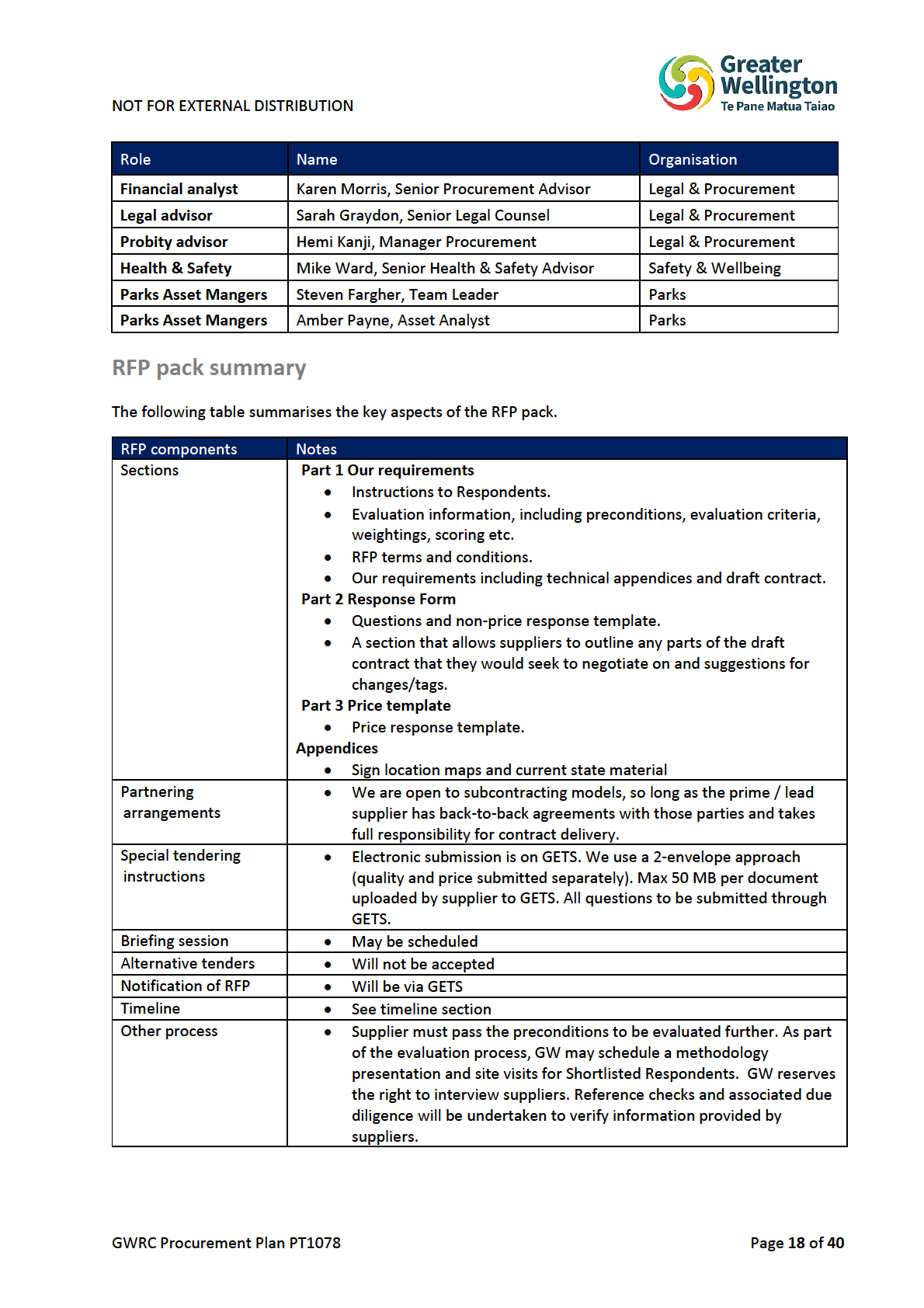
Indicative timeline
The proposed timeline for the procurement is as follows and available here.
GWRC Procurement Plan PT1078 Page
19 of
40

NOT FOR EXTERNAL DISTRIBUTION
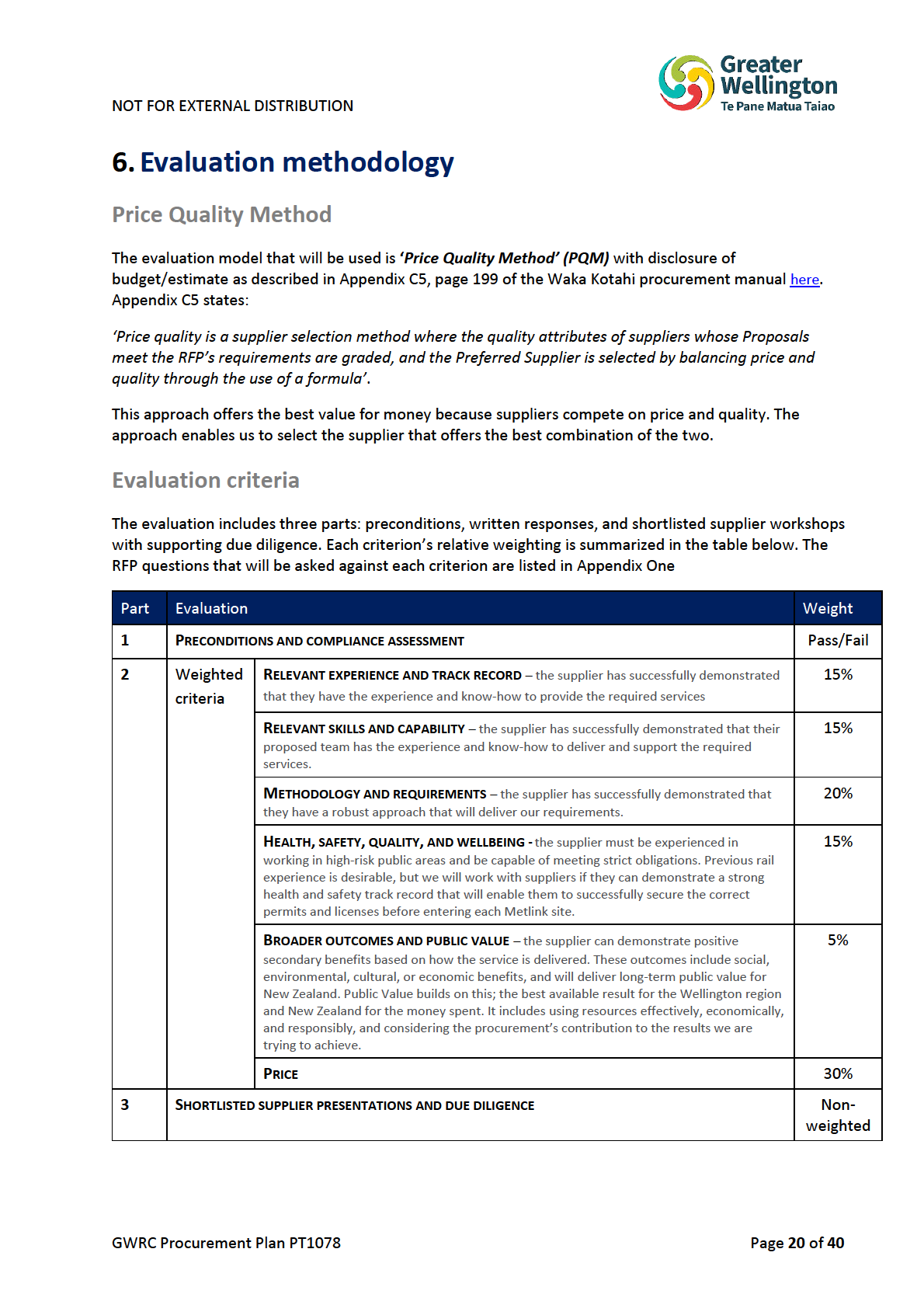
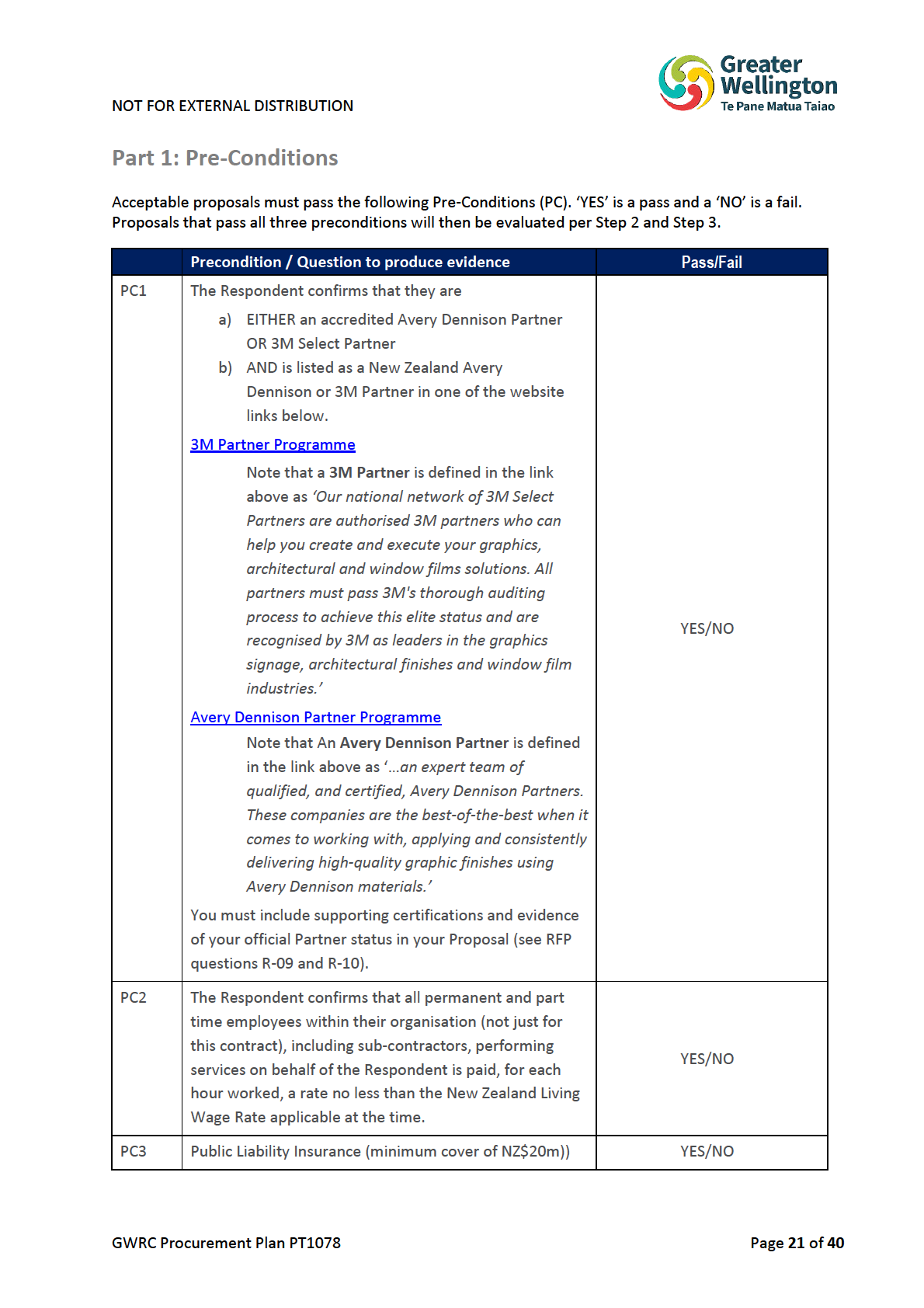
Part 2: Written responses
Individual evaluations of written Proposals
Evaluation Team members will initially evaluate non-price written Proposals independently and grade
each criterion from zero to 100. The RFP questions the Evaluation Team will be evaluating are included at
Appendix One.
The Chair will culminate these individual grades into an Evaluation Moderation Workbook for each
criterion will be calculated for each Respondent, based on the aggregate of the individual grades for that
criterion. The average score is then used as a basis for discussion. For example, if there is an outlier score,
the Team wil hear from that person then a decision made to increase or decrease own scores.
Evaluation Team Moderation Session #1
After individual evaluations are complete, the team will come together for Evaluation Team Moderation
Session #1. At this session, the Chair will oversee a logical discussion about individual grades (namely
outliers). Individuals may adjust their own grades after these discussions and an audit trail will be made
to document such decisions to arrive at an agreed grade for each criterion.
The agreed grades will be inserted into Waka Kotahi’s Price Quality Evaluation Template which is used to
determine the preferred Respondent.
A Quality Threshold wil be applied to this model, so that only capable suppliers are put forward as
Shortlisted Respondents. It is important to note that the Respondents that do not meet the Quality
Threshold will likely not have their pricing envelopes opened. Only Proposals that score 55 or more on
each of the non-price criterion will be considered for shortlisting for Step 3.
Price
Price is not scored by the Evaluation Team. If a Respondent offers a substantially lower price than other
Proposals, we may make enquiries or require additional evidence to verify that the Respondent can meet
all requirements and conditions of the Proposed Contract for the price quoted.
Step 3: Shortlisted supplier due diligence
Based on the PQM model outcome, the Evaluation Team wil confirm Shortlisted Respondents. The
Shortlisted Respondents wil be invited to provide presentations to the Evaluation Team based on a clear
agenda. This part of the evaluation process is an opportunity for the Evaluation Team to deepen their
understanding and ask clarification questions based on written proposals. Any additional due diligence
activities will be carried out at this point in the process (see due diligence section for more details).
Evaluation Team Moderation Session #2
After due diligence is complete, the Evaluation Team will reconvene for Evaluation Team Moderation
Session #2. Here, the Chair will facilitate discussions based on new information that has come to light.
Evaluation Team members will have an opportunity to update scores with documented rationale to
reflect their deeper knowledge base. The Chair is responsible for updating the Evaluation Moderation
Workbook, with supporting annotations for audit purposes. This process will result in a finalised
Respondent scores and finalised Respondent weighted rankings.
Evaluation Team Recommendation Report
GWRC Procurement Plan PT1078 Page
22 of
40


NOT FOR EXTERNAL DISTRIBUTION
• Site visits
• Health and safety checks
• Third party opinion
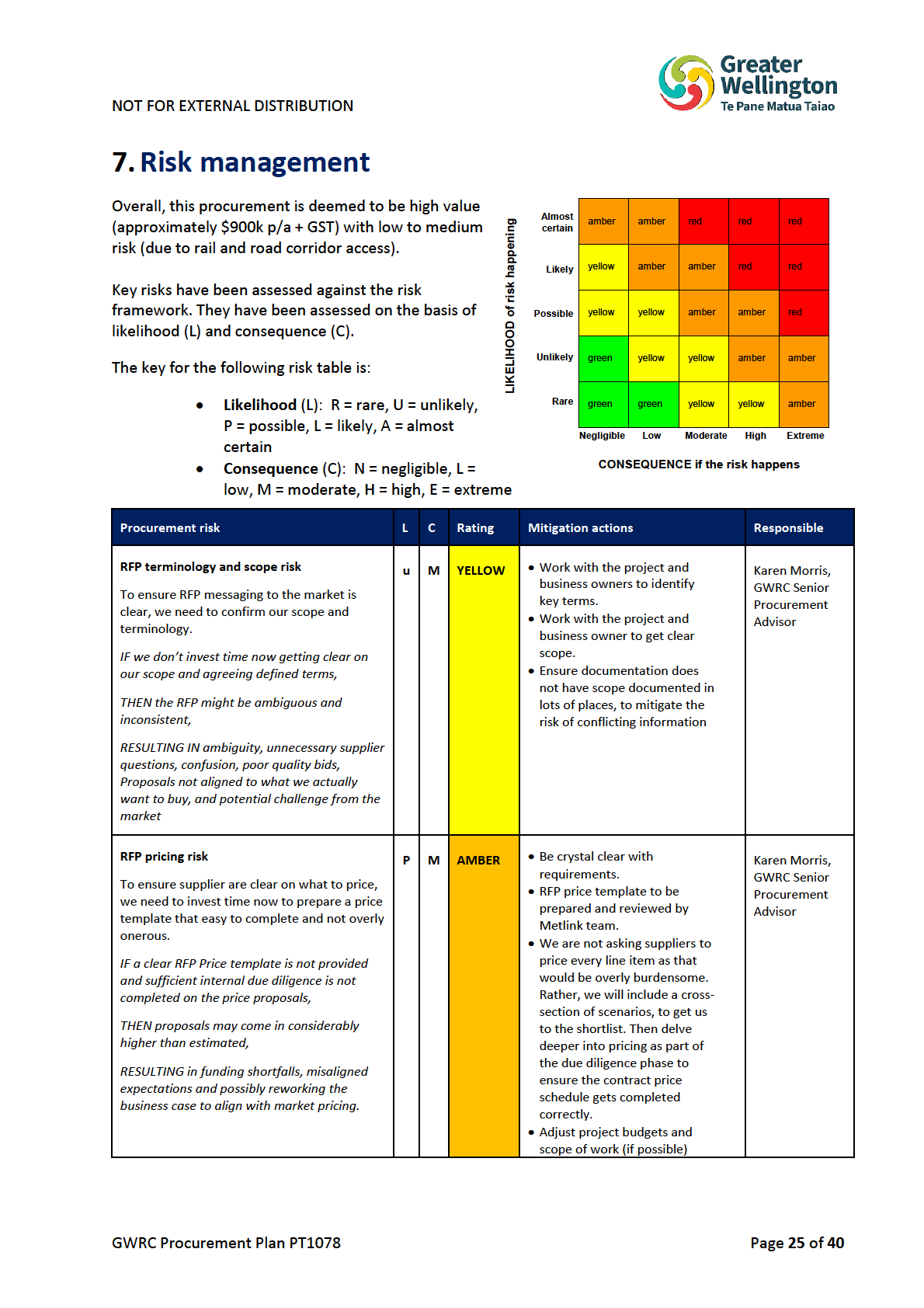
Findings from due diligence conducted prior to supplier recommendation wil be considered as part of the
best value for money (time, cost, quality) proposition of each response. If any supplier red flags arise
during due diligence, the evaluation team wil determine whether the matter is a risk that is manageable
or unmanageable (and therefore acceptable, or not).
GWRC Procurement Plan PT1078 Page
24 of
40


NOT FOR EXTERNAL DISTRIBUTION
R-05
YOUR TEAM
Using a one-page CV for each, identify the individuals who will be assigned to the GW
account if you are the chosen supplier. Include relevant qualifications and relevant CCTV
experience (including any biographies) and detail their commitment to the contract and
expected working hours per month. We also need to know where each of your team
members are geographically located.
Please include an organisation chart in your response to this section, to show how your
team, including sub-contractors and suppliers, fits together and will work with GW's team.
[Insert response here]
R-06
SUBCONTRACTORS’ KEY PERSONNEL
If you are including subcontractors within your Proposal, we want to understand each
subcontractor’s technical and management skills. For each subcontractor organisation,
provide their company details, specific role in the contract, location, key personnel and their
skills and experience and detail their commitment to the contract and expected working
hours per month. Include how your subcontractors wil engage consistently through the
appropriate channels. Please include a one-page CV of the sub-contractor’s key personnel
including their relevant qualifications and relevant CCTV experience.
[Insert response here]
R-07
TEAM RATIONALE
Why are you proposing your team and subcontractors in the way you have?
[Insert response here]
R-08
KEY PERSONNEL RISK MANAGEMENT
Describe how you manage key personnel (and subcontractors) changes, seamless transition
and continuity of a high skil set throughout the delivery of the contract.
What other contract commitments do they have at the same time as this contract that could
impact their ability deliver on time?
[Insert response here]
R-09
QUALIFICATIONS – TEAM MEMBERS
For the duration of the contract, the chosen supplier will be responsible for maintaining
their team’s qualifications.
Please confirm which team members hold or will hold the required certifications to meet
GW’s requirements:
a) For team members assigned to working on the
rail corridor holds or will hold the
required KiwiRail qualification
b) For team members working on GWRC signage hold the required
product
certification, and/or equivalent handling competency or higher
c) For team members
working at height and with
traffic management
responsibilities, confirm they hold the appropriate qualifications/certifications
d) For team members working with
illuminated signs, that they hold suitable
qualifications.
Any additional qualifications as they relate to GWRC’s requirements.
[Insert response here]
GWRC Procurement Plan PT1078 Page
29 of
40


NOT FOR EXTERNAL DISTRIBUTION
[Insert response here]
R-015
SIGNAGE STORAGE, FABRICATION AND PRINTING FACILITIES
We are interested in understanding your storage, fabrication, and printing facilities that you
are proposing to meet GWRC’s requirements. Please introduce the facilities to us, the
address and why you are proposing it for the purposes of this RFP.
a) Where are your facilities based, and how will you transport inventory from the
facilities to GWRC’s sites?
b) If your facilities are based outside Wellington, how will you ensure timelines for
installation are met on an ongoing basis?
Our team may do a site visit to your facility, as described in the due diligence activities.
[Insert response here]
R-016
MAINTENANCE
We would like to understand how your signage maintenance programme works. Please
provide an overview of how you ensure warranty and maintenance obligations are upheld.
[Insert response here]
R-017
URGENT SIGNAGE REQUESTS
From time to time, we might require short-notice disruption signage of a temporary nature
(decals, posters or corflute signage). What is your capability and timelines for fulfilling
printing and installation requests like this?
Please exclude pricing from your answer, this will be addressed in the Excel price proposal.
[Insert response here]
R-018
ASSETS EXPERT ADVICE
We require a supplier that wil work with us and provide expert advice when we stand up
new sites or enhance/re-construct existing sites to provide expert advice on sign type and
placement. How will you provide advice and direction to achieve the desired outcome?
[Insert response here]
R-019
INNOVATION & PRODUCT ROADMAPS
Based on what you know about us from the RFP,
a) Tel us about innovations you've put in place to streamline the signage
design/templating process.
b) what new ideas or innovations can you offer, how would these benefit our
organisation and how could we measure these? For example, greater efficiency,
better quality solution.
how will you share product roadmaps on an ongoing basis, to ensure GWRC can continue to
be across the latest signage solutions?
[Insert response here]
R-020
SIGNAGE AND ENVIRONMENTAL OUTCOMES
We are interested in partnering with a supplier who is committed to ongoing process
improvements with environmental benefits. How will you share your process improvement
initiatives with us?
[Insert response here]
GWRC Procurement Plan PT1078 Page
31 of
40


NOT FOR EXTERNAL DISTRIBUTION
Has an independent assessment been conducted on your HSW management systems? If yes,
who carried it out, what were the results of the assessment and why did you decided to
invest in an independent assessment?
Your response here
R-027
HEALTH, SAFETY, AND WELLBEING – HEALTH & SAFETY BY DESIGN
In a single page, provide an example from a previous contract where you successful y
incorporated the 'Health and Safety by Design 'principles7?
In your response to this question, please outline the challenges you faced, the strategies you
used to overcome them, and the impact on service provision, product safety and user
experience.
Your response here
R-028
HEALTH, SAFETY, AND WELLBEING – OVERLAPPING DUTIES
Provide a detailed explanation of how you meet your HSW obligations when your duties
overlap with other parties such as subcontractors? Specifically, we are interested in your
approach, as the main contractor, to ensuing effective consultation, cooperation,
coordination8 with other parties throughout a contract.
Your response here
R-029
HEALTH, SAFETY, AND WELLBEING – PLANNING & RISK MANAGEMENT
Provide a detailed description of how you meet your HSW obligations during contract
planning and risk management. Specifically, we're interested in understanding your
approach to identifying potential hazards, conducting thorough risk assessments,
developing effective strategies to manage these risks, and reviewing control measures to
determine their ongoing effectiveness.
Your response here
R-030
HEALTH, SAFETY, AND WELLBEING - TRAINING
Please provide a short statement explaining how you meet your obligations with respect to
each of the following areas.
1. Health, Safety and Wellbeing
2. Training and competency
3. Incident management
4. Injury management
5. Emergency preparedness
7 https://www.worksafe.govt.nz/topic-and-industry/health-and-safety-by-design/health-and-safety-by-design-gpg/
8 PCBU’s working Together: advice when contracting – Worksafe NZ
GWRC Procurement Plan PT1078 Page
33 of
40


NOT FOR EXTERNAL DISTRIBUTION
• We support prosperity through quality employment pathways. We encourage
increased opportunities, upskilling and innovative supply chain initiatives, that
encourage a more resilient workforce and reduced inequalities.
• We want suppliers to demonstrate how they are helping create employment
opportunities and career pathways for target sectors, partnering with local and
agency organisations to reduce barriers to employment.
We want suppliers to show how they are adding to a diverse supplier model to increase
resilience and support a robust local economy. We promote and support partnership
applications, local suppliers and subcontractors and innovative solutions.
[Insert response here]
R-035
Environmental Wel being:
• We support initiatives that protect and enhance the local environment as well as
considering global environmental challenges such as climate change.
We want suppliers to show how their organisation and operations support a circular
economy in terms of waste minimisation. We want suppliers to show how their organisation
can contribute to Council’s target of being Carbon Zero by 2050 and support New Zealand’s
carbon reduction commitments, through energy efficiency, use of alternative energy
sources and innovative solutions through the supply chain.
[Insert response here]
GWRC Procurement Plan PT1078 Page
35 of
40

NOT FOR EXTERNAL DISTRIBUTION
Appendix Two: Proposed Contract
Contracting model
We expect to negotiate a Master Services Agreement or equivalent with the chosen supplier, using
Statements of Work to deliver in-scope requirements across the organisation.
Transitioning to new supplier
Transition arrangements will also be addressed during the negotiations with the new supplier and
detailed in a suitable Statement of Work for transition services.
The start date is expected to be July 2024, to align with the incumbent contract End Date of 30 June 2024.
We recognise transition activities may need to commence before then, so that successful handover tasks
can be carried out together.
Contract delivery
The responsibility for managing delivery under the contract and supplier relationship management will
pass to Mitchell Davis (Technical Asset Planning Specialist, Assets & Infrastructure-Metlink) (for rail), and
Charlie Fairbairn (Assets Advisor Bus & Ferry) (for bus) on the signing of the contract. Given the majority
spend against this contract is rail, we anticipate overarching ownership will rest with Metlink rail. This will
be discussed and agreed as Mitchell and Charlie collectively develop a contract and relationship
management plan. This wil be done in consultation with the successful supplier and the respective
representatives from across the GW business units listed as SMEs.
Contract completion
The strategy for exiting the contract at the end of its term is to let the contract finish and ensure al
supplier’s contract works are achieved. The ownership of the assets will rest with GW who will oversee
their maintenance and renewal requirements on an ongoing basis.
Contract Term
To make a compelling value proposition to prospective RFP respondents, we applied to Waka Kotahi to
extend from five to a maximum of ten years. Waka Kotahi’s approval for this 10-year maximum term is
included in Appendix Three.
Our rationale for this extended term is also included at Appendix Three.
Contract renewals
At this stage, we anticipate renewals to be a 5 + 3 + 2, as requested by Metlink. However. we will work
with the chosen supplier to agree fair and reasonable renewal timeframes, to ensure pricing and services
remain competitive over the life of the contract.
GWRC Procurement Plan PT1078 Page
36 of
40

NOT FOR EXTERNAL DISTRIBUTION
• Over the contract term, renewals are not a given. Rather, we wil use these renewal periods as
an opportunity to review current performance and revisit the supply market so that we are
making an informed decision before proceeding.
• The other way we are avoiding vendor lock in relates to how we wil frame our RFP
requirements. These wil be outcomes-focussed, not prescriptive. Greater Wel ington are not
wedded to the current manufacturing product brand. The final output is what matters and
Greater Wel ington wil be open to suppliers who can deliver on our RFP outcomes so long as
they are able to demonstrate how and why their manufacturing product wil achieve our
desired outcomes
• We will continue to monitor the market at the renewal intervals and supplier performance,
then make informed decisions about whether exercising our right to each renewal, to will
deliver the best outcomes to GW or if alternative market options need to be explored.
GWRC Procurement Plan PT1078 Page
37 of
40


NOT FOR EXTERNAL DISTRIBUTION
Appendix Three: Waka Kotahi extended term approval
GWRC Procurement Plan PT1078 Page
38 of
40

NOT FOR EXTERNAL DISTRIBUTION
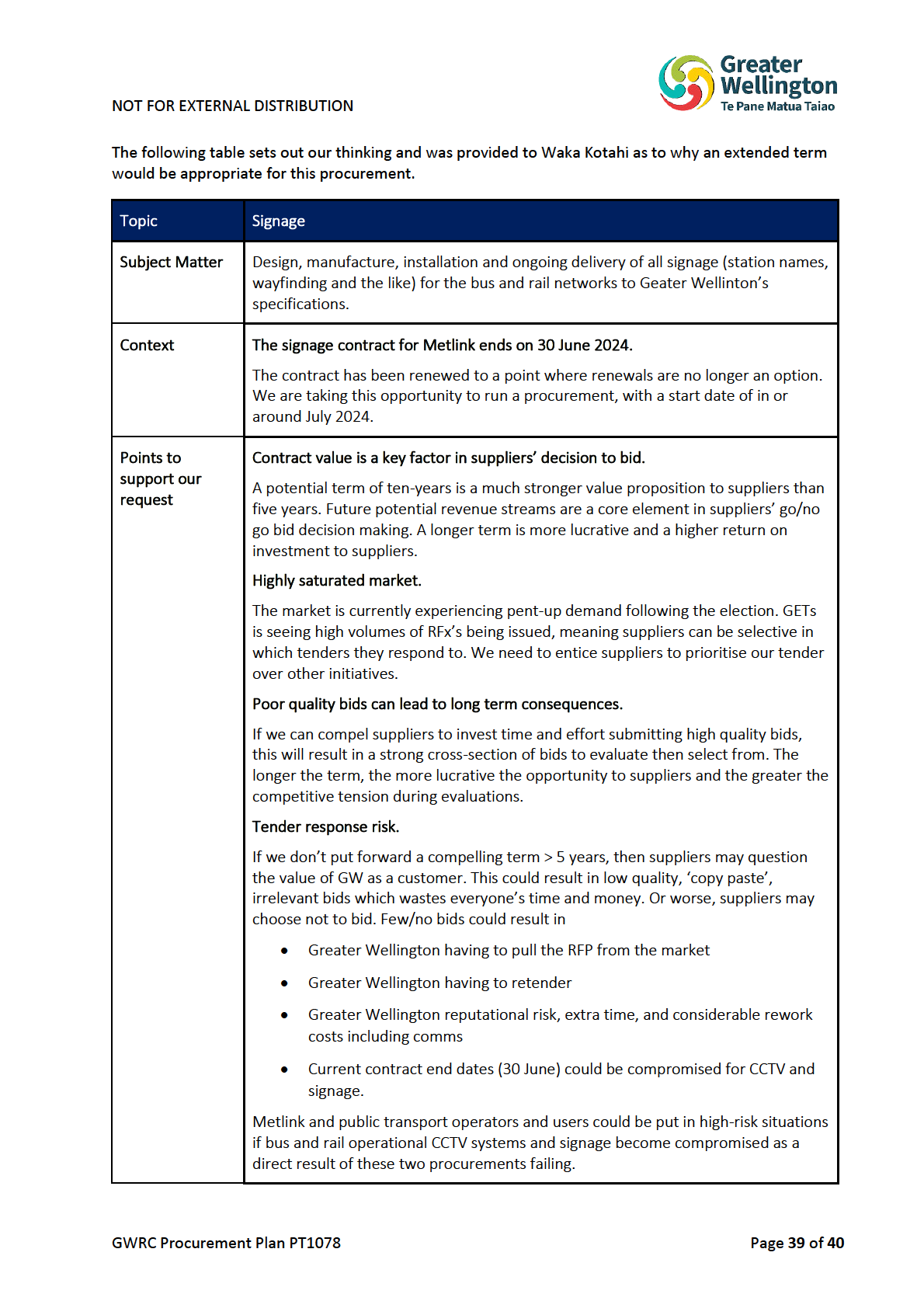
Transitions: Greater Wel ington and Waka Kotahi only need to spend funds on one
transition across 10 years rather than two transitions.
Market: Greater Wel ington are yet to ful y investigate the signage supplier market
but wil do so when we work up the Procurement Plan. But our current market
knowledge indicates there could be a range of possible respondents and the 10 year
contract cycle, if the RFP requirements are set appropriately (as discussed below)
wil not result in supplier lock in with a consequential reduction in available
suppliers over time (i.e. starving out unsuccessful suppliers).
• To be successful, suppliers wil need to demonstrate they can obtain the
necessary accreditations and permits. For example, to access the rail
corridor, traffic management consents and various health and safety
qualifications (e.g. for working at height).
• We wil cast the net sufficiently wide, to enable suppliers to respond who
have not worked on the rail corridor before.
• So long as they can clearly articulate their relevant capability and
experience obtaining similar permits, then we would evaluate these
according to our agreed tender process.
• Over the contract term, renewals are not a given. Rather, we wil use these
renewal periods as an opportunity to review current performance and
revisit the supply market so that we are making an informed decision
before proceeding.
Inventory in storage. A 5-year term means inventory transition from one supplier to
another needs to happen twice. Once at year 5 and again at year 10. This inventory
rationalisation process and standing up a new supplier does not seem like efficient
or effective use of GW and Waka Kotahi funds if the contract is going wel .
Inventory lifespan 5-7 years. If we adopt a 5-year term, the supplier wil not
complete a ful asset base renewal cycle. The extra 5 years wil enable the supplier
Signage ra�onale to establish a deep understanding across our network including access to complex
for extended term and diverse sites. More importantly, using the same supplier to complete asset
refreshes ensure material, cost, and process consistency.
The other way we are avoiding vendor lock in relates to how we wil frame our RFP
requirements. These wil be outcomes-focussed, not prescriptive. Greater
Wel ington are not wedded to the current manufacturing product brand. The final
output is what matters and Greater Wel ington wil be open to suppliers who can
deliver on our RFP outcomes so long as they are able to demonstrate how and why
their manufacturing product wil achieve our desired outcomes
GWRC Procurement Plan PT1078 Page
40 of
40
