Commercial in confidence
Contents
Reviews, Endorsements, and Approval ............................................................................. 4 Background and Context .................................................................................................. 5 Market analysis ................................................................................................................ 7
The supply market .................................................................................................................. 7
GWRC’s value as a customer .................................................................................................. 8
Desired supplier relationship ................................................................................................. 8
Consideration of Asset Transfer ............................................................................................. 8
Requirements and costs ................................................................................................... 9
Our requirements ................................................................................................................... 9
Key dates .............................................................................................................................. 10
Estimated revenue ............................................................................................................... 10
Future revenue generating opportunities ........................................................................... 10
Key stakeholders ............................................................................................................ 11
Internal stakeholders ........................................................................................................... 11
External stakeholders ........................................................................................................... 12
Communications .................................................................................................................. 12
Innovation ............................................................................................................................ 12
Tendering process .......................................................................................................... 13
Type of tender ...................................................................................................................... 13
Market engagement ............................................................................................................. 13
Evaluation team ................................................................................................................... 13
Proposed timeline ................................................................................................................ 14
Evaluation methodology ................................................................................................. 15
Evaluation method ............................................................................................................... 15
Evaluation approach............................................................................................................. 15
Due diligence ........................................................................................................................ 18
Contract type ................................................................................................................. 19
Transitioning to new supplier .............................................................................................. 19
Managing implementation ................................................................................................... 20
Risk management ........................................................................................................... 20 Probity management ...................................................................................................... 22 Contract delivery ............................................................................................................ 22 Contract completion ....................................................................................................... 22
End of term ........................................................................................................................... 22
Exit strategy ........................................................................................................................ 233
2
Left Blank intentionally
3
Background and Context
In 2018, Go Media Ltd (Go Media) were awarded an Advertising Services Contract to sell advertising across
Metlink’s Bus and Rail assets. The contract’s term is 3yr+1yr+1yr.
Greater Wellington Regional Council (GWRC) were satisfied with Go Media’s performance at the end of
the first contract term and extended the contract for both rights of renewal (to 30 June 2023). The
Women’s Footbal World Cup will be in Aotearoa New Zealand over the current expiry date, and the event
is a major revenue generator for GWRC, so the decision was made to extend the contract to 30 September
2023 to maximise this commercial opportunity for both GWRC and Go Media.
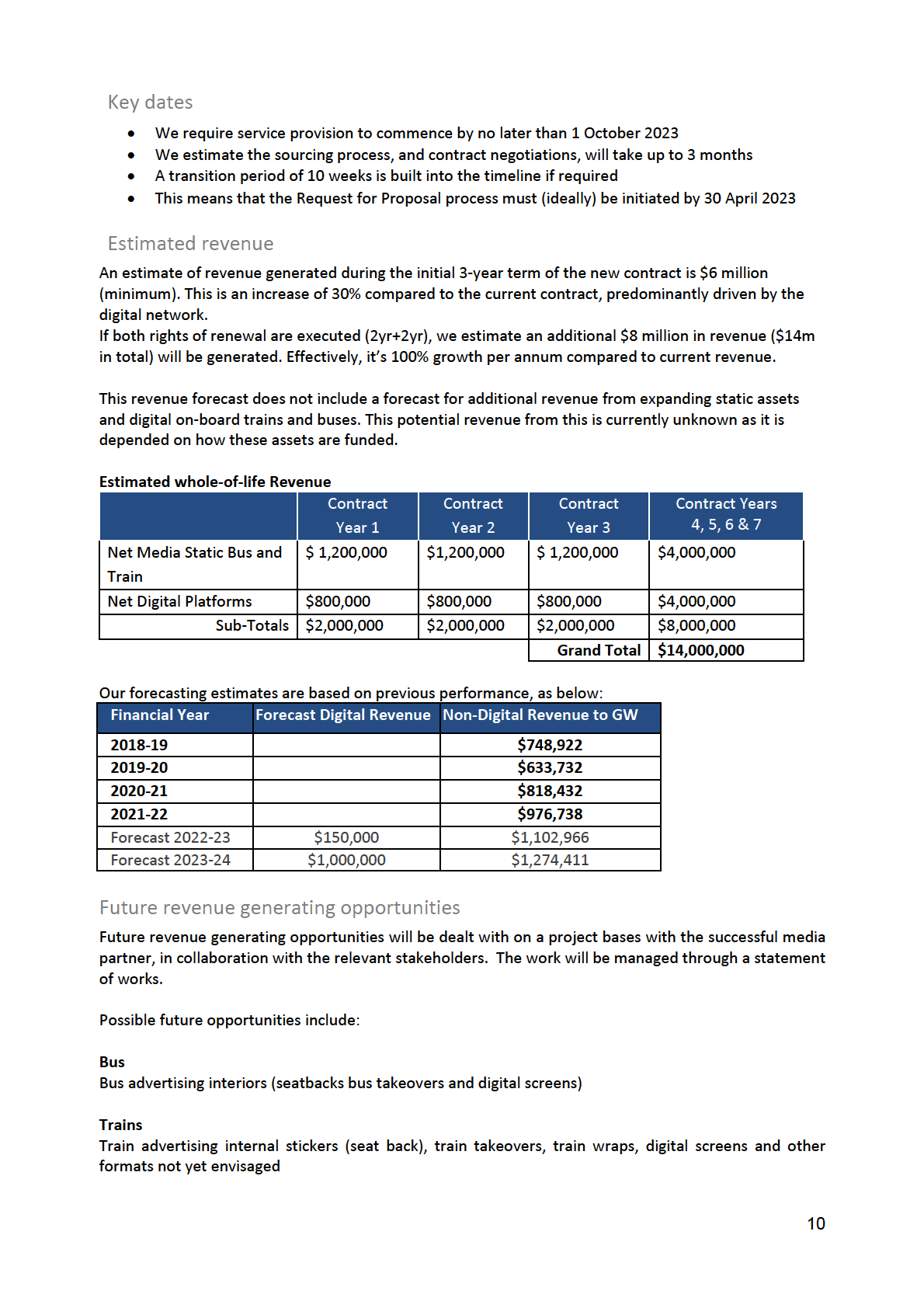
The revenue generated over the current contract period is forecast to exceed $4.2 million (ex GST). While
this is slightly lower than was anticipated when the contract was awarded, there are many mitigating
circumstances
• COVID 19 and lockdowns decimated the out of home advertising market
• New advertising policy which restricted some popular categories such as fast food
• Slower implementation and agreement of new formats (covering windows on buses)
• Train Bulkheads having to be removed for a period due to fire safety issues
GWRC is retendering the contract, and with new formats being made available will be seeking to double
this revenue to the region of $2 mil ion per annum. This procurement plan is to openly advertise the new
contract opportunity to select a supplier to access Greater Wellington Regional Councils public transport
assets and sell advertising on them. The legislation that allows this is covered under the Public Transport
Operating Model (PTOM) agreements.
PTOM
The Land Transport Management Act 2013 (LTMA) establishes a new framework for planning and
contracting public transport services, known as the PTOM.
GWRC transitioned to PTOM within a broader Public Transport Transformation Programme to provide
better value for money and a better customer experience.
Under PTOM, public transport services are grouped into ‘units’ of routes, and Operators have tendered
(and in certain circumstances, negotiated) to deliver all services within those units, instead of individual
routes. The Wellington region is made up of 18 bus units, 1 rail unit and 1 ferry unit.
Under the PTOM rail contract, GWRC is also permitted to display advertising at Station buildings and on
Platforms including Wellington Station Platforms (but excluding Wellington Station building), subject to
the relevant consents and on the Vehicles and other assets owned by Greater Wellington Rail Limited
(GWRL). The recent changes to the Wellington Network Agreement have incorporated the platforms at
Wellington Station in the outer station lease allowing GWRC to create a digital advertising network, this
right will not be unreasonably withheld by Kiwi Rail
There is currently no agreement in place to advertise on the ferry services which are contracted
differently to the bus and rail networks. There may be future opportunities for this, however this is
currently unknown. This wil not be included in the Request for Proposal suite.
GWRC, with its current advertising services partner for the past 4.8 years have successfully sold advertising
across the bus network and more recently the rail network in 83 trains.
The original contract was for bus backs only, and this has now expanded to include:
1) Bus Curb sides
2) Bus Traffic Sides
3) Full Wraps
5

4) Half wraps
5) Top half backs DD
6) Stair Traffic Sides DD
7) Gobstoppers (a complete full traffic side wrap)
In addition, there are bulkheads across the 83 Matangi Trains and a pilot with bulkhead advertising in 25
buses
What is important to us when choosing a supplier
Due to strategic alignment considerations, GWRC proposes to partner with a supplier for a 7-year term
(3yr+2yr+2yr). To this end, we want to partner with a supplier who:
• is innovative, proactive, collaborative, and able to develop new revenue opportunities
• has a demonstrated track record of providing similar services in both digital and static out-of-
home advertising
• has the capacity and capability to manage a delivery team
• will work transparently with GWRC and be able to provide clear financial reporting and
forecasting
• can demonstrate commitment to positive outcomes for Māori
• is a socially responsible organisation that is committed payment of the Living Wage in the
services provided to us
• is committed to driving positive environmental outcomes
• upholds guardianship of the GWRC advertising policy
Championing Broader Outcomes
Government procurement can and should be used to support wider social, economic, cultural, and
environmental outcomes that go beyond the immediate purchase of goods and services. GWRC
believes this contract opportunity can support achieving secondary socio-cultural, economic, and
environmental outcomes and have reflected Broader Outcomes in the proposed weighted criteria.
Importance of this service to GWRC
• Based on our analysis of supply positioning this procurement to GWRC is tactical acquisition:
• This means the procurement will generate revenue for GWRC that wil contribute to the running
of the PT Network and support other funding sources such as rates, however the revenue is
non-vital to GWRC.
• It is worthy to note that this contract is important as it enables customer communication
channels for both Metlink and the other GW departments. To this end, it is a requirement of the
contract that up to 10% of the bus fleet, and 1 in 8 of the digital slots, are made available to
GWRC for communications.
• Strategies to address and maximise revenue generation are
o contracting a minimum annual guarantee
o Making assets available for the media service provider to sell advertising on
6
o The media partner will work with Metlink PTOM operators and strategic partners to
make assets accessible
o Monthly Reporting
o Joint planning
Market analysis
The supply market
• The key suppliers are Go Media (GWRC current supplier), Media Works (AT and ECAN), J C
Decaux Digital Billboards, and ooH Media Street Furniture.
• Go Media and Media Works dominate the bus advertising market in New Zealand.
- Media Works have contracts with ECAN, and AT
- Go Media have contacts with Greater Wellington, and many of other regional councils such as
Horizon, Waikato, Tasman District Council.
• The key buyers and their influence on the market (demand) are
o For bus, regional councils are the main buyer,
o Digital Out of Home (e.g. digital screens) is dispersed between many landlords including
Transport Authorities and district councils, Kiwi Rail, Waka Kotahi, and many private
landlords. For example, in Wellington the street furniture contract which includes bus
shelters is managed by Wellington City Council. The total out of home market (static
and digital) is much bigger than Transport out of home advertising. The total revenue of
out of home advertising in New Zealand per year is estimated at $132 million.
• Competition is primarily based on product types, range and visibility, ie the number of people
viewing the advert and the number of times. The contract opportunity will likely be seen as
desirable by suppliers which will provide competitive tension.
• This is a mature competitive market (advertising services on public transport assets), however
the bus market is limited to the available assets (the primary markets are in Christchurch,
Auckland and Wel ington).
• New digital assets are emerging such as the digital rail network in Auckland and the one being
developed in Wel ington by GWRC. The Digital market is expanding quickly as it is more flexible,
can be changed more quickly and production costs are much lower.
• Existing pricing methodologies are revenue share and fixed priced.
Factors affecting pricing include:
o Out of Home Revenue share of the whole advertising market
o The Metlink assets available to advertise on
o The audience data that is made available to advertisers
o The production cost of installation and the flexibility of digital formats
o Patronage across the public transport network
o The type of advert – how do customers interact with the advert (dwell time)
o The number of times a customer sees and advert in a day.
• The availability of alternative or substitute goods/services is limited for bus and train, but there
is a large offering of out of home media services in the Greater Wellington Region, these
comprise of digital out of home street furniture, digital billboards, and traditional billboards.
• In summary, current market behaviours are moving towards digital and away from static
formats and these impacts on buyers by making their advertising choices more flexible and
cheaper. Therefore, the static on-bus advertising market needs to become more progressive in
how it sells to customers, incorporating new strategies that include cal to actions where the
advertisers take advantage of the dwell time, i.e. the time the prospective customer is in front
of the advert.
• Future market behaviours that would better support successful delivery are expanding the
digital formats available for example digital screens in buses and trains, advertising in Metlink
7
Apps, Websites, and a relationship between Wellington City Council and their street furniture
contract.
• The gaps between current and future behaviours are limited to available assets. Strategies to
close these gaps are working with the Metlink Assets and Customer services team and a future
media services partner to expand the digital network.
• The likely impacts that this procurement could have on the market is low to medium due to the
dominant market duopoly. The Wellington out of home market is an important segment of the
New Zealand out-of-home Market and as such will be important (and strategic) to the supplier
who wins the contract.
GWRC’s value as a customer
• The value of the GWRC’s account and the attractiveness of the account have been assessed.
• We are likely seen as a development opportunity.
• This means there is a real opportunity for the successful supplier to grow their business in both
the Greater Wellington Region and Aotearoa New Zealand.
• Strategies to address this include work collaboratively with the supplier to maximise
opportunities for both parties (creating win-win).
Desired supplier relationship
• GWRC will seek a strategic collaborative relationship with the supplier due to:
o the proposed length of the contract (7 year term – 3yr+2yr+2yr),
o the high level of desired trust and communication with the supplier, and
o the shared approach to managing risk.
• This means at the GWRC will work in partnership to grow the revenue generated from
advertising across the assets and hold an annual strategy hui to develop a strategic roadmap
(which will be reviewed quarterly). The desired outcome wil be to maximise revenues though
the contract for GWRC and the supplier.
• It is important there is a high trust relationship between the parties, in particular the upholding
and process involved in maintaining GWRC’s advertising policy.
Consideration of Asset Transfer
To generate new incremental revenue streams, the current supplier is in the process of rolling out a
digital kiosk network across nine of the regions train stations. This network including establishment
costs has an asset value of $1.331 million exc GST. The asset transfer has been captured in the current
contract under Clause 13. To this end, this procurement plan includes how the asset transfer has been
considered within this upcoming procurement process:
1)
GWRC purchase the assets from the current advertising services provider
Contractually the incoming provider would be required to maintain and manage the assets. The
rate card submitted for the digital network from prospective suppliers would not need to allow
for repayment of this assets and GWRC would expect a higher percentage of the revenue
generated.
2)
The prospective advertising services suppliers agree to transfer the assets
Asset transfer would be at the full establishment cost, and the cost is accounted for in their rate
card.
3)
Alternative asset transfer proposals accepted
The advertising services providers would be invited to propose an alternative option for asset
transfer, articulating why they believe it is the best option for GWRC to pursue.
8
We have determined that option 2 wil provide best outcomes for this procurement. It wil be enacted in
the process through a pre-condition within the RFP response form and recognised within the contract.
This has been discussed with our probity advisor, procurement team, and internal Legal Counsel, and
they are comfortable with this approach.
A primary consideration that underpins GWRC’s recommended option is:
What ‘normal’ best practice in the market is: the assets are usually transferred to the incoming
advertising services provider.
An example to illustrate this ‘normal’ market behaviour is the jumbo screen at Nelson airport that was
installed by Go Media and is depreciated over 10 years. If the contract passes to another provider, the
screen must be transferred at its depreciated value.
Requirements and costs
Our requirements
GWRC wants to partner with an Advertising Services supplier who will:
• manage the entire process of advertising across all available public transport assets in line with
Metlink’s advertising policy. This includes (but not limited to) sales, installation and production
costs, revenue col ection, payment, and distribution.
This will involve managing the relationship between al key stakeholders including but not
limited to operators, Inc kiwi rail, production companies, installation companies, advertising
agencies and direct customers.
• be a single point of contact to manage the above process. GWRC also acknowledges that no one
organisation may be able to deliver all aspects and therefore wil need to sub contact some
work.
• provide accurate annual forecasting and monthly reporting on all activities to GWRC.
• commit to a minimum annual guarantee (and payment mechanism to enable the minimum
guarantee to be met).
• will proactively develop new advertising streams throughout the term of the contract in
collaboration with GWRC.
• be the guardian of the Metlink advertising policy. They will need to ensure all advertising across
all assets is in-line with that policy, other relevant policies that may be added from time to time,
and other relevant industry practice guidelines such as the Advertising Standards Authority
(ASA).
Please Note GWRC retains the right to veto on all advertising.
• champion broader outcomes for Māori, the natural environment, and support the living wage.
The current available assets are
o 450+ Buses - External Decal
o 25 - buses internal bulkheads
o 83 -Trains internal bulkheads
o 49 -Digital Kiosk Commuter Network faces across 9 stations.
There is scope for advertising across additional assets such as Station Buildings, Interiors of trains and
buses, the interchanges. If the opportunity arises, they will be managed through statement of works and
run as individual projects. It is expected that the successful partner will be proactive in identifying these
opportunities and work with the Commercial and Investment team in Metlink to grow revenues through
the contract.
9


 Tendering process
Type of tender
The recommended approach to market is a one-stage open competitive Request for Proposal.
The reason for this recommendation is due to:
1) the supply market being mature, stable, and having more than one supplier operating in it,
2) GWRC would like to see if there are new/innovative ways of delivering the services,
3) GWRC would like to see potential solutions/services from new market entrants, and
4) GWRC desires competitive proposals to maximise best outcomes for the process, and achieve
greatest public value for money:
There is no All-of-Government, syndicated or other collaborative contract which can meet our
requirements. Other approaches to market, including collaboration, were considered but determined as
not suitable.
This approach to market fits with GWRC’s procurement policy, and the Government Procurement Rules,
Charter, and Principles. As this activity is not funded by Waka Kotahi, this process does not need to
follow Waka Kotahi Procurement Rules, this was confirmed via email by Philip Walker of Waka Kotahi -
Waka Kotahi on 27/3/2023.
Market engagement
The dominant suppliers in the market are Go Media and Media Works. They are both aware that this
contract is approaching renewal.
The contract opportunity will be advertised on GETS (and through social media channels if determined
necessary). Before advertising on GETS, GWRC will engage with the market through publishing an early
notice on GETS advising of the intention to go to market.
Evaluation team
13


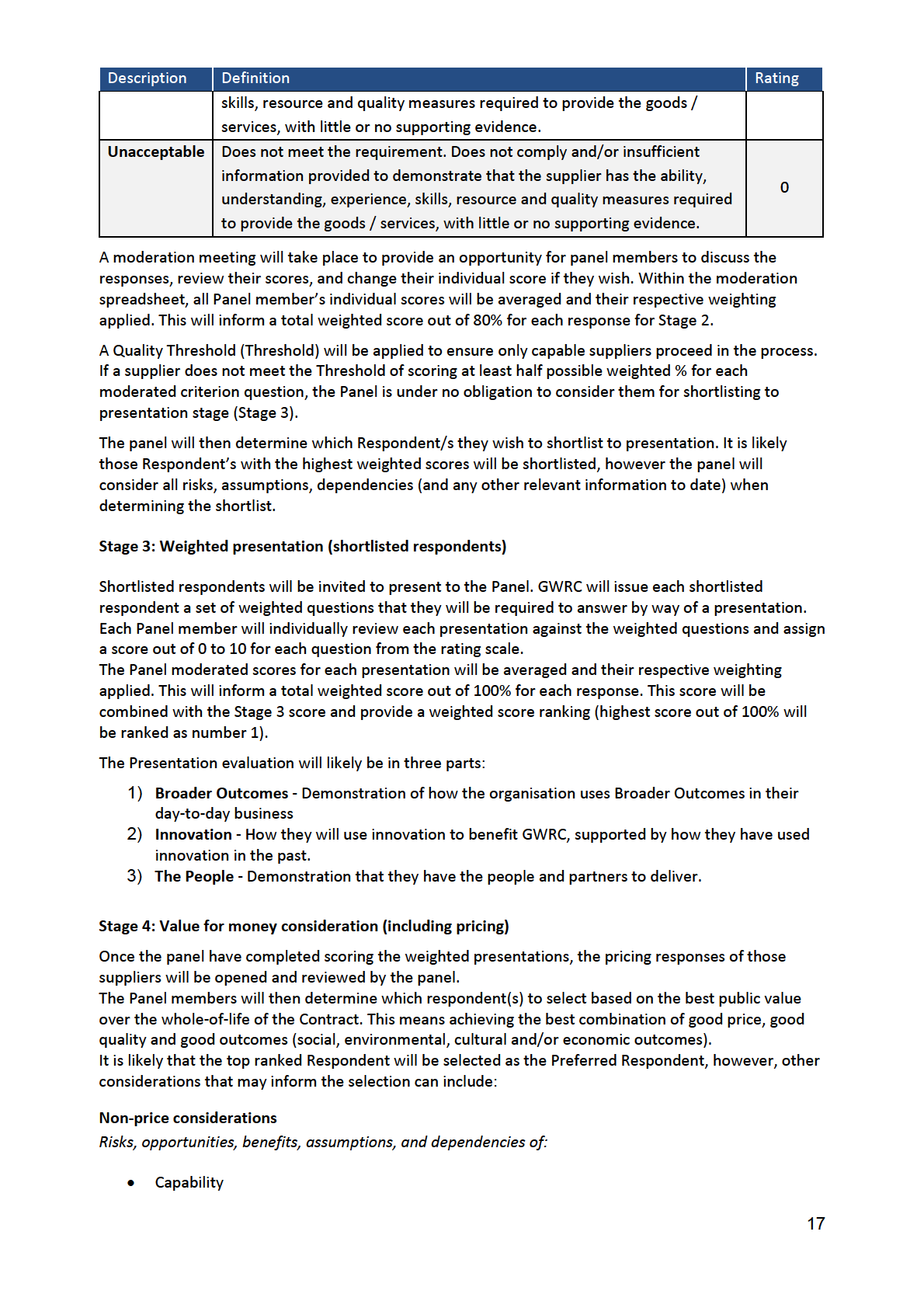
• Capacity
• Approach/methodology
• Contribution to Broader Outcomes
• Degree of innovation
• Supplier presentations
• Supplier response to clarifications
• Willingness to collaborate and co-operate, such as ease of contracting
• Health and safety
• Training and development opportunities
• Any due diligence completed to date
• Size, structure and type of organisation, number of employees, annual turnover
• Wider considerations - eg government strategic landscape, GWRC strategic landscape, supply
market, economy, industry or quality awards, relevant licences and accreditations etc
Price considerations Risks, opportunities, benefits, assumptions, and dependencies of:
• Whole of life revenue (Gross Media/Production) - does it align with our expectations Is it
realistic or unrealistic (based on size/turnover/client base etc)
• Revenue share % (nett) – does it align with our expectations. Is it realistic or unrealistic (based
on size/turnover/client base etc)
• Annual guarantee (digital/bus/train) - does it align with our expectations. Is it realistic or
unrealistic (based on size/turnover/client base etc)
• Annual growth – does it align with our expectations. Is it realistic or unrealistic (based on
size/turnover/client base etc)
• Completeness of pricing (to enable an informed decision to be made)
• Appropriateness of pricing (relevant to supply market)
• Commercial components – eg additional services/optional extras
• Expected costs - does the pricing include al expected costs (one-off’s, ongoing). Could there be
hidden costs. Do we know what costs are fixed, and variable
As well as a Preferred Respondent, there may also be a second/third/forth etc Preferred Respondent
who could be approached if negotiation with the Preferred Respondent fail. No Preferred Respondent
may also be the recommendation.
Due diligence
Due diligence may be conducted at any time during a procurement process if GWRC believes there is
just cause. For example, if it comes to our attention that a supplier may be breaching worker rights at
any time during a procurement process, we have an obligation to undertake due diligence to ascertain
the truth of the claim.
For this procurement process, due diligence will likely consist of the following as a minimum:
1) Reference checks of supplier
2) Refence checks of any third-party organisations a supplier includes in their response
3) Companies Office check
4) Financial viability assessment of 3 years of audited accounts (or agreed substitute)
18
GWRC may wish to undertake any (or all) of the additional following due diligence activities with any
supplier/proposed sub-contractor:
1) Interviews
2) Presentations
3) Site visits
4) Health and Safety checks
5) Third party opinion
Findings from any and all due diligence conducted prior to supplier recommendation will be considered
as part of the overall public value for money proposition of each response.
If any supplier ‘fails’ any aspect of due diligence, GWRC (likely the evaluation panel with support from
Procurement) will determine whether the ‘fail’ is a risk that is manageable or unmanageable (and
therefore acceptable, or not).
Contract type
• The short-listed supplier will be offered a contract for services based on a bespoke set of terms
and conditions drafted for this procurement.
• The proposed contract term is three years with options to extend (i.e. 3+2+2).
• As at commencement date (and subject to negotiation), the quality standards / key
performance indicators for measuring the supplier’s performance are
o Adherence to the agencies advertising policy
o Financial targets are achieved
o Health and Safety Incidents
o The management off and timely removal of expired advertising
• The timeframes for delivery are Services commence 1 October 2023
• Specific reporting requirement
o Operational and financial reports are Monthly
o Strategy meetings quarterly
o Forecasting Annual July 1st.
• GWRC’s Invoice to the supplier wil be based on the supplier’s reporting, and reporting
expectations as detailed in the contract.
• New intellectual property arising as a result of the contract will be the property of GWRC
• The proposed contract terms and conditions are in final draft with GWRC Legal Team
• Variations to contract will be in writing and signed by both parties. Variations involving an
increase in price must only be made within the limit of the financial authority.
• To exit the contract, the supplier will need to write to GWRC at least 5 months prior to the
expiry of a Term.
Transitioning to new supplier
• In the event that this procurement results in the selection of a new supplier a transition plan will
be developed to actively manage the changeover. Transition arrangements will also be
addressed during the negotiations with the new supplier. The current contract has been
extended by 3 months so that the current supplier can sel advertising during the women's FIFA
world cup.
• The transition will likely have a minor impact on ongoing service delivery.
• Significant transition risks to be managed include:
o Transfer of digital assets and technology so that sales of digital adverting can continue
without loss of business
o Inductions of staff to access bus and train depots
19
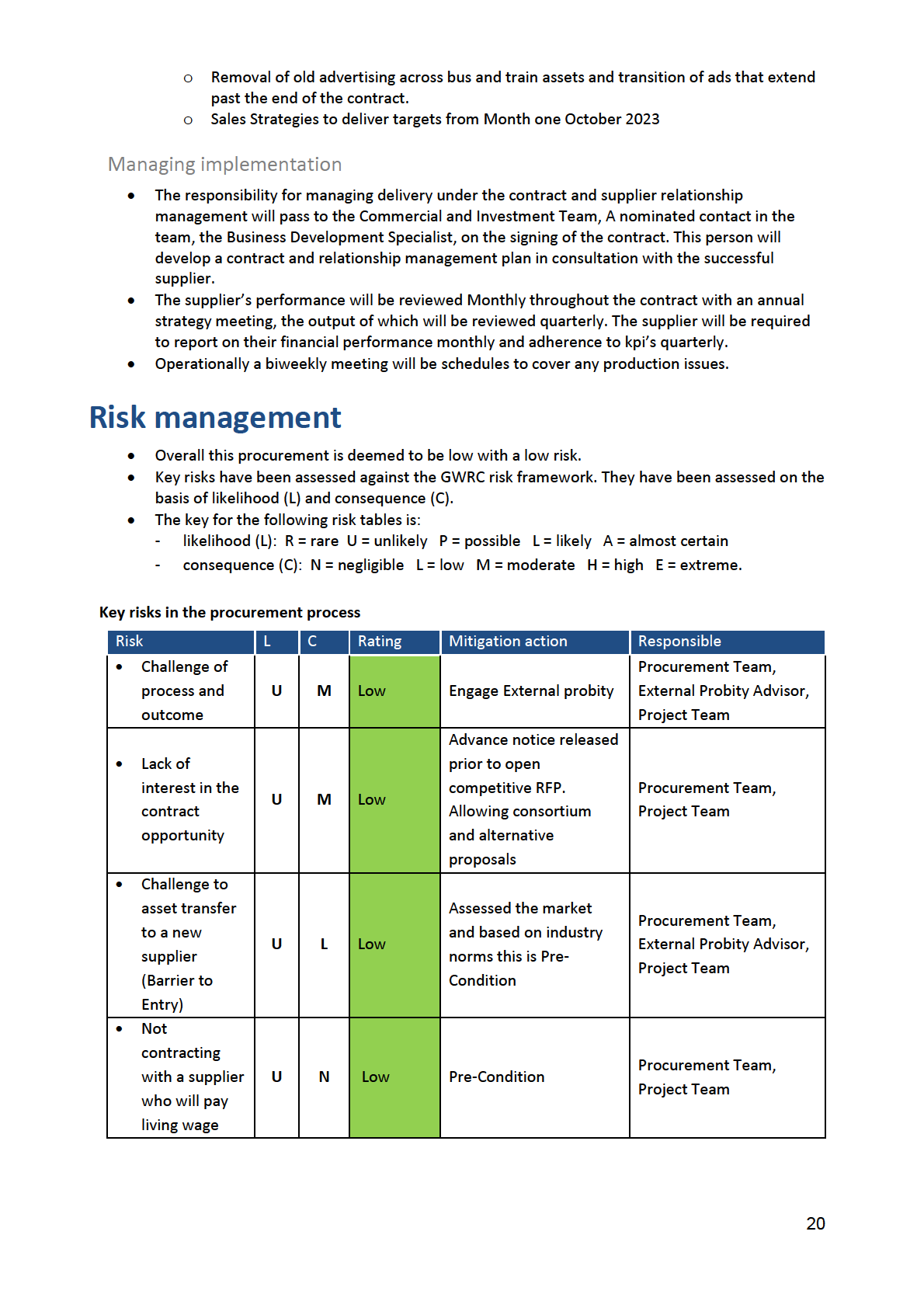

advertising services
partner to minimise the
loss of revenue
Probity management
The day-to-day management of probity for this process will be managed by the GWRC Procurement
Team.
An external probity advisor (Jonathan Kaye Law) will provide ad hoc/specialist probity advice when
required.
For the defensibility of procurement processes, it is essential that GWRC demonstrates ethics and
integrity in all procurement activities. This means:
• acting fairly, impartially, and with integrity
• being accountable and transparent
• being trustworthy and acting lawfully
• managing conflicts of interest
• protecting the supplier’s commercially sensitive and confidential information.
Management of probity in this process will include:
• ensuring compliance with GWRC’s code of conduct
• ensuring that financial authority for the procurement is approved before proceeding to tender
• ensuring everyone involved in the process signs a confidentiality agreement and declares any
actual, potential or perceived conflict of interest
• identifying and effectively managing all conflicts of interest
• ensuring that all responses are opened at the same time and witnessed
• numbering copies of suppliers’ tenders and returning them to the panel chair once the tender
process ends (if appropriate)
• destroying physical copies of supplier responses once the procurement process ends
• treating all suppliers equally and fairly
• providing each supplier with a comprehensive debrief at the end of the procurement process.
Contract delivery
On the signing of the contract, the responsibility for managing its delivery, and supplier relationship
management, will pass to the Business Development Specialist in the Commercial Strategy and
Investment Team. This person will develop a contract and relationship management plan in consultation
with the successful supplier. If required a transition plan from the current supplier to the new supplier
will be drafted in consultation with all stakeholders.
Contract completion
End of term
At the end of the original contract, there wil be an option to extend the contract by 2+2 years subject to
good performance by the supplier and continued best public value-for-money over the whole-of-life
being delivered. At the end of the term GWRC will likely run a new competitive procurement process.
22
Exit strategy
Our strategy to exit from the contract is to run a new RFP at either 3, 5 or 7 years depending on the
performance of the supplier. If the supplier is consistently not delivering the required revenue or
meeting the specified KPI’s. The RFP would be based on lessons learnt from the exiting contract and
contract management. The new contract award would include a transition plan to the new supplier if
required. This is required to minimize the impact on revenue generation through the sales of
advertising.
Document Ends
23
