

Document 1
Piers Bebbington
9(2)(a)
Tēnā koe Piers
1982
Notice of appointment as a member of the Board of Education New Zealand I am pleased to inform you that I have appointed you as a member of the Board of Education
Act
New Zealand (the Board). I have set out the terms of your appointment below and wil shortly
publish a notice in the
New Zealand Gazette confirming your appointment.
Term
I have appointed you to a three-year term beginning from the date you receive this letter.
Roles and duties
I understand that officials have previously supplied you with a position description which
Information
explains the role and duties of an ENZ Board member. You may also wish to familiarise
yourself with sections 49-61, and 62-68 of the Crown Entities Act 2004. These sections set
out the collective and individual duties of Crown entity boards and their members, including
the disclosure of interests. For further information on the functions and governance
arrangements for Education New Zealand please refer to s511 of the Education and Training
Act 2020. You can find this and other legislation at www.legislation.govt.nz.
Official
Conflicts of interest
the
You have declared your interests as a Tourism New Zealand Board member, and as General
Manager Customer Digital with the Bendon Group. I consider that any conflict(s) arising from
these interests can be successfully managed. You wil need to declare these interests to the
Chair and in line with the Board’s operating procedures, and to abide by all agreed approaches
for mitigating these conflicts. This may include stepping out of discussions and voting as
under
required. I also expect you to declare and document any new conflicts (actual, potential or
perceived) as they arise, and to agree and document suitable mitigations.
Fees
You wil be paid $16,800 per annum (GST not applicable), based on an assumed 30 days’
commitment per annum.1 This is in accordance with Cabinet Office Circular CO (25) 2
Cabinet
Fees Framework for members appointed to bodies in which the Crown has an interest. I am
considering the results of a review of fees, and all members wil be advised of any changes
Released
1 A payment of fees to a member is not subject to GST. However, if a person is carrying on a taxable
activity, such as a consulting company, and accepts office as part of their taxable activity, any service
supplied by that person as holder of that office is deemed to be supplied in the course or furtherance
of that taxable activity. Accordingly, the member must return GST on fees they charge for services as
a director.
once I have completed my consideration of the review findings. Further information on fees is
provided in the attached Fees Advice Sheet.
If you become a public sector employee during your term
Appointments of public servants and public sector employees to Crown boards should only be
made in exceptional circumstances where it is clear the Board wil directly benefit, following
an open process to seek candidates from the private and community sectors. This means that
if you are considering employment in the public sector, it may have implications for continuing
on the Board. Please contact the Director, Monitoring and Appointments at the Ministry of
Education for advice. Her contact details are provided below. If you are continuing on the
Board, you wil also need to advise the Board’s secretariat and discuss whether you wil remain
eligible to receive fees. Further information is provided in the enclosed Fees Advice Sheet.
1982
Other expenses
Al Board members are entitled to be paid out of Education New Zealand funds, reasonable
Act
and actual allowances for travel ing and other expenses relating to the performance of their
duties and responsibilities as board members. Education New Zealand wil administer the
payment of any such expenses during your time on the Board.
Ethical conduct
The Public Service Commission’s (PSC) Code of Conduct for Crown Entity Board Members
applies to the Board of Education New Zealand. Al members of the Board must be aware of
the importance of acting ethically and with personal integrity, conducting themselves
professionally, using information properly and being politically impartial. They must also
Information
maintain the interest and enthusiasm needed to contribute effectively to the performance of
the Board throughout their term.
Public Service principles
The Board is responsible for ensuring that Education New Zealand upholds the Public Service
principles when carrying out its functions (see the PSC’s related Guidance). The principles
Official
comprise political neutrality, providing free and frank advice, making merit-based
appointments and fostering a culture of open government and stewardship.
the
Confidentiality and public comment
As a board member, you wil receive confidential information and be a party to confidential
discussions. You wil be responsible for taking all reasonable steps to maintain the security of
the information provided to you and maintaining confidentiality.
under
Resignation and removal from office
Education New Zealand is a Crown agent, and the Crown Entities Act 2004 provides that the
responsible Minister may remove a member of a Crown agent board at any time, at the
Minister’s discretion. Removal of a member is by written notice to the person. You may at any
time, resign by advising the responsible Minister in writing.
Released
More information
The PSC’s Crown Entity Resource Centre provides relevant guidance and standards for board
members. There is also a resource about the all of government requirements and legal
expectations for Crown entities.
2

If you have any questions or concerns about your appointment, please contact Jennifer
Heersping, Director – Monitoring and Appointments, at the Ministry of Education. Her phone
number is 04 463 7734, or you can email her at [email address].
I hope you wil enjoy your time on the Board.
Nāku noa, nā
Hon Erica Stanford
1982
Minister of Education CC
Tony Gray, Chair of Education New Zealand
Act
CC
Dr Linda Sissons, Acting Chief Executive, Education New Zealand
CC
Jennifer Heersping, Director Monitoring and Appointments, Ministry of Education
Enclosed: Fees Advice Sheet
Information
Official
the
under
Released
3
Fees Advice Sheet
Cabinet has confirmed that under the Cabinet Fees Framework CO (25) 2 (CFF) any public
sector employee who is appointed
in their own right to a board or advisory group, cannot
claim both the fee and their ordinary pay if they work on their board or advisory group duties
during ordinary working hours (CFF Section C, 74-78).
Questions and Answers
Q.1 Does this apply to me?
Yes, if you are, or become, an employee of any of
these organisations:
• A department, ministry or Crown entity (including schools);
1982
• An agency in the wider public sector, a tertiary education institution or wānanga;
• A statutory entity in a Ministerial portfolio, e.g., Teaching Council of Aotearoa New
Act
Zealand; or
• Any local authority as defined in section 5(1) of the Local Government Act 2002.
Q 2. In what circumstances could I receive fees if I am employed in one of the above
entities?
Consider these four scenarios to see which applies best to your situation. If none apply, you
would not be able to claim board/advisory group fees.
Scenario 1: You agree with your employer that you wil take annual or special unpaid leave
to do the board/advisory group work. You can be paid the daily fee personally because you
Information
do the role outside of your ordinary working hours as secondary employment. If this might
apply to you, please discuss this
as early as possible with the Board secretariat.
Scenario 2. Where the board/advisory group work is undertaken by a teacher or teaching-
principal in ordinary working hours, they can be offered, or can ask for, ‘Teacher Release
days’ to be paid to their school. This recompenses the school for having less of the
Official
teacher/teaching-principal’s time and funds relievers. If this might apply to you, please
discuss this
as early as possible with the Board secretariat.
Scenario 3. For non-teaching principals, your school may be able to receive your fees and
the
add them to school funds to recognise the provision of your expertise. If this might apply to
you, please discuss this
as early as possible with the Board secretariat.
Scenario 4. If you are working as a full-time academic, you may be eligible to be paid fees
as secondary employment. This depends on your contract conditions, and you wil need to
under
discuss this with your employer. Once you have clarification, please discuss this
as early as
possible with the Board secretariat. Part-time academics should confirm to the Board
secretariat that they wil undertake board/advisory group work outside of their ordinary
working hours.
Q 3. Are any other payments allowed? (applies to any board/advisory group member)
Travel
Fee payment for
time spent travel ing to and from board/advisory meetings is only claimable
Released
if you are receiving a daily fee
and travelling longer than 3 hours in a normal business day
and if the relevant agency agrees to pay a pro-rata fee (CFF Section C, 83-85). The direct
travel expenses you incur are reimbursed by the relevant agency as stated in your letter of
appointment.
Additional work or responsibilities
For those paid annual fees, Ministerial approval is needed for payments regarding extra
responsibilities. Cabinet approval may be required if payment is deemed significant enough
(CFF Section C, 131-148).
4


Document 2
Dr Thérèse Arseneau
9(2)(a)
Tēnā koe Thérèse
1982
Reappointment to the Board of Education New Zealand and elevation to Deputy Chair I am pleased to inform you that I have reappointed you as a member of the Board of Education
Act
New Zealand (the Board) and have elevated you to Deputy Chair. I have set out the terms of
your reappointment below and wil shortly publish a notice in the
New Zealand Gazette confirming your reappointment and elevation to Deputy Chair.
Term
Your reappointment to the role of Deputy Chair, is for a three-year term beginning from the
date you receive this letter.
Information
Roles and duties
A position profile for Deputy Chair is enclosed with this letter. You may also wish to
refamiliarise yourself with sections 49-61, and 62-68 of the Crown Entities Act 2004. These
sections set out the collective and individual duties of Crown entity boards and their members,
including the disclosure of interests. For further information on the functions and governance
arrangements for Education New Zealand please refer to s511 of the Education and Training
Official
Act 2020. You can find this and other legislation at www.legislation.govt.nz.
Conflicts of interest
the
You have declared your interest as an adjunct senior fellow at the University of Canterbury,
as independent chair for Lane Neave Lawyers, and as a board member for House of Travel
Holdings Limited. I consider that any conflict(s) arising from these interests can be
successfully managed. You wil need to continue to declare these interests to the Chair and
under
in line with the Board’s operating procedures, and to abide by all agreed approaches for
mitigating these conflicts. This may include stepping out of discussions and voting as required.
I also expect you to declare any new conflicts (actual, potential or perceived) as they arise,
and to agree and document suitable mitigation strategies.
Fees
You wil be paid $21,000 per annum (GST not applicable), based on an assumed 30 days’
commitment per annum.1 This is in accordance with Cabinet Office Circular CO (25) 2:
Cabinet
Released
Fees Framework for members appointed to bodies in which the Crown has an interest. I am
1 A payment of fees to a member is not subject to GST. However, if a person is carrying on a taxable
activity, such as a consulting company, and accepts office as part of their taxable activity, any service
supplied by that person as holder of that office is deemed to be supplied in the course or furtherance
of that taxable activity. Accordingly, the member must return GST on fees they charge for services as
a director.
currently considering the results of a review of fees, and all members wil be advised of any
changes once I have completed my consideration of the review findings. Further information
on fees is provided in the attached Fees Advice Sheet.
If you become a public sector employee during your term
Appointments of public servants and public sector employees to Crown boards should only be
made in exceptional circumstances where it is clear the Board wil directly benefit, following
an open process to seek candidates from the private and community sectors. This means that
if you are considering employment in the public sector, it may have implications for continuing
on the Board. Please contact the Director, Monitoring and Appointments at the Ministry of
Education for advice. Her contact details are provided below. If you are continuing the Board,
you wil also need to advise the Board’s secretariat and discuss whether you wil remain
eligible to receive fees. Further information is provided in the enclosed Fees Advice Sheet.
1982
Other expenses
Act
Al Board members are entitled to be paid out of Education New Zealand funds, reasonable
and actual allowances for travel ing and other expenses relating to the performance of their
duties and responsibilities as board members. Education New Zealand wil administer the
payment of any such expenses during your time on the Board.
Ethical conduct
The Public Service Commission’s (PSC) Code of Conduct for Crown Entity Board Members
applies to the Board of Education New Zealand. Al members of the Board must be aware of
the importance of acting ethically and with personal integrity, conducting themselves
Information
professionally, using information properly and being politically impartial. They must also
maintain the interest and enthusiasm needed to contribute effectively to the performance of
the Board throughout their term.
Public Service principles
The Board is responsible for ensuring that Education New Zealand upholds the Public Service
Official
principles when carrying out its functions (see the PSC’s related Guidance). The principles
comprise political neutrality, providing free and frank advice, making merit-based
appointments and fostering a culture of open government and stewardship.
the
Confidentiality and public comment
As a member of the Board, you wil receive confidential information and be a party to
confidential discussions. You wil be responsible for taking all reasonable steps to maintain
under
the security of the information provided to you and maintaining confidentiality.
Resignation and removal from office
Education New Zealand is a Crown agent, and the Crown Entities Act 2004 provides that the
responsible Minister may remove a Chair from the Board of a Crown agent at any time, after
consultation with the person, at the Minister’s discretion. Removal of a member is by written
notice to the person and the Board. You may at any time, resign by advising the responsible
Minister in writing. You may also resign from the office of Deputy Chair but remain a member.
Released
More information
The PSC’s Crown Entity Resource Centre provides relevant guidance and standards for board
members. There is also a resource about the all of government requirements and legal
expectations for Crown entities.
If you have any questions or concerns about your reappointment, please contact Jennifer
Heersping, Director – Monitoring and Appointments, at the Ministry of Education. Her phone
number is 04 463 7734, or you can email her at [email address].
2

I hope you wil enjoy continuing to serve on the Board in your new role as Deputy Chair.
Nāku noa, nā
Hon Erica Stanford
Minister of Education CC
Tony Gray, Chair, Education New Zealand
CC
Dr Linda Sissons, Acting Chief Executive, Education New Zealand
1982
CC
Jennifer Heersping, Director Monitoring and Appointments, Ministry of Education
Enclosed: Fees Advice Sheet and Deputy Chair position profile
Act
Information
Official
the
under
Released
3
Fees Advice Sheet
Cabinet has confirmed that under the Cabinet Fees Framework CO (25) 2 (CFF) any public
sector employee who is appointed
in their own right to a board or advisory group, cannot
claim both the fee and their ordinary pay if they work on their board or advisory group duties
during ordinary working hours (CFF Section C, 74-78).
Questions and Answers
Q.1 Does this apply to me?
Yes, if you are, or become, an employee of any of
these organisations:
• A department, ministry or Crown entity (including schools);
1982
• An agency in the wider public sector, a tertiary education institution or wānanga;
• A statutory entity in a Ministerial portfolio, e.g., Teaching Council of Aotearoa New
Act
Zealand; or
• Any local authority as defined in section 5(1) of the Local Government Act 2002.
Q 2. In what circumstances could I receive fees if I am employed in one of the above
entities?
Consider these four scenarios to see which applies best to your situation. If none apply, you
would not be able to claim board/advisory group fees.
Scenario 1: You agree with your employer that you wil take annual or special unpaid leave
to do the board/advisory group work. You can be paid the daily fee personally because you
Information
do the role outside of your ordinary working hours as secondary employment. If this might
apply to you, please discuss this
as early as possible with the Board secretariat.
Scenario 2. Where the board/advisory group work is undertaken by a teacher or teaching-
principal in ordinary working hours, they can be offered, or can ask for, ‘Teacher Release
days’ to be paid to their school. This recompenses the school for having less of the
Official
teacher/teaching-principal’s time and funds relievers. If this might apply to you, please
discuss this
as early as possible with the Board secretariat.
Scenario 3. For non-teaching principals, your school may be able to receive your fees and
the
add them to school funds to recognise the provision of your expertise. If this might apply to
you, please discuss this
as early as possible with the Board secretariat.
Scenario 4. If you are working as a full-time academic, you may be eligible to be paid fees
as secondary employment. This depends on your contract conditions, and you wil need to
under
discuss this with your employer. Once you have clarification, please discuss this
as early as
possible with the Board secretariat. Part-time academics should confirm to the Board
secretariat that they wil undertake board/advisory group work outside of their ordinary
working hours.
Q 3. Are any other payments allowed? (applies to any board/advisory group member)
Travel
Fee payment for
time spent travel ing to and from board/advisory meetings is only claimable
Released
if you are receiving a daily fee
and travelling longer than 3 hours in a normal business day
and if the relevant agency agrees to pay a pro-rata fee (CFF Section C, 83-85). The direct
travel expenses you incur are reimbursed by the relevant agency as stated in your letter of
appointment.
Additional work or responsibilities
For those paid annual fees, Ministerial approval is needed for payments regarding extra
responsibilities. Cabinet approval may be required if payment is deemed significant enough
(CFF Section C, 131-148).
4
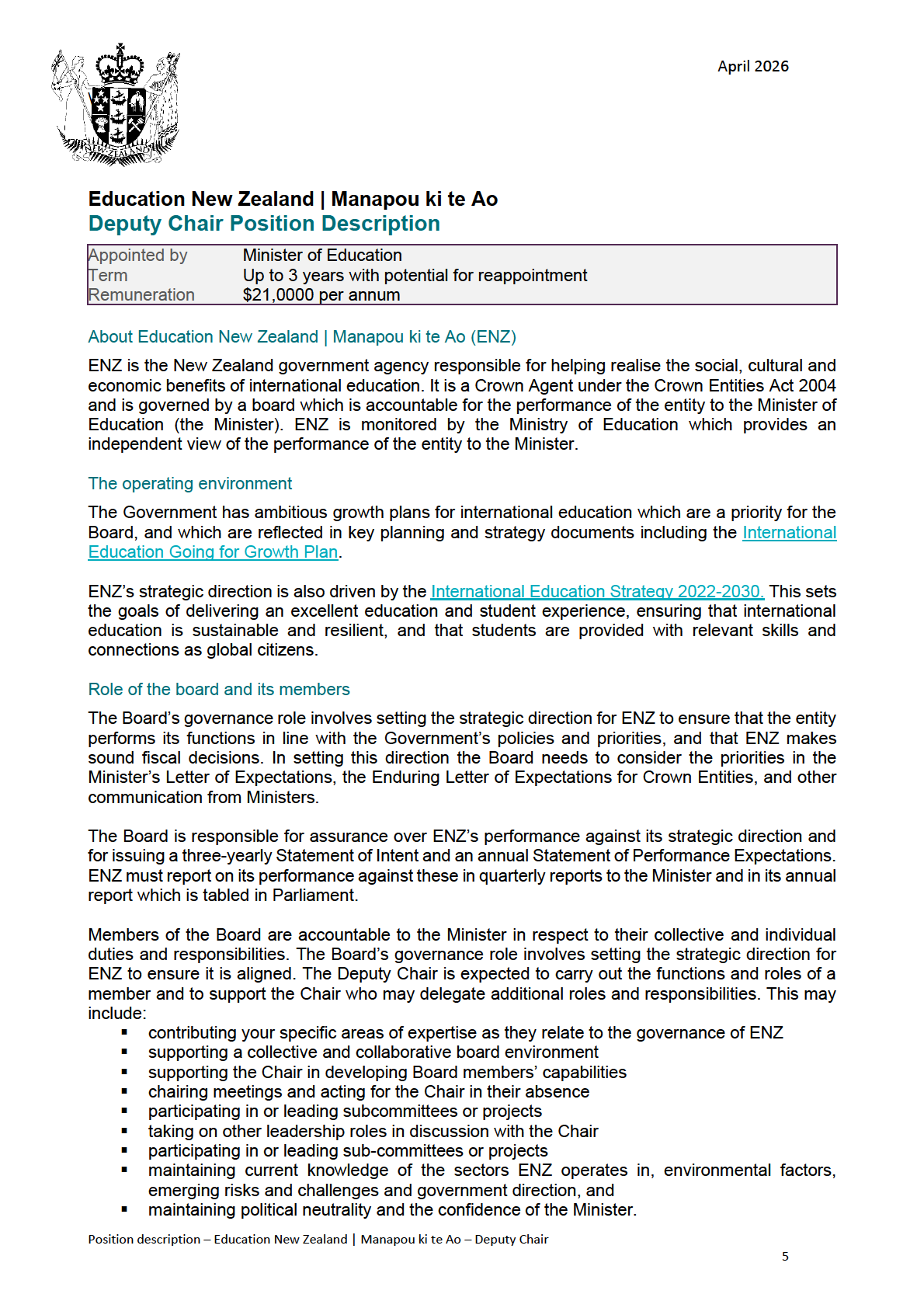
1982
Act
Information
Official
the
under
Released

April 2026
Relevant legislation
The Education and Training Act 2020 s511 sets out the functions of ENZ at the following link:
https://www.legislation.govt.nz/act/public/2020/0038/latest/LMS280895.html
As set out in the Public Service Act 2020 the Board must preserve, protect, and nurture the spirit of
service to the community (s13), and is responsible for ensuring ENZ upholds Public Service
principles (s12), which are:
• political neutrality
• providing free and frank advice
• making merit-based appointments
• fostering a culture of open government, and
• promoting stewardship of the public service – the long-term capability of its people, 1982
institutional knowledge, systems and processes, assets, and the legislation agencies
administer.
Act
The rules for governance, operation, and accountability of Crown entities are set out in the Crown
Entities Act 2004.
Skil s, experience, and attributes of the Board
To help the Board succeed in its roles and functions, it should collectively have:
• strong governance experience
• executive leadership experience, a strategic outlook, and the ability to lead through change
• strong financial capability and acumen, and commercial experience
Information
• a detailed understanding of the machinery of government including the role of Crown Agents
• an understanding of the operating context for education in New Zealand
• an understanding of overseas markets and international relations.
• knowledge of te reo Māori, tikanga Māori, Mātauranga Māori, and Te Tiriti o Waitangi, and
• an ability to build robust, collaborative relationships in complex environments.
Official
Workload, remuneration and term of appointment
The expected workload for the Deputy Chair is approximately 30 days per year to attend meetings
the
and other board business. The Board meets around ten times a year. The Deputy Chair fee is
$21,000 per annum which is calculated at 125 percent of the member fee of $16,800 per annum.
This is set and reviewed in accordance with CO (25) 2: Cabinet Fees Framework for members
appointed to bodies in which the Crown has an interest | Department of the Prime Minister and
Cabinet (DPMC).
under
Al members (including the Deputy Chair) are paid out of ENZ’s funds for reasonable and actual
allowances for travel ing and other expenses relating to performing their duties and responsibilities
as board members. Appointments are for up to three years and all members may be considered for
reappointment when their term expires.
Resignation or removal from office
A member may, at any time, resign from office by notifying the Minister and the Chair in writing. Any
Released
member, including the Deputy Chair, may be removed by the Minister by written notice. The Deputy
Chair may also resign from the office of Deputy Chair but remain a member.
Position description – Education New Zealand | Manapou ki te Ao – Deputy Chair
6
