1982
Act
Information
Official
the
under
Released
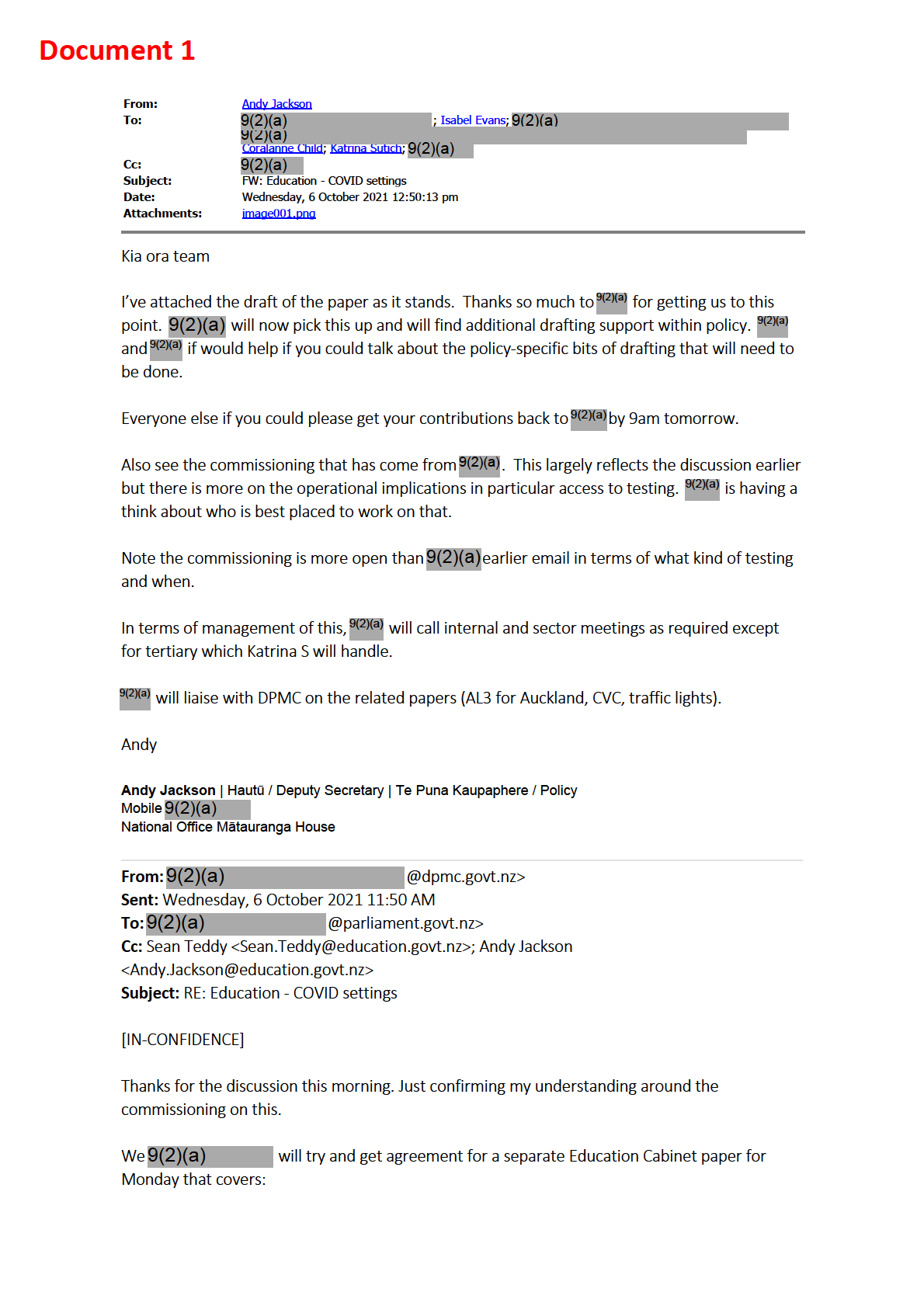
Decisions on mandatory vaccination for education workforce (and consideration of
exemptions (and protections) for those who can’t get vaccinated due to health conditions)
Testing requirements and regime for early learning and schools ahead of 18 October
return in Auckland (high level requirements will be signposted in the Alert level paper as
well)
I think the tertiary settings can be picked up through traffic lights and vaccine certificates
advice – but would be good to know if you think anything needs to be done as part of this
paper.
Your email below covers the direction of travel but Minister Hipkins is looking for advice on
implications and any risks/issues and how to operationalise. Requirements for vaccination for
Education workforce should not get ahead of (but could go alongside) decisions on health
1982
workforce.
You understand that we need to separate out some of the advice below about what relates
Act
specifically to Auckland and stepping down restrictions at AL3 and what would be for the whole
country. Key points in relation to this include:
Bullet 1 - Early learning centres in Auckland and across New Zealand are already open
(some may still be closed at AL3 but most won’t be) therefore first bullet needs to be
turned into regular testing regime (for not fully vaccinated) put in place for AL3 areas at a
minimum
Bullet 4 limiting bubbles until vaccination increased – can only relate to Auckland.
Information
Everywhere else all children are back.
Schools Bullet 1 – Schools have already been open for essential workers in Auckland and
everyone outside of Auckland. Possible to require a PCR test before going back after
holidays in Auckland, but would suggest this plus ongoing testing regime for those who
are not fully vaccinated. Testing may need to be prioritised for Auckland first, with a
longer lead in for other areas if Ministers want to go beyond L3 areas.
Official
From my perspective, the Education advice needs to cover:
the
For vaccination, advice and implications by early learning type (Home-based, Maori medium,
Parent led), and school type (kura) and potential workforce shortages.
Vaccination – high level operationalisation and feasibility. Processes for redeployment etc.
What will schools and early learning need to know when this announced? What needs to be
decided now, what can follow and have more engagement on final details?
under
Testing – feasibility for operationalising, what will early learning services and schools need and
how will we know it has been done? What needs to be decided now, what can follow and
have more engagement on final details?
Who is covered by education workforce? My understanding is we are talking about all staff in
early learning and compulsory. But will need to be clear about this and rationale.
It will also be important to keep closer to broader work on mandatory vaccination being led by
MBIE. I understand that 9(2)(a)
group is leading but I have not tracked down specific
Released
contact yet.
Thanks
9(2)(a)
9(2)(a)

Advisor
Policy Advisory Group
Department of the Prime Minister and Cabinet
P 9(2)(a)
M
E 9(2)(a)
@dpmc.govt.nz
The information contained in this email message is for the attention of the
1982
intended recipient only and is not necessarily the official view or
communication of the Department of the Prime Minister and Cabinet. If you
are not the intended recipient you must not disclose, copy or distribute this
message or the information in it. If you have received this message in error,
please destroy the email and notify the sender immediately.
Act
From: 9(2)(a)
@parliament.govt.nz>
Sent: Tuesday, 5 October 2021 10:42 am
To: Iona Holsted <[email address]>; Sean Teddy
<[email address]>; Helen Hurst <[email address]>; 9(2)(a)
Information
9(2)(a)
@dpmc.govt.nz>
Cc: 9(2)(a)
@parliament.govt.nz>; 9(2)(a)
9(2)(a)
@parliament.govt.nz>; 9(2)(a)
@parliament.govt.nz>; 9(2)(a)
9(2)(a)
@parliament.govt.nz>; 9(2)(a)
@parliament.govt.nz>;
9(2)(a)
@parliament.govt.nz>; 9(2)(a)
Official
9(2)(a)
@parliament.govt.nz>; 9(2)(a)
@parliament.govt.nz>
Subject: Education - COVID settings
the
Here are some thoughts from the Minister on how we move forward around COVID-19 and
education settings:
Early childhood education:
under
· All centre staff required to have a negative PCR test before centre can re-open
· ECE staff required to have first dose of the vaccine by mid-November, and fully
vaccinated by 1 Jan
· Any staff who are not vaccinated must undergo a weekly PCR test until they are
Released
vaccinated
· Until then, group sizes limited to 10 children. Once all ECE staff in a centre are
vaccinated, they can increase group size to 20
· All visitors to ECE centres, including parents, must wear face coverings. Where possible,
drop-off and pick-up should be done outdoors
Schools:
· All school staff required to have a negative PCR test before school can re-open
· All teachers and staff who interact with students required to have first dose of the
vaccine by mid-November, and fully vaccinated by 1 Jan
· Any staff who are not vaccinated must undergo a weekly PCR test until they are
vaccinated
· All visitors to schools, including parents, must wear face coverings. Where possible, 1982
drop-off and pick-up should be done outdoors
· Face coverings required in all secondary schools, and for students aged 12+ in other
Act
school settings. Schools with a 90+ percent vaccination rate amongst staff and students
will be exempt from the face covering requirement.
· Schools will be required to keep a vaccination register (as they do now). Any students
not producing evidence of vaccination will be counted as unvaccinated.
Tertiary education:
Information
· Face coverings to be worn in all indoor settings until the overall population in the
provider’s region has a 90% vaccination rate
· Once vaccine certificate is available, all students attending a class with more than 50
people will be required to show it on entry. Any unvaccinated will be confined to remote
Official
participation.
the
Sent with BlackBerry Work
(www.blackberry.com)
under
Released
Document 2
I N C O N F I D E N C E
In Confidence
Office of the Minister of Education
Cabinet
Education System Vaccination and Testing Requirements
Proposal
1982
1
This paper seeks agreement to mandatory vaccination for the education
workforce and testing requirements while vaccination levels are increasing.
Act
Relation to government priorities
2
The proposals in this paper support the Government’s response to the
COVID-19 pandemic.
Executive Summary
3
COVID-19 vaccines are an important part of the New Zealand’s COVID-19
response. They will protect an individual from more serious illness if they
contract COVID-19, help prevent people from becoming infected, and/or
Information
reduce COVID-19 transmission. Since the start of this outbreak in August,
vaccination rates have increased across the country, but particularly in
Auckland.
4
The Government has developed the three-stage roadmap that gradually
eases COVID-19 restrictions in Auckland. This may enable children, students,
Official
and educators to physically return to their places of learning sooner.
5
Everyone being able to attend onsite will benefit children and young people.
the
Face-to-face teaching and learning works best for most learners, especially
those that find it difficult to engage in their education over lockdowns. This will
also benefit learners that are digitally and economically disadvantaged, some
of whom have found lockdown conditions particularly challenging.
under
6
At this stage, children under the age of 12 are not eligible to be vaccinated.
Young people between the ages of 12 and 18 were amongst the last group of
New Zealanders to become eligible for the vaccination at the beginning of
September, and are less likely to be vaccinated than adults. To increase the
protections for children and young people, I am proposing to make
vaccination mandatory for the education workforce that works with children
and young people.
Released
7
I propose the following requirements for the whole of New Zealand:
7.1
Employees of education services and workers who may have contact
with children and students when delivering an education service will be
required to receive their first dose of the COVID-19 vaccine by 15
November and be fully vaccinated by 1 January 2022. This includes
1
I N C O N F I D E N C E
I N C O N F I D E N C E
home based educators and any other adult or young person over the
age of 12 who lives in a home where homebased education and care is
delivered.
7.2
From 1 January 2022, education services must only allow fully
vaccinated employees and workers who may have contact with
children and students, to deliver a service.
7.3
From 1 January 2022, education services must, during opening hours,
only allow those who are fully vaccinated to provide a service onsite or
in a home, including those providing volunteer services, Initial Teacher
1982
Education students on practicum, learning support specialists and
education advisors.
Act
7.4
Education services will be required to maintain an up-to-date register
with the vaccine status for all staff and, for secondary schools, eligible
students (fully, partially, exempt or no information provided). This
information will be sought once schools restart, and is expected to be
collected within two weeks.
8
A large number of the education workforce will already be partially or fully
vaccinated from COVID-19. To manage the risk while the remainder are being
vaccinated, I am introducing the following requirements for Auckland and any
Information
other Alert Level 3 areas:
8.1
weekly testing of education service staff or other people within the
definitions above who are not fully vaccinated; and
8.2
individual school staff will be required to return a negative COVID-19
Official
result ahead of physically returning to a school, and early learning staff
will be required to do so by 26 October.
the
9
The following decisions will be made through the companion paper on alert
level change paper, but are included here for completeness:
9.1
All visitors to education services, including parents, must wear face
coverings.
under
9.2
In Alert Level 3 areas face coverings are currently required to be worn
in all registered schools that provide secondary education. However, I
propose that schools with a 90 percent or higher vaccination rate
amongst staff and students be exempt from this face covering
requirement.
9.3
face coverings will be required on school transport for year 9 to 13
Released students (school transport services are currently exempt from public
transport face covering requirements)
9.4
time outdoors for students and staff will be maximised, including breaks,
lunch, before and after school (unless the weather does not allow), and
rooms will be aired during breaks;
2
I N C O N F I D E N C E
I N C O N F I D E N C E
9.5
exercising and singing will take place outdoors;
9.6
groups meeting indoors, including assemblies or staff meetings, will be
avoided;
9.7
exams will go ahead, but physical distancing will be maximised within
the space available, with a minimum of 1.5m between desks; and
9.8
schools or early learning services near suburbs and clusters of concern
will be closed if required.
1982
10
In this paper, education service refers to all early childhood services, including
homebased education and care services, but excludes playgroups, and to all
schools including Māori Medium and private schools, but excludes tertiary
Act
education organisations.
11
The situation for tertiary education is different. This sector has a very different
student population, who are generally eligible for vaccination, and online and
distance is provision is already extensively used, alongside face-to-face
provision. In addition, as with early childhood education, services are already
able to operate with some restrictions and do not follow a shared term start
date, so there is not the same urgency to provide clarity.
12
I will be taking further advice on how to manage vaccination and testing in the
Information
tertiary sector, and intend that these arrangements be aligned with the wider
work on vaccinations in employment, CVCs and the traffic light framework.
Officials will also be considering any impacts on secondary-tertiary transitions
as part of this work.
Official
13
To implement the proposals in this paper, an order or orders under the
COVID-19 Public Health Response Act will be required. Further consultation
with Parliamentary Counsel and the Crown Law Office, the Ministry of Health
the
will be required. Further work will be undertaken to determine any appropriate
exemptions that will be granted after 1 January 2022, when full vaccination
will be required. Those who will not be fully vaccinated by this date, will not be
able provide teaching or any other services to children and students face-to-
face.
under
Background
14
Two months of Alert level 3 and 4 in the Auckland region have helped contain
the Delta outbreak geographically and bought time to ramp up our
vaccinations rates. Now 85 percent of Aucklanders have received one dose
and 56 percent are fully vaccinated.
Released
15
Vaccines have proven effective in combating COVID-19, with modelling
showing that our current cases are 50 percent lower than what they could
have been had we not had vaccines. The success of vaccines in combatting
COVID-19 means we have more options available to us. We are now in a
place where we can transition from only using heavy restrictions, like those
3
I N C O N F I D E N C E
I N C O N F I D E N C E
required under Alert Levels 3 and 4, to where we use vaccines alongside
every day public health measures to combat and contain the virus.
16
In light of these developments, the Auckland region is currently being
transitioned out of current restrictions carefully, with regular check-ins before
stepping down a further stage. Alongside this paper, Ministers are considering
when schools in the Auckland region and other Alert Level 3 areas will be able
to open again and any changes to the operation of early learning services.
Analysis
1982
17
There is a strong public health rationale for making it mandatory for the
education workforce to be vaccinated. COVID-19 vaccines protect an
individual from more serious illness if they contract COVID-19, help prevent
Act
people from becoming infected, and/or reduce COVID-19 transmission.
18
At this stage, children under the age of 12 are not eligible to be vaccinated.
Young people between the ages of 12 and 18 were amongst the last group of
New Zealanders to become eligible for the vaccination at the beginning of
September, and are less likely to be vaccinated than adults. By making it
mandatory for the education workforce to be vaccinated, we will be increasing
the protections for children and young people who cannot.
Information
19
Increasing the vaccination rates in schools may also enable schools to remain
open if there has been a case, and for reduced public health control measures
to be in place. Returning to places of learning will be beneficial to children and
students in Auckland and will help facilitate good educational outcomes.
International evidence shows that many students made little or no progress
while learning from home during lockdowns. In New Zealand, whilst individual
Official
experiences of learners vary greatly, initial Ministry of Education data
suggests that negative learning impacts may not be as widespread as
expected.
the
20
It is possible that lockdowns in New Zealand have not been long enough to
see negative achievement impacts. We have heard that staying engaged in
education over lockdowns can be difficult for many students, particularly
digitally and economically disadvantaged children and students.
under
21
Creating a safe pathway back to education for learners will differ by
community and the learners who attend different education providers. For
example, schools and early learning services which have significant
proportions of their roles from communities with lower vaccination uptake
rates or where students and their families are vulnerable to COVID-19 as a
result of their underlying health status. There is also likely to be a regional
variance, with lower vaccination uptake rates in rural communities in
Released
particular.
22
In the early learning sector, Kōhanga Reo have been particularly careful about
re-opening in response to changes in alert levels as they are conscious of the
health risks for kōhanga whanau arising out of COVID-19, particularly given
the lower vaccination rates among Māori. In the current resurgence, many
4
I N C O N F I D E N C E
I N C O N F I D E N C E
kōhanga have chosen not to open at all in Alert Level 3, and the Kōhanga
National Trust have indicated that getting kōhanga whanau vaccinated is its
highest priority. Other early learning services that work with more vulnerable
communities, for example, puna reo or Pacific Language services, may have
similar reticence.
23
Māori and Pacific learners and whānau have reported mixed schooling
experiences of COVID-19 lockdowns. In particular, some learners struggled to
access on-line and distance learning, became disengaged from education and
have been slower to return to education services than other learners. These
circumstances underscore the importance of re-opening education services 1982
and supporting Māori and Pacific learners to re-engage with confidence.
24
It is likely that some parents may be reluctant to return their children to face to
Act
face learning if they are anxious that their children may be exposed to the
Delta variant while at school, particularly where that child or young person is
unable to be vaccinated themselves and in Auckland. After the Auckland
August 2020 lockdown, Pacific and Māori children were the slowest to return
to regular attendance. There is, therefore, potential for a more rapid return to
regular attendance at school if students and their whānau are more
comfortable that the adults around them are vaccinated.
National requirements
Information
25
Being vaccinated is one of our greatest protections against COVID-19 and the
best way to protect children and students who cannot be vaccinated is to
vaccinate the adults around them. This is a proportionate response and so I
propose that:
Official
25.1 Employees of education services and workers who may have contact
with children and students when delivering an education service will be
required to receive their first dose of the COVID-19 vaccine by 15
the
November and be fully vaccinated by 1 January 2022. This includes
teacher aides, administration staff, maintenance staff, OSCAR
providers etc. This also includes home based educators and any other
adult or young person over the age of 12 who lives in a home where
homebased education and care is delivered.
under
25.2 From 1 January 2022, education services must only allow fully
vaccinated employees and workers who may have contact with
children and students, to deliver a service.
25.3 From 1 January 2022, education services must, during opening hours,
only allow those who are fully vaccinated to provide a service onsite or
in a home, including those providing volunteer services, Initial Teacher
Released Education students on practicum, learning support specialists and
education advisors.
26
Additionally, I propose that education services be required to maintain an up-
to-date register with the vaccine status for all staff and, for secondary schools,
eligible students (fully, partially, exempt or no information provided). This
5
I N C O N F I D E N C E
I N C O N F I D E N C E
information will be sought once schools restart, and is expected to be
collected within two weeks.
27
Having such a register will enable schools and early learning service to know
the vaccination status of their staff and relevant students in the case of an
outbreak and to respond accordingly. It was also be of use to schools and
early learning services as of 1 January 2022 when they will be required to
only allow fully vaccinated employees and works who may have contact with
children and students, to deliver a service.
28
Officials will explore options for how schools and early learning services can 1982
best manage this requirement, with a preference for low-compliance options
such as retaining records locally.
Act
Additional Auckland specific requirements
29
A large number of the education workforce will already be partially or fully
vaccinated from COVID-19. To manage the risk while the remainder are being
vaccinated, I am introducing the following requirements for Auckland and any
other Alert Level 3 areas:
29.1 weekly testing of education service staff or other people within the
definitions above who are not fully vaccinated; and
Information
29.2 individual school staff will be required to return a negative COVID-19
result ahead of physically returning to a school. A similar requirement
will not apply to early learning services, as these are already operating.
30
Our approach is in line with other jurisdictions that have adopted mandatory
Official
COVID-19 vaccinations in education settings such as Washington, New York,
and Victoria. Washington for example, requires all teachers and school
personnel including, sports coaches, bus drivers and volunteers to be fully
the
vaccinated as a condition of their employment.
31
Testing regimes are also seen in other jurisdictions such as Israel, which
requires unvaccinated teachers to be tested twice weekly and to show a
negative test before being allowed entry into educational facilities or to take
under
part in in-person teaching.
Implementation
32
The schooling and early childhood workforce is large and diverse, with around
55,000 teachers and 41,000 specialist and support staff working in schools
and kura, and 30,000 teachers working in early childhood settings, alongside
non-teaching early learning support staff, and staff in school hostels.
Released
Education occurs in a wide variety of settings, from early childhood centres,
kōhanga reo, schools and kura, to community facilities, and in homes.
33
This workforce is employed by a diverse range of employers, including school
boards, community groups, large corporates and small businesses.
6
I N C O N F I D E N C E
I N C O N F I D E N C E
34
The shift to mandatory vaccination with an associated testing regime will be a
significant change in employment settings for education sector workers. The
new minimum standard around vaccination and testing exceed the current
expectations of employers under their current health and safety policies and
COVID-19 response plans.
35
I am aware that there have been stronger calls from the sector for mandated
vaccinations.
36
The Ministry of Education will work closely with providers and the workforce to
support them through these changes and give practical guidance on how to 1982
implement them, including scoping of the different education settings, and
requirements of those who enter education sites for a range of reasons,
including visitors, property maintenance and construction, emergency
Act
services, as well as requirements for staff in school hostels.
37
It is noted that implementation of vaccinations and testing regimes may be
particularly challenging in some rural or isolated communities and settings,
which may have further impact on Māori education providers and ākonga.
Consideration could be given for either exemptions from the Director General
for Health to allow these communities to continue operation if they cannot
meet the timeline for implementation, or to seek additional supports from iwi
and health to work with impacted communities to meet vaccination and testing
Information
requirements.
38
As part of a package of initiatives focused on promoting and supporting
vaccination amongst the education workforce, work is underway to connect
with Māori communities by using social media and other channels to promote
vaccination. The Ministry is producing products aimed at whānau Māori and
Official
Māori medium communities, which would feature Māori education and iwi
leaders, and other high profile individuals, including rangatahi and kapa haka
leaders who have influence with hapu and iwi. Messages will focus on
the
empowerment, whakapapa and houora and will reflect the korero that is
already occurring in communities.
39
We will work closely with the Ministry of Health to co-ordinate on this, and to
identify areas where greatest uptake is needed. We will work to connect with
under
events such as Super Saturday and Vaxathon.
40
In addition the Ministry are hosting a series of webinars for teachers across
the motu, to engage with a well known expert to discuss the science behind
vaccinations. These will start from the last week of the school holidays and
will run for as long as there is demand.
41
In situations where a person cannot be vaccinated, or chooses not to do so,
Released
employment law applies in determining their outcomes. Options such as
leave, changes to work arrangements or redeployment can be considered. In
some cases, this could result in the ending of employment, either by mutual
agreement, or by an employer. This is consistent with the approach that
applies to workers at the border and in MIQ facilities.
7
I N C O N F I D E N C E
I N C O N F I D E N C E
42
The requirements of an employer who is seeking to enforce the requirements
of the Order remain unchanged under the Employment Relations Act 2000 in
the pandemic environment. In essence, this means that decisions must be fair
and reasonable, and the employer must run a fair process before deciding to
terminate an employee’s employment, including giving an employee an
opportunity to comment before the employer makes any decisions. The
Ministry will not prescribe the process for employers and employees to have
these conversations as it is for the parties themselves to choose the course of
action appropriate to their individual circumstances.
43
It is not yet clear if compensation for the ending of employment due to
1982
requirements of a COVID-19 Order will be required. This was recently tested
before the Employment Relations Authority which found in favour of the
employer, in part because of the robust approach the employer had taken to
Act
assessing the health and safety risks involved, and the process taken to seek
to identify alternatives to dismissal. However, this remains a largely untested
area of law, and there is the possibility that it will be determined that
compensation for severance of employment should apply, in which case the
costs may be significant.
44
The Ministry of Education will work with all early learning peak bodies,
kōhanga reo and schooling peak bodies, including the Kōhanga Reo National
Trust Board and New Zealand School Trustees Association (NZSTA) and to
Information
support education providers as they make employment decisions relating to
those who refuse to get vaccinated.
45
The size and nature of the education workforce and the high level of public
interest mean the implementation of these proposals will be complex and
require careful consideration and support. Accordingly, the Ministry and NZSTA
Official
will provide detailed advice to education services and workers to help them to
understand their roles and responsibilities.
the
46
Initially it is likely to be challenging for education providers to understand and
implement the revised requirements. The changes are likely to be disruptive
and compliance may be slow initially but will build quickly as understanding
grows. under
47
There are a number of other consideration that the Ministry will work through
with the education sector and relevant community/stakeholder groups to
support the implementation of these proposals, including:
47.1 Possible delays for employers in issuing advice to workers during this
term break.
47.2 Smaller education services and those in rural or isolated settings will
Released find it challenging to meet requirements for all staff to be tested to allow
on site learning.
47.3 Employers may need to provide paid time off work for employees to
receive a vaccination or test. This may also include the period of time
that an employee is waiting for the result of a test.
8
I N C O N F I D E N C E
I N C O N F I D E N C E
47.4 Where an education service is unable to meet minimum staffing
requirements, they will be required to remain closed, provide distance
learning or employ temporary workers who meet the necessary
requirements at additional cost.
47.5 Vaccination and testing attestation processes and information sharing
systems.
48
It is likely that some workers will object to the requirement to be fully
immunised, or tested, or face coverings. They may consider this is to be an
unreasonable expectation from their employer, or that their inability to attend
1982
the workplace until requirements are met as an unlawful and unreasonable
suspension of their employment. This will be partially mitigated through
communications which make clear the public health evidence and rationale for
Act
these requirements. However, it is highly likely that some employees will raise
a personal grievance with their employer, and this may in due course be
tested in the Courts.
Financial Implications
Schooling
49
Compulsory vaccination and testing will incur significant additional costs for
Information
the schooling sector. Employers (boards) will be required to provide leave for
employees to be vaccinated or tested, which will mean covering some
teaching and non-teaching staff time during term four. Schools have
continued to receive their operational grant funding during Alert Levels 3 and
4; however, these new leave requirements may be well in excess of that
funding.
Official
50
While many staff may choose to be vaccinated or tested outside of teaching
hours, the effect of the staffing entitlement is that if boards choose to provide
the
leave, then the payroll effects of this must be covered by the Ministry of
Education. Therefore the change creates a cost pressure for the Crown.
51
It is difficult to estimate costs as vaccination rate among teaching and non-
teaching staff is not currently known. The Ministry has estimated the following
under
maximum costs:
51.1 Vaccinations - $6m for all teaching and non-teaching staff across New
Zealand. This assumes vaccination rates align with current regional
averages with a 10 percent uplift before term 4 begins.
51.2 Testing - $12m for teaching and non-teaching staff in Auckland and
Waikato who are not fully vaccinated to be tested weekly. This
Released assumes a steady reduction in the number of staff requiring testing
each week, as more become fully vaccinated.
52
While the change will put pressure on the relevant appropriations, we will not
know until closer to the year-end how significant the effect is relative to other
movements in the appropriations.
9
I N C O N F I D E N C E
I N C O N F I D E N C E
53
As the change is a policy change it cannot be treated as a forecast
adjustment. However, due to the uncertainty of the costs, I propose that
Cabinet agree that a funding source be identified with the Minister of Finance
once the full costs are known.
54
We will also brief Ministers on any other unforeseen costs arising from
implementation of the changes, including creation of a vaccination register if
required. I have not provided for these costs in this paper as officials are not
yet in a position to advise on the full costs of implementation at this stage.
Early learning
1982
55
As for schooling, in the early learning sector the shift to compulsory
vaccination with an associated testing regime will come with additional
Act
financial cost to services, such as, teacher release time. While the options
presented above, provide a pathway towards some early learning services in
Alert Level 3 areas being able to accommodate more children, many will still
not be operating at full capacity. They are therefore facing additional costs at
a time where they also face a loss of their non-government revenue (i.e.,
parent fees).
56
To date we have supported early learning services through ensuring
continuity of Government funding (both education and childcare subsidy
Information
funding) through the various lockdown periods. Consideration needs to be
given to what additional support should be provided to early learning services
to offset the costs involved in administering the new requirements and taken
into the loss of income they have incurred.
57
Using a similar methodology to schooling above, the estimated cost in the
Official
early learning sector would be around $8.5M. I am seeking your approval to
meet this cost out of the Early Learning Sustainability Fund we set up through
the original CRRF. the
Legislative Implications
58
To implement these proposals, an order or orders under the COVID-19 Public
Health Response Act will be required. Further consultation with Parliamentary
under
Counsel and the Crown Law Office, the Ministry of Health will be required.
Further work will be undertaken to determine any appropriate exemptions that
will be granted after 1 January 2022, when full vaccination will be required.
Impact Analysis
Regulatory Impact Statement
Released
59
The Regulatory Impact Analysis Team at the Treasury has determined that
the proposal requiring mandatory vaccination for the education workforce and
testing requirements while vaccination levels are increasing is exempt from
the requirement to provide a Regulatory Impact Statement on the grounds
that it is intended to manage, mitigate or alleviate the short-term impacts of
the declared emergency event of the COVID-19 pandemic, and
10
I N C O N F I D E N C E
I N C O N F I D E N C E
implementation of the policy is required urgently to be effective (making a
complete, robust and timely Regulatory Impact Statement unfeasible).
60
The RIA Team notes that the policy issue around vaccination of high-risk
frontline workers, including the education workforce has been known for some
time such that impact analysis supporting this proposal would have been
feasible.
Climate Implications of Policy Assessment
61
The Climate Implications of Policy Assessment team has been consulted and
1982
confirms that the CIPA requirements do not apply to this proposal as the
threshold for significance is not met.
Act
Population Implications
62
As Māori and Pacific peoples are likely to be disproportionately affected by (a)
a widespread epidemic and (b) prolonged disconnection from education
services, the proposals are likely to have a positive effect on reducing their
exposure to COVID-19 and related socio-economic impacts.
63
However, as Māori and Pacific peoples also have traditionally lower
vaccination rates, Māori and Pacific people working in the education
workforce may be disproportionately affected by the proposed restrictions. We
Information
propose to address this through: (a) a bespoke communications campaign
aiming at this part of our education workforce and (b) targeted vaccination
measures that will be developed in conjunction with Māori and Pacific
Education Peak Bodies and Social Service providers.
Official
Te Tiriti o Waitangi implications
64
The Government has Kāwanatanga and Ōritetanga responsibilities to support
health and socio-economic outcomes for Māori. The proposed measures in
the
this paper support those responsibilities.
65
Iwi and Māori organisations have played a significant role in supporting Māori
through COVID-19 lockdowns and in encouraging and administering
vaccination. This work should be implemented in ways that support Iwi and
under
Māori to continue to exercise agency and authority over how Māori are
supported to become vaccinated and return to education. The Ministry will
work closely with Māori education providers and related groups in
implementing the measures. In particular, the Ministry will work closely with
Te Kōhanga Reo in implementing these measures, including assessing what
impact the measures will have on Kōhanga Reo and how these can be best
managed.
Released
66
It will be important to ensure clear, constant and consistent information is
provided to Māori in English and Māori through appropriate channels.
11
I N C O N F I D E N C E
I N C O N F I D E N C E
Human Rights
67
Section 9(ba) of the COVID-19 Public Health Response Act 2020 explicitly
requires that orders made under section 11 of the Act be made consistently
with the Bill of Rights Act 1990. If an order limits a right or freedom affirmed in
the Bill of Rights Act, all or part of the order may be invalid unless the
limitation can be demonstrably justified in a free and democratic society (s 5).
68
Mandating vaccines in the education workforce engages the right to refuse to
undergo medical treatment (s 11 of the Bill of Rights Act). Workers who are
affected by the requirement must choose between getting vaccinated and, at
1982
best, redeployment, and at worst, loss of their employment. Given the limited
opportunities for redeployment that many schools will have, termination is a
real possibility for workers who do not wish to be vaccinated. Where the
Act
coercion to get vaccinated overwhelms the worker’s choice, the right to refuse
to undergo medical treatment is limited. It is also possible that it engages the
right to be free from discrimination on the basis of disability and, potentially, of
sex (pregnancy) or religious belief (s 19 of the Bill of Rights Act, s 21 of the
Human Rights Act 1993, ss 104 and 105 of the Employment Relations Act
2000).
69
The limitation on those rights are, however, likely justified. While not
guaranteed by the Bill of Rights Act, there is a right to education at
Information
international law. That right cannot be given full effect until educational
institutions open. While remote learning is possible it is sub-optimal and
access to the necessary learning tools is not evenly distributed across society.
But if schools are to reopen they must open safely. For as long as children
under 12 are not able to be vaccinated there is an acute risk of them being
infected with COVID-19, and once there is transmission within a school
Official
community it is likely to spread quickly. The risk for children over 12 and other
users of the education system can be mitigated by becoming vaccinated
themselves, but there is still an unavoidable risk of transmission to on-site
the
users of education services and some of them may still be vulnerable to
severe health consequences from infection.
70
More generally, because of COVID-19’s capacity to induce a severe
respiratory condition that will require ICU care, there is the risk that
under
widespread community transmission will compromise the capacity of the
health system to respond to those who need intensive care. The ECE and
school environments are such that should the virus enter, widespread
community transmission is likely.
71
Given what we know about the effectiveness of the vaccine at this stage, it is
unlikely that other, non-vaccination measures will sufficiently reduce that risk.
Early childhood education centres and primary schools are likely to have more
Released
difficulty implementing PPE and testing requirements than secondary schools.
But nonetheless vaccination of staff in secondary schools is important. It
appears that in the Delta variant environment, PPE and testing will not be
sufficient to stop the spread among groups of people together in enclosed
spaces, such as classrooms.
12
I N C O N F I D E N C E
I N C O N F I D E N C E
72
In the period prior to 1 January 2022, it is proposed that education workers
who are not fully vaccinated in Auckland and other Alert Level 3 areas are
subject to mandatory weekly COVID-19 testing. Mandatory testing constitutes
a search for the purpose of s 21 of the Bill of Rights Act. A provision requiring
mandatory testing will be unlawful if it is unreasonable. In the circumstances
of Alert Level 3 where there is community transmission of the virus, testing of
staff who are potential vectors for transmission in the education environment,
with unvaccinated children, close contact with large groups and enclosed
spaces, is not unreasonable.
Consultation
1982
73
The Department of the Prime Minister and Cabinet and the Treasury were
consulted.
Act
Communications
74
I will develop a communications plan following Cabinet’s decisions.
Proactive Release
75 I intend to proactively release this Cabinet paper subject to redaction as
appropriate under the Official Information Act, once Cabinet decisions have been
Information
made.
Recommendations
The Minister of Education recommends that Cabinet:
Official
1.
agree that the definition of education services used in this paper refers to all early
childhood education services, including homebased education and care services,
but excludes playgroups, and to all schools including Māori Medium and private
the
schools, but excludes tertiary education organisations
2.
agree that employees of education services, and workers who may have
contact with children and students when delivering an education service, will
be required to receive their first dose of the COVID-19 vaccine by 15
under
November and be fully vaccinated by 1 January 2022. This includes home
based educators and any other adult or young person over the age of 12 who
lives in a home where homebased education and care is delivered
3.
agree that from 1 January 2022, education services must only allow fully
vaccinated employees and workers who may have contact with children and
students, to deliver a service
Released
4.
agree that from 1 January 2022, education services must, during opening
hours, only allow those who are fully vaccinated to provide a service onsite or
in a home, including those providing volunteer services, Initial Teacher
Education students on practicum, learning support specialists and education
advisors
13
I N C O N F I D E N C E
I N C O N F I D E N C E
5.
agree that education services will be required to maintain an up-to-date
register with the vaccine status for all staff and, for secondary schools, eligible
students (fully, partially, exempt or no information provided) This information
will be sought once schools restart, and is expected to be collected within two
weeks
6.
agree that for Auckland and any other Alert Level 3 areas, weekly testing of
education service staff or other people within the definitions above, who are
not fully vaccinated, is required
7.
agree that for Auckland and any other Alert Level 3 areas, individual school 1982
staff be required to return a negative COVID-19 result ahead of physically
returning to a school, regardless of vaccination status
Act
8.
agree that for Auckland and any other Alert Level 3 areas, individual early
learning staff are required to return a negative COVID-19 result by 26 October
or before they physically return to the service, regardless of vaccination status
9.
note that the policy decisions in the recommendations above related to
schools create a significant fiscal risk for the Ministry of Education, estimated
at up to $18m in 2021/22
10.
agree that the Minister of Education will discuss and agree funding options
Information
with the Minister of Finance when the full costs are known and after options
for absorbing the increased costs within baseline have been further explored
11.
agree that the $8.5m to fund leave support for staff and to give effect to the
policy decisions in the recommendations above related to Early Learning be
funded from the Early Learning Sustainability Fund
Official
12.
note that this will largely exhaust funding remaining in the Early Learning
Sustainability Fund so additional funding may be required from the COVID-19
the
Response and Recovery Fund to further support sustainability of the early
learning network at a later date
13.
agree to direct the Minister for Covid-19 Response to issue drafting
instructions to the Parliamentary Counsel Office for one or more Orders to be
under
made under the Covid-19 Public Health Response Act 2020 to give effect to
the above recommendations
14.
agree to authorise the Minister for COVID-19 Response to make minor and
technical decisions during the drafting of the Order/s that are consistent with
the intent of the proposals in this paper.
Released
Authorised for lodgement
14
I N C O N F I D E N C E
I N C O N F I D E N C E
Hon Chris Hipkins
Minister for Education
1982
Act
Information
Official
the
under
Released
15
I N C O N F I D E N C E
