
15 May 2026
Ref: DOIA-REQ-0031509
Andrew Riddel
[FYI request #34504 email]
Tēnā koe Andrew Riddel
Thank you for your request of 16 April 2026 to the Ministry of Business, Innovation and Employment
(MBIE) requesting, under the Official Information Act 1982 (the Act), the fol owing information:
The Ministry is currently reports twice a week on stocks of petrol, diesel and jet fuel. The reports
give stock levels as they were some three days before the release of the report.
There are other sites, nzoilwatch for example, which provide more detailed and up to date reports
of fuel stocks.
Please provide copies of all reports, communications and assessments prepared since 28 February
this year on ways of col ecting and reporting fuel stock data, including considerations of different
frequencies of reporting, reporting in real time v delayed reporting, and different ways of
differentiating between future fuel stock replenishments that have differing degrees of uncertainty
with respect to actually arriving in Aotearoa New Zealand.
MBIE did not prepare any formal written assessment comparing alternative fuel stock reporting models.
Decisions about reporting frequency, timing, and treatment of uncertainty were made through
operational discussions as the fuel response evolved, informed by how fuel stocks and shipping operate in
practice.
MBIE determined that twice-weekly reporting is the most frequent cadence at which fuel stock data can
be col ected, reconciled and quality-assured accurately across fuel importers and infrastructure. Once
verified data is received from industry, MBIE reports it publicly on the next business day.
Engagement with fuel importers confirmed that the industry standard for fuel planning is based on a
verified weekly opening stock position, which is then actively managed through the week as new
information becomes available. Balancing accuracy against administrative burden, MBIE and industry
agreed that twice-weekly verified reporting, supported by notifications of any material changes to plans,
provides the most reliable basis for national monitoring.
More frequent, or ‘real-time’ reporting would not improve accuracy. Daily or live indicators typically rely
on estimates inferred from ship tracking data, which can be misleading, particularly while vessels are
unloading or moving between ports. Fuel stocks change slowly and in large increments, so inferred daily
updates would reduce accuracy rather than increase it, while material y increasing administrative burden.
MBIE therefore relies on verified stock snapshots supplemented by shipping intelligence. Fuel cargoes that
have departed their port of origin are included in reporting because they are highly likely to arrive and

material y affect national fuel availability. Cargoes that have not yet departed are not included due to the
higher degree of uncertainty associated with those shipments.
This approach provides a more accurate and decision-relevant system-level review of fuel availability than
high-frequency indicative trackers or inferred estimates and avoids creating false precision, or misleading
signals about fuel supply security.
Please find attached the documentation relevant to your request.
Please note some information has been withheld under section 9(2)(a) of the OIA, to protect the privacy
of natural persons, including that of deceased natural persons. Some additional information has been
redacted as it fal s outside the scope of your request. These redactions have been marked up as ‘out of
scope’.
I do not consider that the withholding of this information is outweighed by public interest considerations
in making the information available.
If you wish to discuss any aspect of your request or this response, or if you require any further assistance,
please contact [email address].
You have the right to seek an investigation and review by the Ombudsman of this decision. Information
about how to make a complaint is available at www.ombudsman.parliament.nz or freephone 0800 802
602.
Nāku noa, nā
McLeish Martin
Head of Data, Research and Insights
From:
Neel Vanvari
To:
Andrew Craig; Scott Ussher
Subject:
Fwd: Z Energy - Clarification on weekly fuel volume reporting & frequency
Date:
Saturday, 14 March 2026 7:02:21 pm
Attachments:
image001.png
Looping both of you in on this, see below for Z's view about daily data reporting.
Cheers,
Neel
Get Outlook for iOS
From: s 9(2)(a)
Sent: Saturday, March 14, 2026 6:46 pm
To: Fuel Sector Coordinating Entity Chair; Dominic Kebbell; Justine Cannon; Peter
Anderson; Neel Vanvari
Cc: s 9(2)(a)
Subject: Z Energy - Clarification on weekly fuel volume reporting & frequency
Kia ora all
Following the industry call this afternoon, I wanted to come back to you all with
clarification on Z’s view of the request floated for increased weekly reporting
(i.e., daily) on ‘MSO data/weekly volumes.’
Clarification on terminology
As a point of clarification, it would be helpful to avoid referring to the weekly
volume reporting as “MSO reporting”, as there are important nuances between
the two. Unless MBIE is comfortable intentionally using the term in a broader
sense, the distinction matters, as the mechanisms are materially different.
The key differences are outlined below:
MSO Reporting
Weekly Volume
Reporting
Volume
Average across month
As at Sunday midnight
Vessel volume
Within EEZ only
Vessels from load port
Retail site volumes
No
Proposed to include
under the Official Information Act 1982
from next week (see
note below)
Frequency of reporting
Z has reviewed the request floated for daily stock reporting and does not
consider that moving from weekly (current agreement) to daily reporting would
materially improve the national‑level fuel security picture for Ministers.
The two primary drivers of changes in reported weekly stock levels are:
Released
1. Demand variability, and
2. The number and size of vessels loading during the reporting period.
1. Demand variability is already normalised in MBIE’s methodology
MBIE’s current approach converts stock volumes into “days cover” using
average annual demand. This indicates that demand seasonality is not
considered material for the purposes of national fuel volume monitoring.
If seasonal variability is not material at this level, then day‑to‑day fluctuations in
demand—which daily reporting would primarily capture—are even less likely to
meaningfully affect the overall national stock position. Weekly reporting is
therefore sufficient to reflect underlying demand impacts.
2. Vessel loading is the primary driver of stock movements
The most significant changes in national stock levels occur when:
The volume loaded on vessels during the week is less than weekly demand
(resulting in a net stock decrease), or
The volume loaded exceeds weekly demand (resulting in a net stock
increase).
Accordingly, the key visibility required by MBIE is not higher‑frequency stock
snapshots, but clarity on shipping activity (which Z notes, we are already
providing MBIE).
To support this, Z proposes that all importers provide MBIE with the following:
A view of vessels currently on the water, and
Visibility of vessels expected to load in the coming week.
Daily or regular updates on vessel movements could include status updates on
these cargoes. MBIE should, however, expect a degree of variability in load and
arrival dates due to normal operational and logistical constraints.
In Z’s view, weekly reporting supplemented by improved forward visibility of
shipping activity provides a more meaningful and actionable picture of national
fuel security than daily stock reporting alone.
3.
Clarification on inclusion of retail and truck site volumes
Z would also welcome MBIE’s view on whether volumes held at retail and truck
sites should be included in the weekly reporting. Under MSO settings, these
volumes are not counted, and Z has not included them in prior weekly reports to
MBIE.
However, these sites collectively hold an additional approximately 3–6 days of
fuel supply for New Zealanders. From a national fuel availability perspective, it
appears appropriate that these volumes be included when assessing total fuel
held within New Zealand, and Z is supportive of incorporating them if MBIE
agrees.
s 9(2)(a)
 Z Energy Limited
3 Queens Wharf,
PO Box 2091, Wellington 6140
New Zealand
s 9(2)(a)
W z.co.nz
CONFIDENTIALITY NOTICE: The information in this document and attachments may be privileged and confidential. It
is intended only for the use of the named recipient. Any confidentiality or privilege is not waived or lost if you receive it in
error or if you are not the intended recipient. If you are not the intended recipient, please notify us immediately and then
delete this document. Do not disclose the contents of this document to any other person, nor take any copies. Violation
of this notice may be unlawful. Also note, the opinions expressed in this document are those of the author, and not
necessarily those of Z Energy or its related entities.
under the Official Information Act 1982
Released
From:
Scott Ussher
To:
Jeff de Jong
Cc:
Peter Anderson; Neel Vanvari; Andrew Craig
Subject:
Notes for Nic/AOG request
Date:
Wednesday, 18 March 2026 3:00:00 pm
For review before addition.
Out of Scope
982
Timing on stock holding data - why can’t we get more than twice weekly data?
Rel One-liner:
While companies are providing stock data more frequently at our request, daily snapshots
can be distorted by shipping and unloading timing, so we rely on verified stock updates
alongside daily shipping intelligence to get a clearer picture of fuel availability.
Talking notes:
Timing of stockholding data
Fuel stock data is currently being provided to us more frequently than usual at our
request. Stock information from the five providing fuel companies and third party
providers so producing verifying stock figures takes time for companies to compile and
reconcile across terminals, pipelines, and vessels.
Stock levels move continuously during the week, particularly as ships arrive, unload
over several days, or are mid‑discharge at the time of measurement. This can
materially affect whether fuel appears as “on‑water” or “in‑country” at any single point
in time.
More frequent snapshots would increase noise rather than insight, as short-term
movements are heavily influenced by operational timing rather than changes in overall
fuel availability.
Why fuel companies don’t use daily stock snapshots
Fuel companies typically use a stock progression approach, tracking how stocks are
planned to change over time based on known deliveries, draw down, and operational
plans.
They consider this more informative than daily point‑in‑time snapshots, which can be
distorted by:
ships arriving or departing close to the measurement time,
vessels unloading over several days,
fuel temporarily held in transit within New Zealand waters.
As a result, daily stock figures can misrepresent the underlying position, even when
total fuel availability is unchanged.
How we will manage this
We focus on total national fuel cover, rather than the precise split between on‑water and
in‑country stocks at any single point.
We combine periodic verified stock data with daily shipping information, which provides
earlier warning of any genuine supply disruption.
Week‑to‑week variability is expected, and the key signal we monitor is whether there is a
under the Official Information Act 1982
sustained and unusually rapid draw‑down in total stocks — which we are not seeing at this
stage.
Released
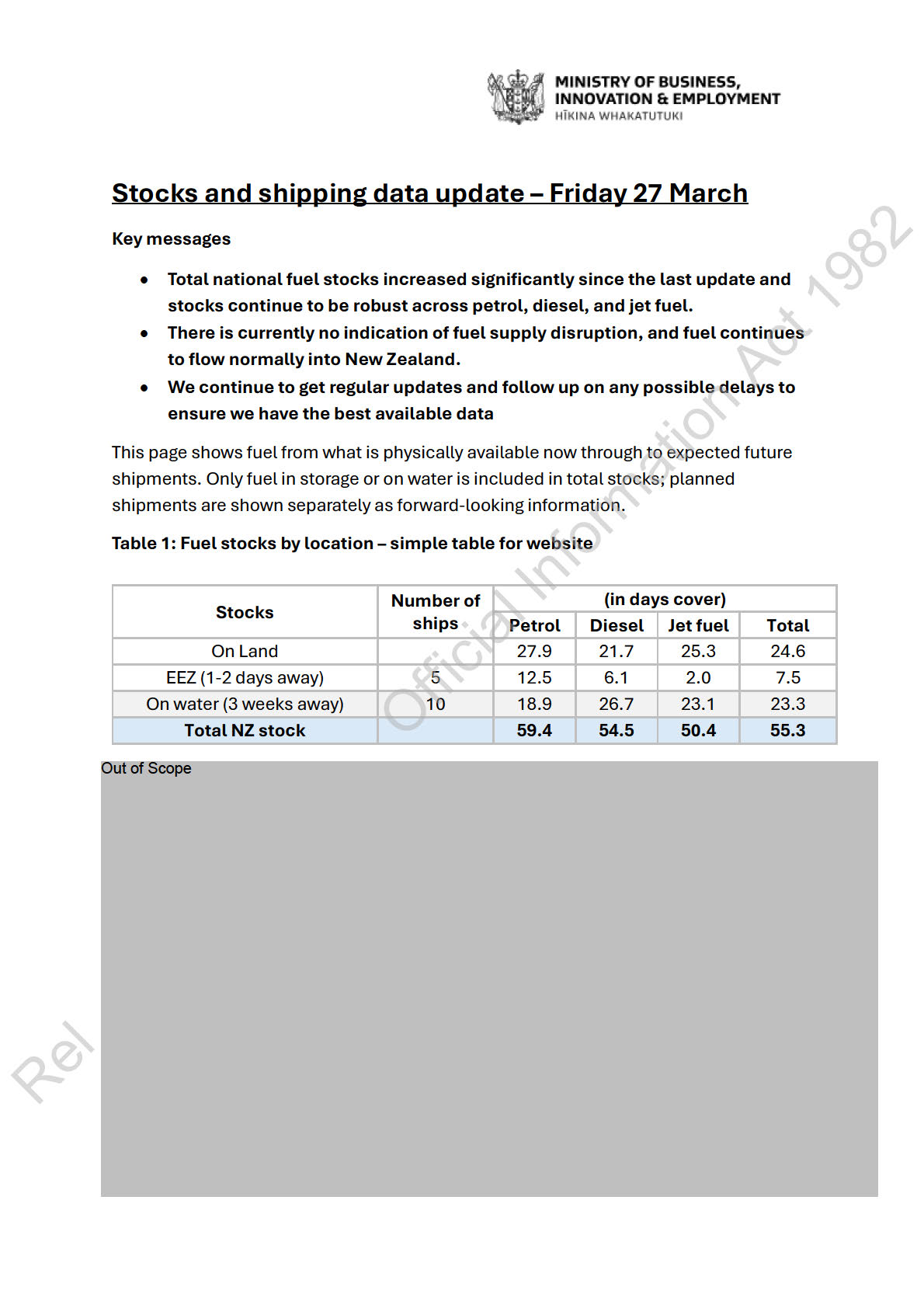

 Why we do not report stocks daily
• Fuel arrives in New Zealand in large shipments that unload over several days,
meaning the timing of ship arrivals and discharge can material y affect
short-term stock snapshots. As a result, week-to-week movements in reported
stocks are normal and reflect operational timing rather than changes in overal
fuel availability or supply chain performance.
• For example, fuel stocks may appear slightly lower at a point in time when a
larger-than-average volume of fuel is on ships that have arrived or are moving
between New Zealand ports but have not yet been ful y discharged. That fuel is
expected to enter storage over the coming days. Daily reporting would amplify
these timing effects, showing volatility driven by shipping schedules rather than
meaningful changes in supply.
Definitions of terms used
•
Stock in country- includes fuel physically held in storage tanks of the fuel
importers, such as terminal storage and airport fuel systems.
o Excludes fuel at retail sites, carriers, distribution networks etc.
•
Stock on water- includes fuel that has left its port of departure and is travel ing
to New Zealand.
o This includes fuel both within and outside New Zealand’s EEZ.
o It excludes fuel that has been ordered but has not yet left the port of
origin.
o It may include fuel on vessels that have arrived and docked but have not
yet entered storage terminals.
•
Stock on water within the EEZ – fuel on vessels that have entered New Zealand
waters, including ships that are berthed, discharging, or moving between New
Zealand ports.
o This fuel is physically within New Zealand waters and, under the MSO, is
t eated in the same way as in-country stock.
under the Official Information Act 1982
•
Stock on water outside the EEZ – Fuel on vessels that have departed their port
of origin but have not yet entered the New Zealand waters.
o This fuel remains subject to international shipping risks until it enters the
EEZ.
•
Total NZ stock – includes both stock in country and stock on water (within and
outside the EEZ).
o Represents the total volume of fuel available to New Zealand when
Released combining fuel held in storage with fuel that is shipped and en route.

o Excludes fuel that has been ordered but has not yet departed the port of
origin, and fuel held at retail sites, in vehicles or within distribution
networks.
•
Planned shipments – are fuel shipments that are expected to supply New
Zealand but have not yet departed their port of origin. These shipments are not
included in total fuels stocks and are reported separately to provide forward-
looking information.
o Planned shipments are inherently more uncertain and may change due
to:
export controls,
force majeure events,
re-routing or rescheduling by suppliers.
•
Days cover – a measure of how long current fuel stocks would last if supply
stopped.
o calculated by dividing total fuel stocks by average daily consumption.
o Used to allow comparison over time and across fuel types.
•
Daily fuel consumption – is based on long-term average national fuel use, using
the same methodology as the MSO.
o Specifical y, it is calculated as the average daily consumption for the 12
months ending four months before the reporting period.
For example, March reporting uses the average daily consumption
for the 12 months to 31 October 2025.
o This provides a stable benchmark and does not reflect real-time demand,
so short-term changes in usage do not directly affect reported days of
cover.
•
Average daily consumption (millions of litres):
Fuel type
Average daily consumption
Petrol
8.1
Diesel
10.7
under the Official Information Act 1982
Jet fuel
4.8
Information Updates on supply
• Fuel stock information is updated twice weekly, with the next scheduled update
on Tuesday 31 March based on stocks from 11.59pm Sunday 29 March.
Released
• We continue to have good cooperation from fuel supply companies with regular
updates on shipping information, including any disruptions.

• We are working closely with fuel importers on supply data.
• We have good cooperation on daily updates on ships on the water.
• We are working to get better information for ‘stock on water’ shipments provided
to us by fuel importers.
under the Official Information Act 1982
Released
