1982
Act
Information
Official
the
under
Released
Covid-19 Protection Framework - Background
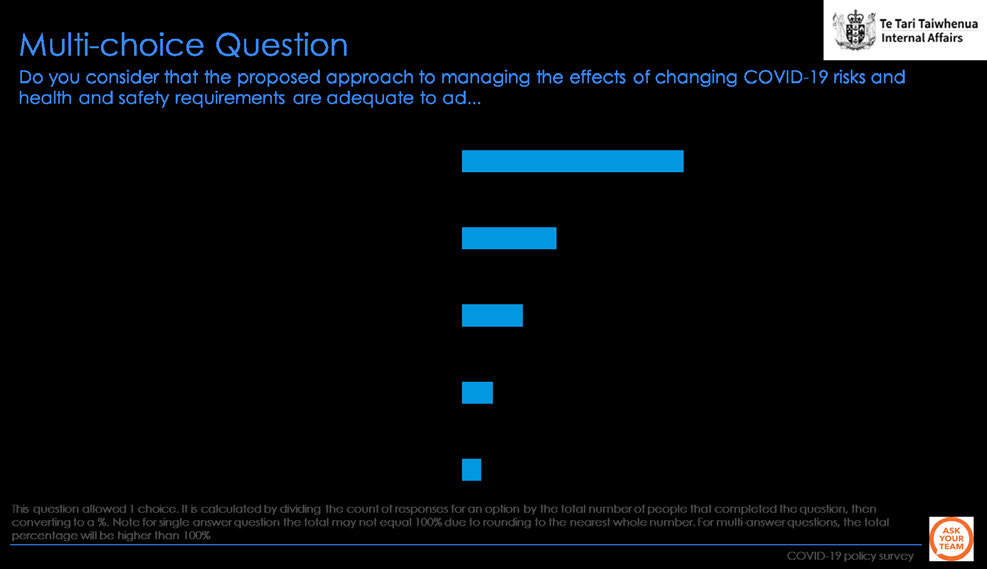
3. The COVID-19 Protection Framework (CPF) introduces a new traffic light system to
manage COVID-19 in the community with Green, Orange and Red settings. The CPF
sets out general settings and restrictions in a range of environments.
4. The CPF is still in development, and our understanding of what it means for Te Tari
Taiwhenua continues to evolve, with the framework itself, and with guidance from the
Ministry of Health and the Public Service Commission. Our preliminary view is that not
much wil change for DIA in terms of the requirements of the CPF. The CPF wil present
Te Tari Taiwhenua with some choices and ELT has already made some choices about 1982
travel and face masks. ELT wil also need to make choices about how and when to
open up Auckland offices to staff and how and when to reconsider capacity limits on
other sites.
Act
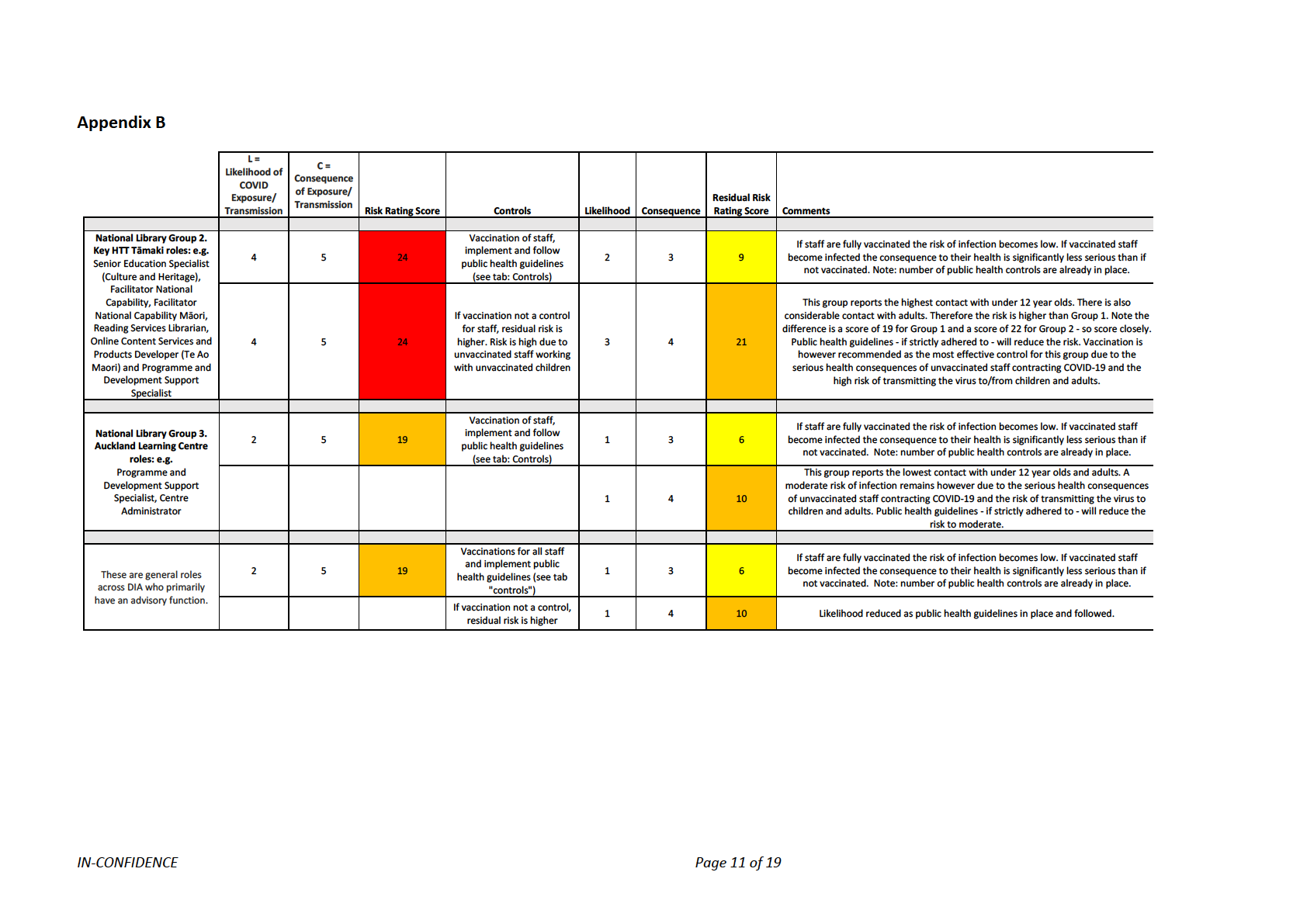
5. The Government has mandated that certain people must be vaccinated to do their
jobs. The Education Mandate affects some National Library staff and a process is
nearing completion with the kaimahi in these jobs. Other than through the Education
Mandate, the current draft of the CPF does not
require any other staff or visitors for
any of DIA’s premises to be vaccinated. We do not expect this to change, but it cannot
be confirmed until the order is made on Monday 29 November 2021.
6. There may be some additional requirements for events and gatherings but we
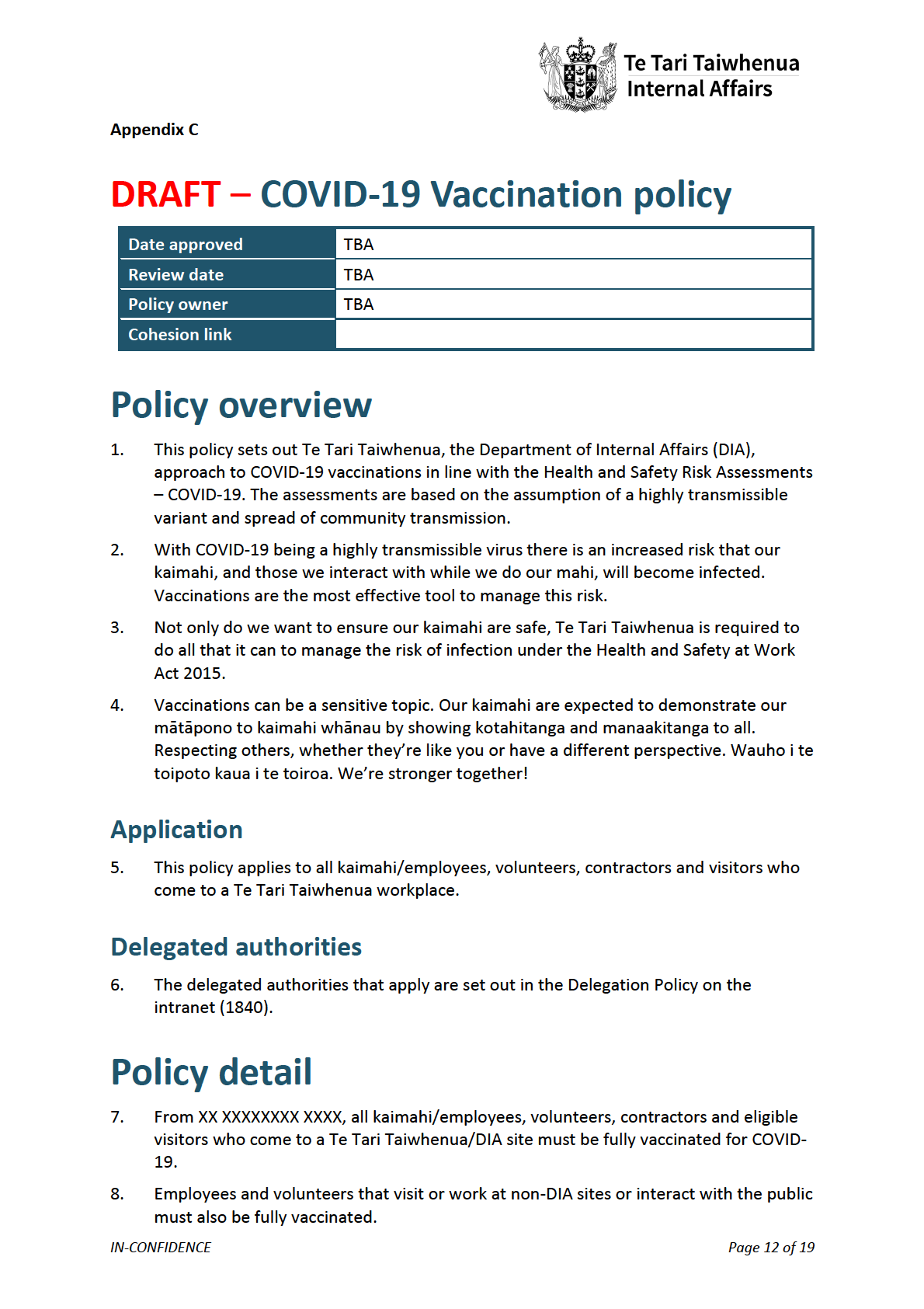
understand that there is a choice to be made about whether events should be only
Information
available to vaccinated persons (including kaimahi). The definitions of gatherings and
events wil not be clear until the order is made on Monday. At that stage, further work
wil be needed to assess how this will apply to different activities organised by Te Tari
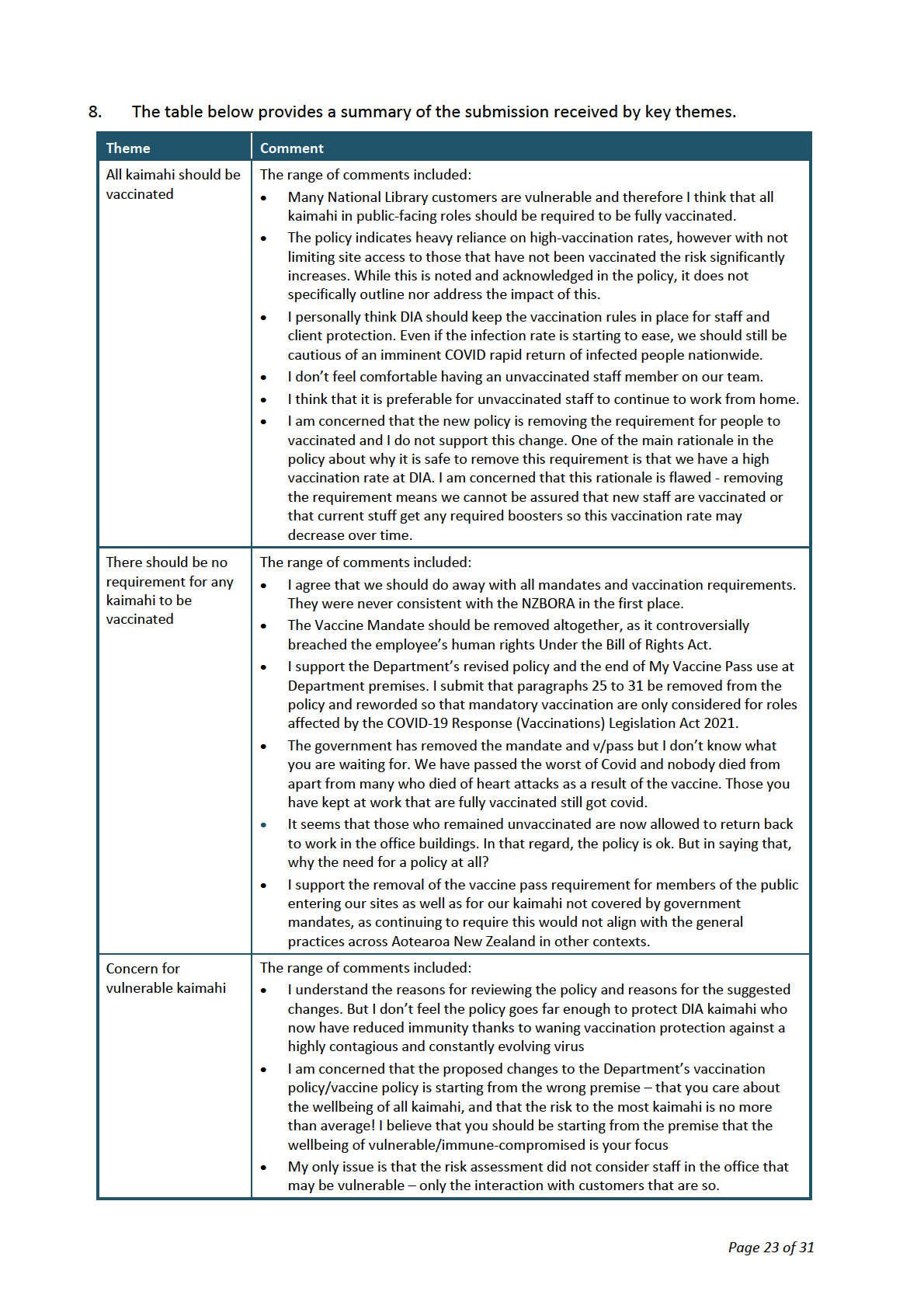
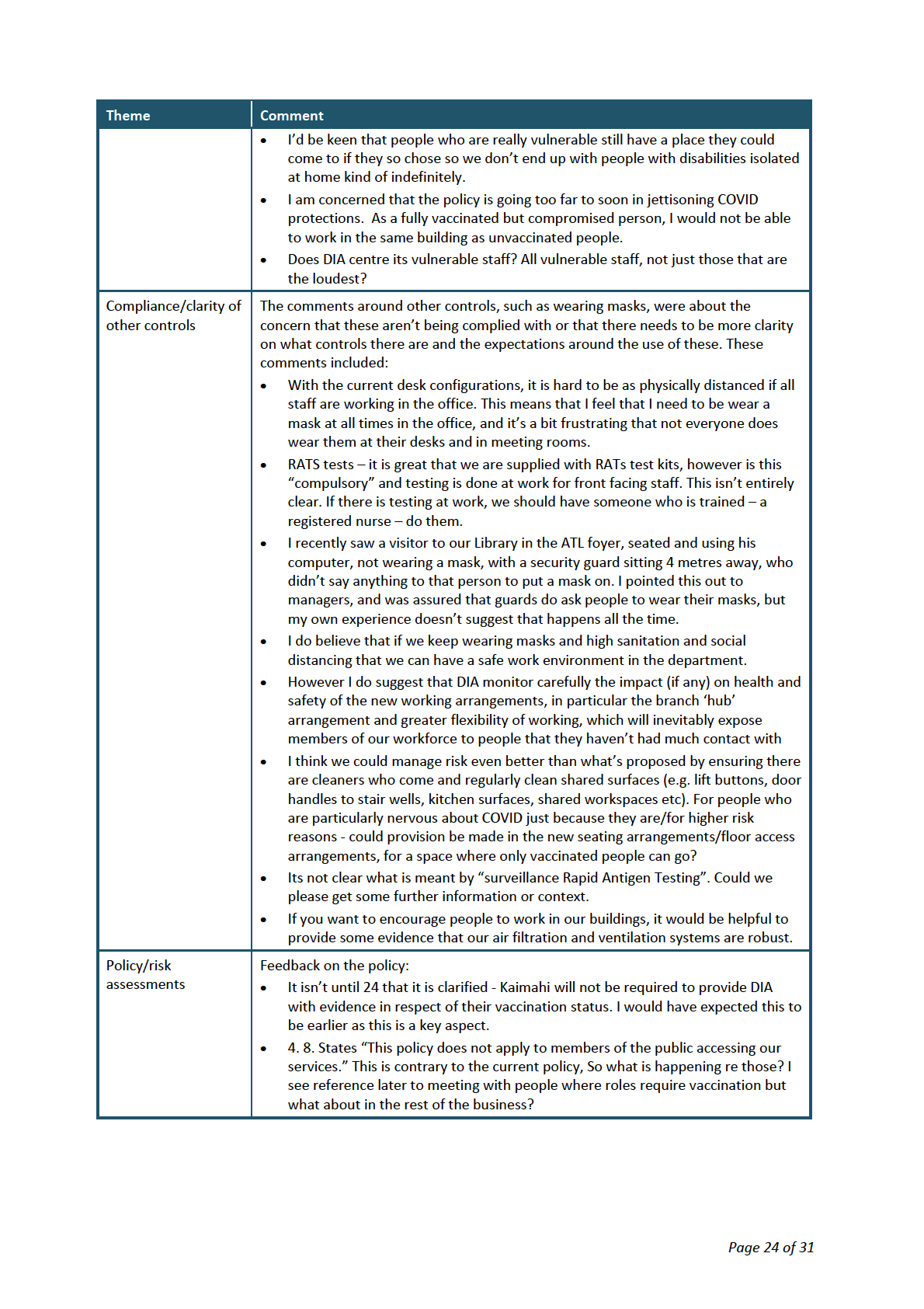
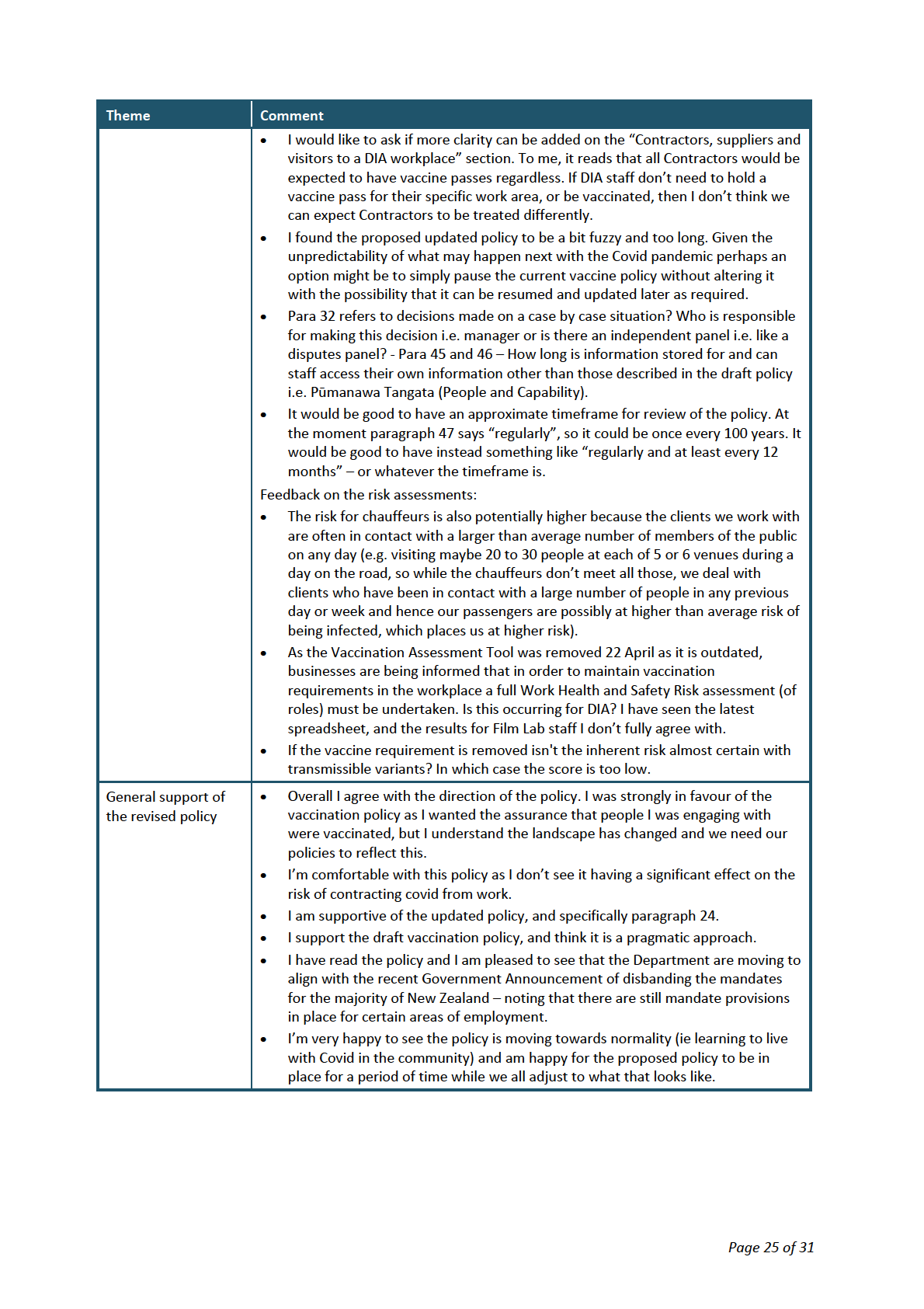
Taiwhenua. We anticipate that ELT wil have some choices about how to proceed and
we recommend bringing back further advice for ELT on a policy for events and
gatherings.
Official
7. On Tuesday 23 November, ELT agreed in principle that DIA will require all members of
the public and visitors to be vaccinated. It is possible that this decision could trigger a
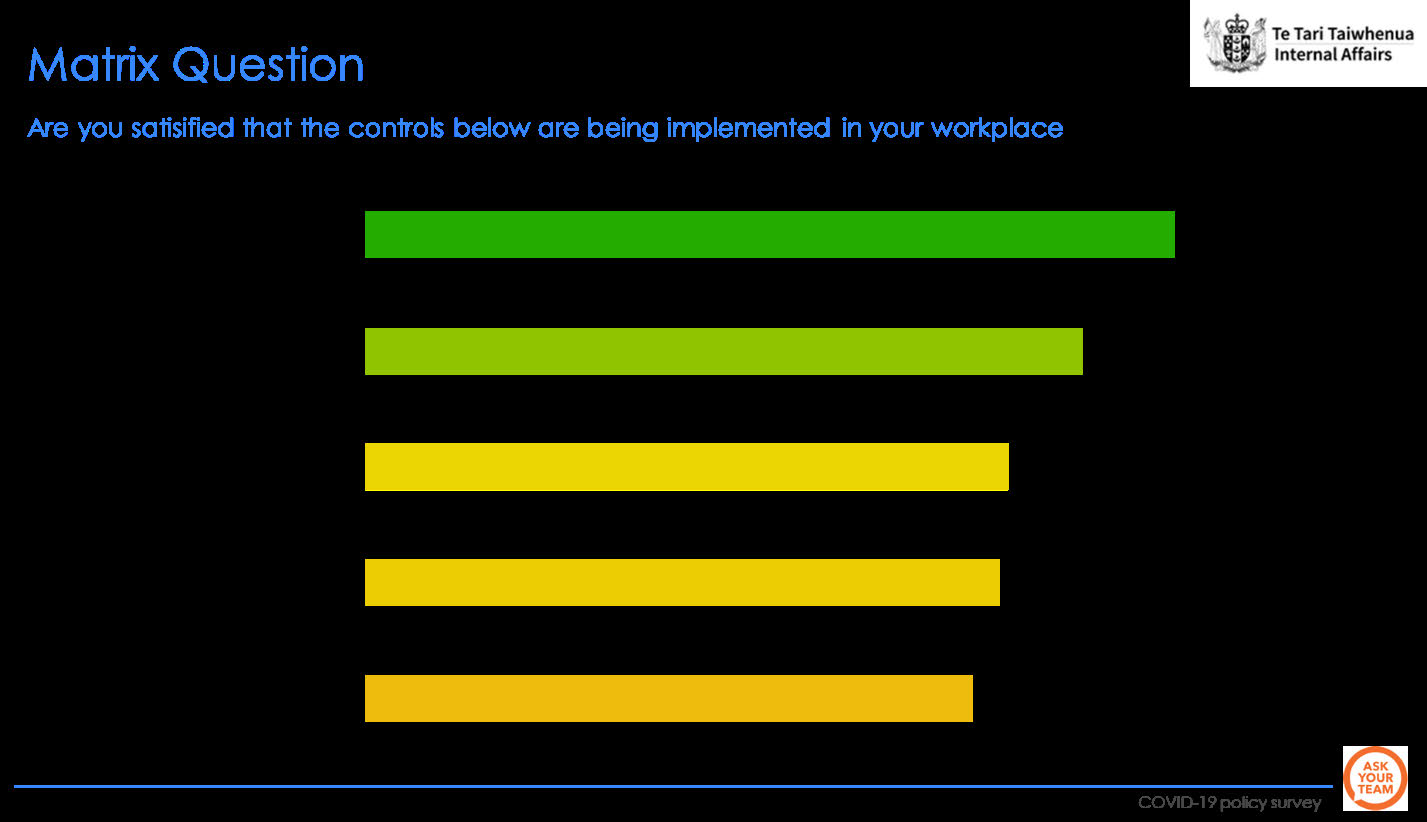
requirement under the CPF for al staff to also be vaccinated. Until the order is made,
the
it is not possible to confirm this. Given this risk, ELT considered that an interim
restriction on access could be put in place for staff, pending the outcome of the risk
assessment process for kaimahi roles.
8. On 23 November ELT also provided feedback on a CPF guide for DIA. This document
under
has now been updated to reflect ELT decisions, feedback from branch representatives,
recent guidance from the Public Service Commission9(2)(h)
.
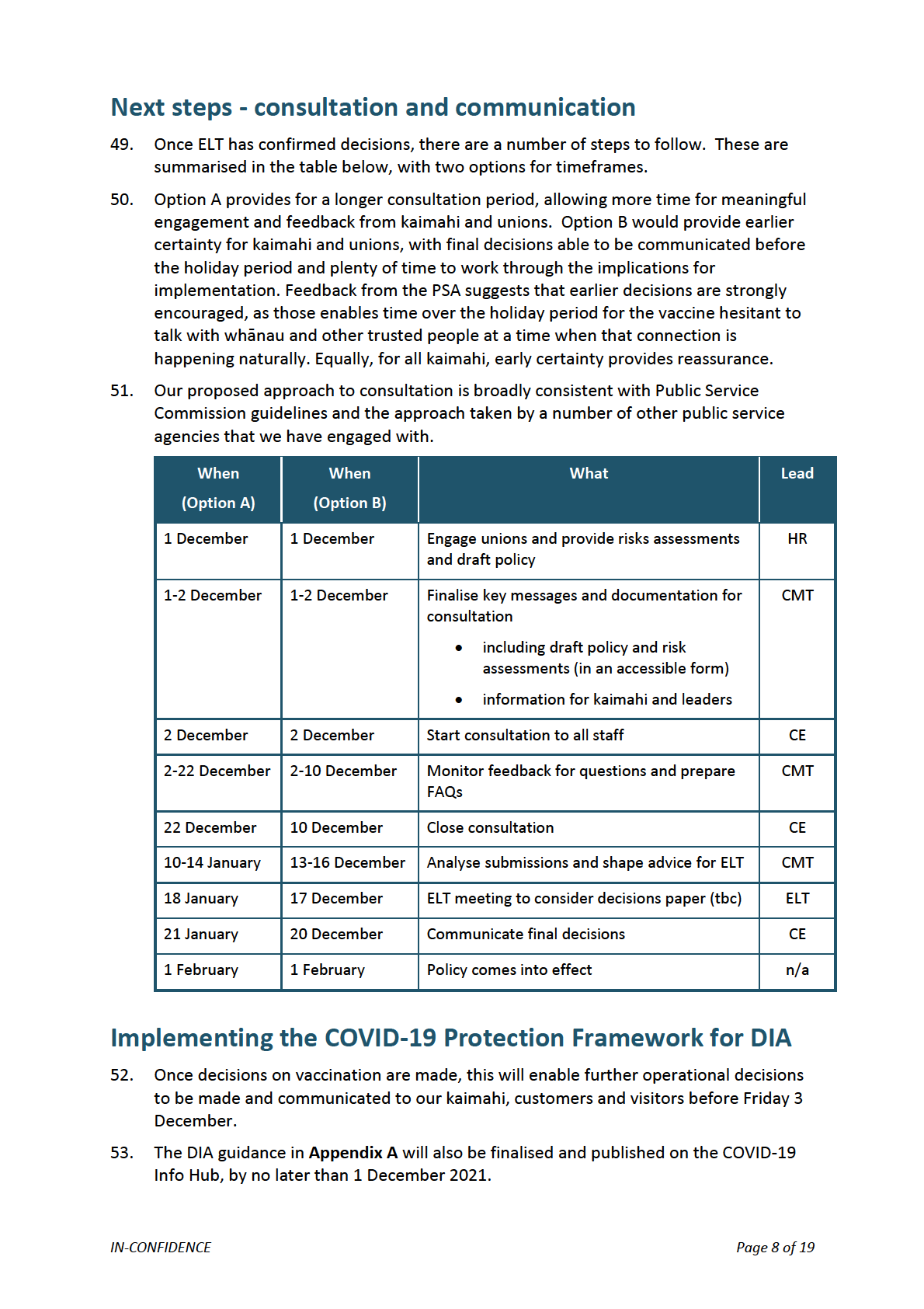
Further details are outlined in the
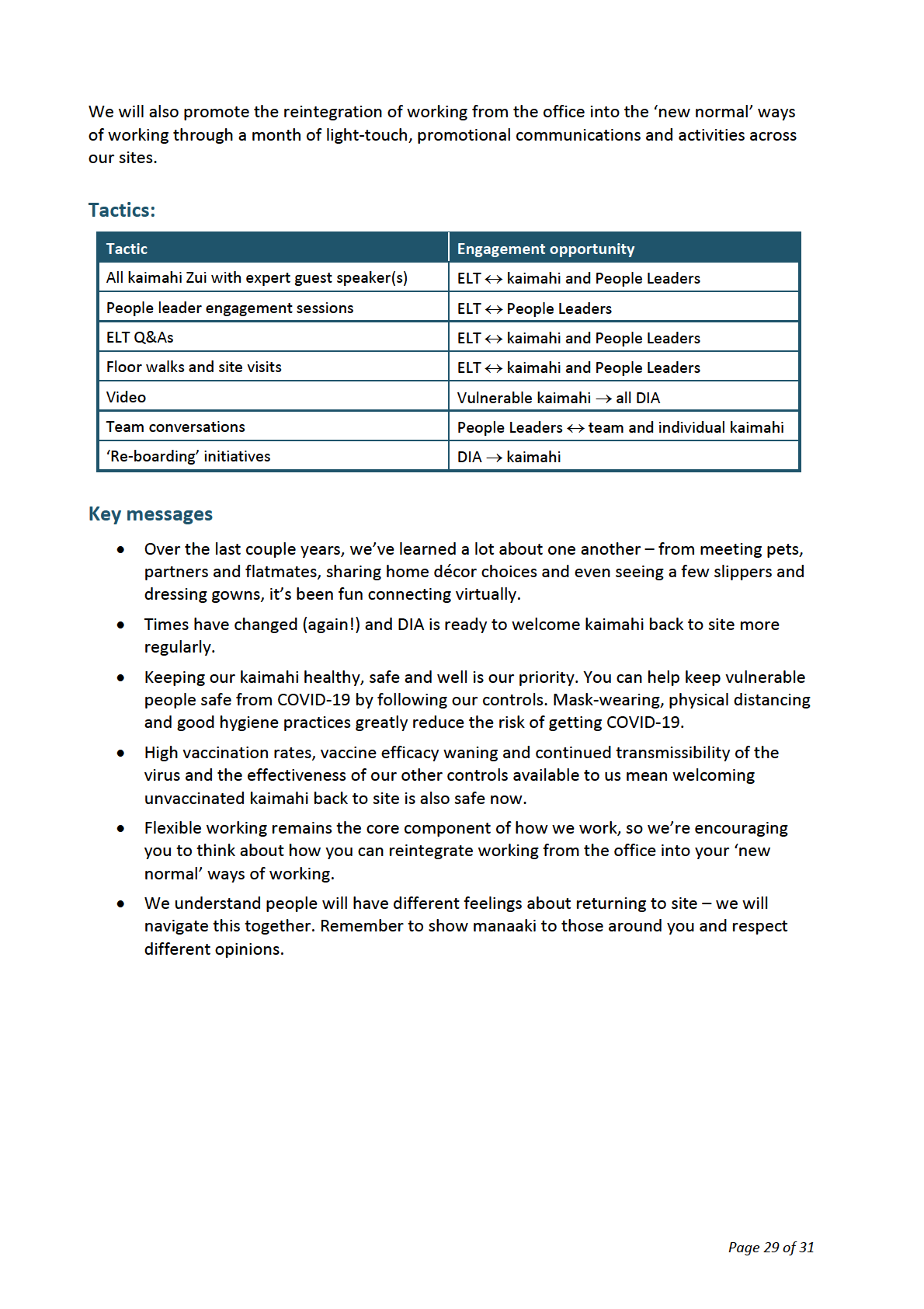
Implementing the COVID-19 Protection Framework
for DIA section at the end of this paper.
9. On Thursday 25 November, ELT agreed to bring forward the timing of mandating
decisions from 7 December 2021 to Tuesday 30 November 2021, to enable decisions to
be made for the whole Department at the same time, and so that consultation with
Released
kaimahi, unions and other relevant groups can start
before the implementation of the
new traffic light system.
IN-CONFIDENCE
Page 2 of 19
Decisions for ELT
10. The ELT Board is responsible for ensuring a safe working environment for employees,
contractors and visitors. As part of this responsibility, the ELT Board is considering
whether to require the fol owing groups to be vaccinated:
a) staff1;
b) members of the public visiting DIA sites to use our services; and
c) other visitors to DIA sites, for example contractors, suppliers and people attending
meetings.
1982
11. Decisions must be made on the basis of health and safety risk assessments. The
Outcome of Risk Assessment Process section of this paper summarises the findings of
these assessments.
Act
12. There are a number of other matters that must be considered in making decisions on a
vaccination policy, including:
a) Whether a vaccination policy is proportionate, as restricting access to our
premises to vaccinated people could be seen as an indirect limitation on the
right to refuse to undergo a medical procedure, which is protected by the New
Zealand Bill of Rights Act 1990 (
BoRA).
b) How restricting access to our sites to vaccinated people wil impact on public
access to DIA services - we need to consider whether any service is esse
Information ntial
and, if it is essential, whether there is a viable alternative to onsite access.
c) How a vaccination policy will impact on Māori (staff and members of the public),
taking into account the Crown obligations under Te Tiriti o Waitangi
d) Ensuring that any policy does not discriminate, for example on the basis of age,
Official
ethnicity, disability or religious belief.
13. In some circumstances there may be additional factors to be taken into account, such
as:
the
a) National Library and Archives New Zealand both have statutory obligations to make
the material they hold accessible to the public. 9(2)(h)
.
under
b) Whether there are any contractual constraints on imposing vaccine requirement
for contractors and suppliers
14. These matters are canvassed in the following sections of this paper.
15. Following the ELT Board decisions, a number of further steps wil be required. These
are outlined in the
Next steps - consultation and communication section below.
Released
1 Other than those to which a statutory vaccine mandate applies.
IN-CONFIDENCE
Page 3 of 19
What our kaimahi are telling us
16. There is high demand from leaders and kaimahi for more information, to support them
to prepare for the transition to the new CPF, and frustration about the lack of detail
about DIA work arrangements under each colour of the CPF. Kaimahi are also
expressing concern about working alongside unvaccinated colleagues.
17. Information from the recent Whakahōki Kōrero survey indicates that our kaimahi are
wanting Te Tari Taiwhenua to take a clear position as soon as possible on mandating
vaccines in our workplace.
1982
Outcome of Risk Assessment Process
18. The Department, as an employer, and PCBU, has duties under the Health and Safety at
Act
Work Act 2015 (HSWA) to ensure, so as far as reasonably practicable, the health and
safety of our employees. Equal y, our employees have their own health and safety
obligations to ensure, so as far as reasonably practicable, their own health and safety
and that of others. This requires known hazards to be eliminated where possible, and if
not possible, minimised by employing all reasonably practicable means to do so.
19. The risk assessment framework followed by DIA is broadly consistent with the
approach taken by other public service agencies. 9(2)(h)
Some of these
Information
considerations included:
a) Work activities that involved contact with the public, contractors, and staff from
other sites or agencies
b) Work activities undertaken by public facing versus ‘back-office’ roles and the
degree of intermingling across roles and work environments, including the need
Official
for flexibility of deployment in some role types
c) Frequency and length of exposure
d) The expectation that community cases would increase, balanced with the
the
greater number of vaccinated people
20. Risk assessments based on role types across DIA have now been carried out. An
example is included at
Appendix B. Role types included al roles that complete some
form of public facing activity, as well as a number of role types that have no public
under
facing activities.
21. Branches, in consultation with the Wel being Health and Safety (WHS), identified role
types across each branch, including MEC and the Royal Commission. Initial risk
assessments were then completed by WHS and feedback was provided by branches.
22. The risk assessments found that in al role types across all branches there was at least
a medium level of risk of COVID being contracted or transmitted, with the likelihood of
severe consequences. In role types where there were public facing activities the risk
Released
exposure increased to a high risk rating. This has resulted in risk ratings from 19
(Medium) to 24 (high) across all groups, using DIA’s risk matrix.
23. Approximately 80% of the role types assessed resulted in risk ratings of 22-24 (High).
The risk assessments found that the risk profile reduced after the controls described in
this paper were considered, resulting in approximately 65% of roles found to have a
residual risk rating of 9-13 (Moderate).
IN-CONFIDENCE
Page 4 of 19
24. Risk assessments were completed at pace and with only a smal group of key contacts
across each branch, a thorough consultation process has not yet taken place that
includes employees, unions, health and safety or branch representatives.
25. Public health guidelines (such as the use of face coverings, basic hygiene measures,
physical distancing, the use of QR codes etc.) if strictly adhered to, wil reduce the
likelihood of transmission further. There is a risk that these are not adhered to.
Additional y where multi-layered controls can be applied together with vaccination,
this would provide a more robust form of risk control.
1982
Recommended controls
26. Given that nature of the work activities carried out across DIA and the identified risk
exposure of all role types, vaccination is recommended as the most effective control
Act
for these groups to reduce the likelihood of transmission.
27. If mandatory vaccination is implemented, it is possible COVID-19 still could be
contracted, but the likelihood of this is reduced, and the consequence of contracting
COVID-19 is also reduced.
28. It is proposed to consult with kaimahi, unions and other relevant parties on a Draft
Vaccination Policy for DIA, included as
Appendix C.
9(2)(h)
Information
Official
the
under
Released
IN-CONFIDENCE
Page 5 of 19
9(2)(h)
1982
Act
Information
Official
the
under
Released
IN-CONFIDENCE
Page 6 of 19
9(2)(h)
1982
Act
Considerations and risks
43. We recommend that ELT does not seek to implement a vaccination mandate by Friday
Information
3 December. We think it is preferable to consider the position of staff, contractors and
visitors together and to consult with staff and contractors before making a final
decision.
44. The current vaccination status of our employees is unknown however we have
assumed that vaccination rates are largely representative of the wider New Zealand
population (i.e. as at 26 November 2021, 85% of the
Official eligible population has received
two doses). If mandatory vaccination is implemented and the vaccination rates are
lower than anticipated, this could result in a more significant percentage of staff who
may be unable to continue their current employment.
the
45. We could mitigate this risk by ensuring adequate lead-time for any changes to allow
time to recruit or redeploy existing resources to minimise disruption. Consideration
should also be given to whether kaimahi could work solely from home for extended
periods of time, noting that this has already been the case for some Auckland kaimahi,
under
as a result of Alert Level restrictions.
46. Consideration should also be given to the fact that there wil be a disproportionate
impact for Māori and Pasifika kaimahi as the vaccination rates for those populations
(esp Māori) are lower than other populations.
47. Further work needs to be done to identify and consult with other PCBUs where we
have joint or overlapping responsibilities for health and safety. This could also be
progressed during the period for staff consultation.
Released
48. Providing assurance and clarity of our intentions to our people, along with seeking
their views, wil be key. The proximity to the Christmas close-down period means a
number of our staff wil be on leave from mid-December until mid-late January 2022.
IN-CONFIDENCE
Page 7 of 19
1982
Act
Information
Official
the
under
Released
54. It should be noted that there have been some changes to MOH and PSA guidance since
ELT discussed the previous version of the DIA guidance A3, which will impact decisions
previously taken by ELT. Specifically:
a) In Red, guidance is now for workplaces to be Open and ‘working from home
may be appropriate for some workers’, and not closed.
b) Although PSC guidance suggests that a Vaccine Pass may be a condition of entry
for visitors, including contractors, our recommendation, as outlined above, is
that we include this as part of our consultation process, before ELT confirms any
decision.
1982
Act
Information
Official
the
under
Released
IN-CONFIDENCE
Page 9 of 19
 Appendix A
1982
Act
Information
Official
the
under
IN-CONFIDENCE
Page 10 of 19
Released
1982
Act
Information
Official
the
under
Released
1982
Act
Information
Official
the
under
Released
9. The timeframe for having at least one vaccination is XX XXXXXXXX XXXX. Full
vaccination is required by XX XXXXXXXXXX XXXX.
Health and safety risk assessment - transmission of COVID-
19 in the workplace
10. Te Tari Taiwhenua has assessed the risk and impact of a COVID-19 infection for
kaimahi based on an assumption of a highly transmissible variant and spread of
community transmission. The Health and Safety risk assessments are available here. 1982
11. The assessments identify the mahi that involves contact with others, the most credible
worst-case scenario associated with the risk of infection with COVID-19, and the
likelihood of transmitted infection occurring and it leading to that consequence.
Act
12. The inherent risk, residual risk with current controls (e.g., barriers, masks,
handwashing, distancing), and the effect of having al kaimahi/employees, contractors
and visitors vaccinated on the risk ratings have been assessed.
13. The risk assessments reflect the public health advice that vaccination is the highest
level of control, reducing both likelihood and consequence (severity) of infection.
Vaccination is the only control that reduces the residual risk to a medium risk.
14. The risk assessments wil be revised should any factors change and could change if
other controls become available, for example, rapid antigen testing.
Information
Jobs with a legal y mandated vaccination requirement
15. Some jobs require vaccination under law. The jobs covered by mandatory vaccinations
may change over time.
Official
16. Existing kaimahi in jobs with mandated vaccination requirements must provide a copy
of their vaccination record to their manager.
17. Where vaccination status is not disclosed that person will be treated as unvaccinated
the
and wil be encouraged to get vaccinated (where medically possible) with support
provided as much as possible to make that decision.
18. For kaimahi who are unable to be fully vaccinated, or choose not to be fully
vaccinated, or do not provide proof of vaccination, managers will be available to
under
discuss alternative options including redeployment. If redeployment is not possible,
then termination may be considered on a case by case basis. Te Tari Taiwhenua’s
priority is to retain kaimahi and accommodate individual choice wherever possible.
19. New appointees to jobs with mandated vaccination requirements must provide proof
that they are fully vaccinated and including boosters before an employment offer is
made.
Released
Unvaccinated kaimahi/employees, volunteers, contractors
and visitors to a DIA site; and kaimahi/employees and
volunteers visiting other sites
20. Contractors and visitors will be advised of the vaccination requirements and wil be
required to provide proof of vaccination before entering a DIA site.
IN-CONFIDENCE
Page 13 of 19
21. Kaimahi/employees should exercise caution when considering bringing anyone under
the age of 12 years onto a DIA site.
22. Managers will work to understand the individual situation of employees or volunteers
who are not vaccinated, choose not to be vaccinated, choose not to disclose their
vaccination status or are unable to be vaccinated (e.g. for medical reasons). Kaimahi
who are unable to be vaccinated wil be required to provide evidence of this from the
Ministry of Health.
23. Decisions about individuals will be made on a case-by-case basis in consultation with
that individual. The nature of the work undertaken, the way the individual works, the
ability for them to undertake their work from an alternative location, the availability of 1982
alternative work and the reason(s) for the individual not being vaccinated will be taken
into consideration.
Act
24. Kaimahi/employees will have the opportunity to respond to any proposed changes to
their employment and feedback wil be taken into consideration before any final
decisions are made. Kaimahi can meet with their manager and have a support person
of their choice present. Should they decide to have the vaccination, Kaimahi wil be
supported to do so.
25. If other options or redeployment are not possible, termination may be considered as a
last resort on a case by case basis. Kaimahi will be provided with notice as provided for
in their employment agreement. Te Tari Taiwhenua’s priority is to retain kaimahi and
accommodate individual choice wherever possible. Information
Vaccination status
26. Kaimahi/employees are asked to disclose their vaccination status by providing a copy
of their COVID-19 vaccination certificate or My Health Record to their manager.
Official
27. Al prospective new kaimahi must provide a copy of their COVID-19 vaccination
certificate or My Health Record prior to an offer of employment being made.
28. Prospective new kaimahi who cann
the ot be vaccinated for medical reasons and provide
proof of this as provided by the Ministry of Health, will have their circumstances
considered on a case by case basis to ensure they can do the job safely unvaccinated.
29. Recruitment advertisements will include the requirement that kaimahi must be fully
vaccinated before they can commence employment.
under
30. Vaccination records can be obtained from https://app.covid19.health.nz/.
31. If an employee chooses not to provide their vaccination status, they wil be considered
to be unvaccinated and treated as an unvaccinated employee as outlined above.
Leave
32. Special paid leave is available for kaimahi to get vaccinated and for them to support
Released
their whanau to get vaccinated.
33. Special paid leave is available in the event an employee feels unwell after their
vaccination.
34. Sick leave is available to support whanau if they become unwell after their vaccination.
IN-CONFIDENCE
Page 14 of 19
Gaining and storage of personal medical information
35. Kaimahi will provide their manager with a record of their vaccination certificate or
confirmation of their vaccination. Managers wil record the vaccination status of their
team including those who are unvaccinated, can’t be vaccinated or choose not to say.
36. Information will be stored in the HR Information System and will only be accessible to
those people in Pūmanawa Tangata (People & Capability) who need to have access to
this information.
Policy review
1982
37. This policy will be reviewed as required for example when new information becomes
availlable from the Ministry of Health
Act
Information
Official
the
under
Released
IN-CONFIDENCE
Page 15 of 19

9(2)(h)
1982
Act
Information
Official
the
under
Released
IN-CONFIDENCE
Page 16 of 19
9(2)(h)
1982
Act
Information
Official
the
under
Released
IN-CONFIDENCE
Page 17 of 19
9(2)(h)
1982
Act
Information
Official
the
under
Released
IN-CONFIDENCE
Page 18 of 19
9(2)(h)
1982
Act
Information
Official
the
under
Released
IN-CONFIDENCE
Page 19 of 19
1982
Act
Information
Official
the
under
Released
Background
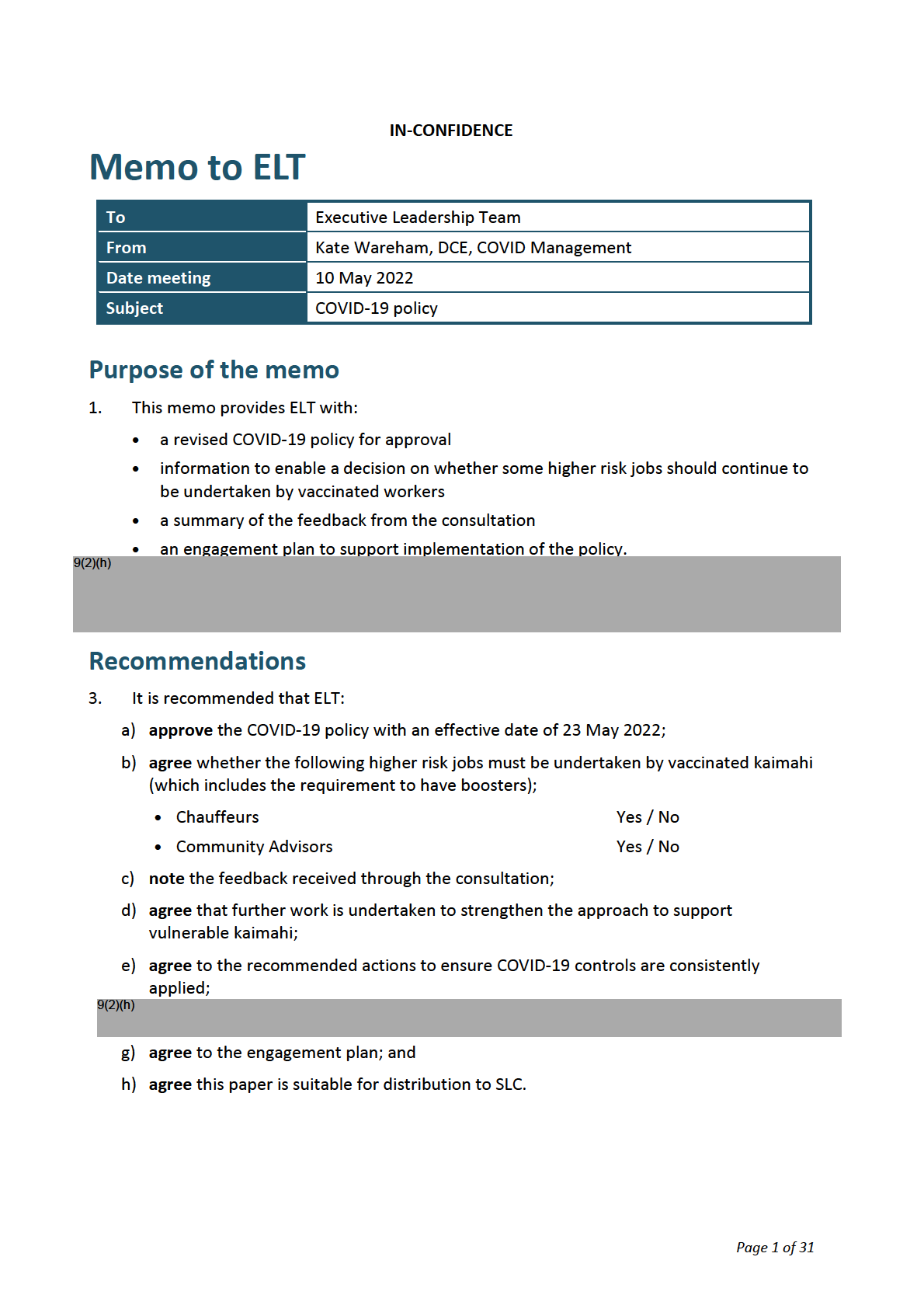
4. On 26 April 2022 ELT agreed to consult with kaimahi on revised draft COVID health and
safety risk assessments completed in March 2022 and a revised draft COVID-19 policy.
5. Consultation was open from 27 April to 3 May 2022 with kaimahi able to provide
feedback through an online survey and/or via email. There were also thirteen zoom drop-
in sessions for kaimahi to discuss the revised policy and risk assessments, raise questions
and share their views and feedback. Sessions were held with the Tangata Whenua
network, Taha Moana network, people leaders, the PSA delegates, E tū members and all
kaimahi.
1982
6. Around 90 kaimahi attended the drop-in sessions. Participation was significantly lower
compared to consultation on the policy in December 2021. Very few people leaders
Act
attended the sessions. While the number attending the drop-in sessions was low, those
that did attend were open, honest and shared their personal experiences. The online
survey generated 366 responses and 49 written submissions were received.
COVID-19 policy
7. Kaimahi indicated support for both the risk assessments and revised policy.
Information
8. The feedback on the risk assessments confirmed that they reflect the risks across DIA with
71% (of 318) of those who responded to the online survey supporting the risk
assessments.
9. The revised policy was supported with 72% (of 318) of those who responded to the
survey question “
Do you support the proposed revised COVID-19 policy” answering
“supported” or “strongly supported”. Official
10. General feedback on the policy included:
• why has the application of the policy to members of the public accessing our services
the
been removed
• more clarity needed on the “Contractors, suppliers and visitors to a DIA workplace”
section
• policy is too long. An option could be to pause the current policy so that it can be
under
resumed or updated later if required
• add a better timeframe for the review of the policy
• the policy still contains a termination clause.
11. Amendments to the policy have been made fol owing feedback. The key changes are:
• Improving the policy overview with improved wording for the mātāpono. Feedback
was provided by Toma Mason, Kaiarahi Matua, Toi Hiranga.
Released
• That the policy applies to the public accessing our services and the Exceptions
paragraphs for the Chief Archivist and National Librarian have been added.
• Clearer and plain english descriptions of the safety and wel being measures that can
reduce the transmission of COVID-19.
Page 2 of 31
• Review and rewrite to simplify the “Vaccination” section.
• Review by Communications for plain english and an easily understood policy.
12. The revised COVID-19 policy is attached as Appendix 1.
13. Based on the risk assessments, and the support from kaimahi through the consultation
process, it is recommended that ELT approve the COVID-19 policy and that it wil come
into effect from 23 May 2022.
Policy inequity analysis
1982
14. There is potential for any vaccination mandates to create inequities for Māori, Pasifika
and other communities who may be less likely to be vaccinated.
Act
15. The total number of unvaccinated kaimahi is low. Removing the vaccination requirement
will mean all kaimahi can return to working in the office reducing any inequities (other
than any higher risk roles that continue to require vaccinated kaimahi). As we are
removing the requirement for vaccination for new kaimahi there could be inequities
should vaccination mandates be implemented in the future because we may employ
unvaccinated people.
16. During consultation concern was raised about kaimahi who are unable to do their job
from home who may use more sick leave if they or their whanau contract COVID. This
Information
could more adversely affect vulnerable kaimahi and those in lower paid roles. When
kaimahi do not have sick leave available managers are guided to consider paid special
leave in the first instance.
17. Key to the identification of higher risk jobs is the amount of time working with vulnerable
communities. Some of these jobs are undertaken by Māori or Pasifika kaimahi. If it is
determined these jobs should be undertaken by vaccina
Official ted kaimahi there may be
consequences for any unvaccinated Māori or Pasifika kaimahi in those jobs.
18. In removing the vaccination requirements there is potential for heightened risk to
the
vulnerable people which includes our Māori and Pasifika kaimahi. This is particularly so if
there is inconsistent application of other COVID controls (mask wearing, distancing etc).
19. If broad vaccination mandates are required in the future, there may be impacts on the
Department’s ability to continue to provide our services to vulnerable communities.
under
Roles continuing to require vaccinated workers
20. Jobs in the Visits and Ceremonial Office based at Auckland airport remain covered by the
requirements of the COVID-19 Vaccination Order as they work at the border. This
requires workers to be fully vaccinated including boosters, which our kaimahi are.
21. At ELT on 26 April 2022, several jobs were identified that when reviewed against
WorkSafe risk factors kaimahi could be at greater risk of getting sick at work than in their
Released
normal life or there is a public health rationale based on protecting vulnerable people and
communities.
Page 3 of 31
22. Consultation has been completed with kaimahi in the fol owing jobs identified as being
potentially higher risk:
• VIP Chauffeurs
• Hapai Hapori Community Advisors
• MaSS Ministerial Advisors and Press Secretaries.
23. ELT need to make a decision on whether these jobs are higher risk and need to continue
to be undertaken by a vaccinated worker. Information to support ELT in making decisions
on these jobs is provided in Appendix 2.
1982
24. Consultation on other higher risk jobs within the Royal Commission into Abuse in Care will
be undertaken and information provided to ELT by the end of June. The Ministry for
Ethnic Communities will also consult on higher risk jobs in June.
Act
25. During consultation some National Library kaimahi raised that some of their jobs may be
at higher risk. These were reviewed, and it has been determined that the current risk
levels are appropriate.
26. Further information on higher risk jobs is provided in Appendix 2.
Determining whether to maintain a vaccination requirement
Information
27. When considering whether to maintain a vaccination requirement for high risk jobs there
are two options. The first is to require only vaccinated kaimahi can undertake the job.
28. The second option is to strongly recommend vaccination and rely on managers
completing risk assessments for higher risk activities to determine whether these
activities would be more safely carried out by a vaccinated worker. (This is the approach
Official
MBIE is implementing for their field workers.)
29. If a risk assessment identifies the activity is with a particularly vulnerable person or
community, or confined space, managers can determine that the engagement should be
the
undertaken by a vaccinated kaimahi rather than an unvaccinated kaimahi. This may also
natural y occur if the community group has its own vaccination requirements.
30. This also may not always be practical if the role requires an ongoing relationship with a
vulnerable person/community. Resource or skill constraints within teams may also mean
under
it is not practical to reallocate higher risk engagements from unvaccinated kaimahi to
vaccinated kaimahi all of the time. However, this option does enable teams the flexibility
to make these risk-based decisions as required.
31. Information to support ELT to make decisions on maintaining a vaccination requirement
are provided in Appendix 3.
9(2)(h)
Released
Consultation feedback themes
33. A summary of feedback themes, information from the online survey and feedback from
the Tangata Whenua Network and the PSA is available in Appendix 5. The full written
submissions are available here.
Page 4 of 31
34. In all the drop-in sessions kaimahi discussed:
• their concerns for vulnerable people
• the lack of commitment across the Department to other COVID-19 controls
particularly limited use of facemasks and inability to appropriately distance from
others.
Concern for the vulnerable
35. Kaimahi shared and discussed concerns not just about their own vulnerabilities but the 1982
impacts on vulnerable colleagues, friends and whanau, and those they work or interact
with in the community.
Act
36. Vulnerable people expressed anxiety about coming back into the office when they may
not be ready and that working from home is their safe environment. The recent
messaging of the restack of Pipitea Street and the increase in the number of people on
each floor along with kaimahi not wearing facemasks or practising physical distancing,
especially in meeting rooms increases their levels of anxiety. Some vulnerable kaimahi
said they were prepared to share their experiences in an 1840 story or short video,
communications are progressing this.
37. It is recommended that further work is undertaken to strengthen the approach to support
vulnerable kaimahi, focus on supporting people leaders to engage wel to discuss the
Information
options and support available for vulnerable kaimahi.
38. Kaimahi who are not vulnerable also expressed anxieties. While this may not be at the
same level of risk as for vulnerable kaimahi they clearly outlined how their mental health
and wel being is being impacted. The wel being aspects of kaimahi as they adjust to
changing working requirements should be actively considered in communications and by
Official
people leaders.
Lack of commitment to other COVID controls
the
39. There is poor and inconsistent implementation of controls that can restrict the
transmission of COVID, particularly around facemasks and appropriately distancing from
others. It was felt the Department is very relaxed about using these controls, they are
encouraged rather than enforced, leaders are seldom seen to be role modelling. There is
under
a perception that removing the vaccination requirement will increase the risk to kamahi
more generally.
40. This interactive framework Visualising SARS-CoV-2 transmission routes and mitigations |
The BMJ shows how simple precautions such as mask wearing, physical distancing and
hand washing can protect everyone.
41. Concerns were also raised that the level of cleaning described was not being carried out
Released
and Rapid Antigen Testing appeared to be stopping as supplies of the tests were used.
Page 5 of 31
42. The ongoing and effective use of other COVID control protections is important because
they are the basis on which the Department shifting from vaccination being the primary
control in the risk assessments. The risk of transmission is still high, and the risk that an
infected person could suffer adverse effects (including long-Covid) also remains high.
Setting an expectation that kaimahi follow public health messages is important,
particularly as there remains a high risk that kaimahi wil come into contact with people
who are infectious (including visitors).
43. Demonstrating the importance of maintaining these basic protections in our workplaces
will assist in easing the anxiety of kamahi when returning to work and build confidence
that their safety is a priority. This is particularly important for our vulnerable kaimahi.
1982
44. Monitoring and reviewing the effectiveness of controls is an important part of managing
the risk of COVID-19 spreading in the workplace. It is recommended the fol owing actions
Act
are undertaken to ensure that controls are consistently applied:
• leaders actively role model the controls by wearing masks while moving, encouraging
1m distancing in meetings and seating arrangements
• ELT and SLT set expectations with their direct reports
• Emergency Site Managers are also supported to implement the controls such as
ensuring signage is up, masks and RATS are available (where required)
Information
Working with or being near unvaccinated kaimahi or the public
45. Not knowing whether new kaimahi are vaccinated was raised. The current recruitment
campaign for LISOs was identified as a concern. Vulnerable people noted this increased
their anxiety as it would be harder to protect themselves as they are unsure about the
vaccination status of these people. Official
46. A small number of concerns were raised about how the unvaccinated wil integrate back
into the office. There were different perceptions shared about the work done by
unvaccinated people over the last three months. Concerns were raised about contracting
the
COVID from an unvaccinated person. It is important that our communications approach
continues to educate people about COVID transmission as it is evident that vaccinated
people also transmit the Omicron variant.
47. Some kaimahi are concerned about the close proximity when dealing with the public and
under
the uncertainty of whether they are vaccinated. Examples included those who are in the
public reading rooms in the National Library who refuse to wear masks.
Engaging with kaimahi
48. Some kaimahi are concerned about coming into the office under the new policy while
COVID-19 is still present in the community, particularly those who are vulnerable or have
Released
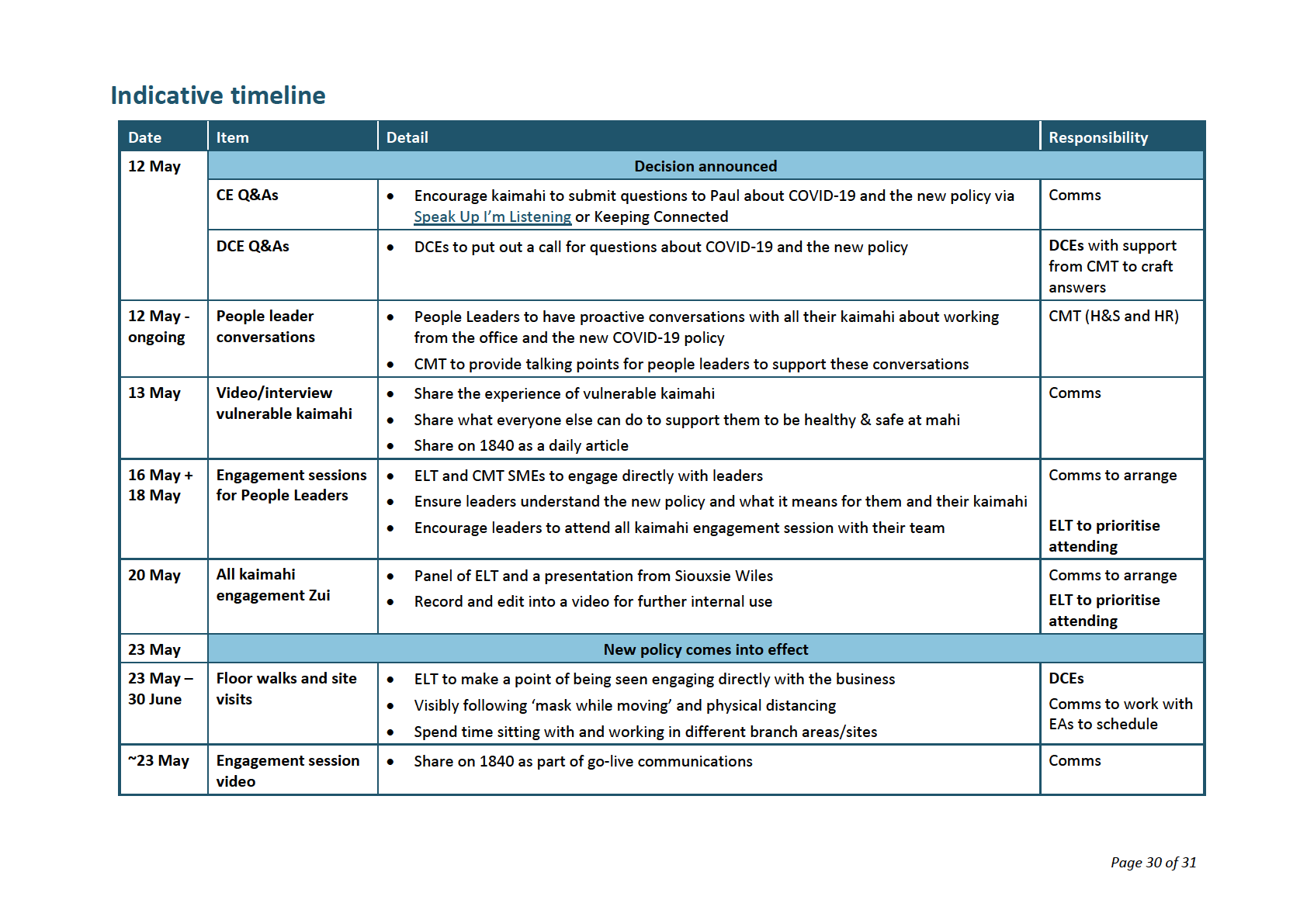
vulnerable people at home. An Engagement Plan has been created to support ELT to
address concerns kaimahi have and help them feel safe working on-site.
49. The plan focuses on acknowledging these concerns and supporting kaimahi to understand
how other controls, when properly implemented, greatly reduce the risk of COVID-19 and
make it safe to return to the workplace.
Page 6 of 31
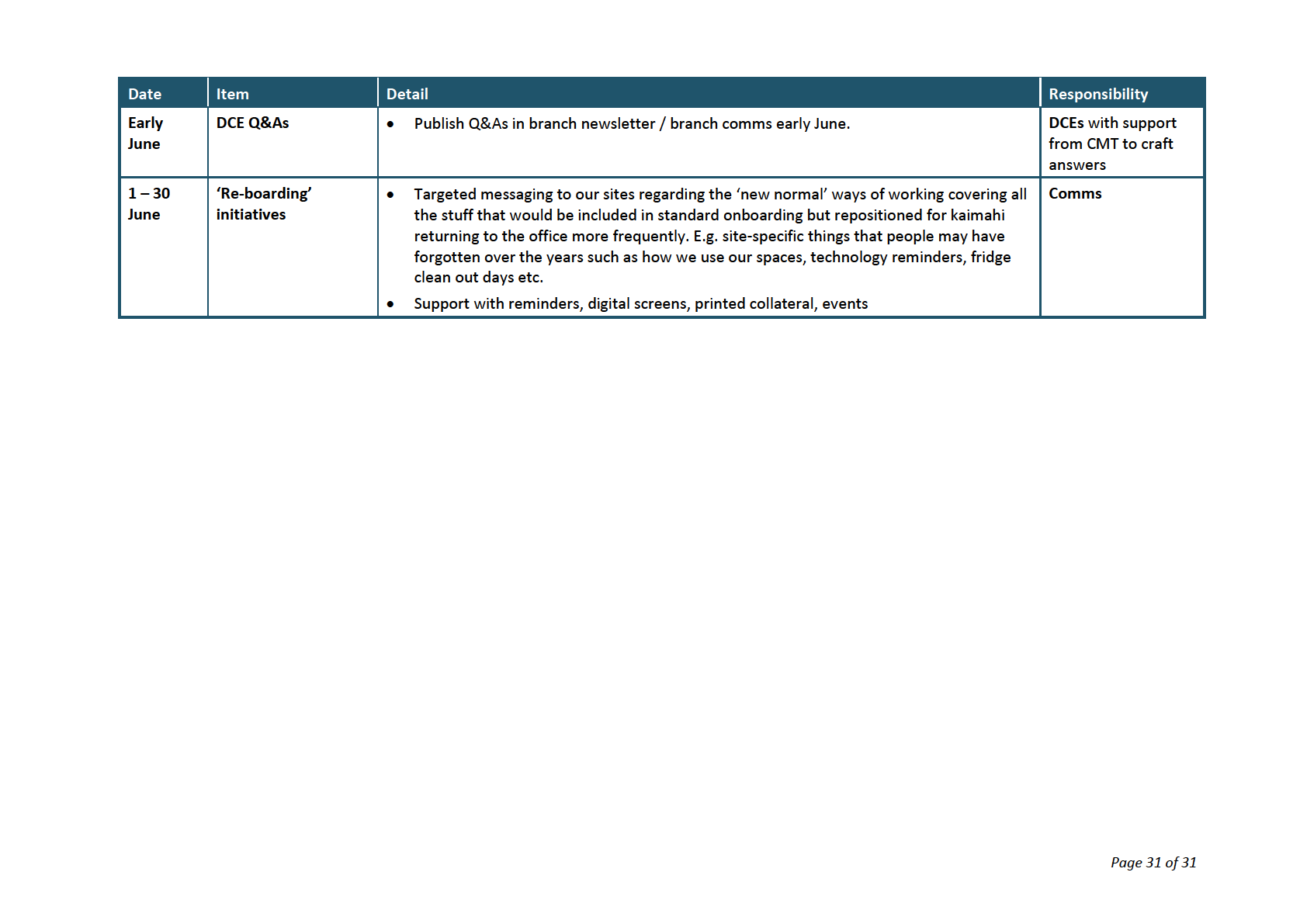
50. The plan also promotes the reintegration of working from the office into ‘new normal’
ways of working through a month of light-touch, promotional communications and
activities across our sites.
51. While the plan is currently weighted towards people returning to the office it will
continue to be refined to ensure balanced messages for all kaimahi.
52. The Engagement Plan is attached at Appendix 6.
53. It is recommended that ELT approve the Engagement Plan.
1982
Act
Information
Official
the
under
Released
Page 7 of 31
1982
Act
Information
Official
the
under
Released
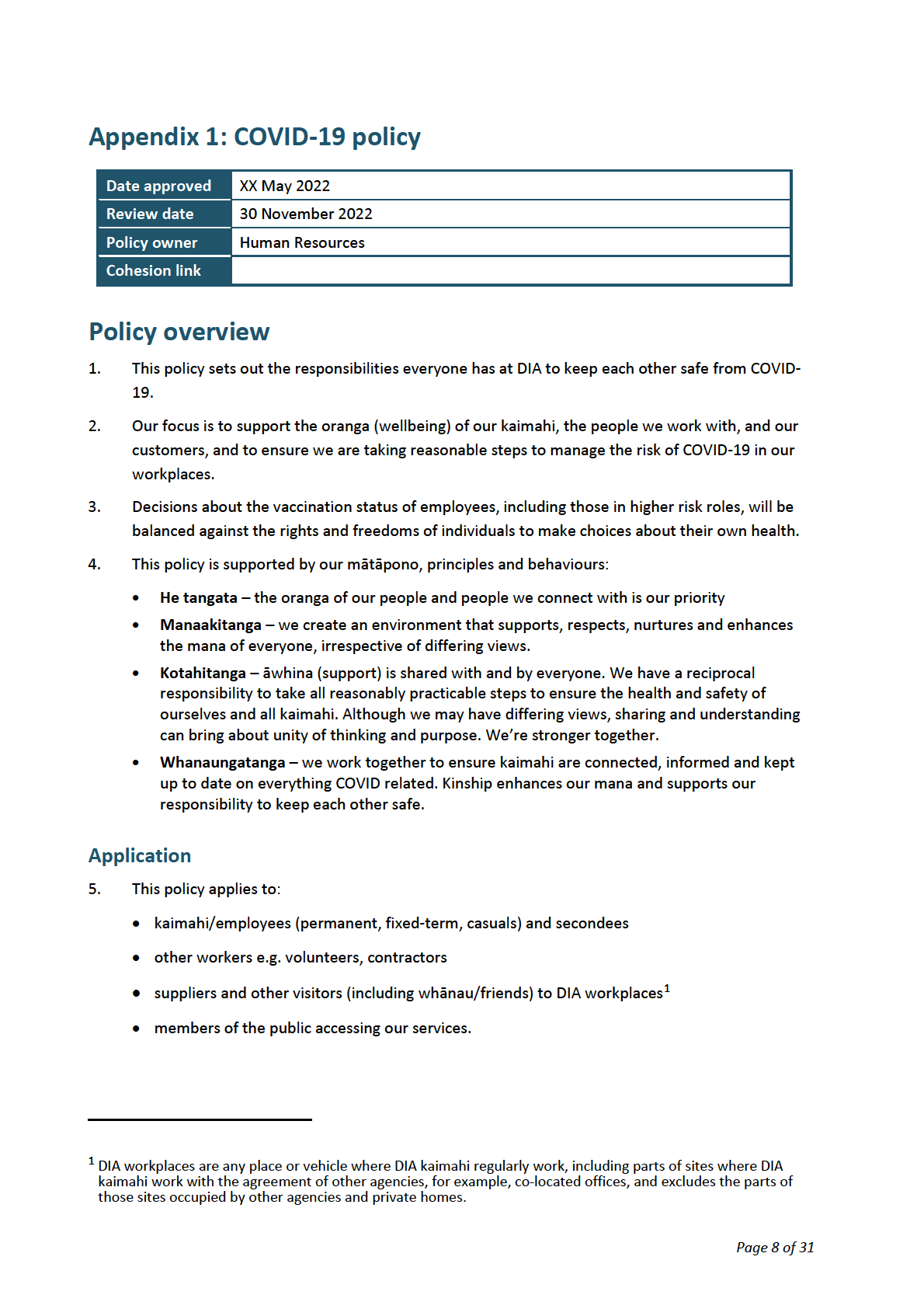
Exceptions
6.
The Chief Archivist may approve exceptions to this policy to allow members of the public to
access public records under Archives New Zealand’s control.
7.
The National Librarian may approve exceptions to this policy to allow members of the public to
access the collections of the National Library and the Alexander Turnbull Library.
Delegated authorities
8.
The delegated authorities that apply are governed by the Delegation Policy on the intranet (1840). 1982
Policy detail
Act
9.
COVID-19 is a highly transmissible virus with widespread community transmission, which is likely
to be ongoing as strains appear or mutate. The effects can be serious and ongoing. This poses a
risk that our kaimahi and those we interact with at work may become infected.
10. DIA needs to take all reasonably practicable steps to manage COVID-19 in our workplaces in a
flexible and agile way, given the rapidly-changing environment.
11. When making decisions to amend this policy, DIA wil be guided by current public health advice
from the Ministry of Health, health and safety advice from WorkSafe (in relation to the
management and control of COVID-19) and balanced against the preservation of the basic rights
Information
and freedoms that individuals have to make decisions about, and manage their own health.
12. Safety and wellbeing measures to reduce the transmission and effects of COVID-19 supported by
DIA include:
• encouraging and supporting kaimahi to be vaccinated, including boosters
Official
• ensuring kaimahi stay home if unwell
• encouraging kaimahi to wear masks where physical distancing of 1m is not possible, for
example in meeting rooms, lifts, communal areas or when moving about the workplace
the
• maintaining physical distancing of 1m wherever possible
• kaimahi in public facing roles being provided and wearing N95 (or similar) masks
• maintaining healthy hygiene habits, such as coughing into your elbow, washing and sanitising
under
hands (hand sanitiser is available at all sites), desk cleaning (cleaning supplies should be
available at all sites), and respecting personal space
• branches providing access to surveillance Rapid Antigen Testing
• reorganising work and supporting flexible working arrangements (see the flexible working
hub).
13. Kaimahi are encouraged to regularly read the information provided on the COVID-19 Info Hub on
Released
1840.
Page 9 of 31
Health and safety risk assessment - transmission of COVID-19 in the workplace
14. DIA’s health and safety risk and impact assessments are completed in line with the Health &
Safety at Work Act 2015.
15. The assessments identify mahi that involves close or higher risk contact with others, and the risk
of kaimahi becoming infected with COVID-19 at work. They also consider worst-case scenarios.
16. The assessments compare the inherent risk (without controls in place) and residual risk (with
available controls in place) of contracting or transmitting COVID-19 in the workplace, and whether
that is higher than it is outside the workplace, in everyday life.
1982
17. The current risk assessments also consider New Zealand’s high vaccination rate, the reduced risk
of infection for those who have recently recovered from COVID-19, and the apparent lowering of
vaccine effectiveness against the transmission and/or effects of recent variants.
Act
18. The assessments are dynamic, reflect the latest public health advice and be reviewed if factors or
the broader environment change. For example, the emergence of a new variant or a significant
change to Ministry of Health or public health advice.
19. The latest assessments are available here. Kaimahi can provide feedback at any time.
Vaccination
20. Vaccination is an important protection for managing the risk to health and safety, particularly for
Information
those at higher risk of severe illness. Vaccination reduces the likelihood and severity of infection.
However, vaccine effectiveness wanes over time. Decisions by DIA on the use of vaccinations as a
protection measure are based on the risk assessment outcomes.
21. DIA encourages all kaimahi to be fully vaccinated against COVID-19. Kaimahi are not required to
be vaccinated or to provide DIA with evidence of their vaccination status.
Official
22. Where the Government makes a statutory decision that kaimahi must be vaccinated to perform a
job or part of a job (for example the COVID19 Public Health Response (Vaccinations) Order 2021)
the
DIA will make that a condition of performing that job.
23. If health and safety risk assessments identify a job, or part of a job, as having a higher risk of
COVID-19 that cannot be sufficiently managed by other controls, kaimahi may, be required to be
vaccinated under this policy.
under
Process when vaccinations are required
24. Where kaimahi are required to be vaccinated to perform their job, they will be consulted prior to
any final decision on that vaccination requirement being made.
25. Kaimahi will be advised of the date(s) they are required to be vaccinated, with enough notice to
allow them to become fully vaccinated.
26. A person will be regarded as fully vaccinated based on the Ministry of Health Guidance at the time
Released
and having received a full course of any of the COVID-19 vaccines approved by the New Zealand
Government (currently described in Schedule 3 of the Vaccinations Order as amended from time
to time), including booster doses. Kaimahi will provide DIA with suitable evidence of full
vaccination status as/when required.
Page 10 of 31
27. DIA will collect evidence of vaccination status and exemption status from kaimahi if they are
required to be fully vaccinated through an official Ministry of Health record regarding COVID-19
vaccination or any other evidence that DIA considers appropriate at that time.
28. The information will be forwarded to Pūmanawa Tangata (People and Capability) and stored
securely in the HR Information System.
29. Kaimahi can choose not to show evidence of their vaccination status but will be considered an
unvaccinated employee for the purposes of this policy.
30. Information held by Te Tari Taiwhenua can be accessed and corrected by the person it is about. 1982
The information is required to ensure compliance with this policy, and to inform decisions
(including decisions that may be adverse) about employment or discussions with kaimahi.
Act
Outcomes for kaimahi who are not fully vaccinated where vaccination is
required
31. Where kaimahi do not meet the vaccination requirements, managers will have discussions to
understand their situation and identify what options may be available.
32. The nature of the work undertaken, the way the individual works, the ability for them to
undertake their work from an alternative location, the availability of alternative work and the
reason(s) for the individual not being vaccinated will be taken into consideration.
Information
33. Decisions will be made on a case-by-case basis. When meeting with their manager kaimahi can
have a support person or representative of their choice present. Should they decide to get ful y
vaccinated, kaimahi will be supported to do so.
34. Te Tari Taiwhenua’s priority is to retain kaimahi and to explore and attempt to agree reasonable
alternative options wherever practicable. However, if other options are not practicable or
Official
available, ending of employment may be considered. Kaimahi will be provided with notice as
provided for in their employment agreement or any relevant statutory notice requirements.
the
Vaccination status of new kaimahi
35. Unless the job requires vaccination under statute or as a result of a decision made by DIA, new
kaimahi do not have to be fully vaccinated to be employed and will not be required to provide any
proof of their vaccination status. They will be advised DIA has a COVID-19 policy that may require
under
them to be vaccinated if it is later determined to be necessary.
36. Where a job requires a vaccinated person, the recruitment advertisement will include that
information.
If an employee does not believe they can work safely in the workplace
37. If an employee is concerned about their safety, the safety of a member of their household or
Released
other close contact managers should:
• Discuss and consider concerns raised by the employee, the impact on them, others in their
household, and other people in the workplace
Page 11 of 31
• Discuss how the health and safety risk assessment, other controls in place and this policy
support the wel being and safety of the employee
• Discuss whether there are any other reasonable controls or actions by the employee that
could help them to feel safer within the workplace
• Determine an appropriate response in line with employer and employee duties under the
Health and Safety at Work Act 2015 and public health advice from the Ministry of Health.
This may include flexible working arrangements.
1982
Contractors, suppliers and visitors to a DIA workplace
38. If kaimahi are required to be vaccinated to perform work under statute or this policy in the future,
DIA may determine that contractors, suppliers and visitors may only enter a DIA workplace if they
Act
are able to show they are fully vaccinated.
39. At that time, kaimahi who invite contractors, suppliers or other visitors to a DIA workplace will be
expected to:
a) notify them in advance that DIA workplaces require evidence of full vaccination (and what
that may comprise) and they wil be expected to show that evidence when visiting DIA
workplaces
b) advise them of remote contact options that may be available should they want to access them
Information
c) check that every contractor, supplier or visitor can show they are fully vaccinated through the
evidence that DIA (or statute) considers appropriate at that time.
Leave
40. Special paid leave is available for kaimahi to get vaccinated and for them to support their whānau
Official
to get vaccinated.
41. Special paid leave is available if kaimahi feel unwell after their vaccination.
42. Sick leave is available to support whānau if they become unwell after their vaccination.
the
43. Further information is available in the Public Service Workforce Guidance.
Storing vaccination status information where it is required
44. The date the vaccination information was sighted, and the expiry date of the information will be
under
stored in the HR Information System.
45. The information wil only be accessible to those people in Pūmanawa Tangata (People and
Capability) who need to have access to this information.
Policy review
46. This policy will be reviewed regularly with material changes implemented following consultation
with kaimahi wherever doing so is practicable. Reasons for reviewing include:
Released
• changes to the wellbeing and safety measures including new measures becoming available
• new variants impacting significantly on the health and wellbeing of kaimahi
• changing public health advice.
Page 12 of 31
Appendix 2: Jobs with higher risk
1. The information below is provided to support ELT in making decisions on whether jobs
should continue to be undertaken by vaccinated workers.
VIP Chauffeur job
2. The deep dive assessment for VIP Chauffeurs identified the fol owing additional risks:
• Chauffeurs are in contact with many customers, Ministers and their families including
young children who are not able to be vaccinated
1982
• Other passenger’s vaccination status will not be known and may be from higher risk
groups e.g. elderly people
Act
• The cars are confined spaces and it is difficult to ensure distancing of at least 1 metre
even with the passenger sitting in the back seat
• Chauffeurs are sometimes driving for long periods during the day.
3. Submissions were received from 17 Chauffeurs, 15 of them supported the requirement
for the job to continue to be undertaken by vaccinated kaimahi.
4. Submissions supporting continued vaccination noted:
• the Chauffeur role is at higher risk due to the close proximity and confined space that
they work within
Information
• Chauffeurs are in close and regular contact with the higher numbers of the public
frequently over a day
• many Chauffeurs are in the older age group exposing them to a worse outcome
should they catch COVID-19
Official
• feeling safer at work if everyone is vaccinated.
5. Submissions that did not support continued vaccination noted:
• the cars are sanitised after every passenger, gloves are worn to lessen possible
the
contamination, individuals take responsibility to keep themselves hygienical y safe
• with high levels of vaccination, the risk is reduced and there is no more risk than
anyone else in the workplace or community with people catching the virus doing so in
their normal daily environment.
under
6. There is one unvaccinated Chauffeur. Should the decision to continue vaccination be
made options for redeployment wil be pursued.
7. Taking into consideration the points above there is a strong argument that the VIP
Chauffeur job should be undertaken by vaccinated kaimahi.
Community Advisor job
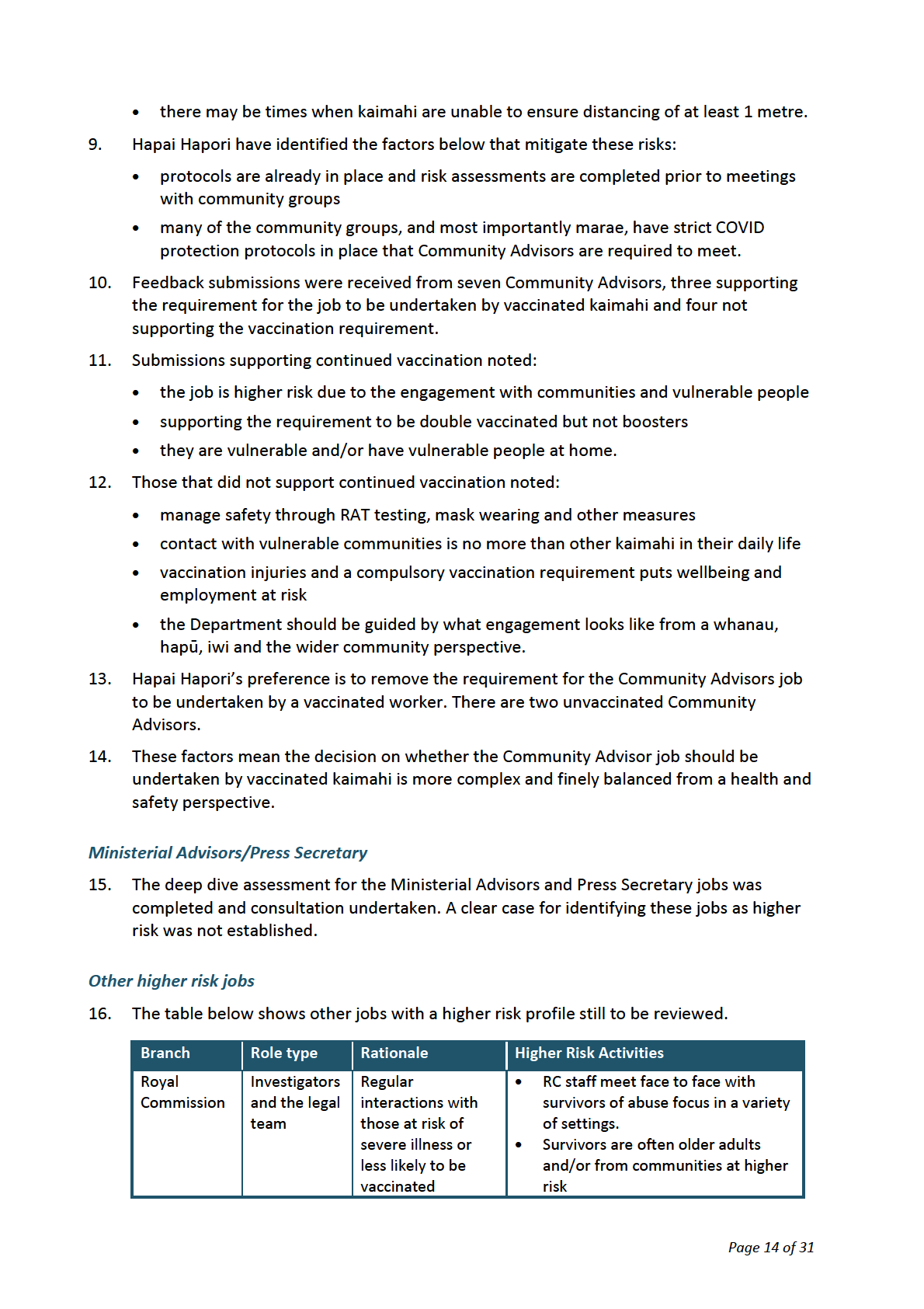
8. The deep dive assessment for Community Advisors identified the fol owing additional
Released
risks:
• Community Advisors have meetings with vulnerable community groups, particularly
with Māori on marae
• these meetings are regularly two to three hours in length and may involve sharing kai
Page 13 of 31
1982
Act
Information
Official
the
under
Released
1982
Act
Information
Official
the
under
Released
Appendix 3: Determining whether to maintain a vaccination
requirement
Considerations for continued vaccination
1. The risk assessment process and Worksafe factors provide a health and safety risk
management basis for these jobs to vaccinated. However, any decision to continue to
require kaimahi to be vaccinated requires ELT to consider and balance vaccination against
the fol owing factors:
1982
a) the Department’s obligations to manage risks as far as reasonably practicable
b) the scientific evidence on the impact of vaccines on transmission
Act
c) public health considerations focussing on protecting vulnerable New Zealanders
d) the protection and preservation of individual rights and freedoms balanced against
justified impingement on those rights and freedoms for health and safety reasons
e) would vaccination requirements mean inequitable outcomes.
Further details of each of these is provided below.
Health and Safety obligations
Information
2. Worksafe advises that in deciding what controls to implement, employers will need to
consider what is reasonably practicable as directed by HSWA. This includes considering:
• likelihood and consequence of the harm
• what is known about managing the risk
• the availability of control measures and how suitable they are
Official
• whether the costs of implementing controls are grossly disproportionate to the risk.
3. The risk assessment process also requires consideration of the ‘hierarchy of controls’
the
which involves prioritising more effective controls over less effective controls. ELT should
consider the effectiveness of vaccination as a control over the other controls such as
mask wearing, rapid antigen testing, physical distancing and hygiene practises.
Scientific evidence under
4. The effectiveness of the vaccine in preventing transmission should be considered. While
the scientific data shows that the efficacy of the vaccination against Omicron is lower
than that of Delta, it is stil accepted that vaccination offers some protection from onward
transmission. Evidence on this is scarce but there is a non-peer-reviewed data from a
smal study suggesting that vaccinated people infect fewer people in their household3.
Public health considerations
Released
5. Public health considerations play a part in the decision making with the shift in the
government’s focus onto protecting vulnerable New Zealanders. The Prime Minister
3 COVID-19: Science news | Ministry of Health NZ
Page 16 of 31
stated on 23 March that “…
with the ongoing presence of Covid in our community, we need
to continue to use tools that can keep our vulnerable communities safe, such as those who
are immunocompromised and those with disabilities.”
6. DIA must assess the role that vaccination will play in achieving these public health goals
and in sustaining public confidence in the provision of services. This includes considering
how kaimahi may impact on transmission in vulnerable communities – for better or,
potentially, for worse.
Balancing individual rights and freedoms
1982
7. WorkSafe advises that employers should first consider the controls that are least intrusive
to employees. This reflects caution in limiting the rights and freedoms of kaimahi unless
they are justified on health and safety grounds. In this case, the imposition of a vaccine
Act
requirement for certain staff would limit that person’s right to make decisions about their
medical treatment.
8. Any decision that proposes to limit an individual’s fundamental rights and freedoms in
order to manage health and safety risks must include consideration of whether those
limits are justified and proportionate to the risk.
9. From a health and safety perspective (supported by the risk assessments and other
considerations above), there is justification that vaccination is warranted for these jobs if
we want to provide the greatest level of protection to our kaimahi, service users, and
Information
vulnerable communities.
10. However, it is difficult to quantify the effectiveness of vaccination in protecting against
transmission of COVID-19 (over and above the use of other controls) when considering if
it is a proportionate control to manage the risk for each role type. Ministry of Health is
clear that it offers ‘some protection, especially after a third (booster) dose’ against
Official
transmission4. It can also be argued that it is a reasonably practicable step to protect
vulnerable individuals and communities in recognition of the public health objectives of
the Government, however, it could be argued that in our current context other steps
the
represent a more proportionate and reasonable response to managing the risk when
balanced against the limitation of personal freedoms and rights.
11. ELT, as Officers under HSWA, need to assess this and make the final determination as to
whether requiring vaccination is a justifiable incursion into employees’ rights and
freedoms for higher risk jobs when balanced against the health and safety considerations
under
outlined above.
9(2)(h)
Inequities
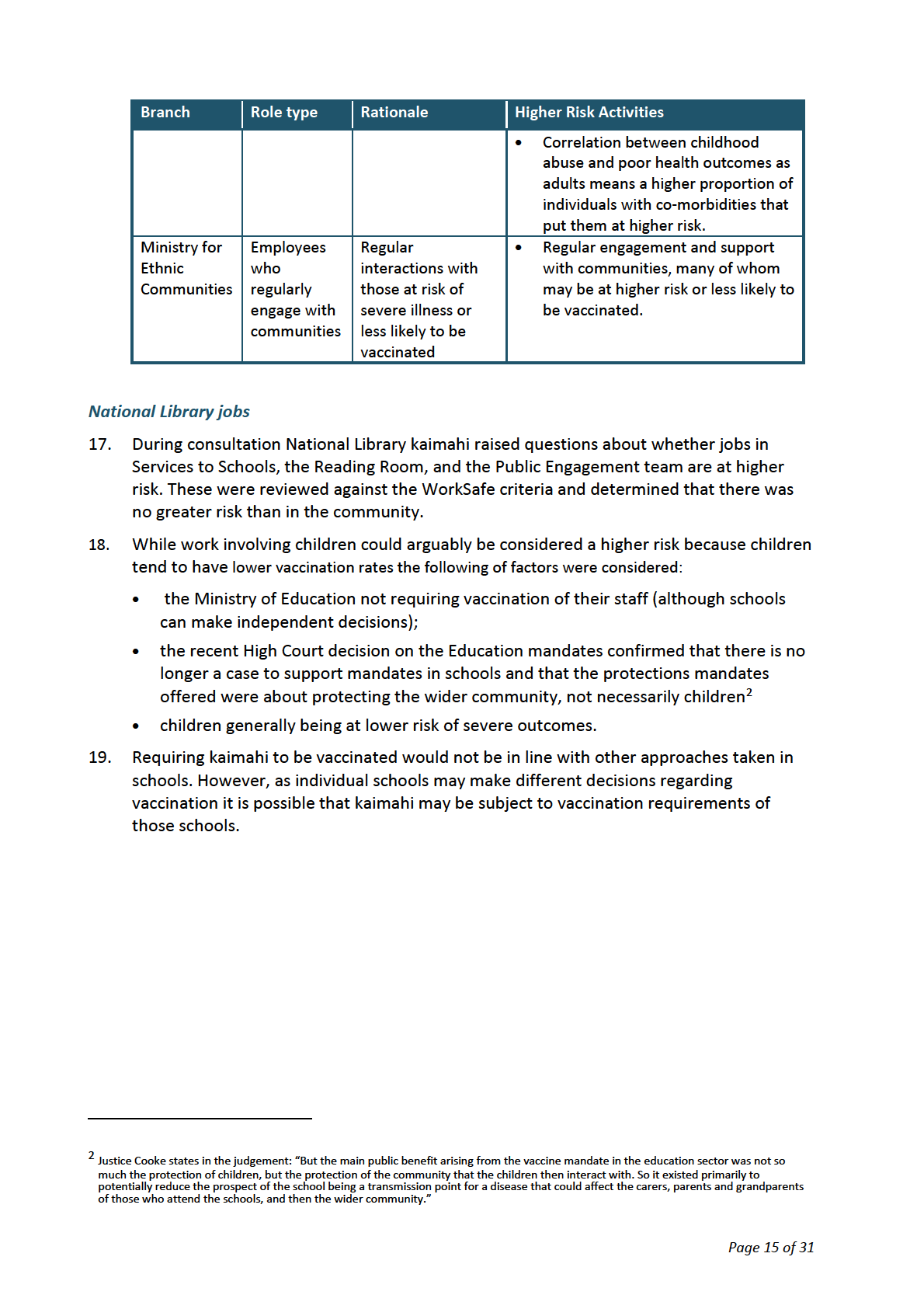
13. Are there more Māori or Pasifika kaimahi in these jobs, would there be negative
outcomes for community groups if only vaccinated staff can provide services or
Released
conversely unvaccinated staff provide services.
4 COVID-19: About the Omicron variant | Ministry of Health NZ
Page 17 of 31
14. The impact is currently low as the number of unvaccinated kaimahi in these roles is small
(3). However, we are do not know whether kaimahi have received their boosters. We
assume the rate of boosters would be similar to that of the general public which is 72.6%.
15. If vaccination is required, the impact on Community Advisors may be higher as there are
kaimahi Māori in this job now and there could be more in the future due to the
recruitment of new employees.
1982
Act
Information
Official
the
under
Released
Page 18 of 31
9(2)(h)
1982
Act
Information
Official
the
under
Released
Page 19 of 31
9(2)(h)
1982
Act
Information
Official
the
under
Released
Page 20 of 31
9(2)(h)
1982
Act
Information
Official
the
under
Released
Page 21 of 31
Appendix 5: Summary of consultation feedback
Feedback from the Tangata Whenua Network
1. Two drop-in sessions were held with the Tangata Whenua Network.
2. They raised their own health and wel being vulnerabilities, ensuring support for other
kaimahi who may be vulnerable and concerns for Māori in the community they work
with.
3. The group expressed the same concerns as others about the uncertainty of serving the 1982
public when their vaccination status is unknown and the uptake of other COVID controls
(mask wearing and distancing).
4. Other issues raised were:
Act
• long COVID and whether kaimahi would have enough sick leave to cover any long
term sickness
• ensuring people feel safe being around unvaccinated kaimahi when they return to the
workplace
• how we support kaimahi Māori to return to work
• concerns about an increasing number of people coming back to the office and
whether there was sufficient space for everyone to fol ow, Waterloo Quay was
Information
mentioned,
• vaccinated kaimahi have been impacted by high workloads and the requirement to
pick up additional work due to unvaccinated not working in the office
• how having the vaccination has affected people in different ways, vaccination injured
• have we considered our Treaty responsibilities, potential inequities, or completed
Official
demographic analysis
• timeframes for consultation and decisions were short (this was highlighted in the
December consultation), we need to change our systems in the future
the
• perception that Wellington was prioritised over the regions e.g. receiving resources
• lack of manaakitanga and leadership by ELT – could have held regular hui to check in
with all kaimahi.
under
PSA feedback
5. The PSA provided feedback on the draft policy which was incorporated prior to the ELT
meeting of 26 April. In the zoom session, discussion with the delegates focussed on
vulnerable employees and ensuring managers provide the appropriate support for each
individual. There are concerns about the lack of mask wearing and physical distancing
across many DIA sites, particularly in SD&O where many temporary staff are coming on
board due to the processing backlogs. The PSA did not provide a written submission.
Released
6. The PSA sent out a separate newsletter encouraging members to engage in the
consultation. The PSA have advised that they have had no issues raised directly with them
about the revised approach.
7. A copy of all the written comments is available here.
Page 22 of 31
1982
Act
Information
Official
the
under
Released
1982
Act
Information
Official
the
under
Released
1982
Act
Information
Official
the
under
Released
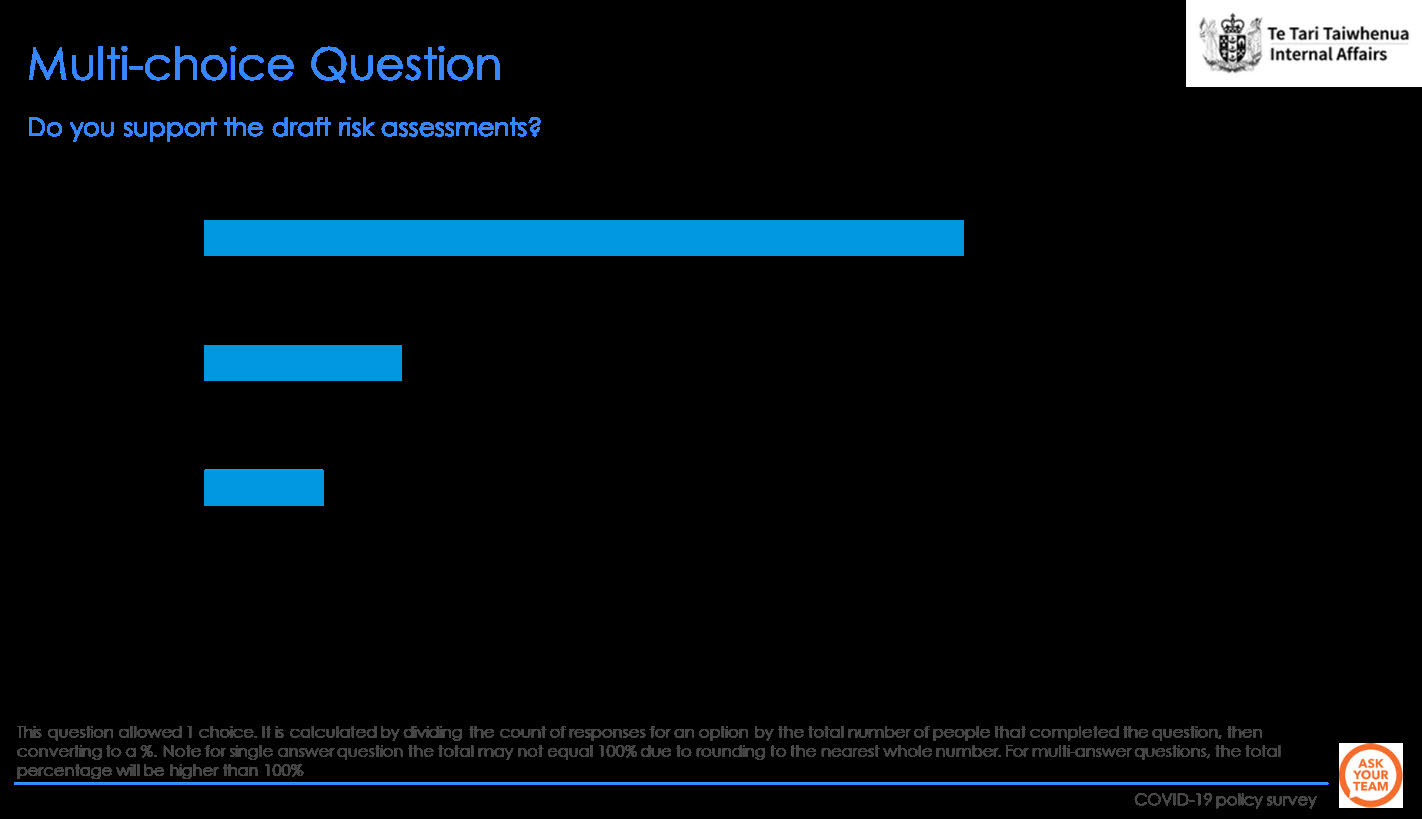 On-line survey results
1982
Act
Information
Official
the
under
Released
Page 26 of 31
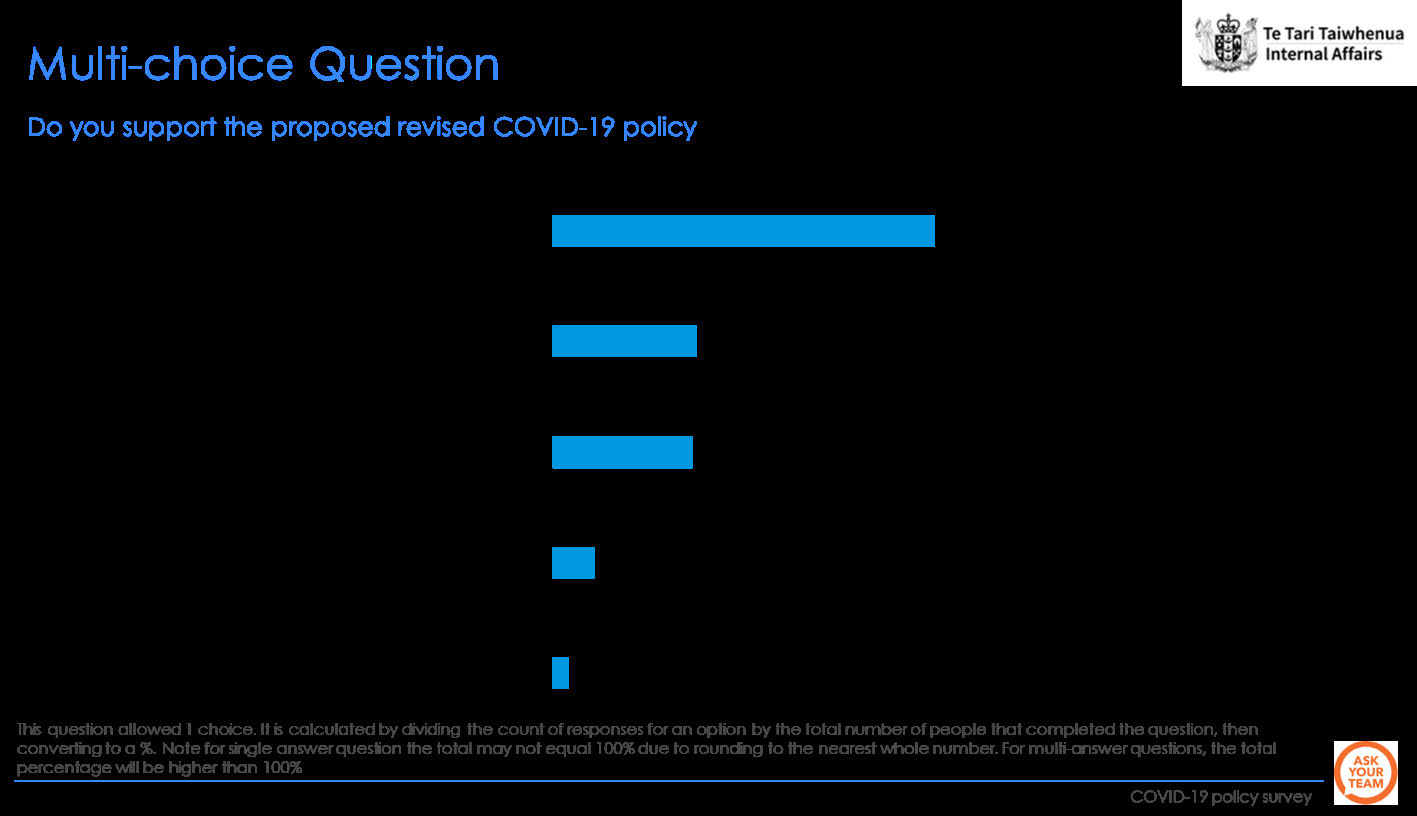
1982
Act
Information
Official
the
under
Released
Page 27 of 31
Appendix 6: COVID-19 Policy engagement plan
COVID-19 Policy Engagement plan
Context
Due to COVID-19 workplaces across New Zealand have had to adjust ways of working. As New
Zealand moves past the Omicron peak and many mandates are being dropped, workplaces are 1982
able to welcome people back to site at increased capacity. DIA is updating its policy to align
with these changes. These changes reflect a change in approach to managing COVID-19 due to
the increased transmissibility of Omicron and the high levels of vaccination in New Zealand.
Act
In the ‘post-peak’ omicron environment, DIA hopes to see kaimahi return to working from the
office more regularly.
We know that some kaimahi, particularly those who are vulnerable or have vulnerable people
at home, are concerned about ways of working in this phase of the pandemic, including the
prospect of coming in to the office while COVID-19 is still in the community.
Some kaimahi are also concerned about contact with unvaccinated kaimahi being allowed to
Information
return to the office and potential impacts in changes to the way controls are implemented.
There are also considerations around property and ways of working – for example Pipitea St is
operating at a 60/100 ratio. This means we physically can’t have all people return to site at the
same time.
Official
Objective
To ensure all kaimahi:
the
• understand the new COVID-19 policy and how it impacts their ways of working
• feel safe and accepted in the workplace before the go-live date
• begin to reintegrate the office into their working arrangements
under
Approach
It will be important for people leaders to have proactive conversations with all their kaimahi to
ensure any anxiety, concerns or questions are addressed in advance of the new policy’s
implementation date.
Our mātāpono, principles and behaviours wil be key to helping us navigate this change
together. It will also be important for kaimahi and People Leaders to see ELT taking ownership
Released
of the new policy decision.
To achieve this, we wil provide opportunities for two-way engagement between ELT, People
leaders and kaimahi.
Page 28 of 31
1982
Act
Information
Official
the
under
Released
1982
Act
Information
Official
the
under
Released
1982
Act
Information
Official
the
under
Released
1982
Act
Information
Official
the
under
Released
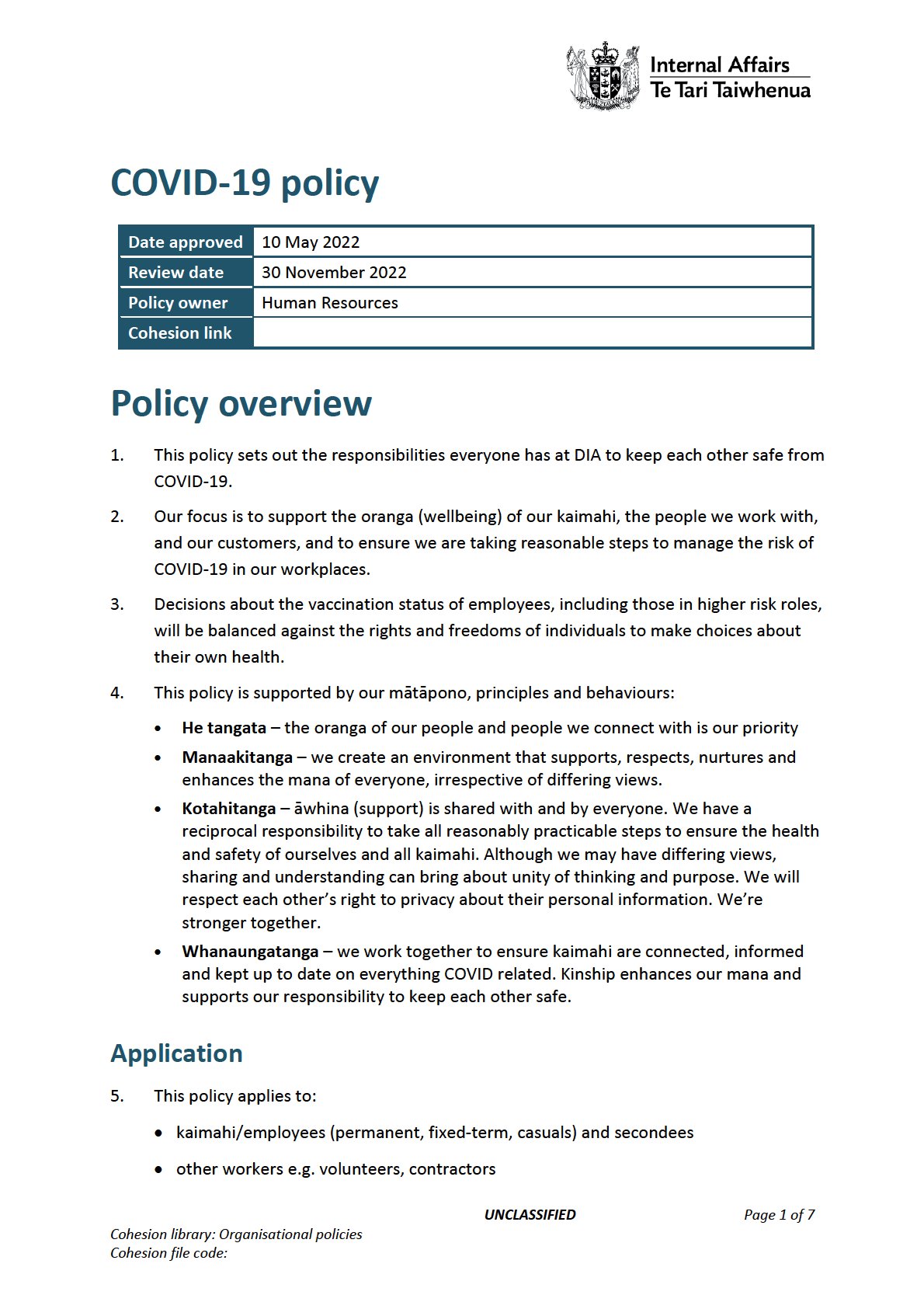
Policy: COVID-19 Vaccination policy
• suppliers and other visitors (including whānau/friends) to DIA workplaces1
• members of the public accessing our services.
Exceptions
6. The Chief Archivist may approve exceptions to this policy to allow members of the public
to access public records under Archives New Zealand’s control.
7. The National Librarian may approve exceptions to this policy to allow members of the
public to access the collections of the National Library and the Alexander Turnbull
1982
Library.
Act
Delegated authorities
8. The delegated authorities that apply are governed by the Delegation Policy on the
intranet (1840).
Policy detail
9. COVID-19 is a highly transmissible virus with widespread community transmission,
Information
which is likely to be ongoing as strains appear or mutate. The effects can be serious and
ongoing. This poses a risk that our kaimahi and those we interact with at work may
become infected.
10. DIA needs to take all reasonably practicable steps to manage COVID-19 in our
Official
workplaces in a flexible and agile way, given the rapidly-changing environment.
11. When making decisions to amend this policy, DIA will be guided by current public health
advice from the Ministry of Health, health and safety advice from WorkSafe (in relation
the
to the management and control of COVID-19) and balanced against the preservation of
the basic rights and freedoms that individuals have to make decisions about, and
manage their own health.
under
12. Safety and wellbeing measures to reduce the transmission and effects of COVID-19
supported by DIA include:
• encouraging and supporting kaimahi to be vaccinated, including boosters
• ensuring kaimahi stay home if unwel
Released
1 DIA workplaces are any place or vehicle where DIA kaimahi regularly work, including parts of sites where DIA
kaimahi work with the agreement of other agencies, for example, co-located offices, and excludes the parts of
those sites occupied by other agencies and private homes.
UNCLASSIFIED
Page 2 of 7
Policy: COVID-19 Vaccination policy
• encouraging kaimahi to wear masks where physical distancing of 1m is not possible,
for example in meeting rooms, lifts, communal areas or when moving about the
workplace
• maintaining physical distancing of 1m wherever possible
• kaimahi in public facing roles being provided and wearing N95 (or similar) masks
• maintaining healthy hygiene habits, such as coughing into your elbow, washing and
sanitising hands (hand sanitiser is available at all sites), desk cleaning (cleaning
supplies should be available at all sites), and respecting personal space
1982
• branches providing access to surveillance Rapid Antigen Testing
Act
• reorganising work and supporting flexible working arrangements (see the flexible
working hub).
13. Kaimahi are encouraged to regularly read the information provided on the COVID-19
Info Hub on 1840.
Health and safety risk assessment - transmission of COVID-19
in the workplace
Information
14. DIA’s health and safety risk and impact assessments are completed in line with the
Health & Safety at Work Act 2015.
15. The assessments identify mahi that involves close or higher risk contact with others, and
the risk of kaimahi becoming infected with COVID-19 at work. They also consider worst-
Official
case scenarios.
16. The assessments compare the inherent risk (without controls in place) and residual risk
the
(with available controls in place) of contracting or transmitting COVID-19 in the
workplace, and whether that is higher than it is outside the workplace, in everyday life.
17. The current risk assessments also consider New Zealand’s high vaccination rate, the
reduced risk of infection for those who have recently recovered from COVID-19, and the
under
apparent lowering of vaccine effectiveness against the transmission and/or effects of
recent variants.
18. The assessments are dynamic, reflect the latest public health advice and be reviewed if
factors or the broader environment change. For example, the emergence of a new
variant or a significant change to Ministry of Health or public health advice.
19. The latest assessments are available here. Kaimahi can provide feedback at any time.
Released
UNCLASSIFIED
Page 3 of 7
Policy: COVID-19 Vaccination policy
Vaccination
20. Vaccination is an important protection for managing the risk to health and safety,
particularly for those at higher risk of severe illness. Vaccination reduces the likelihood
and severity of infection. However, vaccine effectiveness wanes over time. Decisions by
DIA on the use of vaccinations as a protection measure are based on the risk assessment
outcomes.
21. DIA encourages all kaimahi to be fully vaccinated against COVID-19. Kaimahi are not
required to be vaccinated or to provide DIA with evidence of their vaccination status. 1982
22. Where the Government makes a statutory decision that kaimahi must be vaccinated to
perform a job or part of a job (for example the COVID19 Public Health Response
Act
(Vaccinations) Order 2021) DIA will make that a condition of performing that job.
23. If health and safety risk assessments identify a job, or part of a job, as having a higher
risk of COVID-19 that cannot be sufficiently managed by other controls, kaimahi may be
required to be vaccinated under this policy.
Process when vaccinations are required
Information
24. Where kaimahi are required to be vaccinated to perform their job, they wil be
consulted prior to any final decision on that vaccination requirement being made.
25. Kaimahi wil be advised of the date(s) they are required to be vaccinated, with enough
notice to al ow them to become fully vaccinated.
26. A person will be regarded as fully vaccinated based on the Ministry of Health Guidance
Official
at the time and having received a full course of any of the COVID-19 vaccines approved
by the New Zealand Government (currently described in Schedule 3 of the Vaccinations
Order as amended from time to time), including booster doses. Kaimahi will provide DIA
the
with suitable evidence of full vaccination status as/when required.
27. DIA wil col ect evidence of vaccination status and exemption status from kaimahi if they
are required to be fully vaccinated through an official Ministry of Health record
regarding COVID-19 vaccination or any other evidence that DIA considers appropriate at
under
that time.
28. The information will be forwarded to Pūmanawa Tangata (People and Capability) and
stored securely in the HR Information System.
29. Kaimahi can choose not to show evidence of their vaccination status but will be
considered an unvaccinated employee for the purposes of this policy.
Released
30. Information held by Te Tari Taiwhenua can be accessed and corrected by the person it is
about. The information is required to ensure compliance with this policy, and to inform
decisions (including decisions that may be adverse) about employment or discussions
with kaimahi.
UNCLASSIFIED
Page 4 of 7
Policy: COVID-19 Vaccination policy
Outcomes for kaimahi who are not ful y vaccinated where
vaccination is required
31. Where kaimahi do not meet the vaccination requirements, managers will have
discussions to understand their situation and identify what options may be available.
32. The nature of the work undertaken, the way the individual works, the ability for them to
undertake their work from an alternative location, the availability of alternative work
and the reason(s) for the individual not being vaccinated wil be taken into
1982
consideration.
33. Decisions will be made on a case-by-case basis. When meeting with their manager
Act
kaimahi can have a support person or representative of their choice present. Should
they decide to get fully vaccinated, kaimahi wil be supported to do so.
34. Te Tari Taiwhenua’s priority is to retain kaimahi and to explore and attempt to agree
reasonable alternative options wherever practicable. However, if other options are not
practicable or available, ending of employment may be considered. Kaimahi will be
provided with notice as provided for in their employment agreement or any relevant
statutory notice requirements.
Information
Vaccination status of new kaimahi
35. Unless the job requires vaccination under statute or as a result of a decision made by
DIA, new kaimahi do not have to be fully vaccinated to be employed and wil not be
required to provide any proof of their vaccination s
Official tatus. They will be advised DIA has a
COVID-19 policy that may require them to be vaccinated if it is later determined to be
necessary.
the
36. Where a job requires a vaccinated person, the recruitment advertisement will include
that information.
If an employee does not believe they can work safely in the
under
workplace
37. If an employee is concerned about their safety, the safety of a member of their
household or other close contact managers should:
• Discuss and consider concerns raised by the employee, the impact on them, others
in their household, and other people in the workplace
Released
• Discuss how the health and safety risk assessment, other controls in place and this
policy support the wel being and safety of the employee
• Discuss whether there are any other reasonable controls or actions by the
employee that could help them to feel safer within the workplace
UNCLASSIFIED
Page 5 of 7
Policy: COVID-19 Vaccination policy
• Determine an appropriate response in line with employer and employee duties
under the Health and Safety at Work Act 2015 and public health advice from the
Ministry of Health. This may include flexible working arrangements.
Contractors, suppliers and visitors to a DIA workplace
38. If kaimahi are required to be vaccinated to perform work under statute or this policy in
the future, DIA may determine that contractors, suppliers and visitors may only enter a
DIA workplace if they are able to show they are fully vaccinated.
1982
39. At that time, kaimahi who invite contractors, suppliers or other visitors to a DIA
workplace wil be expected to:
Act
a) notify them in advance that DIA workplaces require evidence of full vaccination (and
what that may comprise) and they wil be expected to show that evidence when
visiting DIA workplaces
b) advise them of remote contact options that may be available should they want to
access them
c) check that every contractor, supplier or visitor can show they are ful y vaccinated
through the evidence that DIA (or statute) considers appropriate at that time.
Information
Leave
40. Special paid leave is available for kaimahi to get vaccinated and for them to support
their whānau to get vaccinated. Official
41. Special paid leave is available if kaimahi feel unwell after their vaccination.
42. Sick leave is available to support whānau if they become unwel after their vaccination.
the
43. Further information is available in the Public Service Workforce Guidance.
Storing vaccination status information where it is required
under
44. Individuals personal information is private. Vaccination information will be stored in the
HR Information System.
45. Individual’s privacy wil be protected with vaccination information only accessible to
managers and people in Pūmanawa Tangata (People and Capability) who need to have
access.
Released
Policy review
46. This policy will be reviewed regularly with material changes implemented following
consultation with kaimahi wherever doing so is practicable. Reasons for reviewing
include:
UNCLASSIFIED
Page 6 of 7
Policy: COVID-19 Vaccination policy
• changes to the wel being and safety measures including new measures becoming
available
• new variants impacting significantly on the health and wel being of kaimahi
• changing public health advice.
1982
Act
Information
Official
the
under
Released
UNCLASSIFIED
Page 7 of 7
1982
Act
Information
Official
the
under
Released
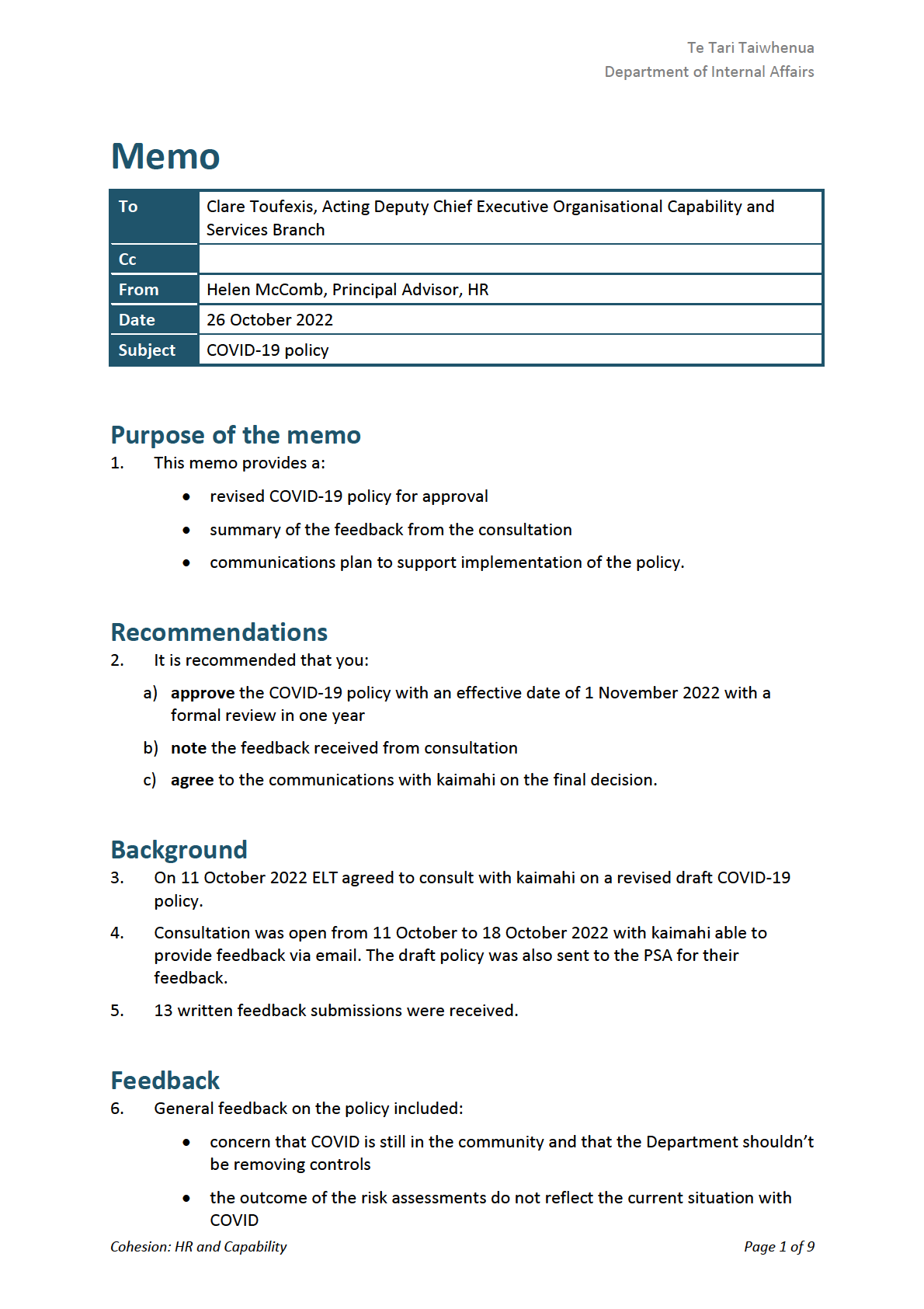
• more clarity is needed on what leave is available when kaimahi get COVID.
7. A summary of the feedback received is attached as Appendix 1.
Amendments to the policy
8. Amendments to the policy have been made following feedback. The key changes are:
• Remove the sentence about the Government’s updated strategic approach.
The sentence above this (in the policy) sufficiently covers what the Department 1982
considers when amending the COVID-19 policy.
• Review and rewrite of the “Leave” section to provide clarity on the leave
options available to kaimahi if they have COVID-19 or they need to get Act
vaccinated.
• Review by Communications for plain english and an easily understood policy.
9. The feedback about the risk assessment was noted and discussed with Wel being,
Health and Safety. This feedback did not result in any changes being made to the risk
assessments.
10. The revised COVID-19 policy is attached as Appendix 2.
11. Based on the risk assessments, and that minimal feedback was received from kaimahi,
Information
it is recommended that you approve the COVID-19 policy and that it will come into
effect from 1 November 2022 with a formal review day in one year.
Communicating the final decision to kaimahi
Official
12. An article will be published on 1840 and on the MaSS intranet advising kaimahi of the
final decision of the COVID-19 policy review.
13. This will include information on what leave is available to kaimahi if they have
the
COVID-19, if they need to get vaccinated or if they are supporting their whanau to get
vaccinated.
14. Managers will be advised through the next available People Leaders Update.
under
Released
Page 2 of 9
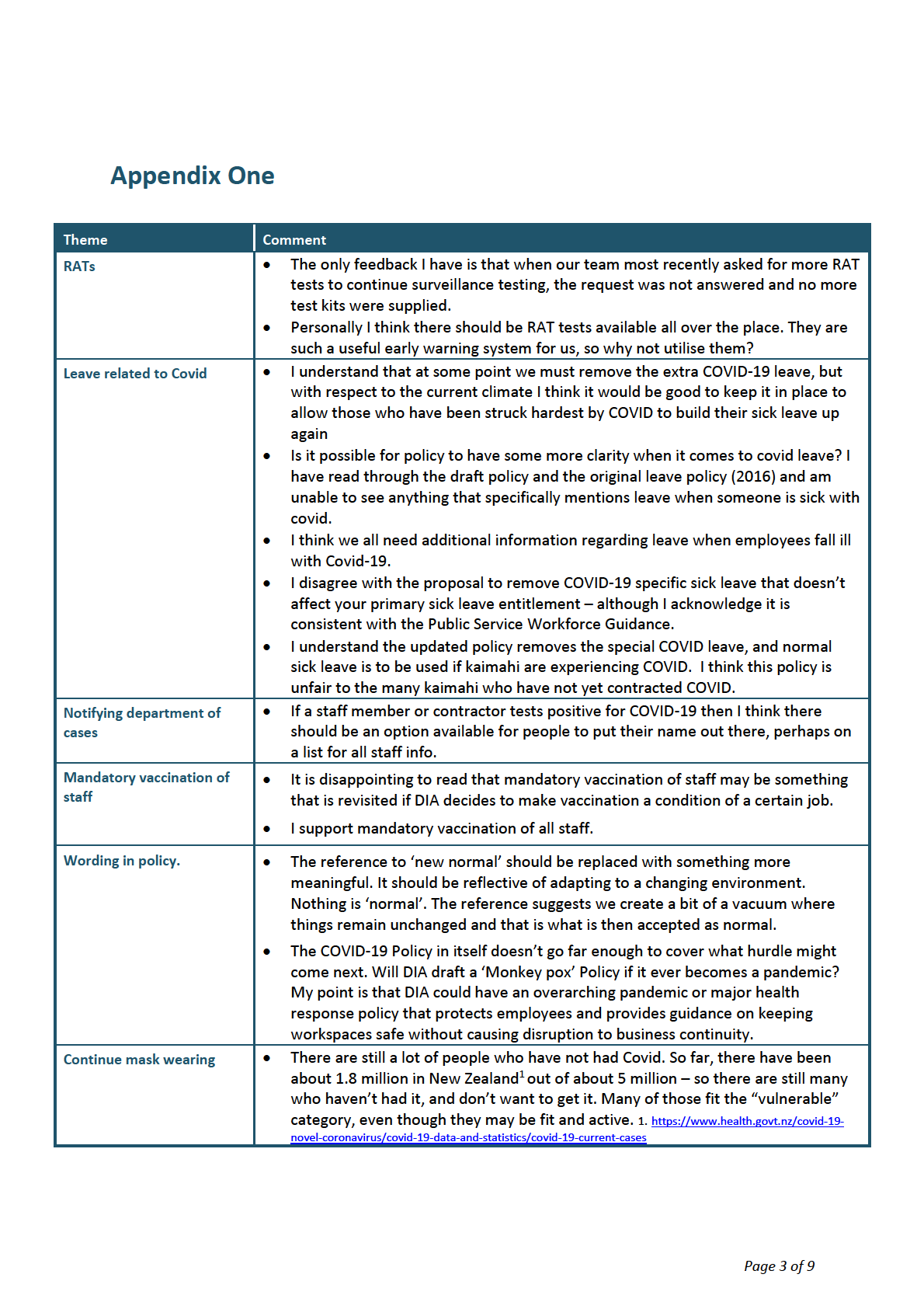
1982
Act
Information
Official
the
under
Released
Keep controls in place
• I am concerned that your document assuming that everything is “business as
usual”, except in high-risk settings, and basic health measures are only listed
under “If the situation changes…”.
• I want to see positive affirmation for continued mask-wearing by kaimahi who
wish to protect themselves and others. Dr Siouxsie Wiles says “there is a way to
ride the [Covid-19] merry-go-round more safely … using the tools we know reduce
transmission: wearing good-quality masks, improving the quality of indoor air,
and isolating when infectious”
• Having read through this it seems to be mostly based on political expediencies
rather than either the science of our time or any real concerns for staff or the
1982
public with which they interact. Remote first working should be in place. Where
managers can justify their people have to work on site then vaccination, masks
and social distancing should stil be required.
Act
Risk Assessments
With the question or risk statement being provided to use by assessors? It’s
chal enging to understand how the residual scoring was achieved when the question
isn’t provided. Did assessors use the DIA Risk Framework for likelihood and
consequence? DIA Risk Management Framework 2019.docx (cohesion.net.nz) Frankly
if it
was used then I’m surprise that assessors concluded the residual consequence
was a ‘3 Moderate’. The consequence criteria for ‘4 Significant’ under ‘Stakeholder’ is
“. Major injury(s) or illness resulting in long-term incapacity or ill health for one or
more stakeholder or kaimahi”. It only takes ‘one’ kaimahi to trigger a ‘significant’
consequence rating.
Information
Official
the
under
Released
Page 4 of 9
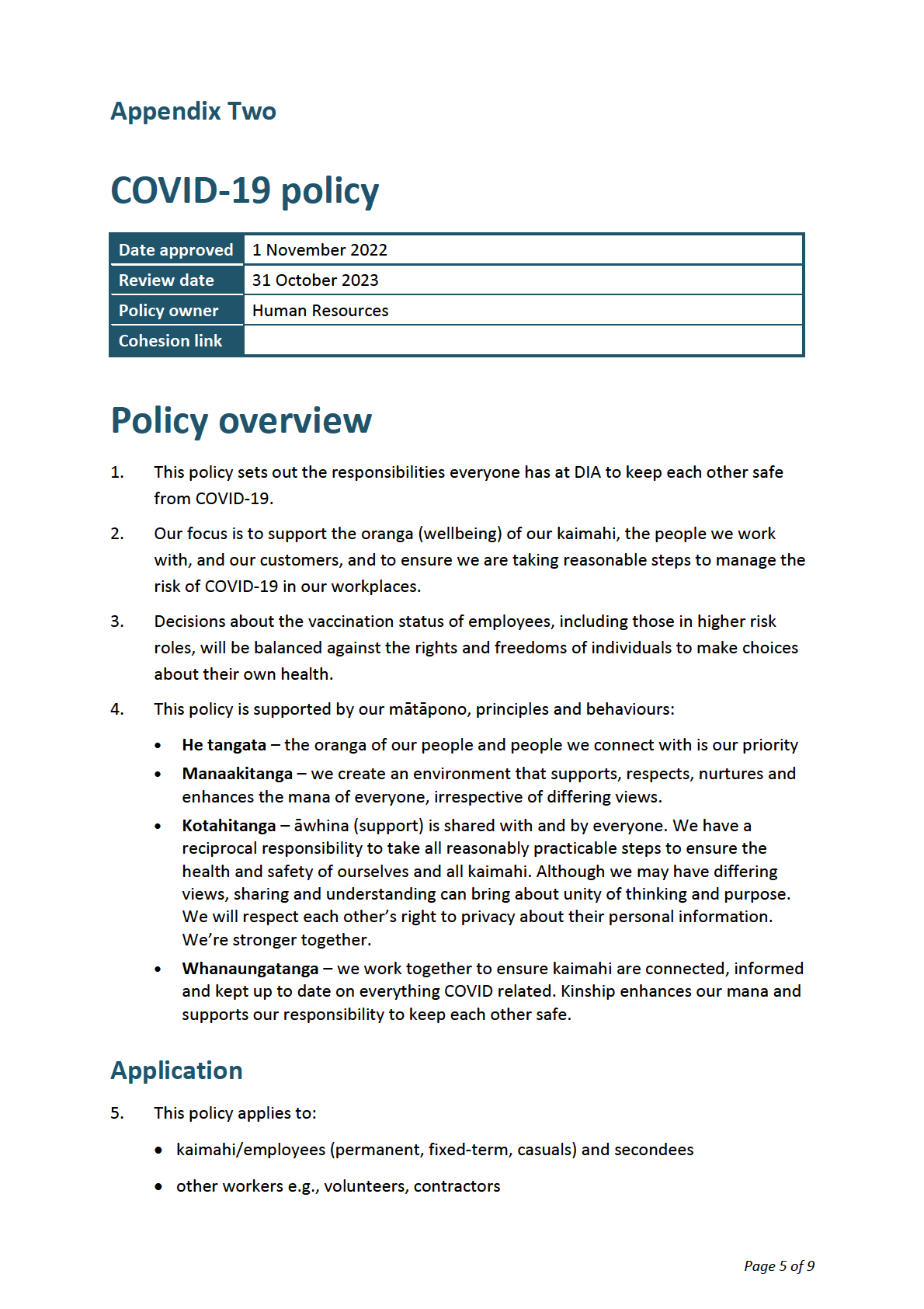
1982
Act
Information
Official
the
under
Released
• suppliers and other visitors (including whānau/friends) to DIA workplaces1
• members of the public accessing our services.
Exceptions
6. The Chief Archivist may approve exceptions to this policy to allow members of the
public to access public records under Archives New Zealand’s control.
7. The National Librarian may approve exceptions to this policy to allow members of the
public to access the collections of the National Library and the Alexander Turnbull
1982
Library.
Delegated authorities
Act
8. The delegated authorities that apply are governed by the Delegation Policy on the
intranet (1840).
Policy detail
9. COVID-19 is a highly transmissible virus with potential to result in widespread
Information
community transmission, which is likely to be ongoing as strains appear or mutate. Any
COVID-19 variant, especially at the same time as seasonal illness, has the potential to
create major disruption.
10. DIA needs to take all reasonably practicable steps to manage COVID-19 in our
Official
workplaces in a flexible and agile way, given the dynamic COVID-19 environment.
11. When making decisions to amend this policy, DIA will be guided by current public
health advice from the Ministry of
the Health, health and safety advice from WorkSafe (in
relation to the management and control of COVID-19) balanced against the
preservation of the basic rights and freedoms that individuals have to make decisions
about and manage their own health.
under
12. Safety and wel being measures/controls that could be utilised to reduce the
transmission and effects of COVID-19 include:
• encouraging kaimahi to wear masks
• access to N95 (or similar) masks
• physical distancing and capacity limits
Released
• isolating
1 DIA workplaces are any place or vehicle where DIA kaimahi regularly work, including parts of sites where DIA
kaimahi work with the agreement of other agencies, for example, co-located offices, and excludes the parts
of those sites occupied by other agencies and private homes.
Page 6 of 9
• reporting and recording of confirmed cases
• accessing Rapid Antigen Testing, including surveillance if appropriate
• reorganising work and supporting flexible working arrangements (see the flexible
working hub).
13. Safety and wel being measures/controls in place to reduce the transmission and
effects of COVID-19 include:
•
encouraging and supporting kaimahi to be vaccinated, including boosters
1982
•
ensuring kaimahi stay home if they are unwell
•
encouraging kaimahi to maintain healthy hygiene habits, such as coughing into
Act
your elbow, washing and sanitising hands (hand sanitiser is available at all sites),
desk cleaning (cleaning supplies should be available at all sites), and respecting
personal space.
14. Kaimahi are encouraged to regularly read the information provided on the COVID-19
Info Hub on 1840.
Health and safety risk assessment - transmission of
Information
COVID-19 in the workplace
15. DIA’s health and safety risk and impact assessments are completed in line with the
Health & Safety at Work Act 2015.
16. The assessments identify mahi that involves close or higher risk contact with others,
Official
and the heightened risk of kaimahi becoming infected with COVID-19 at work, more so
than they would be in the community. This is particularly where this mahi involves
working with vulnerable members of the public or communities. They also consider
the
worst-case scenarios.
17. The assessments compare the inherent risk (without controls in place) and residual risk
(with available controls in place) of contracting or transmitting COVID-19 in the
under
workplace, and whether that is higher than it is outside the workplace, in everyday life.
18. The current risk assessments also consider public health advice; the COVID-19 settings
(the national and regional trends of cases, hospitalisations and fatalities); New
Zealand’s high vaccination rate; the accessibility of masks, Rapid Antigen Testing and
antivirals; the reduced risk of infection for those who have recently recovered from
COVID-19, and the lowering of vaccine effectiveness against the transmission and/or
effects of recent variants.
Released
19. The assessments are dynamic, reflect the latest public health advice and wil be
reviewed if factors or the broader environment change. For example, the emergence
of a new variant of concern or a significant change to Ministry of Health or public
health advice.
Page 7 of 9
20. The latest assessments are available here. Kaimahi can provide feedback at any time.
Vaccination
21. Vaccination is an important protection for managing the risk to health and safety,
particularly for those at higher risk of severe illness. Vaccination reduces the likelihood
and severity of infection. However, vaccine effectiveness wanes over time. Decisions
on the use of vaccinations as a protection measure are based on the risk assessment
outcomes, Government and Public Service Commission guidance.
1982
22. Kaimahi are not required to be vaccinated against COVID-19 or to provide evidence of
their vaccination status. However, kaimahi are encouraged to be fully vaccinated.
Act
23. If the Government makes a statutory decision that kaimahi must be vaccinated to
perform a job or part of a job, DIA wil make that a condition of performing that job.
24. If health and safety risk assessments identify a job, or part of a job, as having a higher
risk of COVID-19 that cannot be sufficiently managed by other controls, kaimahi may
be required to be vaccinated under this policy. Kaimahi will be consulted prior to any
final decision on vaccination requirements being made.
25. Where kaimahi do not meet vaccination requirements, managers will have discussions
Information
to understand their situation and identify what other options may be available. The
nature of the work undertaken, the way the individual works, the ability for them to
undertake their work from an alternative location, the availability of alternative work
and the reason(s) for the individual not being vaccinated wil be taken into
consideration.
Official
26. Te Tari Taiwhenua’s priority wil be to retain kaimahi and to explore and attempt to
agree reasonable alternative options wherever practicable. However, if other options
the
are not practicable or available, ending of employment may be considered.
27. Where a job requires a vaccinated person, any recruitment advertising will include that
information.
under
If an employee does not believe they can work safely in the
workplace
28. If an employee is concerned about their safety, the safety of a member of their
household or other close contact managers should:
• Discuss and consider concerns raised by the employee, the impact on them, others
Released
in their household, and other people in the workplace
• Discuss how the health and safety risk assessment, other controls in place and this
policy support the wel being and safety of the employee
• Discuss whether there are any other reasonable controls or actions that could help
the employee to feel safer in the workplace
Page 8 of 9
• Determine an appropriate response in line with employer and employee duties
under the Health and Safety at Work Act 2015 and public health advice from the
Ministry of Health. This may include flexible working arrangements.
Leave
29. Leave provisions available to kaimahi are provided in the Leave Policy and align with
the Public Service Workforce Guidance.
30. In particular, kaimahi are able to take up to two hours paid leave for medical
1982
appointments for vaccinations for themselves or their whanāu. Managers should also
consider paid special leave when kaimahi have COVID-19 and have no sick leave
Act
available.
Policy review
31. This policy will be reviewed regularly with material changes implemented following
consultation with kaimahi wherever doing so is practicable. Reasons for reviewing
include:
• changes to the wel being and safety measures including new measures becoming
Information
available
• new variants impacting significantly on the health and wellbeing of kaimahi
• changing public health advice.
Official
the
under
Released
Page 9 of 9
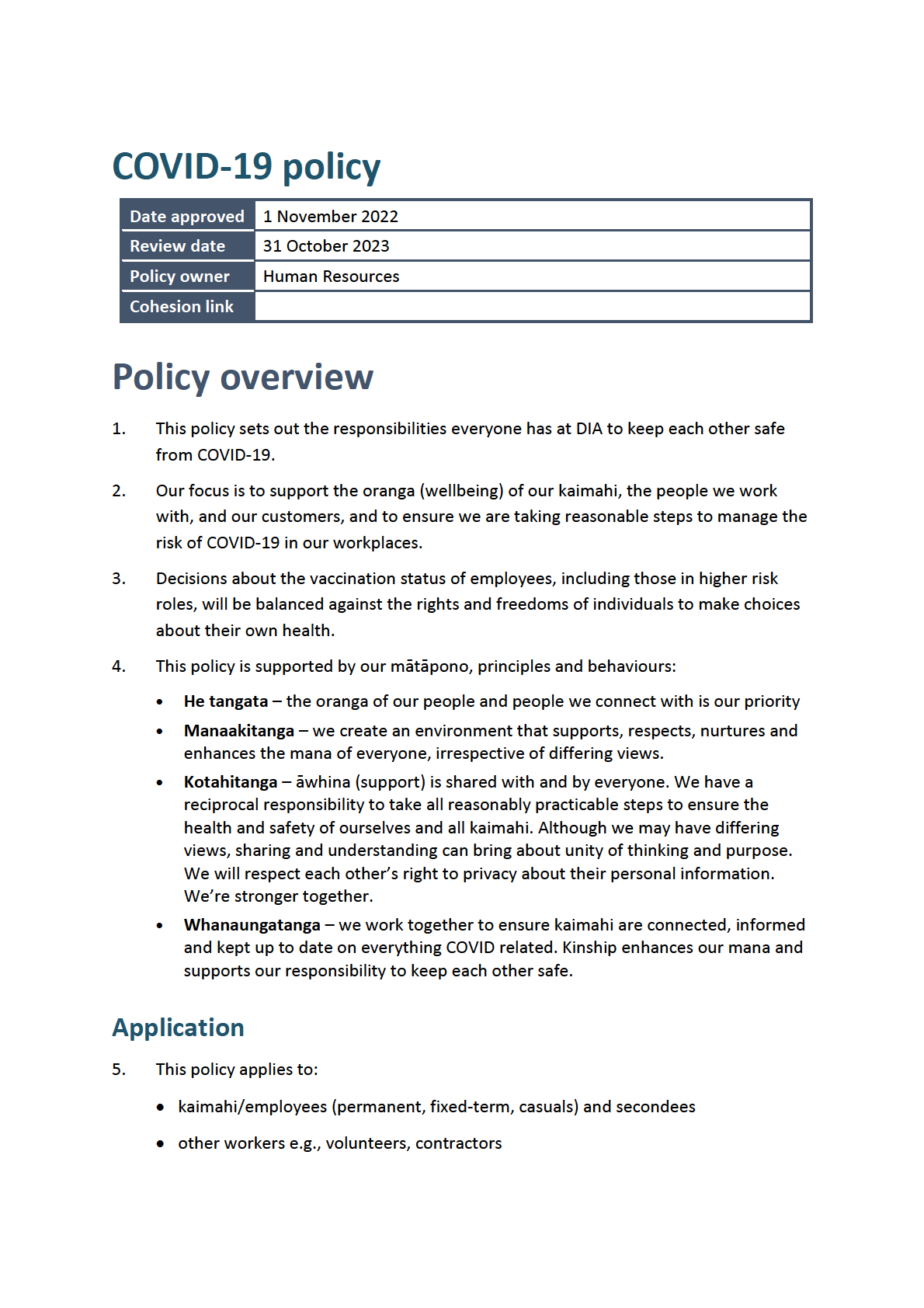
1982
Act
Information
Official
the
under
Released
• suppliers and other visitors (including whānau/friends) to DIA workplaces1
• members of the public accessing our services.
Exceptions
6. The Chief Archivist may approve exceptions to this policy to allow members of the
public to access public records under Archives New Zealand’s control.
7. The National Librarian may approve exceptions to this policy to allow members of the 1982
public to access the collections of the National Library and the Alexander Turnbull
Library.
Act
Delegated authorities
8. The delegated authorities that apply are governed by the Delegation Policy on the
intranet (1840).
Policy detail
Information
9. COVID-19 is a highly transmissible virus with potential to result in widespread
community transmission, which is likely to be ongoing as strains appear or mutate.
Any COVID-19 variant, especially at the same time as seasonal illness, has the
potential to create major disruption.
10. DIA needs to take all reasonably practicable steps to manage COVID-19 in our
Official
workplaces in a flexible and agile way, given the dynamic COVID-19 environment.
11. When making decisions to amend this policy, DIA will be guided by current public
the
health advice from the Ministry of Health, health and safety advice from WorkSafe (in
relation to the management and control of COVID-19) balanced against the
preservation of the basic rights and freedoms that individuals have to make decisions
about and manage their own health.
under
12. Safety and wel being measures/controls that could be utilised to reduce the
transmission and effects of COVID-19 include:
• encouraging kaimahi to wear masks
• access to N95 (or similar) masks
• physical distancing and capacity limits
Released
1 DIA workplaces are any place or vehicle where DIA kaimahi regularly work, including parts of sites where DIA
kaimahi work with the agreement of other agencies, for example, co-located offices, and excludes the parts
of those sites occupied by other agencies and private homes.
• isolating
• reporting and recording of confirmed cases
• accessing Rapid Antigen Testing, including surveillance if appropriate
• reorganising work and supporting flexible working arrangements (see the flexible
working hub).
13. Safety and wellbeing measures/controls in place to reduce the transmission and
effects of COVID-19 include:
1982
•
encouraging and supporting kaimahi to be vaccinated, including boosters
•
ensuring kaimahi stay home if they are unwell
Act
•
encouraging kaimahi to maintain healthy hygiene habits, such as coughing into
your elbow, washing and sanitising hands (hand sanitiser is available at all sites),
desk cleaning (cleaning supplies should be available at all sites), and respecting
personal space.
14. Kaimahi are encouraged to regularly read the information provided on the COVID-19
Info Hub on 1840.
Information
Health and safety risk assessment - transmission of
COVID-19 in the workplace
15. DIA’s health and safety risk and impact assessments are completed in line with the
Official
Health & Safety at Work Act 2015.
16. The assessments identify mahi that involves close or higher risk contact with others,
and the heightened risk of kaimah
the i becoming infected with COVID-19 at work, more so
than they would be in the community. This is particularly where this mahi involves
working with vulnerable members of the public or communities. They also consider
worst-case scenarios.
under
17. The assessments compare the inherent risk (without controls in place) and residual
risk (with available controls in place) of contracting or transmitting COVID-19 in the
workplace, and whether that is higher than it is outside the workplace, in everyday
life.
18. The current risk assessments also consider public health advice; the COVID-19 settings
(the national and regional trends of cases, hospitalisations and fatalities); New
Zealand’s hi
Released gh vaccination rate; the accessibility of masks, Rapid Antigen Testing and
antivirals; the reduced risk of infection for those who have recently recovered from
COVID-19, and the lowering of vaccine effectiveness against the transmission and/or
effects of recent variants.
19. The assessments are dynamic, reflect the latest public health advice and wil be
reviewed if factors or the broader environment change. For example, the emergence
of a new variant of concern or a significant change to Ministry of Health or public
health advice.
20. The latest assessments are available here. Kaimahi can provide feedback at any time.
Vaccination
1982
21. Vaccination is an important protection for managing the risk to health and safety,
particularly for those at higher risk of severe illness. Vaccination reduces the likelihood
Act
and severity of infection. However, vaccine effectiveness wanes over time. Decisions
on the use of vaccinations as a protection measure are based on the risk assessment
outcomes, Government and Public Service Commission guidance.
22. Kaimahi are not required to be vaccinated against COVID-19 or to provide evidence of
their vaccination status. However, kaimahi are encouraged to be fully vaccinated.
23. If the Government makes a statutory decision that kaimahi must be vaccinated to
perform a job or part of a job, DIA wil make that a condition of performing that job.
Information
24. If health and safety risk assessments identify a job, or part of a job, as having a higher
risk of COVID-19 that cannot be sufficiently managed by other controls, kaimahi may
be required to be vaccinated under this policy. Kaimahi will be consulted prior to any
final decision on vaccination requirements being made.
25. Where kaimahi do not meet vaccination requirements, managers will have discussions
Official
to understand their situation and identify what other options may be available. The
nature of the work undertaken, the way the individual works, the ability for them to
undertake their work from an alte
the rnative location, the availability of alternative work
and the reason(s) for the individual not being vaccinated wil be taken into
consideration.
26. Te Tari Taiwhenua’s priority wil be to retain kaimahi and to explore and attempt to
under
agree reasonable alternative options wherever practicable. However, if other options
are not practicable or available, ending of employment may be considered.
27. Where a job requires a vaccinated person, any recruitment advertising will include
that information.
If an employee does not believe they can work safely in the
Released
workplace
28. If an employee is concerned about their safety, the safety of a member of their
household or other close contact managers should:
• Discuss and consider concerns raised by the employee, the impact on them,
others in their household, and other people in the workplace
• Discuss how the health and safety risk assessment, other controls in place and this
policy support the wel being and safety of the employee
• Discuss whether there are any other reasonable controls or actions that could
help the employee to feel safer in the workplace
• Determine an appropriate response in line with employer and employee duties 1982
under the Health and Safety at Work Act 2015 and public health advice from the
Ministry of Health. This may include flexible working arrangements.
Act
Leave
29. Leave provisions available to kaimahi are provided in the Leave Policy and align with
the Public Service Workforce Guidance.
30. In particular, kaimahi are able to take up to two hours paid leave for medical
appointments for vaccinations for themselves or their whanāu. Managers should also
consider paid special leave when kaimahi have COVID-19 and have no sick leave
Information
available.
Policy review
31. This policy will be reviewed regularly with material changes implemented following
Official
consultation with kaimahi wherever doing so is practicable. Reasons for reviewing
include:
the
• changes to the wel being and safety measures including new measures becoming
available
• new variants impacting significantly on the health and wellbeing of kaimahi
changing public health advice.
under
Released
