Document 1
Department of Internal Affairs
Te Tari Taiwhenua
Purpose
1.
This briefing sets out options relating to the approved labelling body function under the Films,
Videos, and Publications Classification Act 1993 (Classification Act). All options address issues
arising from the Film and Video Labelling Body’s (FVLB) financial and operational
unsustainability.
Executive summary
2.
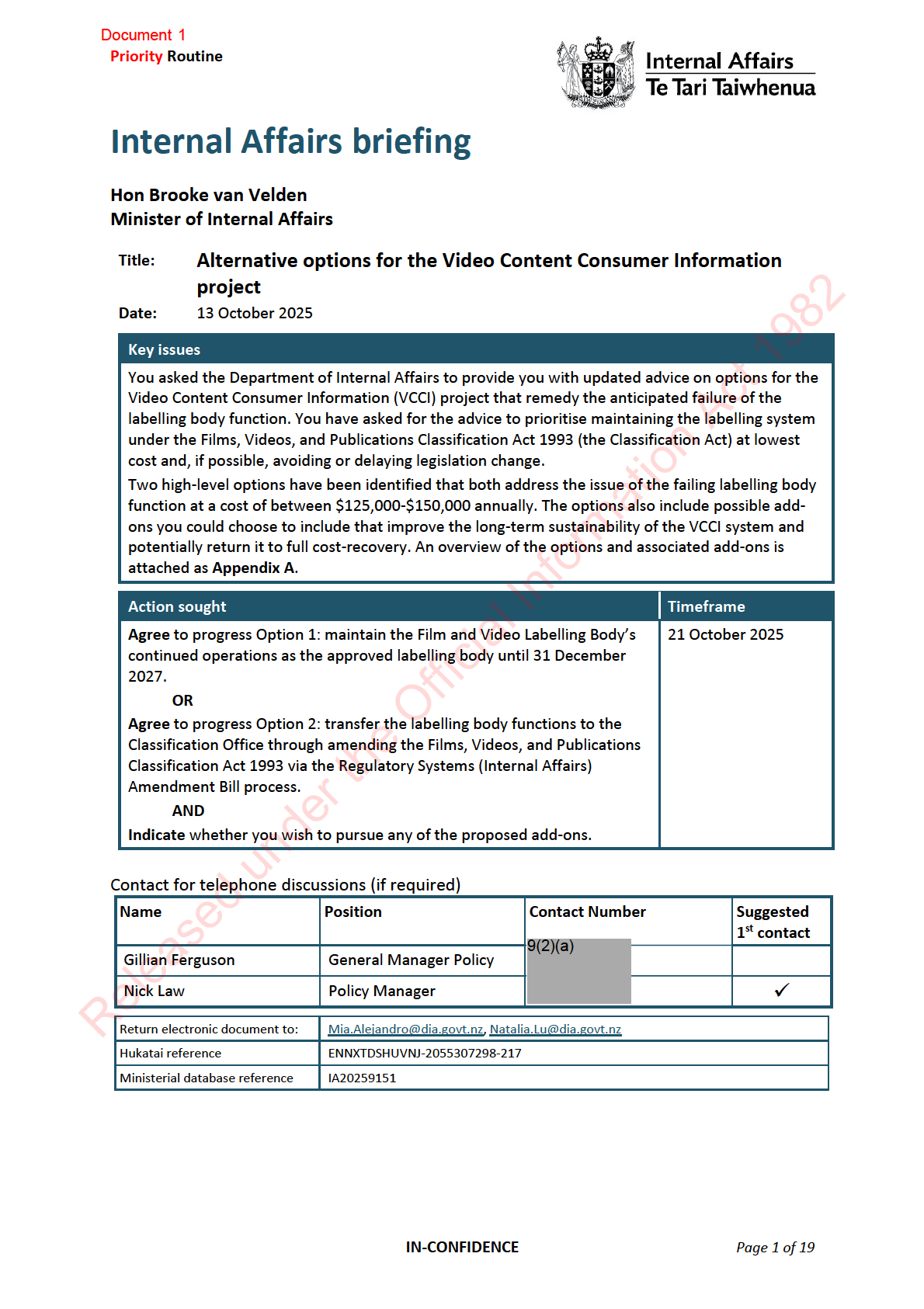
You asked the Department of Internal Affairs (the Department) to provide advice on
alternative approaches to labelling video content under the Classification Act, as there is
insufficient House time to progress a Bill for the Video Content Consumer Information (VCCI)
project as part of the government's legislative programme. Alternative approaches are
necessary to remedy the anticipated failure of the labelling body function.
3.
The FVLB has decided to cease operating by 31 March 2027, with scope to extend until
31 December 2027 if required and with additional government funding. On 25 June 2025, the
FVLB wrote to you to indicate their intention to wind up operations. They subsequently
indicated to the Department that there is no appetite from its industry membership to
continue the labelling body function beyond 31 December 2027, with their preference to wind
up by 31 March 2027. Without an approved labelling body, physical video content cannot be
legally provided to New Zealand consumers.
4.
Two high-level options have been identified that would address the issue of the failing labelling
body function at a cost of
between $125,000-$150,000 per annum and avoid or delay
legislation change. The options also provide you with the choice of including add-ons should
you wish to direct the Department to develop advice to improve the long-term sustainability of
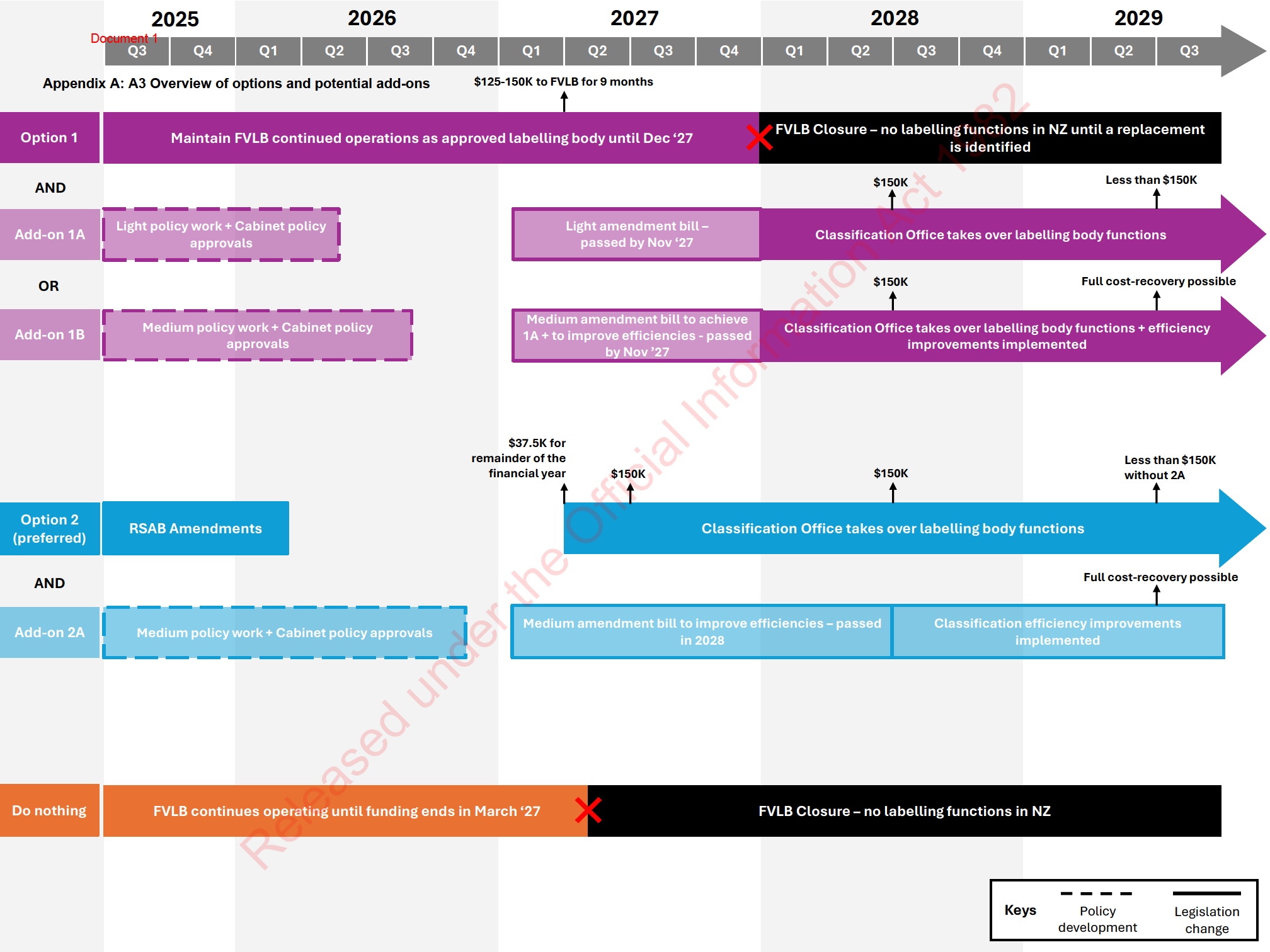
the VCCI system. An overview of these options is attached as
Appendix A which includes:
4.1
Option 1 (short-term fix): maintain the FVLB’s continued operations as the approved
labelling body until 31 December 2027 by providing additional funding, but leave all
further work on a replacement labelling body until the next term.
•
Add-on 1A (medium-term fix): progress policy work to enable transfer of the
labelling body functions to the Classification Office, with policy approvals this term
and the legislative work next term.
OR
•
Add-on 1B (enable long-term operational efficiencies): progress policy work on
Add-on 1A and make more extensive changes to the Classification Act to enable
labelling function efficiencies.
under the Official Information Act 1982
4.2
Option 2 (short-medium term fix): transfer the labelling body functions to the
Classification Office via the Regulatory Systems (Internal Affairs) Amendment Bill
(RSAB) process.
•
Add-on 2A (enable long-term operational efficiencies): progress policy work to
make changes to the Classification Act to enable labelling function efficiencies.
5.
You could choose not to progress with any of the options provided, noting that this would
Released
mean there would be no labelling body function beyond 31 March 2027 and the risks this
would create. We also considered a third option that was discounted as it would be in breach
of the legislation.
You asked for advice on alternative approaches to labelling video content under the
Classification Act that remedy the anticipated failure of the labelling body function
6.
We understand you have asked for advice on alternative approaches to labelling video
content, as there is insufficient House time to progress a Bill for the Video Content Consumer
IN-CONFIDENCE
Page 2 of 19
Document 1
Department of Internal Affairs
Te Tari Taiwhenua
Information (VCCI) project as part of the government's legislative programme. You confirmed
at IA officials on 22 September 2025 that you would like to prioritise maintaining the VCCI
system at the lowest cost; and for the options to either avoid or delay legislation change if
possible. You also requested more information about the labelling body function and the
FVLB's viability issues, as well as costing for each identified option. Detailed information about
the labelling body's function is attached as
Appendix B.
Prior to this briefing, we had been progressing work on a ‘decentralised’ approach to
labelling video content under the Classification Act
7.
Since March 2025, we had been progressing work on a ‘decentralised’ approach to labelling
video content under the Classification Act. This work would have addressed the impending
deadline for the closure of the FVLB and the cost of propping up that part of the system.
8.
A 'decentralised' approach involved moving from age restrictions with legal effect to age
recommendation labels, whilst retaining legal restrictions at the 'R18' age level to modernise
the labelling system to make it more efficient for industry and the regulator and provide more
comprehensive advice to consumers. On 4 August 2025, we provided you with a briefing that
summarised feedback from targeted consultation on the proposal to decentralise the VCCI
system [IA20258466 refers]. As noted above, we understand that you no longer wish to pursue
work to decentralise the VCCI system due to insufficient House time to progress the required
legislation.
The FVLB has decided to cease operating by 31 March 2027, with scope to extend
until 31 December 2027 if required and with additional government funding
9.
The FVLB has required government subsidisation since 2020, as the regulated operating model
is no longer financially self-sustaining. The FVLB is intended to be self-funding, with its income
derived from fees charged for rating and issuing labels for video content submitted to it, and
the sale of printed labels for physical products like DVDs. However, in recent years, its viability
has been significantly impacted by the decline in physical video content consumption, with the
Official Information Act 1982
FVLB’s revenue declining from over $800,000 in 2015 to under $300,000 in 2020. 9(2)(ba)(i)
10.
The significant decline in the FVLB’s revenue necessitated financial support from government
from 2020 onwards It is clear that the FVLB is no longer financially viable without government
subsidisation. The FVLB received $209,000 in funding over 2020/2021 and $150,000 in 2022
through reprioritisation of the Department’s baseline. A further $450,000 was secured as part
of Budget 2022, to be provided to the FVLB over a three-year period ending in 2025. Further
under t
background information, a detailed breakdown of the FVLB’s income and expenses report for
the 2023 and 2024 calendar years, as well as its budget forecasts for the 2025 – 2027 calendar
years, are attached as
Appendix C.
The FVLB wrote to you on 25 June 2025 to provide written confirmation of its intention to
wind up operations on 31 March 2027
Released
11.
The letter states that the FVLB’s industry members have formed the collective view that it is
becoming uneconomic to continue operating the labelling body function indefinitely, citing
changes in the industry and successive government policies as contributing factors to their
determination. The letter is attached at
Appendix D for ease of reference.
12.
Following receipt of this letter, the Department had two meetings with the Chair of the FVLB
to discuss whether the FVLB would be willing to operate beyond the March 2027 date, either
for a set period or indefinitely. On 2 October 2025, the FVLB informed the Department that it
would agree to extend the closure date from 31 March 2027 to 31 December 2027 if required,
subject to the provision of additional government funding of between $125,000 - $150,000.
IN-CONFIDENCE
Page 3 of 19
Document 1
Department of Internal Affairs
Te Tari Taiwhenua
13.
The FVLB’s response also stated that there is no appetite from its industry membership to
continue operating the labelling body function beyond 31 December 2027. Their agreement to
extend operations has been made on the basis that an extension would allow the necessary
policy and legislative process to occur to transition the function. The FVLB’s response to the
Department is attached at
Appendix E.
Without an approved labelling body, physical video content cannot legally be provided to
New Zealand consumers
14.
Should the FVLB cease operating without an alternative labelling body being appointed to take
over the function, video content providers will not be able to submit their content for labelling.
Under current legislative requirements, cinemas and other physical retailers would be liable to
a fine of up to $10,000 if they were found to be providing video content without labels 1
15.
As a result, new movie releases would likely be halted until a new labelling body is appointed.
Depending on how long this process takes, there could be a significant backlog in the labelling
of video content, which would impact consumer choice and damage the revenue streams of
cinemas and other physical retailers.
16.
The Classification Act requires that a labelling body be appointed by the M nister of Internal
Affairs. While in theory you could appoint an alternative to the FVLB no other existing entity in
New Zealand meets the criteria for approval. The Classification Act requires that the labelling
body represent the film production, distribution, and public exhibition industry in New Zealand
while also having the capability to implement labelling requirements under the Classification
Act.23
We have identified two high-level options that would address the issue of the
failing labelling body function
17.
We have identified two options for you to consider that would address the issue of the failing
labelling body function. Both options will require further funding from March 2027 of
approximately
$125,000 - $150,000 per financial year to maintain the labelling body function,
either to the FVLB or the Classification Office. This amount is based on the existing financial
costs for the operations of the FVLB (attached as
Appendix C). Changing who operates the
labelling function is unlikely to materially alter the amount that is required to fund it in the
short-term because the existing employees, systems and assets would be transferred. Both
options also take into consideration the FVLB’s intention to wind up operations by
31 December 2027 at the latest.
18.
In addition, we have identified potential add-ons that could be progressed alongside the
under the Official Information Act 1982
options, should you wish to direct the Department to develop advice to improve the long-term
sustainability of the VCCI system. These add-ons would require policy work this term of
Parliament, with legislation introduced early in the next term of Parliament. We have provided
an overview of all options and potential add-ons as
Appendix A.
19.
We are investigating approaches to provide the required funding through reprioritisation of
Department baseline appropriations. This will require joint Ministerial approval with the
Minister of Finance. We will provide you with a briefing with advice on these funding
Released
approaches if you choose to progress either option in this briefing.
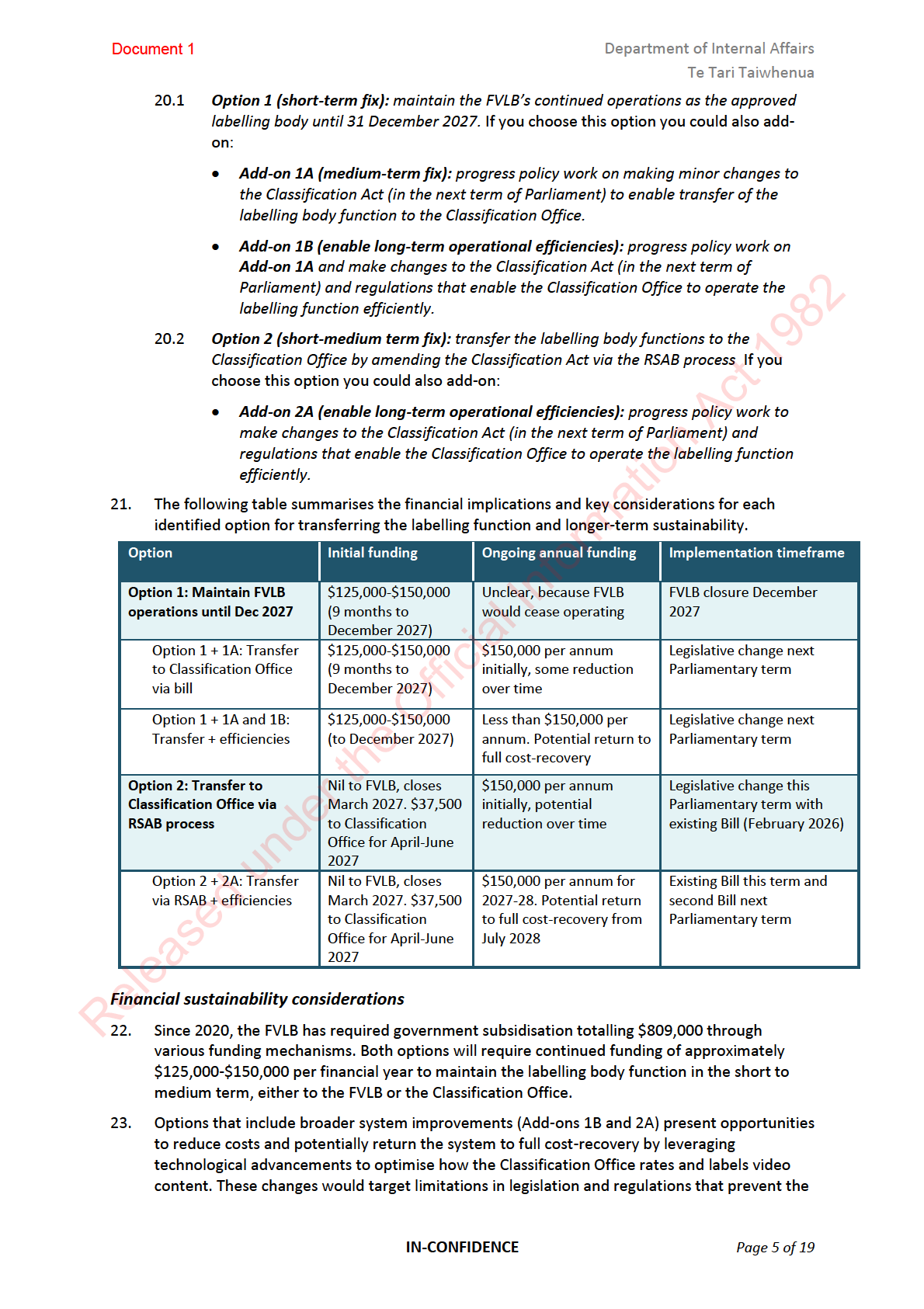
20.
The options and associated add-ons include:
1 Section 120 of the Classification Act sets out offences relating to non-compliance with labelling requirements.
2 Section 72 of the Classification Act sets out all of the criteria for approval of a labelling body.
IN-CONFIDENCE
Page 4 of 19
Document 1
Department of Internal Affairs
Te Tari Taiwhenua
Classification Office from fully streamlining its operations. Policy changes and operational
improvements could remove the need for government subsidisation in the future.
You could choose not to progress any option, noting the risks this would create
24.
As the FVLB will continue to operate until March 2027, which falls outside of the current
Parliamentary term, you may choose to not progress any options. However, the risk of not
progressing any options now is that there will not be sufficient time in the next Parliamentary
term to make the necessary changes to address the issue of the failing labelling body function.
This would mean that from the closure of the FVLB in March 2027, physical video content
cannot legally be provided to New Zealand consumers until a fix is implemented as outlined in
paragraphs 14-16.
Option 1 would maintain the FVLB’s continued operation as the approved labelling
body until 31 December 2027 through further funding
25.
This option would provide the FVLB with additional funding of
$125,000-$150,000 to maintain
operations as the approved labelling body until 31 December 2027. This option would not
require any legislative change. However, the risk of this option is that it only provides a short-
term fix until the closure of the FVLB, which could mean that there is not enough time in the
next Parliamentary term to progress the legislative changes required to maintain the labelling
body function beyond 31 December 2027.
26.
If you choose to proceed with this option, we will provide you with advice on funding options
in line with paragraph 19, including the requirement on joint Ministerial approval with the
Minister of Finance. We also identified two potential add-ons that you could choose to
progress to extend the fix to medium term and/or enable the Classification Office to make
longer-term operational efficiencies.
Add-on 1A would mitigate the risk of progressing this
option alone:
26.1
Add-on 1A (medium-term fix): progressing minor changes to the Classification Act to
enable transfer of the labelling body function to the Classification Office.
26.2
Add-on 1B (enable long-term operational efficiencies): progress policy work on 1A
and make changes to the Classification Act and regulations that enable the
Classification Office to operate the labelling function efficiently.
27.
These add-ons would require policy work to be done and decisions from you and Cabinet this
Parliamentary term. However, a Bill would not be progressed until the next term of
Parliament.
under the Official Information Act 1982
Add-on 1A: Progressing minor changes to the Classification Act (in the next term of
Parliament) to enable transfer of the labelling body function to the Classification Office
28.
This add-on in combination with
Option 1 addresses the issue that the FVLB is unwilling to
continue to operate as the approved labelling body after 2027. It would provide a pathway to
the future appointment of the Classification Office as the approved labelling body, which the
Department considers is best placed to take over the function following the FVLB’s closure.
This would involve minor amendments to the existing requirements under Sections 72 – 75 of
Released
the Classification Act, for an entity to have industry and community representation in order to
be approved. Removing the relevant requirements under the Classification Act would also
provide flexibility for other organisations to be appointed to the role in the future.
29.
The Classification Office has indicated it would require similar levels of funding provided to the
FVLB of
$150,000 in the first year, with the possibility that the annual costs would reduce
thereafter from co-locating this function with the Classification Office. The Classification Office
is also comfortable that there would be no additional funding required for the transition
IN-CONFIDENCE
Page 6 of 19
Document 1
Department of Internal Affairs
Te Tari Taiwhenua
beyond required annual funding. The FVLB has indicated that a plan to transition its system so
that another organisation can deliver the labelling function could be ready in March 2026.
30.
To give effect to this option we would need your policy approval, as well as Cabinet approval
to draft a Bill, but the Bill would not be progressed until the next term of Parliament. We
would work with the Classification Office and the FVLB to prepare this advice and a plan to
transfer the function.
Add-on 1B: Making broader changes to the Classification Act (in the next term of
Parliament) to improve and future-proof the labelling system
31.
In addition to
Add-on 1A, this add-on would progress policy work to enable the Classification
Office to be appointed as the approved labelling body. Policy work on making broader changes
to the Classification Act could then be progressed. These broader changes would focus on
enabling efficiencies in the labelling of video content to improve the operational viability of the
labelling function and the financial sustainability of the overall video content regulatory system
under the Classification Act.
32.
Amendments under
Add-on 1B could include making changes to the Classification Act that
would enable AI/machine learning and other advancements to be leveraged in order to
optimise how video content is rated, classified and labelled. These changes could also enable
the Classification Office to realise more of the benefits of contracting out parts of the VCCI
rating process.
33.
This option expands the policy work under
Add-on 1A. It would progress on the same
timeframe as
Add-on 1A and would require a project with the Classification Office to identify
legal constraints to improving efficiencies of the labelling function. This option could remove
the need for government subsidisation of labelling in the future and return the system to full-
cost recovery.
Option 2 (preferred) would transfer the labelling body function to the Classification
Office through amending the Classification Act via the current RSAB process
34.
Amending the Classification Act through the RSAB would enable changes to be passed this
Parliamentary term. The changes would be the same discrete changes to Sections 72 – 75 of
the Classification Act as described above under
Add-on 1A, which would be targeted to
enabling the labelling body function to be transferred to the Classification Office.
35.
Because the changes would be passed this Parliamentary term, the FVLB could wind up its
operations on 31 March 2027 as originally planned, requiring no further government funding
for the FVLB. This option would also require ongoing annual funding to the Classification Office
under the Official Information Act 1982
from 31 March 2027 of
up to $150,000. Over time we would expect this to decrease as
systems are integrated.
36.
This option would achieve the same outcome as
Option 1 + Add-on 1A, but on a faster
timeline as it would be achieved through the RSAB process (an existing Bill) rather than
through the introduction of a new Bill. As we are using an existing legislative vehicle, it would
use the least policy resources to progress. This option would take effect from March 2027,
allowing the Classification Office to take-over the labelling body functions earlier. This enables
Released
the Classification Office to begin making operational changes to improve efficiencies to the
labelling functions sooner, which would result in the earliest possible cost-savings. For these
reasons, this is our preferred option.
Progressing discrete amendments through RSAB could potentially be achieved without
Cabinet approval as we consider it to be a ‘minor and technical change’
37.
We consider these amendments to be suitable for the RSAB as it aligns with the effectiveness
and efficiency policy objectives of an RSAB, because the amendments would improve the
IN-CONFIDENCE
Page 7 of 19
Document 1
Department of Internal Affairs
Te Tari Taiwhenua
Add-on 2A: Progressing policy work on making broader changes to the Classification Act to
improve the long-term efficiency of labelling
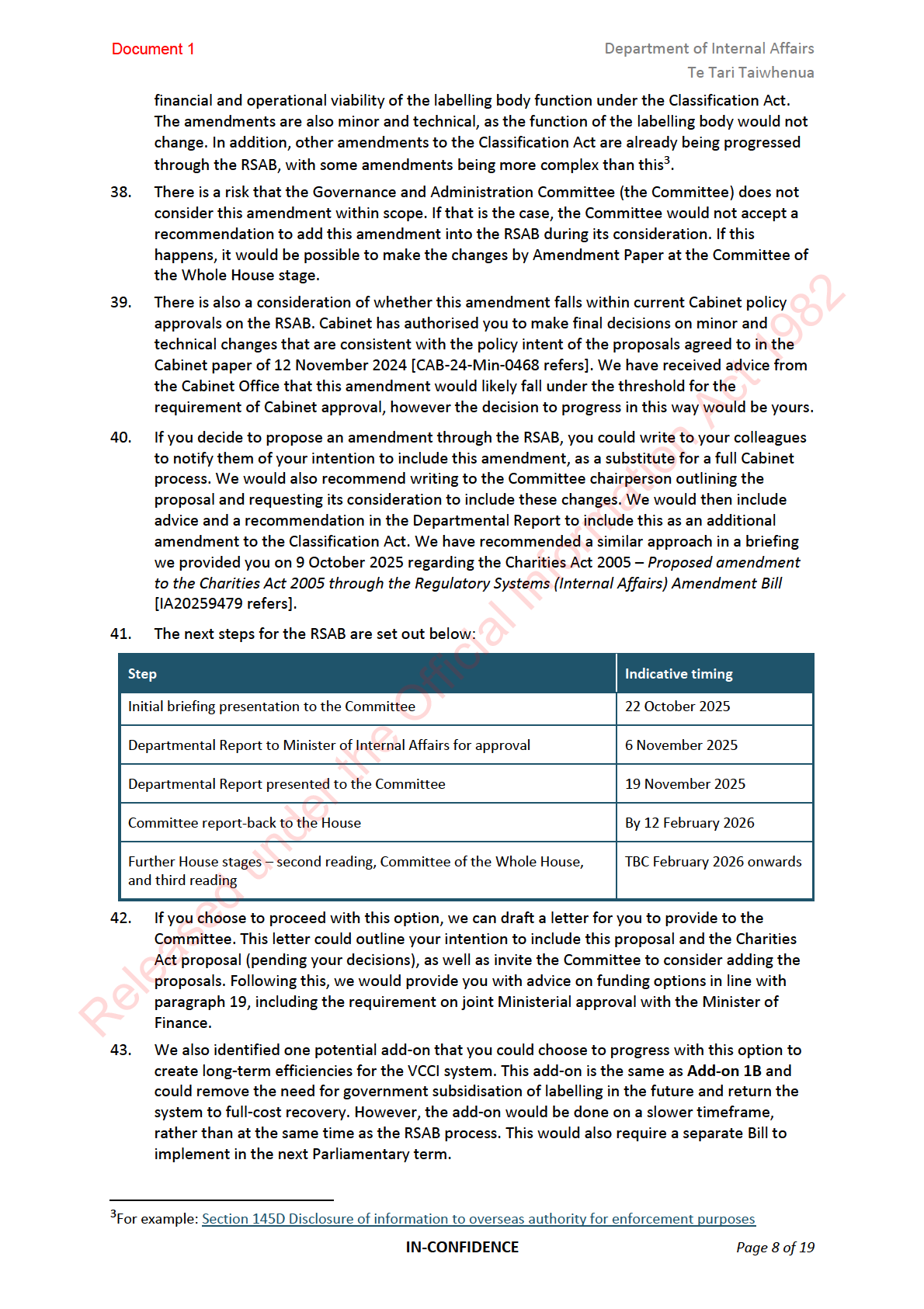
44.
This add-on would enable the Department to continue developing policy proposals aimed at
making broader changes to the Classification Act that would improve the operational viability
of the labelling function and the financial sustainability of the overall video content regulatory
system. These would be the same changes that could be made under
Add-on 1B, described
above. It would require policy decisions this term of Parliament.
We considered a non-legislative transfer of the labelling body function to the
Classification Office, but discounted it as it would be in breach of legislation
45.
We considered a non-legislative transfer of the labelling body function to the Classification
Office (or another body such as the Department). However, option has significant legal risks
and would be in breach of legislation due to the application of the current Classification Act.
46.
The legislation provides specific criteria for the Minister to approve a labelling body and there
is currently no entity in New Zealand that can be legally approved outside of the FVLB, as
explained in
paragraph 16. This means if another entity such as the Classification Office were
to carry out the labelling body function, it would be in an ‘unofficial’ capacity and any labels
issued would carry no legal weight. This results in two significant legal risks:
46.1
The Classification Office (or another entity) carrying out the labelling body function
‘unofficially’ would be committing an offence under Section 1214, which prevents
labels from being issued by anyone outside of the appointed labelling body (which no
other entity apart from the FVLB can be appointed to). Therefore, any labels issued by
the Classification Office (or another entity) would be in breach of Section 121.
46.2
Cinemas and physical retailers would also be committing an offence under Section
1205 if they provide a film that has been labelled by an unofficial labelling body as they
would be in breach of their obligations under Section 66. They could be liable to a fine
of up to $3,000 for an individual or $10,000 for an organisation.
47.
We therefore do not consider this to be a viable option and have discounted it due to the
significant legal risks for the Classification Office and non-government organisations.
There are risks with progressing the options above without also progressing
improvements to digital video content labelling
48.
Industry and regulatory stakeholders expressed support for progressing improvements to
digital video content during targeted consultation on the ‘decentralised’ approach, held in
under the Official Information Act 1982
June – July 2025. In particular, industry and regulatory stakeholders expressed support for
reviewing Commercial Video on-Demand (CVoD) self-rating arrangements and extending the
CVoD self-rating approach to currently exempt video content types like mobile and online
video games.
49
As part of requesting updated advice to remedy the anticipated failure of the labelling body
function for physical video content, you also indicated you do not wish to pursue any
improvements to digital video content labelling. None of the options set out in this briefing
Released
involve improvements to digital video content, so will not meet industry stakeholders’
expectations with regard to the scale of change they consider necessary to achieve a more
efficient and effective labelling system. However,
Add-on 1B and 2A would mitigate some of
4 Section 121: Unlawful issue of labels
5 Section 120: Non-compliance with labelling requirements
6 Section 6: Films to be labelled
IN-CONFIDENCE
Page 9 of 19
Document 1
Department of Internal Affairs
Te Tari Taiwhenua
the risk as it would enable the Classification Office to make significant improvements to the
VCCI system that industry would appreciate.
50.
Industry may raise their concerns with you about these matters directly, as they may have
expectations that government will progress options involving improvements to digital video
content labelling. We can support your Office should you receive correspondence or meeting
requests from industry stakeholders.
Next steps
51.
We are available to discuss the contents of this briefing with you at your earliest opportunity.
under the Official Information Act 1982
Released
IN-CONFIDENCE
Page 10 of 19
Document 1
Department of Internal Affairs
Te Tari Taiwhenua
Appendix B: Information about the labelling body’s purpose and functions under
the Classification Act
The labelling body’s purpose is to issue labels for video content, with the
Classification Act requiring video content to be labelled before being provided to
New Zealand consumers
The Classification Act requires that a ‘film’ (i.e. video content) must not be provided to the
public unless a label has been issued for that film, and the label display requirements have
been met.7 Only certain types of video content are required to be labelled, which are movies
and shows for cinematic or DVD release, and video on-demand content that is made
available by specified Commercial Video on-Demand (CVoD) providers.8
The Classification Act requires video content providers to submit their content to the Film
and Video Labelling Body (FVLB) for assessment, as the approved labelling body under the
Act. The FVLB is an incorporated society and registered charity made up of representatives
from the video content industry.
The FVLB is responsible for assessing unrestricted cinematic releases, DVDs and Blu-ray discs,
and issues the labels that all video content must display before they are supplied to the
public.
The Classification Act requires the FVLB and the Classification Office to follow specific steps
to assess and label video content
Once video content is submitted to the FVLB by a video content provider, it will assess the
content and provide a suitable label for it. A label is made up of three components: a rating
or classification; a corresponding symbol that is the visual representation of the rating or
classification; and a description, which sets out content warnings.
If the content has been given an unrestricted rating in Australia and/or the United Kingdom,
the FVLB can automatically apply the corresponding New Zealand label through a cross-
rating process set out in regulations. Otherwise, the FVLB will assess the content itself, and if
the content is determined to be suitable for general audiences (G), general audiences with
parental guidance (PG), or suitable for mature audiences (M), the FVLB will issue a label to
the provider to display on the content.
under the Official Information Act 1982
If the FVLB’s initial assessment indicates that a classification assessment is required, the
FVLB must refer the content to the Classification Office for assessment. The Classification
Office is an Independent Crown Entity established under the Classification Act to classify
‘publications’ that may need to be restricted or banned.9 Once the Classification Office has
assessed and determined the classification of the video content, the FVLB will provide the
label that displays the required classification to the provider.
Released
7 Film is defined in the Act as ‘a cinematograph film, a video recording, and any other material record of visual
moving images… and includes video on-demand content.’ It is a broad definition that covers all types of video
content that are not in the process of being livestreamed. However, many types of video content are exempt
from labelling requirements, such as video games.
8 ‘Specified CVoD providers are those that are listed in schedule 4 of the Classification Act.
9 ‘Publication’ is a broad definition under the Act that captures all ‘film’ (video content), as well as printed
material such as books and magazines.
IN-CONFIDENCE
Page 13 of 19
Document 1
Department of Internal Affairs
Te Tari Taiwhenua
As you are aware, there is an important distinction between a rating and a classification,
which necessitates different labelling processes and label outcomes. A classification can
‘restrict’ content – in other words, make content illegal to interact with if a person is under
the age specified in the classification, while a rating outcome only advises against interacting
with content if a person is outside of the recommended age.
If the Classification Office determines that video content needs to be age restricted, then
cinemas and other physical retailers are legally required not to show or sell that content to
anyone under the age of that restriction. There are criminal penalties for breaching those
requirements. The Department of Internal Affairs’ Inspectors of Publications are responsible
for enforcing labelling requirements under the Classification Act.
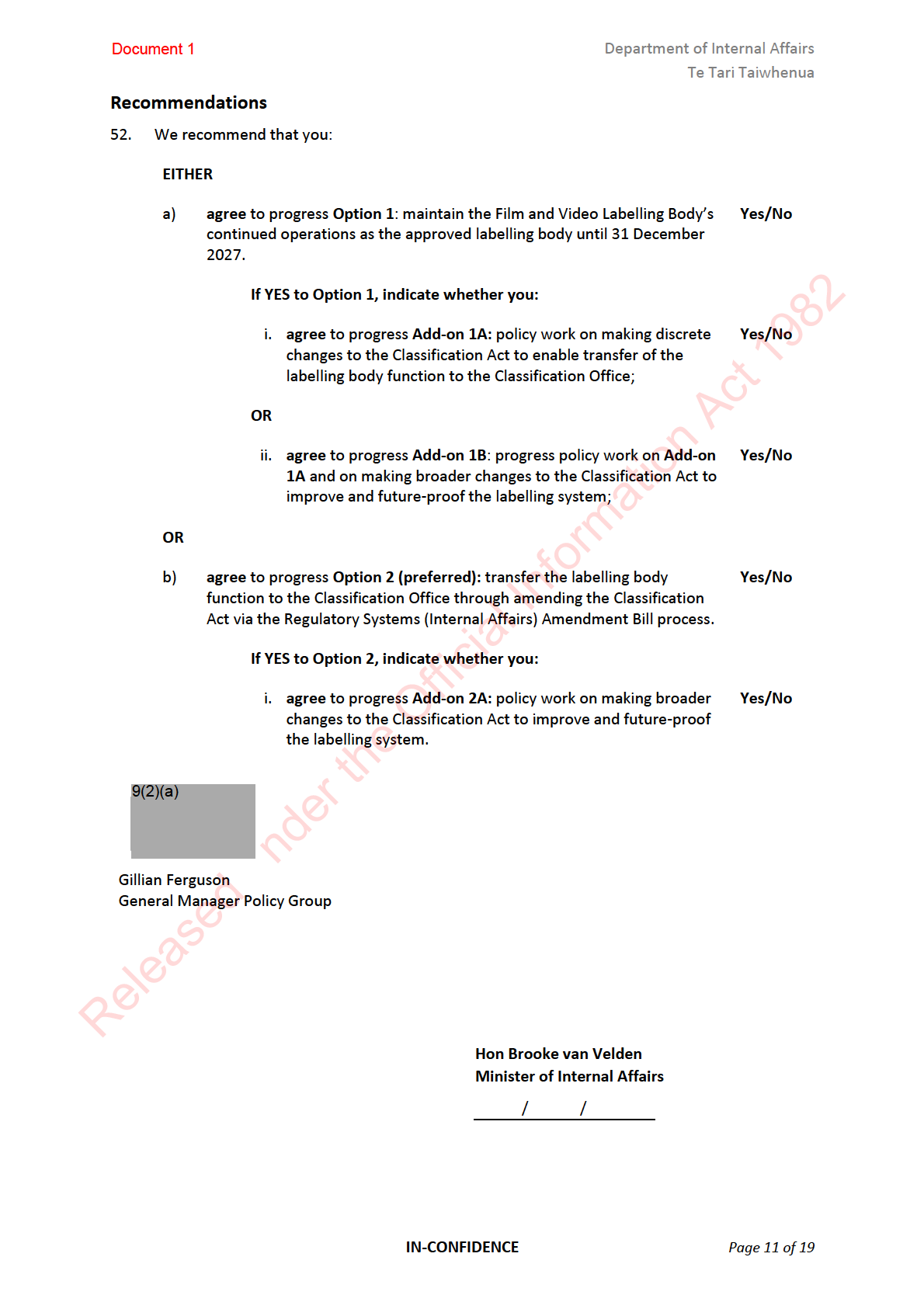
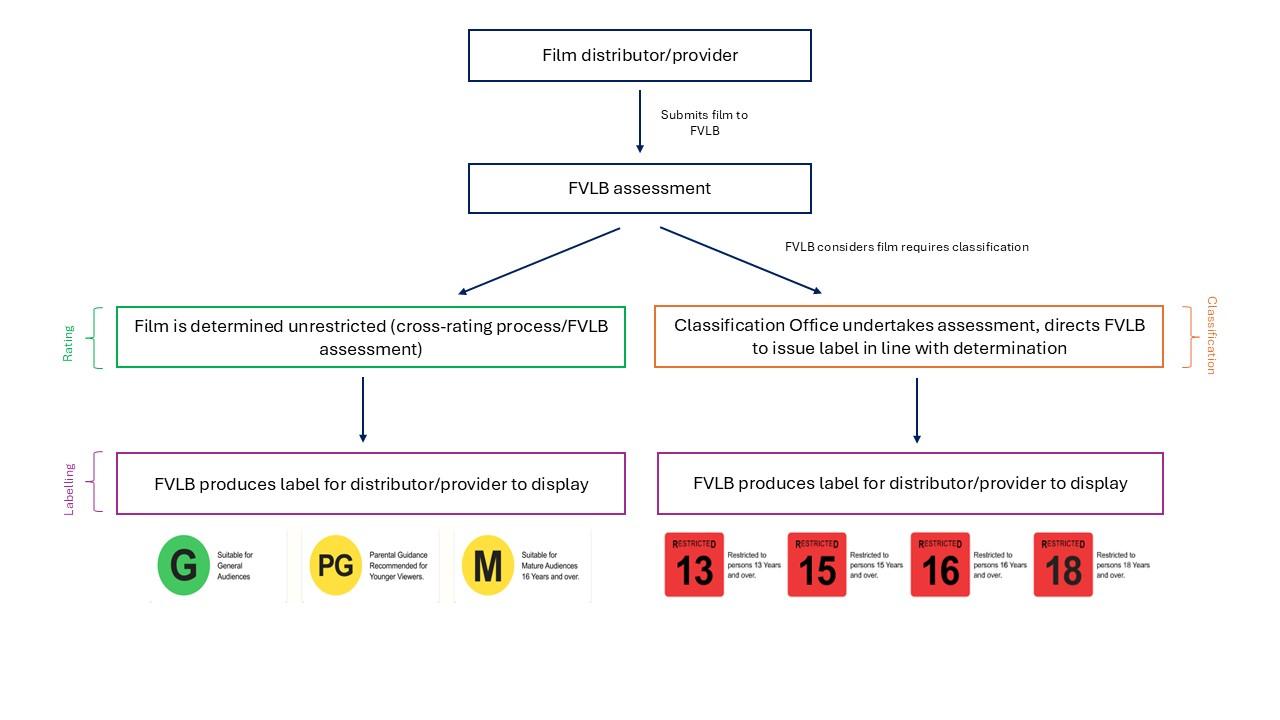
Figure 1 shows a high-level diagram of the labelling process for physical video content that
can lead to either an unrestricted or restricted label.
Figure 1: Labelling process for ‘film’ (video content) under the Classification Act
under the Official Information Act 1982
Released
IN-CONFIDENCE
Page 14 of 19
Document 1
Department of Internal Affairs
Te Tari Taiwhenua
Appendix C: Film and Video Labelling Body background and financial information
The Classification Act requires video content providers to submit their content to the FVLB
for assessment, as the approved labelling body under the Act. The FVLB is an incorporated
society and registered charity made up of representatives from the video content industry.
The FVLB is intended to be self-funding, with its income coming through charging fees for
rating and issuing labels for video content submitted to it and the sale of printed labels for
physical products like DVDs. However, in recent years, its viability has been significantly
impacted by the decline in physical video content consumption, with the FVLB’s revenue
declining from over $800,000 in 2015 to under $300,000 in 2020. 9(2)(ba)(i)
82
The FVLB has the power to set its own fees, so would not require changes to the
Classification Act or secondary legislation to increase fees to match operating costs.
However, increasing fees to match costs would threaten the financial viability of the physical
video content sector in New Zealand. Particularly, the FVLB estimates it would have to
increase its fees for labelling of cinematic releases by 310 per cent to cover shortfalls. Such
an increase in fees would be unsustainable for the physical film sector, particularly following
the global economic impacts of COVID-19 lockdowns on the cinema industry, reductions in
the size of the DVD market in New Zealand, and the flow-on impacts of the 2023 industrial
strikes by Hollywood trade unions on market volumes.
The stark decline in the FVLB’s revenue has necessitated financial support from government
from 2020 onwards, with the Department concluding that the FVLB is no longer financially
viable without government subsidisation. In particular, the FVLB received $209,000 in
funding over 2020/2021 and $150,000 in 2022 through reprioritisation of the Department’s
baseline. A further $450,000 was secured as part of Budget 2022, to be provided to the FVLB
over a three-year period ending in 2025.
Despite looking for alternative revenue sources and undertaking structural organisation
change, the FVLB remains unable to generate sufficient income to sustain itself and to make
necessary upgrades to legacy systems.
Income and expenses report for the 2023 and 2024 calendar years:
nder the Official Information Act 1
9(2)(b)(ii)
IN-CONFIDENCE
Page 15 of 19
Document 1
Department of Internal Affairs
enua
9(2)(b)(ii)
82
IN-CONFIDENCE
Page 16 of 19
Document 1
Department of Internal Affairs
9(2)(ba)(i)
9(2)(b)(ii)
Releas
IN-CONFIDENCE
Page 17 of 19

Document 1
Department of Internal Affairs
Te Tari Taiwhenua
Appendix E: Email from the Film and Video Labelling Body to the Department
From: 9(2)(a)
Sent: Thursday, 2 October 2025 12:13 pm
To: Nick Law <[email address]>
Cc: 9(2)(a)
Subject: FVLB Surrender of Warrant – Extension
Subject: FVLB Surrender of Warrant – Extension
Dear Nick,
Following our conversation via Microsoft Teams on 25 September 2025, I am writing on behalf of the
Film and Video Labelling Body Incorporated (FVLB) in response to your request to extend the current
termination date from 31 March 2027 to 31 December 2027.
After considering your position and as a gesture of good faith, the board of The Film and Video
Labelling Body Incorporated (FVLB) is agreeable to further extend the funded termination date from
31 March 2027 to 31 December 2027 on the basis that the extension will allow the appropriate policy
work and potential legislative change process around the censorship review to run its course.
For the avoidance of doubt there is no appetite from the boards perspective for The Film and Video
Labelling Body Incorporated (FVLB) to continue operating post 31 December 2027. It is still the
society’s intention to surrender the warrant and cease operating as the Labelling Body under section
72 of the Films, Videos, and Publications Classification Act 1993.
In light of the ongoing changes within the industry, the function the FVLB was established to
undertake becoming increasingly irrelevant along with changes in successive Government policies
and the financial challenges it faces, it is no longer viable for the FVLB to continue delivering labelling
services indefinitely.
Accordingly, the Society invites the Minister to terminate its approval with effect from 31 December
2027, or an earlier date if mutually agreed.
Regards
9(2)(a)
d under the Official Information Act 1982
Chair
Film and Video Labelling Body
Īmēra: 9(2)(a)
Waea kawe: 9(2)(a)
Rele
IN-CONFIDENCE
Page 19 of 19


Document 1
Appendix D: Letter from the Film and Video Labelling Body informing you that they
will cease operations on 31 March 2027
25 June 2025
Hon. Brooke van Velden
Minister of Internal Affairs
Parliament Buildings
Wellington 6160
Dear Minister
Film and Video Labelling
1.
I act for the Film and Video Labelling Body Incorporated, a society registered under the Incorporated
Societies Act 1908 (incorporation number 632310) and the Charities Act 2005 (registered charity
number CC20715) (
Society).
2.
The Society has been approved by a previous Minister of Internal Affairs in accordance with section
72 of the Films, Videos, and Publications Classification Act 1993 (
Act) to be the labelling body for the
purposes of the Act, and continues to provide the relevant labelling services described in the Act
(
Services).
3.
The members of the Society have formed the collective view that, given changes in the industry and
with successive Government policies, it is becoming uneconomic for the Society to continue the
indefinite future delivery of the Services.
4.
Accordingly, this letter is confirmation of a verbal notice given to officials – that the Society invites the
Minister to terminate the Society’s approval to provide the Services with effect from 31 March 2027 or
such earlier date as may be agreed (
Termination Date).
5.
The Society will continue to function and to provide the Services until the Termination Date, and has
the resources to do so. It will re-register in accordance with the requirements of the Incorporated
Societies Act 2022, and will likely seek to wind down in a structured, orderly fashion after the
Termination Date.
6.
Please do not hesitate to contact me if you have any questions or concerns.
under the Official Information Act 1982
Yours faithfully
sed
9(2)(a)
9(2)(a)
276287.0001 15026645.2
