
28 April 2026
Ref: DOIA-REQ-0030149
Andrew Riddell
Email: [FYI request #34259 email]
Tēnā koe Andrew Riddell
Thank you for your email of 26 March 2026 to the Ministry of Business, Innovation and Employment
(MBIE) requesting, under the Official Information Act 1982 (the Act), the following information:
Politik reports that yesterday a briefing was provided to top business CEOs on the fuel crisis.
Politik further reports "The CEOs were briefed by Ministry of Business Innovation and Employment
(MBIE) officials, the head of the Department of Prime Minister and Cabinet, Ben King and the
deputy CEO of the Ministry of Foreign Affairs and Trade, Taha McPherson".
Please provide copies of the meeting agenda, the attendance list, all briefing notes used or
referred to by the officials presenting this webinar, copies of any power points or other documents
screen shared during the webinar, and a recording or transcript of the webinar.
It may be helpful to provide additional context for the briefing held on 25 March 2026. The briefing took
the form of a webinar intended for domestic New Zealand businesses. Invitations were issued on 24
March 2026 by MBIE Chief Executive Nic Blakeley to a range of businesses and other sector
representatives.
The webinar provided a forum for businesses and other stakeholders to hear updates and participate in
discussion on developments in the Middle East and the current fuel situation. The session focused on
what these developments may mean for domestic New Zealand businesses and on practical steps that
could be taken in response.
The aim of the webinar was to deliver a practical briefing to help businesses better understand the current
situation and plan with confidence. This webinar was the first in a series of briefings intended to support
businesses during this period.
I can confirm there was no recording or transcript of the webinar. As such, your request for this
information is refused under section 18(e) of the Act as the information does not exist.
Please refer to the document schedule below for a list of information identified as being in scope of your
request. A small amount of information is withheld under section 6(a) of the Act to avoid prejudicing the
security or defence of New Zealand or the international relations of the New Zealand Government.
Document
Document name
Withholding/refusal sections
1.
Domestic Business Briefing (Middle East)
Released in full
2.
2026.03.25 Fuel webinar – briefing pack
Some information withheld under section 6(a)
3.
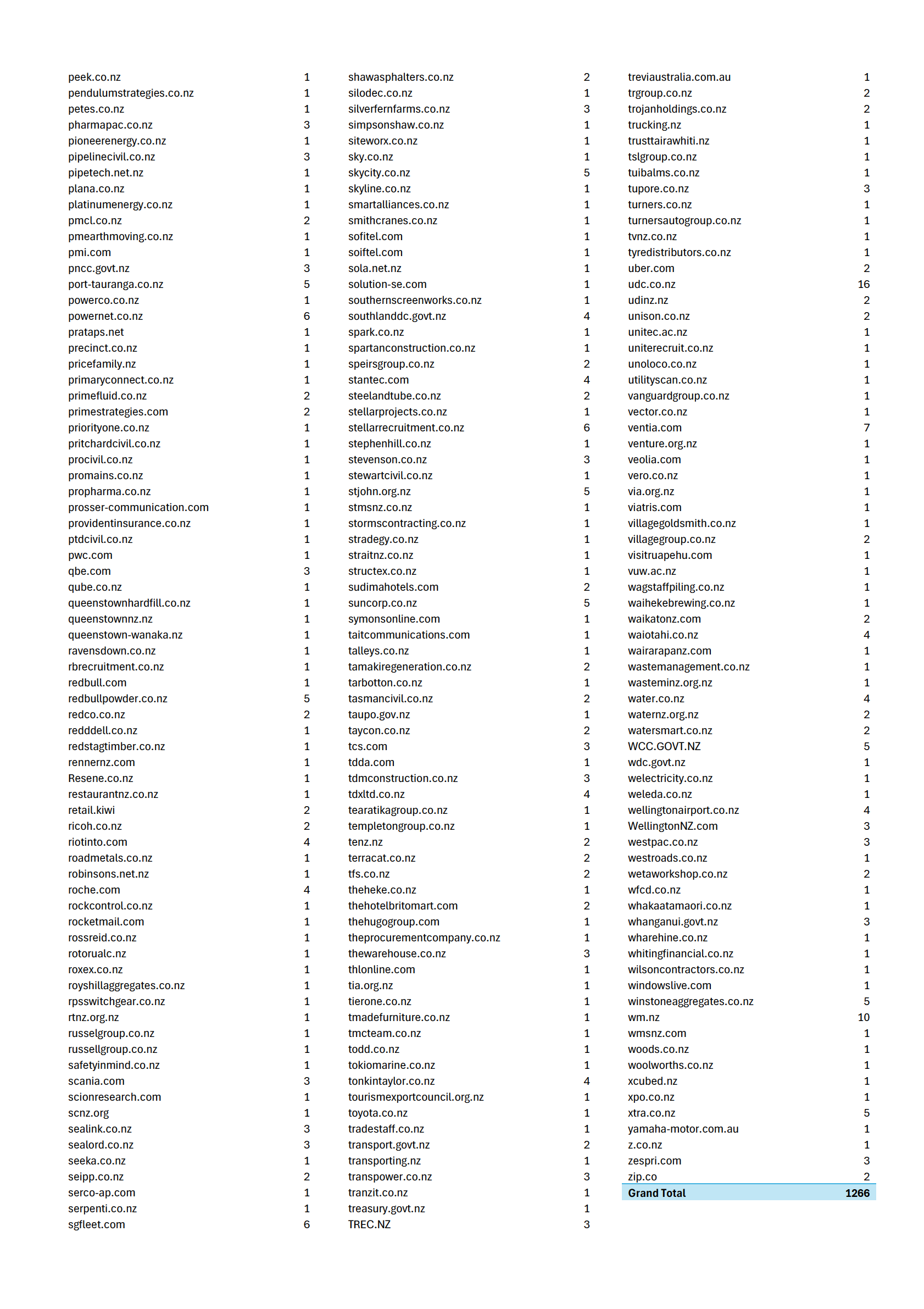
Registration list 20260325
Withheld in full – section 9(2)(a)
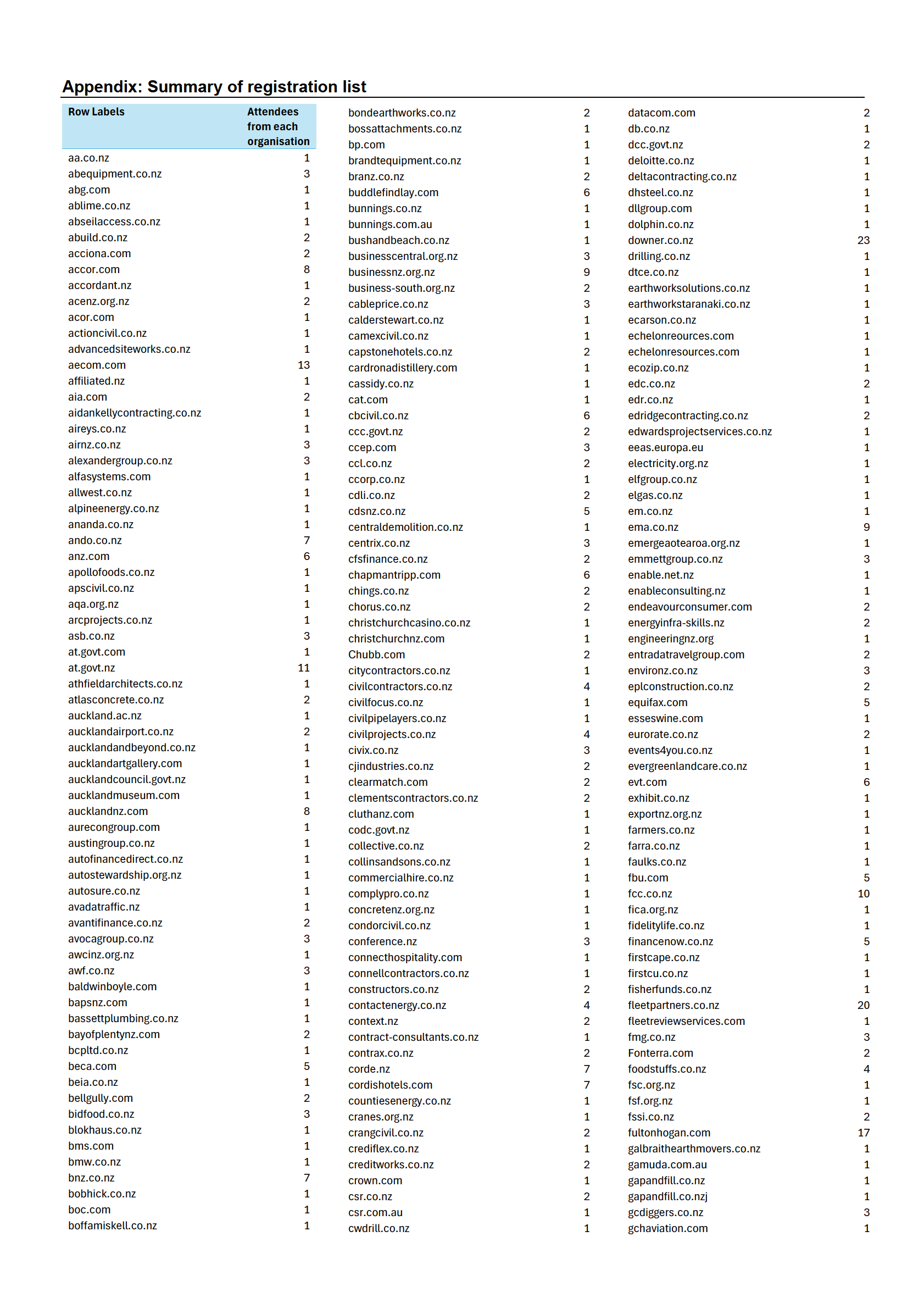
You will note that the registration list is withheld in full under section 9(2)(a) of the Act to protect the
privacy of individuals. I recognise the public interest in this information and as such a summary has been
provided under section 16(1)(e) of the Act.
If you wish to discuss any aspect of your request or this response, or if you require any further assistance,
please contact
[email address]. You have the right to seek an investigation and review by the Ombudsman of this decision. Information
about how to make a complaint is available a
t www.ombudsman.parliament.nz or freephone 0800 802
602.
Nāku noa, nā
Sarena Saunders
Workstream Lead, Engagement, Channels and Insights
Fuel Response



1982
Act
Domestic Business Briefing (
Information
Middle East)
led by the Ministry of Business, In
Official novation and Employment
the
25 March 2026, 2.00pmunder
Released
 RESTRICTED
MBIE LED DOMESTIC BUSINESS BRIEFING (MIDDLE EAST)
RESTRICTED
MBIE LED DOMESTIC BUSINESS BRIEFING (MIDDLE EAST)
Date:
Wednesday 25 March
Technical Check-In:
1.45pm
Start time:
2pm
Finish:
3pm
Moderator:
Sarena Saunders, GM Customer Design and Innovation
MBIE
1982
Host:
Nic Blakeley, Chief Executive, Ministry of Business,
Act
Innovation and Employment (MBIE)
Panelists:
Ben King, Chief Executive, Department of the Prime
Minister and Cabinet
Taha Macpherson, Deputy Chief Executive (Policy),
Ministry of Foreign Affairs and Trade (MFAT)
Experts:
Jolyon Swinburn, Ministry of Transport
Information
Communications Support:
Tina Sudell, Principal Communications Advisor, MBIE
Barnaby Haszard Morris, Senior Communications, MBIE
Official
Zoom Technical Support:
Suyin Thompson, Senior Advisor Sector Engagement
the
under
Released
1
RESTRICTED
 RESTRICTED
GUIDANCE FOR PANELLISTS
• As a panellist, please join the webinar by clicking on your
panel ist link
• Consider what Wi-Fi you are joining from. If joining from MBIE network, there has
been issues with a high number of people using the wi-fi and the webinar cutting
out in past webinars. If joining from MBIE please plug in to the network via an
1982
ethernet cable. If you are able to join from home, please consider this.
Act
• Please join the webinar 10 minutes prior to start time for attendees. This will
enable us to ensure we have resolved any technical issues before commencing the
session
• Find a quiet space with minimal noise or interruption. If there is someone else with
you, its best if they are not also dial ing into the webinar as this wil create sound
Information
issues.
• Speak directly to the camera where possible and sit close to the laptop
Official
• Make sure there is no bright light behind you such as a window. The light is best
coming from the front of you so that you are lit up
the
• Wait to be brought in by the lead presenter before speaking
• Be clear and concise when providing comments and answers
under
• Mute your microphone when you are not speaking, but leave your video on
Released
2
RESTRICTED
 RESTRICTED
RUN SHEET
Time
Segment & Notes
Host/Panel ist Lead
RESTRICTED
RUN SHEET
Time
Segment & Notes
Host/Panel ist Lead
2.00 pm
Housekeeping
Sarena Saunders
2.03 pm
Introduction
Nic Blakeley
2.05 pm
Global Context
Taha MacPherson
1982
2.10 pm
National coordination, system assurance
Ben King
and cross-government alignment
Act
2.20 pm
Domestic impacts
Nic Blakeley
2.27 pm
Q&A
Sarena Saunders and
Panel
2.57 pm
Close
Nic Blakeley
3.00 pm
END
Information
Official
the
under
Released
3
RESTRICTED
 RESTRICTED
WELCOME AND HOUSEKEEPING – SARENA SAUNDERS
RESTRICTED
WELCOME AND HOUSEKEEPING – SARENA SAUNDERS
Kia ora koutou thanks for joining us today I’m Sarena Saunders, I’ll be assisting
moderating the questions a little later but firstly a bit of housekeeping.
• Session for business leaders only – if you are media respectfully please leave.
• Encourage you to drop questions into the QA as we go through the session.
• Please note we are moderating today’s questions – this will help enable us to
1982
group similar questions for a single response so that in the interests of time we
can get through as many as possible.
Act
• We may not have the answers to al your questions.
• This is a series so your areas of interest and questions wil inform the content
for the next sessions.
• There will be a summary Q&A with your invitation to attend the next event.
Information
• You can find the QA function at the bottom of your screen – if it is not visible
click on the three dots to access it.
• Over to you Nic.
Official
the
INTRODUCTION – NIC BLAKELEY 2 MINS
under
Kia ora/ Good afternoon I’m Nic Blakeley Chief Executive of MBIE.
Thanks for joining us today for this update on the current impacts of the situation in
the Middle East for domestic New Zealand businesses.
Released
Joining me today is Ben King Chief Executive of the Department of Prime Minister and
Cabinet.
And Taha Macpherson, Deputy Chief Executive for Policy at the Ministry of Foreign
Affairs.
The Middle East conflict is a major shock to the global energy market and New Zealand
is clearly facing a significant impact.
4
RESTRICTED
 RESTRICTED
The purpose of this session is to ensure you have the information you need in order to
plan and manage your business risks.
• Information on the current fuel system situation, including global context and
the New Zealand position.
• The frameworks and monitoring arrangements that are in place to manage risk
• Some clarity on what this means for businesses
1982
Act
Taha will shortly cover the global context and Ben will fill you in from the all of
Government perspective. I’ll then give you the detail on MBIE’s areas of responsibility.
With that I’l pass to Taha.
Information
GLOBAL CONTEXT – TAHA MACPHERSON DCE – POLICY, MFAT
5 MINS
Official
Good afternoon, everyone, the
After four weeks, the outlook for the conflict between the US, Israel and Iran remains
uncertain.
under
The United States has indicated in recent days that it is pursuing direct negotiations
with Iran. Iran has publicly denied this – and it is too early to say at this point whether
anything will come from it.
Released
s 6(a)
So, it’s a welcome development that they
might be talking s 6(a)
.
s 6(a)
Iran may take the opportunity to pause military action. It
may also look to continue to inflict economic damage, as a way of deterring future
attacks and as a negotiation tactic to secure further concessions.
5
RESTRICTED
 RESTRICTED
Even though Iran’s military has been significantly degraded, it is still able to attack
shipping, oil production, and other targets. Under current conditions this is not
anticipated to change.
Iran’s ability to choke the Strait of Hormuz continues to be its strongest leverage point.
Prior to the war, about 20 million barrels of oil passed through the Strait of Hormuz
daily: 20% of global production. Almost all of this is now stuck inside the Persian Gulf.
1982
Iran surrounds the Strait on three sides and there are a range of ways it can interfere
Act
with shipping. The options to counter this are limited.
Even if Hormuz opened today, there would be a significant tail of economic disruption:
• Over 2,500 tankers remain trapped inside the Persian Gulf.
Information
• Key ports and oil facilities have been damaged across the Gulf.
• Resuming production in some oil fields could take months; and
Official
• It is possible that there will need to be de-mining in the Strait
the
New Zealand has taken a clear and consistent position on the conflict. Like much of the
international community, we share the US and Israel's concerns about Iran’s
under
destabilising behaviour internationally and its nuclear ambitions.
A regional conflict is not in New Zealand’s interests. We are keen to see this end as
soon as possible. Our diplomatic outreach has focused on supporting de-escalation and
Released
a negotiated end to the conflict.
We have also been actively working to shore up New Zealand’s supply chains.
We have been engaging closely with Singapore and Korea, our two main sources of
refined fuel, to stress the need to work together and avoid unilateral export controls.
We are in contact with our partners in the Middle East to understand the situation and
to identify alternative supply routes.
6
RESTRICTED
 RESTRICTED
We are using existing agreements and trade groups to safeguard our imports, and to
emphasize the need to cooperate on fuel supply chains.
New Zealand wil continue to engage with overseas partners to understand potential
export measures being taken and will work to mitigate the impacts of this on New
Zealand supply chains.
This includes tracking supply chain impacts on non-fuel critical goods from our 1982
international partners and reinforcing the importance of working together to secure
Act
our supply chains.
To conclude: there are a number of ways this could end. s 6(a)
but the crisis is unlikely to have a tidy end.
s 6(a)
This is
Information
likely to see shipping in the Gulf remain disrupted, and ongoing security and economic
disruptions.
Official
We are hoping for a positive outcome but preparing for this to drag on.
the
With that I’l hand over to Ben.
NATIONAL COORDINATION, SYSTEM ASSURANCE AND CROSS-
under
GOVERNMENT ALIGNMENT – BEN KING, CHIEF EXECUTIVE DPMC
10 MINS
Ben is speaking off the cuff.
Released
[Handover to Nic]
THE DOMESTIC IMPACTS – NIC BLAKELEY 7 MINS
New Zealand’s fuel stocks are healthy.
7
RESTRICTED
 RESTRICTED
New Zealand is continuing to closely monitor the impacts of the escalating conflict in
the Middle East on global fuel markets. While this is a fast-moving situation
international y, fuel supply into New Zealand remains stable, and onshore and
incoming stocks are healthy.
New Zealand imports 100% of its liquid fuel needs, i.e., petrol, diesel and jet fuel.
Over the last five years, New Zealand has sourced over 90 percent of petroleum
1982
imports from Asian refineries, mostly from Singapore and South Korea. Act
Over the same period these refineries have sourced just over three quarters of their
crude oil imports from countries bordering on the Persian Gulf.
Consequently, countries like New Zealand and Australia are more exposed than other
Information
parts of the world, given the source of our fuel.
Fuel stock levels remain at or above Minimum Stockholding Obligation levels – the
Official
MSO.
the
Introduced in 2025, the MSO acts as a strategic reserve of petrol to safeguard
domestic supply during disruptions.
under
The reserves are in addition to fuel held in service stations and in vehicles.
We are publishing stock numbers twice a week on the MBIE website – the latest
update was yesterday, and as at midnight 18 March, we had 50 days of petrol, 46 days
Released
of diesel, and 45 days of jet fuel
These are for fuel held in shipping terminals and ships headed our way.
Changes in weekly stock levels are normal and we will see numbers move around from
week to week as fuel is used and replenished by incoming ships.
We have also published data for the next two weeks showing how many ships are on
the way to New Zealand with fuel.
8
RESTRICTED
 RESTRICTED
The National Fuel Plan and our 2026 Fuel Response Plan
It is too early to say with any certainty how the current conflict is likely to impact fuel
supply in the longer-term.
Fuel companies report no current issues with supply chains.
As I’ve said New Zealand has healthy stock levels of petrol, diesel and jet fuel, both
1982
onshore and en route.
Act
Global supply chains are rapidly responding and our New Zealand fuel companies are
working hard to source supply. MBIE is talking to the fuel companies every day to keep
abreast of the situation.
Information
Prices have risen and could wel continue to rise, but there is no current issue with
supply. Rising prices are starting to have an impact on demand, as you would expect,
as New Zealanders consider different ways to get around.
Official
The best outcome is that global supply chains are able to respond and continue to
the
supply the fuel we need.
But while we all want the situatio
under n to improve, given what you’ve heard from Taha, it
is prudent and responsible for us to have a plan in place in case it doesn’t
In 2024, the National Fuel Plan was published, which sets out what measures could be
considered if shortages in supply were to become an issue.
Released
In the past weeks we have been working on updating that plan for these current
circumstances, which has involved a lot of discussion with the fuel companies. We will
continue to work closely with the fuel companies to flesh out the detail of how the
Plan could be implemented if needed.
Minister Willis has indicated that she intends to talk more about this Plan in the
coming days.
9
RESTRICTED
 RESTRICTED
The FSCE continues to meet the 5 importer sub-group every day to get the most up to
date information from importers about supply risks.
As part of the Government’s wider work in this space, the Fuel Response Plan sets out
a strategic pathway to bolster our medium- to long-term resilience. It builds on the
progress we have already made – increasing our onshore fuel stocks and publishing a
Response Plan for emergency responses – and outlines further measures to ensure
1982
people and business can continue to access fuel no matter what chal enges the future
brings.
Act
Measures in response
At this stage, all shipments are on track to be delivered, and it will be a matter of
weeks rather than days before our fuel supplies become strained.
Information
We are keeping a close eye on the situation and wil keep you informed if that
changes.
Official
The Government has also agreed to temporarily allow fuel that meets Australian
the
standards to be supplied in New Zealand. Al owing Australian spec fuel in New Zealand
reduces the risk that we are excluded from much-needed fuel supply purely for
under
technical reasons. Before now, Australia and New Zealand had slightly different
rulebooks for what counts as acceptable fuel — things like how thick it should be, how
clean it needs to be, and whether certain types of newer cleaner fuels were al owed.
New Zealand has basically just agreed to play by the same rulebook as Australia, so
Released
tankers heading that way can pull into our ports too New Zealand and Australian fuel
specifications are almost identical, and there are no material differences that would
affect the safety or quality of our fuel.
Our fuel specifications will still ensure fuel quality, make sure fuel is compatible with
our vehicles, avoid harmful impacts on human health and the environment, and
protect consumers. The Government is ensuring that fuel sold in New Zealand must
10
RESTRICTED
 RESTRICTED
stil be ‘fit for common purpose’, which means it can safely be used in New Zealand
vehicles.
We are planning for a range of scenarios to make sure we are ready to respond.
Demand restraint measures would be one of the final measures in the Government’s
toolkit. At this point, there is stil no indication that we wil need to use those
measures. As I say, we’ll let you know if this changes.
1982
Act
We can now open for questions – Sarena I’ll handover to you.
LIVE Q&A: FACILITATED BY SARENA
Please use the QA function to add your questions its at the bottom of your screen.
Information
We’ll get through as many as possible in this session.
You’ll be receiving an email following this session and we’ll answer as much as we can
in this email.
Official
First question –
the
[Hand back to Nic]
CLOSE – NIC BLAKELEY
under
Thank you again to al of you for joining us today.
I hope that the session has been informative and I look forward to continuing to
connect with you over the next few weeks.
Released
As Sarena said we’ll be following this with an email with the link for the next session
and also answers to any questions we have been unable to answer today.
11
RESTRICTED
 RESTRICTED
APPENDIX 1: FREQUENTLY ASKED QUESTIONS
MBIE – Middle East Conflict Reactive Q&As
RESTRICTED
APPENDIX 1: FREQUENTLY ASKED QUESTIONS
MBIE – Middle East Conflict Reactive Q&As
MBIE – Middle East Conflict Reactive Q&As ............................................................................... 12
Regional and global fuel security impacts ............................................................................... 13
New Zealand’s fuel supply ...................................................................................................... 14
Fuel Rationing .......................................................................................................................... 16
1982
Fuel pricing .............................................................................................................................. 17
The Government’s role and levers .......................................................................................... 18
Act
IEA Collective Action (21/03)................................................................................................... 21
Supply chains ........................................................................................................................... 22
LNG .......................................................................................................................................... 25
What is the impact on Tourism
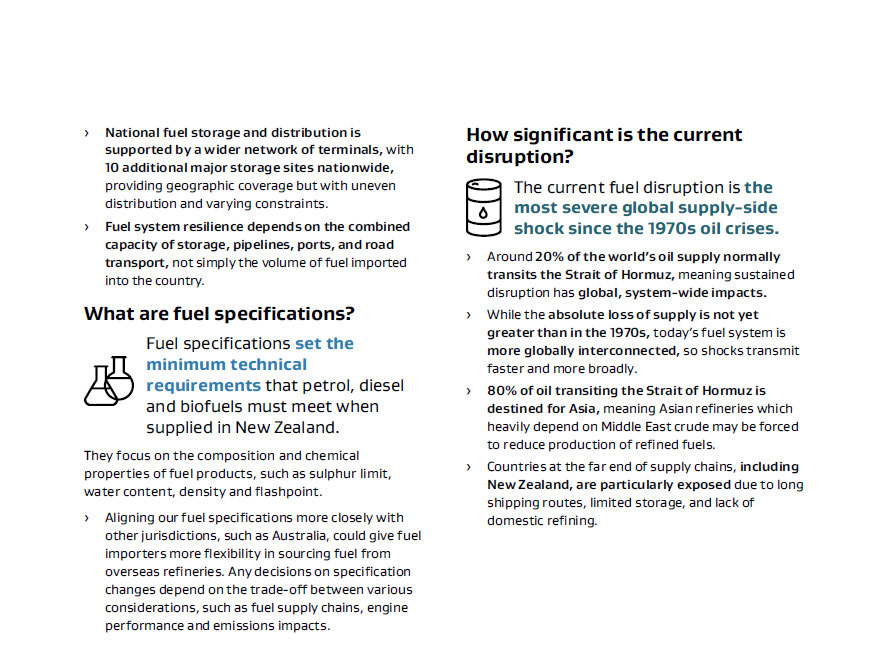
NEW ZEALAND FUEL FACTS AT A GLANCE
Information
Official
the
under
Released
12
RESTRICTED
 RESTRICTED
REGIONAL AND GLOBAL FUEL SECURITY IMPACTS
How have global markets reacted to the conflict?
RESTRICTED
REGIONAL AND GLOBAL FUEL SECURITY IMPACTS
How have global markets reacted to the conflict?
Markets have remained relatively calm so far, but there may be increased volatility if the
conflict escalates. Equity markets and the New Zealand dollar have remained fairly stable. The
price of crude oil has risen sharply but is still lower than the levels seen when Russia invaded
Ukraine.
How is Australia responding to the fuel security situation?
Since 2023, Australian importers and refiners have been required to maintain a baseline level
of fuel stocks as part of Australia’s national fuel security framework. This takes the form of a
1982
‘minimum stockholding obligation’ and requires importers and refiners to hold reserves of up
to 24 and 26 days’ worth of usual demand respectively. Australia has previously housed its fuel
Act
stockpiles offshore in the United States.
The Australian Government has announced temporary amendments to Australia’s petrol
quality standards, aimed at supporting fuel supply, stabilising prices and easing pressure on
disrupted supply chains. Similarly, New Zealand has agreed to temporarily allow fuel that
meets Australian standards to be supplied in New Zealand. This will reduce the risk that we are
excluded from much-needed fuel supply purely for technical reasons
In response to the unprecedented IEA collective action, Australia will also be relaxing its
Information
Minimum Stockholding Obligation for petrol and diesel. New Zealand is not currently planning
to relax our own MSO and we will be releasing oil tickets as our contribution to col ective
action.
Is New Zealand working with Australia on the response?
Official
Yes – it’s important that New Zealand’s response to the impacts of the Middle East conflict on
our fuel security is closely aligned with Australia’s. New Zealand is already collaborating closely
the
with Australia, including exchanging insights and ensuring we have the latest intel igence on
any emerging supply chain risks.
We are also engaging at the ministerial level. New Zealand’s Minister for Energy Hon Simon
Watts met with Australian Resources Minister Madeleine King in mid-March at the Indo Pacific
under
Energy Security summit in Tokyo, Japan. The bilateral was an important opportunity to
reinforce the importance of collaboration with our partners in the Asia Pacific with the shared
goal of keeping our refined fuel supply chains open.
Ministers will be staying in touch over the coming weeks as New Zealand’s response evolves,
and the New Zealand Government will monitor any response measures that Australia takes to
ensure its domestic fuel security.
Released
If shipping routes around the Middle East can’t be used/are impacted, what
alternative options are available?
Global shipping companies are experienced in re-routing to deal with conflict situations,
including in the Middle East. Re-routing via alternative corridors is already happening,
including around the Cape of Good Hope. Another option, depending on the destination
market, is to go through the Panama Canal.
Is there a risk of South Korea limiting fuel exports?
The Ministry of Business, Innovation and Employment and Ministry of Foreign Affairs and
Trade are actively monitoring the situation in our major supplier countries (Japan, Singapore,
South Korea, Malaysia).
13
RESTRICTED
 RESTRICTED
NEW ZEALAND’S FUEL SUPPLY
How does New Zealand’s fuel system work?
RESTRICTED
NEW ZEALAND’S FUEL SUPPLY
How does New Zealand’s fuel system work?
We rely on the private sector to deliver fuel. We currently have five fuel companies importing
fuel into New Zealand: the ‘three majors’ (bp, Mobil and Z Energy) and two smaller companies
(Gull and Timaru Oil Services). Once in the country, fuel is stored in large import terminals
before it is distributed to wholesale customers or retail sites.1
New Zealand imports all its refined fuel from overseas with ships arriving once every two days;
this remains the case despite the current conflict.2
These supply routes remain active, and fuel importers continue to report healthy stock levels
1982
and ongoing deliveries.
Our national infrastructure — including terminals at Marsden Point, Mount Maunganui,
Wellington, and Lyttelton — is designed to handle large volumes reliably.
Act
Are we at risk of running out of fuel?
New Zealand’s fuel stocks are healthy. We’re continuing to work with fuel importers and
keeping a close eye on fuel stocks. Regular updates are now published twice a week on the
MBIE website. Fuel supply remains healthy, with good levels of fuel in New Zealand and more
on the way. Fuel importers continue to report no issues with incoming shipments.
You may notice our fuel stock levels moving around from update to update. We can assure you
Information
that this is a normal part of how fuel is distributed around the country and then replenished by
incoming imports.
How much fuel does NZ hold?
MBIE is updating its website regularly latest fuel stocks (both onshore and en route). You can
Official
access this information at: Impact of the Middle East conflict on our fuel security | Ministry of
Business, Innovation & Employment
the
Does the Government have any comment on the diesel situation in particular?
Diesel is our most important fuel by volume and strategic value. It is used by heavy vehicles,
underpins our freight industry, supports offroad use such as in agriculture and is used for
peaking and emergency electricity g
under eneration.
The IEA notes that jet fuel and diesel have seen material losses of supply, but purchasers are
also likely to have more options given the more diverse markets and suppliers.
We are monitoring fuel supply and prices across all fuel types.
What operational meaning should be attached to the combined “total stock” figure
on MBIE’s website?
Released
Operationally, total stock is fuel stock “in country” already available for use and “stock on
water” is fuel stock on ships en route to New Zealand. The ‘total stock’ figure on MBIE’s
website is calculated by adding the in country and stock on water for each fuel to get a total
stock figure in litres, which is then divided by the total demand in litres per day to get a total
New Zealand fuel position.
We are in contact with fuel importers who have reported no known delays in shipments.
MSO regulations treat fuel stock within our Exclusive Economic Zone (EEZ) as stock that can be
counted towards the MSO requirement.
1 Fuel Security Plan | Ministry of Business, Innovation & Employment
2 Need a reference to confirm a ship every 2 days
14
RESTRICTED
 RESTRICTED
In a prolonged disruption scenario, does MBIE treat product on water as equivalent
to stock physical y held in New Zealand?
RESTRICTED
In a prolonged disruption scenario, does MBIE treat product on water as equivalent
to stock physical y held in New Zealand?
For disruption planning and reporting we are including product on water both inside and
outside the EEZ.
MSO regulatory requirements only count fuel on ships in New Zealand’s EEZ.
How confident is MBIE that cargoes currently counted as “on water” wil arrive in
New Zealand on schedule?
Global fuel companies operating in New Zealand are confident that cargoes will arrive in New
Zealand on schedule.
1982
What are MBIE’s current estimates of daily national consumption for petrol, diesel
and jet fuel?
New Zealand’s average daily demand for petrol, diesel and jet fuel as at January 2026
Act (average
MSO data) is as follows:
• Petrol 8.1 million litres/day
• Diesel 10.7 million litres/day
• Jet Fuel 4.8 million litres/day
(This is equivalent to Petrol = 51 thousand barrels/day, Diesel = 67 thousand barrels/day, Jet =
30 thousand barrels/day).
Information
Based on those demand levels, how many days of forward cover would in-country
stocks alone represent?
Based on the averages listed above, the days’ cover of stock in country is as follows:
Official
• Petrol 33 days (~265 million litres, with demand of 8.1 MLpd)
• Diesel 28 days (~294 million litres, with demand of 10.7 MLpd)
the
• Jet Fuel 32 days (~155 mil ion litres, with demand of 4.8 MLpd)
See more at SP-04-24-National-Fuel-Plan-Final-2024.pdf
Are there issues with independe
under
nts accessing fuel stocks?
Based on information provided by the Fuel Sector Coordinating Entity participants, MBIE is not
aware of any supply issues to independents. There are media reports of some stations being
dry, but this is not general y a supply issue.
Have shipments of oil been cancel ed because of the escalating conflict?
There are reports of one cancellation of a shipment from Asia, but it is not clear whether this is
Released
as a result of the Middle East conflict. There have also been reports of cancelled shipments on
their way to Australia.
For New Zealand, there is no immediate impact on supply. We continue to monitor
developments closely.
Fuel companies are reporting to officials that shipping fuel to New Zealand continues as usual,
and variations in volumes week to week is normal. It’s also important to note that New
Zealand has different supply chain routes than Australia.
We are publishing stock numbers regularly on the MBIE website.
There is uncertainty ahead, but we continue to keep a close eye on fuel supplies.
Which countries currently supply the largest share of New Zealand’s refined fuel
imports?
15
RESTRICTED
 RESTRICTED
In 2025, New Zealand imported over 90 percent of its fuel from four countries in Asia - South
Korea (51 percent), Singapore (31 percent), Malaysia (9 percent) and Japan (3 percent).
How is NZ positioned from a stockpile potential y impacting shipping and air freight
should there be delays or increased demand from markets like China who purchase
80% from the Middle East?
In 2025, New Zealand imported over 90 percent of its fuel from refineries in Asia - South Korea
(51 percent), Singapore (31 percent), Japan (9 percent) and Malaysia (3 percent).
The Government’s minimum stock obligation (MSO), introduced in 2025, acts as a strategic
reserve of petrol to safeguard domestic supply during disruptions.
Minimum mandated levels are: 21 days of diesel, 24 days of jet fuel and 28 days of petrol to be
1982
held in tanks in our country and ships in our EEZ. These reserves are in addition to fuel held in
service stations and in vehicles.
Act
Why are petrol stations running out of fuel across the country?
Based on information provided by the Fuel Sector Coordinating Entity and fuel importers, MBIE
is not aware of any widespread fuel supply issues at this time.
While there have been media reports of some individual service stations temporarily running
low, these are localised issues and do not indicate a broader supply shortage.
We are seeing a significant increase in demand across the national fuel network over the past
week. Fuel companies are working as quickly and safely as possible to move fuel through the
Information
supply chain and ensure it is delivered to where it is needed to meet demand.
Official
FUEL RATIONING
the
Is the Government considering fuel rationing?
It is too early to say with any certainty how the current conflict is likely to impact fuel supply in
the longer-term.
MBIE is actively assessing the fuel s
under ecurity situation for New Zealand following the recent
events in the Middle East and is in close contact with fuel companies.
Fuel companies report no current issues with supply chains. New Zealand has healthy stock
levels of petrol, diesel and jet fuel, both onshore and en route.
The National Fuel Plan has measures on managing sustained domestic supply disruption,
including rationing if needed. See more at SP-04-24-National-Fuel-Plan-Final-2024.pdf
Released
What would trigger fuel rationing?
In a sustained fuel disruption, it may be necessary to ration fuel and prioritise supplying
essential services. The National Fuel Plan envisages that the disruption would need to be
significant before rationing measures are implemented. We are preparing for this possibility as
a precaution.
The Petroleum Demand Restraint Act 1981 allows for fuel rationing by empowering the
Government to make “petroleum demand restraint regulations”. These regulations could
impose measures to restrain demand for petroleum products or ensure the equitable
distribution of eptroleum products when they are, or are likely to be, in short supply.
These regulation making powers are broad and were intentional y designed to al ow the
Government to implement controls such as limits on fuel purchase quantities, al ocation
schemes, priority-use rules and restrictions on vehicle use.
16
RESTRICTED
 RESTRICTED
Regulations would need to made under section 4 of the Act to enable fuel rationing due to
supply disruption resulting from the Iran conflict.
FUEL PRICING
Why are prices moving if supply is stable?
New Zealand is not immune to the impacts of a change in the global crude oil price. Crude
prices have significantly increased since the conflict began, and this has a direct correlation to
the price we pay at the pump.
1982
The Government has made it clear to the fuel companies that our fuel markets must deliver
competitive prices to consumers and continue to function as smoothly as possible during the
Act
conflict. We have asked the Commerce Commission to closely monitor retail prices and fuel
importer margins through this period.
How wil the Government manage price increases at the pump for Kiwi consumers?
The Minister for Commerce and Consumer Affairs has directed the Commerce Commission to
closely monitor retail prices and fuel importer margins through this period. Containing the
cost-of-living pressure from price increases at the pump is a top priority for this Government.
The Minister has written to the Commission to reiterate expectations.
Information
Officials are keeping a close watch on retail prices and fuel importer margins should there be
any significant deviations from historical levels. The Government has made it clear to the fuel
companies that our fuel markets must deliver competitive prices to consumers and continue to
function as smoothly as possible during the conflict.
Official
If motorists suspect any opportunistic pricing or price gouging at petrol stations, we encourage
them to report to the Commerce Commission. The Commission can investigate and take
enforcement action if needed.
the
Are fuel retailers unfairly increasing prices for consumers?
The Government is monitoring the situation. Crude prices have significantly increased, which
has a direct correlation to the price
under we pay at the pump. New Zealand is not immune to the
impacts of a change in the global crude oil price. Our fuel prices have increased, but it is still
too early to say what the full impact will be on the price we pay. This is a dynamic situation
that we’re monitoring closely.
How does this compare to past fuel security disruptions?
The nature of this shock is different to the aftermath of Russia’s invasion of the Ukraine in
Released
2022 as it is more significant in scale. The Russian invasion caused significant disruption to
supply chain constraints and, at its height, a 52–56 per cent surge in Brent and WTI crude
prices, along with sanctions forcing a change in Russian supply chains.
According to the IEA, global oil markets are contending with their largest disruption in
history, with profound implications for energy security, affordability and the world
economy. More than 10 million barrels per day of oil production in the Middle East are
already curtailed or shut in, while more than 5 mil ion barrels per day of oil product
exports are now unavailable.
During recent similar supply disruptions, global fuel supply chains have shown strong resilience
and adaptability. Markets have stabilised through increased production from diverse regions,
strategic shock management and strengthened international cooperation.
How is the ETS factored into fuel pricing, and at what point is it applied?
17
RESTRICTED
 RESTRICTED
For liquid fossil fuels the NZ ETS obligation is set as far up the supply chain as practicable –
specifically when a supplier imports fuel into New Zealand.
Suppliers then pass through the costs associated with their ETS obligations to consumers.
Why not just cancel the ETS on petrol?
Activities subject to the ETS are listed in the Climate Change Response Act (CCRA) – this
includes petrol imports. Petrol is a significant source of emissions priced into the NZ ETS – this
means that it would be difficult to exempt petrol without undermining the environmental
integrity of the ETS
On the recommendation of the relevant Minister, the Governor-General can exempt certain
activities from the ETS. Before recommending this, the Minister must be satisfied that:
1982
• the order will not materially undermine the environmental integrity of the emissions
trading scheme; and
Act
• the costs of making the order do not exceed the benefits of making the order.
In addition to the legislative reasons, the current Climate Strategy and Emissions Reduction
Plan both emphasise the importance of credible markets and regulatory predictability in the
ETS. Creating exemptions for certain activities may run counter to this and undermine the
long-term intent of the ETS.
Information
THE GOVERNMENT’S ROLE AND LEVERS
What is the Government doing to manage the situation?
The Government is monitoring fuel markets daily and working with fuel companies to
Official
ensure security of supply.
Regular public reporting of fuel stock levels on the MBIE website provides transparency for
the
New Zealanders.
Agencies are meeting regularly with fuel importers under the National Fuel Plan to
maintain clear oversight.
The Fuel Sector Coordinating Entity (FSCE) is the national governing body for planning for,
under
and coordinating a response to, a major fuel disruption – including progressing any
response measures that may be required during the disruption.
It is responsible for ensuring government, key stakeholders and the public are kept
informed with consistent information.
Ministers are receiving advice from officials and preparing for a range of scenarios.
What is the Governm
Released
ent doing to ensure the public are wel informed about the
impact of the conflict on New Zealand’s fuel supply and pricing?
The Government is monitoring fuel markets daily and working with fuel companies to ensure
security of supply. As part of this, MBIE is regularly publishing information on the fuel security
situation for New Zealand on its website. You can access the latest available information on
fuel stocks at: Impact of the Middle East conflict on our fuel security | Ministry of Business,
Innovation & Employment
MBIE has also convened the Fuel Sector Coordinating Entity, which consists of government
agencies and fuel companies, under the National Fuel Plan, to provide a greater level of
oversight as we traverse the impacts of this situation.
MBIE is also working closely with journalists and Ministers to ensure consistency in public-
facing communications about the situation, and we wil continue to update the public as the
situation evolves.
18
RESTRICTED
 RESTRICTED
What is the National Fuel Plan?
RESTRICTED
What is the National Fuel Plan?
The National Fuel Plan is a readiness and response framework for the fuel sector. It includes
agreed roles and responsibilities for agencies – including MBIE, NEMA and Civil Defence
Emergency Management Groups. Fuel companies, central and local government and CDEM
Groups worked together to develop this plan.
What is the Fuel Sector Coordinating Entity?
The Fuel Sector Coordinating Entity (FSCE) is the national governing body for planning for,
and coordinating a response to, a major fuel disruption – including progressing any
response measures that may be required during the disruption.
It is responsible for ensuring government, key stakeholders and the public are kept
1982
informed with consistent information.
As the lead agency for managing New Zealand’s fuel security following the recent events
in the Middle East, the Ministry of Business, Innovation and Employment (MBIE) ha
Act s
convened the FSCE to enable information sharing between government and the fuel
sector.
Key functions for the FSCE during a response include:
ο Facilitating sector solutions.
ο Requesting and coordinating support from the Government.
ο Coordinating and providing fuel sector situational information to MBIE.
Information
ο Distributing situational information from MBIE.
ο Coordinating with other affected sectors as required.
The FSCE escalation framework is set out in New Zealand’s National Fuel Plan.
Official
Have the escalation levels in the National Fuel Plan been activated and what level is
New Zealand at?
the
When an international disruption starts affecting New Zealand’s fuel supply, the National
Fuel Plan helps ensure communities stay safe and supported. It sets out measures for
fuel to be prioritised for essential services such as our hospitals and health
services, emergency services, food transport and freight and electricity, water, and
under
telecommunications services.
MBIE has convened the Fuel Sector Coordinating Entity under the National Fuel Plan,
which increases lines of communications with the fuel industry and oversight of fuel
imports. We are currently at level 1 of the Fuel Plan.
If the situation were to worsen, the Government has a range of tools it can use to manage
supply pressures and keep essential services running. These steps would only be taken if
Released
genuinely needed, and they would be scaled to match the severity and duration of the
disruption.
To be clear, we are not experiencing the types of sustained supply disruption that the
National Fuel Plan enables as emergency measures.
As part of the Government’s wider work in this space, the Fuel Security Plan sets out a
strategic pathway to bolster our medium-to long-term resilience. It builds on the progress
we have already made - increasing our onshore fuel stocks and publishing a National Fuel
Plan for emergency responses - and outlines further measures to ensure people and
business can continue to access fuel no matter what challenges the future brings.
Who makes the decision to escalate response levels?
Depending on how severely events in the Middle East impact New Zealand’s fuel sector,
the Government may decide to formally ‘activate’ the FSCE and escalate the response to
19
RESTRICTED
 RESTRICTED
Level 2. Officials are providing advice to ministers on relevant considerations for that
now, and we will have more to say once they have considered that advice.
The potential response measures set out at each level of the National Fuel plan will be
made in line with usual decision-making practice, i.e. by agencies and ministers they have
the powers to do so, or by Cabinet where required.
Acknowledging that 60-70% of Venezuela's oil and 90% of Iran's oil was heading to
China and this wil increase price pressure on supplies that are now global y
available; what is New Zealand doing to secure medium-term supply at a cost that
won't cripple the local economy?
We rely on the private sector to deliver fuel. We currently have five fuel companies importing
1982
fuel into New Zealand: the ‘three majors’ (bp, Mobil and Z Energy) and two smaller companies
(Gull and Timaru Oil Services. They are ordering well ahead of time to ensure we have
Act
medium-term supply headed to New Zealand.
New Zealand is not immune to the impacts of a change in the global oil prices. It’s unavoidable
that global fuel price increases will be reflected at pump prices in New Zealand.
Back-pocket: Wil the Government provide any financial
compensation for firms who have had business operations disrupted
or have incurred unexpected costs due to the Iran conflict?
Information
As of 13 March Cabinet had not discussed financial compensation for individual firms and
there is no real precedent for Government intervening in this way during previous conflicts.
It is unlikely that the Government wil be providing financial compensation, and government
support is more likely to be focussed on consular support to staff.
Official
FUEL SPECIFICATIONS the
How long wil the measures be in place?
The Government is proposing to limit the length of time we will accept Australian-
specification fuel to six months, or earlier if international fuel supply constraints are
under
eased.
The changes are a temporary measure to provide additional fuel resilience while global
market conditions remain uncertain.
How much of a difference could relaxing fuel specs actual y make? What information
or evidence do we have?
Released
Fuel importers have advised that the main benefit is access to a wider range of shipments
that can get here faster, because we can accept fuel that is already available in our
regional markets.
For example, with a shipment of fuel from the USA, a very large tanker could discharge
fuel to Marsden Point before carrying on to Australia. This could make supplying the New
Zealand market much more attractive to refiners.
Why is Australia changing their fuel specs?
Australia announced on Thursday 12 March that it’s temporarily relaxing part of its fuel
specs because Ampol’s refinery in Brisbane is not currently compliant with recent
changes to Australia’s fuel specs. While the Brisbane refinery is upgrading infrastructure,
20
RESTRICTED
 RESTRICTED
the fuel from the Brisbane refinery is being exported. Australia is relaxing its fuel specs so
that fuel can be used domestically.
Why isn’t New Zealand relaxing its standards around sulphur, like Australia?
Australia’s Brisbane refinery currently exports high sulphur fuel. Australia is relaxing its
sulphur standards so it can use the product from the refinery at home, rather than needing
to export it. It is not anticipated that Australia would export this diesel to New Zealand, so
there is no need for us to relax our sulphur standards alongside them. Relaxing sulphur
levels would come with downsides in terms of pollution and impact on vehicles
(particularly newer vehicles’ engines), so we wouldn’t match Australia’s change unless
1982
needed.
Is it safe for me to fil up my car with fuel that meets different standards?
Act
New Zealand and Australian fuel specifications are already very similar, and there are no
material differences that would impact on the safety or quality of our fuel.
Our fuel specifications will still ensure fuel quality, make sure fuel is compatible with our
vehicles, avoid harmful impacts on human health and the environment, and protect
consumers. The Government is ensuring that fuel sold in New Zealand must stil be ‘fit for
common purpose’, which means it can safely be used in New Zealand vehicles.
Information
For example, there are some differences between Australian and New Zealand
specifications to account for warmer or colder climates. That means that diesel sold in
Queensland couldn’t be sold in the South Island, because there is a big difference in
temperature.
Official
If the NZ and Australian fuel specs are so similar, and there are benefits to aligning,
why are our specs currently different
the
from Australia?
Our fuel specs are very similar, and they are broadly based on the European standard.
Each country updates fuel specs at different times in response to various triggers in line
its domestic circumstances.
under
What fuel would this change to fuel specifications cover?
Allowing Australian-spec fuel would just cover ground and shipping fuels – predominately
petrol and diesel. Jet fuel is set to an international standard common for al commercial
flights everywhere. Relaxing it would create significant safety risks and would not increase
our flexibility in sourcing jet fuel supplies.
Released
IEA COLLECTIVE ACTION (21/03)
What has the IEA agreed to? What is a col ective action?
On 11 March IEA members agreed to take collective action by making 400 million barrels
of oil from their emergency reserves available to the market. Collective action aims to add
supply to the global oil market, which should help reduce pressure on refiners’ access to oil
from the Middle East and stabilise markets.
The current IEA col ective action is significantly greater in volume than what was
agreed to by IEA Members for col ective action in response to the Russia-Ukraine
21
RESTRICTED
 RESTRICTED
conflict. Is col ective action mandatory or voluntary? What are the options to
comply?
RESTRICTED
conflict. Is col ective action mandatory or voluntary? What are the options to
comply?
The collective action process is part of New Zealand’s Treaty obligations under the Agreement
on an International Energy Programme.
Al IEA members – including New Zealand – are expected to participate in the collective action.
IEA members have the freedom to choose how to respond to col ective action, provided that
their actions fulfil the IEA’s allocated response for that country. Options include releasing
domestic stock, reducing stock obligations on commercial entities, releasing oil tickets and
reducing demand.
New Zealand has previously met collective actions through release of oil tickets.
1982
How will New Zealand be fulfilling our obligations for IEA collective action?
New Zealand’s allocation under the IEA collective action is for 1.577 mil ion barrels of
Act
crude oil or equivalent. We hold oil tickets, which are options to purchase different types
of oil or refined fuel. We will release some of the tickets we hold to the global market.
What is the impact for New Zealand at home?
Releasing these tickets has a minimal impact on New Zealand’s fuel security position. Oil
tickets are contracts that give the Government the option to purchase different types of fuel.
New Zealand is not releasing physical supply to the market.
While not a direct comparison, the release is comparable to around 10.9 days
Information of daily New
Zealand fuel demand.
The purchase options New Zealand will release are for crude oil, which cannot be refined in
New Zealand, and for a form of gasoline that cannot be used under New Zealand
specifications.
Official
How would NZ rebuild fuel stocks to meet its 90‑
day obligation? What are the cost
implications?
the
Eventually New Zealand would be expected to return its fuel stocks back to a level
sufficient to meet its 90-day obligation, at a time in the future specified by the IEA. This
will not be until such time as the IEA judges that oil markets have returned to more normal
operations which could be someti
under me in the future. The timing and cost of this is
accordingly highly uncertain.
What kind of impact wil this have on NZ consumers?
Release of oil stocks by New Zealand, along with the release by other IEA members, will
increase international stocks by improving market supply. This may help to place downward
pressure on prices.
Released
The IEA published a report outlining options that could help protect people from the
oil shock. Wil New Zealand be taking any of the measures in the report?
Ministers are receiving advice on a range of different measures. We are currently at Level 1 (of
four levels) of the National Fuel Plan, which means there is currently minimal impact on fuel
distribution across the country – but the response may escalate. We are planning for a range
of scenarios to make sure we are ready to respond. We will keep the public informed.
SUPPLY CHAINS
What is the Government observing in terms of supply chain implications for New
Zealand?
22
RESTRICTED
 RESTRICTED
At this stage, the Government is closely monitoring shipping and air‑freight movements
through the affected region. We are tracking early indicators such as route adjustments,
carrier advisories, and potential congestion points. We are also drawing on updates from
international partners to assess any evolving risks. Overall, our focus is on ensuring we
maintain visibility of potential impacts as the situation develops.
What actions is the Government taking in response?
The Government is taking a coordinated cross‑agency approach to monitoring and assessing
supply chain implications. This includes:
•
Engaging with key regional partners, including Australia and Singapore, to exchange
insights and ensure we have the latest intel igence on any emerging supply chain risks.
1982
•
Maintaining direct engagement with industry to gather on‑the‑ground feedback from
freight forwarders, and exporters.
Act
• Ensuring government agencies can provide relevant guidance and information quickly,
should conditions change.
We are also working with MFAT to ensure any updates relevant to the business sector can be
included in their weekly Market Intelligence Report.
What does the Government recommend businesses do right now?
We encourage businesses to take a proactive and practical approach by:
Information
•
Engaging early with logistics providers, importers, and export customers to
understand any operational adjustments, routing changes, or commercial implications.
•
Reviewing business continuity plans, including alternative freight options, inventory
strategies, and customer communication plans.
Official
•
Staying informed through official channels such as MFAT’s Market Intelligence Report
and agency updates.
the
•
Assess and stress-test supply chains beyond tier 1 suppliers to identify where
upstream vulnerabilities may sit – including reliance on single-source suppliers,
concentration risks, or exposure to routes affected by regional instability.
under
These steps wil help businesses stay prepared should any supply chain conditions shift.
We would also encourage businesses to engage with their associations to share insights on the
emerging supply chain implications. Alternatively, if you have information to share, or if you
have questions on supply chains, please contact us at [email address].
In this current phase of supply chain disruptions, business and industry insights are critical to
inform our assessment of the wider situation and appropriate steps that the government can
Released
consider responses.
What could be the implications for New Zealand if the conflict expands
and affects the Suez Canal?
A prolonged or expanded conflict involving Iran that disrupts the
Suez Canal would have
significant global supply chain impacts, given that Suez normally carries around
12% of
global trade and serves as a critical route for containerised goods between Europe, the
Middle East, and Asia. When the canal was previously blocked, similar proportions of
global trade experienced major delays.
Current reporting shows that carriers are already
avoiding the broader region due to
heightened risks, with some lines
suspending Suez transit and rerouting vessels via the
23
RESTRICTED
 RESTRICTED
Cape of Good Hope
RESTRICTED
Cape of Good Hope, adding weeks to sailing times and tightening global container
capacity. CMA CGM, for example, has suspended Suez passage and begun rerouting
vessels, a step other carriers are also taking.
If an expanded conflict were to limit or close Suez access, New Zealand could face:
•
Longer transit times for goods travelling to or from Europe and parts of the Middle
East, as vessels divert thousands of kilometres around Africa.
•
Reduced global container capacity, as extended routes absorb ships and cause
congestion elsewhere.
•
Higher freight rates and volatility across both ocean and air networks, 1982
consistent with what freight analysts are already observing in Middle East‑linked
trade lanes.
Act
•
Upward pressure on fuel costs if disruptions coincide with constraints in nearby
chokepoints such as the Strait of Hormuz. Past and current analysis highlights that
prolonged disruptions in these corridors typically elevate global energy and
transport prices.
Knock‑on effects from global freight delays, container shortages, and cost increases
would likely be felt across multiple sectors.
Information
What is the impact of the crisis on plastics and fertiliser?
Most packaging plastics are derived from petroleum feedstocks. New Zealand exporters
rely on consistent, affordable plastic packaging to meet overseas market standards, so
Official
instability in supply chains can raise input costs and create delays. Key nutrients in
fertiliser are also linked to gas and oil production. Nitrogen production is dependent on
the
natural gas as a feedstock, while sulphur is a by-product of oil refining. Disruptions or
price spikes therefore raise fertiliser costs and reduce availability.
How does MBIE assess the medium to long-term impact of the Middle East conflict
under
on New Zealand’s economy and domestic demand, and how does this compare with
shocks like the GFC or COVID-19?
From a supplychain perspective, the Middle East conflict is primarily driven by a refined
petrochemical and fuelrelated shock at this stage.
These disruptions, along with longer shipping routes and delays, are adding upward
pressure to global fuel
Released and petrochemical prices. For New Zealand, which relies on
imported fuels and petrochemicalderived inputs across manufacturing, agriculture,
plastics, and transport, these pressures can translate into higher operating costs and
longer lead times.
MBIE is actively monitoring these developments. We are engaging daily with industry and
across government to understand emerging risks, receive information on stock and
expected supply. This includes tracking potential vulnerabilities around critical
chemicals, minerals, and other key goods that underpin production across many sectors.
In the short term, the current situation differs from shocks like the GFC or COVID19.
Those events caused widespread immediate financial or operational shutdowns across
the entire economy. However, based on our experience with COVID-19, as Nicole
highlighted, we would expect a return to BAU to take some time.
24
RESTRICTED
 RESTRICTED
Whether the current events become a wider structural and systemic supply chains shock
will depend on how prolonged the disruption to Middle East supply routes becomes.
LNG HOW WILL THE CONFLICT IN THE MIDDLE EAST AFFECT NEW
ZEALAND’S ACCESS TO IMPORTED LNG?
The Government is monitoring the conflict in the Middle East closely. The medium to long-
term impacts on the LNG market are unclear because there is also a significant increase
in production capacity coming online. IEA forecasts show a 50 per cent increase in
capacity from 2025-2030.
1982
Energy Minister Simon Watts has spoken with his counterparts in a range of countries, and
there are opportunities for New Zealand to secure supply from non-middle east
Act
locations, for example, Canada or Alaska.
The fact is New Zealand’s dry year problem and domestic gas situation are significant
issues that need dealing with. LNG remains the leading solution available to manage the
dry year problem at this time, and it buys us time for alternative options to arise in future.
The value of LNG isn’t so much its price, it’s that the availability of LNG in New Zealand
will enable generators to run gas-fired generation. LNG prices could double before diesel
Information
would become a more attractive fuel for generation (on the basis of cost of generation
alone).
The recently released GIC 2026 Gas Supply and Demand Study (produced by PWC)
suggests prices in a domestic gas-only market could reach $31/GJ and cause significant
Official
economic destruction. Earlier work by Sense partners shows that having LNG saves $1.2b
in GDP by 2035. This al underscores that the counterfactual to LNG is not continuing as
the
we are, it is significant economic destruction.
TOURISM
under
What is the impact on tourism?
We know volatility in jet fuel prices is increasing airfares and leading to some flight
consolidation. Currently this consolidation is not expected to significantly impact tourism
volumes as passengers can be accommodated on alternative services.
Given New Zealand is now late in our peak summer arrival season, the impact on overall
Released
international visitor arrival volumes has so far been limited and daily international visitor
arrivals remain stable. It is still too early to identify the medium-term impacts on tourism
and visitor arrivals.
We know airlines and the wider tourism sector are increasingly concerned about the
medium-term impacts of high oil prices on domestic and international tourism. We are
not currently seeing dampened medium or long-term demand yet but are tracking the
situation closely.
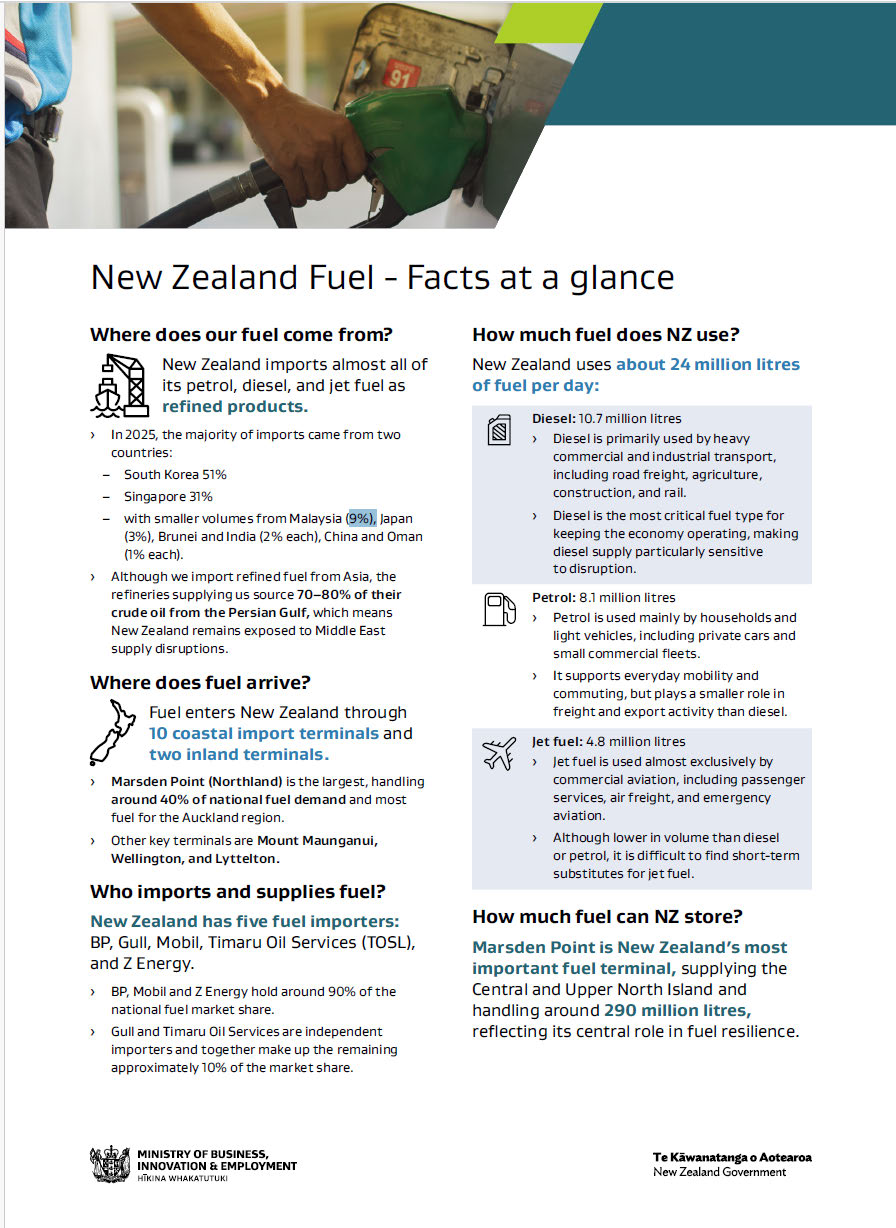
MESSAGING FROM AOG SITREP – 25 MARCH 2026
Immigration operations and the New Zealand border continue to operate as normal. People
affected can apply for all the same visa categories that were available before the conflict.
25
RESTRICTED
 RESTRICTED
We recognise the situation may make it difficult for some people to access standard
documents; applicants should provide what they can reasonably access, and INZ will take a
pragmatic, empathetic approach within existing immigration settings.
MPI remains closely engaged with major companies across all sectors, including dairy, forestry,
red meat, honey, forestry, viticulture, fertiliser, aquaculture, fisheries, vegetables, and
horticulture to manage impacts from the Middle East conflict and support continued trade.
Primary sector businesses are well equipped to deal with disruption and are planning for any
issues that arise.
New Zealand’s key primary products remain in high demand and continue to reach export
markets, with established processes in place to redirect shipments and manage disruptions
where needed.
1982
Primary sector exporters are managing freight logistics well directly with their partners and
there are no issues with cool store capability.
Act
At present, there is enough fertiliser supply available to meet demand until spring, and
businesses report sufficient packaging is available.
Our exporters have built strong resilience. MPI and NZTE remain focused on ensuring they
have the support and information they need to navigate ongoing volatility.
Treasury scenarios suggest that impact is likely to mean higher inflation in the near-term.
Treasury’s next public economic and fiscal update wil be released with the Budget on May
28. That will capture repercussions of the Iranian situation and any other developments.
A proportion of NZ trade transits through or originates from the Middle East re
Information gion
Recent trade negotiations and agreements mean NZ’s security and economic interests are
increasingly linked to the Middle East.
The Minister of Finance has instructed Treasury and Inland Revenue to work on targeted
support measures to help ease the burden of high fuel prices on households.
Official
− Cabinet confirmed a temporary $50 per week increase to the in-work tax credit,
applying from 1 April 2026. the
under
Released
26
RESTRICTED

 RESTRICTED
1982
Act
Information
Official
the
under
Released
27
RESTRICTED

 RESTRICTED
1982
Act
Information
Official
the
under
Released
28
RESTRICTED
1982
Act
Information
Official
the
under
Released
gdcgroup.nz
1
indebted.nz
1
minesrescue.org.nz
1
genesisenergy.co.nz
2
inflite.nz
1
missionzero.nz
1
genevafinance.co.nz
2
inframax.co.nz
2
mito.org.na
1
geofabrics.co.nz
1
infrastructure.org.nz
3
mito.org.nz
8
geotechnics.co.nz
2
infrasure.co.nz
1
mitre10.co.nz
1
ghd.com
1
initia.co.nz
1
mitsui.com
1
ghel a.com
3
inlinegroup.co.nz
2
mmc.com
1
gib.co.nz
1
isaac.co.nz
6
mnce.co.nz
1
gilescivil.co.nz
1
itm.co.nz
2
moanaskies.co.nz
1
gisborne.net.nz
1
itraffic.co.nz
1
montanagroup.co.nz
1
glasgow.co.nz
2
its.jnj.com
1
motat.org.nz
1
gmail.com
19
jasmax.com
3
movelogistics.com
2
goodrich.nz
1
jbwil s.co.nz
1
movogo.co.nz
1
gorentals.co.nz
4
jensenclassics.co.nz
1
mpi.govt.nz
2
gpfl.co.nz
1
jesani.co.nz
1
mscivil.co.nz
2
gradarecruitment.com
1
jkbwil s.co.nz
1
msd.com
1
graffitisolutions.co.nz
1
johnstons.net.nz
1
msd.govt.nz
10
grandchancellorhotels.com
1
jrcontracting.co.nz
1
mta.org.nz
2
graymatter.co.nz
2
jrs-anz.com
1
mtf.co.nz
2
graymont.com
3
jswap.co.nz
2
myob.com
1
groundfix.co.nz
1
kaikoura.co.nz
1
mytona.com
1
gsinz.nz
1
kaingamaha.co.nz
1
natroad.co.nz
1
1982
gsl.nz
3
kaingaora.govt.nz
3
naturalhealthproducts.nz
2
guildspence.co.nz
1
kdcivil.co.nz
1
nbs.co.nz
1
gymleader.co.nz
1
kingsquarry.nz
1
nectar.co.nz
1
Act
habit.health
1
kiwibank.co.nz
3
nema.govt.nz
1
haighworkman.co.nz
2
kiwirail.co.nz
3
neo.co.nz
1
hanrahancivil.nz
1
kmart.com.au
1
networkwaitaki.co.nz
1
harkerwize.co.nz
1
kora.co.nz
1
newlands.net.nz
1
harmoney.co.nz
2
kt.co.nz
1
newmarket.co.nz
1
harrisongrierson.com
8
landcorp.co.nz
1
newzealandcruiseassociation.com
1
haurakicoromandel.com
1
latteygroup.co.nz
1
nextlevelcivil.co.nz
1
hayesint.co.nz
2
lavenderfarm.co.nz
1
ngi.co.nz
1
hbcraneandplatform.co.nz
1
lccl.nz
1
nimbus.co.nz
1
Information
hcc.govt.nz
1
ldx.co.nz
1
nminsurance.co.nz
1
hdc.govt.nz
4
leachltd.co.nz
1
nmtraffic.nz
1
healthcareplus.org.nz
1
linde.com
1
northpine.co.nz
1
heartland.co.nz
2
lintoncontracting.co.nz
1
northport.co.nz
1
heartlandhotels.co.nz
1
lionco.com
1
nttourism.co.nz
1
heb.co.nz
11
lm4group.co.nz
1
ntttourism.co.nz
1
Official
helicopterme.co.nz
1
loaders.co.nz
1
nwgroup.co.nz
1
Hel ers.co.nz
1
mackenzie.govt.nz
2
nz.gt.com
1
henryadams.co.nz
1
magcivil.com
1
nz.icbc.com.cn
1
the
hertz.com
2
magnumhire.co.nz
1
nzcic.co.nz
1
hesearthmoving.co.nz
1
maoritourism.co.nz
4
nzconcretecontractors.org.nz
1
hgg.co.nz
4
mappro.co.nz
1
nzfmoney.co.nz
1
hianz.net.nz
2
marlborough.govt.nz
1
nzi.co.nz
1
hibiscus-contractors.co.nz
1
marlboroughnz.com
1
nzia.co.nz
1
under
hickbros.co.nz
2
masterbuilder.org.nz
2
nzibf.co.nz
1
higgins.co.nz
8
masterplumbers.org.nz
1
nzpm.co.nz
1
hilton.com
2
mates.net.nz
3
nzsae.org.nz
1
hirepool.co.nz
3
matson.com
1
nzta.govt.nz
10
hirock.co.nz
1
maugers.co.nz
1
nzte.govt.nz
5
hiway.nz
1
mbdcontracting.co.nz
1
nztraveladventure.com
1
hiways.co.nz
1
mbie.govt.nz
4
oceanagold.com
2
hl .org.nz
2
mcdgroup.com
1
oceaniahealthcare.co.nz
1
Released
holcim.com
3
mcgregorconcreteltd.co.nz
2
ocs.co.nz
2
holmesgroup.com
2
mckparm.co.nz
3
omana.nz
1
hospitality.org.nz
1
megexports.co.nz
1
omataroa.com
1
hotmail.com
2
menard.co.nz
1
omc.com
3
hotshot-sports.com
1
menatwork.co.nz
1
omv.com
1
hql.co.nz
1
mercedes-benz.com
1
one.nz
2
humes.co.nz
5
mercer.com
1
onestaff.co.nz
1
hydraulink.com
1
mercury.co.nz
2
opdgisborne.co.nz
1
hydrovac.co.nz
1
meridianenergy.co.nz
5
oriongroup.co.nz
2
hynds.co.nz
2
mia.co.nz
1
orix.co.nz
1
iag.co.nz
4
mia.org.nz
1
outlook.co.nz
2
iandickconcrete.co.nz
1
mico.co.nz
1
outlook.com
1
iaonz.co.nz
1
milfordasset.com
1
pandfglobal.com
2
ibanz.co.nz
1
milfordsoundtourism.nz
1
panpac.co.nz
3
icc.govt.nz
1
millenniumhotels.co.nz
3
paral axx.co.nz
3
icnz.org.nz
1
mil salbert.co.nz
3
parker.com
1
idnewzealand.com
2
mineralscouncil.co.nz
2
pclcnontracting.co.nz
1
1982
Act
Information
Official
the
under
Released
Document Outline
