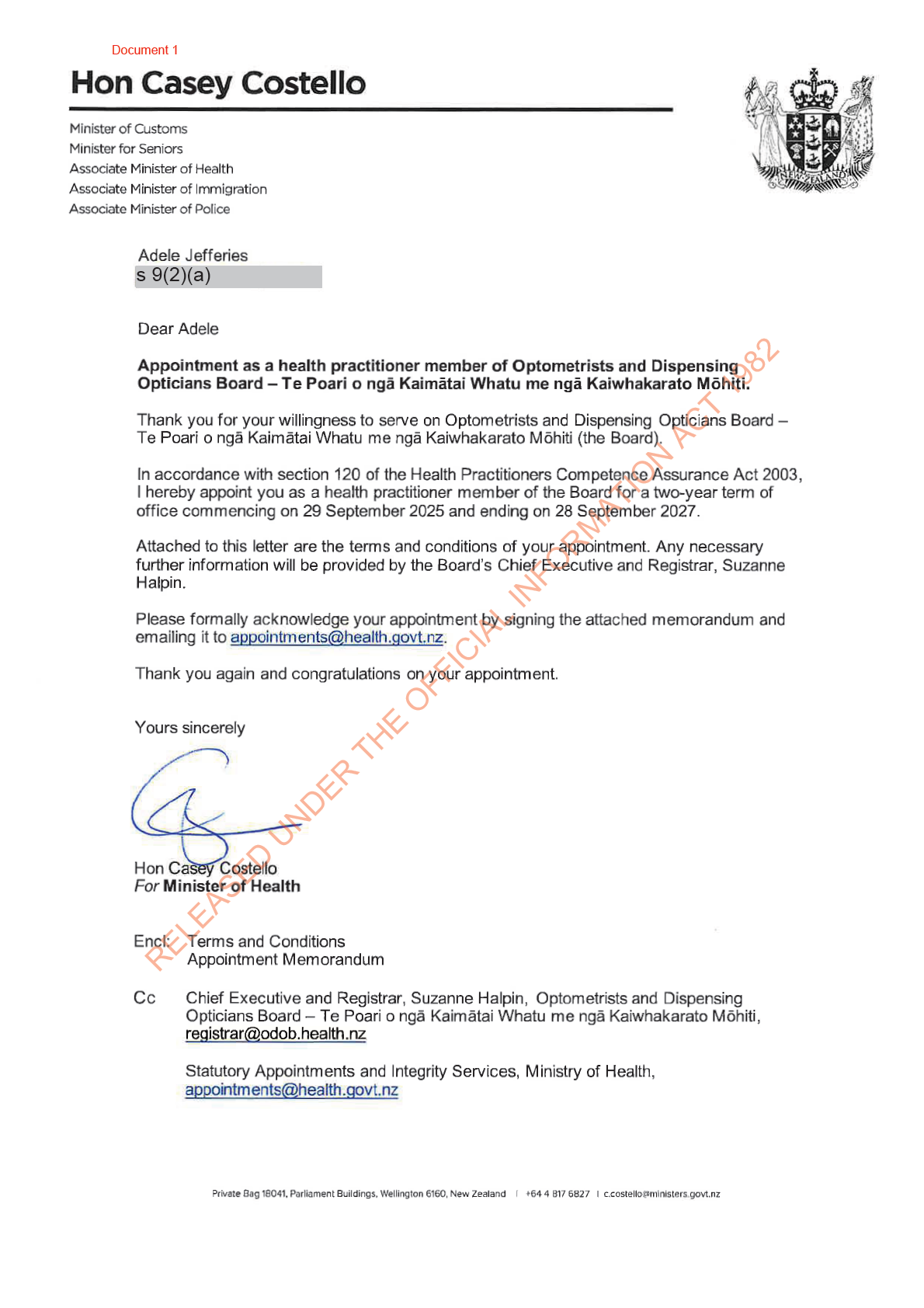
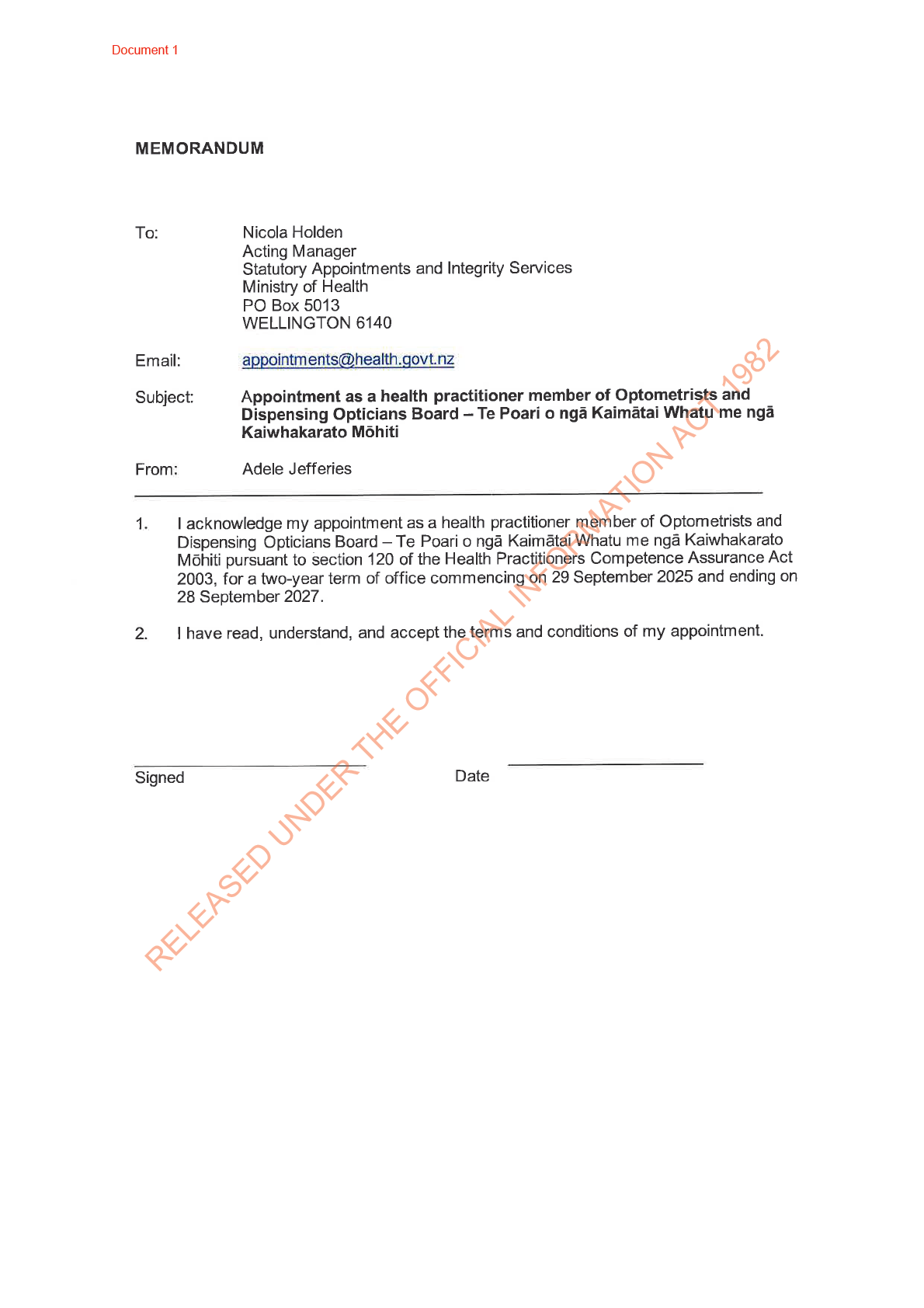
Document 2
1
Candidate Information on the Terms and Conditions of
Appointment to the
Optometrists and Dispensing Opticians Board |
te Poari o ngā Kaimātai Whatu me ngā
Kaiwhakarato Mōhiti
Health Practitioners Competence Assurance Act 2003
Introduction
This document provides information for prospective candidates for membership of the
ACT 1982
Optometrists and Dispensing Opticians Board | te Poari o ngā Kaimātai Whatu me ngā
Kaiwhakarato Mōhiti (the Board). It sets out the:
role and functions of the Board
composition of the Board
terms and conditions of appointment
duties and responsibilities of a member.
The Role of Registration Bodies in Regulating Occupations
INFORMATION
Consumers do not always have enough knowledge to make an informed decision whether
dispensing opticians and optometrists are competent to carry out their occupations. This can
be a matter of concern when the actions of an incompetent practitioner may impact on the
health and safety of consumers. Occupational regulation is one way of providing consumers
with information about a practitioner’s competence. It ensures that only practitioners who have
demonstrated that they meet the minimum standards for entry to an occupation can practise or
use protected titles.
The Health Practitioners Competence Assurance Act 2003 (the HPCA Act) establishes
responsible authorities to protect consumers of health services. The HPCA Act requires
responsible authorities to establish the competencies required for the registration of
practitioners, who must demonstrate they possess the competence to practise safely. The
Board is one such responsible authority.
Individuals appointed to the Board have a range of experience, from first-time appointees with
little or no experience as a member of such authorities to members with extensive experience.
The Board draws considerable benefits from having a diverse membership with a range of skil s,
attributes and experience.
RELEASED UNDER THE OFFICIAL
Functions of the Board
The Board is a body corporate established under section 114 of the HPCA Act. The purpose of
the HPCA Act is to protect the health and safety of members of the public by providing
mechanisms to ensure that health practitioners are competent and fit to practise their
professions.
The functions of the Board are set out under section 118(1) of the HPCA Act. As they relate to
the Board, these functions are:
(a)
to prescribe the qualifications required for scopes of practice within the profession, and,
for that purpose, to accredit and monitor educational institutions and degrees, courses
of studies, or programmes:
(b)
to authorise the registration of health practitioners under this Act, and to maintain
registers:
Optometrists and Dispensing Opticians Board | Te Poari o ngā Kaimātai Whatu me ngā Kaiwhakarato Mōhiti, February 2026
Document 2
2
(c)
to consider applications for annual practising certificates:
(d)
to review and promote the competence of health practitioners:
(e)
to recognise, accredit, and set programmes to ensure the ongoing competence of health
practitioners:
(f)
to receive information from any person about the practice, conduct, or competence of
health practitioners and, if it is appropriate to do so, act on that information:
(g)
to notify employers, the Accident Compensation Corporation, the Director-General of
Health, and the Health and Disability Commissioner that the practice of a health
practitioner may pose a risk of harm to the public:
(h)
to consider the cases of health practitioners who may be unable to perform the functions
required for the practice of their profession:
(i)
to set standards of clinical competence, cultural competence (including competencies
that wil enable effective and respectful interaction with Māori), and ethical conduct to be
observed by health practitioners of the profession:
ACT 1982
(j)
to liaise with other authorities appointed under this Act about matters of common interest:
(ja) to promote and facilitate inter-disciplinary collaboration and co-operation in the delivery
of health services:
(k)
to promote education and training in the profession:
(l)
to promote public awareness of the responsibilities of the authority:
(m) to exercise and perform any other functions, powers, and duties that are conferred or
INFORMATION
imposed on it by or under this Act or any other enactment.
Composition of the Board
Under section 120 of the HPCA Act, the Board may consist of up to 14 members, a majority
of whom are health practitioners. The Board’s membership must include two laypersons if the
authority has eight or fewer members, or three laypersons if the authority has nine or more
members.
Consumer Constituency
The consumer constituency of the Board includes those who use optical dispensing and
optometry services, as wel as those with an interest in the eye care of themselves and other
New Zealanders. Those who use or may use these services are a cross-section of New
Zealanders in terms of ethnicity, age, gender, and geography.
Appointment as a Member of the Board
In making yourself available to be considered for appointment, please ensure that:
RELEASED UNDER THE OFFICIAL
there is no conflict of interest which would preclude your appointment; and
you are available to serve for a term of office of up to three years.
The Board provides an induction package to al new members.
Board members are expected to follow the terms and conditions set out
below.
Terms and Conditions of Appointment
The Minister of Health appoints members to the Board for a term of up to three years by notice
published in the
Gazette. Members may be reappointed from time to time, but no person is
eligible to be a member for more than nine consecutive years. Any member of the Board may
at any time resign by giving notice to that effect to the Minister.
Optometrists and Dispensing Opticians Board | Te Poari o ngā Kaimātai Whatu me ngā Kaiwhakarato Mōhiti, February 2026
Document 2
3
The HPCA Act states that appointed members are considered to have vacated their office if
they die or are judged bankrupt under the Insolvency Act 1967. The Minister of Health may at
any time remove members from office, on the grounds of:
inability to perform the duties of the office
neglect of duty
misconduct, proved to the satisfaction of the Minister
with the concurrence of the Board, by notice given to the member, on the grounds that
the member’s performance on the Board is inadequate.
Duties and Responsibilities of a Member
This section sets out the Minister of Health’s expectations regarding the duties and
responsibilities of a person appointed as a member of the Board. This is intended to aid
members of the Board by providing them with a common set of principles for appropriate
conduct and behaviour and serves to protect the Board and its members from being exposed
to legal challenges.
As an independent statutory body, the Board has an obligation to conduct its activities
ACT 1982in an
open and ethical manner. The Board has a duty to operate in an effective manner within the
parameters of its functions as set out in section 118(1) of the HPCA Act.
General
Board members have a commitment to protect the public and work for the greater good of the
Board. Members are accountable to the Minister of Health (and through the Minister to the
public of New Zealand).
INFORMATION
Board members attend meetings, and undertake Board activities, as independent persons
responsible to the Board as a whole. Members are not appointed as representatives of
professional organisations, their respective profession, or communities. This issue is
particularly important when Board members may, at times, be required to be party to decisions
which conflict with the views of other organisations with which they are involved.
There is an expectation that Board members wil make every effort to attend al Board meetings
and devote sufficient time to become familiar with the affairs of the Board and the wider
environment within which it operates.
Board members wil also be required to serve on one or more Board committee or working
group.
Legislation and Conflicts of Interest
It is important that Board members have a common understanding of their role, in order that
decisions can be reached within the spirit of the governing legislation - namely, for the purpose
of protecting the public interest through the regulation of dispensing opticians and optometrists.
Board members wil be expected to become familiar wi
RELEASED UNDER THE OFFICIAL th, and operate according to, the
HPCA Act.
In addition, members of the Board are expected to be familiar with, and operate according to,
the:
principles of natural justice and administrative law
Health and Disability Commissioner Act 1994- Code of Health and Disability Services
Consumers' Rights
Health and Disability Services Act 2001
Trans-Tasman Mutual Recognition Act 1997
Privacy Act 2020
- Health Information Privacy Code 2020
Human Rights Act 1993
Treaty of Waitangi.
Optometrists and Dispensing Opticians Board | Te Poari o ngā Kaimātai Whatu me ngā Kaiwhakarato Mōhiti, February 2026
Document 2
4
Board members should perform their functions in good faith, honestly and impartial y, and avoid
situations that might compromise their integrity or otherwise lead to conflicts of interest. Proper
observation of these principles wil protect the Board and its members and wil enable public
confidence to be maintained.
When Board members believe they have a conflict of interest on a subject that wil prevent them
from reaching an impartial decision or undertaking an activity consistent with the Board’s
functions, then they must declare the conflict of interest and withdraw themselves from the
discussion or activity.
Confidentiality
Meetings, including agenda material and minutes, of the Board are confidential. Board
members must ensure that the confidentiality of Board business is maintained.
Members are free to express their own views within the context of Board meetings, or the
general business of the Board.
Board members must publicly support a course of action decided by the Board, or if unable to
ACT 1982
do that, must not publicly comment on decisions.
At no time shall Board members individually divulge details of Board matters or decisions of the
Board to persons who are not Board members. Disclosure of Board business to anyone outside
the Board must be the decision of the Board, or between meetings, at the discretion of the
Chairperson of the Board, or in the case of committees, the Chairperson of the Committee (if
they have the delegated authority from the Board).
Board members must ensure that Board documents are kept secure to ensure the
INFORMATION
confidentiality of Board work is maintained. Release of Board correspondence or papers can
only be made with the approval of the Board.
Meetings of the Board
The Board meets formally four times a year, but this can be reviewed depending on
requirements. Teleconferences or video conferences for urgent business are held during the
year as wel .
A member should expect to spend an average of two to four hours per week on Board matters.
Much of this work wil be conducted through email or phone.
In addition, members may be required to participate on sub-committees established to address
specific issues, for example, continuing education, professional standards, registration,
legislation, and administration. Board committees do not generally meet, instead relying on
phone and email contact.
The conduct of meetings and quorum necessary for the Board to transact business is set out
in Schedule 3 of the HPCA Act.
RELEASED UNDER THE OFFICIAL
When carrying out its functions the Board must follow the principles of natural justice and
administrative law. The Board must act lawfully, that is, the Board can only act within the limits
of its powers as set out in the HPCA Act. The Board must also act fairly when carrying out its
functions. Decisions of the Board are reviewable by the Courts, and it is also possible for
persons to take civil action against the Board or its individual members.
Fees and Allowances
Members of the Board, and of any sub-committees appointed by the Board, are paid a monthly
honorarium. This is currently set at $958.33 per month but may change from time to time.
Additional y, the Board pays for actual and reasonable travel and accommodation expenses.
More detailed information can be obtained from the Chief Executive and Registrar of the
Board:
Optometrists and Dispensing Opticians Board | Te Poari o ngā Kaimātai Whatu me ngā Kaiwhakarato Mōhiti, February 2026
Document 2
5
Suzanne Halpin
Chief Executive and Registrar
Optometrists and Dispensing Opticians Board | Te Poari o ngā Kaimātai Whatu me ngā
Kaiwhakarato Mōhiti
22 Wil eston Street
Wel ington Central, Wellington 6011
PO Box 9644
WELLINGTON 6141
Ph:
(04) 474 0705
E-mail [email address]
ACT 1982
INFORMATION
RELEASED UNDER THE OFFICIAL
Optometrists and Dispensing Opticians Board | Te Poari o ngā Kaimātai Whatu me ngā Kaiwhakarato Mōhiti, February 2026
Document 3
Health Practitioner Vacancies on the Optometrists and Dispensing Opticians Board – Te Poari o
ngā Kaimātai Whatu me ngā Kaiwhakarato Mōhiti
The Ministry of Health – Manatū Hauora (the Ministry) is seeking candidates who wish to be
considered for appointment as
health practitioner members of the Optometrists and Dispensing
Opticians Board – Te Poari o ngā Kaimātai Whatu me ngā Kaiwhakarato Mōhiti (the Board). The
Board is a Responsible Authority under the Health Practitioners Competence Assurance Act 2003
(the HPCA Act). The purpose of the Board is to protect the health and safety of members of the
public by ensuring that practitioners are fit and competent to practise.
About the role - Kōrero mō te tūranga
Being a member of the Board is rewarding and chal enging. You wil be committed to improving the
health of New Zealanders, through your contribution to the governance of the Board’s legislative
requirements.
ACT 1982
The functions of responsible authorities are set out under section 118 of the HPCA Act, and more
information about the Board is available on the Board’s website and in the terms of reference.
Appointments to the Board are made by the Associate Minister of Health, Hon. Casey Costello,
typical y for terms of three years. Members can be reappointed for up to nine consecutive years.
The Ministry recognises that diversity enables our boards and councils to be high-performing and is
committed to ensuring they represent the diversity in New Zealand's population, in
INFORMATION cluding gender,
ethnicity, disability, age and geographic location. The Ministry encourages people from all
backgrounds, especial y those who can reflect the needs, values, and beliefs of Māori, and will
understand and be committed to fulfil ing the obligations under the Treaty of Waitangi, to apply for
these roles.
About you - Kōrero mōu
For al applicants, governance and/or regulatory experience is a plus but not required. It is beneficial
if you can lead strategically and balance competing demands.
Health practitioner applicants must be registered optometrists or dispensing opticians, hold a
practising certificate and registration, and have a good understanding of these scopes of practice,
competencies, and code of ethical conduct.
• a strong understanding of contemporary practice
• knowledge of the legislation governing the optometry and optical dispensing profession, and
how regulatory frameworks operate to protect the p
RELEASED UNDER THE OFFICIAL ublic
• knowledge of the role and functions of a Responsible Authority, including standards-setting,
competence, and disciplinary processes
• demonstrated knowledge and understandings of the Treaty of Waitangi principles within
health, regulator, and governance settings
• knowledge of te ao Māori and tīkanga Māori, and experience with Māori models of health
care
• awareness and understanding of a range of cultural perspectives in health care and their
impact on service delivery and regulatory decision-making
• previous experience in governance, leadership, or regulatory environments (desirable but
not essential)
Document 3
• strong communication and interpersonal skills, including the ability to work constructively
with both practitioner and lay members on the Board.
Under the HPCA Act members of the board of a Responsible Authority cannot simultaneously be a
member of the Health Practitioners Disciplinary Tribunal (the Tribunal).
How to apply - Me pēhea te tono
Applications must be made using the Ministry of Health online Career Centre by the end of the day
22 March 2026 and include:
• a covering letter, and
• a current CV.
Due diligence checks wil be undertaken for shortlisted applicants. Your personal information will be
handled in accordance with the Privacy Act 2020. The Ministry may also request that the New
ACT 1982
Zealand Security Intelligence Service conduct national security screening of you as part of the
appointment process.
The appointment process can be lengthy, taking up to six months. Your patience and professionalism
as we work through the next steps is appreciated. The outcome of the recruitment process for the
Board wil be confirmed after it has been considered by the Cabinet Appointments and Honours
Committee.
INFORMATION
Who we are - Ko wai mātou
See the Ministry of Health Board appointments webpage for more information.
If you would like to obtain further information or clarification, or if your circumstances change or
should you wish to withdraw your application, please contact the Statutory Appointments team by
emailing: [email address]
RELEASED UNDER THE OFFICIAL
