OIA Document 1 - Speech notes
Myles Ward, Deputy Government Chief Digital Officer’s keynote to the
Digitising Government New Zealand conference
Wednesday 18 March 2026, Tākina, Wel ington
Welcome
Thank you, Tech New Zealand, for this opportunity to speak to you today. I’m excited to
share how we are moving the dial on digitising government and reshaping how services
reach New Zealanders in a digital age.
Across government, the pressures are real and growing. Expectations for simple, trusted
digital experiences continue to rise, while at the same time we face tighter fiscal settings and
underlying structures that have not kept pace with what the country now needs from us.
The result is something al of us recognise - fragmentation, duplication, and services that too
often reflect the machinery of government rather than the lives of the people we serve.
Today, I want to talk about how we are making changes to deliver better, more consistent
services for people, reduce cost and duplication across the system, and lay the foundations
for a digital y enabled public service that is fit for the future.
In many respects, this represents a clear call to action from the PM, Minister Collins, Sir
Brian, and our CEs. The moment is right, the direction is set, the expectations are explicit,
and the system now needs to move with purpose and discipline.
Start with the “why”: why change is necessary
What we are confronting is not a col ection of technology problems, but a set of system
issues that have accumulated over many years. The Public Service is being asked to deliver
more – more consistently, more transparently, and with greater fiscal restraint—while
expectations from New Zealanders continue to rise, and rightly so.
under the Official Infomation Act
Yet the structures that sit beneath our work, from how we organise information to how we
invest and share capability, have not kept pace. The result is duplication, fragmentation, and
a system that too often struggles to act as one.
The expansion of our digital footprint and lack of a unified all-of-government direction has
led to services that are hard to find, use, and maintain, and a digital landscape that is
Released
unaffordable and unsustainable.
Before we talk about digitising government, we need clarity about the problems we are
trying to solve: restoring fiscal balance, improving productivity, enabling a genuinely joined
up Public Service, and building the foundations for services that are reliable, equitable, and
modern.
Digitisation is not the end in itself; it is the means by which the system can operate
coherently, sustainably, and with the maturity New Zealanders now expect. We want to
meet the customer where they are with proactive service provision that is grounded in trust,
privacy and ease of access.
UNCLASSIFIED
Along with this, digital technologies have advanced rapidly. Modern cloud platforms and AI
enable faster, more convenient services and significantly reduce the cost and time required
to deliver enterprise scale solutions.
But over the years the Government’s adoption of digital has been largely agency by agency.
This has produced a landscape of bespoke systems, duplicated capability, and siloed
delivery—an approach that is costly to maintain, slow to adapt, and increasingly difficult to
justify.
The symptoms of the current model are wel known:
• services that are hard to find and harder to maintain;
• a digital estate that is ageing and unsustainable;
• foundations—platforms, data, and architecture—that are inconsistent across
agencies; and
• decision makers who lack the real time insight needed for coordinated planning
and investment.
This is not a digital inconvenience; it affects service quality, public trust, productivity, and the
performance of the system as a whole.
We are managing an estimated $13 billion digital investment pipeline over five years, with
significant duplication and unfunded initiatives. That is not a pathway to value for money,
nor to a coherent Public Sector. We cannot ask frontline staff to deliver 21st century services
on 20th century platforms.
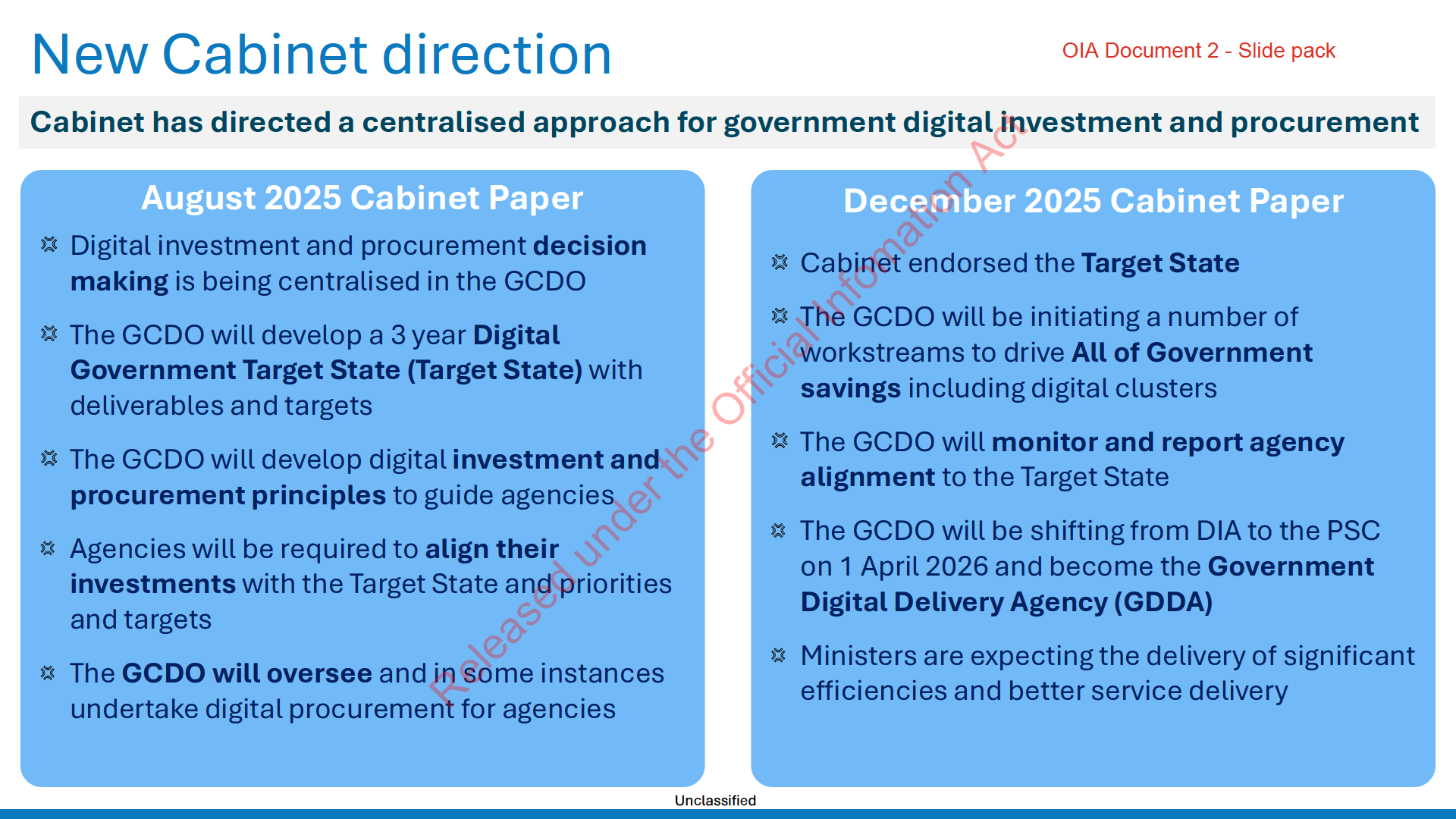
We are now at a turning point. The Government has endorsed a more central and disciplined
direction for digitising government—one that moves us away from fragmented investment
and procurement and toward a unified, system level approach.
under the Official Infomation Act
This will see the Government Chief Digital Office will lead the development of a multi-
year Digital Government Target State. I will explain this more in detail but essentially the
Digital Government Target State will provide a shared vision and a practical pathway from
the complexity we have today to a more coherent, affordable, and enduring digital system.
This is why change is necessary, and why the direction is now clear.
Government Digital Deliver
Released
y Agency (GDDA)
It is also key to note that this is not a new approach. Leading digital nations like Singapore,
Estonia, Australia and Denmark all use strong, centralised digital leadership.
Like them we are prioritising reusable platforms, cloud, and modular development to
achieve major savings and better citizen services. Now is the time that we really move this
forward.
UNCLASSIFIED
For the first time, a dedicated agency - the Government Digital Delivery Agency (GDDA) - will
be established to focus exclusively on government digitisation and aligning the public service
with the Target State.
The transfer of the GCDO function to the Public Service Commission as a dedicated
Government Digital Delivery Agency showcases the need to accelerate the use of digital
capabilities across the Public Sector to better serve our customers: all New Zealanders.
The placement of the GCDO function into the Commission under a Functional Chief
Executive leverages its central agency expertise and enables a greater col ective opportunity
to influence, engage and affect change across the Public Sector.
Act
This wil aid the Public Sector as a system to enhance technology adoption, taking a
considered and deliberate approach to address the needs of New Zealanders.
The target state: what “good” looks like (Guiding Star analogy)
The Digital Government Target State is the system-wide direction of travel for how we
modernise digital government. It sets out the architecture, standards, and common
capabilities, including the digital public infrastructure that agencies must align to, and
Infomation
provides the basis for how we prioritise, sequence, and fund digital investment across the
Public Sector.
The Government has been clear: the current fragmented, agency-by-agency model of digital
delivery is no longer sustainable. The Target State is the mechanism that replaces it with a
coherent, disciplined, and fiscally responsible approach.
Official
At its core, the Target State defines what must be shared across government, what must be
the
standardised, and what must, over time, be retired. It ensures that digital infrastructure is
built once and reused widely, that data can move safely across organisational boundaries,
and that digital identity, channels, and platforms operate as system assets—not individual
agency assets.
under
It is the framework the GCDO is responsible for developing and maintaining on behalf of the
system, and against which future investment intentions, procurement choices, and Budget
proposals will be tested.
The Target State also reflects the expectations New Zealanders now hold of their Public
Sector services. People want simple, safe, and connected services without navigating the
machinery of government.
Released
Businesses want lower compliance burdens and predictable digital interactions. The
economy needs modern, interoperable infrastructure; trustworthy identity; and secure,
mobile data foundations.
And the private sector needs early clarity on direction to invest and innovate with
confidence in areas such as digital identity, data exchange, cloud, and AI-enabled services.
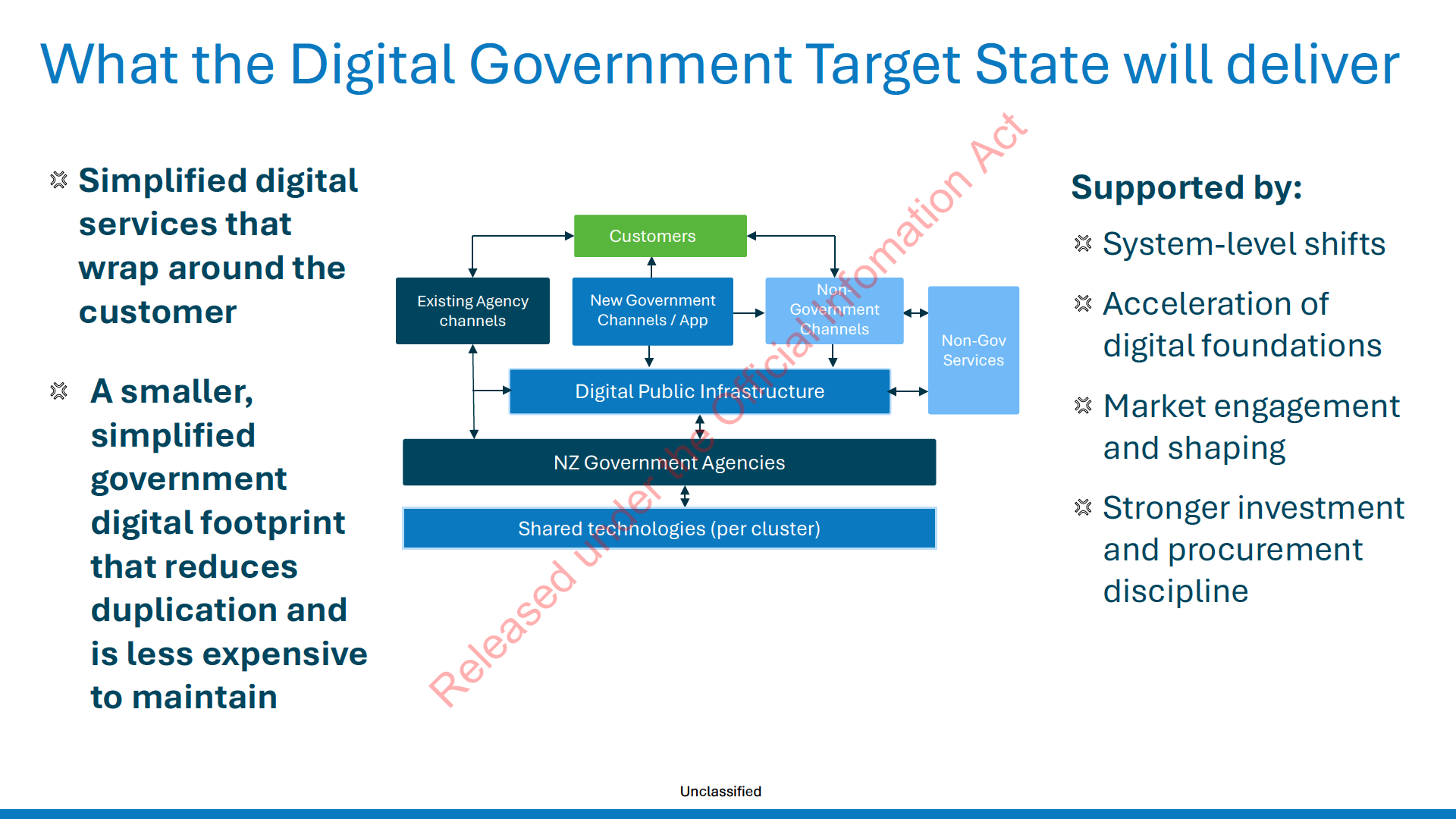
In practical terms, the Target State will deliver:
UNCLASSIFIED
• A secure front door for government services, with digital credentials, notifications, and
over time, payments available through agreed channels.
• Common digital foundations such as identity, data exchange, cloud, and service patterns
that are established once and reused across agencies.
• Logical groupings of agencies connecting into common platforms where it makes sense,
reducing duplication and shrinking the digital footprint.
• Joined-up services designed around life events and customer needs, rather than
organisational boundaries.
The direction the Government has set is unmistakable: a more coherent, more trusted, and
Act
more sustainable digital government—with stronger central stewardship, aligned
investment, and fewer, better platforms that deliver better services for New Zealanders.
At the centre of the future system is our Digital Public Infrastructure
What is Digital Public Infrastructure (DPI)? This is the foundation that wil al ow government
to operate in a more connected and coherent way. It provides the safe, reliable means for
agencies to link their services, their data, and their channels, so that the system work
Infomation s as
one rather than as a col ection of separate parts.
Digital Public Infrastructure is the architectural layer that enables this. It connects customers
to services, services to each other, and agencies to the information they need to act with
confidence. It supports secure and trusted data exchange across government and with the
Official
third parties who help deliver public value. It gives people greater confidence that their
information is handled safely and used for their benefit.
the
Without these foundations, we wil continue to build solutions that operate in isolation,
duplicating cost and effort and making it harder for New Zealanders to navigate government.
With them, we have the ability to create a digital system that is coherent, trusted, and
sustainable — one where services can work together and agencies can act in concert, not in
under
silos.
This will be how we move from a fragmented system to a genuinely connected Public Sector.
Agencies wil be able to connect into these services as opposed to building them themselves.
How are we going to get there?
Released
Our next steps are about shifting from intention to disciplined, system-wide execution. In
the coming period, the GCDO wil issue clear guidelines that set out what the Digital
Government Target State requires, how agencies align their architecture and investment,
and the practical steps involved in moving from today’s fragmented landscape to a more
coherent one.
We wil also be developing a forward investment and forward procurement plan for the
system. This wil be built from the investment intentions agencies provide and wil identify
where system-level investment is required—particularly where gaps remain in the Digital
Public Infrastructure layer.
UNCLASSIFIED
Alongside this, we will begin implementing a set of system accelerators—practical levers
designed to reduce cost, improve coherence, accelerate consolidation.
Another cornerstone of this work will be digital identity, which will enable a connected
ecosystem that puts citizens in control of their information and allows the citizen to access
services in a way they are used to.
Achieving a modern, trusted, and citizen-centred digital system requires transforming how
government manages identity, data, and access. Our approach is built on a series of
paradigm shifts:
• From centralised to decentralised identity — moving from agency-specific systems to a
model that lets individuals verify and share information securely across services.
Act
• From government-centric to citizen-centric design — placing people at the centre,
al owing them to choose how, when, and with whom their data is shared.
• From static to portable data — enabling data to follow citizens across agencies and
sectors, reducing duplication, improving accuracy, and simplifying service access.
• From compliance to trust and transparency — embedding consent, security, an
Infomation d
accountability at every level of design and operation.
• From siloed capability to shared digital infrastructure — investing in common
platforms, standards, and assurance frameworks to support interoperability and a
consistent user experience.
Official
This is not centralisation of al digital assets; it is thoughtful consolidation where the
benefits—financial, operational, and customer
the -facing—are clear and enduring.
The private sector plays an important role:
The private sector plays an essential role in lifting the performance of our digital system. If
we expect industry to bring its capability
under , innovation, and investment to the table, then we
must meet it with a clearer, more predictable way of working. A more consistent,
streamlined, and predictable approach would not only reduce cost for suppliers but would
also open the door to a broader, more diverse market—one that can genuinely support
government at the pace required.
We should also be making far better use of the private sector to augment, scale, and
strengthen the services we provide. Industry already delivers much of the technology that
Released
underpins modern digital services, and there is real value in leaning into that expertise. With
the right guardrails in place—clear standards, strong accountability, and shared
expectations—we can enable private partners to deliver components and capabilities that
government simply cannot do alone, or cannot do as effectively. This is not about
outsourcing responsibility; it is about building a col aborative model where public purpose
and private capability reinforce one another. If we get that balance right, we can create a
digital system that is more resilient, more innovative, and far better aligned with the speed
at which New Zealanders expect services to be delivered.
UNCLASSIFIED
We are also looking seriously at the commercial models we use, because the way we work
with the private sector today does not always incentivise genuine partnership. Too often,
solutions arrive in ways that divide rather than unify—different pricing for different
agencies, licensing arrangements that cannot move with us, and components that are not
made available for wider government consumption. That approach fragments the system
and slows us down. What we need instead is licensing portability, predictable commercial
terms, and a level of openness that supports the joined-up model we are trying to build. We
are asking the private sector to invest in government for the long term—so we must also
move beyond the traditional transactional approach that has shaped procurement for
decades.
The private sector will also play a central role in how our services are exposed and consumed
Act
across the digital ecosystem. We have seen this already with examples like Xero integrating
with the tax system. There is considerably more opportunity for industry to innovate in the
same direction we are heading, particularly in areas such as digital identity, credentialisation,
and high-trust data exchange. The irony, of course, is that government is currently leading
the way on digital identity—yet the private sector needs to catch up if we are to realise the
full value of these capabilities and where the target state is taking government.
In closing
Infomation
We’ve been clear today about the chal enge we face. The way government has been
operating digitally is no longer sustainable. Costs are rising, duplication is common, and too
often our services reflect organisational boundaries rather than people’s lives.
Official
With a significant digital investment pipeline ahead of us, doing more of the same is simply
not an option. This represents a real shift in how we work. It means stronger central
direction on digital investment and procurement, and it also means agencies continuing to
the
lead service delivery — but in a way that is aligned to system-wide priorities and shared
platforms.
That’s why the Digital Government Target State is so important. It gives us a shared,
multi-year direction and a clear picture
under of the future system we are deliberately working
towards.
Success depends on al of us thinking beyond our own organisations and making decisions
that support the whole system.
If we get this right, the prize is substantial — better services for people, significant savings
for government, and a digital system that is coherent, resilient, and fit for the future.
Released
Ngā mihi, thank you
END
UNCLASSIFIED