I N C O N F I D E N C E
Office of the Minister of Justice
Cabinet Business Committee
Declaring English an Official Language
ACT 1982
Proposal
1
This paper seeks agreement to policy decisions to legislate for English as an official
language of New Zealand.
Relation to government priorities
2
This proposal contributes to the commitment in the coalition agreement between
National and New Zealand First to progress legislation to make English an official
language of New Zealand.
Executive Summary
3
The National-New Zealand First coalition agreement includes a commitment to
INFORMATION
legislate to make English an official language of New Zealand.
4
New Zealand has three official languages but the status of English as an official
language is not set out in legislation. Both te reo Māori and New Zealand Sign
Language (NZSL) have legislation that set out their status as official languages.
5
I seek agreement to progress a Bill that declares English an official language of New
Zealand, in line with the coalition agreement.
6
As the predominant language in New Zealand, I do not consider it necessary to
provide any other specific provisions in the Bill for the use of the English language.
Background
7
The National-New Zealand First coalition agreement states that to “uphold the
principles of liberal democracy, including equal citizenship and parliamentary
sovereignty, the Parties will: Legislate to make English an official language of New
Zealand.”
8
An official language is the language, or one of the languages, accepted by a country's
government, used in the courts of law, and used in schools. Official language status
can be ‘de facto’, that is, widely used and accepted as an official language but not
having its status as an official language set out in legislation, or its official status can
be in legislation.
9
New Zealand has three official languages, two of which have their official language
status set out in legislation. Te reo Māori through Te Ture mō Te Reo Māori 2016 /
The Māori Language Act 2016 and NZSL through the New Zealand Sign Language
Act 2006. For those languages, legislation was considered necessary to protect the
rights of linguistic minorities under section 20 of the Bill of Rights Act 1990 and to
1
I N C O N F I D E N C E
RELEASED UNDER THE OFFICIAL
3reelrmyjx 2025-06-30 15:07:09
I N C O N F I D E N C E
legislate for the right to use each language in legal proceedings where they may
otherwise not have been provided for.
10
The English language has ‘de facto’ official language status in New Zealand. It is the
predominant language used across government institutions, the courts, and
Parliament, and is spoken by approximately 95 percent of the New Zealand
ACT 1982
population.1
Analysis
11
English is not legislated as an official language in New Zealand. Some consider,
therefore, that the legal status of the English language is unclear and raise concerns
with the legislative inconsistency amongst the official languages of New Zealand.
Some also have a perception that, without legislation, the status of the English
language could be diminished in future.
12
I consider that legislating to clarify the status of English as an official language would
prevent any confusion about the status of the language, resolve any inconsistency that
the status of only some official languages is set out in legislation, and make it clear
that New Zealand has three official languages.
INFORMATION
13
In line with the coalition agreement, I seek agreement to progress a stand-alone
‘English Language Bill’ that would legislate English as an official language of New
Zealand. This would be a straightforward Bill to set out the existing status of English,
which is recognised already as a ‘de-facto’ official language, as an official language
in legislation.
14
As the predominant language of New Zealand, English does not require provision to
continue to be used in the courts, Parliament, and government communications. I am
therefore not seeking to include any other provisions for the language in the Bill.
15
Legislative recognition of the status of English as an official language will not affect
the status or use of te reo Māori and NZSL, nor will it affect the use or status of other
languages used in New Zealand.
Implementation
16
I expect to introduce legislation in August 2025 and for the Bill to progress through
the remaining parliamentary stages by April 2026.
17
The Bill will come into force upon Royal Assent.
Cost-of-living Implications
18
The proposal contained in this paper has no cost-of-living implications.
Financial Implications
19
There are no financial implications arising from this proposal.
1 4.75m out of a total population of 4.99m - Census 2023 Data.
2
I N C O N F I D E N C E
RELEASED UNDER THE OFFICIAL
3reelrmyjx 2025-06-30 15:07:09
I N C O N F I D E N C E
Legislative Implications
20
This paper is seeking agreement to a proposed Bill being included in the 2025
Legislation Programme with a priority Category 5 to progress to select committee by
the end of the year.
ACT 1982
21
The proposed Bill will bind the Crown. The Bill will be administered by the Ministry
of Justice.
Impact Analysis
Regulatory Impact Statement
22
The Ministry for Regulation has determined that this proposal is exempt from the
requirement to provide a Regulatory Impact Statement on the grounds that it has no or
only minor economic, social, or environmental impacts.
Climate Implications of Policy Assessment
23
The Climate Implications of Policy Assessment (CIPA) team has been consulted and
confirms that the CIPA requirements do not apply to this policy proposal, as the
INFORMATION
threshold for significance is not met.
Population Implications
24
The proposal is not expected to change the use of the English language in New
Zealand, nor impact the use and support for the two other official languages, te reo
Māori and NZSL, nor the use and support for any other languages used in New
Zealand.
25
The proposal is not expected to impact any population groups in New Zealand.
Human Rights
26
The proposal in this paper raises no inconsistencies with the New Zealand Bill of
Rights Act 1990 or the Human Rights Act 1993.
Use of external resources
27
No external resources were used in the development of this advice.
Consultation
28
The following departments have been consulted on this paper: the Department of Internal
Affairs, Cabinet Office, Te Puni Kōkiri, Ministry of Disabled People – Whaikaha, the
Ministry for Regulation, Treasury, the Ministry for Culture and Heritage, and the Public
Service Commission. The Department of the Prime Minister and Cabinet has been
informed.
29
The ACT Party and the New Zealand First Party have been consulted on this paper.
3
I N C O N F I D E N C E
RELEASED UNDER THE OFFICIAL
3reelrmyjx 2025-06-30 15:07:09
I N C O N F I D E N C E
Communications
30
I intend to issue a press release when the Bill is introduced later this year.
Proactive Release
ACT 1982
31
I will proactively release this Cabinet paper, with appropriate redactions, alongside
the introduction of the Bill, in accordance with paragraph 25.2 of the Cabinet Office
Circular CO (23) 04.
Recommendations
32
The Minister of Justice recommends that the Committee:
1
note that the National-New Zealand First coalition agreement includes a commitment
to legislate to make English an official language of New Zealand;
2
agree to progress a stand-alone ‘English Language Bill’ to meet the coalition
agreement to make English an official language of New Zealand;
3
note that the proposed Bill will have no impact on the official status and use of te reo
Māori and New Zealand Sign Language as provided for in their legislation;
INFORMATION
4
agree to include the Bill on the Governments 2025 Legislative Programme with a
priority Category 5 (to progress to select committee by the end of the year);
5
agree that the Bill will bind the Crown;
6
invite the Minister of Justice to issue drafting instructions to give effect to the
decisions in these recommendations;
7
authorise the Minister of Justice to make any minor and technical policy decisions that
may arise prior to the Bill’s introduction in accordance with policy agreed by Cabinet.
Authorised for lodgement
Hon Paul Goldsmith
Minister of Justice
4
I N C O N F I D E N C E
RELEASED UNDER THE OFFICIAL
3reelrmyjx 2025-06-30 15:07:09
 I N C O N F I D E N C E
CBC-25-MIN-0029
Cabinet Business
Committee
I N C O N F I D E N C E
CBC-25-MIN-0029
Cabinet Business
Committee
Minute of Decision
This document contains information for the New Zealand Cabinet. It must be treated in confidence and
ACT 1982
handled in accordance with any security classification, or other endorsement. The information can only be
released, including under the Official Information Act 1982, by persons with the appropriate authority.
Declaring English an Official Language
Portfolio
Justice
On 30 June 2025, the Cabinet Business Committee:
1
noted that the National-New Zealand First Coalition Agreement includes a commitment to
legislate to make English an official language of New Zealand;
2
agreed to progress a stand-alone English Language Bill (the Bill) to meet the commitment
INFORMATION
referred to in paragraph 1;
3
noted that the Bill will have no impact on the official status and use of te reo Māori and
New Zealand Sign Language as provided for in their legislation;
4
agreed to include the Bill on the 2025 Legislation Programme with a category 5 priority (to
proceed to select committee by the end of 2025);
5
agreed that the Bill will bind the Crown;
6
invited the Minister of Justice to issue drafting instructions to the Parliamentary Counsel
Office to give effect to the above decisions;
7
authorised the Minister of Justice to make any minor and technical policy decisions that
may arise prior to the Bill’s introduction in accordance with the policy agreed by Cabinet.
Rachel Clarke
Committee Secretary
Present:
Officials present from:
Hon David Seymour (Chair)
Office of the Prime Minister
Rt Hon Winston Peters
Department of the Prime Minister and Cabinet
Hon Nicola Willis
Hon Chris Bishop
Hon Simeon Brown
Hon Shane Jones
Hon Erica Stanford
Hon Paul Goldsmith
Hon Louise Upston
Hon Judith Collins KC
1
RELEASED UNDER THE OFFICIAL
3reelrmyjx 2025-06-30 15:01:54
I N C O N F I D E N C E
 I N C O N F I D E N C E
CAB-25-MIN-0228
Cabinet
Minute of Decision
This document contains information for the New Zealand Cabinet. It must be treated in confidence and
I N C O N F I D E N C E
CAB-25-MIN-0228
Cabinet
Minute of Decision
This document contains information for the New Zealand Cabinet. It must be treated in confidence and
ACT 1982
handled in accordance with any security classification, or other endorsement. The information can only be
released, including under the Official Information Act 1982, by persons with the appropriate authority.
Report of the Cabinet Business Committee: Period Ended 4 July 2025
On 14 July 2025, Cabinet made the following decisions on the work of the Cabinet Business
Committee for the period ended 4 July 2025:
Out of scope
INFORMATION
CBC-25-MIN-0029
Declaring English an Official Language
CONFIRMED
Portfolio: Justice
Out of scope
Rachel Hayward
Secretary of the Cabinet
1
RELEASED UNDER THE OFFICIAL
3reelrmyjx 2025-07-14 14:51:54
I N C O N F I D E N C E
In Confidence
Office of the Minister of Justice
Cabinet Legislation Committee
ACT 1982
English Language Bill: Approval for introduction
Proposal
1
This paper seeks approval to introduce the English Language Bill (the Bill).
Policy
2
The National-New Zealand First coalition agreement includes a commitment to
legislate to make English an official language of New Zealand.
3
On 14 July 2025, Cabinet agreed to progress the English Language Bill [CAB-25-
MIN-0228]. The Bill will recognise the official status of the English language in
INFORMATION
legislation.
4
New Zealand has three official languages, two of which already have their official
language status set out in legislation. Te reo Māori through Te Ture mō Te Reo Māori
2016/The Māori Language Act 2016 and New Zealand Sign Language through the
New Zealand Sign Language Act 2006. For those languages, legislation was
considered necessary to protect the rights of linguistic minorities under section 20 of
the Bill of Rights Act 1990 and to legislate for the right to use each language in legal
proceedings where they may otherwise not have been provided for.
5
As the predominant language of New Zealand, English does not require special
provision to continue to be used in the courts, Parliament, and government
communications. Therefore, no other provisions were agreed for inclusion within the
Bill.
6
Cabinet noted that legislative recognition of the status of English as an official
language will not affect the status or use of te reo Māori and New Zealand Sign
Language as the two other official languages of New Zealand.
7
This paper seeks approval to introduce the English Language Bill in August 2025.
Impact Analysis
8
The proposal is exempt from Cabinet’s regulatory impact analysis requirements on
the grounds that it has no or only minor economic, social, or environmental
impacts.
1
RELEASED UNDER THE OFFICIAL
Compliance
9
The Bill complies with:
9.1
the principles of the Treaty of Waitangi;
ACT 1982
9.2
the rights and freedoms contained in the New Zealand Bill of Rights Act 1990
and the Human Rights Act 1993;
9.3
the disclosure statement requirements (a disclosure statement is attached);
9.4
the principles and guidelines set out in the Privacy Act 2020;
9.5
relevant international standards and obligations; and
9.6
the Legislation Guidelines (2021 edition), which are maintained by the
Legislation Design and Advisory Committee.
10
The Treaty Provisions Officials Group has not been consulted as there are no
specific Treaty provisions in the Bill.
INFORMATION
Consultation
11
The following departments and Offices have been consulted on this paper:
Department of Internal Affairs, the Treasury, Cabinet Office, Te Puni Kōkiri, Ministry
for Regulation, the Public Service Commission, Ministry of Culture and Heritage,
and Whaikaha – Ministry of Disabled People. The Policy Advisory Group in the
Department of the Prime Minister and Cabinet has been informed.
12
The ACT Party and the New Zealand First Party have been consulted on this
Cabinet paper.
Binding on the Crown
13
The Bill will bind the Crown.
Creating new agencies or amending law relating to existing agencies
14
The Bill does not create any new agencies.
Allocation of decision-making powers
15
The Bill does not allocate decision making powers between the executive and
judiciary.
Associated regulations and Other instruments
16
The Bill does not contain any associated regulations or other instruments.
2
RELEASED UNDER THE OFFICIAL
Definition of Minister/department
17
The Bill does not contain a definition of Minister, department, or Chief Executive of a
department.
ACT 1982
Commencement of legislation
18
The Bill will come into force on the day after the day of Royal Assent.
Parliamentary stages
19
The Bill should be introduced by 21 August 2025. I expect the Bill to pass through the
remaining parliamentary stages by the end of April 2026.
Proactive Release
20
I propose to proactively release this Cabinet paper, the earlier Cabinet policy paper,
and the related Cabinet Minutes, with appropriate redactions, in accordance with
Cabinet Office Circular Co (23) 04, following the introduction of the Bill.
INFORMATION
Recommendations
21
The Minister of Justice recommends that the Committee:
1.
note that the English Language Bill holds a priority of Category 5 on the 2025
Legislation Programme (to progress to select committee by the end of 2025);
2.
note that the English Language Bill provides legislative recognition that the
English language is an official language of New Zealand;
Approval to introduce
3.
approve the introduction of the English Language Bill;
4.
agree that the Bill be introduced by 21 August 2025 and pass through the
remaining parliamentary stages by the end of April 2026;
5.
agree that the Bill:
5.1.
be referred to the Governance and Administration Committee for
consideration; and
5.2 come into force the day after Royal Assent.
Authorised for lodgement
Hon Paul Goldsmith
Minister of Justice
3
RELEASED UNDER THE OFFICIAL
 I N C O N F I D E N C E
LEG-25-MIN-0155
Cabinet Legislation
Committee
I N C O N F I D E N C E
LEG-25-MIN-0155
Cabinet Legislation
Committee
Minute of Decision
This document contains information for the New Zealand Cabinet. It must be treated in confidence and
ACT 1982
handled in accordance with any security classification, or other endorsement. The information can only be
released, including under the Official Information Act 1982, by persons with the appropriate authority.
English Language Bill: Approval for Introduction
Portfolio
Justice
On 14 August 2025, the Cabinet Legislation Committee:
1
noted that the English Language Bill (the Bill) holds a category 5 priority on the 2025
Legislation Programme (to proceed to select committee by the end of 2025);
2
noted that the Bill provides legislative recognition that the English language is an official
INFORMATION
language of New Zealand;
3
approved the English Language Bill [PCO 28180/5.0] for introduction;
4
agreed that the Bill be introduced by 21 August 2025;
5
agreed that the Government propose that the Bill be:
5.1
referred to the Governance and Administration Committee for consideration;
5.2
enacted by the end of April 2026.
Tom Kelly
Committee Secretary
Present:
Officials present from:
Hon David Seymour (Chair)
Officials Committee for LEG
Hon Paul Goldsmith
Office of the Leader of the House
Hon Brooke van Velden
Hon Shane Jones
Hon Nicole McKee
Hon Casey Costello
Hon Penny Simmonds
Stuart Smith, MP
Todd Stephenson, MP
Jamie Arbuckle, MP
1
RELEASED UNDER THE OFFICIAL
3reelrmyjx 2025-08-14 12:03:51
I N C O N F I D E N C E
 I N C O N F I D E N C E
CAB-25-MIN-0282
Cabinet
Minute of Decision
This document contains information for the New Zealand Cabinet. It must be treated in confidence and
I N C O N F I D E N C E
CAB-25-MIN-0282
Cabinet
Minute of Decision
This document contains information for the New Zealand Cabinet. It must be treated in confidence and
ACT 1982
handled in accordance with any security classification, or other endorsement. The information can only be
released, including under the Official Information Act 1982, by persons with the appropriate authority.
Report of the Cabinet Legislation Committee: Period Ended
15 August 2025
On 18 August 2025, Cabinet made the following decisions on the work of the Cabinet Legislation
Committee for the period ended 15 August 2025:
Out of scope
INFORMATION
LEG-25-MIN-0155
English Language Bill: Approval for Introduction
CONFIRMED
Portfolio: Justice
Out of scope
Rachel Hayward
Secretary of the Cabinet
1
RELEASED UNDER THE OFFICIAL
4b23j7gqir 2025-08-19 15:54:34
I N C O N F I D E N C E
Hon Paul Goldsmith Minister of Justice
Draft Cabinet paper: Declaring English an Official Language
ACT 1982
Date
11 June 2025
File reference
DOG-11-06-25
Action sought
Timeframe
Confirm policy settings for legislating English as an official
As soon as practicable, by 19
language of New Zealand, as per coalition agreement.
June 2025.
Approve the attached draft Cabinet paper for Ministerial and
coalition consultation, subject to any feedback you may have.
Contacts for telephone discussion (if required)
Name
Position
Telephone
First
contact
(work)
(a/h)
INFORMATION
s9(2)(a)
Kathy Brightwell
General Manager, Civil &
Constitutional
Hayley Denoual
Policy Manager,
Democracy and Open
Government
Anna Moore-Jones
Senior Advisor,
Democracy and Open
Government
Minister’s office to complete
Noted
Approved
Overtaken by events
Referred to:
Seen
Withdrawn
Not seen by Minister
Minister’s office’s comments
IN CONFIDENCE
RELEASED UNDER THE OFFICIAL
IN CONFIDENCE
Purpose
1.
This briefing:
1.1.
seeks agreement to policy settings to meet the National-NZ First coalition
agreement to legislate to make English an official language of New Zealand ACT 1982
1.2.
provides a draft Cabinet paper for your approval ahead of Ministerial consultation
and consideration by the Social Outcomes Committee (SOU) on 16 July 2025.
Executive Summary
2.
The National-NZ First coalition agreement includes a commitment “to legislate to make
English an official language of New Zealand”. You have indicated that you would like to
introduce legislation by the end of September 2025.
3.
New Zealand has three official languages, two of which have their official language status
set out in legislation (te reo Māori and New Zealand Sign Language). The English language
is accepted as a ‘de facto’ official language of New Zealand, though its status as an official
language is not set out in legislation.
INFORMATION
4.
To meet the coalition agreement, the Ministry seeks agreement to a stand-alone Bill to
legislate for English as an official language. We seek your direction whether the Bill should
be specific to the English language or note all official languages of New Zealand with
appropriate cross-references. There are opportunities and drawbacks to both approaches.
5.
No other provisions are proposed for inclusion within the Bill as the Ministry does not
consider that any protections are necessary to support the use of the English language, as
the predominant language of New Zealand.
Background
6.
The National-NZ First coalition agreement includes a commitment to legislate to make
English an official language of New Zealand. You have indicated that you would like
legislation to be introduced by the end of September 2025; timeframes to meet this
deadline are below.
7.
An official language is a language that is accepted by a country's government,
used in schools, used in the courts of law, and so on. It can be a ‘de facto’ official language,
that is, widely accepted and used as such but not designated as an official language in
legislation, or it can have its official language status set out in legislation.
8.
New Zealand has three official languages, two of which have their official language status
set out in legislation - Te Reo Māori (through Te Ture mō Te Reo Māori 2016 / The Māori
Language Act 2016) and New Zealand Sign Language (through the New Zealand Sign
Language Act 2006).
2
RELEASED UNDER THE OFFICIAL
IN CONFIDENCE
9.
English has ‘de facto’ official language status as its status is not set out in legislation. In
2018, there was a Member’s Bill which sought to legislate the status of English as an official
language.1 Members of the public have also presented petitions on the topic.2
Is there a need for legislation for the English language in New Zealand?
ACT 1982
Legislating for an official language can protect the rights of linguistic minorities and provide for the
use of their languages in formal settings
10.
Some people have argued that the legal status of the English language in New Zealand is
unclear. They consider that, because the official status of the English language is not
provided for in legislation, it raises concerns with the legislative inconsistency amongst the
official languages of New Zealand. Some people may have a perception that, without
legislation, the status of the English language could be diminished in future. However, there
is no evidence to support concerns about the use or status of English as an official
language in New Zealand.
11.
Although its status as an official language is not set out in legislation, the English language
is the predominant language used in New Zealand, and the English language is the default
language used in the courts, Parliament, and government communications. As of 2023,
INFORMATION
roughly 95 percent of the New Zealand population spoke English.3
12.
This differs from both te reo Māori and New Zealand Sign Language (NZSL). For those
languages, legislation was considered necessary to protect the rights of linguistic minorities,
under section 20 of the Bill of Rights Act 1990, and to legislate for the right to use each
language in certain scenarios where they may otherwise not have been provided for.
13.
Te Ture mō Te Reo Māori 2016 and the New Zealand Sign Language Act 2006 therefore
provide for the right to use those respective language in legal proceedings, as well as a set
of principles for consultation with the relevant communities and in the provision of
government information to the public.
14.
Under its Act, te reo Māori is also acknowledged as taonga to iwi and Māori, and the Act
requires the development of Māori language strategies. That Act also established an
independent statutory entity (Te Taura Whiri i te Reo Māori | Māori Language Commission)
to provide leadership in promoting the health of the language.
Very few predominantly ‘English-speaking’ countries have legislated for English as an official
language
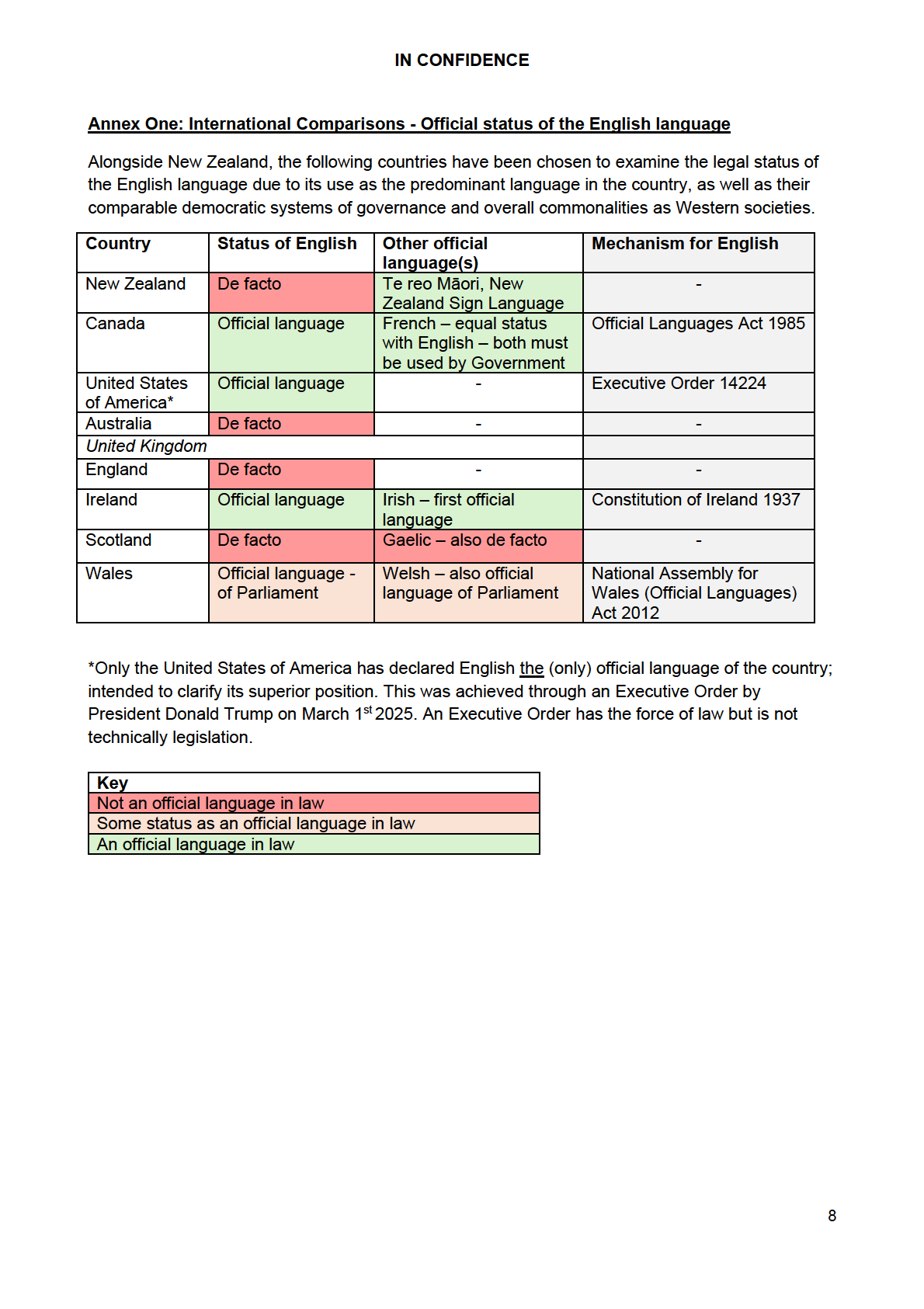
15.
Internationally, very few predominantly English-speaking countries have legislated for
English as an official language. Where it is legislated, it appears to be to ensure another
language is of similar status and use in Government and official contexts. For example, in
1 ‘English an Official Language of New Zealand Bill’ (Clayton Mitchell MP). This Member’s Bill was never
drawn from the ballot.
2 Two petitions have been identified; one reported back by select committee in September 2019 and the
other in March 2025. In March 2025, the select committee noted English was a ‘de facto’ official language of
New Zealand and mentioned the coalition agreement commitment to legislate its status.
3 4.75m out of a total population of 4.99m - Census 2023 Data.
3
RELEASED UNDER THE OFFICIAL
IN CONFIDENCE
Canada, the legislation establishes that both French and English are to be used in the
courts, Parliament, and government communications.
16.
Annex One has more information about the status of the language in comparable overseas
countries.
ACT 1982
We do not consider it necessary to legislate English as an official language of New Zealand
17.
In our view, the English language does not need to be legislated as an official language. It
does not require statutory support to continue to be used in courts, Parliament, and
government communications in New Zealand. Strategies to support the health or use of the
English language would not have any advantages or provide any practical changes.
18.
Setting out in legislation that English is an official language of New Zealand would not
change its status as the default language, nor the status of the other official languages, nor
the status of English vis-à-vis the other two official languages.
There are two ways to legislate English as an official language of New Zealand
19.
To meet the coalition agreement to legislate to make English an official language, the
Ministry recommends the creation of a new stand-alone Act to declare English to be an
INFORMATION
official language. A new Act is required because there is no existing Act into which such a
provision could logically be added.
20.
There are two approaches that could be taken to a new Act. Neither approach is intended
to affect the current use, status, or legislation of the other official languages of New
Zealand, nor the other languages spoken in New Zealand.
21.
We are seeking your decision on whether you prefer:
21.1.
Option 1: An
‘English Language Bil ’ – this would be specific to the English
language. This would mean each official language had its own legislation.
It is the most straightforward approach to meet the coalition agreement. It would be
a short symbolic Bill and may be criticised as being unnecessary.
21.2.
Option 2: An
‘Official Languages Bil ’ – this could list in a single statute all three
official languages of New Zealand, with cross-references to the two existing official
language Acts as necessary.
This would also be a short, largely symbolic Bill. However, this approach would
provide some context to legislating the English language as an official language and
reduce the possibility of criticism for doing so unnecessarily.
22.
We do not recommend attempting to consolidate the two existing official language Acts into
one Act, alongside provisions legislating the status of English as an official language. This
would be a much more significant drafting exercise and require more time and resource to
complete. It could also risk creating undue confusion and concern for users of te reo Māori
and NZSL, as these communities might consider that a consolidated Act diminishes the rights
4
RELEASED UNDER THE OFFICIAL
IN CONFIDENCE
of use of each language in their stand-alone legislation. A consolidated Act is also not
considered necessary to meet the coalition agreement.
23.
We seek your decision between the two options outlined above. You may wish to also
discuss with the NZ First Party. The attached draft Cabinet paper can then be amended
based on your preferred option, prior to formal Ministerial consultation.
ACT 1982
Consultation
24.
We have consulted Te Puni Kōkiri (TPK) and Whaikaha | Ministry of Disabled People
(Whaikaha) as the agencies responsible for the other official language legislation.
24.1. TPK does not support progressing the proposed legislation and raised concerns that
the proposal may compromise the status of te reo Māori. TPK considers that there is
a potential risk that progressing the proposed legislation may result in a breach of
the Crown’s commitment to actively protect and promote te reo Māori.
The Ministry notes that the proposed Bill will have no impact on Te Ture mō Te Reo
Māori 2016. It will therefore not have an impact on the status, use, or protections for
te reo Māori that are found within that legislation (and any relevant strategies).
INFORMATION
24.2. Whaikaha did not raise any concerns with the proposal.
25.
Further consultation with other agencies, including the Treasury, the Department of Internal
Affairs, and the Ministry for Culture and Heritage, will be undertaken alongside Ministerial
consultation. Public feedback will be sought as part of the select committee process.
Proposed timelines and next steps
26.
In line with the coalition agreement, we attach a draft Cabinet paper that seeks Cabinet
agreement to legislate for English as an official language of New Zealand (
Annex Two).
The paper seeks agreement to include a Bill on the Legislation Programme with a category
5 priority (legislation to select committee by the end of the year).
27.
Subject to any changes, we recommend you circulate the draft Cabinet paper for Ministerial
consultation, including consultation with coalition partners, as soon as possible. Following
any feedback from Ministerial consultation by 4 July, we anticipate the Cabinet paper could
be finalised for consideration at SOU on Wednesday 16 July.
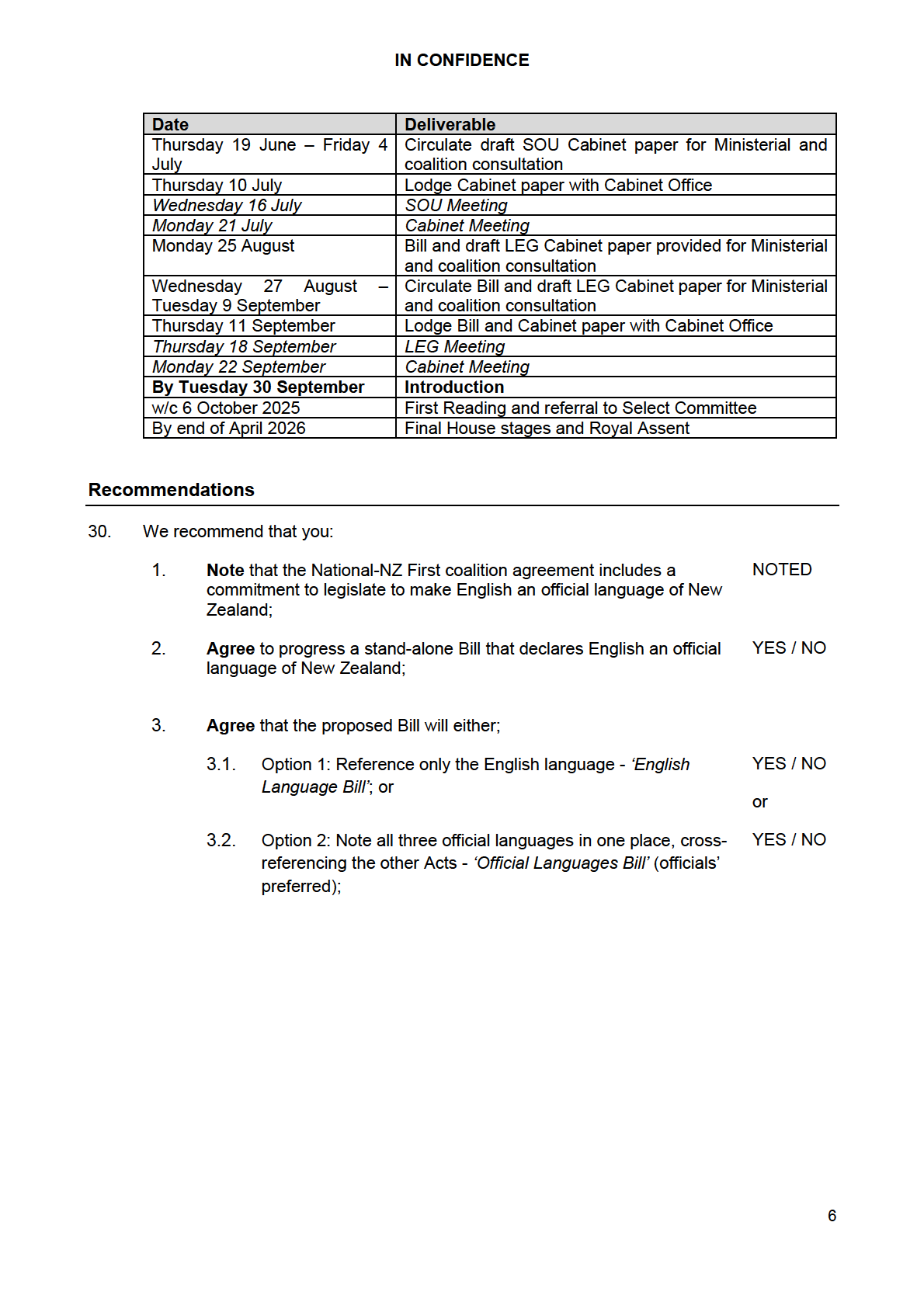
28.
Indicative timeframes for introduction of a Bill by the end of September 2025 are set out
below. Parliamentary Counsel Office (PCO) have noted that this timeframe is very tight and
will depend on the availability of PCO drafting resource in July and August. If PCO
resourcing is tied up on other bills, more time may be required for drafting. An alternative
timeframe could provide for a Bill to be introduced during the October sitting period instead,
which should still allow the Bill to be enacted by early May 2026. We can liaise with your
Office to discuss any adjustments to the timeframe once the drafting instructions have been
provided to PCO in late July.
29.
Proposed timeline for a Bill is as follows:
5
RELEASED UNDER THE OFFICIAL
ACT 1982
INFORMATION
RELEASED UNDER THE OFFICIAL
 IN CONFIDENCE
4.
Circulate the attached draft Cabinet paper for Ministerial
YES / NO
consultation, including with coalition partners, by 19 June 2025 for
feedback no later than 4 July 2025.
ACT 1982
___________________________________
Hayley Denoual
Policy Manager, Democracy and Open Government
INFORMATION
___________________________________
Hon Paul Goldsmith
Minister of Justice
Date / /
APPROVED SEEN NOT AGREED
Attachments:
•
Annex One: International Comparisons – Official status of the English language
•
Annex Two: Draft Cabinet paper - Declaring English an Official Language
7
RELEASED UNDER THE OFFICIAL
ACT 1982
INFORMATION
RELEASED UNDER THE OFFICIAL
