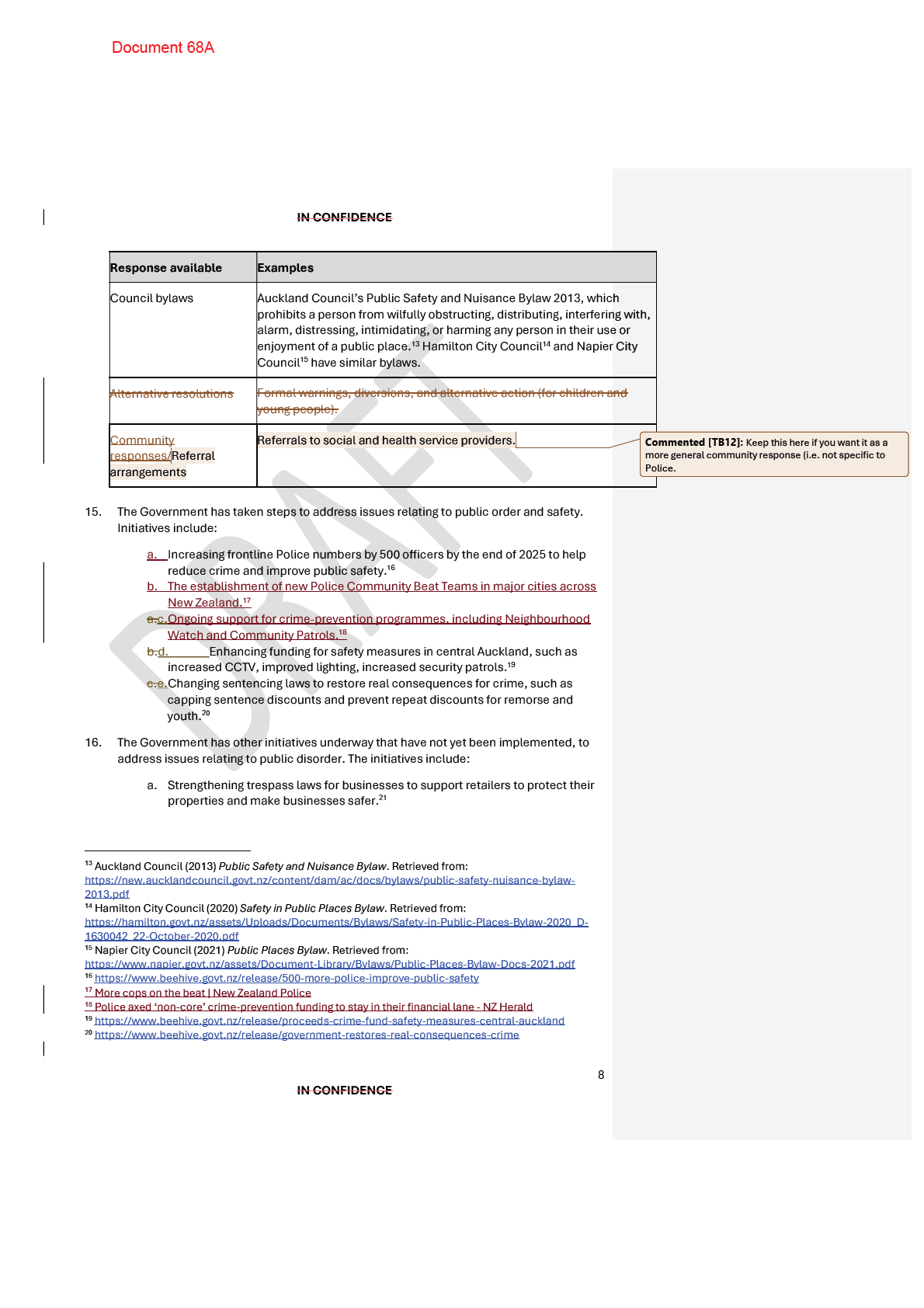
under the Official Information Act 1982
Released
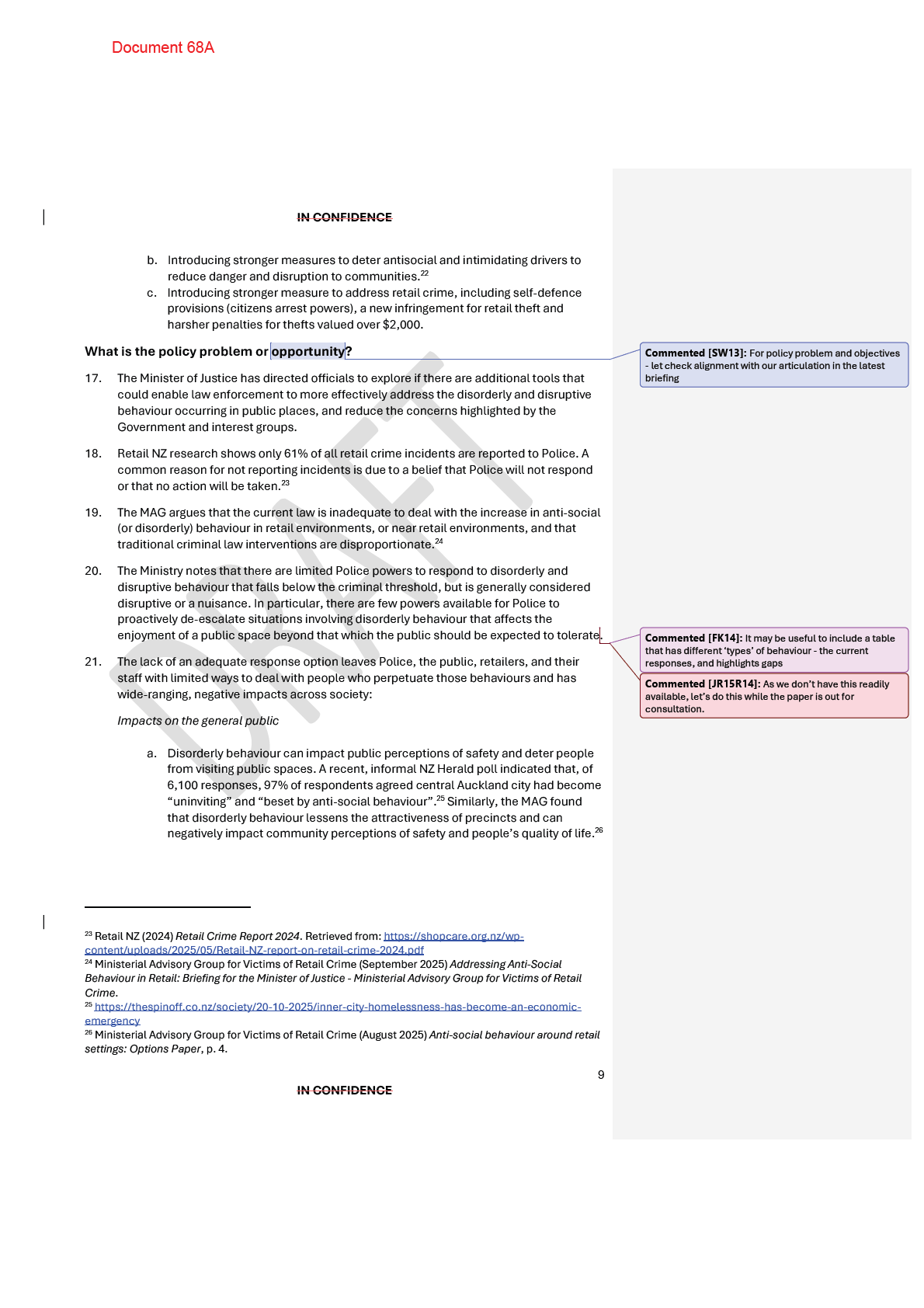
under the Official Information Act 1982
Released
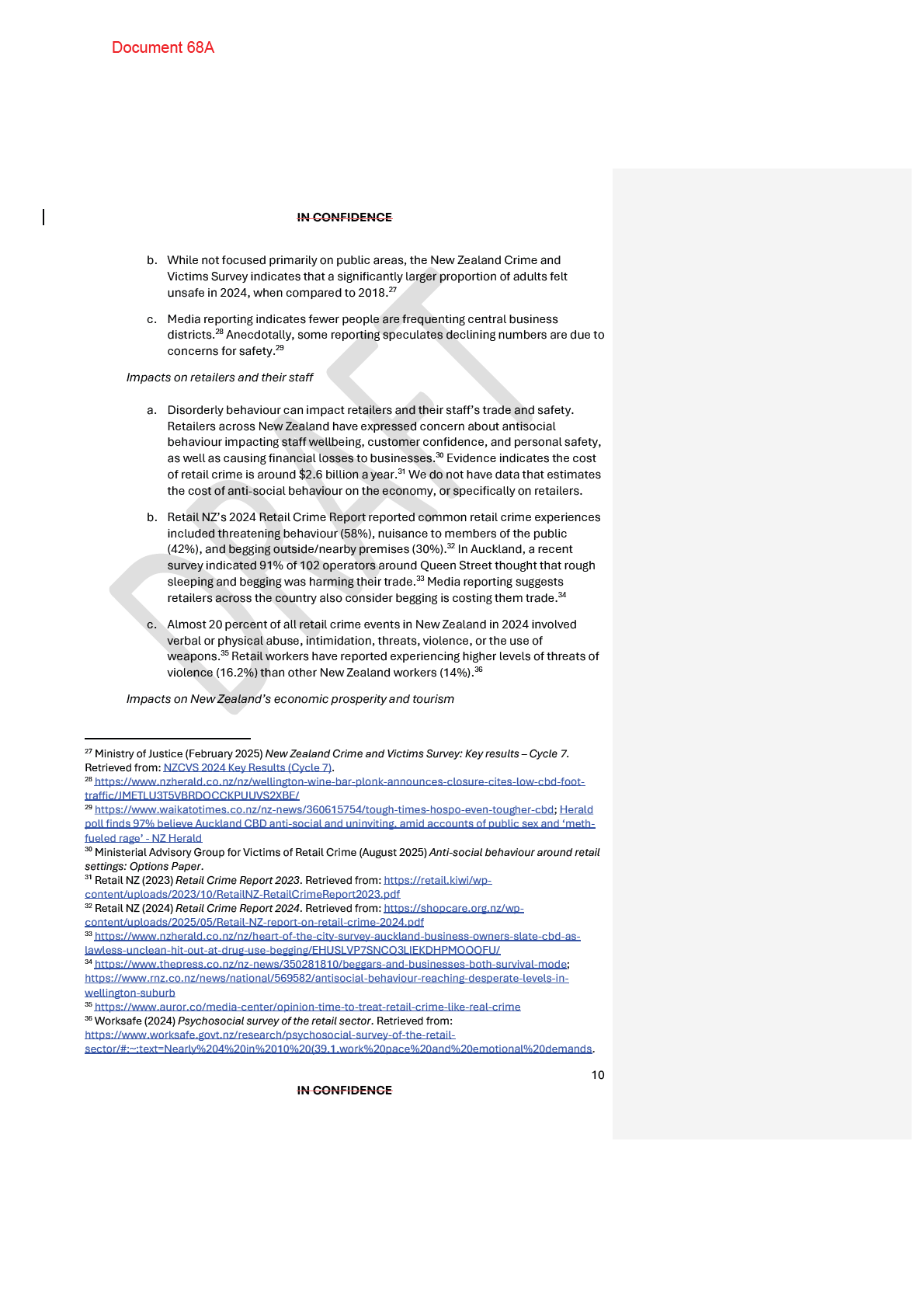
under the Official Information Act 1982
Released
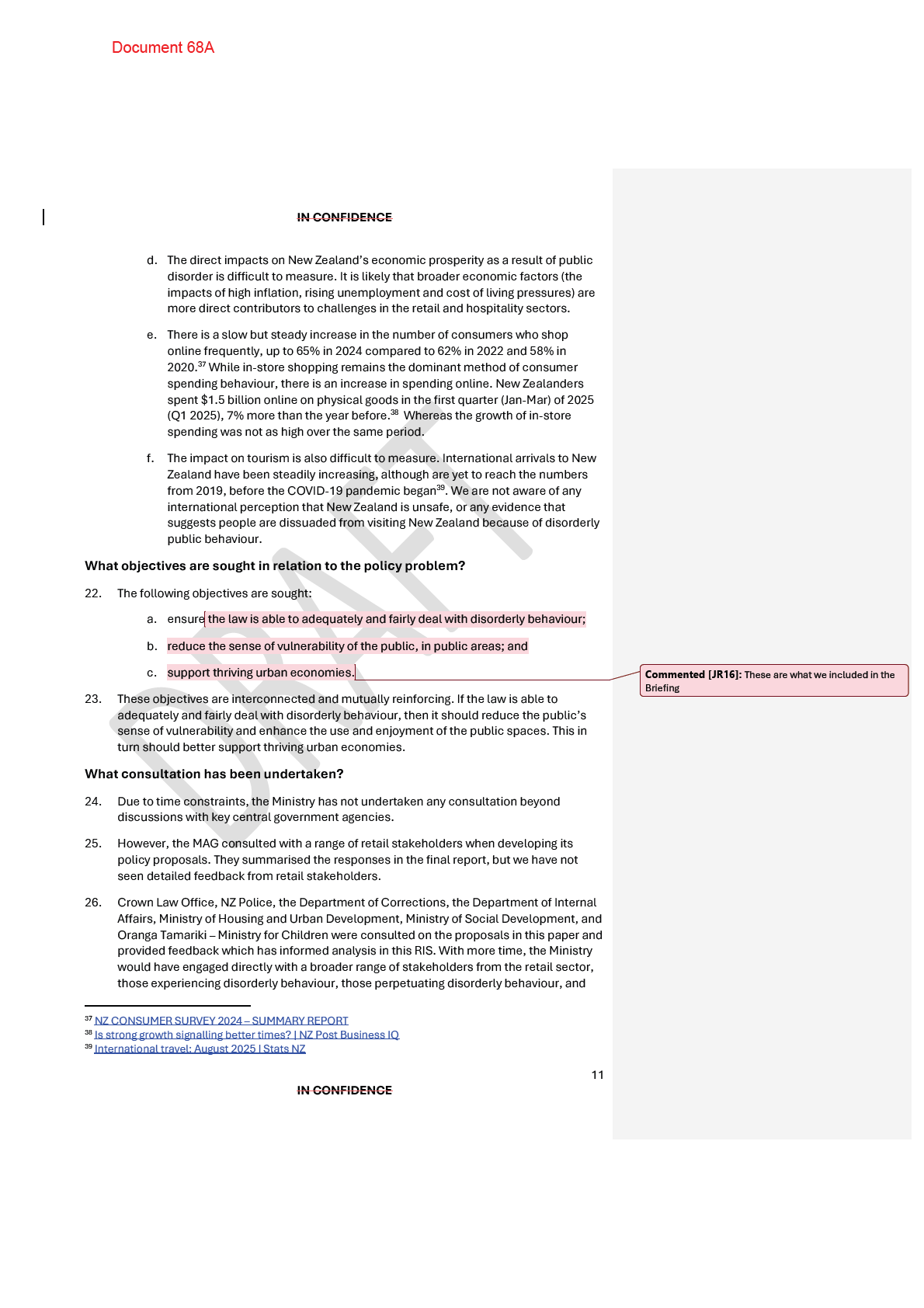
under the Official Information Act 1982
Released
under the Official Information Act 1982
Released
under the Official Information Act 1982
Released
under the Official Information Act 1982
Released
under the Official Information Act 1982
Released
under the Official Information Act 1982
Released
under the Official Information Act 1982
Released
under the Official Information Act 1982
Released
under the Official Information Act 1982
Released
under the Official Information Act 1982
Released
under the Official Information Act 1982
Released
under the Official Information Act 1982
Released
under the Official Information Act 1982
Released
under the Official Information Act 1982
Released
under the Official Information Act 1982
Released
under the Official Information Act 1982
Released
under the Official Information Act 1982
Released
under the Official Information Act 1982
Released
Document 68A
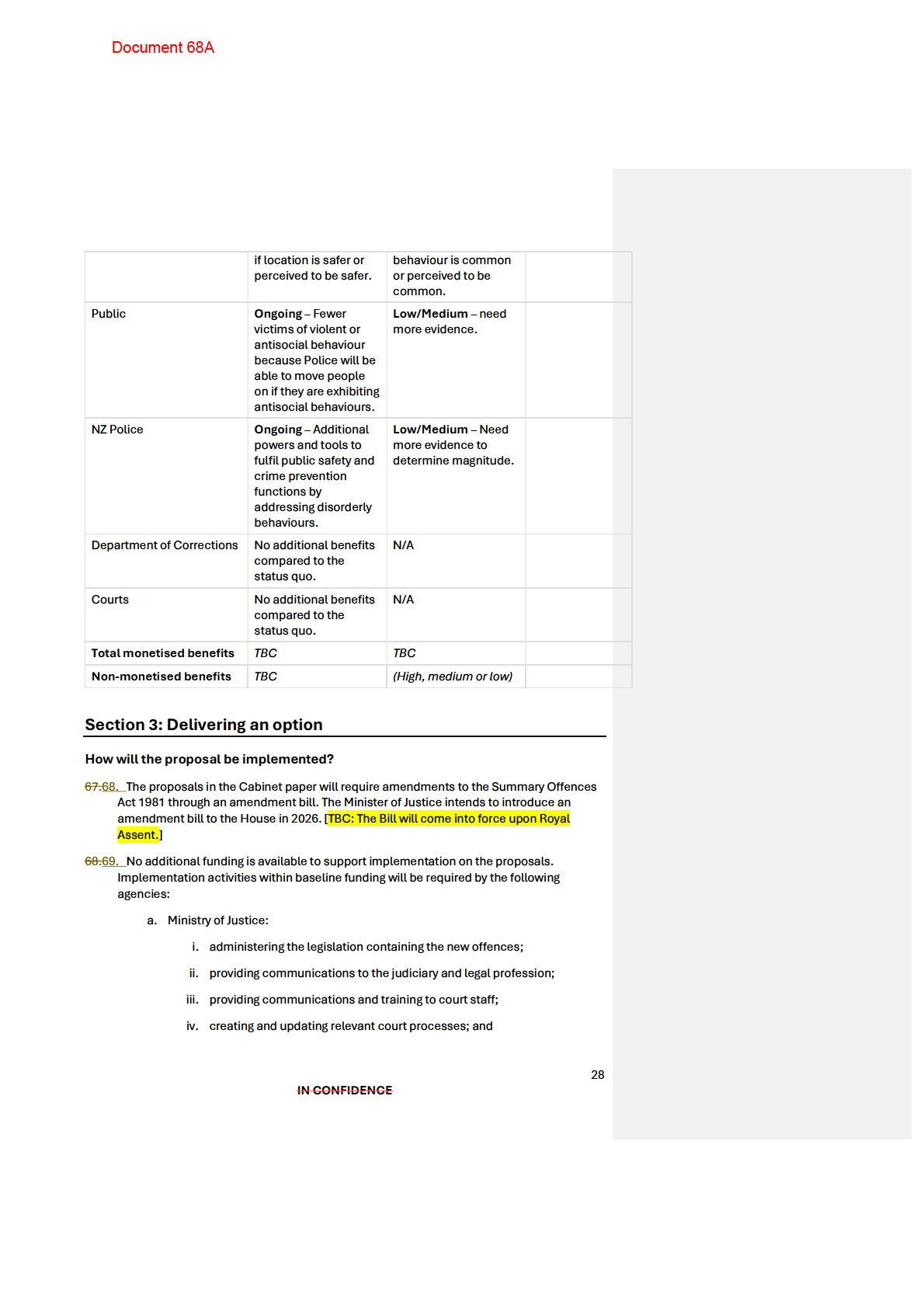
v. updating IT systems (such as offence codes).
b. New Zealand Police:
i. making necessary changes to operational policies, guidelines and
documentation (such as for investigating and charging offences);
i . providing communications and training to staff; and
i i. updating IT systems (such as offence codes).
c. Department of Corrections: Responsible for managing any persons sentenced
to imprisonment. Implementation activities will include ensuring sufficient
prison capacity for those sentenced to imprisonment following conviction.
69.70. [Placeholder for implementation re any support services (or the need for these
services)]
71. [Any implementation risks?]
70.72. New Zealand’s courts are undergoing the biggest modernization in its history, referred
otto as Te Au Reka. The design work for Phase 2 of Te Au Reka (criminal and civil
proceedings in the District Court and High Court) is expected to be complete by July 2026.
The extent of the impact and associated costs that relate to this proposal will depend on
the final design and timings of the Bill. To incorporate the proposals into the solution for
Phase 2, the details would need to be confirmed by July 2026. As the proposals progress,
the Ministry will continue to work to identify impacts and dependencies as early as
possible.
How will the proposal be monitored, evaluated, and reviewed?
71.73. The Ministry has regulatory responsibility for the Summary Offences Act 1981, meaning
the Ministry has responsibility for ongoing stewardship of the law and monitoring,
evaluating and reviewing the proposals outlined in this paper. These responsibilities will
be informed by:
a. Police data relating to the use of move-on orders;
b. Ministry and Police data on charges, convictions, and sentencing outcomes for
new offences;
c. Findings from the New Zealand Crime and Victim Survey;
d. Reported case law;
under the Official Information Act 1982
e. Academic studies of these proposals; and
f. Media reporting.
72.74. Stakeholders, including Police, can raise any identified concerns directly with the
Ministry.
73.75. There is currently no formal measurement of disorderly behaviour. This means that,
despite the ongoing monitoring outlined above, it may be difficult to determine whether
the proposals have an impact on the objectives to protect the safety of retailers and the
public in public areas, ensure the law is able to adequately deal with disorderly
Released
29
IN CONFIDENCE
Document 68A
behaviour, and support thriving urban economies. However, proxy measures, such as the
New Zealand Crime and Victim Survey for perceptions of safety, may be used to assess
some of the impacts. Data relating to the use of new tools and offences will also be able
to be used to determine whether the law is dealing with disorderly behaviour.
under the Official Information Act 1982
Released
30
IN CONFIDENCE
Document 68A
Appendix A: Alternative options that were ruled out
74.76. The MAG recommended five options in its report, Addressing Anti-Social Behaviour in
Retail, which we considered but ruled out due to a variety of reason.
a. move-on orders – a new tool for Police in the Summary Offences Act 1981 to
require a person to move-on to a different location if that person is behaving in
an anti-social manner;
b. two bespoke criminal offences for assaulting and threatening or abusing a retail
worker;
c. a legal framework to implement a criminal offence to ban begging within 15
metres of a ‘relevant area’;
d. additional powers for Councils though regulations under section 259(1)(a) of the
Local Government Act 2002 to enable Councils to enforce their bylaws
addressing disorderly behaviour; and
e. the Government committing to issuing a strategy or action plan to address
disorderly behaviour in retail and how the new proposals will work, alongside a
strategic investment plan.
75.77. We considered each of the five MAG options, and we ruled them out as unsuitable
responses, for the following reasons:
a. Move-on orders: the MAG proposal was specific to retail settings, and we
considered that a more universal application that did not focus on one setting
was more appropriate to address the policy problem.
b. Two bespoke criminal offences: Creating these offences would duplicate
existing offences in the Summary Offences Act 1981 and Crimes Act 1961.
Assault provisions within these two Acts have maximum penalties ranging from
6 months to 14 years imprisonment.
c. A legal framework to implement a criminal offence to ban begging: Such a
ban risks essentially criminalising homelessness and survival behaviour.
Begging behaviour, particularly that which is not aggressive or threatening, does
not warrant a criminal justice response.
d. Additional powers for Councils: Enabling local authorities to enforce public
disorder offences requires caution given the potential for conflict or escalation.
The MAG notes that local authorities do not think additional enforcement should
under the Official Information Act 1982
be part of councils’ role.
e. The Government committing to issuing a strategy or action plan to address
disorderly behaviour in retail: There may be limited value in progressing this
initiative as the emphasis on the retail setting is narrow and focuses on a niche
problem and group. Progressing a government action plan that achieves long-
term results would also be resource intensive.
Released
31
IN CONFIDENCE
under the Official Information Act 1982
Released
under the Official Information Act 1982
Released
Document 70
From:
S9(2)(a)
Sent:
Monday, 10 November 2025 5:22 pm
To:
Mercuri, Alida
Cc:
S9(2)(a)
; S9(2)(a)
Subject:
RE: Auckland actions - Multi Minister meeting
Hi Alida,
Below are some points S9(2)(a) and I pulled together for the Mul Minister mee ng tonight.
1982
Mul -Ministerial Mee ng 10 November 2025 - Move-on orders and bylaws
Minister Goldsmith met with Minister Wa s to discuss move-on order and bylaws, as part of the dra
Auckland Ac on Plan last week. We have not had a readout from that mee ng.
Act
Move-on orders proposal
Minister Goldsmith will bring a paper to SOU on 3 December, with a proposal to establish a move-on power
for Police.
Move-on orders will apply to ac vi es that are disorderly, offensive, threatening or disturbing, interfering
with trade or businesses, obstruc ng a public way, breaching the peace, or causing anxiety to a person.
Importantly, to get to the crux of the issue that Auckland is facing, the Minister has emphasised the need to
capture:
people who are occupying a footpath (to address people who are homeless who are set up
on a footpath in busy retail spaces), and
Information
all forms of begging, including unsolicited requests for money, goods, or services that occur
ac vely or passively.
The proposal is included in the dra Cabinet Paper and RIS that were sent out for Ministerial consulta on
today.
What is Jus ce’s interest in bylaws?
Jus ce was interested in council bylaws that relate to public disorder as the MAG proposed to promulgate
Official
regula ons under the Local Government Act 2002 to enable councils to enforce bylaws addressing an social
behaviour. The Minister decided not to progress this proposal, on our advice.
Bylaws are provided for in the Local Government Act 2002, which is administered by the Department of
the
Internal Affairs (DIA).
s9(2)(f)(iv)
under
We think Police is the appropriate enforcement body to issue move-on orders
Local authority enforcement powers are primarily applicable to offences rela ng to building compliance,
public health, the environment, and waste management, for example.
We would not recommend providing addi onal powers for councils to enforce bylaws rela ng to an social
behaviour given the risk of escala on and lack of adequate training and supervision for councils exercising
enforcements powers.
Good luck.
Released
Many thanks,
S9(2)(a)
From: S9(2)(a)
@justice.govt.nz>
Sent: Monday, 10 November 2025 4:29 pm
To: S9(2)(a)
@justice.govt.nz>; S9(2)(a)
@justice.govt.nz>
1

Document 70
Subject: FW: Auckland actions - Multi Minister meeting
Importance: High
S9(2)(a)
Policy Manager | Criminal Justice Unit | Policy Group
Ministry of Justice | Tāhū o te Ture
S9(2)(a)
Justice Centre | 19 Aitken Street | Wellington 6011
1982
From: Justice.PS <[email address]>
Sent: Monday, 10 November 2025 4:27 pm
Act
To: Mercuri, Alida <[email address]>; [email address]; S9(2)(a)
@justice.govt.nz>; S9(2)(a)
@justice.govt.nz>; Brightwell, Kathy
<[email address]>; Greaney, Caroline <[email address]>
Cc: S9(2)(a)
Parliament S9(2)(a)
@parliament.govt.nz>; S9(2)(a)
.parliament.govt.nz
S9(2)(a)
@parliament.govt.nz>; S9(2)(a)
@parliament.govt.nz>
Subject: Auckland actions - Multi Minister meeting
Importance: High
Kia ora koutou,
Information
Apologies for the late notice, but we have been advised that o icials are now required for the
Auckland actions - Multi Minister meeting at 8pm tonight. The Minister is in Christchurch on his way
to Antarctica – he may join via Teams but this is not confirmed.
Auckland actions - Multi Minister meeting Official
Date/time: Monday 10 November, 8:00pm – 8:30pm
Location: Minister Brown’s O ice 6.6EW; Teams (link below)
the
O icials: Yes
Attendees:
Minister for Auckland, Hon Simeon Brown
Minister of Social Development & Employment, Hon Louise Upston
Minister of Police, Hon Mark Mitchell
under
Associate Minister of Housing, Hon Tama Potaka
Minister for Mental Health, Hon Matt Doocey
Jules Lynch, Auckland Regional Public Service Commissioner
Michael Quinn, Head of the Auckland Policy O ice
Released
_____________________________________
Microsoft Teams Need help?
Join the meeting now
Meeting ID: 477 308 504 891 3
Passcode: Bz6RR68m
For organizers: Meeting options
2

Document 70
________________________________________________________________________________
Ngā mihi,
S9(2)(a)
S9(2)(a)
Private Secretary – Justice | Office of Hon Paul Goldsmith
Minister for Arts, Culture and Heritage
Minister of Justice
Minister for Media and Communications
Minister for Treaty of Waitangi Negotiations
Mobile S9(2)(a)
| Email S9(2)(a)
@parliament.govt.nz
1982
Private Bag 18041, Parliament Buildings, Wellington 6160, New Zealand
Authorised by Hon Paul Goldsmith, Parliament Buildings, Wellington
Act
Information
Official
the
under
Released
3
Document 71
From:
S9(2)(a)
Sent:
Thursday, 13 November 2025 7:52 am
To:
S9(2)(a)
Subject:
FW: [EXTERNAL] Public disorder - Preparing Cabinet Paper and RIS
IN CONFIDENCE
Data for corrections below – should help a little with Treasury’s section.
IN CONFIDENCE
From: s9(2)(a)
@corrections.govt.nz>
Sent: Wednesday, 29 October 2025 11:02 am
To: S9(2)(a)
@justice.govt.nz>
Cc: s9(2)(a)
@corrections.govt.nz>
Subject: FW: [EXTERNAL] Public disorder - Preparing Cabinet Paper and RIS
To the first line of para 3
From: s9(2)(a)
Sent: Wednesday, 29 October 2025 10:54 AM
To: 'S9(2)(a)
@justice.govt.nz>
Cc: s9(2)(a)
@corrections.govt.nz>; s9(2)(a)
@corrections.govt.nz>
Subject: RE: [EXTERNAL] Public disorder - Preparing Cabinet Paper and RIS
Kia ora S9(2)(a)
That should su ice – you may want to add “because of these and other changes” to the first line, as while this
could, due to capacity and resilience, be a driver of needing the additional infrastructure it would not only
house these people.
Ngā mihi,
under the Official Information Act 1982
s9(2)(a)
From: S9(2)(a)
@justice.govt.nz>
Sent: Wednesday, 29 October 2025 10:46 AM
To: s9(2)(a)
@corrections.govt.nz>
Cc: s9(2)(a)
@corrections.govt.nz>; s9(2)(a)
@corrections.govt.nz>
Released
Subject: RE: [EXTERNAL] Public disorder - Preparing Cabinet Paper and RIS
IN CONFIDENCE
Hi s9(2)(a)
1
Document 71
Thanks so much for your comment yesterday. I have included the below in the briefing (I’ll look at the RIS later
today). Let me know if you want to make any tweaks, although we are being really pushed to reduced content
where we can.
Many thanks,
s9(2)(a)
There would also some impact on Correc ons
Penalising begging with imprisonment could put pressure on the prison popula on. Assuming 5,000 people per
annum receive a warning for begging, and 20% failed to stop begging, the prison popula on is projected to increase
by 2.
The above data is separate to the es mated impact of move-on orders on the prison popula on, which may see an
es mated increase in the prison popula on by 4 people per year. Therefore, the combined impact of the two
proposals on the prison popula on could be as much as an addi onal 6 people each year.
Correc ons has advised that should the prison popula on increase because of these changes, future prison network
funding decisions would need to be made to ensure there is sufficient capacity in Correc ons’ prison infrastructure,
and frontline staff are supported to manage people safely and effec vely. The prison network currently has limited
available capacity and low resilience so even a policy change with just a small popula on increase on top of current
projec ons could engage the need for addi onal infrastructure investment (which would cost at least $300 million).
Any new infrastructure to accommodate addi onal prisoners takes an average of 4-8 years to implement.
IN CONFIDENCE
From: s9(2)(a)
@corrections.govt.nz>
Sent: Wednesday, 29 October 2025 10:37 am
To: S9(2)(a)
@justice.govt.nz>
Cc: s9(2)(a)
@corrections.govt.nz>; s9(2)(a)
@corrections.govt.nz>
Subject: RE: [EXTERNAL] Public disorder - Preparing Cabinet Paper and RIS
Kia oraS9(2)(a)
You probably already read it in but I just wanted to note should new infrastructure be required it would not only
be used people imprisoned for this o ending (should the imprisonable penalty options progress). So the costs
set out below would be spread across more than one policy change.
under the Official Information Act 1982
Ngā mihi,
s9(2)(a)
From: s9(2)(a)
Sent: Tuesday, 28 October 2025 6:12 PM
Released
To: 'S9(2)(a)
@justice.govt.nz>
Cc: s9(2)(a)
@corrections.govt.nz>; s9(2)(a)
@corrections.govt.nz>
Subject: RE: [EXTERNAL] Public disorder - Preparing Cabinet Paper and RIS
Kia ora,
2



Document 71
Thanks for sharing this paper and the RIS for review – and we also appreciate you providing s9(2)(a)
modelling on
Friday.
The poten al prison popula on impact of the move on offence in para 24, rec 4.2 of the paper, is not stated (4
people per annum) only the impact of the begging offence is – see para 65. Can you please correct this paragraph
(i.e. it’s a total of 6 (equivalent across the year) people per annum).
Can you please also insert the following to capture the impact:
Amend paragraph 65 to include the following: Prison popula on impacts can be as li le as direct costs rela ng to
food, bedding, clothing, medical and transport (amongst other direct costs) of approximately $7,500 per prisoner per
annum through to more significant costs at a unit or site level of $120,000 per prisoner per annum. Should the prison
popula on increase because of these changes, future prison network funding decisions would need to be made to
ensure there is sufficient capacity in Correc ons’ prison infrastructure, and frontline staff are supported to manage
people safely and effec vely. The prison network currently has limited available capacity and low resilience so even a
policy change with just a small popula on increase on top of current projec ons could engage the need for
addi onal infrastructure investment (which would cost at least $300 million). Any new infrastructure to
accommodate addi onal prisoners takes an average of 4-8 years to implement.
Please also change the RIS to align with this. Please note that should the addi onal infrastructure be required it
would house more people than just those imprisoned due to these proposed changes.
We thought it may be helpful to note that the research cited references two pieces produced by advocacy groups
(with one explicitly posi oned as opinion) rather than qualita ve and quan ta ve (academic, peer reviewed
research).
It looks like the no ces are not a aching other condi ons (such as community work), but please let us know if we
are mistaken and that has already been approved. To the extent they do, we assume that you are no longer
considering any op ons that may engage Correc ons. Please advise if that’s not the case.
Ngā mihi,
Maxine
s9(2)(a)
Principal Policy Adviser, Strategic Policy
Ara Poutama Aotearoa, Department of Correc ons
a: Mayfair House, 44-52 The Terrace, Wellington, 6011
p: s9(2)(a)
under the Official Information Act 1982
e:s9(2)(a)
@correc ons.govt.nz
From: S9(2)(a)
@justice.govt.nz>
Sent: Friday, 24 October 2025 10:38 AM
To: s9(2)(a)
@corrections.govt.nz>
Released
Cc: s9(2)(a)
@corrections.govt.nz>; s9(2)(a)
@corrections.govt.nz>; S9(2)(a)
@justice.govt.nz>;
s9(2)(a)
@police.govt.nz;s9(2)(a)
@police.govt.nz>; S9(2)(a)
@justice.govt.nz>
Subject: RE: [EXTERNAL] Public disorder - Preparing Cabinet Paper and RIS
IN CONFIDENCE
3
Document 71
Mōrena s9(2)(a)
Please find a ached the indica ve/preliminary data on the impact on the courts and correc ons, for the RIS. It has
not yet been signed out and we can send you the final data next week, but I wanted to get it to you as quickly as
possible.
We have made some changes to the dra brief to reflect the data – please note this is holding place text, and we
would welcome your input how you might like to reflect the impact on correc os in the brief.
You will also see that there is data on move-on orders. We are unsure if we will include this since the minster has
already made decisions on this, however it’s possible there will be a short update at JSLB-Subgroup next week on
these proposals and we will likely draw form this data to give an indica on of the possible impact on Police, the
courts and correc ons.
Please let me know if you have any ques ons or comments.
Many thanks,
S9(2)(a)
IN CONFIDENCE
From:s9(2)(a)
@corrections.govt.nz>
Sent: Monday, 20 October 2025 5:05 pm
To: S9(2)(a)
@justice.govt.nz>
Cc: s9(2)(a)
@corrections.govt.nz>
Subject: RE: [EXTERNAL] Public disorder - Preparing Cabinet Paper and RIS
Thanks S9(2)(a) I think we should be able to make that work.
From: S9(2)(a)
@justice.govt.nz>
Sent: Monday, 20 October 2025 4:37 PM
To: s9(2)(a)
@corrections.govt.nz>
Cc: s9(2)(a)
@corrections.govt.nz>
Subject: RE: [EXTERNAL] Public disorder - Preparing Cabinet Paper and RIS
under the Official Information Act 1982
IN CONFIDENCE
Hi s9(2)(a)
We hope to have indicative data by the end of the week that we will be able to share with you, which we will
finalise on Tuesday. As these are new o ences, the data will have several built-in assumptions. I acknowledge
that this is a tight timeframe, apologies.
Released
Also, I’ve realised that Monday is a public holiday, so a response by COB Tuesday would be great if possible.
Please let us know if this isn’t ging to work. We are taking the RIS to the QA panel on Thursday next week.
Many thanks,
S9(2)(a)
4
Document 71
IN CONFIDENCE
From: s9(2)(a)
@corrections.govt.nz>
Sent: Monday, October 20, 2025 9:55 AM
To: S9(2)(a)
@justice.govt.nz>
Cc: s9(2)(a)
@corrections.govt.nz>
Subject: RE: [EXTERNAL] Public disorder - Preparing Cabinet Paper and RIS
Thanks S9(2)(a) and also for the heads up re the briefing being shared this week.
Do you have projected conviction volumes for the o ences/will that be provided before feedback is due on 27
October?
From: S9(2)(a)
@justice.govt.nz>
Sent: Friday, 17 October 2025 4:33 PM
To: s9(2)(a)
@corrections.govt.nz>; s9(2)(a)
@corrections.govt.nz>; s9(2)(a)
@corrections.govt.nz>; s9(2)(a)
@police.govt.nz; s9(2)(a)
@police.govt.nz
Cc: S9(2)(a)
@justice.govt.nz>; S9(2)(a)
@justice.govt.nz>
Subject: [EXTERNAL] Public disorder - Preparing Cabinet Paper and RIS
IN CONFIDENCE
Kia ora koutou
As you may be aware, Minister Goldsmith will soon take a paper to cabinet to seek decisions on tools to address
an -social behaviour, which is a Government Quarter 4 Target. The two proposals he intends to put forward include:
-
Crea ng a move-on power for Police in the Summary Offenses Act - with the penalty for a breach of the
move on order being up to 3 months imprisonment and/or a $2,000 fine
-
Crea ng a new criminal offence for begging in a ‘relevant area’ - poten ally with a similar penalty to the
move-on order but we are yet to seek decisions from the minister on that detail.
We are providing the Minister a second briefing seeking outstanding policy decisions on 30 October, which we will
share that with you next week seeking feedback.
We are also preparing the Cabinet Paper and RIS at pace to meet the Q4 target. We kindly ask that consider the
under the Official Information Act 1982
a ached dra RIS cost/benefit and implementa on sec ons and provide feedback on this sec on by Monday 27
October se we can incorporate the informa on before the RIS panel.
Key date for you to be aware of
-
Next week [probably Wednesday] dra brief for your comment
-
30 October – second briefing provided to the Minister seeking outstanding policy decisions
-
6 November – dra Cabinet Paper and RIA to the Ministers Office
-
10 – 14 November – Agency and Ministerial Consulta on
Released
-
3 December – SOU
-
8 December – CAB
We are happy to meet you discuss this with you further and look forward to hearing you feedback.
Ngā mihi,
S9(2)(a)
5
under the Official Information Act 1982
Released

Document 72
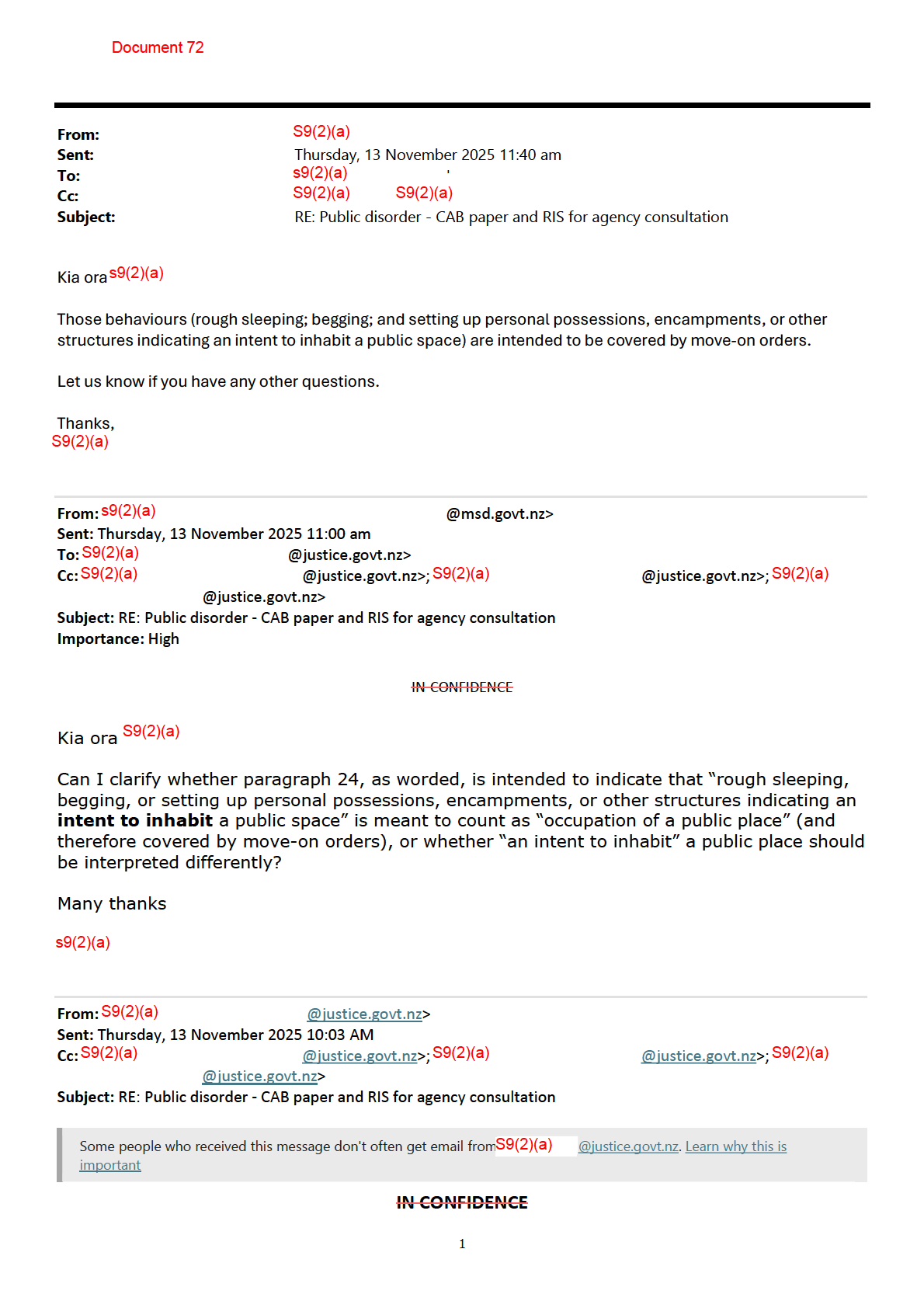
Kia ora koutou,
I wanted to let you know that at the direc on of our Minister we have made an addi on to the cabinet paper. We
have updated this to the SharePoint in Version 2, with track changes at paragraph 24. The addi on adds to the list of
behaviours that could be captured by the order.
We will make the corresponding changes to the RIS in due course.
Apologies for the late no ce. We look forward to receiving your feedback on the documents and are available if you
would like to discuss anything.
Ngā mihi,
S9(2)(a)
1982
Act
IN CONFIDENCE
From: S9(2)(a)
Sent: Monday, 10 November 2025 3:59 pm
Cc: S9(2)(a)
@justice.govt.nz>; S9(2)(a)
@justice.govt.nz>; S9(2)(a)
@justice.govt.nz>
Subject: Public disorder - CAB paper and RIS for agency consultation
Kia ora koutou,
Information
Apologies for the technical difficul es today.
You should now have received the necessary informa on to set up your Microso 365 SharePoint onboarding, and
for those of you who have been through the steps, you should have access to the site and documents. Please reach
out if you have any further issues.
Official
There are two papers for agency consulta on – Dra Cabinet Paper and Dra RIS. You can access these from the
the
tabs on the le -hand side of the site. Please note that you will not be able to download, print or edit the documents.
We have disabled these func ons in order to ghtly manage the informa on. If there are addi onal people who will
need access, please let us know.
We kindly ask for your feedback/comments by email. Please provide comments by email to S9(2)(a)
, S9(2)
under
and myself by COB Monday 17 November.
(a)
Ministerial consulta on will also begin today and will run for five days, un l Monday 17 November.
If you would like to discuss anything further, please let me know. We are also happy to meet if that is preferable.
Ngā mihi,
S9(2)(a)
Released
S9(2)(a)
Principal Policy Advisor | Criminal Jus ce Unit | Policy Group
Ministry of Jus ce | Tāhū o te Ture
Jus ce Centre | 19 Aitken Street | Wellington 6011
S9(2)(a)
@jus ce.govt.nz | jus ce.govt.nz
2
under the Official Information Act 1982
Released
under the Official Information Act 1982
Released

Document 73
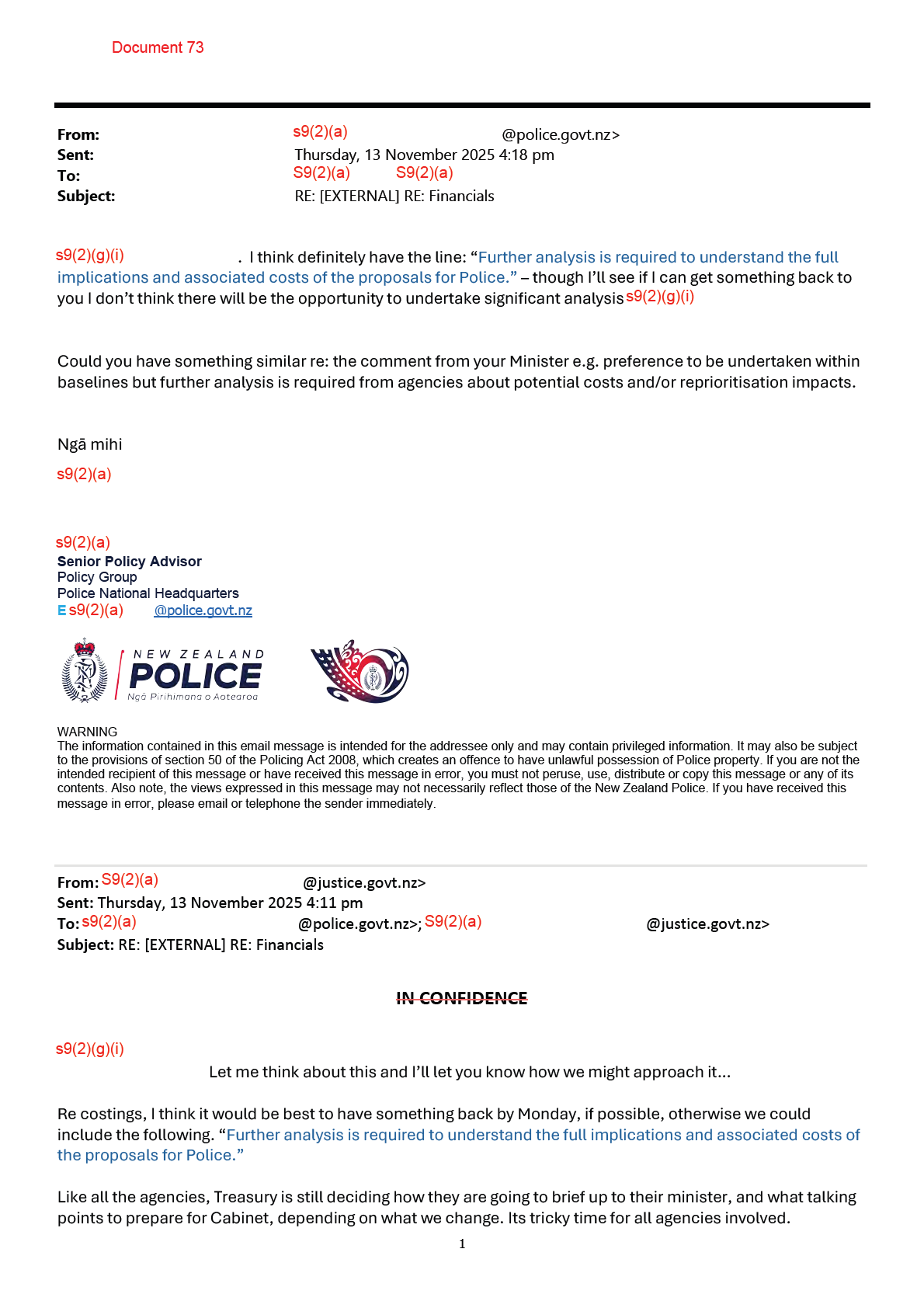
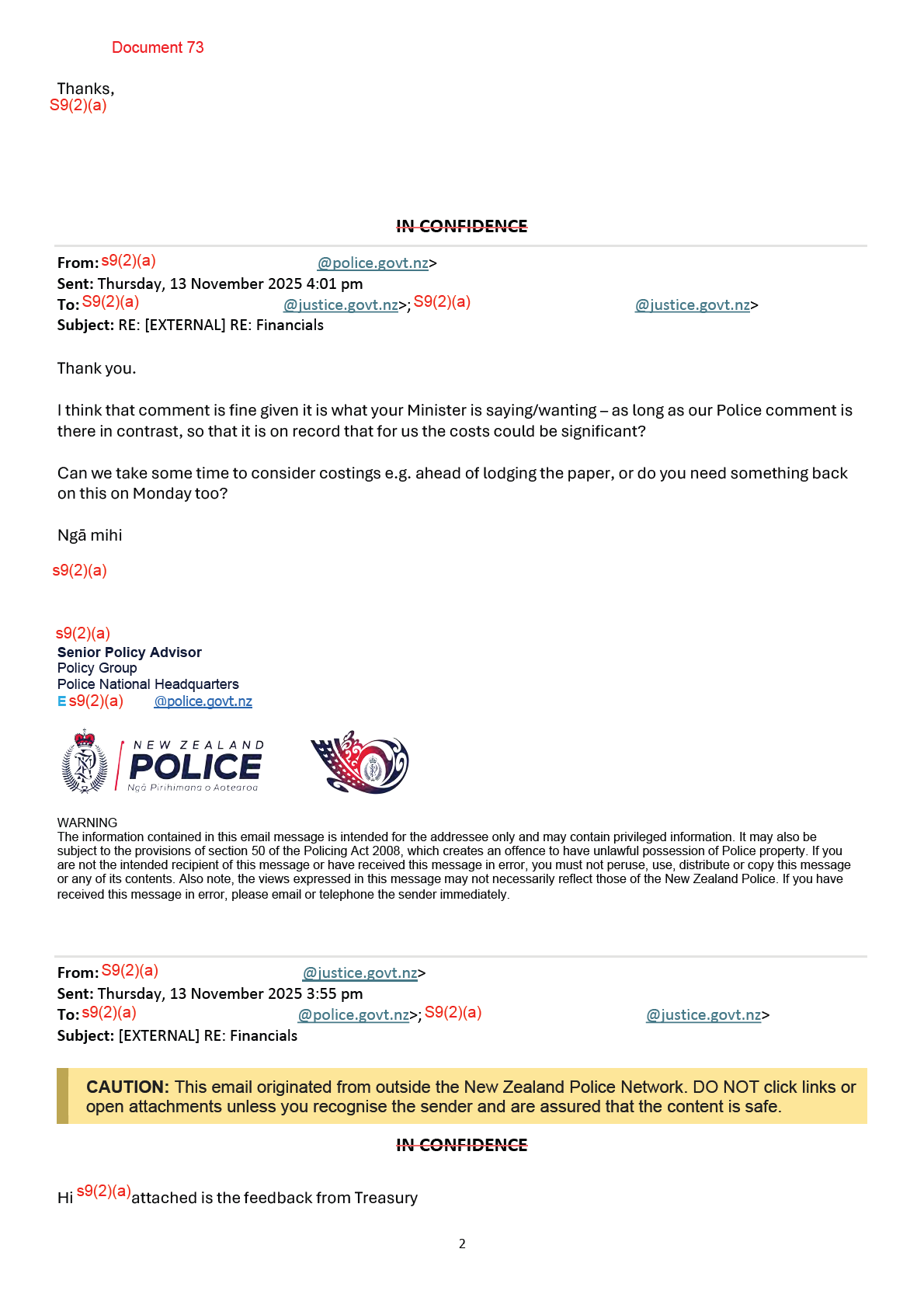
I’ve attached the indicative estimates that our data people pulled together. For the Ministers preferred option
we essentially add move-on orders and the begging ban o ence data together to get the data. We note in the
RIS that the data could vary depending on how Police use move-on orders, and therefore it includes the
following assumptions:
a. It is based o Trespass Act o ences in the courts, as it has a similar penalty of up to 3-month
imprisonment or a $2,000 fine
b. The demographic/profile of the o ender is similar to those committing Trespass o ences
c. It assumes that 9,000 to 15,000 people per annum could receive move on orders and 12% to
20% breach the order
d. It may result in up to 207 to 818 additional court cases per annum, and up to 6 additional
people in prison each year
e. It accounts for when the policy is fully realised, two -years after the bill is implemented
We are also considering including a line in the Cabinet paper that says the fol owing… which we would
1982
welcome your input on. Are you comfortable with us saying this?
“It is my expectation that any costs of the proposals will be met within agencies’ baseline funding. I note that
Act
implementation of the proposals could require reprioritisation of funds.”
Many thanks,
S9(2)(a)
IN CONFIDENCE Information
From: s9(2)(a)
@police.govt.nz>
Sent: Thursday, 13 November 2025 3:49 pm
To: S9(2)(a)
@justice.govt.nz>; S9(2)(a)
@justice.govt.nz>
Subject: Financials
Hey again
Official
Let me know if you can forward that email from TSY, or in the absence of that, what kind of financial
the
parameters you might want for the paper costings.
Tomorrow is all good, but just after a bit of a steer before approaching our relevant finance people.
Thanks!
under
Ngā mihi
s9(2)(a)
s9(2)(a)
Senior Policy Advisor
Policy Group
Released
Police National Headquarters
E s9(2)(a)
@police.govt.nz
WARNING
The information contained in this email message is intended for the addressee only and may contain privileged information. It may also be subject
to the provisions of section 50 of the Policing Act 2008, which creates an offence to have unlawful possession of Police property. If you are not the
3
Document 74
From:
S9(2)(a)
Sent:
Friday, 14 November 2025 8:04 am
To:
s9(2)(a)
Cc:
s9(2)(a)
S9(2)(a)
Subject:
RE: [EXTERNAL] RE: Public disorder - CAB paper and RIS for agency consultation
IN CONFIDENCE / CABINET
Kia ora s9(2)(a)
Thank you for your feedback and work on this. I have included the paragraph you have provided, but I think that
we might need to have to tighten it a little bit (also see a that I reference that section to Corrections). I’ll let you
know if we make any further changes.
I’ll also share this section with Treasury this morning so they can understand how they might need to brief MOF
– I’ll loop you into that email.
Implementation and Financial Implications
The Ministry of Justice, Corrections, Police, and Crown Law are the key agencies responsible for implementing
the proposals. Implementation will include ensuring capacity to manage workloads, updating documentation
and IT systems (and associated operating costs), sta training, and providing communications and guidance
to relevant parties.
It is my preference that any costs of the proposal will be undertaken within agencies’ baseline funding, but
further analysis is required from agencies about the potential costs and/or reprioritisation impacts.
Police note that further analysis is required to understand the full implications and costs. [TBC – Police
exploring if they can provide costings.]
I note that there will be an increase in cases being prosecuted in the courts for breaches of move-on orders.
Any increase in cases could impact court timeliness. Indicative estimates suggest it would cost the courts
$XX per year, by mid-2028 after two years after implementation.
The Department of Corrections note that the prison population is projected to increase by 6 people per annum
under the Official Information Act 1982
at the high estimate within two years of enactment. The costs of imprisonment are $120,000 per prisoner per
annum inclusive of any operational changes required at a unit or site level. The current prison network has
limited capacity available and low resilience and even a policy change with a small population increase
beyond current projections, collectively with other policy changes and factors, is likely to engage the need for
significant additional infrastructure investment (which would cost at least $300 million). Future prisoner
network funding decisions would be needed to ensure that there is capacity in Corrections’ infrastructure, and
frontline sta are supported to manage additional people safely and e ectively. Any new infrastructure to
accommodate additional prisoner population impacts would take average 4 to 8 years to build and implement
Released
and may not be available until after the full policy impact takes e ect.
We will carry this your proposed wording into the RIS and also include a point about the mental health impacts
that you detail below.
Many thanks,
S9(2)(a)
1
Document 74
IN CONFIDENCE / CABINET
From:s9(2)(a)
@corrections.govt.nz>
Sent: Thursday, 13 November 2025 5:05 pm
To:S9(2)(a)
@justice.govt.nz>
Cc: s9(2)(a)
@corrections.govt.nz>; s9(2)(a)
@corrections.govt.nz>; s9(2)(a)
@corrections.govt.nz>
Subject: FW: [EXTERNAL] RE: Public disorder - CAB paper and RIS for agency consultation
Kia ora S9(2)(a)
In terms of bullet point one, for the avoidance of doubt Corrections requests that you incorporate our lines
without rewording them – noting that they’re in our earlier email. It would helpful if you could then show us the
relevant pages, so that we can see how they’ve been incorporated.
This should be a breakdown rather than a totalled figure – i.e. $120,000 per annum per prisoner for an
additional six prisoners per annum.
The line in the second bullet point in your email should not be included as it is inaccurate.
Ngā mihi,
s9(2)(a)
From: S9(2)(a)
@justice.govt.nz>
Sent: Thursday, 13 November 2025 4:20 PM
To: s9(2)(a)
@corrections.govt.nz>
Cc: S9(2)(a)
@justice.govt.nz>
Subject: RE: [EXTERNAL] RE: Public disorder - CAB paper and RIS for agency consultation
IN CONFIDENCE
Hi again –
I thought it might be helpful to share how we have redrafted two parts of the implementation and financial
implications section of the cabinet paper. I want to stress that we will take your lead on this section – it is
under the Official Information Act 1982
Corrections cost implications, so please frame it in a way that reflects your position.
The estimated indicative increase in annual costs to Corrections is $1.05M, by mid-2028 (two-years
after the Bill is expected to be implemented. The costs include the increase to the prison population,
home detention, intensive supervision and community detention. While the figure is relatively small,
the cumulative impact of all law-and-order policy proposals on the prison population is notable. The
prison network currently has limited available capacity and low resilience so even a policy change with
just a small population increase on top of current projections could engage the need for additional
infrastructure investment (which would cost at least $300 million). Any new infrastructure to
Released
accommodate additional prisoners takes an average of 4-8 years to implement.
The other point that we are toying with including, based o treasury’s feedback, is below about how it will be
funded. We would welcome your initial thoughts on this.
It is my expectation that any costs of the proposals will be met within agencies’ baseline funding, but
further analysis is required from agencies about potential costs and/or reprioritisation impacts.
2
Document 74
Treasury are very interested in where was land with this section of the cabinet paper and were hoping to see
how we have reworked before they provide the Ministerial comment for their minister on Monday.
Many thanks,
S9(2)(a)
IN CONFIDENCE
From: s9(2)(a)
@corrections.govt.nz>
Sent: Thursday, 13 November 2025 1:38 pm
To: S9(2)(a)
@justice.govt.nz>
Cc: S9(2)(a)
@justice.govt.nz>
Subject: RE: [EXTERNAL] RE: Public disorder - CAB paper and RIS for agency consultation
Thanks – I’ll talk to s9(2)(a)
in finance and we’ll come back to you.
From: S9(2)(a)
@justice.govt.nz>
Sent: Thursday, 13 November 2025 1:36 PM
To:s9(2)(a)
@corrections.govt.nz>
Cc: S9(2)(a)
@justice.govt.nz>
Subject: RE: [EXTERNAL] RE: Public disorder - CAB paper and RIS for agency consultation
IN CONFIDENCE
Hi s9(2)(a)
Will do. We have had ini al feedback from Treasury asking for more detail on the cos ngs, including for each agency
(treasury feedback a ached). So, to give the Cab paper a bit more detail our team has taken another look at the
data and is working off the a ached figures.
We are adding more detail into the Cabinet paper to sa sfy Treasury and will clearly set out the cos ng as we
understand them, no ng that you will have input on this sec on. I think that I will be able to email that sec on to
you directly later today or tomorrow. We are going to chat to Treasury soon to see if they are happy with our
proposed approach before we make the changes.
under the Official Information Act 1982
Many thanks,
S9(2)(a)
IN CONFIDENCE
Released
From: s9(2)(a)
@corrections.govt.nz>
Sent: Thursday, 13 November 2025 12:53 pm
To: S9(2)(a)
@justice.govt.nz>
Cc: S9(2)(a)
@justice.govt.nz>; S9(2)(a)
@justice.govt.nz>
Subject: RE: [EXTERNAL] RE: Public disorder - CAB paper and RIS for agency consultation
Thanks – we will comment on the first version so the next point is a general one for now.
3
Document 74
Per your second para, should future changes be made can you please check whether they alter the modelling
for the estimated # of notices issued and people imprisoned per annum (high estimate). It may be that the
assumptions behind the initial modelling will cover changes dependent on what they are, but please double
check.
From: S9(2)(a)
@justice.govt.nz>
Sent: Thursday, 13 November 2025 12:28 PM
Cc: S9(2)(a)
@justice.govt.nz>; S9(2)(a)
@justice.govt.nz>
Subject: [EXTERNAL] RE: Public disorder - CAB paper and RIS for agency consultation
IN CONFIDENCE
Kia ora ano,
I’m sorry for this being a bit un dy, but a er further discussions with our Ministers Office, we are not yet consul ng
on the addi onal wording in the Cab Paper we added to SharePoint his morning. Therefore, we have removed V2 of
the Cabinet Paper from the SharePoint - please revert to the original version.
I’m really sorry for any confusion. We will reach out if/when we have substan ve changes to share.
Ngā mihi,
S9(2)(a)
IN CONFIDENCE
From: S9(2)(a)
Sent: Thursday, 13 November 2025 10:03 am
Cc: S9(2)(a)
@justice.govt.nz>; S9(2)(a)
@justice.govt.nz>; S9(2)(a)
@justice.govt.nz>
Subject: RE: Public disorder - CAB paper and RIS for agency consultation
Kia ora koutou,
I wanted to let you know that at the direc on of our Minister we have made an addi on to the cabinet paper. We
have updated this to the SharePoint in Version 2, with track changes at paragraph 24. The addi on adds to the list of
behaviours that could be captured by the order.
under the Official Information Act 1982
We will make the corresponding changes to the RIS in due course.
Apologies for the late no ce. We look forward to receiving your feedback on the documents and are available if you
would like to discuss anything.
Ngā mihi,
S9(2)(a)
Released
From: S9(2)(a)
Sent: Monday, 10 November 2025 3:59 pm
Cc: S9(2)(a)
@justice.govt.nz>; S9(2)(a)
@justice.govt.nz>; S9(2)(a)
@justice.govt.nz>
Subject: Public disorder - CAB paper and RIS for agency consultation
4

Document 74
Kia ora koutou,
Apologies for the technical difficul es today.
You should now have received the necessary informa on to set up your Microso 365 SharePoint onboarding, and
for those of you who have been through the steps, you should have access to the site and documents. Please reach
out if you have any further issues.
There are two papers for agency consulta on – Dra Cabinet Paper and Dra RIS. You can access these from the
tabs on the le -hand side of the site. Please note that you will not be able to download, print or edit the documents.
We have disabled these func ons in order to ghtly manage the informa on. If there are addi onal people who will
need access, please let us know.
We kindly ask for your feedback/comments by email. Please provide comments by email to S9(2)(a)
, S9(2)
1982
and myself by COB Monday 17 November.
(a)
Ministerial consulta on will also begin today and will run for five days, un l Monday 17 November.
Act
If you would like to discuss anything further, please let me know. We are also happy to meet if that is preferable.
Ngā mihi,
S9(2)(a)
S9(2)(a)
Principal Policy Advisor | Criminal Jus ce Unit | Policy Group
Ministry of Jus ce | Tāhū o te Ture
Jus ce Centre | 19 Aitken Street | Wellington 6011
S9(2)(a)
Information
@jus ce.govt.nz | jus ce.govt.nz
-------------------------------------------------------------------------------------------------------------------------------
Official
---------------
The information in this message is the property of the New Zealand Department of Corrections. It is
intended only for the person or entity to whic
the h it is addressed and may contain privileged or in
confidence material. Any review, storage, copying, editing, summarising, transmission,
retransmission, dissemination or other use of, by any means, in whole or part, or taking any action in
reliance upon, this information by persons or entities other than intended recipient are prohibited. If
you received this in error, please contact the sender and delete the material from all computers.
under
-------------------------------------------------------------------------------------------------------------------------------
---------------
The information in this message is the property of the New Zealand Department of Corrections. It is
intended only for the person or entity to which it is addressed and may contain privileged or in
confidence material. Any review, storage, copying, editing, summarising, transmission,
retransmission, dissemination or other use of, by any means, in whole or part, or taking any action in
Released
reliance upon, this information by persons or entities other than intended recipient are prohibited. If
you received this in error, please contact the sender and delete the material from all computers.
-------------------------------------------------------------------------------------------------------------------------------
---------------
The information in this message is the property of the New Zealand Department of Corrections. It is
intended only for the person or entity to which it is addressed and may contain privileged or in
confidence material. Any review, storage, copying, editing, summarising, transmission,
5
Document 75
From:
s9(2)(a)
@mbie.govt.nz>
Sent:
Friday, 14 November 2025 8:51 am
To:
S9(2)(a)
Cc:
S9(2)(a)
; S9(2)(a)
s9(2)(a)
Subject:
RE: Public disorder - CAB paper and RIS for agency consultation [IN-CONFIDENCE]
Kia ora S9(2)(a)
Thanks for providing MBIE Tourism and Hospitality with an opportunity to comment on the draft
Cabinet paper and RIS. Our comments are below.
MBIE Tourism and Hospitality Branch has not had any engagement with hospitality and
tourism businesses about disorderly and disruptive conduct.
We are aware of concern from some hospitality businesses about the impact of disorderly and
criminal behaviour on their businesses. This includes, for example, through the Restaurant
Association's Safety and Security surveys.
For example, according to the association's most recent survey, 36.36 percent of businesses
said they had been a victim of crime in the last six months, a 3 percent increase from the
previous year. Of those businesses who experienced crime 28.57 percent indicated they had
issues with anti-social behaviour in or outside their premises, an increase of 12 percent on the
previous year.
We note:
the risk that moving on disorderly individuals risks moving the negative impacts of their
behaviour to other locations, but the Minister of Justice sees value in dispersing people
engaging in these types of behaviour (Cabinet paper, para 33);
other initiatives underway across government to address the drivers of public disorder
and to support communities (Cabinet paper, para 13)
Please add MBIE to the list of agencies consulted.
We’re happy to find a time to discuss any of the above if that’s useful to you and your team.
Aku mihi nui
under the Official Information Act 1982
s9(2)(a)
s9(2)(a)
SENIOR POLICY ADVISOR
Tourism Regions and Hospitality
Tourism and Hospitality Branch
Released
Labour, Science and Enterprise Group
Ministry of Business, Innovation & Employment
s9(2)(a)
@mbie.govt.nz |
PO Box 1473, Wellington 6140 | 15 Stout St, Wellington 6011 | New Zealand
1
[remainder of email chain removed as duplicate]

Document 76
From:
s9(2)(a)
@police.govt.nz>
Sent:
Friday, 14 November 2025 3:27 pm
To:
S9(2)(a)
; S9(2)(a)
Cc:
s9(2)(a)
ULU, Phillipa (Pip)
Subject:
Preliminary costings
Kia ora
As promised preliminary costings. As we’ve discussed we expect that there could be significant costs for
Police/reprioritisation could have significant impacts for the delivery of other core Police functions.
Thanks for the placeholder text you put in the paper, I’m keen to keep that and add our first cut at costs, does
the below work for you guys?
Placeholder text : It is my preference that any costs of the proposal will be undertaken within agencies’
baseline funding, but further analysis is required from agencies about the potential costs and/or
reprioritisation impacts.
Police note that further analysis is required to understand the full implications and costs. [TBC – Police
exploring if they can provide costings.]
Proposed text (added to placeholder): Police note that further analysis is required to understand the
full implications and costs. Preliminary costings by Police suggest that implementation of the
proposed legislative changes, based on comparable work, could be approximately s9(2)(f)(iv)as a one-
o cost).
I’ll be back in touch on Monday with the agency feedback.
Have a great weekend!
Ngā mihi
s9(2)(a)
s9(2)(a)
Senior Policy Advisor
under the Official Information Act 1982
Policy Group
Police National Headquarters
E s9(2)(a)
@police.govt.nz
WARNING
Released
The information contained in this email message is intended for the addressee only and may contain privileged information. It may also be subject
to the provisions of section 50 of the Policing Act 2008, which creates an offence to have unlawful possession of Police property. If you are not the
intended recipient of this message or have received this message in error, you must not peruse, use, distribute or copy this message or any of its
contents. Also note, the views expressed in this message may not necessarily reflect those of the New Zealand Police. If you have received this
message in error, please email or telephone the sender immediately.
1
Document 77
From:
s9(2)(a)
@ot.govt.nz>
Sent:
Friday, 14 November 2025 3:47 pm
To:
S9(2)(a)
Cc:
s9(2)(a)
; S9(2)(a)
; S9(2)(a)
; S9(2)(a)
Subject:
RE: Public disorder - CAB paper and RIS for agency consultation
IN-CONFIDENCE
Hi S9(2)(a)
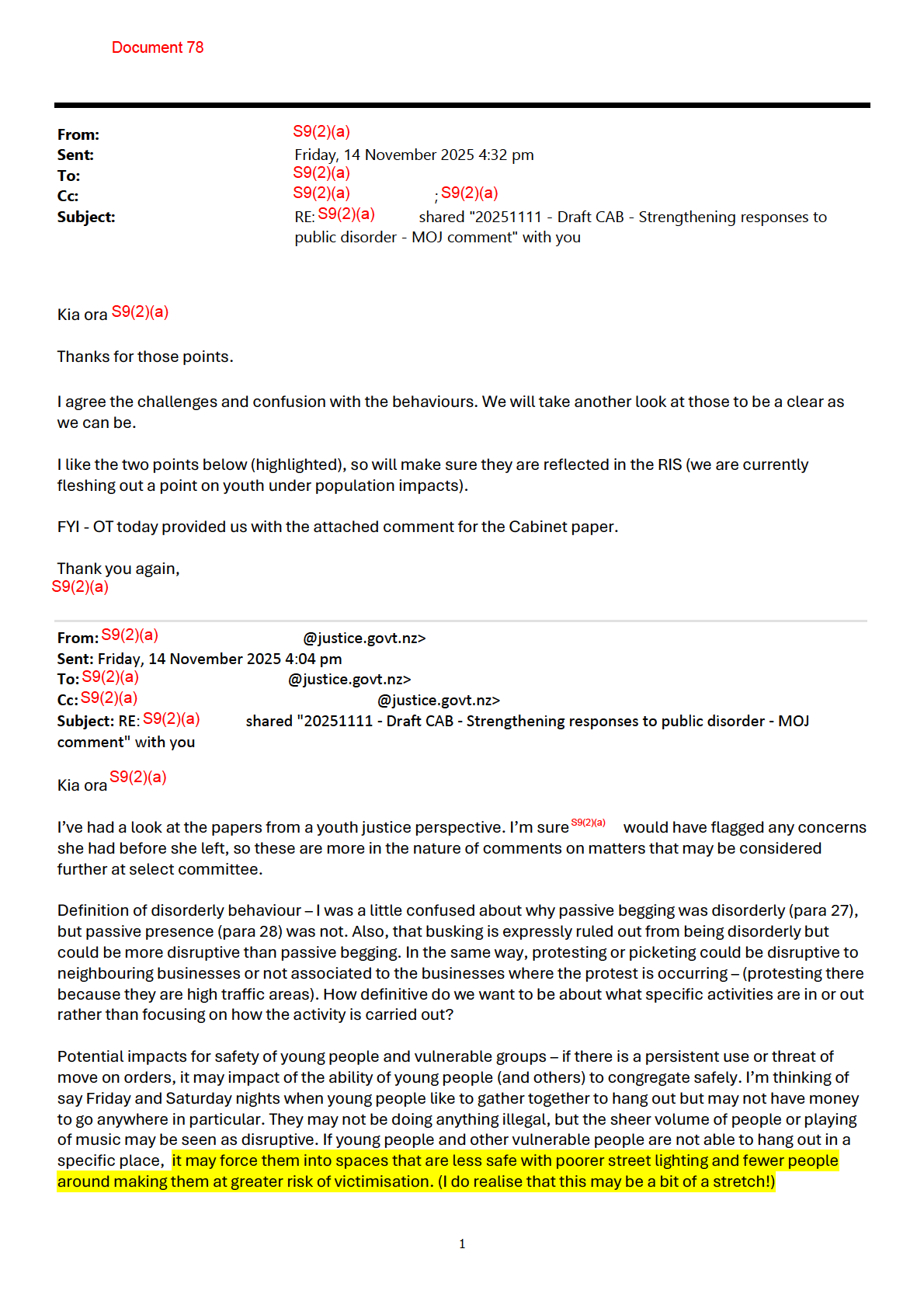
Thanks for the opportunity to comment on the paper. Our previous feedback remains accurate to our positon ,
but we but o er the following suggested Oranga Tamariki comment for the consultation section of the Cab
paper. Feel free to edit/paraphrase to suit.
Oranga Tamariki does not support move-on orders being applied to young people aged 14 to 18. Existing care
and protection and/or youth justice responses, which are already provided for under legislation, are age-
appropriate and e ective at dealing with this behaviour. Approximately 92% of all o ending behaviour by young
people is addressed through Police alternative action. There are also mechanisms available in the Family
Court and Youth Court when alternative action is not successful.
Please let me know if we can provide any further information.
s9(2)(a)
Principal Policy Advisor
From: S9(2)(a)
@justice.govt.nz>
Sent: Thursday, 13 November 2025 12:28 pm
Cc: S9(2)(a)
@justice.govt.nz>;S9(2)(a)
@justice.govt.nz>
Subject: RE: Public disorder - CAB paper and RIS for agency consultation
IN CONFIDENCE
under the Official Information Act 1982
Kia ora ano,
I’m sorry for this being a bit un dy, but a er further discussions with our Ministers Office, we are not yet consul ng
on the addi onal wording in the Cab Paper we added to SharePoint his morning. Therefore, we have removed V2 of
the Cabinet Paper from the SharePoint - please revert to the original version.
I’m really sorry for any confusion. We will reach out if/when we have substan ve changes to share.
Released
Ngā mihi,
S9(2)(a)
IN CONFIDENCE
1
[remainder of email chain removed as duplicate]
under the Official Information Act 1982
Released
under the Official Information Act 1982
Released

Document 79
From:
offenceandpenaltyvet
Sent:
Friday, 14 November 2025 4:54 pm
To:
S9(2)(a)
Cc:
Mercuri, Alida; S9(2)(a) ; S9(2)(a)
; S9(2)(a)
; S9(2)(a)
; S9(2)
; offenceandpenaltyvet
(a)
Subject:
RE: Public disorder Draft Cab paper and RIS
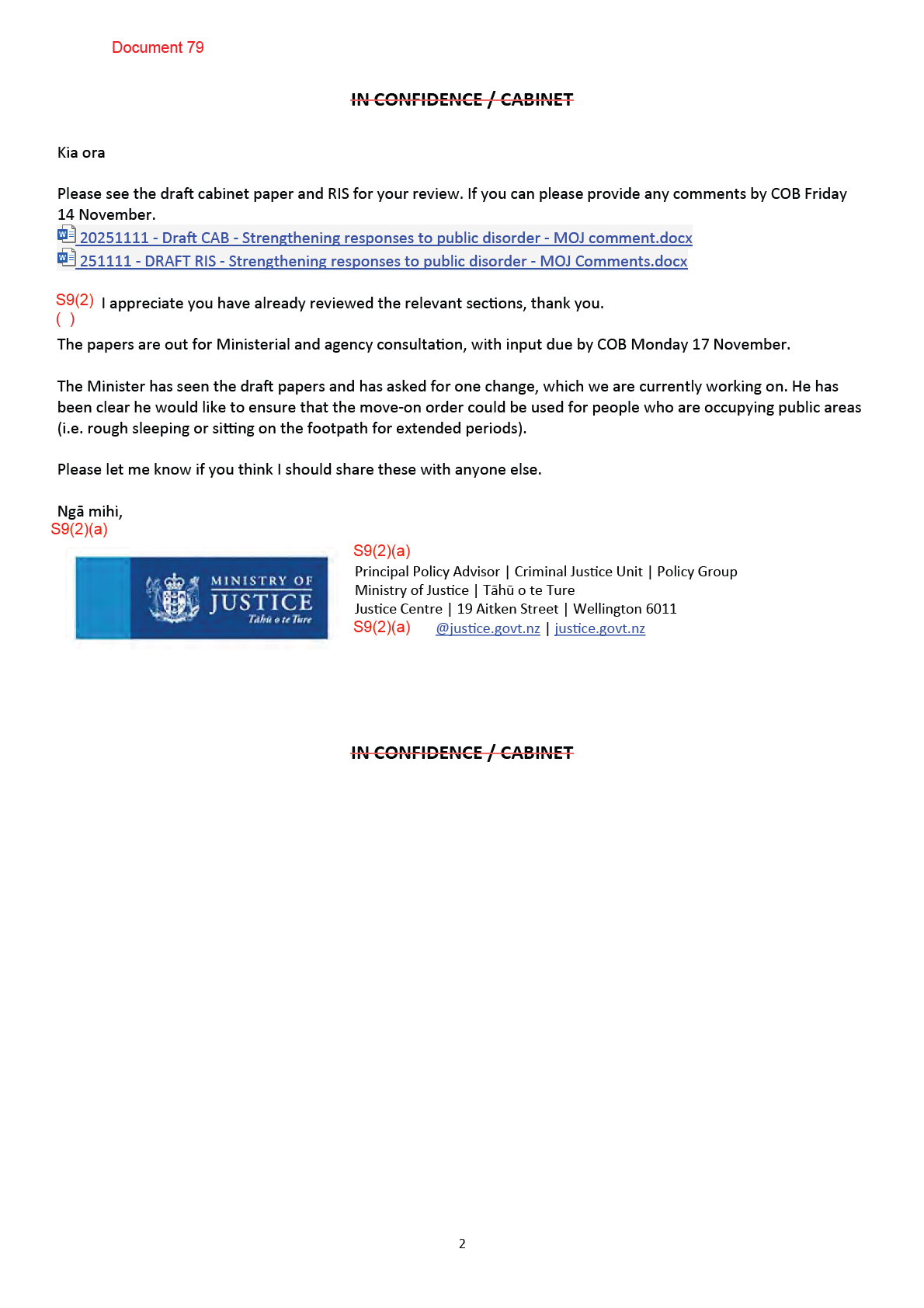
IN CONFIDENCE / CABINET
HiS9(2)(a)
Thanks for giving OPV the chance to have a look at these papers and for the great job you and the team have
done putting them together in the time available!
I have suggested a slight tweak to the OPV comment in the Cabinet paper to reflect that the o ence now has a
‘without reasonable excuse’ element included. In the RIS, S9(2)(a) and I have proposed adding a paragraph at
para 28 with OPV comment and have track changed some minor suggested tweaks in the options analysis and
table at the back of the document.
Happy to discuss further if needed – cheers and have a good weekend
S9(2)(a)
Offence and Penalty Ve ng (OPV) Co-Ordinator
Senior Policy Advisor | Kaitātari Matua Kaupapahere
Sentencing and Rehabilita on Team
Criminal Jus ce Unit | Policy Group
Ministry of Jus ce | Tāhū o te Ture
Phone +64 4 494 9746
S9(2)(a) @jus ce.govt.nz
s9(2)(a)
@jus ce.govt.nz (for all OPV ma ers)
Na onal Office | Jus ce Centre | 19 Aitken Street
DX Box SX10088 | Wellington
jus ce.govt.nz
out of scope
under the Official Information Act 1982
Released
IN CONFIDENCE / CABINET
From: S9(2)(a)
@justice.govt.nz>
Sent: Wednesday, 12 November 2025 3:14 pm
To: S9(2)(a)
@justice.govt.nz>; S9(2)(a)
@justice.govt.nz>;
s9(2)(a)
@justice.govt.nz>; S9(2)(a)
@justice.govt.nz>
Cc: S9(2)(a)
@justice.govt.nz>; S9(2)(a)
@justice.govt.nz>; S9(2)(a)
@justice.govt.nz>
Subject: Public disorder Draft Cab paper and RIS
1
under the Official Information Act 1982
Released
Document 80
From:
s9(2)(a)
@corrections.govt.nz>
Sent:
Monday, 17 November 2025 10:00 am
To:
S9(2)(a)
Cc:
S9(2)(a)
Subject:
RE: [EXTERNAL] RE: Public disorder - CAB paper and RIS for agency consultation
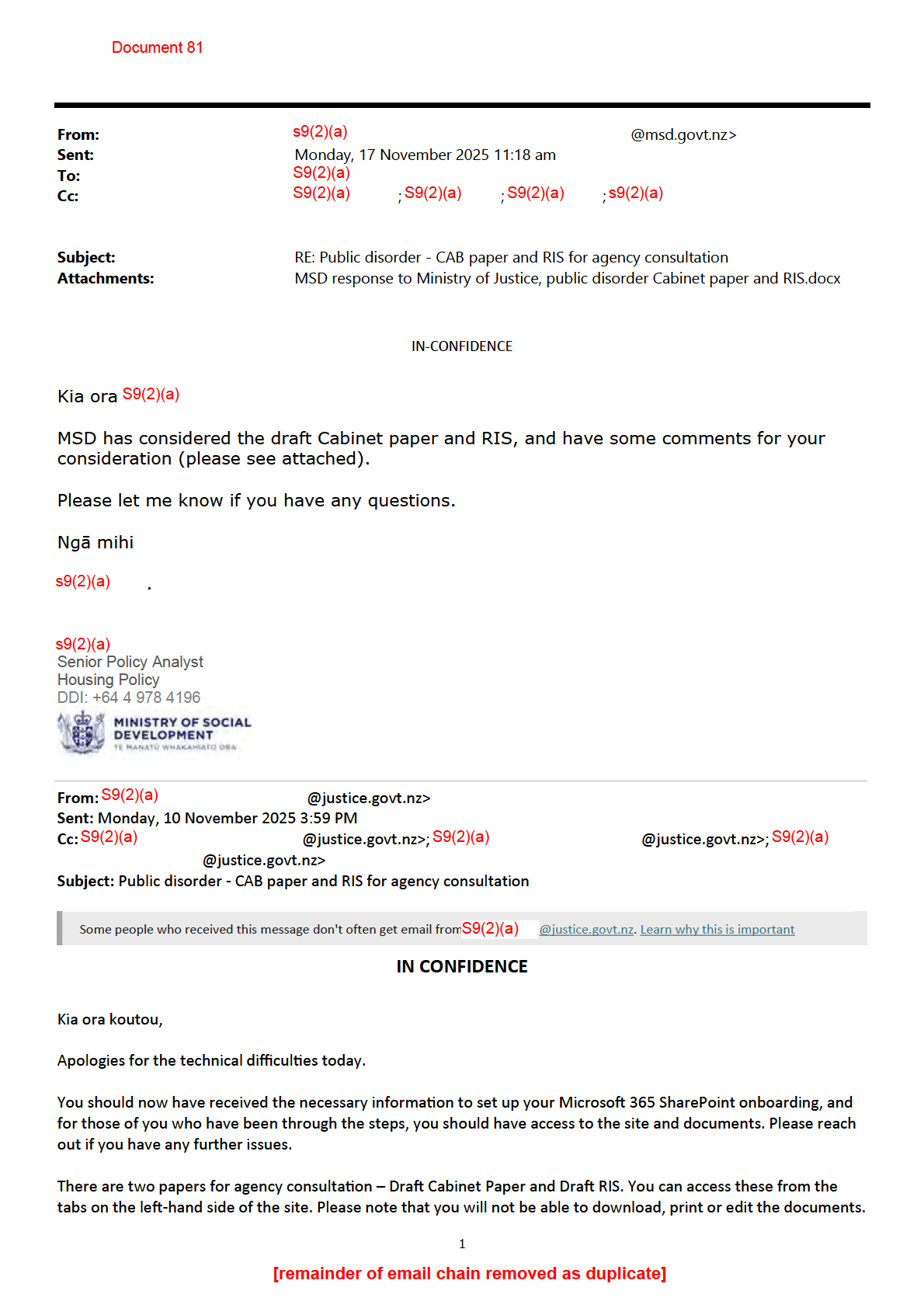
Yes, we can rework our end. It came through to us at close to COP from our Strategic Finance team, so I had to
determine whether to finesse the wording or send it through.
From: S9(2)(a)
@justice.govt.nz>
Sent: Monday, 17 November 2025 9:49 AM
To: s9(2)(a)
@corrections.govt.nz>
Cc: S9(2)(a)
@justice.govt.nz>
Subject: RE: [EXTERNAL] RE: Public disorder - CAB paper and RIS for agency consultation
IN CONFIDENCE
Kia ora s9(2)(a)
Thank you for the redrafted section below. Noting you have said you would like it included as is, we are under
pressure to keep the paper tight. We think the first paragraph could be condensed. We are also a bit confused
about what the second paragraph is trying to say in addition to the points in the first paragraph, and therefore
not sure if its necessary.
Would you like to redraft it to ensure the key points are delivered in a concise way, or would you like us to do
this and run the reworked section back to you?
Thank you again for working with us on this.
S9(2)(a)
under the Official Information Act 1982
IN CONFIDENCE
From: s9(2)(a)
@corrections.govt.nz>
Sent: Friday, 14 November 2025 5:10 pm
To: S9(2)(a)
@justice.govt.nz>
Cc: S9(2)(a)
@justice.govt.nz>; S9(2)(a)
@justice.govt.nz>
Subject: FW: [EXTERNAL] RE: Public disorder - CAB paper and RIS for agency consultation
Released
Kia ora,
As noted earlier, we have tweaked the lines to provide more detail around baselines and to provide other
clarifica ons. Please note that while we are okay to put the text from us about costs a er “Correc ons notes” the
statement about the 6 person increase should come before that as it is from MOJ modelling.
1
Document 80
I’ve inserted it into your text below. Please don’t hesitate to reach out Monday morning about anything that needs
clarifying but we thought it would be helpful to get the addi onal content across to you today so you’ve got the
substan ve material.
Implementation and Financial Implications
The Ministry of Justice, Corrections, Police, and Crown Law are the key agencies responsible for implementing
the proposals. Implementation will include ensuring capacity to manage workloads, updating documentation
and IT systems (and associated operating costs), sta training, and providing communications and guidance
to relevant parties.
It is my preference that any costs of the proposal will be undertaken within agencies’ baseline funding, but
further analysis is required from agencies about the potential costs and/or reprioritisation impacts.
Police note that further analysis is required to understand the full implications and costs. [TBC – Police
exploring if they can provide costings.]
I note that there will be an increase in cases being prosecuted in the courts for breaches of move-on orders.
Any increase in cases could impact court timeliness. Indicative estimates suggest it would cost the courts
$XX per year, by mid-2028 after two years after implementation.
The Department of Corrections note that the prison population is projected to increase by 6 people per annum
at the high estimate within two years of enactment. The costs of imprisonment are $120,000 per prisoner per
annum inclusive of any operational changes required at a unit or site level. The current prison network has
limited capacity available and low resilience and even a policy change with a small population increase
beyond current projections, collectively with other policy changes and factors, is likely to engage the need for
significant additional infrastructure investment (which would cost at least $300 million). Future prisoner
network funding decisions would be needed to ensure that there is capacity in Corrections’ infrastructure, and
frontline sta are supported to manage additional people safely and e ectively. Any new infrastructure to
accommodate additional prisoner population impacts would take average 4 to 8 years to build and implement
and may not be available until after the full policy impact takes e ect.
Replace with amended text
This policy change is projected to increase the prison population by six prisoners per annum, at the high estimate,
within two years of enactment. The Department of Corrections notes that this forms part of a wider suite of policy
proposals that could impact the prison population. This means that both the operational costs of each additional
prisoner in the prison network ($120,000 per prisoner per annum inclusive of any operational changes required at a
unit or site level) and the infrastructure implications must be considered on a network-basis, which cannot be
funded from existing baselines given prison population projections. The current prison network has limited capacity
under the Official Information Act 1982
available and low resilience, so even a policy change with a small population increase beyond current projections
(collectively with other policy changes and factors) will add risk to the need for significant additional infrastructure
investment. Any new infrastructure to accommodate additional prisoner population impacts would take an average
of four to eight years to build and implement and may not be available until after the full policy impact takes effect.
s9(2)(f)(iv)
Released
2
Document 80
Regarding the assumptions in the data, we will include this detail in the RIS. I am of the understanding that the
Remand impacts is included in the data, however, the person who ran the data is not back it he o ice until
Monday.
Many thanks,
S9(2)(a)
IN CONFIDENCE
From: s9(2)(a)
@treasury.govt.nz>
Sent: Thursday, 13 November 2025 7:49 am
To: S9(2)(a)
@justice.govt.nz>
Cc: S9(2)(a)
@justice.govt.nz>; S9(2)(a)
@justice.govt.nz>; S9(2)(a)
@justice.govt.nz>; s9(2)(a)
@treasury.govt.nz>; s9(2)(a)
@treasury.govt.nz>; s9(2)(a)
@treasury.govt.nz>
Subject: RE: Public disorder - CAB paper and RIS for agency consultation
[IN-CONFIDENCE]
Kia ora S9(2)(a)
Thanks for consulting the Treasury on this paper and RIS. We have worked to get comments to you early so we
can chat about the extent to which they will be addressed at agency level. An indication of this by COB today
would be appreciated to allow time for us to consider what advice we may need to give to our Minister to
progress through Ministerial consultation, given these processes are being run in parallel.
I summarise our key concerns below. We’d be happy to chat about any of these points further. Other than 10-
11am, my diary is clear today so feel free to call.
We consider that the Cabinet paper does not adequately identify the financial implications of the
proposal, even though it is evident that there will be direct costs for Police, Corrections, and
Justice/Courts (and Crown Law, referred to in the Cabinet paper but not the RIS). The costs should be
estimated in dollar terms rather than mentioned in generalities so that the financial implications are
clearly understood by Ministers when they take decisions. In addition:
o While the RIS states “no additional funding is available to support implementation on the
proposals” and that implementation and ongoing costs will be baseline funded, we are
concerned that this may not hold over the long term – eg, costs may be folded into future
Budget submissions as cost pressure bids, thereby having fiscal implications.
under the Official Information Act 1982
We are aware that Police, Justice/Courts, and Corrections are all experiencing
significant cost pressures already, and that agencies consider much of these costs
can’t be met within baselines – it is unclear how the costs associated with this proposal
would be different.
o Where costs are met through baseline reprioritisation, Ministers should be made aware of the
trade-offs at hand. This requires them to know what the costs of the proposals are for each
agency and therefore how much funding will be reprioritised, and the operational/delivery
implications of the reprioritisation decisions (eg, what other Police services might be
Released
deprioritised?).
o If no new funding is attained and reprioritisation within baselines does not occur,
implementation will likely suffer. This should be raised as a risk associated with the proposal
given this could compromise attainment of the proposal’s objectives.
o The paper should indicate not just the quantum but also timing of costs. It is unclear, for
example, in which financial year Police would be incurring implementation costs, and at which
point following passage of the legislation courts and prisons would start to see the impacts.
3

Document 80
Of particular note, the costs for Corrections should be clearly detailed, including information about the
per-prisoner operating costs and potential implications for prison capacity and associated capital
investment – again, as much as possible, this should be in dollar terms rather than indicated in
narrative terms only.
o While six extra prisoners may seem small relative to the prison population implications of other
recent policy decisions, we understand the per-prisoner operating cost sits at $120k and that,
in the context of constrained prison capacity, even a small increase could generate the need to
consider capital investment – ie, the financial implications are non-negligible.
o Further, the assumptions behind the modelling suggesting a six-person impact should also be
presented.
If the six-person impact hinges on the assumption that “most people will obey the law
and the overall impacts on our courts and prisons due to offending will be low,” this
claim requires substantiation. At first blush, it seems unlikely to withstand scrutiny,
given the difficulties the most affected people may face in complying with move on
1982
orders (including lack of alternative places to go, mobility constraints, limited transport
access, the issuance of multiple move on orders across bordering areas, and personal
safety concerns associated with moving from publicly visible places).Act
In addition, it will be important to reflect the prison population impacts of not just the
sentenced population but also the remand population. Given many people subjected to
move on orders may not have viable bail addresses, it seems likely people awaiting trial
in the context of criminal court backlogs may be remanded in custody.
The RIS contains useful information about the limited evidence to indicate the proposal would
generate the intended outcomes (eg, no evidence that move on orders reduced crime rates in Australia
and the UK). It also suggests the problem may be more perceptual than real, stating that “Police data
does not appear to support the perceived increase in disorderly behaviour, with available data
indicating a decrease in demand and prosecutions for public order, health and safety offences over the
Information
past five years.” It would be helpful to see this information from the RIS reflected in the paper itself to
help Ministers understand the potential limitations to the realisation of the proposal’s objectives.
While noting that the RIS does not monetise potential benefits associated with the proposal and that
costs are not concretely presented (as discussed above), based on the available information, we agree
with the assessment in the RIS that the costs are likely to outweigh the benefits – ie, this proposal is
unlikely to represent value for money. The preferred option presented in the RIS (ie, status quo) seems
Official
well-reasoned, particularly noting there are several new initiatives that are likely to contribute to the
objectives expressed in the Cabinet paper which haven’t yet been fully implemented and therefore
which remain to be evaluated for effectiveness.
the
Short of this being approached as an interagency paper, it would be useful for the paper to contain
comments from Police and Corrections given their stake in the policy proposal and its strong
operational leaning. A comment from Police about the sufficiency of current powers and feasibility of
implementing the proposal (including in view of the RIS’ statement that no new funding is available)
would be particularly helpful and would support Ministers in understanding whether the anticipated
under
benefits are likely to be realised (and therefore whether the costs are justified). A Corrections
comment about the operational impacts and risks associated with the prison population increase with
no new funding would also be useful.
Ngā mihi nui,
s9(2)(a)
s9(2)(a)
| Te Tai Ōhanga The Treasury
Released
Justice and Courts Vote Analyst
Infrastructure, Security and Government Team | Public Sector Performance Division
Tel: +64 4 890 7447 | Email:s9(2)(a)
@treasury.govt.nz
treasury.govt.nz | LinkedIn | Youtube
4
[remainder of email chain removed as duplicate]
under the Official Information Act 1982
Released
IN CONFIDENCE
Document 81A
MSD feedback: Cabinet paper Strengthening responses
to public disorder
Summary
•
MSD does not support amending the Summary Offences Act to introduce a power
for Police to issue a ‘move-on’ order.
•
We are concerned, in line with previous feedback, that the offence and penalty
proposed is disproportionate to the problem, and will saddle people living on the
street with unsustainable debt. In addition, having a criminal record will make it
harder for affected individuals to obtain suitable housing, and therefore worsen
housing accessibility.
•
We are not satisfied there are sufficient safeguards or limitations built into the
proposals, that they are proportionate, targeted to the problematic behaviour, or
that they are needed to achieve public safety (previous evidence presented to
Justice Sector Ministers has been that disorderly behaviour has actually been
decreasing, and is at a 10-year low).
•
We have concerns around the subjective judgement required by individual Police
officers (with the inherent risks this carries) on aspects that are not clearly
defined. For example, on what behaviour would be considered to reasonably
cause “anxiety” to the public, and what would constitute a “reasonable excuse”
for breaching a move-on order.
•
The paper is light on a number of details, including risks, such as the
significant consequences for those that may have the penalty imposed and are
unable to afford the (up to $2,000) fine. This is further highlighted under cost-of
living implications (para 38). The paper states the impact of applying move-on
orders (to those begging, people experiencing homelessness, and other low-
income populations) has not been quantified.
•
However we are pleased to see that the paper acknowledges the solution
proposed may simply displace the problem to another location, and that unpaid
fines can perpetuate cycles of poverty and homelessness.
under the Official Information Act 1982
Move on orders
•
There is still an insufficient rationale presented on why Police need
additional tools to respond to low-level disorderly behaviour. Police
already have a range of tools available to them and there is a lack of evidence
that these existing tools are insufficient, or that it is a good use of Police resource
to respond to behaviour described as “annoying”. We note there is already
Released
provision in the Summary Offences Act to address public disorder offences
including obstruction of a public way. Would move-on orders simply duplicate
existing offences?
•
The paper lacks clarity around definitions, e.g., para 29 on parameters for
move-on orders states a person will not be liable for breaching an order if they
have a “reasonable” excuse. We reiterate the importance of robust operational
1
IN-CONFIDENCE
Document 81A
guidance and training, since it appears that
a number of decisions will be
subject to the judgement of individual officers. Other definitions that lack
clarity include:
o
what would count as a ‘footpath’ (as begging on a footpath would be
covered by move-on orders)
o
what should be a “reasonable distance” from the specified area. It is
unclear how this would be applied in practice. E.g. how close to retail
entrances would a person be permitted?
o
what would count as “obstruction” of a public way, and whether that
obstruction was “reasonable”
o
whether a person is or has been causing “anxiety”, and whether that
anxiety is “reasonable”
o
what is a “reasonable excuse” for breaching a move-on order
o
whether a person is “begging”. The proposed definition of begging (at
recommendation 4) should be discussed in the body of the paper.
•
Paragraph 19 notes that “many disruptive, distressing and potentially harmful
acts can occur before officers are able to step in to de-escalate the situation.” We
would point out that this can occur regardless of whether Police have the ability to
issue move-on orders;
a new move-on power won’t prevent disruptive or
harmful acts from occurring.
•
We reiterate our previous advice that:
o
move-on orders will not be effective, and will simply move the problem
down the road. It is essentially punishing survival behaviours caused by
homelessness
o
move-on orders should not be used to effectively criminalise homelessness
or those who appear undesirable. Having a criminal record will make it
harder for individuals to obtain suitable housing, and therefore worsen
housing accessibility
o
move-on orders should not interfere with access to support and essential
services (this includes MSD offices), or where people live
under the Official Information Act 1982
o s9(2)(g)(i)
•
Para 27 - we are concerned that
move-on orders being applied to passive
Released
begging in particular is not aligned with “activities that are disorderly, offensive,
threatening or disturbing, interfering with trade or businesses, obstructing a
public way, breaching the peace, or causing anxiety to a person”. It could be
argued there is a fine line between being able to sit on a footpath (excluded from
move-on orders) compared to sitting on the footpath with a sign/begging bowl
(included in move-on orders). Arguably being approached by charitable
2
IN CONFIDENCE
Document 81A
fundraisers on the street can be more annoying to the public than someone
sitting on the side of the footpath with a sign.
•
Proposed power of temporary detention: we reiterate our previous advice
that a temporary detention power risks victimising people experiencing
homelessness and/or exhibiting symptoms of addiction or mental distress. There
is already an ability to detain a person for ‘disturbing the public peace’ under
s.315 of the Crimes Act, so it’s unclear why an additional power of detention
would be needed. The paper is unclear on whether there is a maximum timeframe
envisaged for detention, or what would happen if an individual refuses to supply
the information requested. As previously advised, we would like to see an
assurance that particulars to be gathered by officers will be treated in accordance
with Privacy principles, and in particular, are not held longer than required, or
used for profiling purposes.
Enforcement, penalty and offences
•
We reiterate our previous advice that
those most impacted by the fine
proposed will be those with high and complex needs, who are the least
likely to be able to pay. It therefore will not create an effective deterrent, and
risks saddling people living on the streets with unsustainable debt. For those who
are genuinely homeless, additional debt will also make it harder to secure housing
and may discourage them from engaging with government and/or community
services, which may undercut the intention of the significant new investment that
the Government has made in homelessness outreach services.
•
We are pleased to note, and
support MOJ’s advice that the offence created
and level of fine is disproportionate to the problem, and should not be
aligned with penalties for offences such as careless driving causing death, or
selling Class C drugs.
•
MoJ’s advice also states that imprisonment should be reserved for the severest
offending where the person intentionally, knowingly, or recklessly committed the
act, however, this is not the case with the proposed offence, removing a key
protection for individuals. We note there is no mention of how this will be
communicated to those it is most likely to impact, resulting in individuals who
have no knowledge or awareness of this penalty/offence.
under the Official Information Act 1982
•
We also agree that provision needs to be made for a defence, and would question
whether this might impact legal aid resourcing.
Risks
•
A number of important risks are not canvassed, some of which we have
previously raised; for example, the implications for natural justice (i.e. the
presumption of innocence, the right to a fair trial etc) seem significant. This is
Released
especially the case given the orders may be issued to those with the least ability
to challenge them or to access legal representation.
•
There is no clear rationale or mitigation discussed for the identified risk of moving
people on from one place to another (para 33). This raises concern that people
may be repeatedly moved and displaced, impacted by penalties/offences, and in
3
IN CONFIDENCE
Document 81A
worse circumstances. Without any support in place, this may exacerbate their
needs and not address the underlying issues resulting in homelessness or
begging etc. in the first place.
•
There are references to alternative personal and social support options being
available to assist people in meeting their basic needs. While this is positioned as
a key mitigation to many of the risks, there is no consideration of the wider
implications of high demand on existing social supports and services. MSD
recommends considering an effective package that could support social services
to meet the possible increased demand, mitigate the outlined risks, and address
underlying issues that have placed individuals in such circumstances – which in
turn may more effectively achieve the intended outcomes of this paper. There
also needs to be consideration for where this may increase the current demands
for personal and social support options.
•
While the population implications section (from para 44) specifies Māori, youth
aged 14 and over, and people experiencing mental health needs, poverty, and
addiction, there is limited detail on safeguards, robust consideration of the
possible implications and mitigations for these groups.
People experiencing mental health episodes may be perceived as
disorderly, disruptive, or intimidating (para 47). The paper states Police
will continue to utilise existing responses to situations involving mental
health concerns, however, it lacks detail as to how decisions or
assessments will be made prior to enforcing move-on orders and/or any
penalties.
There is a lack of clarity on how move-on orders will be enforced and
operationalised. This feedback applies to the paper in general, including
the threshold (as para 8 includes issuing orders for intimidation without
intent to frighten another person).
Population implications
•
We agree that Māori are likely to be disproportionately impacted, and as
previously advised, are over-represented among those living without shelter, in
emergency housing and on the social housing register. We are also concerned
that young people and people experiencing mental health distress may also be
under the Official Information Act 1982
disproportionately impacted, and that move-on orders could be applied to
individuals as young as 14 years. We consider this should be covered under
human rights implications (as there are likely to be implications for UNCROC
compliance).
•
Other cohorts likely to be impacted are not mentioned – e.g. disabled people,
Pacific people, and older people.
Released
Human rights (paragraphs 52 – 54)
•
We agree that move-on orders are likely to conflict with NZ's international human
rights obligations including freedom of movement and freedom from
discrimination (including discrimination on the basis of employment status). We
will be interested to read Crown Law’s advice on BORA implications.
4
IN CONFIDENCE
Document 81A
Regulatory Impact Statement
Summary
Policy problem and objectives
•
The
policy problem seems more like a statement of symptoms rather than
identifying the root cause. Given the objectives, would it be better to focus the
problem on any deficiencies in the law, the tools available to Police, or on the
public’s sense of vulnerability (noting there needs to be clear evidence for these)?
•
Options considered – it would be useful to cover these at a high level in the
Cabinet paper (even as an attachment) as they add a lot of context.
Minister’s preferred option
•
Additional costs could note the potential for public defence and appeal costs,
assuming this will be available to those being prosecuted for breaching a move-on
order.
•
Indirect costs to people issued with move-on orders, particularly those who may
be convicted of breaching an order, should include financial impacts in the form of
debt to government, and social impacts such as it being harder to secure suitable
housing. It may also discourage people from engaging with government and/or
community services. While the RIS notes that people will no longer be able to beg
or ask for assistance in public places, it should also point out that losing this
ability could drive an increase in petty crime by affected people as a survival
mechanism.
Balance of benefits and costs
•
MSD supports the Ministry’s view that costs are likely to outweigh the benefits,
and will fall primarily on those issued with move-on orders, and public services.
Diagnosing the policy problem
•
Para 7 asserts that an increase in homelessness and visible rough sleeping could
be contributing to perceptions of increased public disorder (these perceptions
aren’t backed up by evidence as we note in our Cabinet paper feedback). It
should be acknowledged that several different groups of people may be the
under the Official Information Act 1982
perpetrators of public disorder.
•
The table following para 14 sets out the different tools available to deal with
disorderly paper, including Police alternative resolutions to deal with offending
that sit below the prosecution level. It could therefore be made clearer at para 20
why Police powers to proactively de-escalate lower level disorderly behaviour are
limited and insufficient. Could some examples of common scenarios be included?
Released
•
Para 21 onwards discusses impacts of not being able to adequately deal with
disruptive behaviour. Impacts on New Zealand’s economic prosperity note at (e)
on page 12, a slow and steady increase in online shopping. However, what
evidence is there that increased online shopping is due to public disorder? There
will be other factors involved.
5
IN CONFIDENCE
Document 81A
•
Consultation is noted at paragraph 26. This should summarise the feedback from
the agencies involved, perhaps by way of a table (which could be appendicised).
•
Population impact analysis should be included, as should Treaty analysis.
Comparison of the options with the counterfactual
•
The table of options needs the usual key to interpret the ratings given (we would
assume, for example, that -- means that the option is much worse than the
status quo, but a key would be useful for unfamiliar readers).
•
We support the Ministry’s assessment of notable points relating to the different
options; for example that:
o
move-on orders are not necessary to respond to public disorder
o
there is limited evidence that move-on orders actually work
o
move-on orders can be applied in a discriminatory manner (including
against people who are homeless, indigenous or young), and bypass
formal justice system mechanisms
o
move-on orders can deny recipients the right to conduct a defence
o
criminal prosecution for non-compliance with move-on orders is not a
proportionate response to such behaviours, and should not carry a term of
imprisonment.
•
We support notable points made in relation to Option Four (the Minister’s
preferred option), in particular that:
o
it may penalise people who are experiencing poverty
o
there is no evidence of a problem associated with begging that justifies
the changes proposed
o
there is little difference to the public between someone sitting passively on
the footpath holding a cup/sign, versus someone sitting/loitering on the
footpath without a cup/sign.
Marginal costs and benefits, implementation
•
This should note the high level of indirect cost to people exhibiting disorderly
under the Official Information Act 1982
behaviour (see above comment).
•
The cost to Courts from potential slowing down of court cases (due to dealing
with new prosecutions from non-compliance with move-on orders) could be noted
•
Any additional costs from further public defence/legal aid being required could be
added. Depending on where these costs fall, it could also be noted under
Implementation.
Released
Monitoring, evaluation and review
•
Should the proposals be passed into law, we would also suggest that a review of
how the new law is functioning, including effectiveness, would be worthwhile.
6
Document 83
From:
s9(2)(a)
@police.govt.nz>
Sent:
Monday, 17 November 2025 4:09 pm
To:
S9(2)(a)
S9(2)(a)
; S9(2)(a)
Cc:
s9(2)(a) ; Tanya.Roth
Subject:
FW: [EXTERNAL] Public disorder - CAB paper and RIS for agency consultation
Kia ora koutou
Thank you for the opportunity to provide feedback and discussions to date. These comments also apply to
related content in the RIS. As always, happy to discuss, quite a lot has come through since our last catch
1982
up!
Substantive matters for Police
Act
We can see merit in the use of move-on orders to address behaviours that meet offending
thresholds. However, we consider operationalising move on orders for behaviours that do not meet
offence thresholds will be challenging. We note that the only new aspects at recommendation 3, that
may not be covered by existing offences, are breach of the peace, causing anxiety and begging. We
consider that operationalising move-on orders is likely to be most practicable when a move-on order is
designed/developed as one tool among other existing tools (such as written warnings, infringements,
referral to services), to address behaviours that reach the threshold for offending and as an alternative
to arrest. Clear and transparent decision making is important for maintaining public trust and
confidence in Police.
Police has identified significant risk in terms of potential fiscal implications (thank you for providing
Information
us with the opportunity to include a comment in the paper reflecting this). If move-on orders are to be
developed within baseline, as proposed, then there could be significant impacts on the delivery of other
core Policing functions. s9(2)(f)(iv)
Ahead
of design decisions, that will determine the scope of move-on orders, we are not in a position to know
Official
how much funding could need to be reprioritised, and the operational/delivery implications of any
reprioritisation decisions.
s9(2)(g)(i)
the
Design work will also need to consider:
o Operationalising Police responses for the range of behaviours in scope for Police issued move-
under
on orders, including finer details about enforcement and non-compliance. s9(2)(f)(iv)
I note that, following our conversation on Thursday, you were
going to do some work around clarifying this part of the paper.
Released
o The role of agencies other than police in addressing disorderly or disruptive behaviour e.g.
council enforcement of bylaws, community led responses – particularly where these behaviours
do not meet offending thresholds.
o Broader factors such as the availability of services.
Police comment (for inclusion in the Cabinet paper):
Police consider that operationalising move-on orders is likely to be most practicable when a move-on order
is developed as one tool among others (such as written warnings, infringements, referral to services), to
address behaviours that reach the threshold for offending and as an alternative to arrest. Move-on orders
1
Document 83
will need to be carefully designed to provide certainty to police and the public and to maintain public trust
and confidence in Police, including with other agencies. Police has identified a significant risk in terms of
fiscal implications of the proposals. We expect significant costs, including National Intelligence Application
implications, operational costs, and development and delivery of training for staff. If move-on orders are to
be developed within baseline, as proposed, then there could be significant impacts on the delivery of other
core Policing functions. [Highlighted section you may want to include here or move to the financial
implications section].
Additional comments:
Language
s9(2)(g)(i)
1982
Act
Potential human rights implications - freedom of association/arbitrary detention/disproportionate use on
Information
certain cohorts e.g. youth, vulnerable, Māori.
Application to 14+ years olds is likely to be problematic e.g. compliance with OT Act/international
conventions.
Broad range of the behaviours covered:
o the response and penalty (assuming they breach the order) is the same for a person passively
sitting in a public place vs a person causing a breach of the peace (where offence grounds are
Official
met but the move-on order is an alternative to arrest). Is it dis/proportionate to treat such
seemingly distinct behaviours in the same way?
o there may be operational issues/confusion for staff with regards to behaviours that sit below the
the
threshold for offending and on what behaviours do reach the threshold – the mix of behaviours
(passive vs active), tests (does it cause anxiety), and defences (is there a reasonable excuse, is
it a protest, is it transactional) may make this difficult for frontline staff to determine whether a
move-on order can be issued.
Good to see recognition in the paper of the risk that moving people on from one location may displace
under
the problem to another location. However, the paper does not provide a solution. It also does not
address that moving disorderly people from say, a CBD, may result in people going to somewhere with
less oversight (e.g. infrastructure/CTV/ police presence). This may escalate safety issues for both the
person ‘moved-on’ and city fringe suburbs e.g. moving people from Wellington CBD resulting in a
higher concentration of disorderly people in Newtown (where this exact issue is currently playing out,
with fewer resources than the CBD to keep everyone safe). This could be particularly relevant for
vulnerable people e.g. youth, disabled, mental health needs, who are moved and go to where they are
at greater risk/are unsafe.
Released
Disproportionate impacts on particular cohorts –
o Noting recognition in the paper that the proposal is likely to disproportionately affect Māori, it
would be useful to identify how this could be mitigated.
o It would also strengthen the paper to include broader analysis in the population impact section
on other ethnicities and cohorts that could be disproportionately impacted by the proposals. For
example, Pacific peoples are also disproportionately represented in severe housing deprivation
/homelessness statistics; those with disabilities, others experiencing homelessness or poverty
or mental health/addiction issues, youth, etc. may be disproportionately impacted.
2
Document 83
Feedback related to specific recs/para’s
Recommendations:
s9(2)(f)(iv)
Paragraphs:
Para 8 - “intimidation without intent to frighten another person” – I get that this is to distinguish the
behaviour from s21 (intimidation) of the SOA, however this technicality would be difficult to
operationalise i.e. it seems to be saying there is intimidation without the intent to frighten another
1982
person, intimidation with the intent to frighten another person, begging that may include intimidation,
begging that might not include intimidation.
Sub heading above para 17 refers to Police not having sufficient powers to respond to disorderly and
disruptive behaviours, then para 17 says Police has a range of options for responding to those same
Act
behaviours – suggest deleting the sub-heading.
Para 17.2 is not quite right. Police cannot detain someone simply because they are intoxicated (certain
criteria must be met) and they must consider alternatives (such as taking them home or to a shelter);
and the sentence structure links trespass to causing harm or being harmed. The heading is also
referring to low-level offending but being intoxicated is not an offence.
Para 18 - it is arguable that all concerning/non-offending behaviours are the responsibility of Police –
can para 18 be removed? I think you go on to make the point you want to in the next para.
Para 20 – I’m not sure that this is pitched quite right. It sounds as if Police do nothing in these
circumstances, when in reality Police interact with vulnerable populations every day (without the need
Information
to arrest). Can we take Police out of this para and focus on the behaviours that the Minister is wanting
to address e.g.
I am hearing from x,y,x (retailers etc) about Police also cannot respond to many low-level disorderly
behaviours that are annoying and disrupting the peaceful enjoyment of public places, such as
begging on a footpath or next to retail entrances. I acknowledge that for some, begging is a
response to challenging personal circumstances. However, it is also important to recognise that
Official
there are alternative personal and social-support options available. As retailers and communities
report, begging can have wider negative social and economic impacts for busy urban areas.
I think this way you still get the sequence you want e.g. 17 outlines the responses that Police has to
offending, delete 18, and then 19 and 20 are about behaviours that are disorderly/disruptive and don’t
the
meet offence thresholds.
Para 23 – As noted above, most of the activities described here are already offences, and for those that
aren’t it is not clear how Police could ‘police’ them e.g. anxiety of the reasonable person? Should
begging also be listed here, given it is referred to in the paras following and is separately noted in the
recs?
under
Para 31 – refer to substantive comment above about enforcement/non-compliance.
Para 32 – covers penalty for breach of a move-on order but not what happens if a person doesn’t
provide details.
Para 34 - notes that people breaching may have difficulty paying and goes on to say that the Minister
does not consider that breaches will occur – what is the evidence for this? Given the needs of the
populations that move-on orders could apply to, including those who are begging, if they breach they
may not have any or sufficient income to make payment.
Para 45 – is it worth footnoting why health and safety offences are included here e.g. the ANSOC
Released
category clusters this with public disorder? It just sits out a bit oddly otherwise.
Para 47 – could you please add ‘or the public’ to the first sentence e.g. ‘ . . . may be perceived by law
enforcement or the public as disorderly, disruptive or intimidating’. It is the public that may call
Police/alert Police beat teams to the behaviour in this scenario.
Ngā mihi
3
under the Official Information Act 1982
Released
