

IR-01-26-9176
22 May 2026
James M
[email address]
Tēnā koe James
Request for information
Thank you for your Official Information Act 1982 (OIA) request of 13 March 2026. You
asked for information regarding Police radio cal signs and codes.
My response to each part of your request can be found below.
1. I would like to request the most current list of Police Radio callsigns. If possible, I
would like the list to include Callsign, location, and unit Descriptor. An example of this
would be WLN1, Wellington, Senior Sergeant (Or appropriate).
The list of Police Radio cal signs is withheld pursuant to section 6(c) of the OIA as the
making available of the information would be likely to prejudice the maintenance of the law
including the prevention, investigation and detection of offences and the right to a fair trial.
There is a national guideline on the makeup of call signs, however there are also
variations in police districts and workgroups which are decided at a local level. There are
currently over 30,000 cal signs in use national y and call signs in use can change daily.
Call signs are made up of component parts and are generally (but not always)
constructed as follows:
Call Sign Construction & Components (in order)
Available codes (refer)
National, District, Area, Station Code
2 letters
Scene Stations Code
Unit Identifier
1-2 letters
Unit Codes
Letter identifying supervisory role
1 letter (optional)
Unit Codes
Group number identifier
1-2 numbers
2.
I would also like updated versions of the following information: (Similar to
https://fyi.org.nz/request/8908/response/30917/attach/8/Holmes%20Thomas%20code
s%20ir%2001%2018%2014122%20signed.pdf):
We have interpreted your request as relating to codes in the Computer Aided Dispatch
(CAD) system. CAD is an operational system designed to enable unit dispatch and event
management.
a.
A list of current event type codes;
b.
A list of current Incident codes;
link to page 2


Information is provided in the attached spreadsheet (‘CAD Event (incl Incident) Codes’
worksheet).
When Police communication centres receive a request for service, an event is entered in
the CAD system. CAD events can only have one code type, and Police practice is to code
the most serious risk or alleged offence.
Events may be later categorised in more detail when they are transferred to the National
Intel igence Application (NIA). NIA al ows more information to be recorded, such as one
or more precise offence, incident, or task codes.
c. A list of current result codes;
d. A list of current status codes;
e. A list of 2 digit station codes and associated station
Information is provided in the attached spreadsheet (‘Disposition (Result) Code’, ‘Status
Codes’, and ‘Scene Station Codes’ worksheets).
f. A list of unit types and definitions i.e. I – 2-up PST vehicle
While unit codes and definitions have been released previously, an updated list of these
codes is withheld pursuant to section 6(c) of the OIA as the making available of the
information would be likely to prejudice the maintenance of the law including the
prevention, investigation and detection of offences and the right to a fair trial.
3. Any policy documents relevant to implementation or use of the above information
operationally.
Police has published externally a document called ‘National Recording Standard
1. This
chapter is the standard for recording information about offences and incidents. It sets out
the rules for what must be recorded and when. It also includes definitions and examples
to help people apply the rules correctly and consistently.
For information on cal signs, including requests or changes refer to Call Signs SOP.
A copy of the Cal Signs Standard Operating Procedure (SOP) is provided as an
attachment. Sections of this document recording unit codes and definitions have been
withheld pursuant to section 6(c) of the OIA as the making available of the information
would be likely to prejudice the maintenance of the law including the prevention,
investigation and detection of offences and the right to a fair trial.
4. Can you also advise the callsigns used by the Police ART (Armed Response Teams)
during their use.
Police ran a pilot programme for Armed Response Teams (ART) from 30 August 2019
until 26 April 2020. ART has been discontinued and the call signs denoting those units
are no longer in use. Call signs that were used by ART during the pilot programme are
detailed in the attached ‘ART Call Signs’ spreadsheet.
Please note that as part of its commitment to openness and transparency, Police
proactively releases some information and documents that may be of interest to the
1
https://www.police.govt.nz/sites/default/files/publications/national-recording-standard-
nrs.pdf



public. An anonymised version of this response may be publicly released on the New
Zealand Police website.
You have the right to seek an investigation and review by the Ombudsman of this
decision. Information about how to make a complaint is available at
www.ombudsman.parliament.nz or freephone 0800 802 602.
Nāku noa, nā
Stefan Sagar
Acting Director Emergency Comms and Dispatch
New Zealand Police
SOPS
⚠
You are viewing this in print mode, this means website features have been removed, document
information and any district contacts are found further down the document.
Call Signs
This SOP outlines the purpose, structure, and process for creating or amending Police radio call signs. Due
to the large number of call signs, a full list is not included.
Call signs are not assigned to individual QIDs in the CAD Callsign Register. Districts, Areas, and
Workgroups manage allocation. Staff must log into CRA via Enterprise terminal or Mobile Responder at the
start of each shift.
Purpose of Call Signs
−
Call signs allow Police personnel to be contacted by dispatchers via Police Radio.
Requests for call signs for staff without radios (e.g. for secondary applications) are not supported, as
they pose safety and operational risks.
Create or Amend Call Sign
−
Creating a new call sign or making changes to an existing call sign must be requested via
Service
Portal.
Before Making a Request
Endeavour to follow the established protocols for the make-up of call signs. See definitions below.
If creating new call signs for an office or station, consider future proofing so that it will not be
necessary to create additional call signs again in a few months.
If amending existing callsigns make sure it is clear in the business reason what the actual change
is that you are requesting.
Units should not have permanent QIDs assigned to them in the description as this makes them
less versatile if someone moves into or out of that role or is relieving in it.
Consider what is the most appropriate station for the unit to be assigned to and whether or not the
unit is instead a District or Area unit and should be using a District or Area code.
Help Desk will reply (
usually via email) advising when the call sign(
s) is available for use and
awaiting approval.
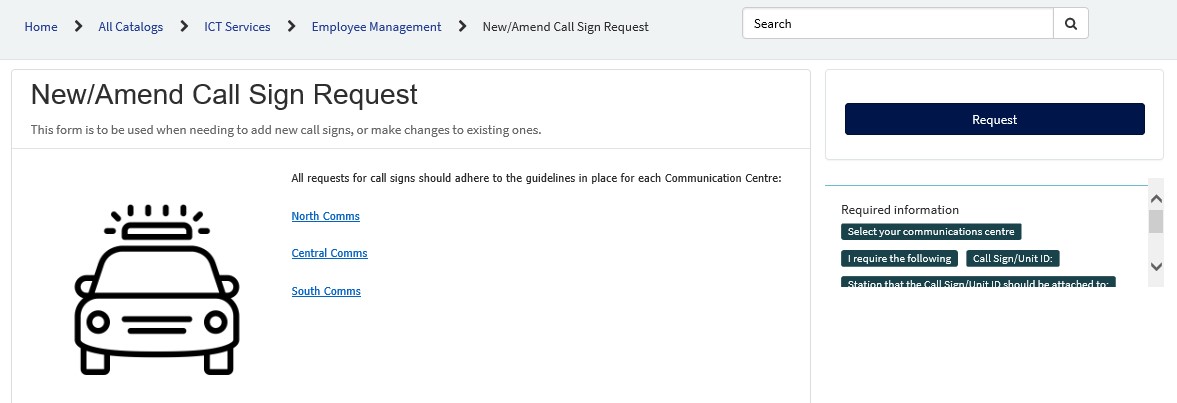 Complete a Change Request
1. Go to
Service Desk Portal: New/Amend Call Sign Request, will be required to login
with enterprise username and password
2. Follow the instructions in this form and ensure all compulsory fields are completed.
Once submitted, the Service Desk will create a ticket and respond (usually via email) when the call sign
is ready.
Section 9(2)(a) Official Information Act 1982
Alternatively, can phone Service Desk on
☎
Call Sign Definition
−
A Call Sign is used to identify a unit over radio.
The table below uses examples to illustrate how a typical call sign is structured, e.g. the meaning of the
letters, suffix, etc.
Examples
National, District,
Unit
(Optional) Letter
Group Number
Area, Station
Identifier
Identifying
Identifier (1-2
Code (2 letters)
(Usually 1
Supervisory Role (S,
numbers)
or 2 letters)
N, A,)
WDXN1
WD
X
N
1
(Waitemata District
s.6(c) OIA
(Snr/Sgt)
(Group 1)
Code)
PM
YZ
12
(Palmerston North
s.6(c) OIA
(Group 1, second
Station)
unit)
WLC41
WL
C
41
(Wellington District)
s.6(c) OIA
(Group 4, Unit 1)
FNI1
FN
I
1
(Far North Area)
s.6(c) OIA
(Group 1)
Specialist District (and National Units usually based in a particular district most of the time) usually use
District Codes. Some National Units use PC, HQ, or NZ.
Unit Identifier
Follow standard coding for clarity and ease of use
Avoid ending identifiers in S, N, A unless used for supervisory roles
Some identifiers (e.g. “Intel”) are spoken as words, not phonetically
Supervisory roles may omit the unit identifier
List of Unit Identifiers
−
Most of the call signs in use nationally align across the ECD’s allowing for lower learning curves, cross-
channel interoperability and more ef
ficient Business Continuity Plans (BCP).
Unit
Description
s.6(c) OIA
s.6(c) OIA
s.6(c) OIA
Document Information
Category:
Support SOP
Classification:
IN CONFIDENCE
Business Owner(s):
ECD Operations Team
Last modified:
23/10/2025
Related Resources
Related SOPs
•
Business Continuity Plans (BCP)
•
CAD (Computer Aided Dispatch)
•
Card Resource Allocation (CRA) - Login Link
•
I/NetViewer and I/NetDispatcher
Ten One Resources
•
Unit Identification Grid (PDF, Jan 2020)
External Resources
•
Service Portal
