
FOR DECISION
Board Paper – Service Agreement 2023/24 – Measures and reporting
Purpose
The Service Agreement and corresponding measures and targets
described in this paper provide transparency of performance and wil be
This paper provides information to support the Board consideration of the
reported against at year-end in the Annual Report.
performance framework proposed for inclusion in the Service Agreement
2023/24 (
SA24). The measurement approach that has informed the SA24
The Service Agreement, amongst other things, state what deliverables
measures is provided in the
Approach to measuring our success for
we commit to deliver to progress our strategic goals and how we wil
Huakina Te Rā paper.
demonstrate success, specifically:
Background
• The quality and quantity of services to be provided by ACC.
The new strategic direction established through Huakina Te Rā and the
• The expected cost of delivering those services.
Statement of Intent 2023-2027 represents a significant change in focus
• The performance measures, targets and related information
for ACC. Given this, we need to introduce a new measurement approach
necessary for the Minister to assess our performance.
to provide visibility of our performance and progress towards achieving
• The nature and frequency of the reporting requirements against the
this strategic vision in the SA24. Endorsed by the Board in April 2021, Te
Agreement.
Kāpehu Whetū has been used to inform all the measures for Māori.
• How we wil deliver our outputs.
ACC is legislatively required to enter into a Service Agreement with the
Recommendations
Minister for ACC annually and to provide “related information necessary
1. Note our approach to developing measures as described in the
for the Minister to assess our performance”.
Approach to measuring our success for Huakina Te Rā paper.
The Service Agreement is prepared in accordance with the Crown
2.
Approve the proposed performance framework, including bridging
Entities Act 2004 and the Accident Compensation Act 2001. The Service
measures for inclusion in the draft SA24.
Agreement is one of ACC’s three accountability documents (the others
3.
Note the next steps for the SA24.
being the four-year Statement of Intent and the Annual Report), which are
to be read together.
Prepared by
Kelly Siddall, Head of Finance and Planning
Approved by
Stewart McRobie, DCE Corporate and Finance
Date
14 March 2023
Board Paper
Page 1 of 14
IN CONFIDENCE
Key Issues
Performance measures SA24
This paper proposes the accountability measures for inclusion in the SA24 – refer
Appendix 1: SA24 performance framework. In addition,
Appendix 2:
Measure glossary includes the definition of all measures. These proposed measures represent the best alignment to the strategic goals of Huakina Te Rā
using the most robust measures currently available for SA24. For a fuller description of how the SA measures demonstrate progress toward achieving the
longer-term strategic outcomes and goals of Huakina Te Rā please refer to the paper,
Approach to measuring our success for Huakina Te Rā. Given the new
strategic direction, measures selected in the SA24 represent a transition towards measuring progress. The measures focus on foundational performance
(injury prevention, rehabilitation and financial guardianship) for the SA24. Proposed measures more closely align to the goals of Ringa Atawhai | Guardianship
and Oranga Whānau | Safe and Resilient Communities. There is less coverage for Mana Taurite | Equity, where there is a limited availability of existing
measures.
The SA24 includes a smaller number of measures than in prior years (40 measures 2022/23, 31 measures 2023/24
1). Distil ing these to a tightly focused set
of measures provides a sharpened picture of performance externally. This is consistent with the current direction in public sector accountability reporting.
Comparable entities (including Waka Kotahi and NZTE) had 12 to 26 accountability measures.
Appendix 3: Mapping current performance framework to
new provides a mapping of the current (2022/23) performance framework to the proposed framework to aid understanding and demonstrate coverage.
The accountability measures are supported by organisational and operational measures to increase our understanding of our performance and the ways we
can lift performance. The three-tier performance framework provides distinct but related measures at three levels:
•
Accountability – a set of measures that reflect the critical aspects of our performance in the context of our strategic goals. These are the only measures
presented in the SA24.
•
Organisational – a set of additional measures that support tactical and strategic decision making around course correction of performance.
•
Operational – additional measures (which can be added to as appropriate) that are used internally to support improvement in operational performance.
The proposed new performance framework for the SA24 also reflects a shift for performance reporting. Historically, we have used the framework of the
Service Agreement to build performance reporting to the Board. Going forward, external reporting (Quarterly report to Minister for ACC) wil cover this
framework, where performance reporting presented for the Board wil also use key metrics, trends and analysis to support tactical and strategic discussions
around performance where appropriate. This is demonstrated in the
Approach to measuring our success for Huakina Te Rā paper.
1 Excludes Asset Performance Measures
Board Paper
Page 2 of 14
IN CONFIDENCE
The measure set for the SA24 is also divided between our core strategic goals (ManaTaurite | Equity, Ringa Atawhai | Guardianship and Oranga Whānau |
Safe and Resilient Communities) and Organisational health and capability goals (people, information and technology). This distinction is important – The
Crown Entities Act requires us to differentiate between the two in our SOI.
We undertook a process to refine measures from the long-term strategic goals to the medium-term results in the Statement of Intent through to the SA24.
Criteria were applied to the selection of potential accountability measures to identify measures appropriate for target setting. In this first year of Huakina Te
Rā, we are including some interim measures. We have termed these ‘bridging measures’, measures without targets. We can capture data for these metrics to
understand baseline but are unable to set targets at this stage. Performance targets are a specification of what we wil deliver and we are unable to make
meaningful assessment for these metrics because we have insufficient historic data and/or an incomplete understanding of which factors drive and influence
the measure. We consider these to be indicators or watchpoints and offer them in good faith as a means of giving stakeholders as much visibility as possible
on key areas relevant to each goal.
Overall, the number of measures is reduced from previous Service Agreements but stil covers the breadth of the business (Refer to
Appendix 4: SA24 core
goal measures to Outputs)
Mana Taurite | Equity
In the SA24 we have three measures for this goal. Of these, one has targets and two are bridging.
• Mana Taurite | Equity aims to achieve equity of access, experience and outcome for Māori and all New Zealanders. Overall client satisfaction for Māori
is currently the only measure with targets proposed for this goal. Satisfaction levels give a high-level indication of the relevance and quality of
experience for Māori.
• As Mana Taurite | Equity is a new focus for ACC, we have identified a large number of relevant new measures to construct but need to improve
capture of ethnicity, disability and gender data and move to customer (rather than claim) level data collection.
• In the SA24, we have included three bridging measures. Claim lodgement ratio for Māori and claim lodgement ratios for other population groups track
how many claims are lodged per thousand of population. While this gives some indication of access across populations, it requires contextual
information about base injury rates for each population in order to be meaningful. For example, a comparable claim lodgement ratio for Māori and the
total population may not indicate equitable access if Māori have a higher level of injury.
• Uptake of rongoā Māori services, is included as a bridging measure but again requires additional context to give insight into the cohorts not accessing
the scheme and the role that rongoā services play in equitable access, experience and outcome for Māori or other population groups.
Ringa Atawhai | Guardianship
In the SA24 we have 13 measures for this goal. Of these 12 have targets and one is bridging.
• Customer sentiment - Client, provider, and business customer satisfaction measures are now included in the measures for this goal, along with public
trust and confidence. This is a change from the Net Trust Score refer to paper,
New approach to trust measures, September 2022.
Board Paper
Page 3 of 14
IN CONFIDENCE
• Financial sustainability - Focus on the long-term sustainability of the Scheme is covered by measures covering the OCL movement, new year claim
costs and investment performance. This is supplemented with the existing measure covering a major driver of the OCL (care hours for serious injury
clients) and a more immediate financial measure of efficiency (percentage of total expenditure paid directly to clients or for services to clients).
• Carbon reduction commitments - We are proposing to formalise the existing carbon emission targets (corporate and global equity portfolio) in the
SA24.
Oranga whānau | Safe and resilient communities
In the SA24 we have 16 measures for this goal. Of these,13 have targets and three are bridging.
• Rehabilitation - Changes have been made to the rehabilitation measures to improve our understanding of the full claim trajectory. For short-term
performance, we have extended the average weekly compensation days paid measure to start on day one. This enables us to measure the full first
year of claims, rather that assessing specific points in the claim. In addition, we propose measuring the rehabilitation rate at one year, to describe
performance before claims enter the long-term claims pool.
The long-term rehabilitation performance measures remain the same, as does the return to independence for those not in the workforce.
• Injury prevention - Our effectiveness at supporting communities to remain injury free is measured by the return on investment for injury prevention
spend, and claims avoided. We propose to measure the complete injury prevention portfolio in one return on investment measure.
Rates of serious injury claims and sensitive claims for Māori are included as bridging measures. While these give some indication of Oranga Whānau
progress, information about the base rates of these forms of injury is required.
Organisational health and capability
In the SA24 we have five measures for this goal. Of these, all have targets.
• Employee engagement – The performance framework includes a shift from Employee Net Promoter Score to Employee Engagement GrandMean
(based on the Gallup Q12). The Q12 is based on multiple questions, is well researched, and widely validated. This measure is more reliable over time
and provides a more robust and interpretable performance picture. It can also be benchmarked against a range global trends and industry standards.
• Privacy – we propose maintaining the existing measure (Number of category 3,4 or 5 breaches and near misses) for the coming year. However, we
wil alter the definition of the measure slightly to exclude historical incidents where behaviour happened three or more years ago.
The current measure does use a rating system developed by the Government Chief Privacy Officer (GCPO) that has recently been decommissioned.
Despite significant work and investigation over the past 6 months, it has been challenging to pinpoint one or two measures that would accurately
reflect privacy maturity with the current information and data we have available. Work wil be completed in 2023/24 to test potential replacement
measures.
Additional legislative requirements considered in the development of the SA24 performance framework include:
• The Accident Compensation (Access Reporting and Other Matters) Amendment Bil (currently at Select Committee stage), if passed will require us to
report annual y on access for Māori and other population groups including any disparities and barriers and contributing causes or factors. In the SA24
we are proposing to include Claim lodgement ratio for Māori and other groups.
Board Paper
Page 4 of 14
IN CONFIDENCE
• From 2022, we were required to comply with a new standard for service performance reporting (PBE FRS 48). Paragraph 15a states:
“An entity’s service performance information shall provide users with sufficient contextual information to understand why the entity exists, what it
intends to achieve in broad terms over the medium to long term, and how it goes about this.”
The performance framework sets us up well to achieve this.
• Finally, we are also required to include asset performance measures in the Service Agreement as per Cabinet Office Circular CO (19) 6: Investment
Management and Asset Performance in the State Services. To address this requirement, we have eight additional measures aligned to out two largest
asset portfolios: property and ICT.
The SA24 wil also include information necessary to support the understanding of the Scheme and how we wil deliver on our objectives. This information will
include, but is not limited to:
• funding ratios by Account
• claims volumes
• demographics about our employees.
Performance targets SA24
Striking the right balance in performance targets between ambition and confidence of delivery is a challenge.
The targets aim for an improvement in
performance year on year, but achievability is also considered. We are socialising these targets across the organisation to ensure this balance is achieved.
The proposed targets wil be provided to the April 2023 Board meeting for discussion.
Where possible, the Budget and Service Agreement are aligned in terms of performance target aspirations. However, the timing of the Service Agreement
does mean we can reflect more recent performance and experience in the targets should this be necessary and potentially accept some inconsistency. In the
event where targets are updated following the SA24 process, it is unlikely to materially impact the Budget and therefore, we would not normally update the
Budget for any changes.
Impacts
Areas
Impact
Extent
Comment
Customers
Positive
Low
The performance framework wil support the provision of information to demonstrate
how effectively we are delivering on our strategic goals
Stakeholders
Positive
Low
The performance framework wil support the provision of information to demonstrate
how effectively we are delivering on our strategic goals
Financial
Neutral
N/A
The performance framework includes measures of financial performance
Board Paper
Page 5 of 14
IN CONFIDENCE
People, Health, Safety and
Neutral
N/A
The performance framework includes measures of People, Health, Safety and
Wellbeing
Wellbeing performance
Environmental
Positive
Low
The performance framework wil support the provision of information regarding our
environmental performance.
Whāia te Tika
Whāia Te Tika aspirations are embedded throughout the measurement framework, rather than forming stand-alone content. Specifically, Huakina Te Rā,
which underpins the SOI, is built on a commitment to upholding te Tiriti o Waitangi/the Treaty of Waitangi. The strategy is based on a partnered approach
between tāngata whenua and tāngata Tiriti toward a common purpose.
Next Steps
The key dates for the development of the SOI and SA are set out below:
Date (2023)
Action
21 March (Board meeting)
Board consider performance frameworks
19 April (Board meeting)
Board consider Draft Statement of Intent and Draft Service Agreement (including targets)
By 30 April
Draft SOI and Draft SA provided to Minister for ACC
By 21 May
Feedback received from Minister
22 June (Board meeting)
Board approval of final SOI 2023-2027 and SA 2023/24, following Minister feedback
By 30 June
SA 2023/24 signed
ASAP
Both documents published on www.acc.co.nz
Board Paper
Page 6 of 14
IN CONFIDENCE
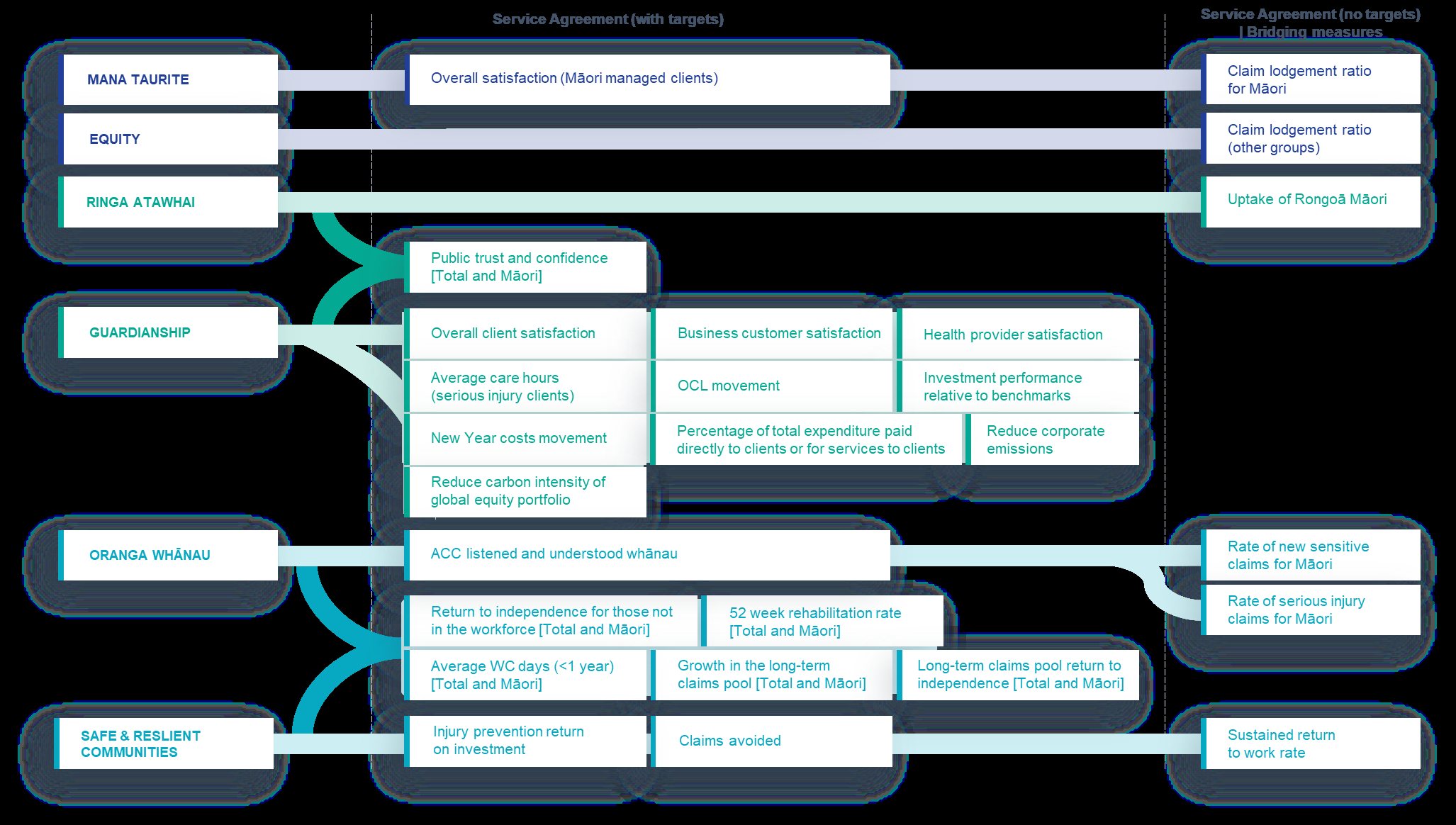 Appendix 1: SA24 performance framework - Core strategic goals
Board Paper
Page 7 of 14
IN CONFIDENCE
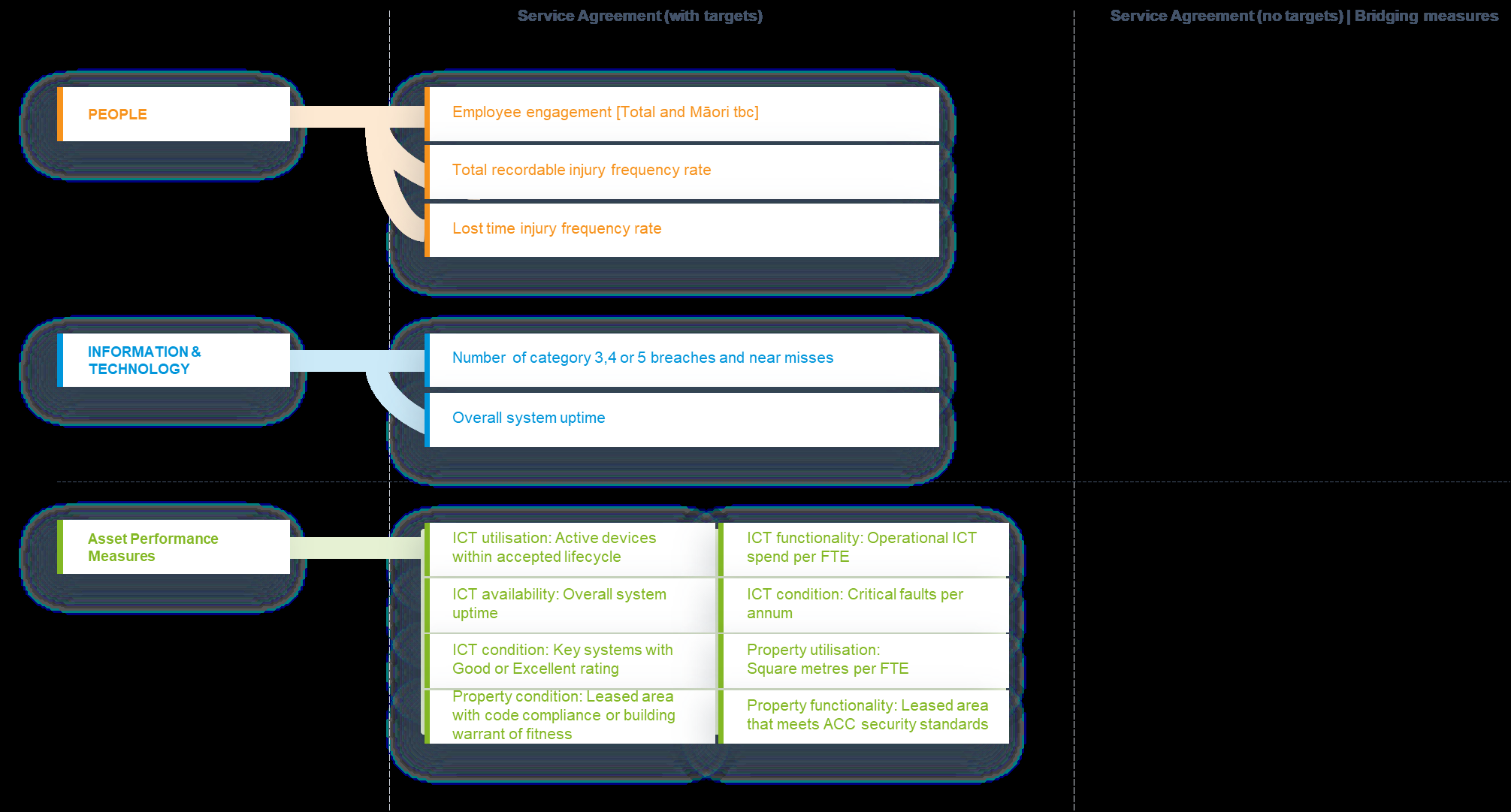 Appendix 1: SA24 performance framework – Organisational health and capability goals
Board Paper
Page 8 of 14
IN CONFIDENCE
Appendix 2: Measure glossary
Measure Name
Definition
Goal
52 Week rehabilitation rate
The percentage of clients receiving weekly compensation, who return to work within one year (365 days). A client is
Oranga Whānau | Safe
considered to have returned to work five weeks after the cessation of weekly compensation payments. Presented
and Resilient
as a 52-week rolling average result.
Communities
ACC listened and understood whānau
A measure where managed clients rate the level to which they agree with the statement: “The people I have dealt
Oranga Whānau | Safe
with at ACC have listened and understood my personal circumstances”. Respondents rate on a scale of 1 (strongly
and Resilient
disagree) to 5 (strongly agree) The measure is the percentage of clients that rate 4 (agree) and 5 (strongly agree).
Communities
Presented as a rolling four-quarter result.
Average care hours (serious injury clients)
The average annual hours of attendant care, home help and childcare per Serious Injury claim. Presented as a
Ringa Atawhai |
rolling four-quarter result.
Guardianship
Average WC days (<1 year)
The average number of weekly compensation days paid (AWCDP) for all clients returning to work (exits) with less
Oranga Whānau | Safe
than 365 days paid. Presented as a 52-week rolling result.
and Resilient
Communities
Business customer satisfaction
A measure where business customers (who have had personal contact with ACC in the last 12 months) are asked
Ringa Atawhai |
to rate their overall satisfaction with ACC in response to this question: “How satisfied were you that ACC met the
Guardianship
needs of your business on that occasion?” Business customers rate on a scale of 1 (very dissatisfied) to 5 (very
satisfied). The CSAT is the percentage of business customers that rate 4 (satisfied) and 5 (very satisfied). The
survey samples self-employed persons as well as the owners or senior managers of small, medium and large
businesses. Results are weighted by business size. Presented as a rolling four-quarter result.
Claims avoided
The number of claims avoided in the areas where we have targeted injury prevention programmes. Presented as a
Oranga Whānau | Safe
year-to-date result.
and Resilient
Communities
Employee engagement
Employee engagement is measured annually using a Gallup survey tool. Our people respond anonymously to 12
Organisational Health and
questions which cover aspects of engagement including basic needs, management support, teamwork and
Capability
belonging, and growth. The overal engagement score is calculated as the grand mean for all employees across all
12 questions. Result presented annually.
Growth in the long-term claims pool
The proportional change or growth in the number of claims who have received weekly compensation for more than
Oranga Whānau | Safe
365 days. Presented as a point in time result.
and Resilient
Communities
Health provider satisfaction
A measure where providers rate their overall satisfaction with ACC in response to this question: ‘Generally
Ringa Atawhai |
speaking, how satisfied or dissatisfied are you with your current relationship with ACC?’
Guardianship
Providers rate on a scale of 1 (very dissatisfied) to 5 (very satisfied). The CSAT is the percentage of providers that
rate 4 (satisfied) and 5 (very satisfied). The provider sample is stratified by equal proportions of the following
segments: GPs, Physiotherapists, Other Health Providers, Other Al ied Health Professionals, Specialists and
Rehabilitation Providers. Data is weighted to reflect population i.e., amount of contact with ACC. Presented as a
rolling four-quarter result.
Board Paper
Page 9 of 14
IN CONFIDENCE
Measure Name
Definition
Goal
ICT Availability – Overall operational system
Percentage of time key applications and networks are available to perform required functions. Presented as a year-
Asset Performance
availability
to-date result.
ICT Condition: Number of critical faults (P1) per
Number of critical faults (P1) for key ACC systems per annum. Presented as a year-to-date result.
Asset Performance
annum
ICT Condition: Percentage of key systems with a
Percentage of key systems with a condition rating of Good or Excellent. Condition is based on currency of
Asset Performance
condition rating of Good or Excellent
supportability factor. Presented as a year-to-date result.
ICT Functionality – Total operational ICT spend per
The total operational ICT spend across the organisation per FTE to provide ICT services enabling delivery
Asset Performance
FTE
organisational outcomes. Presented as a year-to-date result.
ICT Utilisation – Use of Technology
Percentage of active ACC computer devices that are within the accepted lifecycle target. Presented as a year-to-
Asset Performance
date result.
Injury prevention return on investment
The return on investment from our injury prevention investments. This consists of two parts: the historical value of
Oranga Whānau | Safe
claims saved divided by the cost of the interventions to date, and the 10-year expected claims saved divided by the
and Resilient
likely future cost of the interventions. The future investment and value of claims saved in the calculation of the
Communities
return on investment are discounted using our expected investment rate of return. The workplace measure
excludes ACC’s investment with WorkSafe New Zealand. Presented as an evaluation of the costs and savings at a
point in time.
Investment performance relative to benchmarks
A measure of ACC’s investment performance after costs compared with the industry standard. Measured as the
Ringa Atawhai |
percentage above the blended market average benchmark. Presented as a year-to-date result.
Guardianship
Long-term claims pool return to independence
The net number of Long-Term Claim Pool clients who have returned to independence (ceased receiving weekly
Oranga Whānau | Safe
compensation) in 12 months. A Long-Term Claim Pool client has received weekly compensation for more than 365
and Resilient
days. Presented as a rolling 12-month result.
Communities
Lost time injury frequency rate
The number of lost-time incidents per mil ion hours worked. Presented as a year-to-date result.
Organisational Health and
Capability
New year costs movements
Movement in the expected lifetime cost to ACC for new accidents in the financial year, excluding legislation and
Ringa Atawhai |
policy changes.
Guardianship
Number of category 3,4 or 5 privacy breaches and
The number of category 3, 4 and 5 privacy breaches and near misses (as defined by the Government Chief Privacy
Organisational Health and
near misses
Officer’s privacy matrix based on date of notification. Excludes incidents where behaviour occurred three or more
Capability
years ago. Presented as a year-to-date result.
Property utilisation: Square metres per FTE
Square metres (m2) of leased area per full-time equivalent. Presented as a point in time result.
Asset Performance
Property condition: Leased area with code
Percentage of total leased area with a current code of compliance certificate / building warrant of fitness. Presented
Asset Performance
compliance or building warrant of fitness
as a point in time result.
Property functionality: Leased area that meets
Percentage of total leased area that meets or exceeds the ACC security standards. Presented as a point in time
Asset Performance
ACC security standards
result.
Board Paper
Page 10 of 14
IN CONFIDENCE
Measure Name
Definition
Goal
OCL movement
The movement in the total OCL strain/release excluding legislation and policy changes
Ringa Atawhai |
Guardianship
Overall Client Satisfaction
A measure where managed clients rate their overal satisfaction with how their current claim has been handled by
Ringa Atawhai |
ACC. Respondents rate on a scale of 1 (very dissatisfied) to 5 (very satisfied) – to the question: ‘Overal , how
Guardianship
satisfied are you with the way your claim is being handled by ACC?’ The CSAT is the percentage of managed
clients that rate 4 (satisfied) and 5 (very satisfied). The survey samples managed clients – clients who have
received an entitlement in the last 70 days (excluding Serious Injury and Sensitive claims). Data is weighted by
recovery team. Presented as a rolling four-quarter result.
Overall Satisfaction (Māori managed clients)
A measure where managed clients who identify as Māori rate their overall satisfaction with how their current claim
Mana Taurite | Equity
has been handled by ACC. Respondents rate on a scale of 1 (very dissatisfied) to 5 (very satisfied) – to the
question: ‘Overall, how satisfied are you with the way your claim is being handled by ACC?’ The CSAT is the
percentage of managed clients that rate 4 (satisfied) and 5 (very satisfied). Presented as a rolling four-quarter
result.
Overall system uptime
Percentage of time key applications and networks are available to perform required functions. Presented as a year-
Organisational Health and
to-date result.
Capability
Percentage of total expenditure paid directly to
The proportion of expenditure (claims paid and administration costs) paid for clients (claims paid). Investment costs
Ringa Atawhai |
clients or for services to clients
are excluded. Presented as a year-to-date result.
Guardianship
Public trust and confidence
A measure where respondents rate their overall trust and confidence in ACC in response to this question.
Ringa Atawhai |
Presented as a rolling four-quarter result.
Guardianship
Reduce carbon intensity of global equity portfolio
This metric incorporates all the emissions for which our investee companies are directly responsible, the emissions
Ringa Atawhai |
generated in the production of the energy they use, and the emissions embedded in the fossil fuel production
Guardianship
volumes of reserves’ owners in the energy sector and the diversified metals and mining industry.
Reduce corporate emissions
Our corporate emissions are the tCO2e of our corporate-related Scopes 1 and 2 and certain Scope 3 emissions
Ringa Atawhai |
measured using an emissions tracker based on the Ministry for the Environment’s emissions factors.
Guardianship
Return to independence for those not in the
The proportion of clients (who have never received weekly compensation) who have returned to independence
Oranga Whānau | Safe
workforce
(ceased receiving any entitlement payments) in 12 months. Presented as a rolling 12-month result. (Excludes
and Resilient
serious injury claims).
Communities
Total recordable injury frequency rate
The number of lost-time incidents, restricted work incidents and medical treatment incidents per mil ion hours
Organisational Health and
worked. Presented as a year-to-date result.
Capability
Board Paper
Page 11 of 14
IN CONFIDENCE
Bridging measures
Bridging Measure Name
Definition
Goal
Claim lodgement ratio for Māori
Proportion of Accepted claims for Māori compared to Māori population of Aotearoa New Zealand (Number of claims
Mana Taurite | Equity
made per 1,000 of population). Presented as a rolling four-quarter result.
Claim lodgement ratio (other demographics)
Proportion of Accepted claims for the selected population compared total size of the selected population within of
Mana Taurite | Equity
Aotearoa New Zealand (Number of claims made per 1,000 of population). Presented as a rolling four-quarter result.
Priority population groups are those who disproportionality face barriers to accessing our Schemes and
entitlements, and experience inequities in health and wellbeing outcomes. Our priority population groups wil be
confirmed through further research. We already know from existing research that Māori, Pacific people, disabled
people, and women experience inequities in accessing our Schemes and in wellbeing outcomes. Presented as a
rolling four-quarter result.
Rate of new sensitive claims for Māori
Proportion of accepted sensitive claims for Māori compared to Māori population of Aotearoa New Zealand (Number
Oranga Whānau | Safe
of claims made per 10,000 of population). Presented as a rolling four-quarter result.
and Resilient
Communities
Rate of serious injury claims for Māori
Proportion of accepted Serious Injury claims for Māori compared to Māori population of Aotearoa New Zealand
Oranga Whānau | Safe
(Number of claims made per 10,000 of population). Presented as a rolling four-quarter result.
and Resilient
Communities
Sustained return to work rate
The percentage of clients in the Work Account who have returned to work and have remained at work. Presented
Oranga Whānau | Safe
as a rolling four-quarter result.
and Resilient
Communities
Uptake Rongoā Māori
Number of claims that use rongoā Māori on a 12-month rolling annual basis. Claims that use the service across
Ringa Atawhai |
multiple months wil be counted in each month where the service was used. Presented as a year-to-date result.
Guardianship
Board Paper
Page 12 of 14
IN CONFIDENCE
Appendix 3: Mapping current performance framework to new
The following provides a breakdown of how the current performance framework (Service Agreement 2022/23) maps to the proposed framework for SA24.
Injury Prevention
Customer Outcomes and Experience
Sustainability
Return on Investment 0-20 year
Replaced with single ROI for entire
Replaced with Ave WC days paid
No - Can be managed through
Change in average treatment cost.
programmes
portfolio
Return to work within ten weeks
<365 and RTW 365
financial control processes
Return on Investment Workplace
Replaced with single ROI for entire
Replaced with Ave WC days paid
No - Can be managed through
Administration costs per active claim.
programmes
portfolio
Return to work within nine months
<365 and RTW 365
financial control processes
Percentage of total expenditure paid
Investment in Kaupapa Māori IP
Replaced with Ave WC days paid
directly to clients, or for services to
Included
programmes
No - organisational performance
Average Weekly compensation days
paid
<365 and RTW 365
clients.
Claims processed per full time
No - Can be managed through
Number of claims avoided
Included
Return to independence for those not
Included
in the workforce
equivalent.
financial control processes
Average care hours per serious
Rate of SI & fatal 0-20 programmes
No - context from rate of SI and rate
Included
of SC
Public trust and confidence
Included
injury claim
Replaced with Influenceable
Rate of SI Workplace programmes
No - context from rate of SI and rate
of SC
Client net trust score
Replaced with Satisfaction
Actuarial movement
movement in OCL and claims costs
Speed of cover decisions - non
Investment performance after costs
No - organisational performance
Included
complicated claims
relative to benchmark
Investment management costs as a
Speed of cover decisions -
No - organisational performance
proportion of total funds under
No - organisational performance
complicated claims
management
Reviews as a percentage of cover
No - organisational performance
decline decisions
Average time to resolution for claims
No - organisational performance
with reviews.
Proportion of ACC reviews upheld (in
No - organisational performance
favour of ACC).
Organisational health and capability
ACC focused on the best possible
No - Managed through drivers of
outcomes
client satisfaction
Replaced with engagement grand
Employee Net Promoter Score
Client net trust score for Māori
Replaced with Satisfaction
mean
Proportion of ACC staff who identify
Contextual information included in
Replaced with Claim lodgement ratio
Māori lodgement ratio
as Māori
SA24 - no targets
for Māori
Proportion of ACC staff who identify
Contextual information included in
Provider net trust score.
Replaced with Satisfaction
as having a disability
SA24 - no targets
Total recordable injury frequency
Included
Business net trust score.
Replaced with Satisfaction
rate
Lost time injury frequency rate
Included
Growth in the Long-term claims pool
Included
The number of category 3, 4 and 5
privacy breaches and near misses
Included (with smal change to
Long Term Claim Pool returns to
Included
(as defined by the Government Chief
methodology
independence
Privacy Officer’s privacy matrix
Overall operational system
Rate of long-term clients in part-time
Included
No - organisational performance
availability
work.
Board Paper
Page 13 of 14
IN CONFIDENCE
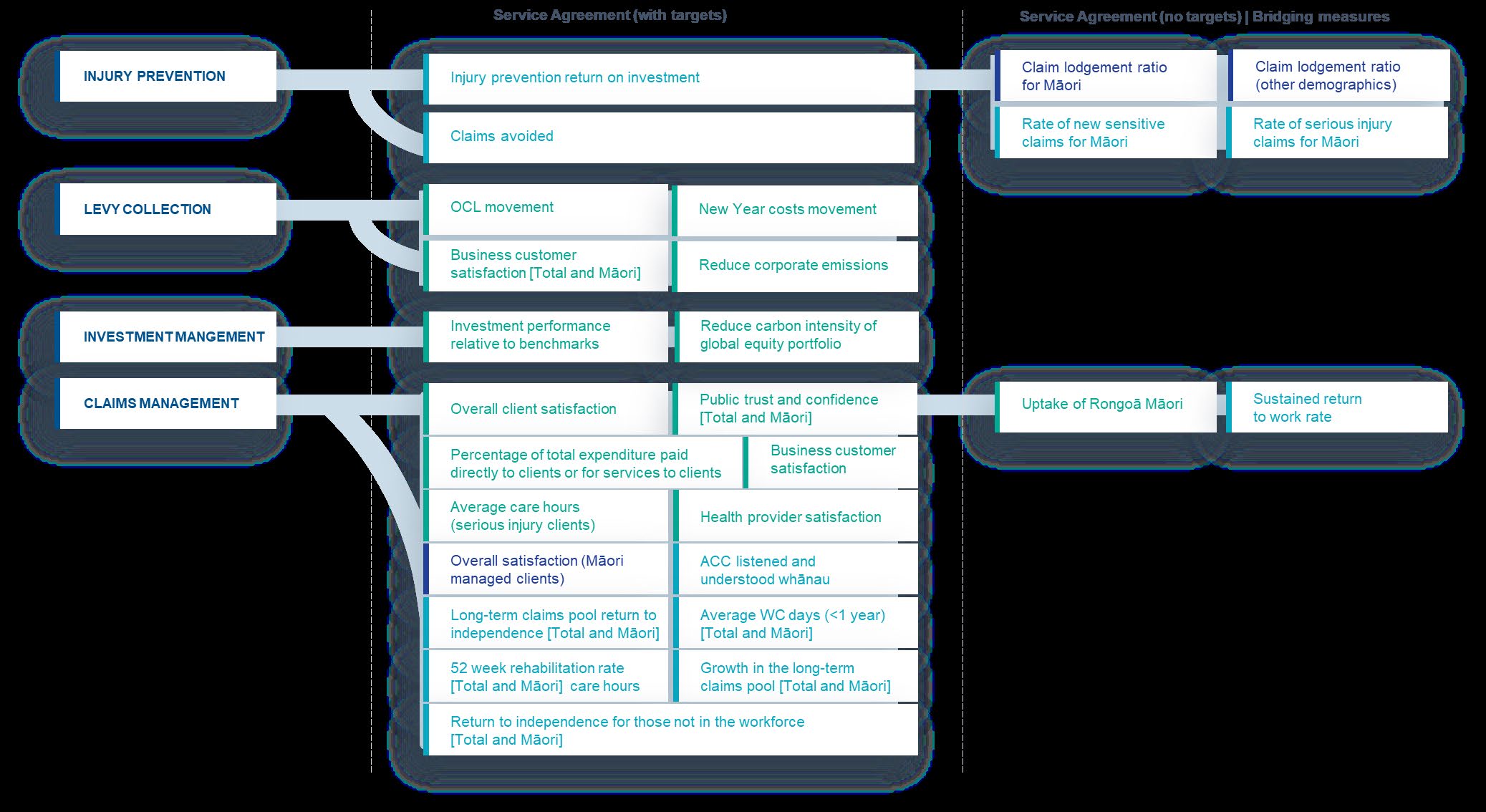 Appendix 4: SA24 core goal measures to Outputs
Board Paper
Page 14 of 14
IN CONFIDENCE
