Historical development and councils’ interactions with
Whareroa Marae and the
Mount Maunganui Industrial Area
Brief History
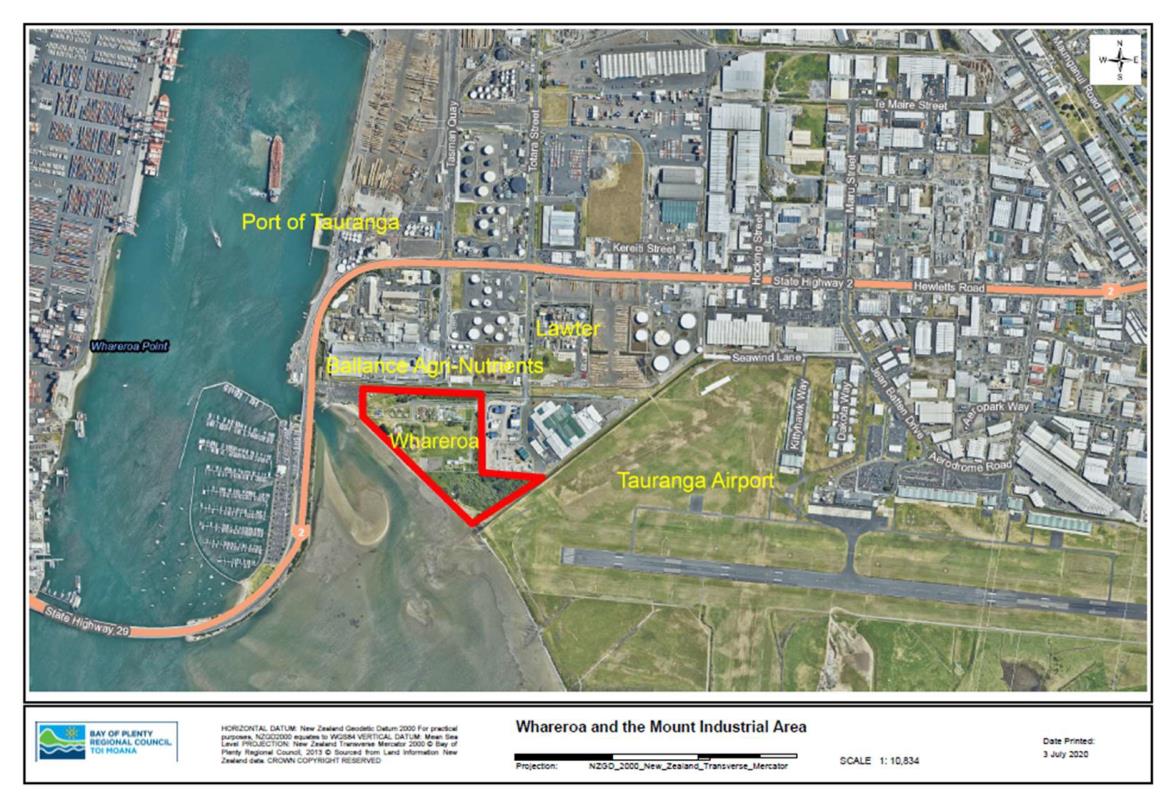
Whareroa Marae and the adjoining community is situated on the shore of Tauranga
Harbour, neighbouring the Mount Industrial Area, primarily made up of industrially
zoned land (as determined by the Tauranga City District Plan). The Whareroa Marae is a
traditional pa site and key marae for Ngai Tukairangi and Ngāti Kuku hapū of the Ngāi
Te Rangi Iwi. Whareroa Marae has been present since the early 1870’s, making it one of
the oldest kainga in the area.
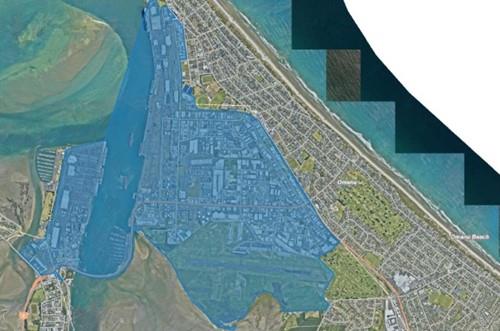
The Mount Industrial Area covers approximately 930 hectares and with around 650 – 700
businesses operating in the area. The image below shows the boundary of the gazetted
Mount Maunganui Airshed.
A brief outline of the history of development in the Whareroa / Mount Maunganui
Industrial area:
Whareroa is the whenua of Ngai Tukairangi me Ngati Kuku Ki Whareroa, hapū
of Ngāi Te Rangi iwi.
1873 – Wharenui “Rauru Kitahi” constructed by chief Taiaho Hori Ngatai,
of Ngāi Te Rangi at Whareroa, opens.
September 1873 – the Port of Tauranga was officially established by order of
the Governor of New Zealand.
1880’s – 1890’s - Crown purchasing activity led to the loss of lands at one of
Ngāi Te Rangi’s most significant sites, Mauao.
1927 – Railway wharf at Tauranga, was completed and used almost
exclusively for coastal shipping until October 1948.
1930’s to 1950’s – harbour side blocks compulsorily acquired under the
Public Works Act between Hull Rd and Whareroa Marae
14 January 1939 –Tauranga Airport officially opens.
1940’s to 1950’s – Ballance Agri-nutrients and Port development and
expansion.
1952 – Crown obtains further land under the Public Works Act for “better
utilisation”.
November 1953 – First pile driven for new wharf at Mount Maunganui.
2 October 1962 – Map submitted to Commission of Enquiry proposing the Mount
Industrial Area and the reclamation of Sulphur Point.
1974 – Mount Maunganui Borough District Scheme identifies all land to the north of
Whareroa Marae being zoned Industrial D.
June 1979 – Whareroa boat ramp established as a single lane (and expanded in
2006/2007 to a two-lane ramp). In September 2006, consent was issued for
improvements to the ramp by placing new pontoons there.
1980 - The tanker berth dedicated to the transfer of dangerous goods in bulk was
completed.
13 March 1988 – Official opening of the Tauranga Harbour Bridge
1992 – Dredging program completed to allow larger vessels to enter the Port.
April 1992 – The Tauranga wharves were completed and officially opened by the
Governor General.
23 September 1998 – extension to Tauranga Airport commences.
July 2009 – An application is lodged for a dredging consent to dredge channels to 14.5
meters draught at low water.
7 September 2009 – the Harbour Link Project opens which includes a new bridge
constructed next to the original.
July 2020 – The Port of Tauranga owns 113 hectares of land at Mount Maunganui that
includes wharves and surrounding industrial land uses.
Chronological history of development in the Whareroa area (Tauranga City Council).
Date
Correspondence and / or Action
March 1979
A report summarising initial investigations and development studies of
Whareroa Marae is completed for and on behalf of the Maori Trustee and
lodged with Council. Proposed retaining the marae site, enabling
residential to the north and rezoning the land to the east for light industrial.
2 July 1979
Whareroa Marae provide the report (March 1979) and request rezoning of
land through the Third Review of the District Scheme.
16 November 1979 The Maori Land Court approves to provide the Maori Trustee the power
subdivide and sell portions of Whareroa 2E7B.
November 1982
Mount Maunganui Borough Council finalise the Third Review of the District
Scheme that implements the Whareroa Marae report (March 1979)
1993
Whareroa Marae committee raised issues of erosion as a result of the
Tauranga Harbour Bridge opening.
8 December 1995 BOPRC grant resource consent to TCC to undertake erosion protection at
Whareroa Marae.
16 June 2004
Ngai te Rangi again expressed concern that the Whareroa Marae foreshore
erosion had escalated since the construction of the Tauranga Harbour
Bridge.
1 March 2005
Council agrees to road access over reserve land for new Ngai Te Rangi Iwi
Office
June 2009
Report on foreshore erosion at Whareroa Marae prepared by Tonkin &
Taylor. An assessment was undertaken of coastal erosion processes and
remedial solutions for the shoreline fronting Whareroa Marae. Four options
were provided to mitigate against the Whareroa Marae’s erosion due to
onshore wave action from wind-generated waves within the harbour
resulting in lowering of the beach and undercutting of the bank toe. T&T
recommended option one was undertaken to include a combination of hard
and soft solutions. This included increasing the height of the existing five
timber groynes by 300mm and erecting three new timber groynes of similar
construction.
15 March 2011
Exchange of land between TCC and Trustees for Whareroa 2E No 8 Block.
24 October 2012
Hui on the Stormwater Catchment Management Plan
2013
Ngati Kuku prepare a Cultural Impact Assessment for the Stormwater
Catchment Management Plan. The information was compiled during
meetings at Whareroa Marae and Te Runanga o Ngai Te Rangi Iwi Trusts
Resource Management Unit.
April 2014
Stormwater Catchment Management Plan is finalised for Mount Industrial
and Sulphur Point areas.
3 August 2016
TCC installs CCTV security camera in the Whareroa Reserve.
17 February 2020
Inter-agency hui hosted by Whareroa Marae includes Ministry for the
Environment, BoPRC, TCC and Toi Te Ora. The outcome is a large number of
concerns raised by the community, which the government agencies are to
respond to with a plan of actions to be undertaken.
18 March 2020
Letter from BoPRC & TCC to Whareroa acknowledging the hospitality of the
marae in hosting the government agency hui on 17 February 2020 and
outlining council actions going forward.
8 July 2020
Hui with Whareroa and TCC to discuss plan changes (26, 27 30).
Consent Monitoring (TCC)
Applications that have been lodged with TCC within the vicinity of Whareroa Marae range
from petrol store tanks, to operate a scrap metal handling, sorting and processing facility,
Storage and use of hazardous substances to exceeding the 16-metre height limit for the
purpose of container storage. It is noted that there are land uses that have established as a
Permitted Activity and therefore no resource consent is required.
Stormwater Catchment Management Plan (TCC)
The purpose of the Stormwater Catchment Management Plan (the Plan) is to establish an
integrated stormwater approach in the Mount Industrial area. The Plan outlines and
incorporates the key stormwater issues and objectives for this catchment and addresses the
effects of stormwater discharges on the receiving environment, Te Awanui (Tauranga
Harbour). The Plan provides a suite of management methods implemented programmed or
available in the future to mitigate identified issues. The Plan was approved in April 2014, with
an annual summary report prepared every 12months and monitoring report every 5 years in
accordance with the comprehensive stormwater consent conditions.
Ngai Tukairangi and Ngati Kuku prepared cultural Impact Assessments in the preparation of
the Stormwater Catchment Management Plan that included Hui with Whareroa Marae.
Air Quality monitoring & compliance enforcement (BOPRC). A timeline and actions
undertaken to monitor and improve air quality in the Mount Maunganui Industrial Area.
1995: Environment and Science Research (ESR) undertook SO2, NOx and Fluoride monitoring
in Totara Street.
1999: Prosecution - BoPRC take a successful prosecution against Ballance Agri-nutrients for
breach of consent conditions. The discharge of excessive SO2 gas resulted in a court-imposed
fine of $35,000.
2000: Air quality complaints data is available from this year. The general trend has shown Air
Odour has always dominated annual complaints, lately associated with pet food
manufacture.
2001 – 2003: Total Suspended Particulates and fine dust/PM10 monitoring undertaken at
Totara Street.
2001: TSP monitoring undertaken to determine dust emissions from Fletcher Challenge
timber processing plant in McRae Avenue. This was in response to public complaints. No
exceedances were detected.
2002: Enforcement – one infringement notice issued for unauthorised discharge.
2003: Regional air quality inventory completed included analysis of air emission sources in the
Tauranga urban area.
Enforcement – one infringement notice issued for unauthorised discharge.
2004: The National Environmental Standards for Air Quality (NESAQ) became legislation. This
set ambient air quality limits for Carbon Monoxide, Nitrogen Dioxide, Ozone, Sulphur Dioxide
and PM10.
Enforcement – three infringement notices issued for unauthorised discharges.
2004 / 2005: Dust complaints peak, coinciding with the Port beginning large-scale coal
importation.
2005: The Totara Street air monitoring station was established, monitoring SO2 and Total
Suspended Particulate (TSP) levels. PM10 monitoring was added in 2008.
Enforcement – two infringement notices issued for unauthorised discharges.
2006: Enforcement - four abatement notices issued for unauthorised discharges.
2007: A monitor was established in Maru Street to monitor SO2 and operated until 2010.
Enforcement - one abatement notice issued for an unauthorised discharge.
2008: The Industrial Pollution Prevention Programme (IP3) was established in Mount
Maunganui and has been carried out five times since 2008, inspecting every business
premises in the Mount Industrial area and on Port land to determine the effects of business
activity on air, land and water quality.
2010: Enforcement - three abatement notices issued for unauthorised discharges. Two
infringement notices issued for unauthorised discharges.
2012 (February): BoPRC published the Mount Maunganui Dust Monitoring report by Shane
Iremonger. A comprehensive report investigating all dust emission sources in the Mount
Industrial Area.
Enforcement - two abatement notices issued for unauthorised discharges.
2014: Prosecution - BoPRC take a successful prosecution against Ballance Agri-nutrients for an
unauthorised discharge of SO2 beyond the property boundary resulting in a court-imposed
fine of $60,000.
2014 (June/July): Initial TSP monitoring in De Havilland in response to public complaints.
Enforcement - one abatement notice issued for an unauthorised discharge.
2015: (February/March): Second round of monitoring in De Havilland in response to public
complaints.
2015 (June): Meeting with Ngāti Kuku at Whareroa Marae to hear concerns about the effects
of air quality on people residing around the marae.
2015 (September): Air quality monitoring station installed at Whareroa Marae, sampling the
largest number of contaminants of any of our air monitoring stations (Sulphur Dioxide,
Hydrogen Sulphide, Hydrogen Fluoride, Total Suspended Particulates plus metrological
information)
2016 (February): First SO2 National Environmental Standard Air Quality (NESAQ) exceedance
detected at the Whareroa air-monitoring site.
Enforcement - four abatement notices issued for unauthorised discharges.
2016 (February-May): Seven further exceedances of SO2 NESAQ recorded. BOPRC serve
Abatement Notice to cease breaching NESAQ limits – No further SO2 exceedances recorded
at Whareroa Marae to present day.
2015-2019: Regular hui with Whareroa Marae and Ngāi Te Rangi held to hear their concerns
and keep them informed of ongoing actions from Regional Council.
2016: Dust Audit of the Port of Tauranga, Emission Impossible, and report published April
2017.
2017: Enforcement - seven abatement notices issued for unauthorised discharges. Five
infringement notices issued for unauthorised discharges.
2017: Prosecution - Unauthorised SO2 emission from acidulation site at Ballance. BOPRC take
enforcement action and court imposes fine of $82,000 on Ballance.
2017: Council approves $500,000 additional annual budget over 3 years for enhanced air
quality monitoring.
2017: Ballance spends $8.4million on capital works replacing SO2 convertor that works to
reduce SO2 emissions.
2017: Tender process begins for extensive air monitoring exercise and appointment of an
independent air-monitoring agency. Securing sites and establishing power supply to each new
monitoring location.
2018 (October): Six additional monitoring stations established and operational along the Port
boundary, with one at Sulphur Point. This adds to the three existing stations on Totara /
Maru Street, Whareroa Marae and the Harbour Bridge Marina. Introduced In-situ Volatile
Organic Compound (VOC) monitoring for Methyl bromide, rolled out expansion in PM10 and
SO2 monitoring.
Three additional monitoring stations established along De Havilland Drive to detect PM10
emissions related to activity in this area.
2018: Enforcement - 12 abatement notices issued for unauthorised discharges.
2019: Enforcement - seven abatement notices issued for unauthorised discharges. Two
infringement notices issued for unauthorised discharges.
2019: Exceedances and breaches of NES levels for SO2 and PM10 recorded between January
and March. Investigations indicated PM10 caused by an accumulation of particulate from a
spread of sources and SO2 most likely attributed to emissions from ships, including cruise
ships in berth.
Council Action Plan: Response document following Whareroa, local and central government
hui, Wednesday 19 February 2020.
A hui was convened and hosted at Whareroa Marae to bring together representatives of
Bay of Plenty Regional Council, Tauranga City Council, Toi te Ora District Health Board and
Ministry for the Environment to hear the concerns and gain an appreciation for the physical
location of residents of Whareroa Marae and Taiaho Place, Mount Maunganui.
The key outcome of the hui was local and central government agencies taking away a clearly
vocalised list of concerns of the community surrounding their alienation from their whenua
and moana, their ability to undertake tikanga and importantly the impact on their health from
the large scale industrial discharges which now almost encircle what is left of their land.
To address some of the issues raised and work through a way of improving outcomes for the
Whareroa Community, BoPRC and TCC proposed a set of actions presented to the Marae as
an Action Plan response document.
The community and councils are currently working through this response to ensure the
actions council proposes to undertake meet community expectations and will ensure
improvements and changes can be recorded and measured, and if councils are not the correct
agency to tackle community concerns, then the appropriate agencies will undertake the
actions identified.
