 Attachments
1. Steering Group Report on the review of Te Ture mō Te Reo Māori 2016
2. Terms of reference for the review of Te Ture mō Te Reo Māori 2016
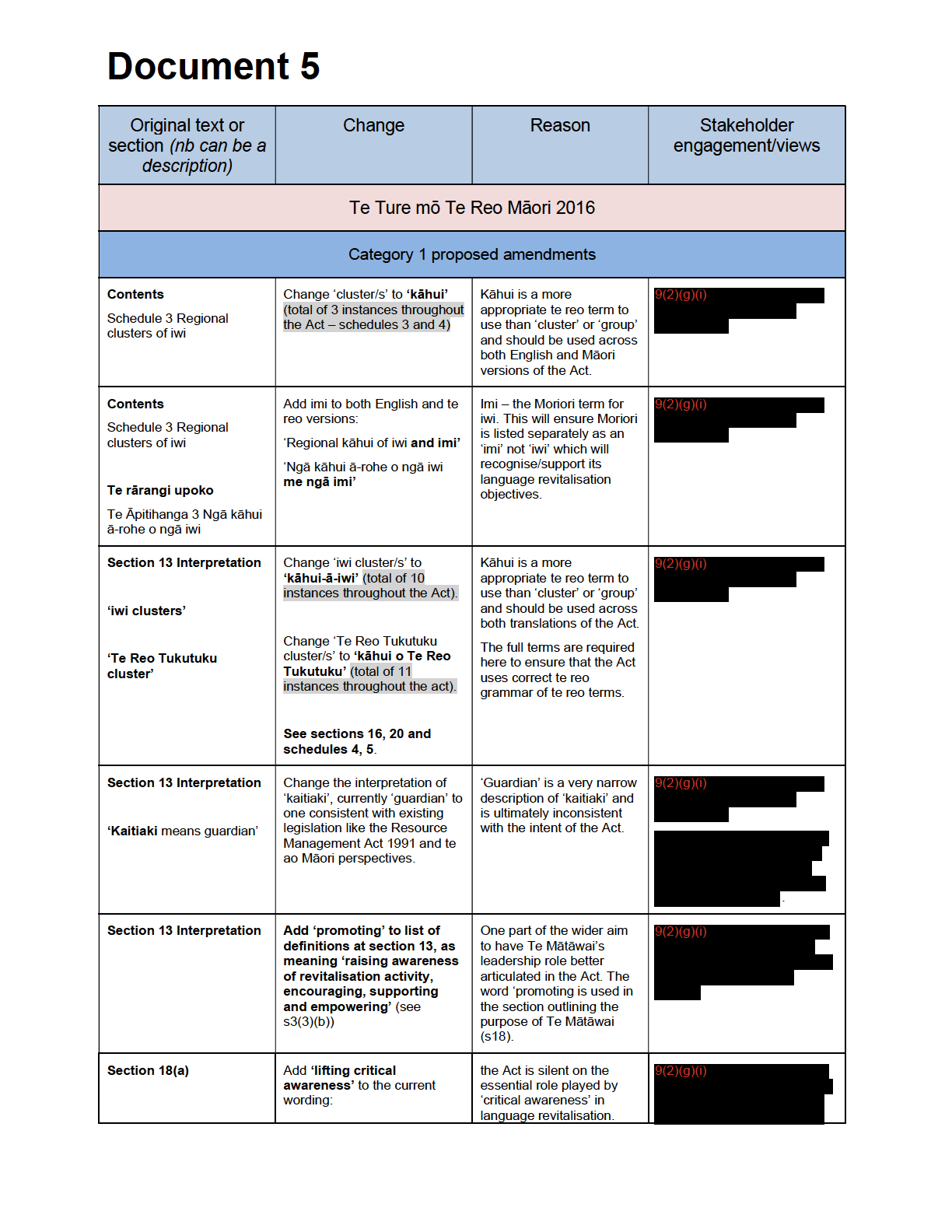
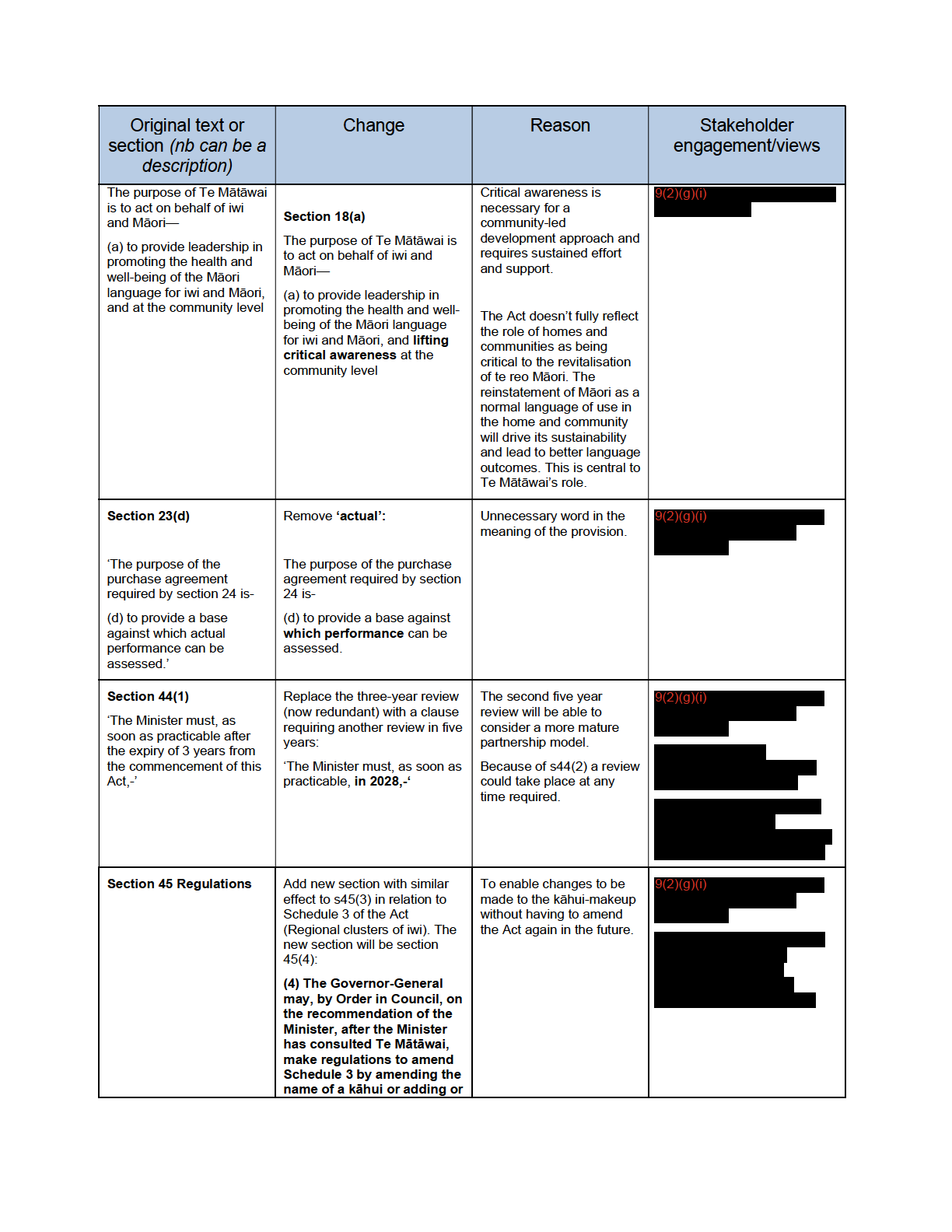
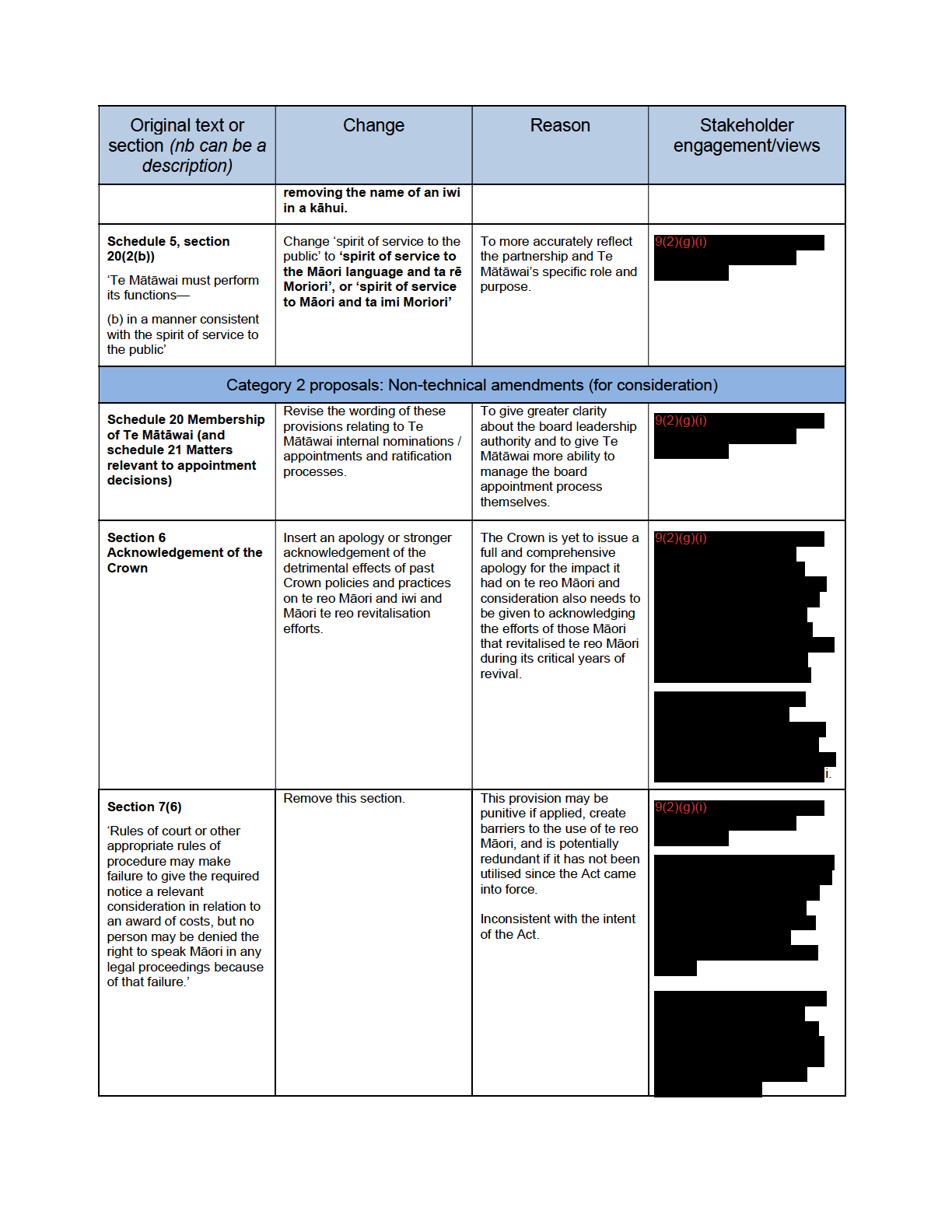
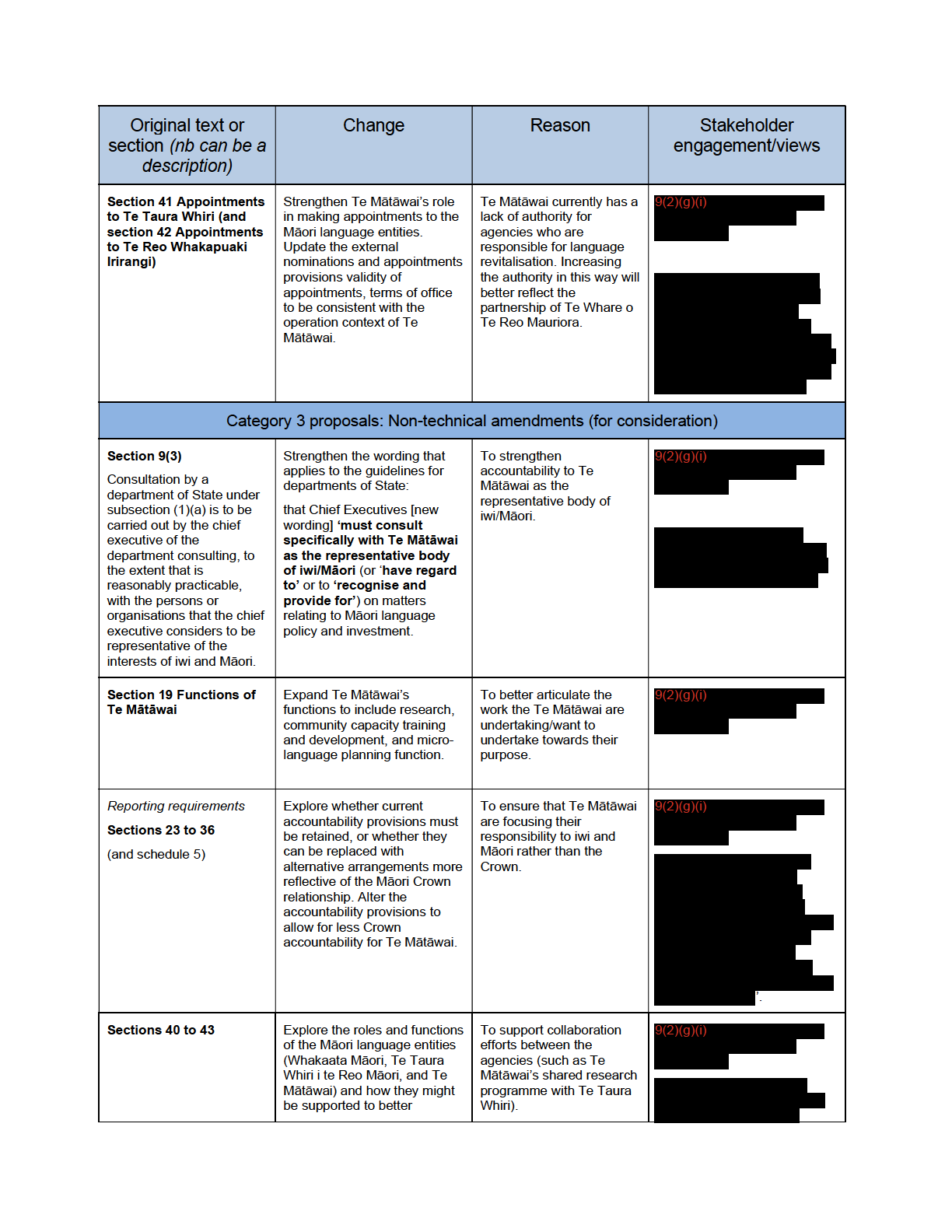
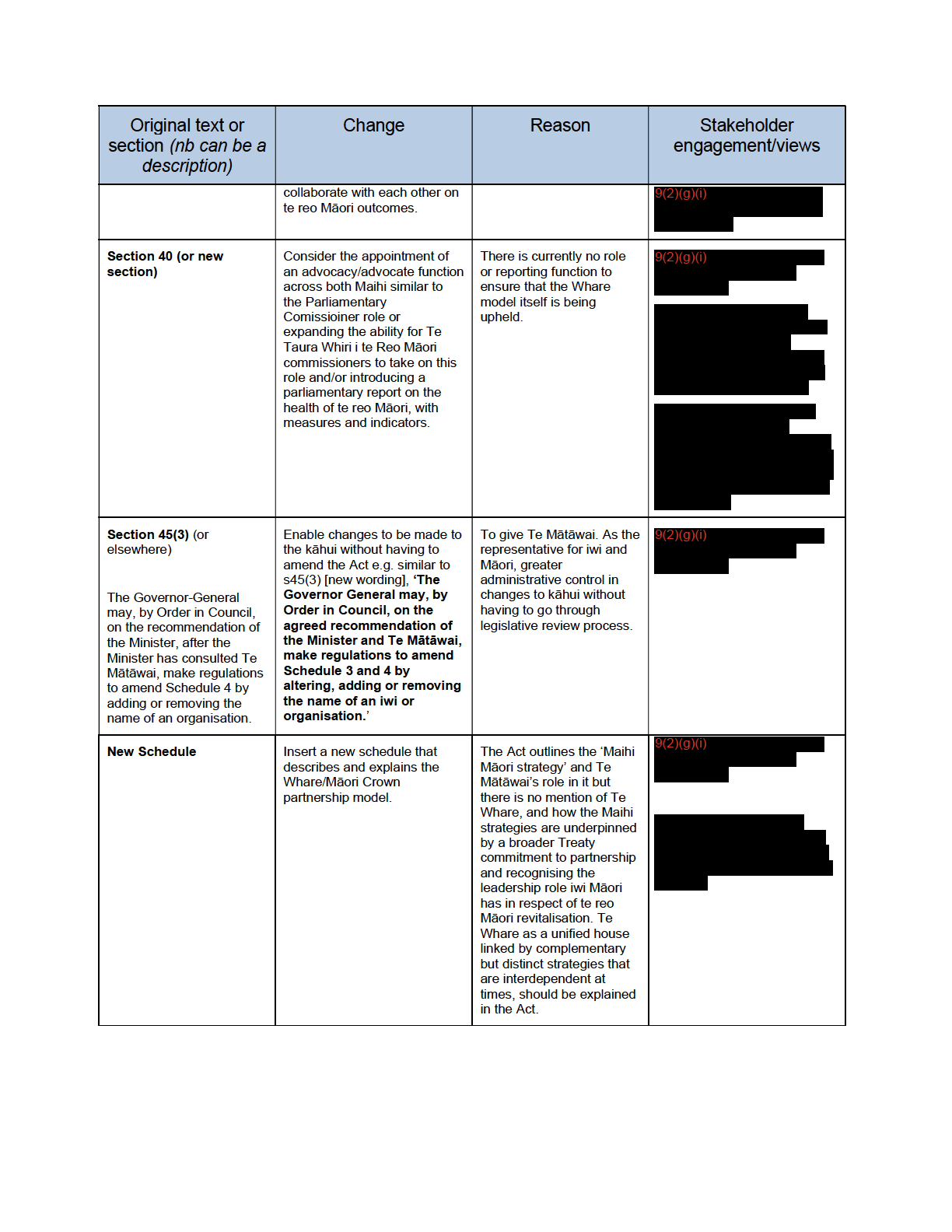
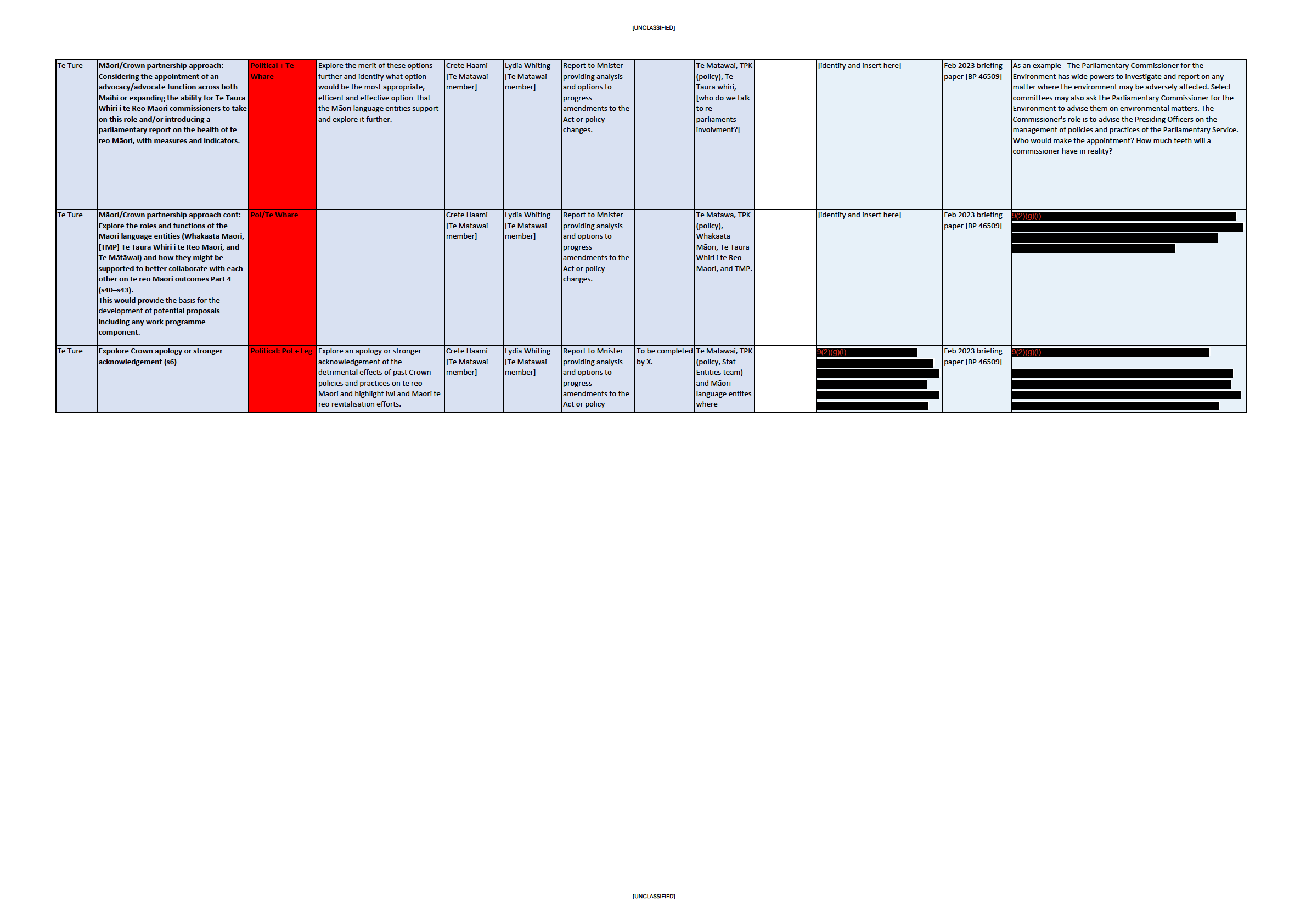
3. Table of proposals
Minister’s office to complete:
☐ Approved
☐ Declined
☐ Noted
☐ Needs change
☐ Seen
☐ Overtaken by Events
☐ See Minister’s Notes ☐ Withdrawn
Comments:
Page 1

17 February 2023
Te Minita Whanaketanga Māori
Te Ture mō Te Reo Māori 2016 review and related advice
Purpose
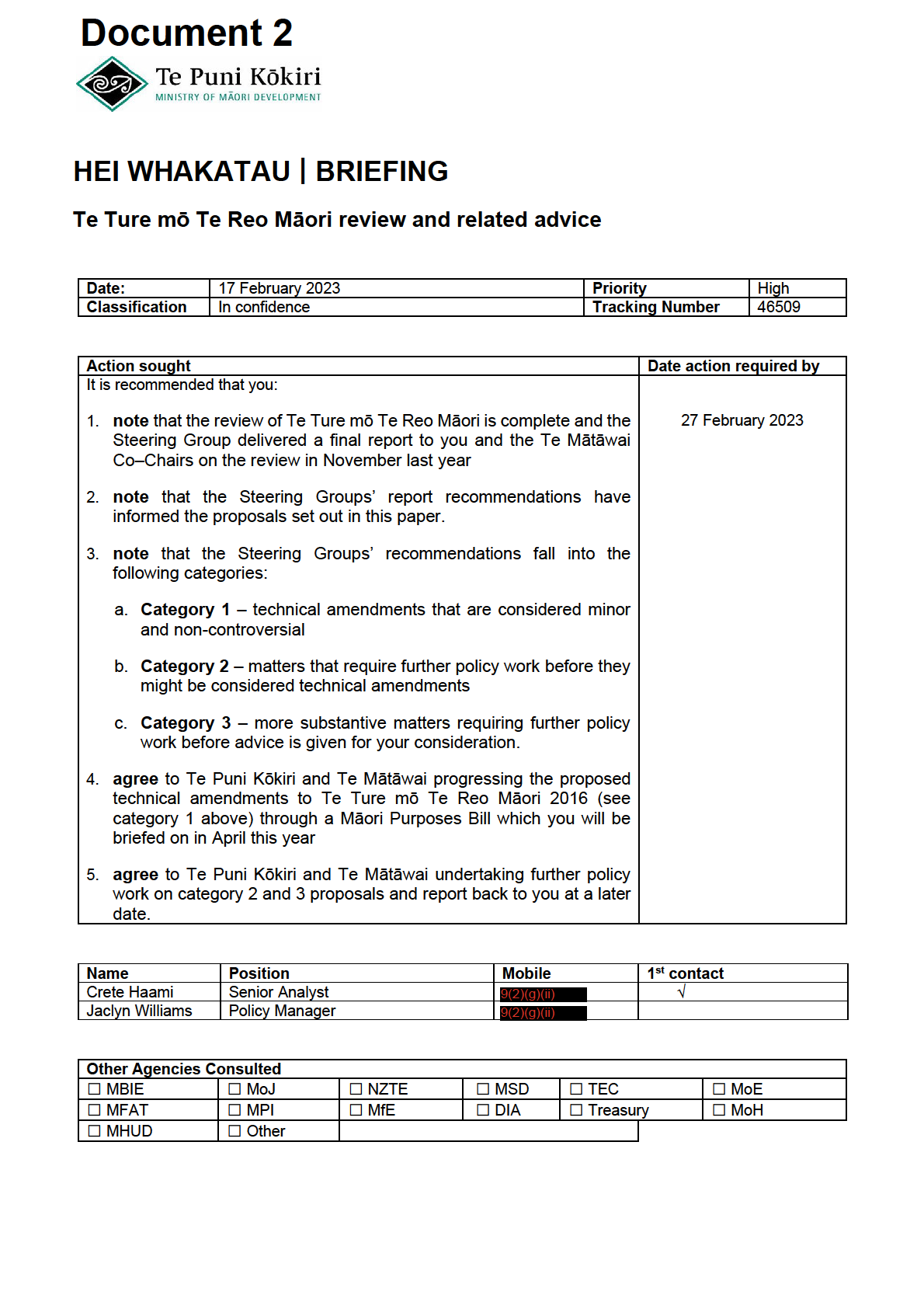
1. This paper seeks your agreement to:
a. officials progressing technical amendments to Te Ture mō Te Reo Māori 2016 (the
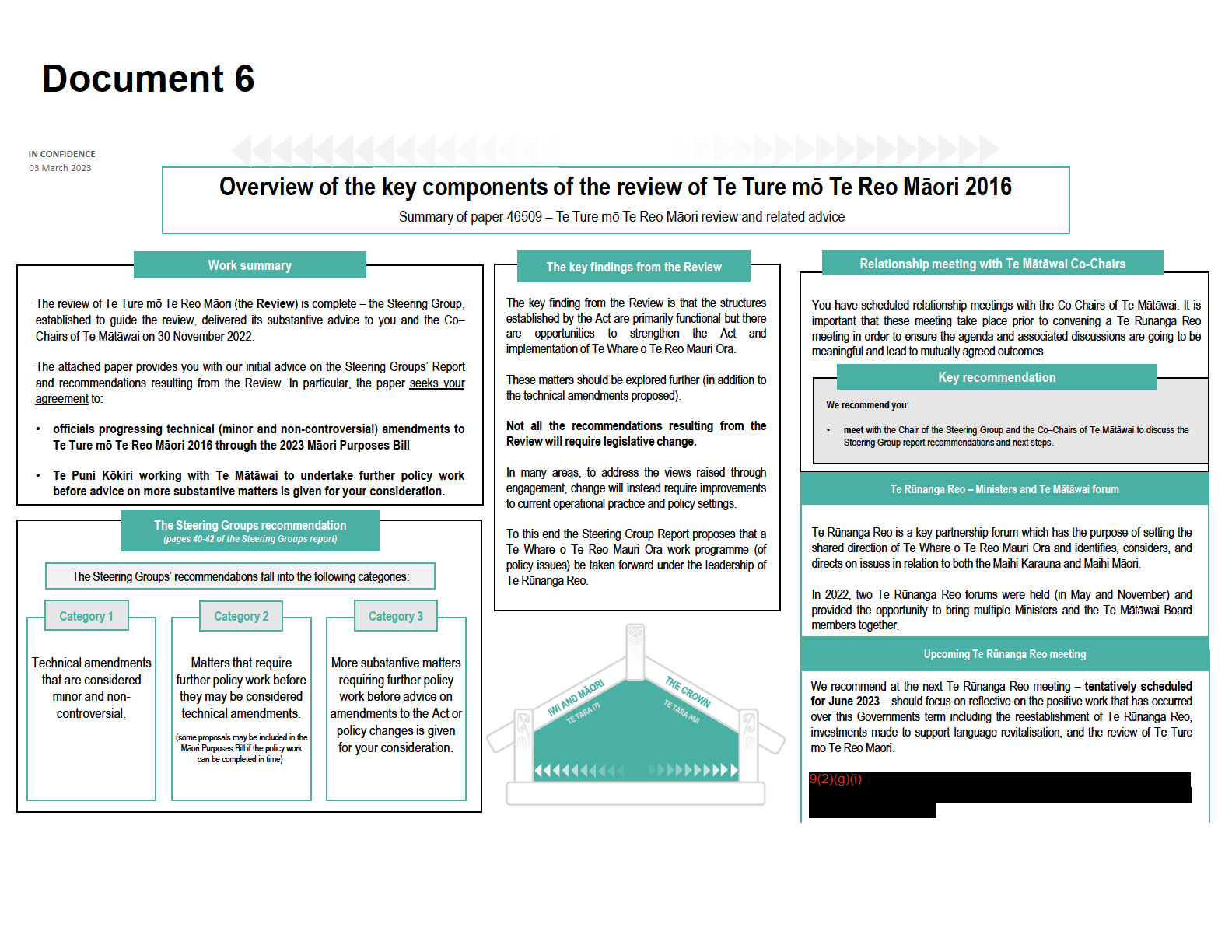
Act)
through a Māori purposes bill this year.
b. Te Puni Kōkiri working with Te Mātāwai to undertake further policy work resulting from the
review.
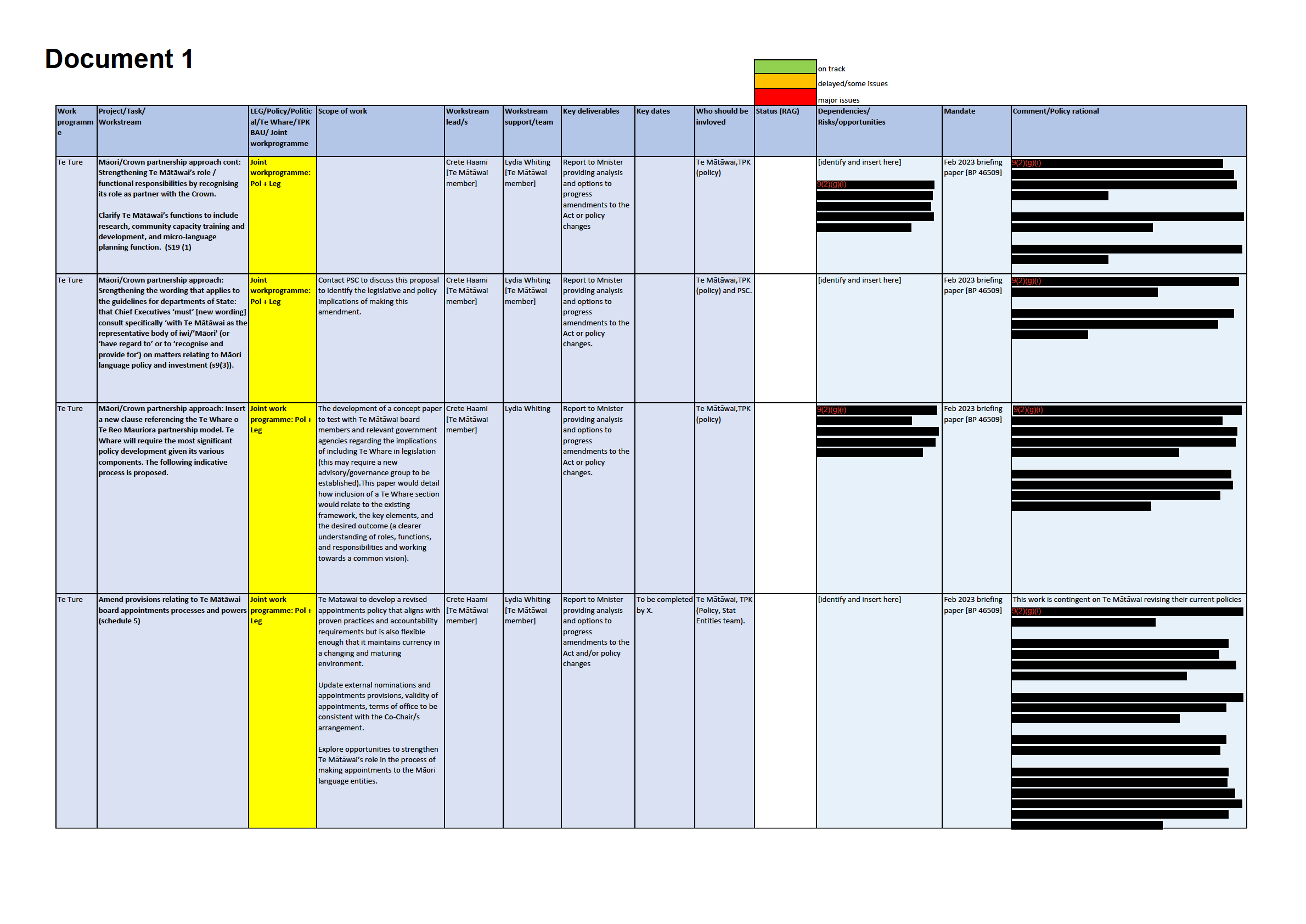
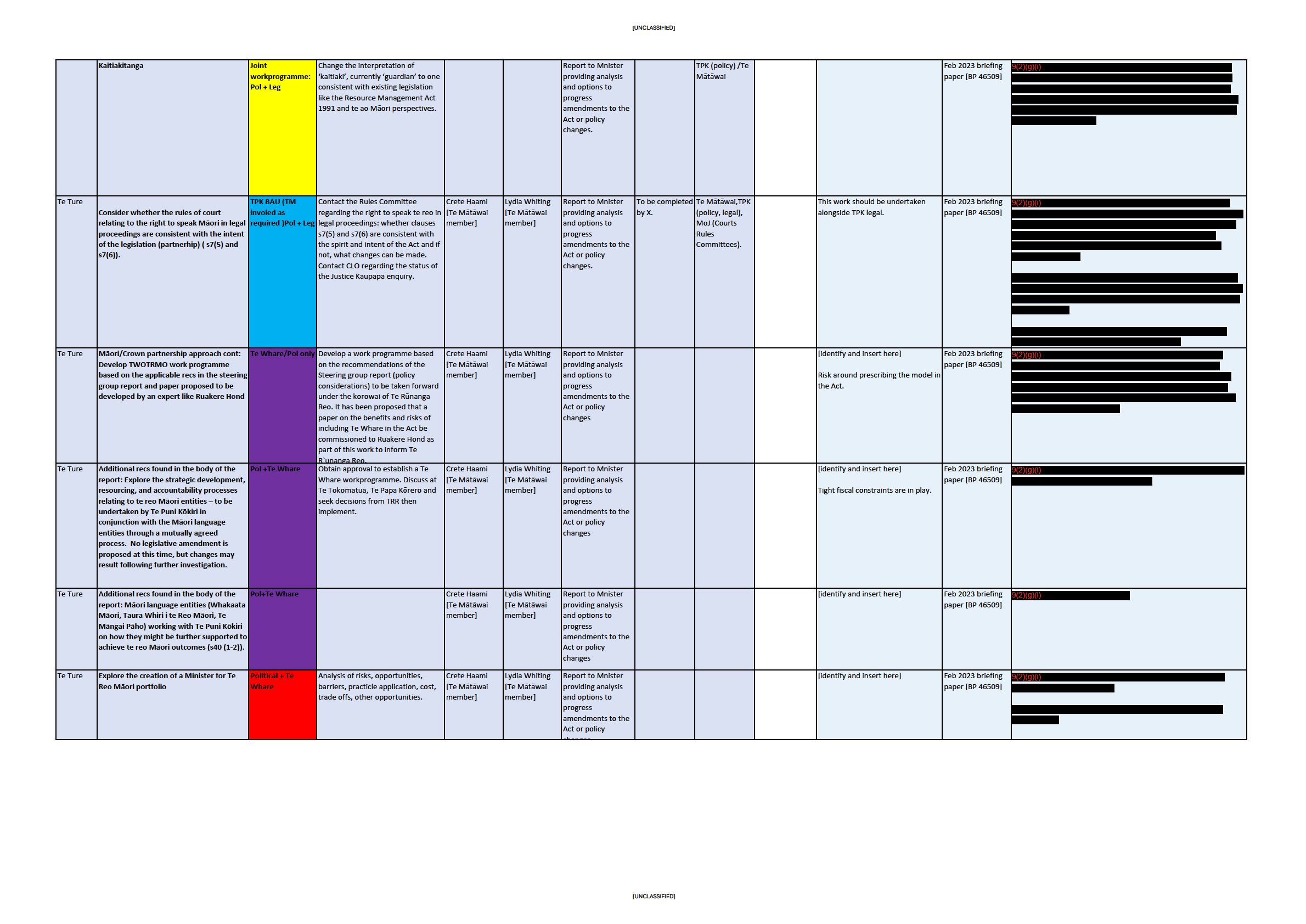
2. It also provides you with advice on the Steering Groups’ report (the
Report) attached as
(
Attachment 1), recommendations resulting from the review (the
Review) of the Act.
Background
3. The Act provides for a partnership approach to language revitalisation whereby the Crown
and Māori (represented by Te Mātāwai) have distinct but complementary roles. The Act also
called for a Review on its operation and effectiveness as soon as practicable three years from
when the legislation which was enacted on 30 April 20161.
4. The purpose of the review was to explore the operation and effectiveness of the Act, with an
aim of strengthening the legislation, in relation to its original intent and to refine it so that it is
fit for purpose to support the delivery of its objectives. The overarching purpose of the Review
is set out in its terms of reference (
Attachment 2). It contains 5 focus areas that form the
basis of the review:
partnership; the status of te reo Māori; the roles of Te Mātāwai; te reo
Māori entities; and government agencies.
5. Because it was a legislative review as opposed to a policy review, the focus was on
understanding the experiences of those key stakeholders who operate under the Act. Primarily
these included government agencies with responsibility for revitalising te reo Māori under the
Maihi Karauna, and iwi and Māori represented by Te Mātāwai and its Ngā Pae Motuhake
Kāhui.
6. The Review provided an opportunity to ensure that this legislation is achieving what it was set
out to do, and to strengthen the role of te reo Māori across government, for iwi and Māori, and
all New Zealanders. It also provided a tangible opportunity to demonstrate meaningful
partnership with Te Mātāwai, from officials right through to Ministerial level. The approach to
the Review reflected a desire to maintain the integral role that te reo Māori has in supporting
cultural, social and economic wel being for Māori and all New Zealanders.
1 Section 44 of the Act: The Minister must, as soon as practicable after the expiry of 3 years from the commencement of this Act: (a)
commence a review of the operation and effectiveness of the Act in accordance with the terms of reference set by the Minister and
Te Mātāwai; and (b) prepare a report on that review.
Page 2
7. Te Whare o te Reo Mauri Ora is an active partnership between the Crown, and iwi and Māori
(represented by Te Mātāwai), established by Te Ture mō Te Reo Māori 2016 to revitalise te
reo Māori. The vision for Te Whare o te Reo Mauri Ora is
Kia mauri ora te reo Māori.
8. In reflecting our approach to date, the review was undertaken in close partnership with Te
Mātāwai, commensurate with the partnership kaupapa of Te Whare o te Reo Mauri Ora, and
with close support from Māori language entities under Vote Māori Development.
9. Given the range of issues raised through the Review, broader engagement and consultation
was subsequently undertaken – more than a technical review might have envisaged. Although
beyond the ambit of technical review, the review enabled a in depth conversation amongst
stakeholders around policy matters, and in turn, identified opportunities to strengthen the
implementation of the Act and partnership approach to the revitalisation of te reo Māori.
10. Given the size and scale of involvement sought in the Review, a steering group (the
Steering
Group) was established, to provide guidance and strategic direction to Te Puni Kōkiri and Te
Mātāwai advisors during the process of the Review.
11. The membership of the Steering Group reflected the Crown/Iwi and Māori partnership that
underpins Te Whare o Te Reo Mauri Ora. It was comprised of three representatives from Te
Mātāwai, and one each from Te Taura Whiri i te Reo Māori, Te Arawhiti, and Te Puni Kōkiri.
Together they contributed a broad range of skills and experience, ranging from language and
education, broadcasting, Māori Crown relationships, and government policy specialists.
Context
12. You previously agreed for Te Puni Kōkiri to prioritise Te Whare o Te Reo Mauri Ora as one of
its strategic focus areas to support the review of the Act [briefing 42529 refers]. In November
2022 we informed you of the progress of the review, provided high-level findings and signalled
that the Report would be provided to you and the Co– Chairs of Te Mātāwai that same month
[aide memoire 46321 refers].
13. The Steering Group delivered its substantive advice to the you and the Co–Chairs of Te
Mātāwai on 30 November 2022. This paper provides you with advice on the Steering Groups’
Report and recommendations resulting from the Review of the Act.
Comment
Key aspects of the Steering Group report
14. A range of issues were considered during the period of the Review, some major and others
more minor in nature. Careful consideration was given to the engagement feedback, the Act,
and other relevant government policy. Underpinning the Steering Groups recommendations
is the understanding that to remain viable as a living thriving language, the Māori language
requires a critical mass of fluent speakers of all ages who use te reo as their everyday means
of communication in their homes and communities.
15. The focus of the Steering Group deliberations was on assessing whether the intent of the Act
is being achieved as intended and identify where improvements and future opportunities may
lie. Not all the recommendations from the Review will require legislative change – in many
areas, to address the views raised through engagement, change will instead require
improvements to current operational practice and policy settings. To this end the Report
proposes that a Te Whare o Te Reo Mauri Ora work programme (of policy issues) be taken
Page 2
forward under the leadership of Te Rūnanga Reo. This presents an opportunity for the forum
to be more participatory and reflective of partnership and joint strategic decision-making.
16. The intent of the Act is to strengthen iwi Māori autonomy and bring a stronger distinction to
the roles and responsibilities of Māori and the Crown (through the establishment of Te
Mātāwai, and the two maihi). While this has been achieved, more purposeful framing of the
partnership should be considered. This may assist in addressing issues around the balance
of decision-making and resourcing between government-led efforts and iwi and Māori
determined efforts, enabling more equitable outcomes to arise from both maihi. In the same
manner, iwi Māori autonomy and leadership, as set out in the Act, becomes more meaningful.
17. The key finding from the Review is that the structures established by the Act are primarily
functional to the benefit of both maihi. Although considerable progress has been achieved in
terms of the Act meeting its overarching policy objectives, improvements that can be made
to:
a. better calibrate the system of supports for te reo by strengthening the Act where it makes
sense to do so, to take account of changing attitudes towards te reo, and to draw from the
lessons arising from implementation
b. ensure the two maihi are more united and complementary, as was intended by the Act,
and for this to be reflected in future decisions on resourcing.
18. The Steering Group suggests that one way to achieve the above is to make it explicit in the
Act that Te Whare o Te Reo Mauri Ora should guide all those involved in language
revitalisation. It would also signal that, while having two sides, it is a unified house linked by
complementary but distinct strategies.
19. Extensive consultation with relevant sector stakeholders – Te Mātāwai and its stakeholders,
Māori language entities, and government agencies – was conducted during the Review
process. Community level consultation was undertaken by Te Mātāwai as well as successive
rounds of engagement through the entities that contribute to the Māori language sector.
Steering Group report recommendations
20. The Steering Group report recommendations (pg. 40–42 of the Report refers) are placed into
3 categories:
a.
Category 1 – technical legislative amendments that are considered minor and non-
controversial in nature
b.
Category 2 – matters that require further policy work before they may be considered
technical legislative amendments
c.
Category 3 – more substantive matters requiring further policy work before advice is given
for your consideration.
Category 1 recommendations to be amended through a Māori Purposes Bil
21. We propose amending nine of these changes (category 1) through a Māori Purposes Bil . A
Māori Purposes Bil is a vehicle for minor, technical and non-controversial amendments to
Māori affairs legislation. Te Puni Kōkiri officials are currently in the process of finalising the
proposals to be included in the latest Māori Purposes Bil .
Page 3
22. The latest Māori Purposes Bil currently has a priority of 4 (drafting instructions to be issued
before September 2023) in the 2023 Government Legislation Programme. Adding minor,
technical and non-controversial amendments to Te Ture mō Te Reo Māori 2016 Māori
Language Act 2016 through the latest Māori Purposes Bill is unlikely to have any material
impact on the timing of the suite of amendments being progressed through the same Bill. A
briefing paper on the Māori Purposes Bil wil be with you for your consideration in April.
23. A table including the proposed amendments (including a summary and rational for the
changes) is attached (
Attachment 3).
Category 2 and 3 recommendations
24. We recommend that these categories be clustered together moving forward and that further
policy work be undertaken before policy or legislative changes can be considered. Subject to
this further policy work – some of these recommendations may be considered to be technical
amendments (and shift to category 1) and be progressed in time to be included in the Māori
Purposes Bill, while other recommendations (that require in-depth consideration), could form
the basis of a future work Te Whare o Te Reo Mauri Ora joint work programme (as
recommended by the Steering Group) – resulting in policy changes in the medium term and
possibly further substantive legislative changes in the long term.
Next Steps
25. We recommend that you meet with the Chair of the Steering Group and the Co–Chairs of Te
Mātāwai to discuss the Report recommendations and next steps.
26. We will undertake further policy work on category 2 (more than minor) and 3 (substantive)
matters and report back to you at a later date.
27. You wil be briefed on the Māori Purposes Bil in April which wil include the proposed category
amendments and legislative timeframes.
Recommended Action
8. It is recommended that you:
1.
note a review was required by Section 44 of Te Ture mō Te Reo Māori (the
Māori Language Act 2016): “The Minister must, as soon as practicable after the
expiry of 3 years from the commencement of this Act [30 April 2016].
2.
note that the review of Te Ture mō Te Reo Māori is complete and the Steering
Group delivered a final report to you and the Te Mātāwai Co–Chairs on the
review in November last year.
3.
note stakeholders included government agencies with responsibility for
revitalising te reo Māori under the Maihi Karauna, and iwi and Māori via Te
Mātāwai and its Ngā Pae Motuhake Kāhui.
4.
note that the Steering Group recommendations are placed into 3 categories –
category 1 (technical legislative amendments that are considered minor and
Page 4

non-controversial in nature); category 2 (matters that require further policy work
before they may be considered technical legislative amendments); and Category
3 (more substantive matters requiring further policy work before advice is given
for your consideration).
5.
agree to Te Puni Kōkiri and Te Mātāwai progressing the technical amendments
YES NO
(category 1) to Te Ture mō Te Reo Māori 2016 through a Māori Purposes Bil
which you will be briefed on in April 2023.
6.
agree to
Te Puni Kōkiri and Te Mātāwai undertaking further policy work on
YES/NO
category 2 and 3 matters and report back to you if any further decisions are
required.
Jaclyn Williams
Manager / Policy Partnerships
Hon Willie Jackson
Te Minita Whanaketanga Māori
Date:____
24 _ / ____
03 _ / 2023
Attachment 1: Steering Group report on the review of Te Ture mō Te Reo Māori
2016
Page 5
Attachment 2: Terms of reference for the Review
Page 6
Attachment 3: Table of proposals
Page 7
Document 3
Withheld under s 18(d) of the
Official Information Act 1982.
Document
4
Withheld under s 18(d) of the
Official Information Act 1982.