 From:
From:
section 9 (2) (a)
To:
section 9 (2) (a)
; Nicola Grigg MP; Mark Cameron; Andrew Hoggard; Mike Butterick MP; Mark
Patterson; Penny Simmonds
Subject:
INV134 Invite attached from Groundswell NZ
Date:
Sunday, 28 January 2024 5:18:01 PM
Attachments:
image001.png
Ag MP Meeting invite - 27.01.24.pdf
Please see invitation to meet with Bryce and Laurie attached.
Kind regards,
section 9 (2) (a)
section 9 (2) (a)
ACT 1982
INFORMATION
RELEASED UNDER THE OFFICIAL

PO Box 93, GORE 9740
27 January 2024
Todd McClay
ACT 1982
Penny Simmonds
Nicola Grigg
Mark Cameron
Andrew Hoggard
Mark Paterson
Mike Butterick
We write to request a meeting with you al , either in Wellington or in Southland if you are in
our region for the Southern Field Days (14-16 Feb). We would be available to travel either
the week of 26 February or week of 18 March.
INFORMATION
Groundswell has received extensive feedback from farmers (we are sure you have heard it
too) who are committed to improving the environment but are hamstrung by impractical,
costly and time-consuming regulations.
We acknowledge the changes you have in the pipeline, but are concerned that the big
pressure points on farmers in the next 12 months will be Freshwater Policies such as
consents, regional plan roll-outs, freshwater farm plans along with SNA’s and SASM.
The opportunity to meet with you would allow us to give you the grass-roots view of what is
happening to farmers in these areas and help you to plan next steps to give farmers
confidence.
Kind regards
GROUNDSWELL NZ
Bryce McKenzie & Laurie Paterson
Co-founders
RELEASED UNDER THE OFFICIAL
From:
Groundswell NZ 2020
To:
Christopher Bishop (MIN); Todd McClay (MIN); Penny Simmonds (MIN); Nicola Grigg (MIN); Andrew
Hoggard (MIN); Mark Patterson (MIN); Simon Court; Stuart Smith; Mark Cameron; Miles Anderson; Mike
Butterick
Subject:
COR287 Letter from Groundswell NZ about RMA reform and Freshwater Farm Plan Regulations
Date:
Wednesday, 27 March 2024 6:29:40 PM
Attachments:
20240327 Letter to Government re RMA Section 6 and FWFPs.pdf
Groundswell NZ - Freshwater Farm Plan Regulations destined to fail.pdf
Dear Ministers and MPs
Please see attached a letter from Bryce McKenzie and Laurie Paterson, co-founders of
Groundswell NZ, about RMA reform and Freshwater Farm Plan Regulations.
Also attached is a document detailing the Groundswell NZ position on Freshwater Farm
Plans, referred to in the letter.
ACT 1982
Kind regards
section 9 (2) (a)
INFORMATION
RELEASED UNDER THE OFFICIAL

PO Box 93, Gore 9740
hel o@groundswel .org.nz
27 March 2024
To Ministers and Members of Parliament.
We appreciate recent action by the Government to fix unworkable environmental regulations,
ACT 1982
including the repeal of Labour’s RMA reforms and suspension of Significant Natural Areas (SNAs).
However, there are 2 laws that urgently need addressing:
The first is
Section 6 RMA matters of National Importance, including wetlands, lakes and rivers (a),
landscapes and features (b), SNAs (c), sites and areas of significance to Māori (e) and heritage (f).
The problem with SNAs identified by the government equally apply to all RMA Section 6 matters.
The inherent problem is not SNAs, it is Section 6 and its lack of respect for people, property owners
INFORMATION
and property rights, impacts on property values, and the way in which councils implement the
legislation.
Groundswel NZ receives more complaints about Section 6 matters than any other legislation. We
are currently fielding concerns from across the country from distraught property owners being
impacted by Section 6 issues. This issue brings disruption into people's lives, wastes millions of
dollars and fails to deliver on long term environmental outcomes.
The most recent case is the draft Waitaki District plan where our LGOIMA request has revealed that
540,000 hectares (75% of the district land area) is proposed to be captured under Section 6
regulatory classifications Waitaki residents have initiated a petition opposing these Section 6
classifications.
The longer this Section 6 legislation stays in place, the more community upheaval it wil cause and at
a huge cost. It is urgent that the government take steps to halt the implementation of Section 6 as
soon as possible.
The second legislation requiring urgent action is the
Freshwater Farm Plan Regulations 2023. Again,
we are fielding concerned calls from around the country, the latest from Marlborough farmers -
frustrated that their council is ploughing ahead with the Freshwater Farm Plan legislation regardless.
Farmers had assumed that this legislation was to be paused as part of the coalition governments
rewrite of Labour's unworkable Freshwater reforms.
RELEASED UNDER THE OFFICIAL
It is unclear whether the coalition government intends to continue with Labour’s Freshwater Farm
Plan legislation, one that is widely opposed by farmers. This legislation is flawed in so many ways
(see attached), that a substantial rewrite or repeal is necessary. Given this, it will be a huge waste of
council and farmer resourcing, money and time to meet existing deadlines and requirements - when

at the very least, a significant rewrite is required. It is urgent that these deadlines are extended,
coupled with a clear indication to regional councils that the legislation will change.
Groundswell requests clarification on these issues so we can report back to our supporters what
they can expect. We are available to discuss these issues - in person or via Zoom.
Yours faithfully,
Bryce McKenzie & Laurie Paterson
Groundswel NZ
ACT 1982
INFORMATION
RELEASED UNDER THE OFFICIAL

February 2024
Freshwater Farm Plan Regulations destined to fail
The Freshwater Farm Plan Regulations 2023 were established by the previous (Labour) government.
Under this legislation, all livestock and arable farmers with over 20 hectares and all horticulturists
with over 5 hectares require a certified Freshwater Farm Plan (FWFP), as prescribed by the
legislation. The dates to have a certified FWFP vary across the regions from 2024 through 2026.
While the new coalition government have indicated there will be changes to the legislation, this
ACT 1982
does not recognize the legislation is destined to fail for several key reasons:
• The legislative framework that underpins the Freshwater Farm Plan regulations does not
provide for practical, cost effective and workable farm plans in many situations.
• As identified by MfE from the original submission process, mandatory Freshwater Farm Plans
were opposed by “…a large number of sheep and beef farmers.” The legislated farm plans do
not have the buy-in of farmers and have been strongly resisted by one of the first of the 2
areas to go live – Aparima in Southland. Groundswel NZ has called for farmers to boycott
the Freshwater Farm Plans.
INFORMATION
• The legisla�on’s inflexibility does not account for the constant change in markets, weather,
and natural events that impact farming. It fails to recognize that every farm and farming
family are different and operate within constantly changing budgetary constraints.
• The legisla�on undermines the value of farm plans and represents a major lost opportunity
to implement a valuable environmental management tool for farmers. The FWFP’s do not
empower farmers in environmental stewardship/Kai�akitanga, which is a cri�cal component
of successful integrated farm environmental planning.
The legislation has multiple flaws and impractical elements including:
1. A one-size-fits-all approach, extensively prescribed, including around what is included in
FWFPs, cer�fica�on and audi�ng requirements, and informa�on to be submited to regional
councils.
2. It is heavily focused on �cking boxes – an unavoidable consequence of the way the legisla�on
is dra�ed.
3. The extensive FWFP legislated requirements will add to the compliance overload and stress
on farmers.
4. Farmers pay for the costs of preparing the farm plans, cer�fica�on, and audi�ng (ongoing
cost) meaning less money available for environmental spend on the ground.
RELEASED UNDER THE OFFICIAL
5. There is no clarity around peoples’ privacy and private property informa�on. Regional
Councils must keep records of all farm plans including farm details, maps, ac�on plans,
cer�fica�on details and audit grades and may request a ful copy of a FWFP. Because this
farm plan system is to be implemented by Regional Councils under Government legisla�on,
(rather than an industry led ini�a�ve), the public informa�on obliga�ons apply. There are

examples where informa�on submited by farmers through farm plans, funding applica�ons
and consents is being used for other purposes without the farmers knowledge. If anyone
claims that private property informa�on is protected, ask them where it says that in the
legisla�on.
6. Farmers are required to meet al exis�ng rules (including unworkable ones) rela�ng to
freshwater. Thousands of farmers will face a cer�fied plan they cannot prac�cally or
financially implement, and many will face the prospect of having to undertake major changes
in how and what they farm. An analysis of the FWFP system in Canterbury revealed that it
will be impossible for most hill and high-country farmers to implement their cer�fied plan
and pass the audits without a change away from farming livestock.
7. While on the one hand, the role of cer�fiers is extensively prescribed, on the other hand,
ACT 1982
they (unlike council staff) are given a huge amount of unfetered power to require farmers
undertake ac�ons even if the farming ac�vity is permited or the catchment has no or minor
freshwater issues.
8. The new legisla�on changes the bal game for exis�ng farm plans, which wil need to be
updated and brought into line with the new requirements. This legisla�on overrides all
exis�ng successful voluntary industry and regional council farm plans. Al that work over
many years undermined.
9. The extensive obliga�ons on cer�fiers and auditors and increased risk/liability implica�ons
INFORMATION
are causing a reluctance to take on these roles. The farmer cer�fier/auditor rela�onship will
be fraught with frustra�on and conflict - an inevitable outcome from inflexible and
unworkable legisla�on.
10. Resourcing the cer�fier and auditor roles and addi�onal regional council staff will be a
challenge. There will be few, if any, prac��oners currently qualified enough and with the
legislated competencies to be a cer�fier or auditor.
11. The siloed focus on freshwater in the FWFP legisla�on is contrary to integrated management
principles and will deliver perverse outcomes. Farmers will be forced to priori�ze funding to
freshwater ac�ons detailed in their Freshwater Farm plans (to pass audits), and this will at
�mes be at the expense of greater priori�es such as protec�ng biodiversity and weed and
pest control
12. There is huge uncertainty around how FWFPs will meet Te Mana o te Wai (the priority is the
vital importance of the life suppor�ng capacity of water) and the Catchment Context,
Challenges and Values (CCCV) approved by the regional councils, par�cularly around how
contaminant limits such as nitrogen would apply and where community values determine
that there should be heavily restricted or no farming in the catchment.
13. Cer�fiers, auditors, and regional councils are placed in the unenviable posi�on of having to
enforce a legislated requirement that is widely opposed by farmers. Conflict is inevitable.
RELEASED UNDER THE OFFICIAL
14. Every farmer requires a state-prescribed FWFP, regardless of the effects or intensity of their
ac�vi�es, or whether there are any water quality issues within their catchment. This
unfetered state control is a significant departure from the effects-based approach of the
RMA.

Groundswel NZ has developed an alternative approach to farm plans in The Groundswell Solution,
including integrated farm plans that empower farmers in environmental stewardship and a focus on
actions prioritising the most important environmental risks and issues.
Jamie McFadden
Groundswel NZ environmental spokesperson
s9(2)(a)
ACT 1982
INFORMATION
RELEASED UNDER THE OFFICIAL
 From:
From:
Andrew Hoggard (MIN)
To:
Groundswell NZ 2020
Bcc:
s9(2)(a)
Subject:
RE: COR287 Letter from Groundswell NZ about RMA reform and Freshwater Farm Plan Regulations
Date:
Wednesday, 8 May 2024 9:01:00 AM
Attachments:
CORM-2350 Bryce Mckenzie.pdf
image001.jpg
Dear s9(2)(a)
Please see attached a letter from Hon Andrew Hoggard responding your concerns about RMA
reform and Freshwater Farm Plan Regulations.
Kind Regards,
ACT 1982
Office of Hon Andrew Hoggard
Minister for Biosecurity
Minister for Food Safety
Associate Minister of Agriculture (Animal Welfare, Skills)
Associate Minister for the Environment
Email: [Andrew Hoggard request email]
| Website: www.Beehive,govt.nz
Private Bag 18041, Parliament Buildings, Wellington 6160, New Zealand
+6448176343
Authorised by Hon Andrew Hoggard, Parliament Buildings, Wellington
Disclaimer: The information contained in this email is privileged and confidential and intended for the addressee only. If you are not the intended
recipient, you are asked to respect that confidentiality and not disclose, copy, or make use of its contents. If received in error, you are asked to
INFORMATION
destroy this email and contact the sender immediately. Your assistance is appreciated.
Please note information about meetings related to the Ministers’ portfolios will be proactively released (this does not include personal, or
constituency matters). For each meeting in scope, the summary would list - date, time (start and finish), brief description, location, who the meeting
was with, and the portfolio. If you attend a meeting with the Minister on behalf of an organisation, the name of the organisation will be released. If
you are a senior staff member at an organisation, or meet with the Minister in your personal capacity, your name may also be released. The
location of the meeting will be released, unless it is a private residence. The proactive release will be consistent with the provisions in the Official
Information Act, including privacy considerations. Under the Privacy Act 1993 you have the right to ask for a copy of any personal information we
hold about you, and to ask for it to be corrected if you think it is wrong. If you’d like to ask for a copy of your information, or to have it corrected, or
are concerned about the release of your information in the meeting disclosure, please contact the sender. You can read more about the proactive
release policy at https://www.dia.govt.nz/Proactive-Releases#MS
From: Groundswell NZ 2020 <[email address]>
Sent: Wednesday, March 27, 2024 6:29 PM
To: Christopher Bishop (MIN) <[email address]>; Todd McClay (MIN)
<T.McClay@ministers govt.nz>; Penny Simmonds (MIN) <[email address]>;
Nicola Grigg (MIN) <[email address]>; Andrew Hoggard (MIN)
<[email address]>; Mark Patterson (MIN) <[email address]>;
Simon Court <[email address]>; Stuart Smith
<Stuart [email address]>; Mark Cameron <[email address]>;
Miles Anderson <[email address]>; Mike Butterick
<[email address]>
Subject: COR287 Letter from Groundswell NZ about RMA reform and Freshwater Farm Plan
Regulations
RELEASED UNDER THE OFFICIAL
Dear Ministers and MPs
Please see attached a letter from Bryce McKenzie and Laurie Paterson, co-founders of
Groundswell NZ, about RMA reform and Freshwater Farm Plan Regulations.
Also attached is a document detailing the Groundswell NZ position on Freshwater Farm Plans,
referred to in the letter.
Kind regards
s9(2)(a)
ACT 1982
INFORMATION
RELEASED UNDER THE OFFICIAL

COR287/CORM-2350
8 May
Bryce Mckenzie
Laurie Paterson
Groundswell NZ
[email address]
ACT 1982
Dear Bryan and Laurie,
Thank you for your letter of 27 March 2024 about Section 6 Resource Management Act (RMA)
matters of National importance and Freshwater Farm Plan Regulations 2023 (FW FP). I am
replying to you as the issues you raise relating to FW FPs fall within my portfolio responsibilities
as Associate Minister for the Environment. I understand that my col eague, Hon Chris Bishop,
has responded to your separately regarding section 6 RMA matters of national importance.
Sector groups and farmers have told us the current system is too costly and complex, and that
improvements are needed. This is why the Government has recently announced that we intend
INFORMATION
to improve the freshwater farm plan system, so it is more cost-effective and practical for farmers.
We believe that farm plans should be able to highlight the work that many farmers and growers
are already doing to reduce the impact of farming activities on the freshwater environment, and
we want to enable farmers and growers to find the right solutions that are tailored for their farm
and catchment.
We want an enduring system to manage risks of farming on freshwater through the
improvements that are made. It is important that councils and the community can have
confidence in the robustness of the freshwater farm plan system as an alternative to local rules
and consents.
We want to build on the good work of farmers in their regions while ensuring any improvements
to the system do not result in sudden changes to plans already being developed. We are
exploring how to make any changes fair for all farmers. As part of this, we may look into whether
current requirements to complete a freshwater farm plan could be paused while improvements
are developed
Thank you again for writing.
Yours sincerely
Hon Andrew Hoggard
RELEASED UNDER THE OFFICIAL
Associate Minister for the Environment
 From:
From:
section 9 (2) (a)
To:
section 9 (2) (a)
; Andrew Hoggard; Mark Patterson
Cc:
"Bryce McKenzie"; "Laurie Paterson"; "section 9 (2) (a) "
Subject:
letter attached from Groundswell
Date:
Monday, 20 May 2024 12:31:06 PM
Attachments:
image001.png
Methane Review letter - 20.05.24.pdf
Please see attached.
Kind regards,
section 9 (2) (a)
section 9 (2) (a)
ACT 1982
INFORMATION
RELEASED UNDER THE OFFICIAL

PO Box 93, GORE 9740
[email address]
20 April 2024
Dear Todd Maclay, Andrew Hoggard and Mark Patterson
We write to outline our concern regarding the upcoming Methane Science Review. We see this review as an excellent
opportunity to provide the industry and government with a definitive framework to which agriculture’s contribution to
climate change can be assessed.
ACT 1982
There are two main streams of research that the industry is seeking clarity on with regards to Methane;
1. The new research outlined by Happer and Wijngaarden which proposes water vapour dominates Methane
within the radiative spectrum.
2. The current IPCC research (including GWP*) and how could be applied to agriculture.
To accurately assess the warming effect of Agriculture there will need to first be a decision as to which of these two
competing theories stands up to the detailed scrutiny of the review. To achieve this outcome, we believe there must be
at least one expert in the field of radiative spectrum analysis on the panel, such as David Coe or person of similar
qualifications.
INFORMATION
We also ask that you consider candidates that offer different perspectives to ensure balance and impartiality on the
panel. Groundswell NZ is mindful of the recent situation where the Rural Advocacy Network challenged some research
conducted by Environment Canterbury which was found to be flawed. This scientific assessment of land reclamation of
braided rivers had been reviewed multiple times by qualified experts who found no errors. It was not until an
independent review was conducted at the behest of RAN that the errors were acknowledged. There was never a
question of the reviewers being sufficiently qualified, this was a question of the reviewers being impartial.
Everyone involved in the Methane Science discussion is seeking clarity and a definitive outcome so energy can be
directed towards solutions and promoting our climate credentials. It would be a major missed opportunity for both the
government and farmers if the Methane review panel was seen to be favouring a particular outcome. In essence, it will
have achieved nothing.
Groundswel NZ is willing to get behind which ever theory on Methane’s warming effect proves most robust, most
importantly to us is that the review is conducted with accuracy and impartiality.
Yours sincerely,
Bryce McKenzie & Laurie Paterson
GROUNDSWELL NZ
RELEASED UNDER THE OFFICIAL
From:
Groundswell NZ 2020
To:
Christopher Bishop (MIN); Todd McClay (MIN); Penny Simmonds (MIN); Andrew Hoggard (MIN); Mark
Patterson (MIN)
Subject:
COR728 - Letter from Groundswell NZ regarding the SNA Review and RMA reform process
Date:
Wednesday, 4 September 2024 5:10:03 PM
Attachments:
20240904 Letter to Ministers re SNA review.pdf
Dear Ministers
Please see attached a letter from Bryce McKenzie and Laurie Paterson, Groundswell NZ
co-founders, regarding the SNA Review and RMA reform process.
Kind regards
s9(2)(a)
Groundswell NZ
ACT 1982
INFORMATION
RELEASED UNDER THE OFFICIAL

PO Box 93, Gore 9740
hel o@groundswel .org.nz
4 September2024
Hon Chris Bishop
Minister for RMA Reform
[email address]
Hon Todd McClay
Minister of Agriculture
[email address]
ACT 1982
Hon Penny Simmonds
Minister for the Environment
[email address]
Hon Andrew Hoggard
Associate Minister for the Environment and Associate Minister of Agriculture
[email address]
Hon Mark Patterson
INFORMATION
Associate Minister of Agriculture
[email address]
Dear Ministers,
Our concerns regarding the SNA Review and RMA reform process
Groundswel NZ is seeking clarification from the Government over the recently announced review of
the Significant Natural Area (SNA) legislation.
SNAs were an important election issue for farmers and property owners throughout New Zealand. A
key concern was how the SNA legislation trampled over private property rights, a concern echoed by
National, ACT, and NZ First during the election campaign
The SNA legislation fal s under the National Policy Statement Indigenous Biodiversity, identified by
Groundswel NZ in the top four of unworkable regulations. Groundswel NZ continues to receive
more complaints from across New Zealand over SNAs and other RMA Section 6 land classifications
than on any other issue.
RELEASED UNDER THE OFFICIAL
However, the recently announced review of SNAs appears to be focused on the SNA criteria and
assessment process, rather than the policy itself. The presumption in the Government’s media
release is that the SNA policy will remain and, if that is the case, farmers, councils, and
conservationists will be bitterly disappointed.

The problem with the SNA policy is not the criteria but how it (and other section 6 classifications
such as Landscapes and cultural sites) tramples over property rights, penalises conservation minded
landowners, pits councils against their ratepayers, and turns biodiversity on private land into a
liability. It is not just a rural issue, but thousands of urban property owners are unfairly impacted too.
The SNA policy must be reviewed in its entirety – examining whether it is achieving anticipated
environmental outcomes and in a cost-effective manner. Groundswell NZ is supportive of the new
regulation ministry and the SNA policy would be a perfect candidate for a wide-ranging review. We
are aware of biodiversity policy alternatives that are delivering positive environmental results with a
fraction of the cost and without the grief that the SNA policy causes.
Groundswel NZ is further concerned that this SNA review is putting the cart before the horse, ahead
of RMA reform. Our expectation from the Government after the election was that the RMA reform
ACT 1982
would be looking at key controversial issues, including SNAs and Section 6. We are seeking
clarification from the Government if this is stil the case and why the Government appears to be
locking in SNAs, ahead of the RMA reform.
We are available to discuss these issues - in person or via Zoom.
Yours sincerely,
INFORMATION
Bryce McKenzie & Laurie Paterson
Groundswel NZ
RELEASED UNDER THE OFFICIAL
 From:
From:
[email address]
To:
Hon Todd McClay; Andrew Hoggard; Mark Patterson
Cc:
"Bryce McKenzie"; "Laurie Paterson"
Subject:
COR1420 - Letter attached from Groundswell
Date:
Sunday, 27 April 2025 7:13:08 PM
Attachments:
image001.png
Minister Letter - 24.04.25.pdf
Good evening
Please see attached letter from Bryce and Laurie, with a couple of question on Farm Plans
and SNA/RMA
Many thanks, Mel @ Groundswell
ACT 1982
[email address]
INFORMATION
RELEASED UNDER THE OFFICIAL

27 April 2025
To Ministers A.Hoggard, T.McClay and M.Patterson
RE: Farm Plans and SNA
ACT 1982
We are writing with concern from farmers around your recent releases on new freshwater farm
plans and SNA/RMA reform policies.
Are you please able to answer the following questions, to give us clarity on direction:
1- Will it be a requirement for Farm Plans to be certified and audited by the farmer?
INFORMATION
2- Will farm plans be nationally prescribed in legislation, and compulsory for all farmers?
3- Preference would be a simple tick box for farmers to identify risks on their farm and
outline mitigations that will be taken, to keep on file and update annually.
4- Many farmers are not computer literate or App savvy, so we think a paper-form option is
necessary.
5- Will the current RMA reform include a full review of the SNA Policy, rather than just
reviewing how SNA’s are identified? Property rights need to be protected first and
foremost.
Thank you, we would appreciate a response as soon as you are able.
Kind regards
GROUNDSWELL NZ
Bryce McKenzie and Laurie Paterson
[email address]
RELEASED UNDER THE OFFICIAL
From:
Laurie Paterson
To:
Peter Foster; Todd McClay (MIN); Simon Watts (MIN)
Cc:
Andrew Hoggard (MIN); Mark Cameron; Penny Simmonds (MIN); Christopher Luxon (MIN); David Seymour
(MIN); Winston Peters (MIN); Bryce McKenzie
Subject:
Re: Nationals commitment to Paris
Date:
Monday, 10 February 2025 7:17:14 PM
Attachments:
gisp-last-10000-new.png
interGcyclesMod.jpg
UAH LT 1979 thru January 2025 v6.1 20x9-scaled.jpg
wijngaarden ghg warming.jpg
GlacialDustStors.jpg
Excellent Peter.
Laurie
Get Outlook for Android
ACT 1982
From: Peter Foster s9(2)(a)
Sent: Monday, February 10, 2025 6:01:49 PM
To: [email address] <[email address]>; [email address]
<[email address]>
Cc: [email address] <[email address]>;
[email address] <[email address]>;
[email address] <[email address]>; [email address]
<[email address]>; [email address] <[email address]>;
[email address] <[email address]>; Laurie Paterson
INFORMATION
s9(2)(a)
; Bryce McKenzie s9(2)(a)
Subject: Nationals commitment to Paris
Dear Ministers,
I am in receipt of your letter to National Party rural supporters on the Government commitments to the Paris
Agreement.
Your newsletter totally avoids the issue of how you are going to meet your Paris commitments.
From previous comments there appears to be a fanciful belief that some significant reduction can be made to
livestock methane by the use of a technology such as boluses, vaccines, genetics etc. The public reaction
overseas to bovaer coupled with the cost and effort to farmers should tell you that that is not a solution.
You will no doubt be hearing from many scientists telling you they are on the brink of a solution, just a few
more millions in research needed. Unfortunately they have been doing that for decades and but their claims
never eventuate- only the demand for more funding.
In reality, the only way to reduce stock methane is to reduce stock.
Like every other country, NZ will not meet its commitments so your latest change will mean that NZ has to pay
for the shortfall. In the process it will destroy our agricultural industry and increase poverty in NZ.
.You have been sent the Groundswell response to the Methane Review Panel report. You need to read the
Groundswell response but it is fairly technical, so please concentrate your mind on the figures I am about to
give you.
My first number is based on a number stated by the
Ministry for the Environment; that the cumulative
warming caused by NZ's anthropogenic methane in the 172 years from 1850 until 2022 is 0.0021°C, this
RELEASED UNDER THE OFFICI
RELEASED UNDER THE OFFICIAL
equates to 0.000012 °C/year. BUT because NZ livestock has reduced significantly, the number going forward,
as calculated by Professor David Frame, is of the order of 0.00001 °C/year.
1st
0.00001 °C/year or
10 millionths of a degree/year
Now atmospheric temperature measurements have an average margin of error of ± 0.35. So my second number
is the number of years it would take for warming from NZ's methane to equal the margin of error (i.e. to reach
a value that might be measurable). That number is 0.35/0.00001 = 35000
2nd
35,000 years
So it will take 35,000 years before NZ's warming could even be noticed, but that is not the end of it, that
warming would be lost in the noise of the variability of global temperatures.
In the 13 months from January 2023 world temperature increased by
1 °C. From February 2024 until this
January, it decreased by just on
0.5 degrees (see UAH global temperature below) What temperature change is
caused by nature and what is caused by man is very difficult to determine (that 1 °C increase was not expected,
was not explained by the climate models and while there are some suggestions, such as the water vapour put
into the air by the Hunga Tonga Ha'apai , the cause of that increase is unknown).
In 1995 the scientists preparing the summary for policy makers wrote that they would need to have more data
on natural variation before they could determine whether any increase was caused by CO2. So, what is natural
and what is caused by humans is difficult to determine.
ACT 1982
In 35,000 years Earth will be well into the next glacial period, many degrees cooler than now, glaciers will be
advancing across the northern hemisphere, permanent ice will cover most of northern Europe, Asia and
America. The cold oceans will have absorbed CO2 to the point where atmospheric CO2 is less than 190 ppm,
plants die, most land is desert and dust storms ravage the planet. (plants die from lack of CO2 when it goes
below ~200 ppm)
This is written in the ice record, it will happen again as it has happened, repeatedly, in the past, see evidence
below.
Global Methane
INFORMATION
Now let us consider global methane. Methane's ability to absorb energy is
30 times that of CO2 at present
concentrations, but CO2 is increasing
300 times faster than methane. So from adding one methane we get 30
warming units = 30 and for every methane CO2 increases 300 fold, so 300 CO2 @ 1 warming unit each = 300.
Warming from methane then is only 10% of the warming from CO2. Not the 28 times worse that you use.
The warming caused by the increase in CO2 (at the present rate of increase) is 0.85 °C/century. methane is a
tenth of that at 0.085 °C/century, that is 0.00085 °C /year or 0.86 thousandths of a degree/year.
The additional warming caused by the increase in methane, based on its present rate of increase.
3rd
0.00085 °C /year
(0.85 Thousandths of a degree/year)
Which means it would take 412 years to reach the error margin of temperature measurements, let alone have
any significant effect on global temperatures
4th
412 years
In 400 years time the next cyclic cold period will be well underway and that will be colder than the last Little
Ice Age.
Ministers, the first two numbers are based on MfE values,
RELEASED UNDER THE OFFICIAL
they are your
figures.
The numbers 3 & 4 are based on very sound research that has become available in the last few years but ignored
by the Methane Review Panel.
The choice for you, Minister, is to pour billions of dollars into a failed venture and destroy the NZ economy, or
to pull out of the Paris Agreement.
To continue to waste taxpayers money on a temperature increase that is so minuscule as to be unmeasurable for

35000 years, is the epitome of madness.
Lets not pull punches Minister, do you want to be remembered as a politician of merit, or a dumb naive gullible
idiot.
To stay in Paris is virtue signalling for no benefit to anybody, will the world follow our lead ?
Reflect on this;
USA, Indonesia have pulled out of Paris, Argentina is set to follow
BRICS group are not taking part except for China who has no intention of reducing its use of fossil fuels
- it is there merely to help push the western world to its own destruction
EU & UK are in industrial decline with an energy crisis on hand. They will move politically to the right
in the near future and pull out of Paris or renege on commitments.
Canada is in political turmoil and if a center right group takes over it will pull out of Paris.
ACT 1982
Mitigation is at a dead end. Adaptation is the new buzz word. Why throw good money after bad. The NZ green
fringe will just have to bite the bullet of reality so stop appeasing them.
Pull out of Paris now
Yours sincerely
Peter Foster
INFORMATION
Supporting data.
Warming from Greenhouse gases
wijngaarden ghg warming.jpg
RELEASED UNDER THE OFFICIAL
ACT 1982
INFORMATION
RELEASED UNDER THE OFFICIAL

From:
Laurie Paterson
To:
s9(2)(a)
Helen Mandeno
Cc:
Grant McCallum; Andrew Hoggard (MIN); Bryce McKenzie; s9(2)(a)
Mark Cameron
Subject:
Re: NZ Farming, Groundswell and Methane Science Accord Ruminant Methane Survey
Date:
Tuesday, 13 May 2025 9:23:17 PM
I would publish it as an open letter. Very well written Helen.
Laurie
Get Outlook for Android
From: s9(2)(a)
Sent: Tuesday, May 13, 2025 7:32:26 PM
To: s9(2)(a)
ACT 1982
Cc: [email address] <[email address]>; Andrew
s9(2)(a)
N
Hoggard <[Andrew Hoggard request email]>; Bryce McKenzie
Laurie
Paterson s9(2)(a)
s9(2)(a)
s9(2)(a)
;s9(2)(a)
Mark
CAMERON MP <[email address]>
Subject: Re: NZ Farming, Groundswell and Methane Science Accord Ruminant Methane Survey
Should we publish that as an open letter Helen??
INFOR
INFORMATION
On 13 May 2025, at 6:27 pm, Helen Mandeno s9(2)(a)
wrote:
Dear Grant,
I was very disappointed to hear your response on the Country Show to the
results of the combined NZ Farming, Groundswell and Methane Science Accord
ruminant methane survey.
You insinuated that the study was not scientific, and you dismissed the results
as not being representative of the general farming population. The combined
reach of the survey was to more than 400,000 farmers and rural supporters and
your comment is therefore highly inaccurate and quite frankly, insulting. Are you
implying that 400,000 supporters is not representative of the general farming
populace?
The results of the survey should have served as a wakeup call to your
RELEASED UNDER THE OFFICIA
RELEASED UNDER THE OFFICIAL
government that there is a severe disconnect between industry representatives
and grassroots farmers, but your instant dismissal was characteristic of the
marginalisation and arrogance that has been shown to farmers regarding the
ruminant methane issue. You even said that the survey results reflected the
echo-chamber that was to be expected from Groundswell and Methane Science
Accord supporters. You conveniently seemed to forget about the huge and
broad base of following that NZ Farming has.
I also heard you mention that you had attended the Dairy Industry Awards and
that those present had a different viewpoint and were supportive of methane
reduction measures. It is obvious that you have failed to recognise that you only
inhabit echo chambers yourself.
Farmers have been gaslit right from the start. No one has previously asked
grassroots farmers for our opinion. The only opportunities to express our
concerns have been small-sized random surveys that contained loaded
questions or woolshed meetings where industry representatives talked over us
and didn’t listen. This is the first chance that ALL farmers have been asked theirACT 1982
opinion.
Grassroots farmers are the backbone of our country, providing not only vital
income and jobs for the economy but also providing necessary support for our
rural communities.
Seeing as you are so confident in your opinion that our survey was unscientific
and not representative of grassroots farmers, I am cordially inviting you to a
meeting with a hall full of NZ farmers where you can chat to them to gauge for
INFORMATION
yourself.
To refuse this invitation will show that you are not confident in your opinion
whatsoever.
Therefore, please let me know a date and time that suits and we will invite NZ
farmers along to have a conversation with you about ruminant methane
reduction requirements.
Kind regards,
Helen Mandeno
Methane Science Accord.
RELEASED UNDER THE OFFICIAL
From:
Groundswell NZ 2020
To:
Simon Watts (MIN); Todd McClay (MIN); Penny Simmonds (MIN)
Cc:
Nicola Grigg (MIN); Andrew Hoggard (MIN); Mark Patterson (MIN)
Subject:
COR2021 - Letter from Groundswell NZ regarding the proposed NZ Taxonomy from the Centre for
Sustainable Finance
Date:
Thursday, 23 October 2025 11:20:37 AM
Attachments:
20251023 Letter to ministers re CSF Taxonomy.pdf
Dear Ministers
Please see attached a letter from Groundswell NZ co-founders Bryce McKenzie and Laurie
Paterson regarding the proposed NZ Taxonomy from the Centre for Sustainable Finance.
Kind regards
s9(2)(a)
Groundswell NZ
ACT 1982
INFORMATION
RELEASED UNDER THE OFFICIAL

PO Box 93, Gore 9740
hel o@groundswel .org.nz
23 October 2025
Hon Simon Watts
Minister of Climate Change
[email address]
Hon Todd McClay
Minister of Agriculture
ACT 1982
[email address]
Hon Penny Simmonds
Minister for the Environment
[email address]
Dear Ministers,
INFORMATION
The Centre for Sustainable Finance’s NZ Taxonomy must be scrapped
We write concerning the latest consultation document from the Centre for Sustainable Finance on
their NZ Taxonomy development and reiterate our cal for the entire project to be scrapped
immediately.
While we cover specifics below the most important elements for the Government to understand
are:
• The entire project is an ideological exercise divorced from scientific, economic, and political
reality. Consider alone their continued insistence on the 1 tonne of CO2e per hectare limit
for a farm be considered “green”, despite our farms – the most efficient in the world –
operating at between three to nine times that figure.
• The policy goals, direction, and process run directly contrary to the Government’s stated
approach to climate and agricultural policy, continuing with the worst of the Ardern era’s
backward, unscientific approach to agricultural emissions and promoting unworkable
regulations to chase the resulting unachievable targets.
• The outsourcing of policy development to a private trust, while receiving ministerial backing
and Government funding, has gone beyond the unclear status of the project to make a farce
of the entire consultation process.
RELEASED UNDER THE OFFICIAL
Over $3 mil ion in Government funding has been handed over to the Centre for Sustainable Finance
so far. What the New Zealand public has received in exchange is a collection of Paris Agreement
waffle from the global consultant class, a botched consultation process that failed to involve the
Agriculture Sector, and a set of unworkable regulations in pursuit of unachievable, unscientific
targets.

We urge the Government to get out now, while this project is merely a colossal waste of money and
not yet a Government-backed assault on farmer access to credit and banking services.
This scheme is claimed to be both a voluntary scheme and intended to become compulsory in time.
It is an NGO working independently, as wel as backed with funding and “legitimacy” by the
Government.
No voluntary scheme to qualify for something extra or a cheaper rate lasts long before it becomes
the new baseline and an excuse to turn down the screws on the general public. If the NZ Taxonomy
were to become policies in action, however that might actually work, banks would have another
excuse to charge the vast majority of farms in New Zealand still higher rates – or even decline to
lend at all.
ACT 1982
The Centre for Sustainable Finance also says its Taxonomy proposal is necessary to attract global
capital interested in these sorts of low-emissions categories but, as similar schemes in the UK and
Australia unravel and the Net Zero Banking Alliance falters, it is clear global capital has other
priorities.
Any capital honestly looking for low-emissions food production to invest in should already be coming
New Zealand’s way. If there was any intellectual honesty in the NZ Taxonomy project, it would be
seeking to advantage current Kiwi production methods and emissions levels against the higher-
emitting farming in the rest of the world. That it does not demonstrates that the Centre for
Sustainable Finance either actively seeks to erode food production in New Zealand or that it has a
INFORMATION
callous disregard for the consequences of the proposals they push to appear fashionable to their
counterparts overseas.
Across the entire col ection of documents on the NZ Taxonomy, there is nothing addressing
emissions leakage or the use of up-to-date emissions metrics. If ministers are somehow unsure
whether to end this project now, we encourage them to meet with the CSF and put these basic
elements of emissions policy to them. This is an ideological exercise, not serious policy development.
Further, not merely uninformed on emissions, the NZ Taxonomy veers into taking stances on the
Treaty of Waitangi and duplicating farm plans. Is all this value for money? Is the taxpayer getting
their $3 million worth yet?
The Government’s funding decisions have established and expanded a group dedicated to keeping
the Ardern-Shaw approach to agricultural emissions alive. This is will either be a fundamental
betrayal of the voters that put this Government in office or, if action is taken now, merely a waste of
millions of dollars when Kiwis can least afford it.
Our questions to you:
• Why has the Government funded this private trust with millions of taxpayer dollars to
contradict the Government?
• Does the Government intend to continue funding this plan for economic arson or wil New
Zealand’s taxpayers only have to bear the money lost so far?
RELEASED UNDER THE OFFICIAL
• Is the Government sincere in its stated climate and agricultural regulation policies or should
we expect the NZ Taxonomy to progress?
• Will the Government at least commit now to providing not one dollar more to this scheme?

Groundswel NZ, along with our tens of thousands of supporters, opposes the Paris Agreement
framework and New Zealand’s current approach to it. Our surveys show more and more farmers are
also coming to oppose the Paris Agreement as they understand how successive governments have
sold them out.
This NZ Taxonomy proposal, however, is both opposed to the Coalition Government’s policies and
funded by it. In asking you to scrap it, we are merely requesting that you act to follow your own
stated policy. Anything less would confirm the complete capture of the Government by the climate
consultant class.
We are available to discuss these issues - in person or via Zoom.
ACT 1982
Yours sincerely,
Bryce McKenzie & Laurie Paterson
Groundswel NZ
INFORMATION
CC:
Hon Nicola Grigg
Associate Minister of Agriculture
[email address]
Hon Andrew Hoggard
Associate Minister of Agriculture
[email address]
Hon Mark Patterson
Associate Minister of Agriculture
[email address]
RELEASED UNDER THE OFFICIAL
 From:
From:
[email address]
To:
Hon Andrew Hoggard
Subject:
INV1093 - Meeting Request
Date:
Monday, 10 November 2025 9:44:56 AM
Attachments:
image001.png
Good Morning
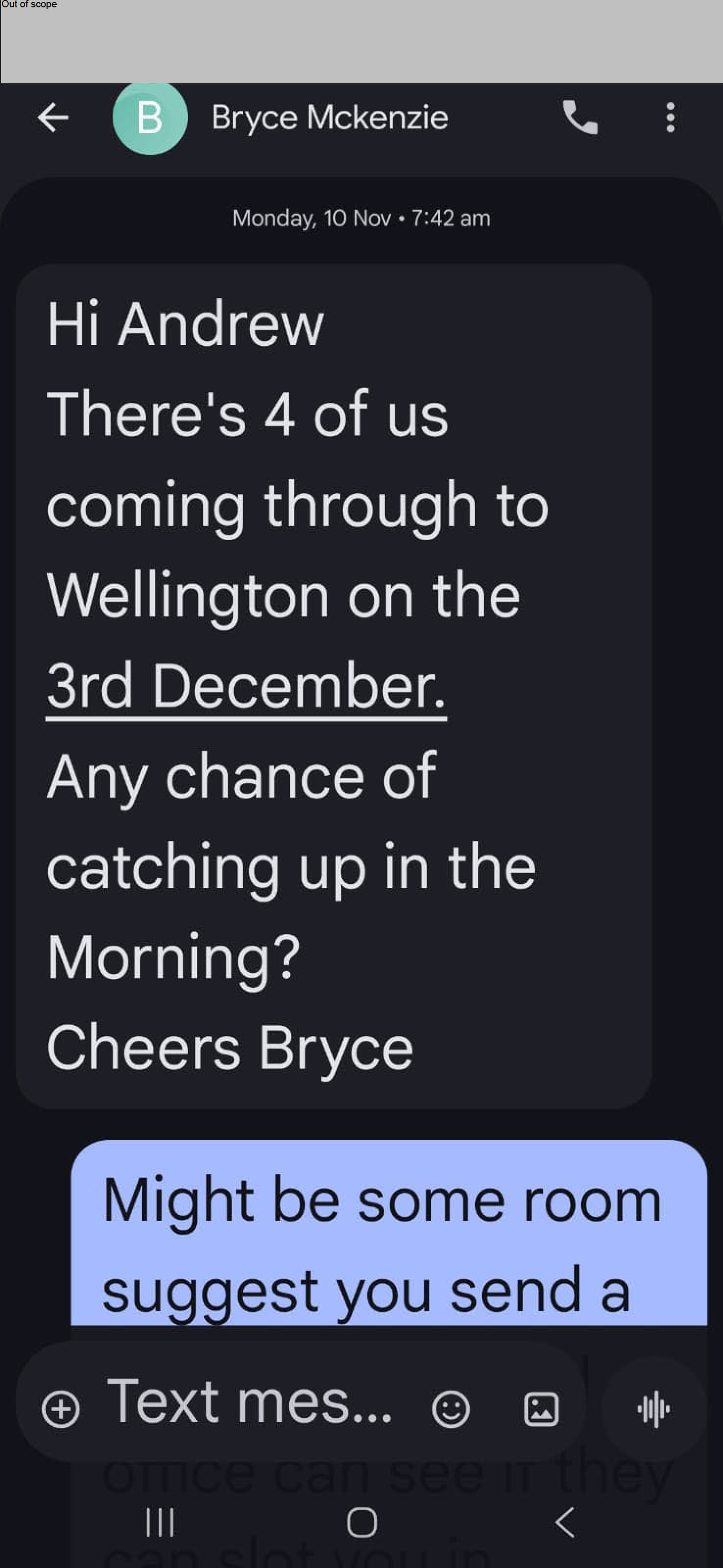
I am writing to please see if there is an opportunity for Bryce McKenzie and Laurie
Paterson, co-founders of Groundswell NZ, to meet with Minister Hoggard when they will be
in Wellington on Wednesday 3rd December 2025.
They are meeting other ministers in the afternoon, so anytime mid-late morning would be
good.
Please advise at your earliest convenience.
ACT 1982
Kind regards, s9(2)(a) – Groundswell NZ
s9(2)(a)
INFORMATION
RELEASED UNDER THE OFFICIAL
ACT 1982
INFORMATION
RELEASED UNDER THE OFFICIAL
Jamie McFadden - environmental consultant and practitioner, farmer and
rural advocate.
s9(2)(a)
ACT 1982
INFORMATION
RELEASED UNDER THE OFFICIAL
There are several key policies that farmers are concerned the coalition government is
failing to address:
1. It defies logic to
Methane tax the world’s most emissions efficient food
producers. This, and the ill-conceived climate change policies, are driving more
farmers off the land and into pines. The methane tax is widely opposed by
farmers and if implemented will mean the environment will be worse off with
farmers having less money to spend on environmental projects.
2. Exit the
Paris Accord and repeal the unachievable methane targets. A recent
Farmers Weekly readers’ poll showed 70 % in favour of exiting the Paris Accord.
Develop an exit strategy that tells the story of how NZ farmers are, and will,
continue to lead the world in environmentally sustainable food and fibre ACT 1982
production, but that being bound to the Paris Accord undermines that.
3. Stop wasting taxpayers money on
methane technologies such as boluses and
vaccines. Most farmers have switched off emissions thanks to the HWEN
debacle and the appetite among farmers for adopting methane mitigation
strategies is evaporating. Hence, commercialized methane products will have
limited uptake – pull the pin on AgriZeroNZ.
4. Overhaul of
Freshwater legislation. This is underway but farmers are concerned
the changes will not go nowhere far enough to fix the complexity and
INFORMATION
unworkability of both the national and regional legislation. Consenting
processes are a dog’s breakfast and costs spiralling out of control. Wide-ranging
reform is urgently required to simplify the system. Strong support from the
primary sector for Shane Jones’s call for longer consent durations.
5. Repeal the
Freshwater Farm Plan legislation. This is impractical, ill-conceived
Labour Party designed legislation in a silo, and farmers don’t understand why the
coalition government are persisting with it. Beef+LambNZ survey found 83% of
farmers oppose freshwater farm plans being mandatory, something the
government should heed. Farm plans need to be industry led, holistic and
integrated. There are lots of different industry, council and individual farm plan
models already in place, do not undermine this with top-down government
legislation.
6. Drop the
SNA policy. Widespread disappointment the government are
continuing with this policy, tweaking it rather than getting rid of it altogether.
Broken election promise. A curse of a policy that penalizes conservation minded
landowners, pits councils against their communities, wastes $millions and
doesn’t help biodiversity.
7. Same with SNA’s, is all other
RMA section 6 land grab classifications including
the new SASMs (Sites and Areas of Significance to Maori). These should all be
RELEASED UNDER THE OFFICIAL
halted pending the RMA review.
8. Dump the
National Policy Statement Indigenous Biodiversity. This legislation
has multiple unworkable elements which trample property rights, places more
unnecessary costs on landowners and ratepayers, and achieves nothing positive
for biodiversity. Needs pausing and reconsidered as part of the RMA reform.
9. New legislation is urgently needed to stop governments and councils riding
roughshod over
property rights. As promised during the election campaign
.
10. As part of new legislation support the addressing of environmental issues –
freshwater, indigenous biodiversity etc, through empowering
industry/community led solutions like
Catchment and Landcare Groups,
integrated industry farm plans (already in place to a large extent), expanded
QEII Trust covenant system and biodiversity trusts. Taking a holistic approach
will deliver multiple environmental benefits, including for the climate.
11. Aligned with 10. above is support a simple framework that helps farmers with
environmental issues in a holistic, integrated manner. This ideally should be
industry led and across the whole country. Ditch all the unnecessary and ACT 1982
duplicating bureaucracy. The emissions space is an example of unnecessary
bureaucracy with AgriZeroNZ, PGGRC and NZARGC draining off farmers and the
taxpayer’s purse.
12.
The RMA reform is piecemeal and arse about face. All policies, including SNA’s,
farm plans, National Policy Statements etc need to be reviewed before
implementing RMA reform. The coalition government is squandering the once in
34-year opportunity to do a proper review and reform of the RMA.
13.
The Gene Technology Bill is dividing farmer opinion and there remains
significant unease across the rural sector about the implications and
INFORMATION
consequences of this legislation and haste with which it is being pushed
through.
Jamie McFadden
Environmental consultant and practitioner, farmer and rural advocate.
s9(2)(a)
RELEASED UNDER THE OFFICIAL
stay. Reading back on Andrew's Press Release it states that the review of
SNAs will consider how SNAs are identified, criteria etc rather than a review
on the effectiveness of the SNA policy per se.
Same with the Freshwater Farm Plan press release only talks about improving
the current freshwater farm plan legislation rather than whether it is
appropriate or effective in the first place. Both laws are dogs and the
Beef+Lamb survey showed a huge majority (83%) of farmers were against the
mandatory freshwater farm plans.
Farmers would like to know who in government is pushing for these policies
to remain and it defies logic that both policies are not being properly reviewed
for their suitability and effectiveness as part of the RMA reform. The Press
Releases indicate it is a foregone conclusion these policies will remain even
before the RMA review has been done and consulted on?
ACT 1982
cheers
Jamie
-------- Forwarded Message --------
Subject:To National MP's
INFORMATION
Date:Sun, 16 Mar 2025 20:46:56 +1300
From:Jamie McFadden s9(2)(a)
Out of scope
RELEASED UNDER THE OFFICIAL
CC:Bryce McKenzie s9(2)(a)
Laurie Paterson
s9(2)(a)
Winton Dalley
s9(2)(a)
s9(2)(a)
s9(2)(a)
s9(2)(a)
s9(2)(a)
s9(2)(a)
s9(2)(a)
s9(2)(a)
s9(2)(a)
s9(2)(a)
s9(2)(a)
, DairyNZ
<[email address]>, s9(2)(a)
ACT 1982
s9(2)(a)
s9(2)(a)
s9(2)(a)
s9(2)(a)
s9(2)(a)
s9(2)(a)
s9(2)(a)
s9(2)(a)
DeerNZ <[email address]>,
INFORMATION
Farmers Weekly <[email address]>, Rural News
<[email address]>, s9(2)(a)
s9(2)(a)
A.Hoggard@ministers govt.nz,
Out of scope
Out of scope
[email address]
Out of scope
RELEASED UNDER THE OFFICIAL
Out of scope
ACT 1982
INFORMATION
regards
Jamie McFadden - environmental consultant and practitioner, farmer and
rural advocate.
s9(2)(a)
RELEASED UNDER THE OFFICIAL
From:
Jamie McFadden
To:
Andrew Hoggard (MIN)
Cc:
Out of
; Bryce McKenzie; Laurie Paterson; Groundswell NZ; s9(2)(a)
s9(2)(a)
Subject:
Freshwater Farm plans
Date:
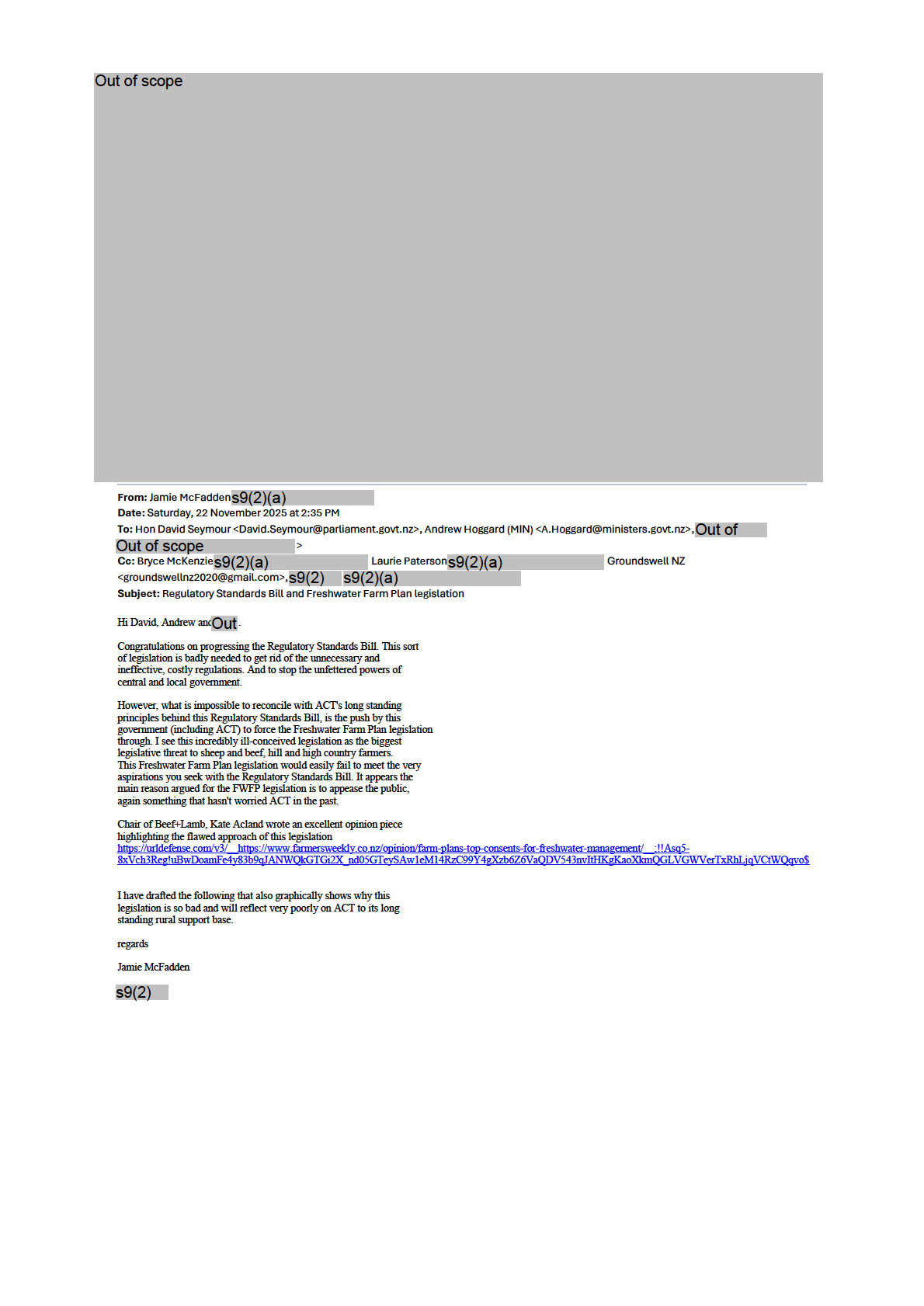
Sunday, 17 August 2025 7:14:55 PM
Hi Andrew.
Copied below for reference is my reply to your Facebook comment about farm plans. It is
not the detail of the Freshwater Farm Plan legislation that is the predominant issue, it is the
policy framework that wraps around them. A government prescribed mandatory stick,
rather than industry and farmer led as was already happening.
The FWFP legislation is top down rather than ground up. It increases
ACT 1982
regulation/bureaucracy/admin for many farmers (particularly hill & high country, low
environmental impact). It increases government interference into farming (going against
the election promise to get government out of farming). It adds more unnecessary and
unproductive cost onto farmers, particularly those mentioned above. It increases
bureaucracy - MfE employing more staff, councils employing more staff, more tick box
consultants. All of them draining more and more off farmers!
Everything about this goes against the principles I thought ACT stood fors9(2)(a)
It appears ACT have fallen for the we must do
this for our licence to operate spin and it seems extraordinary that ACT would agree to a
INFORMATION
mandatory system of this nature.
I have had extensive experience in farm plans and recently started down a different track
with irrigating and dairy farmers because the audited farm plan system in Canterbury
wasn't empowering many farmers and not delivering the necessary environmental
outcomes. The alternative approach is focused on simple environmental risk and
opportunity farm assessment using science/knowledge from each farm e.g. water quality
testing and catchment context, biodiversity, pest issues etc to draw out the top 2 or 3
environmental priorities/solutions. This is being rolled out in conjunction with 13 new
catchment groups.
You seem to be of the view the farm plan is the be all and end all whereas experience
shows it is just one of many tools that farmers can use to address environmental issues like
freshwater.
With my knowledge of farm plans I can see this legislation you are drafting is going to be
really bad for farmers (particularly when Labour/Greens get back in). It will also become
an administrative nightmare, particularly once biodiversity and emissions are added in.
Along with Paris it will become one of the biggest legislative threats and frustrations to NZ
farmers, again particularly for hill and high country farming families.
Last time we spoke with you in Wellington about this you did not appear prepared to listen
and stated along the lines that we were going to have to lump it. I suggest continuing in
RELEASED UNDER THE OFFICIAL
that frame of mind and with this legislated approach will not end well for ACT or for
farmers.
cheers
Jamie
Jamie McFadden
Andrew Hoggard MP given there has been a massive uptake by farmers of environmental farm plans and
catchment groups why did the government not back the industry to continue to roll it out, rather than having
it as top down state prescribed legislation? Industry groups - beef&lamb, dairy, deer, arable etc were all doing
heaps of work in the farm plan space, recognising no one size fits all works across sectors and individual farms.
It is not a question of 2 paths but a question of the how the farm plan/catchment groups path works in
addressing environmental issues. Essentially the choice is an industry & community led approach supported
by Government or a top down legislated model that operates as a certified/audited mandate. It is bloody
disappointing the govt has chosen the latter and it will hugely undermine the huge potential of farm plans and
all the good work farmers have been doing. Beef&Lamb survey showed 83% of sheep & beef farms opposed
the mandatory approach you are promoting. Farmers are crying out for less paperwork & less bureaucracy.
This proposal creates more of both for many hill and high country farmers, particularly those that don't have
winter grazing - ironically some of the lowest environmental impact farms. I am involved in projects that
involve a simple environmental risk assessment and the key actions required. It doesn't need lots of paperwork
or certifying or auditing but a trusted, knowledgeable advisor that helps the farmer understand the key issues
ACT 1982
and key actions required (and in my case can implement them). This is similar to the hugely successful
Catchment Board farm plan system. The role of farm advisors should be to make things as simple as possible,
least cost and deliver farmers real value for the service provided. Another reason the Freshwater Farm plan
legislation is flawed is because it is silo focused on freshwater whereas farmers are calling for integrated farm
plans. For many farms, especially hill and high country, they have more pressing issues than freshwater - e.g.
weeds and pests. An integrated plan recognizes this. Farmers have been given the sales pitch, have farm plan,
no need for consents. But the only example the government continue to provide is winter grazing. What about
consents for stock exclusion, gravel extraction, works in waterways, outstanding landscapes rules, SNAs, offal
pits, discharges to land or water - there are hundreds of rules, many that farmers are unaware of. Farm plans
are only one tool in the toolbox and not every farmer finds them useful. It is the environmental risk
assessment (across all environmental issues) all farmers should be doing but again this should be industry led.
Put some faith in our sector for a change and gives us the chance to develop our own solution from the
INFORMATION
grassroots as is already happening.
RELEASED UNDER THE OFFICIAL
ACT 1982
INFORMATION
RELEASED UNDER THE OFFICIAL
ACT 1982
INFORMATION
RELEASED UNDER THE OFFICIAL
ACT 1982
INFORMATION
RELEASED UNDER THE OFFICIAL
ACT 1982
INFORMATION
RELEASED UNDER THE OFFICIAL
ACT 1982
INFORMATION
RELEASED UNDER THE OFFICIAL
ACT 1982
INFORMATION
RELEASED UNDER THE OFFICIAL
ACT 1982
INFORMATION
RELEASED UNDER THE OFFICIAL
ACT 1982
INFORMATION
RELEASED UNDER THE OFFICIAL
ACT 1982
INFORMATION
RELEASED UNDER THE OFFICIAL

ACT 1982
INFORMATION
RELEASED UNDER THE OFFICIAL
