Challenging callers
Information and suggestions to help you deal with some of the more challenging callers you may come across.
Sometimes callers may become angry or rude while you're talking with them. This could be for a number of reasons, such as they're
frustrated waiting for their payment to come through or they feel like they're being given the run around to solve an issue.
For information about handling callers who make threats against people (including themselves) or the Ministry please go to: Threats and
(1982)
Security
More information: Challenging Callers - Doogle
Act
The difference between an inappropriate comment, a direct or an indirect threat
Inappropriate comments
Inappropriate comments include yelling, shouting, insulting, offensive conversation, unwanted sexual overtones and swearing.
Example: “
No wonder you guys get shot”.
This isn’t a threat, this is just an Inappropriate comment, often used with MSD to be insulting.
Direct threats
A direct threat identifies a specific target and is delivered in a straightforward, clear and explicit manner.
Example: “
I am going to come down to the office and kill you”
Information
It's direct, specific, and targeted.
Indirect threats
An indirect threat tends to be vague, unclear and ambiguous. The plan, the intended victim, the motivation, and other aspects of the threat
are masked or equivocal.
Example: “
Do I need to go down to the Office and hurt someone to get this sorted?”
Official
This is an indirect threat as they are trying to justify these actions while keeping the context of the threat vague.
the
For information about handling callers who make threats against people (including themselves) or the Ministry please go to: Threats and
Security
Angry, abusive or inappropriate comments (but not threats)
You are not expected to listen to swearing and abuse.
Where the caller is verbally abusive (including yelling, shouting, insulting, offensive conversation, unwanted sexual overtones and
swearing) you are not expected to listen to such calls. During these calls, make sure you get all the facts as this will help you understand the
under
caller's needs. Listen to what they're saying and take notes if you need to.
During these calls
make sure you acknowledge how they're feeling
– you don’t have to agree or justify matters but sometimes clients just want to feel
heard
apologise if you need to
– but be sincere
make sure you get all the facts as this will help you understand the caller's needs
listen to what they're saying and take notes if you need to
never say: "It's our policy" – an angry client does not want to hear about ministry policy or have someone else blamed
Released
Remember, try not to:
lose your temper – if you're both angry, you will never find a solution
be defensive, aggressive or abrupt
interrupt or try to apply logic – angry people are often not logical
blame anyone – either the caller, yourself or the Ministry
At any time during the call, you can always place the client on hold.
Managing the call
1. Keep the client focused on moving towards a solution. Ask the client to stop the behaviour so you can both focus on the matter at hand:
“[Client name] I really want to help today, however it is difficult with you talking to me in this way, so if we could please focus
on...”
“[Client name] I can hear you’re upset, but I won’t be able to help you with this if you continue to treat me this way…”
“[Client name] I don’t appreciate the way you are speaking/treating me; the Ministry doesn’t tolerate this kind of behaviour.
Please stop.”
2. When you do not feel safe during a call: You can transfer the call to a manager or end the call.
(1982)
If the client is continuing in their behaviour and the call is not progressing you can transfer the call to your manager or warn you
may end call:
Act
"
[Client name],
I am going transfer you to a manager at the <office / contact centre> to assist you with your enquiry."
“[Client name] if the swearing/yelling continues I may need to end this call.”
3. When warning to end the call: be sure that the tone in your voice is not threatening.
We want to use this as an opportunity for the client to change their behaviour and work with us, rather than escalate the situation.
4. If the behaviour continues you can politely terminate the call.
“
[Client name] I’ve asked you to stop, I will now end the call.”
Information
Where caller details are known the event should be entered in STAR and a CEN added (templates below).
Call escalated to a manager
Kia ora, Note Type: Engagement Log Note subject: Client Engagement Short Description: Call escalated Contents:
Client's call was escalated to Service Manager Client Service Support [SM name] Ng mihi
Reset
Official
Call terminated
Kia ora, Note Type: Engagement Log Note subject: Client Engagement Short Description: Call terminated Contents:
Client's call was terminated due to aggressive or abusive behaviour Ng mihi
the
Reset
If a client makes a threat or comment in support of harm towards the Ministry or our people, see: Threats and Security
Impersonating a client
We handle huge amounts of information about people's lives so keeping this information safe at all times is really important. To keep this
information safe, you must be sure the caller is genuine so no personal information is given to people who don't have the right to it or who
under
are trying to commit fraud. You can do this by thoroughly
at the beginning of the call.
ID'ing and verifying the client
At times, people will call us pretending to be clients. This could be for a number of reasons, the most common reasons are they're trying to:
access private client information e.g., current address or bank account number
change private client information e.g., stopping the client's benefit
get a client's payment
CSR process
Released
When you're talking to someone and have doubts about their identity, ask additional verifying questions
Still have doubts? Don't proceed with the call and politely decline their request for information - if the caller is unhappy with this, transfer
them to a Service Manager Client Service Support.
If the caller was posing as a client, complete the below template and email it to your service manager (cc in your Contact Centre Manager).
Caller posing as a client - info template
Kia ora, I've just spoken with someone who was posing as a client, the details from the call are as follows: - Date and
time of call: - Client's SWN: - Phone number displayed: - What information the caller requested: - What information
was given to the caller: - What identifiers were used, and did the caller provide these before being asked? - Was the
caller hesitant in their responses to questions relating to identifiers? - Was the caller Male / Female/ unable to
identify? - Were there any distinctive characteristics of the caller's voice? - Was there anything else unusual about the
call? A copy of this information has been saved to CMS. Ng mihi
Reset
(1982)
Your Service Manager Client Service Support will notify the client's case manager immediately if you suspect an impostor caller has been
Act
trying to access a client's file. The case manager may discuss options with the client (where appropriate).
For details on what to do if you realise during/after the call that it wasn't the client you were speaking to, see When a client tells you that
someone has stolen their information
Repeat callers
Sometimes clients will ring repeatedly. This can be for a variety of reasons e.g., following up on their benefit application
If you have a repetitive caller, always try to help:
"I've noticed you've phoned a few times today about this and I'd like to help resolve this for you."
Ask:
Information
What is the client calling about?
Has the client already called before about the same reason?
Are you able to resolve the call without having the client call back?
Are there any notes on the client's record?
Is the client unhappy about a letter, can you access the letter and go through this with the client?
Is the client requesting to speak with their case manager? Can the client be referred to the Manager Client Service Operations of the
service centre for their site?
Official
Is the client frustrated and having a vent, or are they being unreasonable and a nuisance?
If the client is upset that things have not yet been completed or processed, reiterate the following:
the
The service centre has 5 working days to complete the processing once they've received everything
Once an email/voicemail has arrived, the office has 24 hrs to action it and/or call the client back
If the delay is putting them into hardship, you can always discuss ways we can help with hardship assistance now or offer to
request through the region S2P queue for an appointment/refer as a walk-in
Only offer to send an email or transfer a caller if it has gone past these standards.
under
Released
Managing Challenging Callers
*Service Manager Client Service Support* | This page offers links to helpful documents which offer guidance when managing challenging
and difficult callers.
Here is a list of documents available and a summary of what they each cover:
Dealing with angry callers
(1982)
This document offers 9 helpful tips for dealing with angry callers.
Master tips
This document offers master tips for managing challenging callers including some useful phrases and a step by step process for
Act
how to handle the call from start to finish.
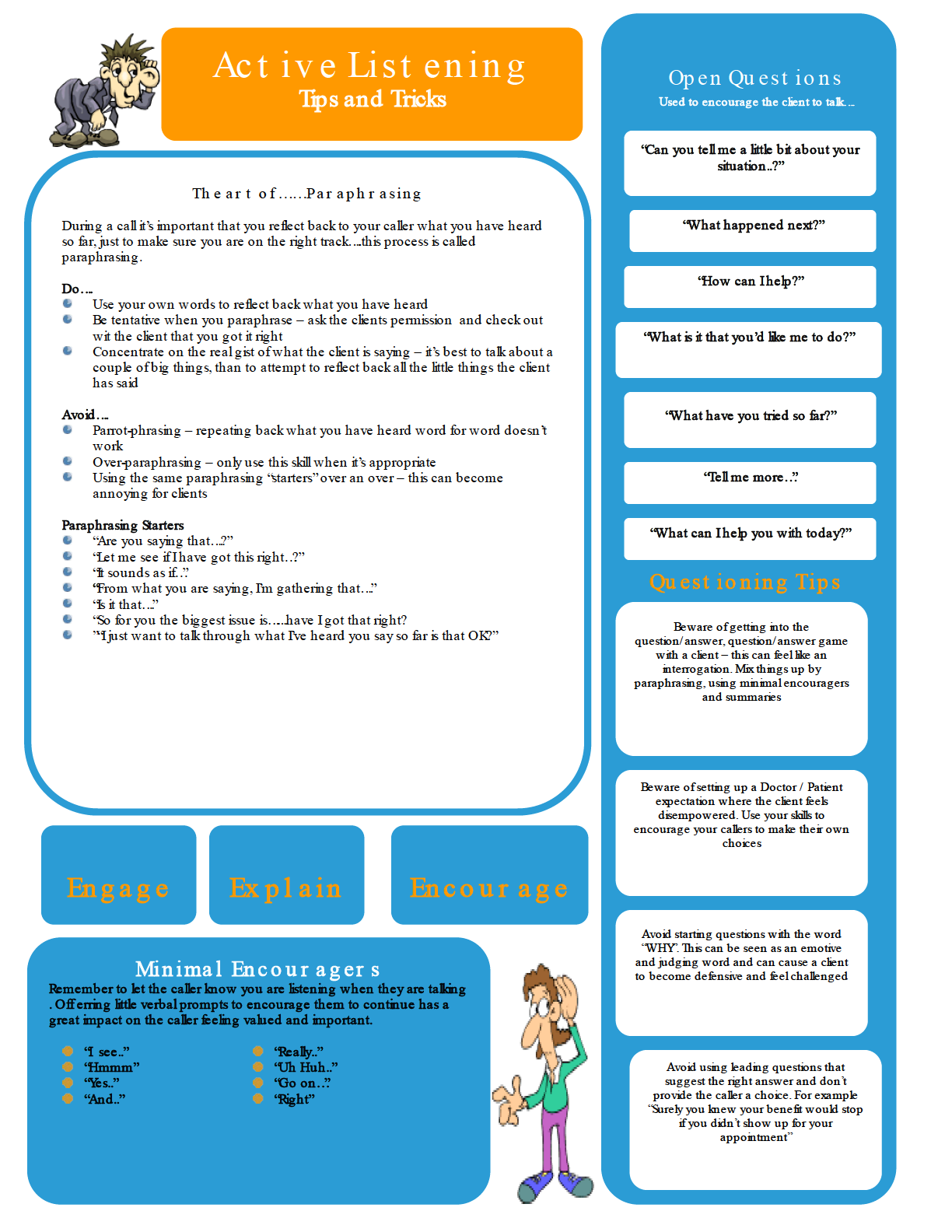
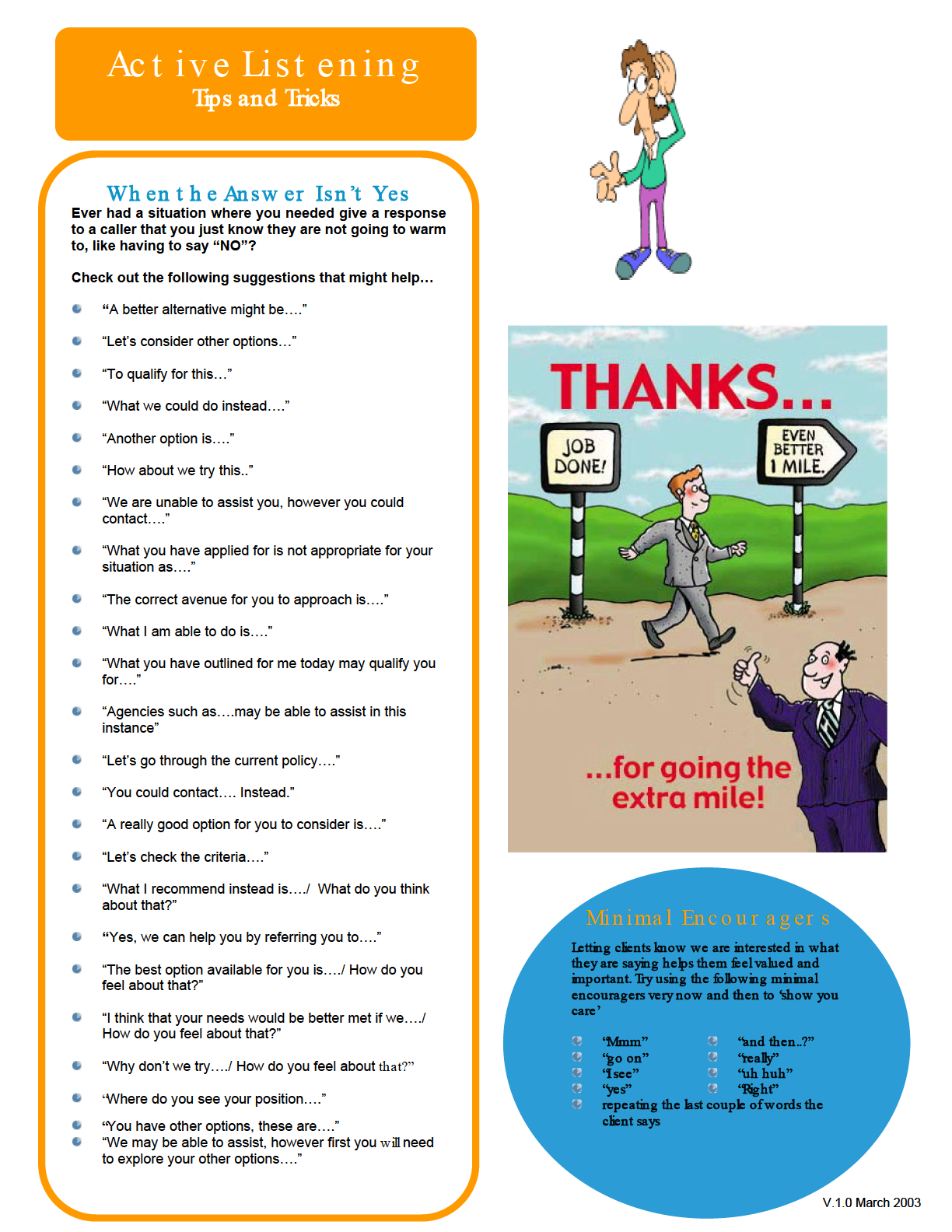
Listening tips, tricks and skills
This document offers tips on how to use active listening to resolve calls.
Dealing with different or difficult people
This document offers techniques and strategies for managing conversations. It offers some useful phrases and examples of how to
handle challenging calls.
Information
Official
the
under
Released
1. Acknowledge the other person's anger quickly. Nothing adds more fuel to
someone's fire than having their anger ignored or belittled. The faster you
verbally recognize their anger, the better.
2. Make it clear that you're concerned. Tell them you realise just how angry
they are. Let them know you're taking the situation seriously. Make notes of
every possible detail they give you.
3. Don't hurry them. Be patient, and let them get it all out. Never try to interrupt (1982)
or shut them up. In many cases, the best move is to simply listen. They'll wind
themselves down eventually. In some cases, they'll realise they blew the situation
out of proportion and feel foolish for it. They're then likely to accept nearly any
Act
solution you offer.
4. Keep calm. Most angry people say things they don't really mean. Learn to let
those things pass.
5. Ask questions. Your aim is to discover the specific things that you can do to
correct the problem. Try to get precise information about the difficulties the
problem caused, rather than a general venting of hot air.
Information
6. Get them talking about solutions/options. This is where you'll learn just how
reasonable this client is. By the time you get to this step, their anger should have
cooled enough to discuss the challenge rationally.
7. Agree on a solution/options. After you know exactly what the challenge is,
you're in a position to look for some kind of action that wil relieve the challenge.
Propose something specific. Start with whatever w
Official il bring them the best and
quickest relief. Don't get into a controversy over pennies at this point.
8. Agree on a schedule. Once you've agreed on a solution, set up a schedule
the
for its accomplishment. Agree to a realistic time frame that you know you can
handle. The biggest mistake you can make is to agree to something that can't be
done. More importantly another CSR wil get it because you haven’t come
through for the client!
under
9. Meet your schedule. Give this schedule top priority. You've talked yourself
into a second chance with this client, so make sure you don't blow it. Once
you've satisfied the client with regard to this situation, you'll have earned another
opportunity to serve their needs in the future...and the needs of those they'll tell
about how well you handled it.
REMEMBER - DON’T OVER PROMISE.
Released
Master Tips
No matter how angry or unreasonable your client is, your ultimate three goals are to:
* Calm them down
* Communicate your understanding of their problem, empathize, fix it and
* Hear a hearty ‘thank you!’ when it’s over
(1982)
Pre Call/Frame-up
Act
Assume that the Client has a Right to be Angry
Nobody makes mistakes on purpose, but they do happen. Working in our Contact Centre
means you are going to encounter an irate client at some time. The most common response
is to evaluate the merit of the complaint while you’re listening to it. Try to curb that common
response and replace it with the assumption that the client has a right to be angry, even
before you know the details. Perhaps the client feels betrayed because the service did not
meet expectations. The client may be angry because he or she made incorrect assumptions
that led to improper expectations. The client may be angry because of previous experiences,
previous contacts with the ministry or simply because the problem occurred at a very
inconvenient time in the clients schedule. Regardless of the circumstances, accept the client
has the privilege to be irate. Listen carefully to how the anger is expressed so you can find
Information
the root cause of the emotion.
Keep Cool
Try to remain calm and don’t take the situation personally. This may be easier said than done,
especially when a client is screaming about a problem that you had no part in creating.
However remember “Customer Service Representatives who control their emotions deal from
Official
a position of strength.”
Belief
the
This is the cornerstone of handling a client’s interaction with you. Yes, the client may be lying
and be incorrect about their situation. It is important to understand that the client believes that
someone or something has wronged them. That is their belief.
Discussion under
•
Talk with the person next to you about a call you took where the client was angry:
o
Did you have an immediate reaction?
Released
1
THE GREETING
Always greet the callers the same way, with the same pitch and tone to your voice. Smile as
you answer the phone (yes, people can really tel )! Your ‘body language’ – in this case your
tone, inflection, pitch - can say more about you, than the words that come out of your mouth.
It’s just like an actor going on stage, when you put your headset on, you become the
ministry’s contact centre representative. You are on ‘stage’.
Discussion
•
Sit back to back with the person next to you
•
Repeat how you would normally answer the screen pop
•
Ask for their feedback about whether you had a smile on your face when you said it – (1982)
did they ‘hear’ it
Act
LISTENING
You wil very quickly hear how the client is feeling. Once you’ve asked the person to explain
their problem or issue to you, it’s then crucial that you simply listen before you say anything.
Ask yourself ‘Are they being angry/aggressive or just assertive?’ – there’s a difference!
Assertive communication is a constructive way of expressing feelings and opinions. People
are not born assertive; their behavior is a combination of learned skil s. Assertive behavior
enables you to:
a. Act in your own best interests.
Information
b. Stand up for yourself without becoming anxious.
c. Express your honest feelings.
d. Assert your personal rights without denying the rights of others.
Assertive behavior is different from passive or aggressive behavior in that it is:
a. Self-expressive
b. Honest
c. Direct
Official
d. Self-enhancing
e. Constructive, not destructive
Assertive behavior includes both what you say and how you say it.
the
Listen to the problem, rather than the criticism. That can be hard to do when someone
appears to be attacking you. However, it is absolutely essential to focus on “what” is making
the person angry rather than on the anger itself. Stop and listen to your client's complaint. I'm
not certain whether it's natural instinct or just plain stubbornness – but as soon as a client
under
starts to complain, we start to think of how we wil respond to the accusation before we are
done listening, and too often the case, already have the response ready to fight back. Take a
second, relax, and listen – hear what is being said. On occasions a complaining client will be
rude, angry, and use vulgar language - stay the course and remain calm and level headed.
Let the angry client talk through their problems and get it all out of their system without
interrupting. Al ow the client to express their opinions
. Al ow them to communicate their
feelings however they choose to without passing judgement. If you interrupt the client, you
wil make them more irate. It is like pouring petrol on a raging fire. By interrupting them ‘mid-
Released
flow’ they are likely to be highly charged emotionally and you run the risk of them getting
even more upset. As they talk make indications that you are listening such as "uh huh",
“OK”, "really?", etc.. This step is important because the more time a client spends airing their
grievances, the more time they have to calm down.
2
By letting them speak until they’ve completed what they want to say, you’l soon become
aware of a plateau which is the point at which their anger is at its fiercest and then, once this
climax point has been reached, they’l start to slow down and regain their composure before
reaching the end of what they’ve had to say – Then, and only then, is it your time to start
talking.
Take written notes if necessary to better understand why the person is upset. Ask questions,
gather the facts and assess the problem.
The vast majority of client complaints have some legitimacy to them, so this should always be
your first assumption. Write important information down to ensure accuracy; to help you get to
the bottom of the problem; and make it easier for you to relate the situation to someone else if
(1982)
needed. Avoid making the client repeat themselves, this wil only frustrate the client more
and they wil think you are not listening. Put yourself in their shoes – how would you feel?
Act
Discussion
Information
Official
the
under
Released
3
ACKNOWLEDGEMENT
A communication skil cal ed active listening is especially useful in emotional situations
because it enables you to demonstrate that you understand what the other person is saying
and how he or she is feeling about it. Responding productively to emotional statements can
have a positive affect. Active listening means restating, in your own words, what the other
person has said. It's a check of whether your understanding is correct. This demonstrates that
you are listening and that you are interested and concerned.
Active listening responses have two components:
a. Naming the feeling that the other person is conveying
(1982)
b. Stating the reason for the feeling
Here are some examples of active listening statements:
Act
"Sounds like it’s really upset you with what happened at Service Centre."
"I can tell this has annoyed you getting this second letter"
"You sound really frustrated as you can’t get an answer to this."
"It makes you angry when you get told two different things."
"Sounds like you're really worried about what you were told."
"I can hear you’re feeling very frustrated about this situation that’s occurred."
Information
“I can understand that how you are feeling if that happened.”
“I understand that’s it’s not OK to have to ring 3 times to find out.”
Actively listening is not the same as agreement. It is a way of demonstrating that you intend
to hear and understand another's point of view.
Official
Listen to the inflections and emphasis that the client places on specific topics to identify the
emotional catalyst. Listen to the emotion as well as the words. This wil help you to identify
the specific item or items that need primary attention. Resolving a technical issue may be only
the
partially effective if it does not also address the client emotional concerns. It may not be
possible to completely resolve the emotional distress, but it is appropriate to acknowledge it.
Deal with the emotion first, then the problem. Remember that the client anger is not directed
at you personally, even if the client’s language is directed at you. If the client’s language is
attacking and borderline abusive, it is because the client is looking for acknowledgement and
response to the emotional distress as well as the technical or administrative issues. It may be
under
necessary to repeatedly acknowledge the clients emotion to diffuse the situation and
reassure the client that you are attentive to the importance of the emotional distress as well
as the technical issue e.g.
Client is very upset about not getting her accommodation supplement paid into her bank
account this week…..
‘I can hear that this has really upset you as you were expecting this money’ or ‘I can see that
this has made you really angry, because you believed it was going to be paid this week’
Released
It’s often the emotional distress that is connected to the issue/problem that is causing the
client to behave this way. In the case above, the client may have been waiting for this money
to pay for her child’s camp fees and as a consequence, she has had to try and make other
arrangements with the school for this.
Do not respond with emotion………..
4
When the client is done venting and you have acknowledged the emotion that they are feeling
(you may also detect that there is a ‘plateau’); then in a calm, non-judgmental tone, repeat
their problem. An example is:
"So what I hear you saying is that, you dropped off your application for accommodation
supplement last Tuesday and you believed that this would be actioned and the payment in
your account this week, is that correct?"
By repeating the problem at hand, you've demonstrated your ability to the client that you
heard and understood their problem.
Listen and clarify. Never defend or justify.
(1982)
The client doesn't care if it’s busy or if you're having a bad day, they only care that they get
taken care of. No excuses, just solutions.
Above all be patient, polite and professional. It becomes more difficult for a rude client to
Act
keep attacking someone who is treating them with respect.
Sometime the client anger wil erupt again and return like another set of waves. When that
happens, be patient and wait for the client to run out of steam before you approach the fire
again. Acknowledge the emotion and reiterate your compassion, acknowledge the client right
to be angry and the catalyst for the emotional distress. Take quiet deep breaths and wait
patiently for your turn to speak. We call this shifting gears
Discussion and practice
Information
Official
the
under
Released
5
ANOTHER LITTLE TRICK……
When you encounter a loud and abusive client, respond by speaking softly and a bit slower
and with a very steady tone. If you try to shout over the client or interrupt, then the client will
concentrate on the verbal battle for attention and wil not pay attention to the importance of
your message. It wil become a battle ground. Often the client wil reduce their tone and
volume to match yours.
Ultimately the client does want your advice and assistance to resolve the problem. Once the
client remembers why he or she contacted you, the client wil be receptive to your soft spoken
conversation.
Don’t allow yourself to dehumanize the client. Sometimes you can pretend the client is
(1982)
standing in front of you. It wil be more difficult to lose your temper if you picture the client
standing there.
Responding under pressure -
Act
One of the main problems you can face is that when under the pressures of a really tough
conversation your logical thinking mechanism can desert you. It’s a medical fact, that when
we perceive ourselves to be “under attack”, our brain functions focus upon “fight or flight”
objectives, leaving us exposed when asked to perform a simple task (think of the exam
questions, the driving test, the simple question on a TV game show!). It is therefore vital that
you are able to develop useful phrase to use (see examples above) and think about which
ones are most likely to work for you and best reflect you and the ministries values to utilise in
such situations. Talk about this with your team, examine your experiences, compare these
with the each other and rework appropriate responses.
Empathy
Information
Be careful with being too empathic - Empathy implies that you feel the same way as the
client and truly understand their feelings. It can create further issues to say "I understand
your anger" – but if you do not truly understand, the client may shoot back "You have no
idea!"
Official
the
under
Released
6
APOLOGISE IF YOU NEED TO
If the client has been getting the runaround, and you are stil not the person who has the
answer, tell the client that you wil find out who can help and try to fix it.
Apologise if you need to. Apologise can sometimes be interpreted as admission of guilt.
There are three types of apology that can be used – choose the most applicable:
Direct:
"I apologize that we did not send your application on time."
Blameless: "I apologize for the fact you are frustrated - let's see if we cant turn this around."
Fake:
"It sounds like we owe you an apology."
(1982)
Many clients interpret this to be an apology when in fact none is ever made.
Always apologize even if you did nothing wrong – but be sincere. From your clients'
perspective, they have a legitimate complaint, and they expect an apology. It could be as
Act
simple as "I'm sorry we've inconvenienced you." or "I'm sorry I know how frustrating this must
be for you". A sincere apology wil usually diffuse a lot of frustration that the client has.
"I apologize that you have been passed on to so many people and had to ring several times.
Although I do not have the answer to your question, I wil try find the answer so you don't
have to be passed on again or ring back.”
Never say "It's our policy." An angry client does not want to hear about ministry policy
Never blame someone else in the ministry
. Always keep a united front: "I apologize for the
experience you have had and I wil do my best to help you."
Information
Official
the
under
Released
7
SOLUTION MODE
After they complete their story, you need to sort out the facts. You start to move into solution
mode so you need to know when to ask open questions – so you get more information and
when to ask closed questions for clarification.
For example, “Now, would you mind if I just clarify some things with you. You said you’d
paid……….. is that correct?” If you’ve assumed correctly, the client wil say ‘yes’ and then
you can move on. If not, they might wish to explain things further before you can proceed to
the next stage. Once they’ve acknowledged that you have understood them correctly, you
can then start to work upon a resolution to the problem.
(1982)
MAKE IT RIGHT IF YOU CAN
Let the client know the steps that wil be taken to solve the situation. If it can be solved
immediately, explain why and how. If you can’t solve it yourself, explain who can and outline
Act
the steps that wil be taken to make that person aware of the client’s concern. Be specific
about what the client can expect as an end result.
There is never going to be a successful outcome every time and what may be a satisfactory
resolution for one client may not appease another but what is important is to go about trying
to resolve the problem in the correct manner.
Information
Official
the
under
Released
8
SUMMARY
Summarise what the problem was, what you have done about it, what the client needs to do
(if anything) and the outcome.
Thank the client for calling and complaining. Why? With the simple act of complaining, they
are giving you the opportunity to fix the problem. Puts a different spin on it doesn't it? Thank
them for letting you know that something is wrong and didn't work like it normally does; for
giving you the chance to make it right and for the opportunity to fix it for them.
IN A NUT SHELL
The first thing that most angry people need to do is:
(1982)
• have their say
So you need to:
Act
• listen and make acknowledging signals
• Calm things down, talk quietly and slowly, and acknowledge their feelings ‘I
understand how you feel’, ‘it must have been really annoying’, ‘I can understand that’.
• Repeat back what you have understood so far: ‘Mr Brown, let me just recap’
• Tell them what you are going to do, ‘Right, Mr Brown, this is what I am going to do’,
and by when
• Always do what you say you wil
Information
• Thanks the client for calling
Turning a challenging call into a positive experience is very rewarding.
Official
the
under
Released
9
SOME USEFUL PHRASES
• So how can I help you?
• Thanks so much for your patience and cooperation
• Sir, could you please explain the situation so I can help you resolve this?
• I’m so sorry to hear that? I don’t blame you for being frustrated.
• Let’s see if we can work together to resolve this, OK?
• I can see why you feel that way?
(1982)
• I see what you mean?
• That must be upsetting?
Act
• I understand how frustrating this must be for you and I really appreciate your
patience?
Phrases to Avoid at All Costs
• Our policy is…
• Calm down!
• What’s your problem?
Information
• That’s not our/my fault!
• I can’t help it if someone was rude.
• I’m not going to repeat this again!
• Listen to me!
Official
• You’re not listening to me.
• I can’t do that.
the
• Excuse me!
• Why don’t you be reasonable?
• There’s nothing else I can do?
under
• I’m not putting up with that sort of language!
Released
10
(1982)
Act
Information
Official
the
under
Released
(1982)
Act
Information
Official
the
under
Released
DEALING WITH DIFFERENT or DIFFICULT PEOPLE
Here are some thoughts, ideas, philosophies, mindsets and techniques that may be useful for
CSR’s:
The mindset
There are times when clients are going to be angry.
(1982)
As a CSR, recognise and accept that clients have a right to be upset or angry.
Angry clients want you to be helpful even if you can’t solve their entire problem.
Act
They might want choices and alternatives so that they don’t feel helpless.
Any client wants to be acknowledged. They want to feel you are making the effort to understand
their situation and their emotional reactions to it. Often the simple act of acknowledging that a
person is upset wil help to calm them down, provided the acknowledgment is phrased and
toned correctly.
Clients may want you to help solve their problem but remember to acknowledge their feelings
before going into problem-solving mode. If you go straight into problem-solving mode without
acknowledging their feelings clients may see this as uncaring, unfeeling and unhelpful and can
intensify their anger. If and when the client is ready to talk about fixing things try using co-
Information
operative language.
Examples of co-operative language…
“What I can do to help you is…”
“Is it possible that…”
Official
“One option might be to…”
“Have you thought about…”
“Have you tried…”
the
“If you like you can…”
“Have you considered…
“
“Were you aware that…”
“That’s never happened as far as I know but I’l check for you…”
under
“An alternative might be to…”
“Let’s consider other options…”
“We could look at…”
“Why don’t we try…”
“I can help you by referring you to…”
“To qualify for this…”
“Have you tried options such as…”
“Were you aware that XYZ agency can help you with that…?”
Released
1
Taking the bait
Sometimes clients may say things (intentionally or non-intentionally) that get you to react,
usually in an emotional manner.
Examples:
“Are you people thick or something?”
“Are you saying my children have to starve because of this?”
“What language do you speak?”
“Am I speaking to a Kiwi?”
(1982)
“It’s alright for you, you’ve got a job”
Consider such statements as “bait” or “triggers” If you respond emotionally to “bait” or “triggers” it
Act
might result in you being upset and can throw you off balance as a result of being angry or
intimidated.
Remember: in order to remain composed and in control of yourself and the call you must avoid
responding to nasty attacks emotionally. The key point about “bait” and “triggers” is that you
recognise it but don’t take it, think to yourself ‘I’m not going to get suckered in by that suggestion
or comment’.
Suggestion: have a think about your own “triggers” or the last time you responded emotionally to
“bait”. What are these triggers? How could you have responded differently?
Information
Consider these two examples.
Example A:
Client: “
What the hell is wrong with you people! This happens every year! I return my
renewal form and my benefit still gets cut and I get the run-around. If you people knew
what you were doing, this wouldn’t happen. And, this is the last time you are going to do
Official
this to me!”
CSR: “Please don’t talk to me like that, there’s no point in getting angry at me. The call
centre doesn’t clear the renewal forms it is done at the site
”
the
Client:
“I can talk to you like that! My children are hungry and I have bil s to pay!”
Example B:
Client: “
What the hell is wrong with you people! This happens every year! I return my
under
renewal form and my benefit stil gets cut and I get the run-around. If you people knew
what you were doing, this wouldn’t happen. And, this is the last time you are going to do
this to me!”
CSR: “I can hear that you are really upset about this Mr Key”
Client: “
Damn right I’m upset. Now what are you going to do about it?”
CSR: “I just need to get some information from you first so I can help you. Can you give
Released
me your client number please?”
Client: “
Yes, its 359…”
2
Some things to remember:
Your state of mind can go a long way towards successful client satisfaction
Compassion and understanding can transform difficult clients into satisfied clients
The first thing that most angry people need to do is have their say so you need to
listen and acknowledge to the client that they have been heard. Communicate your
understanding of their problem and show empathy.
An angry client presents you as a CSR with a perfect opportunity for you to practise
your skil s
(1982)
Thank the client for bringing your attention something that needs to be fixed or done
better. The client is doing you a favour when they comment on bad service as it gives
you the chance to try and make things right
Act
Thank the client at the end of the call
Helpful mindsets when dealing with angry clients:
When a client is angry the trick is to look beyond their angry behaviour and realise you are
witnessing a low state of mind not a personal attack. Recognising this fact is the first step in
controlling your own reactions and starting to deal effectively with the client. Instead of leading
with your defences, lead with your ear.
It is time to listen.
Information
It’s not enough just to hear the words; you must really listen so you truly understand the client.
The client may have their own unique view of things – their anger is a result of their own state of
mind lowered by negative thoughts. If you keep your own good feeling and listen with
compassion, you’l more than likely begin to defuse the clients anger.
Strategy for responding to client issues:
Official
Providing clients with a great experience, handling complaints and turning around angry clients
doesn’t have to be a battle when you have the skil s and the attitude.
the
Here’s an easy to remember acronym
B L A S T
B - Believe
L - Listen
under
A - Apologise
S - Solution
T – Thank
Believe
everything that the client communicates to you.
Listen.
Always stop and listen to your client’s situation or complaint or feedback.
Acknowledgement, empathy and active listening should help diminish a client’s anger. It might
be natural for you to start thinking how you wil respond before you are done listening or you
may already have a response or a defence ready. But try and take a couple of seconds, relax,
Released
and listen. Even if your client is rude or angry or using bad language (remember what we said
previously – they have a right to be angry) just stick with it and remain clam, level headed and
3
professional When the client is done venting, in a calm, non-judgmental tone, acknowledge how
this has made them feel, paraphrase and acknowledge their problem. The clients anger should
be diminished somewhat if the client feels you understand them.
Here’s some examples of paraphrasing:
“So you’re saying that…”
“It sounds like…”
“It seems to me that you’re… Is that right?”
“In other words…”
“Let’s see if I’ve got this right…”
(1982)
“By that do you mean…?”
“What I’m understanding from all this is…”
“Let’s see if I understand correctly…”
“So you were under the impression that…”
Act
“So what you’re saying is…”
Apologise. If a client says they have been wronged or has received bad service always
apologise.
That is their belief. Even something as simple as “I’m sorry you have been
inconvenienced” or “I’m sorry about how long that took to get processed for you”. A sincere
apology can sometimes diffuse a lot of frustration that the client has.
Solution.
If the client hasn’t already told you ask them what can be done to make things
right for them. This may or may not be something you can do for them. Remember to listen and
acknowledge and apologise if necessary before offering solutions. Remember the sequence –
do not attempt to deal with the problem until you have dealt with the feelings first.
Information
Hint:
if you find yourself explaining the same thing again (or over and over), or the
client does not appear to be listening and continues to interrupt, these are hints that the client
isn’t ready to deal with the problem. If this occurs, go back to the acknowledgment component –
we call this ‘shifting gears’. Don’t escalate the emotional temperature. You can defuse their
(and your) emotional temperature by listening and reflecting their point of view fully before
adding any more of your own view. This wil keep the situation calm and create a dialogue
instead of an argument.
Official
Thank. Doesn’t matter when; thank the client for their feedback or complaint. They are giving
you the opportunity to either make things better or to pass on their concerns to someone who
can help.
the
Other useful skil s to demonstrate…
Use the clients name in the conversation where you can (without it sounding forced or
unnatural).
Always give the client your full attention and
presence – don’t interrupt at the beginning.
under
Presence is the state of giving your full attention to the client and the matter in hand.
Presence is the absence of distractions.
Presence happens naturally when you are right there with the client (ie no distracting thoughts in
your head). Clients wil almost certainly sense it when you are not fully present.
Always let the client know that they have been heard. Use minimal encouragers and
paraphrasing to ensure you have understood exactly what it is that the client is conveying to
you.
Released
4
