

1982
Act
Blue Skies Speed
Information
Qualitative Exploration
February 2023
Official
the
under
Released
Background
1982
• Waka Kotahi’s overall road safety strategy is to build a safe road system, in which it plans
Act
and designs for the likelihood that people won’t always get things right, and that they are
actually quite easily hurt when things go wrong. The vehicle, the road environment, the
user and the speeds we drive at, all need to back each other up even when one of the
system components fails.
• In a safe system, no-one should be killed or seriously injured because they have made a
mistake.
Information
• Safe Speed is a high priority for road safety in New Zealand. It is one of the four pillars of
a safe system, it is one of the five top priorities for Waka Kotahi, and it is one of the five
high priority objectives for the Road Policing programme.
Official
• Unfortunately, a significant proportion of the driving population still likes to travel at
speeds which are too fast for the conditions, on the open road and around town, posing
the
risk to themselves and to others who share the roads with them.
under
© Glasshouse Consulting 2023 | Slide 2
Released
The Challenge
1982
Act
• Over the years, Waka Kotahi has been addressing speed on two fronts, supporting
enforcement while at the same time seeking to change the way we talk about speed. It
has essentially been using four basic messages in the speed campaign to meet these two
main objectives, something like:
shifting the conversation
Information
you’ll crash
you’ll be caught
you’ll be hurt
it’s unacceptable
supporting enforcement
• In the past ads have often highlighted the consequences associated with travelling too
Official
fast – you might crash, you might kill innocent people. Although these approaches
have been effective, many drivers appear to regard these outcomes as outside their
the
experience, and so continue to drive at speeds they consider are safe enough, but
which are faster than should be acceptable.
• Other approaches in the speed campaign have included social disapproval (
Principals,
under
Numbers,
Mistakes), ridicule (
Mantrol), gratitude for not speeding (
Thank You) and
passenger pressure (
Invisible).
© Glasshouse Consulting 2023 | Slide 3
Released
Speed Executions To Date
1982
•
Mistakes (2014), one of the most impactful ads in the speed catalogue in recent years
Act
had an immediate effect in moving the public conversation about speed. Their reaction
showed that we had tapped into the broad support of the silent majority, giving voice to
a side of the debate that had been quiet for so long. By side stepping blame and inviting
speeders to be part of the conversation,
Mistakes gave people a legitimate reason to ask
others to slow down – and to defend this position.
• All the later ads are the culmination of many messages over the years, from “Slow
Information
Down”, to “The faster you go the bigger the mess”, “Stay in Mantrol” and “Prepared to
speed, prepare to kill”, in urban and rural environments, targeting various young drivers,
male drivers, and communities. With
Thank You we made the target audience more
generic, bringing the conversation more around speed itself than the various players and
Official
protagonists, and with
In my Shoes (2018) the topic of speed has been re-associated with
the importance of enforcement. This has been carried on with ‘
Through my eyes’ (2023).
the
•
Apprentice (2020) and
Invisible (2019) sought to apply more pressure from peers,
onlookers, passengers, bystanders and potential victims.
under
© Glasshouse Consulting 2023 | Slide 4
Released
Through my eyes
1982
Act
• The latest campaign ‘Through my eyes’
set the challenge to shift the
acceptability of speeding amongst New
Zealand drivers. They have a variety of
‘reasons’ and excuses for their
speeding and don’t believe they will be
Information
caught or have a crash. This campaign
reminds drivers that there are
consequences to ignoring the speed
limit; whether that be Police
Official
enforcement or a potentially fatal
crash.
the
under
© Glasshouse Consulting 2023 | Slide 5
Released
Recent Crash Data
1982
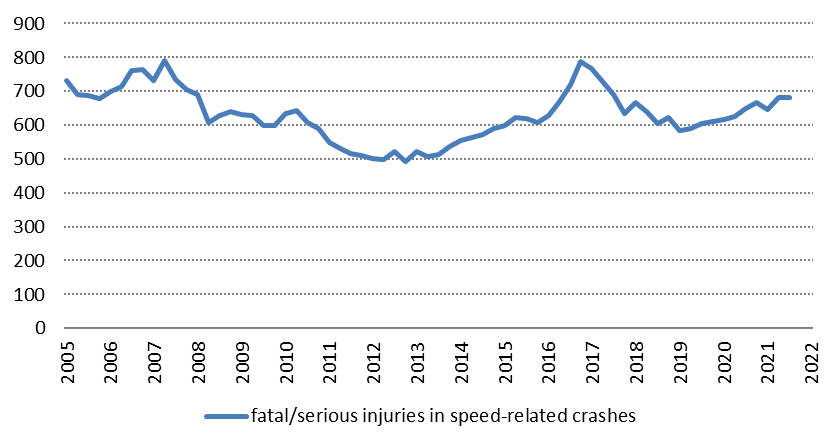
Speed is often mistaken as a debate about ability or skill, and so messages ar
Act e taken as
a personal affront at the individual level. However the most skilled driver will still make
mistakes or encounter circumstances where other people have made mistakes and a
crash will result.
“Control” is one of the key facets of speeding behaviour. People like to be in control of
their driving world, and for drivers it is a demonstration of their skill and expertise. Loss
Information
of that ability to control their world is one of the core fears of our target audience.
In general, many drivers don’t see speeding as dangerous, nor a serious offence.
However, driving fast increases both the likelihood of a crash, and the severity of that
crash.
Official
the
under
© Glasshouse Consulting 2023 | Slide 6
Released
Need for more insight
1982
Act
• For those who don’t buy the idea that speed and crash likelihood are linked, or that
speed determines the severity of a crash, there is a need to understand their reasons –
rarity (it’s never happened to me), confidence (a good driver won’t crash, or a good
driver could escape the situation), other factors (stop just blaming speed).
• Their perception is that the consequences of speeding are trivial. The magnitude of the
offence looks trivial – sometimes 4 or 8 km/h when the limit is 100 km/h. It’s hard to
Information
take the enforcement seriously when there’s widespread knowledge that you can safely
travel 10 km/h over the limit. And the penalties are trivial – a $30 fine for speeds up to
10 km/h over the limit is less than a parking ticket.
• Unlike most road safety problems, changing people’s speed behaviour faces the major
Official
challenge of confronting fun, instant gratification, efficiency and mastery. The people we
most want to influence are those who are already wedded to the pleasurable
the
alternatives, so we will need compelling reasons for them to think about changing.
under
© Glasshouse Consulting 2023 | Slide 7
Released

One in three New Zealanders believe there is not much
1982
chance of a crash if you are careful when you speed. This
has doubled since 2015
Act
•
Attitudes towards speeding and enforcement (% among Total NZ)
•
Agreement over time (% strongly agree / agree)
•
If you are careful when you speed, there is not much chance of a crash
Don't know
Strongly disagree
Disagree
If you are careful when you speed, there is not much
Information
Neutral
Agree
Strongly agree
100
chance of a crash
54
32
80
2022 1
13
40
13
24
8
60
67
23
40
Official
2021 1
23
44
9
18
5
20
the
59
30
0
2020 1
17
42
10
25
6
🔺 = Significantly higher than previous year at 95% CL
🔻 = Significantly lower than previous year at 95% CL
under
© Glasshouse Consulting 2023 | Slide 8
Released

Three in four New Zealanders agree that enforcing the
1982
speed limit helps to reduce road deaths. A minority
disagree at 15%.
Act
•
Attitudes towards speeding and enforcement (% among Total N
•
Agreement over time (% strongly agree / agree)
•
Enforcing the speed limit helps to reduce road deaths
Don't know
Strongly disagree
Disagree
Enforcing the speed limit helps to reduce road deaths
Information
Neutral
Agree
Strongly agree
100
15
73
90
80
2022
70
13
12
12
51
22
60
50
14
74
Official
40
30
2020 3 3
12
9
50
24
20
the 100
Those with a heavy vehicle licence are more likely to disagree:
2022
2020
Heavy vehicle
🔺 29%
🔺 24%
1995
1996
1997
1998
1999
2000
2001
2002
2003
2004
2005
2006
2007
2008
2009
2010
2011
2012
2013
2014
2015
2016
2020
2022
🔺 = Significantly higher than previous year at 95% CL
🔻 = Significantly lower than previous year at 95% CL
under
The majority of road users broadly recognised the risks of speeding and supported enforcement of the
speed limit. However, crash statistics suggest that many do not put their understanding of speed risk
into practice
© Glasshouse Consulting 2023 | Slide 9
Released
What has worked and what could we do next?
1982
Act
Speed advertisements which have performed best, in terms of audience cut-through,
relevance and message takeout, have featured:
▪ some aspect of enforcement, such as a speed camera, a cop talking to the crash victims,
losing a licence
▪ a story, such as leaving the kids at the farm gate, Mum and Dad coming from “that way”
Information
▪ using the audience’s language – I know these roads, it’s only a little bit over, just a
simple mistake
▪ shock or surprise, such as a crash, but without making the crash the feature of the ad
which distracts the audience into analysing the cr
Official ash instead of thinking about the
driver’s wrong behaviour
▪
the
an emotional tug, often using children (“she was only 4”, “tell it to his kids”, “the last
thing Nicky heard …”,“But who gets hurt Daddy?”, kids at the farm gate, child sad at
losing a parent at a street corner in
Consequences or on the highway in
Understand),
but also friends or family being present at the scene as in
Spot the Difference and
Ten
under
Minutes.
© Glasshouse Consulting 2023 | Slide 10
Released

1982
Act
From last concept
test - Attitudes to
Driving & Previous
Information
studies
Official
the
under
Released
What is great about driving
1982
Act
• Independence
• Freedom
• Being a lone wolf
• Being able to do whatever I want
Information
• Having no one who can tell me what to
CONTROL & EGO
do
My Limits
• Doing my own thing
My zone
• My own space
Official
• Just enjoy sensation of driving fast the
• Great roads in New Zealand that let you
drive fast
• Getting myself somewhere on my own
terms and in my own time frame
under
© Glasshouse Consulting 2023 | Slide 12
Released
Their biggest driving
1982
frustration
Act
• Being held up
• Slow drivers
• People doing the limit
• The fast lane is for speeding not for
driving the limit
Information REGULATED
• People sitting in the passing lane
Others' Limits
• Time wasters
imposed on me
• 30, 40 & 50K speeds
Official
• Traffic
the
• Other people in general
• On ramp lights
under
“
We are selfish about where we are going and how quickly we can get there”
© Glasshouse Consulting 2023 | Slide 13
Released
The ‘road law’ vs ‘The law’
1982
The law is there to regulate society and keep
Act
The road law is norms and common usage law –
us all safe, through our compliance.
we all do it. Speeding and for lots the speed limit
itself, sits here.
• Black and white rules – we can’t break.
“Stick to what I’m told”.
• Slow down ‘to my limit’ –what I want to do
• Don’t drink and drive
• Suggested and variable speeds/rules
• Stop at red lights (categorical)
• Tolerances – i.e. in GPS and from some Police –
they can judge the context – a chance to
• Speed cameras (absolute)
Information
explain.
• School zones - limit
•
“Fast lane’
• Seat belts & child seats
•
”The road law is contextual”
•
“The law is drawing a line in the sand”
Official
Humans (ourselves and the Police who are human too) have a tolerance for ‘grey area’, whereas
cameras don’t. Need to shift the belief that enforcement of speeding is open to interpretation and the
the
speed limit is a guideline to the enforcement of speeding and the speed limit is black and white.
•
There is no Police discretion or tolerance - anymore.
•
The speed limit is not a suggestion it is a safety measure
•
Enforcement is about protecting our safety not revenue collecting/hitting quotas based on individual attitudes
under
“I’ve been pulled over several times. It depends on which Officer you get, some of them are alright, they let you get
away with it”
© Glasshouse Consulting 2023 | Slide 14
Released
Previous Qualitative Research
1982
Act
• In 2017, Qualitative research with some of those who do not entirely buy our messages
gave a few insights into their grumpiness and frustrations, prior to two of the recent
speed advertising executions (
Thank You and
In my Shoes). Their concerns included:
▪ an over-focus on speed as the main cause for crashes, with “speeders”’ being held
overly responsible for road safety
Information
▪ adjusting your speed to the conditions can mean up or down, a skilled driver can drive
faster in good conditions
▪ slow drivers, not driving “at” the maximum speed limit, setting the travelling speed for
other motorists, not targeted by “slow cameras”
Official
▪ speed limits are a poor means of addressing inadequate infrastructure or the absence
the
of proper driver education, they are set for the weakest link
▪ cars are much safer but speed limits have not kept pace with changing times, although
accepting that our roads and safety systems are still quite backward.
under
© Glasshouse Consulting 2023 | Slide 15
Released
