Appendix A: Document 1
1982
Act
Information
Official
the
under
Released
1982
Act
Information
Official
the
under
Released

Document 2
[UNCLASSIFIED]
December 2025
\
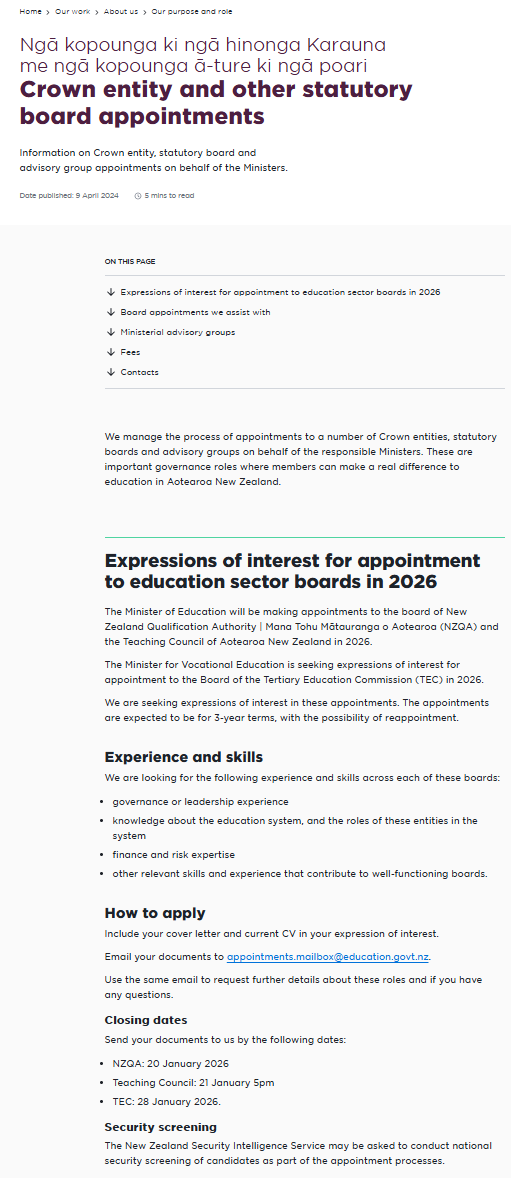
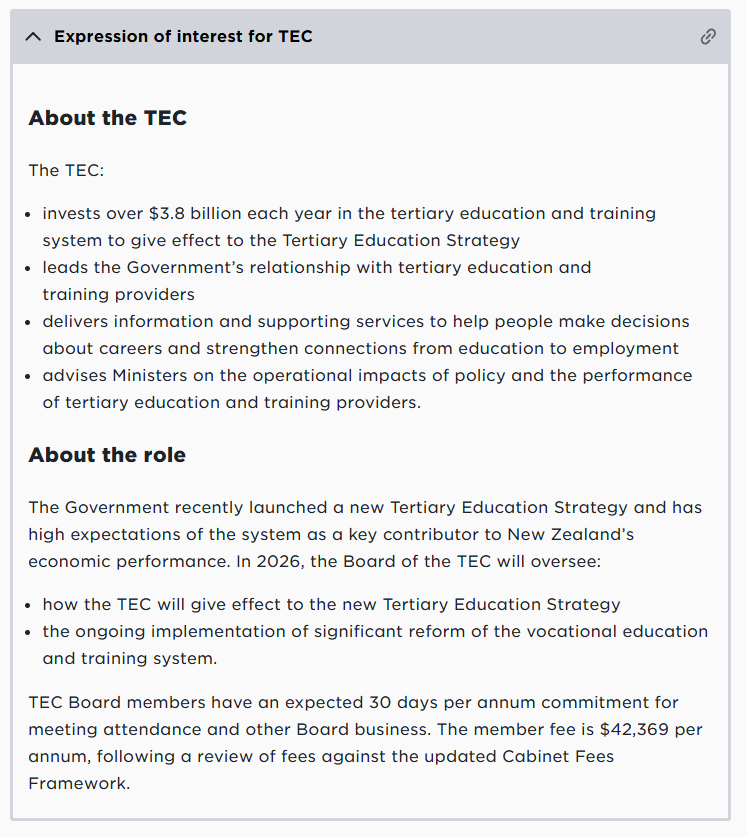
Tertiary Education Commission (TEC) | Te Amorangi Mātauranga Matua
Board Member Position Profile
Appointed by
Minister for Vocational Education
Term
Up to 3 years with potential for reappointment
Remuneration
$42,369 per annum
1982
About the TEC | Te Amorangi Mātauranga Matua
The TEC is a Crown Agent under the Crown Entities Act 2004. It leads the Government’s relationship
with the tertiary education sector and provides career services from education to employment. It
Act
invests nearly $4 billion each year in the tertiary education and careers system to help ensure New
Zealanders are equipped with the knowledge and skil s they need for lifelong success.
The TEC is governed by a board (the Board) that is accountable for its performance to the Minister
for Vocational Education (the Minister). It is monitored by the Ministry of Education.
The role of the Board and its members
The Board’s role involves ensuring the TEC performs its functions in line with the Government’s
policies and priorities (particularly the new
Tertiary Education Strategy), and that the TEC makes
Information
sound fiscal decisions. In setting the TEC’s direction, the Board needs to consider the priorities in
the Minster’s Letter of Expectations, the Enduring Letter of Expectations for Crown Entities, and
other communication from Ministers.
The Board is also responsible for assurance over the TEC’s performance against its strategic
direction, and for issuing its Statement of Intent, and Statement of Performance Expectations. The
TEC must report on its performance in quarterly reports to the Minister, and in its Annual Report
Official
which is tabled in Parliament.
Members of the Board are accountable to the Minister in respect to their collective and individual
the
duties and responsibilities, and the Chair has primary accountability for entity and board performance
with support from the Deputy Chair. As a member of the Board, you are expected to support the
Board’s work as directed by the Chair (or Deputy Chair) by:
• contributing your specific areas of expertise as they relate to the governance of the TEC
under
• supporting other members and working in a collective and collaborative manner
• participating in, or leading, sub-commit ees or projects
• maintaining current knowledge of the sectors the TEC operates in, environmental factors,
emerging risks and challenges and government direction, and
• maintaining political neutrality and the confidence of the Minister.
Relevant legislation
Section 409 of the Education and Training Act 2020 sets out the functions of the TEC. As a Board
Released
member, you also need to have a sound understanding of Part 4 and Subpart 1 of Part 5 of the Act,
which sets the statutory framework for the tertiary education and training system, and Part 1 of the
Act, which sets the statutory framework for the over-arching education system, including the role of
Te Tiriti o Waitangi.
As set out in t
he Public Service Act 2020, the Board must preserve, protect, and nurture the spirit of
service to the community (s13), and is responsible for ensuring the TEC upholds Public Service
principles (s12), which are:
Position Profile – Tertiary Education Commission - Board member
1
[UNCLASSIFIED]

[UNCLASSIFIED]
December 2025
• political neutrality
• providing free and frank advice
• making merit-based appointments
• fostering a culture of open government, and
• promoting stewardship of the public service – the long-term capability of its people,
institutional knowledge, systems and processes, assets, and the legislation agencies
administer.
The rules for governance, operation, and accountability of Crown entities are set out in th
e Crown
Entities Act 2004. For more information about the expected role and conduct of Crown Entity Board
Members, please see the Public Service Commission’s
Code of Conduct for Crown Entity Board
Members.
1982
Required skills, experience and attributes
To help the Board succeed in its roles and functions, it should collectively have:
Act
• strong governance experience
• executive leadership experience, a strategic outlook and the ability to lead through change
• strong financial capability and acumen, and commercial experience
• a detailed understanding of the machinery of government including the role of Crown Agents
• an understanding of the operating context for tertiary education in New Zealand
• an understanding of tertiary education funding processes and systems
• knowledge of te reo Māori, tikanga Māori, Mātauranga Māori, and Te Tiriti o Waitangi, and
• an ability to build robust, collaborative relationships in complex environments.
Information
Workload, remuneration and term of appointment
The expected workload for members is approximately 30 days per year on meeting attendance
and other board business. The Board meets around ten times a year. Members receive a fee of
$42,369 per annum. This is set and reviewed in accordance with the Cabinet Fees Framework,
which can be found here:
Fees Framework for bodies in which the Crown has an interest |
Department of the Prime Minister and Cabinet.
Official
All members are paid out of the TEC’s funds for reasonable and actual allowances for travelling and
other expenses relating to performing their duties and responsibilities as board members.
the
Appointments are for terms of up to three years. Members may be considered for reappointment
when their term expires.
Resignation or removal from office
under
A member may, at any time, resign from office by notifying the Minister and the Chair in writing. Any
member, including the Chair, may be removed by the Minister by writ en notice.
Released
Position Profile – Tertiary Education Commission - Board member
2
[UNCLASSIFIED]
Document Outline
