 BRIEFING
Paid Parental Leave: Background and Next Steps for Manifesto
BRIEFING
Paid Parental Leave: Background and Next Steps for Manifesto
Commitment
Date:
7 December 2023
Priority:
Medium
Security
Tracking
In Confidence
2324-0945
classification:
number:
Action sought
Action sought
Deadline
Hon Brooke van Velden
Discuss the next steps for the paid
Minister for Workplace
parental leave Manifesto
14 December 2023
Relations and Safety
commitment with officials.
Contact for telephone discussion (if required)
Name
Position
Telephone
1st contact
Manager, Employment
Alison Marris
04 901 8564
s 9(2)(a)
✓
Standards Policy
Senior Policy Advisor,
Tim Spackman
Employment Standards
04 897 5059
Policy
The following departments/agencies have been consulted
Inland Revenue
Minister’s office to complete:
Approved
Declined
Noted
Needs change
Seen
Overtaken by Events
See Minister’s Notes
Withdrawn
C
Released under the Official Information Act 1982
omments
 BRIEFING
Paid Parental Leave: Background and Next Steps for Manifesto
BRIEFING
Paid Parental Leave: Background and Next Steps for Manifesto
Commitment
Date:
7 December 2023
Priority:
Medium
Security
Tracking
In Confidence
2324-0945
classification:
number:
Purpose
The National Party has a Manifesto commitment in relation to paid parental leave. This paper gives
you background information on New Zealand’s parental leave scheme and seeks a discussion on
your goals and preferred approach to the parental leave work programme.
Executive summary
New Zealand’s paid parental leave scheme offers job-protection, leave and payments to
supplement a family’s income while a parent or caregiver is not working, due to a new child in the
family. Leave and payments are separate components, each with different eligibility criteria.
Eligibility for both components is based on the primary carer’s employment in the first instance.
The
Parental Leave and Employment Protection Act 1987 (the Act) has rigid rules and does not
meet the needs of some New Zealand families, given the way parenting has evolved. Amendments
to modernise the Act have also made it complex to administer and confusing for parents.
The National Party Manifesto commits to a more flexible and modern parental leave scheme that
allows parents to make the choices that best suit their personal circumstances. Based on this
commitment, we have begun to explore ways to introduce more flexibility for parents.
There are limited options to achieve greater flexibility within the structure of the current Act. The
main option would be through amendments to the transfer provisions. In our view, a truly flexible
scheme that meets the needs of today’s families would best be achieved through a full review. This
would also help to manage the risk of making changes to the Act that introduce further complexity.
We look forward to talking with you about your goals and preferred approach. We can then provide
more detailed advice about options and timing for achieving your priorities.
Recommended action
The Ministry of Business, Innovation and Employment recommends that you:
a
Released under the Official Information Act 1982
Discuss the next steps for the Manifesto commitment with officials.
Agree/Disagree
Alison Marris
Hon Brooke van Velden
Manager, Employment Standards Policy
Minister for Workplace Relations and Safety
Labour, Science and Enterprise, MBIE
..... / ...... / ......
..... / ...... / ......
2324 – 0945
In Confidence
1
Overview of the parental leave scheme
1.
Parental leave has both economic and social benefits. Parental leave supports child
cognitive development, women’s and children’s health, and reduces child poverty. It also
allows mothers to recover from pregnancy and childbirth and parents to bond with their child.
Parental leave is associated with protective effects on mothers’ mental health 1.
2.
A well-designed parental leave scheme can have a positive impact on female labour force
participation2 and lowering the gender pay gap3. It helps keep employees connected to their
employer and eases financial stress for new parents without placing additional financial
pressure on employers.
New Zealand’s paid parental leave scheme offers job-protection and payments
3.
New Zealand’s parental leave scheme protects employment and provides payments to
supplement a family’s income while a parent or permanent caregiver has stopped working to
care for a new child. The parental leave scheme is set out in the
Parental Leave and
Employment Protection Act 1987 (the Act). Over the year to June 2023, approximately 60
percent of births had a parent receiving paid parental leave 4
.
4.
Job-protected leave and payments are separate components, each with different eligibility
criteria. Someone may be eligible for one component but not the other5.
5.
Unpaid job-protected leave of up to 52 weeks is available to the ‘primary carer’ of the child6.
Job-protected leave can be shared between eligible parents, either in alternate periods or
simultaneously (see
Annex One for an overview). Partners are entitled to up to two weeks of
unpaid leave.
6.
Eligible parents and permanent caregivers are also entitled to up to 26 weeks of government-
funded parental leave payments. Payment eligibility can be transferred to a spouse or
partner7 but both parents cannot receive payments simultaneously and only one transfer is
possible after payments have commenced. Payments are made at the rate the person would
usually be earning, up to a maximum of $712.17 gross per week. This rate increases
annually in line with the average weekly wage (see
Annex Two for more information).
7.
The parental leave provisions set out in the Act are a statutory minimum. Some employers
negotiate to go above and beyond this minimum.
8.
Parental leave policy falls within your authority as the responsible Minister for Workplace
Relations and Safety. Inland Revenue (IR) administers applications and makes payments
while the Ministry of Business, Innovation and Employment (MBIE) provides you policy
advice on parental leave. The Employment Services operational branch within MBIE is
Released under the Official Information Act 1982
1 Heshmati, A., Honkaniemi H., & Juarez S. P. (2023). The effect of parental leave on parents’ mental health: a systematic review,
The
Lancet,
8(1), 57-75,.
2 Nandi, A., et al., (2018), The Impact of Parental and Medical Leave Policies on Socioeconomic and Health Outcomes in OECD
Countries: A Systematic Review of the Empirical Literature,
The Milbank Quarterly, 434–471.
3 Del Rey, Racionero, & Silva, (2021), Labour market effects of reducing the gender gap in parental leave entitlements, Labour
Economics,
72.
4 This is calculated by dividing the number of new applicants who have received a parental leave payment (37,432) divided by the
number of live births (58,707),
5 If an individual is entitled to payments, but is not entitled to parental leave they can take a period of negotiated carer leave or
otherwise stop working to care for the child, and will receive parental leave payments.
6 A primary carer is either the biological mother of the child, or the spouse or partner of the biological mother (if the biological mother
transfers their entitlement to their spouse), or a person taking permanent primary responsibility for the care, development and
upbringing of a child under six years old.
7 The transferee must also meet the parental leave payment eligibility test.
2324 – 0945
In Confidence
2
responsible for operational issues and resolving disputes (see
Annex Two for more detailed
information on these roles).
9.
The parental leave scheme sits within a wider government support system for families,
including Working for Families, and the Early Childhood Education subsidy (see
Annex One for other government support).
The Act was built around eligibility to the birth mother in the first instance
10. When the Act was passed in 1987 it was designed to provide a brief period of employment-
protected leave to women who had given birth, with payments introduced in 2002. A key
focus of the 2002 changes was incentivising women to stay attached to the labour market8,
which influenced eligibility criteria and the structure of the Act.
11. If a biological mother is not eligible for payment, their spouse or partner cannot be eligible in
their own right. Although an eligible mother can transfer eligibility for payments to her spouse
or partner, this is unusual. As of August 2022, only 2.5 per cent of the people receiving
payments over the preceding three years were a spouse or partner.
Past amendments to modernise the Act have made it complex to administer and
confusing for parents
12. There have been eight Parental Leave and Employment Protection Amendment Acts since
the Act was passed in 1987. Eligibility for payments has expanded to a wider variety of family
and working situations, and the ability to transfer to a spouse or partner now exists.
13. Amendments have modernised the Act to some extent, but have also led to a complex and
unwieldy piece of legislation. The Act has become longer and more complicated with each
amendment, and some changes created loopholes or contradictions that have been
addressed through further amendments.
14. The complexity of the legislation, along with its rigid rules, leads to a process that is
confusing for applicants. Eligibility for payments sits with the mother or primary carer in the
first instance and there is no specific paid leave for a spouse or partner. The primary carer
can transfer their entitlement to payment to their spouse or partner, but the payments must
be received in one continuous period (i.e. they cannot return to work for a while and then
resume payments) and payments can only be transferred once. Some parents lose their
entitlements as a result of not understanding the eligibility criteria or going about the transfer
process incorrectly.
15. Eligibility for unpaid partner’s leave depends on continuous attachment to a single employer
for at least six months and this eligibility requirement may not be met by people working for
Released under the Official Information Act 1982
wages, doing ‘gig work’ or in less stable employment9.
16. As New Zealand family dynamics have shifted and working arrangements have become
more flexible, the Act has been less able to accommodate the needs of modern families and
the choices they wish to make about their own caregiving arrangements.
8 A payment linked to employment provides an incentive to apply for employment leave that already existed. This job-protected leave
maintains connection with the workplace, minimising longer-term negative financial impacts from time out of the workforce with children.
9 In 2021, approximately 16 per cent of wage-earning fathers may not meet eligibility for the two weeks’ unpaid leave. For Māori and
Pasifika this is closer to 25 per cent of wage-earning fathers not meeting eligibility criteria. (Kulkarni, R & Mok, T. (2021)
. ‘What about
the menz?’ Low employer attachment and ineligibility for partner parental leave. The Southern Initiative
.)
2324 – 0945
In Confidence
3
17. Having dated legislation that is inflexible and confusing places a burden on delivery
resources10 and has resulted in legal challenges from applicants who have been declined
payments. MBIE has observed an increase in appeals to the Employment Relations Authority
(the Authority) since 202011. The Act is also a driver of demand for dispute resolution
services, which could be reduced by better legislation (see
Annex Two for more
information). This is not a significant portion of demand or output for the Authority or MBIE,
but there is a potential for significant adverse impacts on parents and children during a
pivotal time period in their lives, due to issues with the overall design of the scheme.
18. Agencies have made improvements in order to simplify the application process, such as
moving to online applications and updating online guidance. Having modern, fit for purpose
legislation would assist families in making use of the scheme and, in the long-term, reduce
demands on both MBIE and IR.
The National Party Manifesto commits to more flexibility and
choices for families
19. Parental leave is not specifically referenced in the National/ACT Coalition Agreement or the
National/NZ First Coalition Agreement. We have taken the National Party Manifesto
commitment as the starting point for our advice, however, we would like to discuss your
objectives for this area of work.
20. The Manifesto committed to a more modern and flexible parental leave scheme that allows
parents to make the choices that best suit their personal circumstances. The Manifesto
mentions allowing parents to receive parental leave payments simultaneously or one after
another. There is no deadline set for meeting this commitment.
21. There is already some flexibility with respect to the unpaid job-protected leave. Job-protected
leave from employment of up to 52 weeks is available in some circumstances, which can be
shared between eligible parents. Parents can alternate periods of job-protected leave or take
it simultaneously.
22. However, the rules around parental leave payments are more rigid than those for job-
protected leave; as noted in paragraph 14, eligibility sits with the primary carer in the first
instance and allows a single transfer of entitlement which then must be received in one
continuous period. This may not offer the flexibility some New Zealand families need.
Some elements of the current legislation could be amended to provide some
increased flexibility and choice, but that may not go far enough
23. Due to the way the Act is structured (for example only allowing for one primary carer at a
Released under the Official Information Act 1982
time) the flexibility and choice that could be achieved through targeted amendments to the
transfer provisions is limited. Targeted amendments could provide more flexibility with
receiving and transferring payments (if both parents meet eligibility criteria) but may not
provide the desired level of flexibility and could introduce further complexity or confusion.
24. s 9(2)(h)
10 In 2022/23, the Labour Inspectorate received 94 cases from IR for decisions, up from 75 cases in 2021/22, after a peak of 110 in
2020/21.
11 20 cases went to the Authority for determinations in 2022, up from six cases in 2021, and 1 case in 2020.
2324 – 0945
In Confidence
4
s 9(2)(h)
25. IR will need an understanding of the scope and desired parental leave settings, to ensure it
can accurately advise on complexity, timeframes for build and implementation, as well as
costs.
26. We would like to discuss the Manifesto commitment and your objectives with you in more
detail to ensure that we understand the outcomes you wish to achieve. We will then be in a
better position to provide more detailed advice.
Full flexibility and choice for parents would require a review of the Act
27. While it is possible to increase flexibility around payment transfers, this would not address
challenges in other areas; such as the rigidity of the eligibility thresholds, payment eligibility
defaulting to the mother, or technical issues that increase administrative costs. Our initial
view is that the Manifesto commitment would best be achieved through a full review of the
Act.
28. A full review would provide scope to consider the foundations and intent of the scheme, and
create a truly flexible scheme that meets the needs of today’s families, balanced with the
needs of employers. This offers the opportunity to modernise the outdated legislation,
remove rigidity, and simplify the scheme’s administration. A full review would take longer
than a targeted change.
29. Additional information on areas of the parental leave system that impact on flexibility and
choice, and some international examples of changes made to increase flexibility, are outlined
in
Annex three.
Next steps
30. We would like to talk with you about your goals and preferred approach to parental leave
policy. This discussion will inform further advice to you about this work programme. Some
key questions we would like to discuss during this conversation are:
• Is there more information you would like to receive about a particular aspect of the
parental leave scheme?
• What outcomes would you like from the parental leave scheme?
• What sort of flexibility do you want parents to have? Do you want to introduce flexibility
for the sharing of parental leave payments, or increase flexibility for the scheme as a
whole?
Released under the Official Information Act 1982
• Do you have key priorities we should consider in preparing advice on options?
• How should we prioritise work on parental leave, relative to your other planned work in
the Workplace Relations and Safety portfolio?
Annexes
Annex One: Overview of the parental leave scheme
Annex Two: Administration of the parental leave scheme
Annex Three: Changes to increase paid parental leave flexibility in other jurisdictions
Annex Four: OECD comparison of weeks of parental leave
2324 – 0945
In Confidence
5
Annex One: Overview of the parental leave scheme
Job-protected leave
1. Job-protected leave requires the employer of eligible parents and primary carers to allow their
employee to take time away from work to care for a new child, with up to 52 weeks of unpaid
employment-protected leave. This can be shared between eligible parents or caregivers.
Partners are entitled to up to two weeks of unpaid leave.
2. There is complete job protection for the first four weeks for every employee on parental leave.
After four weeks, the job must be kept open, unless it is a key position12 or redundancy
situation. In cases of redundancy or the employer defining the job as a key position, the person
on parental leave will go into a 26 week 'period of preference' at the end of their parental leave
and must be offered any available jobs that are similar to their previous job before these are
offered to anyone else.
3. Eligibility for job-protected leave requires firstly that an employee is the primary carer of a child.
To be a primary carer, an employee must be either:
•
a female (biological mother) who is pregnant, or has given birth to a child within the last
year
•
the spouse or partner13 of a female who is pregnant, or has given birth to a child, and
who has had parental leave payments transferred to them
•
a person, other than the biological mother or her spouse or partner, who takes permanent
primary responsibility for the care, development, and upbringing of a child who is under
the age of six.
4. Secondly, the primary carer must have worked for the same employer, for either:
•
at least an average of 10 hours a week in the six months immediately preceding the
expected date of delivery of the child (if a child is to be born to an employee or their
spouse or partner), or assumption of responsibility for the care of the child (in any other
case), which entitles them to 26 weeks of primary carer leave
•
at least an average of 10 hours a week in the 12 months immediately preceding the
expected date of delivery of the child (if a child is to be born to an employee or their
spouse or partner), or assumption of responsibility for the care of the child (in any other
case), which entitles them to 26 weeks of primary carer leave and an additional 26 weeks
of job-protected leave.
Parental leave payments
5. Parental leave payments (payments) provide financial support during the time away from work,
Released under the Official Information Act 1982
providing eligible parents and primary carers with up to 26 weeks of government-funded
payments. Payments are at the rate the person would usually be earning, up to a maximum of
$712.17 gross per week (this was increased from $661.12 gross per week on 1 July 2023).
6. Employee eligibility for payments has the same requirement that a person is a new primary
carer of a child. The employment criteria is also similar to that for job-protected leave described
12 An employer must prove that a temporary replacement is not reasonably practicable, due to
it being a key position within the
business. In determining whether a position is a key position, the employer may have regarded to the size of their business and the
training period or skills required for the role.
13 Partner means the spouse or partner of the mother or nominated primary carer, male or female, same sex or different sex.
2324 – 0945
In Confidence
6
above but the employment included in calculations for this test can be with more than one
employer and does not have to be continuous employment.
7. Somebody who has changed employers within six months of their child being born or who has
multiple employments may not be eligible for job-protected leave from any of their employers
but may be eligible for payments if they stop working. This person can request negotiated carer
leave from their employer, and this request can only be rejected on specified grounds.
8. Self-employed people may be eligible for payments, but are not covered by leave provisions.
To receive payments, they must stop working for the period they are receiving payments, other
than occasional administrative and oversight duties. To be eligible, a self-employed person
must have been working in self-employment for at least an average of 10 hours a week over
any 26 of the 52 weeks before the expected date of delivery of the child, or the date where they
become the primary carer of the child. The same maximum payment rate applies to both
employees and self-employed people, but there is also a minimum payment rate for self-
employed people, which is set at 10 hours of the minimum wage (currently $227 gross per
week).
9. In cases of whāngai14, surrogacy and adoption, one parent elects to be the ‘primary carer’ for
the purposes of parental leave payments, and this carer can transfer their entitlement to their
spouse or partner (who also meets eligibility criteria) if they wish.
10. The ability to elect the primary carer does not exist for biological mothers and their spouse or
partner. If the biological mother is not eligible for payments, then the spouse or partner cannot
elect to become the primary carer to receive payments as there is no entitlement to transfer.
Uptake of parental leave payments and length of parental leave is increasing
11. Significant policy changes after 2015 were followed by increases in the number of people
accessing parental leave payments. Changes in the number of weeks of entitlement, as well as
the introduction of shared extended leave between parents, improving the eligibility for
employees with multiple jobs, and entitlement to preterm baby payments, have been followed
by increased participation in the scheme.
12. On average, recipients of parental leave payments were receiving 90 per cent of the maximum
rate in 202115. Payments were received for approximately 18 weeks (four months), increasing
from an average of 12.5 weeks in 2003.
The parental leave scheme interacts with other government support
13. Parental leave payments and job-protected leave interact with other systems and are part of a
suite of tools across the tax, welfare and education systems that support families. In addition to
t Released under the Official Information Act 1982
he parental leave scheme, the government provides a range of financial support to help
caregivers raise young children. Entitlements are based on family income and family
circumstances. The support includes:
• Working for Families Tax Credits including Best Start, a payment of $69 a week for
eligible families supporting a new baby.
14 Whāngai is the Māori tradition of children being raised by someone other than their birth parents, usually a relative. Whāngai usually
involves a child being raised by its whānau or extended family.
15 The average recipient received a payment of $558 per week in 2021, when the maximum payment was capped at $621.76.
2324 – 0945
In Confidence
7
• Main benefits, such as Jobseeker Support, Supported Living Payment, Sole Parent
Support, and Young Parent Payment, provide additional support if the recipient has a
child or children.
• Orphan’s Benefit and Unsupported Child’s Benefit.
• Disability Allowance and Child Disability Allowance.
• Caregiver Allowance.
• Childcare Subsidy.
• Early Childhood Education subsidy.
• Early Learning Payment.
• Accommodation Supplement.
• Winter Energy Payment.
Released under the Official Information Act 1982
2324 – 0945
In Confidence
8
Annex Two: Administration of the parental leave scheme
IR administers parental leave applications and payments while MBIE has policy
responsibility and dispute resolution functions
1. MBIE delegates its paid parental leave administrative functions to IR. Applicants apply to IR for
parental leave payments and contact IR if they disagree with a decision. On occasion, IR will
refer a case through to MBIE for a decision, as MBIE holds policy responsibility for the Act. If a
dispute is unresolved, a Labour Inspector may be involved. A dispute that remains unresolved
may go to the Authority for a determination.
2. Although IR administers the scheme, MBIE is a party to all litigation about the Act relating to
administrative decisions, including the Authority's review of decisions made by both MBIE and
IR. In a significant proportion of the Authority determinations about the Act, parents seek that
the Authority exercise its relatively wide discretion, on the grounds of equity, to modify or
reverse decisions made by IR or MBIE that were based on technical interpretations of the Act.
3. MBIE and IR officials keep in regular contact about the operation of the Act, and identify
opportunities for non-legislative improvements, such as communications, systems and
processes, to keep the Act working as smoothly as possible. The Memorandum of
Understanding that governs how IR shares information with MBIE for these purposes was
updated recently.
The rates of payment are adjusted every year
4. Parental leave payment rates are adjusted on 1 July each year in accordance with a formula
set out in the Act (based on wage growth). If there is a downward percentage movement in
wages, there is no adjustment in the rates of payment. Officials will brief you in advance of this
change, but there is no discretion in the Act for the Minister for Workplace Relations and Safety
to decide the annual rate adjustment.
5. On 1 July 2023, the maximum parental leave payment rate for eligible employees and self-
employed parents increased from $661.12 to $712.17 per week, before tax - an increase of 7.7
per cent, reflecting the 7.7 per cent rise in average weekly earnings.
6. The Minister for Workplace Relations and Safety is required to publish the adjusted maximum
rate for employees and self-employed people and the new minimum rate set for self-employed
persons. MBIE will seek your agreement to publish these online in order to fulfil this
requirement.
The parental leave payments appropriation
7. Released under the Official Information Act 1982
Parental leave payments are part of Vote Revenue, for which the Minister of Revenue has
responsibility. Parental leave payments for 2022/23 were estimated at $630 million. The Budget
for 2023/24 parental leave payments is $677 million.16
16 The Treasury,
Finance and Government Administration Sector – The Estimates of Appropriations for the Government of New Zealand
for the Year Ending 30 June 2023, B5 Vol 4, 286.
2324 – 0945
In Confidence
9
Annex Three: Changes to increase paid parental leave flexibility in
other jurisdictions
1.
Australia, Austria, Japan and Quebec have increased flexibility in their paid parental leave
schemes, each in different ways. These jurisdictions provide examples of parental leave
design settings you could consider as part of a full review. Where possible, impacts of the
changes are included.
Australia
2.
In July 2023, Australia expanded paid parental leave laws so that either parent can make the
initial application for paid parental leave, and parents can access their entitlement in multiple
blocks. Leave can be taken at the same time by parents, or shared. Requirements that
parental leave must be taken within the 12 months following birth, and that leave must be
taken in one continuous period, were removed. Parents can take leave in increments as
small as one day at a time, while working flexibly around this17. It is too early to measure the
effect of these changes, but they are being welcomed as an "improvement" by most.
Austria
3.
In 2008, Austria moved from offering a flat payment rate for 36 months, to introducing a
second option where parents could take less leave while receiving the same total amount of
payment, allowing parents to decide the amount of time away from work and income
replacement rate that worked best for them. In 2010, a second reform further increased
flexibility and also raised the income-replacement rate significantly, to 80 per cent of usual
income. Each change was followed by an increase in the share of fathers going on parental
leave by about 10 to 20 per cent18.
Japan
4.
Japan had a generous 'Childcare Leave' scheme, but has consistently seen low uptake by
men. In April 2022, the first phase of revised Childcare Leave Laws were rolled out. Leave
can now be taken in two periods and the requirement that the entitlement be used by the
child's first birthday has been removed. Flexible "postpartum paternity leave" of up to four
weeks has been introduced, ring-fenced for male employees, and must be used in the first
eight weeks postpartum. A Ministry of Health, Labour and Welfare study of over 3,000
workplaces found eligible men’s uptake of childcare leave increased by 3.16 per cent to
17.13 per cent in 2022, Japan’s highest ever rate. The Government plans to increase
subsidies offered to small and medium business that offer "support allowances" for the co-
workers who cover the work of the person who has taken parental leave, to address a
workplace culture that discourages the taking of leave19.
QueReleased under the Official Information Act 1982
bec
5.
In 2006, the Canadian province of Quebec brought in its own parental leave system, the
Quebec Parental Insurance Plan (QPIP). QPIP gave parents higher payment rates than the
rest of the country (75 per cent of usual income), offered more flexibility for sharing leave,
such as taking leave simultaneously, and instituted a "daddy quota" of five weeks’ paid leave
ring-fenced for fathers and partners on a use-it-or-lose-it basis. Usage of parental leave by
17 Paid Parental Leave Scheme Employer Toolkit (servicesaustralia.gov.au).
18 Ziegler, L and Bamieh, O.
(2023).
When fathers take parental leave: The role of financial incentives and flexibility, , Centre for
Economic Policy Research.
19 Tochibayashi, N and Kutty, N
(2023).
Could Japan’s paternity leave policy narrow the gender gap?, World Economic Forum.
2324 – 0945
In Confidence
10
eligible fathers increased over 250 per cent. Over 90 per cent of fathers in Quebec now take
paternity leave, compared with around 20 per cent of eligible fathers in the rest of Canada20.
Released under the Official Information Act 1982
20 Beaupre, P. (2021).
Family Matters: Parental Leave in Canada, Statistics Canada.
2324 – 0945
In Confidence
11
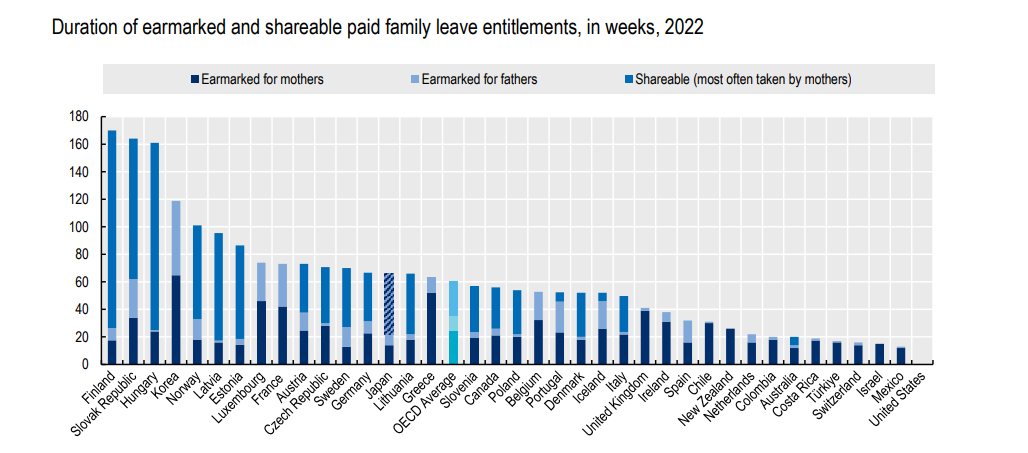 Annex Four: OECD comparison of weeks of parental leave
1.
The chart below shows the number of weeks of reserved (earmarked for mothers, or earmarked for fathers) and shareable statutory paid leave
entitlements across OECD countries, in 202221.
New Zealand
2.
New Zealand law provides 26 weeks of payments, which is 43 per cent of the OECD average of 61 weeks of entitlements. The OECD notes
that “[t]his indicator provides an overview of parental leave systems across OECD and EU countries. Parental leave systems are diverse and
individual systems do not always fit neatly into classifications suitable for international comparison.”
Released under the Official Information Act 1982
21 OECD Family Database, Parental leave systems, http://www.oecd.org/els/family/database.htm
2324 – 0945
In Confidence
12
3.
In addition to issues around the classification of leave entitlements, international
comparisons of leave systems are affected by other issues:
• Comparisons do not capture the different uptake rates of the various entitlements. In
some countries, societal norms and culture may act as an effective barrier to taking up
leave entitlements for some parents. For example, Japan offers a generous father-
specific paid leave entitlement, but only a low per cent of new fathers in Japan take
advantage of the leave22. As a result, while the information above reflects what is
technically on offer to parents, statutory entitlements may say little about what is actually
taken up.
• State and local governments sometimes provide alternative entitlements and additional
financial support for parents on leave that differ from federal settings. These local
variations are not included in the OECD data, which results in the United States’ leave
recorded as zero weeks’ leave.
• Employer-funded top-up payments (over and above the statutory minimum) are not
included in the chart. Practices differ across businesses, sectors and countries, but in
many OECD countries these payments are substantial23. As a result, the chart above will
in some countries underestimate the actual amount that parents receive.
• Leave benefits in some but not all countries may be subject to taxation and may count
towards the income base for social security contributions. As a result, the actual amounts
received by the individual on leave may differ from those shown above, depending on the
rules for and rates of taxation in the given country. For instance, New Zealand’s
payments are subject to taxation and other deductions such as student loan or child
support payments.
Notes on OECD data
4.
Information refers to paid birth-related leave entitlements to care for young children in place
as of April 2022, such as maternity, paternity, home care and parental leave.
5.
Periods labelled “earmarked for mothers” and “earmarked for fathers” are individual, non-
transferable entitlements for paid employment-protected leave of absence for employed
parents, or periods of an overall leave entitlement that can be used only by one parent and
cannot be transferred to the other, as well as any weeks of shareable leave that must be
taken by one or both parents for the family to qualify for “bonus” weeks of parental leave.
6.
Weeks of shareable leave refer to parental and home care leave entitlements that can be
freely shared between mothers and fathers.
7.
Released under the Official Information Act 1982
For Japan, the 44 weeks of the individual parental leave entitlements for the mother must be
taken simultaneously with the father if both parents are to use the entirety of their
entitlements.
22 Tochibayashi, N and Kutty, N
(2023).
Could Japan’s paternity leave policy narrow the gender gap?, World Economic Forum.
23 Crayon, (https://www.gocrayon.com/) a New Zealand business, provides a searchable database of New Zealand businesses’ parental
leave policies, information for parents and employees, and financial planning services for parents.
2324 – 0945
In Confidence
13
