link to page 4 link to page 6 link to page 8

Policy
Privacy
Introduction
When to use
Use this policy when you want to understand the requirements for col ecting,
storing, handling and using personal information at Fire and Emergency New
Zealand when we are not operating in an emergency.
Note: Application of the Information Privacy Principles (IPPs) may differ when Fire
ACT 1982
and Emergency is operating in an emergency situation.
This policy should also be used when managing a privacy incident or making a
privacy complaint, in conjunction with th
e Managing privacy incidents guidelines or
Making privacy complaints guidelines. Note: You should read this policy in conjunction with
Te Tikanga Whanonga Our
Code of Conduct and
Unacceptable behaviours schedule.
Contents
This policy contains the following content:
About this policy
INFORMATION
Definitions
Policy statements
Good information privacy practice at Fire and Emergency
Responsibilities
Related information
About this policy
Purpose
This purpose of this policy is to set expectations for ensuring that Fire and
Emergency only col ects personal information for a lawful purpose, safely and
securely stores personal information, and ensures personal information is not used
or disclosed for unauthorised purposes. It is also to ensure individuals are
protected from any harm that could result from breaches of the
Privacy Act 2020. This policy sets out expectations for those that col ect, hold, use or disclose
personal information so that Fire and Emergency complies with the responsibilities
set out in the Privacy Act 2020. That is, we treat the personal information we
collect and hold lawfully, respectfully and with care, and only use or disclose
personal information where permitted. The purpose of this policy is also to ensure
that privacy incidents and complaints are managed appropriately.
This policy also sets expectations in relation to persons requesting access to their
personal information and taking reasonable steps to update personal information
when it is wrong.
RELEASED UNDER THE OFFICIAL
4 June 2025
1
link to page 2 link to page 3
Policy - Privacy
Who it applies to
We expect the following groups of people to comply with this policy:
• permanent and temporary employees
• casual employees
• volunteers
• contractors (individuals, employees of contractors, subcontractors, or persons
affiliated with third parties)
• anyone working on behalf of Fire and Emergency (for example, service
providers).
In some cases, our providers will have their own privacy policy, however, when
these providers are delivering services on our behalf, the requirements of this
ACT 1982
policy will apply instead.
Everyone has a duty to meet th
e commitment and
requirements statements below.
Definitions
The following definitions apply to this policy and all places where these terms are used in Fire and
Emergency:
Personal
Personal information means any information about an identifiable individual. The
information
Privacy Act 2020 applies to all personal information collected and held by Fire and
Emergency.
INFORMATION
Personal information includes information about people in our community, and
information about Fire and Emergency employees and volunteers or individuals
who provide services on behalf of the organisation.
Examples of personal information include names, addresses and contact details,
and also location of incidents if they occurred on private property.
Sensitive personal Sensitive personal information is information about an individual that has some
information
real significance to that person, is revealing of them, or generally relates to
matters an individual might want to keep private. This includes information that
will potentially allow others to draw inferences about the individual, or might
result in the individual being treated a certain way.
Examples of sensitive personal information include information about a person’s
race, ethnicity, gender or sexual orientation, health, disability, age and religious,
cultural and political beliefs.
Policy statements
Our commitment
At Fire and Emergency, we’re committed to respecting the information we collect
and hold about other people and ensuring we treat it lawfully and with care.
Everyone at Fire and Emergency deals with information in some way, including
personal information about people, which can be sensitive, such as the identities
of victims involved in emergency incidents. The communities we serve have a right
RELEASED UNDER THE OFFICIAL
to expect that we will respect their privacy and comply with our legal obligations.
4 June 2025
2
link to page 4
Policy - Privacy
Requirements
As personnel of Fire and Emergency, we are responsible for ensuring the
collection, use, disclosure and storage of any personal information complies with
the IPPs in the Privacy Act 2020.
Further detail on th
e IPPs is provided below, and guidance is also available on the
Office of the Privacy Commissioner’s website at privacy.org.nz > Privacy Act 2020 >
Privacy Act 2020 and the Privacy Principles.
Minimising risk
Fire and Emergency will consider the IPPs each time a system or process that
col ects, uses, discloses and/or stores personal information is reviewed, adapted or
developed.
The Privacy Officer must be engaged at the outset of any new initiative to
determine whether a Privacy Impact Assessment (PIA) is required.
ACT 1982
Privacy Impact
A Privacy Threshold Assessment must be completed at the outset of any new
Assessments (PIA) initiative or project to determine whether a Privacy Impact Assessment (PIA) is
required.
There is more information about completing a PIA on the Office of the Privacy
Commissioner’s website at privacy.org.nz > Your responsibilities >
Privacy Impact
Assessments.
Privacy incidents
All privacy breaches and near misses (collectively known as privacy incidents)
regarding unauthorised access to, correction of, use of or disclosure of personal
INFORMATION
information must be reported to the Privacy Officer.
Privacy incidents will be managed according to the Privacy incident process in the
Managing privacy incidents guidelines. Under this process, the Privacy Officer or
the Legal Team will take steps to:
• contain the breach and perform an initial assessment (contain)
• initiate an investigation, and evaluate the risks (evaluate)
• remedy and respond (notify)
• consider the cause and how to prevent it happening again (prevent).
The Privacy Officer will engage with and inform the Privacy Commissioner of
notifiable privacy breaches when appropriate and required to by law.
Privacy incidents wil be recorded by the Privacy Officer and reported on regularly
to Audit and Risk Committee of the Fire and Emergency New Zealand Board.
The Information and Communications Technology (ICT) Directorate may also be
involved in this process, in particular, when the incident involves a security breach.
Privacy complaints Privacy complaints wil be assessed, investigated and responded to according to
the process set out in the
Making privacy complaints guidelines.
The Privacy Officer will provide advice, assistance and oversight in the
management of privacy related complaints. Where the complaint is identified as a
breach, the privacy incident process set out in the
Managing privacy incidents
guidelines will also be followed.
RELEASED UNDER THE OFFICIAL
Privacy complaints will be recorded by the Privacy Officer and reported on
regularly to the Audit and Risk Committee of the Fire and Emergency New Zealand
Board.
4 June 2025
3
Policy - Privacy
Commitment to
At Fire and Emergency, we are committed to working with Māori as tangata
Māori
whenua.
Fire and Emergency, through implementing our
Rautaki Māori, will consider
tikanga and te ao Māori when col ecting, storing, using or disclosing personal
information that relates to Māori. Fire and Emergency will also engage with Māori
when making decisions that relate to Māori personal information.
Good information privacy practice at Fire and Emergency
Introduction
The Privacy Act 2020 sets out the Information Privacy Principles (the IPPs). The IPPs
are the basis for good information privacy practices. If we fol ow these principles, it
ACT 1982
will mean that Fire and Emergency is acting lawfully in our collection, use,
disclosure and storage of personal information
Information
The fol owing table summarises the IPPs.
Privacy Principles
Note: For general information, see the Office of the Privacy Commissioner’s
guidance at privacy.org.nz > Privacy Act 2020
> Privacy Act 2020 and the Privacy
Principles.
IPP number
Principle
IPP 1
Only collect personal information if it’s necessary for a lawful purpose
and connected with Fire and Emergency's functions or activities.
INFORMATION
IPP 2
Where possible, always collect personal information directly from the
person.
IPP 3
Be open and transparent with people about why we’re col ecting their
personal information.
IPP 3A
If you collect personal information other than from the individual
concerned, you must take reasonable steps to ensure the individual is
aware their personal information has been collected and certain
information about the collection.
IPP 4
Ensure personal information is collected fairly, reasonably and legally.
IPP 5
Keep personal information safe and secure.
IPP 6
Let the person see their information if they ask to see it
IPP 7
Correct personal information if we’re asked to do so
IPP 8
Ensure personal information is accurate and up to date before it is used.
IPP 9
Dispose of personal information when it is no longer needed and lawful
to do so.
IPP 10
Only use personal information for the purpose for which it is collected or
if there is another valid reason.
IPP 11
Only disclose personal information if it directly relates to the purpose for
which it was collected or there is another valid reason.
For information requests during an emergency, s
ee Requesting
information from Fire and Emergency New Zealand in emergencies
RELEASED UNDER THE OFFICIAL
guideline.
IPP 12
Only disclose personal information overseas if there are appropriate
safeguards in place.
IPP 13
Only use unique identifiers where it is clearly allowed.
4 June 2025
4
Policy - Privacy
Integrating privacy Privacy management must be considered at the initiation stage when developing,
into organisational updating or upgrading any of Fire and Emergency’s systems and processes. A
processes
Privacy Impact Assessment will usually be required before developing, updating or
upgrading systems and processes.
Col ecting and
When col ecting information, Fire and Emergency must be clear and open about
storing personal
our purposes for col ecting personal information, limit the intrusiveness of
information
col ection and keep the personal information secure.
(IPPs 1–5)
Fire and Emergency will:
• only collect information that is necessary and relevant to Fire and Emergency's
functions, and only col ect the minimum information necessary
ACT 1982
• wherever possible, collect personal information directly from the person or
people concerned
• be as open as possible about why the information is being collect, the intended
use of the personal information collected, and who will have access to the
information
• be clear about whether providing the information is compulsory or voluntary,
and what wil happen if the information isn’t provided
• col ect personal information in a way that respects individuals’ personal needs
for privacy
• ensure personal information held by Fire and Emergency is safe and secure
INFORMATION
• protect personal information held by Fire and Emergency from loss,
unauthorised access, use, modification or disclosure, or other misuse.
Note: During an emergency, there are different rules around col ecting and
gathering information under IPPs 2–4. For example, during an emergency, Fire and
Emergency can col ect and gather relevant information about a property without
the property owner’s consent. At any other time, we would require consent from
the property owner to col ect information about the property.
Accessing and
Fire and Emergency must facilitate requests from individuals to view and correct
correcting
their personal information.
personal
information
Fire and Emergency will:
(IPPs 6–7)
• give people access to their personal information if it is readily retrievable,
unless a withholding ground under the Privacy Act applies
• tell people that have requested their information that they are entitled to
request that we correct the information, if it is wrong
• make every effort to correct personal information on request
Note: If we are not wil ing or able to do this, an individual is entitled to require
us to attach a statement to the information setting out the corrections they
have asked for.
• ensure requests to access personal information are referred to the Information
Requests Team at
[FENZ request email].
RELEASED UNDER THE OFFICIAL
4 June 2025
5
Policy - Privacy
Using and
Fire and Emergency must manage personal information careful y, including only
disclosing personal using or disclosing personal information with proper authorisation or where use or
information
disclosure is permitted under the Privacy Act. Personal information should only be
(IPPs 8–13)
kept as long as needed for the purposes for which it was col ected.
Fire and Emergency will:
• take reasonable steps to check personal information is accurate, up to date,
complete, relevant and not misleading before using the information
• only retain personal information if it is still needed for the purpose for which it
is collected.
Note: Before disposing of any records or information including personal
information, you
must contact the Records Management Team to ensure
ACT 1982
disposal is lawful and complies with the Public Records Act 2005.
• only use personal information for the purpose it was col ected, unless an
exemption applies
• only disclose person information with authorisation, unless it is necessary to
disclose the information for one of the purposes for which it was collected, or
one of the exemptions in the Privacy Act applies
• only disclose personal information to another organisation outside New
Zealand if the receiving organisation meets one of the following criteria:
o They are subject to the Privacy Act because they do business in New
Zealand.
INFORMATION
o They are subject to privacy laws that provide comparable safeguards to the
Privacy Act.
o They have agreed to adequately protect the information (for example, by
using model contract clauses).
• only use unique identifiers where it is necessary to enable Fire and Emergency
to carry out its functions.
Note: If another organisation is requesting personal information from Fire and
Emergency in an emergency, fol ow the
Requesting information from Fire and
Emergency New Zealand in emergencies guidelines.
Responsibilities
Table of
Individual and col ective responsibilities are assigned in the following table:
responsibilities
Role
Responsibilities
Fire and Emergency
Lead and model best practice behaviours to ensure privacy is core to all aspects of
Executive Leadership Team the culture within Fire and Emergency
Deputy Chief Executive
• Consider privacy matters escalated from the Privacy Officer to the Deputy Chief
Office of the Chief
Executive Office of the Chief Executive
Executive
• If matters are not resolved, then escalate the matter to the Chief Executive for
consideration
RELEASED UNDER THE OFFICIAL
Privacy Officer
• Work with relevant business units to ensure effective privacy risk management is
fully embedded within the risk management activities of Fire and Emergency
• Ensure resource is available to support compliance activities with this policy and
associated guidelines
4 June 2025
6
link to page 2
Policy - Privacy
• Ensure organisational controls are in place to support the implementation of this
policy
• Develop and provide training and communications to raise awareness of this
policy and build capability in good privacy practice
• Oversee privacy investigations and complaints
• Regularly report on privacy incidents, investigations and complaints
• Notify any notifiable privacy breaches to the Privacy Commissioner and the
individuals affected
Legal Directorate
• Provide legal advice in relation to compliance with the Privacy Act 2020 and
associated codes and regulations
• Provide legal advice in relation to information-sharing arrangements
• Assist with investigations and complaints involving privacy issues
ACT 1982
• Prepare Privacy Impact Assessments (as and when that is appropriate and
necessary)
Information and
• Ensure privacy has been appropriately considered before making or al owing
Communications
technology changes
Technology Directorate
• Address privacy concerns within their capability and capacity
Data and Analytics
• Ensure Person Private Information (PPI) data stored within the Modern Data
Directorate
Platform and our Geospatial platform has been appropriately identified as private
information, and has metadata which describes it
• Ensure that those accessing PPI from our data platforms are doing so
appropriately
INFORMATION
• Ensure Privacy Impact Assessments are completed and current for all data sets
stored on our data platforms
• Manage the appropriate sharing of PPI with third party organisations, including
other emergency services partners
Records Management
• Oversee the disposal of Fire and Emergency information, including personal
Team
information, to ensure it is in line with Public Records Act 2005 requirements
• Provide advice and support on the secure storage of personal information within
their capability and capacity
Managers and Supervisors • Identify privacy risk in their own teams and ensure appropriate controls are in
at all levels and all
place
locations
• Notify privacy incidents to their own manager and the Privacy Officer
• Liaise with the Privacy Officer following all privacy incidents
• Ensure personnel are aware of their obligations regarding personal information
and recognise the importance of their role in privacy
• Ensure new personnel complete privacy training as appropriate
• Model good privacy behaviour – take due care in managing and working with
personal information
• Take steps as advised by the Privacy Officer (or the Legal Team on behalf of the
Privacy Officer) following a privacy incident
All personnel (as described • Treat information with care and respect
in
Who it applies to above) • Report al privacy incidents to a manager and the Privacy Officer
• Comply with this policy
RELEASED UNDER THE OFFICIAL
• Understand and apply this policy and the Information Privacy Principles (IPPs) in
their day-to-day work
• Refer to privacy guidance and seek advice from the Privacy Officer when needed
• Actively participate in privacy training
4 June 2025
7
Policy - Privacy
Related information
Who to contact:
If you have questions about this policy or to make a privacy complaint, email the Privacy Officer at
[email address]
Policies
Te Tikanga Whanonga Our Code of Conduct
Unacceptable behaviours schedule
Vetting
ACT 1982
Guidelines
Managing privacy incidents
Making privacy complaints
Requesting information from Fire and Emergency New Zealand in emergencies
Legislation
Privacy Act 2020
References
INFORMATION
Privacy Act 2020 and the Privacy Principles
Document information
Owner
DCE Office of the Chief Executive
Steward
Privacy Officer
Last reviewed
4 June 2025
Review period
Yearly
Record of amendments
Date
Brief description of amendment
April 2022
Initial version.
10 July 2024
Standards of Conduct policy retired and replaced by the Te Tikanga Whanonga Our Code of
Conduct, and Unacceptable behaviours schedule. No further review, no version update.
4 June 2025
Scope of policy widened to include col ection, storage and security of personal information,
RELEASED UNDER THE OFFICIAL
added additional definitions, expanded explanation of IPPs and how Fire and Emergency
will comply with the IPPs.
3 November 2025
Added Vetting policy to Related information. Not reviewed.
4 June 2025
8
link to page 15 link to page 16

Safety, health and wel being – Manual
Health monitoring programme (Hauora)
Introduction
Fire and Emergency is committed to reducing the impact of injury and illness on
employees, volunteers and the organisation, by providing best practice prevention
programmes and rehabilitation services.
A health monitoring programme has been developed, cal ed ‘Hauora’, that
provides free on-site health assessments and aims to identify the risk and where
possible prevent ill health occurring by providing access to a regular set of
comprehensive health screening assessments. The programme is open all Fire and
Emergency personnel (paid and volunteer).
Related
Documents related to this section include:
ACT 1982
documents
•
Appendix A: Health monitoring programme – Participant consent form
•
Appendix B: Referral letter
Health monitoring (Hauora) programme outline
Programme
The Hauora programme was established to:
outline
• Improve individual health outcomes by proactively identifying any health
concerns or conditions at an early stage (work-related and non-work-related
health concerns and conditions). This is achieved by providing each person
with a personal health assessment and referrals for further medical assis
INFORMATION tance
(if required).
• Provide high-level data (non-identifiable) and trends to inform our risk
management practices and provide evidence to support activities that allow
Fire and Emergency to manage the occupational health and wellbeing of
operational personnel.
The Hauora programme has three important objectives. It aims to:
• Evaluate the health of all personnel by using specific tests. These tests are
designed to provide essential personal and general health information to each
person who chooses to participate in the programme.
• Ensure that we meet our duties to personnel under the Health and Safety at
Work Act 2015 to monitor employees’ health and provide them with their
results. These requirements relate to circumstances where personnel are
exposed to work-related risks that have the potential to affect health. The
purpose of the tests is to identify any ill-health effects as early as possible, so
that action can be taken to provide treatment and improve risk controls.
• Collect general statistical information about the overall health of personnel, so
we can identify any trends to inform health programmes and initiatives.
Note: The statistical information will not identify any individual. To ensure
anonymity, we will report only on information at a group level.
Hauora
What’s included in the programme?
programme
components
The programme focuses on personal health monitoring and include specific
RELEASED UNDER THE OFFICIAL
assessments and tests to assess the impact of working with known occupational
health hazards. This includes:
• Audiometry screening
• Spirometry screening
• Cardiovascular screening
16 October 2025
12-1
Safety, health and wel being – Manual
• Vision screening
• Mental health screening
• Immunisation reviews
• Intercurrent disease reviews
• Health and wellness promotion
What’s excluded from the programme?
The programme is not able to complete environmental hazard assessments,
including assessments of noise, dust or other airborne contaminants found in the
workplace. Environmental assessments can be completed outside of the
programme, as required, or may be completed using standard Fire and Emergency
equipment during operational incidents.
ACT 1982
Monitoring of other workplace hazards will continue to be the responsibility of all
personnel within Fire and Emergency, supported by specialist Safety, Health and
Wellbeing personnel and Fire and Emergency managers.
Programme
The Hauora programme complements Fire and Emergency’s health screening
principles
strategies, and incorporates the following principles:
Principle
Description
Voluntary
Participation in the Hauora programme is voluntary, but strongly
participation
recommended for al employees and volunteers.
Security of
Health information about identifiable individuals wil remain
INFORMATION
information
confidential to the medical provider/patient relationship and wil not
be shared with Fire and Emergency. The requirements of the Privacy
Act and Health Information Privacy Code wil be strictly adhered to.
Fitness for duty
Information obtained through the Hauora programme wil not be
used in assessing the fitness of any paid or volunteer firefighter or
other personnel. In situations where results indicate a serious
il ness, a referral process wil be implemented in consultation with
the person concerned.
Selection of
Only health professionals who have the relevant experience and are
providers
qualified in the field of health screening wil conduct the
assessments of the Hauora programme.
Assuring
Quality assurance for the Health Monitoring Programme is ensured by:
programme quality • a consistent authorised computerised national health screening programme
• competent and qualified health providers
• a secure national database
• regular critical review of Health Monitoring Programme effectiveness.
Health providers must:
• be professionally trained and registered with the appropriate professional
body (postgraduate qualifications in occupational health are recommended)
• provide annual written evidence of a current practicing certificate
• follow standards of professional, ethical behaviour and practice.
No tests may be left out unless the individual being tested refuses consent.
RELEASED UNDER THE OFFICIAL
The screening programme may not be changed in any way, including frequency or
referral criteria.
16 October 2025
12-2
Safety, health and wel being – Manual
Hauora health information and results
Who it applies to
Hauora is freely available to all employees and volunteers.
Confidentiality of
Health information about identifiable individuals collected during the Hauora
health information programme will:
collected
• remain confidential between the medical provider and the individual
• be handled in accordance with the requirements of the:
o Privacy Act 2020
o Health Information Privacy Code 2020
o Health and Safety at Work (General Risk and Workplace Management)
ACT 1982
Regulations 2016
If the health information collected about an individual indicates that they are at
imminent risk of suffering a serious illness (and therefore potentially not fit for
operational duties), the health provider is to:
• advise the person that they need to seek further medical attention, and
provide a referral letter
• check that the person has sought further medical advice within a reasonable
timeframe
• remind the person of the potential consequences of inaction if they do not
seek further medical advice.
INFORMATION
If the individual does not follow the health provider’s referral advice, the health
provider will share the medical information with the Fire and Emergency National
Medical Officer (NMO) without identifying the individual. If the NMO confirms the
risk, they will request the individual’s contact details and notify the person’s
manager/officer in charge (OIC) without disclosing the medical condition or any
other medical information.
If the health information collected about an individual indicates that there’s an
imminent risk of serious self-harm or harm to another individual, then it needs to
be treated as a medical emergency and they need critical support as set out in
‘Section 14: Wel being support’
(Go to Section 14 in this PDF | Open Section 14
PDF).
Providing
At the end of the testing process, the health provider wil offer a copy of al the
information to the results obtained directly to the individual, and will give them advice regarding:
individual
• the results of the tests
• the meaning and interpretation of the results and advice about any
recommended fol ow-up actions
• the advisability of seeking further specific medical advice.
Disclosure of
Medical information about an individual can only be disclosed to Fire and
health information Emergency if the individual:
• discloses it themselves or,
RELEASED UNDER THE OFFICIAL
• gives informed written consent for the information to be disclosed.
Storage of health
Health information collected during the health monitoring process will be:
information
• entered in the Workplace Predict
database by the health provider
16 October 2025
12-3
Safety, health and wel being – Manual
• stored in an encrypted form
• held in a secure storage facility outside of the Fire and Emergency network
• held for a duration of up to 40 years.
Any written records must be kept secure from unauthorised access and protected
from damage or loss. They must also be accurate and legible.
Historical written records that are no longer in use must be returned to a national
facility for secure storage until needed.
Reporting
Fire and Emergency will use the health information stored in the Workplace
Predict database to:
• better understand and develop a picture of the health status of personnel who
participate in the programme
ACT 1982
• identify trends on which we can act if necessary.
This information will be reported only at a group level to ensure anonymity of
individuals.
Roles and responsibilities
Personnel
Personnel will make an informed decision about whether to participate in the
Hauora programme. If they decide to participate in the Hauora programme,
personnel are responsible for:
INFORMATION
• attending arranged consultations with the health provider
• actively engaging with the health provider:
o in the health monitoring process, which includes consenting to the health
provider recording and using the unidentifiable data for reporting and
trend analysis
o regarding any subsequent safety, health and wel being education,
expertise and/or resources offered
• actively following through on any recommendations and referral options made
by the health provider.
Officers and
Officers and managers are responsible for:
managers
• working closely with the health provider to ensure their personnel have every
opportunity to engage in the Hauora programme
• including the programme in the watch/brigade activity plan.
District/Group
District/Group Managers are responsible for:
managers
• ensuring all officers/managers are actively promoting the Hauora programme
• working closely with the Hauora programme health provider to ensure
personnel have every opportunity to engage in the programme.
Al managers
All managers are responsible for actively promoting the Hauora programme within
their workplace and direct reports, through communications, meetings, notices
and promotional material.
RELEASED UNDER THE OFFICIAL
16 October 2025
12-4
Safety, health and wel being – Manual
Region Safety,
Region Safety, Health and Wellbeing Advisors are responsible for:
Health and
Wellbeing Advisors • maintaining close working relationships with Hauora programme providers
• ensuring that all Fire and Emergency workplaces, brigades and watches are
fully informed of the Hauora programme’s existence and its core value to
personnel
• providing Region management with regular updates (minimum quarterly)
regarding the Hauora programme’s trends
• escalating any difficulties that the programme or provider is encountering, and
seeking support for a resolution with the relevant manager
• regularly reviewing the programme’s implementation, delivery, and
organisational value
ACT 1982
• working with brigade/watch OICs and business unit managers to ensure a
continued smooth and streamlined programme delivery
• driving the responsibility for Hauora programme promotion and marketing,
through the programme provider’s routine activities.
Manager Safety,
The Manager Strategy Systems and Assurance is responsible for:
Health and
Wellbeing –
• providing statistical trends to the National Safety, Health and Wellbeing
Strategy Systems
committee, Executive Leadership Team and the Board, included as part of the
and Assurance
safety, health and wellbeing quarterly dashboard report.
• developing and including any resulting health, safety and wellbeing initiatives
INFORMATION
into the business/activity planning at a national level
• monitoring the contractual agreements between Fire and Emergency and
Hauora programme providers
• managing a payment programme for services provided within the contracted
agreement
• managing the contract providers, as the contract principal.
National Medical
The National Medical Officer is responsible for:
Officer
• providing information as requested by the National Manager Safety, Health
and Wel being
• providing specialist advice on summary statistical data analysis, reporting,
future initiatives
• acting on information supplied by health providers who have identified an
imminent serious illness or risk of serious self-harm or harm to another
individual who has not sought further recommended medical advice
• representing Fire and Emergency in any scenario where specialist medical
representation is required.
Contracted
External health providers contracted to Fire and Emergency are responsible for:
external health
providers
• carrying out the tests and assessments in accordance with the service
agreement of the contract
• collecting this information and inputting it into the online database in
RELEASED UNDER THE OFFICIAL
adherence to the Privacy Act 2020
• supplying anonymised summary data information to the Region(s) they are
contracted to (via the Region Safety, Health and Wellbeing Advisor)
• effectively managing the scheduling of appointments
16 October 2025
12-5
Safety, health and wel being – Manual
• following up with OICs/managers to confirm proposed appointments in the
week immediately prior to the agreed appointments
• maintaining a strong working relationship with the Region Safety, Health and
Wellbeing Advisor.
National Safety,
The National Safety, Health and Wellbeing Committee is responsible for:
Health and
Wellbeing
• reviewing and monitoring the Hauora programme on behalf of personnel they
Committee
represent
• receiving and tabling concerns raised by Regional Safety, Health and Wellbeing
Committees around the delivery of the Hauora programme
• receiving quarterly dashboard reports with statistical trends on the Hauora
programme
ACT 1982
• contributing to the identification and development of health, safety and
wellbeing initiatives
• providing direct feedback to Regional Safety, Health and Wellbeing
Committees.
INFORMATION
RELEASED UNDER THE OFFICIAL
16 October 2025
12-6
Safety, health and wel being – Manual
Appendix 1: Health monitoring programme – Participant consent form The consent form includes the fol owing information, plus a consent declaration to sign at the time of your
appointment.
About the Health Monitoring Programme
The Health Monitoring Programme is a voluntary programme offered by Fire and Emergency to all paid and
volunteer personnel.
This programme screens for cardiovascular and diabetes disease risk, hearing status, lung functioning,
vision, fatigue levels, depression score. It also asks firefighters about certain diseases you may have
developed during your time as a firefighter to determine if these are more common in firefighters than in
the general population.
ACT 1982
This health monitoring programme is conducted by specialist occupational health providers which have
been contracted by Fire and Emergency New Zealand. Participation involves collecting health information
about you by way of asking you relevant health questions and completing health monitoring screening. This
is a limited screening exercise and does not provide advice as to your complete health status. You will be
advised of the results of the tests during your appointment.
What isn't included in the Health Monitoring Programme?
Fire and Emergency does not fund the diagnosis and management of any health problems identified,
however you may be able to access additional support via the Fire and Emergency illness management
programme.
INFORMATION
What happens to the results?
Screening test results will be stored anonymously in a non-identifiable, computerised database at a secure
health information storage facility outside Fire and Emergency.
Only the programme providers can access personal identifiable information. The National Medical Officer
and the National Safety, Health & Wellbeing Manager will be able to access non-identifiable information.
This information wil be used to identify hazards and health trends and to provide a profile of the health
status of Fire and Emergency personnel who take part in the programme.
You are entitled to request a copy of your personal health information from your programme provider. You
can also request amendments be made to your personal health record.
What if there are health problems identified?
In addition to the above, if the health information col ected about you indicates that you are at imminent
risk of suffering a serious illness (and therefore potentially not fit for operational duties), the health
provider is to:
• advise you that you need to seek further medical attention, and provide a referral letter
• check that you have sought further medical advice within a reasonable timeframe
• remind you of the potential consequences of inaction if they do not seek further medical advice.
If you do not follow the health provider’s referral advice, the health provider will share the medical
information with the Fire and Emergency National Medical Officer (NMO) without identifying the individual.
If the NMO confirms the risk, they will request your contact details and notify your manager/officer in
RELEASED UNDER THE OFFICIAL
charge (OIC) without disclosing the medical condition or any other medical information.
If the health information collected about you indicates that there is an imminent risk of serious self-harm or
harm to another individual, then it needs to be treated as a medical emergency and they need critical
support as set out in ‘Section 14: Wel being support’
(Go to Section 14 in this PDF | Open Section 14 PDF).
16 October 2025
12-7
Safety, health and wel being – Manual
Appendix 2: Referral letter A referral letter for a participant contains this information.
[date]
Fire and Emergency Health Monitoring Programme – Hauora
Dear [name]
Introduction
ACT 1982
This letter is regarding
Name: [name]
Address: [address]
DOB: [date of birth]
who recently participated in the Fire and Emergency Health Monitoring Programme.
Reason for referral
We noted the fol owing:
INFORMATION
• [details]
Fire and Emergency status
This person [is/is not] an operational firefighter – [paid/volunteer].
Action advised
This person has been advised to see you for further management.
Referrer signature and details
Yours sincerely,
[signature]
Provider: Fire and Emergency Health Monitoring Programme
Region: [Region]
Name: [name]
Address: [address]
Phone: [phone]
Email: [email]
RELEASED UNDER THE OFFICIAL
16 October 2025
12-8
Safety, health and wel being – Manual
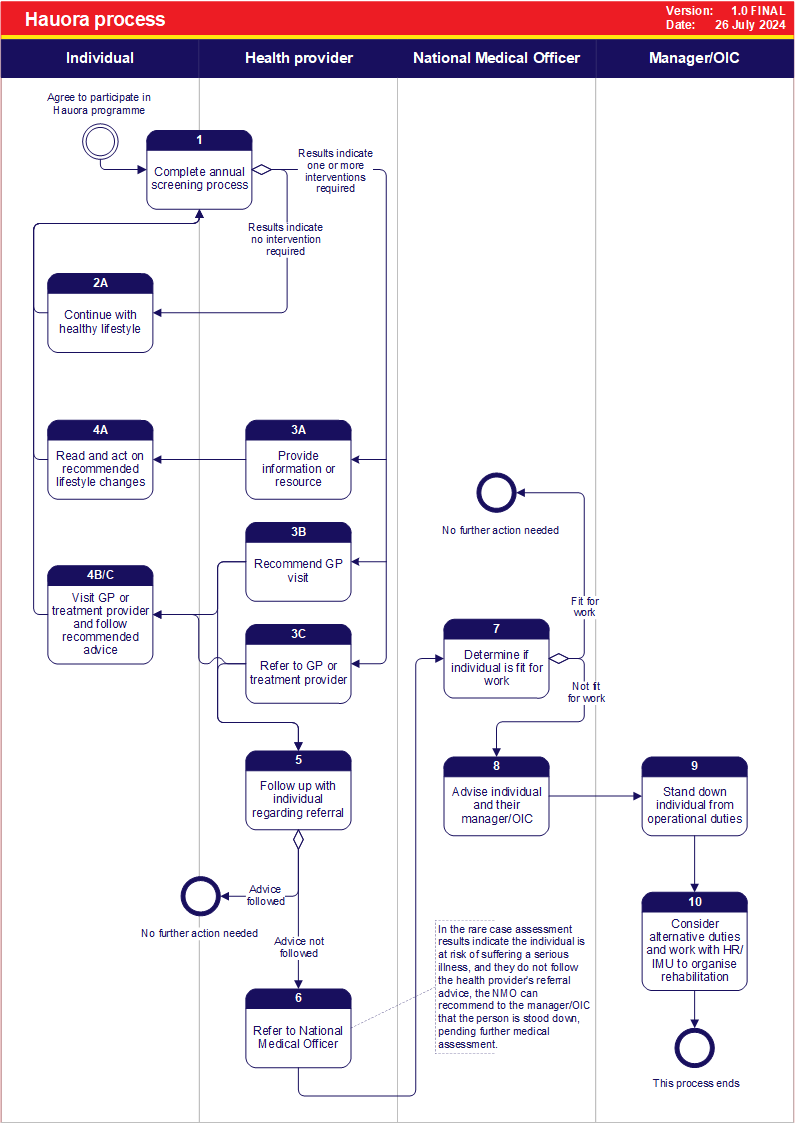
Hauora process
Process map
The process map below gives an overview of the Hauora process.
ACT 1982
INFORMATION
RELEASED UNDER THE OFFICIAL
16 October 2025
12-9
Document Outline
