Question for oral answer due: 22 October 2025
Is she confident that firefighters have the appliances and equipment they need to keep them
safe on the job, if so, why?
Answer
Hon Brooke Van Velden replied:
Yes. Fire and Emergency New Zealand’s fleet and equipment is regularly maintained, safe,
certified and legally compliant. Fire and Emergency has a robust servicing programme of
planned maintenance and repairs. There is an ongoing programme of asset replacement,
and I am aware that there is a legacy of aging assets which Fire and Emergency is addressing.
under the Official Information Act 1982
Released
Page 1 of 7
Possible supplementary questions
Question one: How much is spent on updating and maintaining Fire and Emergency’s
appliances and equipment each year?
Fire and Emergency invests more than $20 million per year in new firefighting trucks and
vehicles.
1982
Expenditure was $26 million in 2023/24, $20 million in 2024/25, and $29 million is planned
for 2025/26. Current forecasts provide for $75 mil ion over the next three years. Act
However, this remains below the 10-year average of approximately $35 million per year
which is required to bring the fleet fully within target asset life over the next decade.
Question two: If the Minister has confidence in Fire and Emergency’s appliances and
equipment, why are firefighters currently on strike?
I am aware of ongoing issues with Fire and Emergency’s appliances and equipment. That is
why we have already invested $20million per year on truck maintenance. Over the next
three years, Fire and Emergency will invest $75million as new vehicles arrive and older relief
Information
appliances are retired. This is part of my commitment to firefighters, to ensure that they
have all necessary assets and equipment to do their jobs.
It would be remiss of me not to point out that the New Zealand Professional Firefighters
Union, who received a 24% pay increase when they settled their last collective agreement in
2022, and who have recently rejected a 5.1% increase offered to them in favour of going on
Official
strike, are using social media to highlight every single truck that breaks down as part of their
campaign for an even bigger settlement.
the
Question three: Does it concern her that so many trucks are breaking down on the way to
fires, and can the public feel safe that the right appliance wil arrive at the right time?
under
Al New Zealanders want to have confidence that the right resource will arrive quickly to an
incident. With a fleet of 1300 trucks, operational issues are unavoidable but aren’t evidence
of a lack of investment or safety.
Fire and Emergency operates a networked approach to responding to incidents which
ensures there are back-up trucks and crews available to respond as required, so a
breakdown does not mean no one is coming.
Released
Page 2 of 7
Question four: What assessment, if any, has been undertaken of the safety risks to
firefighters and the public arising from aged or unreliable fire appliances?
Answer:
I am advised by Fire and Emergency that all its fire trucks are safe, certified and legally
compliant. Each truck is on a regular maintenance schedule and during this maintenance, an
assessment is undertaken to ensure that it continues to be safe, certified and legally
compliant. Trucks that do not meet this standard are not sent out.
1982
Fire and Emergency operates using a network of resources that ensures community and
firefighter safety is the focus of its operational response.
Act
Information
Official
the
under
Released
Page 3 of 7
Supplementary research / information
Recent Written Parliamentary Questions:
Seven Written Parliamentary Questions have been asked by the Member regarding the Fire
and Emergency Levy. The responses to these questions are due to be posted on 22 October
2025.
Background to supplementary question two:
1982
Fleet and other operating costs in the 2023/24 financial year were $126.1 million ($31.4
million fleet and $94.7 million other operating costs).
Act
Additional information regarding procurement of fire trucks:
Topline messaging:
• Fire and Emergency must ensure that its fleet meets operational requirements. I
expect the organisation to manage procurement effectively, resolve any issues
promptly, and involve firefighters where appropriate.
• I expect Fire and Emergency to continue consulting with operational staff on fleet
Information
requirements to ensure appliances meet practical needs.
• I expect Fire and Emergency to resolve the locker space limitations on the 11 recently
delivered rescue tenders as quickly as possible and keep the Board informed of
progress.
Q&A’s:
Official
Were firefighters consulted on the new fire trucks (Type 3 appliances)?
• Firefighters and union representatives were involved in developing requirements for
the Next Generation Type 3 appliances, which wil begin arriving in 2026.
the
Why are some of the new rescue tenders reported to be not fit for purpose?
• The issue relates to locker space due to changes in the truck’s body configuration.
• The stowage lists used did not reflect the amount of equipment later fitted to the
trucks. under
• Fire and Emergency is investigating how the issue occurred and working with
firefighters on local solutions.
• If needed, the affected trucks can be redeployed as standard pump appliances.
What is the timeframe for resolving the rescue tender issue?
• If local fixes are not workable, the 11 rescue tenders will be redeployed as pump
tenders.
• Whether deployed as rescue or pump tenders, these trucks represent a useful
Released
investment in Fire and Emergency’s fleet,
• Replacement rescue tenders under the Next Generation fleet will have larger lockers
and are due by December 2026.
Page 4 of 7
Supportive media statements and commentary
‘Just jamming up all the lockers’ - rescue gear can’t fit in new fire trucks - NZ Herald
'Just jamming up all the lockers' - new fire trucks don't fit rescue gear | RNZ News
Excerpt:
1982
The country’s newest fire engines cannot be used at rescues because they are too smal to fit
all the lifesaving gear they need to carry.
Act
Firefighters say managers have even talked about cutting holes in them to make room for
the gear.
Fire and Emergency New Zealand said it was “not ideal”, but it was working on a solution. In
the meantime, delivery of the engines has been disrupted.
One firefighter cal ed it “ridiculous”, but “not unexpected”.
Fire and Emergency NZ spent millions of dollars and five years shipping the 28 medium-sized
fire trucks – called a Type 3, the fleet workhorse – to Britain to get them fitted out.
Information
They have now returned to New Zealand, with stations with old trucks that keep breaking
down expecting them.
But two trial runs at packing gear on them last month did not go wel .
Official
Firefighters go on strike in pay and staffing dispute with FENZ | RNZ News
the
Paid firefighters walked off the job for an hour on Friday amid stalled negotiations with their
employer Fire and Emergency New Zealand (FENZ).
It fol ows a FENZ pay offer in June of 5.1 percent over three years, which was declined by the
New Zealand Professional Firefighters Union (NZPFU).
under
"Back in 2022 we fought for better conditions and various other things," Woolston senior
firefighter Kevin Crozier said from the picket line today. "Since that time, very little has
changed."
The union said members had not had a pay increase since July 2023.
"NZPFU members are fed up with the lack of progress and hope that the strike notice will
Released
motivate FENZ to come to the table next week with a revised position that deals with al
outstanding issues including wages," it said earlier this month.
"The state of the fire appliances is dire and failing, leaving firefighters stranded on the way
to cal s, at station or even at the incident without water while internal firefighting," NZPFU
said.
Page 5 of 7
"The lack of staff, working excessive overtime, the dire state of appliances are all factors in
the level and intensity of mental health issues for our members."
NZPFU said FENZ continued to fail firefighters with occupational cancer and had "been
criticised in ACC reviews for not applying the law".
Union national secretary Joanne Watson said striking was a last resort.
"We feel like we're an inconvenience to the organisation," Woolston station officer Alan
Skilton said. "We feel like there's not enough emphasis towards frontline operations -
1982
particularly in our fleet and our staffing."
Skilton said issues with fleet pumps failing, trucks breaking down and intercoolers bursting
Act
are common themes for the trucks running at the moment.
"Spreydon firestation, I think they're on their 10th or 12th intercooler. They keep bursting,
which of course then we have to take that truck out of commission, it has to be repaired," he
said.
"We feel like we're always fighting and begging and asking and it just feels like we keep
getting put up with resistance when we feel operations should be supported better."
"We aren't asking for much," Crozier said. "We're just asking for them to be a good
Information
employer."
FENZ said it received calls for three vehicles crashes while firefighters were striking, with
volunteers responding to cal outs over that time.
But its deputy national commander Megan Stiffler says the union is putting the public at risk.
Official
"Of course they are. Fire and Emergency has a network of response right across the nation.
As soon as a large portion of that network is offline, of course there will be delays.
the
"We want the firefighters to know that there is no need to put the public safety at risk."
But the union said one of Auckland's busiest volunteer trucks had a total pump failure
minutes before the strike, and said FENZ is gambling with safety.
under
Firefighters struggling with ageing truck fleet - union | RNZ News
The firefighters union says overheating equipment in a 28-year-old fire truck is symptomatic
of the workers' ageing tools.
The New Zealand Professional Firefighters Union said a power converter ignited and burned
Released
out in the cab of the vehicle as it returned from a factory fire.
It said it triggered an evacuation and crew to get fire extinguishers at the ready.
Fire and Emergency said no fire was involved.
Page 6 of 7
The union's Tauranga branch secretary Mike Swanson told Morning Report elderly trucks
were being used more than ever.
"They are there to replace frontline appliances as they go to service but they never seem to
get a rest themselves because they've been pushed around from station to station."
Swanson said there were new trucks on the way but they would take some time to arrive. 1982
"Til the new ones come in, we don't get another truck."
In a statement, FENZ said the truck had an electrical issue which meant it gave off a burning
Act
smell.
"Our firefighters and support staff reacted promptly, and the charger was replaced within an
hour."
The spokesperson said an alternative truck was available and still is, should an urgent issue
arise.
They said they had a replacement programme and that 70 new trucks were on order.
Information
"Since 2017 around 317 new trucks have been added to the Fire and Emergency fleet."
Fire and Emergency urgently restarting work on plan to replace big-ladder trucks | RNZ News
Official
‘Robbing Peter to pay Paul’ - firefighters to go on strike | Stuff
the
Background information for questioning Member’s electorate:
Mangere Mountain fire: Update 2 | Fire and Emergency New Zealand
under
Large fire on Māngere Mountain in Auckland; smoke warning for West Auckland - NZ Herald
People seen running from area after Māngere Bridge funeral home fire
Fire on Māngere Mountain: Crews heading back to scene as extent of damage revealed - NZ
Herald
Released
Page 7 of 7


Fire and Emergency New Zealand aide memoire 1982
Subject
Cost Savings Initiatives
Date of Briefing
11 November 2025
Reference
BR-25-14
Act
Classification
In confidence
Priority
Non-urgent
From
Kerry Gregory, Te Tumu Whakarae / Chief Executive
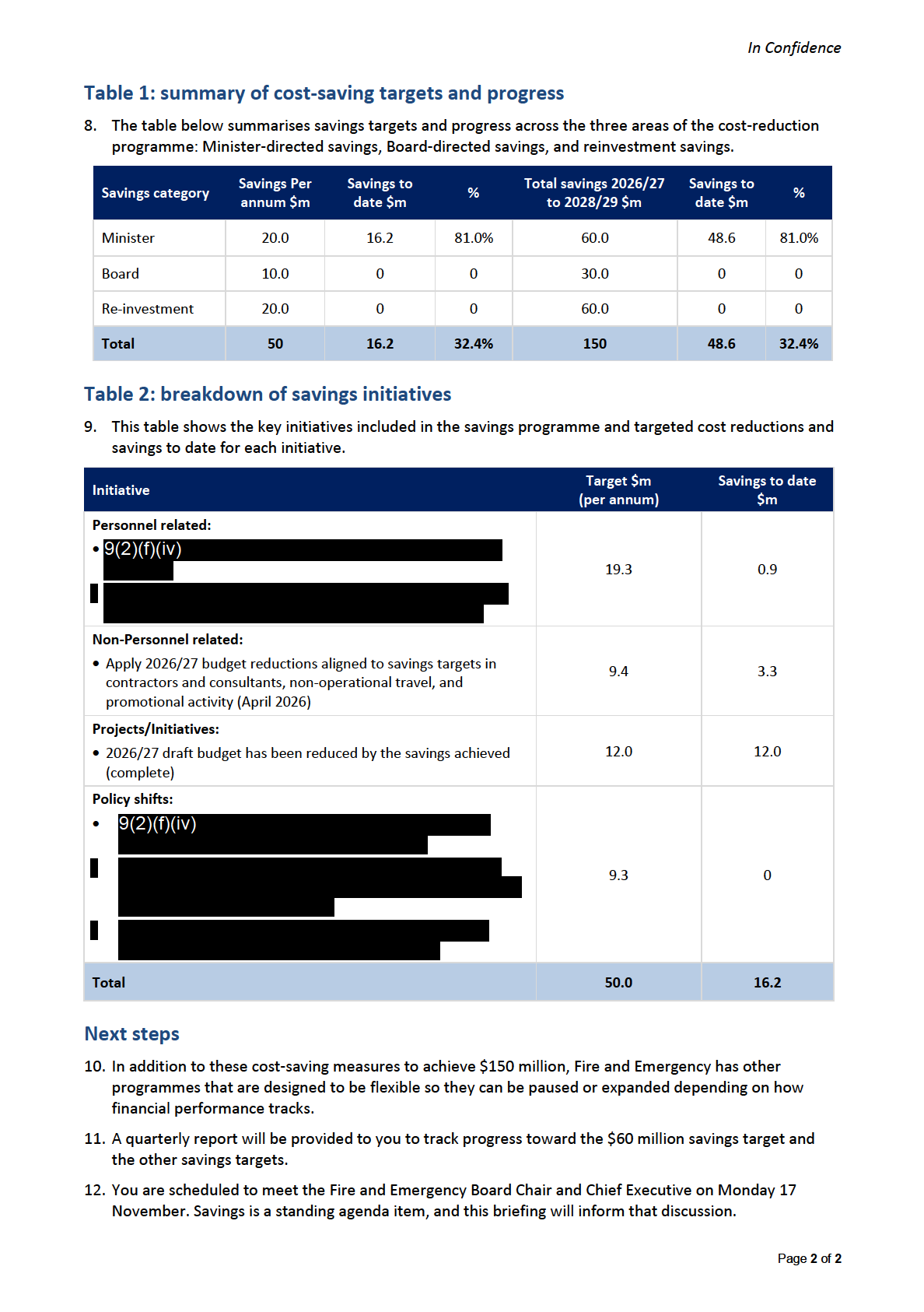
Purpose 1. To provide a high-level summary of Fire and Emergency’s cost-reduction initiatives and to show how the
$60 million savings you requested by 30 June 2029 is incorporated in the programme.
Background
Information
2. In July 2024 you requested Fire and Emergency to achieve $60 million of savings by the end of the first
levy period. Further to your request the Fire and Emergency Board sought an additional $90 million of
savings over the same period.
3. In response, Fire and Emergency management has launched a package of cost-saving and cash-
management measures. Together these aim to reduce expenditure by $150 mil ion by June 2029, while
Official
maintaining frontline emergency service delivery.
4. Your request for $60 mil ion in savings by June 2029 has been prioritised as the first milestone and sits
within that wider $150 million programme. So far, around $49 million (81 %) of your target has already
the
been achieved.
5. On 12 November we launched our second consultation document,
Proposal to Restructure Fire and
Emergency New Zealand, which aims to achieve a further $19 million per annum, or $57 million over the
three-year levy period to 2029, through the proposed reduction in personnel. This will take savings to
$106 million for those three years on the basis the changes proceed as proposed.
under
6. The measures address the following savings requests to be made by June 2029:
•
Minister-directed savings, which deliver the $60 million you requested.
•
Board-directed savings, focusing on the organisation’s internal reprioritisation and governance
efficiencies, with a savings target of $30 million.
•
Re-investment savings, aimed at freeing $60 million in funds for future capital and service delivery
priorities.
Released
7. Tables 1 and 2 summarise progress under each area and outline the initiatives contributing to them.
1982
Act
Information
Official
the
under
Released
1982
Act
Information
Official
the
under
Released
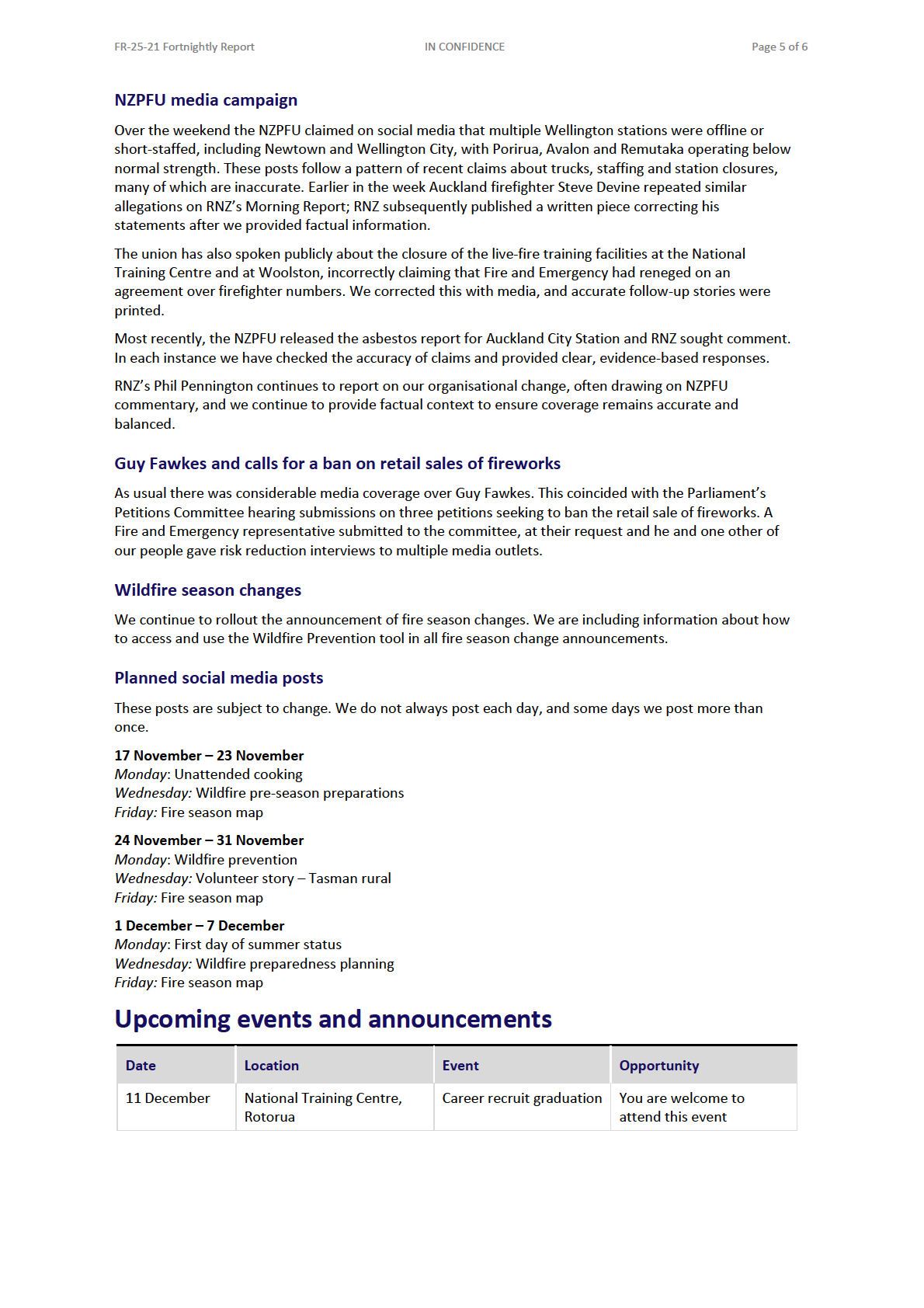
FR-25-21 Fortnightly Report
IN CONFIDENCE
Page 1 of 6
Updates
Organisational change proposal published
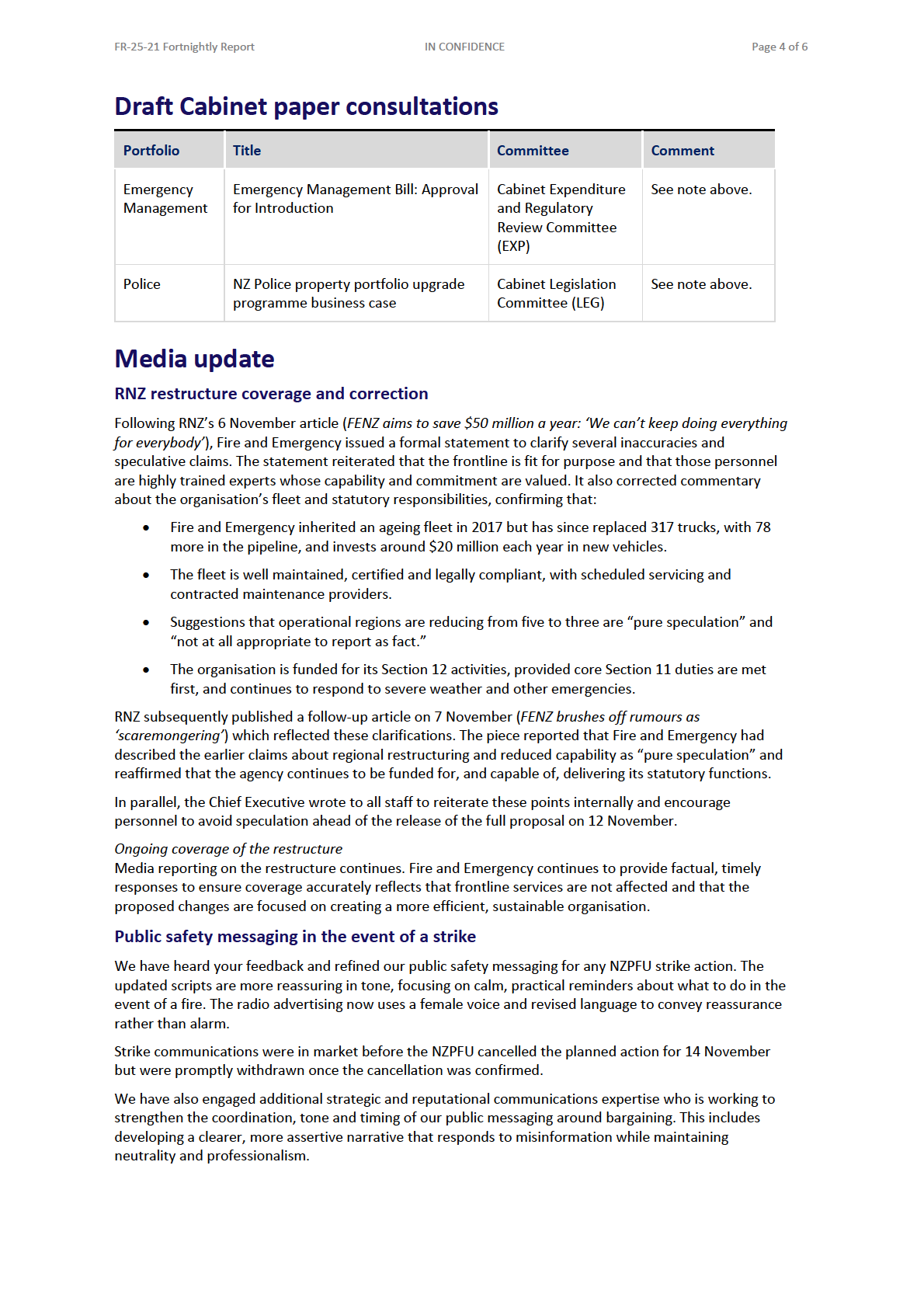
At 4:00pm on Wednesday, 12 November, we opened consultation on the proposed restructure of the
organisation. A copy of that proposal has been provided to your office, together with the media release
about it. Feedback on the proposals is open until 4:00pm on Wednesday, 26 November.
We wil discuss the proposal further when we meet with you next week.
1982
Tongariro National Park fire
Over the weekend of 8–10 November, a wildfire burned across approximately 3,000 hectares of Tongariro
National Park. The fire began in steep terrain late Saturday afternoon and was driven by strong north-Act
westerlies. By early Sunday it was burning on multiple fronts and threatening access routes and visitor
areas.
Fire and Emergency led a large, multi-agency response. Up to 23 firefighting units were on scene at the
height of operations, supported by helicopters and fixed-wing aircraft operating under difficult visibility
conditions. Crews from the Central Plateau, Taranaki, Wel ington, Manawatū-Whanganui and Hawke’s Bay
were mobilised alongside Department of Conservation (DoC), New Zealand Defence Force, and iwi
partners.
The fire prompted evacuations, road closures and public safety warnings across the weekend. Heavy rain
mid-week brought welcome relief and by Monday the fire was fully contained, with hotspots being
monitored. Control of the fireground was transferred to DoC on 12 November.
Information
The Minister for Emergency Management and Recovery and the Minister of Conservation both visited the
fireground on Sunday and Monday. Our chief of staff was based at the Emergency Operations Centre,
working directly with the incident control er and regional leadership. Across Sunday and Monday, your
office received a high volume of real-time updates, talking points and public messaging coordinated
through the Board and Ministerial team.
Media and public interest were intense, with the Public Information Managers working to deliver material
Official
to more than 70 national items across television, radio and online. Coverage was largely accurate and
positive, highlighting col aboration and community support. Our teams worked closely with DoC, Police,
Civil Defence and iwi to maintain consistent information and public confidence.
the
The event was an early-season test of national wildfire readiness. A post-incident review with DoC and
regional partners is being planned.
Bargaining with the New Zealand Professional Firefighters Union (NZPFU)
As we advised your office on Thursday (13 November), late morning that day the NZPFU cal ed off its strike
under
planned one hour strike that was to occur at on 14 November. The union then issued notice of another
strike for Friday 28 November. This is now in addition to the existing strike notice for 21 November.
9(2)(j)
9(2)(j)
Released
As previously advised was likely, pending movement on the NZPFU situation we have nothing substantive
to update on Fire Emergency Commanders Association (FECA) and Public Service Association (PSA)
bargaining at this time.
FR-25-21 Fortnightly Report
IN CONFIDENCE
Page 2 of 6
Acting Minister of Internal Affairs visit to Auckland City Station
As you know, fol owing public comments by Auckland firefighter Steve Devine during an RNZ interview in
which he al eged the Minister was “either being lied to or lying” about a range of Fire and Emergency
related matters, the Acting Minister for Internal Affairs arranged to visit Auckland City (Pitt Street) Fire
Station on Friday 7 November.
The acting Minister met informal y with around 20 firefighters, including Mr Devine and several NZPFU
representatives. Discussion covered fleet numbers, asbestos management at the station, procurement
processes, and firefighter training and welfare issues. Participants in the conversation were highly critical
of Fire and Emergency’s leadership, claiming a lack of confidence in the Board and executive and making a
range of unfounded claims around station condition, vehicle reliability, and uniform supply.
We have since provided your office with detailed information correcting those claims and confirming the
1982
facts. We are happy to discuss the issues raised at next week’s meeting.
Governance and Administration Committee (GAC) 2024/25 Annual Review
Act
Our people are working through responses to the 85 2024/25 Annual Review questions from the GAC. Our
printed and electronic final version of the document are due at Parliament no later than 24 November. Our
responses wil be sent to your office ahead of that date.
As you know, our hearing before the committee reviewing the 2024/25 year is scheduled for 28 January.
Addressing NZPFU claims and warnings about asbestos
On 11 November the NZPFU posted on its website and social media about asbestos being identified in one
sample bulk air supply tank that was used prior to 2023 to fil Breathing Apparatus (BA) cylinders at
Auckland City Station. They said they were concerned about a possible risk of asbestos contamination in
Information
breathing apparatus cylinders that were fil ed from that air tank. To recap, Auckland City Fire Station, like
many buildings of similar age, was constructed using asbestos containing materials. In April 2023 there was
an asbestos exposure during a construction activity; remediation work was completed; station-wide testing
identified additional asbestos remediation requirements which have since been completed either by
removal, encapsulation, or by restricting access to areas.
Fol owing the April 2023 incident, Fire and Emergency immediately isolated the compressor and the air
storage tanks used to fil breathing apparatus cylinders. Tests were conducted in 2023 on around 20
Official
breathing apparatus cylinders fil ed from the current and previous compressor, both of which had been
attached to air storage tanks which are then directly connected to breathing apparatus cylinders for fil ing;
al air tests were negative for the presence of asbestos.
the
Asbestos was removed from both the compressor and BA testing/ fil ing rooms in August and September
2024. A clearance certificate was issued after this for use. The compressor room remained closed.
However, the testing/fil ing room was unlocked fol owing receipt of the clearance certificate. The room has
since been sealed. Fol owing extensive engagement with the NZPFU a testing protocol was established for
the Auckland compressor and storage tanks in May 2025. The testing included lab-based analysis of air and
swab samples in Australia to a standard which exceeds New Zealand requirements; analysis was completed
under
in the only facility in the southern hemisphere capable of completing the work.
Swab sampling identified the presence of two asbestos fibres in one of the storage tanks used to hold air
from the compressor and then fil breathing apparatus. Fol owing rigorous testing we confirmed no
asbestos was present in the air discharged from either from the compressor or the storage tank. The origin
of the two fibres remains unknown. Test reports were shared with the NZPFU and both parties agreed to
seek an independent review of the findings and discuss next steps. In the meantime, the NZPFU has
demanded, in spite of the negative air tests, that they want several hundred BA cylinders used in Auckland
to be tested for asbestos. We are working to identify a pragmatic way forward given al air tests have been
returned negative for asbestos (2023 against New Zealand testing standards and 2025 against a standard
Released
which exceeds New Zealand requirements).
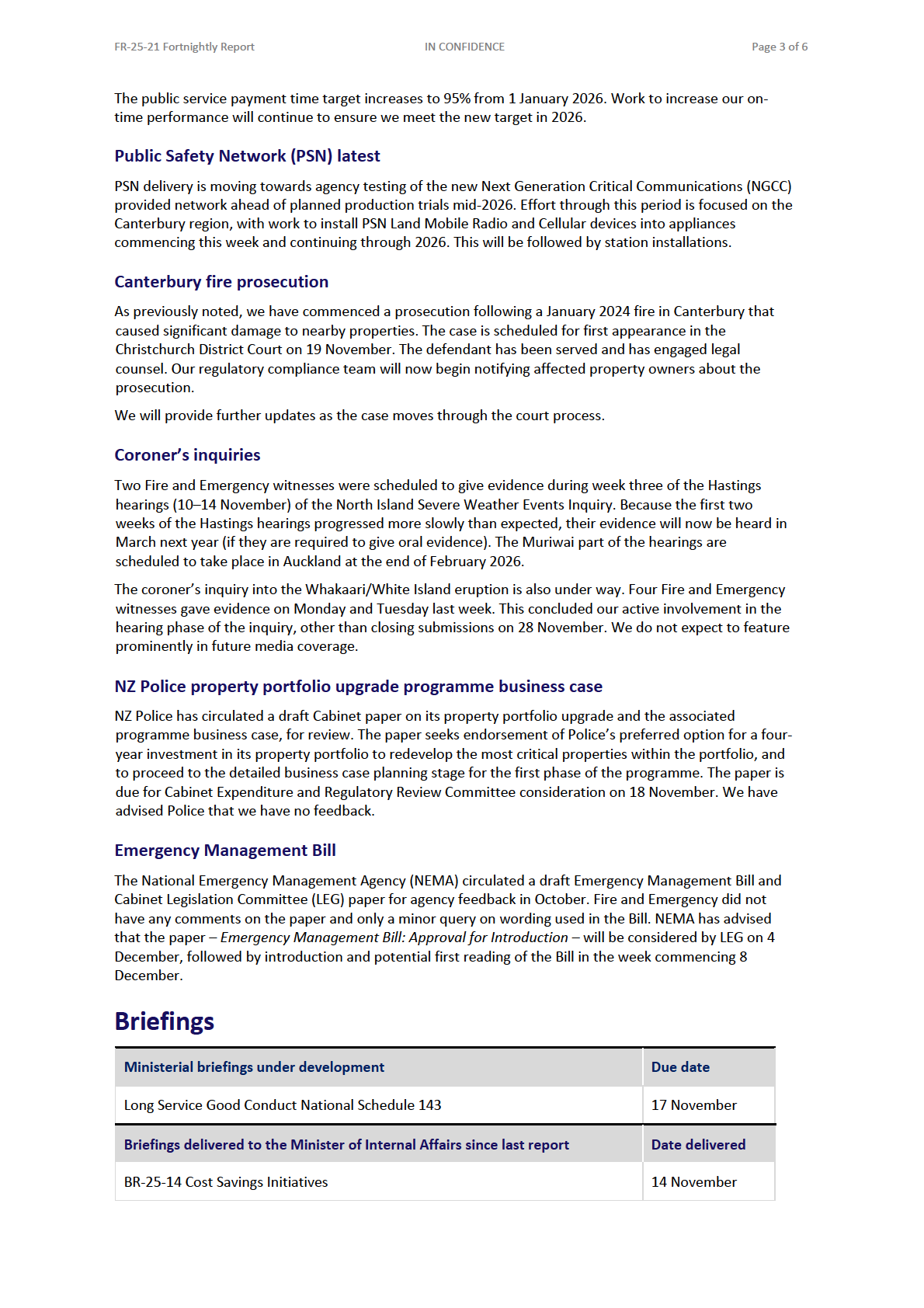
Payment times improving further
Our quarterly Government Payment Times Survey results for the period July – September 2025 (Q3) have
been provided to MBIE this week. For Q3 we achieved 92.4%, this exceeds the target of 90% and is a strong
improvement on the last two quarters (Q1 was 79%, Q2 87%).
1982
Act
Information
Official
the
under
Released
1982
Act
Information
Official
the
under
Released
1982
Act
Information
Official
the
under
Released
1982
Act
Information
Official
the
under
Released


Fire and Emergency New Zealand aide mèmoire
Subject
Firefighting Appliance Delivery Schedule
1982
Date of Briefing
24 November 2025
Reference
BR-25-17
Classification
In confidence
Priority
Non-urgent Act
From
Sarah Sinclair, Deputy Chief Executive Asset and Programme Delivery
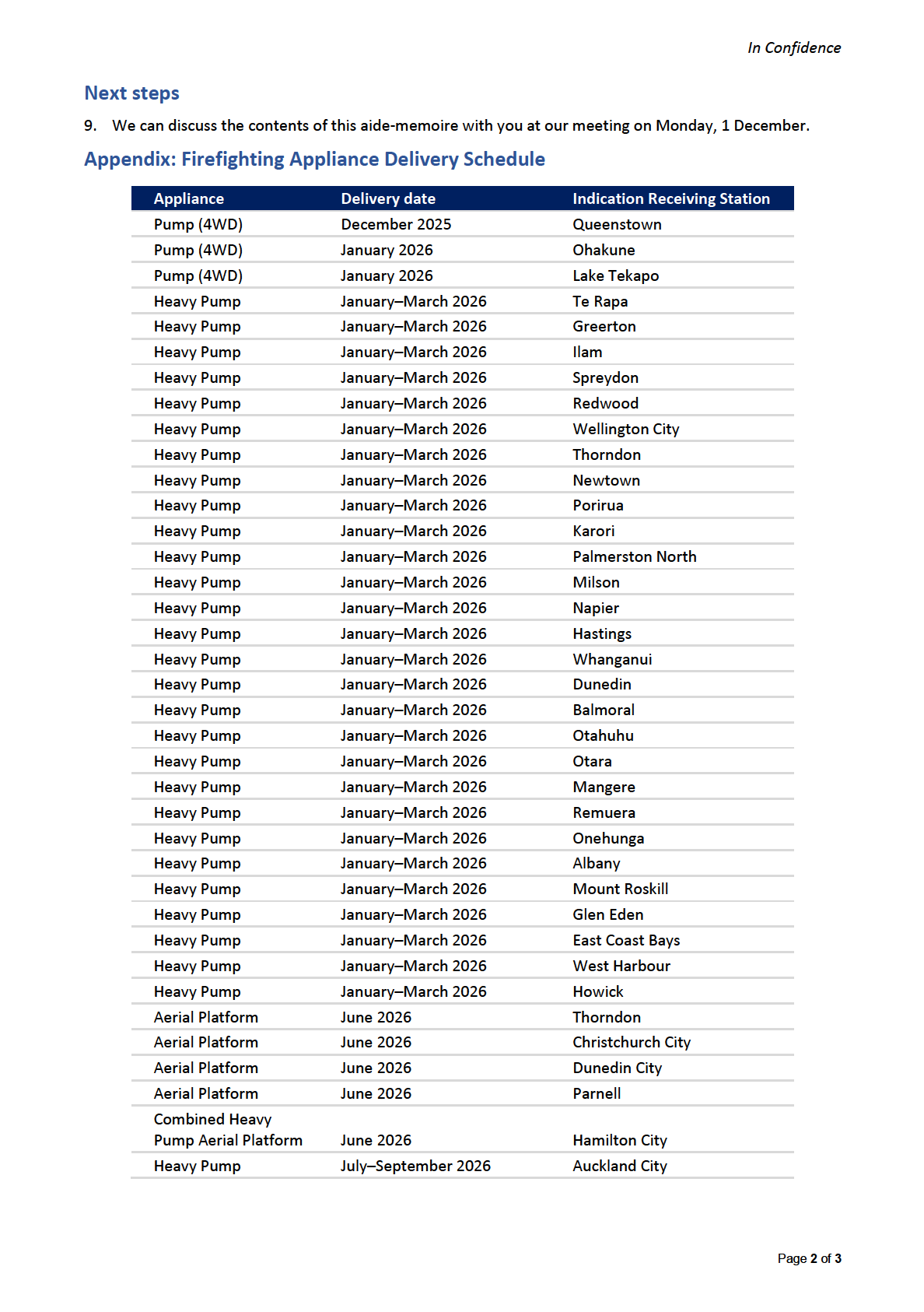
Purpose 1. To provide you with the current schedule for delivery of the 78 new firefighting appliances through to
April 2027, as requested when you met with Fire and Emergency officials on 17 November.
Background
2. Fire and Emergency operates a national fleet of around 1,300 firefighting trucks. A significant proportion
of the fleet is older than the ideal 20–25-year life which is dependent on the type of vehicle. New
Information
appliances typically require 18–24 months from order to delivery. Renewal occurs progressively as
manufacturing capacity, shipping timeframes, and local operational needs allow.
3. The schedule attached as Appendix 1 outlines the indicative delivery dates for appliances scheduled for
delivery to station.
4. These dates indicate when appliances are expected to be available to stations for training, rather than
Official
the point at which Fire and Emergency formally takes ownership or the appliance enters operational
service. New trucks arrive earlier than these dates to allow for acceptance testing, safety checks, and
resolution of any issues identified during inspection.
the
5. Once an appliance passes acceptance, additional steps may still be required before it goes live, including
fitting radios and ICT equipment, applying signage and branding, preparing training materials, training
our maintenance providers, and tailoring stowage to meet each brigade’s needs. The timing of crew
training also depends on brigade and trainer availability. For these reasons, the exact date an appliance
will enter operational service is only confirmed shortly before commissioning.
under
6. Final allocation decisions are made close to the delivery date. This allows Fire and Emergency to take
account of each station’s service demands, local risks, and the actual condition and mileage of the trucks
being replaced. In some instances, it may be more appropriate to retain an older appliance that remains
in excellent condition and retire a slightly newer truck that has had heavier use.
7. New appliances are placed with the stations that have the greatest operational need at the time of
delivery. The trucks they replace are then moved to lower-demand locations until they reach the end of
their service life. All appliances, regardless of age, are legally compliant and maintained to the standards
required for safe and reliable operation.
Released
8. The FY25/26 fleet budget is fully allocated, as is most of the FY26/27 forecast. This reflects both the
extended order-to-delivery timeline and the need to confirm future manufacturing slots well in advance.
1982
Act
Information
Official
the
under
Released
In Confidence
Heavy Pump
July–September 2026
Papatoetoe
Heavy Pump
July–September 2026
Takapuna
Heavy Pump
July–September 2026
Mount Wel ington
Heavy Pump
July–September 2026
Avondale
Heavy Pump
July–September 2026
Papakura
Heavy Pump
July–September 2026
Henderson
Heavy Pump
July–September 2026
Chartwell
Heavy Pump
July–September 2026
Tauranga
Heavy Pump
July–September 2026
Brooklyn
Heavy Pump
July–September 2026
Hutt City
1982
Heavy Pump
July–September 2026
Johnsonvil e
Heavy Pump
July–September 2026
Christchurch City
Act
Heavy Pump
July–September 2026
Wigram
Pump
September 2026
Silverstream
Pump
October 2026
Marton
Pump
October 2026
Mahurangi East
Pump
November 2026
Kamo
Pump
November 2026
Arrowtown
Pump
November 2026
Manly
Pump
November 2026
Feilding
Information
Pump
December 2026
Tawa
Pump
December 2026
Waitakere
Pump
December 2026
Wairoa
Pump
January 2027
Temuka
Pump
January 2027
Whangarei Heads
Pump
February 2027
Waipu
Official
Pump
February 2027
Ashburton
Pump
March 2027
Kaitaia
the
Pump
March 2027
Thames
Pump
April 2027
Kaikohe
Pump
April 2027
Waikanae
Pump
May 2027
Otaki
Pump
May 2027
Te Puke
under
Pump
June 2027
Motueka
Pump
June 2027
Tuakau
Pump
July 2027
Greymouth
Pump
July 2027
Kaukapakapa
Pump
August 2027
Ashburton
Pump
August 2027
Edgecumbe
Pump
September 2027
Waihi
Released
Pump
September 2027
Helensville
Page
3 of
3
