





Criminal Charging Advisory
Panel / CCAP
Terms of Reference (ToR) 1.8
11 Aug 2025

Document history
Version
Date
Initiated by
Description
0.1
09/11/2020
Lisette Nolan
Initial draft.
0.2
04/12/2020
Selena Moon
Updated with feedback from Jason Guthrie.
0.3
04/12/2020
James Harris
Peer reviewed.
0.4
11/12/2020
Selena Moon
Updated with feedback from the Criminal Charges Advisory
Panel members and Senior Professional Conduct
Managers.
1.0
14/12/2020
Selena Moon
Released as v1.0 for pilot.
1.1
14/12/2020
James Harris
Updated with feedback from Jason Guthrie, including
changes to the Decision to Charge cover sheet
1.2
01/02/2021
James Harris
Updated with feedback from Jason Guthrie, Alice Handcock
and PPC team members
1.3
06/04/2022
Sonya Douglas
Review as requested by Jason Guthrie
1.4
19/09/2022
Sonya Douglas
Further review as requested by Jason Guthrie
1.5
21.02.2023
Sonya Douglas
Updated to reflect CCA panel meeting change of day from
Fridays to Tuesdays 9am
1.6
15/10/24
Jimi McGrogan
Update AC Districts groupings and include AC
Investigations as one of the chair / decision makers
1.7
31/03/25
Jimi McGrogan
Update CCAP membership following Executive realignment
and amendment to terminology to reflect the current Police
priorities. Approved by AC Rusbatch 16/06/2025.
1.8
11/08/25
Jimi McGrogan
Update CCAP membership following review by
Commissioner Chambers.
Criminal Charging Advisory Panel TOR v1.8
2 of 11

Contents
Document history .................................................................................................... 2
Approver .................................................................. Error! Bookmark not defined.
1 Purpose ................................................................................................................... 4
2 Background ............................................................................................................. 4
3 The Criminal Charging Advisory Panel .................................................................... 4
Key responsibilities ................................................................................................. 4
Scope 4
Membership ............................................................................................................ 5
In attendance .......................................................................................................... 5
Meetings ................................................................................................................. 5
Minutes and actions ................................................................................................ 6
Process for Panel decision ...................................................................................... 6
Panel decision ......................................................................................................... 7
Appendix C: High-level Process Flow ......................................................................... 11
Criminal Charging Advisory Panel TOR v1.8
3 of 11

1 Purpose
1. The purpose of this document is to provide the terms under which the Criminal Charging
Advisory Panel (CCAP) wil operate.
2. The primary responsibility of CCAP is to determine if an employee should be criminal y
charged and the appropriate charge (if any) taking into consideration the Solicitor General’s
Prosecution Guidelines.
2 Background
3. During 2020 whilst developing the Te Ohu Manawanui framework for managing
employment matters, several issues were raised by the Independent Police Conduct
Authority (IPCA), Service Unions and our people, regarding how we make decisions for
criminal matters. These issues primarily related to a lack of visibility at a national level
(with the potential for misalignment or a disconnect with what we are trying to achieve
cultural y), perceived lack of consistency in decision making, poor timeliness and
insufficient separation between Police’s role as an employer and as a charging body.
4. Given the issues raised, Police considered options to improve the way charging decisions
were made, and in November 2020 the Organisational Capability Governance Group
(OCGG) approved to trial the proposed approach to centralise charging decisions which
would be made by an independent decision-maker, supported by CCAP.
5. Fol owing a new Executive structure becoming operational on 31 March 2025, membership
of CCAP has been modified as below at point 11. CCAP continues to contribute towards
the Commissioners Priorities by providing supportive and accountable leadership, timely
and transparent decision making in respect of resolutions, whilst enabling District leaders
to focus on core policing.
3 The Criminal Charging Advisory Panel
Key responsibilities
6. CCAP wil consider each case and support the Panel Chair to make determinations on
charging decisions.
7. Centralising the management of these activities wil assist with consistency and timeliness
of charging decisions.
8. High-level responsibilities of CCAP include:
a. Reviewing the investigation report to ensure that a criminal charging decision is
appropriate based on the Solicitor General’s Prosecution Guidelines.
b. Seeking further information or advice where a decision to charge or not charge cannot
be made.
c. Reviewing the case information received and providing feedback on the quality of the
investigation report and the Decision to Charge cover sheet.
d. Managing lessons learned and ensuring these are shared with appropriate parties to
help inform future decision-making.
Scope
Criminal Charging Advisory Panel TOR v1.8
4 of 11

In Scope
9. Al matters where a criminal investigation has been completed in relation to Police
officers/employees.
Out of Scope
10. The fol owing matters are out of scope:
Charging associated with Road Policing matters (Driving Charging Advisory Panel
(DCAP) decision)
Charging associated with Critical Incidents (Territorial Detective Superintendent
decision)
Urgent matters where an immediate charging decision is required by Districts, for
example an officer, off-duty and an assault al egation against that officer where Police
attend and where evidential sufficiency is met to arrest and charge. In such cases, the
outcome of the decision wil be reported back to the panel for noting (District
Commander / Frontline supervisor decision)
Membership
11. The membership of the Criminal Charging Advisory Panel is as fol ows:
Roles
Name
Chair and decision-
AC Deployment (Chair)
maker
AC Road Policing and District Support (Deputy Chair)
AC Investigations, Serious, and Organised Crime
AC Iwi and Community Partnerships
AC National Security and International
Director: Integrity and Conduct
Director: Resolutions
Advice and
National Legal Counsel Police Prosecution Service
Secretariat
Professional Conduct Criminal Case Advisor (Secretariat)
12. The Chair is the decision-maker.
13. If AC Deployment is unavailable, the Deputy Chair is the decision-maker.
14. If neither AC Deployment or AC Road Policing and District Support are available, the Chair
and decision-making can be delegated to another member of the Panel.
In attendance
15. Wider attendance at meetings wil be determined by agenda items and wil be on an as
needed basis. The Panel wil be supported by both Police Professional Conduct and Police
Prosecution Services, who wil provide co-ordination support.
Meetings
Criminal Charging Advisory Panel TOR v1.8
5 of 11

16. CCAP wil meet on a fortnightly basis, 9am Tuesdays. Additional meetings may also be
arranged on an as needed basis. The first meeting was conducted on Friday 18 December
2020.
17. Meetings wil be held at PNHQ (venue to be arranged by the Criminal Case Advisor) and
on Teams for attendees who are unable to join the meeting in person.
18. Al information shared with and discussed by CCAP must be treated as private and
confidential.
19. Any potential or known conflict of interest must be raised with the CCAP Chair prior to
discussion on each matter before the panel.
20. Meeting quorum:
Minimum of 1 of the Assistant Commissioners
Director: Integrity & Conduct or appointed delegate
Director: Resolutions or appointed delegate
21. Supporting documentation must be provided to the panel no later than five working days
prior to each meeting by the Professional Conduct, Criminal Case Advisor. The only
exception to this is where an urgent decision is required by the panel. In these cases, the
panel wil consider the matter at the next panel meeting irrespective of when the material
is received.
Minutes and actions
22. Key recommendations, decisions and actions wil be recorded at each meeting by the
Criminal Case Advisor (CCA) and provided to the relevant Police Professional Conduct
Manager (PPCM), after having been confirmed accurate and correct by the panel.
23. The CCA wil contact the District PPCM and verbal y advise of the outcome, to charge or
not charge, which wil be fol owed up by the CCA with formal written/email notification once
the CCA Panel meeting minutes are confirmed as accurate and correct by the panel.
24. The District PCM wil make contact with the subject officer/employee and advise them
charge/no charge.
25. The District PCM wil make contact with their respective Employment Resolutions
Specialist (ERS) when a no charge situation and progressing to an Employment pathway.
26. In accordance with s 29(1)(a)(b) of the Independent Police Conduct Authority Act 1988, the
Criminal Case Advisor wil provide the written CCA Panel Meeting Minutes to the
Independent Police Conduct Authority, (excludes privileged Police or Crown Legal
Opinions and Action points), after the employee/officer has been notified of the outcome
by the relevant PPCM.
Process for Panel decision
27. Once a criminal investigation has been completed, the local PPCM must provide assurance
that the investigation has been completed as per the pre-determined scope of the
investigation, including providing confirmation that the investigating officer’s report
addresses the Evidential Sufficiency and Public Interest Tests.
28. A legal opinion should only be sought if there is a particular point of law that requires
clarification. Police Legal wil not provide a general opinion about whether the Evidential
or Public Interest Tests have been met.
29. If CCTV footage has been obtained, this is to be electronical y saved into the downloads
folder O:\PNHQ - 445\IPCA Download folder
Criminal Charging Advisory Panel TOR v1.8
6 of 11

30. The PPC Criminal Case Advisor wil review conduct histories to identify any previous
matters that may be relevant to the Panel’s decision-making (i.e. due to propensity or public
interest reasons).
31. The District PPCM wil email, Investigation Report and Police Legal Opinion (if obtained)
to their Senior Professional Conduct Manager for review before onforwarding to the PPC
Criminal Case Advisor.
32. The PPC Criminal Case Advisor wil review the material and complete the ‘Decision to
Charge’ (DTC) sheet O:\PNHQ - 445\Employment Practices and Professional
Conduct\CCAP\Admin\Templates
33. The PPC Criminal Case Advisor wil email the combined documents to the Panel members,
5 days before the panel meets.
34. There is an obligation on Police (as the prosecuting agency) to regularly review
prosecutions in terms of the Solicitor-General’s Prosecution Guidelines.
Panel decision
35. At the meeting, the Panel Chair, supported by Panel members, wil make a determination
whether the Test for Prosecution has been met or not, and whether to charge or not charge.
The minutes wil clearly document the rationale for the Chair’s decision.
36. Alternatively, further information or advice may be sought. The outcome and any
considerations, action points wil be included in the CCAP meeting minutes.
37. If the views of the Panel are not unanimous then the minutes should record the views by
role title, so it is clear which Panel members favour which outcome.
38. Feedback on the investigation report and content may also be provided by the Panel
members to help Police continual y improve investigation standards expected of criminal
investigations.
Decision to charge
39. If the decision is to charge,
a. The PPC Criminal Case Advisor wil advise the District PPCM to coordinate for the
officer/employee to be notified.
b. The District PPCM wil coordinate a meeting with their District/Area Commander, and
HR/ER Advisors – to update and take action as required re duty status and letters to
the officer/employee as required.
c. The District PPCM wil liaise with the criminal investigator to file the criminal charge(s)
d. The District PPCM wil liaise with the criminal investigator to prepare a Court Summons
for a date of the first court appearance.
e. The PPCM wil advise the relevant District Prosecution Manager of the first court
appearance of the officer/employee to assist in managing potential/perceived conflicts
of interest.
f. In accordance with the PPS Practice Note, the Crown wil be instructed to prosecute a
Police Prosecution due to a Conflict-of-Interest Police have with prosecuting Police
employees.
Decision not to charge
Criminal Charging Advisory Panel TOR v1.8
7 of 11

40. If the decision is not to charge, the PPC Criminal Case Advisor wil advise the District
Professional Conduct Manager (PPCM) to facilitate next steps,
g. The District PPCM to facilitate for the officer/employee to be advised the outcome of
no charge.
h. The District PPCM wil advise and discuss next steps with the respective District
Commander / Director and the HR Advisory team. This may include a revisit to the
National Assessment Team to identify an appropriate pathway.
Decision of Supported Resolutions recommended
i. The PPC Criminal Case Advisor wil advise the District PPCM that CCAP determined
that Evidential Sufficiency was met, however due to low Public Interest, a Supported
Resolutions pathway was recommended.
j. The District PPCM wil facilitate the criminal investigator to meet with the
officer/employee and explain the process and what obligations must be met, including
if the Supported Resolution is declined or not completed, a criminal charge may be filed
and a prosecution commenced.
k. Should the Supported Pathway be declined or incomplete, the relevant Assistant
Commissioner or Executive Director wil be advised, so as to make a decision about
next steps.
l. This wil occur in consultation with the Director, Integrity and Conduct and the relevant
District; and there may be a requirement to re-visit a decision by the CCAP.
Roles and Responsibilities
41. Below are the high-level roles and responsibilities of those involved in the criminal
investigation process:
Role:
Responsibilities:
Criminal Investigator
Conducts criminal investigation.
Manages criminal investigation in IMT.
Where Adult Sexual Assault, Child
Protection, ASA/CP protocols to be
fol owed, including appointing qualified
investigator, completion of investigation
plans/QAIFs and an L4 ASA qualified review
completed.
Completes investigation report.
Ensures
supervisor
reviews
their
investigation and investigation report for
quality assurance.
District Police Professional Conduct Manager
Case Lead for the criminal investigation.
(PPCM)
Reviews and provides oversight of
requirements, timelines, standard required
and guidance and support to the
investigator
for
investigation
and
investigation report.
Liaises with the District/Area Commander
about the criminal investigation progress
Criminal Charging Advisory Panel TOR v1.8
8 of 11

(but does not provide their criminal
investigation report)
Responsible for emailing the criminal
investigation report in draft to the IPCA
(excluding privileged Police/Crown Legal
opinion) for its views of the investigation and
any other enquiries they recommend
Responsible for emailing the investigation
report, Police Legal Opinion (if obtained)
and supporting evidence such as CCTV
footage to their Senior PPC Manager for
review and includes the IPCA views.
The Senior PPC Manager then emails al
the documents to the PPC Criminal Case
Advisor in preparation for the next CCAP
meeting.
PPC Criminal Case Advisor
Final assurance reviews of al supporting
documentation for CCAP.
Provides support and acts as conduit
between PNHQ and District PPCMs.
Col ates and provides CCAP with al
relevant criminal investigation documents
into a package and completes a ‘CCAP
cover sheet’
Submits al the matters into one email and
sends to CCAP 5 working days before the
Panel meets
Ensures the IPCA views are provided to the
Panel.
After the CCAP meeting informs District
PPCMs outcomes of the panel meeting in
an email, ‘CCAP Outcome’ document.
Provides the Independent Police Conduct
Authority with the CCAP Meeting Minutes
(without privileged Legal Opinion or Action
points) and only after the officer/employee
has been advised through District channels.
Col ates and manages CCAP outcomes as
data and determinations into the CCAP
national spreadsheet.
Provides trends and insights from the data
to the Director I & C.
Criminal Charging Advisory Panel TOR v1.8
9 of 11


CCAP COVER SHEET
COMPLETED BY THE CRIMINAL CASE ADVISOR FOR CCAP PANEL
Employee Name
QID
Rank / Designation
District/Service Centre
Duty Status
☒ No-change ☐ Special Leave ☐ Stood Down ☐ Suspended
☐ Restricted duties ☐ Resigned
IPCA Category (if known)
Category B
Recommendation of
investigator
CCAP Panel date
File Number
Purpose
To establish whether there is sufficient evidence for a prosecution (Evidential Test and the Public Interest
Test) when considered against the Solicitor General’s Prosecution Guidelines.
Attached documents
☐ Investigation Report
☐ Police Legal Opinion
Checks completed
☐ PPC history
☐ NIA history
☐ IPCA views
Notes
CCTV footage:
PPC History:
NIA History:
IPCA view:
CCAP outcome
master.docx
Criminal Charging Advisory Panel TOR v1.8
10 of 11

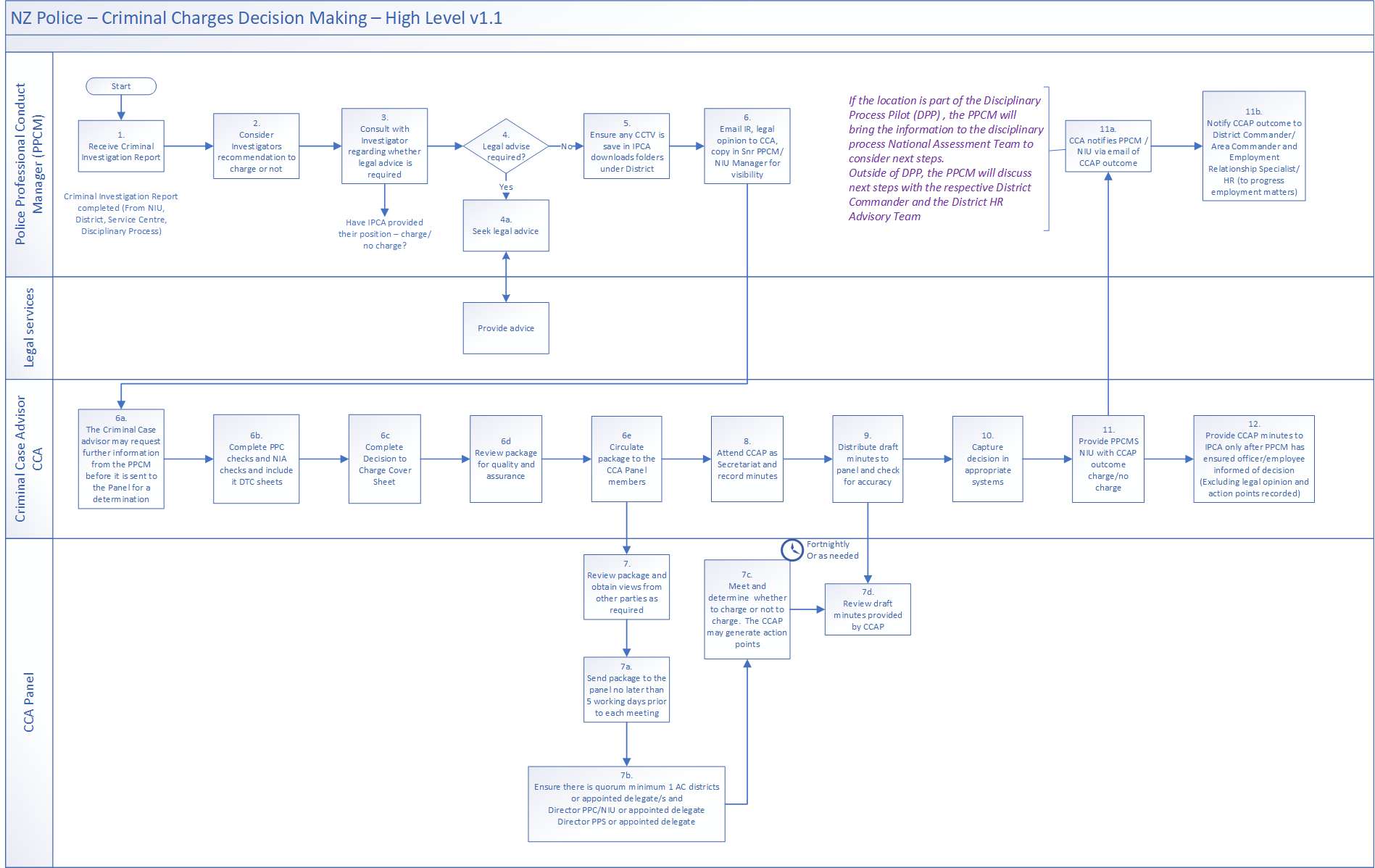
Appendix C: High-level Process Flow
Criminal Charges Advisory Panel TOR - v1.8 August 2025
11 of 11
