1982
Act
Information
Official
the
under
Released
Purpose
The role and purpose of the MAG is to report to and provide specialist independent advice to
both the Minister for Infrastructure and Minister of Education (the Ministers) on the design of
a transition to a new model or entity for school property, and in particular support Ministerial
oversight of that transition.
The MAG will consider the full lifecycle of assets and whole system impacts to ensure that its
advice supports good long term infrastructure and educational outcomes.
The MAG is not involved in the day-to-day operational tasks and decisions regarding school
property. The Ministry wil provide the MAG and its Secretariat all advice, data, information,
1982
research and analysis in order for the MAG to fulfil its purpose.
The MAG is not a decision-making body nor a representative group. Members are appointed
Act
as individuals and are expected to provide impartial advice to Ministers. The MAG wil be in
place until 19 December 2025, and this may be extended if agreed by Ministers.
Scope
The MAG will provide advice to Ministers on:
• Changes to the approach for the delivery of school property.
• The transition to the new model or entity for delivery of school property, including
Information
improvements to processes that are being implemented, such as:
o
the Ministry’s CO(23)9 planned improvements; and
o
risk and accountability frameworks for School Boards to access greater
flexibility/autonomy or greater support for maintenance
• Any other matters relevant to Ministers’ decisions on the transition to the new model.
Official
Members
the
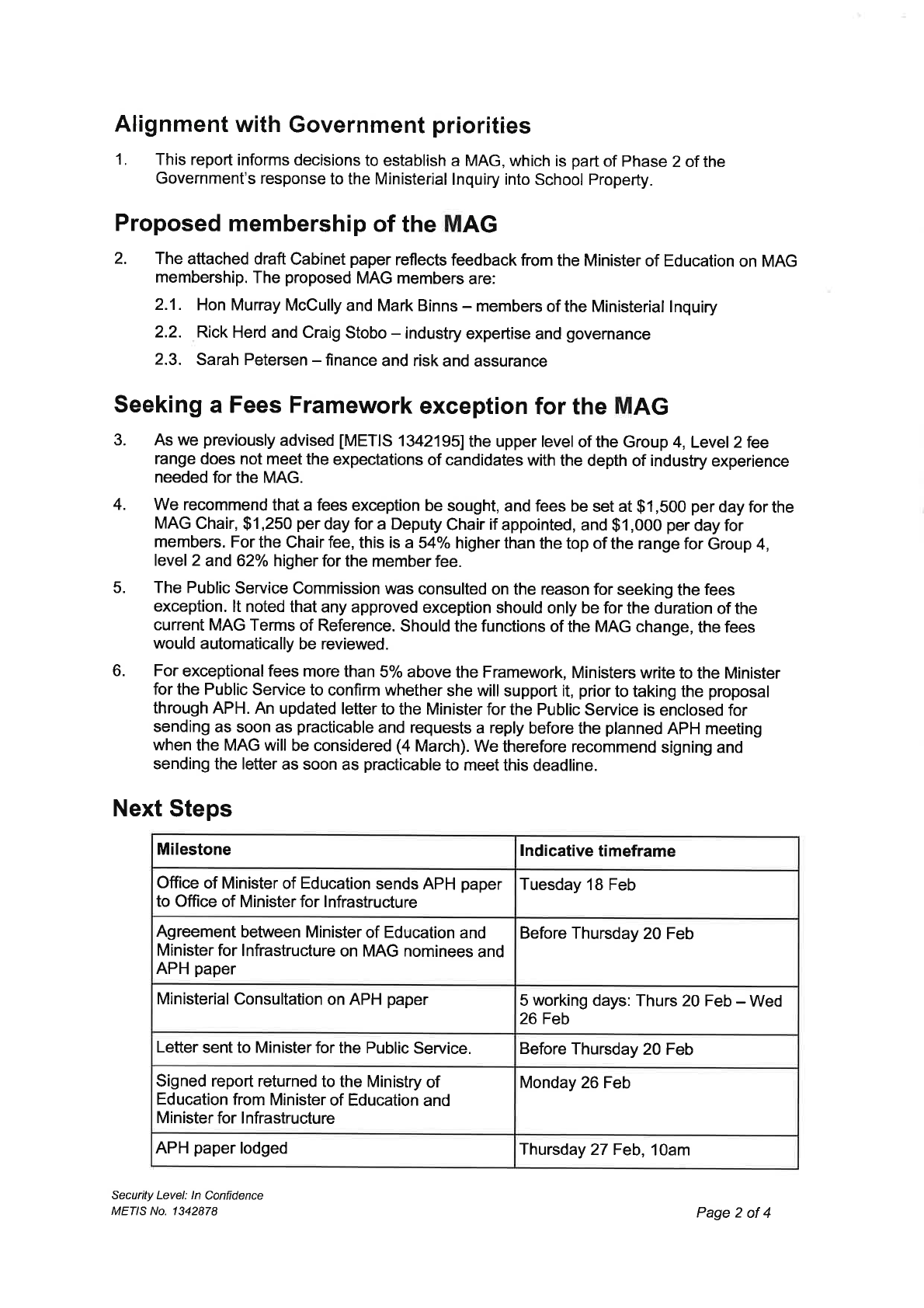
The Minister for Infrastructure and Minister of Education will appoint members to the MAG,
after consultation with the Cabinet Appointments and Honours Committee, and may review
membership as needed to ensure the required expertise is represented on the MAG.
Chair
under
The MAG wil have an independent Chair with the appropriate skil s and specialist
knowledge to manage the complexity of advice on transition of school property to the new
model or entity.
A Deputy Chair may be appointed to cover any duties that would normally be undertaken by
the Chair, should they be unavailable. The Deputy Chair wil be an existing member of the
Released
MAG and wil be appointed by Ministers in consultation with the Chair.
Skil s, knowledge and experience
The MAG wil be made up of individuals who have the appropriate range of skil s, knowledge
and experience to carry out its purpose. The MAG should have a mix of education and
2
industry expertise as well as that of the customer (schools and their communities).
Collectively, the MAG wil demonstrate:
• extensive experience leading system improvements for wider social outcomes,
including organisational change / business design, within a public sector
environment;
• a strong understanding of the role of government agencies in supporting outcomes;
• in-depth knowledge of governance in construction, property delivery and asset
management;
• strong commercial background or financial acumen across the infrastructure
investment lifecycle in asset planning, delivery and management, and risk
1982
management particularly within large infrastructure or property portfolios;
Responsibilities
Act
Members of the MAG wil :
• ensure they have the capacity and capability to fulfil the role and are fully committed
for the duration stated, including being available to attend monthly meetings;
• provide constructive input and advice to the work of the MAG and Ministers and
provide advice to the FCE if requested by the FCE. If the FCE seeks advice from
members of the MAG, the FCE would need to ensure appropriate role clarity and
Information
other arrangements consistent with public sector expectations for external advice;
• commit to the work of the MAG and understand the importance of their personal
contribution to the work’s success;
• ensure they maintain the confidentiality of information provided for their advice,
comment, and critique (including by signing a non-disclosure agreement);
Official
• shal act in good faith and on a ‘no surprises’ basis.
Conflicts of interest
the
Any, actual, perceived and potential conflicts of interest wil be disclosed to Ministers prior to
appointment. Members should be aware of all actual, perceived, and potential conflicts of
interest and notify the Chair before any meeting. The Secretariat wil maintain a register of
conflicts and potential conflicts which wil be regularly reviewed by the Chair and members.
under
Ministers wil be kept informed by the Chair.
Resignation and removal
Members can resign from the MAG by notifying the Chair in writing of intention to resign.
Effective date of resignation wil be after the MAG and Ministers have both been notified.
Members may at any time be removed by Ministers, or the Chair with the agreement of
Released
Ministers. It is expected that the Chair take reasonable steps to mediate any potential
disputes before removal of a member is considered. Removal wil be by notice in writing
stating the effective end-date. Terms include but are not limited to, inability to perform the
duties of a member, neglect of duty or misconduct compromising the MAG’s ability to provide
effective and independent advice to Ministers.
3
Administration
The Chair
The Chair wil lead meetings of the MAG, unless otherwise directed by Ministers, or
otherwise agreed. If the designated Chair is unavailable, then the Deputy Chair wil be
responsible for convening and conducting that meeting. The Chair may also engage directly
with Ministers, on behalf of the MAG.
Meetings
The MAG wil meet as required by the Chair, with an agreed agenda and meeting focus. It is
1982
intended meetings wil be approximately monthly. The meetings wil be held based on
availability of members, to be determined once the MAG has convened and established a
work programme with Ministers. Meetings may be held in-person and remotely or in a hybrid
Act
format.
At least half the MAG, including the Chair or Deputy Chair, must be present for the Group to
reach a quorum.
Work Programme and Advice
The MAG wil work within the agreed scope set by Ministers, with a work programme agreed
between Ministers and the Chair of the MAG. The MAG is not expected to produce a
Information
summative report.
Al advice provided by the MAG wil be based on consensus of MAG members where
possible. Where this is not possible, the Chair may make final determinations on the advice,
with individual members or sub-groups of members retaining the right to note points of
Official
difference in any advice.
The Ministry of Education and the Treasury (officials) are accountable for providing advice to
the
Ministers on education and infrastructure issues and have a statutory obligation to provide
free and frank advice. At the Ministers’ request, the MAG may provide an independent view
on officials’ advice on relevant matters.
Resources
under
The MAG wil have access to advice, information, data, research and analysis developed by
officials for topics under discussion. This may include material that is stil under
development, and that does not reflect either agency views or Government policy. Material
provided by officials is not to be shared outside of the MAG.
The MAG wil be supported by a secretariat. The secretariat wil provide the full range of
Released
organisational support and resources required by the MAG to carry out its functions. The
secretariat wil report to the Chair of the MAG. The MAG may access external advice,
support and resource as it deems necessary to undertake its work, as agreed with Ministers.
4
Costs
The Ministry of Education wil cover costs directly associated with meetings of the MAG, in
line with its internal policies. This is expected to include member fees, transport and other
actual and reasonable costs associated with members’ attendance.
Member Fees
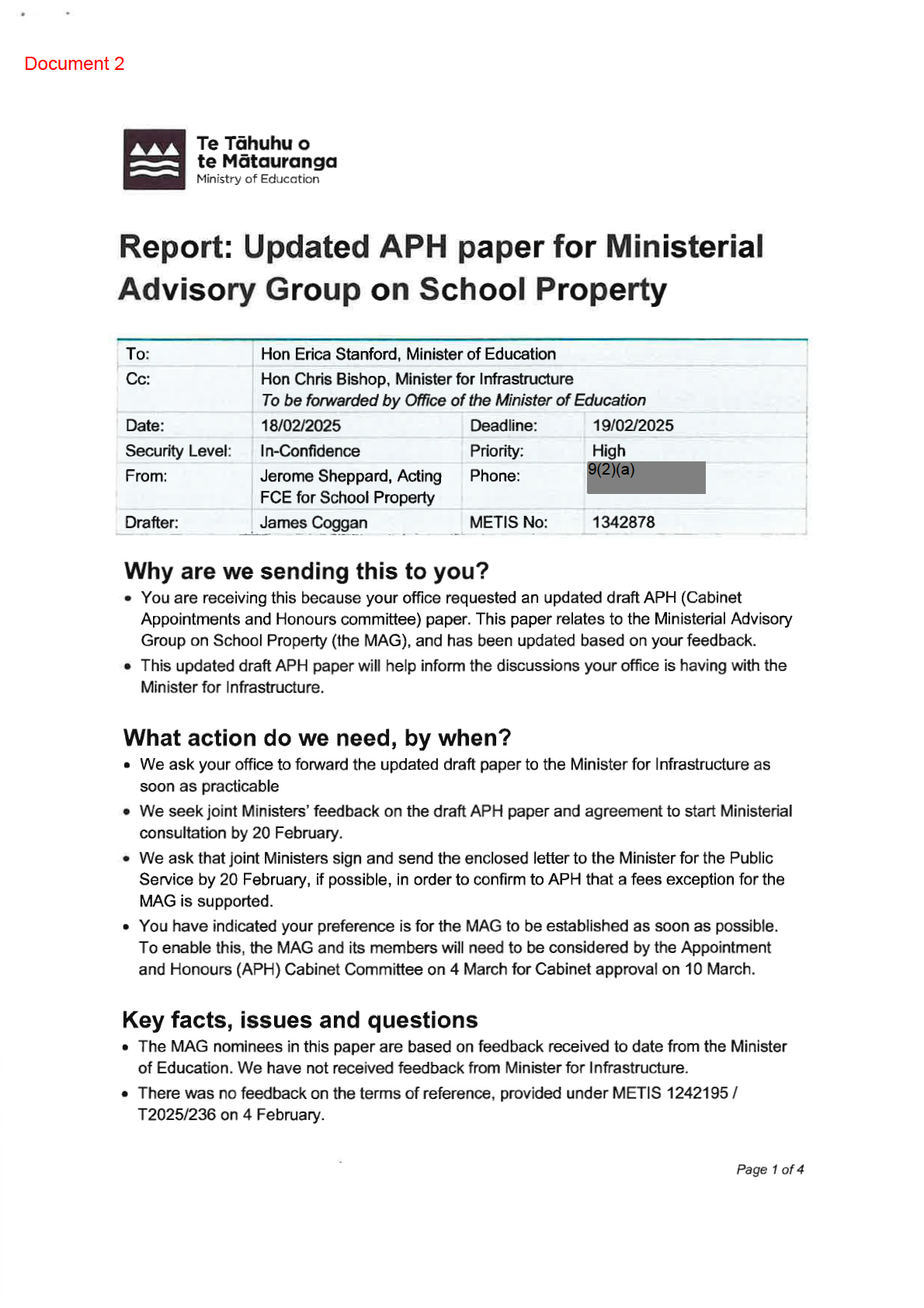
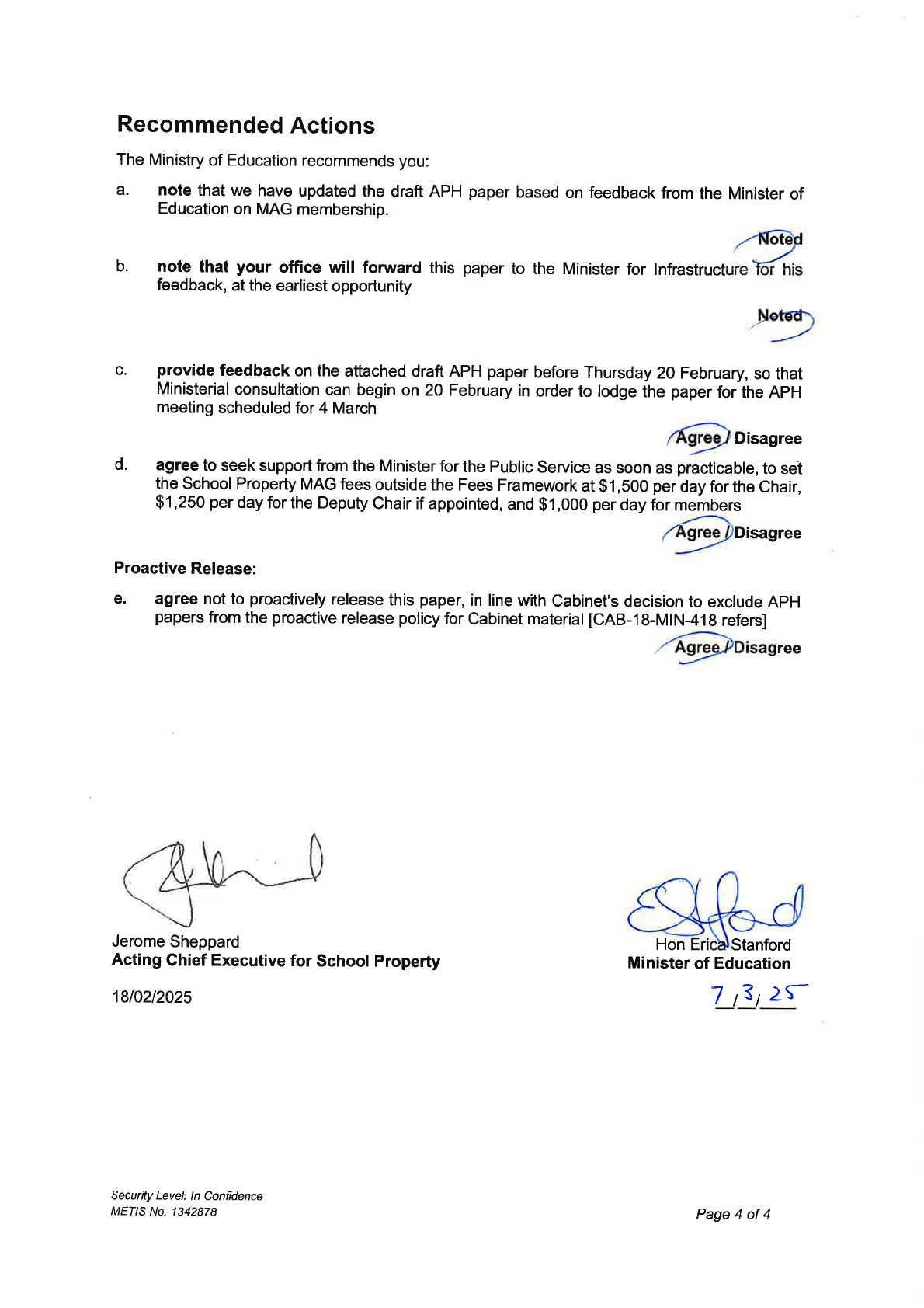
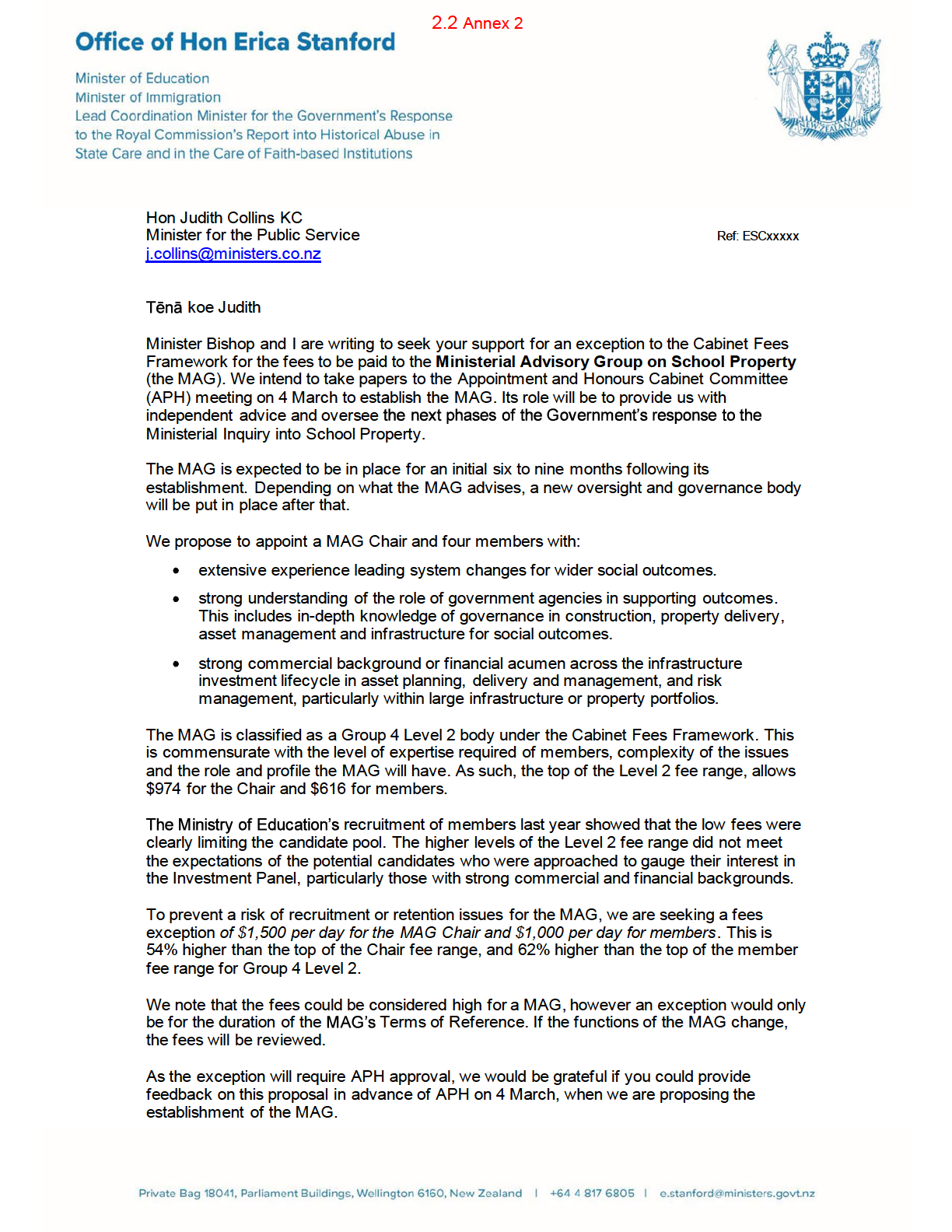
Fees for members of the MAG have been assessed in accordance with the Cabinet Fees
Framework, according to Cabinet Office Circular CO (22) 2. The Group falls within Group 4,
Level 2 (‘Al other committees and other bodies’). The Minister for the Public Service is
currently considering a request for a fees exception on the basis of the fee range not 1982
meeting market expectations.
Confidentiality and Official Information
Act
Advice and recommendations provided by members of the MAG wil be treated in
confidence. Members wil receive confidential information or be a party to discussions and
decisions that are confidential. Members are responsible for taking all reasonable steps to
maintain the security of the information provided to you and maintaining confidentiality.
It is essential that the papers provided to the MAG, and any subsequent group discussion
and advice, remain confidential to the MAG, at least until such time as any proactive release
is undertaken. Al other information must be treated as confidential in perpetuity.
Information
The Official Information Act 1982 wil apply to the activities of the Group.
Public engagement
All public or media statements made from the MAG
wil be made by the Chair with the
Official
approval of Ministers.
the
under
Released
5
1982
Act
Information
Official
the
under
Released
1982
Act
Information
Official
the
under
Released
1982
Act
Information
Official
the
under
Released
1982
Act
Information
Official
the
under
Released
1982
Act
Information
Official
the
under
Released
Naku noa, n
Hon Erica Stanford
Hon Chris Bishop
Minister of Education
Minister for Infrastructure
1982
cc
Jerome Sheppard, Acting Chief Executive, School Property, Ministry of Education
Act
Information
Official
the
under
Released
1982
Act
Information
Official
the
under
Released
Document 4
NZ School Property Agency – Establishment Board
Terms of Reference
Background
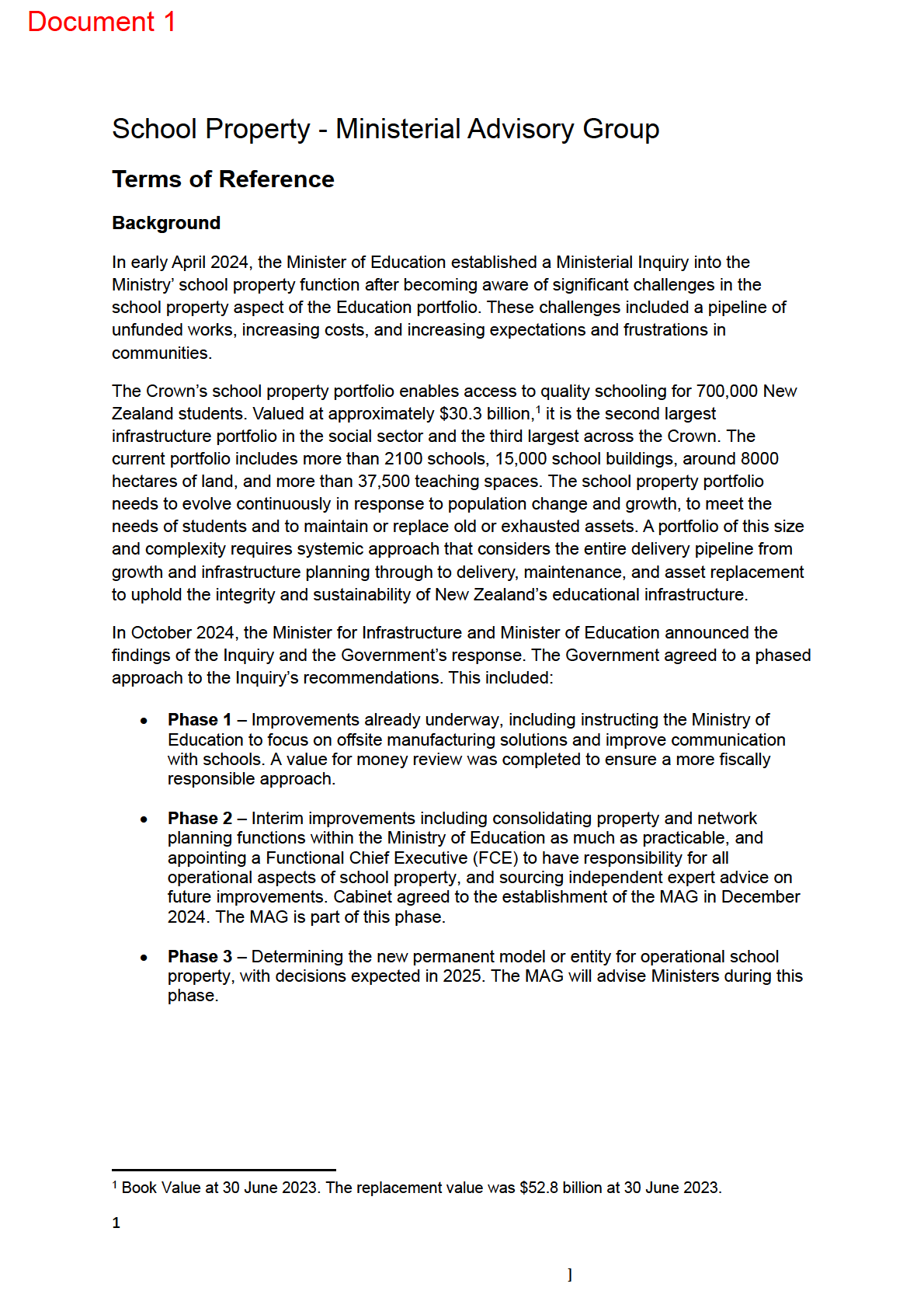
In June 2025, Cabinet approved the establishment of the New Zealand School Property
Agency (NZSPA). The NZSPA wil manage school property and undertake building,
maintenance and administration of the school property portfolio on behalf of the Crown.
Cabinet authorised the Minister of Education and the Minister for Infrastructure to make
further decisions for the establishment of the NZSPA, in line with Cabinet decisions.
1982
The Ministerial Advisory Group (MAG) for School Property was set up in March 2025 to
provide specialist independent advice to Ministers on the design of a transition to a new
Act
model or entity for the delivery of School Property. The MAG suggested and Ministers have
decided to disestablish the MAG and replace it with an Establishment Board for the NZSPA
(the Board) now that the Crown entity model for delivery is decided on and associated
legislation is ready to be introduced to the House.
Purpose
The role and purpose of the Board is to provide specialist independent advice during the
setup phase of the NZSPA. It advises the Minister for Infrastructure and Minister of
Information
Education (the Ministers), the Functional Chief Executive for School Property and the
Secretary for Education. This Board wil continue until NZSPA is created as a Crown agent,
when the NZSPA Board would replace the Establishment Board.
The Board wil advise on shaping priorities, preparing for implementation, and ensuring
readiness for when the NZSPA is legally established.
Official
The Board is not involved in the day-to-day operational tasks and decisions regarding school
property. The Ministry wil provide secretariat support and advice in order for the Board to
the
fulfil its purpose.
The Board is not a decision-making body nor a representative group. Members are
appointed as individuals and are expected to provide impartial advice to Ministers, the
under
Functional Chief Executive for School Property and the Secretary for Education. The Board
wil be in place until the NZSPA is established as a Crown agent.
Scope
The Board wil provide advice to Ministers and/or the Functional Chief Executive for School
Property and the Secretary for Education on the following.
Released
Transition to the new model for School Property
• The transition to the new model or entity for delivery of school property, including the
design of the operating model for NZSPA and the Implementation Business Case.
• Opportunities for more flexible property management service offerings.
• School Property’s ongoing efforts to drive better value for money and improvements
to procurement.
Ministerial-directed operational focus areas
• The standardisation of property, including Offsite Manufactured Buildings.
• A potential future asset recycling strategy for NZSPA.
• Delivering initiatives in the Accelerating School Property Maintenance package
(covering the open-plan classroom contestable fund, the property maintenance top-
up, and the expansion of the Ngā Iti Kahurangi programme).
• Budget 26 School Property initiatives (advice to the Functional Chief Executive for
School Property only).
• The Long-Term Investment Plan (LTIP) in relation to School Property.
• Any other matters relevant to Ministers’ decisions or requirements of the Functional
1982
Chief Executive for School Property on the transition to the new model.
Membership
Act
The Minister for Infrastructure and Minister of Education wil appoint the members and the
Chair of the Board, and may review membership as needed to ensure the required expertise
is represented. The term of appointment wil be date of appointment until NZSPA is
established as a Crown agent.
Chair
The Board wil have an independent Chair with the appropriate skil s and specialist
Information
knowledge to manage the complexity of advice on transition of school property to the new
model / entity.
A Deputy Chair may also be appointed to cover any duties that would normally be
undertaken by the Chair, should they be unavailable. The Deputy Chair must be an existing
Official
member of the Board and is appointed by Ministers in consultation with the Chair.
Skil s, knowledge and experience
the
The Board wil be made up of individuals who have the appropriate range of skil s,
knowledge and experience to carry out its purpose. The Board should have a mix of
education and industry expertise. Collectively, the Board wil demonstrate:
under
• extensive experience leading system improvements for wider social outcomes,
including organisational change / business design, within a public sector
environment;
• a strong understanding of the role of government agencies in supporting outcomes;
• in-depth knowledge of governance in construction, property delivery and asset
management;
• strong commercial background or financial acumen across the infrastructure
Released
investment lifecycle in asset planning, delivery and management, and risk
management particularly within large infrastructure or property portfolios;
• leadership experience and knowledge of New Zealand’s schooling sector, in
particular how to deliver and achieve educational outcomes for all students;
• understanding of Te Tiriti o Waitangi and knowledge of Te Ao Māori and working with
iwi to contribute to education, commercial and social outcomes.
Responsibilities
Members of the Board wil :
• ensure they have the capacity and capability to fulfil the role and are fully committed
for the duration stated, including being available to attend monthly meetings;
• provide constructive input and advice to the work of the Board and Ministers and
provide advice to the Functional Chief Executive for School Property on request. If
the Functional Chief Executive for School Property seeks advice from members of
the Board, the Functional Chief Executive for School Property would need to ensure
appropriate role clarity and other arrangements consistent with public sector
expectations for external advice;
1982
• commit to the work of the Board and understand the importance of their personal
contribution to the work’s success;
Act
• ensure they maintain the confidentiality of information provided for their advice,
comment, and critique (including by signing a non-disclosure agreement);
• act in good faith and on a ‘no surprises’ basis.
Conflicts of interest
Any, actual, perceived and potential conflicts of interest wil be disclosed to Ministers prior to
appointment. If members develop new actual, perceived, or potential conflicts of interest they
must inform the Secretariat before any meeting.
Information
Members of the Board who have a conflict of interest in relation to an issue or item wil
recuse themselves from consideration of those issues or items.
The Secretariat wil maintain a register of conflicts and potential conflicts which wil be
regularly reviewed by the Chair and members. Ministers wil be kept informed by the Chair.
Official
Resignation and removal
the
Members can resign from the Board by notifying the Chair in writing of intention to resign.
Effective date of resignation wil be after the Chair and Ministers have both been notified.
Members may at any time be removed by Ministers, or the Chair with the agreement of
under
Ministers. It is expected that the Chair take reasonable steps to mediate any potential
disputes before removal of a member is considered. Removal wil be by notice in writing
stating the effective end-date. Terms include but are not limited to, inability to perform the
duties of a member, neglect of duty or misconduct compromising the Board’s ability to
provide effective and independent advice to Ministers.
Administration
Released
The Chair
The Chair wil lead meetings of the Board, unless otherwise directed by Ministers, or
otherwise agreed. If the designated Chair is unavailable, then the Deputy Chair or member
designated to act in their place wil be responsible for convening and conducting that
meeting. The Chair may also engage directly with Ministers, the Functional Chief Executive
or the Secretary for Education, on behalf of the Board.
Meetings
The Board wil meet as required by the Chair, with an agreed agenda and meeting focus. It
is intended meetings wil be approximately monthly. The meetings wil be held based on
availability of members, to be determined once the Board has convened and established a
work programme with Ministers. Meetings may be held in-person and remotely or in a hybrid
format.
At least half the Board, including the Chair or Deputy Chair, must be present for the Group to
reach a quorum.
Work Programme and Advice
1982
The Board wil work within the agreed scope set by Ministers, with a work programme
agreed between Ministers and the Chair of the Board. The Board is not expected to produce
Act
a summative report.
Al advice provided by the Board wil be based on consensus of Board members where
possible. Where this is not possible, the Chair may make final determinations on the advice,
with individual members or sub-groups of members retaining the right to note points of
difference in any advice.
The Ministry of Education and the Treasury (officials) are accountable for providing advice to
Ministers on education and infrastructure issues and have a statutory obligation to provide
Information
free and frank advice. At the Ministers’ request, the Board may provide an independent view
on officials’ advice on relevant matters.
Resources
Official
The Board wil have access to advice, information, data, research and analysis developed by
officials for topics under discussion. This may include material that is stil under
development, and that does not reflect either agency views or Government policy. Material
the
provided by officials is not to be shared outside of the Board.
The Board wil be supported by a Secretariat. The Secretariat wil provide the full range of
organisational support and resources required by the Board to carry out its functions. The
Secretariat wil report to the Chair of the Board. The Board may access external advice,
under
support and resource as it deems necessary to undertake its work, as agreed with Ministers.
Costs
The Ministry of Education wil cover costs directly associated with meetings of the Board, in
line with its internal policies. This is expected to include member fees, travel and other actual
and reasonable costs associated with members’ attendance.
Released
Member Fees
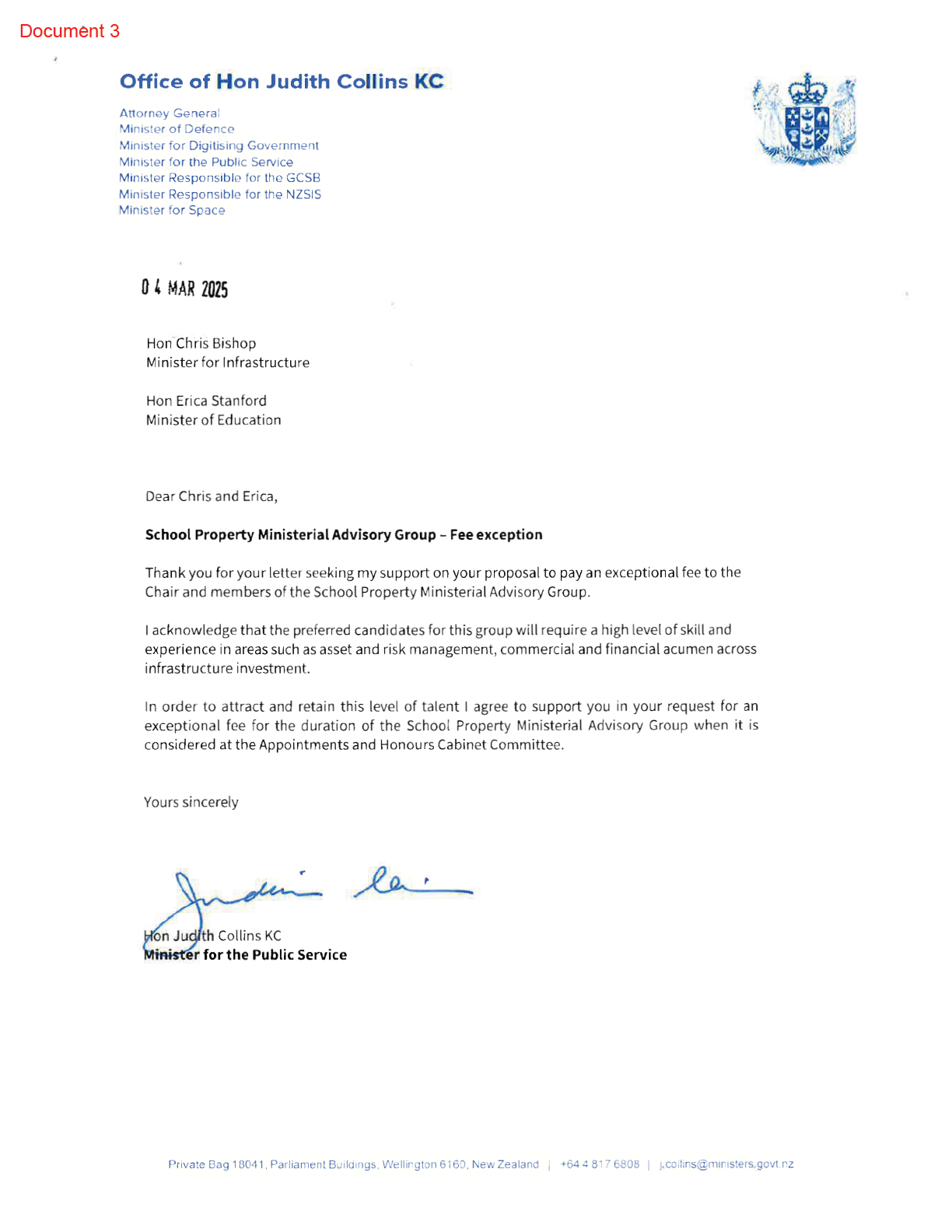
Fees for members of the Board have been assessed in accordance with the Cabinet Fees
Framework, according to Cabinet Office Circular CO (25) 2. The Group falls within Group 4,
Level 2 (‘Al other committees and other bodies’). A request for a fees exception request is
underway and wil be confirmed as part of the appointments process. The proposed
exception includes a rate of $1,500 per day for the Chair and $1,000 per day for the
members. These rates are consistent with the current fees exception approved for the MAG.
Confidentiality and Official Information
Advice and recommendations provided by members of the Board wil be treated in
confidence. Members wil receive confidential information or be a party to discussions and
decisions that are confidential. Members are responsible for taking all reasonable steps to
maintain the security of the information provided to them and maintaining confidentiality.
It is essential that the papers provided to the Board, and any subsequent group discussion
and advice, remain confidential to the Board, at least until such time as any proactive 1982
release is undertaken. Al other information must be treated as confidential in perpetuity.
The Official Information Act 1982 wil apply to the activities of the Group.
Act
Public engagement
All public or media statements made from the Board
wil be made by the Chair with the
approval of Ministers and in consultation with the Functional Chief Executive for School
Property.
Information
Official
the
under
Released
