

Document 1
MEMO
DATE
7 March 2024
TO
Nic Blakeley, Deputy Secretary Labour, Science and Enterprise
PREPARED BY Mara Wolkenhauer, Principal Policy Advisor, Future Pathways
Benno Blaschke, acting Manager, Future Pathways
APPROVED BY Prue Williams, GM Future Research System
SUBJECT
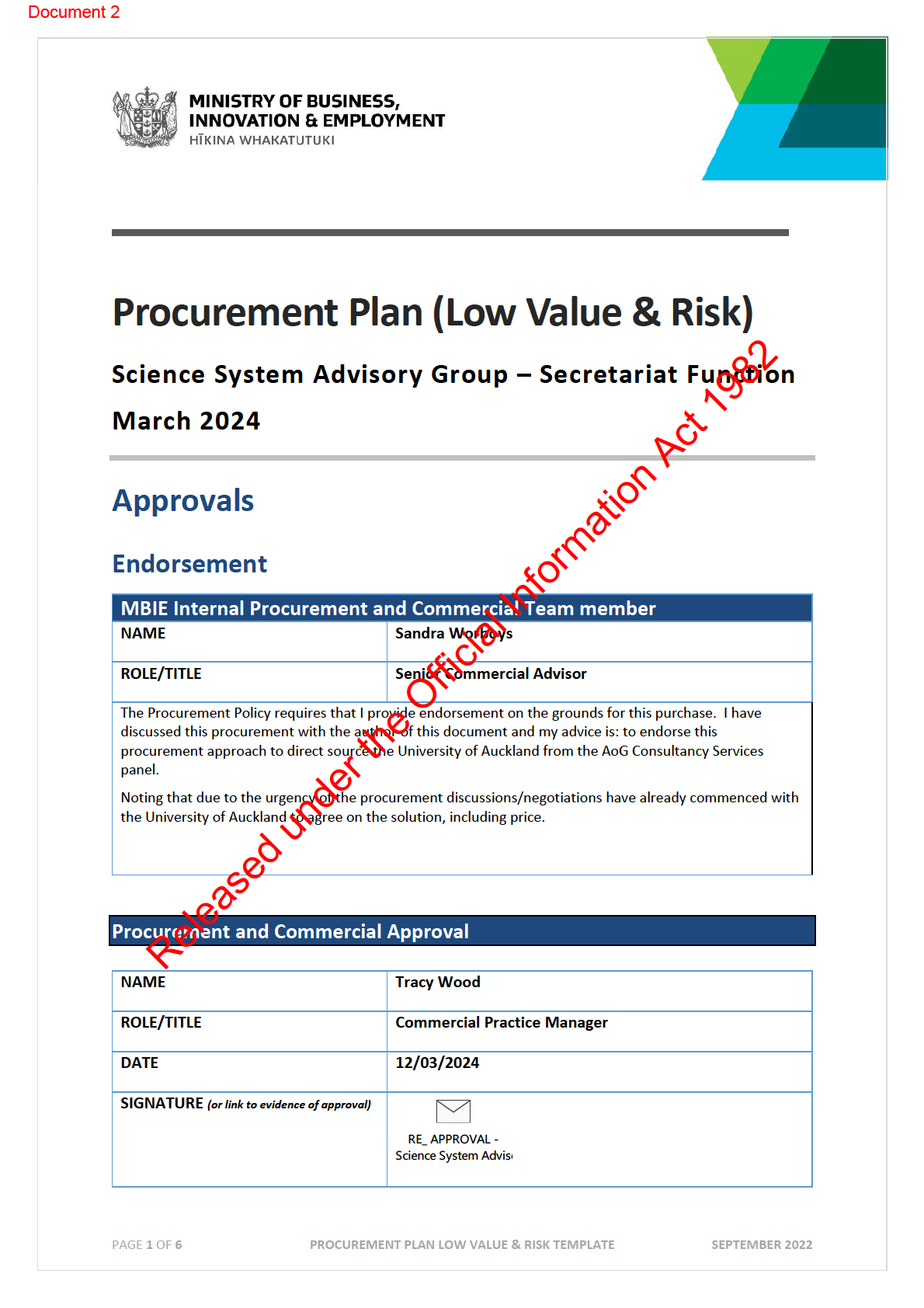
PROCUREMENT PLAN FOR THE SCIENCE SYSTEM ADVISORY GROUP
SECRETARIAT FUNCTION
RECOMMENDATIONS
1.
Note the needs and risk associated with outsourcing the secretariat function for
MBIE’s Science System Advisory Group.
2.
Agree and sign procurement plan provided.
PURPOSE
To provide you with the updated procurement plan for sign-out that outlines the reason why
we are outsourcing the secretariat function for the upcoming Science System Advisory Group
(SSAG).
CONTEXT
Prue Williams, General Manager Future Science System, has al ocated some funds to support
under the Official Information Act 1982
outsourcing the secretariat function of the proposed SSAG. Koi Tu – The Centre for Informed
Futures [the Centre], through the University of Auckland (UoA) as their host, has been put
forward as the appropriate organisation. We have discussed and negotiated a suitable budget
with the Centre for the 8-months contract (Mar-Oct 2024).
RISK AND BENEFITS
Released
Benefits
• Outsourcing the secretariat function frees up our staff to do policy work.
• Being slightly removed from logistics, including making detailed travel arrangements,
provides the Centre with a certain flexibility necessary to get some of the more senior
advisors (who are located overseas) involved in the SSAG.
• The contract budget will be offered as an “up-to” amount, with monthly financial
reporting of actuals against forecast required, and a caveat of having to pay back funds
at the end if not spent. This enables the secretariat function while also providing
transparency to MBIE.


Risks
• Government policy might not be applied when booking travel and accommodation.
This is traded off against providing the Secretariat the needed flexibility to get senior
intentional members of the SSAG involved.
• The close association of Sir Peter Gluckman to the Centre (he is the director) could be
seen as a conflict of interest.
• Our original budget was roughly half of what is now proposed; however, additional
services (e.g. website) have been added.
ENDS
under the Official Information Act 1982
Released
Beside project coordination function, the Secretariat will also provide some data analytics and
report-writing.
In summary, our requirements of the proposed Secretariat Function are for them to:
• Oversee and co-ordinate activity and resources for the SSAG;
• Provide all administrative tasks associated with running the SSAG (incl. travel and
remuneration of the SSAG members);
• Provide some data analyses to support the discussion and work of the SSAG;
• Support the SSAG with report writing and delivery of recommendation; and
• Provide a hub for connection and communication between the SSAG and relevant
stakeholders and MBIE (through a website aligned with MBIE’s communication plan).
Procuring the recommended services listed above is the best way to meet the Minister’s needs
because MBIE currently does not have the required capacity to run the Secretariat in-house without
having to employ additional staff. Current fiscal constraints do not allow us to hire additional
personnel.
Why University of Auckland and not 3 quotes?
• Koi Tū – Centre for Informed Futures (as part of The University of Auckland) has the key skills
and expertise needed for the Chair of the SSAG (Sir Peter Gluckman) to facilitate effective
delivery of the key outputs the Minister is expecting from the SSAG.
• University of Auckland is geographically best placed to run the logistics (it is more cost-
effective to have the Secretariat based close to the proposed SSAG Chair and its Member
Meetings in Auckland, as opposed to coordinating this remotely from Wellington).
• University of Auckland has agreed to be flexible and accept potential secondments for tasks
such as data analysis and report writing where MBIE staff could contribute.
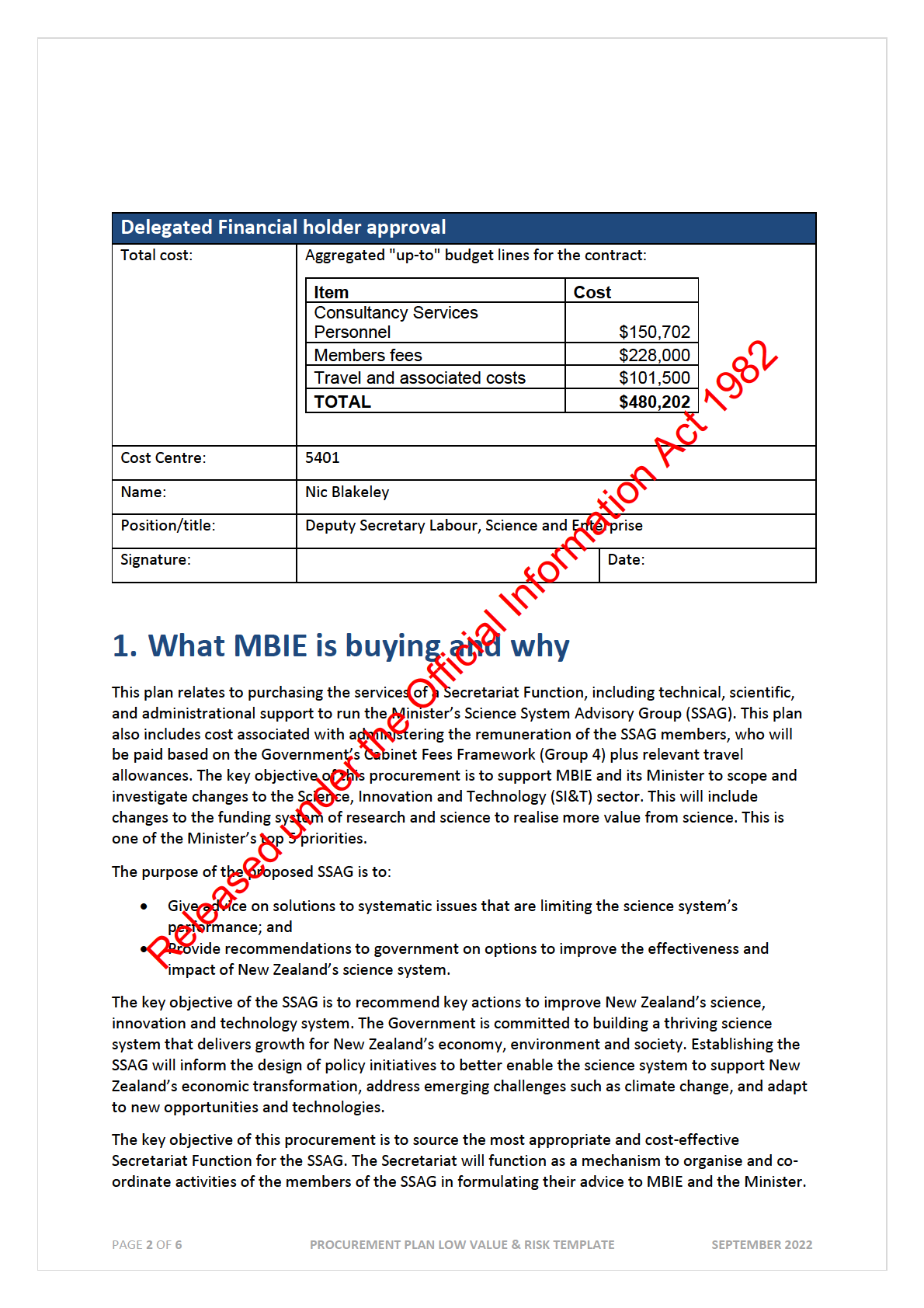
An estimate of the total cost over the whole-of-life of the contract, exclusive of GST is $480,202. We
require the contract to commence by 28th March 2024.
2. Approach to selecting a Supplier
There is currently the Al -of-Government (AoG) Consultancy Services panel that can meet this
requirement. The recommended approach to selecting a supplier is direct source to The University
of Auckland from that AoG Panel.
under the Official Information Act 1982
This supplier has been selected based on the reasons listed above.
3. Indicative timeline
The Minister wil be taking her intent of setting up the SSAG to Cabinet on 25th March and then
announcing it to the sector before Easter.
Released
Timeline for the Procurement process:
Activity
Date
Procurement plan approved
15 March 2024
Proposal requested and received from
Early February 2024
University of Auckland
Proposal evaluated by panel
Late February 2024
Contract drafted and reviewed (including Legal) March 2024
Contract signed
28 March 2024
PAGE
3 OF
6
PROCUREMENT PLAN LOW VALUE & RISK TEMPLATE
SEPTEMBER 2022
Timeline for the SSAG is as follows (taken from the TOR):
Deliverable
Due date
Establishment of the Group
February 2024
Terms of Reference approved
March 2024
Document review and baseline assessment
April 2024
Report 1 completed by the Group
30 May 2024
Stakeholder engagement and consultation
June-July 2024
Report 2 completed by the Group
30 October 2024
Meeting with the Minister
Mid-November
4. Evaluation methodology
The preferred supplier’s proposal/response will be evaluated against the following criteria:
• Meets the business requirements (40%);
• Quality (20%);
• Ongoing support (5%);
• Past experience and knowledge the supplier offers (20%);
• Broader Outcomes (i.e.: Cultural, Economic and Social Benefits (15%).
Price will:
• not be a weighted criterion. Instead, price will be taken into account in determining overall
value for money over the whole-of-life of the contract.
The response will be evaluated by Prue Williams, Richard Walley and Lee Robertson.
Declaration of Conflicts of Interest will be completed before the evaluation process in accordance
with MBIE’s Procurement Policy.
The purpose of the evaluation is to formulate appropriate recommendations which will be
submitted to the Delegated Financial Authority for approval.
under the Official Information Act 1982
5. Contract
The direct sourced supplier wil be required to enter into a Consultancy Service Order (CSO) under
the AoG Consultancy Services Panel Agreement.
The proposed contract term is approximately 8 months (from 28 March to 30 November 2024).
Released
The CSO will be reviewed by legal services prior to signing, as the value is over $100K.
6. Broader Outcomes
The SSAG, supported by the Secretariat Function, will promote collaboration and reduce
fragmentation and duplication across the science system. This is expected to contribute to the
following broader outcomes:
• Building stronger partnerships between businesses, communities and industries;
PAGE
4 OF
6
PROCUREMENT PLAN LOW VALUE & RISK TEMPLATE
SEPTEMBER 2022
• Enhancing efficiencies in government spending through better targeting of science
investments, identified through enhanced collaboration and better integration of effort;
• Enhancing the science, innovation and technology skil s and talent pathway through
upskilling opportunities in the science sector, reduce ‘brain drain’ (researchers moving
overseas), and enabling more New Zealanders to move into high-paying roles;
• Increasing diversity in the science sector, including Mātauranga Māori; and
• Supporting regional and national growth by increasing the skilled labour force for roles in
the science and technology industries.
7. Other Considerations
This contract is considered low risk as The University of Auckland and associated Centre for Informed
Futures (Koi Tū) have a history of delivering high-quality services, including providing coordination
function for various science engagement and projects.
Risk
Mitigation action
Responsible
Reputational risk to
The Chair of the SSAG is the same
MBIE Officials, University of
MBIE and the
person as the Director of the Centre
Auckland research office
Minister
running the Secretariat. This could be
(UniServices) key staff and
perceived as a conflict of interest (CoI).
their DVC-R (Deputy Vice
This will be mitigated by involving
Chancellor for Research)
University of Auckland’s wider team who
will monitor any CoI regularly.
Non-delivery of key
A Programme Lead, Comms Person and
Supplier (University of
secretariat functions Finance lead have been al ocated to
Auckland)
support the ful -time coordinator to
ensure internal systems and financial
knowledge are always available (incl.
leave-cover).
Scope creep and
A clear CSO with a defined budget and
Minister, MBIE Officials and
alternative
scope will be signed prior to any work
the Supplier
deliverables required commencing.
Money is not spent
Monthly financial reports will be
MBIE contracts manager and
according to budget required from the supplier and all
finance staff
amounts are provided as an ‘up-to’
under the Official Information Act 1982
budget with unspent funds having to be
returned at the end of the contract
8. Probity
Probity (managing procurement processes fairly in a way that maintains the trust and confidence of
Released
all stakeholders) will be managed by:
• giving consideration to the five Principles of Government Procurement.
• acting fairly, impartially and with integrity, acting lawfully, and being accountable and
transparent;
• ensuring compliance with MBIE’s code of conduct and identifying and managing conflicts of
interest;
• ensuring that financial authority for the procurement is approved before proceeding to
contract; and
PAGE
5 OF
6
PROCUREMENT PLAN LOW VALUE & RISK TEMPLATE
SEPTEMBER 2022
• protecting the supplier’s commercially sensitive and confidential information.
under the Official Information Act 1982
Released
PAGE
6 OF
6
PROCUREMENT PLAN LOW VALUE & RISK TEMPLATE
SEPTEMBER 2022
 Document 3
Uutorscope
From:
Document 3
Uutorscope
From: James Campbell
Sent: Friday, 17 May 2024 6:09 pm
To: [email address]
Cc: Andy Jackson <[email address]>; Tim Fowler - TEC
<[email address]>; Alastair MacCormick <[email address]>; TEC - Deirdre
Marshall <[email address]>; Katrina Sutich <[email address]>
Subject: Budget and secretariat discussion
Kia ora Sir Peter
Thank you for the meeting earlier today- it was very helpful in resolving some of the key issues
(as outlined in the attached note that was tabled in the meeting):
• MoE and TEC will increase the cap on the total budget to $400,000
• The panel will be paid a standard weekly rate reflecting the average amount of time
expected to be spent on UAG activities.
o Could you please confirm the comfort of the rest of the panel with this approach? I
have drafted a very short memo to members on this (attached) - if this can be
nder the Official Information Act 1982
discussed and
u minuted at the next upcoming meeting then we can lock this in.
• We agreed that the other costs allowed for were appropriate, noting that they allow for a
small contingency.
• We agreed that a contract would Koi Tu would be for less than $50,000 and that I would
work with you to provide the degree of specificity that Andy is looking for in this - I will
provide some suggestions on this as a starting point.
Released
• I will be the point of contact for the secretariat (coordinating across MoE and TEC) and we
will set up a weekly meeting for us to work through how the secretariat can support the
UAG's upcoming activity. I will reach out to your EA to find a time for this.
Does this all align with your understanding? Please just let me know if I've missed anything or if
there is anything you would like to discuss.
Looking forward to working with you to progress this important work.
Nga mihi
James
James Campbell | Senior Policy Manager, Tertiary Education
Te Pou Kaupapahere | Policy
Mobile 9(2)(a)
nder the Official Information Act 1982
u
Released



Document 4
To:
University Advisory Group members
From:
James Campbell, Senior Policy Manager, Ministry of Education
Date:
17 May 2024
Subject:
Arrangements for member fees
Following discussion with the Chair, we would like to confirm a proposed approach to member’s fees that
appropriately recognises members’ time, within the context of a constrained budget environment.
Rather than asking members to invoice for actual time spent, we propose to pay members for a flat amount of time
per week across the entirety of the UAG process:
1.5 days per week for the Chair and Deputy Chair, 1 day per week
for members, at the rate specified in members’ appointment letters. This is intended to reflect expectations about the
average amount of time that members will be spending on UAG work over the course of the UAG process – we would
expect that significantly less time will be spent in some weeks, while more time will be spent in others (for example
when members are travel ing for the UAG’s work, having significant engagements or workshops).
The proposed rate would be inclusive of all panel time and should align with expectations on members in the UAG’s
work programme. Reimbursement of any member expenses associated with the Panel’s activities (e.g. travel) will be
dealt with in accordance with the Cabinet Fees Framework based on actual costs incurred and in in accordance with
the budget agreed with the Chair.
Subject to confirmation that members are comfortable with this approach, we will seek the necessary information
from each member to allow payment of these fees to be processed (backdated to members’ dates of appointment).
nder the Official Information Act 1982
u
Released
Memo

Document 4
[IN-CONFIDENCE - RELEASE EXTERNAL]
UAG budget - proposed approach for discussion 17 /5/24
After considering the Chair's proposed budget, which significantly exceeds the $250,000 amount
originally allocated for this work, MoE and TEC would be prepared to increase the total budget to
$400,000. This would great us closer to the amount outlined, although would still require some
reductions. For example, it would allow for the following while leaving some room for a contract
with Koi Tu:
UAG panel fees
Average
days per
#of
UAG role
Daily rate
week
weeks
Weekly cost
Cost
Chair
$
900
1.5
45 $
1,350
$
60,750
Deputy Chair
$
600
1.5
45 $
900
$
40,500
Other UAG members $
600
6
43 $
3,600
$
154,800
TOTAL
$
5,850
$
256,050
Other costs included
Probity checks
$
660
16 university visits
and other
engagement costs
$
50,000
In person UAG
workshops
$
12,000
Invoice for website
$
7,000
nder the Official Information Act 1982
Publishing costs
$
7,000
u
TOTAL
$
76,660
GRAND TOTAL
$
332,710
Released
The key difference to the figures given by the Chair is that the above would not provide for
additional panel time for the review of submissions, report input beyond what is already reflected in
the higher weekly hours. In relation to this we would be comfortable with either:
•
paying for panel time on the basis of the above as an expectation of average weekly hours
(averaged out across weeks of lower BAU activity and all periods that will require more
panel time), provided that was clearly understood by panel members.
•
paying a lower number of hours for BAU activity (panel meetings etc), and paying panel
members for additional actual hours for engagement activity, whole day workshop, input
into reports etc, provided that it was clearly budgeted to fall within the new total.
[IN-CONFIDENCE - RELEASE EXTERNAL]
[IN-CONFIDENCE - RELEASE EXTERNAL]
The above travel costs and workshop costs are maximums that would need to be worked within,
with actual expenditure in accordance with MoE/TEC travel policies.
The remaining amount would provide scope for us to enter into a small contract with Koi Tū – this
would need to have clear outputs, with monthly payments made ex-post following delivery of
outputs.
MoE and TEC have capacity to provide secretariat support to the group, including analysis and advice
for the panel, note taking for engagements, submissions analysis, booking travel, paying panel costs
etc. A clearer picture of planned panel activity (meetings and engagement) would be required for
MoE and TEC to perform this role effectively.
Points for discussion
• Does the average level of panel activity fairly reflects the expected level of activity through
to the end of February 2025?
• Would the Chair and other panel prefer to be paid a flat average amount or to separate BAU
activity from significant engagement, workshop, report writing activity?
• Do the other costs provided for in the above account for all of the other costs that the UAG
could be expected to incur? Is there anything else that should be budgeted for?
• What support does the UAG need from the secretariat in terms of note taking, analysis and
advice, submissions analysis etc? How can we better set ourselves up to deliver on this?
nder the Official Information Act 1982
u
Released
[IN-CONFIDENCE - RELEASE EXTERNAL]
Document 5
[IN-CONFIDENCE - RELEASE EXTERNAL]
University Strategy Group
Terms of Reference
Context
The Government is committed to maintaining a thriving higher education system for the
benefit of all learners. Higher education – generally defined as education offered at degree
level and above – is a key contributor to New Zealand’s economic growth and productivity,
our ability to grow and innovate, and achieving better social outcomes.
Universities deliver most higher education provision in New Zealand, and overall they serve
New Zealand well – but the university system faces challenges. To strengthen the university
system to drive collective decision-taking, improved policy and regulatory settings and
coordinated action to give effect to the Tertiary Education Strategy (TES) priorities, the
Minister for Universities is establishing the University Strategy Group (the Group).
Purpose
The Group will bring together independent experts, sector leaders and senior officials to act
as a leadership forum and coordination point for the university system.
It will also consider and provide advice on significant issues and challenges specific to
universities and how well all elements of the system (including government agencies) are
working to contribute to the Government’s objectives for tertiary education, as outlined in the
Tertiary Education Strategy (TES).
The Group’s influence will be through shaping collective sector strategy and direct dialogue
rather than formal recommendations to the Government. It will not have any governance
powers and will not assume the roles or functions of any members.
Scope and Approach
The Group will prioritise giving effect to the TES priorities and strengthening coordination
nder the Official Information Act 1982
u
within and outside of the university sector by fostering a shared understanding of long-term
strategic issues and leveraging collective expertise.
The Group will act as a coordination point in which members will be able to share ideas and
best practice on matters specific to New Zealand’s university system. It will provide
opportunities to directly promote coordination both between universities and with other
entities in the wider research and science system. The Group will identify options to improve
Released
policy and regulatory settings and opportunities for government to lead other change
initiatives.
Topics of Focus
Each meeting will have a focus on a particular topic (with flexibility to allow time to revisit
developments on previous topics and to raise specific issues of the day, as agreed with the
1
[IN-CONFIDENCE - RELEASE EXTERNAL]
[IN-CONFIDENCE - RELEASE EXTERNAL]
chair). Topics for discussion will be determined by the Minister for Universities, as the
Group’s chair, in consultation with other members.
Examples of the kinds of topics likely to be discussed will include mechanisms to incentivise
and reward collaborative approaches to system level challenges, such as international
education and artificial intelligence. For each topic, the Group will consider what, if any,
action needs to be taken, the impact of this on the university system, and any implications
for the wider tertiary education system. The performance of individual universities will not be
considered.
Membership
The Group will be chaired by the Minister for Universities. The number of participants at
each meeting may vary depending on the topic under consideration, but core membership
will consist of the Chair and:
• up to three independent members
• three university Vice-Chancellors (nominated by Universities New Zealand)
• Senior leaders from the Ministry of Education and the Ministry of Business,
Innovation and Employment
• the Chief Executive and a board member of the Tertiary Education Commission
• a nominated representative of the four Public Research Organisations.
The Prime Minister’s Chief Science Advisor, in his capacity as a member of the Prime
Minister’s Science, Innovation and Technology Advisory Council, will be invited to join the
Group.
Representatives of other government agencies or other organisations may be invited to
participate in meetings when the topic under consideration is of direct relevance to them.
Term
The Group will run for a term of 18 months in the first instance. At the end of this term, the
Ministry, in consultation with the Minister for Universities, will review the effectiveness of the
Group and a decision will be made on whether the Group is extended for a further period
and on whether any changes to these Terms of Reference are required.
nder the Official Information Act 1982
Meeting frequency
u
The Group will meet approximately every quarter, although may meet more frequently if
required. Meetings may be held either in-person or virtually. Meetings will be focussed on a
particular issue or theme decided in advance. Subsets of members may also be asked to
meet separately to consider an issue in more depth and to report back to the main Group.
Minutes and information
Released
The Secretariat will record minutes of each meeting. These minutes will be shared with
members, and will be subject to the provisions of the Official Information Act, but will not be
proactively published.
Information will generally be shared on the basis that it can be shared within members’
organisations (although not more broadly), other than where it is specified that information is
being shared under a stricter expectation of confidence.
Conflicts of interest
2
[IN-CONFIDENCE - RELEASE EXTERNAL]
[IN-CONFIDENCE - RELEASE EXTERNAL]
Members should be aware of all actual, perceived and potential conflicts of interest and
notify the chair before any meeting. The Secretariat will maintain a register of notified
conflicts. If any conflicts of interest should arise for Group members, the chair is responsible
for determining mitigations to address them.
Remuneration
Remuneration will be paid to independent members in accordance with guidance set out in
Cabinet Office Circular CO (22)2: Revised Fees Framework for members appointed to
bodies in which the Crown has an interest. If one of these members is appointed as Deputy
Chair, they will receive an additional 25% of the member fee.
Remuneration will not be paid to ex officio members. For those members who are
employees of government agencies listed in Schedule 2 of the Public Service Act 2020, their
employer is responsible for meeting all costs associated with their membership of the Group.
Secretariat
Secretariat support will be provided by the Ministry of Education. The Tertiary Education
Commission, Universities New Zealand and the Ministry of Business, Innovation and
Employment will also have a role in providing advice or analysis to the Group where
relevant.
Funding
The Ministry of Education will provide secretariat services through access to Ministry staff
resources for writing and analysis, including the recording of the minutes of meetings, project
coordination and for expense claims and travel bookings. Other cost-generating activities
must be agreed by the Ministry of Education before the costs are incurred.
nder the Official Information Act 1982
u
Released
3
[IN-CONFIDENCE - RELEASE EXTERNAL]
