From:
Sue Powel
To:
Anna Tregaskis; Liz Stewart; Leigh Huffine;
Subject:
Dra map for review
A achments:
Strengthening public media v0.2.pdf;IMG_3597.jpg;IMG_3598.jpg;
Sent:
3/03/2020 3:11:41 pm
HI all
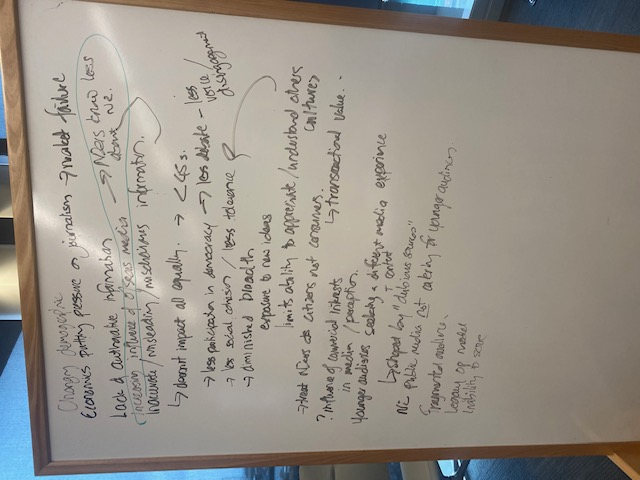
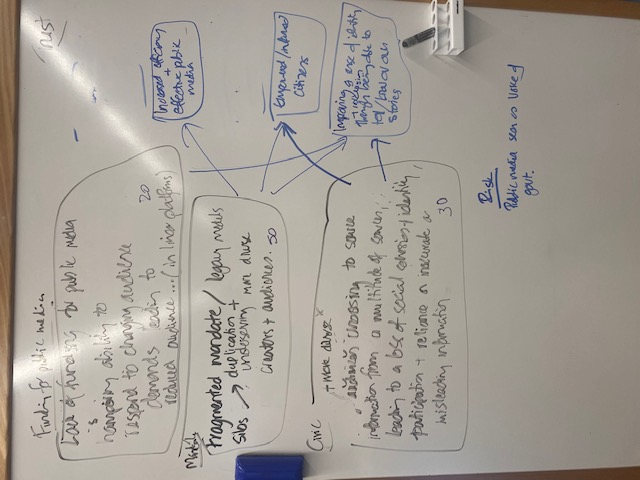
please see the map as redrafted following our workshop. I have taken a few liberties with the wordsmithing (photo of
original attached) to get the statements shorter and more direct.
One of the limitations of the template is that I have had to leave the main story to the middle, not the top (otherwise it
becomes a confusion of arrows). This wont matter in the business case proper, as they can assemble the information in
the order they choose (and this gets relegated to appendices)
Key changes I have made:
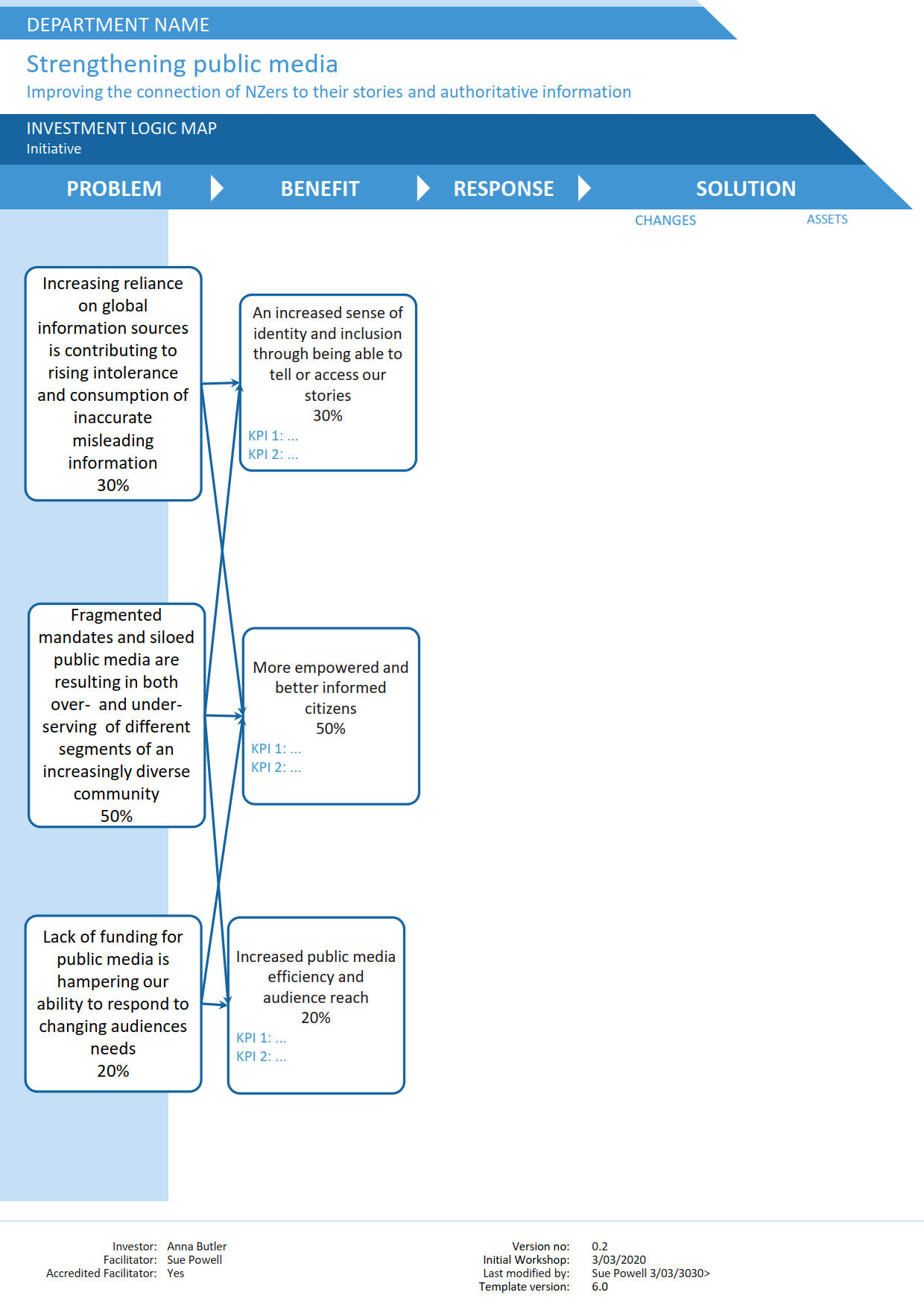
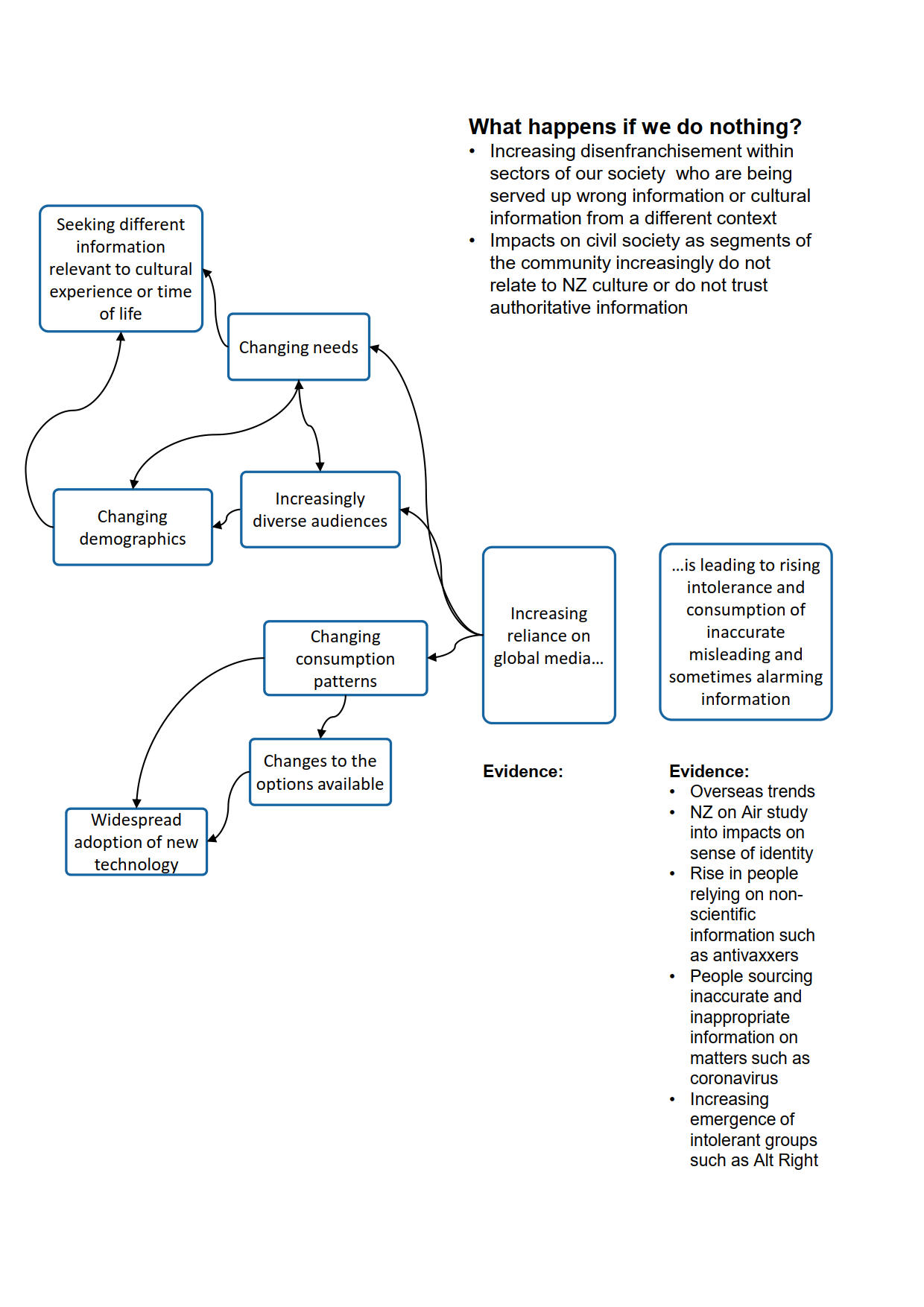
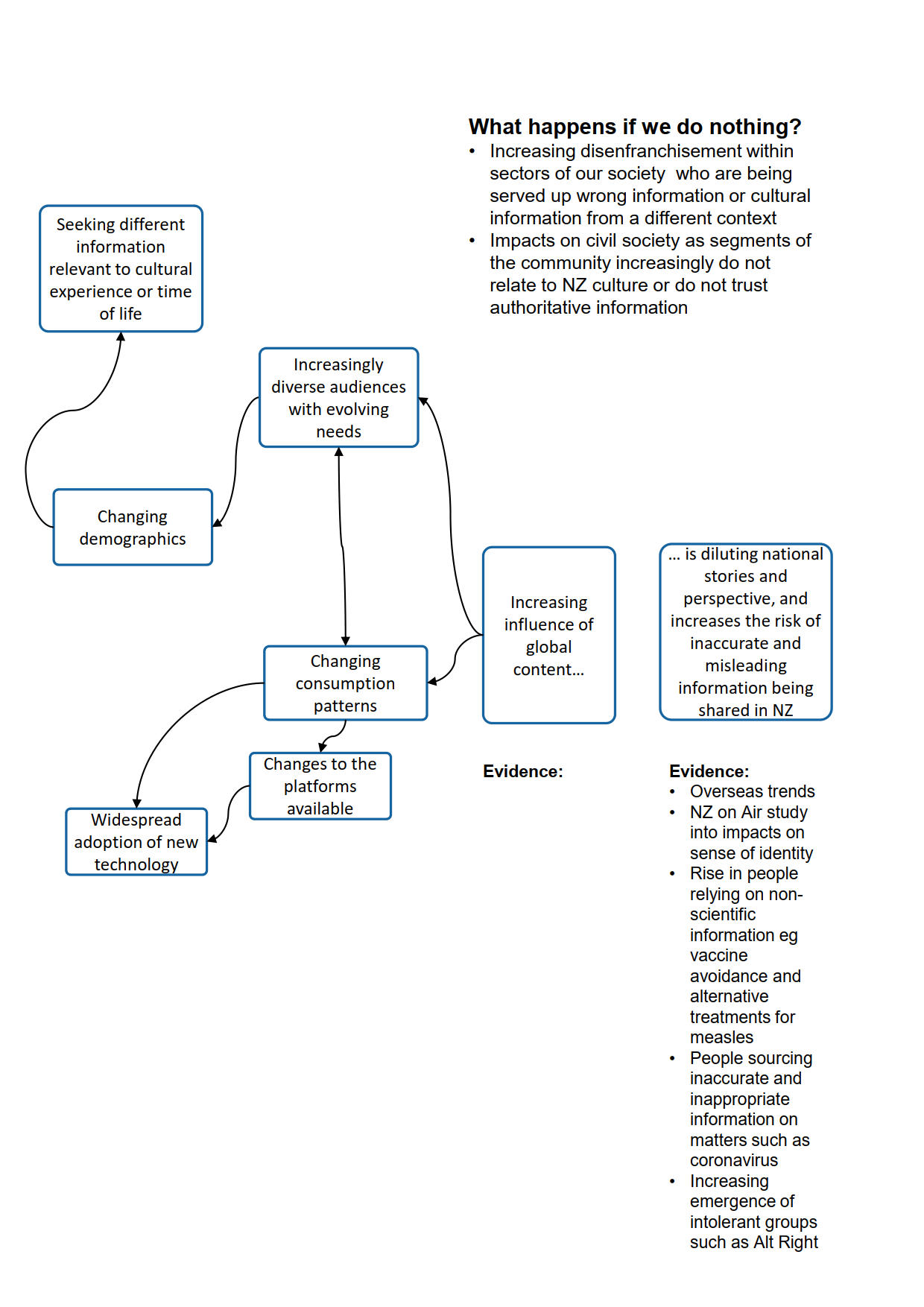
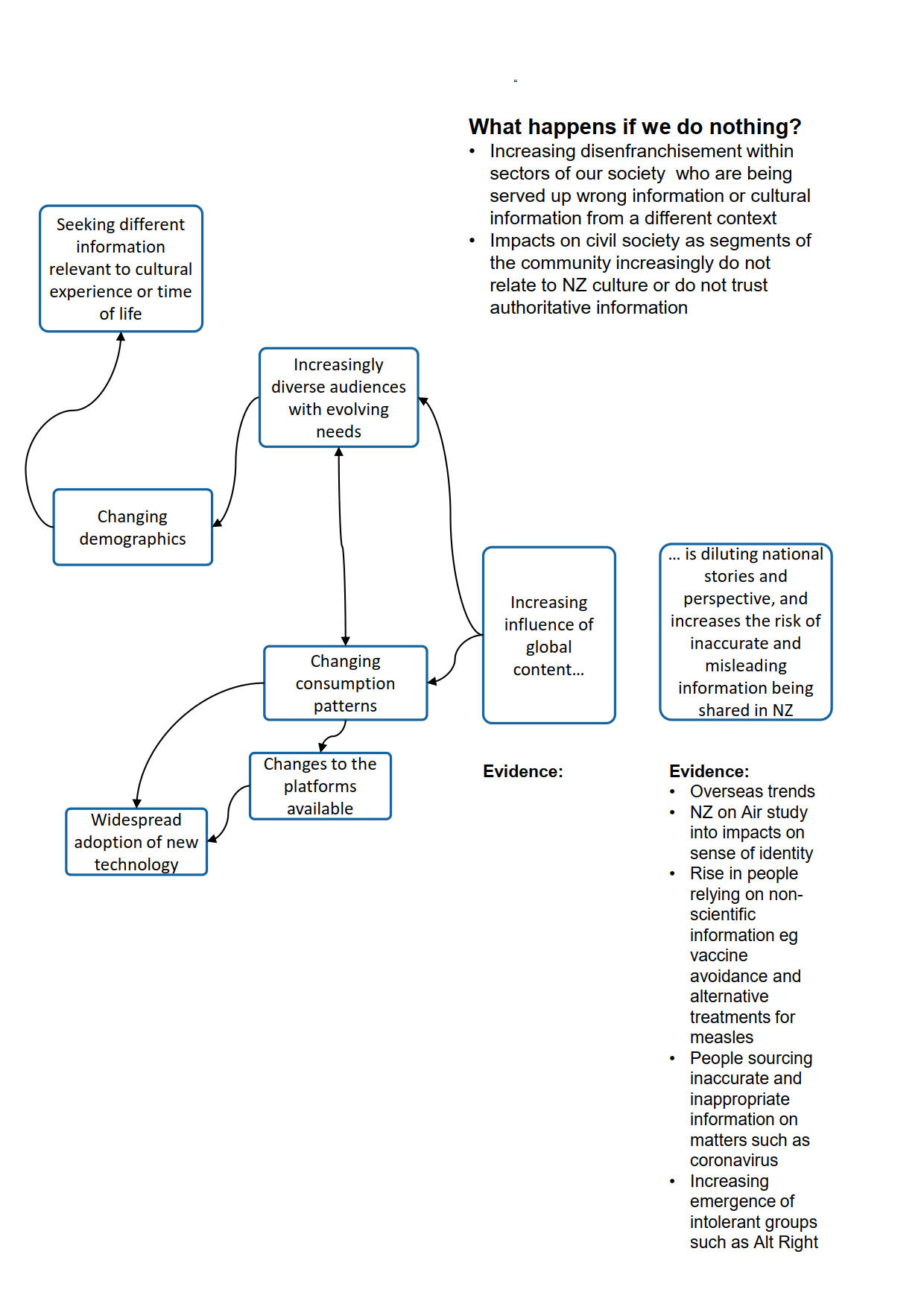
Problem 1 - I have dropped the "increasingly diverse audiences" back to the root cause (see page 2) as the presenting
problem is the ocean of choices - many of which are poor - available and being consumed. I have substituted rising
intolerance" for "social cohesion". The latter is more of a benefit, so I have attempted to create the negative image of it.
It may be too strong.
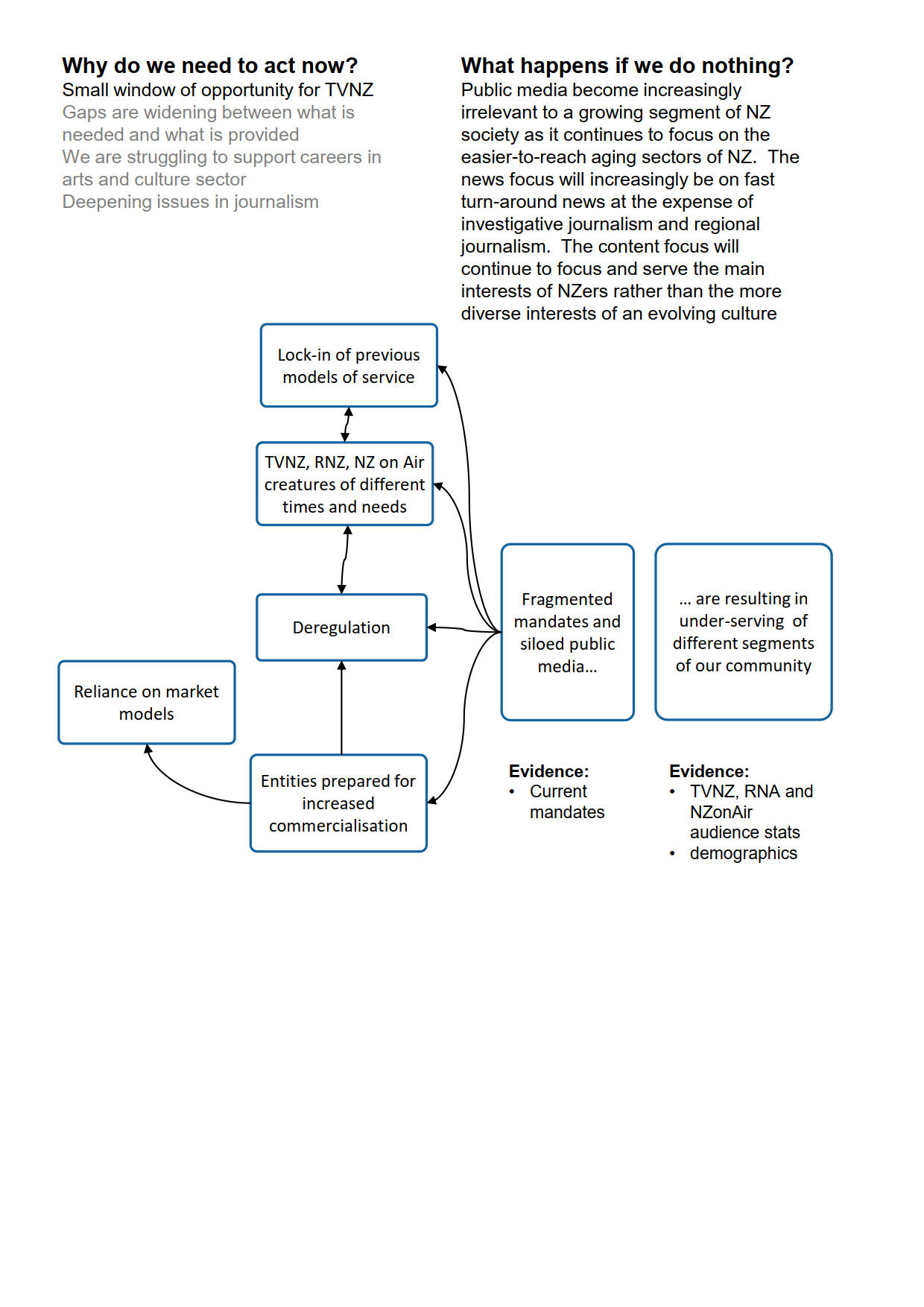
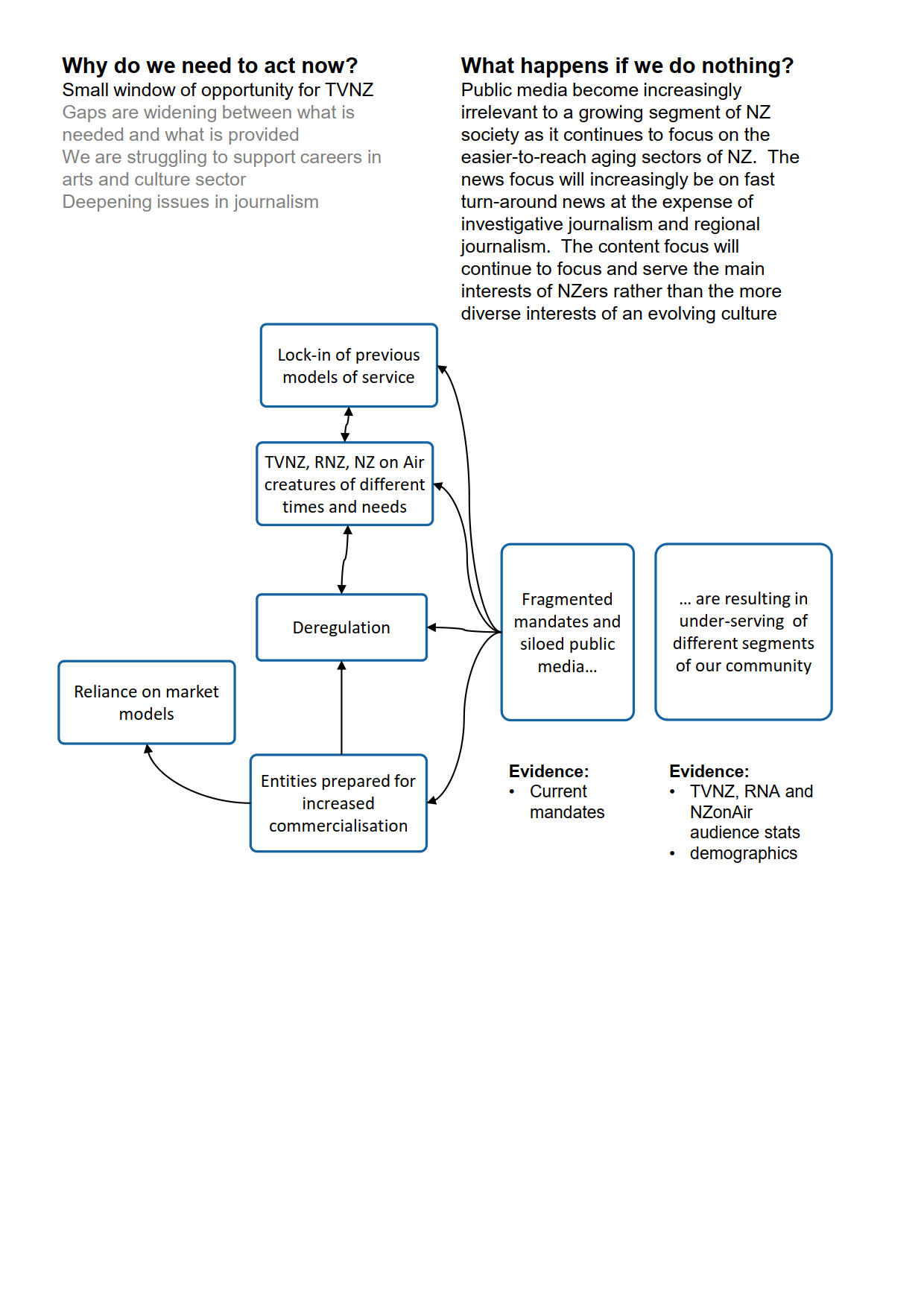
Problem 2 is largely as it was, but I have dropped out "content creators" from the underserved, and left it at
communities. This is undifferentiated between creators and consumers. It also didnt quite fit the context - but I think we
can pick it up as a possible KPI under benefit 1 (ie increased creation of diverse NZ content). I do have a question
however that might improve the story - is it "fragmented mandates", or is it "narrow manadates"? I think the latter
would be stronger if true...
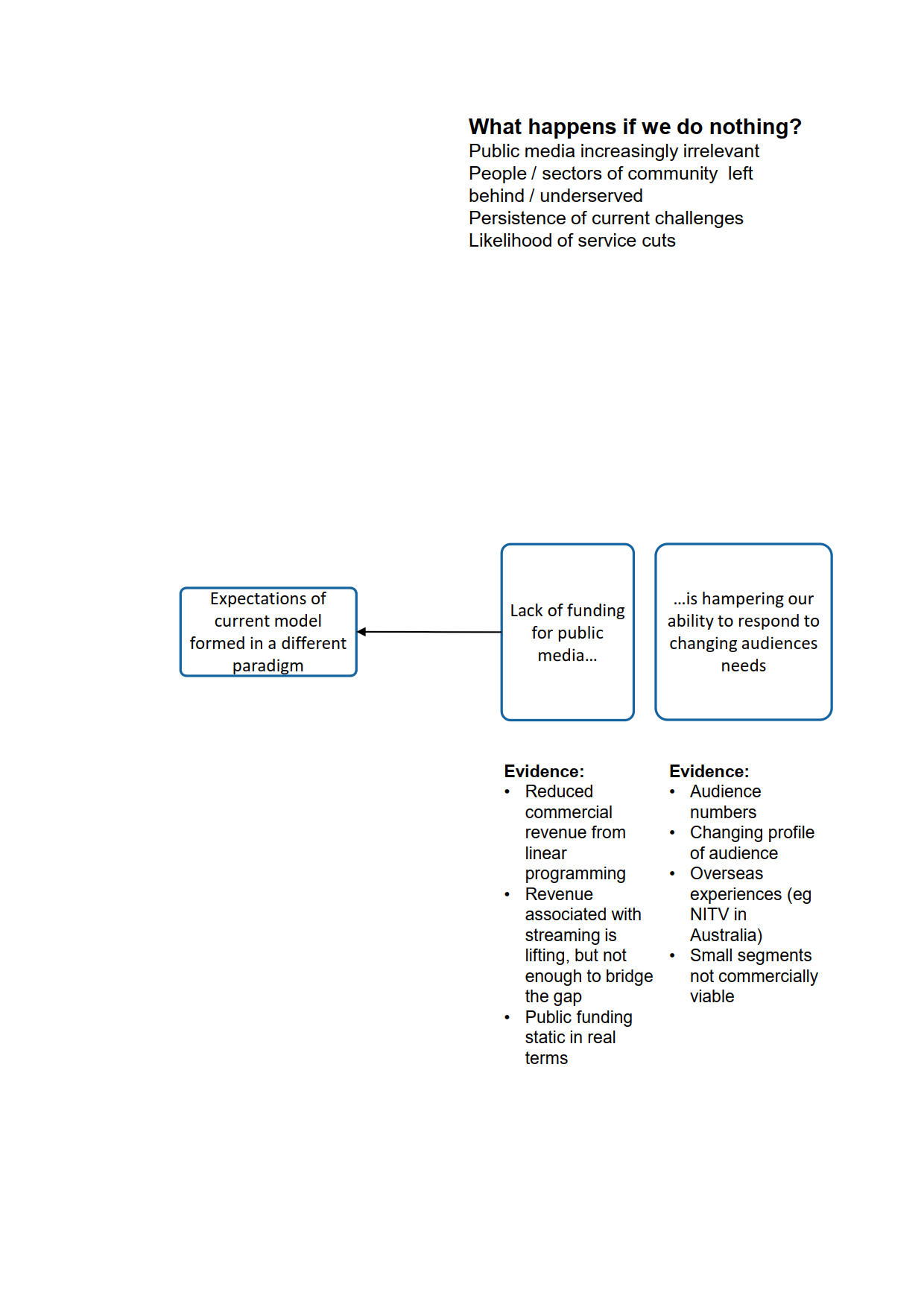
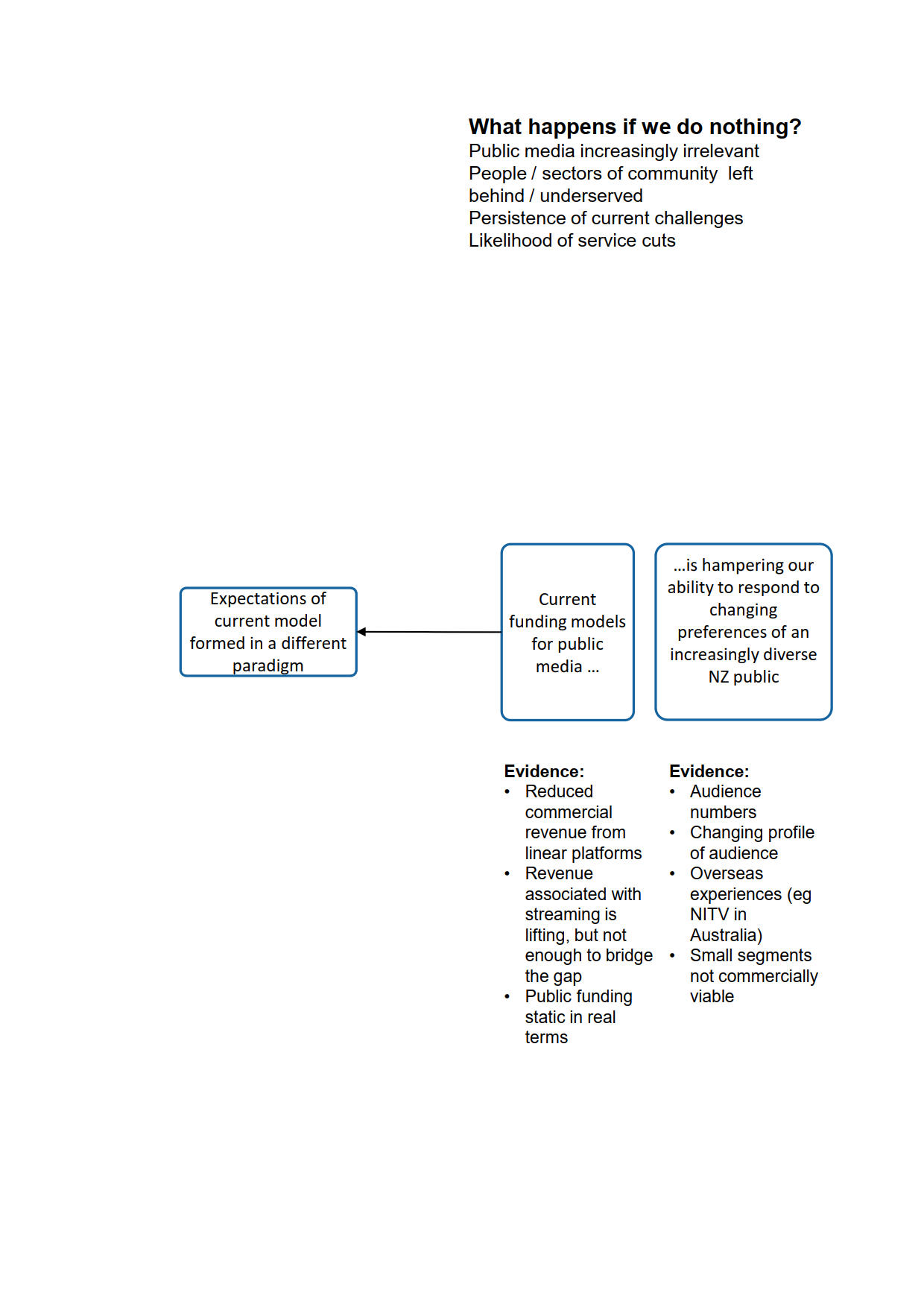
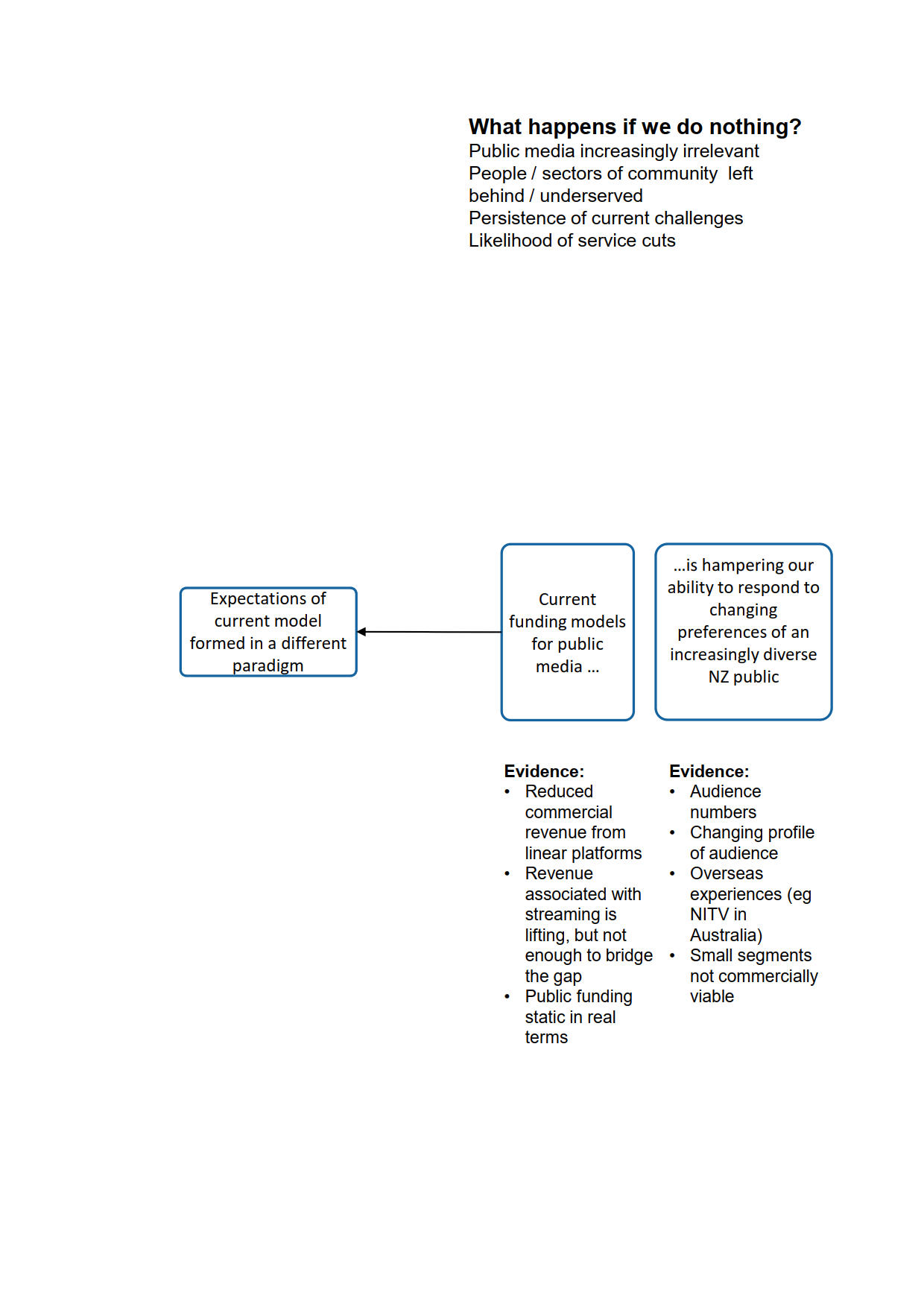
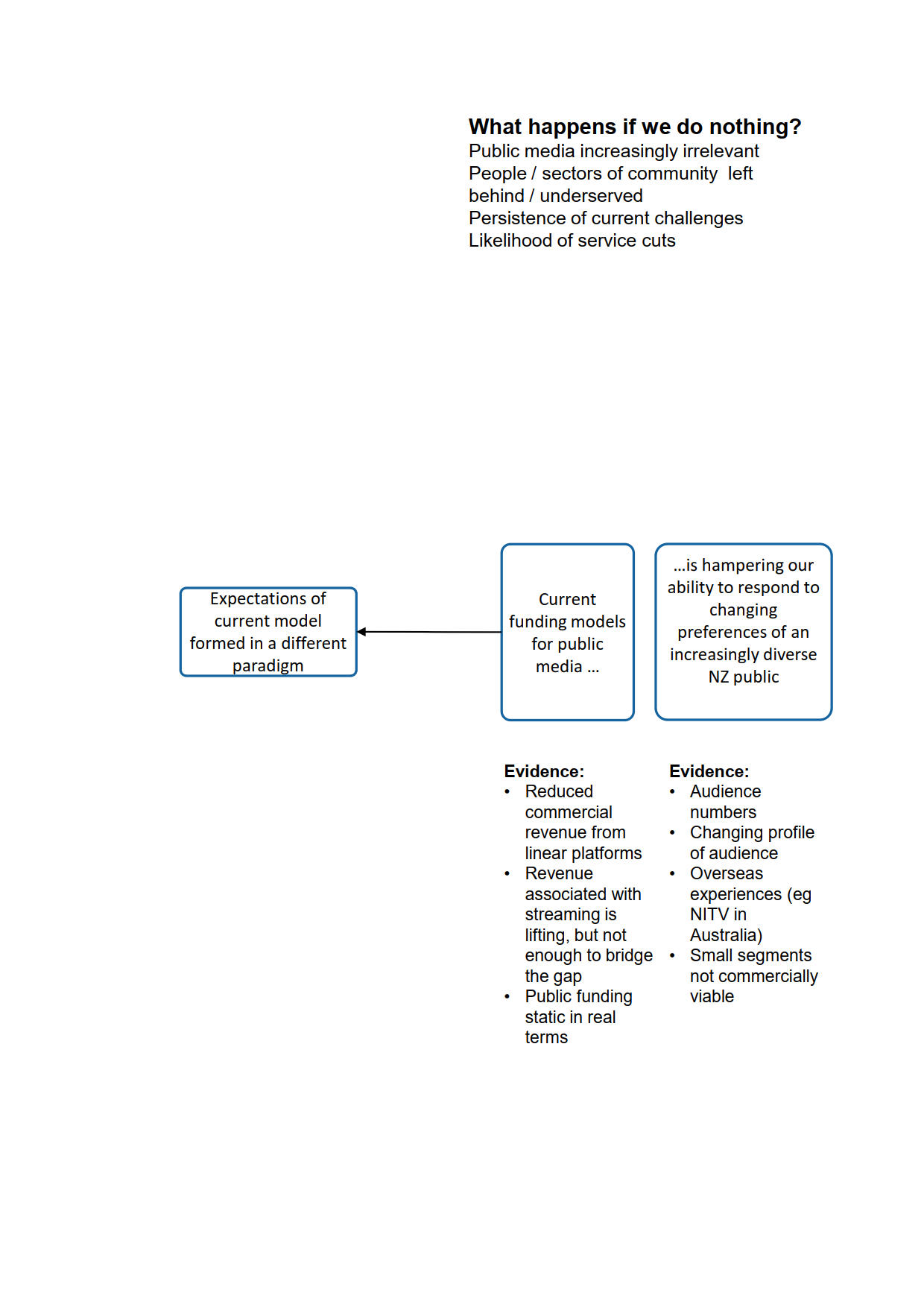
Problem 3 is pretty much as it was, except I have dropped the linear platforms back to the evidence (see page 4)
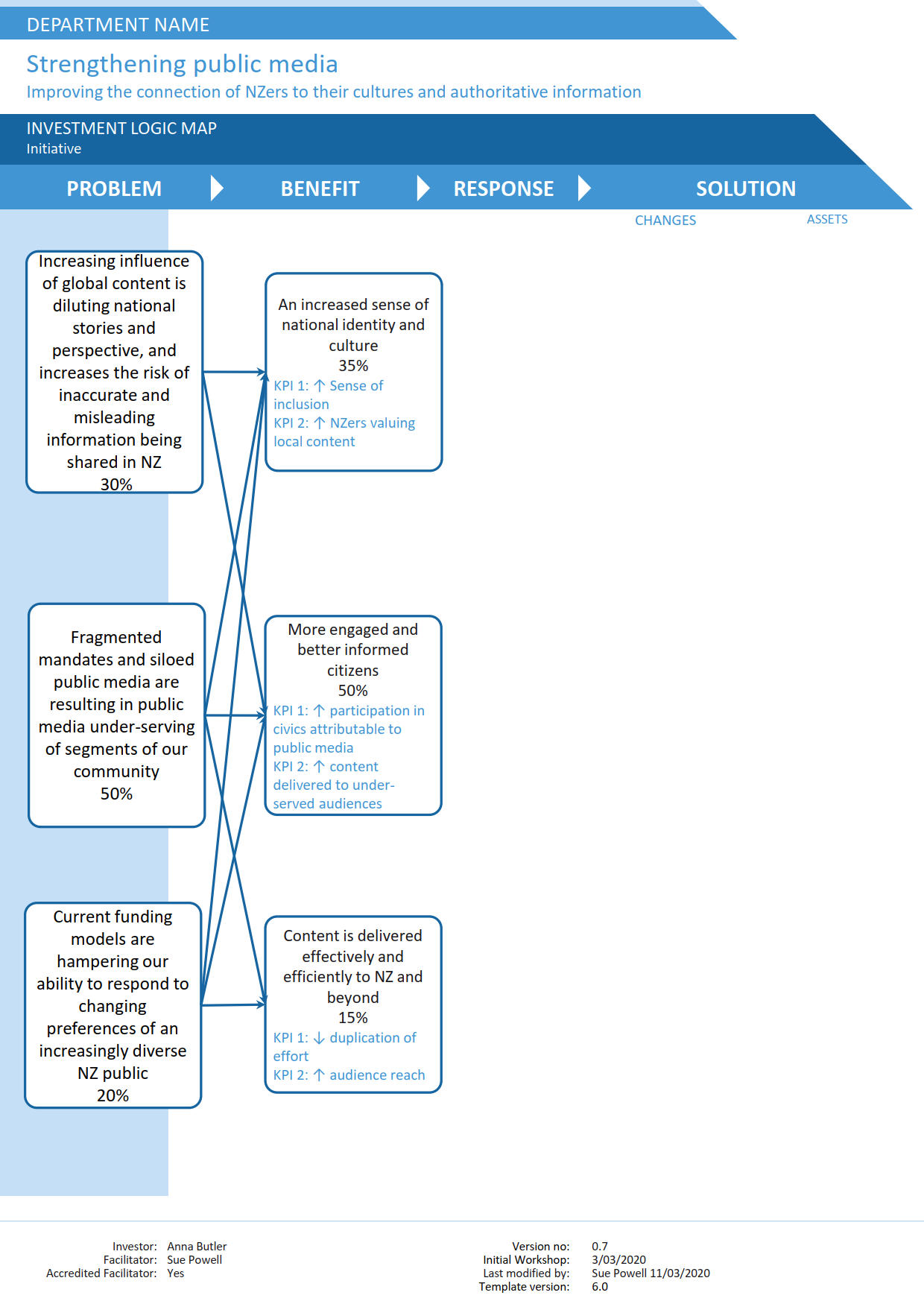
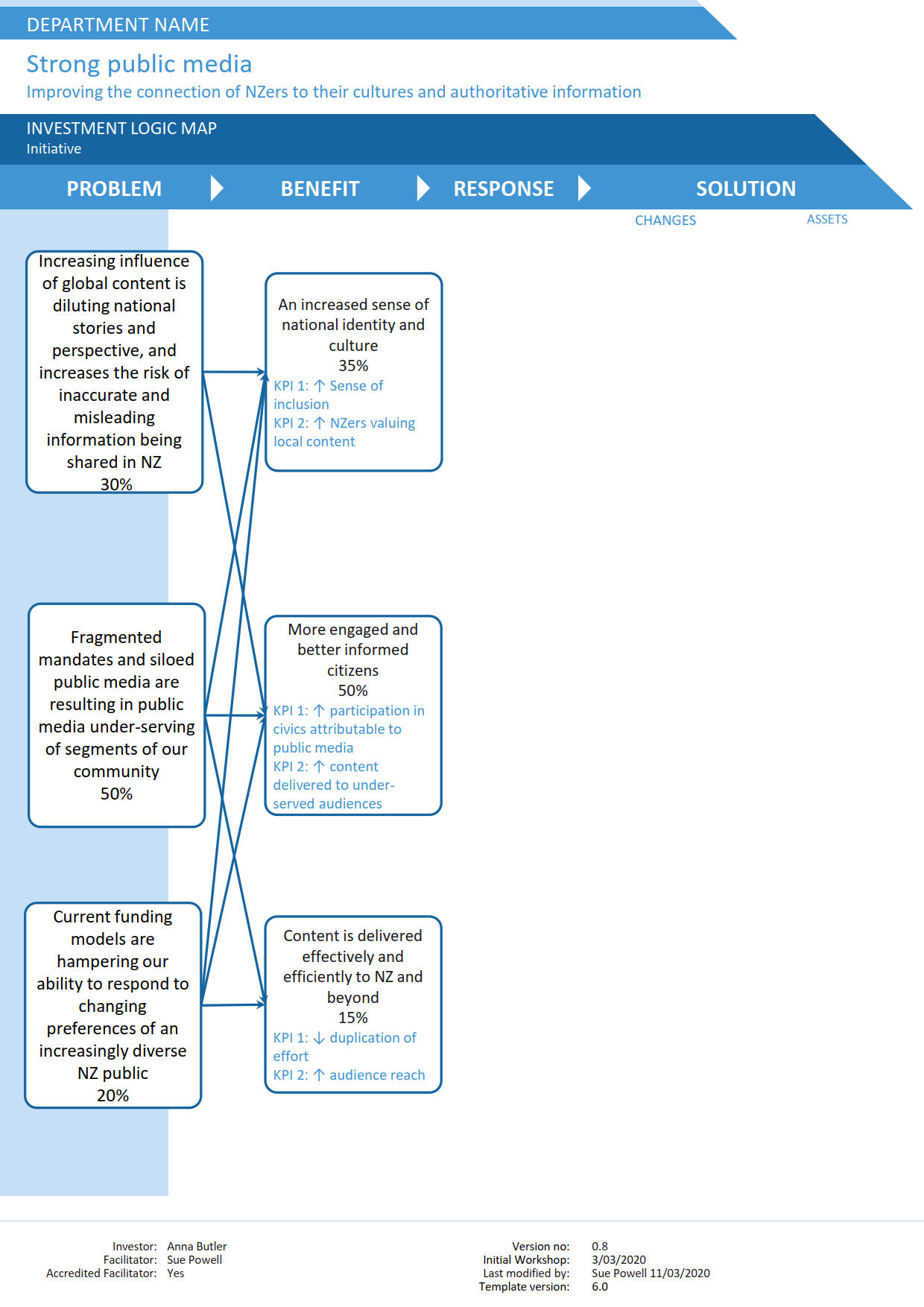
Benefits 1 and 2 are unchanged (bar minor wordsmithing), and benefit 3 I have swapped out "effectiveness" for
"audience reach" - as more attributable, and more specific.
I have allocated weightings - these can be played with.
We still need to do KPIs - and I am happy to work with you to sort. (Ideally we draw on existing sources as much as we
can, and avoid creating new measures unless we have to).
Overall - does the story resonate? Is it painting the right picture? Is there anything missing that needs to be called out
(ie have I over-edited)
Are the root causes right? Is there more evidence?
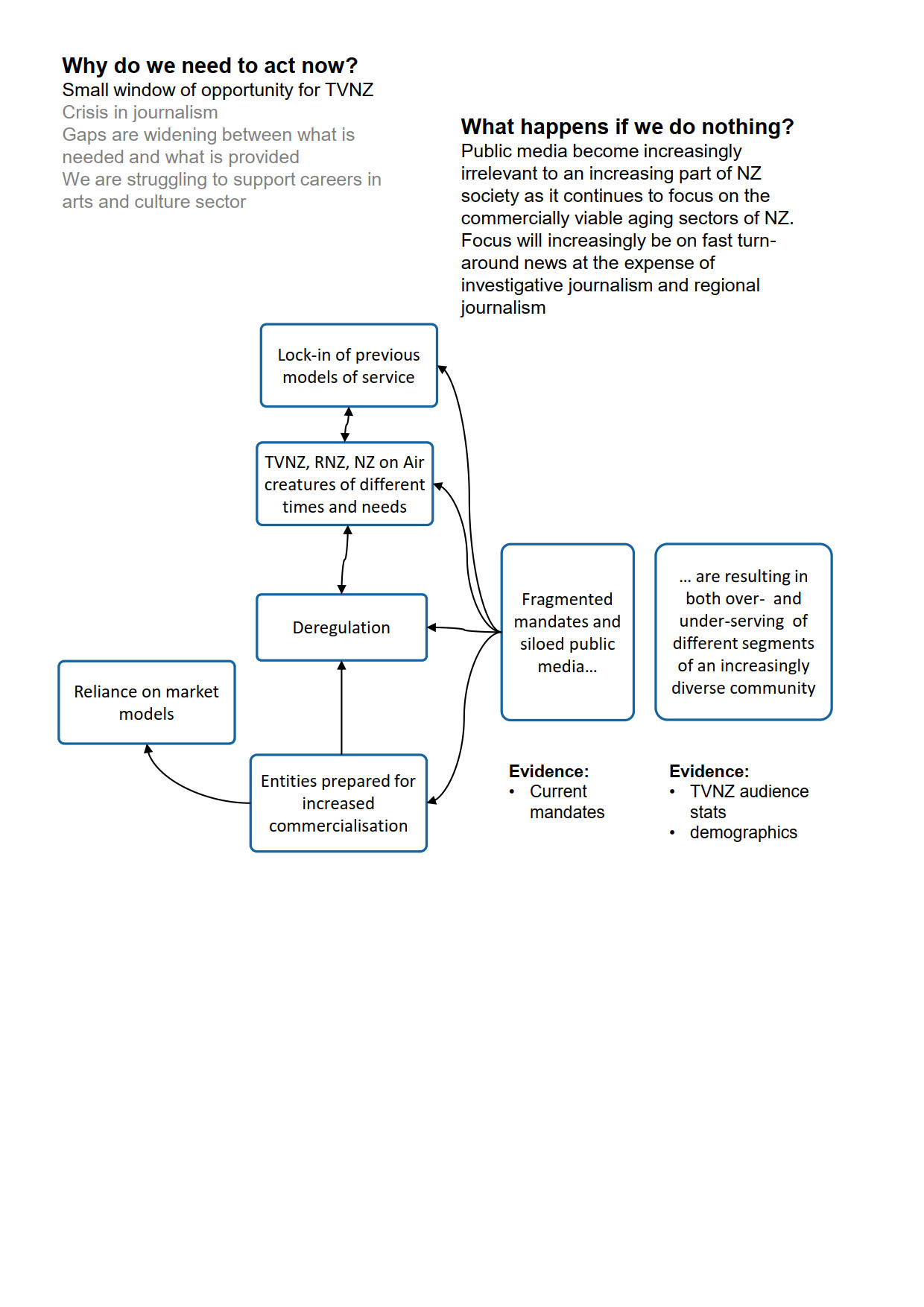
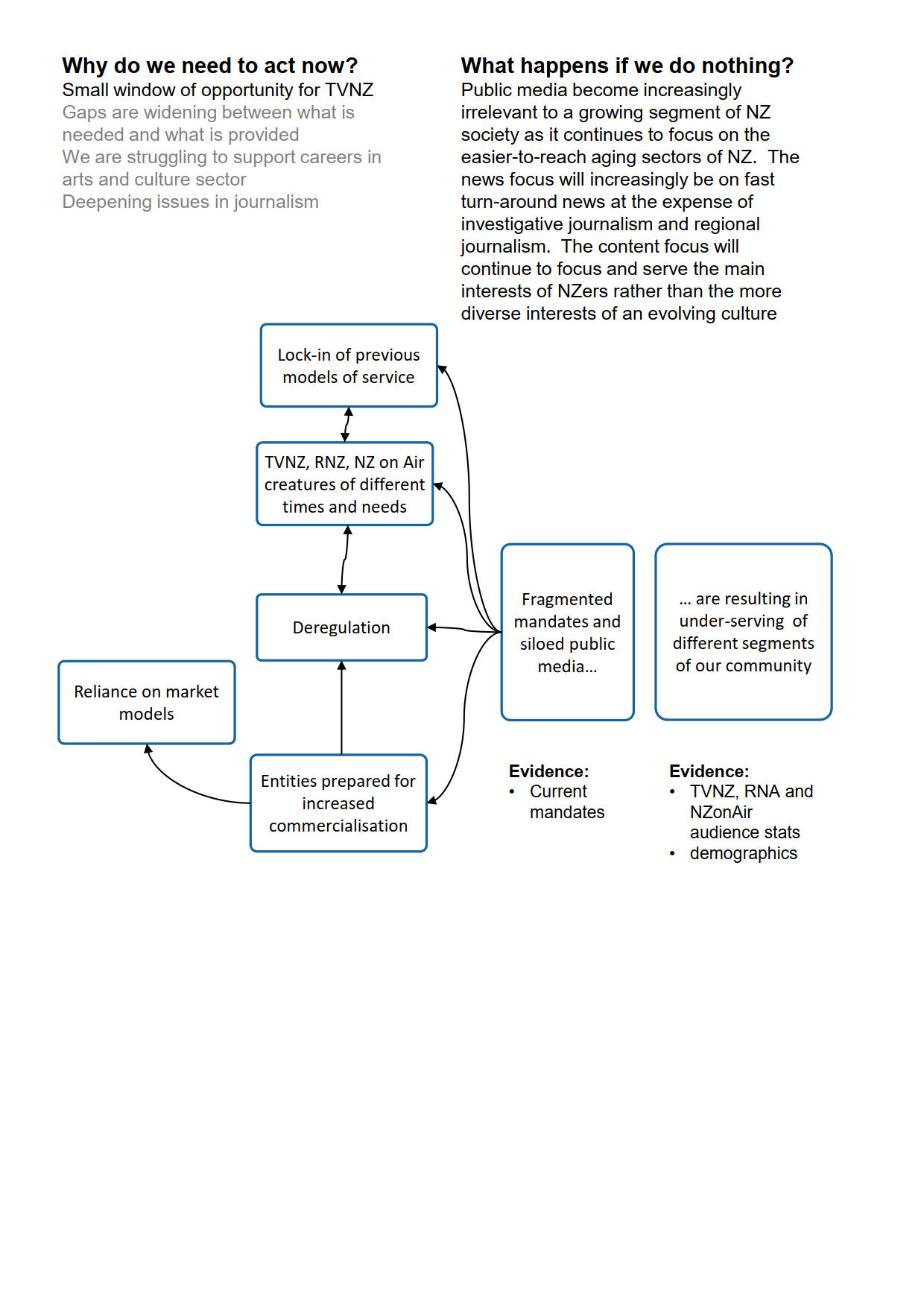
Do note that I have put the "why now" story on page 3 - and have greyed out the ones that seem a bit more tangential. I
understand that career journalism is really important to this audience. This, and the root cause analysis pages are not part
of the standard, and are there only for assistance and information, but I find it helpful to test the thinking. They are there
for the case writer.
Overall - let me know your thoughts, and if there are things you have reacted to that you wouldn't want to put in front of
the Programme Board!
I have also attached the original scribble, and the list of more-or-less verbatim challenges
Warm regards
Sue
Sue Powell
Partner
Tregaskis Brown Ltd
Released under the Official Information Act 1982
Level 8
| Berl House
| 108 The Terrace
PO Box 25242
| Wellington
| 6146
[email address]
9(2)(a)
www.tregaskisbrown.co.nz
Strategy to action
If you are not the intended recipient for this email, any use, disclosure or copying of this message and/or any attachment is strictly prohibited. If you receive
this email message in error, please advise us immediately and erase all copies of the message and attachments.
Released under the Official Information Act 1982
Released under the Official Information Act 1982
Released under the Official Information Act 1982
Released under the Official Information Act 1982
Released under the Official Information Act 1982
Released under the Official Information Act 1982
Released under the Official Information Act 1982
From:
Sue Powel
Anna Butler; [email address]; Al anah Kalafatelis; [email address];
To:
Aaron.Gil @treasury.govt.nz; [email address]; Carolyn Risk; [email address];
[email address];
Cc:
Leigh Huffine; Liz Stewart; [email address]; Anna Tregaskis;
Subject:
Updated ILM for review
A achments:
Strengthening public media v0.3.pdf
Sent:
4/03/2020 12:13:14 pm
Kia ora tatou
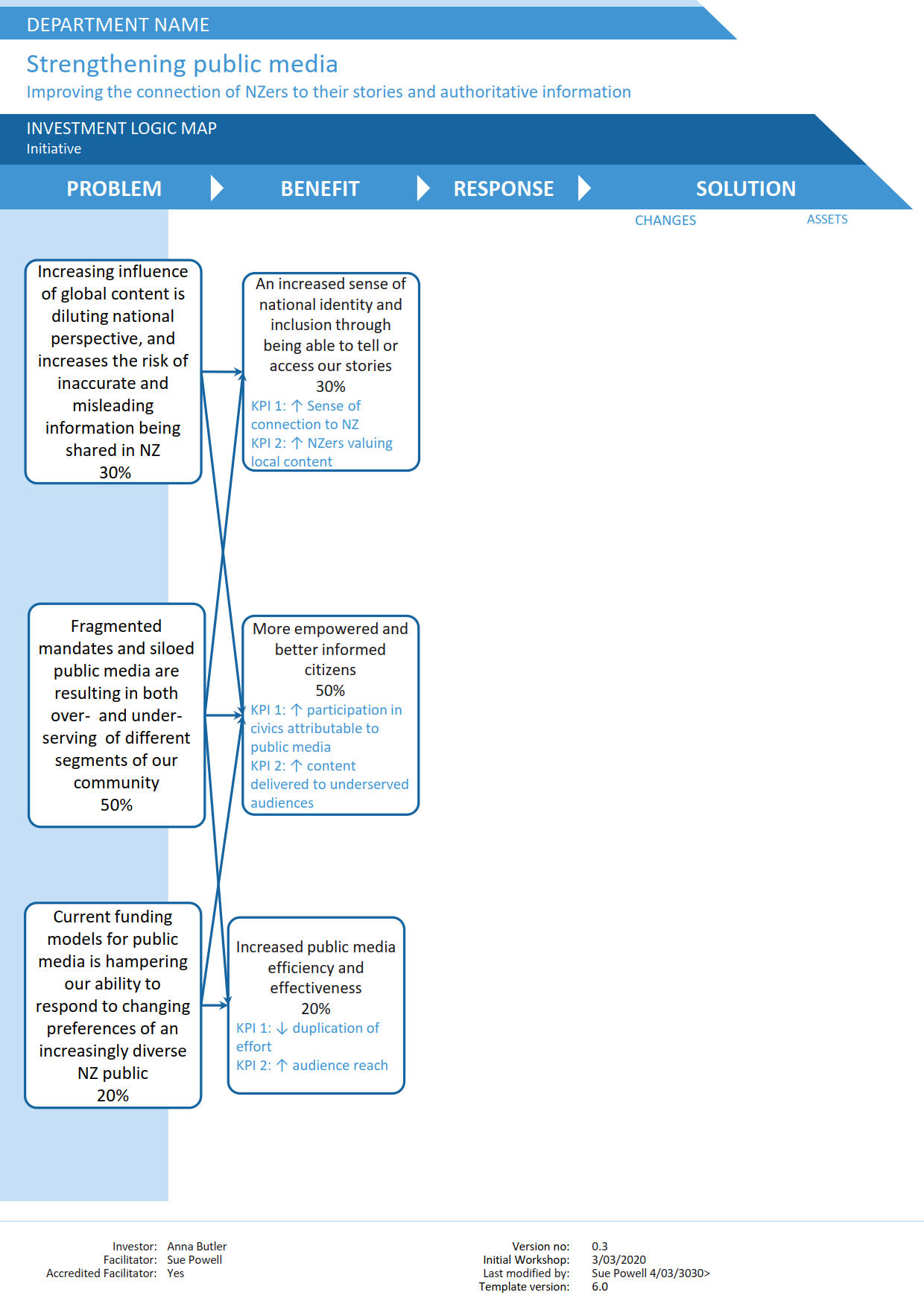
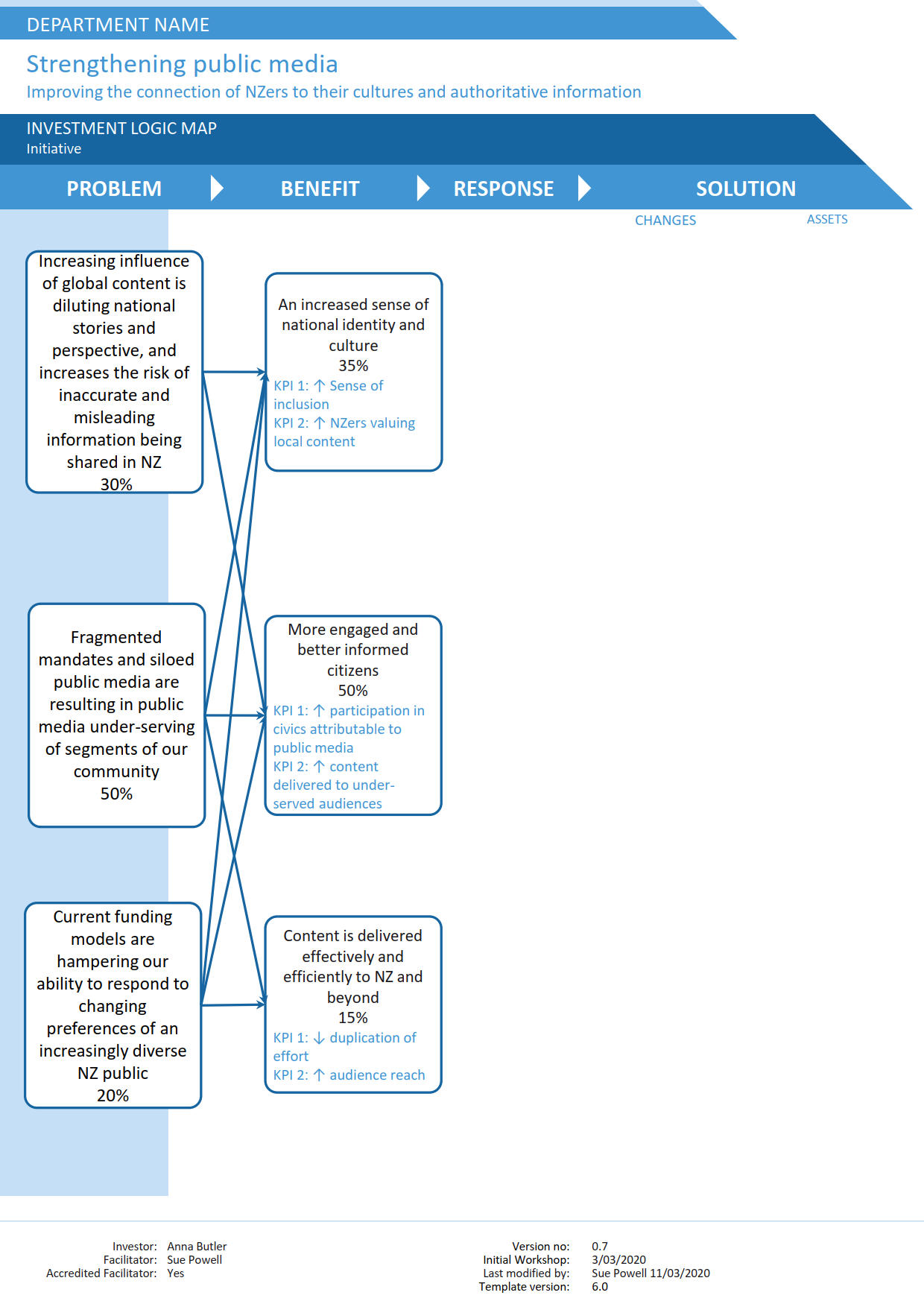
Please find attached a draft ILM for review. The map was prepared following our session yesterday, and was discussed
at Programme Board this morning with some further refinements being made.
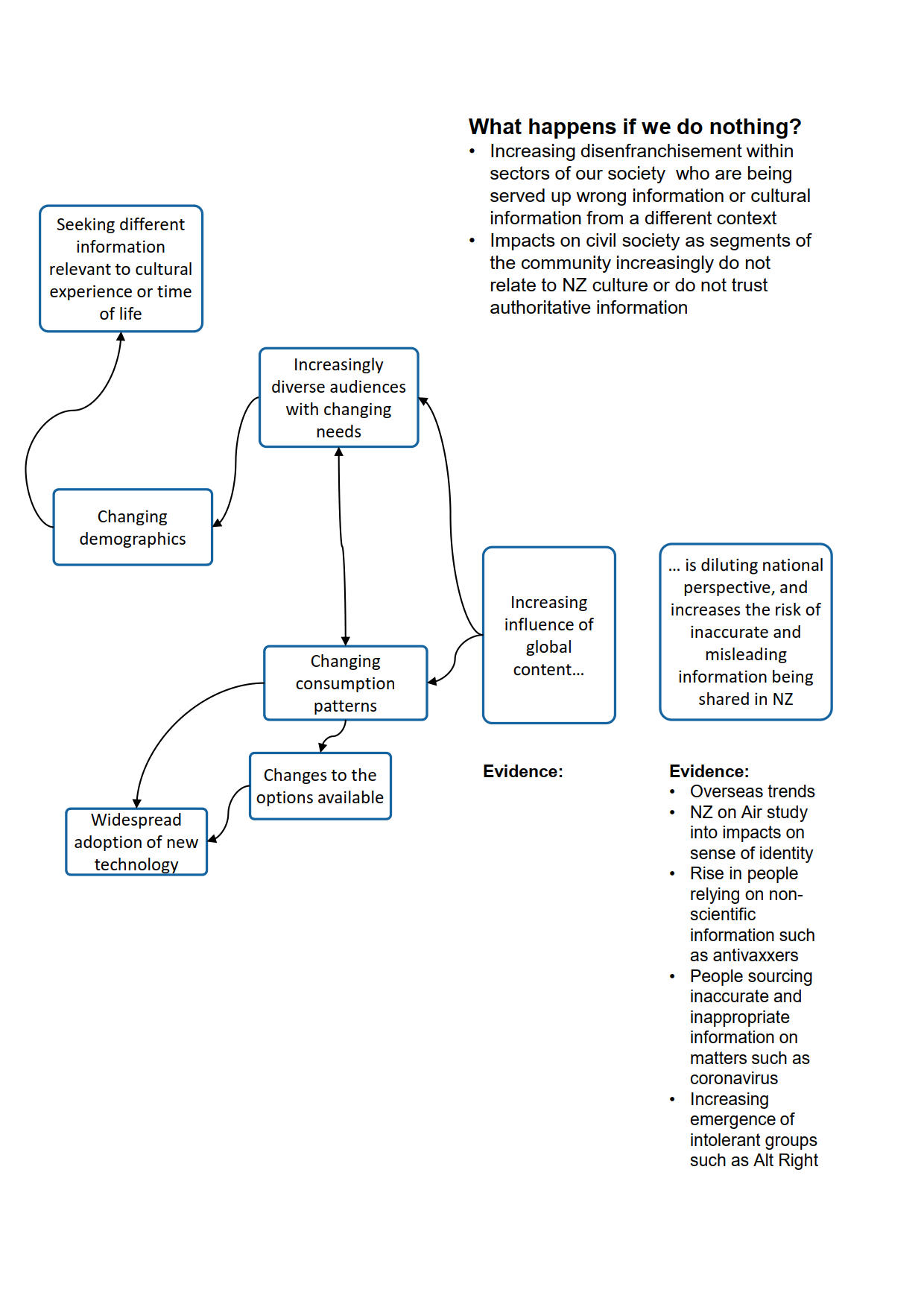
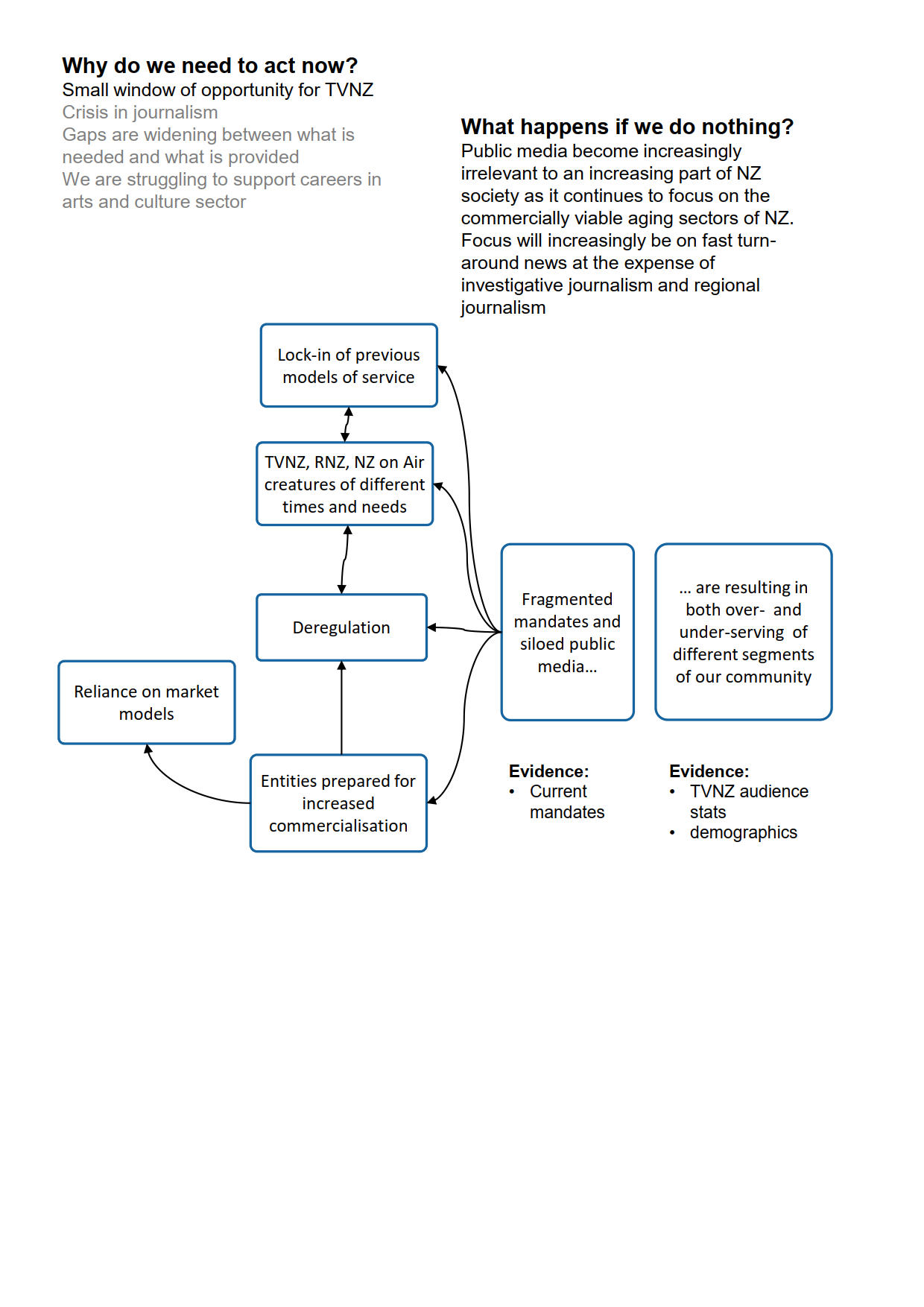
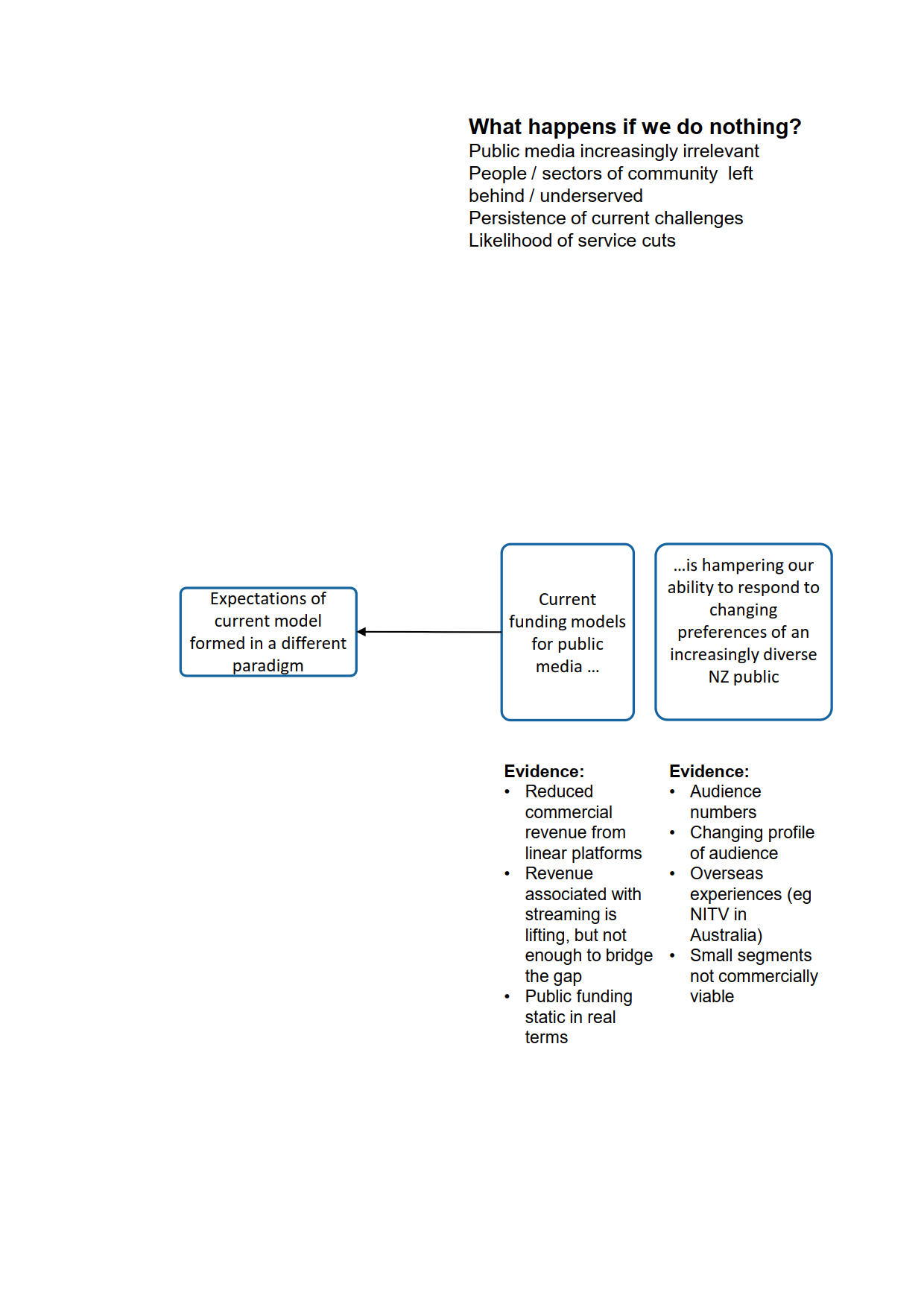
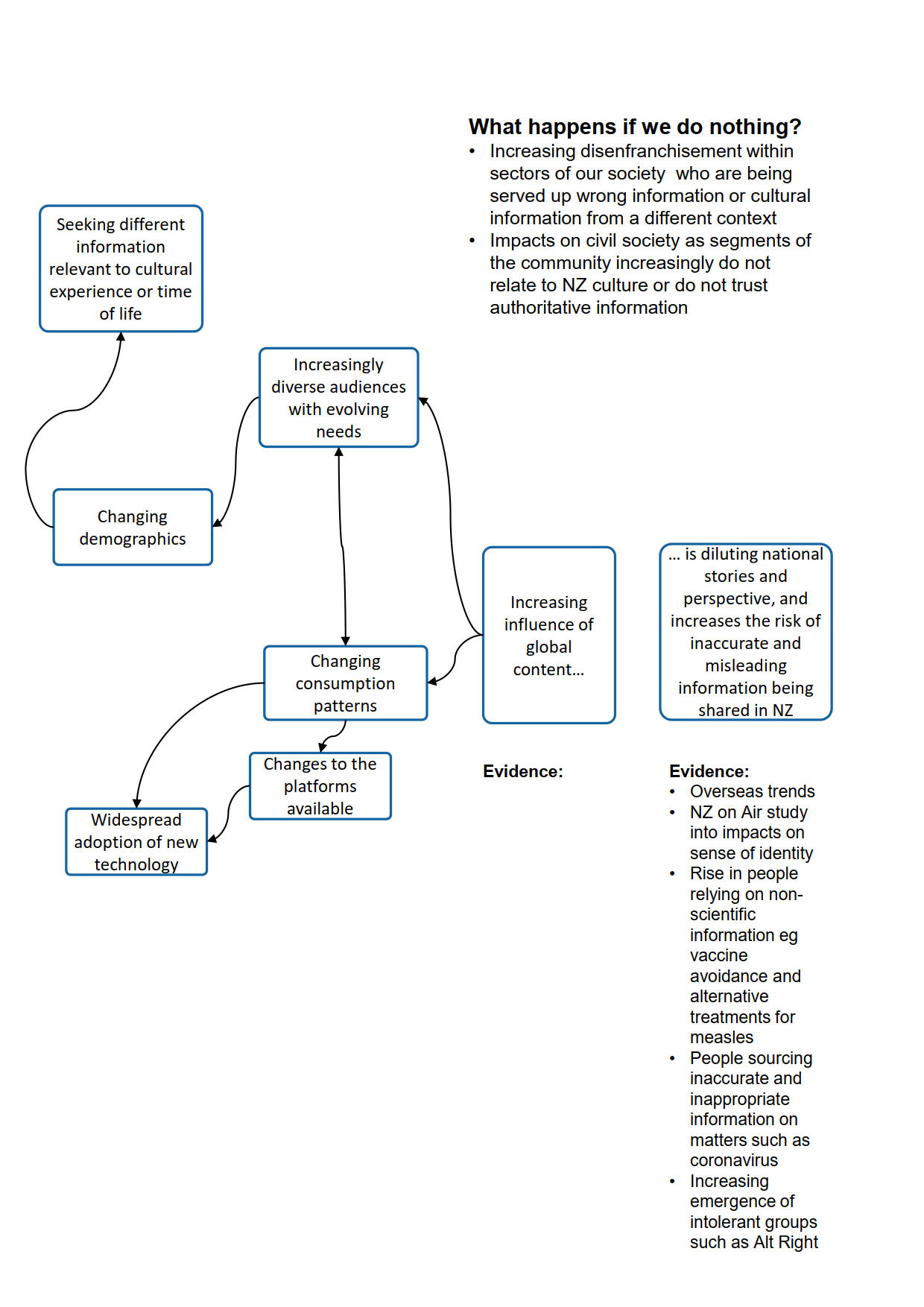
Please note the root causes, consequences of doing nothing, and why now on subsequent pages.
Key changes since the workshop:
Problem 1 - the role of the diverse audience has been pushed back into the root cause for both economy reasons, and of
course because it is not good to blame the audience!
We have reframed the "what's broken" part of the problem to "increasing influence of global content".
We have wordsmithed the consequence component, and I have taken further liberties (again in the interests of economy)
of keeping "national identity" in the benefit, and keeping "diluting national perspective" in the problem. I have
wordsmithed the second part to make it very specific.
Problem 2 is the main problem, and ideally would appear at the top. However limitations of the template means that it is
easier to read this way (fewer crossing arrows).
I have removed the reference to "increasingly diverse community" descriptor in the consequence, again for economy,
and because it is repeated in the next problem statement.
Problem 3 - we have moved away from "lack of funding" to "funding models" as the primary cause, which aligns it
better to the day 1 discussions. We have added in "increasingly diverse NZ public" into the consequences.
The benefits are largely as they were in the workshop, but we have now identified candidate KPIs. Wherever possible
we will try to draw these from existing sources, but some will require some baselining. In particular, KPI 1 in Benefit 3
is a bit challenging. It could be that we might be better to look at avoided costs rather than efficiency gains - which puts
it firmly in the cost of service space rather than the nature of service, meaning the map is relatively silent on the issue of
"overserving".
What do I need from you?
Please review the map and associated root causes, and provide feedback. The main questions I have are:
Does the story ring true? Does it resonate?
Is there anything missing, or inaccurate in the story?
Are we confident we have the evidence to back up our statements? (there are some gaps in the root cause pages)
Are the benefits attributable and within scope?
Are the KPIs realistic?
Sending the feedback
Please send feedback back to me by
close-of-business on friday 6th March. Please cc in all, so people get a sense of
the building story, and can comment on thoughts by others. The ILM process is iterative, and benefits from a mulling
over and a good night's sleep. I am happy to take scrawled notes on the PDF, or emailed text.
And again - thank you all for your willing participation
Warm regards
Sue Powell
Partner
Tregaskis Brown Ltd
Level 8
| Berl House
| 108 The Terrace
PO Box 25242
| Wellington
| 6146
[email address]
9(2)(a)
www.tregaskisbrown.co.nz
Released under the Official Information Act 1982
Strategy to action
If you are not the intended recipient for this email, any use, disclosure or copying of this message and/or any attachment is strictly prohibited. If you receive
this email message in error, please advise us immediately and erase all copies of the message and attachments.
Released under the Official Information Act 1982
Released under the Official Information Act 1982
Released under the Official Information Act 1982
Released under the Official Information Act 1982
Released under the Official Information Act 1982
Released under the Official Information Act 1982
Released under the Official Information Act 1982
Released under the Official Information Act 1982
Released under the Official Information Act 1982
ILM session – 3 March Sue, Ciara, Carolyn, Paul M, Stephen, Glenn, Alan, Anna
Observers: Aaron, Dan, Leigh, Liz, James, Mike, Janelle, Brendan, Rebecca, Simon
--
Hand out: focused on first two columns, problems and benefits
Potential solutions need to be measured against root cause and whether they wil deliver the
benefits identified
Ideally would also have the user in the room
We have decreasing revenue for a number of reasons, fragmented mandate and silos
affecting ability to respond, impact on audience if we don’t have a strong public media –
what is the consequence of declining engagement?
Para 10 of Cabinet paper
Reflects RNZ mandate and core function of public media
Economics of the market are putting pressure on journalism, in the future that pressure wil
increase, potential for the collapse of existing news services
Technology and global practice is driving vulnerability to unreliable news, one of the interests
of govt is ensuring people have a source of news they can trust. PSM provides authoritative
source of trusted, independent news. Increasing prevalence of info that is deliberately
intended to be misleading.
What are the consequences of the media being increasingly dominated by these
chal enges?
Market failure, decreasing number of journalists
Some statements more true of certain demographics than others, younger demographics
making choices around where they access content
Less participation in democracy, diminishment of opportunities for sharing ideas and
perspectives, risk of echo chambers – lack of social cohesion, people withdraw into
containers of information, not exposed to new ideas
At a time when NZers are becoming more and more diverse, need to understand and
appreciate other cultures, tolerance
Accountability in the democratic process – PSM mandate is holding democratic process to
debate, speaking truth to power, less participation at national and local level
Treating NZers as citizens not consumers – transactional value of an audience for
commercial media is to sell attention and participation of audience, transactional value for
PSM is about imparting and sharing information. Both a citizen and a consumer though –
Released under the Official Information Act 1982
media should serve both aspects – related to trust? New entity can and should do both.
Debate around trust – who you ask and how you ask the question. One News is one of the
most trusted brand in the country despite being commercial.
Colmar Brunton survey – TVNZ is only media company in the top 20
Not mutually exclusive to generate commercial revenue and build trust – other factors drive
trust
Part of problem is overseas influence that doesn’t care about NZ beyond business
opportunity – consequence is there is less information for NZers to foster a sense of national
identity and know about themselves
Public media has a benefit even if they don’t access it, just knowing it exists – a component
of being a functional, healthy nation – but is this currently broken or not?
Younger demo looking for news differently, short sharp information, leading to market failure
– seeking a different media experience in terms of platforms and content. Community of
interests that is forming their news doesn’t bring a local context
Lack of a local voice is the bad thing, being a global citizen is a positive thing – it’s getting
the right balance between them
Relevance – young demo not finding relevant content here so seeking it from overseas, not
getting the local context
TVNZ’s Re: social media platform, but it’s a niche offer – haven’t created news format that
are relevant in delivery and content. But where they commercially viable? Daily news
podcast on RNZ
Missing voice of the user/audience
Source of news for young demo is their social network, same in markets that are massively
funded for public media (e.g. BBC in UK losing young audiences rapidly), pockets of
audiences that are broad or narrow
Young people choosing to source info that doesn’t give them 1) authoritative source and 2)
sense of national identity/context
Can’t hold back Facebook and Google, but can offer them a viable alternative/addition
TG4 – people pleased it exists even if they don’t consume content on it
Young people much more discerning about media
Not about excluding global content, but balancing it with local content – consequence of
people having an asymmetrical source of information without local relevance, objective risk
of unreliable and inaccurate information becoming widely available
Does this logic flow hold for ethnic minorities, other socioeconomic groups, not just youth?
Strong correlation between ethnic dimension and youth dimension
Major changing demographic creates new chal enges for public media to deliver relevant
Released under the Official Information Act 1982
content
Public media has been under-funded since deregulation, lack of funding has constrained
ability to deliver well for underserved audiences
Commercial operators are less able to do work in this space, as commercial space becomes
more constrained it puts greater pressure on public media to deliver
No mandate for commercial to do anything in public media space
Locked into legacy business models
Lack of funding impairs ability to respond to changing audience demands
High risk to take new opportunities when you have a limited amount of funds
RNZ and TVNZ have declining audiences on their linear platforms, but both organisations
are seeing strong growth on digital platforms
Fragmented mandates – they overlap but aren’t fully complementary. Duplication, overlaps,
service gaps. Double-serving some audiences and then not serving others.
Impact on content creators? Gatekeepers have to serve commercial mandates, TVNZ and
Three and Prime have to deliver on same homogenous audiences, they don’t necessarily
want the diverse content that NZ On Air wants to get out
Gap in having the creators to make the relevant content as wel
NZoA can spend its money more assuredly in other areas, haven’t had extra money to target
new demographics
Wasn’t a Maori production community until Maori Television was launched – need the outlet,
same with the Pacific community and SunPix
Cost per hour for Maori, Pacific programming is materially less than cost per hour across
mainstream media channels – pennies for pounds…. also apples for pears?
Mandate is the biggest thing that’s influencing this – TVNZ doesn’t commission these shows
because it comes with an opportunity cost
Underserving creators and the audiences
Public media funding has potential to remove appetite for risk as an impediment
Sub-optimal ownership model where same owner is investing in different areas in ways that
compound the problem, current mandates compromise collective ability to respond
Ten years of static funding have landed us in part where we are now – NZOA would have
been taking greater investment if available to them
ACCESSIBILITY New entity should deliver greater quantity of content
Released under the Official Information Act 1982
Can we put evidence behind these three problem statements (funding, mandate and civic
consequences for audiences)?
Funding problem is easy to back up – NZ funding compared to OECD, consequence of 10
years of static funding, revenue trends for commercial assets, growing number of
applications NZ On Air declines due to funding constraints, loss of purchasing power
Even if you’re holding your own in a financial sense, you’re compromised to respond to
change and pursue the new opportunities while maintaining core services
Entities have done the best they can within constraints
Fragmented mandate – created at different times and for different purposes, complete
deregulation, different mandates
TVNZ wil run out of cash in three years, fixed funding for RNZ means it wil have to cut
services in real terms to sustain – compounding situation
TVNZ’s news service continuing to be profitable, large percentage of revenue comes from
primetime
Response of other commercial providers has been to cut news at the margins
Cohesion – Identity, Culture research from NZOA, annual value indices from RNZ
Have we got any information on impacts of disinformation? No end of examples
(coronavirus, anti-vaxxers, Cambridge Analytica, etc)
Changing demographics and changing consumption patterns, moved from a pond to an
ocean – Where Are the Audiences research in May
Link between where audiences access content and the societal/behavioural outcomes is a
bit difficult
Needs to be some testing re audiences
Why do we need to act now? TVNZ wil run out of money, RNZ doesn’t have capacity to
reflect changes in society, crisis in journalism (NZoA roundtable), private media are
individually and collectively struggling, gaps widening, effects of long-term static funding,
creative artist careers are struggling, Three pul ing local shows
Conversation has been quite information and news focused, national identity content
important as well
Which issue is driving us the most at the moment? Solve the mandate, and then you’l make
the case for funding. Al equal y important. Could chuck money at it but it wouldn’t
necessarily solve the problem
Less about weighting, more about sequencing – must solve mandate question first
What are the benefits?
More trust and confidence in public media
If this strengthens our organisations to the detriment of private media, then we’l have too
Released under the Official Information Act 1982
dominant of a government role
But can’t do nothing because commercial media are in trouble – don’t add to the problems of
commercial media
- Improved debate and discussion
- More informed and empowered citizens
- Strengthened sense of identity and inclusion from being able to tell our own stories
- Increased sense of inclusion
Scale? Balance of local/foreign content? Discoverability? Solutions / inputs
- Increased viability (efficiency and effectiveness) of public media in NZ
Solving fragmented mandate gives us all three outcomes
Solving funding gives us stronger sense of identity
Solving audience delivery gives us empowered/informed citizens and stronger sense of
identity
Normally would tidy it up and weight – give it to people for overnight
Take it to Programme Board tomorrow? Sue wil send it through
Released under the Official Information Act 1982
Released under the Official Information Act 1982
Released under the Official Information Act 1982
Released under the Official Information Act 1982
Released under the Official Information Act 1982
Released under the Official Information Act 1982
Released under the Official Information Act 1982
Released under the Official Information Act 1982
Released under the Official Information Act 1982
Strong Public Media
DRAFT INVESTMENT OBJECTIVES AND CRITICAL SUCCESS FACTORS
Introduction
Role of Investment Objectives
Investment Objectives form a critical part of the frame that is used both to set the direction of any
initiative, and measure the success of any initiative undertaken. They define what the investor
might expect to see in terms of outcomes, and should be clearly specified about the what and the
when. In the business case it is expected that each investment objective is linked back to the
problem statements, and evidence is provided regarding the current state, and the target state (the
investment objective)
Role of Critical Success Factors
Critical Success factors are measures that weigh up the characteristics of any options being
considered. They are normally based around the following thematics:
• Strategic fit and business needs
• Potential value for money
• Supplier capacity and capability
• Potential Affordability
• Potential Achievability
Additional factors can be added that are critical to any investment’s success.
How they get used in a business case:
These are used in options analysis. It is worth noting that options analysis is expected to cover the
5 dimensions of choice, being:
• Scale, scope, and location (in this case scale and scope)
• Solution options
• Service delivery options (eg by whom)
• Implementation options (especially time)
• Funding options
Note that all dimensions of choice are expected to be assessed.
The rationale for this is to ensure that all possible options are canvassed, avoiding or minimising
the risks of solution bias.
Released under the Official Information Act 1982
20210218 STRONG PUBLIC MEDIA WORKSHOP OUTPUT20210218 Strong Public Media Workshop Output20210218 Strong Public Media
Workshop Output
PAGE 1 OF 5
PROPOSED INVESTMENT OBJECTIVES
Draft Investment Objectives further developed from the workshop of February 4 2021 are as
follows:
Investment Objective 1
Content serves purpose, supply-side
Public media informs, educates and entertains NZ and beyond [with NZ content, NZ-derived
content, or republished content – this may be more a matter for charter]
Problems it responds to:
• Not meeting the changing preferences of an increasingly diverse NZ public
• Dilution of the national stories and perspective
• Under-serving of segments of our community
Investment Objective 2
Audience reach, demand-side
NZers increasingly (what percentage / metric and by when) value enjoy and use public media
(e.g., x % of NZers)
Problems it responds to:
• Dilution of the national stories and perspective
• Under-serving of segments of our community
Investment Objective 3
Efficiency, future service-focused
All NZ is serviced efficiently through reduced duplication of audience, infrastructure,
platforms and content
Problems it responds to:
• Fragmented mandates in current state public media
• Need for increased investment
• Flip-side of underserving, in that we are overserving some elements of the community
This IO also reflects the benefits identified, and what government is seeking with this
investment in terms of best use of scarce public funds in the face of declining advertising
revenue
Released under the Official Information Act 1982
20210218 STRONG PUBLIC MEDIA WORKSHOP OUTPUT20210218 Strong Public Media Workshop Output20210218 Strong Public Media
Workshop Output
PAGE 2
POTENTIAL CRITICAL SUCCESS FACTORS:
The following draft critical success factors have been derived from the workshop material. These
are additional to the standard factors anticipated in any business case:
•
Editorial independence is maintained
This is established in the cabinet paper.
•
A healthy media ecosystem is sustained / maintained
This means that any option under consideration must not undermine the overall ecosystem, if NZ is
to maintain a healthy 4th Estate.
Adaptation of the standard critical success factors
This adaptation is expected, and provides a more granular assessment for Strong Public Media:
• Strategic fit – delivers against Ministers expectations as outlined in the Cabinet paper
• Potential value for money – represents an acceptable ROI for the Crown
• Potential affordability – can be achieved within a determined funding envelope
• Potential achievability – Outcomes can be achieved in the necessary timeframes / how well
any option is likely to be able to be delivered given the changes required
• Supplier capacity and capability This has been excluded as procurement of an overall
solution is not part of this exercise, subsequent decision making on platforms is a matter to
be canvassed by a potential new entity, and platforms exist.
Released under the Official Information Act 1982
20210218 STRONG PUBLIC MEDIA WORKSHOP OUTPUT20210218 Strong Public Media Workshop Output20210218 Strong Public Media
Workshop Output
PAGE 3
How it all fits together:
Problems
Benefits
Investment Objectives
Critical Success factors
Define the problems (cause and
Defines what the value is to NZ of
What govt wants to achieve from
These are the pass / fail factors that
effect), supported by evidence. The
resolving the problems. The benefits are the investment.
any option should be scored against
role of problem definition is to ensure the things we use to identify the success
(as well as achieving the Investment
that we are fixing the right problems
of any initiatives that result from the
Objectives)
(ie part of the scope setting).
business case, and the KPIs are the
details of how we will measure them.
So, in the case of Strong Public media this is reflected as follows:
Problems (at a thematic level)
The benefits of resolving these
What govt wants to achieve
Pass/fail criteria
problems through strong public media through Strong Public Media:
• Ocean of content, meaning NZ
• Editorial independence is
voice and authoritative
are:
(investment objectives)
maintained
information is swamped if not
• More engaged and better informed
• Public media informs, educates
• A healthy media ecosystem is
crowded out, undermining trust
citizens
and entertains NZ and beyond
sustained / maintained
and social cohesion
• Increased sense of national identity
• NZers increasingly value enjoy
• Delivers against Ministers
• Public media are not reaching
and culture
and use public media
expectations as outlined in the
many segments of our
• Improved efficiency and
• All NZ is serviced efficiently
Cabinet paper
increasingly diverse community,
effectiveness of public media,
through reduced duplication of • Represents an acceptable ROI for
creating gaps in access to and
delivering to NZ and beyond
audience, infrastructure,
the Crown
consumption of local content and
platforms and content
• Can be achieved within a
critical information
determined funding envelope
• Current funding models and a
• Outcomes can be achieved in the
severe drop-off in advertising
necessary timeframes / how well
funding, alongside increased need
any option is likely to be able to
for investment in future services is
be delivered given the changes
threatening viability of critical
required
elements of our public media
Released under the Official Information Act 1982
20210218 STRONG PUBLIC MEDIA WORKSHOP OUTPUT20210218 Strong Public Media Workshop Output20210218 Strong Public Media Workshop Output
PAGE 1 OF 5
RAW CONTENT FROM WORKSHOP:
Scope: Commercials are important, but are not part of the purpose (ie put aside for the purposes
of this workshop)
Investment Objectives:
• NZers increasingly (what percentage / metric and by when) value enjoy and use public
media
• Faces voices and stories increasingly reflect the (breadth and depth) of NZ society
• Public media informs, educates and entertains NZ and beyond
Discarded:
• Public media ensures that NZ’s story is told to NZ and on the international stage
(considered redundant and out of scope)
These were derived from identified measures of success being:
• NZ has a vibrant healthy media ecosystem underpinned by public media
• Reach more NZers
• NZers have choice in how they access and consume media
• Public media meets audience needs that would not otherwise be met
• Public media provides coverage of areas that may not otherwise be addressed
Factors that the workshop felt needed to be reflected into IOs based on measures of success
included:
• We reflect the NZ story on the international stage
• The audience reflects the diversity of NZ
• Content reflects the full richness of our (pluralistic) society
• Content services that inform, educate and entertain
Thematics for potential critical success factors were:
• Editorial independence is maintained
• NZ has a healthy media ecosystem underpinned by…
• Sustainable and secure public media
Released under the Official Information Act 1982
20210218 STRONG PUBLIC MEDIA WORKSHOP OUTPUT20210218 Strong Public Media Workshop Output20210218 Strong Public Media
Workshop Output
PAGE 1 OF 5
Strong Public Media
DRAFT INVESTMENT OBJECTIVES AND CRITICAL SUCCESS FACTORS
Introduction
Role of Investment Objectives
Investment Objectives form a critical part of the frame that is used both to set the direction of any
initiative and measure the success of any initiative undertaken. They define what the investor
might expect to see in terms of outcomes and should be clearly specified about the what and the
when. In the business case it is expected that each investment objective is linked back to the
problem statements, and evidence is provided regarding the current state, and the target state (the
investment objective)
Role of Critical Success Factors
Critical Success factors are measures that weigh up the characteristics of any options being
considered. They are normally based around the following thematics:
• Strategic fit and business needs
• Potential value for money
• Supplier capacity and capability
• Potential Affordability
• Potential Achievability
Additional factors can be added that are critical to any investment’s success.
How they get used in a business case:
These are used in options analysis. It is worth noting that options analysis is expected to cover the
5 dimensions of choice, being:
• Scale, scope, and location (in this case scale and scope)
• Solution options
• Service delivery options (eg by whom)
• Implementation options (especially time)
• Funding options
Note that all dimensions of choice are expected to be assessed.
The rationale for this is to ensure that all possible options are canvassed, avoiding or minimising
the risks of solution bias.
Released under the Official Information Act 1982
20210311 STRONG PUBLIC MEDIA INVESTMENT OBJECTIVES.FINAL20210311 Strong Public Media Investment Objectives.Final20210311
Strong Public Media Investment Objectives.Final
PAGE 1 OF 6
PROPOSED INVESTMENT OBJECTIVES
Draft Investment Objectives further developed from the workshop of February 4 2021 are as
follows:
Investment Objective 1
Content serves purpose, supply-side
Mainstream public media informs, educates and entertains NZers and those who live in
Aotearoa NZ Problems it responds to:
• Not meeting the changing preferences of an increasingly diverse NZ public
• Dilution of the national stories and perspective
• Under-serving of segments of our community
Rationale – we have added in mainstream to identify we are not including all public media
(excluding Maori television). We have also changed NZ and beyond, to NZers and those who live
in Aotearoa NZ to ensure that we are capturing all audiences within NZ, not just citizens.
We have also left in the last 2 bullet points under problems it responds to – because if we are
serving all, then presumably we are serving up content in a manner that delivers to all, and to a
degree, will be addressing the dilution issue (providing of course they consume).
Investment Objective 2
Audience reach, demand-side
NZers (either across all demographics or by a key demographic and by when) access and
consume public media
(e.g. 50 % of 15-24 year olds engage with public media at least weekly by 2031)
Problems it responds to:
• Dilution of the national stories and perspective
• Under-serving of segments of our community
Rationale – this is the key demand-side metric that the crown will be able to measure success by.
What the metric should be has yet to be determined, and I assume will be derived from the survey
that has been undertaken in conjunction with expectations of the Ministry / Minister. We have
suggested a key demographic that cuts across all cultures, with the basis being if we can capture
this audience, that sets the frame for the future. We have proposed 2031 to provide for a
significant transition period. These values matter, as they will identify the investment hurdle
required to move from the current state to a desired state.
Investment Objective 3
Efficiency, future service-focused
Delivery of content and services by future mainstream public media is efficient and effective
Released under the Official Information Act 1982
Problems it responds to:
• Fragmented mandates in current state public media
• Need for increased investment
20210311 STRONG PUBLIC MEDIA INVESTMENT OBJECTIVES.FINAL20210311 Strong Public Media Investment Objectives.Final20210311
Strong Public Media Investment Objectives.Final
PAGE 2
• Flip-side of underserving, in that we are overserving some elements of the community
This IO also reflects the benefits identified, and what government is seeking with this
investment in terms of best use of scarce public funds in the face of declining advertising
revenue
Rationale – this is necessarily service-focused, and is a minor variation of the original proposal.
Again we have inserted “mainstream” to narrow the attribution. We have left it linked to the
fragmented mandate as in part if deals to the issue raised of different mandates created at
different times for different purposes getting in the way of efficient service delivery.
Released under the Official Information Act 1982
20210311 STRONG PUBLIC MEDIA INVESTMENT OBJECTIVES.FINAL20210311 Strong Public Media Investment Objectives.Final20210311
Strong Public Media Investment Objectives.Final
PAGE 3
POTENTIAL CRITICAL SUCCESS FACTORS:
The following draft critical success factors have been derived from the workshop material. These
are additional to the standard factors anticipated in any business case:
•
Editorial independence is maintained
This is established in the cabinet paper.
•
Mainstream public media supports a healthy media ecosystem
This means that any option under consideration must not undermine the overall ecosystem, if NZ is
to maintain a healthy 4th Estate.
Rationale – this is mainly a wording change to be more specific as to the impact of any possible
changes.
Adaptation of the standard critical success factors
This adaptation is expected, and provides a more granular assessment for Strong Public Media:
• Strategic fit – delivers against Ministers expectations as outlined in the Cabinet paper
• Potential value for money – represents an acceptable ROI for the Crown
• Potential affordability – can be achieved within a determined funding envelope
• Potential achievability – Outcomes can be achieved in the necessary timeframes / how well
any option is likely to be able to be delivered given the changes required
• Supplier capacity and capability This has been excluded as procurement of an overall
solution is not part of this exercise, subsequent decision making on platforms is a matter to
be canvassed by a potential new entity, and platforms exist.
Rationale – this applies to the solution (potentially the new entity), not the overall ecosystem. That
has been addressed in the special CSF above.
Released under the Official Information Act 1982
20210311 STRONG PUBLIC MEDIA INVESTMENT OBJECTIVES.FINAL20210311 Strong Public Media Investment Objectives.Final20210311
Strong Public Media Investment Objectives.Final
PAGE 4
How it all fits together:
Problems
Benefits
Investment Objectives
Critical Success factors
Define the problems (cause and
Defines what the value is to NZ of
What govt wants to achieve from the
These are the pass / fail factors that
effect), supported by evidence. The
resolving the problems. The benefits
investment.
any option should be scored against
role of problem definition is to ensure are the things we use to identify the
(as well as achieving the Investment
that we are fixing the right problems
success of any initiatives that result
Objectives)
(ie part of the scope setting).
from the business case, and the KPIs
are the details of how we will measure
them.
So in the case of Strong Public media this is reflected as follows:
Problems (at a thematic level)
The benefits of resolving these
What govt wants to achieve
Pass/fail criteria
problems through strong public
through Strong Public Media:
• Ocean of content, meaning NZ
• Editorial independence is
voice and authoritative
media are:
(investment objectives)
maintained
information is swamped if not
• More engaged and better
• Mainstream public media informs, • Mainstream public media supports
crowded out, undermining trust
informed citizens
educates and entertains NZers
a healthy media ecosystem
and social cohesion
• Increased sense of national
and those who live in Aotearoa NZ • Delivers against Ministers
• Public media are not reaching
identity and culture
• NZers (either across all
expectations as outlined in the
many segments of our
• Improved efficiency and
demographics or by a key
Cabinet paper
increasingly diverse community,
effectiveness of public media,
demographic and by when) access • Represents an acceptable ROI for
creating gaps in access to and
delivering to NZ and beyond
and consume public media
the Crown
consumption of local content and
• Can be achieved within a
• Delivery of content and services
critical information
by future mainstream public
determined funding envelope
• Current funding models alongside
media is efficient and effective
• Outcomes can be achieved in the
increased need for investment in
necessary timeframes / how well
future services is threatening
any option is likely to be able to
viability of critical elements of our
be delivered given the changes
public media
required
Released under the Official Information Act 1982
20210311 STRONG PUBLIC MEDIA INVESTMENT OBJECTIVES.FINAL20210311 Strong Public Media Investment Objectives.Final20210311 Strong Public Media Investment Objectives.Final
PAGE 1 OF 6
RAW CONTENT FROM WORKSHOP:
Scope: Commercials are important, but are not part of the purpose (ie put aside for the purposes
of this workshop)
Investment Objectives:
• NZers increasingly (what percentage / metric and by when) value enjoy and use public
media
• Faces voices and stories increasingly reflect the (breadth and depth) of NZ society
• Public media informs, educates and entertains NZ and beyond
Discarded:
• Public media ensures that NZ’s story is told to NZ and on the international stage
(considered redundant and out of scope)
These were derived from identified measures of success being:
• NZ has a vibrant healthy media ecosystem underpinned by public media
• Reach more NZers
• NZers have choice in how they access and consume media
• Public media meets audience needs that would not otherwise be met
• Public media provides coverage of areas that may not otherwise be addressed
Factors that the workshop felt needed to be reflected into IOs based on measures of success
included:
• We reflect the NZ story on the international stage
• The audience reflects the diversity of NZ
• Content reflects the full richness of our (pluralistic) society
• Content services that inform, educate and entertain
Thematics for potential critical success factors were:
• Editorial independence is maintained
• NZ has a healthy media ecosystem underpinned by…
• Sustainable and secure public media
Released under the Official Information Act 1982
20210311 STRONG PUBLIC MEDIA INVESTMENT OBJECTIVES.FINAL20210311 Strong Public Media Investment Objectives.Final20210311
Strong Public Media Investment Objectives.Final
PAGE 1 OF 6
