 Oral Fluid Testing (OFT) pilot training
Overview
Oral Fluid Testing (OFT) pilot training
Overview
This training is for the pilot period from the 15 December 2025 to 31 March 2026 only. It will be used to train a
selected small group of officers on the processes, procedure, and equipment required to test drivers at the
roadside for drug driving and to enforce the law.
Feedback on the pilot training pack will be obtained from officers at the end of the session. Follow-up sessions
will gain further knowledge from the experience of the officers once they deploy.
The pilot training and all relevant learnings will form the basis for national training which will start from April
2026 when Police commence national implementation.
Note: The national training package will include the full digital solution and content regarding this will change
the training package.
Legislation
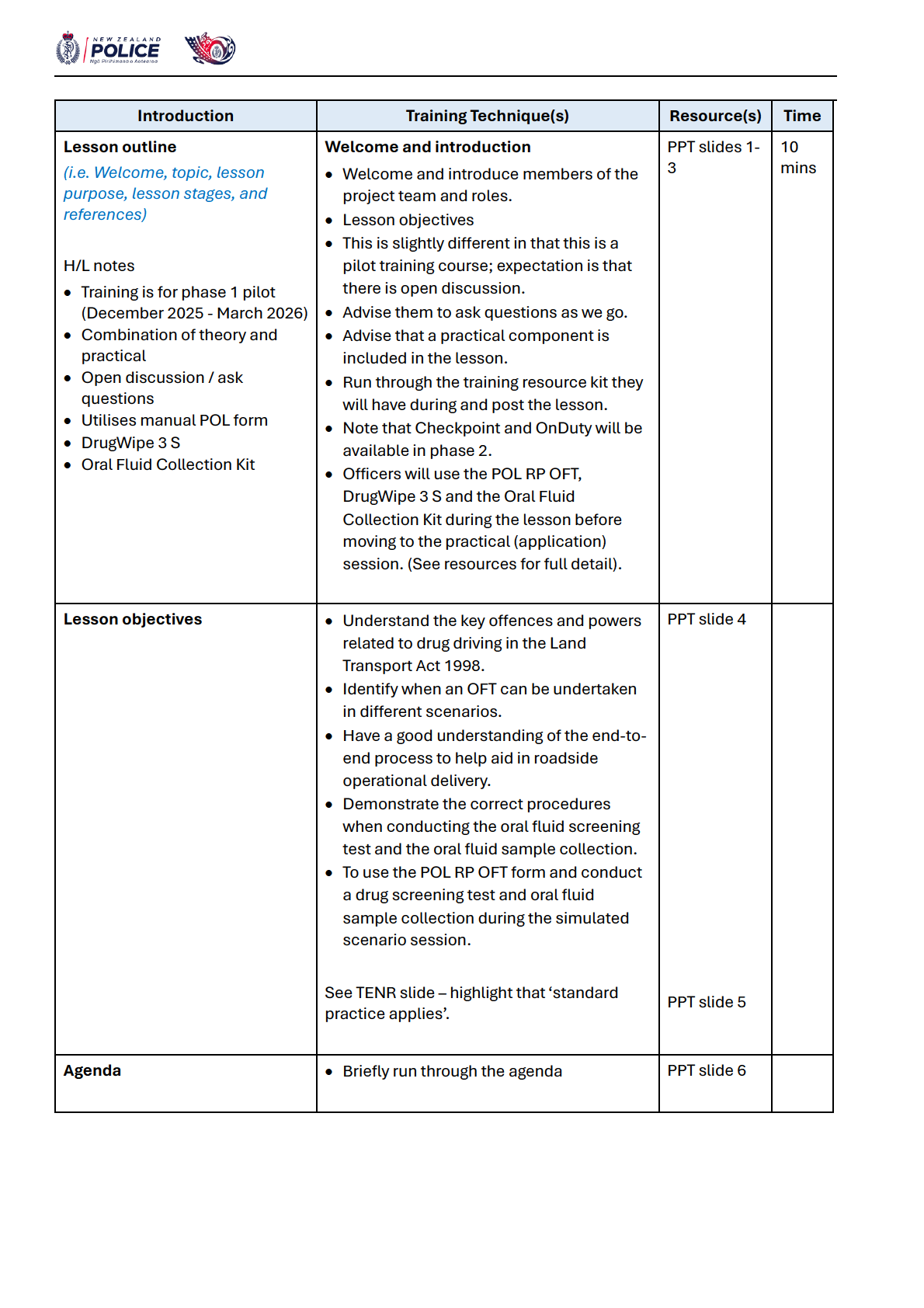
Land Transport Act 1998 with specific regard to the Land Transport (Drug Driving) Amendment 2025.
Description
The training session will introduce officers to the Oral Fluid Testing (OFT), the equipment (Securetec DrugWipe
3 S and Pathtech’s Oral Fluid Collection Kit) and related learnings.
This lesson plan is to be used in tandem with the PowerPoint:
OFT pilot training.
Lesson objectives
By the end of the training, learners will be able to:
1. Understand the key offences and powers related to drug driving in the Land Transport Act 1998.
2. Identify when an OFT can be undertaken in different scenarios.
3. Have a good understanding of the end-to-end process to support roadside operational delivery.
4. Demonstrate the correct procedures when conducting the oral fluid screening test and the oral fluid
sample collection.
5. To use the POL RP OFT form and conduct a drug screening test and oral fluid sample collection during
the simulated scenario session.
During this session, learners will undertake the following forms of assessment:
• Knowledge checks during the lesson.
• Officer can follow the correct device handling instructions.
• Simulated scenarios to practice applying OFT.
Project checks
• A confidence check at the end of the lesson
• Feedback and Q&As
1
 Duration
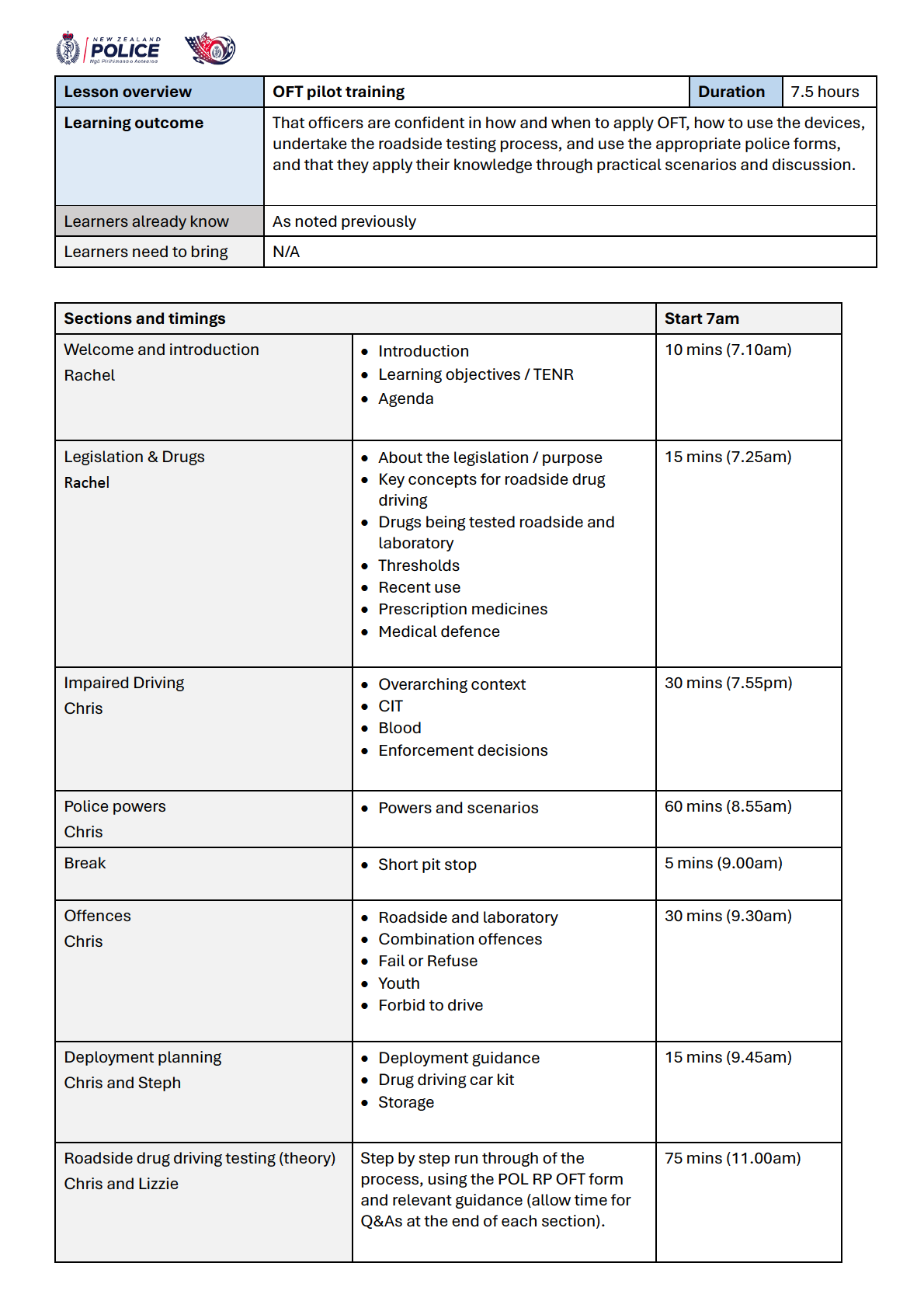
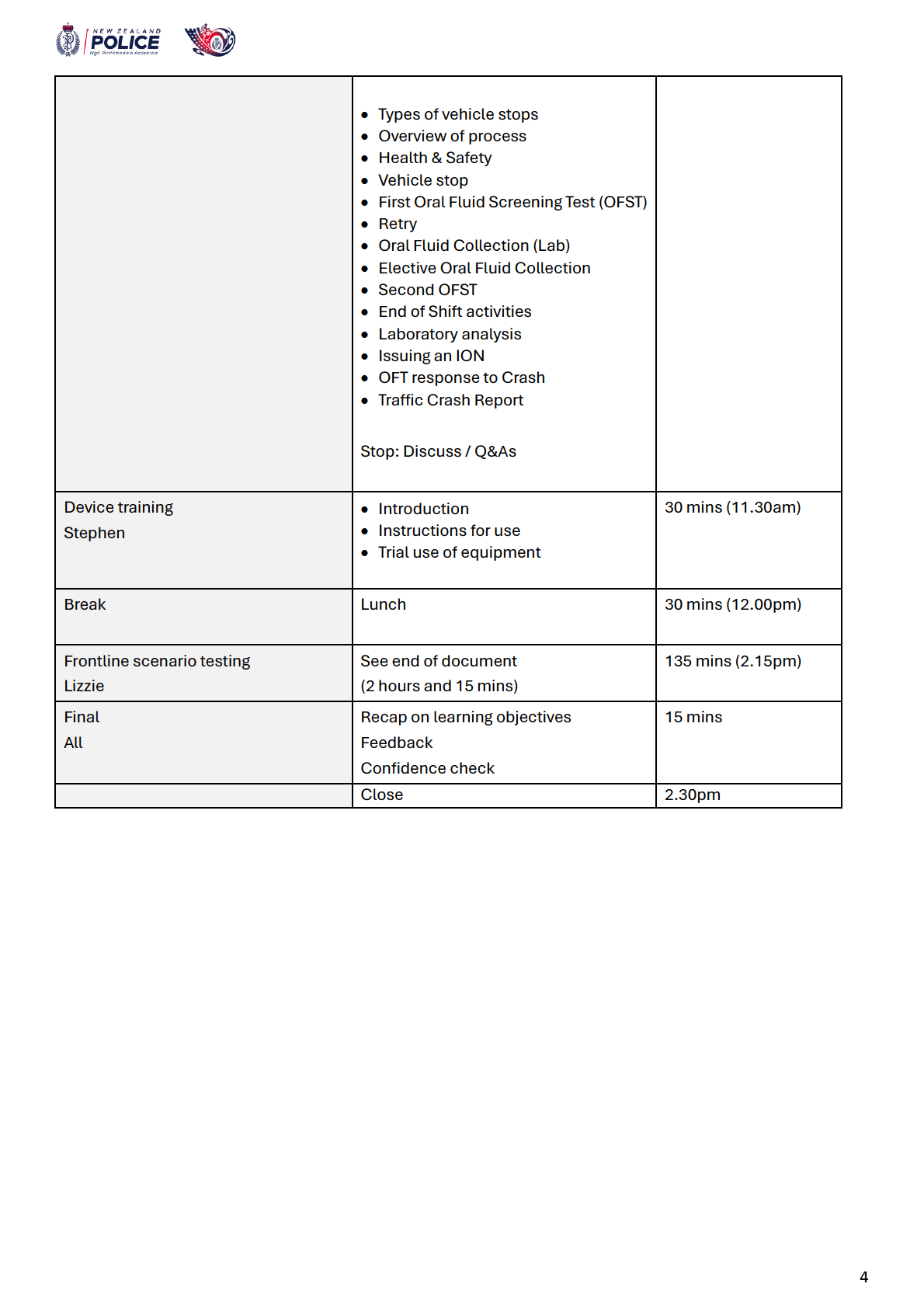
Classroom/wharenui: 7 hours and 30 minutes break for lunch
Learning support
• Staff being training in OFT will have support from trained Field Training Officers (FTOs).
• Staff will have access to support and learnings from officers who were initially trained on 9 December
2025.
• Officers attending this lesson will have some knowledge of OFT.
• Officers attending this lesson will have opportunities to trial using the equipment during and post
training, and prior to deployment.
• FTOs are required to assess staff readiness for deployment.
Room set-up
• Facilitator choice
Preparation
Before this session you need to:
• Familiarise yourself with the lesson plan and PowerPoint
Resources
You need these resources:
• Lesson plan and PowerPoint
• Whiteboard markers
• Drug diving car kit with checklist
• Knowledge Check
• Checkpoint OFT table
• Device instruction guide (see PPT from Pathtech)
• Observation run through (1 x DrugWipe and 1 x Oral Fluid collection kit)
• Securetec DrugWipe 3 S (6pp) (2 for device training; 4 for scenarios)
• Pathtech Oral fluid Collection Kit (4pp) (2 for device training; 2 for scenarios)
Forms
• POL RP OFT form
• POL RP-LAB
• POL 406
• Analyst certificate
2

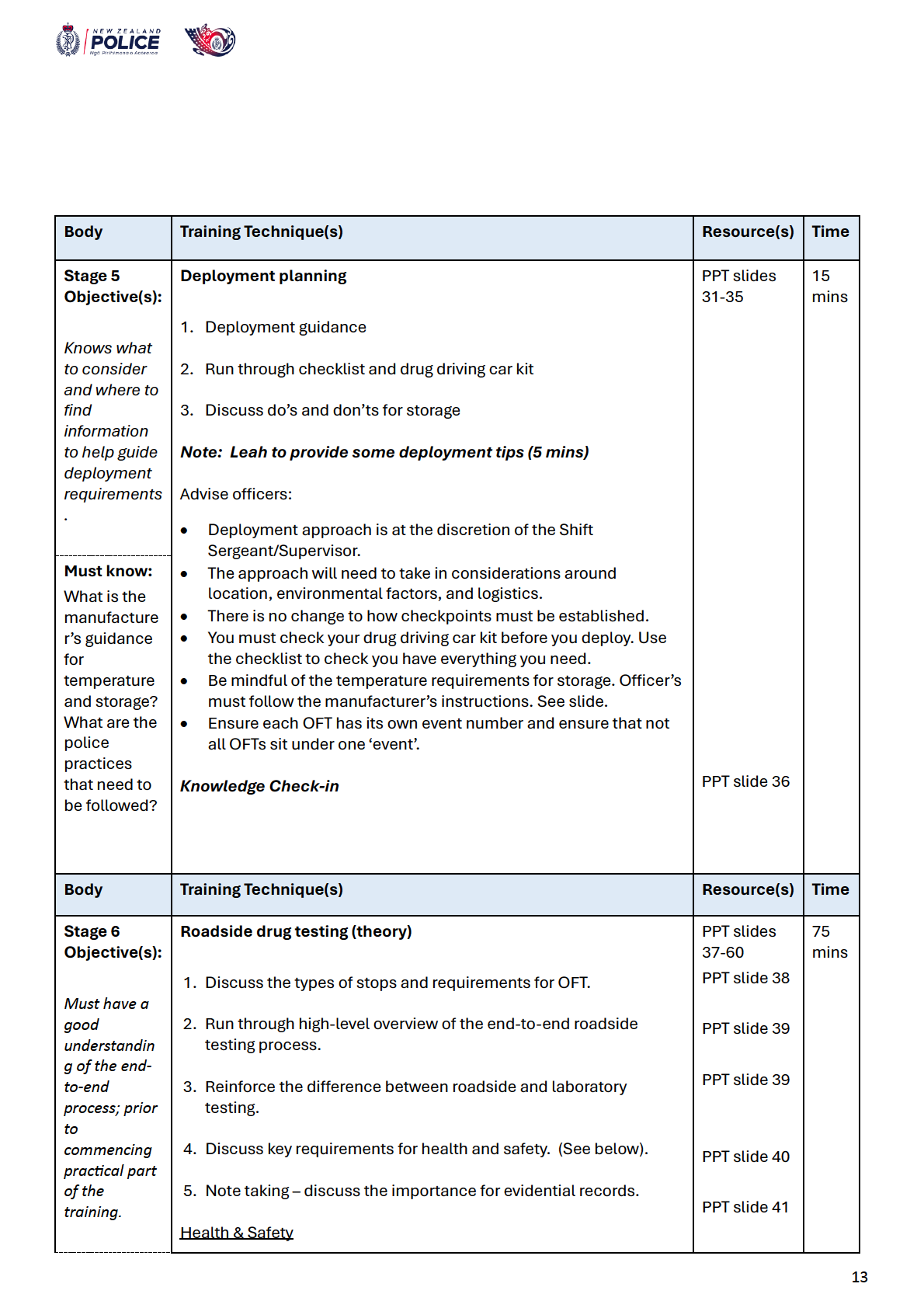
• Provide background context in terms of
Must know:
how the thresholds were set. Discuss
the importance of “recent use”.
Which drugs wil be tested for at
• Provide a high-level overview of Medical
the roadside?
Defence.
How many drugs wil be tested
for in the laboratory?
Advise officers:
Can ADHD drugs test positive for
at the roadside or laboratory?
• All drugs in the legislation are qualifying
Could you test positive for
drugs and are in the Misuse of Drugs Act
medicinal cannabis?
1975.
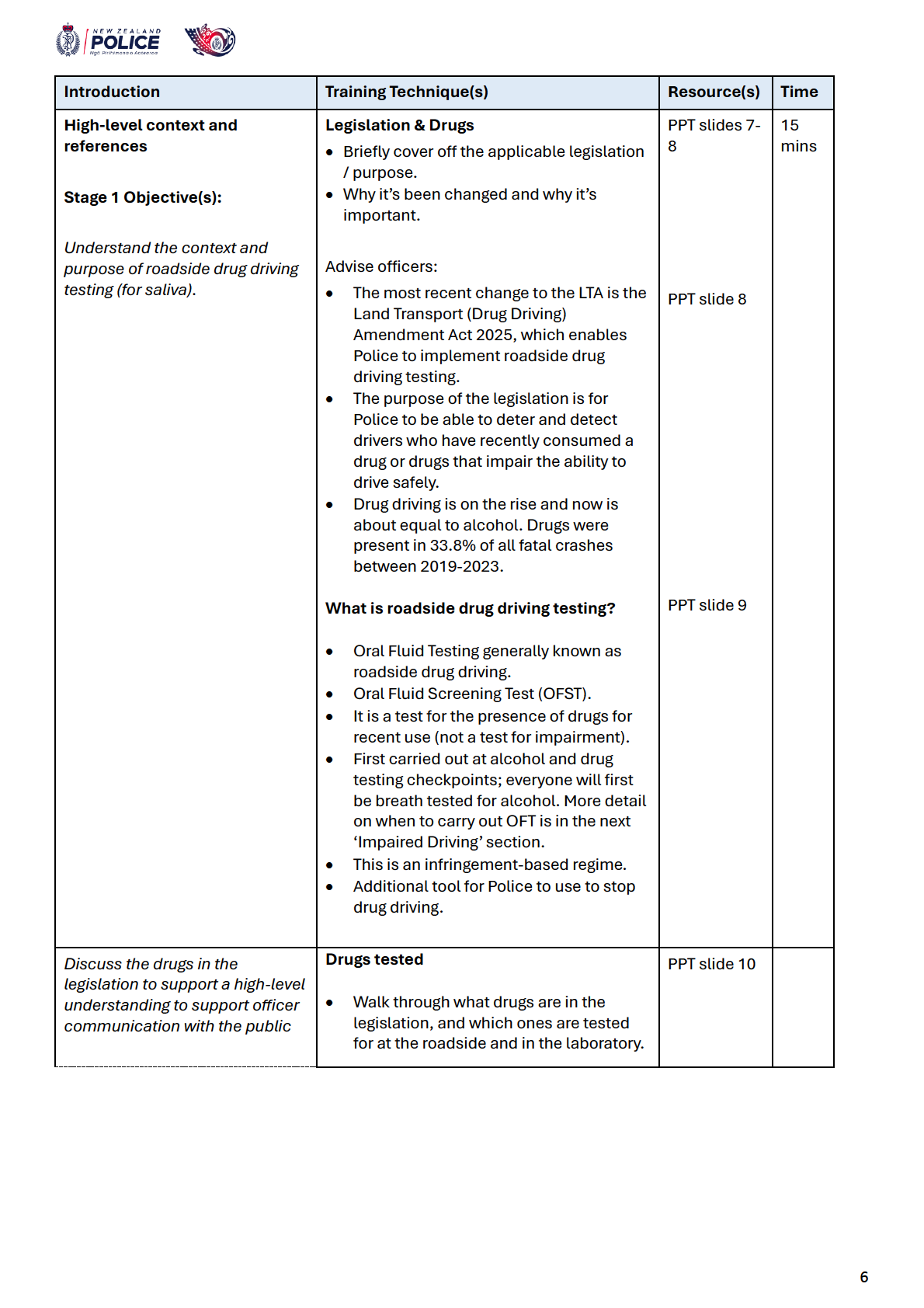
• Schedule 5 of the LTA includes 25 drugs
Would a driver producing a
that have the highest risk to road safety.
prescription make a difference to
• Schedule 5 includes 21 prescription
what you would do? Why?
medicines and four illicit drugs.
• These drugs have not changed since the
introduction of drug driving in March
2023.
Drug screened for at the roadside
• Drugs screened for at the roadside
include four drugs: THC (cannabis),
Methamphetamine (Meth), MDMA
(ecstasy), and Cocaine.
Drug tested for at the laboratory
• All 25 drugs in Schedule 5 can be tested
for in the laboratory.
Thresholds
• Police met the requirements set out in
the legislation to be able to set the
evidential threshold for each drug.
• Each drug has had a threshold set that
indicates “recent use”. The thresholds
are set to exclude past use and passive
exposure.
• Thresholds have been set after
considering current scientific evidence,
including drug concentrations reported
in oral fluid and blood after recent use,
the time of likely impairment and the
length of time required to eliminate the
drug from the oral fluid.
• To ensure the process is fair and
evidence-based, Police established a
Scientific Panel to provide independent
advice. The Scientific Panel included
government agencies and scientists.
The proposed laboratory thresholds
were also reviewed by an independent
scientific expert.
Prescription medicines
PPT slide 11
• Drivers cannot use a prescription or
medical note at the roadside to stop
7

them from undergoing a test or to
dispute a positive saliva screening test
result.
• It is the responsibility of the driver to
check their prescription medicine(s) and
ensure that it is okay to drive and to
ensure that they are aware of the risk of
mixing drugs or prescription medicines
and/or taking with alcohol.
• The DrugWipe 3 S does not test for
amphetamine; and wil not cross-react
with any ADHD medicines.
• Medical cannabis with a higher level of
THC could be detected at the roadside.
Medicinal cannabis products do not
have a ‘set’ level or specified limit.
• A medicinal cannabis product that has
high THC could be as impairing as
recreationally used cannabis.
• A CBD product (section 2A of the Misuse
of Drugs Act 1975) may have high levels
of cannabidiol (CBD) and low levels of
THC (if any). Legally these products
cannot contain more than 2% of THC
and other specified substances. This
low level of THC in CBD-based products
is not high enough to be detected by the
roadside drug driving screening test.
Medical defence/Use of Prescriptions
• A prescription or medical
note cannot be used at the roadside
to stop a driver from undergoing a test
or dispute a positive drug screening test
result.
• An officer cannot validate a prescription
at the roadside or know whether you
have taken your prescription as
prescribed.
• A driver can find information about
medical defence on the police website.
Open the link on the PPT slide to show
officers where the information is on the
police website (under Police Infringement
Bureau).
Knowledge check-in
PPT slide 12
8
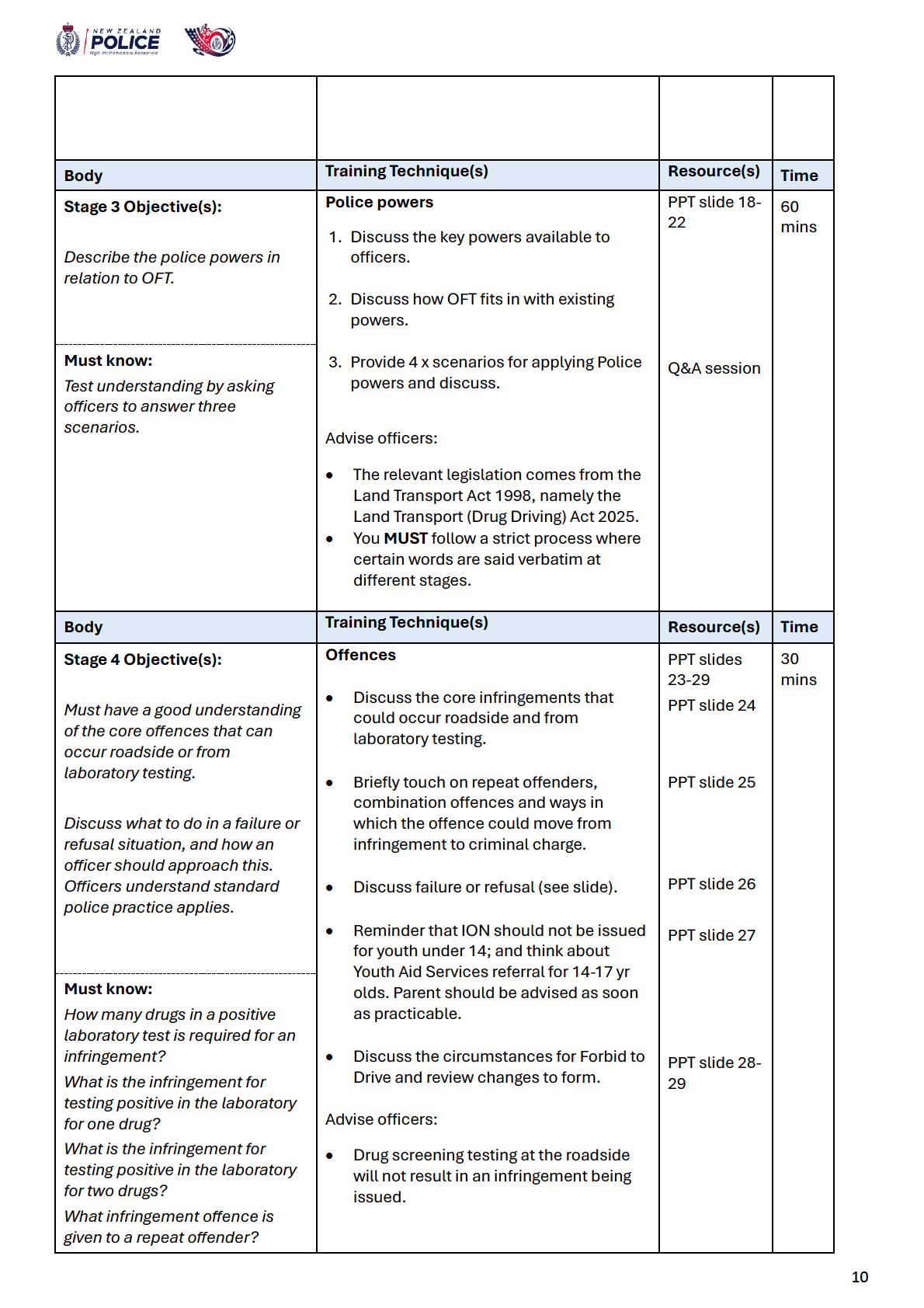
 Name a type of failure or refusal
 • Requires a positive laboratory test for an
offence that could happen
infringement offence notice to be
roadside?
issued.
•
Reinforce: There is no criminal offence
from a positive laboratory test of saliva.
• At the roadside there are infringement
offences for failure or refusal to remain,
accompany or undergo the test without
delay.
• Forbid to drive is mandatory (including
youth aged 14 years and older) when a
driver has two positive drug screening
tests, as wel as the above (2nd bul et
point).
• Precedent codes can be found in the
LRT for all drug driving offences.
Officers could look up codes in LRT
and discuss different possible
offences.
Roadside and laboratory infringement
offences
• Refer to slide.
• Roadside: Failure or refusal as noted
above + Forbid to drive. These = the
highest infringement (see below).
• Laboratory: One drug: $200 fine and 50
licence demerit points. Two drugs: $400
fine and 75 licence demerit points.
Failure or refusal
• They are required to remain at the place
where they most recently underwent an
OFST to provide the oral fluid sample, or
• If it’s not practicable for them to provide
a sample at that location,
to accompany you without delay to an
alternative place where it is likely they
can provide a sample
o
Note the distance travel ed should
be reasonable and justifiable in the
circumstances.
• If they fail/refuse to remain
or accompany having been
required to do so, they may be
arrested without warrant.
o
Arrest must be your last
resort option and only used to
enable the issuing of an infringement
and mandatory 12-hour prohibition
from driving.
Blood
• If a driver is unable to provide sufficient
saliva for testing, sample col ection, or
11

is involved in a crash and returns two
positive drug screening tests, they could
be required to provide a blood sample
for testing.
• A positive drug-blood test could result in
an infringement or criminal charge
depending on the drug-blood
concentration level found by laboratory
analysis.
Youth
• If the driver is a youth under 14 years,
they must be referred to Youth Aid
Service (YAS) and an infringement notice
should not be issued.
• If the driver is aged 14-17 years
(inclusive), they can be issued an
infringement notice, and the matter wil
be dealt with by PIB as it would be for an
adult.
• Police should consider a referral to
Youth Aid Service (YAS) – it may be that it
is desirable – or convenient - for the
infringement notice and chargeable
offence to be heard together at the
Youth Court.
• Infringement notices wil not be dealt
with by Youth Court, however there are
pathways to chargeable offences that
are dealt with by Youth Court.
• If a chargeable offence is committed by
a youth (14-17 years inclusive) and they
are required to be brought before the
Youth Court, and this offence relates to
the same event or series of events that
caused the infringement notice to be
issued.
Knowledge Check-in
PPT slide 30
12

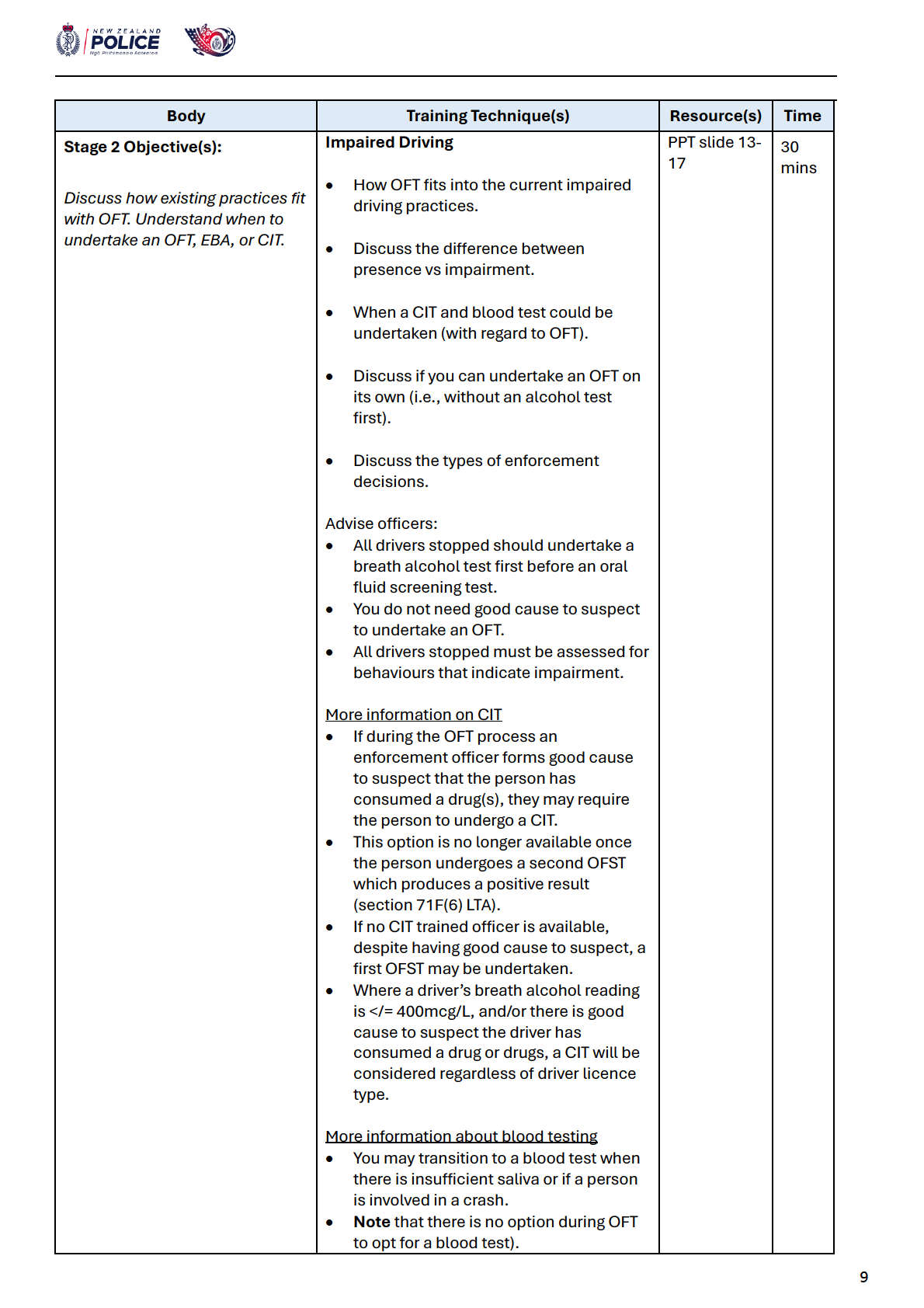
• Officers must consider all usual training to keep themselves safe,
for example – bending over to put the device down or turning their
back on the driver makes them vulnerable.
• Officers must wear disposable gloves when undertaken testing
or col ection of saliva. Gloves are changed between tests.
Must know:
Vehicle stop
PPT slide
When can
• Cover off when OFT can be undertaken and what to when a
42-43
OFT be
vehicle is stopped.
applied?
• Not required to have good cause to suspect that a driver has
Can you
consumed drugs.
name
• A test for alcohol impairment is generally undertaken first.
describe the • A person can be requested to undergo an OFST (a) if a person is
four key
driving or attempting to drive on a road; (b) a person has
steps?
committed an offence against the LTA involving a motor vehicle;
When can
(c) a driver of a vehicle involved in a crash; or (d) a where a crash
you apply
has occurred, but the identity of the driver cannot be
CIT?
ascertained, OFST can be undertaken with anyone you have good
cause to suspect to have been in the vehicle at the time of the
crash.
PPT slide
Frist Oral Fluid Screening Test (OFST)
44-45
• Instructions for use to be given during device training. Uses the
DrugWipe 3 S.
• The OFST must be undertaken as pursuant to s.71A LTA.
• No consumption of food or liquids prior to or during test.
• It’s important that the driver runs their tongue around the inside
of their mouth in a circular motion three times.
• OFST commences when the officer advises “I now require you to
undergo…” and hand the driver the drug screening device.
• OFST is complete when the device is handed back to the officer
and the officer has ascertained the result.
• A single positive OFST requires an oral fluid sample to be sent to
the laboratory (this a key reason for undertaking the OFCT next).
• If there is no OFST device and no good cause to suspect, then the
driver is free to go (unless other relevant legislation should be
applied).
Retry
PPT slide
• If the first OFST is inconclusive and a retry is also inconclusive –
46-47
driver is free to go.
• If the first OFST is positive, but the second is inconclusive, and
the retry is inconclusive – driver is free to go. The oral fluid
sample is
still sent to the laboratory.
CIT
• If there is good cause to suspect move to CIT.
• If no CIT qualified enforcement officer can move to OFST.
• If a person has undertaken a CIT or been hospitalised following a
crash, they are not required to undergo an OFST. In
these cases, apply s.73 LTA.
Oral Fluid Sample Collection
PPT slide
• Instructions for use to be given during device training. Uses the
48-49
Oral Fluid Collection Kit.
14

• There are no limitations in the legislation on the number of times
an oral fluid collection can be tried.
• If the driver fails/refuses to comply with the requirement to
provide an oral fluid sample, either verbally or by physical
inaction or delay, you may deem that refusal or inaction to
constitute a failure/refusal to provide an oral fluid sample.
• Reiterate prior advice pursuant to s.71DE(3) LTA that they will
commit an infringement offence if they fail/refuse to supply a
sample for laboratory analysis.
• Issue an infringement offence notice and forbid the driver from
driving for 12 hours, or
o
at your discretion and if, based on your perceived cumulative
assessment, you think the driver has made a reasonable
attempt:
o
offer another opportunity to provide a sample.
• If after the retry the person is unable to supply an oral fluid
sample sufficient for laboratory analysis when required:
• request the driver (to accompany you) for an evidential blood
test.
Notes:
• It is the Quantisal packet (not the outer packet) that the lot
number is required to be recorded.
• The date uses the American date format “mm-dd-yyyy”. New
Zealand uses “dd-mm-yyyy”. Be aware that the month and the
days are reversed to what you are used to seeing.
Laboratory (confirmation) test
• See post roadside for the process steps.
• The laboratory tests will test for all 25 drugs in the legislation.
• PHF Science wil conduct the analysis of the oral fluid.
• A laboratory certificate wil be sent to the O/C with the results.
Elective sample
• A driver must confirm whether or not to proceed with an elective PPT slide
sample. There is a 10-minute time period for this, however, there 50-51
is no requirement to have to wait until the end of the 10-minute
period if the driver confirms his or her intention. The driver’s
choice is final. Advise the driver that they cannot change their
mind once you move forward with the process.
• If a driver has elected to provide a sample, follow the same
process as noted above.
• There are no limitations in the legislation on the number of times
an elective oral fluid sample can be tried.
•
An elective sample is stored with PHF Science for six months.
•
The driver or their lawyer may apply in writing to the
Commissioner of Police requesting the sample is sent to a private
analyst of their choice.
•
The application should be no later than 28 days after the
infringement offence notice is served, or the date in which the
driver is first charged in court.
PPT slide
Second Oral Fluid Screening Test (OFST)
52-53
• Fol ow the same process and requirements as Step 1.
15