
Reference: 20250856
24 February 2026
Nigel Gray
[FYI request #33158 email]
Dear Nigel
Thank you for your Official Information Act (OIA) request, received on 6 December
2025. You requested the following:
… disclosure of the following information from 1 January 2022 to present:
Records of financial authorisations, budget allocations, or Cabinet directives that
approved funding for New Zealand’s support to Ukraine.
Documentation of any external obligations or requests cited as justification for
these financial allocations.
Copies of Treasury briefings or advice provided to Ministers regarding funding for
Ukraine.
The time to respond was extended for 20 working days due to the need for
consultations.
Information being released
Please find enclosed the following documents:
Item
Date
Document Description
Decision
1. 1 November
Ministerial Consultation- Ukraine paper MFAT
Released in full
2022
comments
2. 8 November
New Zealand Assistance for Ukraine Continuing
Released in full (except
2022
Existing Mandates
phone number)
3. 10 June
New Zealand Assistance for Ukraine A Strategic
Released in full (except
2022
Framework for Additional Support
phone number)
4. 11
New Zealand Assistance for Ukraine Continuing
Released in full (except
November
Existing Mandates
phone number)
2022
5. 17 June
New Zealand Assistance for Ukraine Options for
Released in part
2022
Further Support
6. April 2022
Additional Assistance to Ukraine Options MFAT
Released in full (except
1 The Terrace
PO Box 3724
Wellington 6140
New Zealand
tel. +64-4-472-2733
https://treasury.govt.nz
Comments
phone number)
7. February
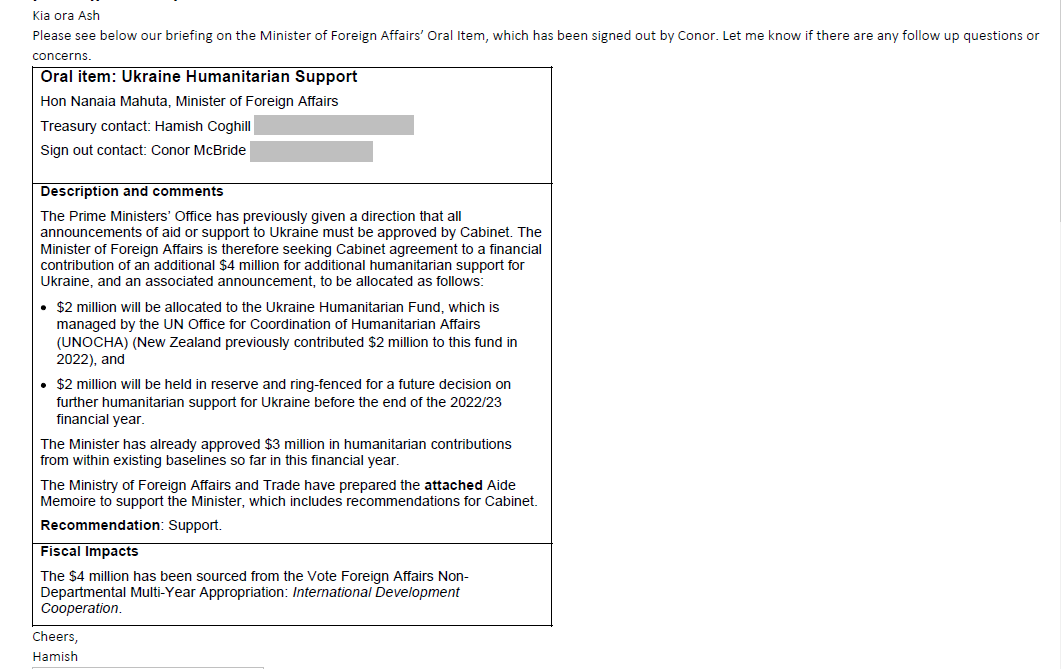
Oral item Ukraine Humanitarian Support
Released in full (except
2023
phone number)
8. June 2024
Cabinet Paper Briefing – Funding Assistance to
Released in full (except
Ukraine
phone numbers)
9. March 2022
Oral item Ukraine Further Aotearoa New Zealand
Released in full (except
Assistance MFAT Comments
phone numbers)
10. September
Cabinet Paper Briefing -Oral item- Assistance to
Released in full (except
2024
Ukraine
phone numbers)
11. 7 December
Treasury Report T2023/1965– EBRD votes on net
Released in part
2023
income reallocation and paid-in capital proposal to
support Ukraine
12. 20 March
Ukraine 2023-2024 Options
Released in part
2023
13. 16 February
Ukraine Assistance 2024-25
Released in part
2024
I have decided to release the relevant parts of the documents listed above, subject to
information being withheld under one or more of the following sections of the OIA, as
applicable:
•
section 6(a) – to protect the security or defence of New Zealand or the
international relations of the Government of New Zealand, and
•
section 9(2)(k) – to prevent the disclosure of information for improper gain or
improper advantage. This reduces the possibility of staff being exposed to
phishing, social engineering and other scams. This is because information
released under the OIA may end up in the public domain, for example, on
websites including Treasury’s website.
Some information has been redacted because it is not covered by the scope of your
request. This is because the documents include matters outside your specific request.
Information publicly available
The following information is also covered by your request and is publicly available on
the Treasury website:
Item
Date
Document Description
Website Address
1. 11 July 2025
New Zealand Assistance for
www.treasury.govt.nz/sites/d
Ukraine: Military Options
efault/files/2025-07/oia-
2025/2026
20250334.pdf
2. 11 May 2022
Aide Memoire: Request for budget
www.treasury.govt.nz/sites/d
and foreign exchange support for
efault/files/2023-02/oia-
2
Ukraine via IMF
20220345.pdf
3. 18 November
Treasury Report T2024/2851: New
www.treasury.govt.nz/sites/d
2024
Zealand Participation in the EBRD
efault/files/2025-05/oia-
General Paid-In Capital Increase
20250052-tranche-two.pdf
Accordingly, I have refused your request for the documents listed in the above table
under section 18(d) of the OIA: the information requested is or will soon be publicly
available.
Some relevant information has been removed from documents listed in the above table
and should continue to be withheld under the OIA, on the grounds described in the
documents.
In making my decision, I have considered the public interest considerations in section
9(1) of the OIA.
Please note that this letter (with your personal details removed) and enclosed
documents may be published on the Treasury website.
This reply addresses the information you requested. You have the right to ask the
Ombudsman to investigate and review my decision.
Yours sincerely
Jacinta Gould
Unit Manager, Economic and External Strategy
3
link to page 5 link to page 7 link to page 9 link to page 9 link to page 10 link to page 12 link to page 15 link to page 17 link to page 18 link to page 19 link to page 19 link to page 20 link to page 21 link to page 32 link to page 33
Table of Contents
1.
1 Nov 2022 Ministerial Consultation - Ukraine paper MFAT Comments
1
2.
8 Nov 2022 New Zealand Assistance for Ukraine Continuing Existing Mandates
3
3.
10 June 2022 New Zealand Assistance for Ukraine A Strategic Framework for
5
Additional Support
4.
11 Nov 2022 New Zealand Assistance for Ukraine Continuing Existing Mandates
6
5.
17 June 2022 New Zealand Assistance for Ukraine Options for Further Support
8
6.
April 2022 Additional Assistance to Ukraine Options MFAT Comments
11
7.
Oral item Ukraine Humanitarian Support
13
8.
June 2024 Cabinet Paper Briefing - Funding Assistance to Ukraine CM edits
14
9.
March 2022 Oral item Ukraine Further Aotearoa New Zealand Assistance MFAT
15
Comments
10.
Sept 2024 Cabinet Paper Briefing - Oral Item - Assistance to Ukraine
16
11.
Treasury Report T2023/1965
17
12.
Ukraine Assistance 2024-25
28
13.
Ukraine 2023-2024 Options
29
20250856 TOIA Binder 3
Page 1 of 30
IN-CONFIDENCE
Title of paper
New Zealand Assistance for Ukraine: Continuing Existing Mandates
Minister and agency Minister of Foreign Affairs, Ministry of Foreign Affairs and Trade
Minister of Defence, New Zealand Defence Force and Ministry of Defence
Description
This paper seeks additional baseline funding for Vote Foreign Affairs and
Vote Defence Force to continue to assist Ukraine. The paper presents
options for continued assistance through our diplomatic, economic and
military support pillars.
Comments
We have been working with the Ministry of Foreign Affairs and Trade (MFAT)
and the New Zealand Defence Force (NZDF) on earlier iterations of this
paper, but we were not given sufficient time to comment on this version prior
to Ministerial consultation (in particular, the financial recommendations). The
paper has been modified in response to our earlier advice, but some of our
advice has not been accepted:
i.
We continue to question why new funding is required to maintain the
Russia Sanctions Taskforce. This is a government priority, and we
have not seen sufficient justification from MFAT as to why current
arrangements (which rely on secondments) cannot be maintained.
Filling twelve new permanent positions would be difficult in the
current market, and it is unclear how long the Taskforce wil be
needed for and what will be done with the permanent positions once
the funding runs out (funding is only being sought for the current
financial year) or the taskforce is stood down.
ii.
MFAT recommends the $2 mil ion in-principle expense transfer
(IPET) is used for the Russia Sanctions Taskforce and the case
against Russia on the International Court of Justice (ICJ) case
(confirmation of this IPET is being sought by through the October
Baseline Update). We note that Cabinet can decide to redirect this
funding towards whichever initiatives it considers are highest priority,
which in our view are either the legal accountability costs, or the
North Atlantic Treaty Organisation (NATO) trust fund contribution.
ii .
Paragraph 39 includes a statement that Treasury officials
discouraged MFAT from seeking specific contingency funding for
potential legal challenges. We have asked MFAT to reflect the
reason we discouraged this, which is due to the uncertainty of the
costs actually eventuating at this stage, which we considered meant
it did not meet the high bar to receive out of cycle funding.
iv.
It would be useful for the paper to outline the relatively higher or
lower priority for extensions to the range of NZDF support in place
We wil provide additional feedback to MFAT during Ministerial consultation
relating to the financial recommendations (which currently present errors),
and certain elements to do with the drafting of the paper.
Consulting
COP 1 November
Minister’s due date
Cabinet or Cabinet
CPC 8 November
Committee
1
IN-CONFIDENCE
20250856 TOIA Binder 3
Page 2 of 30
IN-CONFIDENCE
Fiscal implications
Below is the funding sought for Vote Foreign Affairs:
Summary of bid
FY2022/23 ($NZ million)
Legal Accountability (ICJ + ICC)
2.000
Support to Sanctions Function
1.300
NATO Trust Fund
3.700
Total
7.000
The $2m IPET can be directed towards any of these costs, reducing the total
sought to $5m (which would be charged from the Between Budget
Contingency). This cost is only for this financial year, and we understand the
Minister of Foreign Affairs may be seeking an invitation to submit a Budget
2023 initiative for additional funding to support Ukraine.
Below are the options presented for NZDF:
Option
2022/23 2023/24 2024/25
Option One
0.000
0.000
0.000
Option Two (Intelligence, Liaison,
3.803
0.000
3.803
Logistics)
Option Three (Liaison, Training)
5.354
2.099
7.453
Option Four (Intel igence, Liaison,
10.206
2.328
12.534
Logistics, Training and Command/admin)
Options One, Two and Three can be funded from Vote Defence Force’s
existing baselines. If Option Four is selected, $4.704 million wil be sought
from the Between Budget Contingency.
Recommended
We recommend you ask the Minister of Foreign Affairs to:
action
• ask her officials as to why the current arrangements for the Russia
Sanctions Taskforce cannot be maintained.
• if you agree these initiatives are a high priority, ask that the funding
from the $2 mil ion IPET is directed instead towards either the NATO
trust fund contribution (and seek the remaining $1.7m in new
funding) or the legal accountability costs, as these appear to be less
discretionary than the Russia Sanctions Taskforce.
We recommend you ask the Minister of Defence to include in the paper an
explanation of the relatively higher or lower priority for extensions for the
range of NZDF support in place.
2
IN-CONFIDENCE
20250856 TOIA Binder 3
Page 3 of 30
New Zealand Assistance for Ukraine: Continuing Existing Mandates
Hon Nanania Mahuta, Minister of Foreign Affairs, Hon Peeni Henare, Minister of Defence
Treasury contacts: Foreign Affairs: Susie McKenzie s9(2)(k)
Defence: Michael
Lonergan s9(2)(k)
Sign out contacts: Foreign Affairs: Sarah Key s9(2)(k)
Defence: Colin Hall s9(2)(k)
s9(2)(k)
Description: This paper presents options for continued diplomatic, economic and military
support assistance for Ukraine.
Comments:
Foreign Affairs options
This paper proposes to meet the $7m cost of the four proposed foreign affairs activities
through:
• the confirmation of a $2m in-principle expense transfer that was agreed as part of the
previous support package in June [CPC-22-MIN-0020], and
• reducing by $5m (as opposed to ‘drawing down’) the $75m tagged operating contingency
Pacific emergency budget support: preventing fiscal crises and strengthening resilience in
response to COVID-19 set aside at Budget 2022. The version previously circulated for
Ministerial consultation proposed to meet this $5m from the between-Budget contingency.
Approach to reducing the Pacific emergency budget support contingency
This contingency is yet to be drawn down. It is due to expire on 30 June 2023 and, at this
stage, it is unclear whether the ful $75m wil be required. We understand MFAT has relatively
wel -developed plans for drawing down $45m of this tagged contingency soon for support to
Tonga, Samoa, and the Cook Islands. MFAT’s plans to support Vanuatu, the Solomons and
Niue are less-wel developed and are likely to be submitted by March 2023, but are expected to
draw down an additional $20m. MFAT has advised that the situation in many Pacific Island
countries is not as acute as expected 12 months ago, however, global inflation and increasing
food and fuel prices have created new pressures. This tagged contingency was publicly
communicated as being $75m for the Pacific.
If Ministers wished to take an alternative approach that did not involve reprioritising funding
specifically set aside for Pacific emergency budget support, we consider MFAT would be able
to cover the $5m cost for additional support to Ukraine from the International Development
Cooperation (IDC) appropriation baselines. This would require alternative financial
recommendations seeking approval of a fiscal y neutral adjustment between appropriations.
Defence options
We have no views on the four options in the defence portfolio, although we note Option 4
would require $4.704 million in additional funding, which the paper specifies would be sought
from the between-Budget contingency. We have not had the opportunity to interrogate these
costs and confirm that they only represent the marginal costs of the proposal. Options 1, 2 and
3 can be funded from within existing Vote Defence Force baselines. Options 3 and 4 would
largely extinguish the appropriation and result in any subsequent unexpected NZDF
deployments or contingency response requiring fiscally neutral adjustments or new
funding.
1
20250856 TOIA Binder 3
Page 4 of 30
Treasury Recommendation: Support overall. If you prioritise ensuring that the full $75m for
Pacific emergency budget support remains in the contingency, we consider the $5m required to
implement each foreign affairs activity could be funded from the IDC appropriation. This would
require a fiscal y neutral adjustment within existing IDC baselines.
Fiscal Implications: Foreign Affairs
The cost of each foreign affairs option is set out in the table below:
Summary
FY2022/23 ($m)
Legal Accountability (International Court of Justice +
2.000
International Criminal Court)
Support to Sanctions Function
1.300
NATO Trust Fund
3.700
Total
7.000
The paper seeks agreement for the $2m from the IPET to fund the ICJ case ($700,000) and
the Support to Russia Sanctions Function ($1.3m), however we note this could be directed
towards any of these activities. The paper proposes the $5m balance is funded by reducing the
Pacific emergency budget support contingency.
Funding source: Tagged operating contingency – Pacific emergency budget
support: preventing fiscal crises and strengthening resilience in response to COVID-
19
Operating ($m)
Capital ($m)
26/27 &
26/27 &
22/23 23/24 24/25 25/26
22/23 23/24 24/25 25/26
outyears
outyears
5.000
-
-
-
-
-
-
-
-
-
Defence
The cost of each defence option is set out in the table below:
Option
2022/23 2023/24 Total
Option One
-
-
-
Option Two (Intelligence, Liaison, Logistics)
3.803
-
3.803
Option Three (Liaison, Training)
5.354
2.099
7.453
Option Four (Intel igence, Liaison, Logistics,
10.206
2.328
12.534
Training and Command/Admin)
Options One, Two and Three can be funded from Vote Defence Force’s existing baselines.
However, if Option Four is selected, $4.704 mil ion will be sought from the between-Budget
contingency established through Budget 2022:
Funding source: between-Budget contingency
Operating ($m)
Capital ($m)
26/27 &
26/27 &
22/23 23/24 24/25 25/26
22/23 23/24 24/25 25/26
outyears
outyears
4.704
-
-
-
-
-
-
-
-
-
2


20250856 TOIA Binder 3
Page 5 of 30
From:
Susie McKenzie [TSY]
Sent:
Friday, 10 June 2022 12:20 pm
To:
Strategy and Performance Inbox [TSY]
Cc:
Hamish Coghill [TSY]; Sarah Key [TSY]
Subject:
RE: ACTION: CAB and CBC Briefings (Due Friday 10 June)
Thanks so much.
Below is the briefing. Just to note – this is only for the paper titled “New Zealand Assistance for Ukraine: A Strategic
Framework for Additional Support”, as the second paper (“New Zealand Assistance for Ukraine: A Strategic
Framework for Additional Support”) has been postponed to later in the month.
New Zealand Assistance for Ukraine: A Strategic Framework for Additional Support
Hon Nanaia Mahuta, Minister of Foreign Affairs; Hon Peeni Henare, Minister of Defence
Treasury contact: Susie McKenzie s9(2)(k)
Sign out contact: Sarah Key s9(2)(k)
Description: This paper proposes a strategic decision-making framework to inform ongoing decisions on all
forms of New Zealand support to Ukraine in response to Russia’s invasion.
Comments:
We are supportive of the initiative to adopt a framework to allow for the more systematic and deliberate
consideration of New Zealand’s contributions, and the framework proposed by MFAT appears to be appropriate.
In particular, one of the proposed criteria included in the framework is 'proportionate and affordable' and this
includes key questions that we are supportive of and align with expectations of good fiscal management.
We support the expectation that funding for future initiatives to support Ukraine should be sought within existing
baselines in the first instance. However, Ministers should be aware of existing pressures for Official Development
Assistance funding, especially in the Pacific, and there are inherent trade-offs involved with any future
contribution from New Zealand to Ukraine.
This is the first of two papers to be considered on Ukraine assistance. The second paper is scheduled to be
considered later in June, and will outline options for New Zealand to provide further assistance to Ukraine and to
extend and enhance existing New Zealand Defence Force (NZDF) deployments. We will brief on this paper
separately.
Treasury Recommendation: Support this paper.
Fiscal Implications: This paper has no direct financial implications.
Thanks!
Susie McKenzie (she/her)
Kaitātari - Analyst | International | Te Tai Ōhanga – The Treasury
Email/IM: [email address] |
s9(2)(k)
1
20250856 TOIA Binder 3
Page 6 of 30
New Zealand Assistance for Ukraine: Continuing Existing Mandates
Hon Nanania Mahuta, Minister of Foreign Affairs, Hon Peeni Henare, Minister of Defence
Treasury contacts: Foreign Affairs: Susie McKenzie s9(2)(k)
Defence: Michael
Lonergan s9(2)(k)
Sign out contacts: Foreign Affairs: Sarah Key s9(2)(k)
Defence: Colin Hall s9(2)(k)
s9(2)(k)
Description: This paper presents options for continued diplomatic, economic and military
support assistance for Ukraine.
Comments:
Since being considered by the Cabinet Priorities Committee (CPC), this paper has been
revised to include proposed financial support for the World Food Programme (by
commensurately reducing the proposed support to the NATO Trust Fund), additional details on
the Pacific emergency budget support tagged contingency, elaboration of the legal
accountability and Russia Sanctions Taskforce requests for Vote Foreign Affairs, and to only
present the Defence option endorsed by CPC (Option Four).
Foreign Affairs options
This paper proposes to meet the $7m cost of the five proposed foreign affairs activities
through:
• funding provided through the confirmation of a $2m in-principle expense transfer through
the October Baseline Update process that was agreed as part of the previous support
package in June [CPC-22-MIN-0020], and
• reducing by $5m (as opposed to ‘drawing down’) the $75m tagged operating contingency
Pacific emergency budget support: preventing fiscal crises and strengthening resilience in
response to COVID-19 established at Budget 2022.
Pacific emergency budget support contingency
This contingency was publicly announced as being $75m at Budget 2022, and is yet to be
drawn down. It is due to expire on 30 June 2023 and, at this stage, MFAT expects that around
$10m of this contingency will not be required. We understand MFAT has relatively wel -
developed plans for shortly drawing down $45m of this tagged contingency for support to
Tonga, Samoa, and the Cook Islands. MFAT’s plans to support Vanuatu, the Solomons and
Niue are less-wel developed and are likely to be submitted by March 2023, but are expected to
draw down an additional $20m. MFAT has advised that the situation in many Pacific Island
countries is not as acute as expected 12 months ago, however, global inflation and increasing
food and fuel prices have created new pressures. We understand further details about this
planned expenditure will be provided by the Minister of Foreign Affairs oral y at Cabinet.
Defence proposal
We understand CPC indicated a preferred option (previously Option Four) at its meeting on 8
November 2022, which the revised paper now contains as a single proposal. The proposal
requires $4.704 million charged against the between-Budget contingency. We have not had the
opportunity to interrogate these costs and confirm that they only represent the marginal costs
of the proposal. This proposal would largely exhaust the available funding in the appropriation
and result in any subsequent unexpected NZDF deployments or contingency response
requiring fiscally neutral adjustments or new funding.
1
20250856 TOIA Binder 3
Page 7 of 30
Treasury Recommendation: Support.
Fiscal Implications: Foreign Affairs
The cost of each foreign affairs option is set out in the table below:
Summary
FY2022/23 ($m)
International Court of Justice (ICJ)
0.700
Support to International Criminal Function
1.300
Support to Russia Sanctions Function
1.300
NATO Trust Fund
1.850
Support to World Food Programme
1.850
Total
7.000
The paper seeks agreement for the $2m from the IPET confirmed at OBU to fund the ICJ case
($700,000) and the Support to Russia Sanctions Function ($1.3m). The paper proposes the
$5m balance is funded by reducing the
Pacific emergency budget support contingency.
Funding source: Tagged operating contingency – Pacific emergency budget
support: preventing fiscal crises and strengthening resilience in response to COVID-
19
Operating ($m)
Capital ($m)
26/27 &
26/27 &
22/23 23/24 24/25 25/26
22/23 23/24 24/25 25/26
outyears
outyears
5.000
-
-
-
-
-
-
-
-
-
Defence
The paper seeks $4.704 mil ion from the between-Budget contingency established through
Budget 2022:
Funding source: between-Budget contingency
Operating ($m)
Capital ($m)
26/27 &
26/27 &
22/23 23/24 24/25 25/26
22/23 23/24 24/25 25/26
outyears
outyears
4.704
-
-
-
-
-
-
-
-
-
2
20250856 TOIA Binder 3
Page 8 of 30
From:
Hamish Coghill [TSY]
Sent:
Friday, 17 June 2022 4:50 pm
To:
^Parliament: Rose Boele van Hensbroek
Subject:
FW: Briefing for late CPC item: New Zealand Assistance for Ukraine: Options for Further Support
Attachments:
Aide Memoire_ Request for budget and foreign exchange support for Ukraine via the IMF.docx
Spelt your email address wrong in my initial email – apologies.
Hamish
From: Hamish Coghill [TSY]
Sent: Friday, 17 June 2022 4:48 pm
To: Caralee McLiesh [TSY] ; Bryan Chapple [TSY] ; Andrew Rutledge [TSY] ; ^Parliament: Susan Ivory ; ^Parliament:
Jordan Ward ; [email address]
Cc: Sarah Key [TSY] ; Susie McKenzie [TSY] ; Conor McBride [TSY] ; James Beard [TSY] ; Michael Lonergan [TSY] ; Hugo
Van Dyke [TSY] ; Hermano Pinto [TSY] ; Sian Hilton [TSY] ; @Precab ; Giles Bollinger [TSY]
Subject: Briefing for late CPC item: New Zealand Assistance for Ukraine: Options for Further Support
Kia ora koutou
This email is to provide an updated briefing for what was going to be a DEV paper but which is now going to be a
late CPC paper from the Minister of Foreign Affairs:
New Zealand Assistance for Ukraine: Options for Further
Support.
The paper was updated earlier today following feedback from PMO, which has changed one of the options
described in the earlier version of the briefing, so I have updated it accordingly below.
Also attached is the recent AM which is referred to in the briefing.
New Zealand Assistance for
Ukraine: Options for Further
Support
Hon Nanaia Mahuta, Minister of Foreign Affairs;
Hon Peeni Henare, Minister of Defence
Treasury contact: Hamish Coghill s9(2)(k)
Sign out contact: Sarah Key s9(2)(k)
Description: Presents a range of diplomatic,
economic, and military initiatives for New
Zealand to provide further assistance to
Ukraine, following the Cabinet Business
Committee’s earlier consideration of a strategic
framework to guide decision-making regarding
the response to the Russian invasion of Ukraine
[CBC-22-MIN-0034 refers].
1
20250856 TOIA Binder 3
Page 9 of 30
Comments:
We have no views of the merits of each
individual initiative. The costs of each are to be
met from with existing baselines:
• Initiatives funded from Vote Foreign Affairs
are utilising forecast departmental
underspends from 2021/22. These
underspends are largely the result of
reduced travel expenditure due to COVID-
19 restrictions worldwide. Utilising these
forecast underspends to fund initiatives to
support Ukraine is a pragmatic approach
whereby funding that would otherwise be
returned to the centre is being repurposed
to avoid the need to provide additional
funding.
• Initiatives funded from Vote Defence Force
do not require additional funding because
they utilise existing baseline funding in the
NZDF appropriation that funds
deployments, which totals $30.100 million
operating in 2022/23 and outyears. Since
2018/19, the reduced cost and number of
NZDF deployments (driven partly by COVID-
19 and reduced activity in the Middle East
and Afghanistan) has resulted in the
increased availability of funding for
deployments.
The paper indicates that Ukraine will require
additional economic support from the
international community in the future. If New
Zealand decides to contribute to the many
initiatives (new and under development) it
would require funding beyond what is already
allocated, which may require new money. MFAT
officials will be providing advice on these
options, which will need to be considered
against the criteria in the strategic framework
agreed by Cabinet Business Committee,
including the relative priority of support to
Ukraine against competing needs, such as the
Pacific. We will input into this process,
particularly insofar as the IMF account is
considered an avenue for support [T2022/944
refers].
Treasury Recommendation: Support, however
you may wish to use this opportunity to discuss
with your colleagues s6(a)
2
20250856 TOIA Binder 3
Page 10 of 30
s6(a)
Fiscal Implications:
This paper has no immediate fiscal implications:
no additional funding is sought for any of the
individual initiatives.
Agreement is sought for two in-principle
expense transfers of forecast underspends for
2021/22 in Vote Foreign Affairs for two of the
initiatives:
• Secondment of Major General Howard to
the International Criminal Court: $800,000
is to be transferred to 2022/23 ($400,000)
and 2023/24 ($400,000) to meet the
marginal costs of the secondment.
Authorisation is also sought for joint
Ministers to subsequently agree a fiscally
neutral adjustment of this funding into Vote
Defence Force baselines.
• Further Contribution to NATO Trust Fund –
Recommended Option: setting aside $2.000
million and transferring it to 2022/23 to
become available for future decisions on
support to Ukraine – whether that be
diplomatic, economic or military assistance.
Authorisation is also sought for joint
Ministers to agree any fiscally neutral
adjustments that may be required to give
effect to future decisions on support to
Ukraine.
3
20250856 TOIA Binder 3
Page 11 of 30
From:
Susie McKenzie [TSY]
Sent:
Friday, 8 April 2022 12:33 pm
To:
@Precab; @Governance and Accountability Team; @FiscalCalculator [TSY]
Cc:
Ash Smith [TSY]; Hamish Coghill [TSY]; Hugo Van Dyke [TSY]; Conor McBride [TSY]
Subject:
RE: ACTION: PreCab briefings for the W/C 11 April
Kia ora,
Please see below the briefing for the Ukraine Assistance item.
Cheers,
Susie
Additional Assistance to Ukraine: Options
Hon Nanaia Mahuta, Minister of Foreign Affairs; Hon Peeni Henare, Minister of Defence
Treasury contact: Susie McKenzie s9(2)(k)
Sign out contact: Conor McBride s9(2)(k)
Description: Following on from the discussion at Cabinet on 4 April and ERS on 5 April about options for further aid to
Ukraine, this updated paper presents options for two potential $20 million packages of military and humanitarian assistance
for approval – s6(a)
Comments:
We have been consulted on the updated paper as it was developed this week, although given time constraints our feedback
again focussed on the financial implications and recommendations sections.
We do not have a view on which package Ministers should prefer.
As we advised in our briefing on this paper ahead of Cabinet's consideration on 4 April:
•
the costs of either package can be met from a forecast underspend of MFAT's departmental baselines for 2021/22,
and
•
there is an additional $18 million forecast underspend available in the multi-year appropriation established to meet
the costs of hosting APEC 2021, should Ministers wish to increase the size of the packages in a way that is fiscally
neutral.
We understand Ministers may wish to defer decisions on some options for future consideration. Ministers should be aware
that any increases to appropriations for the 2021/22 financial year, which may be necessary to give effect to these options,
after Budget Day (19 May) and before the end of the current financial year (30 June) will be unappropriated expenditure that
will require validation in the Appropriation (2021/22 Confirmation and Validation) Bill to be introduced to the House in March
2023 and debated in April 2023.
s6(a)
while also complying with the general principle that
appropriations should not overlap with one another.
Treasury Recommendation: Support.
Fiscal Implications:
This paper has no direct fiscal implication – both packages can be funded from within existing baselines and through fiscally
neutral transfers.
1


20250856 TOIA Binder 3
Page 12 of 30
While the proposals are fiscally neutral, there are trade-offs involved. If not for this proposal, these underspends would have
either been used to addressed departmental cost pressures over the next two years or returned to the Crown (which would
be our recommendation).
Susie McKenzie (she/her)
Kaitātari - Analyst | International | Te Tai Ōhanga – The Treasury
Email/IM: [email address] |
DDI: s9(2)(k)
out of scope
2
20250856 TOIA Binder 3
Page 13 of 30
s9(2)(k)
s9(2)(k)
1
20250856 TOIA Binder 3
Page 14 of 30
Funding Assistance for Ukraine: Financial Year Transfer
Rt Hon Winston Peters, Minister of Foreign Affairs
Treasury contact: Ephraim Wilson
Sign out contact: Conor McBride s9(2)(k)
Description:
This paper seeks approval of an in-principle expense transfer within Vote Foreign Affairs
to enable the use of a $6.000 million forecast underspends in the 2023/24 financial year,
for use in the 2024/25 financial year for the purpose of funding military assistance to
Ukraine.
Comments: MFAT has identified $6.000 million from Vote Foreign Affairs 2023/24 funding through
reprioritisation, resulting in underspends that could be used to provide military assistance
to the Ukraine. Usually, Joint Ministers agree fiscally neutral transfers. However, Cabinet
is being asked to approve this fiscally neutral transfer within Vote Foreign Affairs
because under CO(18)2, transfers from an appropriation in one year to another
appropriation in another year require Cabinet approval.
The Minister of Foreign Affairs seeks that this funding is used to provide:
• a NZ$2 million contribution to a NATO-led “Flagship Project” alongside Indo-Pacific
partners (Australia, Japan, Korea, and New Zealand) focused on supporting military
healthcare in Ukraine; and
• a NZ$4 million contribution to a UK/Latvia-led coalition (this is the minimum
contribution required to join) which aims to deliver one million drones to Ukraine.
MFAT has also earmarked $4.000 million from the International Development
Cooperation (IDC) appropriation for further Ukraine humanitarian assistance (subject to
Ministerial approval of IDC sub-allocations for the next triennium). The intention is that
with this contribution, the Prime Minister could announce a $10.000 million aid package
at the upcoming NATO Summit on 9-11 July.
MFAT considers that this aid package supports New Zealand’s strategic interest in
maintaining the rules-based international order, and in deterring other countries in our
region with ambitions to take control of territory by force.
Treasury Recommendation: Support.
Fiscal Implications:
There are no direct or immediate fiscal or regulatory impacts resulting from this paper.
The proposed $6.000 million transfer will be fiscally neutral.
Note that the cumulative value of New Zealand’s pledged assistance to Ukraine since
Russia’s full-scale invasion in February 2022 (including defence deployments) is valued
at over NZ$114.000 million. Also note that there will likely be further calls for military and
humanitarian assistance in the future from Ukraine, its allies, or NATO.
1
20250856 TOIA Binder 3
Page 15 of 30
From:
Susie McKenzie [TSY]
Sent:
Friday, 25 March 2022 11:34 am
To:
Sian Hilton [TSY]; @Precab; @FiscalCalculator [TSY]; @Governance and Accountability Team
Cc:
Conor McBride [TSY]; Hamish Coghill [TSY]; Hugo Van Dyke [TSY]; Tawhai Moss [TSY]
Subject:
RE: URGENT ACTION: Briefings for Cabinet and Committees for the week beginning 28 March
2022 (Due NOON TODAY)
Attachments:
sub on IPEF - 24 Mar 22.docx
Kia ora,
See below two oral briefings:
Russia/Ukraine: Update
The Minister of Foreign Affairs will discuss options for further Aotearoa New
Oral item: Ukraine:
Zealand assistance to Ukraine.
Further Aotearoa New
Zealand Assistance
This oral item seeks Cabinet approval for $5m for Ukraine support to give effect to
Hon Nanaia Mahuta, Minister of the Prime Minister’s announcement on Monday 21 March, of which $4,250,000
Foreign Affairs
will be transferred to the NATO Trust Fund and $750,000 will be used to purchase
850 Tait tactical radios.
Treasury contact: Susie
McKenzie s9(2)(k)
The Minister may raise further options for assisting Ukraine, including the
Sign out contact: Conor
deployment of NZDF personnel to Europe (not Ukraine), s6(a)
McBride s9(2)(k)
s6(a)
, human rights and international criminal prosecution support,
and possible future humanitarian support.
These items are likely to be raised as a discussion rather than seeking a decision. If
the option of s6(a)
We also understand the deployment of NZDF personnel may require additional
funding.
We recommend that any substantive decisions Ministers may want to make
following the discussion are either in-principle only, pending consideration of a
formal Cabinet submission, or where this is not possible, a Minute is prepared that
provides joint Ministers with the necessary authority to take decisions to
implement Cabinet’s decision. If there is a formal Cabinet submission, any public
announcement would ideally occur after that submission is considered so Cabinet’s
decision making remains unfettered.
We understand that the costs of this proposal are expected to be funded from
underspends in Vote Foreign Affairs and therefore be fiscally neutral. We note
that, if not for this proposal, our advice would have been that at least a portion of
this funding be returned to the Crown, rather than retained by Vote Foreign
Affairs. Although this decision could be funded from underspends, Cabinet should
not consider this decision to be costless.
1
20250856 TOIA Binder 3
Page 16 of 30
Oral Item: Assistance to Ukraine
Rt Hon Winston Peters, Minister of Foreign Affairs
Treasury contact: Hamish Coghill
Sign out contact: Conor McBride s9(2)(k)
Description:
We understand the Minister of Foreign Affairs intends to seek Cabinet’s comfort with a
proposed $12-14 mil ion package of assistance to Ukraine, which includes humanitarian
support, support for reconstruction and recovery, and military assistance.
Comments: We have no concerns about the proposal to provide this package of further assistance to
Ukraine. However it is not clear from the briefing materials provided by MFAT to the
Minister of Foreign Affairs whether Cabinet is being asked to simply note the proposed
package that the Minister of Foreign Affairs and Minister of Defence wil later decide to
announce, or whether delegated authority is sought from Cabinet to approve and
announce the finalised package – which would be in line with the Cabinet Manual
requirement that Cabinet considers ‘significant policy issues’, and is how packages of
assistance to Ukraine have been treated in the past.
We also note that the proposed military assistance will require changes to appropriations
to provide funding for the appropriation that provides authority for this kind of
expenditure. This means you as the Minister of Finance will need to be added to the list
of joint Ministers that are required approve the finalised package of assistance.
Treasury Recommendation: Support, however ask that:
• you as the Minister of Finance are added to the joint Ministers who are required to
approve the finalised package of assistance to Ukraine, and
• delegated authority is formal y sought from Cabinet for joint Ministers to approve and
announce the finalised package.
Fiscal Implications:
The $12-14 mil ion cost the proposed package of assistance is comprised as follows:
• $7 million humanitarian assistance
• $3 million assistance for reconstruction and recovery, and
• $2-4 million for military assistance.
We understand these costs will be funded from existing baselines, with the humanitarian
assistance and assistance for reconstruction and recovery being funded from the aid
programme and the military assistance being funded from underspends elsewhere in
Vote Foreign Affairs baselines.
1

20250856 TOIA Binder 3
Page 17 of 30
RESTRICTED
Treasury Report: EBRD votes on net income reallocation and paid-in
capital proposal to support Ukraine
Date:
7 December 2023
Report No:
T2023/1965
File Number:
[IM-1-6]
Action sought
Action sought
Deadline
Minister of Finance Agree to vote
in favour of the proposed EBRD net income
14 December 2023
(Hon Nicola Willis)
reallocation.
Agree to vote
in favour of the €4 billion general paid-in capital
increase proposal, presented by the EBRD.
Sign the voting forms attached to this report that the Treasury
will convey to the EBRD for New Zealand’s votes to be cast.
Refer this report to the Minister of Foreign Affairs.
Contact for telephone discussion (if required)
Name
Position
Telephone
1st Contact
Diego Cardona
Analyst, International
s9(2)(k)
Conor McBride
Manager, International
Minister’s Office actions (if required)
Return the signed report and voting forms (x2) to Treasury.
Refer this report to the
Office of the
Minister for Foreign Affairs.
Note any
feedback on
the quality of
the report
Enclosure:
Yes (attached separately): Reports of the EBRD Board of Directors to Governors on the
two relevant votes and the corresponding voting forms.
Treasury:3544113v2
RESTRICTED
20250856 TOIA Binder 3
Page 18 of 30
RESTRICTED
Treasury Report: EBRD votes on net income reallocation and paid-in
capital proposal to support Ukraine
Executive Summary
This report seeks your agreement to vote
in favour of two votes presented by the European
Bank for Reconstruction and Development (EBRD) to its Board of Governors, which you are a
member of (the Aide Memoire [T2023/2032] sent simultaneously to this report specifies your
role as Governor of all international financial institutions (IFIs)). There are no immediate, nor
will there
necessarily be future, fiscal implications for New Zealand resulting from these
decisions. Potential fiscal implications would stem from future decisions on the paid-in capital
package to support Ukraine.
If New Zealand does not cast a vote before the 15 December 2023 deadline, New Zealand
will be recorded as ‘not having voted’ and be subject to the decisions made by voting
members.
out of scope
Paid-in capital package vote to support Ukraine
During the 2023 Annual Meeting, the EBRD Governors asked the Board of Directors to
prepare a concrete proposal for the scope of the Bank’s future work in Ukraine and a
potential paid-in capital increase by the end of 2023. New Zealand voted in favour of making
this request [T2023/756 refers].
As a result, the Board of Directors have proposed a €4 bil ion general paid-in capital
increase. The proposal would enable the Bank to maintain financial strength, and to invest at
a scale consistent with its ambition to support Ukraine in wartime and with future
reconstruction. Funds would be deployed in areas where the EBRD has a comparative
advantage and experience, such as state-owned enterprises reform, trade finance,
investment in food security, private sector development and vital infrastructure. The EBRD
expects to leverage shareholders’ resources, from this capital package, over six times by
2032.
We recommend you vote
in favour of the paid-in capital package proposal because:
•
its approval would allow the Bank to maintain support for Ukraine
•
a vote in favour would align with New Zealand’s established position on Ukraine
•
the resolution is expected to draw broad support from EBRD members, particularly
from like-minded shareholders, and
T2023/1965 EBRD votes on net income reallocation and paid-in capital proposal to support Ukraine
Page 2
RESTRICTED
20250856 TOIA Binder 3
Page 19 of 30
RESTRICTED
•
a vote in favour is not a binding commitment for New Zealand to subscribe to new
shares.
Given the size of New Zealand’s existing shareholding (0.035%), the capital increase would
be around NZ$2.4 million and payment would be spread over five years (2025 to 2029),
should New Zealand decide to participate.
Next steps
If the capital package proposal is approved, the deadline for subscription of new shares is
mid-2025. In order to meet this deadline, decisions have to be made earlier than mid-2025
on:
•
whether the Government wishes to subscribe to new shares, and
•
how that subscription would be financed (noting that there is no existing funding in Vote
Finance for IFI capital subscriptions, which are funded on an ad hoc basis).
Accordingly, the Treasury and the Ministry of Foreign Affairs and Trade (MFAT) wil provide
further advice in 2024 on how this capital package proposal sits alongside other avenues to
provide support for Ukraine, and potential funding options to support your decision, including
using existing funding from Vote Foreign Affairs baselines and requesting new funding
through Budget 2025.
Consultation
MFAT has been consulted in the preparation of this report and supports the
recommendations.
Recommended Action
We recommend that you:
a
Note the Aide Memoire T2023/2032 sent simultaneously with this report, which
specifies your role as Governor of international financial institutions, including the
European Bank for Reconstruction and Development (EBRD).
out of scope
T2023/1965 EBRD votes on net income reallocation and paid-in capital proposal to support Ukraine
Page 3
RESTRICTED
20250856 TOIA Binder 3
Page 20 of 30
RESTRICTED
out of scope
Agree/disagree
Paid-in capital increase proposal to support Ukraine
g
Note that during the 2023 Annual Meeting, the EBRD Board of Governors asked its
Board of Directors to prepare a concrete proposal for the scope of the EBRD’s future
work in Ukraine and a potential paid-in capital increase by the end of 2023.
h
Note that the resolution is expected to draw broad support, particularly from like-
minded shareholders, so New Zealand would be an outlier if you were to vote against.
i
Note that a vote in favour, and/or the approval of the capital increase proposal, does
not represent a binding commitment for New Zealand to subscribe to its share of the
new shares, which is approximately €1.4 mil ion, so there are no immediate, nor
necessarily any future, fiscal implications resulting from this decision.
j
Note that as the deadline for subscription by New Zealand for new EBRD shares is not
until mid-2025, any fiscal implications would stem from a future decision on whether the
Government wishes to subscribe to new shares.
k
Agree to vote
in favour of the €4 bil ion general paid-in capital increase proposal,
presented by the EBRD Board of Directors to largely support Ukraine.
Agree/disagree
l
Note the Treasury and the Ministry of Foreign Affairs and Trade wil provide further
advice, in the first half of 2024, on subscribing for shares through this capital package
and, if supported, funding options for acquiring shares as part of the broader support
New Zealand provides to Ukraine.
m
Sign and return the voting forms attached to this report that the Treasury wil convey
to the EBRD for New Zealand’s votes to be cast.
Signed/not signed
T2023/1965 EBRD votes on net income reallocation and paid-in capital proposal to support Ukraine
Page 4
RESTRICTED
20250856 TOIA Binder 3
Page 21 of 30
RESTRICTED
n
Refer this report to the Minister of Foreign Affairs and Trade.
Referred/not referred
Conor McBride
Manager, International
Hon Nicola Willis
Minister of Finance
___/___/____
T2023/1965 EBRD votes on net income reallocation and paid-in capital proposal to support Ukraine
Page 5
RESTRICTED
20250856 TOIA Binder 3
Page 22 of 30
RESTRICTED
Treasury Report: EBRD net income reallocation and paid-in capital
proposal to support Ukraine votes
Purpose of Report
1.
This report seeks your agreement to vote
in favour of two votes presented by the
European Bank for Reconstruction and Development (EBRD):
a.
a net income reallocation of €131 mil ion from surplus funds to the EBRD
Shareholder Special Window (€108 mil ion), the Trust Fund for West Bank and
Gaza (€20 million), and the Community Special Fund (€3 million), and
b.
a €4 billion general paid-in capital increase proposal, largely to enable the Bank
to support Ukraine.
2.
You are receiving this report as priority post-election advice as the deadline to cast
these votes is 15 December 2023. While you are not strictly required to vote, there is a
strong case for doing so given New Zealand will be subject to the decisions made by
voting members and not doing so sends a signal that New Zealand is not engaged in
important international financial issues.
3.
Alongside this report, we have provided an Aide Memoire [T2023/2032] with
background information on New Zealand’s relationship with international financial
institutions (IFIs) and your role as Governor of these institutions.
out of scope
T2023/1965 EBRD votes on net income reallocation and paid-in capital proposal to support Ukraine
Page 6
RESTRICTED
20250856 TOIA Binder 3
Page 23 of 30
RESTRICTED
out of scope
out of scope
Paid-in capital package vote to support Ukraine
Background to EBRD’s support to Ukraine
11. The EBRD is an important partner for Ukraine. Since its inception, the EBRD has been
the largest institutional investor in Ukraine with cumulative investment of over
€18 billion through over 500 projects.
out of scope
T2023/1965 EBRD votes on net income reallocation and paid-in capital proposal to support Ukraine
Page 7
RESTRICTED
20250856 TOIA Binder 3
Page 24 of 30
RESTRICTED
12. Since Russia’s invasion of Ukraine, in February 2022, the EBRD has deployed
€3 billion of financing in Ukraine’s economy to mitigate the impact of the conflict.
These resources have been provided through a risk-sharing partnership approach with
donors on an average 50/50 basis and focused on areas of strength such as state-
owned enterprises reform, trade finance, investment in food security, private sector
development resilience and vital infrastructure. While not partnering with the EBRD in
this way, New Zealand has provided around NZ$85 mil ion in assistance related to the
conflict, including for defence and humanitarian purposes, the latter both in Ukraine
and in neighbouring countries.
13. International assessments show that needs in Ukraine are immense. The second
Rapid Damage and Needs Assessment coordinated by the World Bank suggested that
the amount of finance required to al ow the restoration of pre-war normality total ed
€391 billion, or 2.6-times Ukraine’s GDP in 2022, over the ten years from 2023 to 2033.
14. The EBRD’s financial position has been affected by the war in Ukraine. The EBRD
recorded a net loss of €1.1 bil ion in 2022. Impairment losses, primarily on loans based
in Ukraine, the Russian Federation and Belarus reached €1.4 bil ion, with the
proportion of non-performing loans increasing from 4.9 per cent to 7.9 per cent during
the year. The invasion also led to a significant fall in the value of the Bank’s equity
investments based in Russia, where a relatively large legacy portfolio of financial
assets remained.
15. While the Bank remains well capitalised and, according to management, continues
operating in excess of AAA requirements as determined by credit rating agencies,
absent a paid-in capital package, the current level of support for Ukraine under the
50/50 risk-sharing model with donors is increasingly unsustainable.
Description of the capital package
Overall 16. In May 2023, during the EBRD’s Annual Meeting, its Governors asked the Board of
Directors to prepare a concrete proposal for the scope of the EBRD’s future work in
Ukraine and a potential paid-in capital increase by the end of 2023. New Zealand voted
in favour of this resolution [T2023/756 refers], given:
a.
it contributed to international efforts to support Ukraine,
b.
the role of the EBRD has and can continue playing in mobilising and leveraging
capital, and
c.
the fact that a capital package proposal did not have any immediate, nor
necessarily future, fiscal implications.
17. Consequently, the Board of Directors has presented a €4 bil ion general capital
increase proposal, which would increase the Bank’s authorised capital from €30 bil ion
to €34 billion2, to the Board of Governors for a vote. If agreed to by the Board of
Governors, the capital increase and the shareholder purchases of shares would be
spread over five years (2025 to 2029) with a final commitment to purchase shares
having to be made by the end of June 2025.
2 Each subscription shall comprise of paid-in shares only, and the capital stock of callable shares will not change.
T2023/1965 EBRD votes on net income reallocation and paid-in capital proposal to support Ukraine
Page 8
RESTRICTED
20250856 TOIA Binder 3
Page 25 of 30
RESTRICTED
18. The Bank estimates that the €4 billion paid-in capital increase could be leveraged over
six times3 by the end of 2032, which would enable the Bank to continue its current level
of investment (€1.5 bil ion per year) and assist with reconstruction, without the need for
other forms of shareholder support. According to EBRD modelling, the capital increase,
plus continued organic capital growth (through placing surplus net income in reserves),
is sufficient to enable the projected levels of support for all countries of operations while
maintaining capital strength consistent with a AAA rating.
19. EBRD investments in Ukraine wil continue focusing on areas of comparative
advantage, specifically financial institutions, industry commerce and agribusiness, and
sustainable infrastructure. This sectoral approach is to be complemented by a policy
engagement with a view to increasing administrative capacity and achieving reform.
New Zealand’s allocation
20. New Zealand’s shareholding at the EBRD is €10.5 million (of which €3.5 million is paid-
in capital and €7 million is callable), which represents 0.035% of the total shares.
A €4 billion capital increase, subscribed in proportion with the current shareholding,
would amount to around €1.4 million (around NZ$2.4 mil ion at the current exchange
rate), which can be paid over five equal annual instalments from 30 April 2025 to
30 April 2029.
We recommend that you vote in favour of the capital increase proposal
21. We recommend you vote
in favour of the paid-in capital package proposal presented
by the Board of Directors because:
a.
Its approval would allow the EBRD to set up the mechanism to seek the funds
necessary to maintain support for Ukraine.
b.
It would align with New Zealand’s established position on Russia’s invasion,
particularly that New Zealand has contributed in different ways to actions of the
international community to support Ukraine.
c.
It is expected to draw broad support, particularly from like-minded shareholders.
The majority of EBRD shareholders, including s6(a)
s6(a)
have already expressed support
for the capital package – despite some initial differences in terms of the quantum
(a range between €3 and €5 bil ion was initial y presented). Voting in favour of the
resolution would ensure we are well aligned with these partners, while voting
against would negatively impact our relationship, and would risk aligning us with
s6(a)
who are expected to be the only countries to oppose this
proposal.
3 Central to MDBs work is to multiply several times shareholders’ contributions to support development objectives. Capital
leveraging can be achieved in various ways, for example, using interest from lending to issue new loans, partnering with
other MDBs and the private sector to mobilise capital, by providing guarantees, or by using its equity to issue bonds, among
others.
4
against the resolution that asked the Board of Directors to prepare the capital package proposal in
s6(a)
the Annual Meeting, and are expected to maintain this position. s6(a)
expected to vote in favour, following a positive
intervention on the issue at the 2023 Annual Meeting
T2023/1965 EBRD votes on net income reallocation and paid-in capital proposal to support Ukraine
Page 9
RESTRICTED
20250856 TOIA Binder 3
Page 26 of 30
RESTRICTED
d.
A vote in favour of the capital package will not obligate New Zealand to subscribe
to new shares, so there are no fiscal implications resulting from this decision.
New Zealand has not subscribed to shares in past EBRD capital increases.
22. There is a risk that voting in favour for the capital package proposal creates an
expectation, at the EBRD and with like-minded partners, that New Zealand will
subscribe to new shares. We consider that this risk can be managed, particularly given
New Zealand’s small shareholding at the Bank and that New Zealand has not
subscribed to past capital increases.5
There are no immediate, nor will there necessarily be future, fiscal implications
resulting from this vote
23. While this proposal is to be voted by Governors by 15 December 2023, the deadline for
subscriptions of shares for EBRD members that decide to participate is 30 June 2025,
with a possible extension of six months. Therefore, any fiscal implications would stem
from a future decision on whether New Zealand subscribes to new shares, if the capital
packaged proposal is approved.
24. In order to meet the deadline for subscription, decisions must be made earlier than
mid-2025 on:
a.
whether the Government wishes to subscribe to new shares, and
b.
how that subscription would be financed (noting that there is no existing funding
in Vote Finance for IFI capital subscriptions, which are funded through budgets
on an ad hoc basis).
25. Accordingly, the Treasury and MFAT wil provide further advice towards the middle of
2024 on how this capital package proposal sits alongside other avenues to provide
support for Ukraine, and potential funding options to support your decision, including
using existing funding from within Vote Foreign Affairs baselines and obtaining new
funding through Budget 2025.
Consultation
26. We have consulted with MFAT on the contents of this report, and they agree with the
recommendations. Given the votes concern matters that intersect with New Zealand’s
foreign policy interests in regard to both the West Bank and Gaza, and Ukraine, we
recommend that you refer it to the Minister of Foreign Affairs.
Next Steps
27. The Treasury wil return the signed voting forms to the EBRD for New Zealand’s votes
to be cast. We will inform your Office on the results of the votes.
5 The EBRD has gone through two capital increase packages since its inception. One in 1996 and another in 2010 (after the
Global Financial Crisis). While New Zealand voted in favour of the supporting resolutions, we did not subscribe shares in any of
these capital packages and, consequently, our shareholding decreased from 0.1% in 1991, to 0.05% after 1996, and to 0.035%
after 2010.
T2023/1965 EBRD votes on net income reallocation and paid-in capital proposal to support Ukraine
Page 10
RESTRICTED
20250856 TOIA Binder 3
Page 27 of 30
RESTRICTED
28. If the reallocation of net income surplus is approved, the EBRD will proceed with that
reallocation and no further action will be required from you.
29. If the capital package is approved, we wil work with MFAT to prepare further advice on
how this capital package proposal sits alongside other avenues to provide support for
Ukraine and potential funding options. We will provide this advice to you in the first half
of 2024.
T2023/1965 EBRD votes on net income reallocation and paid-in capital proposal to support Ukraine
Page 11
RESTRICTED
20250856 TOIA Binder 3
Page 28 of 30
RESTRICTED
CABINET PAPER BRIEFING TEMPLATE 2023
New Zealand Assistance for Ukraine: Military Options 2024/2025
Hon Judith Col ins, Minister of Defence
Rt Hon Winston Peters, Minister of Foreign Affairs
Treasury contact: Michael Lonergan s9(2)(k)
Sign out contact: Colin Hall s9(2)(k)
Description:
This paper seeks decisions on the future of New Zealand Defence Force (NZDF) deployments to
Europe in Support of Ukraine, and agreement to fiscally neutral adjustments to provide for $3.5
million in military assistance via the International Fund for Ukraine.
Comments:
We have not seen the final version of this paper.
The mandate for the current NZDF deployment of up to 97 personnel in support of Ukraine concludes
on 30 June 2024. The paper seeks decisions on whether to evolve and extend the current
deployment (the recommended option in the paper), or to conclude the deployment. We have no
views on the merits of the deployment options proposed.
The paper also seeks agreement to make fiscally neutral adjustments between the Ministry of
Defence (MoD) and Ministry of Foreign Affairs and Trade (MFAT) to make a $3.5 million contribution
towards military assistance via the International Fund for Ukraine. The impact on each agency’s
primary departmental appropriation is minor and time-limited to 2023/24. This will have no impact on
MoD or MFAT's Initial Baseline Savings targets, which apply from 2024/25. If this proposal is not
agreed, Ministers have the option to return this funding from agency baselines to the centre.
Treasury Recommendation: Support, provided you are comfortable with the proposal. You may
wish to:
• test the relative priority of this deployment compared with other planned deployments, and
• request that Cabinet is provided a forward view of deployments across the coming financial year,
so that it can prioritise deployments and make the best use of funding.
Fiscal Implications:
The recommended option, based on an extended deployment of up to 97 personnel for a 12-month
period, would cost $13.028 million in 2024/25.
The Treasury does not have any concerns from a financial perspective given the costs of the
proposed deployment can be met from within existing baselines. Unspent funding will be utilised in
the appropriation ‘Operations Contributing to New Zealand’s Security, Stability and Interests’, which
provides baseline funding to meet the costs of these deployments.
The paper does not make clear how much unspent funding in the appropriation remains in 2024/25,
but we understand it totals $14 mil ion after the paper is agreed. We are also aware of two further
deployment papers being prepared for FPS in March seeking decisions on deployments in the Middle
East. We have not received final cost estimates, but at this stage the proposals in the two papers risk
exhausting all available funding in 2024/25 prior to the beginning of the financial year. You may wish
to request that Cabinet is given a full view of upcoming deployments for each year in advance, so that
decisions can be made to prioritise across all deployments and make the best use of the available
funding.
Treasury:4921748v1
IN-CONFIDENCE
1
20250856 TOIA Binder 3
Page 29 of 30
IN-CONFIDENCE
New Zealand Assistance for Ukraine: 2023/2024 Options
Hon Andrew Little, Minister of Defence
Treasury contact: Michael Lonergan s9(2)(k)
Sign out contact: Colin Hall s9(2)(k)
Description:
This paper seeks agreement to:
• extend existing NZDF deployments in support of Ukraine to 30 June 2024
s6(a)
• provide $5.300 million of economic and humanitarian assistance for Ukraine.
Comments: We have no views on the deployment extension.
s6(a)
The recommended option is to
s6(a)
You may wish to consider whether any funding agreed by Cabinet s6(a)
s6(a)
should be deducted from any defence funding agreed
through Budget 2023.
The paper recommends five mechanisms for providing $5.3 mil ion in economic and
humanitarian assistance for Ukraine. Two of these mechanisms include alternative
spending options if the recommended mechanism cannot proceed.
• The paper recommends contributing $1.2 mil ion for landmine removal and risk
education in Ukraine. The paper recommends that if the necessary due diligence
for this mechanism cannot be completed before 30 June 2023, the $1.2 million wil
be provided to the NATO Trust Fund for non-lethal military equipment.
• Similarly, the paper recommends a $0.5 mil ion contribution to the launch of a
New Zealand Disaster Response Partnership funding round. If this round is
undersubscribed, the paper notes that officials wil provide $0.50 million to the
United Nations High Commissioner for Refugees (UNHCR).
In effect, both recommendations delegate final decisions to officials, however these
decisions would ideal y be made by the Minister of Foreign Affairs to support appropriate
oversight. While we understand the Prime Minister’s Office has issued a direction that all
decisions on the Ukraine response should be made by Cabinet, in this case, a pragmatic
option could be for the final decisions on the expenditure of Cabinet-approved funding
being delegated to the Minister of Foreign Affairs, which should provide sufficient
oversight.
Treasury:4773585v1
IN-CONFIDENCE
1
20250856 TOIA Binder 3
Page 30 of 30
IN-CONFIDENCE
Treasury Recommendation: Support the recommended options, including Option
Two (A) in relation to s6(a)
You may wish to:
• set the expectation that that any funding agreed by Cabinet to donate LAV will be
deducted from Budget 2023 defence funding, and
• consider whether final decisions on the two Vote Foreign Affairs initiatives above
should be made by the Minister of Foreign Affairs, rather than officials.
Fiscal Implications:
The deployment extensions and humanitarian options in the paper can be met within
existing NZDF and MFAT baselines.
The recommended option is to
s6(a)
Treasury:4773585v1
IN-CONFIDENCE
2
Document Outline
