


Te Pou Tūhono | SWRB Education Standards
Prescription and
monitoring framework
link to page 3 link to page 3 link to page 3 link to page 4 link to page 5 link to page 5 link to page 6 link to page 6 link to page 6 link to page 7 link to page 9 link to page 9 link to page 10 link to page 10 link to page 11 link to page 11 link to page 12 link to page 12 link to page 12 link to page 12 link to page 13 link to page 14 link to page 14 link to page 15 link to page 15 link to page 15 link to page 16 link to page 16 link to page 16 link to page 16 link to page 17 link to page 18 link to page 18 link to page 20 link to page 20 link to page 22 link to page 22
Contents
1 Purpose
3
2 Legislative compliance
3
3 About the SWRB Education Standards
3
3.1 Weaving kaupapa Māori into the future of social work education and regulation
4
4 Prescription and monitoring
5
4.1
The SWRB’s values
5
4.2
Prescription process
6
4.3
Prescribing a new qualification
6
4.4
Prescribing a significantly changed qualification
6
4.5
Prescription confirmation assessment
7
4.6
Prescribing a unified qualification with multi-site/multi-provider delivery
9
4.7
Prescription outcomes
9
4.7.1 Prescription declined
10
4.7.2 Prescription revoked
10
4.8
Internal reviews and appeals
11
4.9
Discontinued programmes
11
4.10
Guaranteed credit agreements
12
4.11
How the SWRB works with other statutory bodies
12
4.12
Monitoring process
12
4.13
Proportionate monitoring
12
4.14
Annual monitoring
13
4.15
Custom monitoring
14
4.16
Breaches of the Education Standards
14
4.17
Monitoring outcomes
15
5 SWRB reporting
15
5.1
Prescription assessment and confirmation reports
15
5.2
Monitoring reports
16
5.3
Thematic reporting
16
5.4
Publication of prescription reports
16
6 Prescription and monitoring panels
16
6.1
Panel composition and monitoring decisions
17
Appendix A
18
Weaving kaupapa Māori into the future of social work education and regulation
18
Appendix B
20
Prescription and monitoring panels
20
Appendix C
22
How the SWRB assesses risk in prescription and monitoring
22
link to page 3
1 Purpose
The guidance in this document is for tertiary education organisations (TEOs) who deliver or intend to
deliver social work qualifications leading to social work registration in Aotearoa New Zealand. It outlines
the SWRB’s processes for prescribing and monitoring social work qualifications. This formalises existing
practice into a transparent and consistent process which is based on the legislative change that makes
the SWRB’s monitoring function explicit and al ows the SWRB to meet its legislative requirements.
1
2 Legislative compliance
The Social Workers Registration Board (SWRB) has the legislative responsibility to prescribe and monitor
Aotearoa New Zealand social work qualifications that lead to professional registration as a social worker
in Aotearoa New Zealand. It can also prescribe and monitor training standards that contribute to
registration.
The SWRB derives its regulatory authority for reviewing social work qualifications from the Social
Workers Registration Act 2003 (the Act). Under the Act, the functions of the Board include:
99(1)(f)
to recognise or prescribe New Zealand educational qualifications
for the purposes of this Act and monitor the provision and delivery of
those qualifications.
99(1)(i)
in consultation with providers of social work education and training
in New Zealand and bodies that set standards for social work
education and training in New Zealand, to promote and set
standards for such education and training for the purposes of this
Act.
The purpose of the Act includes protecting the safety of the public and enhancing the professionalism of
social workers.
The SWRB Education Standards are secondary legislation.
3 About the SWRB Education Standards
The Education Standards outline the SWRB’s regulatory requirements of TEOs in their delivery of social
work qualifications.
The Standards are designed to ensure that graduates of prescribed programmes have the knowledge and
skills to practise social work safely. Qualifications prescribed by the SWRB educate ākonga/students in
line with contemporary and internationally recognised theory, practice, and skills in social work.
The SWRB Education Standards set a benchmark against which the SWRB can monitor delivery of
prescribed social work qualifications, ensuring graduate outcomes meet regulatory requirements and
protect the safety of the public.
The SWRB Education Standards are aligned with SWRB’s Regulatory Strategy and therefore underpinned
by the principles of accountability, fairness and transparency.
1 On 30 March 2025, section 99(1)(f) of the Social Workers Registration Act 2003 was amended to add “monitor the provision
and delivery of those qualifications” as one of the functions of the SWRB.
3.1 Weaving kaupapa Māori into the future of social work education and
regulation
The SWRB seeks to ensure the aims and aspirations of Māori are embedded in the Education Standards.
The Standards support Te Tiriti o Waitangi-based practice through qualifications which are inclusive in
nature, provide contemporary and indigenous approaches to social work and reflect the solid grounding
of established practice.
He Arapaki – the SWRB Māori Development Strategy and Action Plan – has been instrumental to
guiding the approach for the development and implementation of the Education Standards. More
information on the contribution of He Arapaki and other kaupapa Māori models to the Education
Framework is available in Appendix A Structure of the SWRB Education Standards
The Education Standards are represented by three Pou. The SWRB assesses and monitors evidence to
determine whether each Pou of the Education Standards is upheld.
Pou One: Rangatiratanga | Governance
• Aligns with the SWRB value Matatika
• Compliance, autonomy, staffing, qualification delivery, stakeholder engagement, quality
assurance, collaboration and consultation
Pou Two: Manaakitanga | The ākonga journey
• Aligns with the SWRB value Manaaki
• Admission, selection, information provision, commitment to professional development
Pou Three: Kaitiakitanga | Curriculum and field education
• Aligns with the SWRB values Māia and Mahitahi
• Curriculum (mātauranga Māori, skills and knowledge), field education (clarity of purpose and
placement requirements, management and evaluation)
The Education Standards require prescribed qualifications to prepare ākonga for registration within the
SWRB’s General Scope of Social Work Practice. This means they must be able to meet the SWRB Core
Competence Standards, Code of Conduct, the ANZASW Code of Ethics and the requirements under
SWRB’s Fit and Proper Person and Supervision Expectations policies.
Social work graduates are also expected to be able to work autonomously under professional
supervision, as a beginning social work practitioner and as effective members of a team.
The Standards ensure that prescribed qualifications prepare ākonga for registration so they may enter
the social worker workforce with the expected knowledge, skil s and attitudes of an entry- level
qualification of study. Under the Pou, the Standards highlight the relational nature of social work
practice. Whakawhanaungatanga – building relationships, connection, and engagement – underpins,
unites, and is embedded within the three Pou. This brings together programme leaders, the deliverers,
the ākonga and mana whenua and collectively and col aboratively they build the foundation to connect,
engage, build relationships with whānau, tamariki, hapori and communities.
The Standards emphasise knowledge of and attention to the needs of Māori and the necessity of
developing culturally safe practice for all through critical reflection with a focus on public safety.
We acknowledge the contribution of the social work sector, particularly the advisory rōpū who brought
a Tiriti focus to the development of the Education Standards.







 4 Prescription and monitoring
The Education Standards are the SWRB’s regulatory tool for assessing the delivery and quality of social
work qualifications. Prescription is the SWRB’s process for assessing whether a qualification meets the
Education Standards. Holders of social work qualifications prescribed by the SWRB are eligible to apply
for social worker registration within the SWRB’ General Scope of Social Work Practice in Aotearoa New
Zealand.
Monitoring is the SWRB’s process for ensuring prescribed qualifications continue to comply with the
Education Standards. Prescription is reassessed at least every four years. This process is called
prescription confirmation and is one of the monitoring events described in this document.
The SWRB Education Standards and prescription and monitoring methodology is aligned with SWRB
Regulatory Strategy. The underpinning principles of accountability, fairness and transparency apply to all
prescription and monitoring activities. Our regulatory practise is intelligence-led, responsive,
proportionate, and public safety focused.
Qualifications prescribed by the SWRB are delivered in line with contemporary and internationally
known theory, practice, and skil s in social work.
The SWRB Education Standards and prescription and monitoring processes are additional to the
approval and accreditation requirements of:
• the New Zealand Qualifications Authority (NZQA) for wānanga, private training establishments
(PTEs) and institutes of technology and polytechnics (ITPs), and
• the Committee on University Academic Programmes (CUAP) for university qualifications.
Overview of SWRB monitoring events
This document provides guidance on the fol owing SWRB monitoring events:
• Prescription confirmation (4.5)
• Annual monitoring (4.14)
• Custom monitoring (scheduled or unscheduled) (4.15).
4.1 The SWRB’s values
The SWRB seeks to uphold the fol owing organisational values in the prescription and monitoring of
qualifications against the Education Standards:
Mahitahi
Matatika
To work collaboratively and
To provide timely, fair and
professionally with other teams
impartial advice that is informed
to identify the best solutions.
by evidence and data insight.
Manaaki
Māia
To treat everyone with
To be bold and confident in
respect, and to deliver quality
chal enging the status quo, and
products with our legislative
be open to continuous service
purpose in mind.
improvement.
4.2 Prescription process
Overview
• All TEOs who wish to deliver social work qualifications leading to registration in Aotearoa New
Zealand must have their qualification prescribed by the SWRB before commencing course delivery.
• New qualification prescription assessment is a comprehensive process that may take up to six
months.
• Prescribed programmes wil be reassessed at least once every four years. This assessment is a
monitoring event called prescription confirmation.
• Ongoing prescription is subject to satisfactory ongoing monitoring.
• SWRB may form joint panels with NZQA or CUAP for new qualification assessments or
prescription confirmation. The SWRB and NZQA/CUAP wil produce independent reports.
• Prescription reports may be shared with the other relevant tertiary monitors (NZQA or CUAP).
4.3 Prescribing a new qualification
A TEO intending to offer a social work qualification leading to registration must have the qualification
prescribed by the SWRB before commencing course delivery.
The first step to gain prescription is to submit a completed new qualification prescription application
(available on request from the SWRB). We recommend TEOs submit this application at least six months
before the intended course start date. Assessment wil be scheduled as soon as a prescription and
monitoring panel (PMP) is available. The PMP wil assess the proposed qualification against the Education
Standards. Information about the structure and activities of the PMP is found in section 7 and Appendix B.
The prescription assessment process includes:
• a desk review of the proposed curriculum and evidence provided in the application
• a request for further information if needed
• a visit to the site(s) from which the qualification wil be delivered (one to two days)
• interviews with key staff and stakeholders, e.g. mana whenua, employers, community
stakeholders, using a key lines of enquiry approach
New qualifications will have a monitoring visit approximately one year after programme delivery begins.
This wil fol ow the format of custom monitoring. See sections 4.13 and 4.15 for more information.
4.4 Prescribing a significantly changed qualification
If a TEO wants to make a significant change to a prescribed qualification, the qualification must first be
reassessed to retain prescription. The TEO must notify the SWRB promptly of a proposed change to
al ow time for us to schedule assessment before the delivery of the changed programme starts.
Significant change may include but is not limited to changes in:
• qualification title
• regulations concerning entry requirements and cross-crediting arrangements
• the level or credits necessary to gain the qualification
• overall programme objectives
• the structure, content, duration or mode of delivery of the qualification
• the programme being offered at a new site or change of site
• anything covered by NZQA as a Type Two change
• any proposal that must be submitted to CUAP as described by the CUAP handbook.
link to page 7
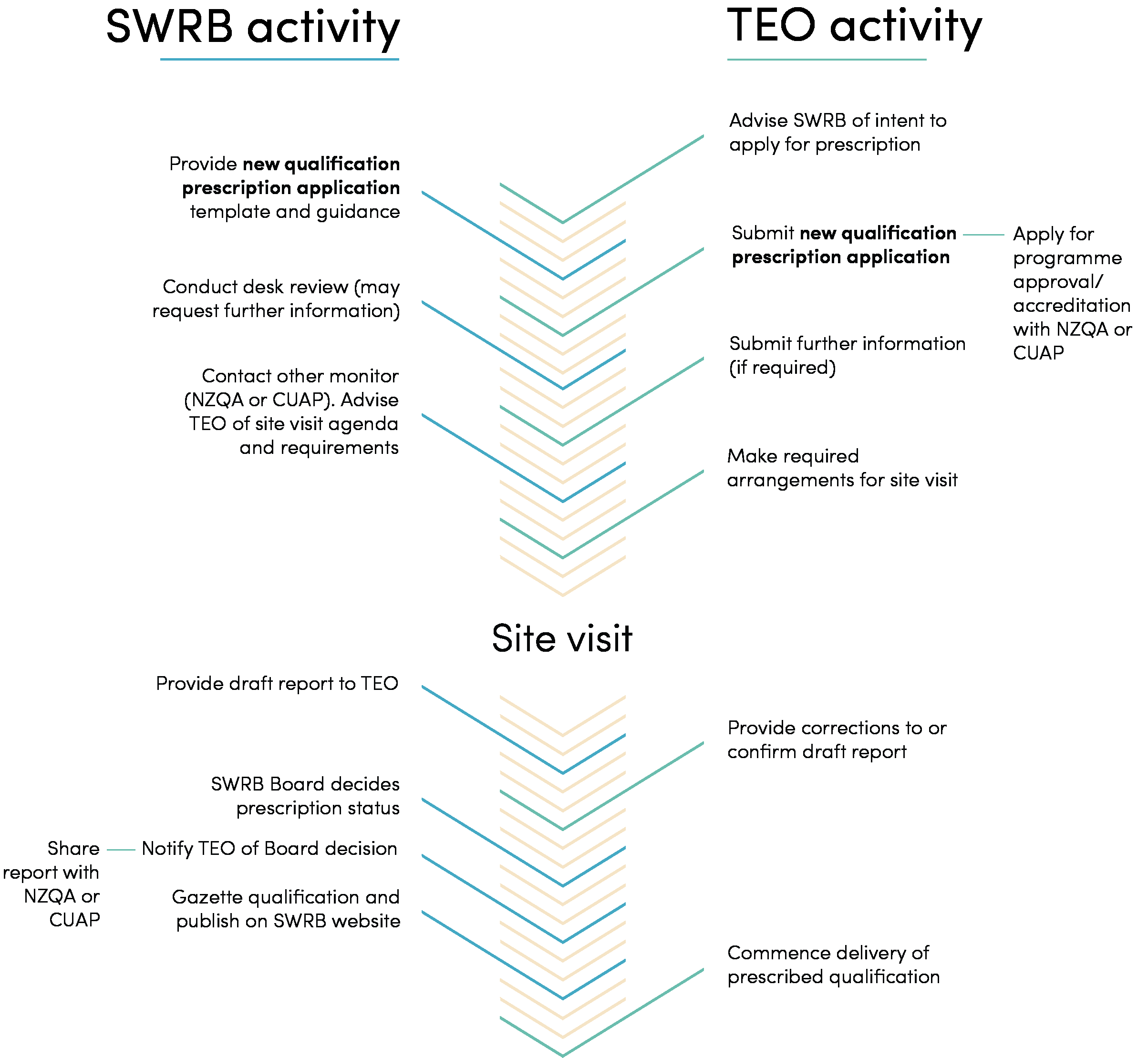
There may be cases where a change listed above is proposed as an isolated matter that does not have
wider impact on the programme and is therefore not classed as a significant change. If you are unsure
whether the proposed changes are significant, the SWRB can provide advice to guide you.
A significantly changed qualification will be assessed by a PMP using the same process as a new
qualification prescription assessment. Please complete the new qualification prescription application
template to apply to have a significantly changed qualification assessed.
Figure 1: Prescription process for new and significantly changed qualifications
4.5 Prescription confirmation assessment
Prescription confirmation is a comprehensive monitoring event that is due four years after the last
prescription event in most cases.
2 The qualification will be assessed by a PMP against all Education
2 In cases where there are significant requirements to meet, the next prescription confirmation may be scheduled for less than
four years, but not less than two years from the most recent prescription confirmation.
Standards to ensure ongoing compliance. Prescription status wil be updated after each prescription
confirmation.
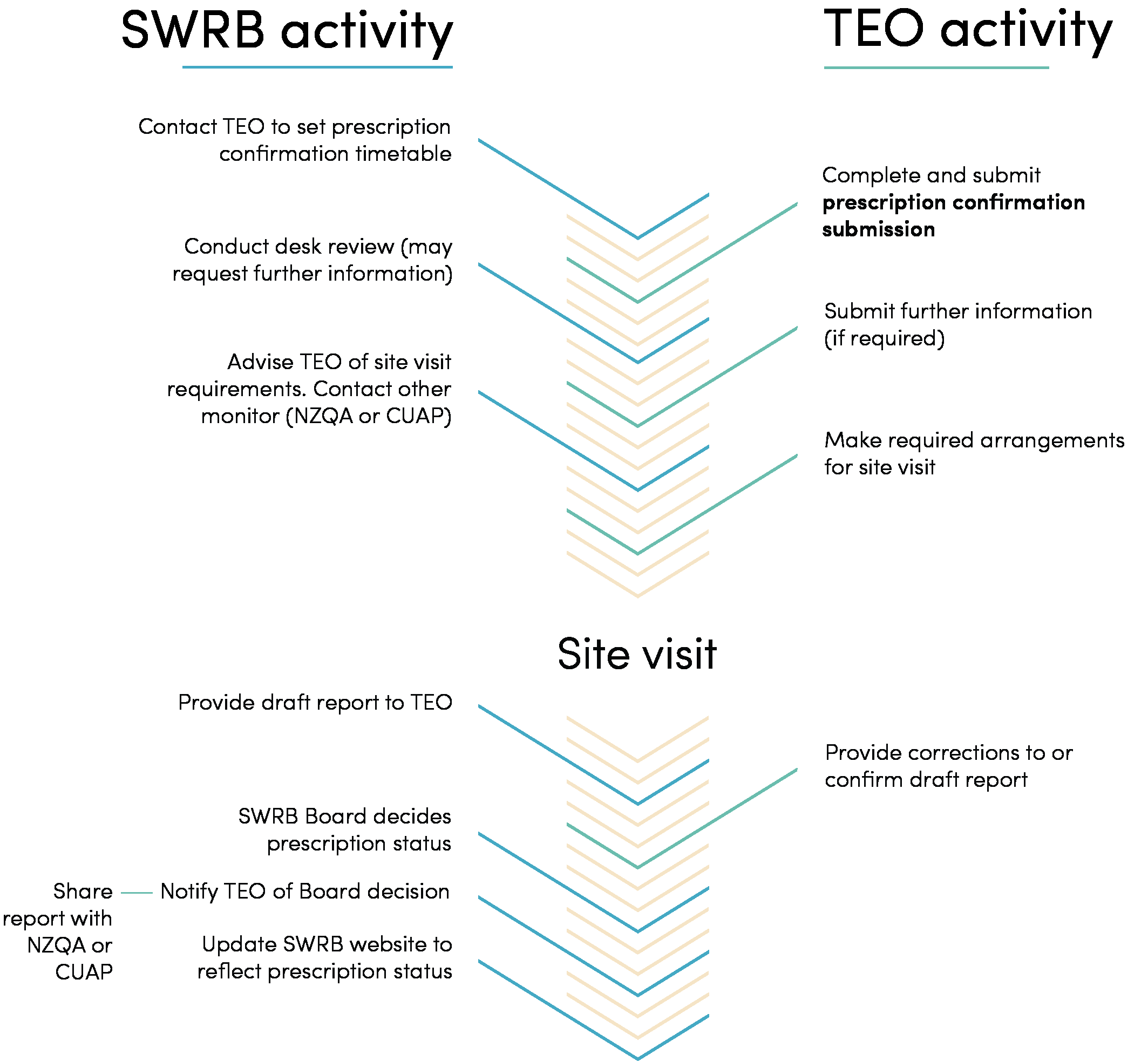
The SWRB wil contact the TEO and provided the submission template approximately one year before
prescription confirmation is due. We recommend starting work on the prescription confirmation
submission early to successfully complete and submit it by the due date. The process for prescription
confirmation includes:
• a desk review of the prescription confirmation submission provided by the TEO to demonstrate
how the programme meets the SWRB Education Standards
• a review of institutional documentation including curriculum by the PMP
• an ākonga survey
• stakeholder engagement
• a site visit (where a qualification is delivered at multiple sites, each site is assessed individually).
Ahead of the PMP assessment visit to your site, we wil send you the visit agenda and let you know our
key lines of enquiry.
Figure 2: Prescription confirmation process
link to page 9
4.6 Prescribing a unified qualification with multi-site/multi-provider delivery
Prescribing or confirming prescription of a unified qualification follows the same process as new
qualification prescription or prescription confirmation with the addition of the following requirements:
• The TEOs must identify a lead TEO with responsibility for maintaining curriculum integrity.
• The TEOs must provide evidence to the SWRB of how delivery would be managed between the
different consortium members.
• Each site from which unified degrees are delivered wil be reviewed by the SWRB as part of the
prescription and monitoring process.
A monitoring visit will be scheduled approximately one year after commencement of programme
delivery.
Specific detail and templates for prescription and monitoring of unified degrees delivered across
multiple sites wil be provided when the new structure of the vocational education and training system
is announced.
4.7 Prescription outcomes
The SWRB takes a right-touch regulatory approach to prescription and monitoring.
3 By grading
prescribed qualifications according to risk, we can monitor these programmes proportionately and
responsively, which aligns with the principles of our Regulatory Strategy. The benefits of this approach
include:
• allowing for commendations
• providing an opportunity to reduce the burden of regulatory compliance where excel ence is
evidenced
• promoting continuous improvement. Feedback provided in prescription and monitoring reports
can be used by TEOs to strengthen their prescribed social work qualifications.
A description of the SWRB’s risk assessment model is provided in Appendix C
When a new qualification prescription assessment or prescription confirmation is completed the PMP
makes recommendations to the SWRB Board. The recommendations include the:
• prescription outcome
• date for next prescription confirmation
• custom monitoring schedule (if appropriate).
Table 1 explains the range of possible prescription outcomes. Further detail on declined and revoked
prescription outcomes follows the table. Section 5 outlines how the SWRB communicates prescription
outcome decisions with TEOs.
3
https://www.professionalstandards.org.uk/improving-regulation/right-touch-regulation Cited 17 March 2025
Table 1
Prescription outcome
What the outcome means
Scheduled monitoring activities
Prescribed with
• The programme has met all Standards, several with
• Annual review
commendation
commendation
• Some recommendations may be made for
improvements
• No requirements
Prescribed
• The programme has met all Standards
• Annual review
• Recommendations for improvements are made
• Custom monitoring, either
• May have some low-risk requirements which can
virtual or on-site visits
reasonably be expected to be met within a short,
specified timeframe
Prescribed with
• Specified requirements must be met within
• Annual review
requirements
timeframe set by the SWRB to meet Standards and
• Custom monitoring by on-site
retain prescription status
visits
• Recommendations may also be made
May be
declined or
• Further detail on prescription being revoked or
If prescription is granted:
revoked
declined is provided in the fol owing sections
• Prescription may be granted for
OR
less than 4 years (but not less
May be prescribed with
than 2 years)
requirements*
• Annual review
• Custom on-site visits
*Where there is a reasonable expectation that Standards can be met within specified time without posing unacceptable risk
4.7.1 Prescription declined
If we assess a new qualification prescription application and find that the Education Standards are not
met, the SWRB may decline prescription. In the interest of natural justice, we wil first provide detail on
what the TEO needs to do to achieve prescription and allow a reasonable time to complete those
requirements.
If a TEO requests reassessment of the requirements within the specified time and our assessment finds
they are al met, the SWRB Board may prescribe the qualification without charging any additional fee. If
the TEO does not request reassessment within the specified time and/or the reassessment finds the
requirements are not met, we will decline prescription and provide a full explanation for the decision.
If a new qualification prescription application has previously been declined, any subsequent application
will be treated as a new application and the full new qualification prescription application fee will be
payable.
4.7.2 Prescription revoked
Prescription revocation is a serious action. Revoking the prescription of a qualification may be required
if the Education Standards are no longer being met to such an extent that we no longer have confidence
that graduates wil have the competence required of social workers in Aotearoa New Zealand and there
is a risk to public safety. Before deciding to revoke prescription, the SWRB Board wil seek the views of
the fol owing groups:
• the TEO management and staff
• relevant social work entities (CSWEANZ, ANZASW, TWSWA)
• ākonga who are currently enrol ed in the programme
• relevant social work employers and mana whenua/iwi groups.
A proposal to revoke prescription wil be provided in writing, including a full explanation of the reasons.
The TEO wil be invited to respond to the proposal to revoke prescription within 20 working days of
receiving the proposal. The response and al other feedback wil be considered by the SWRB Board
before a final decision is made.
When the Board makes a final decision to revoke prescription of a qualification, it will remove that
qualification from the list of prescribed qualifications published in the New Zealand Gazette. The
qualification and date until which it was prescribed will be added to the schedule of historical
qualifications.
Ākonga who graduated with the qualification while it was prescribed by the SWRB remain eligible to
apply for social worker registration in Aotearoa New Zealand. Ākonga who graduate after prescription is
revoked will not be eligible for registration. Ensuring continuity for affected ākonga is outside the
SWRB’s legislative mandate. However, we strongly encourage and wil support the TEO to arrange a
cross-credit agreement to provide a pathway for ākonga to continue their journey towards social worker
registration. More information is provided in section 4.10 (Guaranteed credit agreements).
4.8 Internal reviews and appeals
A TEO can request an internal review of a decision to decline or revoke prescription of a qualification by
lodging a request for review with the SWRB’s Chief Executive within 20 working days of receipt of the
prescription decision. The request must state the grounds on which it is based.
Grounds for internal review are normally limited to errors of fact or breach of policy, Standards and/or
procedures set out in SWRB Guidelines.
The Board wil consider the request and may appoint a review panel of not fewer than one experienced
academic and one experienced practising social worker to investigate the process and decision and
advise the Board. A regulatory and/or evaluative professional may also be appointed to the review
panel.
Where the Board declines to change its decision as a result of an internal review, a TEO may be able to
appeal the Board’s decision to the District Court under section 88 of the Social Workers Registration Act
2003. Such appeals must be brought within 20 working days of the Board’s final decision. If a TEO
wishes to explore this option, the SWRB strongly advises it to seek independent legal advice.
4.9 Discontinued programmes
If a TEO decides to discontinue delivery of a prescribed programme, they must advise the SWRB and
NZQA (for wānanga, PTEs, ITPs) or CUAP (for universities) as soon as practicable. The SWRB wil offer
advice to support the development of an acceptable guaranteed credit agreement (see section 4.10,
Guaranteed credit agreements) to enable ākonga to transfer to another prescribed qualification with
minimal disruption to their course of study.
When discontinuation is confirmed, the SWRB wil remove the qualification from the list of prescribed
qualifications published in the New Zealand Gazette and add it to the schedule of historical
qualifications leading to social worker registration in Aotearoa New Zealand.
4.10 Guaranteed credit agreements
A guaranteed credit agreement (GCA) may be made between two TEOs to provide a pathway for ākonga
to transfer from a qualification that is being revoked or discontinued. Before a GCA is implemented, it
must be approved by the SWRB. This is to ensure that graduate outcomes remain consistent with the
Education Standards.
The SWRB wil provide advice and support for the development of GCAs. There is no fee for this activity.
The GCA must be approved in writing by the SWRB before ākonga enrolments are transferred.
4.11 How the SWRB works with other statutory bodies
NZQA and CUAP are responsible under New Zealand legislation for the approval and accreditation of
degree programmes in Aotearoa New Zealand. Their assessment and monitoring roles to ensure
compliance and quality assurance complement SWRB’s role in prescribing and monitoring social work
qualifications. The SWRB Education Standards are concerned with matters specific to social worker
education and require TEOs to meet al other relevant obligations including those set by NZQA and
CUAP.
The SWRB has a Memorandum of Understanding (MoU) with NZQA to support integrated assessment
and monitoring processes and information sharing. Under the MoU, SWRB and NZQA may convene
joint panels for assessing/monitoring proposed and existing social work qualifications, with panellists
nominated by both parties.
When the SWRB forms a joint panel with either NZQA or CUAP, the SWRB wil provide 2–3 panel
members. These members wil be selected in consultation with NZQA or CUAP to ensure a balance of
expertise. Further detail on the SWRB’s approach to assessment panels is provided in section 7 and
Appendix B.
While NZQA and the SWRB take a collaborative approach to assessment and monitoring, each
organisation has a distinct function and legislative mandate. Following any combined panel assessment
(in col aboration with NZQA or CUAP) the SWRB wil produce an independent report. The SWRB report
wil be shared with the other relevant monitor.
4.12 Monitoring process
Overview
• Prescribed qualifications are monitored by the SWRB. All qualifications are monitored annually at
a minimum.
• Custom monitoring (virtual or on-site) may also be required as indicated by a TEO’s prescription
outcome.
• Monitoring outcomes may include a change to the matrix score (outlined in Appendix C) or
scheduled date of next prescription confirmation.
• The SWRB has discretion to monitor against all Standards or a selected number, according to
identified risk factors.
4.13 Proportionate monitoring
When a TEO commences delivery of a prescribed qualification, the SWRB will begin a cycle of annual
monitoring to ensure ongoing compliance with the Standards. Monitoring is proportionate to risk and
specific to the individual programme. Appendix C provides more detail on how the SWRB assesses risk.
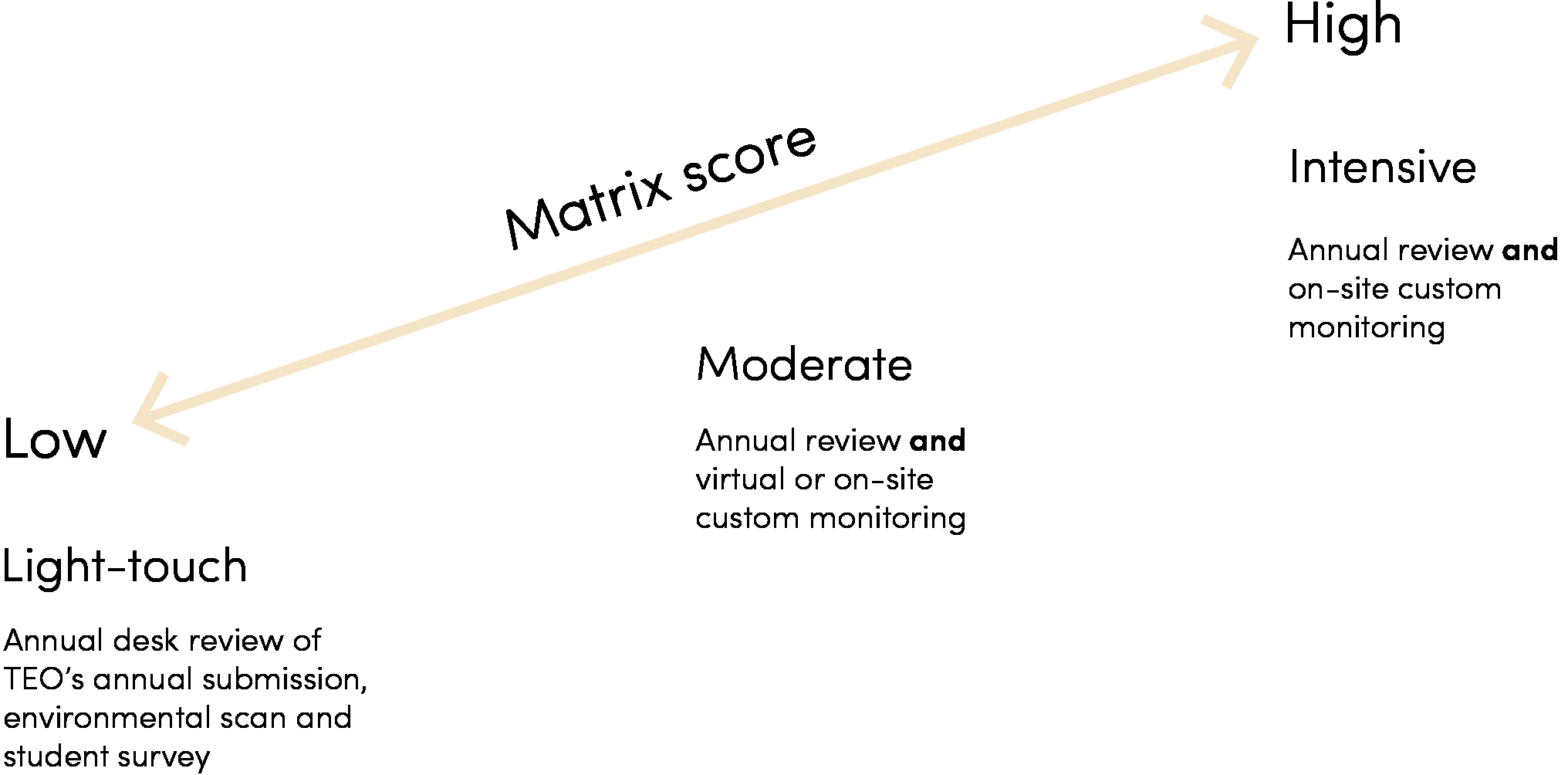
All TEOs wil be monitored annual y, and additional custom monitoring may be scheduled depending on
the prescription outcome.
The type and frequency of custom monitoring wil be determined on a case-by-case basis according to
the nature of the requirements to achieve compliance with the Education Standards.
Figure 3 il ustrates the scope of monitoring options that may be applied.
Figure 3: Proportionate monitoring
4.14 Annual monitoring
All TEOs delivering prescribed social work qualifications are monitored annually. In a year that a TEO
undergoes prescription confirmation an annual monitoring submission is not required. Three elements
form part of each annual monitoring event.
1. TEO annual monitoring submission
The SWRB will provide TEOs with a template for the annual monitoring submission. This
requires the provision of evidence on how the Standards continue to be met and reflection on
progress against requirements and recommendations (if applicable)
2. Ākonga survey
The SWRB wil provide a link to an online ākonga survey to be shared with ākonga via the TEO’s learning
management system. Ākonga wil be invited to complete the survey. Receiving honest feedback from
ākonga is important so the survey will be confidential and anonymous. The survey wil be
complemented by face-to-face interviews and focus groups with ākonga during site visits.
3. Environmental scan
The SWRB wil conduct an environmental scan using data collected across the academic year. For
example, this could include:
• accumulated news reports
• media information
• ākonga or other stakeholder complaints
• mandatory reports
• other relevant data.
The SWRB wil conduct a desk review of the above information and consider whether any changes to
the planned custom monitoring schedule are indicated. If custom monitoring is required, key lines of
enquiry wil be identified by the SWRB, and the TEO advised prior to the custom monitoring event.
NB The information requested in annual monitoring is not replicated in the SWRB’s annual education
data return.
4.15 Custom monitoring
Custom monitoring is designed to ensure that requirements identified at initial prescription or
prescription confirmation are being actively progressed to align with the Education Standards. It is
tailored to the specific TEO with a matrix score of 3 or higher (see Appendix C for explanation).
Custom monitoring is additional to annual monitoring, and its purpose is to ensure progress is being
made against requirements. Prior to each scheduled monitoring event the TEO must complete a
monitoring submission. The format of this submission will vary depending on what is being monitored.
The SWRB wil provide specific information and guidance on the evidence that would demonstrate
progress.
Where lighter-touch monitoring is indicated, the SWRB may determine that a virtual meeting is
appropriate in the first instance. Where necessary, a custom monitoring on-site visit may be required.
The number of panel ists wil depend on the reason for custom monitoring and the expertise needed.
Custom monitoring may be scheduled or unscheduled.
Scheduled custom monitoring
If required, custom monitoring events are scheduled at the time prescription is granted or confirmed.
The frequency and format of custom monitoring wil depend on the nature of the requirements set out
in the prescription outcome.
If monitoring finds that requirements have been achieved and a lower matrix score is justified, further
scheduled custom monitoring events may be changed from requiring a site visit to a virtual visit, or
cancelled.
Unscheduled custom monitoring
Additional monitoring may be required due to any of the following circumstances:
• Annual or scheduled custom monitoring finds an area/s of concern.
• The TEO does not submit their annual submission to the SWRB, or their submission is incomplete.
• The SWRB is notified of a potential breach of Standards.
4.16 Breaches of the Education Standards
Before commencing unscheduled custom monitoring, the SWRB wil make preliminary enquiries in
accordance with the principles of natural justice to confirm whether it is reasonable to suspect a breach
has occurred. We wil contact the TEO concerned in the first instance. Therefore, a notification of a
breach wil not automatical y result in unscheduled monitoring.
Ways in which the SWRB may identify a possible breach of the Standards include but are not limited to:
• ākonga complaints to SWRB or to the media
• adverse media reports on teaching, staffing, or course outcomes
• staff complaints
• concerns raised directly with the SWRB
• poor retention rates in comparison to other TEOs
• employer feedback
• mandatory reports.
Where a breach is identified, the SWRB may conduct custom monitoring (see section 4.15).
4.17 Monitoring outcomes
Matrix scores may be adjusted as an outcome of monitoring if:
• evidence is provided to show requirements and/or recommendations have been met, or
• a breach of the Standards is discovered.
Depending on the nature of change to a matrix score the following may occur:
• scheduled monitoring events may be cancelled or conducted virtually instead of on-site, or
• additional unscheduled monitoring events may be required.
If the PMP proposes additional monitoring events, we will share the reasoning behind the proposal with
the TEO and invite feedback. After considering the TEOs response, the SWRB will make a final decision on
whether to schedule additional monitoring.
While monitoring may result in a change in matrix scores, it will not impact the prescription status
published on the SWRB website. Prescription status is only updated at the time of prescription
confirmation.
5 SWRB reporting
A key objective of the prescription and monitoring process is to encourage continuous improvement by
TEOs in the delivery and quality of prescribed social work programmes. The SWRB contributes to the
continuous improvement of each TEO’s programme through reporting on the prescription and
monitoring of qualification delivery.
5.1 Prescription assessment and confirmation reports
At the end of the final roundtable of the site visit, the panel lead wil give the TEO executive and
programme lead a verbal indication of the PMP’s emerging recommendation to the SWRB Board.
If the SWRB has no further requests for information, a provisional prescription assessment or
confirmation report wil be provided to the TEO within 20 working days of a PMP visit. The report is a
summary of findings and includes:
• the matrix score
• the prescription status
• any commendations, recommendations and requirements for the TEO, with rationale
• an outline of proposed custom monitoring (if any), with rationale
• the year in which the next prescription confirmation event is proposed (if qualification is
prescribed).
The TEO has 20 working days from receipt of the provisional report to clarify any factual errors. After
the 20 working days have passed, the report wil be presented at the SWRB Board’s next scheduled
meeting for decision. The final report wil be released to the TEO within 20 working days of that Board
meeting.
5.2 Monitoring reports
The SWRB wil provide a monitoring report to the relevant TEO within 20 working days of every custom
monitoring event.
A monitoring report will only be provided following annual monitoring if custom monitoring plans are
changed. This may happen if:
• a TEO provides evidence of significant improvement in meeting requirements. In this case,
scheduled monitoring may be conducted virtual y instead of requiring an on-site visit,
rescheduled to a later date, or custom monitoring events may be cancelled as they are no longer
required.
• concerns arise about a possible breach of the Standards. In this case, custom monitoring may be
scheduled or upgraded from virtual to on-site visit according to the nature of the monitoring
findings.
Monitoring reports include the updated matrix score and rationale for the change. If a matrix score is
being raised and results in the addition of unscheduled monitoring events, a provisional report wil first
be provided. The TEO wil have 20 working days to provide feedback before the matrix score and report
are finalised.
5.3 Thematic reporting
Every year, the SWRB wil produce an annual prescription and monitoring report on the aggregated
analysis of trends emerging from within the social work education sector.
These “Learnings From” Reports will be collated from education visits and other engagement activities
across the academic year (January to December), including the annual SWRB ākonga survey. This
composite thematic report wil provide a broad overview of issues, trends, innovations, and chal enges.
It wil also col ate requirements, recommendations, and commendations. This report wil be directly
shared with TEOs and other key stakeholders and available to the public via the SWRB website.
Wherever possible, and in the spirit of continuous improvement learnings and case study examples will
be shared, with the agreement of the TEO, as notable practice examples.
5.4 Publication of prescription reports
When a decision to prescribe a new qualification is made, the prescription status of the qualification
wil be gazetted and published on the SWRB website. This information wil be updated as any changes
occur.
Our intent is to move towards publishing reports in ful for each TEO’s prescription assessment and
confirmation. We do not envisage that the reports will contain any personal or commercially sensitive
information. TEOs are expected to ensure that current and prospective ākonga are aware of the current
prescription status of their programme(s).
6 Prescription and monitoring panels
The purpose of the prescription and monitoring panel (PMP) is to provide expert advice and
recommendations to the SWRB Board on:
• whether proposed and currently prescribed social work qualifications meet the SWRB Education
Standards
• prescription status
• proposed monitoring programmes.
The PMP wil assess the evidence provided, obtain feedback from other sources including stakeholders,
and make recommendations to the SWRB Board on any proposed or existing social work qualification
leading to registration.
Under the Act, the Board is responsible for all prescription
6.1 Panel composition and monitoring decisions
The SWRB will appoint a panel to assess each qualification being proposed or confirmed. If required, a
panel may also be appointed for custom monitoring.
Panel members wil be selected to ensure the required expertise is available to provide robust
independent judgement on whether a qualification meets the SWRB Education Standards. A panel lead
will be appointed to direct panel activities.
Panels will be constituted to ensure inclusion of social work, tertiary education, te ao Māori, regulatory,
and evaluative experience.
Appendix B outlines the composition and activities of PMPs in more detail.
Appendix A
Weaving kaupapa Māori into the future of social work education and
regulation
He ara pūkenga, he ara tauwhiro, hei whakamana mātā waka
The many pathways of knowledge, the many pathways of social work, upholding
the dignity of all
The purpose of the Social Workers Registration Act 2003 (the Act) is to protect the safety of the public
and enhance the professionalism of social workers. To this end the Board has designed the SWRB
Education Standards 2024 to ensure that graduates of prescribed social work programmes have the
knowledge, skil s and competence to practise social work safely. Section 100 of the Act requires the
Board to ensure the aims and aspirations of Māori are an ongoing priority. Tangata whenua advisors
and some key Māori models have guided and informed the development of the Education Standards
and prescription and monitoring methodology.
He Arapaki, the SWRB Māori Development Strategy and Action Plan, aligns closely with the key
principles and responsibilities set out in the Act. He Arapaki embeds kaupapa Māori into the SWRB’s
approach, drawing on important frameworks such as Pūao-Te-Ata-Tū, Tukutuku Rau, and the
Kaitiakitanga framework. These frameworks along with other Māori models, ensure that social workers’
competencies are grounded in Māori knowledge systems and values, reinforcing the Board’s obligations
under section 100 of the Act to prioritise Māori aspirations and involvement in the regulatory
framework.
The SWRB whakatauākī captures the connection between Māori values and the SWRB’s regulatory role
in setting educational standards.
• He Ara Pūkenga – drawing on ancient Māori knowledge and teachings
• He Ara Tauwhiro – embedding Māori esoteric knowledge into core business functions
• Hei Whakamana Mātā Waka – ensuring the SWRB is a modern regulator through active
partnering with Māori.
‘Pathways of knowledge’ and ‘pathways of social work’ reflect the Board’s regulatory responsibilities to
ensure that TEOs develop qualifications that produce social work graduates who are qualified to apply
for registration under the Act.
These pathways are aligned with the SWRB's core values – matatika, manaaki, mahitahi, and māia –
which correspond to the Pou of the Education Standards: rangatiratanga, manaakitanga, kaitiakitanga,
al bound together by the unifying principle of whakawhanaungatanga. The Pou of the SWRB Education
Standards represent the structural elements of a wharenui (meeting house). They symbolise the
broader cultural and social responsibility to protect, guide, and uplift the profession, in a way that
honours Te Tiriti o Waitangi. The SWRB Education and Training Framework not only meets the SWRB’s
legal and regulatory obligations but also guides a culturally responsive and inclusive approach to social
work practice in Aotearoa New Zealand.
Te Pou Tūhono
Te Pou Tūhono reflect the centrality of people and relationships in social work education:
• Rangatiratanga | Governance
• Manaakitanga | The ākonga journey
• Kaitiakitanga | Curriculum and field education.
The Pou of Whakawhanaungatanga is embedded throughout.
The SWRB is committed to ensuring that there is tangata whenua representation on al prescription and
monitoring panels (See Appendix B).
Appendix B
Prescription and monitoring panels
A prescription and monitoring panel (PMP) for new qualification prescription and prescription
confirmation is comprised of a minimum of three to a maximum of six people with evaluative,
monitoring and assessment experience. The other areas of expertise required on each panel is outlined
below under the heading ‘Essential panel membership’. Panel members
are likely to bring expertise
from more than one area.
All panel members are:
• recommended to the Board by the Registrar
• approved by the Board
• trained and inducted according to SWRB prescription and monitoring requirements
Essential panel membership
In addition to evaluative, monitoring & assessment and regulatory experience, the following expertise
will be required on each panel:
• Panel chairing experience
• Social work education experience including a registered social worker with social work academic
experience
• Tangata whenua/te ao Māori representation
For custom monitoring, panel membership may be less than three people depending on the reason
custom monitoring is required. This is discussed in section 4.15
Additional panel membership
In some instances, panels may include additional members with regulatory and/or educational
evaluative experience and expertise. Where the inclusion of additional panellists is deemed necessary,
the SWRB wil inform the TEO of the rationale. Examples of expertise that may be brought by additional
panel members includes:
• Non-social work academic/educator
• International social work academic
• Employer of social workers and/or field work placement provider
• Recent social work graduate (less than 5 years since qualification).
Additional panellists will only be used if additional expertise is required. The SWRB would only include
an international social work academic if they are already in Aotearoa New Zealand and hold a current
New Zealand practising certificate.
Cost to the TEO is a key consideration and panels wil be constituted with the minimum number of
people the SWRB considers necessary to effectively evaluate whether the qualification and programme
delivery meets all regulatory requirements.
Conflicts of interest
Panel members must disclose any conflict of interest (known or perceived) upon invitation to join a
panel. The TEO wil be advised of the proposed panellists and asked to declare any conflict of interest
(known or perceived) before the panel membership is finalised for a particular prescription or
monitoring event.
Observer
An observer may be included in the panel. The observer does not participate in making
recommendations to the SWRB Board but is included to build capability in regulatory evaluation of
social work programmes. An observer may be asked for their observations on the panel process or
findings after a report is completed, supporting the SWRB’s commitment to continuous improvement.
Inclusion of an observer in a panel would be cost-neutral to the TEO.
Prescription and monitoring panel activities
The assessment and monitoring activities undertaken by each panel wil vary depending on the purpose
(new prescription, prescription confirmation or monitoring) and current matrix score (in the case of
monitoring). Panels will follow the SWRB methodology for prescription and monitoring, applying the
SWRB values and Regulatory Strategy. Activities may include:
• Desk reviews of documentation submitted by TEOs
• Planning key lines of enquiry for site visits, virtual monitoring, and requests for further
information
• Virtual interviews – may be a selection of panel or whole panel
• Site visits – if required, up to 3 panel members may attend a site visit. The panel lead wil decide
which panel members should attend, based on key lines of enquiry for the visit
• Producing a report to the SWRB Board including advice and recommendations on prescription
status, custom monitoring and timing of next prescription confirmation
 Appendix C
How the SWRB assesses risk in prescription and monitoring
The SWRB uses a risk assessment model to prescribe and monitor according to need, rather than
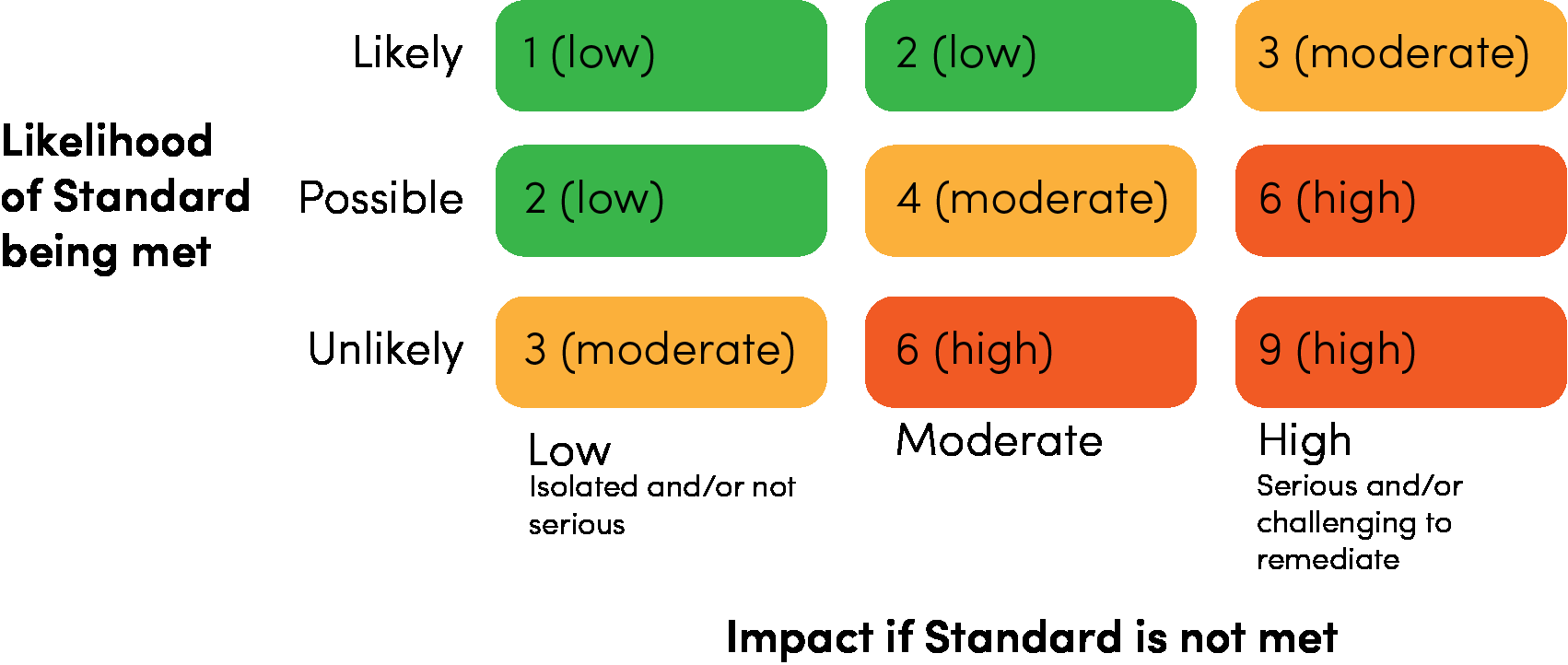
employing a one-size-fits-al methodology. The SWRB uses a three-by-three matrix (Figure B1) which is a
standard tool used across business, assessment and regulation. Using this matrix, we map the likelihood
of each Standard continuing to be met against the severity of impact if the Standard is not met during
the prescription period.
Every Standard will be scored by the prescription and monitoring panel. A matrix score of 6 or 9 will
indicate to the panel that a requirement should be issued so the TEO can improve compliance with that
Standard. The matrix scores for al Standards are then considered and an on-balance decision is made
to reach the overal matrix score. Scores for each Standard are not averaged as there are many variables
which can be weighted differently.
Regulatory judgement wil be used by the prescription and monitoring panel (PMP) to determine the
overall matrix score which determines the prescription status of a qualification. Evidence provided by
the TEO, and the rationale applied to that evidence for the score given, will be clearly stated in
prescription and monitoring reports.
Figure C1: Risk matrix
To inform the overal matrix score, the PMP wil consider the requirements that must be met to keep a
TEO compliant with the Education Standards. Requirements that are simple to achieve in a short
timeframe will carry less weight and may result in a lower overal matrix score. Complex requirements
that are expected to take a longer time to achieve wil carry more weight and may result in a higher
overall matrix score.
The extent and frequency of monitoring activities and the time before the next prescription
confirmation may vary depending on a TEO’s overal matrix rating and the factors that contribute to it.
Table C1 provides a high-level view of how prescription outcomes are determined by the overall matrix
score.
Table C1: Translating matrix scores to prescription outcomes
Matrix score
Prescription outcome
1 or
2 (low risk)
Prescribed with commendation
3 or
4 (moderate risk)
Prescribed
6 (high risk)
Prescribed with requirements
May be declined or revoked
9 (severe risk)
or
May be prescribed with requirements*
*Where there is a reasonable expectation that Standards can be met within specified time without posing unacceptable risk
Document Outline
