
 E.73
E.73
Statement of Performance
Expectations 2024/2025
For the period ending 30 June 2025
1
SWRB Statement of Performance Expectations 2024/25
link to page 3 link to page 5 link to page 6 link to page 7 link to page 7 link to page 7 link to page 8 link to page 8 link to page 9 link to page 10 link to page 13 link to page 13 link to page 13 link to page 14 link to page 16 link to page 17 link to page 17 link to page 18 link to page 18 link to page 19 link to page 21 link to page 21 link to page 21 link to page 21 link to page 21 link to page 24
Contents
Foreword ............................................................................................................. 3
Board Statement ................................................................................................................................... 5
Who we are ......................................................................................................... 6
Our role as the social work occupational regulator and workforce planning lead ................. 7
Our Regulatory role .......................................................................................................................... 7
Our Workforce Planning role .......................................................................................................... 7
Our role as a Crown Agent ............................................................................................................. 8
How we are funded ......................................................................................................................... 8
Our values............................................................................................................ 9
Key areas of focus for our work programme for the year ahead ............. 10
Statement of Performance Expectations 2024/2025 ................................... 13
Output Class: delivery of mandatory registration and workforce planning for all social
workers .................................................................................................................................................. 13
How we wil measure performance ................................................................................................. 14
Prospective financial statements ..................................................................... 16
Statement of prospective comprehensive revenue and expense for the SWRB for the year
ending 30 June 2025 ........................................................................................................................ 17
Statement of prospective changes in equity for the SWRB for the year ended 30 June
2025 .................................................................................................................................................... 18
Statement of prospective financial position for the SWRB as at 30 June 2025..................... 19
Notes to the prospective financial statements ............................................... 21
Basis of preparation ............................................................................................................................ 21
Changes in accounting policies ......................................................................................................... 21
Functional and presentation currency ............................................................................................. 21
Significant accounting policies .......................................................................................................... 21
Crown Copyright ............................................................................................... 24
2
SWRB Statement of Performance Expectations 2024/25
Foreword
Ka huri te kei o te waka ki te pae tawhiti
Kia hoe ngātahi ki te pae tata
As the SWRB looks forward to 2024/25, we wil continue to build on the progress made over
the last three years fol owing the transition to mandatory registration. It has been a period of
great change, which included our expansion into the lead agency role of workforce planning
for al social workers. We have now entered a steadier state. With our continuous
improvement approach, we have a strong platform from which to build our work
programme for the year ahead.
Our priorities and work programme are delivered across our three areas of focus as an
organisation - regulator, social worker workforce planning lead and Crown agent.
In our regulatory role, we seek to lift our performance and service using operational insights.
In 2024/25 we wil develop and trial our regulatory strategy. This wil lead to further
improvements as we update and improve policies and procedures. We wil complete a
review of the register database to ensure it is of sufficient quality to provide information to
organisations and the public, ensuring that social workers can be held accountable and that
their practising status is transparent. We are actively refining and improving our use of
technology (such as the iMIS platform for the register) to support more efficient service
delivery and real-time insights in a cost-effective way.
Alongside work on the regulatory strategy and register development, we wil be undertaking
other key regulatory activity relating to both our education and our complaints and
disciplinary functions. The 2024/25 year wil see the introduction of the revised education
standards and we wil be working with education providers on their implementation and
monitoring. For complaints and notifications, we wil be developing more efficient systems,
making use of insights from our register to guide and inform our work. We will also be
working to further embed the Social Worker Disciplinary and Complaints Tribunal secretariat
function, which moved inhouse from an external provider towards the end of the 2023/24
year. This allowed for greater oversight and reduced the cost of administering our
disciplinary functions.
In an area that spans our regulatory and workforce areas, we wil be exploring potential new
pathways into social work. This may include how scopes of practice can be applied to
provide an end-to-end career pathway. In 2023/24, as part of the pay equity settlement for
community-based social workers, we undertook work to better understand roles being fil ed
within social services and health which overlap significantly with traditional social worker
roles, but without the safety provisions that a regulatory framework provides. This will inform
some of our thinking over how a career pathway could look both under our existing
legislation, and in the future as the review of our Act is initiated. Part of this wil include
working with other organisations such as Ministry of Social Development.
3
SWRB Statement of Performance Expectations 2024/25


Our workforce planning role continues to build from previous years, where we have seen
positive progress made, especially in relation to linkages with the health sector. We have
worked constructively with health to augment workforce planning data and bring visibility to
the social worker workforce in the health context – social workers being the largest regulated
profession within the Allied Health workforce. The 2024 Annual Social Worker Workforce
Survey will continue to provide valuable insight into the social worker workforce and will
underpin reports and insights published in the 2024/25 year. We look forward to undertaking
further activity with employers to identify where workforce shortages are most acute and to
support work with decision makers and policy makers to identify and address barriers.
At an organisational level, we continue to ensure that our processes and policies align with
the guidance set down by the Public Service Commission for Crown Agents. In addition,
because we want to ensure that we are transparent for the way we operate, we wil be
piloting a Code of Service in 2024/25. As wel as setting out service expectations to which we
may be held to account, we are developing a pathway for the public to raise concerns about
us. We want to use these opportunities and this feedback to learn and grow as part of our
journey.
Finally, we would like to acknowledge the incredible work of social workers. They provide
invaluable skills, experience, and insights into the whānau, communities, children and tamariki
with whom they work. We continue to see echoes of the chal enges in a post-Covid
environment where parts of New Zealand have also been wrestling with the consequences of
natural disasters. Social workers are often at the forefront of rapid response and addressing
those in highest need of assistance across a diverse range of scenarios. In this frontline role,
high standards of professional practice and accountability are essential to the public, and to
the communities social workers serve.
The year ahead provides SWRB with further opportunities to lift and refine our performance
and we are committed to doing so. We express our thanks and appreciation to the members
of the Board and the Secretariat for their ongoing work and commitment.
Shannon Pakura,
Sarah Clark
MNZM, RSW
Chief Executive,
Chair, SWRB
SWRB
4
SWRB Statement of Performance Expectations 2024/25

Board Statement
This SPE reflects our proposed performance targets and forecast financial
information for the financial year 1 July 2024 to 30 June 2025.
This SPE is produced in accordance with the requirements of section 149E of the
Crown Entities Act 2004.
The forecast financial statements and underlying assumptions in this SPE have been
authorised as appropriate for issue by the Board of the SWRB, in accordance with its
role under the Crown Entities Act 2004.
The Board acknowledges responsibility for the information and prospective financial
statements contained in this SPE.
Signed on 21 June 2024
Shannon Pakura, MNZM, RSW
Adam Davy
Chair, SWRB
Chair, Finance Audit and Risk Committee,
SWRB
5
SWRB Statement of Performance Expectations 2024/25
Who we are
6
SWRB Statement of Performance Expectations 2024/25
Our role as the social work occupational regulator and
workforce planning lead
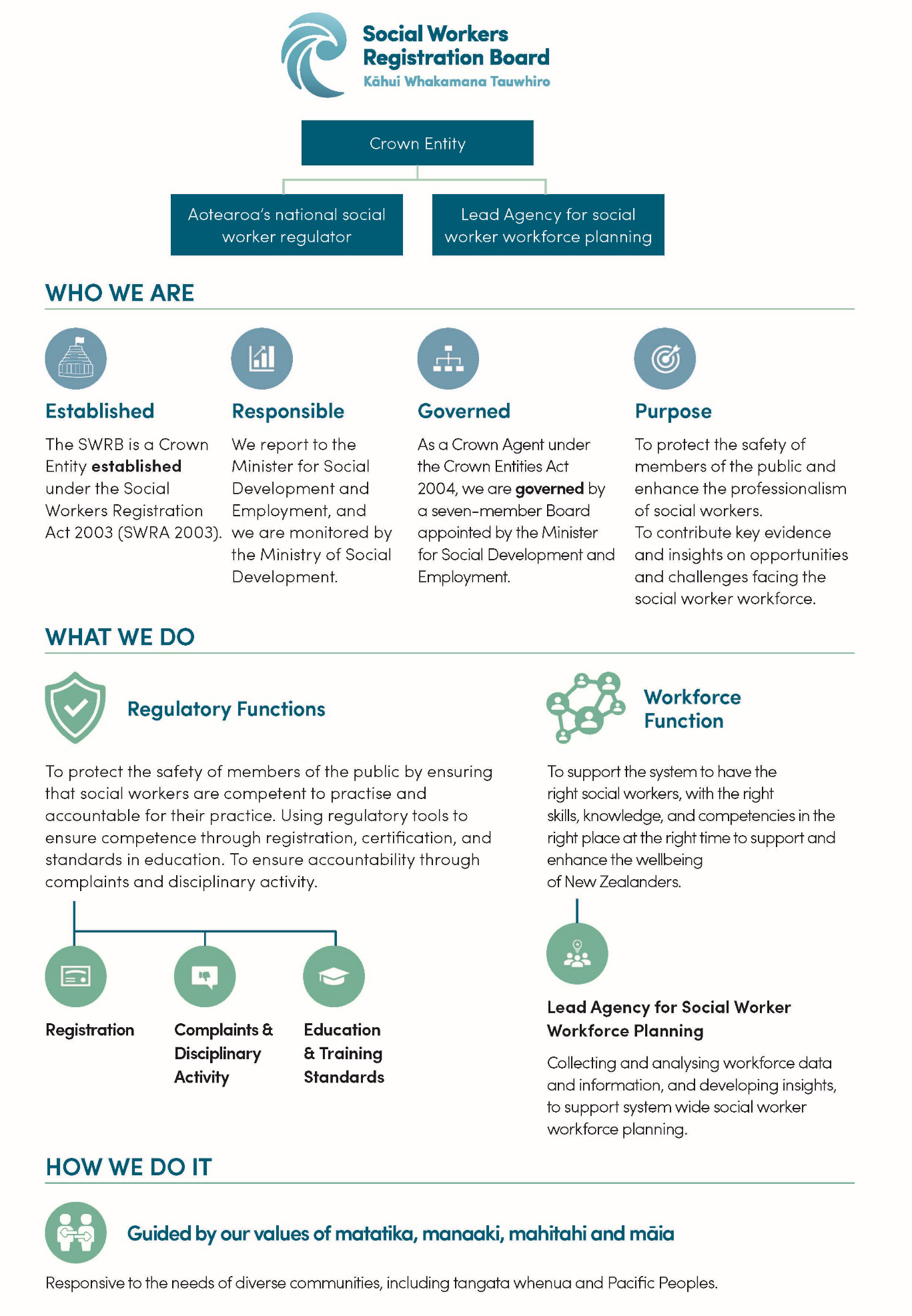
The Social Workers Registration Board (SWRB) is New Zealand’s occupational
regulator of the social work profession, established under the Social Workers
Registration Act 2003. In 2021, we were also assigned the role of lead agency for
workforce planning for all social workers. As a Crown Agent under the Crown Entities
Act 2004, we are monitored by the Ministry of Social Development and accountable
to the Minister for Social Development and Employment.
Our purpose is to protect the safety of members of the public by ensuring social
workers are competent and safe to practise and are accountable for the way in
which they practise. We also enhance social workers’ professional practice and
provide insight into the opportunities and challenges facing the social worker
workforce.
Our organisation has three key areas of focus: Regulatory, Workforce Planning and
Crown. For more detail around these pillars and the SWRB’s long-term outlook,
please refer to ou
r Statement of Intent 2024-2028 and our
Outcomes Framework
2024
Our Regulatory role
Our role as the regulator of social workers is set out in the Social Workers Registration
Act 2003 and includes enhancing the professionalism of social workers. We use a
range of regulatory tools, including:
the registration of social workers and maintaining a public register of social
workers
issuing practising certificates
publishing a scope of practice, code of conduct, and core competencies
managing concerns, complaints, and notifications
prescribing standards in social work education.
Our Workforce Planning role
The SWRB is the Lead Agency for workforce planning for all social workers and has
held the role since 2021. In the early stages of this workforce planning role, we been
focused on building our evidence base through collecting and reporting workforce
data, and building connections across the sector. Growing this knowledge base
remains key to understanding the pressures facing the workforce, and is an integral
part of our approach to workforce planning to date.
7
SWRB Statement of Performance Expectations 2024/25
This past year we have made substantial progress in strengthening linkages between
key agencies and employers to support connection, communication and
collaboration around priorities for tackling their workforce issues. In the 2024/25 year
we will expand on activity to combine these data insights and sector relationships,
highlighting risks and opportunities for the social work workforce in the immediate
and long term. This will include a focus on building a sector-wide Workforce Strategy
and Action Plan. A key component for developing this strategy will be undertaking a
survey of employers to better understand the requirements, pressure points and
opportunities that employers are facing. This will be used to frame development of
the strategy.
Our role as a Crown Agent
The SWRB is a Statutory Crown Agent under the Crown Entities Act 2004. As part of
the Crown, we must meet the requirements of the Crown Entities Act, the Public
Service Act 2020, and the Public Finance Act 1989, as well as our own establishment
legislation. The SWRB is governed by a seven-member Board appointed by the
Minister for Social Development and Employment.
How we are funded
We run a cost recovery model for our regulatory practices, in line with Auditor
General and Treasury guidelines for setting fees. This is similar to other regulators in
New Zealand. The fees and disciplinary levy are set by the Board and imposed by a
Gazette Notice under sections 108 and 109 of the Social Workers Registration Act
2003. In summary:
Registration fee – recovers the cost of an activity the SWRB provides directly to an
individual registered social worker, an individual applying for registration
(regardless of success), or an education provider.
Disciplinary levy – paid annually by registered, practising social workers, or their
employer on their behalf. Recovers the cost of complaints and notifications and
disciplinary proceedings.
Practising Certificate fee – paid by a registered social worker (or their employer
on their behalf) who wishes to practise. Practising certificates are renewed
annually for those who wish to continue to practise. Recovers the cost of
processing the application, and the balance recovers the cost of the SWRB’s
functions.
Education and Training programme fees – paid by the education providers
annually to recover the cost of the SWRB’s functions attributable to them. It is
anticipated that the approach to funding the regulatory education function will be
reviewed early in the term of this SOI, as a result of refreshing the Education
Standards. In addition, the development of the Training framework with possible
training standards would be required to operate on a cost recovery basis.
8
SWRB Statement of Performance Expectations 2024/25




The SWRB also receives funding from the Crown, with ongoing funding for the
Workforce Planning role, as well as Crown funding related to public good obligations
due to our status as a Crown agent.
Our values
Our purpose, areas of focus and outcomes are delivered in alignment with ō matou
uara (our values). Ō mātou uara support us to fulfil our aspirations in a way that
recognises that the way we work, to uphold the mana of all, is as important as our
deliverables.
Matatika
Manaaki
To do what is right and just, ethical, fair,
To look after the dignity of others, to
equitable, honest, unbiased, impartial,
support, to tend to, take care of, protect,
moral, trustworthy.
look out for, show respect, generosity and
kindness towards others.
Mahitahi
Māia
To work together as one, collaborate,
To be bold, brave, capable, confident,
cooperate, co-design, connect, interact, courageous, to have endurance, strength,
reciprocate, discuss, debate, work in unity
resilience.
with teamwork and synergy.
9
SWRB Statement of Performance Expectations 2024/25
Key areas of focus for our work programme
for the year ahead
Our work programme for 2024/25 is centred around our journey of continuous
improvement. Three years after the introduction of mandatory registration, we are
meeting our core legislative requirements, and can increase our focus on being a
responsive, trustworthy and effective modern and risk proportionate occupational
regulator.
In the coming year we have a full work programme which includes activity across the
three pillars of our organisation as shown below. The table also includes reference to
the associated performance measures for the focus areas (found on page 14):
Regulatory focus areas for 2024/25
Associated
performance
measure
Our work programme for the regulatory space is designed to support us to lift our regulatory
performance, using operational insights to inform our system-wide perspective while
maintaining a high level of service. We continue to deliver our baseline functions as per our
statutory obligations.
In 2024/25, we will have a particular focus on:
Developing a regulatory strategy to be finalised and trialled in 2024/25. This SPE(QT)4
involves updating and improving our internal policies and procedures with the SPE(QL)1-2
goal of increasing capability.
SPE(QL)4
Increasing social worker capability by implementing new education SPE(QL)6
standards. In 2023/24 we developed new education standards which social
work education providers must meet to ensure that social work graduates are
competent and safe to practise as they enter the workforce. As part of the work
around capability, we wil also be developing an education and training
framework with a view to setting training standards. The aim is to ensure there
is a more robust system for training courses within the regulatory space.
Exploring and building pathways into the profession, such as through SPE(T)3
additional Scopes of Practice.
Developing a more efficient complaints and notifications system. Since the SPE(T)2
introduction of mandatory registration, we have seen a continued increase in SPE(T)4
the number of complaints that we receive about social workers. This activity
reflects the ‘downstream’ enforcement end of regulation, and we need to
ensure that what we do is fit-for-purpose, proportionate, and meets the
requirements of our legislation: to ensure public safety. We have better
integrated complaints into our register database, enabling us to draw on
insights about the workforce to guide and inform our complaints and
notification work, and to achieve a more efficient system using existing
10
SWRB Statement of Performance Expectations 2024/25
Regulatory focus areas for 2024/25
Associated
performance
measure
technology. We will also implement a revised risk assessment framework along
with a focus on building employer understanding of mandatory reporting
requirements for social workers.
Embedding the Social Worker Disciplinary and complaints Tribunal SPE(T)2
secretariat function. Towards the end of 2023/24 year, the secretariat functions SPE(T)4
moved from an external provider to being delivered in-house at SWRB. This
allows for greater oversight of processes, and also reduces costs of the
Tribunals administration. We will establish a new Tribunal website and ensure
that there are clear delineations of responsibility, maintaining independence
between the Tribunal and wider regulatory functions.
Improving the pathway for overseas qualified social workers as we deal with SPE(T)1
a workforce shortage, while maintaining the required standards of professional
practice.
Workforce planning focus areas for 2024/25
Associated
performance
measure
As the Lead Agency for workforce planning for all social workers, we collect and share
evidence about the social worker workforce, including pressures and challenges for the
workforce now and in the future. We also build and maintain cross-system relationships with
key workforce partners such as employers and social work education providers, among
others.
As we reach three years since mandatory registration came into effect, we are better placed
to build the connection between workforce planning and our occupational regulatory
activities.
In 2024/25, we wil have a particular focus on:
Continued administration and reporting on our annual workforce and SPE(QT)1
education provider surveys to inform our understanding of the workforce, SPE(QL)5
and those entering through the NZ qualification pathway to registration. Over
the 2024/25 year, we plan to build on our insights and reporting from these
data sources, responding to topics of interest for internal and external
audiences and stakeholders. This will include a survey of social work
employers. We will be providing advice to the Minister on insights gathered,
including short to medium-term recommendations for actions to support
addressing workforce shortages.
Building on our connections and relationships with stakeholders and SPE(QL)5
partner organisations such as employers and decision-makers. Our ‘whole of
system’ approach means we work to identify opportunities to share
11
SWRB Statement of Performance Expectations 2024/25
Workforce planning focus areas for 2024/25
Associated
performance
measure
information and col aborate on issues affecting workforce sustainability. We
have observed a ‘missing link’ where the social work workforce is often
omitted from subsets of planning and strategic discussions in some service
delivery areas. Work wil also begin in 2024/25 to support the development of
a cross-sector Workforce Strategy and Action plan with a view to having this
completed in the 2025/26 year.
Exploring potential new pathways into social work, which sits across our SPE(T)3
workforce planning and regulatory functions. Our role extends to identifying
issues of workforce sustainability, shortages and risks, and potential solutions,
while also ensuring that we have a competent and safe workforce.
Organisational capability and Crown Agent focus areas for 2024/25
Most of our activity as an organisation relates to our regulatory function, augmented by our
workforce planning role. These roles intersect with our obligations as an agency of the
Crown. As such, we undertake tasks that relate to the obligations of our Crown agent status,
including implementing the Enduring Letter of Expectations, and standards set down by the
Public Service Commission.
In line with our update to the SWRB Outcomes Framework in 2024, we have made our
commitment to increasing SWRB organisational capability and effectiveness more explicit
and measurable.
In 2024/25, we wil have a particular focus on:
Continued adherence to public sector requirements and standards Requirement as
across a range of areas such as the Official Information Act, Public a Crown Agency
Records Act, employment standards as well as reporting and monitoring
as required.
Initiating an operational review of the Act and organisation during the Requirement as
2024/25 year. This is an opportunity to ensure that our legislation is fit for a Crown Agency
purpose, in light of the change to mandatory registration in 2021.
Completing a review of our Crown funding model, to augment the Fee Requirement as
and Levy Review undertaken in 2023/24.
a Crown Agency
Increasing SWRB staff and Board understanding of the regulatory SPE(QL)3
environment, and the SWRB’s role as an occupational regulator in the SPE(QT)4
wider regulatory system. This includes:
Regulatory stewardship, taking a whole-of-system, proactive
approach
Understanding of te ao Māori in a regulatory context.
12
SWRB Statement of Performance Expectations 2024/25
Statement of Performance Expectations
2024/2025
Output Class: delivery of mandatory registration and workforce
planning for all social workers
The following Statement of Performance Expectations (SPE) sets out the outputs the
SWRB is funded to provide and the standards against which we will assess our
performance.
Our SPE outlines the performance expectations of the SWRB for the year ending 30
June 2025, covering both service performance and the prospective financial statements
that are agreed with the Minister for Social Development and Employment.
The SPE is a key element of public and government accountability and enables the
Crown to be part of setting annual expectations for the entities that it directly funds.
The SWRB currently delivers services under a single Output Class: delivery of
mandatory registration and workforce planning for all social workers. This Output
Class is set to:
protect the safety of members of the public by ensuring social workers are
competent and safe to practise, accountable for the way in which they practise, as
well as enhancing social workers’ professional practice.
provide insight into the opportunities and challenges facing the social worker
workforce.
As part of our ongoing transformational journey, we regularly review our performance
measures in collaboration with the Ministry of Social Development. This review ensures
that our measures remain relevant, fit for purpose, and provides a full picture of our
organisational performance, across our core roles.
13
SWRB Statement of Performance Expectations 2024/25
link to page 14
How we wil measure performance
Our performance measures for 2024/25 align with and reflect recent updates to our
Outcomes Framework and Statement of Intent 2024-2028, and meet the
requirements of our monitoring department as a Crown entity. These measures are
framed using timeliness (T), quality (QL) and quantity (QT) indicators, and the table
below shows the source of information, previous target (where applicable) and the
target for the 2024/25 year.
Output measure description and type
Source
Previous
2024/25
2023/24 Target
Target
Output class: Delivery of mandatory registration
SPE(T)1: Percentage of overseas
Application
New measure
70%
competence assessments that are assessed tracking through
within 35 working days
iMIS
SPE(T)2: Percentage of verified
1 complaints
Notification
New measure
80%
and notifications that receive a triage
tracking through
outcome within 10 working days
iMIS
SPE(T)3: Percentage of verified1 Section 13
Section 13
80%
80%
Experience Pathway applications that have tracking through
an outcome within 40 working days of
iMIS
submission
SPE(T)4: Percentage of complaints and
iMIS status
New measure
75%
notifications competence assessments that
tracking
are returned within 25 working days of
receipt
SPE(QL)1: Percentage of applicants who
Survey at time
80%
80%
report a neutral or positive experience with
of registration
the support received in the registration
process
SPE(QL)2: Percentage of applicants who
Survey at time
80%
80%
report a neutral or positive experience with
of PC renewal
the support received in the practising
certificate renewal process
SPE(QL)4: Percentage of stakeholders
Survey
75%
80%
surveyed who rated the leadership provided
by the SWRB as a modern regulator as
effective
1 The term ‘verified’ is used to indicate a notification or application where the person submitting has
provided al the necessary information to al ow the SWRB to triage and/or assess against the required
criteria.
14
SWRB Statement of Performance Expectations 2024/25
Output measure description and type
Source
Previous
2024/25
2023/24 Target
Target
SPE(QL)6: Monitor, support and review
Visit calendar; 4 engagements
5 reviews
education providers to ensure they are
Reports to
completed
meeting education standards
Board
and reported
back to Board
Output class: Delivery of workforce planning
SPE(QL)5 Percentage of stakeholders
Survey
75%
80%
surveyed who rated the leadership provided
by the SWRB on workforce planning as
effective
SPE (QT)1: Col ect and share information
WFP reporting
New measure 2 topline
about social work workforce and education,
survey reports
highlighting current and potential future
published
issues and challenges facing the social
2 ‘spotlight’
worker workforce
reports
published
Organisational capacity
SPE(QL)3: Percentage of SWRB staff who
Internal staff
Updated
85%
report that their understanding of the
survey
measure
SWRB’s role as an occupational regulator
(and the wider regulatory environment) has
improved
SPE(QT)4: Implement internal process
Business Plan
New measure
Four projects
improvement projects, with a focus on
monitoring
implemented
increasing SWRB organisational capability
or developed
and effectiveness
15
SWRB Statement of Performance Expectations 2024/25
Prospective financial statements
For the year ending 30 June 2025
Expenses incurred during 2024/2025 will be funded by payments received by the
Board from social workers who apply for registration, from Registered Social Workers
who apply for Practising Certificates, from the Disciplinary Levy and from Tertiary
Education Organisations that deliver prescribed social work qualifications.
Note: As the statements below show, the SWRB is forecasting a deficit for 2024/25
year. This is because of time-limited Crown funding being provided, and included as
revenue in previous years’ SWRB financial statements, with related project expenses
being rolled over into the 2024/25 year. We are forecasting a return to surplus in the
2025/26 and out years. SWRB Reserves have not been affected and will remain within
the SWRB Board’s Reserve policy.
Actual 2022/23 Estimate 2023/24
Forecast 2024/25
$000
$000
$000
7,965
7,914 Revenue
7,579
6,649
7,431 Expense
8,819
1,316
483 Total surplus/(deficit)
(1,240)
16
SWRB Statement of Performance Expectations 2024/25
Statement of prospective comprehensive revenue and expense for the
SWRB for the year ending 30 June 2025
Actual 2022/23 Estimate 2023/24
Forecast 2024/25
$
$
$
Revenue
5,035,831
5,274,502
Registration & practising fees
and levy
6,554,808
2,667,000
2,363,000
Revenue from the Crown
765,765
165,600
85,000
Program recognition & other
revenue
170,000
96,613
191,655
Interest
87,691
7,965,044
7,914,157
Total Income
7,578,264
Expense
194,142
240,489
Administration and overhead
costs
251,311
395,577
501,550
Complaints and tribunal fees
530,087
38,049
34,905
Publications & Promotions
35,934
28,274
30,664
Depreciation & amortisation
34,166
4,686,848
4,979,893
Personnel costs*
5,467,825
1,306,305
1,644,104
Other expenses
2,499,510
6,649,948
7,431,605
Total Expense
8,818,833
0
0
Other Comprehensive revenue
0
1,315,850
482,552
Net Surplus/(deficit)
(1,240,569)
The accompanying notes and accounting policies form part of these financial statements.
These statements have not been audited.
*Note to Board: The treatment of personnel costs may be amended to reflect that a
significant portion the costs relate to Crown funded projects. Previously these have been
reported within projects, however because of timing of the Crown funding, they are currently
sitting within personnel costs.
17
SWRB Statement of Performance Expectations 2024/25
Statement of prospective changes in equity for the SWRB for the year
ended 30 June 2025
Actual
Forecast
Estimate 2023/24
2022/23
2024/25
$
$
$
566,192
1,882,042
Total Crown Equity at start of year
2,364,594
1,315,850
482,552
Net surplus/(deficit)
(1,240,569)
1,882,042
2,364,594 Total Crown Equity at end of year
1,124,025
The accompanying notes and accounting policies form part of these financial statements.
These statements have not been audited.
18
SWRB Statement of Performance Expectations 2024/25
Statement of prospective financial position for the SWRB as at 30 June
2025
Actual 2022/23 Estimate 2023/24
$
$
Forecast 2024/25
$
Current Assets
2,706,291
3,959,957
Cash & cash equivalents
3,115,820
470,445
131,523
Account receivable
133,500
1,600,000
1,600,000
Term Deposits
1,500,000
133,620
148,297
Prepayments
152,992
4,910,069
5,839,777
4,902,312
Non-current assets
50,002
63,988
Property plant & equipment
64,822
4,960,071
5,903,765
Total Assets
4,967,134
Less
Current Liabilities
901,684
469,245
Accounts payable & accruals
383,650
304,222
193,873
Employee costs payable
202,741
1,872,123
2,876,053
Income received in advance
3,256,718
-
-
Deferred lease liability
-
3,078,029
3,539,171
3,843,109
Non-Current Liabilities
-
-
Deferred lease liability
-
3,078,029
3,539,171
Total Liabilities
3,843,109
1,882,042
2,364,594
Net Assets employed
1,124,025
Crown Equity
566,192
1,882,042
Accumulated surplus
2,364,594
1,315,850
482,552
Current year surplus/(deficit)
(1,240,569)
1,882,042
2,364,594
Total Crown Equity
1,124,025
The accompanying notes and accounting policies form part of these financial statements.
These statements have not been audited.
19
SWRB Statement of Performance Expectations 2024/25
Statement of prospective cash flows for the SWRB for the year ended
30 June 2024
Actual 2022/23 Estimate 2023/24
Forecast 2024/25
$
$
$
Cash Flows from Operating
Activities
5,066,119
5,636,718 Revenue received
6,642,360
2,667,000
2,363,000 Revenue from the Crown
765,765
73,775
191,655 Interest received
87,691
(4,099,154)
(4,689,022) Payment to employees
(5,012,395)
(2,774,301)
(2,216,640) Payment to suppliers
(3,392,558)
Net Cash flows from operating
933,439
1,285,711 activities
(909,137)
Cash Flows from Investing
Activities
Net movement in bank term
(1,600,000)
- deposits held
100,000
Sale of property, plant &
-
- equipment
-
Purchase of property, plant &
(19,557)
(32,045) equipment
(35,000)
-
- Purchase of intangible assets
-
Net Cash flows from investing
(1,619,557)
(32,045) activities
65,000
(686,118)
1,253,666 Net increase (decrease) in cash
(844,137)
or cash equivalents
3,392,409
2,706,291 Cash or cash equivalents at
3,959,957
beginning of year
Cash or cash equivalents at end
2,706,291
3,959,957 of year
3,115,820
The accompanying notes and accounting policies form part of these financial statements.
These statements have not been audited.
20
SWRB Statement of Performance Expectations 2024/25
Notes to the prospective financial statements
For the year ending 30 June 2025
Basis of preparation
The forecast financial statements of the Social Workers Registration Board have been
prepared in accordance with the requirements of the Crown Entities Act 2004, which includes
the requirement to comply with general y accepted accounting practice.
These forecast financial statements comply with public benefit entity (PBE) financial reporting
standard (FRS) 42 – Prospective Financial Statements. They have been prepared in
accordance with Tier 2 PBE Accounting Standards. We are required to prepare a Statement
of Performance Expectations including prospective financial statements at or before the start
of each financial year to promote public accountability by providing a base against which
entity’s actual performance can later be assessed. The forecast financial statements may not
be appropriate for any other purposes.
Al transactions in the Performance Report are reported using the accrual basis of
accounting. The Performance Report is prepared under the assumption that the entity wil
continue to operate in the foreseeable future.
Changes in accounting policies
The accounting policies have been applied consistently to all periods presented in these
financial statements.
Functional and presentation currency
The financial statements are presented in New Zealand dol ars. Transactions not in New
Zealand dol ars are translated at the exchange rate at the date of the transaction. Monetary
asset and liability balances are to be translated using the exchange rate at balance date.
Significant accounting policies
Revenue
Revenue is recognised to be extent that it is probable that economic benefit wil flow to the
Board and revenue can be reliably measured. Revenue is measured at the fair value of the
consideration received or receivable.
Revenue from the Crown
The fair value of revenue from the Crown has been determined to be equivalent to the
amounts due in the funding arrangements. This funding is restricted in its use for the purpose
of the Board meeting the objectives specified in its founding legislation and the scope of the
relevant appropriations of the funder.
Revenue from exchange transaction
Interest income
Interest revenue is recognised as it accrues, using the effective interest method.
21
SWRB Statement of Performance Expectations 2024/25
Revenue from non-exchange transaction
Practising Fees
The SWRB’s annual recertification cycle runs from 1 July to 30 June. Fees received in advance
of the commencement of the recertification cycle are recognised on the first day of the
recertification year, that is 1 July. Fees received within the recertification year to which they
relate are recognised in ful upon receipt.
Other Revenue from non-exchange transactions
Application fees and fees for competence assessment, competence recertification and non-
binding assessment are recognised when all application data has been received.
Disciplinary Levy
The disciplinary levy is to reflect the costs of managing complaints and disciplinary processes.
The disciplinary levy income is recognised as income upon receipt by the applicant.
Leases
Operating leases Leases that do not transfer substantially all the risks and rewards incidental to ownership of
an asset to the Board are classified as operating leases. Lease payments under an operating
lease are recognised as an expense on a straight-line basis over the term of the lease in the
statement of financial performance.
Cash and cash equivalents
Cash and cash equivalents include cash on hand and deposits held with New Zealand
registered banks with original maturities of three months or less.
Accounts receivable
Accounts receivables are recognised at fair value and subsequently measured at amortised
cost using the effective interest rate method, less any allowance for impairment.
A receivable is considered uncol ectable when there is evidence the amount due wil not be
fully col ected. Impairment is the difference between the amount due and the present value
of the amount expected to be col ected.
Investments
At each balance sheet date, the Board assesses whether there is any objective evidence that
an investment is impaired.
Short-term investments
Short – term investments comprise term deposits which have a term of greater than three
months and therefore do not fal into the category of cash and cash equivalents.
Property, plant, and equipment
Property, plant, and equipment asset classes consist of leasehold improvements, furniture,
office equipment, computer equipment which are shown at cost less any accumulated
depreciation and impairment losses.
22
SWRB Statement of Performance Expectations 2024/25
Additions
The cost of an item of property, plant and equipment is recognised as an asset only when it is
probable that future economic benefits or service potential associated with the item will flow
to the Board and the cost of the item can be measured reliably, and the total value of the
item exceeds $2,000.
Disposals Gains and losses on disposals are determined by comparing the proceeds with the carrying
amount of the asset.
Gains and losses on disposals are included in the statement of financial performance.
Subsequent costs
Costs incurred subsequent to initial acquisition are capitalised only when it is probable that
future economic benefits or service potential associated with the item wil flow to the Board
and the cost of the item can be measured reliably.
The costs of day-to-day servicing of property, plant and equipment are recognised in the
statement of financial performance as they are incurred.
Depreciation
Leasehold improvements are depreciated over the unexpired period of the lease or the
estimated remaining useful lives of the improvements, whichever is the shorter.
Depreciation of furniture, office and computer equipment is provided on a diminishing value
basis at rates provided under the Income Tax Act 2007.
The depreciation and amortisation rates of major classes of assets have been estimated as
follows:
Leasehold improvements (16.7% SL)
Furniture and office equipment (18% - 60% DV)
Computer equipment (48% DV)
Impairment of property, plant, and equipment
If an asset's value to the Board in using the asset fal s below the carrying amount of the asset
it is impaired and the carrying amount is written down to the recoverable amount and
recognised in the statement of financial performance.
Intangible Assets
Intangible assets acquired separately are measured on initial recognition at cost. The cost of
intangible assets acquired in a non-exchange transaction is their fair value at the date of the
exchange. The cost of intangible assets acquired in a business combination is their fair value
at the date of acquisition.
The useful lives of intangible assets are assessed as either finite or indefinite. Intangible assets
with finite lives are amortised over the useful economic life and assessed for impairment
whenever there is an indication that the intangible asset may be impaired.
The Board does not hold any intangible assets that have an indefinite life.
The amortisation periods for the Board’s assets are as fol ows:
Developed website and computer software (20% SL)
23
SWRB Statement of Performance Expectations 2024/25
Creditors and other payables
Creditors and other payables are initially measured at cost.
Employee benefits
Wages, salaries, and annual leave
Payments for wages, salaries and annual leave are recognised in surplus or deficit during the
period in which the employee provided the related services. Liabilities for the associated
benefits are measured at the amounts expected to be paid when the liabilities are settled.
Goods and Services Tax (GST)
All items in the financial statements are presented exclusive of GST, except for receivables
and payables, which are presented on a GST inclusive basis.
Income tax
The Board is whol y exempt from New Zealand income tax having ful y complied with all
statutory conditions for these exemptions.
Crown Copyright
This work is licensed under the Creative Commons Attribution 4.0 New Zealand licence. In
essence you are free to copy, distribute, and adapt the work, as long as you attribute the
work to the Crown and abide by the other licence terms.
To view a copy of this licence, v
isit https://creativecommons.org/licenses/by-nc-
nd/4.0/deed.en
The Social Workers Registration Board logo may not be used in any way that infringes any
provision of the Flags, Emblems, and Names Protection Act 1981 or would infringe such
provision if the relevant use occurred within New Zealand. Attribution to the Social Workers
Registration Board should be in written form and not by reproduction of Social Workers
Registration Board’s logo.
24
SWRB Statement of Performance Expectations 2024/25
Document Outline
