
IN-CONFIDENCE
PARTIES
This Memorandum of Understanding is between Oranga Tamariki—Ministry for Children
(Oranga Tamariki) and New Zealand Police (Police).
Oranga Tamariki is the government agency dedicated to supporting any child or young
person in New Zealand whose wel being is at risk of harm now, or in the future. This includes
children or young people who may have offended or are likely to offend.
The Police vision is to be the safest country and its mission is to prevent crime and harm
through exceptional policing.
The Police functions, detailed in section 9 of the Policing Act 2008, include to:
• keep the peace
• maintain public safety
• enforce the law
• prevent crime
• support and reassure the community
• maintain national security
• participate in policing activities outside New Zealand
• manage emergencies.
BACKGROUND
Oranga Tamariki and Police work together at al levels in order to improve outcomes for
children, young people and their families, and create safer communities.
The Memorandum of Understanding (MoU) formalises this working relationship.
This MoU replaces the MoU between New Zealand Police and Child, Youth and Family dated
July 2013.
PURPOSE AND OUTCOMES
The purpose of this MoU is to set out the commitment to an effective working relationship
between Oranga Tamariki and Police.
The agreement establishes the basis for:
• regular strategic consultation between the parties
• shared agreements needed to support national, regional, and local operations,
including an agreed record of al these agreements
• information sharing
• consultation on policy developments and initiatives
• shared training or other services
2

IN-CONFIDENCE
• management of disputes
• communication and media strategies
• research.
Formal procedures and a positive working relationship between the parties are necessary to
ensure that children and young people are kept safe and their wellbeing is improved,
community safety is improved, and offenders are held accountable.
GUIDING PRINCIPLES
The parties agree to be guided by the purposes and principles of the Oranga Tamariki Act
(1989), the Policing Act (2008), the Privacy Act (2020), the Official Information Act (1982)
and relevant legislation in al areas of engagement.
INFORMATION DISCLOSURE
Information disclosed between the parties wil be disclosed in compliance with any relevant
legislation, including the Oranga Tamariki Act (1989), the Policing Act (2008), the Official
Information Act (1982), and the Privacy Act (2020) (including any codes issued under that
Act) as applicable.
Oranga Tamariki and Police wil develop strategies to share information to achieve the
outcomes of this MoU. This may include developing information sharing agreements or
other schedules to enable the provision of effective services while ensuring compliance with
relevant obligations.
RELATIONSHIP PRINCIPLES
Effective communication is the key to a good working relationship. The parties agree to take
al reasonable steps to adopt the fol owing principles in al their work:
• To communicate in an honest, open and timely manner.
• To inform each other about relevant work programmes, strategic developments,
policy developments or initiatives, media campaigns or any operational
developments that may affect or involve the other party.
• To respond promptly to requests by the other party.
• To establish information structures to facilitate the exchange of information as
authorised within existing legislation and agreements made between the parties for
the purpose of ensuring the safety and wel being of children and young people, the
accountability of offenders, and the management of the care and protection and
youth justice systems.
• To take opportunities for joint communication campaigns at national, district or local
levels as appropriate.
3

IN-CONFIDENCE
SCHEDULES TO THE MEMORANDUM OF
UNDERSTANDING
The parties agree that from time to time they may develop agreements relating to specific
procedures and activities involving the parties. These wil be attached to the MoU as a
schedule and wil be consistent with the conditions of the MoU.
A list of schedules to this MoU is listed in Appendix 1. Appendix 2 lists other agreements
that Oranga Tamariki and Police are signatories to.
1
These appendices wil be updated as new schedules are created, amendments are made to
existing schedules, or existing schedules are terminated. The updates to the appendices wil
be by written agreement but wil not require the MoU to be resigned.
Agreements made between the parties wil include the fol owing sections unless otherwise
agreed:
• Purpose
• Service or policy context
• Reference to any agreement being replaced
• Agreed process
• Agreement on any information sharing, including provisions to ensure privacy and
safety are preserved as required by law
• Definitions, if required
• Parties' representatives (owners of agreement)
• Review
• Signatory and date.
Al new or updated agreements between the parties must ensure that procedures and
practices align with the obligations set out in section 7AA of the Oranga Tamariki Act.
Al new or updated agreements between the parties, or between the parties and other
organisations, wil be accompanied by an implementation plan. The implementation plan
must consider the fol owing for each organisation:
• Staff training requirements
• IT system requirements
• Policy changes
• Communications plan
• Documentation of procedures
• Budget for implementation
• Human resource implications.
1 While some of these agreements listed may be between Child, Youth and Family, or Ministry of Social Development and
Police, they are deemed to be between Oranga Tamariki and Police and continue until reviewed and updated.
4

IN-CONFIDENCE
Schedules wil be reviewed one year after they are signed and then every two years, or as
agreed. The schedules wil be signed at the agreed level between both parties and these
signatories wil be responsible for the review.
Three months’ notice in writing must be given of any intention to withdraw from a schedule.
CONSULTATION ON STRATEGIC PRIORITIES,
PLANS, AND POLICY INITIATIVES
The parties recognise that, unless agreed otherwise, it is beneficial for managers and
operational staff at national, regional and local levels to meet regularly with their
counterparts to discuss matters arising in the course of Oranga Tamariki and Police
business.
In order to ensure that there are opportunities to plan for and manage strategic and
operational issues, the parties agree to formal regular meetings at the national and regional
level.
National relationship
The Chief Executive of Oranga Tamariki (or delegate) and the Commissioner of Police (or
delegate) and wil meet at least once during the year or as required.
The purpose of the meetings is to:
• maintain a positive strategic relationship between the parties
• discuss strategic direction, priorities and plans, initiatives and policies (including
Cabinet submissions), and programme and service delivery
• discuss any issues that are impacting the ability of either party to achieve the
outcomes agreed in this MoU
• ensure reviews of agreements including those approaching expiry are conducted
• discuss any other matters as necessary.
National work programme
The parties have an ongoing work programme of national policy development and
implementation. Oranga Tamariki and Police wil ensure that senior managers meet
regularly to col aborate on any national work and lead any changes arising from this. Where
there are changes to Government policy which affect the purpose and functions of this MoU,
each party agrees to inform the other of those changes at the earliest possible time
thereafter and agrees to meet to re-negotiate aspects as required.
Regional and local relationships
Each Oranga Tamariki Regional Manager and New Zealand Police District Commander (or
their representatives) wil meet at least twice each year.
5

IN-CONFIDENCE
Each Oranga Tamariki Site Manager and the New Zealand Police Area Commander (or their
representative) wil also meet at least twice a year.
The purpose of these meetings is to:
• maintain a positive working relationship at the operational or local level
• discuss operational matters arising in their district or region
• discuss any issues that are impacting the ability of either party to achieve the
outcomes agreed in this MoU
• discuss any other matters as necessary.
COMMUNICATION AND CONSULTATION ON
MEDIA RELEASES/STATEMENTS
At district or local levels both parties wil inform each other of relevant communication
strategies that they are undertaking, at the initial stages of development and on an on-going
basis. Each party wil take al reasonable steps to ensure that adequate time is given to
provide comment where appropriate.
Each party wil consult with the other beforehand if either is considering providing
information or comment to the media on a matter which:
• comes within the other parties’ responsibility, or
• in which that other party has an interest.
Each party wil raise any operational or policy concerns through appropriate internal
channels. These wil not be raised through the news media.
CONSULTATION ON POLICY INITIATIVES
National y, regional y or local y, each party wil provide the other with an outline of their
respective relevant policy work programmes and wil inform each other of any changes to
priorities and timelines.
Both parties wil inform each other, at the initial stage of development, of relevant policy
initiatives, including Cabinet submissions that either party is undertaking. Each party wil
take al reasonable steps to ensure that adequate time is given for the other to provide
comment where appropriate.
TRAINING
Oranga Tamariki and Police at a national, district or area level should take opportunities to
hold joint training sessions. Oranga Tamariki and Police at national, district and area level
are encouraged to advise each other of training opportunities and invite each other to
participate.
6

IN-CONFIDENCE
REVIEW OF MEMORANDUM OF
UNDERSTANDING
The MoU must be reviewed every five years.
A review may also be initiated at any time by either party giving three months’ notice.
VARIATION OR TERMINATION OF
MEMORANDUM OF UNDERSTANDING
The MoU may be varied by the parties by mutual agreement in writing signed by the persons
authorised to do so by the Oranga Tamariki Chief Executive and the Police Commissioner.
Three months’ notice in writing must be given of intention to withdraw from the MoU.
ISSUE OR DISPUTE RESOLUTION
Disputes may arise from time to time between Oranga Tamariki and New Zealand Police. To
ensure that the interests of the parties, children, young people or their families are not
unduly affected, disputes should be settled in a timely manner.
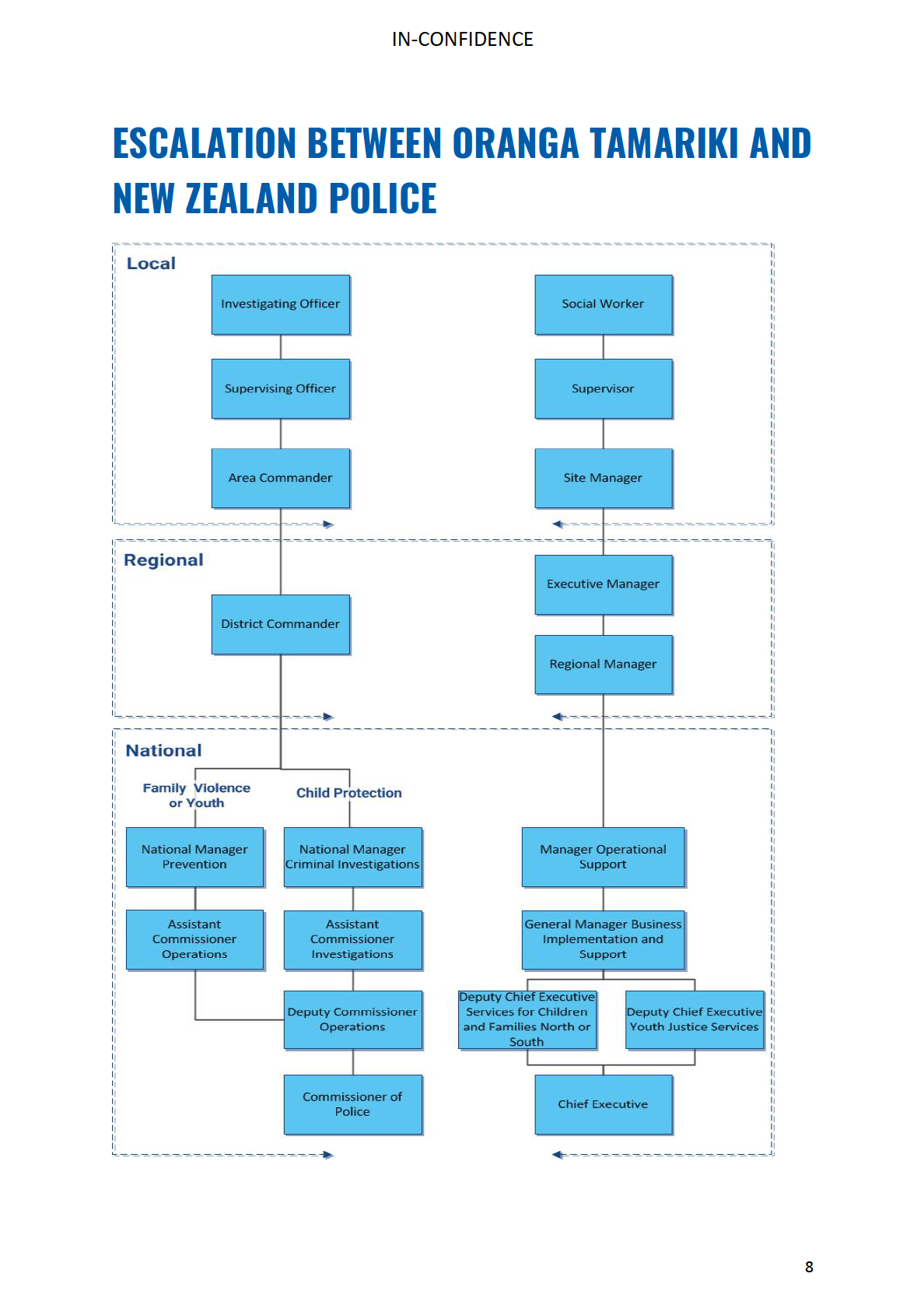
Al disputes should fol ow the escalation pathway set out in the escalation table below.
Disputes that cannot be resolved within 28 days should be referred to the next level and an
attempt made to resolve the dispute with the counterpart within a further 28 days. Disputes
that require further escalation should consider the time elapsed and ensure there is no
undue delay in resolution.
7

IN-CONFIDENCE
APPENDIX 1: SCHEDULES TO THIS
MEMORANDUM OF UNDERSTANDING
• Child Protection Protocol: Joint Operating Procedures (CPP) 2016
• Policy for the Youth Offending Risk Screening Tool 2008
• Information Sharing Guidelines Between New Zealand Police and Child, Youth and
Family for the Youth Offending Risk Screening Tool 2008
• Operational Level Agreement between New Zealand Police and Child Youth and
Family on Electronic Monitoring of Bail 2007
• Specialist Child Witness Interview Guide
• Joint protocol for Reporting and Managing Missing Children and Young People in
Care 2013
• Joint Operating Procedures – Mass Al egation Investigation 2017
• Approved Agency Agreement for access to the New Zealand Police Vetting Service
and the Australian National Police Checking Service
• Schedule 1: Information sharing protocol – to be attached to the Memorandum of
Understanding between NZ Police and the Ministry of Social Development
o Variation No. 1 to Information Sharing Protocol between New Zealand Police
and Ministry of Social Development dated 22 July 2014
10

IN-CONFIDENCE
APPENDIX 2: OTHER AGREEMENTS BETWEEN
ORANGA TAMARIKI, NEW ZEALAND POLICE
AND OTHER AGENCIES
• Interagency Protocol on matters relating to children and young persons between
Child, Youth and Family, New Zealand Police and ACC 2002
• Memorandum of Understanding between Child, Youth and Family, New Zealand
Police and District Health Board 2011
o Schedule 1: Children admitted to hospital with suspected of confirmed abuse
or neglect 2011
o Schedule 3: Neglect of Medical Care Guideline 2016
o Schedule 4: Joint Standard Operating Procedures for Children and Young
Persons in Clandestine Laboratories 2016
• Managing abuse al egations involving an adult working in or associated with an
education setting 2015
Other agencies:
Ministry of Education
New Zealand Teachers Council
• Letter of Agreement Multi-Agency Response to Reports of Potential and Actual
Forced Marriage
Other agencies:
Family and Community Services
Ministry of Education
Work and Income New Zealand
Immigration New Zealand
• Information Sharing Agreement for Improving Public Services for Vulnerable Children
25 June 2015
Other agencies:
Ministry of Social Development
Ministry of Health
Ministry of Justice
Ministry of Education
Children’s Action Plan Directorate
• Information Sharing Agreement between the New Zealand Gang Intelligence Centre
Agencies for the purpose of reducing gang-related harm to individuals and New
Zealand society general y
Other agencies:
Accident Compensation Corporation
Department of Corrections
Department of Internal Affairs
11

IN-CONFIDENCE
Housing New Zealand
Inland Revenue Department
Ministry of Business Innovation and Employment
Ministry of Education
Ministry of Health
Ministry of Social Development
New Zealand Customs Service
• Memorandum of Understanding for Youth Justice National Minimum Dataset
between Ministry of Justice, New Zealand Police, Ministry of Social Development and
Department of Corrections
• Appendix 2: Protocols governing the exchange of information about prisoners to
ensure their health, safety and secure custody dated June 1997
Other agencies:
Department for Courts
Department of Corrections
• Agreement for sharing information about child sex offenders November 2010
Other agencies:
Department of Corrections
Ministry of Social Development
Housing Corporation
12
