IN-CONFIDENCE
Contents
Policy statement and principles .............................................................................................................................. 4
Overview ................................................................................................................................................................. 5
Definitions ............................................................................................................................................................... 8
Roles and responsibilities ..................................................................................................................................... 10
The specialist child interviewer ...................................................................................................................................................................... 10
The Monitor ................................................................................................................................................................................................... 10
Oranga Tamariki and Police Managers .......................................................................................................................................................... 11
Purpose and conduct of the interview ........................................................................................................................................................... 12
Interviewing number and duration of interviews .......................................................................................................................................... 12
Structure of interview .................................................................................................................................................................................... 13
Interviewing tools........................................................................................................................................................................................... 13
Breaks, including Monitor breaks .................................................................................................................................................................. 13
Support Person ............................................................................................................................................................................................... 14
Interpreters .................................................................................................................................................................................................... 14
Before the SCI ................................................................................................................................................................................................. 15
Pre‐interview with the Child ....................................................................................................................................................................... 16
After the SCI ................................................................................................................................................................................................... 17
SCI Report ....................................................................................................................................................................................................... 17
Role of the Interviewer in court ..................................................................................................................................................................... 18
Transcripts ...................................................................................................................................................................................................... 18
Video recordings ............................................................................................................................................................................................ 18
Facilities and equipment ................................................................................................................................................................................ 19
Training and development ............................................................................................................................................................................. 20
Peer review .................................................................................................................................................................................................... 20
Accreditation .................................................................................................................................................................................................. 20
Professional development opportunities ...................................................................................................................................................... 21
Supervision ..................................................................................................................................................................................................... 21
Interviewing neurodivergent children and/or children with intel ectual and communication disabilities ......... 22
Introduction.................................................................................................................................................................................................... 22
Planning .......................................................................................................................................................................................................... 22
Seeking Additional Information ...................................................................................................................................................................... 23
Medication and anxiety .................................................................................................................................................................................. 23
Familiarisation ................................................................................................................................................................................................ 23
Room set up ................................................................................................................................................................................................... 23
During the interview ..................................................................................................................................................................................... 24
Tools ............................................................................................................................................................................................................... 24
Breaks ............................................................................................................................................................................................................. 24
Communication aids ....................................................................................................................................................................................... 24
Engage and explain ......................................................................................................................................................................................... 25
Account .......................................................................................................................................................................................................... 25
Questions ....................................................................................................................................................................................................... 26
Multiple interviews ......................................................................................................................................................................................... 26
Term ...................................................................................................................................................................... 26
Review and variation ............................................................................................................................................ 26
Termination .......................................................................................................................................................... 26
Signatories ............................................................................................................................................................ 27
Appendix A: Information about common neurodivergent conditions, intel ectual and/or communication
disabilities ............................................................................................................................................................. 28
Intellectual disability ...................................................................................................................................................................................... 28
Down syndrome ............................................................................................................................................................................................. 28
Autistic Spectrum Disorder (ASD) .................................................................................................................................................................. 29
Attention Deficit Hyperactivity Disorder (ADHD) .......................................................................................................................................... 29
Foetal Alcohol Spectrum Disorder (FASD) ..................................................................................................................................................... 30
Dyslexia .......................................................................................................................................................................................................... 30
Physical disabilities ......................................................................................................................................................................................... 30
Sensory Disability ........................................................................................................................................................................................... 31
2
IN-CONFIDENCE
Appendix B: Checklist for interviewing neurodivergent children and children with intel ectual and
communication disabilities ................................................................................................................................... 32
Key personal details ....................................................................................................................................................................................... 32
Description of disability.................................................................................................................................................................................. 33
Language ........................................................................................................................................................................................................ 33
Attention span ................................................................................................................................................................................................ 34
Comprehension .............................................................................................................................................................................................. 34
Social .............................................................................................................................................................................................................. 34
Appendix C: Flowchart showing the interview phase .......................................................................................... 35
3
IN-CONFIDENCE
Policy statement and principles
What
Oranga Tamariki–Ministry for Children (Oranga Tamariki) and the New Zealand Police (Police) have
a joint commitment to providing specialist child interviewing services.
This document details policy and guidelines relating to specialist child interviews (SCI):
- agreed jointly by Oranga Tamariki and the Police
- for trained specialist child interviewers of Oranga Tamariki and the Police, and their supervisors
and managers.
SCI can be used for investigations, criminal prosecution and care and protection purposes.
This guide sits as a schedule to
The Memorandum of Understanding etween Oranga Tamariki—
Ministry for Children and New Zealand Police.
This guide replaces all previous child specialist interview guidelines.
Why
The guide ensures specialist child interviews (SCI) are conducted and recorded in accordance with
the Evidence Act 2006 and the Evidence (Video Records and Very Young Children’s Evidence)
Regulations 2023 (Evidence Regulations 2023). Following the guidelines wil enable investigators
to support Child interviewees to provide complete and accurate accounts.
How
Oranga Tamariki and Police Specialist Child Interviewers and/or Monitors will:
- conduct SCIs according to the rules of evidence and the Evidence Act 2006 and the Evidence
Regulations 2023
- video record a SCI of a Child who has, or may have, been abused or witnessed a serious crime
- complete the nationally recognised SCI training course, and be on the SCI register before
undertaking video interviews of a Child
- ensure SCIs are monitored
- conduct interviews in a child-friendly environment ‐ never in a suspect interviewing room
- depending on the Child’s age and level of maturity, try to explain to them the interview
procedure, its recording and use
- consider appropriate variations to interviewing procedures for children with disabilities/neuro
divergent children to assist them to provide a complete and accurate account
- inform the social worker and Police of the interview outcome and, provide a ‘SCI Report’
- discuss the Child's immediate safety needs with the social worker and family when a Child has
made an allegation of abuse in the interview
- secure every outline, drawing, Monitor’s message and note made during the interview as these
may be used as evidence.
4
IN-CONFIDENCE
Overview
Contact for enquiries
Any questions in relation to these policies and guidelines should be addressed to the National
Criminal Investigation Group (NCIG) at Police National Headquarters.
Introduction
Specialist child interviewing is a skilled task which requires specific training and supervised practice.
A SCI cannot be conducted competently just by following the policy and guidelines in this document.
This document should be read in conjunction with:
- Part 3, Subpart 5 of the Evidence Act 2006
- the Evidence (Video Records and Very Young Children’s Evidence) Regulations 2023 (Evidence
Regulations)
- the Child Protection Protocol (CPP) between Police and Oranga Tamariki (a schedule to the
MOU between the two agencies), for responding to complaints or reports of concern that allege
actions or behaviour that may constitute a criminal offence.
Oranga Tamariki and Police recognise that some interviewing situations may call for procedures
not specifically referred to within this document. Where this occurs, the Interviewer should exercise
their discretion with care, taking into account the welfare of the Child being interviewed while also
considering the legal implications of such action. These situations require consultation and
agreement between the Interviewer and the Monitor and/or other experienced person, for example
the National SCI Coordinator & Trainer based at Police National Headquarters.
The practice guidelines within this document are current at the point of publication. Practice
changes may have occurred since publication as a result of court precedent, research and
literature.
When and why should specialist child interviews be used?
A SCI may be used as part of an investigation where a Child has, or may have, been abused or
witnessed a serious crime. It may later be used as part of court evidence.
A SCI is conducted in a manner that complies with the Evidence Regulations 2023.
Police can:
- use the SCI in a prosecution to present all or part of the evidence‐in‐chief in court under Part 3,
subpart 5 of the Evidence Act 2006 and to show or give access to the SCI to lawyers/suspects
(reg 18 and 19, and also s 106 of the Evidence Act)
- provide disclosure of the SCI for certain Family Court proceedings for the permitted purposes
outlined in regulation 26 of the Evidence Regulations 2023 and in accordance with the process
set out in regs 26A to 27B.
- provide access for Oranga Tamariki to the SCI on request (reg 32).
- show or give access to the SCI for the purposes as permit ed in regulation 37 of the Evidence
Regulations 2023.
5
IN-CONFIDENCE
Video recording of SCI is considered the best way to meet both the Child’s needs and interests, and
the interests of justice. It meets the Child’s needs in that:
- the interview process is focused on the Child and allows them to state clearly and freely what (if
anything) has happened while also capturing the information according to the rules of evidence
- the SCI can be used for investigations, criminal prosecution and care and protection purposes.
This lessens the number of times that a Child needs to recount their statement.
This serves the interests of justice in that:
- the interview process is conducted according to the rules of evidence in order to meet the
standards necessary for criminal prosecution.
- SCIs are a transparent method of interviewing and therefore have the greatest level of
accountability
- it allows the Family Court in Oranga Tamariki Act 1989 proceedings, the best opportunity to view
the Child’s evidence, while limiting the impact on the Child.
Joint Oranga Tamariki / Police SCI protocol
A SCI of a Child who has, or may have, been abused or witnessed a serious crime must be video
recorded.
SCI must be conducted according to the rules of evidence and the Evidence Act 2006, and the
Evidence Regulations 2023.
If there is more than one suspect, separate SCI should be conducted to discuss the incident(s)
relating to each al eged offender, unless the alleged offences were jointly committed. In some
circumstances, it may be appropriate to complete one SCI relating to more than one offender. In this
instance, details relating to each offender should be covered off fully prior to moving to the next
offender.
A SCI must be carried out by an Interviewer with specialist training in the interviewing of children
and the requirements of the Evidence Regulations 2023. This specialist training course is run at the
Royal New Zealand Police College (RNZPC) and includes e‐learning as well as a week‐long face‐
to‐face course. Interviewers trained in the SCI Model may also be the most appropriate Interviewers
for adults with intellectual disability and, if so, this policy and guidelines will also apply.
Every SCI must be monitored. The Monitor must be an Oranga Tamariki Specialist Child
Interviewer or a Police employee who understands the requirements of the Evidence Regulations
2023. In instances of a sexual nature, it is preferred that SCI be monitored by a constabulary
Police member who has experience working on child protection or adult sexual assault
investigations.
The interview must take place in a child-friendly environment. It should not take place in a
suspect interviewing room. Police must supply the medium on which the SCI is recorded.
Guidelines for referrals
Referral for an SCI is indicated when:
6
IN-CONFIDENCE
- a Child has disclosed sexual abuse, physical abuse, neglect, or serious family violence
where the Child is a witness; and / or:
- medical findings indicate possible abuse or neglect
- there are extreme and persistent patterns of sexual behaviour
- there has been unsupervised contact with a known suspect
- abuse is witnessed by a third party
- abuse is admitted by a suspect
- a serious crime has been witnessed
- there is a disclosure witness
- a Child is a recent complaint witness.
Related information
See ‘Hate-motivated crimes’ chapter for information about recognising, recording and dealing
appropriately with
hate crime,
hate incidents and
hate speech within the context of scene
attendance, investigations, applying proportionality and using discretion.
7
IN-CONFIDENCE
Definitions
The following definitions identify the meaning of key terminology within this document.
Term
Definition
Child
Child or young person under the age of 18 years.
Child Protection
The CPP is the joint process that is followed when Oranga Tamariki and
Protocol (CPP)
Police are responding to complaints or reports of concern that allege
actions or behaviour that may constitute a criminal offence, and where
there is a role for both parties.
The CPP is a schedule to the MOU between the two agencies.
Communication
A language and communication specialist employed to facilitate effective
Assistant
communication and support participation in a SCI.
Disclosure
A disclosure witness/recent complaint is the first person to whom a Child
witness / Recent
disclosed.
complaint
Emotional /
Emotional / psychological abuse is any act or omission that results in
psychological
adverse or impaired psychological, social, intellectual, emotional
abuse
functioning and/or development.
Interpreter
A suitably qualified interpreter who can assist the Child, where their first
or preferred language is other than English, or the Child has a
communication disability.
Interviewer
A person with specialist training in the skills associated with
interviewing children, having successful y completed the Level 3: SCI
initial training programme.
Monitor
An Oranga Tamariki Specialist Child Interviewer or a Police employee
who understands the requirements of the Evidence (Video Records and
Very Young Children’s Evidence) Regulations 2023.
Monitor break
A pause in the interview to allow the Interviewer and Monitor to confer.
Movement
A physical form or digital register attached to the video record that
sheet
details the location of the video record and forms a record for the chain
of evidence (if using DVD technology).
Neglect
When a person intentionally ill‐treats or neglects a Child or causes or
permits the Child to be ill‐treated in a manner likely to cause the Child
actual bodily harm, injury to health or any mental disorder or disability,
and that ill‐treatment or neglect is serious and avoidable.
Parent
The usual fulltime caregiver or legal guardian of the Child. This may
include biological parent/s, step‐parent/s, wider whānau or family or
anyone with caregiver responsibilities (the parent or guardian or usual
carer/custodian may arrange or ask for you to arrange another adult to
fulfil the role of supporting the Child).
Evidence
The Evidence (Video Records and Very Young Children’s Evidence)
Regulations 2023.
8
IN-CONFIDENCE
Regulations 2023
Physical
The actions of an offender result in, or could potentially result in,
abuse
physical harm or injury being inflicted on a Child. The three areas to
consider when determining this are set out in the CPP.
Sexual abuse
An act involving circumstances of indecency with, or sexual violation of
a Child, or using a Child in the making of sexual imaging.
Specialist Child
A recorded interview that can be used as part of an investigation where
Interview (SCI)
a Child has, or may have been, abused, or witnessed a serious crime. It
may later be used as part of court evidence.
Support
Any person (other than the suspect(s)) who supports the Child during
person
the interview process.
9
IN-CONFIDENCE
Roles and responsibilities
The specialist child interviewer
A SCI must be carried out by a trained Interviewer from Oranga Tamariki (social worker), or a Police
Interviewer trained in interviewing children (having successful y completed the Level 3: SCI initial
training programme and the requirements of the Evidence Regulations 2023.
The Interviewer must:
- ensure they are aware of the provisions of the Evidence Regulations 2023, in particular Part 1,
Part 3 and Part 4
- cover the points listed in regulation 11 of the Evidence Regulations 2023
- provide a child-friendly environment
- facilitate a process where a Child can talk about what, if anything, has happened
- when planning and conducting interviews, have regard to any intellectual and/or communication
challenges the Child has
- report key observations to the referring social worker and Police, following the interview
- recommend any further action needed to the social worker
- provide evidence in court for criminal prosecution or other proceedings if required.
The Interviewer must not:
- engage in therapy with the Child, or their family members
- assess whether the suspect is guilty or not
- assume social work responsibility for the Child’s case
- conduct the wider investigation and assessment (except Police may conduct the wider
investigation, in some circumstances).
Conflict of interest
The assigned Interviewer should consider whether or not they could be perceived to have a conflict
of interest in managing the case. If the Interviewer identifies that an actual, perceived or potential
conflict of interest exists, they should notify their supervisor as soon as possible and complete the
appropriate form declaring that conflict of interest.
For more information see:
- Oranga Tamariki: Disclosure of Interest Policy June 2023
- Police: ‘Managing conflicts of interest’
The Monitor
A SCI must be monitored by an Oranga Tamariki Specialist Child Interviewer or a Police employee
who understands the requirements of the Evidence Regulations 2023. In instances of a sexual
nature, it is preferred that SCI be monitored by a constabulary Police member who has experience
working on child protection or adult sexual assault investigations.
The Monitor must:
10
IN-CONFIDENCE
- have knowledge of the referral information
- ensure video recording equipment is set up and functioning and operate the equipment where
required during the interview
- be present in the Monitor’s room throughout the interview
- take accurate, legible interview notes of the required investigative information
- attempts should be made to use the Child’s own words in relation to the disclosure or details
about the suspect but are not intended to be a transcript
- ensure the context of the offending is explored (including who, what, where, how) and that
ingredients of offences are satisfied
- provide support to the Interviewer by identifying areas that are missing from the interview or
which need clarifying or expanding
- record the time at significant points throughout the interview ‐ this must include beginning and
end of interview and all breaks.
The Monitor should:
- be alone in the Monitor’s room unless other professional support is required due to the Child’s
special needs or the needs of the investigation
- during breaks, keep discussion with the Interviewer to a minimum
- only interrupt the interview if it is absolutely necessary, for example if a legal requirement is
missed, or equipment failure.
- assist the Child, and monitor the Child’s interactions with other people, should they leave the
room for any reason
(See section ‘
Breaks, including Monitor breaks’)
Oranga Tamariki and Police Managers
Oranga Tamariki Managers and Police District Commanders (or their nominees) must ensure that
children have access to SCI services. This includes:
- trained and skilled Interviewers
- adequate interviewing facilities and resources i.e. venue, video-recording and interview
equipment
- access to these services as soon as practicable on receipt of SCI referrals.
In highly complex cases, such as mass allegations, it is important that there is a high level of
consultation and co‐ordination between the investigating team and the Interviewer. It is the
responsibility of the Oranga Tamariki Manager and the Police District Commander (or their
nominees) to ensure this occurs.
In the case of a MAI or suspected MAI please refer to the Mass Al egation Investigation Joint
Operating Procedures.
- Oranga Tamariki: Mass Al egation Investigation – Joint Operating Procedures
- Police: Mass Al egation Investigation – Joint Operating Procedures
Staff
11
IN-CONFIDENCE
Where Oranga Tamariki or Police staff are working as Interviewers, their managers must ensure
that they receive specialised training as well as regular and appropriate clinical supervision. (See
section ‘
Training and development’ and ‘
Supervision’.)
The Oranga Tamariki Manager and the Police District Commander (or nominees) must ensure that
Interviewers have opportunities to meet with one another to improve and standardise their practice.
All Oranga Tamariki and Police Interviewers must achieve and maintain accreditation under the
New Zealand Police and Oranga Tamariki Specialist Child Interviewing Training and Accreditation
Policy.
- Oranga Tamariki: Specialist Child Interviewing Training and Accreditation Policy
- Police link: ‘Specialist Child Interviewing Training and Accreditation Policy’.
Purpose and conduct of the interview
A SCI usually takes place as a part of the investigation and assessment process. The SCI is a tool to
help Oranga Tamariki and Police to establish if:
- the Child is in need of care or protection.
- there is information that a criminal offence has been committed.
The Interviewer is responsible for the SCI and specific tasks relating to the interview. Oranga
Tamariki and Police are responsible for the other tasks relating to the care and protection of the
Child.
The primary functions of Oranga Tamariki and Police are to assess the safety and wellbeing of
children, provide care and protection where this is needed, investigate allegations and hold offenders
to account wherever possible.
The CPP is the joint process that is followed when Oranga Tamariki and Police are responding to
complaints or reports of concern that allege actions or behaviour that may constitute a criminal
offence.
Interviewing number and duration of interviews
In most cases one video interview will be sufficient. It may be appropriate to conduct subsequent
interviews where:
- the Child becomes tired or distressed and is unable or unwil ing to complete the interview
- the Child makes an allegation or further allegations late in the interview and is wil ing to
undertake a further interview
- the Child spontaneously reveals further information outside the interview
- the Child has special considerations, for example, needs an Interpreter or technical aid to
communicate (see section ‘Interviewing neurodivergent children and/or children with intellectual
and communication disabilities)
- the Child gives new information indicating a more serious offence
- the Child gives information about a second suspect unconnected with the first interview
- equipment failure occurs
12
IN-CONFIDENCE
- other considerations arise following consultation with the investigation team.
Most interviews take 45‐75 minutes.
Structure of interview
All SCIs must be conducted in accordance with the Evidence Regulations 2023. The phases and
steps within the SCI are fully explained and practised within the Level 3: SCI initial training
programme that all Interviewers attend before conducting interviews.
All SCIs are divided into three phases summarised below ‐ Engage and Explain, the Account, and
the Closure. All three phases are video-recorded.
Stage
Description
Engage and
- Cover regulation requirements
Explain
- Ground rules
- Practice narrative using SCI questioning approaches
Account
- Encourage the Child to talk about any offences using a free
narrative approach and SCI questioning approaches
Closure
- Seek further clarification of details if required
- Sign exhibits
- Explore a neutral topic to ensure the wellbeing of the Child
Interviewing tools
Any piece of equipment in the interview room must be for the purpose of SCI.
The waiting room must not contain books, leaflets and toys that relate to child abuse/protection.
Suitable tools and equipment for SCI should be carefully considered, stored appropriately and used
only as required.
Care must be taken when using any tool. Research shows that Interviewers’ question types can
become more focused when tools are introduced and so caution should always be used. It has
also been demonstrated that while the introduction of tools during the account phase may elicit
further information, the accuracy tends to be lower than for information elicited spontaneously
through the use of invitations, especially with young children.
Breaks, including Monitor breaks
In SCIs the Interviewer should break the interview and confer with the Monitor to check that all key
areas of questioning have been covered. This break should be taken when the Interviewer believes
that all topics have been covered.
Breaks may occur for other reasons, for example, if the Child needs to use the toilet, the equipment
malfunctions or there is a fire alarm. Children might also need breaks if they become anxious or
tired. Children with disabilities may need more or less breaks depending on their support needs.
There are no restrictions on the number of Monitor breaks. However, they should be kept to a
minimum as too many breaks become disruptive to the Child.
13
IN-CONFIDENCE
There may be times where it is preferable for the Monitor to pass a written message to the
Interviewer to avoid the need for an additional Monitor break. Al written notes must be retained on
the interview file.
Before leaving the interview room, the Interviewer must state the time and reason for the break. On
return to the interview room, they should state the time the Interview is recommenced. This is
required by regulation 12 of the Evidence Regulations 2023.
The Child must remain in the view of the camera during the Monitors break and the camera will
continue recording. If Interpreters or support people remain in the room during the break, they must
not confer with the Child about the disclosure. For this reason, it is usually preferable that they leave
the room for the duration of the break.
The Monitor must supervise or arrange for appropriate supervision of the Child if they leave the room.
Support Person
The Evidence Regulations 2023 allow for the presence of a Support Person under regulation 9.
The Child may have a Support Person present at the interview if the Child considers that it is in their
interests, and the Interviewer considers that the proposed person is an appropriate person to support
the Child Regulation 9(1).
The Interviewer must clearly inform the Support Person about their role and ask them to sign the
appropriate confidentiality statement (see below) prior to the interview taking place. The Support
Person must be clearly informed that they cannot participate in any way during the interview and
must be clearly visible throughout the interview (Regulations 9(2)9 and 11(1)).
It is preferred that a Support Person leave the interview room during any breaks. If the Support
Person is to remain in the room, they must be clearly instructed not to engage in any discussion
regarding the disclosure.
Download current confidentiality statements
Support person confidentiality statement – non whānau
- Oranga Tamariki: Specialist child interview confidentiality statement - Support person
- Police Link: Specialist child interview confidentiality statement – Support person
Support person confidentiality statement – whānau
- Oranga Tamariki: Specialist child interview confidentiality statement - Support person whānau or
family
- Police: Specialist child interview confidentiality statement – Support person
Interpreters
The Evidence Regulations 2023 allow for the use of an Interpreter under regulation 10.
The Interviewer must clearly inform the Interpreter about their role in the interview. They are to
interpret the Interviewer’s questions for the Child and to translate the answers back for the
Interviewer. The interpretation must be verbatim as much as possible.
14
IN-CONFIDENCE
The Interpreter must be visible on video at all times (regulation 11(1)) and should leave the room
with the Interviewer at any Monitor breaks.
The Interviewer should ask the Interpreter to sign a confidentiality statement prior to the interview
taking place.
Download current Interpreter Confidentiality Statement
- Oranga Tamariki: Specialist child interview confidentiality statement - Interpreter
- Police link: Specialist child interview confidentiality statement - Interpreter
The Interviewer should spend time before the interview with the Interpreter to explain the process
of the interview, in particular the need for as close to ‘word for word’ interpreting as possible
regarding both the Child’s responses and Interviewer questions.
Before the SCI
Preparation and planning
Thorough preparation and planning are integral to the SCI. It is essential for the Interviewer to have
an interview plan, which may or may not be written.
When planning the SCI the Interviewer must consider:
- if the Child has any special considerations including disabilities, liaise with the social
worker to identify the appropriate agency for preliminary assessments, advice and/or
organising assistance. This could include an Interpreter, Communication Assistant or
Support Person present at the interview (Regulations 8, 9 and 10)
- if the Child is neurodivergent and/or has an intellectual or communication disability
please refer to the ‘Interviewing neurodivergent children and/or children with intellectual
and communication disabilities’ section of this Guide for further information.
- what information and support needs to be provided to the Child
- whether the referral and background information are clear. The Interviewer should be
familiar with the information provided
- who wil accompany the Child to the interview. The Child should be accompanied to the
interview unit by their Parent or a Support Person. The Child’s social worker should also
be present, if one is allocated, and should wait with the Parent/Support Person during
the interview. They should also be available to debrief with the Interviewer following the
SCI.
Consultation with the Parent and social worker
The Interviewer must have:
- taken all steps to ensure that relevant information is known before the SCI. This should
include a meeting or telephone consultation with the Child’s social worker if they will not
be present at the SCI.
- informed the Parent and social worker about the possibility that the interview with the Child
may not result in clarification of the referral concerns. Alternative explanations for the
concerns may need to be considered.
- informed the Parent and social worker about the recording and use of the interview.
- obtained informed consent to video record the interview with the Child.
15
IN-CONFIDENCE
In most cases the Child should not be present at any consultation with the Parent or social worker.
With older children it may be appropriate to ask if they want to be present when you are talking to
the Parent.
Notes should be made during the consultation with the Parent and these notes added to the
investigation file as soon as practicable afterwards. Any issues of contention or concern should be
declared, resolved and recorded.
Consent
Where appropriate, consent should be obtained from the Child to be interviewed. Interviews with a
Child should not proceed if the Child is unwil ing to be interviewed.
Download the current Consent to SCI form:
- Oranga Tamariki: Consent to specialist child interview form
- Police link: Consent to specialist child interview form
Informed consent should also be obtained from the Parent or guardian, wherever practicable and
appropriate. It is preferable that this consent is written.
If parental or guardian consent is refused, the interview may proceed with written consent from the
social worker or their supervisor, provided that the Chief Executive of Oranga Tamariki (the Chief
Executive) has custody of the Child.
If a Parent refuses consent and the Child is not in the custody of the Chief Executive, legal advice
should be sought with a view to seeking a warrant under sections 39 or 40 of the Oranga Tamariki
Act 1989. Under section 40 of the Act, the reasonable beliefs listed under section 40(1) must be
specified as the allegation of an offence is not sufficient grounds in itself for the issue of a warrant.
In some cases, an older Child may be of sufficient capacity and understanding to consent to an
interview, without the need for parental consent or custody. Extreme caution must be exercised,
and prior legal advice must be obtained in these situations. The use of a warrant may reduce any
potential harm to the relationship between the Parent/guardian and the Child and so should be
considered, even if the Child has sufficient capacity and understanding to consent.
The matter of consent, and an agreement on the action to be taken if consent cannot be gained from
the Parent/guardian should be considered within the CPP joint investigation plan.
Pre‐interview with the Child
Depending on the Child’s age and level of maturity, the Interviewer or Monitor must endeavour to
explain to them about the interview procedure, its recording and use.
Any relevant information disclosed by the Child at this time should be recorded in writing. It is
preferable that the Interviewer explains the procedure to the Child to build rapport and keeps a
record of any relevant details or spontaneous disclosures made by the Child during this time.
The Child may need some time to settle and familiarise themselves with the surroundings before
the interview begins. Depending on the needs of the Child this may need to occur on a dif erent
day.
16
IN-CONFIDENCE
Be honest with the Child. Do not make promises that cannot be kept. For example, the Interviewer
cannot promise:
- absolute confidentiality
- that the Child wil not have to appear in court
- who wil see the transcript and video
- what the court outcome will be.
After the SCI
Debriefing
The role of the Interviewer and/or Monitor post-interview is to provide the Parent/Support Person
and social worker with appropriate information about what has been said in the interview.
The Interviewer must inform the social worker and Police of the interview outcome.
The Interviewer must talk to the Parent (wherever possible with the social worker and/or the O/C
Case present) to:
- give them feedback on the interview in appropriate detail
- explain what will happen to the video records and who may see them
- explain what will happen next regarding your role
- talk about how the Child is feeling and any recommendations of any ongoing support
- confirm the adult is comfortable with any recommendations and understands important next
steps.
Note: Discuss the Child's immediate safety needs with the social worker and the family when a Child
has made an allegation of abuse in the interview. It may sometimes be necessary to talk to the social
worker alone first.
Record significant points from these debriefings and date, sign and file this record. These
significant points should also be included in the SCI Report.
The Interviewer and Monitor should, where possible, meet to debrief after the interview for the
purpose of evaluation for the investigation and improvements for future interviewing and monitoring
practice.
SCI Report
The Interviewer must secure every outline, drawn or written material related to the disclosure,
Monitor's communications, and any notes made or brought in during the interview as these may be
used as evidence and wil be retained by Police.
The Interviewer must complete a SCI report for every interview conducted (including when no
disclosure is made).
Police Interviewers must complete the SCI node and report tab. They must then forward a copy of the
report to Oranga Tamariki.
Oranga Tamariki Interviewers must complete the SCI Report template and forward this to Police for
entry into NIA. The Interviewer must follow up to ensure a copy of the completed report is uploaded
into CYRAS. Specialist child interview report
The report is not a verbatim account. It should contain a factual summary of the interview and the
17
IN-CONFIDENCE
allegations.
The report must:
- state whether the Child alleged abuse
- present factual notes about what they said or did.
The report may include information for further Police and/or social work follow up.
Role of the Interviewer in court
Where the Child's evidence is presented on video record in court, the Interviewer may be called as a
witness. The Interviewer may be cross-examined on any aspect of the interview process.
When presenting evidence in court, preparation is crucial.
The Interviewer should go through the transcript thoroughly with another Interviewer or supervisor
to identify areas where they are likely to be cross‐examined and:
- where possible review the SCI
- consult with, and seek advice from, an Oranga Tamariki solicitor or Police prosecutor as
required.
The Crown Prosecutor is acting for the Police in these matters. Oranga Tamariki staff should seek
advice from the site solicitor to avoid any conflict of interest. If aspects of the criminal process are not
within the immediate knowledge of the site solicitor, it is their role to find someone who can assist the
Interviewer.
Interviewers must not declare themselves as experts and should contact the National SCI
Coordinator & Trainer if a request is made to provide a formal statement confirming themselves as
an expert. If they are confirmed as expert witnesses they must then agree to comply with Schedule
Four of the High Court Rules 2016 ‐ Code of conduct for expert witnesses.
Transcripts
The Evidence Regulations 2023 identify Police are responsible for making transcripts of a Police
Video record where a transcript is required under the Evidence Act, the Evidence Regulations 2023
or an order of a Judge (Regulation 56 and Regulation 27).
A transcript is usually not required until a not guilty plea is entered in which case the transcript must
be provided to the defendant’s lawyer as soon as practicable after that not guilty plea (Regulation
22).
The transcript should be checked against the video record for accuracy. This is done by the most
appropriate person, which may be the Interviewer or the Officer in Charge of the Case. If a transcript
has been prepared, a copy must be kept on Police files.
Video recordings
Security and access to video records
Security and access to video records is governed by the Evidence Regulations 2023 and the
Evidence Act 2006 (e.g. sections 106 and 119 to 119B):
- Information Privacy Principles 6 (the right of an individual to access their personal information)
and 7 (regarding correction) of the Privacy Act do not apply to video records made under the
18
IN-CONFIDENCE
Regulations or a transcript of the video record (Privacy Act 2020, s 29(1)(e)).
- An Of icial Information Act request for information that is not permitted to be given under the
Evidence Regulations 2023 and the Evidence Act 2006 should be refused on the basis of
section 18(c)(i).
- The Criminal Disclosure Act does not apply to video records made under the Evidence
Regulations 2023, or a transcript of the video record (Criminal Disclosure Act 2008, s 42(2)).
Access to the video record must be in accordance with the Evidence Regulations 2023.
Oranga Tamariki may request access to the video record under regulation 32 in order to discharge
a duty under legislation. Police must then give Oranga Tamariki access to the video record and a
copy of the transcript (if one has been made). Oranga Tamariki must comply with the obligations
in reg 32 and 40 to 46.
Police may show the video record to the Child witness (reg 32(2)(b)), however the Child's best
interests should be considered before doing this and, in this regard, Police should consult with
Oranga Tamariki and/or the Parents/guardians.
Video record storage, retention and destruction
Video storage, retention and destruction requirements for Police are set out in Part 4, Regulations 48,
49, 52 and 54 and 55 of the Evidence Regulations 2023.
Facilities and equipment
Recording equipment
The recording equipment must:
- be high quality both for sound and picture
- be in stereo
- have a wide-angle lens.
- have the capacity to make two video records
- be compatible with court equipment.
Interview rooms
There must be an accurate means for measuring and recording time in hours, minutes and
seconds. (Reg. 11(3)(g)). All video machines should have a digital time reading on the screen that
includes hours, minutes and seconds which would meet this regulation.
Agencies can provide SCI services by the following means:
- using established interviewing units where staff have been appropriately trained
- designating and training social workers or Police employees as Interviewers.
- Locations should have sufficient Interviewers available to relieve and co‐work. It is ideal for an
interviewing facility to have these areas:
o reception area
o waiting room
o playroom
o interview room
o Monitor's room
19
IN-CONFIDENCE
o toilet
o tea/coffee facilities.
The interview and Monitor's rooms should be located away from the public waiting room and
insulated from traffic and corridor noise in order that the noise does not rebound.
Evenly distributed fluorescent lighting must be adequate for the video camera. Windows require
window coverings (curtains or blinds) to ensure optimum video production and privacy.
A range of appropriate interviewing tools should be available and in good condition.
Training and development
All Interviewers must have completed the nationally recognised SCI training course and be on the
SCI register before undertaking video interviews of a Child. All Interviewers on the register are
required to maintain their Accreditation. The Accreditation process aims to assist Interviewers to
develop and maintain best practice techniques and to achieve national consistency.
Training should be:
- nationally consistent
- conducted by an experienced practitioner
- up to date with changing literature and court precedent
- available regularly, for new and existing Interviewers.
A component of the training should include observing experienced Interviewers.
Interviewers have a responsibility to keep their skills and knowledge up-to-date. They should also
keep up-to-date on case law decisions and current literature related to their area of work.
Interviewers should seek legal advice regarding case law as appropriate.
Interviewers should have opportunities to share knowledge, understanding and practical
experience with each other on these topics. This should include regular attendance at local and
national peer reviews, as well as engagement in other professional development opportunities.
Peer review
All Interviewers must attend a national peer review course annually. Peer review includes:
- peer reviewing interviews and providing structured feedback
- sessions with subject matter experts (SME) on a variety of topics
- the opportunity to learn from peers.
Accreditation
All Oranga Tamariki and Police Interviewers must gain and maintain accreditation. The aim of this
assessment process is to achieve national consistency and maintain best practice in SCI.
For more detail refer to:
- Oranga Tamariki Specialist Child Interviewing Training and Accreditation Policy
- Police Link Specialist Child Interviewing Training and Accreditation Policy
20
IN-CONFIDENCE
Professional development opportunities
A range of professional development opportunities are available to all Interviewers and the
responsibility for accessing these lies with the Interviewers. Opportunities include:
- Peer reviews.
- E‐learning.
- Updates from the National SCI Coordinator & Trainer.
- Accreditation.
Supervision
Oranga Tamariki Site Managers and Police District Commanders (or their nominees) must ensure
that Interviewers receive supervision of the following nature:
- practice review by a person or people with sound up‐to‐date knowledge and experience in this
area through the Accreditation process.
- regular and frequent clinical supervision from a person with recognised professional training in
clinical work with children; and/or
- personal supervision from a person with expertise in stress management and debriefing
It is likely that the components of supervision cannot be carried out by one person and within one
agency. It may be necessary to contract‐in some aspects of supervision from an external supervisor.
It is expected that supervision will be accessed through the Accreditation process, peer reviews
and the Wellcheck support policy (for Police) and Supervision Policy (for Oranga Tamariki).
Feedback on interviews by a Crown lawyer and Police can also complement individual supervision.
21
IN-CONFIDENCE
Interviewing neurodivergent children and/or children
with intel ectual and communication disabilities Note: Interviewers trained in the SCI Model may be the most appropriate Interviewers for adults with
intellectual disability and, if so, these guidelines wil also apply.
Introduction
The New Zealand Government is signatory to the
Convention on the Rights of Persons with
Disabilities and Optional Protocol (CRPD) which includes mechanisms that support the
transformation of the disability support system and enables good lives. New Zealand is also party to
the
United Nations Convention of the Rights of the Child (UNCRC) which provides overarching
standards for the treatment of children. These standards include ensuring:
- the best interests of the Child are taken into account when making decisions about the
Child;
- protection from discrimination of any sort;
- protection from sexual exploitation, abuse and economic exploitation;
- children are enabled to develop their own opinions and for those opinions to be heard;
- children are informed about and participate in achieving their rights;
- special measures are in place to protect those belonging to minority groups.
The 2013 New Zealand Census identified 11% of children having some form of disability. Children
with a neurological diagnosis are often referred to as neurodiverse or neurodivergent. Disability can
include physical, intellectual, sensory, learning, neurological and other impairments. With the right
support a Child with a disability and/or a neurodivergent Child should, in principle, be able to
participate in a SCI.
Information on common diagnoses of neurodivergent conditions, intellectual and communication
disabilities that Interviewers may encounter is provided in Appendix A.
The standard SCI policies and guidelines apply when interviewing neurodivergent children and/or
children with disabilities but the following additional factors or variations to procedures should also be
considered when planning and conducting the interview.
Planning
Checklist
The Checklist for Interviewing Children with Intellectual and Communication Disabilities and/or
neurodivergent children in Appendix B is a generalised guideline across intellectual and
communication disabilities covering aspects that should be considered regarding a Child’s unique
communication style. It may not apply to all cases but will provide a comprehensive foundation for
interviews. You should use the checklist and address all relevant points before the interview.
In cases where the Child has a significant communication issue that may impact their ability to
participate fully in a SCI, consider whether it is appropriate to engage a Communication Assistant.
22
IN-CONFIDENCE
Seeking Additional Information
Where appropriate, before the interview, consult with family, guardians, carers and professionals
(e.g. speech and language therapists, psychologists, teachers, teacher aides) involved, as well as the
person themselves to ensure that relevant information that may assist the interview process is
understood.
There are several Acts that may be used to support information sharing for this purpose. These
include the Privacy Act 2020, section 66 and section 66C of the Oranga Tamariki Act 1989, and
section 22C of the Health Act 1956.
You wil need to determine the most appropriate legislation to use on a case-by-case basis. Consult
with your supervisor, manager, or legal team as appropriate if you are unsure which would be most
appropriate. Ensure that you understand the requirements of the legislation and follow the necessary
steps required. If you are unsure, please seek legal advice.
Medication and anxiety
Find out about:
- any medication and its impact on the Child. Medication may have different effects
depending on the time of day and this should be considered when planning the interview
- the Child’s responses to anxiety and any self‐soothing behaviours they may use; how
their support people respond to the Child’s anxiety.
Where appropriate, gain this information from the Child themselves to engage them in the process.
Familiarisation
It may be appropriate for the Child to visit the interview unit on a different day to meet the people
involved in their interview. Familiarisation visits can reduce anxiety and assist Interviewers to better
understand the Child’s needs.
A photobook containing photos of the interview room, and its relevant surroundings is useful and
can be emailed to the family before the interview.
During the visit:
- note any interactions / triggers for anxiety and avoid the interview topic
- discuss the Child’s needs with them and take direction from them, where appropriate, on
the use of any tools or breaks during the interview
- use a picture of the interview process outlining each step if appropriate. See Appendix C
for a suggested template.
Room set up
When interviewing a person with an intellectual or communication disability and/or a neurodivergent
Child it may be necessary to plan changes to the room set up to better accommodate their needs.
The Evidence Regulations 2023 must be adhered to but this stil allows for changes to the room set
up. For example:
- some people may prefer that eye contact is limited, and seats are placed side by side; others
may prefer chairs to be angled further apart to increase distance
- a Child’s physical needs may require changes, e.g. if they use a wheelchair or crutches, or to
23
IN-CONFIDENCE
ensure the room is safe for blind or visually impaired children to move about
- a Support Person or Interpreter might require change depending on the type of interpretation
being provided, e.g. a NZSL Interpreter requires a different set up to spoken language
Interpreters
- if an assistance dog wil be present, ask the Child and/or family where the dog needs to be.
During the interview
During the interview usual procedures in this SCI Guide and the SCI Model should be followed.
Below are some additional considerations.
Tools
Additional tools may be required during an interview to assist neurodivergent children, children with
intellectual or communication disabilities and/or increased anxiety. For example:
- some children with autism wil use stimming (self‐stimulatory behaviours) particularly when
anxious. Stimming can include fidgeting, flapping or twirling
- children may have certain toys or ‘fidgets’ that they wil need to have with them during the
interview.
Breaks
Some children may need to take a break from the interview. For example, they may:
- need to use one of their tools
- be getting anxious or tired
- have a topic that is of special interest to them (this can be a feature of autism). In these cases,
you might consider taking short breaks from the interview topic for the Child to speak about their
special interest (this can help them to return their focus to the interview topic, as well as reduce
anxiety).
To manage breaks:
- simply take a short break when the Child asks, or when you recognise they are becoming more
anxious or tired.
- take regular short breaks from the interview topic to colour, use playdough, talk about the special
interest topic, or sit quietly.
Communication
aids
Communication aids may be needed and whilst these can be effective, caution and careful
planning is required when using these during an interview.
Explore the use of communication aids during the planning and preparation phase and always seek
advice on their use.
When using any communication aids during an interview, they must be visible on camera. An
explanation of the aids should be introduced during the ground rules portion of ‘Engage and Explain’
when completing the required Evidence Regulations 2023.
Communication aids may include:
24
IN-CONFIDENCE
Break cards - such as coloured cards or emotional scales; provide the Child with an increased ability
to ask for a break, to stop and to communicate how they are feeling.
Talking mats - Some children that have difficulty with verbal communication may be skil ed in the
use of talking mats. The use of talking mats involves moving around symbols to facilitate
conversation through a three‐stage process. While talking mats have been shown to provide accurate
information, consultation with someone experienced in their use should occur prior to their inclusion
in an interview.
AAC - If the Child predominantly uses augmentative and alternative communication (AAC) as their
preferred usual form, this should be used within the interview. AAC covers:
- gesture
- signing
- VOCAs, (commonly referred to as ‘talkers’)
- and many other techniques.
Communication aids and question types
The use of certain communication aids can alter the questions being asked in an interview. For
example, some may require more option posing questions as the Child’s access to vocabulary may
be limited.
If interviewing someone with limited vocabulary:
- invitations should be returned to as soon as possible
- series of questions in which the expected response is ‘yes’ should be avoided
- consistent language should be used to offer alternative response
- related questions should be completed before moving to the next topic.
Further information on using communication aids can be found in The Advocate’s Gateway.
Engage and explain
Some children need a shorter Engage and Explain phase due to their concentration levels. Other
children may require additional time before moving to the Account phase, e.g. if:
- they need a more detailed explanation of the Ground Rules
- a longer practice narrative is required to explore question types further
- anxiety is evident
- the Interviewer and interviewee don’t yet understand each other.
When possible, plan in advance to maximise:
- Opportunities for the Child to understand the process and types of questions used.
- For the Regulations to be followed.
Account
Research has shown that children and adults with intellectual and communication disabilities
and/or neurodivergent people can provide accurate accounts, and a clear interview plan will help
with this. When reinstating the ground rules, transferring control and asking the Child to report
everything, additional time may be required again to make sure the Child has fully understood.
These are evidence‐based instructions that are designed to increase the accuracy of the
information to be disclosed, and they also emphasise the need for the interviewee to be in control
during the interview.
25
IN-CONFIDENCE
Consideration should be given to memory, understanding of what has taken place and
communication needs so that people are supported to provide as accurate and complete an account
as they are able.
If a Child is using AAC or other forms of communication aid with which the Interviewer is unfamiliar,
consider the use of an intermediary. This should be assessed on a case-by-case basis. The
Advocate’s Gateway can be a useful source of information. However, you may have local experts in
your area who you can contact, or the National SCI Coordinator & Trainer.
Questions
It is important to follow the SCI Model and utilise the pairing technique (pairing an option‐posing or
direct question with an invitation) during the SCI. This ensures the Child remains in control of the
information being provided.
Research shows that children with intellectual and communication disabilities and/or neurodivergent
children:
- can understand and respond to invitations
- are more accurate in their responses to invitations than other question types
- should not be underestimated in their abilities to provide information.
As with any interview, questions should remain simple and short, avoiding abstract concepts,
multiple questions, and long summaries.
Multiple interviews
There may be instances where it is necessary to conduct more than one interview, to assist the
Child to provide as complete an account as possible. However, the benefits of doing so must be
weighed against the risks of compromising the reliability of the person’s evidence, and potential
challenges to the evidence in Court. Ideally a person’s needs will be considered and planned for
prior to the interview, to minimise the need for multiple interviews.
Any consideration to conduct more than one interview should be discussed with the Monitor and/or
Officer in Charge as there are risks involved.
Term
This guide wil commence on the date of signing by both parties and continue until modified or
terminated in accordance with the terms of this guide.
Review and variation
The parties will review this guide twelve months from signing, and then at least within five (5) years
thereafter.
This guide may only be varied by the mutual, written agreement of the parties’ authorised delegates.
Termination
This guide may be terminated at any time by mutual agreement between the parties.
Either party can terminate this guide by giving three months’ notice in writing to the other party.
26

IN-CONFIDENCE
Signatories
Signed on this day, 4 June 2025
____________________________
__________________________________
Keith Borrell
Anna Palmer
Detective Superintendent
National Manager Specialist Services
Director: National Criminal Investigations Group
Tamariki and Whanau Services
New Zealand Police
Oranga Tamariki
27
IN-CONFIDENCE
Appendix A: Information about common neurodivergent
conditions, intel ectual and/or communication
disabilities
This Appendix provides information on diagnoses of intellectual disabilities and communication
disabilities and aims to give information to assist Interviewers to help children provide a complete
and accurate account. However, it is important to remember that disability support needs vary
greatly and time should be spent gathering information on the individual who has been referred,
rather than on the diagnosis. Efficient planning and preparation will play a large part in the success
of the interview.
Intellectual disability
People who have an intellectual disability generally prefer to use people first language when talking
about their disability. As a result, people prefer to refer to intellectual disability as a learning
disability. Professionals still use intellectual disability so as this document is internal for
professionals it will use the term “intellectual disability” to avoid confusion, but we want to
acknowledge the preferred language. This might also be useful information when interviewing
someone to know the language commonly used in their community.
Intellectual disability is a lifelong disability that an individual is born with or develops early in life.
People with an intellectual disability may require varying levels of support in communication and
language tasks. It is important to remember that every person with an intellectual disability will have
their own specific strengths and weaknesses, the same as anyone else.
Impairments in adaptive skills can be broken down into three main areas:
- Conceptual skill impairments ‐ related to understanding abstract concepts such as general
planning and self‐directed activities
- Social skill impairments ‐ related to interpersonal skills and social problem solving
- Practical skill impairments ‐ related to basic daily activities and tasks such as personal hygiene.
More information on specific intellectual disabilities may be useful to planning an interview and can
be sought from Whaikaha – Ministry of Disabled People. Refer also to the Checklist for interviewing
children with disabilities in Appendix B as a guideline around understanding possible
communication needs for the individual referred for interview.
Peoples First is also a useful website for information about people first language and easy read (a
form of written communication). Easy read is a preferred written communication style for people
with intellectual disability.
Down syndrome
Down syndrome is a life‐long developmental condition and genetic. Various physical growth delays
and mild to moderate intellectual disabilities are likely. It is common for people with Down syndrome
to find language comprehension easier than speech. Difficulties may also include a stutter or
irregular and rapid speech and people may therefore require longer answering questions
comfortably.
28
IN-CONFIDENCE
A large percentage of children with Down syndrome will see a speech language therapist at some
stage during their life. The Interviewer should consult with this therapist prior to the interview, if one
is currently involved and consent is given. Slow speech, simple sentences, and sufficient time to
respond are key components that the Interviewer should consider, as with all interviews. The
Interviewer should be aware that more time than typically expected may be required for the
interview.
Autistic Spectrum Disorder (ASD)
The New Zealand Autistic Spectrum Disorder Guideline (2016) defines autistic spectrum disorder
(ASD) as a new term encompassing classical autism, Asperger syndrome, and people with similar
features. ASD typically occurs in 1 in every 100 babies born in New Zealand.
The three shared characteristics of ASD can present as:
- impairment in the ability to understand and use verbal and non‐verbal communication
- impairment in the ability to understand social behaviour, which affects their ability to interact with
other people
- impairment in the ability to think and behave flexibly which may be shown in restricted,
obsessional or repetitive activities.
ASD is observed on a continuum and no one individual will display the same cluster of symptoms.
Autism NZ stress that features of the disorder can vary widely from one person to another; there is no
single feature that defines either autism or Asperger syndrome.
People with ASD may have communication challenges, such as difficulty responding appropriately in
conversations, misreading nonverbal interactions or having difficulty building friendships appropriate
to their age. Individuals with ASD may be overly dependent on routines, highly sensitive to changes
in their environment, or have a special interest in or high degree of focus on a specific topic.
These symptoms fall on a continuum and the impact of these will vary widely with some individuals
requiring support with all aspects of daily living, and others requiring minimal support.
Impairments in social communication and interaction can be observed in a variety of ways. These
may include difficulty in participating in back‐and‐forth communication, limited eye‐contact and
people may have particular difficulty understanding non‐verbal communication such as facial
expressions or gestures. Prior to the interview, steps should be taken to understand the individual
and their communication.
Repetitive behaviour patterns or interests are likely. Children or adolescents with ASD may
demonstrate rigidness in their routines and may have extreme reactions to disruptions. Additionally,
individuals may experience extreme sensitivity to sensory input such as light, sound, smel and
touch. Sensory distractions should be kept to a minimum during the interview. This includes the
clothing and accessories of the Interviewer, as with all interviews.
Sometimes, ASD will be accompanied by an intellectual disability and so Interviewers need to ask
about this before the interview. The unique communication style of the individual should be
explored before conducting the interview. More information can be found in the Aotearoa New
Zealand Autism Guideline: Third Edition | Whaikaha - Ministry of Disabled People.
Attention Deficit Hyperactivity Disorder (ADHD)
29
IN-CONFIDENCE
ADHD is characterised by a persistent pattern of inattentiveness, hyperactivity and impulsivity.
According to the Ministry of Health, ADHD is estimated to affect approximately 6.7% of the
population. ADHD and ASD share some characteristics and as many as two‐thirds of children with
ASD may have behaviour similar to ADHD.
ADHD can affect executive function and the processes used to regulate. This may affect working
memory and a person’s ability to retain and process information needed to complete tasks and
follow directions. Reduced impulse control and sustained attention may be observed.
Social and behavioural implications for individuals with ADHD include making and sustaining
friendships and positive relationships. This can be due to disruptive behaviours, reduced social
awareness and recognition of social cues.
Symptoms of irritability, becoming easily frustrated, poor mood and emotional regulation should be
considered before the interview. High levels of inattention are linked to an inability to stay on topic
and may be relevant to interview performance. The Interviewer may have to work hard to ensure the
individual remains on topic and engaged. Other considerations can include the length and number of
interviews and breaks relative to the individual’s attention span.
Foetal Alcohol Spectrum Disorder (FASD)
FASD refers to a diagnosis of damage caused to the foetus by pre‐natal alcohol exposure. The
effects occur on a spectrum involving visual facial features, growth and intellectual disability.
Sensory processing impairments are typical, particularly sight and sound. Research in New
Zealand found that approximately 40% of children diagnosed with FASD also had an intellectual
disability. People may be affected in the areas of attention, sensory and motor skills, social
functioning, communication, memory, and learning.
Potential difficulties with sustained attention and focus should be given particular consideration
before the interview. The interview should be kept short and it may be prudent to conduct multiple
short interviews to maximise information gathered. Some children with FASD may also have
ADHD. Therefore, possible ADHD considerations should also be investigated before the interview.
Dyslexia
Dyslexia is characterised by difficulties with literacy and numeracy and occurs on a broad spectrum.
Specific literacy difficulties may include trouble spelling words, understanding what one reads,
processing the meaning of words quickly and needing to ‘sound out’ words in one’s head.
The most relevant difficulties to address are usually around decoding words and their meanings.
Information processing may be affected; as well as planning and organising, motor skills, short‐
term memory and concentration. For some people it can therefore be difficult to follow instructions
or turn thoughts into words. This should be considered before the interview, and, as with all SCI,
Interviewers should minimise difficult language and complex sentences. The interviewee should be
allowed sufficient time to process questions and formulate answers.
The Dyslexia Foundation of New Zealand provides comprehensive, evidence‐based information for
further reading.
Physical disabilities
30
IN-CONFIDENCE
Physical disabilities may impact on an individual and the interview process in a variety of ways. A
physical disability is usually considered to be an impairment in physical functioning and mobility.
Common examples are spina bifida, epilepsy, and cerebral palsy.
Having a physical disability does not mean that an individual has an intellectual disability, although in
some cases they might. Special information regarding how the disability affects an individual’s
communication should be gathered before the interview, and any measures needed to accommodate
this. For example, the furniture in the room may need to be moved, room for a service animal, an
accessible bathroom.
Cerebral palsy is a condition that affects movement, posture and speech. Individuals with cerebral
palsy cannot control some of their movements or involuntary actions, but the impact is on a
spectrum and varies greatly between individuals. Other effects that Interviewers need to be aware
of are epilepsy, squinting, hearing difficulties and difficulty controlling body temperature. In
particular, Interviewers need to consider that some people with cerebral palsy may have limited
spatial awareness and could have difficulty describing distances or picturing objects. They may also
have some form of difficulty with speech, with technology being used to assist those most severely
impacted. The Cerebral Palsy Society provides more information to assist with planning.
Sensory Disability
It is important to keep in mind that deaf people are positive about being deaf. It's a way of life for
them, not a disability. Deaf people see themselves as a distinct group within a country and in New
Zealand, their first language is usually New Zealand Sign Language (NZSL). You can visit Deaf
Aotearoa for more information Deaf Aotearoa – The voice of Deaf people in New Zealand.
31
IN-CONFIDENCE
Appendix B: Checklist for interviewing neurodivergent
children and children with intellectual and
communication disabilities
Key personal details
Factors to
Questions to ask/consider when arranging interview
consider
Age
It is important to treat the Child appropriately relevant to their
age and life experiences, but also keep in mind their
intellectual function will likely not be the same as typically
developing peers of the same age.
Ethnicity, religions, This may have a bearing on understanding an account given
culture, customs,
by a Child. For example, interpreting references the Child may
beliefs
make to reward and punishment, different cultures wil have a
different understanding of these concepts
Language
How does the Child communicate best? Verbal or non‐verbal
communicator? Will they need an Interpreter or a
communication tool? It may be helpful to speak with a speech‐
language therapist if there is one working with the Child
(further info below).
Support people
Who are the most important support people for the Child?
Consider talking to professionals and family involved prior to
interview. Who will be the most neutral and appropriate
Support Person to bring the Child to the interview?
Anxiety
Is this an issue for the Child? How does it impact on the Child,
are there any self‐soothing behaviours? Pre‐ interview
familiarisation visit to interview unit can be helpful. Otherwise
consider emailing pictures of your interview room, or the link
for the SCI video. Consider using the flowchart in Appendix C
to explain interview process.
Home vs. address Where they live and who they live with? Who are caregivers?
The Child may have regular respite carers.
Medication taken
Will the Child’s medication affect their ability to interview?
What is going to be the best time of day to conduct the
interview to counteract this?
Current emotional Includes shock, trauma, depression, distress etc. that you
state
should be made aware of prior to the interview. How will
Interviewer know if Child is becoming anxious?
Current/previous
Have prior interviews occurred that have been good/bad for
contact public
the Child? How will this affect the current interview? What can
health
you learn about the Child from such an experience?
32
Description of disability
Factors to
Questions to ask/consider when planning for interview
consider
Level of need
Take steps before the interview to understand the severity
of the disability. Of particular importance is gaining an
understanding of the difference between age/life
experiences and language/comprehension abilities of the
Child.
For example, a 17-year-old with Autism Spectrum Disorder
may have abilities age equivalent to a 11 year old. It is
important to keep that in mind, in terms of language used
etc. while also treating the Child with respect in regard to
their 17 years’ life experience.
Impact
Consider the impact of the disability on attention span,
behaviour, language and emotional regulation specific to the
Child and based on the severity of the disability.
Have an understanding prior to the interview of how signs of
distress may be exhibited and come up with strategies of how
to minimise this.
Language
Factors to
Questions to ask/consider when planning interview
consider
Extent to which
How does the Child communicate? Do they require a translator
their
or sign language Interpreter? Do they use talking aids?
communication/
language is
expressive
or receptive
Idiosyncrasies
Does the Child have specific words that mean specific things?
This may be relevant to how a question is asked and the
individual’s ability to understand and answer what is asked.
Are there specific words that they simply dislike saying and
should be avoided during the interview?
Does the Child have an understanding of complex concepts
and abstract word e.g. ‘near’, ‘far’, ‘time’, ‘honesty’. This may
affect language used within the interview and may link to their
cognitive age.
Concepts
It is important to gain insight into the Child’s ability to
understand particular concepts.
Who, what and where questions are typically easier to
understand than when, why and how questions.
Does the degree of openness of the question used need to be
assessed? E.g. ‘tell me all about that’ may be too open, ‘tell
me all about last night’ may be more appropriate. This is
particularly relevant in children with ASD.
33
IN-CONFIDENCE
Question structure Children with intellectual disabilities are capable of providing
meaningful responses to invitational questioning. Therefore,
usual best practice questioning should apply but with a
readiness to provide an alternative form of question if required
(for example, as per previous point, utilising a Cued Invitation
in place of an Open Invitation)
What is the most effective question and sentence structure for
the Child? Keep questions and sentences simple ‐ one
concept at a time (one concept per sentence).
Attention span
Factors to
Questions to ask/consider when planning interview
consider
Structure
Monitor rapport, engagement, attention etc. and be willing to
take steps to ensure the interview is responsive to the Child’s
needs, but without unnecessarily prolonging the process.
Length
It may be appropriate to be more flexible in the structure of
the interview. For example, take more frequent breaks and/or
include more regular reminders of the ground rules.
Breaks
Details of a Child’s specific attention span capabilities should
inform any decision. Enquire as to their physiological needs;
they may need multiple opportunities for a bathroom break or
breaks from talking.
Comprehension
Factors to
Questions to ask/consider when planning interview
consider
Time Frequency
When talking about incidents does the Child have an
understanding of time, frequency, or multiple incidents? How
can a question be phrased that is easiest to understand for
the particular Child?
Duration
When talking about incidents does the Child have an
understanding of duration? How can a question be phrased
that is easiest to understand for the particular individual?
Numbers
To what extent can the Child count and can they have a working
knowledge of numbers? For example, if the Child cannot count
past 10, then it is important to have knowledge of this prior to
the interview. This may be important if you need to ask how
many times something has happened.
Social
Factors to
Questions to ask/consider when planning interview
consider
Comfort items
Are there items from home that would help the Child feel more
at ease in the interview room? E.g. a favourite outfit, a favourite
toy, a cushion from the person’s favourite couch.
Topics of
Ensure you have researched topics of interest for the Child
interest
prior to the interview.
34
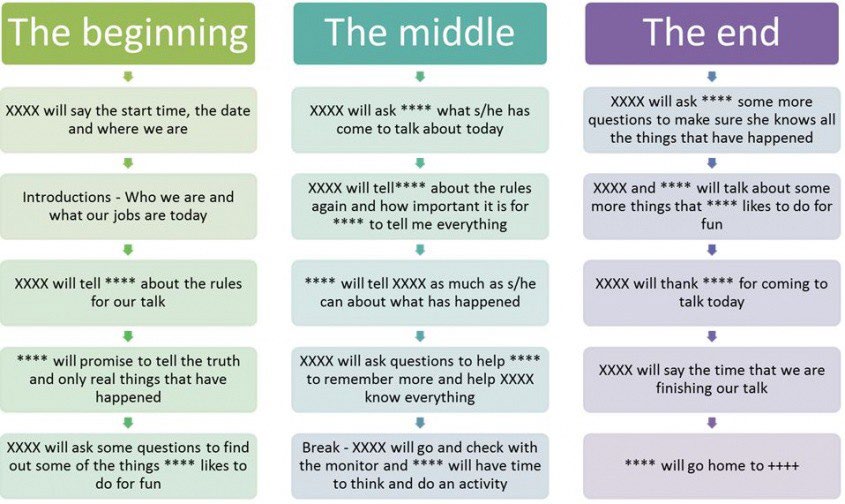
IN-CONFIDENCE
Appendix C: Flowchart showing the
interview phase
35
IN-CONFIDENCE
36
Document Outline
- Policy statement and principles
- Overview
- Contact for enquiries
- Introduction
- When and why should specialist child interviews be used?
- Joint Oranga Tamariki / Police SCI protocol
- Definitions
- Roles and responsibilities
- The specialist child interviewer
- The Monitor
- Oranga Tamariki and Police Managers
- Purpose and conduct of the interview
- A SCI usually takes place as a part of the investigation and assessment process. The SCI is a tool to help Oranga Tamariki and Police to establish if:
- Interviewing number and duration of interviews
- Structure of interview
- Interviewing tools
- Breaks, including Monitor breaks
- Support Person
- Download current confidentiality statements
- Interpreters
- Before the SCI
- Preparation and planning
- Consultation with the Parent and social worker
- Consent
- Pre‐interview with the Child
- After the SCI
- SCI Report
- Role of the Interviewer in court
- Transcripts
- Video recordings
- Security and access to video records
- Video record storage, retention and destruction
- Facilities and equipment
- Recording equipment
- Interview rooms
- Training and development
- Peer review
- Accreditation
- Professional development opportunities
- Supervision
- Interviewing neurodivergent children and/or children with intellectual and communication disabilities
- Note: Interviewers trained in the SCI Model may be the most appropriate Interviewers for adults with intellectual disability and, if so, these guidelines will also apply.
- Introduction
- Planning
- Seeking Additional Information
- Where appropriate, before the interview, consult with family, guardians, carers and professionals (e.g. speech and language therapists, psychologists, teachers, teacher aides) involved, as well as the person themselves to ensure that relevant informat...
- There are several Acts that may be used to support information sharing for this purpose. These include the Privacy Act 2020, section 66 and section 66C of the Oranga Tamariki Act 1989, and section 22C of the Health Act 1956.
- You will need to determine the most appropriate legislation to use on a case-by-case basis. Consult with your supervisor, manager, or legal team as appropriate if you are unsure which would be most appropriate. Ensure that you understand the requireme...
- Medication and anxiety
- Familiarisation
- Room set up
- During the interview
- Tools
- Breaks
- Communication aids
- Talking mats - Some children that have difficulty with verbal communication may be skilled in the use of talking mats. The use of talking mats involves moving around symbols to facilitate conversation through a three‐stage process. While talking mats ...
- AAC - If the Child predominantly uses augmentative and alternative communication (AAC) as their preferred usual form, this should be used within the interview. AAC covers:
- Communication aids and question types
- Engage and explain
- Account
- Questions
- Multiple interviews
- Term
- This guide will commence on the date of signing by both parties and continue until modified or terminated in accordance with the terms of this guide.
- Review and variation
- Termination
- Signatories
- Appendix A: Information about common neurodivergent conditions, intellectual and/or communication disabilities
- Intellectual disability
- Down syndrome
- Autistic Spectrum Disorder (ASD)
- Attention Deficit Hyperactivity Disorder (ADHD)
- Foetal Alcohol Spectrum Disorder (FASD)
- Dyslexia
- Physical disabilities
- Sensory Disability
- Appendix B: Checklist for interviewing neurodivergent children and children with intellectual and communication disabilities
- Key personal details
- Description of disability
- Language
- Attention span
- Comprehension
- Social
- Appendix C: Flowchart showing the interview phase
