The Ministry has a requirement to create vaccine and testing certificates, or a COVID Health Certificate for
people vaccinated in New Zealand. This is seen as a way to facilitate the safer reopening of international
borders and a way to ease restrictions for individuals who have been vaccinated against SARS-CoV-2.
To deliver this, a System is required to create and distribute digital verifiable health certificates related to
COVID-19. The certificates can be issued to people who have received a COVID-19 vaccination, or a COVID-19
test (and potentially in the future proof of having recovered from COVID-19) in New Zealand. This will be
achieved through a digital self-service channel and a call centre assisted channel.
This work is a part of the Travel Health Pass programme overseen by the Border Executive Board. The other
key workstream, led by Customs is tasked with building operational and technology solutions to support the
receiving of vaccination certificates when people arrive (inbound) at the New Zealand border.
There is currently no single international standard for vaccination certificates and this technology is not
currently a core part of Data and Digital’s capability. To understand how Data and Digital might progress this
from a concept to a production service, the Ministry completed a proof of concept (PoC) to understand the
elements of a vaccination certificate. This PoC identified that we should consider a solution that could be
adapted when or if standards changed and a solution that could be leveraged more broadly in line with the
DIA Digital Identity work programme and our work under way on My COVID Record (our consumer web app).
The following key services were examined as part of the PoC:
Public Key Infrastructure (PKI) scope
• Determine an appropriate cryptographic algorithm (i.e., P256, ED25519) for signing.
• Determine production PKI practices and requirements (private clouds, isolated
environments, NIST compliance)
• Determine association to existing PKI infrastructure (i.e., passports and ICAO PKD) -
answering questions around delegation models, root authorities and country signers.
• Determine nature of verification methods and issuer identifiers (i.e., usage of
technologies like x.509 and DIDs)
• Determine discoverability aspects of the issuer identifiers and associated cryptographic
material.
• Determine considerations around PKI governance, for example how long signing keys will
be valid for, what the key rotation policy is.
Interoperability scope
• Determine most appropriate format based on use cases and scope of use.
• Refine vocabulary for completeness and alignment to the WHO recommendations and
consider how test and recovery use cases would be accommodated.
• Define how the NZ based vaccination certificate will be used globally including
conversation / translation / delegation models.
• Determine the relationship between the Vaccination Credential and the DIA VIC
(verifiable identity credential).
• Determine assurance representation for the different aspects (e.g., info, binding,
authenticator) with an NZ privacy lenses.
Customer Experience (CX) Scope
• Determine the spectrum of uses cases and scope of use. Identifying key claim journeys,
presentation journeys, relying parties.
• Describe the varying credential capabilities (e.g., subject binding, selective disclosure,
claiming into wallets) and their impact on usability.
• QR code comprehension including branding, education etc.
Page 2 of 16
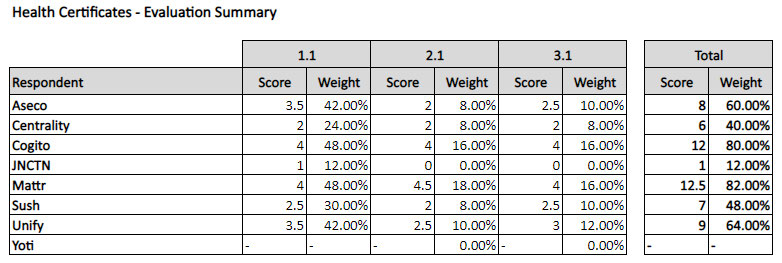
Based on the evaluation, the panel agreed that Mattr provided the best overall response to the Ministry’s
requirements, however, elements of parts of the Cogito solution, such as PKI, would prove useful for the end
solution.
Solution / Scope – Part 1 of 2, Covid Health Certificates
The solution to enable consumers to request, print and download secure health certificates is made up of
multiple components. These will be delivered through a collection of vendors each playing in their specialist
positions. The technical capability will be operationalised through a primary digital self-service channel along
with enabling an assisted channel through the national call centre.
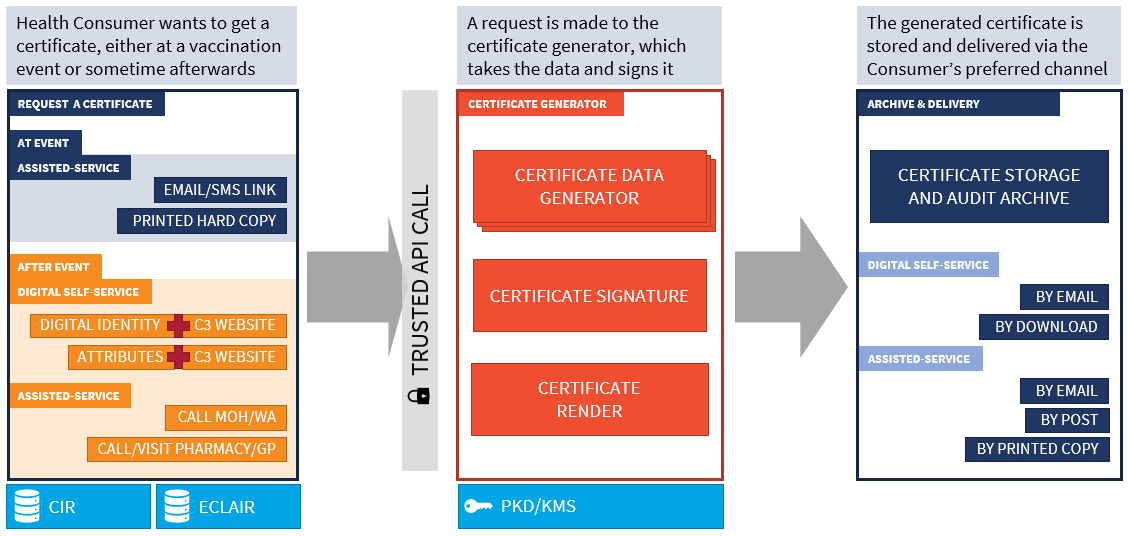
The following diagram shows the key components that make up this solution,
The vendor landscape that will be engaged to deliver this requirement is as follows,
Consumer Interface, Alphero – the existing My COVID Record web app will be iterated to enable consumers to
view vaccination and test results. Once happy with the details they can generate certificates, then print or
download them to their device for offline use. Additional use cases will be implemented such as enabling
consumers to access certificates for dependants.
Certificate Generator and Storage, Mattr – an existing SaaS offering will be utilised to ingest data from the
requesting applications (My COVID Record or CICS). The data will then be structured into the required format
prior to being signed and rendered for consumption through the requesting App.
Certificate Signing, Cogito – another established TaaS offering will be used to provide an external Key
Management Service (KMS) to the Certificate Generator. This service will expose an API that will enable a blob
of data to be ingested and provided back along with a digital signature.
Page 4 of 16
The existing support structure within the Ministry will be extended to support consumers to access Health
Certificates and deal with issues such as missing records or inability to login. Given the volumes of consumers
vaccinated and outbound international travellers requiring proof of testing, a moderate level of support
capacity is forecast as a percentage for engagement through an assisted channel.
The initial focus is on providing certificates in a paper-based (PDF) format, to ensure they are as accessible to
people as possible and can be used offline. Once the paper (PDF) version is in place, additional layers will be
created for storing the certificate in other places for offline digital access (like mobile wallets). There are
broadly two ways of doing this:
1. For some supported mobile wallets, or in an app that the Ministry builds, a consumer can simply scan
the QR code from the PDF and it will be copied into the wallet on their phone. Notably, this will not
work for the built-in Apple Wallet or Google Covid Card, which will require option 2 below.
2. For the wallets built into iOS and Android an additional step of signing the certificate payload with a
developer key before it can be loaded is required. This can be done by adding additional links on the
My Covid Record page so when a certificate is requested, the consumer can choose to receive it as a
PDF or as a downloaded to their iOS or Android wallet. The main difference here is you can’t just
convert from a PDF version after the fact.
The intent is to initially email the PDF to the consumer when they request it through a digital self-service
option or post it out if they have phoned the National Call Centre if they are not comfortable with the digital
option.
Fulfilling option 2 is already on the COVID Consumer Channel roadmap and is targeted for release in early in
2022.
COVID Tracer is not a given for being able to store / hold COVID Health Certificates for offline use. This is
driven by the following factors that will influence plans:
• Inclusion in the COVID Tracer App would suggest a general domestic use case. Currently no such use
cases exist outside the Border Order for those impacted workers.
• Apple and Google have indicated they wouldn’t support this, although it should be noted that this runs
counter to an implementation in Ireland that does exactly this.
• The current plan is to include a link from COVID Tracer to My Covid Record, where a certificate can be
requested and initially emailed to you (or once released downloaded to your device wallet).
• An alternate approach would be to build a Ministry of Health App which could fulfil option #1 above
within a Ministry branded experience. This would utilise a white labelled MATTR app, use MATTR’s
SDK, or to build a custom app.
Solution / Scope - Part 2 of 2, My Covid Record roadmap dependencies
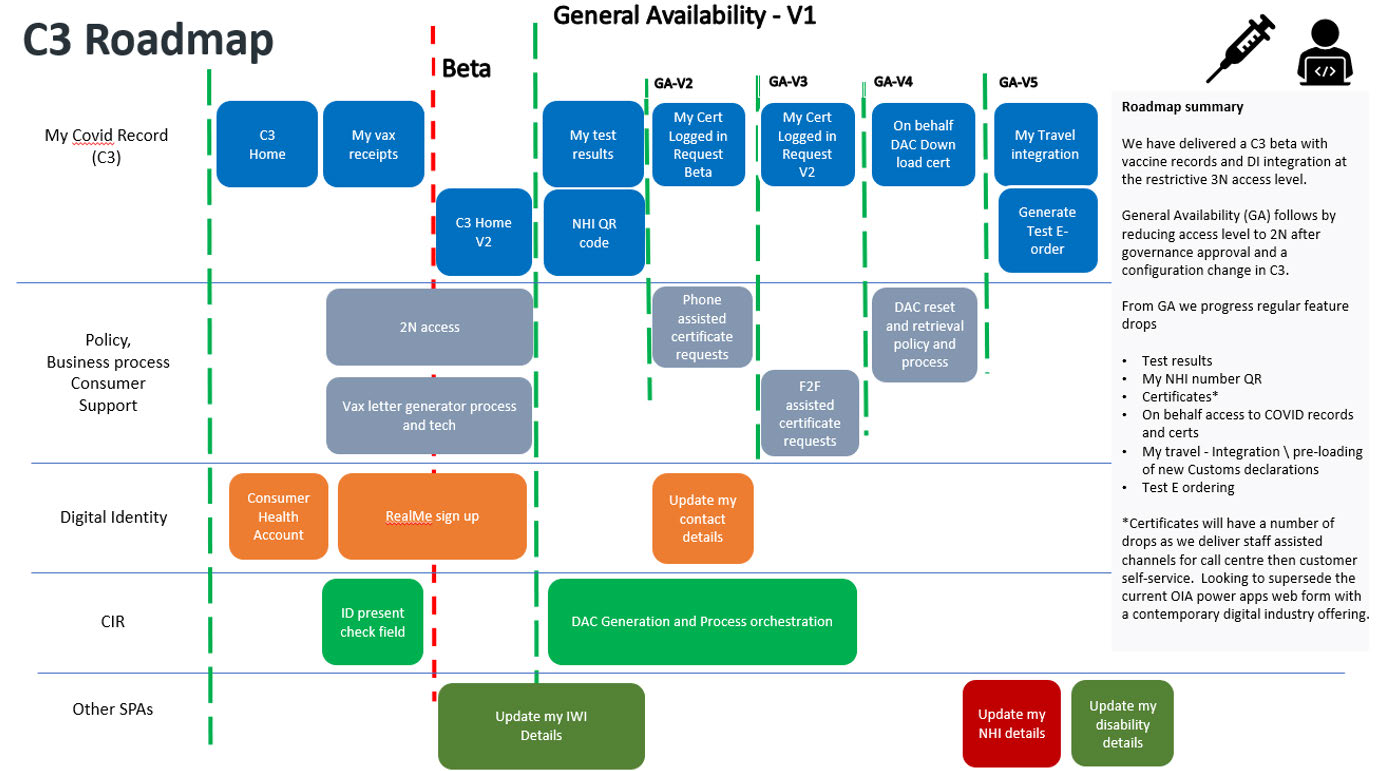
The following roadmap for My Covid Record outlines the targeted functionality for the programme of work to
the end of the calendar year. This is expected to grow as learnings from the current outbreak are converted
into self-service opportunities to drive operational efficiency in the wider COVID response e.g. contact tracing
and testing at CTCs. Alphero will be core to the design, built and evolution of the My COVID Record and the
interdependent additional Single Page Applications (SPAs). Future self-service SPAs can also be developed with
other partners provided they fit with the emerging self-service brand guidelines and integrate with the
Ministry Digital Identity (DI) platform. These roadmap items are critical to the delivery of Covid Health
Certificates at scale without overloading traditional channels such as the call centre and primary care for edge
use cases such as,
-
Update my name in NHI database so certificate generated matches the details of my passport
-
Access Covid Health Certificates for my children as the MoH My Health Account lacks the capability to
capture dependents.
Page 5 of 16
The initial delivery of the Covid Health Certificates requires a moderately light amount of user interface
development to request the certificate, verify personal details for inclusion and select test or vaccination
certificate type. It is the backend certificate generation and digital signing that dominates that release.
This functionality however requires the wider product roadmap to be delivered to realise full value at scale
and the related essential use cases. These additional features are listed below and require the ongoing
engagement of Alphero at current levels of resourcing until the end of 2021,
• Certificate request and digital wallet download UI - to trigger a workflow to validate the details to be
presented on the certificate and calls the require APIs to generate and distribute
• Additional module that enables parents / guardians to access certificates for dependents using an
access code generated in CIR, allow them to confirm they are authorised to access then display the
requested records and enable a certificate for that individual to be emailed or downloaded
• Parallel app delivered to view and update your NHI records using the new FHIR API that is to be
delivered as part of the ongoing NHI upgrade
• Interface to generate an éclair testing e-order through a new Sysmex API connected to CTIP that the
required My Covid Record module will call to trigger a test order for the next 3 days. This will remove
the need for admin activity at CTC’s to collect consumers details prior to paperless sample collection
Out of Scope
The following functionality will not be included within the proposed solution:
•
Inbound Declaration System – while returning New Zealanders are expected to need to submit their
vaccination certificate prior to departure on the return leg, that system or any integration with it, is
not included. However, the programme is working with Customs on this.
•
Material increases (>25%) – if demand for testing due and proof of testing certificates for COVID-19
was to dramatically increase due to COVID-19 in the community then additional funding might be
required e.g. proof of testing being needed to attend mass events.
•
Operations / Vaccinations site team growth – this approach is designed to minimise / avoid
impacting the core vaccination process and as such doesn’t include any funding for additional
resource at vaccination sites, etc.
Page 6 of 16
•
Multiple additional international formats – the estimates are based on a single international
certificate format along with the ability for the Ministry to self-sign certificates for domestic use
cases, e.g. MIQ worker credentials.
Implementation Considerations
The requested funding is required to complete the implementation of the solution, end to end testing, roll out
including the required change management, and ongoing training of support teams. Subsequent sprints are
expected to be required to continually adapt and iterate the solution based on requirements from the Travel
Health Pass and Reconnecting New Zealand programmes and additional operational efficiency gains.
This capability will be surfaced for consumers through two primary channels:
i.
Digital Self-Service – through secure login to the My COVID Record web app and triggering certificate
generation, viewing, printing or downloading.
ii.
Call Centre Assisted Channel – Ministry and/or national call centre agents will be able to identify a
caller and trigger the emailing and/or postage of a certificate to them.
It should be noted that special care will need to be taken in development of the solution and supporting
business processes to ensure that the details the certificate is generated with matches the details on the travel
or identification documents that it will be used with e.g. passport for the purposes of international travel.
Ongoing consumer level 1 and level 2 support are also included in this request for funding. This will be
delivered through augmenting the existing Ministry voice and email support teams and their supporting level 2
capability. This approach is informed by an expected level of consumer issues such as I can’t see my
vaccination of test records, my testing details are incorrect.
Costs
The costs to deliver the full NZ Issued COVID-19 Health Certificate solution including design, testing and
support and required iteration of the solution with changes in International Standards and Border settings is
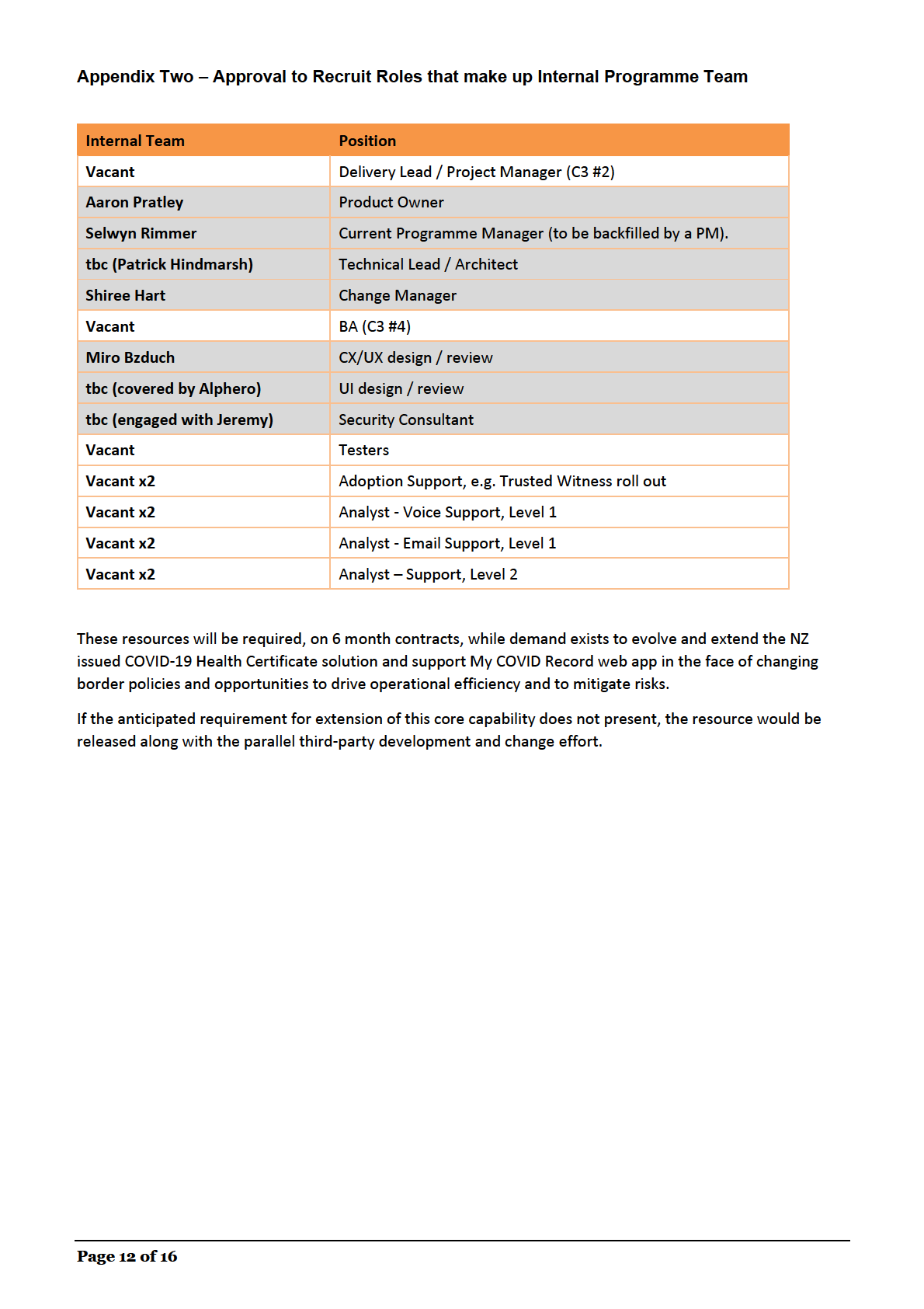
expected to be approximately $3.2M until 31 December 2021. This includes an increase of the internal team of
around 11 people (on six-month contracts) and the provision of the necessary services from Mattr, Cogito and
Alphero. A total cost of $6.2m is estimated for the 2021/22 financial year. This is a mix of one-off
establishment costs and ongoing costs, see Appendix Five for breakdown. No financial commitments are
planned that extend past June 2022. At that point these ongoing costs are expected to material drop as the
public become saturated with proof of vaccination certificates for doses 1 & 2. This would however change if a
dose #3 is confirmed which required POV certificates to be reissued.
Modelling the costs expected has been a challenge, however, the project now has estimates for and some
assumptions on several the relevant factors such as,
• Estimated number who will be vaccinated, 3.73m and outbound international traveller estimates from
Customs and MPI of 1.4m during Nov 21 – Jul 22. Costs estimated based on assumption that 75% of
outbound travellers will request a predeparture test certificate and 50% of all those vaccinated will
want a vaccination certificate.
• Postal costs if 20% of requested certificates are triggered from phone calls to assisted channels
• Vendor charges for front end development, certificate generation and signing along with internal and
vendor estimates for support.
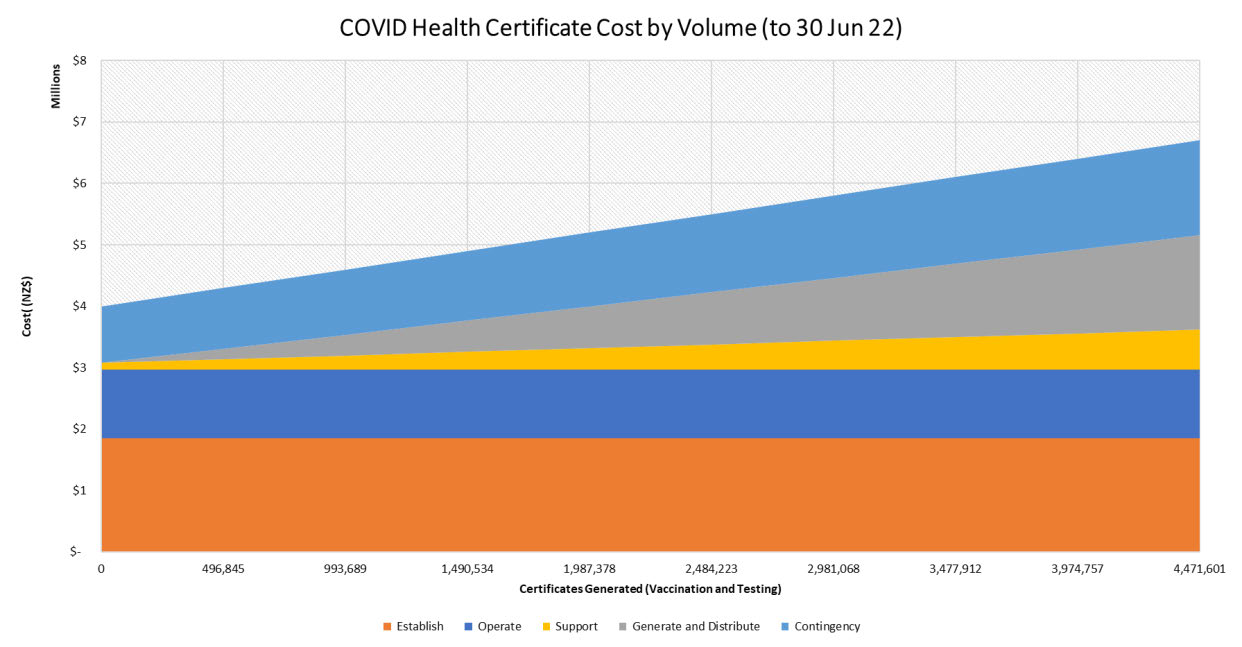
The total cost estimates are materially impacted by the assumptions made on the number of certificates that
will be generated prior to 30 June 2022. Given this the following graph has been created to show the
breakdown of fixed establishment costs versus operating cost, support costs and certificate generation /
distribution costs as the volumes increase.
Page 7 of 16
 Vaccinated 75%
Vaccinated 50%
Intl travellers 75%
Intl travellers 75%
Vaccinated 75%
Vaccinated 50%
Intl travellers 75%
Intl travellers 75%
It should be noted that the Support and Distribution costs forecast are disproportionately skewed towards
certificates that are request through the assisted channel. This is due to the support effort required to verbally
identify consumers and then assist them to generate certificates and the expectation that many of these will
need to be posted to the consumer due to underlying lack of digital access. This is shown in the resulting
average cost per certificate below, based on the forecast 3.3m certificates being generated. Note that the cost
per certificate through the assisted channel is approx. x2.5 that through a digital (self-service) channel.
Channel
Digital
Assisted
Forecast Volume of Certificates
2,691,442
642,705
Average Cost per Certificate
$
1
.43 $
3
.65
The estimated costs to deliver this capability are broken down by provider in the following table.
Supplier
FY21/22 Total
Jul 21 - Dec 21
Comments
Internal
$
1
,381,840 $
6
74,440 Increment product team for delivery and support, plus integration effort.
Mattr
$
7
75,000 $
3
25,000 Certificate generation, rendering, storage and auditing capability.
Cogito
$
6
93,649 $
2
32,135 Digital signing capability for certificates.
Alphero
$
1
,200,000 $
1
,030,000 Web app dev along with user acquisition and experience enhancements.
Servian
$
8
0,000 $
8
0,000 Data pipelines and integration support.
NZ Post
$
6
42,705 $
1
56,030 Print and postage to send out 20% of all certificates generated.
Contingency (30%)
$
1
,431,958 $
7
49,282 Contingency included at 30% given the rapid changes in requirements.
Total
$
6,205,153
$
3,246,887
The required funding will come from the CVIP funding under cost centre 1161, Immunisation COVID-19
Response Technology, which is under D&D delegations. We anticipate there will be sufficient funding through
the CVIP programme to deliver the NZ Issued COVID Health Certificate solution and support Digital self-service
and Assisted Channels. Ministers have been briefed on the work and requested it is to go ahead and ideally
deliver sooner than currently planned.
Governance
The existing CVIP governance structure will be used to oversee delivery of this scope. This will include all
required reporting and endorsements through the following forums:
i.
CIR/Bookings/Consumer Channels Steering Group Meeting – Weekly
ii.
CVIP Programme Leadership Governance (PLG) – Daily
iii.
CVIP Steering Group (SG) - Weekly
Summary
Page 8 of 16
There is a clear opportunity to build on the My Covid Record App that enables consumers to securely log in
and view CIR vaccination records. This would enable Consumers to request/generate a health certificate with
the web app triggering data for the certificate generator for digital signing and rendering. The My Covid
Record app provides digital self-service as the primary channel with an assisted channel option through the
national call centre using the same capabilities. The wider product roadmap features included will support the
delivery of Covid Health Certificates as scale by enable self-service capability to align NHI details with those on
the consumer passport so the certificate details match and to support consume to access certificates for
dependents such as children.
There is uncertainty with regards to many elements, this includes international outbound traveller volumes,
how many will be vaccinated in NZ, what ratio of these will require certificates, how many will need to be
printed/posted and if additional formats will be required in addition to the EU DCC.
This paper outlines what can be achieved with development of the proposed solution and development of
supporting digital channel including:
•
Digital self-service access to generate, print, and download Health Travel Certificates. Also update
NHI details (full name) to match those on their passport and access certificates for dependents
•
Enable the national call centre to trigger the postage of a certificate to a verified caller
•
Provision of a secure credential with consumers NHI and other profile details for identification at a
vaccination or testing centre
•
Ability to store and audit all certificates/secure credentials generated
Recommendations
It is recommended that you:
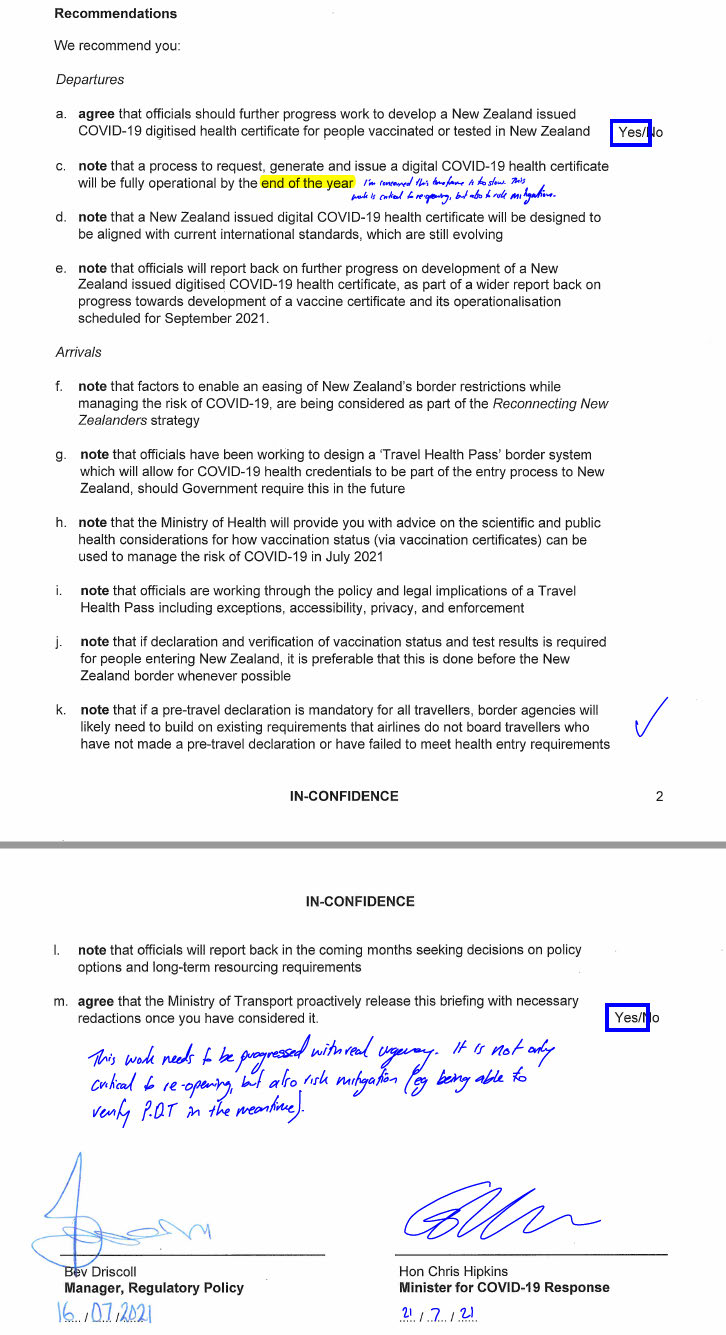
1.
Note:
Ministers concern that Nov/Dec21 delivery of NZ issued Health Certificates
Noted
may be too late, and this work needs to be progressed with real urgency.
2.
Note:
Outcome of procurement activity to select preferred vendors for NZ issued
Noted
Health Certificates and approach taken.
3.
Note:
Estimated costs are $6.2m for the full financial year 21/22 to provide
Noted
certificates generated through self-service and an assisted channel that
generates 20% of certificates and posts them out.
4.
Note:
Estimated ongoing monthly spend at Jun 22 is ~$450k, no financial
Noted
commitments are planned beyond that date. This is expected to drop
materially from that time with proof of vaccination (POV) certificate
saturation, noting a dose #3 could trigger a requirement to reissue POV.
5.
Approve:
Approve the estimated budget of $3.2m (Aug-Dec 21), for the Health
Yes / No
Certificate system (via digital self-service and assisted channels) and
enabling My COVID Record web app development.
6.
Approve:
Contracting of Mattr and Cogito for the outlined scope for certificate
Yes / No
generating, signing and storage.
7.
Approve:
Extension of SoW with Alphero to complete the Web App functionality
Yes / No
outlined.
8.
Approve:
Recruitment of additional resources identified on contract to the end of
Yes / No
the calendar year (i.e. < 6 months) to enable delivery and ongoing product
support.
Page 9 of 16
 Shayne Hunter
Date
Shayne Hunter
Date 15/9/2021
Deputy Director-General, Data and Digital
Page 10 of 16

 Appendix One – Ministers Feedback on Timeline
Update on Travel
Health Pass Work Pro
Page 11 of 16
Appendix Three – Certificate Generation Solution Requirements
Capability required
The Ministry requires a partner with the capability to provide the following:
• Technology and infrastructure to generate compliant digital certificates, aligned to agreed
international standards.
• Integration with or establishment of public key infrastructure for digital health certificates
• Operational support for software and the infrastructure supporting digital health certificates
• Expertise and an established track record in building and operating similar solutions
• Knowledge and experience with current and emerging standards for verifiable credentials within a
health context, with specific interest in standards supporting COVID-19 health credentials.
• Expertise and an established track record in government/enterprise standards for securely managing
private key material, trust frameworks, and supporting the establishment of governance for this.
• Existing organisational and technology accreditations, or an ability to be accredited against recognised
security standards such as SOC 2 and/or ISO27001.
International requirements and standards are rapidly evolving and changing. The Ministry wants to work with
a partner that can not only help with technical implementation, but to help assess this changing landscape and
provide advice to ensure New Zealand remains adaptable to these changing needs.
Capacity required
The Ministry requires a partner with the necessary capacity to deliver to our immediate needs, while
remaining flexible to scale up or down as required to meet the following indicative milestones:
• A production-capable solution, including the ability to generate an EUDCC-compliant certificate, is
available by the start of September 2021. This would mean the bulk of any development and
integration activity will need to complete during August for user acceptance testing and security
review procedures. This iteration is likely to initially be required to support a low volume of certificates
being generated using assisted service channels e.g. a Ministry of Health call centre.
• A fully functional production system, generating certificates on-demand from a range of self-service
and assisted-service channels, in place by the start of November 2021, before the end of year change
freeze.
Requirements
The Ministry has identified the following requirements:
• Technology and infrastructure to generate and manage the generation of compliant digital certificates,
aligned to agreed and emerging international standards. This could be provided as a bespoke solution,
or an existing product or service that meets our requirements. This includes:
a. API(s) and documentation required for external services to call with the required data
elements in order to create a compliant certificate, or an appropriate error message if
incorrect or invalid data is provided.
b. Supporting technology infrastructure that the solution is deployed to. The solution will need to
support being deployed into;
Page 13 of 16
i. one of the Ministry’s current approved Cloud Environments (Amazon Web Services or
Microsoft Azure), and subject to existing security and configuration standards, or
ii. a similar dedicated hosting environment that meets standard Government cloud
security standards. If the solution is provided as Software-as-a-Service, it is preferred
that the solution is not multi-tenant or that guarantees can be made that Ministry
data will not be mixed with other customers.
c. API(s) will need to support being served behind the Ministry of Health API Gateway
• Operational support for the software and infrastructure that will create and manage digital health
certificates. The Ministry does not currently have capacity to manage the ongoing operation and
maintenance of the solution directly. This support includes:
a. Performance monitoring and uptime reporting
b. On-call and reactive support for production incidents and downtime
c. Proactive maintenance and software patching to ensure the solution remains secure and up to
date
d. Integration into Ministry change control and incident management processes
e. A service desk for technical support query escalations that front-line support teams can’t
resolve directly.
• Expertise and an established track record building and operating similar solutions. We are looking for
partners that can demonstrate previous experience developing or running a solution that;
a. can generate verifiable credentials
b. record relevant audit information for each credential for compliance purposes
c. support multiple credential formats depending on the use case
d. support integrations with multiple different front ends
• Knowledge and consultancy on current and emerging standards for verifiable credentials within a
health context, with specific interest in standards supporting COVID-19 health credentials. Alongside
our existing engagement channels, we are looking for partners that can demonstrate knowledge and
expertise in;
a. the WHO DDCC and SVC working groups
b. the ICAO VDS-NC and supporting standards
c. the EUDCC framework and gateways
d. the Good Health Pass and Global Covid Certificate Network
• Expertise and an established track record in government/enterprise standards for securely managing
private key material, trust frameworks, and supporting governance. The Ministry does not have a
formalised PKI Strategy at this stage, although work is underway. It is anticipated these two streams of
work will influence each other.
• Existing organisational and technology accreditations, or an ability to be accredited) against recognised
security standards such as SOC 2 and/or ISO27001. Given restricted timelines this accreditation helps
to streamline our security and compliance processes
Page 14 of 16
Appendix Four – Assumption on Proof of Vaccination and Proof of Testing Certificate Requests
Travellers requesting POT
75%
POT needing to be posted out
16%
Vaccinated requesting POV in FY21/22
50%
POV needing to be posted out
11%
Jul-21
Aug-21
Sep-21
Oct-21
Nov-21
Dec-21
Jan-22
Feb-22
Mar-22
Apr-22
May-22
Jun-22
MPI / Customs outbound travellers
84,720
103,664
115,072
130,000
145,296
179,602
179,037
155,225
201,419
205,333
173,890
172,531
POT certificates - generated
0
0
0
0
85,021
105,096
104,765
90,832
117,863
120,153
101,753
100,959
POT certificates - posted
0
0
0
0
23,950
29,605
29,512
25,587
33,202
33,847
28,664
28,440
Vaccination Uptake NZ
0
0
0
0
3,730,000
0
0
0
0
0
0
0
POV certificates - generated
0
0
0
0
233,125
233,125
233,125
233,125
233,125
233,125
233,125
233,125
POV certificates - posted
0
0
0
0
51,237
51,237
51,237
51,237
51,237
51,237
51,237
51,237
Page 15 of 16
Appendix Five – Cashflow Forecast
Values are in 000's
Aug-21
Sep-21
Oct-21
Nov-21
Dec-21
Jan-22
Feb-22
Mar-22
Apr-22
May-22
Jun-22
Total
Commercial Model
Internal - Delivery / Product Team Effort
$ -
$ 1
49.5
$ 1
49.5
$ 1
56.6
$ 6
7.8
$ 6
7.8
$ 9
4.9
$ 4
2.8
$ -
$ -
$ -
$ 7
29.0
-
Servian - Project Costs
$ -
$ 4
0.0
$ 4
0.0
$ -
$ -
$ -
$ -
$ -
$ -
$ -
$ -
$
8
0.0
-
Alphero - Project Costs
$ -
$ 2
60.0
$ 2
60.0
$ 2
60.0
$ 1
75.0
$ 1
0.0
$ 1
0.0
$ -
$ -
$ -
$ -
$ 9
75.0
-
Cogito - Project Costs
$ 1
0.0
$ 4
0.0
$ 1
0.0
$ 1
0.0
$ -
$ -
$ -
$ -
$ -
$ -
$ -
$
7
0.0
-
Cogito - Support / Platform Costs
$ -
$ -
$ 1
2.5
$ 1
2.5
$ 1
2.5
$ 1
2.5
$ 1
2.5
$ 1
2.5
$ 1
2.5
$ 1
2.5
$ 1
2.5
$ 1
12.3
TaaS service, no committed term
Cogito - Cert Signing Fees
$ -
$ -
$ -
$ 6
0.4
$ 6
4.3
$ 6
4.2
$ 6
1.6
$ 6
6.7
$ 6
7.1
$ 6
3.6
$ 6
3.5
$ 5
11.4
TaaS service, fee per certificate signed, no committed term
Mattr - Platform Costs (MAP Bundle)
$ 5
0.0
$ 5
0.0
$ 7
5.0
$ 7
5.0
$ 7
5.0
$ 7
5.0
$ 7
5.0
$ 7
5.0
$ 7
5.0
$ 7
5.0
$ 7
5.0
$ 7
75.0
MAP Bundle, initial term 9 months from 1 Aug 2021
NZ Post - Printing and Postage
$ -
$ -
$ -
$ 7
5.2
$ 8
0.8
$ 8
0.7
$ 7
6.8
$ 8
4.4
$ 8
5.1
$ 7
9.9
$ 7
9.7
$ 6
42.7
Postage per certificate via assisted channel, no term
Internal - Assisted Channel & Support
$ -
$ -
$ -
$ 8
9.8
$ 6
1.2
$ 6
1.2
$ 8
5.7
$ 8
5.7
$ 8
5.7
$ 8
9.8
$ 9
3.8
$ 6
52.8
Short term contractors ahead of D&D operating model
Alphero - Support Costs (MCR, Info Hub, etc)
$ -
$ -
$ 2
5.0
$ 2
5.0
$ 2
5.0
$ 2
5.0
$ 2
5.0
$ 2
5.0
$ 2
5.0
$ 2
5.0
$ 2
5.0
$ 2
25.0
Expect to contract to end Jun 2022, no cancelation charges
Contingency (30%)
$ 1
8.0
$ 1
61.9
$ 1
71.6
$ 2
29.4
$ 1
68.5
$ 1
18.9
$ 1
32.4
$ 1
17.6
$ 1
05.1
$ 1
03.7
$ 1
04.8
$ 1
,432.0
-
Total
$ 7
8.0
$ 7
01.4
$ 7
43.6
$ 9
93.9
$ 7
30.1
$ 5
15.4
$ 5
73.9
$ 5
09.8
$ 4
55.5
$ 4
49.5
$ 4
54.3
$ 6
,205.2
Page 16 of 16
 Document 2