

11 February 2026
Emma Thompson
By E-mail Only
: [FYI request #32728 email]
Dear Emma,
OFFICIAL INFORMATION REQUEST: 17A REVIEW LEGAL FUNCTIONS
We write to you following an approach from the Office of the Ombudsman with regards to
Councils decision pertaining to your official information requested received by Council dated
4 November 2025 (
Reference: 3253).
You had requested:
LGOIMA
All reports on the last 17A review regarding the Tasman District Council's legal functions
Our previous decision dated 21 November 2025 advised that the information was already
publicly available on our website v
ia LGOIMAs and information of public interest | Tasman
District Council under the Local Government section titled “17A reviews since 2017”.
However, following the approach from the Office of the Ombudsman, we have reviewed the
material in which was requested and was publicly available on our website. Within this
under
release of various documents, we note that the document titled ‘Review of the Council’s
Legal Function’ (page 66-174) contained a number of redactions.
-
Following our review, we have removed or amended some of the redactions contained in
this document. A copy of the document with reconsidered redactions is
attached.
- ‘TDC Legal Review 2024 - Final PDF_ Reconsidered_Redacted.pdf’
Yours sincerely
Legal Services Officer
Released
LGOIMA
under
Released
LGOIMA
under
Released
LGOIMA
under
Released

and planning documents; and information on the Council’s website and legal intranet pages. We
have also used datasets that were provided to us by 6 other local authorities for benchmarking
purposes.
1.8. Our draft report was provided to the Council’s Legal Leadership Team and their feedback has been
taken into account in this final version.
1.9. The primary audience for our report is the Chief Operating Officer and the Legal & Democracy
Services Manager.
1.10. We would like to extend our thanks to everyone who wil ingly took the time to speak to us. Our
particular thanks go to Jennie McFarlane and Leith Townshend for their assistance in responding
so quickly to al our questions and requests for documentation.
LGOIMA
under
Released
4
LGOIMA
under
Released

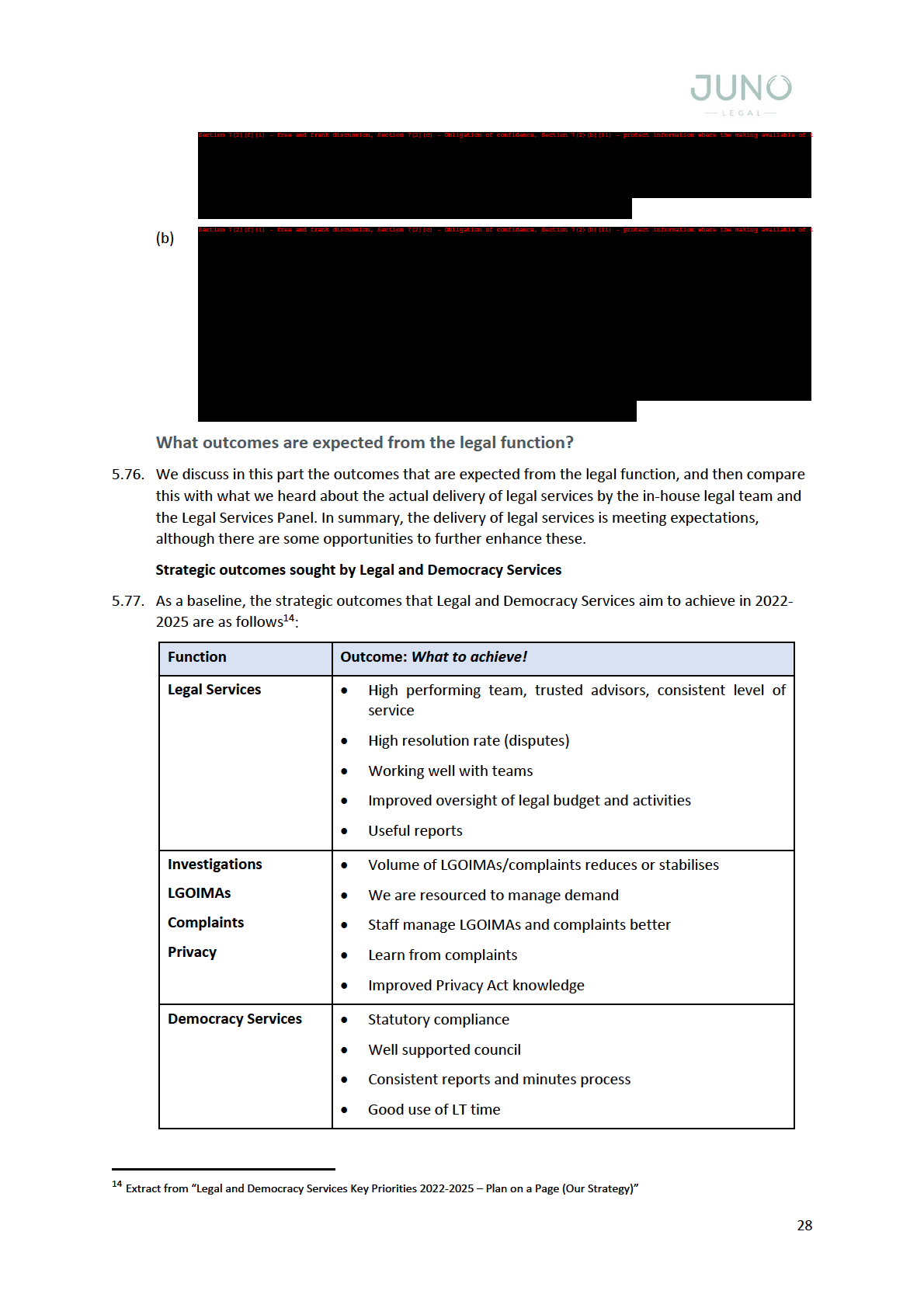
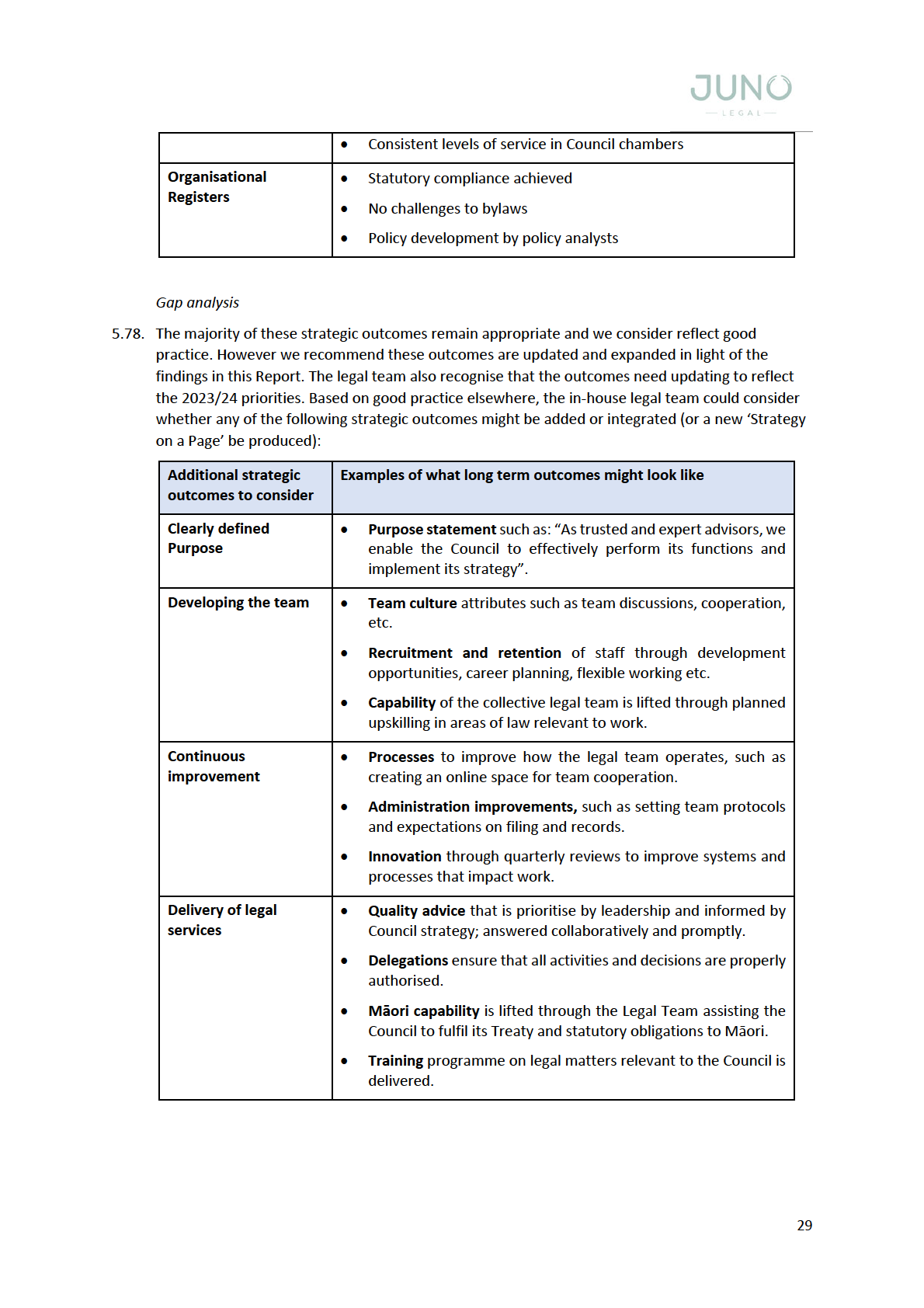
2.11. We recommend the current suite of strategy documents is refreshed, and/or a new “strategy on a
page” is developed that can be easily communicated across the Council. We have carried out a gap
analysis and provided suggestions for what this strategy could cover in Section 5 (see “Strategic
outcomes sought by Legal and Democracy Services”).
1B. Prioritisation criteria
2.12. Being strategic also means maximising the value of the legal function, given the limited resources
available. This requires deciding how work should be resourced and prioritised, based on factors
such as risk, urgency, responsibility, and significance. Setting these expectations should be done in
consultation with clients.
2.13. We recommend the legal team develop and communicate the criteria it wil use to prioritise
business-as-usual work and projects. These criteria could be included in the Operating Framework,
or in a separate prioritisation guide. We have provided suggestions for a “Legal Team Prioritisation
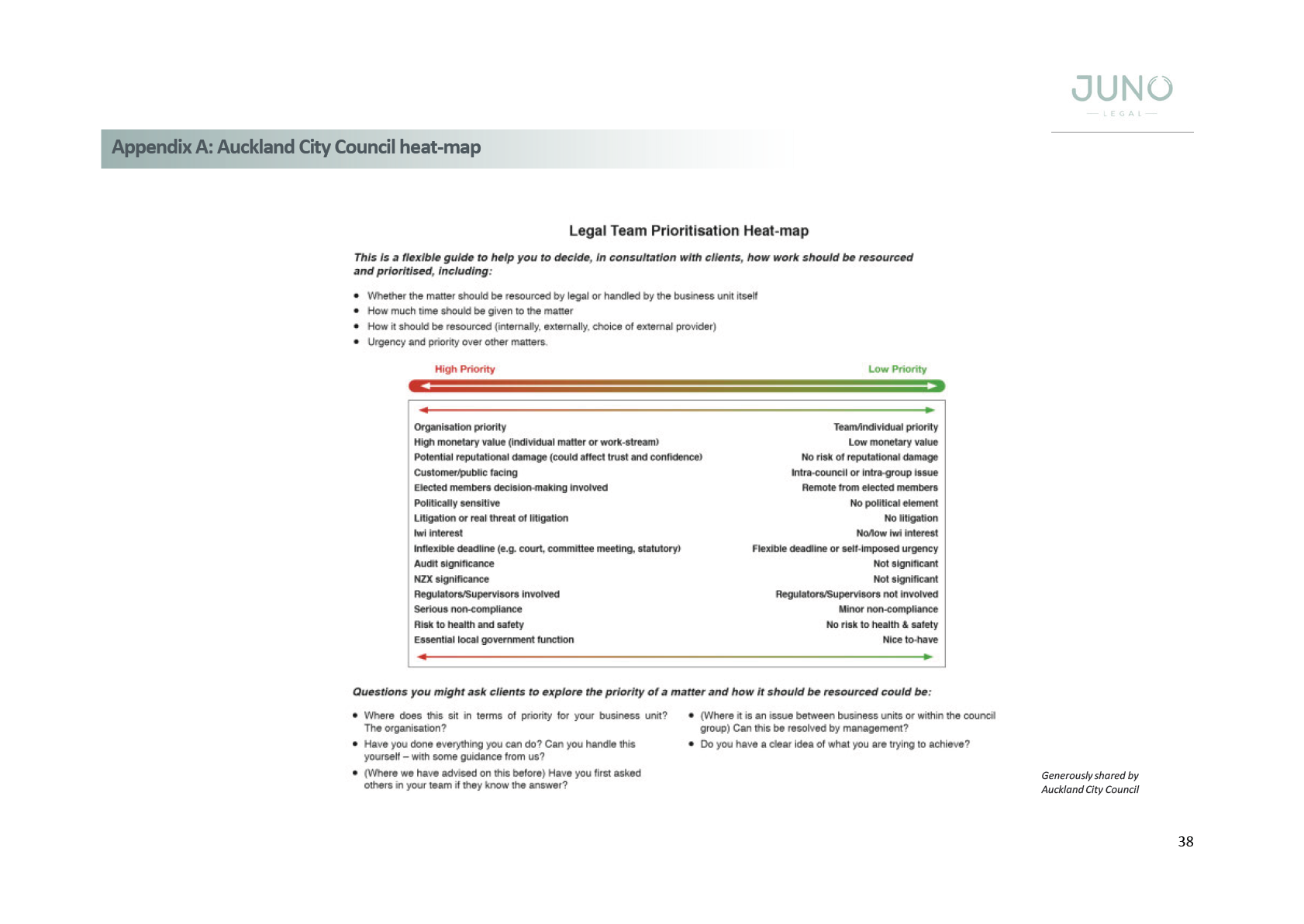
Heat-Map”, based on best practice in other Councils. See Section 5 “Setting priorities and
managing expectations”, and Appendix A.
1C. Operating Framework and Charter
2.14. The legal team has helped (and continues to help) Council staff on the journey of understanding
LGOIMA
what the legal function is and how it operates. The Operating Framework sets out why legal advice
is important, when legal advice should be sought, how to engage with the legal team, and who is
the most appropriate legal specialist. Equally, the legal team has clarified what they wil not do,
such as review or sign-off every communication, or make decisions that are not their responsibility.
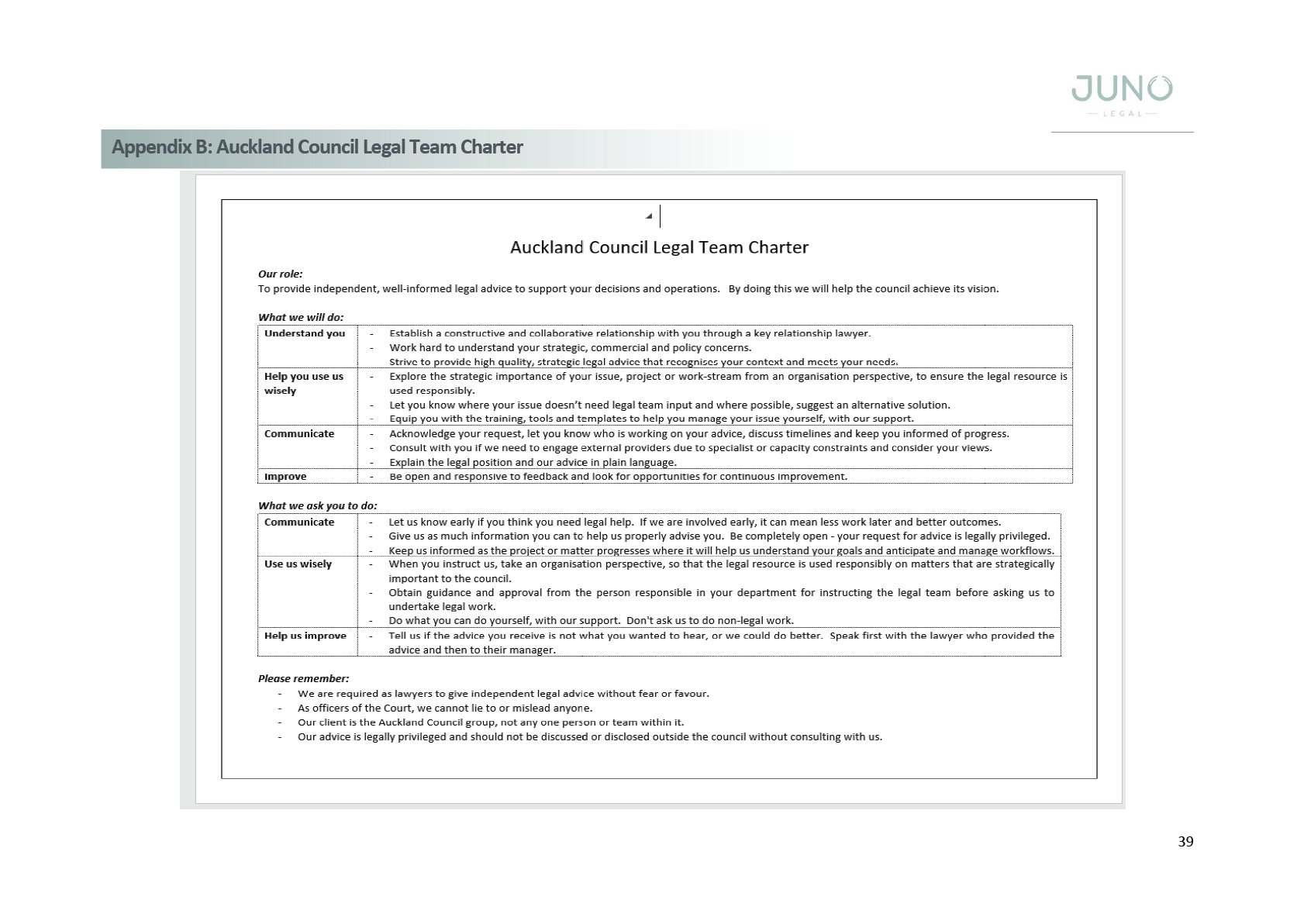
2.15. We recommend the legal team reflect these principles in a separate legal charter (or similar
document) and communicate these across the Council. This can clearly set out the role of the legal
team, what the legal team wil do, and what the legal team expects of Council staff. We have
provided suggestions for a Tasman Legal Team Charter, based on best practice in other Councils.
See Section 5 “Defining the role of the legal team”, and Appendix B.
under
2.16. We also recommend the list of in-scope and out of scope matters in the Operating Framework is
reviewed and updated to reflect the recent re-organisation of the Legal and Democracy Team,
particularly around LGOIMA1, complaints and investigations. It may also be helpful to more clearly
distinguish between what is a democracy services matter, and what is a legal matter.
Recommendation #2: Continue to invest in legal processes and tools to help the
Council staff be more self-sufficient in delivery and decision-making
2.17. The legal team is focused on setting up processes, systems and resources that can reduce the
Council’s reliance on the legal team for lower risk or repetitive tasks. This wil free up the legal
team to provide more strategic and high value advice.
2.18. There were four areas identified to us as potentially offering the most immediate value, that we
endorse. These are discussed further in Section 4, “How are legal services provided?”.
2A. Legal intranet
Released
2.19. The legal intranet has a range of presentations, guidance, registers, and templates. These risk
becoming out of date. We recommend the legal team continues to invest in these resources by
drawing upon the expertise and value added by the external firms. Each legal firm should be asked
to regularly add, review and update their templates and guidance that are published on the
intranet to ensure these reflect best practice across local government and any changes in the law.
1 Local Government Official Information and Meetings Act 1987
6

This potential opportunity has already been identified by the legal team. This should form part of
the free “value-add” that the firms on the panel contract are asked to provide.
2B. LawVu
2.20. The legal team currently uses the “LawVu” for managing matters that have been outsourced to
external law firms. Nelson City Council has also invested in this product and uses it extensively for
workflow management, contracts and reporting.
2.21. s7(2)(b)(ii) - protect information where the making available of the information would be likely unreasonably to prejudice the
commercial position of the person who supplied or
2.22. The legal team is exploring whether LawVu or another system could also deliver contract
management. We recommend that the Council’s investment in a contract management solution
continues and is prioritised by the Digital Innovation Project.
2.23. We also recommend a wider review of the LawVu product (and the internal administration
necessary to support it) be carried out by the legal team, potentially drawing on Nelson’s
LGOIMA
experience, to establish whether this product can be used more effectively by the in-house legal
team, external legal providers and Council staff.
2C. Promapp
2.24. The legal team is responsible for updating various Promapp processes, such as the standard
process for responding to LGOIMA requests. The legal team intends to develop additional
Promapp processes, as time permits, and we endorse this initiative.
2D. Team and professional development
2.25. We encourage the legal team to continue to work ‘on’ the legal team, not just ‘in’ it. This means
under
setting aside dedicated and regular team time (eg. one morning per fortnight) to review and
develop the systems, processes and tools used by the team. It also means looking for opportunities
for professional development for each team member, such as technical, leadership and other
relevant skil s.
Recommendation #3: Review the resourcing and structure of Legal and Democracy
Services
2.26. The Council’s in-house legal team includes three very senior lawyers who are considered to be
doing an outstanding job. These roles are the Legal & Democracy Services Manager, Team Leader –
Legal Services, and Corporate Counsel.
2.27. Based on our understanding of the Council’s future legal requirements, the need for a cost-
effective legal service, and the risk of turnover of key legal staff, our view is that there are three
potential options that could be considered, either now or in the longer term. These are subject to
budget constraints. These are discussed further in Section 4, “How are legal services structured
Released
and resourced?”.
3A. Legal & Democracy Services Manager
2.28. The first option is to review the role and responsibilities of the Manager of the legal team.
Currently this role is also responsible for the democracy services function (providing considerable
support to the Office of the Mayor and Chief Executive), which requires a disproportionate amount
of time (up to 90% of the role). The Manager is also the Privacy Officer for Council and responsible
7

for associated policies and processes, and also for investigations, requests and policies under the
Local Government Official Information and Meetings Act 1987 and complaints. Consideration could
be given to establishing a General Counsel (or Chief Legal Advisor) role that can focus on the legal
function, and is separate from the Democracy Services function. This would be in line with other
unitary councils, and also other councils.
Rec 3B. Democracy Services Team
2.29. The second option is to review the size of the democracy services team (currently 3 staff) to better
align with Councils of a similar size (for example, we understand Nelson Council has a team of 8
staff and Gisborne Council has a team of 6 staff). This should reduce the demand on the Legal &
Democracy Services Manager.
3C. Legal Team
2.30. The third option is to review the size and expertise of the legal team and whether additional
expertise could be brought in-house, rather than needing to outsource certain legal work. The
drivers for this would be to support the Council’s future legal needs and/or reduce the Council’s
external legal spend. For example, the recent appointment of a very experienced Corporate
Counsel has proven the value of having commercial and contracting expertise in-house to support
property, infrastructure and information technology projects.
LGOIMA
2.31. The Council would certainly benefit by adding or procuring additional legal expertise in the areas of
local government, property and/or resource management law. Based on current demand, we
consider the size of the legal team to currently be about right. However the indications in this
report are that additional legal support wil be required in future. Such support would need to be
met by increasing the legal budget (to procure external support) and/or increasing the size of the
legal team. The capability and capacity of the legal team should be kept under review as the
Council’s legal requirements increase, and should be reviewed whenever any senior lawyers
depart.
under
Recommendation #4: Review and refresh the Legal Services Panel
2.32. The current legal services panel contact is due to expire in 2024. The current arrangement is
generally considered to operate successful y and be cost-effective. This is discussed further in
Section 4, “How are legal services structured and resourced?”, and “Accessing ‘value added’ legal
services from external law firms”.
4A. Legal Services Panel
2.33. We recommend that a similar-sized panel arrangement is jointly procured and established by
Nelson and Tasman Councils. Proposals should be sought from a wider range of national, regional
and local firms. The selection criteria and procurement process need to be fit-for-purpose,
transparent and defensible. Firms should be encouraged to expand their value add services.
4B. Fee arrangements
2.34. We recommend that firms are encouraged to put forward innovative fee proposals such as value
based bil ing, fixed fee arrangements for transactional work, and discounted secondment rates.
Released
Recommendation #5: Continue to build strategic partnerships with internal clients
and partnering opportunities with Nelson City Council
2.35. There are already excel ent relationships in place between members of the in-house legal team
and Council managers. There is also regular communication between the legal teams at Tasman
8

and Nelson Councils. We have highlighted three opportunities that were raised with us that could
help enhance particular relationships. These are discussed further in Section 5.
5A. Executive Leadership Team
2.36. First, we consider the Executive Leadership Team (ELT) would benefit from having the Legal and
Democracy Services Manager at its meetings. Given that the legal team works across al areas of
the Council and focuses on risk, the Manager is uniquely placed to offer insights and strategic
advice. The Manager can also help with directing better reporting from across the Council. This
would align with Nelson City Council where the General Counsel (their equivalent of the Legal
Services Manager) attends the Senior Leadership Team (their ELT equivalent) meetings -primarily
in relation to reports.
5B. Chief Executive and Regulatory Manager
2.37. Second, we understand the positions of Chief Executive and Regulatory Manager have recently
been recruited. The role of Chief Operating Officer is now being recruited. These are key
relationships and require strategic alignment with the legal team (and vice versa). We recommend
effort be put into running a legal induction for the new appointees and proving regular legal
briefings.
LGOIMA
5C. Nelson City Council
2.38. There is an opportunity for the in-house legal teams from both Councils to work together to
develop a protocol for how joint instructions are to be issued and legal matters general y dealt
with on joint projects in future. This is particularly relevant to work relating to the Joint
Committees and Infrastructure Holdings Ltd.
Recommendation #6: Review how legal budgets are set and look for opportunities
for cost savings
2.39. The Council operates a decentralised (or devolved) budget for external legal services, rather than
under
a single, centralised legal budget. This means that each Group Manager holds and sets their own
legal budget for their Group, based largely on legal expenditure during the previous year and any
upcoming projects. Our understanding is that the in-house legal team is not involved with setting
the budgets and has minimal visibility of how these are set. These are discussed further in Section
6.
6A. Business Case
2.40. We recommend a business case be prepared on whether there is a case for a centralised legal
budget. There is general agreement that a centralised legal budget would likely result in cost
savings for the Council. However there are other trade-offs that need to be worked through, and
different Councils have taken different approaches. For example, Nelson City Council operates a
decentralised legal budget but Christchurch City Council operates a centralised legal budget.
6B. Annual consultation
2.41. Regardless of whether the budget is centralised or decentralised, we recommend that each group
Released
and/or business unit manager consult with the in-house legal team when setting the annual
budget. This consultation provides an opportunity to discuss the work programme ahead; the
volume and timing of legal services; whether the legal budgets look realistic; and how the budgets
compare across the Council.
9
LGOIMA
under
Released

3.6. The primary roles, responsibilities and activities of the Council are governed by key legislation
including:
(a)
Local Government Act 2002
(b)
Local Government (Rating Act) 2002
(c)
Resource Management Act 1991
(d)
Health Act 1956
(e)
Building Act 2004
(f)
Waste Minimisation Act 2008
(g)
Local Government Official Information and Meetings Act 1987
(h)
Civil Defence Emergency Management Act 2002
(i)
Land Transport Management Act 2003
(j)
Land Transport Act 1998
LGOIMA
Vision, purpose and strategic priorities of Tasman District Council
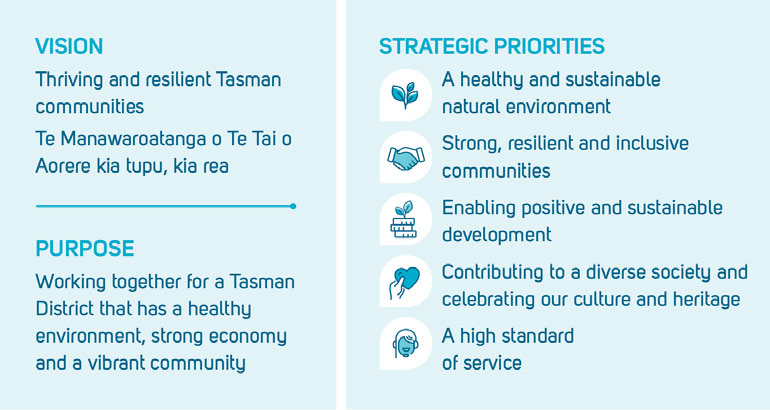
3.7. The Council’s 10 year plan (2021-2031) sets out the vision, purpose and strategic priorities, as
summarised in the table below:
under
Organisational Structure
3.8. The Council is governed by a mayor and 13 council ors. The Council has a total staff of around 414
people. The Council’s senior leadership team (SLT) comprises the Chief Executive, 6 group
managers, and Kaihautū Manager Māori Partnerships.
Released
3.9. The group managers oversee the following areas:
(a)
Council operations
(b)
Community infrastructure
(c)
Environmental assurance
11

(d)
Finance
(e)
Information, science and technology
(f)
Service and strategy
3.10. We spoke to a number of internal stakeholders from each of these groups for their insights on
what their legal requirements are currently, and are expected to be in the future. This is discussed
in the next section.
LGOIMA
under
Released
12
LGOIMA
under
Released

life of these contracts (for example, factoring in additional user licences and data storage
requirements over time). This is requiring an increasing level of legal resource and is currently
highly dependent on one in-house lawyer.
Environmental Information
4.7. Fol owing a restructure around 2 years ago, the science function (including biodiversity) was added
to this Group’s responsibilities.
4.8. Significant legal input was required in respect of the Waikoropupu Springs Water Conservation
Order7. This included preparing submissions and attendances at the Environment Court. We heard
that the Council was very wel served by its external lawyers, which included a Queens Counsel.
Although the main legal work is completed, ongoing legal support wil stil be needed to assist the
Council to implement the Order.
4.9. The Council also expects legal advice wil be required in relation to Resource Management Act
changes, and any other environmental and water reforms. There may also be other litigation or
complaints that arise in these areas. We heard that the legal team is seen as important in helping
the Council ensure there are fair processes, robust information and unequivocal decisions. It is
unknown what level of legal resource wil be required. However, based on the increasing number
of challenges from across the District, more legal support seems likely.
LGOIMA
Community Infrastructure Group
4.10. The Community Infrastructure Group is responsible for all the Council’s major infrastructure, such
as water and waste disposal and transportation. The Group also look after parks, reserves and
community facilities.
Capital Infrastructure Works (Project delivery)
4.11. The construction of all major infrastructure is outsourced, with the Group providing programme
management. The Group typical y prepares and issues tenders and contracts, using established
under
templates (such as NZS3910). We were told by the Group managers that 95% of this contract work
is done by the Council project managers without needing legal input.
4.12. We heard that there are minimal disputes between the Council and contractors. This is attributed
to factors such as: good relationships with trusted contractors and suppliers; clear designs and
specifications; proactive management of contract variations; and thorough evaluation and debrief
processes. There has been a recent focus on the process for awarding contracts and ensuring
appropriate financial delegations and authorisations are in place. For example, large contracts
exceeding $1m are awarded by a Tenders Procurement Panel, comprising the Chief Executive and
three Council ors.
4.13. In other respects, however, this is a major area of work for the legal team. We heard from the legal
team that significant legal input is required across a range of projects, property and reports. For
example, legal support has been needed around government funding agreements, cycleway
projects, Port Tarakohe, and Three Waters work.
4.14. Legal support for construction projects is required in relation to land issues, contracting and
Released
procurement. For example, the acquisition of land that may be needed under the Public Works Act
1981. This work is mostly outsourced to national consultancies that have experience across these
types of issues and projects. The role of the in-house legal team is to instruct the appropriate
lawyers, and keep a ‘watching brief’.
7 Te Puna Waiora o Te Waikorupupu Springs and Wharepapa Arthur Marble Aquifer Water Conservation Order 2023
14

4.15. The Council’s expectation is that a similar level of legal support wil be required for the projects
identified in the 10 year Long Term Plan.
Transportation
4.16. The Council oversees the transport network, which has experienced a period of growth from a
rising population and climate change challenges. The Council has various arrangements with
Nelson City Council, involving joint contracts and co-funding, such as the Joint Principals Contract
for road maintenance. The Council also col aborates with Waka Kotahi, and has responsibility for
the joint delivery of projects under various Developer Agreements. In recent years, the Council has
had to deal with significant damage, or imminent risk of damage, to its roading network from
natural disasters, such as a collapsed bridge.
4.17. The work is these areas was described as legally complex, high risk, and challenging. Legal support
is required to help navigate the relevant legislation, such as the Land Drainage Act 1908 and the
Land Transport Management Act 2003. Legal advice has been sought in relation to contested
property rights, drainage disputes, insurance claims, and drafting and reviewing legal agreements.
4.18. Most of this work is outsourced by the in-house legal team to firms on the legal panel. The
Council’s expectation is for an increase in the amount of legal support required, due to the
increasingly litigious nature of the complaints and chal enges being brought by landowners and
LGOIMA
community groups, and the rise in the number and complexity of LGOIMA requests.
Service and Strategy Group
4.19. The Service and Strategy Group provides planning and policy expertise for the Council, as wel as
library services, customer services and community partnerships. The Group is responsible for most
of the Council’s major policy, plan, strategy and bylaws development and reviews. The Group
draws on the range of expertise within the wider Legal & Democracy Services Team, and this
reliance is expected to increase in future.. This section of our report focuses on the Strategic Policy
area.
under
Community Policy
4.20. The Group is responsible for providing policy and planning advice to support the various statutory
documents that the Council must produce, such as the Long Term Plan, Annual Plan and Annual
Report. The Group also inputs to the various bylaws.
4.21. The Group prepare decision-making reports for the Council and sometimes seek reviews from the
wider Legal and Democracy Services Teams. We heard that these reviews are expect to increase
over time. The reasons include requests from Elected Members for legal advice, and the
mandatory legal section in the Council template reports.
4.22. It was not entirely clear to us, or the Group, whether the Council’s needs in this area are being met
primarily by the legal function or the democracy services function. This is a result of the joint
responsibilities of the Legal and Democracy Services Manager, and the overlaps between the
teams. We discuss this point further below.
Infrastructure Planning
Released
4.23. The Group is responsible for transport, water and waste infrastructure planning. This covers a wide
range of activities such as asset planning, catchment plans, infrastructure bids to central
government (for example West Motueka development), plans with iwi, and bylaws.
15

4.24. Some of these are joint activities with Nelson City Council, for example the Joint Speed
Management Plan. We heard that having the joint legal panel with Nelson City Council has been an
advantage in being able to seek legal advice from one firm on the various joint plans
4.25. For these activities, the Group requires specialist legal advice on points of legal ambiguity,
statutory processes, and legislative reform. For example, legal advice may be sought on the public
consultation requirements under the Local Government Act 2002.
4.26. Routine legal support is required for bylaw reviews that come up on a regular cycle, and helping
prepare various easements, land agreements, and access agreements, For example, the water
bylaw review in 2024 wil require a legal review.
4.27. As with the policy activities above, the Council expects there to be an increase in the level of legal
support for its planning activities. Recent experience suggests an increase in future chal enges to
Council decisions, and therefore a desire for second opinions and external legal peer review.
4.28. Looking to the future, there are likely to be legal implications arising from the Three Waters
reforms given that all operations are outsourced and done under contract. For example,
depending on the delivery entity model, contracts may need to be novated. It was suggested to us
that the various Councils involved (Nelson, Marlborough, Tasman) could consider engaging a single
law firm, rather than each incurring legal fees with multiple law firms.
LGOIMA
4.29. As part of the Council’s initiative to improve long term financial viability, there may be
opportunities to explore other Public-Private Partnerships (PPP)8 or Special Purpose Vehicles (SPV)
with developers. For example, the Infrastructure Funding and Financing Act 2020 provides new
ways to use SPVs to fund and finance infrastructure projects that support housing and urban
development. If pursued by the Council, then these are areas that will require specialist legal
advice.
Climate Change
4.30. The Council is developing a Tasman Climate Response Strategy and Action Plan. This includes
under
mitigation and adaptation planning. Ongoing legal input to the Planning teams is expected to be
remain steady, with occasional “quick questions” being put to the in-house legal team and ongoing
training on relevant legal developments.
4.31. We also heard that the impacts of climate change in the areas of property and consenting are
expected to mean more involvement of the legal team for the foreseeable future. By way of
example, the impacts from Cyclone Gabrielle that occurred in February 2023 have resulted in
significant legal issues for the councils affected, such as developing policies to categorise
properties, managing property owners and organising government funding.
Environmental Assurance Group
4.32. The Environmental Assurance Group oversees the consenting, compliance and enforcement
functions of the Council, across a wide range of legislation and bylaws. This includes maritime
safety, alcohol licensing, parking enforcement, development contributions, animal control,
building and resource consents, and environmental health. The Group’s management represents
Released
the Council in a number of important roles, such as at the Golden Bay Community Board, the
Regional Council Network, and the Dry Weather Task Force.
4.33. The role of legal was described to us as helping find the “lines in the sand” for Council intervention.
This involves a legal risk assessment, based on factors such as legal precedent, public interest, and
8 For example, Waimea Community Dam is a private public partnership between the Council and Waimea Irrigators.
16

an evidential review. The purpose of the legal advice is to enable the Council (not the legal team)
to make a decision about possible enforcement action such as issuing infringement or abatement
notices. For example, the Council is required to regulate swimming pools, seawal s, and dams
under the Building Act 2004 and/or Resource Management Act 1991. There are many legacy
issues, and these have involved the Council in complaints, litigation and determinations. The in-
house legal team provides considerable assistance in responding to LGOIMA requests and
Ombudsman complaints in this area. Specialised legal advice is also provided by external lawyers.
4.34. The Council is also responsible for resource consents under the Resource Management Act 1991
and related legislation9. The consenting and appeals process often involves Hearings. These
require specialised external lawyers to support the Council. However the in-house legal team also
provides legal support and strategic oversight of the process.
4.35. Despite the legal powers available to the Council, we heard that litigation is always seen as a last
resort. The Council’s preference is to resolve non-compliance and to settle disputes directly with
the parties. For example, in the past 18 months we were told that there have only been two
prosecutions under the Resource Management Act 1991. The Council’s lawyers have assisted in
these processes, such as preparing settlement agreements.
4.36. The Group considers that it is a heavy user of legal services, and expects this reliance to continue
LGOIMA
for the foreseeable future in the areas described above.
Finance Group
4.37. The Finance Group is responsible for financial management, and for the Council Enterprises such
as forestry, Motueka Aerodrome and Infrastructure Holdings.
4.38. There is currently limited need for legal advice in relation to the Council’s finances, other than for
specialist tax advice. We heard that the Finance Group has internal expertise around relevant legal
requirements, such as the Credit Contracts and Consumer Finance Act 2003, and has contracted
out its debt management activities to a Council Controlled Organisation (CCO).
under
4.39. The Group does require legal support for the Council Enterprises. For example, specialist legal
advice was needed for the establishment of the new, jointly owned Operational Holding Company
(a Council Controlled Trading Organisation, or CCTO) for the assets and operations of Nelson
Airport and Port Nelson. The in-house legal team instructed an external law firm, and prepared the
required Council resolutions.
4.40. However we were told that there are no new CCOs, CCTOs, or PPPs on the horizon for the Council.
It therefore seems that the legal support required by the Group in these areas should be lower
than in recent years. In other areas, the expectation from the legal team is that significant legal
support wil be required on an ongoing basis.
Council Operations Group
4.41. The Council Operations Group looks after many of the cross-Council functions. The four teams that
make up the group are Legal and Democracy Services; Communications and Change; People and
Wel being; and Assurance and Improvement.
Released
4.42. There is a limited need for legal support across the Group (with the exception of Democracy
Services, discussed below). We heard that legal advice is sometimes required in relation to
employment matters, and this is outsourced to an external law firm. There may also be occasional
9 Related legislation includes the Natural and Built Environment Act 2023 and the Spatial Planning Act 2023.
17

requests for legal review of external communications. The procurement function is expected to
require legal support in future, although this role is currently vacant.
Democracy Services
4.43. Democracy Services is responsible for supporting Elected and Appointed Members
(approximately 61 people) and the supporting processes around Council and Committee meetings,
decision-making, hearings and workshops as wel as assisting with support for the two Community
Boards. There is a significant amount of work required to support the 3 yearly cycle of local
elections, There is also routine work to develop and update policies and registers, terms of
reference, and delegations.
4.44. Democracy Services is part of a combined Legal and Democracy Services Team, rather than a
separate team.
4.45. In practice, with being such smal teams, the two teams work closely together. For example, the
legal team assisted with the 2022 local elections, and the democratic services team is currently
assisting with delegations and warrants. Another example is the Legal Services Team Leader is the
acting manager for the entire team one day per fortnight.
4.46. We heard that the combined functions of the two teams mean that they are essential y running
LGOIMA
the equivalent of an “Office of the Mayor and Chief Executive”.
4.47. These arrangements mean it is difficult to identify what legal services are actually required to
support the democracy services function. For example, we heard from other Managers that it is
unclear at times whether the Council lawyers are providing legal advice wearing their “legal hat”,
or are providing management opinions wearing their “democracy services hat”.
4.48. However there was general agreement from those we spoke to that a similar level and type of
legal support wil continue to be required to deliver democracy services, based on the current
structure and resourcing of the combined team.
under
Legal Services
4.49. The Legal Services team is responsible for overseeing litigation, complaints, investigations and
LGOIMA requests. The team provide legal advice across the Council (as described in this Section),
with the main focus areas being infrastructure, commercial transactions, property, regulatory,
governance (commercial and Council), iwi relationships and compliance.
4.50. We explore in greater detail how these legal services are delivered in the next section.
Released
18
LGOIMA
under
Released

subject to a number of Ombudsman preliminary enquiries and investigations. Good legal advice is
needed to help the Council avoid future litigation. For example, the Legal & Democracy Services
Team has a role in ensuring that report resolutions are wel drafted, and the correct delegations
and authorisations are in place, but lack time and resources to adequately do this.
5.9. Importantly, the Council acknowledges that it is not looking to outsource its legal risk. In other
words, neither the in-house or external lawyers are expected to make and sign-off risky decisions.
Lawyers are required to add value to the decision-making process and be trusted advisors to the
decision-makers. In doing so, lawyers must meet their professional obligations to provide
independent legal advice to their client, even if it means their advice is unpopular at times.
What is the role of the in-house legal team?
Defining the role of the legal team
5.10. The Legal Team’s “Operational Framework” describes the role of the legal services department as
ensuring:
-
“The effective management of legal risk across the organisation;
-
The timely escalation and remediation of matters of legal significance affecting the
Council; and
LGOIMA
-
Prudent and efficient use of finite in-house legal resource.”
5.11. The in-house legal team clearly understand their role is advisory only and do not consider that
there is a transfer of risk to them, or an expectation for them to make the decisions. We consider
this aligns with the expectation of why legal services are required, as discussed above.
5.12. The Operational Framework identifies when it is mandatory for the Council to refer a matter to the
legal team. These matters include litigation, use of an external law firm, creating a bylaw, and
certain types of contracts. Conversely, there are certain types matters that are outside the scope
of ordinary legal services, such as drafting Council reports, drafting responses to complaint letters,
under
procurement questions, and insurers.
5.13. In addition to the Operational Framework, the Council’s Shopfront intranet page states that the
“Legal and Democracy team is responsible for and can offer assistance and advice on various
processes”. This include local elections, staff interests, privacy, and delegations.
5.14. We recommend the list of in-scope and out of scope matters is reviewed and updated to reflect
the recent re-organisation of the Legal and Democracy Team, particularly around LGOIMA,
complaints and investigations. It may also be helpful to more clearly distinguish between what is a
democracy services matter, and what is a legal matter.
5.15. We also recommend reviewing how the legal team’s role is communicated across the Council. This
could involve refreshing the intranet page and/or the Operational Framework document. Another
option is to develop a team charter that sets out on one page the legal team’s role; what the legal
team wil do; and what is asked of clients. A good example is the Legal Team Charter that Auckland
Council developed and has agreed for us to share with other legal teams. This is attached at
Appendix A.
Released
Setting priorities and managing expectations
5.16. Given the potential volume of legal work, it is essential for the in-house legal team to set its
priorities. We reviewed two documents that set out the long term priorities.
20

5.17. The first document is the “Legal and Democracy Services Key Priorities 2022-2025 – Plan on a Page
(Our Strategy)”. This was prepared in 2022 and is due to be updated in 2024. This describes the
current status (“Where we are now?”), the planned activities (“What we wil do?”), the
metrics/KPIs (“How do we know?”), and the Outcome (“What to achieve!).
5.18. The second, related document is the “Legal and Democracy Services 2023-2025
Projects/Priorities”. This lists the larger projects, that are over and above the business-as-usual
work. The projects cover statutory compliance, policy reviews, business improvement, and team
management. The plan sets the priorities by quarter over the next 12 months.
5.19. We consider these two planning documents provide a practical and transparent way of setting the
direction for the legal function.
5.20. Going forward, we recommend that the legal team develop criteria to help assess the relative
importance of each existing and planned project and activity. The purpose is to help the legal
team, in conjunction with clients, decide how work should be resourced and prioritised. A good
example for how to approach this task is the “Legal Team Prioritisation Heat-map” that Auckland
Council developed and has agreed for us to share with other legal teams. This is attached at
Appendix A.
Bringing a strategic perspective
LGOIMA
5.21. We heard from some external law firms that they observe the pressures on the Council are
“immense”. Some of the reasons identified for this are the central government reforms and
requirements; the shortage of experienced Council staff, particularly in the resource management
areas; challenges arising out of the sovereign citizen movement; and the number of complaints
and LGOIMA requests.
5.22. s7(2)(g) - maintain legal professional privilege
under
5.23. The in-house legal team works across the whole Council and can therefore identify cross-Council
issues and risks. This strategic perspective is of real value to the Council and is one reason why the
Head of Legal is often part of the executive team within other Councils in New Zealand. This is not
the case in Tasman. We recommend that the Council give consideration to inviting the Manager of
Legal and Democracy Services to join some or al meetings of the Executive Leadership Team.
Providing training and education
5.24. The in-house legal team has an important training and education role. Four particular areas were
raised with us in the interviews:
(a)
The legal team help educate staff on when and how to involve the legal team.
(b)
The legal team can explain to Council staff what a lawyer is and the different legal specialities
that are available if work is being outsourced.
Released
(c)
There is a role to help staff understand what is not a legal task. For example, the Council’s
expectation is that the legal team’s role does not extend to reviewing all letters and emails.
Managers and team leaders are responsible for delegations and warrants for their teams,
with the Legal Team overseeing the registers and processes.
21

(d)
The legal team can help train staff in certain tasks, so those staff members are equipped with
the right skil s and can operate independently in future. For example, we heard that staff were
expected to draft various contracts but often did not know how to do this. The Legal team
has helped with developing templates and training. This has allowed the legal team to
become more of a “check-in” or sounding board.
Providing a ‘triage’ role
5.25. Another role the in-house legal team performs is to ensure that legal advice is actually obtained
when needed. We heard that the Council may have avoided seeking advice in the past due to the
cost of seeking expensive external advice. However this sometimes led to mistakes which could
have been avoided, and which have proven costly in the longer term.
5.26. This role of the in-house legal team may appear to be generating extra or unnecessary legal work.
However it seems to us to be a necessary part of the maturity journey of the Council. The legal
team is playing an important part by identifying legal barriers and offering solutions. In this way,
legal risks are ultimately being reduced or managed.
5.27. This does not mean that legal advice is needed on every matter or every potential risk. This is
where the in-house legal team performs an important triage (or preliminary assessment) role in
helping identify the level of any legal risk, and the various options for mitigation. For example, we
LGOIMA
heard that a Council Manager may phone to advise of an emerging risk. After a (free) 10 minute
conference call with both the in-house and external lawyers, the decision may be made to just
keep a watching brief at this stage, rather than commission an (expensive) external legal opinion.
Helping with continuous improvement
5.28. The legal team is expected to help the Council with continuous improvement. A good example is
improving the Council’s procurement and contracting processes, such as developing Master
Service Agreements.
5.29. The legal team also prompt other parts of the Council to improve record keeping and reporting.
under
This involves advising the Council on its statutory requirements. For example, the legal team found
property files could be more accessible, and enforcement decisions could be better recorded.
These areas are important for the Council to demonstrate financial accountability, meet its privacy
obligations, and leads to more robust decision-making.
What oversight and controls are in place?
Oversight of external legal services
5.30. The in-house legal team provides important oversight and control over external legal services.
Prior to the in-house team being established, we heard the individual Council managers purchased
external legal services directly for their own areas. This usually did not require a contested
procurement process, and did not necessarily result in the right level or type of legal expertise.
5.31. The role of the legal team was described to us as “the intel igent purchasing of external legal
services” and “keeping the Legal Panel honest”. The in-house team prepare legal instructions;
select the appropriate legal expert; manage the relationships with legal providers; and review
Released
invoices. The Council’s Finance team estimate the in-house legal function has delivered around $1
mil ion in savings to date.
5.32. However the legal team is not responsible for the overal cost or involved in setting budgets for
outsourced legal services. We discuss this further in the next Section 6.
22

5.33. In terms of no longer going straight to external providers, we heard that the Council is still
undergoing a “culture change” and is not quite there yet. However the internal legal team is
focused on trying to make this transition as easy as possible and a good experience for Managers.
Reporting and risk register
5.34. The Council receives regular and good quality reporting from the legal team on areas of legal risk
and statutory compliance. This is an essential part of good governance.
5.35. Reports on legal and democracy matters are provided to the Executive Leadership Team (monthly)
and to the Audit and Risk Committee (quarterly). The reporting provides key metrics and updates
in relation to litigation, investigations, complaints and LGOIMAs. The reporting also identifies
organisational risks, and high risk or high profile legal matters.
5.36. The reports that we reviewed included a comprehensive summary of each litigation proceeding.
Each proceeding is considered in relation to the risks it presents, such as reputation, financial or
compliance risks, along with any mitigations. The costs to date are also tracked and transparent.
5.37. We consider the reporting demonstrates the legal team has a strong understanding of the legal
risks the Council faces, and provides a suitable level of oversight.
Surveys
LGOIMA
5.38. Oversight is also provided through internal surveys. The in-house legal team ran a survey of
Council managers to seek their feedback on the performance of the external firms in 2022. The
surveys we reviewed showed high levels of satisfaction (each firm scored around 7.5-8.5 out of
10). This feedback wil help in the review of the Legal Panel.
The Council also surveys all Council staff for feedback across twelve categories. The “Ask your
Team” surveys we reviewed showed the Legal and Democracy Team generally had higher levels of
satisfaction compared with other teams in the Group. The 2023 results for Legal and Democracy
Team showed an overall increase in satisfaction in one-third the categories, but an overal
under
decrease in satisfaction in two-thirds of the categories. These surveys help in identifying and
addressing areas of concern.
Part B: Delivery of the legal function
How are legal services structured and resourced?
Internal legal services
Current state
5.39. The legal function is part of the centralised Operations Group that reports to the Chief Operating
Officer. The legal function is headed by the Legal and Democracy Services Manager, with a team
leader for legal services and a team leader for democracy services. The Corporate Counsel is part
of the legal function but has a direct reporting line to the Chief Operating Officer.
5.40. We heard the Council has been on a “maturity journey” during the past five years, from when it
first established a legal function with a single in-house lawyer, to the current size of four lawyers.
The legal systems and processes have also developed during this time.
Released
5.41. The Council quickly recognised that one lawyer was insufficient. Following a cost-benefit analysis,
the Council identified that increasing the legal team with the right capability offered better value.
23

A larger and experienced team also had capacity to improve systems and processes, such as
around procurement and contracting.11
5.42. Although a significant amount of legal work is stil outsourced an increasing amount is being
managed internal y and there is a growing recognition of the value the in-house function provides.
5.43. The current size and capability of the in-house legal is considered ‘about right’ by the Council’s
Executive Team. We agree, but it is important to note this assumes the status quo continues in
terms of current volumes of work and the current skil set of the lawyers. As indicated above, there
is a general expectation that the demand for legal support will increase across most of the Groups.
Future state
5.44. Consideration could be given to adding resource management expertise, either through increasing
the external budget or adding further in-house resource. We understand a resource management
specialist was previously on a 6 month part-time contract, and this demonstrated the need for
such advice. The same can be said for adding a further specialist local government lawyer, and/or
increasing the budget for such services.
5.45. We also note the current position could change quickly should one of the current senior lawyers
leave. The size and make-up of the team should be kept under review, given that turnover is
LGOIMA
unavoidable.
5.46. It is also important that the current team is able to implement the various systems and processes.
This includes a contract management system and adding to the self-help resources such as
templates (discussed further below).
5.47. We identified that the Manager is limited in the support she can provide the legal function due to
the democracy services activities taking up to 90% of her time. This appears to be the result of
both the small size of the democracy services team (1 staff member until 2023 compared to a
team of 8 at NCC), and the decision in 2022 to have a combined Legal and Democracy Services
Team.12 Although the current Manager’s depth of experience is very valuable to the Council, both
under
in the legal and democracy space, this does not seem to us to be a sustainable operating model in
the longer term. We have therefore included some possible options in the Recommendations
section of our report.
External Legal Services
Current state
5.48. In 2017, the Council jointly procured a Legal Services Panel with Nelson City Council. The Council
entered an umbrel a contract with each of the selected law firms. Each contract was for three
years, with two rights of renewal for a further two years each.13 Each contract has discounted
11 The Property team employ former legal executives as property advisors but these roles are not part of the legal team and have little
oversight from it.
12 This arrangement was reviewed by the Council in August/September 2022 when it was acknowledged that common practice in other
Councils is to have separate teams under dedicated managers. The Council also noted that Nelson Council has a democracy services team
Released
of 8 staff and Gisborne Council has 7 staff. However the Council’s Change Proposal in August 2022 concluded as fol ows (emphasis added):
“Rather than have separate teams and managers, it is proposed to create two team leader roles, one to oversee legal services
(which wil include managing investigations, overseeing the LGOIMA and complaints registers and assisting with LGOIMA requests
and complaints) and one to oversee democracy services. Initially, four additional roles in Democracy Services wil be established
to support the team leader with undertaking key Council democracy services functions”.
Fol owing consultation, the Council concluded it was not realistic to have a ful functioning Democracy Services team from the outset and
therefore the size was scaled back from four to two additional roles.
13 The original panel comprised 5 law firms. Fol owing a review in October 2020, the Council decided not to renew the contract with one of
the law firms.
24

rates, and some also offer value bil ing. The current Panel arrangement is due to expire on 14
November 2024.
5.49. The Panel currently comprises two local firms (Tasman Law and Fletcher Vautier Moore) and two
national firms (Simpson Grierson and DLA Piper). Although the firms are preferred providers, they
do not have an exclusive arrangement and the Council is free to purchase legal services from other
law firms. (The next section provides a comparison of the Council’s expenditure per legal provider).
5.50. Each firm has particular areas of expertise that the Council can call upon. For example, Tasman
Law advises on regulatory and enforcement matters, and has built up a strong track record having
acted for the Council since 2010.
5.51. There are opportunities for secondments. For example, the Principal at Tasman Law was seconded
to the in-house legal team for 10 hours per week while the Manager was away on Leave.
Future state
5.52. The expiry of the Panel provides an opportunity for the Council to review its arrangements. For
example, although the surveys show a high level of satisfaction with all four firms, we heard
feedback about one firm that is considered to not be performing at the standard expected or
delivering sufficient value for money. (We provide more detailed feedback about the external
LGOIMA
firms at the end of this Section).
5.53. We recommend that the Council seek proposals from a wider range of law firms than just the
existing panel firms, and aim for a similar size of 4-5 preferred providers. The Council should
encourage firms to put forward proposals that are innovative and add extra value (as discussed
further below under “Value add”).
5.54. There is also an opportunity to review whether the Panel is jointly procured by both Councils, or
whether each Council procures its own Panel. A third option is to widen the opportunity to involve
Marlborough District Council. Our conclusion is the joint arrangement is serving both Councils very
wel and we recommend this continue. We also recommend the use of umbrel a contracts
under
continues, with each Council entering into separate contracts with each provider.
How are legal services provided?
Approaching the legal team
5.55. The in-house legal team operates a fairly informal process for receiving new instructions. They
encourage staff to send an email, cal , or come and talk directly to the relevant lawyers. This is
usually followed by more detailed background information that the lawyer may request. If any
external legal input is required, the requirement (which is not always met) is that staff should have
first raised this with a team leader or manager. If it is agreed that external advice is required then
the in-house lawyer wil make contact with the appropriate lawyer or relationship partner at the
firm to organise legal support, and oversee the instruction.
5.56. This ‘triage’ process was commented on very favourably by all Council Managers we spoke to. We
heard that the in-house lawyer works with the Council Manager to help tease out the issue and to
frame the question. This approach generally results in quick responses from the external lawyer.
Released
5.57. Feedback from the in-house legal team was that this informal system generally works wel for
them. However they acknowledged it does mean operating in a more reactive way, compared to
the democracy services team which takes a more proactive and scheduled approach.
5.58. Feedback from the external law firms was that the quality of instructions is general y good,
although there is often some probing for additional information that is required. We heard that
25

the requirement for instructions to be channel ed through the in-house legal team is usually
complied with by Council staff.
5.59. The in-house legal team wil occasionally send their advice to an external law firm to peer review
or ‘sense check’. This provides an extra level of assurance.
5.60. One particular issue raised was that the legal team is sometimes so approachable and wil ing to
help that this could sometimes lead to a backlog of work and timeframes may slip. We heard the
legal team may occasionally be the “victim of their own success”, meaning that the quality advice
they provide results in more requests for their advice. However we also heard from Council
managers that the legal team are good at saying ‘no’, if they are not able to help on a particular
matter. This is an area the team wil need to keep managing closely, particularly given the limited
resources in the team and the increasing demand. The prioritisation criteria (or “heat-map”)
discussed above could assist here.
5.61. Going forward, we consider the legal team should reinforce the requirement that any new internal
or external instructions must come through a Group Manager (or senior Manager) – rather than
directly from any of the 405 staff. This should provide an effective control gate that helps the legal
team to stay on top of matters.
5.62. Legal instructions may occasionally be needed on matters that concern both Tasman and Nelson
LGOIMA
Councils, such as regarding the Holding Company (that owns the Airport and Port) or for regional
funding. There is an opportunity for the in-house legal teams from both Councils to work together
to develop a protocol for how joint instructions are to be issued in future.
Using Technology
Matter management
5.63. The in-house legal teams at both Tasman and Nelson Councils use the legal management product
LawVu. The Tasman in-house legal team use a mixture of emails and LawVu to manage the work
outsourced to external law firms. Typically the law firms are expected to set up new matters in
under
response to an email, phone call or purchase order from the in-house legal team, and to keep
LawVu updated as the matter progresses.
5.64. We heard that Tasman’s legal team is less reliant on LawVu, compared to Nelson’s team who “own
it, run it, manage it”. For example, there is an opportunity for Tasman to expand the use of LawVu
from just managing outsourced matters, to also manage in-house engagements (as Nelson does).
5.65. Although there is certainly an opportunity to enhance how LawVu is used, this does come with a
heavy administrative burden (as Nelson has discovered, the Legal Team has its own administrator
to assist). It was suggested to us that Tasman’s legal team should review what value it gets from
LawVu and communicate its expectations to the Panel firms. Adjustments can then be made. This
is a point that could be considered further as part of the review of the Panel contracts.
5.66. Feedback from the external law firms was that there is a substantial amount of ‘housekeeping’
that could useful y be done by the in-house legal team, such as closing hundreds of old files that
remain open on LawVu. This is currently being undertaken by the Legal team as time and resources
allow. LawVu was also described as “clunky” where a fee estimate traverses multiple Groups.
Released
Contract management
5.67. There is an opportunity to develop LawVu (or a similar product) to assist with automating contract
management. We heard the vision of the legal team is to develop a contract management system
that is accessible to Council staff, has a library of precedents, and issues prompts when contracts
are due for review and renewal. The system could be used by Council staff to select an appropriate
26

contract or submit a request for assistance from the legal team. The types of contracts that could
be added include property access agreements, Early Contractor Involvement (ECI) contracts,
easements, and Public Works Act precedents. The intention is to reduce the number of contracts
that need to be outsourced to legal firms, and reduce the current practice of Council staff using
out-of-date versions or relying on documents provided by landowners and other third parties. We
heard the Council is supportive of these enhancements and it is a focus of the legal team.
5.68. We recommend the Council continue to invest in a solution such as LawVu for its contract and
matter management systems, in order to leave a positive legacy for the Council’s long term legal
function. This should also reduce the demand on the in-house and external lawyers. This is a
reasonable sized project though and wil require resourcing.
Self-help resources
5.69. There is a good selection of self-help resources available for Council staff. These can be accessed
through “Shop front” on the intranet.
Accessing ‘value added’ legal services from external law firms
Current state
5.70. There are a range of free “value add” services that are provided by the law firms on the Legal
LGOIMA
Services Panel.
5.71. All the firms provide training, such as seminars and presentations. Training is delivered in person
or online. We heard from a national firm that they use these training opportunities to visit the
Council for a full day, where they also run a ‘drop in clinic’, and always have at least 2 lawyers
attend.
5.72. Feedback from the law firms was that training sessions are not always wel attended, or those that
do attend were not actually the target audience. However we heard a contrary view from the legal
team that in-person attendance is usually around 50-100 people, plus it was noted that other
under
people wil watch a recording of the session at a later time. There was also feedback from one law
firm that some of the resources and templates that are distributed at these seminars are initially
distributed but then seem to fall out of use or knowledge. We note there is a good selection of
presentations and resources on the legal intranet, but the legal team should consider addressing
the points raised by the law firms.
5.73. The panel firms all provide the opportunity for a short (10min) phone consultation at no charge.
We heard this service is typically used by the in-house legal team when seeking an initial legal
view, before deciding whether to submit a formal instruction. This service is not used by Council
staff, due to the Council’s requirement that al engagement with law firms must be via the in-
house legal team. This may be a service that is being under-utilised by the legal team, and there
could be an opportunity to use it more.
5.74. Other services offered by the national firms are the use of meeting rooms, and the services of their
research librarians.
Future state
Released
5.75. We considered what other value adds could be helpful to the Council, given the upcoming renewal
of the Panel. The firms are obviously best placed to identify what they can offer, based on what
they provide other clients. Two options could be explored with the law firms:
(a)
Section 7(2)(f)(i) - free and frank discussion, Section 7(2)(c) - Obligation of confidence, Section 7(2)(b)(ii) - protect
information where the making available of t
27
LGOIMA
under
Released
LGOIMA
under
Released
 Outcomes sought by the Executive Team
5.79. As discussed at the start of this Section, the Council’s Executive Team see the primary purpose of
the legal function as being to optimise the risk manageable capability of the Council and to help
them make good decisions.
5.80. We heard from the Executive Team that it is important to them that the legal function has high
credibility and good standing, with competent in-house and external legal advisers.
5.81. Value for money and other efficiencies are expected from the legal panel arrangement. For
example, by both Tasman and Nelson Councils using the same legal advisors, each Council should
get an added benefit from the expertise and advice that is being gained by those lawyers.
5.82. There is also an expectation of alignment between the legal function and some of the key areas
such as regulatory compliance and enforcement. With new managers in these areas, there is an
opportunity to establish good relationships.
Delivery of in-house legal services
5.83. The current legal function is described as “night and day” when compared to the period before the
in-house function was established 5 years ago.
LGOIMA
5.84. We heard feedback that the in-house lawyers have a strong understanding of the Council’s
functions and the importance of relationships. We were told they are good at judging the
capability of the person or team seeking advice. The team’s attitude is to work with the Council
staff, rather than dictating what must be done.
5.85. The in-house lawyers are available as a “first port of call” to all the Group Managers, and are
wil ing to get involved early and provide preliminary advice to avoid “legal peril”. Their formal legal
opinions also carry weight with the Executive Team and Elected Members.
5.86. We heard feedback that the in-house lawyers are very good at managing the relationships with
external legal providers. They are also good at making smart decisions about when advice is
under
needed, and who to approach.
5.87. The in-house lawyers were described to us as “wise heads”, “very good lawyers”, “accessible and
approachable”, “treat people with respect and listen”, “constructive”, “go the extra mile”, and
“quality work, quality people”.
Approach to risk management
5.88. Feedback from the external law firms was that the in-house legal team is conservative but not risk
averse, and takes a sensible and pragmatic approach to managing legal risk. The in-house lawyers
are more likely to seek legal advice to fix a problem, rather than accepting the risk and letting it
play out. We heard the in-house legal team exercises an appropriate level of oversight by allowing
the external firms to control the matter (such as litigation), and relying on being copied in or
updated as appropriate.
5.89. Similar feedback was received from Council Managers about the prudent risk management by the
in-house legal team. The in-house team are described as being there to “help, enable and protect”.
Released
5.90. There were some comments that the manner in how some legal advice is written or
communicated may come across as overly “black and white” or risk averse, even if that was not
the intention. We have not seen any examples of legal advice so cannot form an opinion, but this
may be an area the legal team want to reflect on.
30
 Delivery of outsourced legal services
5.91. The expectations of the Council of its external legal providers are that they are: highly skil ed; work
wel with the various Council teams; charge reasonable fees (relative to other local or national
firms); set their advice out clearly so it doesn’t have to be ‘translated’ by the in-house legal team;
are accessible; check-in often with the in-house lawyers; understand the Council’s business; treat
the in-house lawyers and Council staff with respect and as a top-tier client.
5.92. Overal , the feedback we heard was that most law firms are delivering on these expectations.
5.93. Although external advice is expensive, the Group Managers we spoke to accepted the cost is
necessary in order to ensure quality legal advice is being received to help avoid longer term issues.
5.94. We heard that the external firms are al good at meeting deadlines and it is rare to have to fol ow
up.
s7(2)(c) - protect information which is subject to an obligation of confidence or which any person has been or could be compelled to provide under the authority of any enactment where
5.95.
5.96.
LGOIMA
5.97.
under
5.98. The upcoming review of the Legal Services Panel provides an opportunity to review the make-up of
the Panel. We recommend the Council uses the criteria in this section of the Report to help it
assess whether each firm meets the expected performance and delivery requirements.
Released
31
LGOIMA
under
Released

(a)
Groups need control of getting legal advice since they are accountable for delivery of their
work programmes.
(b)
Having direct control and accountability results in better financial discipline, which in turn
helps manage the Council’s overall legal spend and delivers better value for money.
(c)
Groups have better visibility over their actual expenditure.
(d)
There is a risk that having a centralised budget may send a signal that legal advice is a “free
service”, in terms of the Group not having to pay for it. This may increase the demand for
legal services.
6.11. However, there were also a number of factors identified that support a centralised budget for legal
expenses:
(a)
Managers may lack knowledge and experience of whether they might need external legal
advice in the coming year, and what is an adequate amount.
(b)
Having a centralised budget provides oversight across the Council’s proposed external and
internal expenditure. This creates opportunities to identify cost savings, review in-house legal
resourcing requirements, and assess how much work is being outsourced as opposed to being
done in-house.
LGOIMA
(c)
Legal advice may be desirable but the cost may act as a deterrent to some managers,
particularly if their legal budget is insufficient.
(d)
In practice, a shortfal in the legal budget needs to be offset from savings elsewhere in the
Group’s budget (or vice versa).
6.12. Regardless of whether centralised or decentralised, it was acknowledged that Managers stil need
to go through a robust process of determining their requirements for legal support.
6.13. We recommend a business case be prepared on whether there is a case to change to a centralised
legal budget. With an experienced in-house legal team now in place, we consider there is now an
under
opportunity to look at this option. As discussed above, there are other trade-offs that need to be
worked through.
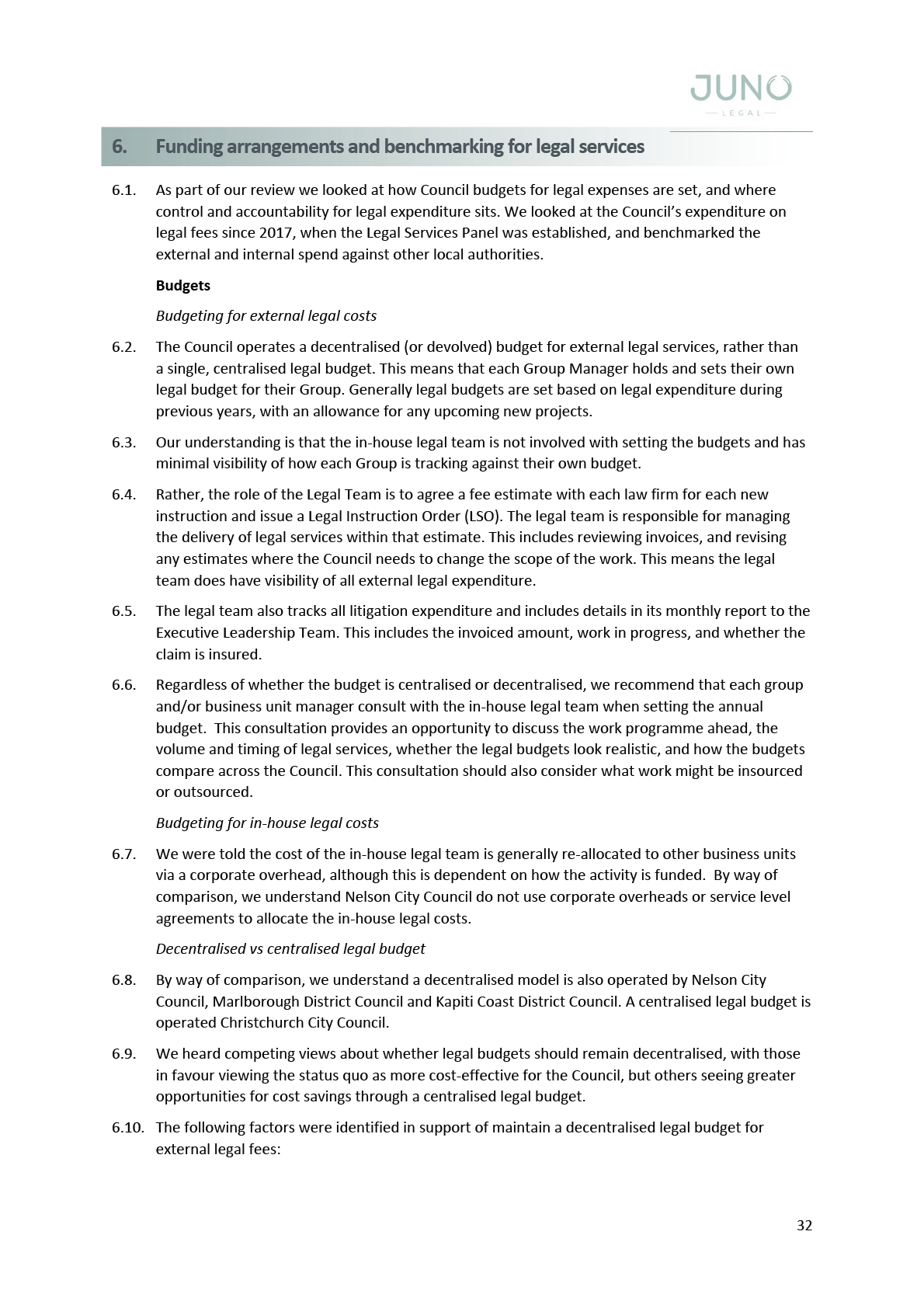
Council legal expenditure
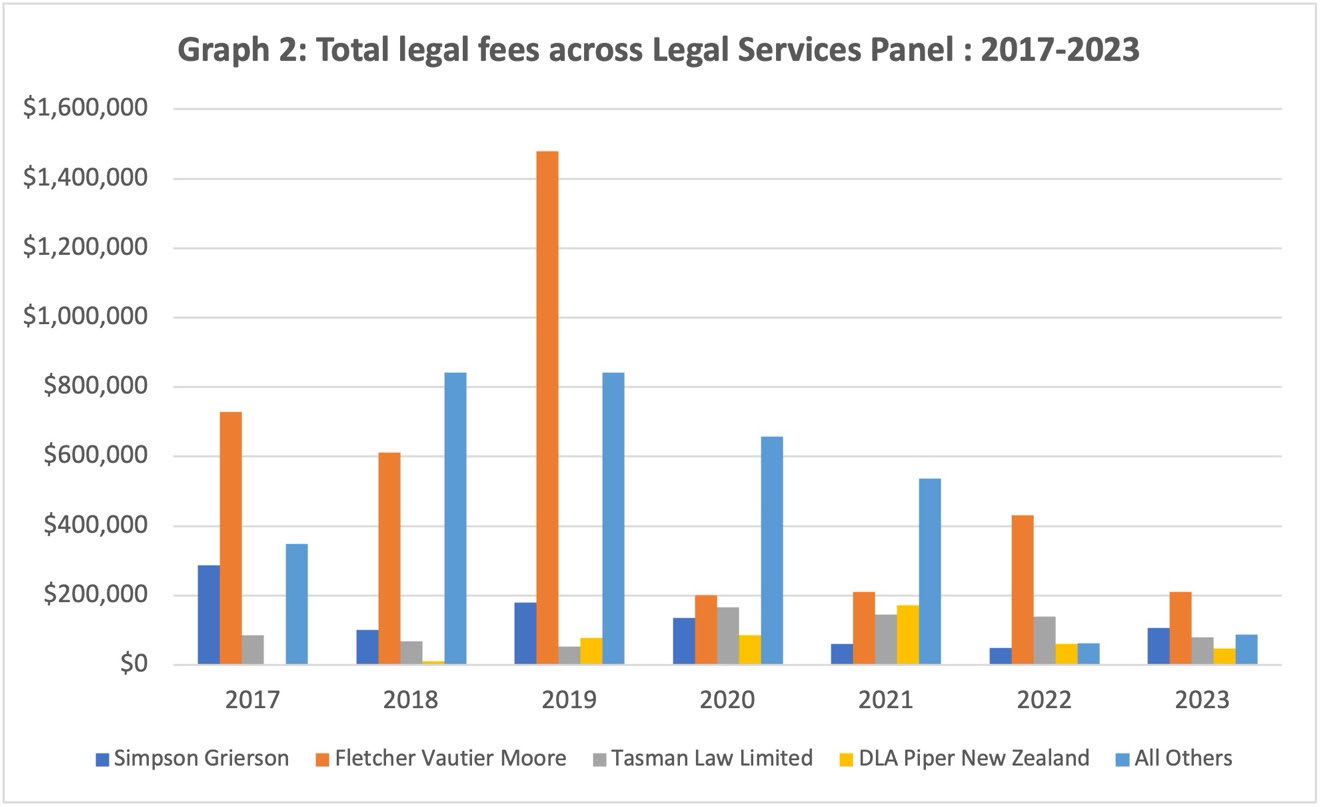
6.14. Since 2017, the Council has instructed between 11-13 different law firms each year. As expected,
most expenditure has been with the 4 firms on the Legal Services Panel.
6.15. The two national law firms provide the Council with significantly discounted hourly rates. The two
smal er, local law firms also provide the Council with cost savings due to their lower hourly fees.
Released
33

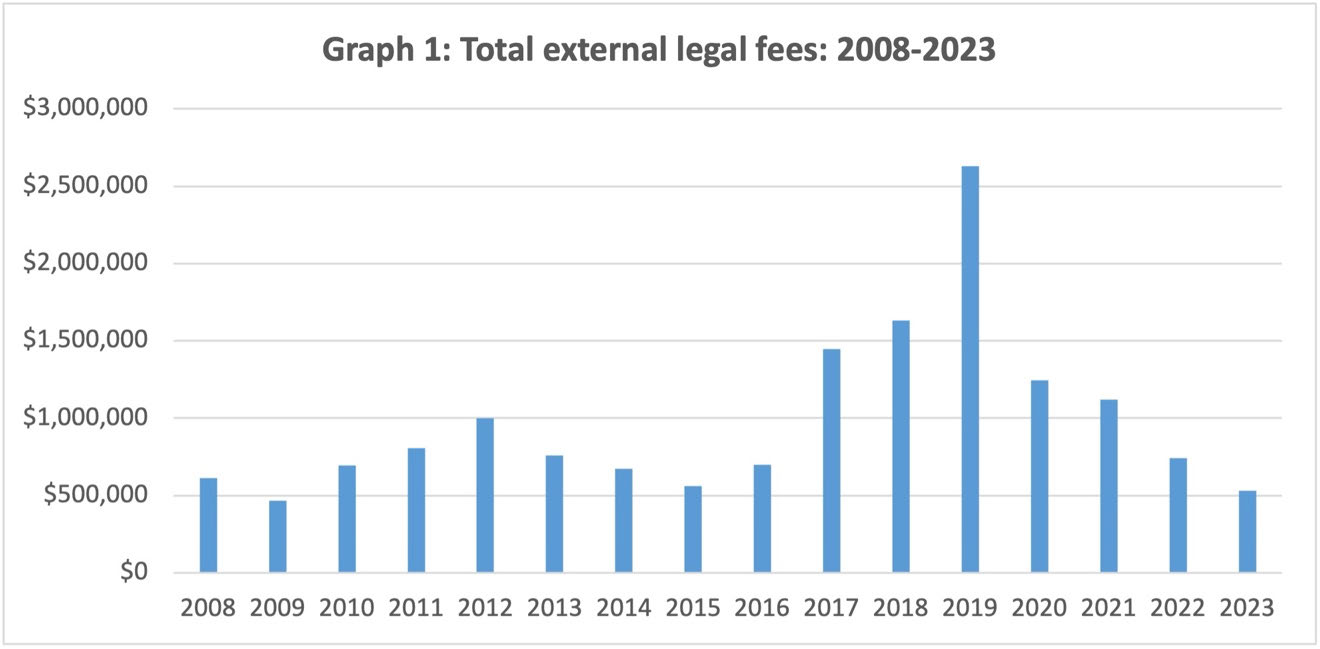
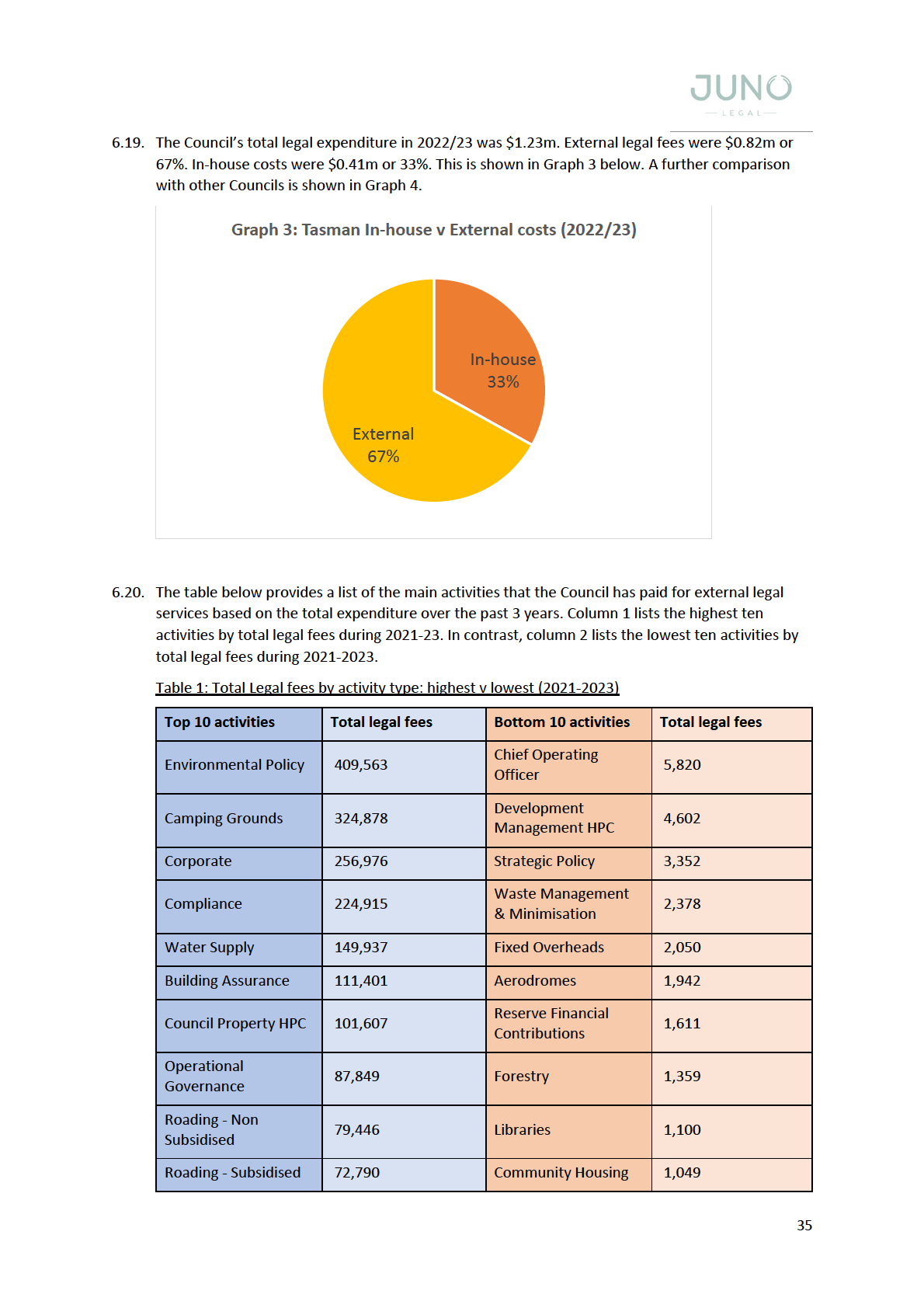
6.16. Graph 1 below shows the total external legal fees over each of the past 15 years. These peaked in
2019 at $2.6m, but since then have steadily decreased, and in 2022 were $0.7m
LGOIMA
6.17. The Council’s total external legal spend since the establishment of the Legal Services Panel in 2017
was nearly $9.4m. The annual spend during this period has ranged from $0.5m and $2.6m. A key
reason for the difference in legal spend each year is litigation or large projects such as the Waimea
Community Dam. The other more recent factor is the establishment of the in-house legal team 2
years ago.
6.18. Graph 2 below shows the legal fees for each of the four law firms on the Legal Services Panel, since
the Panel was established in 2017. The graph also shows the combined total for “Al Other” law
firms.15
under
Released
15 “Al Others” includes Hamish Fletcher Lawyers who was on the Legal Services Panel from 2017-2020.
34
LGOIMA
under
Released
LGOIMA
under
Released
LGOIMA
under
Released
LGOIMA
under
Released
LGOIMA
under
Released
Document Outline
