
CLASSIFICATION
Quarterly Health, Safety and Wellbeing Report
Meeting date: 23 September 2025
Written date: 1 July 2025
Prepared by: 9(2)(a)
, Senior Safety
Sponsor: Laura Dixon
and Wellbeing Advisor
What you’re updating Te Pūrengi on
Q4 (April – June 2025) Health, Safety, and Wel being report covering lead and lag
indicators and work programme update.
At our last meeting in May we presented the Q3 report and updated Te Pūrengi on the
continued progress of the HSW roadmap. 9(2)(g)(i)
. Discussion also focused on
the efficacy of the EAP reporting, changes have been made to this report in line with
that discussion.
This paper specifically provides an update on:
1. Meeting our HSW obligations
2. Outline of future activity
3. Incident and Hazard data
4. Wellbeing data (including EAP)
The report has been discussed at Te Mīmiro with the key points below
highlighted:
• Te Mīmiro was pleased with the improvements in the presentation of wel being
data and supported the ongoing development of the health and safety strategy
including the proposed ‘must-do’ strategy items.
• Additional suggestions from Te Mīmiro for ‘must-do’ actions included:
• Elevating the responsibilities and time al ocation for health and safety and
wel being representatives.
• Provide clarity on workload management responsibilities. Discussion focused
on whether enough has been done in this space from an organisational
perspective, and whether it should remain an HSW focus or shift to sit within
the leadership and business planning space. Te Mīmiro suggested that the
Ministry’s ‘new normal’ may require an ongoing leadership focus and that the
tools and processes are in place, but accountability now sits with leaders.
Reason for Te Pūrengi’s consideration
The intent of this report is to be a tool for Te Pūrengi to receive information, to ask
questions and to discharge their governance duties. This report allows the Ministry as a
PCBU to monitor the HSW performance, status, and progress against current
assumptions.
Have Te Pūrengi considered this item before?
The report contains regular updates on agreed HSW measures, and in addition we would
like to bring your attention to the future planning (slide 4) and the updated presentation of
the EAP and wellbeing data on (slide 6).
Te Pūrengi paper: Quarterly Health, Safety and Wellbeing Report
Te Pūrengi meeting: 23 September 2025
1
CLASSIFICATION
CLASSIFICATION
Recommendations
It is recommended that Te Pūrengi:
Note the following:
• With the HSW Roadmap largely completed, our focus has shifted to planning the next
phase of improving our HSW Management system, including the creation of a long-
term HSW strategy.
• 90% of leaders have completed the
Mental Health for Leaders Workshops.
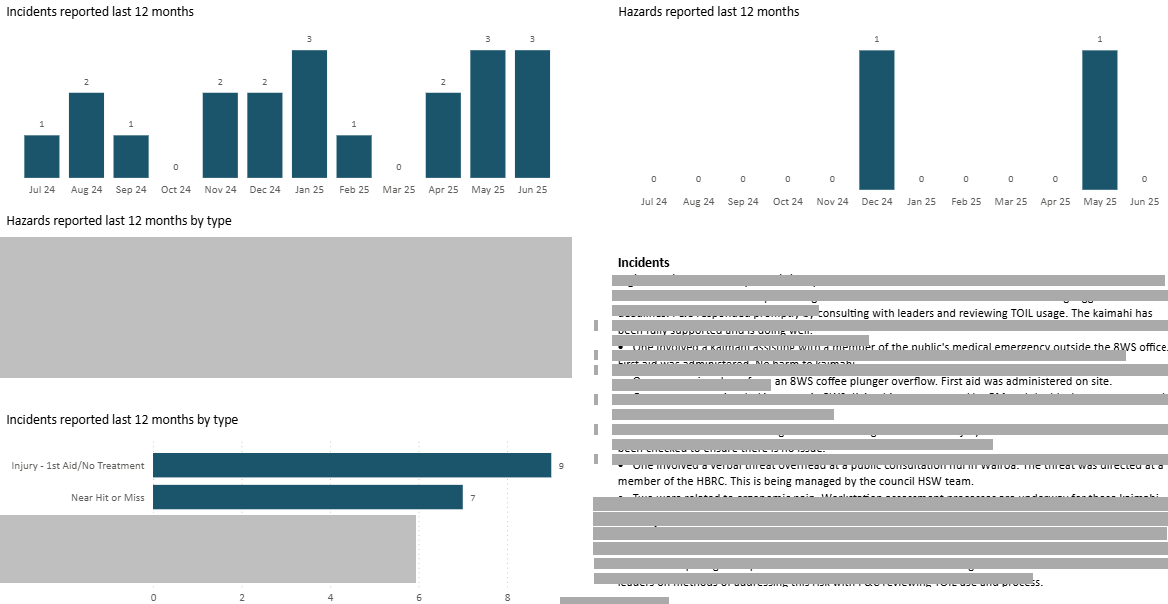
• Eight incidents were reported this quarter, an increase and indication that regular
‘
HSW moments’ are having the desired impact to improve our HSW reporting culture.
• 86 kaimahi accessed EAP services this quarter, up from 56 kaimahi last quarter. 29%
were work-related issues, and 71% were related to personal issues.
Discuss and endorse the ‘must include’ focus areas identified on slide 4; and
Advise on
the highest priority area of the “could include” areas. This wil directly inform the design of
our HSW strategy.
Reinforce the messages on slide 7 with you business groups.
Continue to focus on your development as Officers of the PCBU through
reading the
recommended material noted on slide 7.
Te Pūrengi paper: Update on Quarterly Health, Safety and Wellbeing Report
Te Pūrengi meeting: 23 September 2025
2
CLASSIFICATION

CLASSIFICATION
Quarterly Health,
Safety and Wellbeing
Report
Quarter 4: April – June 2025
CLASSIFICATION

CLASSIFICATION
Contents
Update on meeting our HSW obligations
Slide 3
Looking ahead
Slide 4
HSW Metrics including lead and lag indicators
•
Incident and Hazard data
Slide 5
•
Wellbeing data
Slide 6
Our ask of Te Pūrengi
Slide 7
Appendix
Slide 8 – 18
2
CLASSIFICATION

CLASSIFICATION
Update on meeting our HSW obligations
Our HSW Roadmap has largely been completed with further improvements being made over the next 6-12 months (see below for detail). The focus of this roadmap was to implement key
priorities to strengthen our HSW Management System, support us to manage our risks, and give assurance that we continue to meet our obligations under the Health and Safety at Work Act
2015 (HSWA 2015) (see appendix one for detail).
Looking ahead, we are now planning the next phase of improving our HSW Management system, including the creation of a long-term HSW strategy. See next slide for more detail.
Good Governance Discussion:
During the Good Governance session with Te Pūrengi on 1st July, we discussed the results of the IOD Good
HSW Roadmap Update
Progress
Governance assessment (see results from this assessment in appendix two). The discussion, questions and
1. Driving and Fatigue Policies
Complete
feedback from this session provided valuable insights into the opportunities Te Pūrengi sees for the next phase of
our HSW strategy. These have been summarised on the next slide.
2. HSW Induction
Complete
Mental Health Workshops - Update:
In line with the recommendations from 9(2)(a), 6(d)
a series of Mental Health for Leaders Workshops
3. HSW Governance
Complete
were run in May/June with an external provider, HumanEx, facilitating.
8 Workshops were run with 90% of leaders attending.
4. Leadership MH/Wellbeing Induction
Complete
This training covered the following:
5. HSW Rep Guidelines
Complete
•
Understanding the impact of mental health in the workplace
6. Remote/Hybrid Worker HSW Induction
Paused.
•
Recognising the signs when kaimahi may need support
To be completed once we
•
Knowing where to go for support/escalation when needed
have clarity of equipment
•
The importance of maintaining personal wellbeing
provisioning (in progress).
•
Creating psychologically safe environments that enable high performance
Home office considerations
covered in updated general
induction module.
Emerging Issues:
•
7. Updating incident and hazard reporting
Commentary from BPs/Advisors: “The wellbeing issues we’re seeing are largely driven by workload pressure
Complete
and tight timeframes. Managers have raised performance concerns that also appear to be linked to staff
wellbeing. Increased pressure from the work program has led to a rise in workplace conflict, prompting more
8. Incident Investigation process
Paused.
coaching on de-escalation and rebuilding communication and connection. In areas where conflict has
To be completed in line with
occurred, there’s been a noticeable increase in wellbeing leave and reported feelings of stress”
people systems suite.
• Regulatory changes in the CCMRE space impacting the nature of kaimahi compliance interactions on site.
• Potential impact on wellbeing due to political climate and media commentary around potential changes in the
9(2)(a), 6(d)
public sector.
• International travel.
3
CLASSIFICATION

CLASSIFICATION
Looking Ahead
As outlined in the Q3 HSW Report, our next phase of work will have a longer time-frame but will continue to focus on lifting the maturity of our HSW management system.
This next phase will be structured around these three areas:
1. Create a long-term HSW Strategy including formalising the operating model for the Ministry’s HSW management system, and an updated wellbeing strategy focused on protective
factors that supports our psychological critical risk work. This will lead on from our initial Psychological Harm review see appendix four.
2. Ensuring effective monitoring and review processes are in place specifically in relation to the management of our critical risks and their associated controls. This will include
updating how we report on our risk management to Te Pūrengi.
3. Measuring Progress by completing an external audit on our HSW Management system. This will give Te Pūrengi independent verification of how we are meeting our obligations and
identify areas for improvement.
New HSW Strategy must include
New HSW Strategy could include:
During the Te Pūrengi Good Governance discussion, Te Pūrengi raised several areas of opportunity to be
In addition to our “must include” projects, several “could include”
addressed, and after careful consideration and assessment of our critical risks, the below projects will be
opportunities came out of the Te Pūrengi governance discussion. Given
included in the next phase of our HSW Strategy.
capacity and resource limits our ability to deliver all of these items, we seek
guidance from Te Pūrengi here to understand which of the below should be
Many of these had been identified as ‘gaps’ in our approach so we were pleased to hear these reinforced
included in our next Strategy:
during the governance conversation:
1. Elevating the responsibility and role of HSW Reps, including clear
• Oversight of, provisioning for, and safety procedures for our fully remote workers.
provision of time to complete their duties (akin to ELN Leads and PSA
Reps approach).
• Preparedness for a serious harm incident in one of our offices.
2. Oversight of overlapping duties and the activities of people working on
• Oversight and monitoring of our kaimahi in the field who are driving frequently and conducting site
the Ministry’s behalf.
visits, regulatory activities and/or stakeholder engagement.
3. Strengthening our culture of safety as a Ministry, and understanding of
• Implementing regular site visits for oversight for Officers and HSW specialists. Includes offices and
joint responsibilities.
field locations where our kaimahi are working.
• Building a clear wellbeing and mental health strategy including clarity in our approach for assessing
A detailed strategy will be brought to Te Pūrengi for governance
and managing emerging wellbeing risks.
approval in our next quarterly report.
4
CLASSIFICATION

CLASSIFICATION
Incident, Hazard & Workstation Assessment Data
Incidents
Eight incidents were reported this quarter:
• 9(2)(ba)(i)
9(2)(ba)(i)
Hazards
9(2)(g)(i), 9(2)(ba)(i)
9(2)(ba)(i)
5
CLASSIFICATION


CLASSIFICATION
Wellbeing data: April 1 – June 30 2025
See appendix 13-18 for additional Business Group detail.
9(2)(ba)(i)
EAP data
86 kaimahi accessed EAP services this quarter, up from
56 last quarter.
Work-Related Issues (29%)
9(2)(ba)(i)
9(2)(ba)(i)
9(2)(ba)(i) 9(2)(ba)(i)
No significant hotspots were identified in any specific business group,
suggesting these issues are dispersed across the Ministry.
Personal Issues (71%)
9(2)(ba)(i)
Key Insights
•
EAP engagement continues to be high, likely influenced by extensive internal promotion of EAP and comfort of kaimahi to access this support.
Additionally, the current global context of uncertainty and cost of living has created an increased need for F
inancial advice.
•
9(2)(ba)(i)
TOIL Data
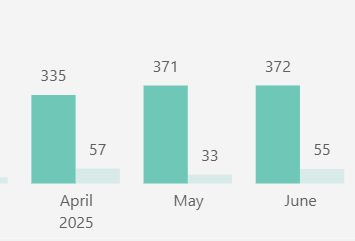
TOIL approved has increased in May and June, reaching
372 days in June.
Mental Health Training
Encouragingly, we’re seeing a stronger effort to ensure TOIL is taken within
two
90% of Leaders have completed the Mental Health Workshops as at
weeks of being accrued, which supports better workload management and
8th August.
wellbeing.
9(2)(ba)(i)
This graph shows that while TOIL taken is still trailing TOIL approved, the
Ministry’s
total TOIL exposure currently sits at 372 days. This figure reflects the
net
balance of TOIL accrued but not yet taken, not a cumulative total across months.
We are pleased with the strong overall attendance rate and will
Our next focus is on developing a plan to
reduce older TOIL balances, ensuring that
continue to reinforce key learnings through self-service resources on
time off is used in a timely and sustainable way, and that historical accruals don’t
Te Taiao. We will be seeking a commitment from those who did not
build up unnecessarily.
attend to take the time to familiarise themselves with the key
escalation points and related insights.
CLASSIFICATION

CLASSIFICATION
Our ask of Te Pūrengi
Discuss the focus areas identified on slide 4 and endorse the “must include” focus areas. Indicate the
“could include” areas of highest priority for Te Pūrengi in their governance role. This will directly inform
the design of our HSW strategy.
Action
Ensure you are undertaking the below and communicating this to leaders:
• We continue to see a lot of sickness occurring. Kaimahi should take leave if unwell. Kaimahi should
not be in the office if they are showing visible signs of sickness (our leaders must be leading by
example here).
• Continue to ensure Managers and GMs are checking in with kaimahi who may be experiencing
additional stress or anxiety due to reports of further change to the public service. Mental Health for
Leaders workshops provided insight into how to identify mental health fluctuations and tools to
support the conversation (the EARS model).
• Continue to focus on sustainable workloads with your kaimahi. Leaders should be checking in
regularly with team members to ensure they are not working excessive hours, utilising TOIL
sustainably, and are clear on the expectations of them in their role.
Recommended Reading
During the recent Good Governance discussion, Te Pūrengi requested that more information be provided
on the current HSW landscape, HSWA 2015 legal updates and general trends in HSWA. With this in
mind, recommended reading for this quarter is the following:
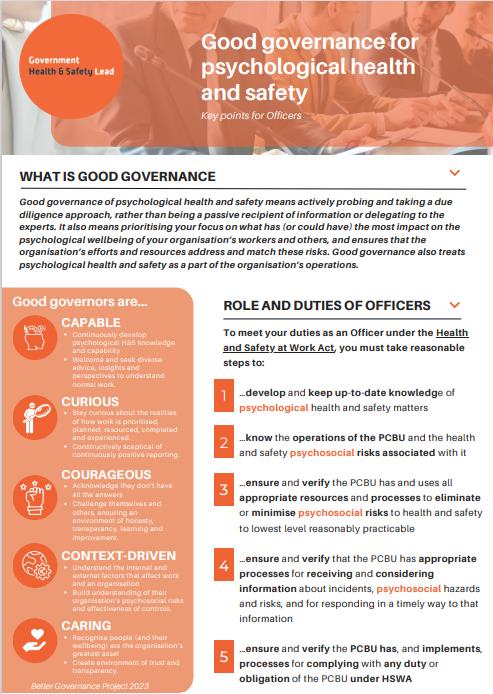
GHSL Good Governance for Psychological Health and Safety
7
CLASSIFICATION

CLASSIFICATION
Appendices
The following slides contain the appendices referenced in the
document or additional information such as EAP data for your
information
8
CLASSIFICATION

CLASSIFICATION
Appendix One: HSW Roadmap detail Shared with Te Pūrengi May 2025
Key elements of the HSW Roadmap:
Priority
Progress
1. Driving and Fatigue Policies
Policy completed and approved by Te Mīmiro.
Building HSW capability and understanding across the Ministry
Next Milestone:
This includes the capability build work made possible through the additional funding from Te Pūrengi
•
Policy communicated to kaimahi
Enhance leaders’ and HSW Representative understanding of our health and safety obligations, their
responsibilities within our HSW Management System, and the foundations of risk management
2. HSW Induction
Current induction reviewed. Updated
• Foster a positive safety culture leading to increased reporting of incidents and hazards
induction content finalised.
• Enhance kaimahi understanding of Ministry HSW expectations, practices, and behaviours, including a H&S
Next Milestone:
KPI across all kaimahi in the new Growth and Performance Framework being rolled out this FY.
E-Module created
3. HSW Governance
Te Pūrengi to complete Self-Assessment
Ensuring robust Critical Risk management
Next Milestone:
• Implementing priority critical risk controls to ensure that we are focusing on mitigating our highest risk
Te Pūrengi discussion on assessment results
activities.
and HSW good governance guide (April)
• Improve Business Groups’ access to critical risk monitoring and procedures to enhance ownership and
management of key risks. Including continuing to embed and monitor critical controls already in place
4. Leadership MH/Wellbeing
Workshops running May/June 2025
Induction
9(2)(a), 6(d)
5. HSW Rep and HSWC
Additional rep training booked in.
Guidelines
Next Milestone:
Guidelines updated for role clarity.
Reinforcing HSW expectations and responsibilities
To support the roadmap milestones, we will ensure key messages and updates are shared. Channels for this
6. Remote/Hybrid Worker HSW
Work progressing.
will include:
Induction
Next Milestone:
• Regular messaging in managers’ update to embed key HSW expectations and procedures
Clarity on remote worker equipment
• Updating HSW Reps and ensuring they cascade information within their business groups
provisions.
• Health and Safety Learning moments included in Business Group Hui
7. Updating incident and hazard
Initial updates completed. Future updates will
reporting system
be in line with the HRIS tech update project.
Streamlining our Health and Safety Management Systems
•
8. Incident Investigation process
Paused. To be completed in line with updated
Strengthening the Ministry’s Health and Safety Management System to ensure accurate and timely
HRIS project.
reporting.
• Enhancing our incident and hazard reporting system and strengthening investigation capabilities both from
9(2)(a), 9(2)(g)(ii), 6(d)
a system and people perspective.
• We are currently reviewing all people systems within the Ministry and a review of the current H&S system
is including in the scoping work
9
CLASSIFICATION

CLASSIFICATION
Appendix Two: Overview Good Governance Results Session held July 1 2025
Strengths identified
•Relationship with CE and management team
•Practice of discussing the complexity of the work environment and context
•Verification is tightly focused on areas of highest risk (ie critical risks)
•Responding constructively to bad news (eg risk of not meeting HSWA obligations)
•Actively seeking narrative feedback on areas that are difficult to measure
What stood out •There was a noticeable split in opinion across responses where some selected ‘good’ and some selected ‘needs improvement’ for 24 out of the 29 questions.
•No ‘needs significant improvement’ selected for any question by any respondent
•Six questions had 43% or more selected ‘needs improvement’
Where 43% or more chose ‘needs improvement’
Foundations
•How well do we work together as a team? Do we: Balance each other well, both in skills and approach? Challenge each other constructively? Review our own performance on a regular
basis? Commission independent evaluation of our effectiveness?
•How well do we keep abreast of good practice in governance as well as in technical areas of our operation?
Learn and Develop
•Does the formal process we have in place maintaining sufficient oversight of the organisation to understand how it is operating meet our needs? Does it balance site visits with deep dives,
expert advice and formal training? Are we confident that we have enough knowledge to make informed and effective decisions that impact on health and safety?
•How well do our interactions with workers centre on learning more about their context and the risks they face? Do they help us understand: Daily pressures and where work goals might
conflict with each other? The reality of work as done, rather than work as imagined? Where work varies from what was intended and what work arounds and innovations are needed to
manage that? Implications for vulnerable worker groups?
Anticipate and Understand
•Do we explicitly consider what conditions need to be in place to deliver good work under expected and unexpected circumstances? Do we then review our provision of resources, training,
equipment and other factors to ensure those conditions are present as consistently as possible?
Monitor and Respond
•Do our indicators and reports give us genuine insights into the capacity of the organisation to deliver safe work? Can we genuinely connect the reported information to the conditions
necessary for safe work?
Full results here:
HSW Good Governance Workshop TP July.pptx
10
CLASSIFICATION

CLASSIFICATION
Appendix Four: Psychological Harm: Initial Review of Controls
Shared with Te Pūrengi May 13. A desktop review of our Psychological Harm controls has been completed. The results of this review (below) should give Te Pūrengi confidence that we
have many effective supports in place for kaimahi who may require support, and multiple projects underway which will strengthen our protective and preventative controls.
Note: we will be performing a more in-depth review and future planning following the completion of the roadmap.
Step One: Review Our Current Context
Step Two: Review and map our current supports
Step Three: Identify additional opportunities to
FTE has reduced and will reduce further in July with
We used the “Mentally Healthy Work” model
protect kaimahi wellbeing and psychological
fixed term contracts ending and delayed redundancy
designed by Dr. Hilary Bennet alongside the
safety
kaimahi leaving.
Business Leaders’ Health and Safety Forum to
bring structure to this review (see next slide for
The following projects and initiatives which are
already underway will strengthen our
Significant Ministerial priorities such as RM reform
detail on this model).
protective/preventative controls:
are high priorities which require significant work
•
Growth and Performance Framework lead
and quick turnaround.
We have multiple effective and well embedded
by the Culture and Capability Team.
controls currently in place (detailed on Slide 6).
Launched in April 2025.
EAP usage continuing to be approximately 10%
These include activity completed in line with the
•
Mental Health for Leaders Training lead by
higher than general EAP usage (10-14%) of other
9(2)(a), 6(d) recommendations and
the Culture and Capability Team. Workshops
clients of Habit Health. These include NZ Police,
deliverables completed in 2024 to support kaimahi
to be completed by July 2025.
MBIE, Ministry of Justice, Ministry of Education.
wellbeing through change (see appendix Two). This
•
Ministry Values and Culture project. Lead
model highlights that we are well covered in the
by Culture and Capability.
To Reo results shared with Te Pūrengi in January
‘support’ space, with some gaps in the
•
Business planning cycle. Lead by SSP.
showed commentary from kaimahi that High
‘preventative’ space.
•
Developing Forecast Reporting. Based on
Workloads, Work Demands , and Organisational
To see improvement in kaimahi wellbeing, we
lead indicators.
Change Uncertainty were impacting wellbeing.
should focus on sustainable workload
management and project planning, and resource
allocation.
Summary: The review has shown that we are well resourced in the reactive/support space. The next phase of control development should be focused on our protective and preventative
controls. This review has shown that the responsibility for delivering on effective preventative controls sits across the business in addition to P&C. To see real impact and drive positive
change for kaimahi wellbeing, this needs to be a Ministry wide leadership, culture and behavioural change with a focus on designing work with kaimahi wellbeing and sustainability front
of mind.
Read the CEO Guide on this Framework here:
Business Leaders’ Health and Safety Forum: Protecting mentally Healthy Work CEO Guide
11
CLASSIFICATION

CLASSIFICATION
Appendix Four contd.
“Mental wellbeing is not a matter of luck but a matter of design. It requires a
deliberate effort to control psychosocial risks and build in the protective factors
associated with ‘good work’.”
- Dr Hillary Bennett - Director, Leading Safety
This model was designed alongside the Business Leaders’ Health and Safety
Forum and helps organisations to design ‘good work’ that protects workers from
risks to mental wellbeing that arise in the workplace.
This model focuses on four key areas:
Obligations
Use these approaches to
prevent harm:
PROTECT
Identify risks to mental health and wellbeing. Eliminate or minimise at source
where practicable, and design in protective factors.
SUPPORT
Provide access to appropriate workplace and clinical support.
---------------------------------------------------------------------------------
Opportunities
Use these approaches to
help people thrive:
FOSTER
Develop the mental health and wellbeing capability of individuals and teams.
RECLAIM
Restore the mental health and wellbeing of individuals and teams
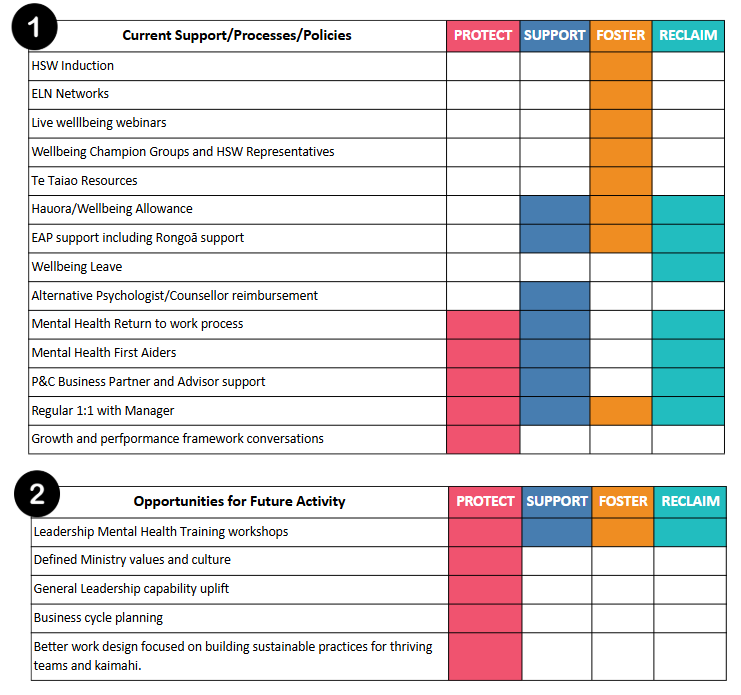
Section one of this table outlines all current activity to support kaimahi wellbeing
and which support type this falls into within the model.
Section two shows opportunities for future activity specifically in the ‘protect’
space.
Some of this activity is currently underway.
12
CLASSIFICATION


 Appendix 5: BTS Wellbeing data
 CLASSIFICATION
EAP data for the period April 1 – June 30 2025
9(2)(ba)(i)
Work-Related Issues (25%) 9(2)(ba)(i)
Personal Issues (75%) 9(2)(ba)(i)
9(2)(ba)(i)
CLASSIFICATION
 Appendix 5: EMA Wellbeing data
 CLASSIFICATION
EAP data for the period April 1 – June 30 2025
9(2)(ba)(i)
Work-Related Issues (29%) 9(2)(ba)(i)
Personal Issues (71%) 9(2)(ba)(i)
9(2)(ba)(i)
CLASSIFICATION
 Appendix 5: CCMRE Wellbeing data
CLASSIFICATION
EAP data for the period April 1 – June 30 2025
9(2)(ba)(i)
Work-Related Issues (33%) 9(2)(ba)(i)
Personal Issues (67%) 9(2)(ba)(i)
9(2)(ba)(i)
CLASSIFICATION
 Appendix 5: PIE Wellbeing data
 CLASSIFICATION
EAP data for the period April 1 – June 30 2025
9(2)(ba)(i)
Work-Related Issues (22%) 9(2)(ba)(i)
Personal Issues (78%) 9(2)(ba)(i)
9(2)(ba)(i)
CLASSIFICATION
 Appendix 5: SSP Wellbeing data
 CLASSIFICATION
EAP data for the period April 1 – June 30 2025
9(2)(ba)(i)
Work-Related Issues (32%) 9(2)(ba)(i)
Personal Issues (68%) 9(2)(ba)(i)
9(2)(ba)(i)
CLASSIFICATION

 Appendix 5: Toil Data
CLASSIFICATION
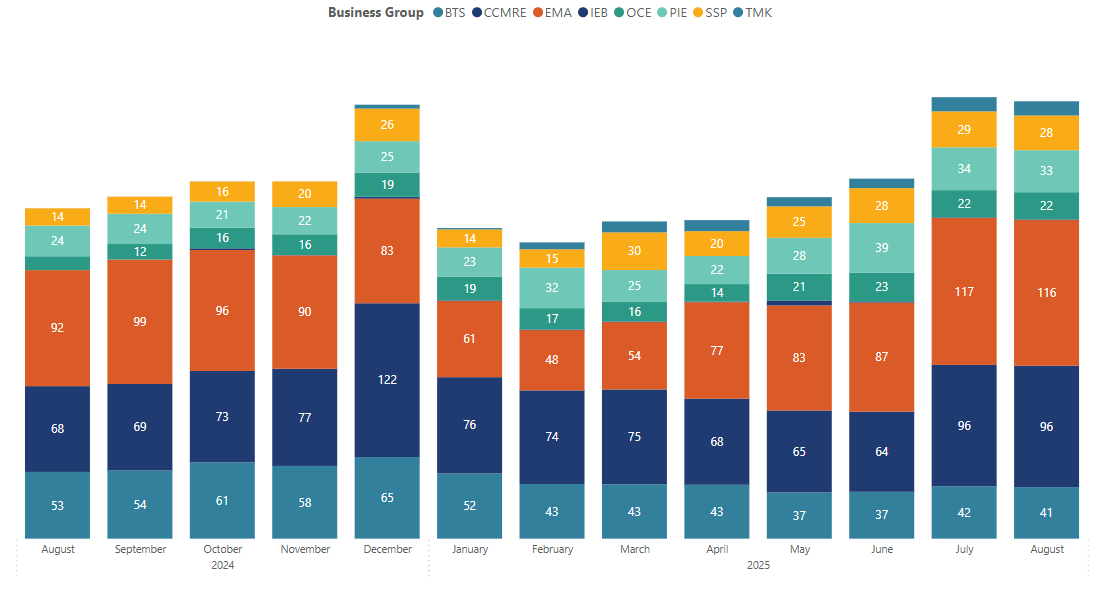
Operational Insights
Workload Peaks:
December 2024, June 2025 and
July 2025 stand out as
months with the highest TOIL accrual, suggesting
intense workload periods.
Dec 24 saw increased RM and Fast Track pressure and
the culmination of the new structure from 1 Nov 24
June & July again see high delivery expectations on top
of business planning and high recruitment requirements
Sustained Pressure:
The consistent accrual across months implies ongoing
high demand, not just isolated spikes. This could
indicate systemic workload issues or under-resourcing.
Business Group Impact:
CCMRE and
EMA are a significant portion of the extra
hours, which may warrant a review of their staffing
levels, project load, or support structures.
The increasing toil accruals for
PIE,
SSP, and
TMK since
January 2025 might reflect either new responsibilities
or redistribution of work, active management of leave,
to it.
Risk Mitigation
Leadership expectations
Reset leadership expectations re approval of TOIL.
When
Toil is approved TOIL to be taken must be booked and
used within 2 weeks of the accrual date
Reporting and oversight from P&C
Resourcing gaps
There are currently 67 vacancies across the Ministry.
Job ads for like roles have been grouped together and
multiple hiring managers form part of the selection
panel.
CLASSIFICATION
Document Outline
