 Memo
To
Memo
To:
Shay McDonald - Otago Regional
Cc:
Council
From:
7(2)(a) - Lane Neave Employee
Date:
6 October 2025
Client:
Matakanui Gold Limited
Matter Number:
271881.0001
Matter
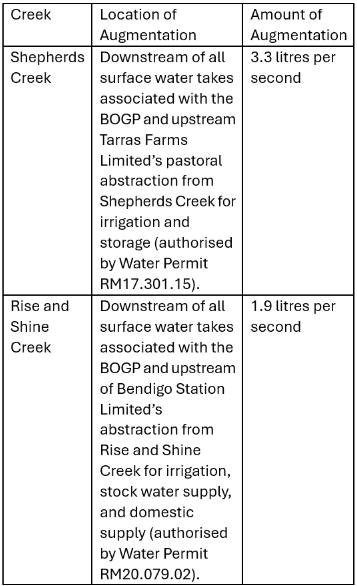
Bendigo-Ophir Project Resource Consenting
Description:
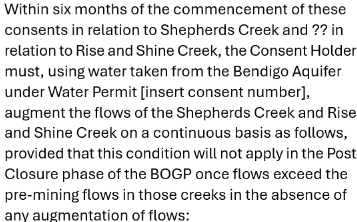
Subject:
Section 30 - Surface Water Flows Augmentation
Introduction
1.
Matakanui Gold Limited (
MGL) is seeking approvals under the Fast-Track Approvals Act 2024
(
FTA) for the Bendigo-Ophir Gold Project (
BOGP).
2.
MGL has notified Otago Regional Council (
ORC) in accordance with Section 30(2) of the FTA
RELEASE
and Section 30(3) now requires ORC to confirm whether there are any existing resource
consents held by another person to which Section 30 would apply. As part of undertaking this
exercise ORC has requested further information relating particularly to proposed water takes
required for the BOGP.
3.
This advice responds to the following points outlined in ORC’s correspondence dated 30
September 2025:
(a)
Our view of the correct interpretation of Sections 124A and 124C of the Resource
Management Act 1991 (
RMA). Related to this we have outlined our view on the role of
these provisions in the FTA process.
(b)
Our view on the correct interpretation of Section 30 of the FTA.
SR.10485
(c)
Which provisions in the ORC Regional Plan: Water (
Regional Plan) will be triggered
by the BOGP and the related implications in terms of Sections 124A and 124C of the
RMA.
(d)
Whether Policy 6.4.1A(c) is applicable to the passive groundwater takes proposed.
(e)
How the Regional Plan rules triggered by the BOGP address:
(i)
allocation in respect of such takes; and
(ii)
whether augmentation of flows requires ORC, according to the Regional Plan,
to treat a water take consent as requiring no allocation or reduced allocation to
the extent augmentation is provided.
LGOIMA
4.
We understand that you have discussed the minor surface water activities proposed by MGL
as part of the BOGP with Mitchell Daysh and MGL which are:
(a)
Take and use surface water that accumulates within mining features (pits, sumps and
silt ponds) as a result of rainfall and groundwater ingress.
(b)
Install cofferdams in Shepherds Creek and abstract water from behind the cofferdams
for use in construction works.
271881.0001 15285788.11
link to page 2 link to page 2
2
Summary
5.
Section 30 operates to ensure that the priority rights set out in Section 124C of the RMA apply
where there is resource competition and insufficient availability of natural resources. In
undertaking its assessment, ORC is required to:
(a)
consider and apply the evidence provided within the expert reports provided by the
applicant;
(b)
take into account the proposed conditions provided by the applicant where those are
relevant to whether the application will be able to be exercised in light of existing
consents;
(c)
assume that consent conditions will be complied with; and
(d)
assess the proposal as a whole, taking into account all measures proposed, and the
effects of the project after measures to avoid, remedy, mitigate, offset, or compensate
have been applied.
6.
MGL has proposed robust flow augmentation conditions to prevent derogation from existing
consents, enabling approvals to be exercised prior to the expiry of existing consents. As a
result, Section 124C(1)(c) of the RMA is not triggered and there are no existing consents which
RELEASE
will be impacted as set out in Section 30 of the FTA.
7.
The proposed water takes associated with the BOGP will not cause the primary allocation of
the relevant catchment to exceed any surface water limits due to the proposed augmentation
of flows in Shepherds Creek and Rise and Shine Creek at locations downstream of the Project
Site.
8.
The augmentation will occur simultaneously ensuring there will not be any effect on
downstream flows and no exceedance of surface water limits downstream. This is because,
the same amount of water will be available to be taken downstream of the BOGP as a result of
the proposed augmentation of flows as would be available in a no BOGP scenario. On that
basis, Rule 12.0.1.2 is not triggered by the water takes associated with the BOGP.
SR.10485
Section 30 of the Fast Track Approvals Act 2025
9.
Section 30 of the FTA applies i
f:1
(a)
the substantive application seeks approvals for resource consents; and
(b)
the applicant does not hold an existing resource consent for the same activity using
some or all of the same natural resource.
10.
Section 30(2) requires notice of the application to be provided to the consent authority and the
consent authority must then advise the applicant whether there are existing resource consents
to which Section 124C(1)(c) of the RMA would apply if the approval were to be applied for under
the RMA. Section 124C(1)(c) applies where a consent granted as a result of the application
LGOIMA
could not be fully exercised until the expiry of an existing consent to undertake an activity
. 2
11.
Sections 124A and 124C of the RMA regulate how a consent authority is to consider new
applications for natural resources which seek the use of the same natural resource as an
1 Fast Track Approvals Act 2024, Section 30(1).
2 Fast Track Approvals Act 2024, Section 30(3)(a).
271881.0001 15285788.11
link to page 3 link to page 3 link to page 3 link to page 3
3
existing consent holder. Sections 124A and 124C provide for a “first in, first served” approach
which affords priority to existing consent holders
.3
12.
Section 30 was included in the FTA to address the issues of priority and the allocation of limited
resources by extending the same priority principles under the RMA to existing consent holders.
13.
When Section 30 was included by the FTA by way of Amendment Paper, the Ministry for the
Environment and the Ministry of Business, Innovation and Employment produced a
supplementary analysist report dated 11 December 2024 (
Analysis Report). The Analysis
Report outlined the amendments that were made to the FTA to address issues of priority and
certainty of allocation rights. The Analysis Report relevantly stated:
(a)
The FTA Bill allows applications for approvals not previously able to be applied for such
as prohibited activities, land exchanges for various categories of conservation land,
and approvals inconsistent with water conservation orders. Existing frameworks, such
as water allocation in regional plans, or rules relating to marine farms, are
considerations in the FTA Bill but do not carry as much weight compared to its purpose
of facilitating the delivery of infrastructure and development projects with significant
regional or national benefits
.4
(b)
The FTA Bill will reflect existing frameworks requiring applications needing to comply
with existing allocation rules and limits as much as it is feasible to achieve
.5
RELEASE
14.
The purpose and intent of Section 30 is clear. It is to check whether an application for approvals
under the FTA would trigger Section 124C(1)(c) of the RMA by seeking approvals for a limited
natural resource and would result in MGL not being able to fully exercise their FTA approval
until the expiry of an existing consent. If this trigger was met the priority mechanism in Section
30 of the FTA would apply.
15.
That is not the case for the BOGP. For the reasons outlined below, the BOGP does not trigger
Section 124C(1)(c) of the RMA and the priority mechanism in Section 30 does not apply.
Potential Effects
Direct Impacts on Downstream Water Permits
SR.10485
16.
In the absence of any augmentation of flows, expert assessment anticipates that the BOGP is
expected to result i
n:6
(a)
an average reduced flow of 3.3 litres per second in Shepherds Creek and 1.9 litres per
second in Rise and Shine Creek; and
(b)
a peak reduced flow rate of 5.2 litres per second in Shepherds Creek and 17.3 litres
per second in Rise and Shine Creek.
LGOIMA
3
Christchurch Readymix Concrete v Canterbury Regional Council HC Christchurch CIV-2011-409-1501, 29
September 2011.
4 Ministry for the Environment; Annex to Supplementary Analysis Report – Fast track Approvals Bill Amendment
Paper relating to policy and workability changes (6 September 2024) at [61].
5 Ministry for the Environment; Annex to Supplementary Analysis Report – Fast track Approvals Bill Amendment
Paper relating to policy and workability changes (6 September 2024) at [51] – [110].
6 Rekker, J., (2025). Bendigo – Ophir Gold Project, Assessment of Downstream Water Rights, and any Derogation
of Rights. Report: Z24002BOG-4, prepared by Kōmanawa Solutions for Matakanui Gold Ltd, August 2025 at pages
3 -4.
271881.0001 15285788.11
link to page 4 link to page 4 link to page 4 link to page 4 link to page 4
4
17.
Existing water permits downstream from the BOGP are used for pastoral, viticultural,
horticultural, and agricultural activities
.7 Modelling prepared by MGL’s technical experts
concludes that without augmentation of Shepherds Creek and Rise and Shine Creek at
downstream points of the BOGP, some potential direct impacts on the following downstream
water permits will be possible
:8
(a)
Tarras Farms Limited’s pastoral abstraction from Shepherds Creek for irrigation and
storage; and
(b)
Bendigo Station Limited’s abstraction from Rise and Shine Creek for irrigation, stock
water supply, and domestic supply.
18.
To ensure these potentially directly impacted downstream takes are able to access their
consented allocation at all times, MGL has proposed the condition set out in
Appendix 1. This
requires MGL to maintain the flows necessary for downstream water takes through use of the
groundwater taken from the Bendigo Aquifer (which will be the subject of one of the resource
consents being sought).
19.
To provide for this, the proposed conditions of consent require a minimum flow rate to be
maintained at all times throughout the life of the BOGP. To meet this condition, MGL will
continuously augment flows at Shepherds Creek and Rise and Shine Creek at points
downstream of the BOGP.
RELEASE
20.
This will be achieved by taking water from the Bendigo Aquifer, which is not fully allocated, via
MGL’s water supply borefield and pipeline. This Aquifer benefits from the infiltration of water
from the Clutha River and provides substantial opportunity for storage of augmentation wa
ter.9
21.
This will ensure existing permit holders are able to access their consented allocation in full
throughout the life of the BOGP and the approvals sought by MGL can be exercised alongside
those existing permits.
22.
In the active closure period, as dewatering activities are reduced, the surface water depletion
is expected to decline
.10 By the post-closure period, runoff flow rates into the creek network are
projected to increase above that of the pre-mining state as former mine surfaces are fully
restored and the TSF surface is rehabilitated to return drainage to the creek network
.11
SR.10485
Potential Indirect Impacts on Downstream Water Permits
23.
Potentially indirectly affected downstream waters have been considered by MGL technical
experts and consist of water users that take water from groundwater in circumstances where
Shepherds Creek or Bendigo Creek is one of the multiple replenishment or recharge sources
of the groundwater aquifer.
7 Rekker, J., (2025). Bendigo – Ophir Gold Project, Assessment of Downstream Water Rights, and any Derogation
of Rights. Report: Z24002BOG-4, prepared by Kōmanawa Solutions for Matakanui Gold Ltd, August 2025 at page
9.
8 Rekker, J., (2025). Bendigo – Ophir Gold Project, Assessment of Downstream Water Rights, and any Derogation
LGOIMA
of Rights. Report: Z24002BOG-4, prepared by Kōmanawa Solutions for Matakanui Gold Ltd, August 2025 at page
2.
9 Rekker, J., (2025). Bendigo – Ophir Gold Project, Assessment of Downstream Water Rights, and any Derogation
of Rights. Report: Z24002BOG-4, prepared by Kōmanawa Solutions for Matakanui Gold Ltd, August 2025 at page
6.
10 Rekker, J., (2025). Bendigo – Ophir Gold Project, Assessment of Downstream Water Rights, and any Derogation
of Rights. Report: Z24002BOG-4, prepared by Kōmanawa Solutions for Matakanui Gold Ltd, August 2025 at page
6.
11 Rekker, J., (2025). Bendigo – Ophir Gold Project, Assessment of Downstream Water Rights, and any Derogation
of Rights. Report: Z24002BOG-4, prepared by Kōmanawa Solutions for Matakanui Gold Ltd, August 2025 at page
6.
271881.0001 15285788.11
link to page 5 link to page 5 link to page 5 link to page 5 link to page 5 link to page 5
5
24.
Potentially (albeit unlikely) indirectly impacted downstream water users would be groundwater
takes from the Lindis Alluvial Ribbon Aquifer, Ardgour Valley Aquifer or Bendigo Aqui
fer.12
MGL’s technical experts have determined that the amount of water that may be lost from creek
flows represents a very small percentage of the naturally occurring replenishment sources such
as irrigation return water, land surface recharge and surface water infiltration
.13
25.
This expert analysis of the quantitative effect on the groundwater users in the lower Lindis
Valley and Bendigo catchment undertaken by the technical experts determines that the effect
of the BOGP in terms of access to water or supply reliability would be negligible
.14 The technical
assessment states that it is arguable whether upstream impacts of the BOGP would have any
net effect on the physical availability of water to indirectly affected users
.15
26.
From this starting point of potential indirect impacts, and to ensure that indirect impacts do not
arise on downstream water permits, MGL has committed through the proposed condition of
consent set out in
Appendix 1, to maintaining the flows necessary to ensure these permit
holders can access their consented allocation at all times.
27.
Augmentation will supplement potential small-scale losses to the downstream groundwater
systems at augmentation rates equivalent to the mean net reduction in in-creek water
resourc
e.16 The pumping of the MGL borefield to carry out augmentation will avoid effects on
other groundwater users in the same aquifer and any change to the water balance would be
largely balanced by infiltration of river water from the Cluth
a.17 RELEASE
28.
With this mitigation in place, there is no possibility that the effects of the BOGP can indirectly
impact existing holders of water takes in the catchment.
Section 124C of the Resource Management Act 1991
29.
ORC has requested confirmation as to “why Lane Neave considers that addressing effects
allows a consent applicant to bypass those provisions”. This is not an accurate interpretation
of our position. Section 30 does not provide for a “bypass”. Rather, it requires consideration as
to whether an approval would result in an existing consent holder being unable to use its
allocated resource.
30.
In undertaking that assessment, ORC must reach its conclusions based on the available
information and evidence which has been presented. The technical assessments supporting
SR.10485
MGL’s application and the proposed conditions securing augmentation of flows, ensure that the
BOGP approvals can be exercised alongside existing permits and will not be competing for
resources.
31.
The wording in section 124C(1)(c) which is expressly incorporated into Section 30 is as follows:
12 Rekker, J., (2025). Bendigo – Ophir Gold Project, Assessment of Downstream Water Rights, and any Derogation
of Rights. Report: Z24002BOG-4, prepared by Kōmanawa Solutions for Matakanui Gold Ltd, August 2025 at page
6.
13 Rekker, J., (2025). Bendigo – Ophir Gold Project, Assessment of Downstream Water Rights, and any Derogation
of Rights. Report: Z24002BOG-4, prepared by Kōmanawa Solutions for Matakanui Gold Ltd, August 2025 at page
6.
14 Rekker, J., (2025). Bendigo – Ophir Gold Project, Assessment of Downstream Water Rights, and any Derogation
LGOIMA
of Rights. Report: Z24002BOG-4, prepared by Kōmanawa Solutions for Matakanui Gold Ltd, August 2025 at page
6.
15 Rekker, J., (2025). Bendigo – Ophir Gold Project, Assessment of Downstream Water Rights, and any Derogation
of Rights. Report: Z24002BOG-4, prepared by Kōmanawa Solutions for Matakanui Gold Ltd, August 2025 at page
3.
16 Rekker, J., (2025). Bendigo – Ophir Gold Project, Assessment of Downstream Water Rights, and any Derogation
of Rights. Report: Z24002BOG-4, prepared by Kōmanawa Solutions for Matakanui Gold Ltd, August 2025 at page
4.
17 Rekker, J., (2025). Bendigo – Ophir Gold Project, Assessment of Downstream Water Rights, and any Derogation
of Rights. Report: Z24002BOG-4, prepared by Kōmanawa Solutions for Matakanui Gold Ltd, August 2025 at page
4.
271881.0001 15285788.11
link to page 6 link to page 6
6
A consent granted as a result of the application could not be fully exercised until the
expiry of the [existing] consent.
32.
Expert assessment confirms that existing consents would be able to be fully exercised until the
expiry of existing consents. MGL has provided a clear pathway for augmentation of flows to
ensure that all existing consents can operate simultaneously with the consents now being
sought.
33.
Section 30 is therefore not “bypassed” but rather when it is applied, the conclusion on the
evidence presented must be that:
(a)
there is no impact on flows for existing consent holders; and
(b)
the consent sought as a result of the applicant can be fully exercised without a need to
wait until the expiry of existing consents.
34.
Given that, the augmentation proposed by MGL is akin to a “run of the river” water take
scenario, as there is no net loss in terms of available surface water flows.
Relevance of Conditions
35.
The conditions provided by an applicant are important to undertaking a Section 30 assessment.
RELEASE
36.
This interpretation was confirmed by the Court’s decision in
Director-General of Conservation
v Northland Regional Council.18 In that case the Court was required to consider multiple
applications to take groundwater from Aupōuri Aquifer in Northland. The Environment Court
was required to determine whether consents could be granted for all applicants, and if so, under
what conditions, while ensuring the protection of the environment and the rights of existing
consent holders. A key legal issue was whether there was competition of the resource (termed
by the Court as an “allocation issue”) that would trigger the statutory priority rules in Sections
124A-124C of the RMA.
37.
The Court held that
:19
(a)
Based on the evidence, it was “very confident” consent could be granted and directed
SR.10485
the parties to work together to refine the proposed conditions of consent that would
ensure there would be no derogation from existing consents.
(b)
Sections 124A-124C of the RMA would only apply in the circumstances where there is
insufficient resource and that this issue was unlikely to arise unless the conditions could
not be framed without a form of further limitation on the application.
38.
This case provides direct authority for conditions to be used as a mechanism to ensure that
there is sufficient resource available to all parties and that those conditions are a relevant factor
in determining whether or not Section 124C applies.
39.
Applied to the BOGP, the condition set out in
Appendix 1 which is proposed by MGL, ensures
that there is no derogation from existing resource consents through a requirement to provide
LGOIMA
for augmentation of flows to ensure that downstream users can continue to access their
allocated water. Because conditions establish a mechanism by which this can be achieved and
evidence has been provided to confirm that this is a realistic proposal, there is no reason to
conclude that the application could not be fully exercised without any flow impacts on
downstream users.
18
Director-General of Conservation v Northland Regional Council18 [2022] NZEnvC 170.
19
Director General of Conservation v Northland Regional Council [2022] NZEnvC 170 at [109].
271881.0001 15285788.11
link to page 7 link to page 7
7
Assuming Compliance with Conditions
40.
It is a well-established case law principle that in undertaking an assessment, the Council is
required to assume that the conditions of consent will be complied with by the applicant. The
Court in
88 The Strand Limited v Auckland City Council20 stated:
…a consent authority, when it imposes conditions, is entitled to assume that the applicant and
its successors will act legal y and adhere to rules and conditions… That is obvious. Nothing
could ever be approved if consent authorities had to work on the contrary assumption, namely
that its rules and conditions would not be observed.
41.
ORC must therefore take into account the proposed conditions of consent, assuming full
compliance with those conditions. MGL has demonstrated that compliance is practicable and
proposed strict criteria within conditions which will ensure minimum flow rates are achieved. In
these circumstances, ORC must assume that those conditions will be met.
Considering the Application as a Whole
42.
For the purposes of Section 30, when assessing whether existing resource consents held by
another person could prevent MGL from fully exercising its BOGP FTA approvals until those
consents expire, the effects management proposed for the BOGP must be considered as a
whole, rather than being divided up into artificial components or assessed without proposed
RELEASE
mitigation in place.
43.
It is clear in the context of RMA decision making that all activities proposed in an application
must be assessed holistically in order to the assess the effects of granting consent for the
proposal
.21
44.
As such, the BOGP activities, including the measures proposed to avoid, remedy and mitigate
adverse effects in relation to water quantity, must be considered as a collective whole to
determine whether the BOGP would result in a derogation of the rights held by existing water
permit holders.
45.
The augmentation of flows is an important part of this effects management approach (in this
case the avoidance of effects arising).
SR.10485
Relevant Provisions of the Regional Plan
Groundwater Interacting with Surface Water
46.
ORC has queried whether Policy 6.4.1A(c) is applicable to the passive groundwater takes
proposed. This Policy addresses when the take of groundwater interacts with surface water,
and as a result is deemed a surface water take in some circumstances.
47.
Policy 6.4.1A states:
A groundwater take is allocated as:
LGOIMA
a. Surface water, subject to a minimum flow, if the take is from any aquifer in Schedule 2C; or
b. Surface water, subject to a minimum flow, if the take is within 100 metres of any connected
perennial surface water body; or
20
88 The Strand Limited v Auckland City Council [2002] NZRMA 475 at [19].
21
Cable Bay Wine Limited v Auckland Council [2022] NZCA 189 at [16].
271881.0001 15285788.11
link to page 8 link to page 8
8
c.
Groundwater and part surface water if the take is 100 metres or more from any connected
perennial surface water body, and depletes that water body most affected by at least 5 litres
per second as determined by Schedule 5A; or
d. Groundwater if (a), (b) and (c) do not apply.
48.
The Regional Plan provides that the reason for this Policy is to ensure that when allocating
groundwater, the management is consistent with the management of surface water allocation,
where the two resources are closely connected
.22
49.
MGL’s technical experts have not been able to identify any known existing groundwater users
of schist groundwater
.23 MGL’s technical experts conclude the following in relation to the taking
of groundwater from the fractured schist groundwater system that would be allocated as
groundwater and part surface water in terms of Policy 6.4.1A(c):
(a)
the peak rates of surface water depletion have been estimated at 5.2 litres per second
on Shepherds Creek catchment; and
(b)
a brief period of 17.3 litres per second in the Rise and Shine (Bendigo) catchment will
occur during mining operations.
50.
As outlined above, to safeguard existing water rights MGL is proposing a condition requiring a
RELEASE
minimum flow rate to maintained throughout the life of the BOGP. This will be achieved by
augmenting flows at Shepherds Creek and Rise and Shine Creek using groundwater from the
Bendigo Aquifer. MGL’s technical experts have determined that the Bendigo Aquifer has
capacity for this, has strong recharge from the Clutha River and has capacity for storage.
51.
These measures ensure existing consent holders retain full access to consented allocations
and the classification of the passive groundwater take as part surface water does not trigger
Section 124C(1)(c) and the priority mechanism in Section 30 of the FTA does not apply.
52.
Rule 12.0.1.2 of the Regional Plan: Water for Otago is as follows:
An application to take water as primary allocation where that take would cause
the primary allocation of a catchment to exceed the relevant limit in Policy 6.4.2,
is a prohibited activity.
SR.10485
53.
For Rule 12.0.1.2 to be triggered, the proposed take of groundwater and/or surface water as
part of the BOGP would need to
“cause the primary allocation of a catchment to exceed the
relevant limit in Policy 6.4.2” (to quote the words of the rule with emphasis added). Policy 6.4.2
states:
To define the primary allocation limit for each catchment, from which surface water takes
and connected groundwater takes may be granted, as the greater of:
(a) That specified in Schedule 2A, but where no limit is specified in Schedule 2A, 50% of
the 7-day mean annual low flow; or
(b) The sum of consented maximum instantaneous, or consented 7-day, takes of:
(i) Surface water as at:
LGOIMA 1. 19 February 2005 in the Welcome Creek catchment; or
2. 7 July 2000 in the Waianakarua catchment; or
3. 28 February 1998 in any other catchment; and
(ii) Connected groundwater as at 10 April 2010,
22 Regional Plan: Water for Otago, 6-16.
23 Rekker, J., (2025). Bendigo – Ophir Gold Project, Assessment of Downstream Water Rights, and any Derogation
of Rights. Report: Z24002BOG-4, prepared by Kōmanawa Solutions for Matakanui Gold Ltd, August 2025 at Table
7 and page 34.
271881.0001 15285788.11
9
less any quantity in a consent where:
1. In a catchment in Schedule 2A, the consent has a minimum flow that
was set higher than that required by Schedule 2A.
2. All of the water taken is immediately returned to the source water body.
3. All of the water being taken had been delivered to the source water body
for the purpose of that subsequent take.
4. The consent has been surrendered or has expired (except for the
quantity granted to the existing consent holder in a new consent).
5. The consent has been cancelled (except where the quantity has been
transferred to a new consent under Section 136(5)).
6. The consent has lapsed.
54.
Irrespective of whatever surface water limit is identified as a result of the application of Policy
6.4.2 above (it is understood that the catchment is fully allocated), the proposed water takes
associated with the BOGP will not
cause the primary allocation of the relevant catchment to
exceed any surface water limits due to the proposed augmentation of flows proposed in
Shepherds Creek and Rise and Shine Creek at locations downstream of the Project Site.
55.
Importantly, the augmentation will occur simultaneously whereby there will not be any effect on
downstream flows and therefore preventing any exceedance of surface water limits
RELEASE
downstream. In other words, the same amount of water will be available to be taken
downstream of the BOGP as a result of the proposed augmentation of flows.
56.
On that basis, Rule 12.0.1.2 is not triggered by the water takes associated with the BOGP.
Conclusion
57.
Expert assessment confirms that existing consents would be able to be fully exercised until the
expiry of those existing consents. The proposed conditions of consent by MGL will ensure
augmentation of flows so that all existing consents can operate simultaneously with the
consents being sought by MGL.
58.
Section 30 is therefore not “bypassed” but rather when it is applied, the conclusion on the
evidence presented must be that:
SR.10485
(a)
there is no impact on flows for existing consent holders; and
(b)
the resource consents sought by MGL can be fully exercised without a need to wait
until the expiry of existing consents.
59.
In accordance with Section 30(3)(b) of the FTA, ORC are therefore required to advise MGL that
there are no existing resource consents of the kind referred to in Section 124C(1)(c) of the
RMA.
LGOIMA
271881.0001 15285788.11
10
Appendix 1 – Draft Condition
RELEASE
SR.10485
LGOIMA
Note: The “??” in the second line of the condition above is where the trigger in terms of the
timing for action needs to be inserted (based on when any depletion would otherwise occur in
the absence of the required augmentation).
271881.0001 15285788.11
