 Document 1
BRIEFING
Document 1
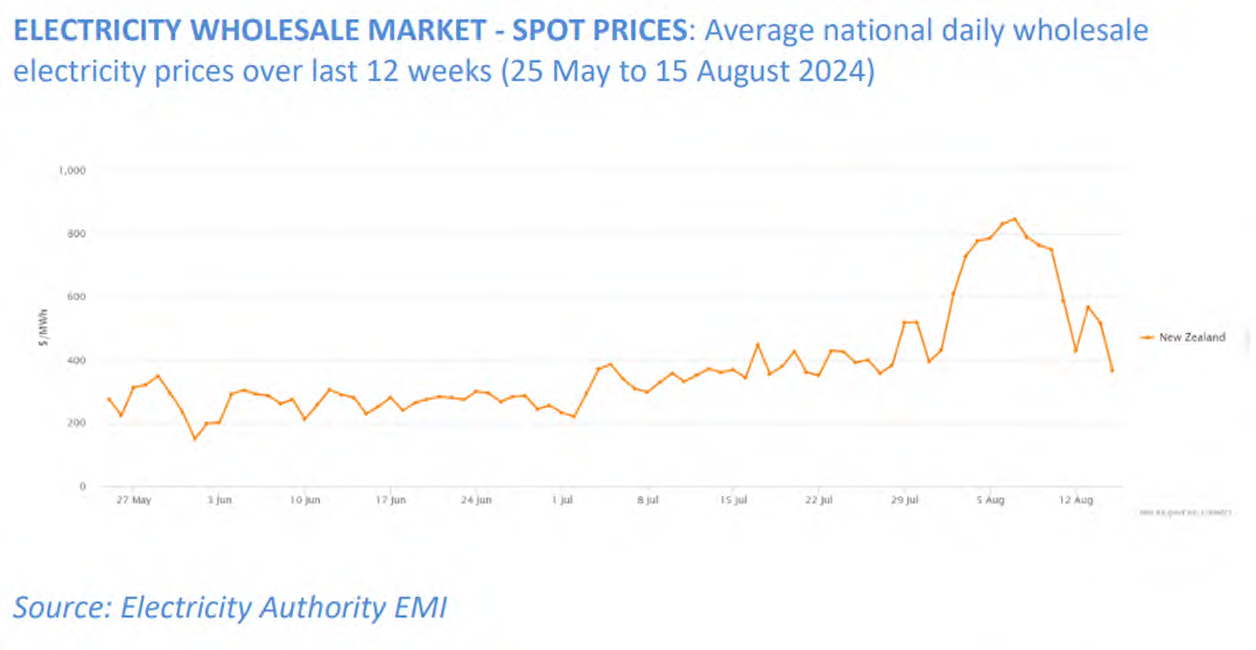
BRIEFING
Appropriate skills and experience for Electricity Authority membership
Date:
13 September 2024
Priority:
Medium
Security
In Confidence
Tracking
2425-1051
classification:
number:
Minister
Action sought
Deadline
Hon Simeon Brown
Note our advice on the ideal mix of
24 September 2024
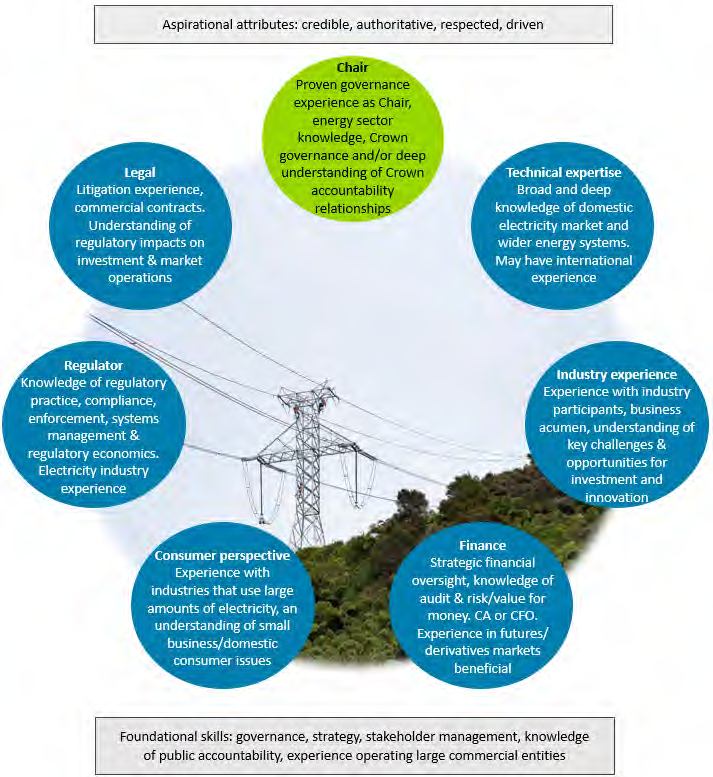
Minister for Energy
skil s and experience for the
Electricity Authority’s membership.
Agree to a shortlist of candidates to
interview for member roles.
Indicate whether you wish us to
search for additional candidates for
roles on the Authority.
Contact for telephone discussion (if required)
Name
Position
Telephone
1st contact
Paul Metcalf
Manager, Appointments and Governance
s 9(2)(a)
Senior Advisor, Board Appointments and
Andrew Flanagan
04 831 9685
Governance
The following departments/agencies have been consulted
Minister’s office to complete:
Approved
Declined
Noted
Needs change
Seen
Overtaken by Events
See Minister’s Notes
Withdrawn
Comments
Released under the Official Information Act 1982
 BRIEFING
Appropriate skills and experience for Electricity Authority membership
Date:
13 September 2024
Priority:
Medium
Security
In Confidence
Tracking
2425-1051
classification:
number:
Purpose
To inform your decisions on appointments to the Electricity Authority.
Executive summary
We have taken a blank-page approach to assess the skil s and experience required for
members of the Electricity Authority and identified seven ideal member roles.
Our assessment of the current board against these roles s 9(2)(g)(i)
Priority skil s, experience and capabilities required for the Authority are technical
expertise, finance and a consumer perspective. s 9(2)(g)(i)
You have the option of shortlisting candidates to interview for up to three roles.
Recommended action
The Ministry of Business, Innovation and Employment recommends that you:
a
Note our advice on the ideal mix of skil s and experience for the Electricity Authority’s
membership.
Noted
b
Note our comparison of the current Authority with the ideal mix of skil s and experience.
Noted
c
Note that we believe the priority skil s, experience and capabilities required for the Authority
are technical expertise, finance and a consumer perspective.
Noted
d
Note that s 9(2)(g)(i)
.
Noted
Released under the Official Information Act 1982
2425-1051
In Confidence
1
e
Agree to a shortlist of candidates to interview for up to three member roles:
Finance role
o s 9(2)(a)
Agree / Disagree
o
Agree / Disagree
Consumer perspective role
o
s 9(2)(a)
Agree / Disagree
o
Agree / Disagree
Legal role
o
s 9(2)(a)
Agree / Disagree
f
Note we have
.
Noted
g
Indicate whether you wish us to search for additional candidates for roles on the Authority.
Yes / No
h
Indicate whether you wish to discuss the Authority skil s mix with officials.
Yes / No
Paul Metcalf
Hon Simeon Brown
Manager, Appointments and Governance
Minister for Energy
Labour, Science and Enterprise, MBIE
13 / 9 / 24
..... / ...... / ......
Released under the Official Information Act 1982
2425-1051
In Confidence
2
Background
1.
You are progressing work to provide for more effective electricity market regulation in
response to the recent security of supply situation, including a new Government Policy
Statement and a review of market performance.
2.
In this context, on 21 August 2024, the Cabinet Economic Policy Committee (ECO) noted
“that the terms of two members of the Electricity Authority Board end in October 2024 and
that the Minster for Energy has asked officials for advice on appropriate mix of skil s and
experience for the Board given the current serious circumstances” [ECO-24-MIN-0172].
3.
Your office has requested advice on the appropriate mix of skil s and experience for the
Electricity Authority’s membership. The Authority currently has six members and one
vacancy. Additional y, the terms of two members expire in October 2024.
4.
The Authority is an independent Crown entity, and members are appointed by the Governor-
General on your recommendation. Members may be removed by the Governor-General for
just cause on the recommendation of the Minister after consultation with the Attorney-
General (sections 28 and 39 of Crown Entities Act 2004).
Requirements and considerations for membership
5.
In light of the recent energy crisis and the Government’s response, we have taken a blank-
page approach in assessing the ideal skil s mix for the Authority membership.
6.
An effective board requires members with complementary skil s and experiences. We have
considered the statutory requirements and skil s and experiences that we believe should be
present to meet your expectations for the Authority to deliver a regulatory environment that
ensures security of supply and fosters investment and innovation.
7.
We have also been mindful to balance sector-based expertise with the skil s and experience
required for the effective governance of a Crown entity more general y.
Statutory requirements
8.
The Electricity Industry Act 2010 (sections 13 and 14) sets out some requirements for
membership of the Authority:
The Authority comprises between five and seven members.
The Minister must have regard to the need to ensure that the Authority has amongst its
members knowledge and experience of, and capability in the electricity industry,
consumer issues and business generally.
No member may represent, or promote the interests or views of, any organisation or
any particular industry participant or group of industry participants.
Governance considerations
9.
Section 25 of the Crown Entities Act sets out the governance role of the board, where all
functions and operational decisions are made by or under the delegation of the board.
Good governance
Released under the Official Information Act 1982
10. In order to exercise the Authority’s functions and duties, members should col ectively have
an understanding of the Electricity Industry Act, the Crown Entities Act and good governance
practice. This includes how to manage the separation of delegation between governance
decisions and operational matters and is led by a chair with deep governance experience.
2425-1051
In Confidence
3
11. As a Crown entity, members of the Authority must understand their accountability to the
responsible Minister, including through the monitoring department (MBIE).
12. The board sets the strategic direction for the Authority and must be able to articulate its
regulatory strategy to ministers, government departments, the industry and the public.
Financial management
13. As with any Crown entity or private sector board, Authority members are responsible for
ensuring the financial wel being of the entity. This is reinforced in section 51 of the Crown
Entities Act (“the board of a statutory entity must ensure that the entity operates in a
financial y responsible manner”).
14. The Authority must demonstrate accountability for its funding and scrutinise the outputs that
its spending provides to ensure value for money. The Prime Minister has set out his
expectations to the Public Service Commission that Crown entities “do the basics bril iantly”
and focus on the quality of their spending.
15. Strategic financial acumen is essential for the board to ensure that the Authority is executing
its functions in a sustainable way and delivering value for levy payers. At least one member
should have the technical financial expertise required to chair the audit and risk committee.
Electricity market and regulatory capabilities
16. The Authority membership must have credibility and connections amongst the electricity
industry to ensure the Authority is a respected regulator and has buy-in from the sector.
Sector-specific capabilities
17. In carrying out its regulatory duties, the Authority must have a deep understanding of the
impact of its decisions on industry participants and electricity consumers.
18. It is important for the Authority to have within its membership: significant knowledge of how
domestic electricity markets operate, how electricity markets interact with other energy and
fuel markets, some knowledge of international electricity markets, an understanding of key
chal enges and opportunities facing market participants, and perspectives of major electricity
users, smal businesses and domestic consumers. Some experience or understanding of
electrical engineering practices may be desirable.
Law and regulatory practice
19. The electricity industry is highly litigious. Experience in commercial and contract litigation or
dispute resolution would hone the board’s deliberations on risk management, compliance
and enforcement.
20. More generally, an understanding of regulatory practice, compliance, enforcement and
economics is essential for the Authority to make regulation that encourages investment and
innovation and does not overburden industry participants.
Released under the Official Information Act 1982
2425-1051
In Confidence
4
 Ideal membership make-up
21. We have identified seven key roles in the ideal make-up of the Authority:
Foundational capabilities
22. Al members should have or be able to obtain the following capabilities:
Governance experience
Released under the Official Information Act 1982
Strategic agility
An understanding of Crown entity accountability relationships
Stakeholder relationship management skil s
A wil ingness to serve in the public interest
2425-1051
In Confidence
5
23. The Authority membership, collectively, should also have the following:
Business and commercial acumen, and experience operating large commercial entities
Senior executive leadership experience
An understanding of energy system trends and emerging energy technologies
Experience as a regulator or operating within a highly regulated environment
Expertise in derivatives, including electricity futures contracts
Crisis management experience
Current board composition
24. As a point of comparison, we have assessed the extent to which the current board aligns
with the ideal board.
25. Note that this has been a desktop exercise, using the CVs of members from when they
applied to MBIE. This has not been sense-checked with the chair or other external
stakeholders.
Name
Term
Relevant skills and experience
Comments
expiry date
Anna Kominik
12/07/2028
Governance including Chair
s 9(2)(g)(i)
(Chair)
experience, electricity retailer
perspective, public relations,
stakeholder engagement
Dr Cristiano
30/06/2028
Energy innovation, strategy,
Marantes
commercialisation of energy
technology, network business
regulation and electrical engineering
Paula Rose
15/01/2028
Regulation, Crown governance,
stakeholder relationship management,
consumer issues (non-electricity)
Erik
15/01/2028
Regulatory economics, market
Westergaard
operations, senior leadership, electricity
distribution business and smal retailer
perspective
Al an Dawson
8/10/2024
Energy markets (incl. international),
(Deputy Chair)
financial risk, senior leadership, fellow
chartered accountant, governance
Lana
8/10/2024
Capital expenditure, debt raising,
Stockman
electricity trading, regulation, gentailer
Released under the Official Information Act 1982
perspective
Vacancy
—
—
—
2425-1051
In Confidence
6
Alignment with ideal roles
26. Based on members’ experience, there is s 9(2)(g)(i)
27. There is no current member whose skil s clearly align between with the consumer
perspective or legal roles. You may wish to fil the vacancy with a new member who brings
these capabilities.
28. s 9(2)(g)(i)
29.
30. Increasing the depth and breadth of sector experience may strengthen the Authority’s ability
to create a regulatory environment that encourages innovation and new investment.
Candidates for shortlisting
31. With one vacancy and two terms expiring, you have the opportunity to recommend up to
three appointments to the Authority.
Technical expertise role
32. We advertised for candidates with “in-depth knowledge of the New Zealand electricity market
and wider energy systems” s 9(2)(g)(i)
.
33. s 9(2)(g)(i)
s 9(2)(a)
34. 9(2)(a), 9(2)(g)(i)
s 9(2)(a)
35. 9(2)(a), 9(2)(g)(i)
Released under the Official Information Act 1982
2425-1051
In Confidence
7
Finance role
s 9(2)(a)
36. 9(2)(a), 9(2)(g)(i)
s 9(2)(a)
37. 9(2)(a), 9(2)(g)(i)
s 9(2)(a)
(previously interviewed)
38. We previously interviewed 9(2)(a), 9(2)(g)(i)
39. s 9(2)(g)(i)
Consumer perspective role
s 9(2)(a)
40. In August, you met with the Major Electricity Users’ Group (MEUG) and invited its nomination
of candidates. MEUG has nominated s 9(2)(a)
. The
Associate Minister for Energy, Hon Shane Jones, has also nominated s 9(2)(a)
.
41. We have contacted s 9(2)(a)
to seek his interest.
s 9(2)(a) would bring perspectives of major
electricity consumers.
s 9(2)(a)
42. 9(2)(a), 9(2)(g)(i)
Legal role
43. We consider that the technical expertise, finance and consumer perspective roles are more
Released under the Official Information Act 1982
important to fil in the current environment and given the statutory maximum of seven
members. If you wish to appoint someone with legal capabilities, we have identified the
following candidate.
2425-1051
In Confidence
8
s 9(2)(a)
44. 9(2)(a), 9(2)(g)(i)
Next steps
45. We wil interview your shortlist of candidates for member roles.
46. Following the interviews, we wil advise you on candidates recommended for appointment.
47. You may wish to direct us to conduct a further search for candidates to fil the technical
expertise role.
Annexes
Annex One: Longlist of candidates
Annex Two: Curricula vitae for candidates
Released under the Official Information Act 1982
2425-1051
In Confidence
9
Annex One: Longlist of candidates
Candidate
Notes
9(2)(a), 9(2)(g)(i)
Released under the Official Information Act 1982
2425-1051
In Confidence
10
Candidate
Notes
9(2)(a), 9(2)(g)(i)
Released under the Official Information Act 1982
2425-1051
In Confidence
11
Annex Two: Curricula vitae for candidates
Withheld under section 9(2)(a) of the Official Information Act 1982
Released under the Official Information Act 1982
2425-1051
In Confidence
12
 Document 2
EVENT BRIEFING
Document 2
EVENT BRIEFING
Meeting with Electricity Authority Board Chair Anna Kominik
Date:
19 August 2024
Priority:
Medium
Security
In Confidence
Tracking
2425-0782
classification:
number:
Action sought
Action sought
Deadline
Hon Shane Jones
Note the contents of this briefing, to 21 August 2024
Associate Minister for Energy
support your meeting with Anna
Kominik on 21 August 2024 at 08:30
am.
Contact for telephone discussion (if required)
Name
Position
Telephone
1st contact
Manager, Electricity Generation,
Tamara Linnhoff
s 9(2)(a)
Infrastructure and Markets Policy
Mark Pickup
Principal Advisor
The following departments/agencies have been consulted
Minister’s office to complete:
Approved
Declined
Noted
Needs change
Seen
Overtaken by Events
See Minister’s Notes
Withdrawn
Comments
Released under the Official Information Act 1982
 EVENT BRIEFING
Meeting with Electricity Authority Board Chair Anna Kominik
Date:
19 August 2024
Priority:
Medium
Security
In Confidence
Tracking
2425-0782
classification:
number:
Purpose
To provide background information and talking points for your meeting with Anna Kominik,
Electricity Authority Board Chair on 21 August 2024 at 08:30 am.
A discussion on energy matters is scheduled for Cabinet on 19 August. This event briefing was
written prior to that Cabinet discussion and any statements or instructions that may follow.
Recommendations
The Ministry of Business, Innovation and Employment (MBIE) recommends that you:
a
Note the contents of this briefing, to support your meeting with Anna Kominik, Electricity
Authority Board Chair.
Noted
Tamara Linnhoff
Hon Shane Jones
Manager, Electricity Markets Policy
Associate Minister for Energy
Building, Resources and Markets, MBIE
..... / ...... / ......
19 / 08 / 2024
Released under the Official Information Act 1982
MBIE 2425-0782
In Confidence
1
 Meeting purpose and logistics
Date:
Meeting purpose and logistics
Date:
Weds 21 August 2024
Time:
08:30 am
Location:
Your office
Anna Kominik, Electricity Authority Board Chair
Attendees: Attendee biography is included at
Annex One.
1.
The meeting has been arranged so that you can discuss the current electricity supply issues
and the powers that the Electricity Authority has to regulate the electricity market.
2.
The remainder of this briefing provides background information and talking points on the
topics outlined above.
Current price situation
3.
Recent pricing in the wholesale electricity market has been volatile, and this is reflective of
underlying supply conditions. New Zealand’s energy supply is currently extremely tight – gas
production has dropped significantly in the past two years and the impact of this on the
electricity system is exacerbated by extremely dry conditions for hydro-electricity generation
where national hydro storage is currently below the 5th percentile of the historical range for
this time of year.
4.
The perceived risk of a potential shortage of fuel, both hydro and gas generation, has
resulted in a price spike:
5.
Prices have come down as fuel supplies for electricity generation have become more secure
(Methanex contracting to free up gas and more certainty over coal imports for Huntly). Prices
Released under the Official Information Act 1982
are expected to continue falling as peak winter demand recedes and thawing snow increases
inflows to hydro lakes. However, market analysts (Jarden) do not expect them to fal to
below $100/MWh til at least 2028 when sufficient new generation is commissioned, or if
substantial new gas volume become available.
MBIE 2425-0782
In Confidence
2
6.
Unhedged businesses are exposed to spot price risk, as you are aware Winstone, Pan Pac
and Oji Fibre all ceased production during recent weeks. Some independent retailers have
stopped taking new customers (Electric Kiwi1) or defaulted (Prime Energy defaulted on its
payments to Manawa Energy).
7.
You may wish to ask
s 9(2)(g)(i)
Gentailer profits
8.
Contact, Genesis, Mercury and Meridian wil release their annual earnings statements (year-
end financial reports) over the next few weeks, on these dates:
Contact
Mercury
Genesis
Meridian
Mon, 19 Aug
Tue, 20 Aug
Thu, 22 Aug
Wed, 28 Aug
9.
The Authority collects information from gentailers about profits, under its information
disclosure rules. It wil soon review those.
10. NZIER looked at the Authority’s approach and reported (in May 2024) that current rules
aren’t working – that the Authority hasn’t been collecting enough information.
11. You may wish to ask
s 9(2)(g)(i)
Released under the Official Information Act 1982
1 Electric Kiwi says wholesale energy prices are up 50 percent on six months ago and high futures prices - what it buys
to protect against the volatile spot prices - mean every new customer the retailer takes on would be loss-making for
the business. RNZ, 23 July 2024
MBIE 2425-0782
In Confidence
3
Hedge markets and retail competition
12. You met recently with Octopus, an independent retailer. They and other independent retailers
are concerned that New Zealand generation companies have excessive market power and
are insufficiently monitored. They consider the wholesale market is not competitive: that
wholesale spot prices are above long run costs of generation and that the Authority is not
adequately focussing on identifying the use of market power to set prices above competitive
levels. They are also concerned about difficulty accessing forward hedges – the lack of
availability of hedges or if offered, the high prices, which they consider poses a significant
barrier to entry for independent retailers.
13. Regarding access to hedges - the Authority is carrying out a risk management review, to
better understand the availability and accessibility of risk management solutions for
independent retailers. This work has been underway since December 2023 and the
Authority has signed that it wil soon release its analysis. Independent retailers are frustrated
with the perceives slow pace of this work.
14. On 14 August (so last week) the Authority made an urgent Code change that had the effect
of reducing some of the market-making2 obligations on incumbent generators (Contact,
Genesis, Mercury and Meridian) in the ASX electricity futures market. This change was
explained as aiming to maintain liquidity in the market.
15. This change has been challenged by some independent retailers (Electric Kiwi, Flick and
Octopus Energy) who wrote to you and Minister Brown on 14 August. They argue that this
change wil seriously reduce their access to necessary risk cover and benefit the incumbent
gentailers at the expense of large industrial users, and other market participants.
16. s 9(2)(g)(i)
17. The independent retailers have submitted (via Matthews Law) a Code change request to the
Authority, requesting an amendment to introduce the UK model of a level playing field, which
requires operational and accounting separation, no discrimination (between a gentailers’ own
retail arm and other retailers) and no cross subsidy (across generation and retail arms).
18. You may wish to ask
s 9(2)(g)(i)
Released under the Official Information Act 1982
2 Market making is an obligation placed on the main gentailers to offer hedges into the futures market.
MBIE 2425-0782
In Confidence
4
Electricity Authority powers and actions
19. The Authority’s primary function is to regulate New Zealand’s electricity system and markets,
enforcing the rules and holding industry participants to account through active monitoring and
enforcement.
20. The Authority’s main statutory objective is to promote competition in, reliable supply by, and
the efficient operation of, the electricity industry for the long-term benefit of consumers.
21. An additional objective is to protect the interests of domestic and small business consumers,
in relation to their supply of electricity. This objective applies to the Authority’s activities in
relation to the direct dealings between participants and these consumers.
22. The Authority has broad power to change the market Code or rules, so long as these
changes are consistent with its statutory objective. In this regard the Authority is actively
investigating ways in which it can address the current pricing situation.
23. A number of measures have already been taken by the Authority to ease that price pressure,
including working with Transpower to release extra water from hydro lakes to enable more
supply, and releasing weekly information showing profit margins of generators.
24. You may wish to ask
s 9(2)(g)(i)
Power Price Task Force
25. A task force is being setup involving the Electricity Authority, the Commerce Commission
(the Commission) and MBIE to investigate the recent wholesale price spikes and develop a
series of short and medium term actions to improve the performance of electricity markets.
26. The Task Force brings together government market regulators to urgently consider the
complex factors underlying wholesale prices and put in place a suite of measures to help
address the current issues across the energy system.
27. The Task Force enables the Commission and Authority to make a holistic assessment of the
options available to further stimulate generation investment and promote competition within
their respective regulatory powers and scope. The task force intends focusing on rapidly
identifying and assessing options within the current powers of the regulators to improve the
performance of the electricity industry and ensure secure and affordable energy within the
context of a financial y sustainable market.
28. As independent regulators, the Authority and the Commission wil continue to operate in
accordance with their existing powers and mandate. The Task Force expects to issue joint
statements or recommendations. A Deputy Secretary of MBIE wil attend the task force as an
observer.
29. You may wish to ask
Released under the Official Information Act 1982
s 9(2)(g)(i)
MBIE 2425-0782
In Confidence
5
Annexes
Annex One: Attendee biography
Annex Two: Suggested talking points.
Released under the Official Information Act 1982
MBIE 2425-0782
In Confidence
6
 Annex One: Attendee biography
Anna Kominik, Electricity Authority Board Chair
Annex One: Attendee biography
Anna Kominik, Electricity Authority Board Chair
Anna is an experienced business leader who has
worked for a wide variety of public and private sector
organisations during the course of her career,
including as the former Asia Pacific Director of Wisk,
part of an international organisation developing a
world-first, all-electric, self-flying air taxi. She is
currently Chair of the Edmund Hil ary Fel owship and
Hil ary Institute, a director of Dawn Aerospace and
advises in the New Zealand aviation and aerospace
sector.
Anna holds a Master’s degree from Northwestern
University, Chicago, where she was a Rotary
International Scholar, has a Certificate of Innovation
and Entrepreneurship from Stanford University, and
was a Commonwealth Foundation Emerging Pacific
Leader.
Released under the Official Information Act 1982
MBIE 2425-0782
In Confidence
7
Annex Two: Suggested talking points
Current price situation
s 9(2)(g)(i)
Gentailer profits
s 9(2)(g)(i)
Hedge markets and retail competition
s 9(2)(g)(i)
Electricity Authority powers and actions
s 9(2)(g)(i)
Power Price Task Force
s 9(2)(g)(i)
Released under the Official Information Act 1982
MBIE 2425-0782
In Confidence
8
 Document 3
BRIEFING
Document 3
BRIEFING
Fees for Electricity Authority Advisory Group
Date:
18 July 2024
Priority:
Medium
Security
In Confidence
Tracking
2425-0299
classification:
number:
Minister
Action sought
Deadline
Hon Simeon Brown
Note that we support the proposed
1 August 2024
Minister for Energy
Electricity Authority Advisory Group
fees of $633 per day for the Chair
and $435 per day for members.
Contact for telephone discussion (if required)
Name
Position
Telephone
1st contact
Paul Metcalf
Manager, Appointments and Governance
s 9(2)(a)
Senior Advisor, Board Appointments and
Andrew Flanagan
04 831 9685
Governance
The following departments/agencies have been consulted
Electricity Authority
Minister’s office to complete:
Approved
Declined
Noted
Needs change
Seen
Overtaken by Events
See Minister’s Notes
Withdrawn
Comments
Released under the Official Information Act 1982

 BRIEFING
Fees for Electricity Authority Advisory Group
Date:
18 July 2024
Priority:
Medium
Security
In Confidence
Tracking
2425-0299
classification:
number:
Purpose
To provide you with our supporting analysis on the proposed fees for members of the Electricity
Authority Advisory Group (EAAG).
Executive summary
The Electricity Authority is seeking your decision on proposed fees for the EAAG.
We agree with the classification of the EEAG as a Group 4, Level 3 body and the
Authority’s proposed fees of $633 per day for the Chair and $435 per day for
members.
The Authority estimates that 15 members and the Chair wil seek payment, with a total
cost of approximately $45,000 per year.
The EAAG is expected to deliver value by reducing the time and cost of longer
consultation processes.
Recommended action
The Ministry of Business, Innovation and Employment recommends that you:
a
Note that the Electricity Authority has sought your decision on the level of fees paid to
members of the Electricity Authority Advisory Group (EAAG).
Noted
b
Note that we support the proposed EAAG fees of $633 per day for the Chair and $435 per
day for members.
Noted
Paul Metcalf
Hon Simeon Brown
Manager, Appointments and Governance
Minister for Energy
Labour, Science and Enterprise, MBIE
Released under the Official Information Act 1982
18 / 7 / 24
..... / ...... / ......
2425-0299
In Confidence
1
Background
1.
The Electricity Authority recently established the Electricity Authority Advisory Group (EAAG)
under section 21(1) of the Electricity Industry Act 2010 (the Act). It has sought your decision
on the level of fees paid to members of the EAAG [Electricity Authority briefing BR-24-0025
refers].
2.
This advice should be read alongside the above briefing.
Framework for remuneration
3.
Section 22(2) of the Act sets out that remuneration of Authority advisory group members
should be determined as if the advisory groups were autonomous Crown entities, that is, by
the responsible Minister in accordance with the Cabinet Fees Framework (the Framework).
Classification
4.
The Authority has recommended that you classify the EAAG as a Group 4, Level 3 body
under the Framework and set the fees at $633 per day for the Chair and $435 per day for
members.
5.
We agree with the Authority’s assessment that the EAAG should be classified as a Group 4,
Level 3 body under the Framework. The fee ranges for this level are $308–$633 for the Chair
and $226–$435 for members [CO (22) 2 refers].
Setting fees
6.
When setting a fee within a band, the Framework sets out that factors such as recruitment
and retention issues and affordability should be considered.
7.
The Authority recommended that you set the daily fees at the top of these bands ($633 for
the Chair and $435 for members). It has identified that some independent EAAG members
commit time that would otherwise be spent undertaking work that would be compensated at
significantly higher rates. It described the recruitment and retention of members of other
Authority advisory groups as chal enging, due to members receiving what they considered
insufficient remuneration. The Authority also noted that EAAG members are required to have
significant expertise and some hold very senior roles.
8.
We are comfortable with the Authority’s assessment of the above factors.
Affordability
9.
The Framework states that affordability should be considered when setting fees. The
Authority has stipulated that it wil not remunerate EAAG members who are public servants
or employees of larger industry companies.
10. The Authority’s briefing was silent on the affordability of the proposed fees. We sought
further information from the Authority to inform your decision. It estimates that 15 members
and the Chair wil seek remuneration for their EAAG work.
11. The Authority is funded through a levy. The rate at which you set the EAAG fees has no
direct financial implications for the government. However, when setting fees, you may like to
consider the value that the EAAG wil deliver and the opportunity costs the fees spend may
Released under the Official Information Act 1982
represent.
12. The Authority expects the investment in the EAAG to deliver value by hearing views from a
broad range of stakeholders early and often. This should reduce the time and cost of longer
consultation processes.
2425-0299
In Confidence
2
13. The Authority anticipates that the Chair and members wil commit ten and six days per year,
respectively. This would result in a total cost of $45,480 per year. The Authority has
budgeted $50,000 per year for EAAG fees. It has indicated that it wil monitor the spend
throughout the year and ensure it makes the most of the time of the EAAG.
Recommendation
14. Given the challenges that the Authority has had recruiting and retaining advisory group
members in the past, we recommend that you agree to the Authority’s proposed fees of $633
per day for the Chair and $435 per day for members.
15. As the proposed fees are consistent with the Framework, there is no requirement for you to
consult the Minister for the Public Service or Cabinet.
Next steps
16. Subject to your decision, the Authority wil pay EAAG members the fees that you set.
Released under the Official Information Act 1982
2425-0299
In Confidence
3
 Document 4
EVENT BRIEFING
Document 4
EVENT BRIEFING
Meeting with the Chairs of the Electricity Authority and Commerce
Commission
Date:
21 June 2024
Priority:
Medium
Security
In Confidence
Tracking
2324-3837
classification:
number:
Action sought
Action sought
Deadline
Hon Simeon Brown
Note the contents of this briefing and 24 June 2024
Minister for Energy
suggested talking points ahead of
your meeting with the Chairs of the
Electricity Authority and Commerce
Commission
Contact for telephone discussion (if required)
Name
Position
Telephone
1st contact
Manager, Electricity Generation,
Tamara Linnhoff
s 9(2)(a)
Infrastructure and Markets Policy
Principal Advisor, Electricity
Laëtitia Leroy de
Generation, Infrastructure and
044 901 2237
Morel
Markets Policy
The following departments/agencies have been consulted
Minister’s office to complete:
Approved
Declined
Noted
Needs change
Seen
Overtaken by Events
See Minister’s Notes
Withdrawn
Comments
Released under the Official Information Act 1982

 EVENT BRIEFING
Meeting with the Chairs of the Electricity Authority and Commerce
Commission
Date:
21 June 2024
Priority:
Medium
Security
In Confidence
Tracking
2324-3837
classification:
number:
Purpose
You are meeting with Anna Kominik, Chair of the Electricity Authority (Authority) and Dr John
Small, Chair of the Commerce Commission (Commission) on Wednesday 26 June at 8:30 am for a
30-minute discussion.
At 10.50am on the same day you wil also meet with Sarah Gil ies, Chief Executive of the Authority
and members of the senior leadership team. You have signal ed the topics you would like to
discuss including wholesale market competition. This is included as part of this briefing.
Recommendations
The Ministry of Business, Innovation and Employment (MBIE) recommends that you:
a
Note the contents of this briefing are to support your meeting with the Chairs of the Electricity
Authority and the Commerce Commission on 26 June 2024.
Noted
Tamara Linnhoff
Hon Simeon Brown
Manager, Electricity Generation,
Minister for Energy
Infrastructure and Markets Policy
Energy Markets, MBIE
21 / 06 / 2024
..... / ...... / ......
Released under the Official Information Act 1982
MBIE 2324-3837
In Confidence
1
Meeting purpose and logistics
Date:
24 June 2024
Time:
8:30 am
Location:
Your office
Anna Kominik, Chair of Electricity Authority
Attendees: Dr John Smal , Chair of the Commerce Commission
Attendee biographies are included at
Annex One.
You have asked for this meeting with both Chairs to discuss competition matters.
No formal agenda has been provided. You may wish to discuss the following:
Each agency’s role and responsibilities
Electricity prices are expected to rise
Agenda:
Your view that competitive markets - both wholesale and retail markets -
are critical for affordable electricity
Understanding the extent of any problem
What could be done? Potential levers to improve competition.
Each agency’s role and responsibilities
1.
The Authority develops and enforces compliance with the Electricity Industry Participation
Code (“the Code”) – the rules governing the electricity market. The Authority’s main objective
is to promote competition, reliability, and efficient operation of the industry. The Authority can
proactively make sector-specific rules that promote competition or reduce the risk that a
participant wil use market power in a way that harms consumers. Generally, the Authority
board decides it’s work programme and priorities.
2.
The Commission enforces competition, fair trading and consumer credit contracts laws and
has regulatory responsibilities in the electricity lines, gas pipelines, telecommunications, dairy
and airport sectors. A role of the Commission's is to undertake ‘Part 2 Commerce Act breach
investigations’ – which involve assessing and potential y prosecuting a breach of competition
law after it has occurred.
3.
You can request the Authority to undertake a specific inquiry or review (under section 18 of
the Electricity Industry Act). Any such request might specify a requirement to consult the
Commission but can't oblige the Commission itself to do anything. Similarly, under the
Commerce Act, a market study can be initiated by the Minister of Commerce and Consumer
Affairs or self-initiated by the Commerce Commission
Independent retailers’ complaints passed from the Authority to the Commission and
now back to the Authority
4.
After hearing their concerns, the Authority suggested independent retailers file a complaint
with the Commission. The Commission then considered the matter and explicitly made no
finding on a potential breach of the Commerce Act and decided not to open an investigation
Released under the Official Information Act 1982
at this time:
MBIE 2324-3837
In Confidence
2
 We have expressly made no decision as to whether we consider there has been or continues to be a
breach of section 36 as al eged by the complainants and we reserve the right to address this
question in future. Instead, we consider the most effective use of the Commission’s competition
resources at this stage is to provide staff-level support to the review that the EA wil undertake into
electricity retailers’ forward risk management in 2024."
5.
The Commission also commented that the Authority has better tools to address the
independent retailers’ concerns via Code amendments.
6.
The Authority opened a ‘Risk Management Review’ in December 2023 to focus on the
availability and pricing of hedge contracts. On 14 June (last week) it communicated to
stakeholders that it is at the data assessment stage and plans to release an initial
assessment for stakeholder feedback later this year. Commission staff are assisting with
peer review for this Risk Management Review.
Suggested talking points
Are your agencies working together? How much active support is the Commission
providing to the Authority’s Risk Management Review?
To the Authority - What is your timeline to deliver the Risk Management Review?
Electricity prices are expected to rise
7.
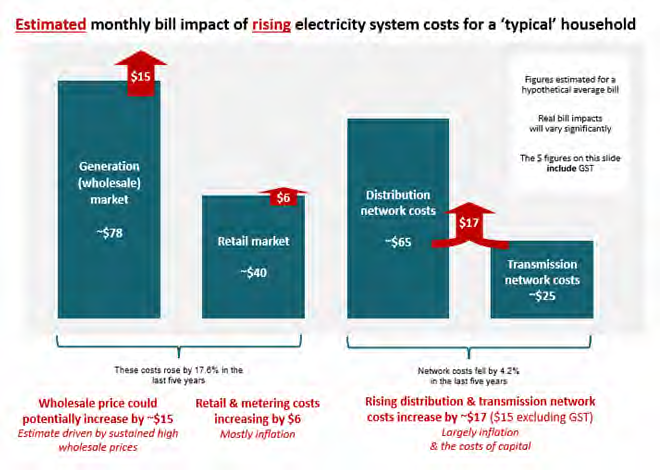
On 15 May 2024 we briefed you verbal y on competition matters. The supporting slides
included the following graphic depicting estimates of the monthly bil impact of rising
electricity system costs for a typical household, with the red box highlighting price rises that
may be slower (or less) in ful y competitive markets:
Released under the Official Information Act 1982
MBIE 2324-3837
In Confidence
3
Competitive markets - both wholesale and retail - are critical for
affordable electricity
8.
Competitive wholesale and retail markets are critical for prices to be at cost and for markets
to be innovative – driving investment in new generation or new plans for consumers. We
consider that the independent generators coming into New Zealand at the moment are
invigorating the generation sector, and that independent retailers are bringing innovation to
customers.
A wide range of parties have expressed concerns regarding competition in the
electricity market
9.
New Zealand has a concentrated wholesale electricity market and profits earned by
gentailers frequently attract negative comment. Competition concerns relating to New
Zealand’s electricity markets are often raised in relation to the wholesale spot market, the
hedge market, and the retail market.
10. Confidence and trust in the electricity market from non-incumbents and large consumers is
low – concerns have been expressed by MEUG, independent retailers and consumer
advocates. The OECD also recently commented on the lack of competition in the electricity
market (6 May 2024).
11. The independent electricity retailers (Electric Kiwi, 2degrees, Flick Electric, Octopus Energy
and Pulse Energy) have consistently expressed strong views on the lack of competition. The
independent retailers claim the gentailers are using and leveraging market power by:
Setting prices in the
wholesale
Setting
high prices and
Cross-subsidising their own retail
market that are substantially
sometimes
refusing to supply
arms using high profits from the
above generation cost
forward hedges
wholesale market to run retail
arms at breakeven (at best).
12. The independent retailers also consider the Authority’s work to be too narrow in scope by not
focussing adequately on remedies. They have engaged Matthews Law to advise them - Andy
Matthews is a leading competition lawyer who represented the NZ Groceries Council on
matters relating to the Commission’s assessment of supermarkets and subsequent
legislative reform.
13. s 9(2)(b)(ii)
Suggested talking points
Are you talking to the new entrant independent generators, and those considering
investing in New Zealand? I have heard s 9(2)(b)(ii)
.
Released under the Official Information Act 1982
MBIE 2324-3837
In Confidence
4
Understanding the extent of any problem
14. To understand the extent and potential impact of any market power on consumers’ power
bil s, we need to address the question: “Do gentailers hold market power in general, or more
specifical y in the markets for supply of firming generation (and potential y also for dry year
cover)?”
15. In 2009, the Commission published analysis (based on work by Stanford’s Professor Wolak),
suggesting the then-gentailers used market power to earn $4.3 bil ion more over 6 1/5 years.
A number of more recent studies have also identified ‘excessive pricing’, including papers by
academics at Auckland University. In 2022, the Authority’s Wholesale market review included
that around $39/MWh from 2018 to 2021 was unexplained by underlying fuel costs.
16. The Authority’s work programme includes market monitoring of wholesale market outcomes
[EA BR-24-0020 refers]. In late 2023, Authority staff confirmed to MBIE officials a view that
the ‘trading conduct rule (introduced in 2021 and which in general terms, requires generators
to make supply offers behaving as if they have no market power) appears to be having an
impact on generator behaviour.
17. Independent retailers remain frustrated as they consider the Authority’s work is not currently
sufficiently targeted at assessing market power and its impact:
“We consider there should be
a tighter and overt focus on the underlying market power problem and how this manifests in
closely related and downstream markets”.
18. MBIE officials recognise that assessment of prices compared to marginal supply costs is
difficult, largely due to the complexity in assessing the opportunity cost of stored water. As
such, the Authority may prefer to col aborate with other agencies, academia or use an
external consultancy to carry out this work.
Suggested talking point, to the Authority
Are you attempting to measure the wholesale margin – do we know if prices are above
costs, in particular during tight supply conditions? In other words – can you tel me if
when prices are high, are they too high?
What could be done? Potential levers to improve competition
19. Potential levers to support or enhance competition span market design levers, structural
remedies, or measures that support a growth in supply.
Market design levers to improve access to hedges
20. Independent intermittent generators want to be able to access hedges for firming supply (so
they can offer firmed PPAs). Independent retailers want to access both baseload and firming
hedges so they can compete in the retail markets ‘on a level playing field’ with the gentailers.
Both generators and retailers report to MBIE officials that gentailers at times refuse to supply
hedges, or offer hedges priced far above marginal cost to supply.
Released under the Official Information Act 1982
21. The Authority’s risk management review is focussed on hedges for independent retailers and
so competition at the retail level. Relatedly, this month (June 2024) the Authority made a
decision to require greater transparency of information on hedges [MBIE Weekly Report 17
June refers].
MBIE 2324-3837
In Confidence
5
22. The Authority’s risk management work is stil in the data analysis phase (problem
identification), the Authority is not yet focused on potential solutions. The Authority could also
expand its scope to also ensure it is addressing barriers to entry for independent generators,
to support competition in the wholesale market.
23. The Authority’s Market Design Advisory group (MDAG) recommended the Authority scope a
back-stop ‘virtual separation’ mechanism as a method to enhance competition in wholesale
and retail markets. The mechanism would require generators with firming supply to offer a
set proportion of that supply to other participants, as forward hedge contracts that are
standardised (e.g. shape, duration). To be effective in enhancing competition and lowering
electricity prices the prices would have to be linked to supply costs.
24. The Authority has committed to scoping the early work to develop this option as a back-stop
but is yet to communicate its thinking on this or wider hedge-related levers as a potential
Code amendment to support competition.
Suggested talking point, to the Authority
How far are you in scoping MDAG’s ‘virtual separation’ solution? This was intended as a
back-pocket option, do you think this has merit?
How could you ensure prices for firming hedge reflect cost?
Market design levers to address concerns around internal transfer pricing (ITPs)
and creating a ‘level playing field’ for independent retailers
25. Independent retailers have also repeatedly expressed concern about the Authority’s
approach to ITPs, that gentailers’ ITPs are too low affecting competition in the retail market,
and ITP methodologies are so unclear profitability is impossible to assess.
26. On 18 June the Authority published retail gross margin (RGM) and internal transfer price
(ITP) data for the 2022/23 financial year. The data indicates retailers seem to have absorbed
“at least part” of cost increases in the 2022-2023 financial year, with al reporting lower gross
retail margins. MBIE officials are yet to review this release in detail. The Authority is
currently carrying out a post-implementation review of the ITP and retail gross margin
information disclosure provisions.
27. NZIER recently prepared a report for the Consumer Advocacy Council on ‘
Gentailer retail
margin disclosure’. The report finds internal transfer price (ITP) disclosures are difficult to
interpret and unlikely to indicate whether generation revenue is excessive. The report
recommends the Authority consider additional analysis and disclosure requirements - more
reliable information about whether gentailer profits are excessive. MBIE officials carried out
similar analysis during 2023 and arrived at similar conclusions: the Authority’s rules for
internal transfer pricing are opaque, it isn’t possible to use them to determine gentailers’
wholesale vs retail profit margins, or to use ITPs as benchmarks to see if forward contracts
are competitively priced.
28. The Authority are not (yet) focussing on wider levers that could also be useful to enhance
competition, such as the non-discrimination requirement approach used in the UK, whereby
gentailers must make detailed financial disclosures and the market’ ‘rules’ include a
Released under the Official Information Act 1982
prohibition of discrimination when selling electricity (to their own retail arm vs other retailers)
and a prohibition on cross subsidies. Octopus (a leading innovator in the UK market and an
independent retailer here in New Zealand) holds a firm view that the Authority should be
considering this.
MBIE 2324-3837
In Confidence
6
Suggested talking points, to the Authority
Does your work programme include looking for evidence of a margin squeeze on
independent retailers?
Wil the post implementation review of the internal transfer pricing (ITP) disclosure rule
take into account NZIER’s recent critique? Wil the calculation of ITPs be made clearer,
and more transparent?
Are you considering the UK model of clear internal transfer pricing and non-discrimination
requirements, as a lever to create a level playing field?
Structural remedies to change the structure of participants
29. Some stakeholders are cal ing for structural separation of the gentailers.
30. s 9(2)(g)(i)
31.
Suggested talking point
Do you have views on the cal s for structural separation?
Levers to support additional supply, to dilute any existing market power
32. s 9(2)(g)(i)
33.
34. Understanding the pipeline of investments is also important.
The Authority’s wider work
programme also includes an annual survey of planned new generation investments [EA BR-
24-0020 refers].
Suggested talking point
Do you have views on whether measures to support new or faster entry in firming supply
should be considered?
Annexes
Annex One: Attendee biographies
Released under the Official Information Act 1982
Annex Two: Suggested talking points
Annex Three: A framework for thinking about competition matters
MBIE 2324-3837
In Confidence
7

 Annex One: Attendee biographies
Anna Kominik, Chair of the Electricity
Annex One: Attendee biographies
Anna Kominik, Chair of the Electricity
Authority
Anna Kominik was appointed Chair in 2023, for
a five-year term. She was previously the Chair
of the Electricity Retailer’s Association of New
Zealand.
Anna is an experienced business leader who
has worked for a wide variety of public and
private sector organisations during the course
of her career. She is currently Chair of the
Edmund Hil ary Fel owship and Hil ary Institute,
a director of Dawn Aerospace and advises in
the New Zealand aviation and aerospace
sector.
Dr. John Small, Chair of the Commerce
Commission
Dr John Small was appointed Chair in
December 2022, and has been a
Commissioner since June 2020.
In May 2024 John was appointed as an
Associate Member of the Australian
Competition and Consumer Commission.
John advised on electricity market reform I the
early 2000s, was a member of the 2018-19
Electricity Price Review’s panel and was the
Founding Director and lead of economic
consultancy firm Covec for 17 years.
Before Covec, John was Head of Economics at
Auckland University’s Business School when
the energy research institute, the Centre of
Excellence in Energy, was opened
John has an extensive experience undertaking
complex competition analysis in a wide range
of sectors, including energy, transport,
agriculture, telecommunications, payment
systems, and construction.
John was also previously a lay member of the
High Court of New Zealand, frequently called
as an expert witness before courts, tribunals
Released under the Official Information Act 1982
and commissions.
MBIE 2324-3837
In Confidence
8
Annex Two: Suggested talking points
Each agency’s role and responsibilities
Are your agencies working together? How much active support is the Commission
providing to the Authority’s Risk Management Review?
To the Authority - What is your timeline to deliver the Risk Management Review?
A wide range of parties have expressed concerns regarding competition in the
electricity market
Are you talking to the new entrant independent generators, and those considering
investing in New Zealand? I have heard s 9(2)(b)(ii)
.
Understanding the extent of any problem
Are you attempting to measure the wholesale margin – do we know if prices are above
costs, in particular during tight supply conditions? In other words – can you tel me if
when prices are high, are they too high?
Market design levers to improve access to hedges
How far are you in scoping MDAG’s ‘virtual separation’ solution? This was intended as a
back-pocket option, do you think this has merit?
How could you ensure prices for firming hedge reflect cost?
Market design levers to address concerns around internal transfer pricing (ITPs)
Does your work programme include looking for evidence of a margin squeeze on
independent retailers?
Wil the post implementation review of the internal transfer pricing (ITP) disclosure rule
take into account NZIER’s recent critique? Wil the calculation of ITPs be made clearer,
and more transparent?
Are you considering the UK model of clear internal transfer pricing and non-discrimination
requirements, as a lever to create a level playing field?
Structural remedies to change the structure of participants
Do you have views on the cal s for structural separation?
Levers to support additional supply, to dilute any existing market power
Do you have views on whether measures to support new or faster entry in firming supply
Released under the Official Information Act 1982
should be considered?
MBIE 2324-3837
In Confidence
9
Annex Three: A framework for thinking about competition matters
A summary of work MBIE officials understand is underway and not yet underway.
Do gentailers have market power -
are they able to set prices above cost, in the wholesale spot or hedge markets?
The Authority is not yet focussing on an assessment
of market power in wholesale spot markets under
specific conditions (e.g. peaking supply or firming
The Authority is at the early stages of wholesale
supply).
hedge market assessment – it is actively assessing
To date, the Authorty has reported market outcomes
information gathered on hedge market contract asks, across all time peiords (and all market conditions) but
offers and prices.
not focussed in on a market for firming.
So any market power concentrated in hydro or
thermal generators and used in periods of scarcity
will be much harder to isolate and identify.
If yes - How much extra are customers paying for electricity,
compared to a competitive market?
The Authority monitors wholesale market outcomes
The Authority is not yet assessing price vs cost
period by period. It is starting to consider market
margins (eg in periods when supply is tight), so we do
definition for supply during periods of scarcity (when
not yet know the customer impact of any exercise of
prices are higher, and may also be higher than the
market power arising due to concentration of firming
cost of gas or scarce water)
supply.
If yes - Are the gentailers restricting independent generators
and independent retailers from competing?
The Authority does not appear to be considering any
anticompetitive behaviour affecting independent
The Authority col ects ITP and retailer margin
generators.
Released under the Official Information Act 1982
information and has signalled it will release a post-
The Authority does not appear to be explicitly
implementation reveiw of these disclosure
assessing the margin squeeze complaint made by
requirments later in 2024.
independent retailers (that gentailers are using
profits from their wholesale business to cross-
subsidise their retail arms)
MBIE 2324-3837
In Confidence
10
